Campaign: Twin Cities
Act Synopsis
This arc brings the Blue Marlin into Twin Cities, the iron heart of the slaver network and a place where cruelty is justified by necessity. It shifts the campaign from frontier suffering to systemic exploitation and forces the crew to operate inside a machine running on blood that cannot be fought head on without consequence. The goal is information and extraction, not reform or victory.
Arrival in Port Iron
The Blue Marlin docks in Port Iron, the shared harbor claimed by both East and West. Almost immediately, representatives of both factions make contact. Lord Varcan Deyr’s agents offer quiet cooperation, intelligence and subtle pressure. Lady Serrana Volkar’s envoys offer muscle, threats and favors backed by violence. These approaches overlap with negotiations for resupply, tying survival and politics together from the first moment.
Neither side is honest. Both seek to use the crew as leverage against the other.
The Search for the Witness
Finding the enslaved witness, Morthen Briarbound, becomes a social and investigative problem rather than a simple lead. Overseers, merchants, slavers, guards and informants all know fragments of the truth. Information is traded for favors, silence or blood. The crew must choose who to deal with and who to anger, knowing that every choice feeds the ongoing feud.
The Twin Cities reveal themselves as a place where blood lines pockets and lies fuel power.
Into the Mines
Once the witness is located, the arc turns inward and downward. The crew must enter an active mine such as Deepwound or Chokepit to extract him. Whether through stealth, bribery or violence, the mines are unstable, crowded and hostile. Slaves panic. Overseers bargain. The earth itself threatens collapse.
This is the emotional core of the arc. Rescue is possible, but clean outcomes are not.
Flight from Twin Cities
If the extraction leaves a visible mark, the crew’s departure becomes urgent. Harbor authorities, hired ships or faction forces may pursue the Blue Marlin. If handled quietly, the escape is tense and watchful rather than explosive. In either case, Twin Cities should feel eager to be rid of them and eager to remember them.
The Lead Forward
The rescued witness provides confirmed information about where the Waverider went next. He also asks for passage back to Elarune, turning the crew from investigators into carriers of responsibility. What they do with him will matter later.
If the Crew Comes Here First
If the crew arrives here before Elarune, they hear partial rumors from another enslaved worker who points them toward the same man. In that case, Elarune becomes a return journey rather than a discovery, without changing the arc’s weight.
Purpose
This arc is about complicity, leverage and consequence. The crew cannot fix Twin Cities, but they cannot pass through untouched either. They leave with a lead, an obligation and the knowledge that the Waverider’s path through the world was paid for in blood that never stopped flowing.
Arrival in Port Iron
Ayesha Marindar was already on deck when Port Iron emerged from the smoke. She rested one hand on the rail, eyes half lidded, breathing in the stink of coal and hot iron like a vintner judging a sour wine. Below them the harbor groaned. Chains rattled. Cranes screamed. Somewhere a forge hammer rang like a bell calling the faithful to prayer.
Scarnax stood beside her, silent as always when land drew near. Caelin barked orders behind them, snapping the crew into clean, efficient motion. Galenor leaned over the side, grinning despite himself, muttering about ore density and hull stress like this was a pilgrimage instead of a port.
When the Blue Marlin slid into her berth, the attention was immediate. Men stopped pretending to work. Runners peeled away into the alleys. Ayesha felt it in her bones, the moment when a room decides who you are going to be before you ever speak.
She smiled anyway.
The gangplank was barely down before a dock official appeared with a ledger, then vanished just as quickly when Caelin stared him into retreat. That was when Ayesha adjusted her rings, smoothed her coat, and stepped forward.
"They will come," she said quietly. "Both of them."
She was right.
The Envoy of West
Karella Volkar came aboard like she owned the deck. She did not ask permission. She did not wait to be announced. Her eyes swept the crew, lingered on Amaxia and Mbaru, flicked to Skarnulf with something like approval, then settled on Ayesha with open curiosity.
"So," Karella said, voice rough with smoke and confidence. "You must be the one who talks."
Ayesha inclined her head, just enough. "Often."
They walked the deck together while the crew pretended not to listen. Karella spoke plainly. West could keep trouble away from the ship. West could make sure supplies arrived quickly and without questions. West knew which overseers drank too much and which guards could be bought with coin or fear. If someone needed to be removed loudly, West excelled at loud.
She laughed when Ayesha asked about consequences. "There are always consequences. We just choose whose."
Ayesha countered with smiles and soft questions. Who paid best. Who held grudges longest. Who survived mistakes. Karella answered most of them. The ones she did not answer were answers in themselves.
Before leaving, Karella stopped near the gangplank and glanced back. "Lady Serrana likes people who choose. Waffling gets you killed here."
She grinned. "Think about who you want angry."
The Envoy of East
The man from East waited until evening. By then, Ayesha had changed dresses and Scarnax had agreed to let her handle it. Master Elion Deyr stepped aboard with measured steps, nodding politely to Junia, complimenting Yasmira on a scent drifting from below decks, and greeting Ayesha by name.
"I hope West did not trouble you," he said mildly.
Ayesha returned the smile. "They were very clear."
Elion seemed pleased by that. They sat at a small table, wine poured by one of Elion’s own clerks. Elion spoke of efficiency and order. Of keeping ships unburned and crews unbled. East could provide papers, permits, schedules. East could make certain doors open without noise and close without witnesses.
He never raised his voice. He never threatened. When Ayesha pressed him, he simply noted how fragile ships could be when inspections went poorly or when a manifest was questioned too closely.
"You strike me as someone who prefers clean solutions," he said gently. "We value the same things."
When he left, he placed a small token on the table, East’s sigil worked into dark metal. "If you want my assistance, this'll let you in." Ayesha did not touch it until he was gone.
That night, as the harbor fires burned low and the Blue Marlin creaked against the dock, Ayesha stood alone with the token in her palm.
Twin Cities had not asked what they wanted.
It had asked which knife they preferred at their back.
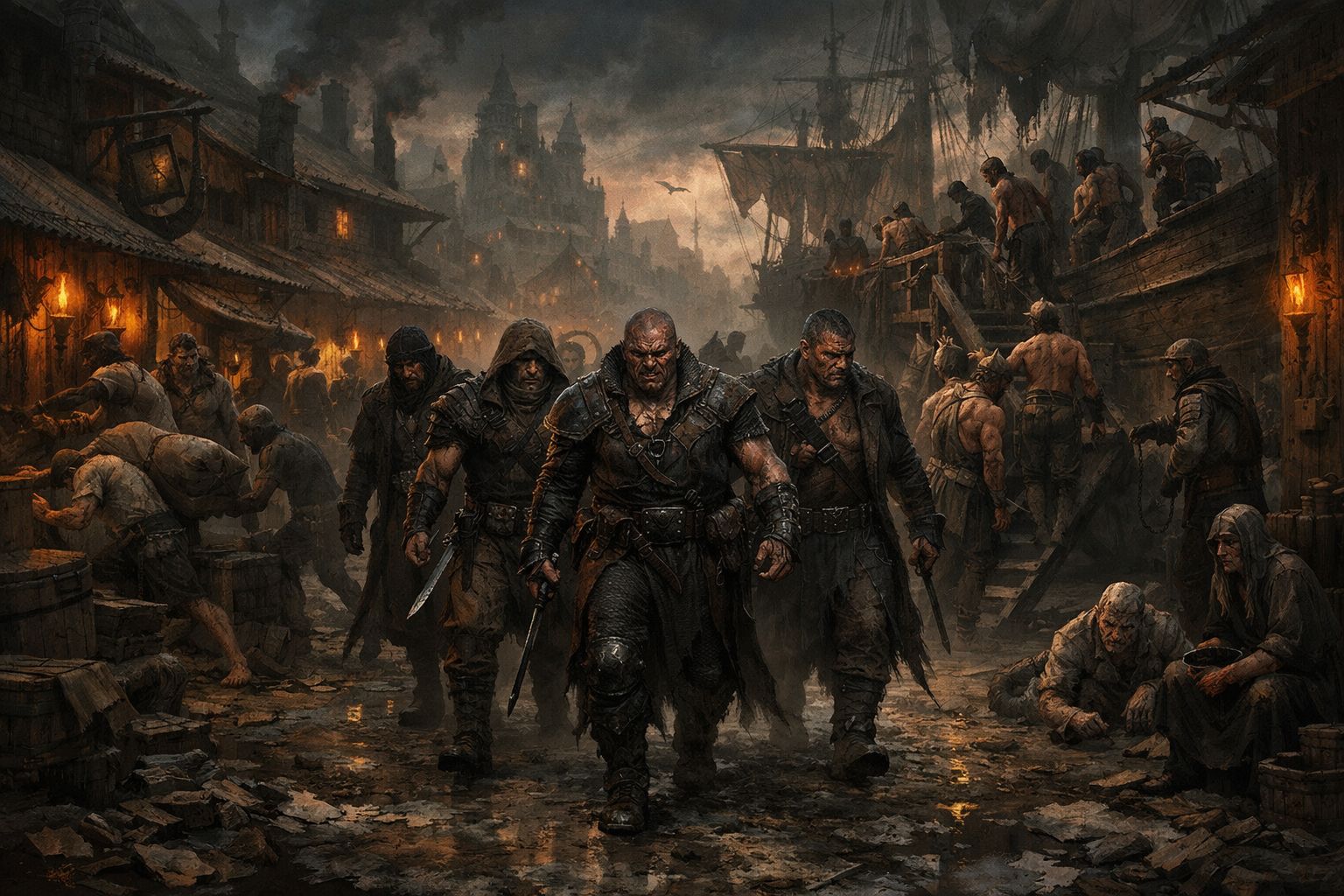
Purpose of the Scene
This opening sequence is meant to establish tone and pressure, not resolve anything. The goal is to make Twin Cities feel alert, predatory and immediately invasive. The crew should understand that their arrival was noticed, assessed and categorized before they finished docking. This is not a neutral port and there is no safe observer position.
Arrival in Port Iron
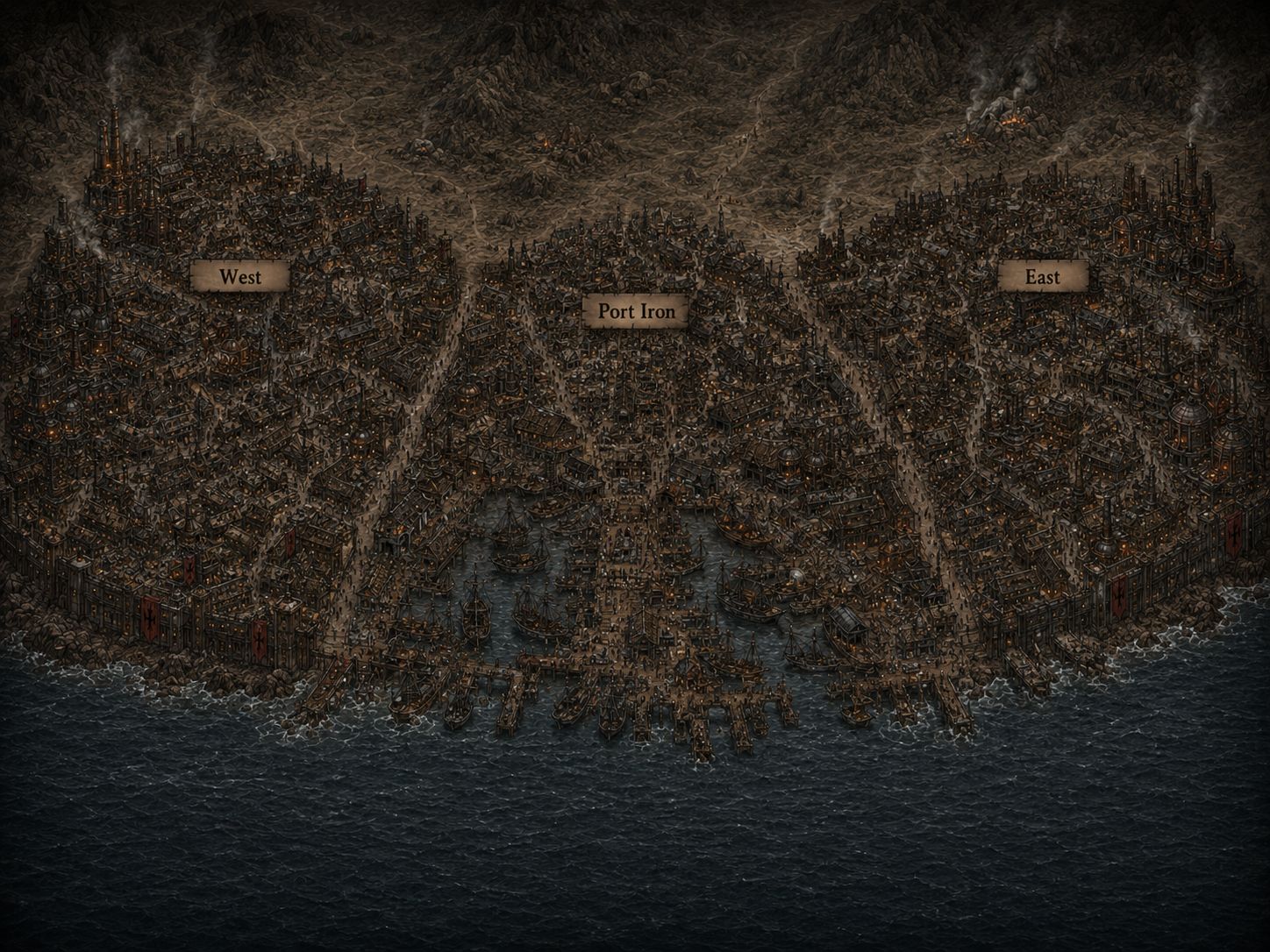
Describe the harbor as crowded, loud and watched. Emphasize industry and surveillance rather than beauty or scale. Make it clear that runners are sent the moment the ship is identified and that the envoys arrive because the city decided the Blue Marlin matters.
Let the crew interact naturally during docking. Caelin managing the deck, Galenor reacting to the iron infrastructure, Scarnax staying reserved. This grounds the scene before the politics arrive. Do not rush the envoys. A short pause builds tension.
The Envoy of West
Use Karella Volkar as a blunt instrument. She should feel physical, confident and unashamed of violence. Her role is to tempt the crew with speed and force. Protection, muscle and obvious solutions.
She should notice the marines first and respect visible strength. She should speak openly about killing and intimidation as tools. Do not make her stupid or reckless. West is violent but not chaotic. Karella should make it clear that choosing West means visibility and consequences, both good and bad.
Let players push back or test her. She should enjoy it. Her threat is not hidden, it is casual.
The Envoy of East
Master Elion Deyr should feel delayed, measured and unsettling. He knows names. He knows details. He never raises his voice and never states a threat directly. East offers access and erasure rather than protection.
Play him as someone who assumes cooperation unless proven otherwise. His confidence should come from systems, not strength. Permits, inspections and schedules are his weapons. If pressed, he deflects rather than denies.
He should leave behind something tangible, a token or document, to make East feel ever present even after he leaves.
Key Game Master Notes
Do not force the crew to choose a side immediately. The pressure comes from knowing they will eventually anger someone.
Avoid framing either faction as correct or preferable. Both are predators with different tools.
Make resupply dependent on dealing with this situation. Even small delays or complications reinforce that politics and survival are linked here.
Most importantly, this scene sets memory. Twin Cities should feel like a place that will remember the crew long after they leave.
The Search for the Witness
This part of the arc is about uncertainty, leverage and moral compromise. There is no single lead that solves the problem. Instead, the crew must piece together the truth by dealing with people who all benefit from the system that hides it. Progress comes from choices, not from deduction alone.
The witness, Morthen Briarbound, exists within the machinery of Twin Cities, not outside it. Finding him means interacting with that machinery rather than bypassing it.
Structure and Flow
Treat this phase as a web rather than a line. Each contact knows something, but no one knows everything. Some have outdated information. Some lie to protect themselves. Some tell the truth because it costs them nothing. Others demand payment, favors or violence in exchange.
The crew should never feel stuck, but they should feel uncomfortable. Every lead should pull them deeper into complicity with overseers, slavers, guards or merchants. Even honest information should carry a stain.
Using the Person Gallery
Each person in this phase represents a different role in the Twin Cities ecosystem. Overseers know where slaves were sent. Merchants know who bought labor and when. Guards know which mines are active and which ones hide problems. Slaves know what happens in the dark, but fear punishment for speaking.
Do not present these people as quest givers. Let the players choose who to approach and how. Reward initiative and roleplay with information, but attach costs or consequences where appropriate.
Contradictions are useful. Two sources can disagree without either being wrong. Let the players decide what to trust.
Showing Twin Cities on the Ground
This phase is an opportunity to make Twin Cities feel lived in and rotten, not just politically corrupt. The search for the witness should be threaded through streets, docks and alleys that constantly reinforce what kind of place this is. The cities themselves are part of the opposition.
Port Iron
Port Iron should feel overcrowded and tense. Dockworkers shout over grinding chains. Guards push through crowds with clubs already half raised. Slaves unload ore under constant watch while ships take on iron and weapons in plain sight.
Show casual brutality. A beaten laborer dragged aside so work can continue. A public argument ending in a knife and no one intervening. The harbor never stops moving, and no one stops to help. Everything is urgent. Everything is expendable.
Port Iron is neutral ground. That only means that there are no big fights, but no sane person on either side would move alone there.
East
East is suffocating rather than chaotic. Streets are narrow, smoky and watched. Notices, permits and seals are everywhere, layered over one another like scars. Guards take notes. Clerks whisper. People avoid eye contact.
Cruelty here is procedural. Punishments are efficient and justified with paperwork. Slaves move in organized columns. Bodies are removed quickly. Nothing looks out of control, which makes it worse. East should feel like a place where mistakes vanish quietly.
West
West is loud, scarred and openly violent. Buildings are reinforced and patched rather than maintained. Weapons are visible. Disputes are settled in the open and remembered forever.
Cruelty here is personal. Overseers beat slaves where everyone can see. Warbands march through streets, daring someone to challenge them. Corpses are left as warnings. West should feel dangerous not because it is lawless, but because its laws are enforced by whoever is strongest nearby.
Guilds
The guilds present themselves as neutral pillars of trade and labor, operating seamlessly across East, West and Port Iron. In practice, they are deeply entangled in the conflict. They profit from instability, from emergency contracts, rushed shipments, sudden labor shortages and the constant need to replace what violence destroys.
The guilds do not seek victory for either side. They seek balance. If East grows too strong, guild pressure quietly shifts resources toward West. If West becomes too disruptive, contracts tighten and supplies flow eastward. This keeps iron moving and prices high.
Guild members rarely act out of loyalty. They act out of preservation. Information is traded, withheld or distorted to prevent either faction from collapsing the system entirely. To the guilds, war would be bad for business, but tension is profitable.
When dealing with the guilds, the crew should feel they are speaking to polite enablers rather than open villains. The guilds will help, but only in ways that maintain the status quo. They are not neutral because they are innocent. They are neutral because neutrality keeps them powerful.
Using the Cities During the Search
Do not separate investigation from environment. Let conversations happen next to suffering. Let clues be found in blood stained alleys, collapsing shacks and smoke choked halls.
The players should feel like every step forward costs something, even when no dice are rolled. Twin Cities is not just where the witness is hidden. It is why he is hidden at all.
What Happened to Morthen Briarbound
Morthen Briarbound arrived in Twin Cities chained in a common slave shipment, weak from travel and already marked as unsuited for heavy labor. His age and injuries made him undesirable, but West bought him anyway, intending to work him until he broke and replace him without concern. To West, he was another expendable body.
East noticed him almost immediately. Through questioning, observation and rumor, it became clear that Morthen knew Elarune well and understood how its villages hid, moved and endured. That knowledge was more valuable than iron. East arranged a quiet exchange. Guards were bribed, records adjusted and another slave was substituted in his place. On paper, nothing changed.
Morthen was taken into East custody and interrogated. The process was deliberate and clinical rather than frenzied. Pain was applied until he broke and spoke. He gave up the locations of Mistroot and Elderglen, not knowing how recent or how deadly that information would be. Once his knowledge was exhausted, so was his value.
Physician Arel Vosk treated him enough to keep him alive and functional, nothing more. When Morthen could stand again, he was returned to the system under a new designation. No longer useful as a source, he was sent to Deepwound Mine for simple labor, his body weakened and his spirit hollowed out.
By the time the crew begins asking questions, Morthen is alive, broken and buried deep underground. The damage has already been done. The raid in Elarune did not come from chance. It came from him, whether he wanted it to or not.
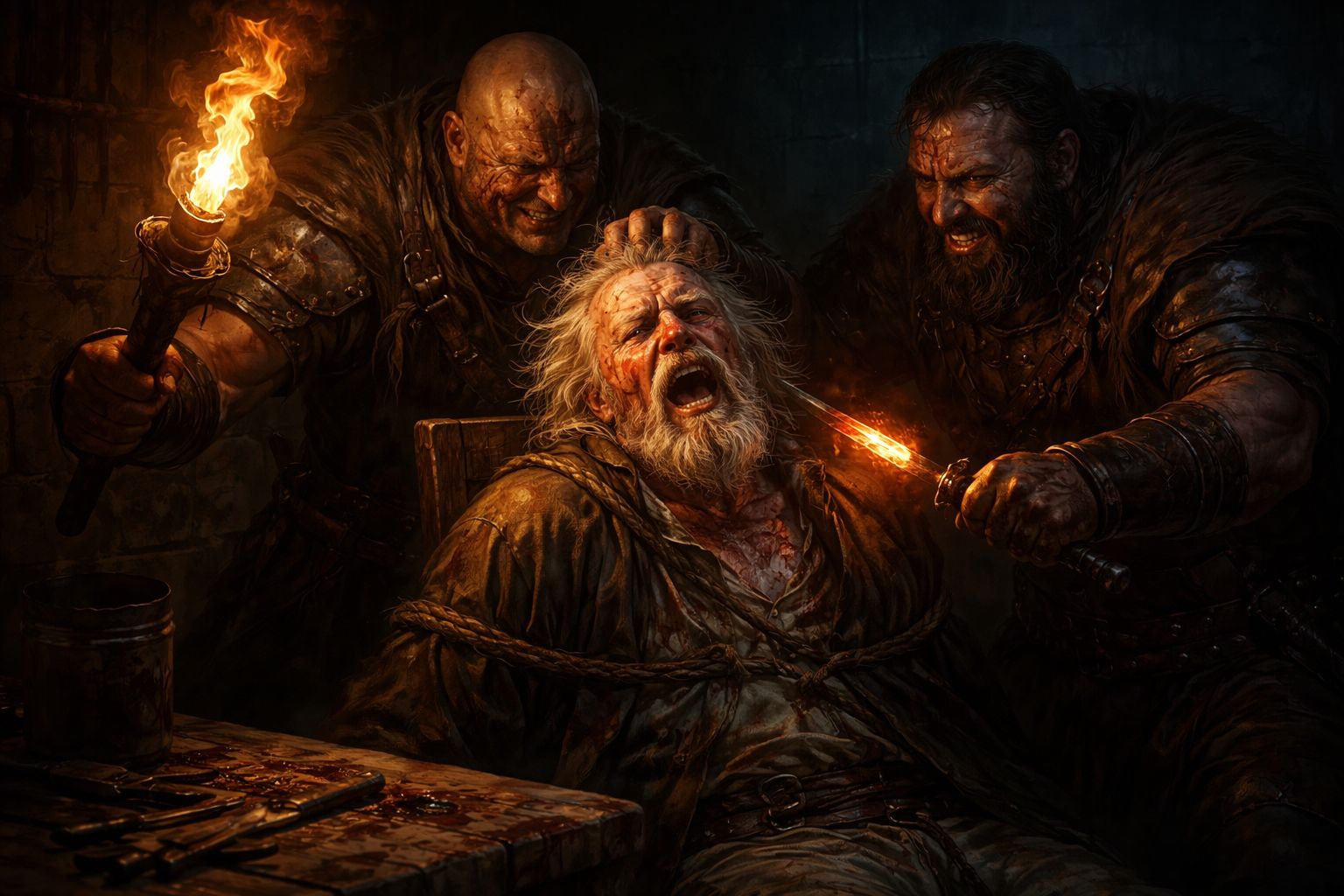
How to Reveal Information
This information should not be delivered as a single reveal. It is meant to emerge in pieces through different people in the person gallery. No one individual knows the whole truth, and no one tells it cleanly. Overseers and guards hint at a quiet exchange. Clerks and guild factors point to altered records and substituted labor. A healer confirms that the witness was kept alive after interrogation, not saved. Others only know that a troublesome forest man caused problems and was buried deep in the mines afterward.
Use the people described below to control how and when each fragment surfaces. Some information should come freely, some only after favors, risks or detours. Let these individuals pull the crew into small, messy side problems that reveal pieces of the truth as a byproduct, rather than presenting answers directly. Of course, the person gallery is by no means an exhaustive list, feel free to add to it as needed.
The crew should assemble the full picture themselves, realizing only gradually that the raid in Elarune was not chance, but the delayed result of a man being broken and used.
Pacing and Pressure
Avoid letting this phase become comfortable. Introduce time pressure subtly. Ships depart. Mines collapse. Overseers change shifts. Rumors go cold. Information degrades if the crew waits too long.
Remind the players that they are being watched. Faction agents may notice patterns. Someone they spoke to might vanish or turn up dead. This reinforces that knowledge here is dangerous.
If the Players Get Stuck
If the crew stalls or chases dead ends, do not withhold progress entirely. Instead, push information toward them at a cost.
A faction agent may approach with an offer that solves part of the problem but demands a favor later. A slave might risk speaking after a beating, implicating the crew by association. A guard could let something slip while drunk, then panic when he realizes what he said.
You can also escalate external events. A mine collapse can reshuffle labor assignments. A public punishment can reveal names or locations. A sudden shipment can force the crew to act on incomplete information.
The key is that help should never be clean. Every nudge forward should tighten the noose or dirty their hands.
Outcome
This phase ends when the crew identifies where Morthen Briarbound is currently held and what it will take to reach him. That knowledge should feel earned and slightly costly.
If the crew tries to minimize harm and exposure, progress should be slower but quieter. If they push aggressively, information comes faster but draws attention.
There is no correct path. There are only consequences.
Person Gallery
East
Master Elion Deyr
Senior envoy and political fixer for East. Elion has access to official slave transfer records and understands exactly how Morthen Briarbound was moved through the system without leaving a clean trail. He will never name the destination directly, but he knows which mines are politically protected and which offices can erase mistakes.
Elion wants leverage, not payment. He prefers arrangements that bind the crew into future obligations or quiet cooperation. Coin is useful only as a symbol.
He is calm, polite and unsettling. Elion rarely lies outright. He assumes compliance and responds to resistance with procedural delays, missing permits and sudden complications. Play him as the face of East’s bureaucracy, smooth, inevitable and suffocating.
Inspector Caldra Veyn
An internal auditor assigned to mine efficiency. Caldra knows which mines are under investigation and which are shielded from scrutiny by political interests. She suspects recent record tampering involving a transferred load of slaves but lacks proof.
She wants clean outcomes and traceable responsibility. If the crew can provide evidence without causing public disruption, she may quietly assist them.
Caldra is precise and controlled. She asks careful questions and never reveals more than necessary. She is dangerous not because she is cruel, but because she is patient and believes disorder is the greatest sin.
Overseer Halvek Sorn
A senior overseer at Deepwound Mine. Halvek can confirm that Morthen was assigned to Deepwound and later removed after an incident involving unrest among the laborers. He knows which foreman handled the transfer.
Halvek wants to avoid blame at all costs. He fears audits, reports and written accusations more than violence. Bribes work, but threats of exposure work faster.
He is tired, defensive and numb to suffering. He talks too much when anxious and becomes hostile when cornered. Play him as a man crushed by the system he enforces.
Clerk Virema Tal
A labor registry clerk with access to intake logs, reassignment orders and coded destination records. Virema knows that Morthen was marked as relocated rather than deceased and can identify the internal code used for his transfer.
She wants anonymity and protection. Coin is useful, but safety matters more. If she believes the crew can shield her, she becomes surprisingly helpful.
Virema avoids eye contact and speaks hesitantly. She panics under open pressure but responds well to calm reassurance and clear plans.
Captain Jorren Malvek
An officer in the East harbor patrol. Jorren knows which slave convoy carried Morthen inland and the date it departed Port Iron.
He wants recognition and stability. Favors that improve his standing matter more than wealth.
Jorren is rigid and proud. He respects rank and procedure. Flattery works better than threats. Public embarrassment creates lasting resentment.
Foreman Darek Pell
A shift foreman formerly assigned to Deepwound. Darek supervised Morthen briefly and remembers him as troublesome and outspoken. He knows why Morthen was reassigned but not where he ended up.
Darek wants to stay employed and avoid attention. He can be bribed with small comforts or intimidated by reminders of oversight.
He is practical and blunt. He does not enjoy cruelty but accepts it as normal. He responds best to direct, unsentimental approaches.
Archivist Lethwyn Korr
A senior records keeper overseeing multiple registry clerks. Lethwyn knows when records are altered and by whose authority, though not always why. He can confirm that Morthen’s file was modified under direct order.
He wants the archives to remain orderly and respected. He will trade information if convinced chaos is worse than truth.
Lethwyn is dry, pedantic and protective of his domain. He treats records as sacred and people as transient.
Guard Serik Vale
A mine transport guard responsible for escorting slave columns between facilities. Serik remembers escorting Morthen during a night transfer but was not told the destination.
He wants to avoid punishment and stay alive. Small bribes and assurances of safety work well.
Serik is jumpy and defensive. He speaks freely once he believes no report will be filed against him.
Factor Ilmena Roth
A logistics factor overseeing iron shipments and labor distribution. Ilmena knows which mines are understaffed and which recently received emergency labor reinforcements.
She wants efficiency and predictability. Delays cost her reputation.
Ilmena is sharp and impatient. She dislikes moral arguments and responds to practical incentives and clear outcomes.
Physician Arel Vosk
An East appointed mine physician who treats injured slaves deemed worth saving. Arel treated Morthen after torture and knows he was moved while still alive.
Arel wants to keep his position without losing what remains of his conscience. He may help quietly if convinced the crew will not make things worse.
He is restrained and weary. He avoids heroics and speaks carefully, but guilt can push him to act.
West
Karella Volkar
A senior envoy of West and cousin to Lady Serrana Volkar. Karella knows which mines West has sabotaged recently, which overseers were killed or replaced and which slave transports never officially arrived. She suspects East moved a problematic forest slave quietly and can point the crew toward the right pressure points without naming a location.
She wants decisive allies. West values action and commitment, not neutrality. Favors, violence or public defiance of East earn her respect.
Karella is blunt, confident and openly threatening. She enjoys testing people and respects strength in any form. Play her as someone who expects betrayal eventually and plans for it.
Lady Serrana Volkar
Ruler of West and warlord by reputation. Serrana does not track individual slaves, but she knows that East recently hid a valuable witness rather than selling him openly. She understands why that matters and where such people usually end up.
She wants leverage over East and visible proof that the crew is willing to dirty their hands. Information is a weapon to her, not a courtesy.
Serrana is proud, direct and ruthless. She speaks plainly and despises hesitation. She does not bluff. If she offers help, she expects payment in action or consequence.
Warband Captain Rusk Haldrim
Leader of a West raiding band specializing in mine strikes. Rusk knows which mines are vulnerable and which recently received increased guard presence. He has heard rumors of a slave being moved under heavy escort.
He wants supplies, weapons or permission to hit an East target. Information is traded for capability.
Rusk is aggressive and impatient. He respects fighters and ignores diplomats unless they prove useful. Play him as a man who thinks violence is clarity.
Dockmaster Vela Corsk
A West aligned dockmaster overseeing parts of Port Iron. Vela knows which convoys were rerouted away from normal routes and which cargo manifests were altered at the docks.
She wants bribes and protection. Dockmasters die young in Twin Cities.
Vela is sharp tongued and suspicious. She assumes everyone is lying and bargains accordingly. She warms quickly once paid.
Fence Marik Tenthorn
A black market broker dealing in stolen iron, weapons and people. Marik has heard of Morthen being flagged as valuable and unfit for open sale. He knows which buyers avoid records entirely.
He wants profit and secrecy. He will trade information for introductions or protection.
Marik is oily, cheerful and cowardly. He flatters constantly and flees at the first sign of real danger.
Overseer Brenna Keld
A former East overseer now working under West protection. Brenna knows Deepwound and Chokepit layouts and understands how East hides problematic slaves before accidents occur.
She wants to stay alive and valuable. Revenge against East motivates her cooperation.
Brenna is bitter and pragmatic. She does not care who suffers as long as she survives. Play her as blunt and transactional.
Pit Boss Orvek Dane
Runs illegal fighting pits using slaves and convicts. Orvek has seen Morthen briefly, brought through for assessment before being rejected as unprofitable.
He wants coin and silence. He dislikes East interference in his operations.
Orvek is loud, cruel and theatrical. He enjoys intimidation and spectacle. He folds quickly if threatened by someone stronger.
Scout Lira Ashfall
A West scout who moves through the Ashen Vale and sabotage routes. Lira knows which guarded paths are active and which mines recently changed patrol patterns.
She wants freedom of movement and favors owed. Coin matters less than safe passage.
Lira is quiet, sharp eyed and wary. She speaks little and watches everything. Trust must be earned.
Priest Korth Malven
A self appointed war priest of a minor god, blessing West raids. Korth hears confessions from fighters and slaves alike and knows rumors about hidden prisoners.
He wants influence and belief. He frames information as divine insight.
Korth is intense and unhinged. He mixes faith with brutality and believes suffering proves devotion. Use him to show how belief curdles in West.
Guilds
Hedron Vale
Master of the Iron Factors Guild, overseeing ore quotas, labor distribution and shipment timing across both cities. Hedron knows which mines received sudden labor reinforcements and which shipments were rerouted quietly. He can narrow Morthen’s destination to a small set of politically sensitive sites.
He wants stability and uninterrupted trade. Anything that threatens iron flow makes him hostile, but proof that someone else is causing disruptions can earn cooperation.
Hedron is controlled, pragmatic and deeply cynical. He treats people as numbers and problems as ledgers. Appeal to efficiency, not morality.
Mirela Quent
Senior broker in the Chainbinders Guild, responsible for purchasing and reallocating slave labor contracts. Mirela knows when a slave is flagged as unsellable or reassigned outside normal markets. She remembers Morthen being removed from sale and reassigned under special instruction.
She wants profit without attention. She trades information for discretion or future business advantages.
Mirela is polished and precise. She never raises her voice and never appears rushed. She dislikes improvisation and responds poorly to threats.
Torvik Rann
Representative of the Dockhands and Stevedores Guild. Torvik knows which convoys arrived late, which cargoes were unloaded under guard and which transfers happened at night. He cannot name mines, but he knows patterns.
He wants protection for his people and bribes for himself. He fears both factions equally.
Torvik is blunt and weary. He speaks plainly and respects honesty more than charm. He opens up once he believes the crew understands dock realities.
Selsha Renn
Accountant for the Carters and Haulers Guild, tracking inland transport routes. Selsha knows which mine routes were reinforced and which were avoided. She can identify where unusual security was assigned.
She wants her books to stay clean. She will cooperate if convinced the crew will not expose her to audits.
Selsha is nervous but sharp. She speaks quickly and corrects others constantly. She relaxes when given clear boundaries.
Brother Ansel Corvane
Cleric for The Divine Court of Flame, attached to the Guild of Stone and Flame, providing rites for miners and smiths. Ansel hears confessions from workers and guards alike. He knows rumors of a forest elder who caused unrest and was moved deeper underground.
He wants to believe he is easing suffering. He will help if convinced it saves lives.
Ansel is soft spoken and conflicted. He avoids eye contact and struggles with guilt. Push him too hard and he retreats into doctrine.
Varek Olm
Inspector for the Mercenary Convoys Guild, contracting guards for shipments. Varek knows which convoys received elite protection and why. He remembers an escort assigned to a single slave rather than cargo.
He wants contracts and reputation. Information is traded for future work or introductions.
Varek is loud and boastful. He exaggerates but does not fabricate outright. He responds well to shared drinks and ego stroking.
Ilyra Fen
Messenger captain for the Red Seal Couriers, carrying sealed orders between East and West interests. Ilyra does not know contents, but she knows urgency, origin and destination patterns. She carried orders related to Morthen’s transfer.
She wants safe routes and neutrality. She avoids faction entanglements.
Ilyra is guarded and professional. She speaks carefully and never volunteers more than asked. Trust builds slowly.
Kenth Morra
Guild surgeon attached to multiple trades. Kenth treated injured slaves deemed valuable enough to recover. He knows Morthen was kept alive and moved despite injuries.
He wants to keep working without choosing a side. He helps quietly when possible.
Kenth is exhausted and detached. He speaks clinically and avoids moral discussions, but evidence of unnecessary cruelty can shake him.
Ressa Halvine
Scrivener for the Unified Weighing Guild, certifying ore and labor tallies. Ressa noticed discrepancies tied to a reassigned labor unit that included Morthen.
She wants her certifications to remain unquestioned. She trades information for silence.
Ressa is meticulous and irritable. She corrects terminology constantly and dislikes improvisation. She responds best to clear, orderly plans.
Unaffiliated
Rook the Lantern
A fixer and information broker who operates out of changing taverns along Port Iron. Rook knows rumors before they harden into fact and has heard talk of a forest slave moved under guard rather than sold. He does not know where, but he knows who started asking questions afterward.
He wants coin and deniability. He sells the same truth multiple times if he thinks he can get away with it.
Rook is charming, evasive and always half drunk. He jokes to deflect danger and vanishes quickly if pressed too hard.
Maela Dockwine
A tavern keeper near the lower docks who serves sailors, guards and smugglers alike. Maela overhears conversations constantly and remembers patterns rather than details. She knows which crews came back nervous after escort duty.
She wants her tavern left alone and her regulars alive. Coin helps, but protection matters more.
Maela is blunt and maternal. She pretends not to notice crimes but misses nothing.
Tern the Hook
A pickpocket and lookout who works the docks. Tern saw a chained prisoner moved at night with unusual escort and remembers the guards arguing about routes.
He wants to avoid punishment and keep stealing. Small payments and promises of safety motivate him.
Tern is twitchy and sarcastic. He lies badly under pressure but folds quickly when treated kindly.
Old Fenra
A scrap vendor who buys broken tools and discarded chains. Fenra recognizes markings on shackles and knows which mines use which iron stamps. She has seen restraints from a recent transfer tied to East.
She wants to survive and keep her stall. She fears guards more than criminals.
Fenra is suspicious and sharp eyed. She tests buyers with questions before answering any herself.
Jorek Ashmouth
A coal hauler with burned lungs and a worse temper. Jorek hauled fuel to multiple mines and remembers a guarded delivery that halted normal operations for hours.
He wants his debts paid and his back left unbroken.
Jorek is angry and loud, but honest once paid. He respects strength and directness.
Silva Reedstep
A street guide who leads outsiders through alleys and side streets. Silva knows which districts suddenly became off limits and which patrols tightened after a recent incident.
She wants steady work and no faction attention.
Silva is quick witted and cautious. She speaks softly and moves constantly, never staying still long enough to be cornered.
Kelm Barrow
A corpse washer who prepares bodies for burial or disposal. Kelm knows when deaths are misreported and remembers a body count that did not add up after a mine incident.
He wants silence and routine. Coin is acceptable, but secrecy is essential.
Kelm is calm and detached. He speaks about death as a trade, not a tragedy.
Nessa Flint
A street vendor selling cheap iron trinkets and charms. Nessa hears gossip from buyers and guards alike. She knows that a forest man caused unrest and was removed quietly.
She wants customers and protection from shakedowns.
Nessa is talkative and observant. She exaggerates stories but keeps the core truth intact.
Brin Lowwake
A smuggler who moves small cargo through sewer outlets and collapsed tunnels. Brin knows unofficial routes toward older mine shafts.
He wants profit and escape routes.
Brin is cautious and practical. He dislikes violence but accepts it as part of the job.
Harl the Bellringer
A dock bellman who signals shifts and arrivals. Harl notices anomalies in schedules and remembers a convoy that arrived without public notice.
He wants to keep ringing bells and not end up in the water.
Harl is simple, earnest and surprisingly perceptive. He responds well to plain questions and fair treatment.
Kessa Benthand
A beggar who sleeps near the slag heaps by Port Iron, missing two fingers and most of her teeth. Kessa saw a chained man collapse during a night transfer and remembers guards arguing about whether he was worth the trouble. She knows the route the convoy took out of the harbor district.
She wants food, drink and to be left alone by guards.
Kessa is sharp beneath the grime. She watches everything and pretends to be harmless. She speaks in fragments and tests listeners before trusting them.
Lioran Silkstep
A prostitute who works the taverns and flophouses frequented by guards and overseers. Lioran overheard drunken talk about a forest man who screamed too much and had to be moved quietly. She knows which mine the guards feared mentioning by name.
She wants protection from violent clients and someone to make a specific overseer stop visiting her.
Lioran is tired, observant and careful with words. She trades information the way others trade favors.
Jax Coil
A street hustler running dice games and shell tricks near the docks. Jax saw East guards escorting a slave through an alley normally controlled by West, which struck him as wrong. He knows which watch captain was bribed.
He wants coin and immunity from a pending beating.
Jax is fast talking and nervous. He lies by habit but cracks when cornered or bribed well.
Mera Tidehook
A fish seller working the lower quays at dawn. Mera saw a slave shipment unloaded before sunrise under heavy guard and remembers the man who could barely stand. She knows which carts took the slaves inland.
She wants her stall left alone and a steady buyer for spoiled fish no one else wants.
Mera is practical and blunt. She speaks plainly and has little patience for dramatics.
Other
While maybe not having access to relevant information, this is also a good opportunity to introduce some of the recurring NPCs, Amir, Bjorn, Prowler, Samir, Sandros, the Licentius couple (if already encountered) and the Silver Moon all work well here. Don't do all of them, though, choose one or two.
Into the Mines
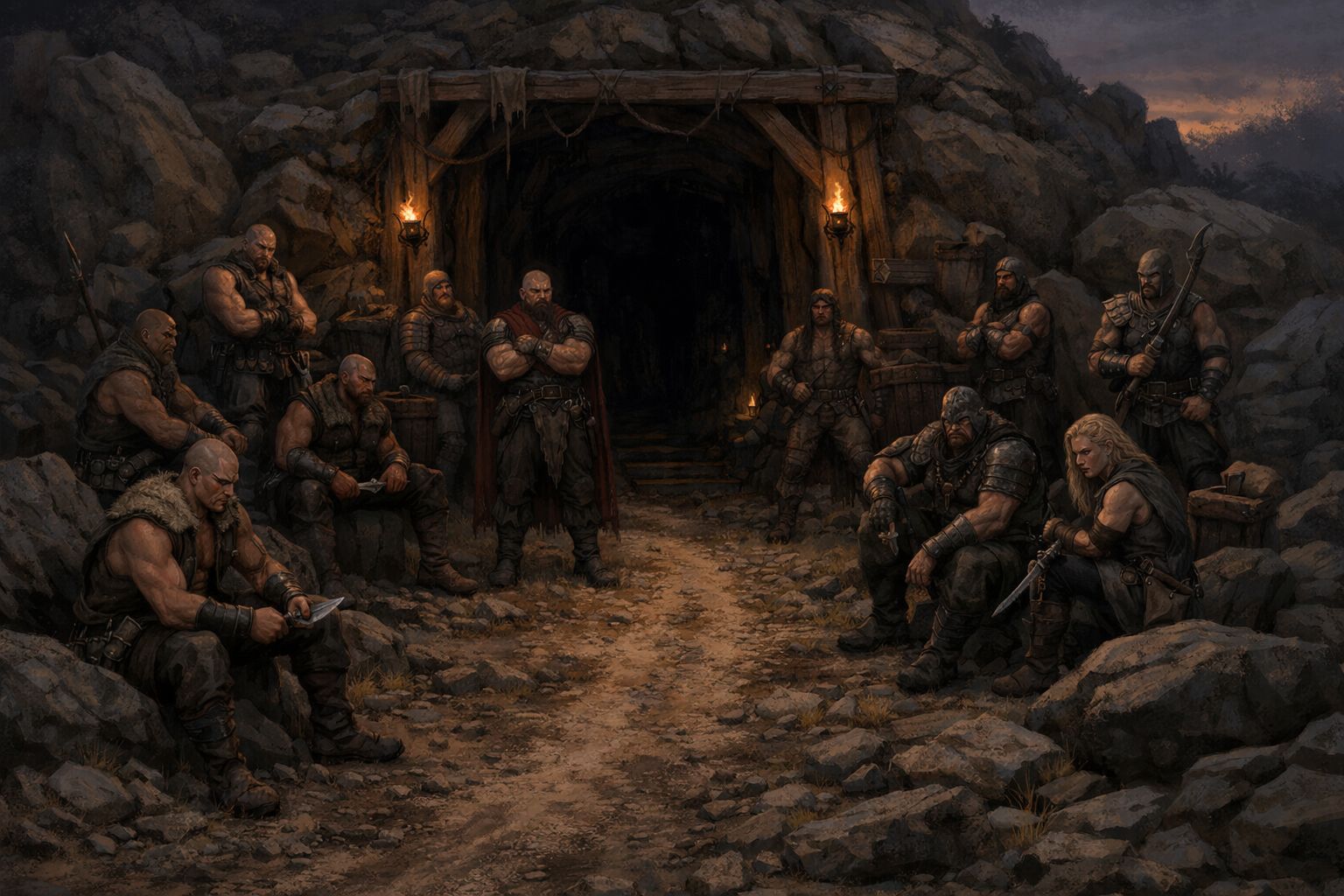
The Gate
The mine entrance is not a stealth puzzle. It is a choke point designed to prevent slaves from escaping, not to stop people from entering. Make this clear to the players early. The guards expect cruelty, not trickery, and their confidence is part of their weakness.
The Gate and the Guards
There is a single reinforced entrance into the mine, framed by iron braces and heavy timbers. Air shafts and ore lifts exist, but they are vertical, narrow and actively used. They are not viable entry or exit routes. Anyone approaching the mine will be seen. Even though there are camps and facilities around the mine, the immediate vicinity is cleared.
The guards at the gate are brutes. They are poorly educated, heavily armed and accustomed to violence. They watch the interior of the mine more than the road, because escape is what they fear. People going in are assumed to be either overseers, replacements or fools.
Do not play the guards as clever or cautious. Play them as confident and bored.
Getting In
Going in is comparatively easy. A confident approach, the right posture or vague authority is often enough. Paperwork helps but is not always required. The guards assume anyone entering has already been condemned by someone higher up.
If the players hesitate, question or act unsure, the guards grow suspicious. Confidence is more important than correctness. Let roleplay matter here more than rolls.
Getting Out with a Slave
This is where the gate becomes dangerous.
Fighting is possible but costly. The guard complement is larger than it appears, with reinforcements nearby. If violence breaks out, it is brutal and immediate. The guards do not retreat or negotiate. They fight to contain what they assume is the start of a revolt, and they will raise an alarm if able to.
Bribery can work, but it is expensive. These guards understand the value of silence and the cost of being discovered. Any bribe must be worth their lives.
Threats do not work. The guards are already violent men in a violent place. Threatening them confirms their worst assumptions and escalates immediately.
Fooling them is viable but risky. Proper paperwork, forged orders or the appearance of authority can convince them a slave is being transferred or disposed of. This requires confident negotiation and believable documents. The guards will argue, delay and try to extract something extra.
Sneaking out is not possible. The entrance is watched at all times.
Drugging the guards can work, but it requires setup. They do not drink on duty openly, but they can be coaxed into it through bribes, boredom or shared ritual. If attempted, play this as a social problem, not a single roll.
Game Master Guidance
Play the guards as obstacles, not villains. They are a cruel but predictable part of the cruel machinery of the operation. Reward planning and confidence. Punish hesitation and threats.
Most importantly, once the crew commits to removing a slave through the gate, the situation should feel tense and final. This is the moment where Twin Cities pushes back hard.
The gate squats at the mouth of the mine like a broken jaw, timbers dark with sweat and soot, iron braces scarred by old blows. Two slaves are dragged out by other slaves as the crew approaches, feet scraping uselessly over stone, heads lolling. One is still breathing. A guard laughs and bets it will stop before the count of ten. No one takes the bet seriously.
The guards are big men, thick armed and red faced, armor patched and mismatched. Clubs hang loose in their hands, used often enough that they no longer think about it. One wipes muddy blood from his knuckles on a dead man’s trousers and complains about the smell. Another nudges the body aside with his boot to clear the path, already bored with it.
At the center stands the commander, Dorgas Storm, broader than the rest and cleaner only by comparison. He leans on his spear like it is furniture, eyes half lidded, chewing something that might once have been meat. He watches the approach without interest, then straightens just enough to signal the others to stop joking.
“Names,” Dorgas says, voice flat. “Purpose.”
His gaze flicks to the crew, then past them, already deciding whether this is worth his time. One of the guards snorts, muttering that no one comes here unless they are paid to or punished enough.
Dorgas waits. The mine breathes behind him, hot air rolling out like a held threat.
Inside Deepwound Mine
This part of the arc is about immersion, exhaustion and scale. The mine should feel vast, hostile and indifferent. It is not a dungeon to be cleared but a machine that consumes bodies. The search for Morthen Briarbound is meant to take time, drain resolve and force the crew to witness what Twin Cities truly runs on.
General Atmosphere
Deepwound is mostly cold. Stone sweats constantly. Water drips from ceilings and pools in uneven hollows. Near active mining fronts the temperature rises sharply, becoming stifling and smoky as fires are used to crack the rock. Stacked wood is burned directly against ore veins, filling tunnels with choking smoke before picks and hammers are brought in.
The air is always bad. Smoke from torches mixes with soot and stone dust. Breathing is work. Light is limited and unreliable. Shadows swallow distance quickly. Every sound carries strangely, picks ringing far away while screams die fast.
The tunnels are narrow and low. Most people must hunch. Some passages force crawling. There is no real plan to the layout. Shafts snake after ore veins wherever they lead. Old tunnels intersect new ones at odd angles. Sudden vertical drops appear without warning, half covered by boards. Getting lost is easy. Finding the same place twice is not guaranteed.
The Slaves
The slaves never see daylight. They work, eat and sleep underground. Mined out chambers serve as sleeping pits where dozens huddle together for warmth. Despite the cold, they wear only rags. Many have nothing left but strips of cloth or bare skin marked by sores, scars and dust ground into wounds. Most are barefoot, and the floor has many sharp rocks.
They do not speak when overseers are near. Eyes stay down. Movements are small and careful. Any hesitation draws attention, and attention brings pain.
Slaves will not volunteer information. Fear is absolute. At most, a glance or a subtle gesture may point the way if the crew earns trust or creates a moment of distraction.
Overseers and Guards
Overseers are everywhere. They carry whips, clubs and short blades. They watch for slowing, mistakes or collapse. Punishment is immediate and public. Beatings are not meant to correct, only to remind.
Despite the cruelty, many overseers are bored. This is routine work to them. They complain about smoke, shifts and paperwork. They gossip. They argue about rations. If the crew passes as authority or outsiders, overseers may talk freely, assuming no one cares about slaves.
Use overseers as moving information sources. They know sections, foremen and recent trouble. They also lie casually and contradict each other.
Navigation and Danger
There is no map that matches reality. The mine changes constantly as new veins are chased and old tunnels collapse. Fires weaken supports. Cave-ins are common. Smoke can fill a tunnel in moments. A careless step can drop someone into a vertical shaft.
Do not use danger rolls. Instead, let the threat be constant and implied. Make the players feel that every minute underground is borrowed time.
The Search for Morthen
Make finding Morthen slow. He is not in a marked area. He has been moved between work gangs and sleeping pits. There are thousands of slaves in the mine. Overseers disagree on where he is assigned now. Some remember him only as a problem that went quiet.
Let the crew explore multiple sections. Let them see different faces of the mine. Use false leads. A man who matches his description but is already dead. A chamber where he slept weeks ago. A foreman who remembers him being reassigned after collapsing.
This search should feel grinding and uncomfortable, not clever.
Finding Morthen Briarbound
When they finally find him, Morthen is alive but barely. He is emaciated, bruised and shaking. His hands are bleeding. His eyes struggle to focus. He can stand only with help and cannot walk far.
Junia can help him but it will take time and better conditions. Healing him properly requires safety, rest and daylight. Any attempt to disguise him as anything but a slave should fail. His body cannot keep up.
From this moment on, the crew is committed. Leaving him behind is a choice. Taking him means facing the gate again with a broken man who cannot hide what has been done to him.
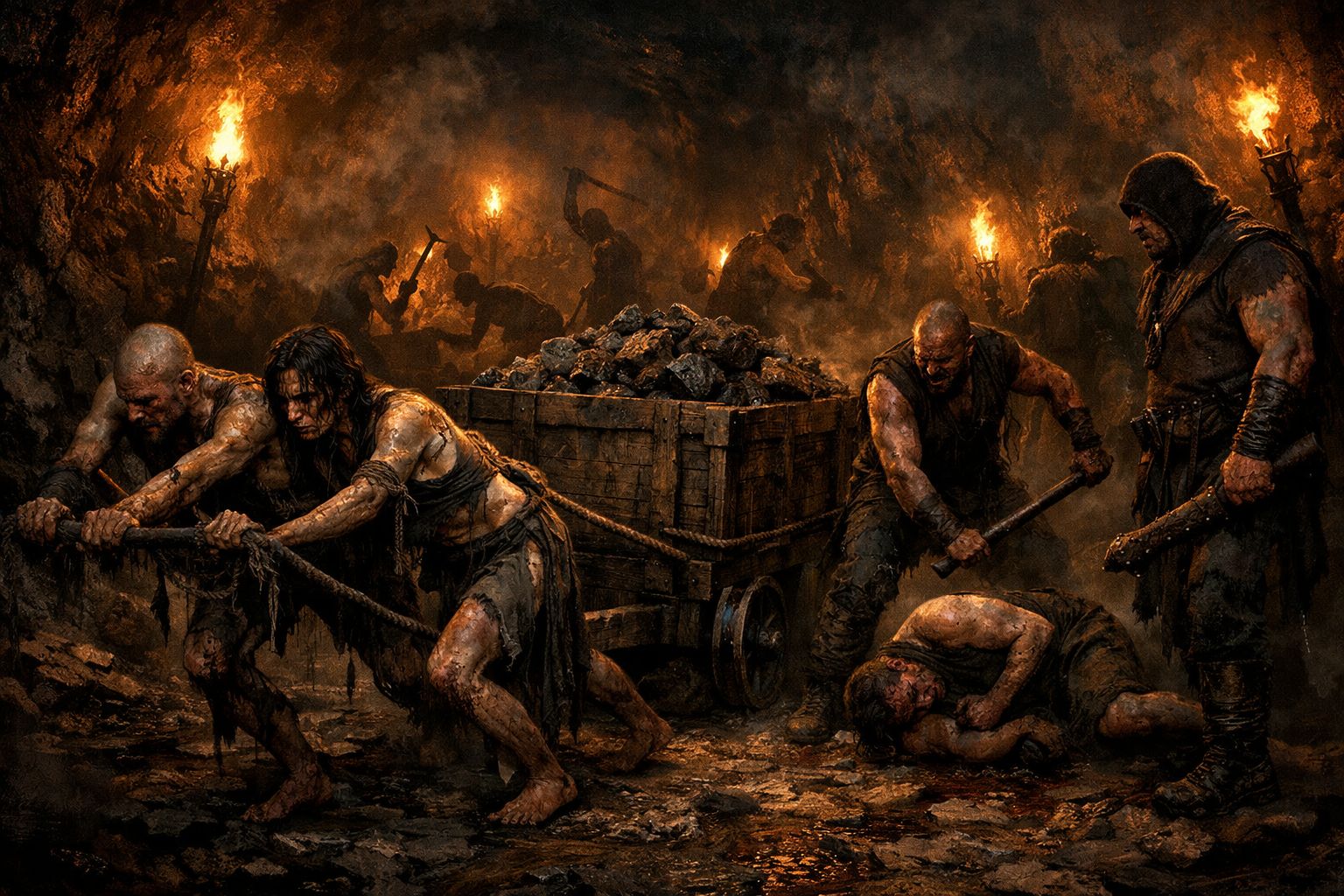
The mine closed around them the moment they passed the gate. The air changed first, turning thick and wet, carrying smoke that clung to the back of the throat. Every breath tasted of ash and iron. Torches threw weak light that trembled with every step, shadows folding over themselves as if the stone was trying to hide what it contained.
Scarnax moved at the front, shoulders squared, jaw set. He had been in holds and chains before, but this was different. This place did not float. It did not move. It pressed. He kept his eyes forward because when he looked too long at the walls, it felt like they were leaning in.
They entered a vast chamber carved rough and low. Hundreds of bodies lay packed together on the stone floor. Men, women and children pressed into one another for warmth, limbs tangled, ribs rising and falling in shallow rhythm. Some were awake, eyes glassy and unfocused. Others muttered in their sleep, fingers twitching as if still working the rock. Water dripped from the ceiling and ran between them, soaking rags and skin alike.
Junia stopped without realizing it. Her breath caught. She knelt beside a girl no older than twelve, barefoot, knees drawn to her chest. The child did not flinch, did not react. Junia reached out, then pulled her hand back. There was nothing she could do here. She knew it. That knowledge hurt more than anything she saw.
An overseer strode through the chamber, boots splashing through pooled water. He kicked a man aside to clear a path, cursed when the body did not move fast enough. Amaxia watched him pass, memorizing his face, his voice, the way he did not even look down. Her smile, when she forced it later, would be sharp enough to cut.
They moved on.
The tunnel narrowed, then opened again onto a shaft that dropped straight down into blackness. Two guards dragged a slave forward. The man was coughing, red flecking his lips, legs useless beneath him. He looked at the crew as he passed. There was no plea in his eyes. Only tired recognition.
One guard joked about how long it would take before he hit bottom. The other laughed and let go with the casualness with which one might throw away a cracked jar.
The scream echoed and echoed, stretching into something thin and animal. It went on far longer than felt possible. Shaedra gripped her bow so hard her fingers ached. She stared into the shaft long after the sound ended in a dull, distant thud. Somewhere deep below, stone answered stone.
No one spoke. The guards did not even slow their patrol.
Further in, heat rolled through the tunnels in suffocating waves. Smoke hung thick as slaves worked at a collapsed section of wall. The roof had caved in, crushing those closest. Hands protruded from the rubble. A foot twisted at an impossible angle jutted from beneath a slab of stone. The slaves pried ore loose anyway, stacking it with shaking arms.
One man sobbed openly as he worked. Another kept glancing up at the cracked ceiling, flinching at every creak. When dust fell, panic rippled through them, a collective intake of breath. No one ran. They knew what happened to those who did.
An overseer stalked behind them, whip loose, shouting that iron did not wait. When a stone shifted and someone screamed, the overseer laughed and told them to dig faster before the rest came down.
Amaxia’s jaw tightened. She took a step forward before Scarnax’s hand closed on her arm. Not yet. They both knew it. That knowledge burned.
In a narrower passage, carts ground along grooves worn into the stone. Children pushed them. Barefoot. Skin cracked and bleeding. The carts were too heavy. They leaned their whole weight into the wood, ribs visible, teeth clenched. One child stumbled and fell. The cart rolled back and trapped his leg. He screamed.
A guard struck another child across the mouth for stopping. Blood sprayed. The cart was dragged free. The boy pulled himself up and limped back into place without looking at anyone.
Junia turned away, swallowing bile. Her hands shook. She pressed them together until they stopped.
They kept moving. Deeper. Left. Right. Down. The tunnels twisted without logic, following ore wherever it led. Old passages intersected new ones. The crew passed chambers where fire had cracked the rock, walls blackened and still warm, smoke lingering like a living thing. Every step felt borrowed.
Overseers gossiped as they passed, complaining about shifts and smoke, arguing about rations. One mentioned a troublesome forest man who had caused problems weeks ago, then gone quiet. Another shrugged and said Deepwound ate everyone eventually.
Ayesha filed the words away. Shaedra lifted her head, heart hammering.
By the time they found him, the crew was exhausted, lungs burning, nerves stretched thin. Morthen Briarbound lay against a wall in a low chamber, barely conscious. His body was thin as a stick. His hands were bleeding, fingers swollen and stiff. His eyes struggled to focus when they knelt beside him.
Junia touched his shoulder and felt how light he was. She murmured his name. It took a long moment before he reacted.
He tried to stand and failed.
In that moment, the mine felt smaller. Closer. Like it knew what they were about to do and was already tightening its grip.
From there on, there was no pretending. No half measures. Either they left him to be swallowed like the rest, or they carried him back through the gate and faced whatever waited on the other side.
The mine breathed around them, patient and hungry.
Escape to the Blue Marlin
This section resolves pressure rather than escalating mystery. The goal is to release the tension built inside the mine while making the consequences of the crew’s choices clear. How they leave matters less mechanically than emotionally. Either way, Twin Cities does not forget.
If Violence Breaks Out at the Gate
If the crew fights their way out of the mine, the alarm is raised immediately. Reinforcements arrive fast and without negotiation. The guards assume a slave revolt and respond with overwhelming force.
Run this as a desperate push rather than a tactical stand. The crew is not meant to hold ground. They are meant to break contact, flee and keep moving. Let chaos carry them forward. Smoke, shouting, bodies and confusion should dominate the scene.
Once they reach Port Iron, the pressure eases. Neither East nor West wants an open confrontation in the harbor. Pursuit fragments into smaller groups. Thugs, hired blades and deniable enforcers may challenge them, but these encounters should feel half hearted and opportunistic rather than determined. The city watches, but it does not commit.
If They Leave Quietly
If the crew exits the mine without raising alarms, the return to the ship is tense but controlled. Eyes follow them. Conversations stop when they pass. There is a sense of being noticed rather than hunted.
Do not add random complications here. The unease should come from restraint, not danger. Twin Cities allows them to leave because causing a scene would cost more than it gains.
Aboard the Blue Marlin
Once aboard, Junia can finally treat Morthen Briarbound properly. He stabilizes enough to speak clearly. He gives the confirmed next destination of the Waverider.
After that, he breaks. He confesses that under torture he gave up the locations of Mistroot and Elderglen. He does not excuse himself. He does not ask for forgiveness. He simply states it, ashamed and exhausted.
The Final Choice
At this point, the crew must decide what to do with him. Take him back to Elarune, which is close and reachable. Keep him aboard. Or punish him for breaking under torture. Can they trust him with the code phrase?
Do not guide them toward a correct answer. Let the silence stretch. Let the decision land.
This is not about justice. It is about who the crew chooses to be after seeing how the world works.
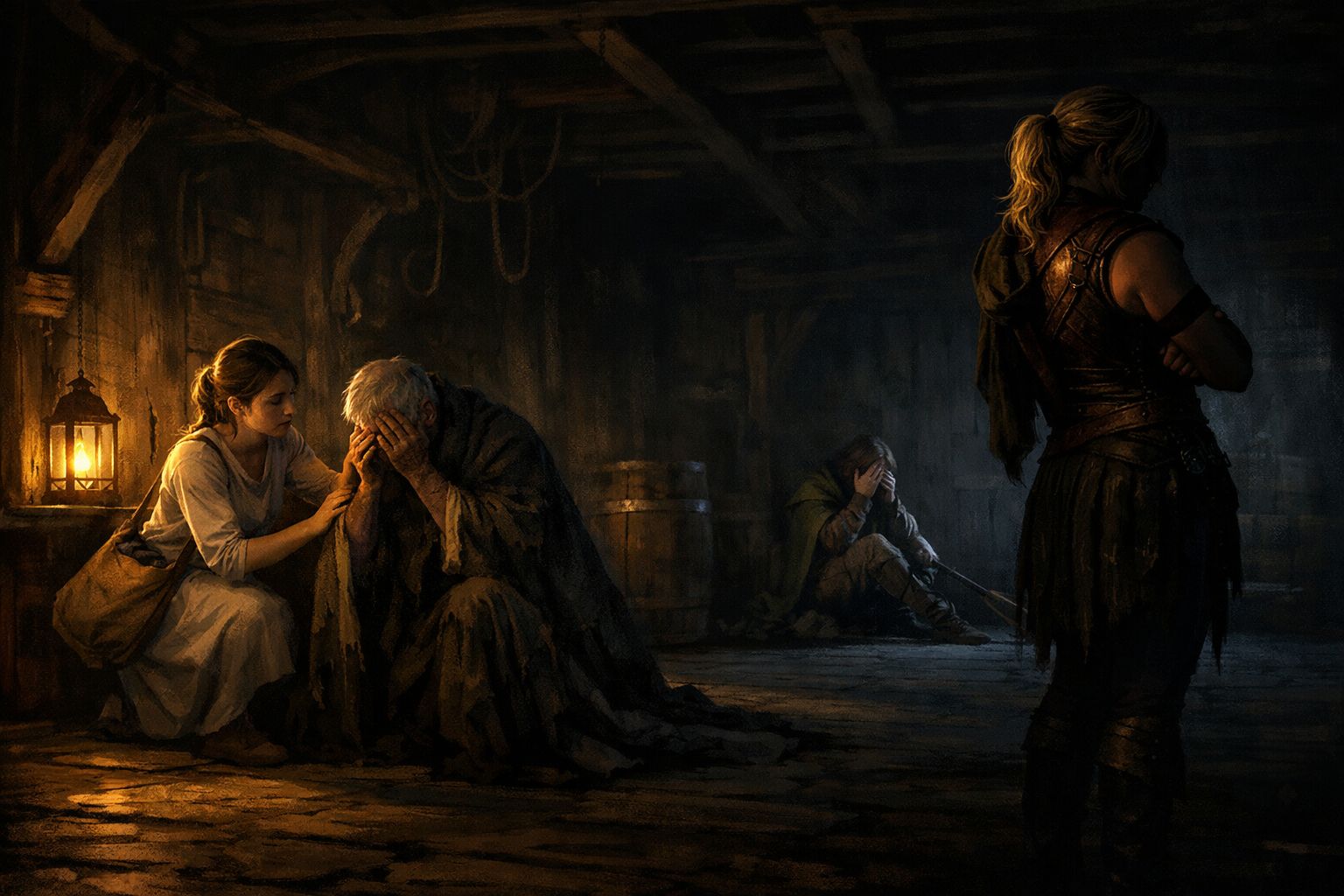
Morthen lay wrapped in blankets in the dim light below deck, the smell of salt and clean wood still strange to him. Junia’s hands moved with practiced care, washing blood from skin that had not known gentleness in a long time. Each touch made him flinch, not from pain, but from disbelief.
When he finally spoke, it was not at first to tell them where the Waverider went. That came easily enough, delivered in a flat voice, like a fact long rehearsed. The destination. Only after that did his breath hitch.
“I told them,” he said.
The words were quiet. Almost lost beneath the creak of the hull.
Scarnax stiffened where he stood, hands curling into fists at his sides. Amaxia’s gaze hardened, jaw set like stone. Junia froze, one hand still resting on Morthen’s shoulder, her mind racing through treatments she could not give and wounds she could not undo.
Shaedra took a single step back, as if struck. Her breath left her in a sharp, broken gasp. For a moment it looked like her legs would give out, like she might fold where she stood. She caught herself on the edge of the table, knuckles white, eyes unfocused. The room seemed to tilt around her, memories crashing together, smoke in the trees, empty glades, names she had stopped saying aloud.
“They hurt me,” Morthen continued, staring at the bulkhead, not at any of them. “I held as long as I could. I thought I had nothing left to give.” His voice cracked then, thin and raw. “But they kept asking. And I knew the paths. I knew where the villages would go when the forest closed.”
His chest hitched. He shook, the sound that came out of him somewhere between a sob and a laugh, broken and helpless. “I didn’t know when. I didn’t know how soon. I thought maybe… maybe they would move again before it mattered.”
No one spoke.
Shaedra slid down until she was sitting on the deck, back against the wall, staring at nothing. Her hands trembled in her lap. Whether what burned in her chest was compassion, grief, rage or something colder was impossible to tell. She did not look at Morthen. She did not look at anyone.
Junia’s eyes burned. She swallowed hard, fighting the urge to pull him close, to promise something she was not sure she could give. Amaxia turned away, pacing once, then stopping herself, shoulders tight. Scarnax looked at the floor, as if measuring weight and balance and finding none of it fair.
Morthen finally looked up at them, eyes red and hollow. “I just wanted the pain to stop,” he said, not pleading, not justifying. Just stating it, like another wound.
The room felt too small. The ship creaked softly around them, steady and indifferent.
They stood there, the truth hanging between them, Shaedra on the floor, Morthen on the cot, and for the first time since leaving the mine, there was no obvious next step.
Act Summary
This arc should leave the players with both concrete progress and lasting emotional weight.
Practically, the crew learned where the Waverider went next and secured a living witness who can confirm it. They gained firsthand understanding of how the slaver network actually functions, not as scattered cruelty but as an organized system supported by trade, politics and willful blindness. They now know how power operates in Twin Cities, who can be bargained with, who cannot and what kind of attention their actions draw. They also earned a reputation, quiet or loud, that Twin Cities will remember.
They may have made some friends and enemies, and some recurring NPCs should have made an appearance.
Emotionally, the arc should have stripped away any remaining distance. Slavery is no longer an abstract evil or a background detail but something the crew walked through, breathed in and failed to stop on a meaningful scale. The mine showed them what the world is willing to tolerate for iron. They can free a slave, but they can’t end slavery.
Morthen’s confession reframed Elarune not as a tragedy caused by monsters, but as the result of a man being broken until he could not endure anymore. There was no clear villain and no clear victim.
Most importantly, the players should leave this arc carrying responsibility rather than victory. They saved Morthen but could not undo what was done with the information he gave up. They now have to decide what mercy, justice or punishment means in a world built to crush people until they comply. That choice, and the memory of how it was earned, should linger well beyond Twin Cities.