Campaign: Tikirri
Act Synopsis
Foreshadowing
As the Blue Marlin makes landfall at the Kretazh Rim, Meyrha has a vision. She sees soft, shapeless demons and feels a vast mind of moving blackness. The vision gives no answers, but it marks the place ahead as deeply wrong.
Arrival at the Kretazh Rim
The Blue Marlin reaches the coast below the mountains surrounding Tikirri. On the shore, the crew finds a small boat rotting where it was pulled up long ago. Nearby are the remains of a camp. Above it, reachable by a climb, is the mouth of a cave.
At this point, Thaleia will insist on being part of the team.
The Rim Cave
The cave runs long and steep through the mountain. It eventually opens onto a ledge high above the floor of the Tikirri crater.
The Researcher’s Remains
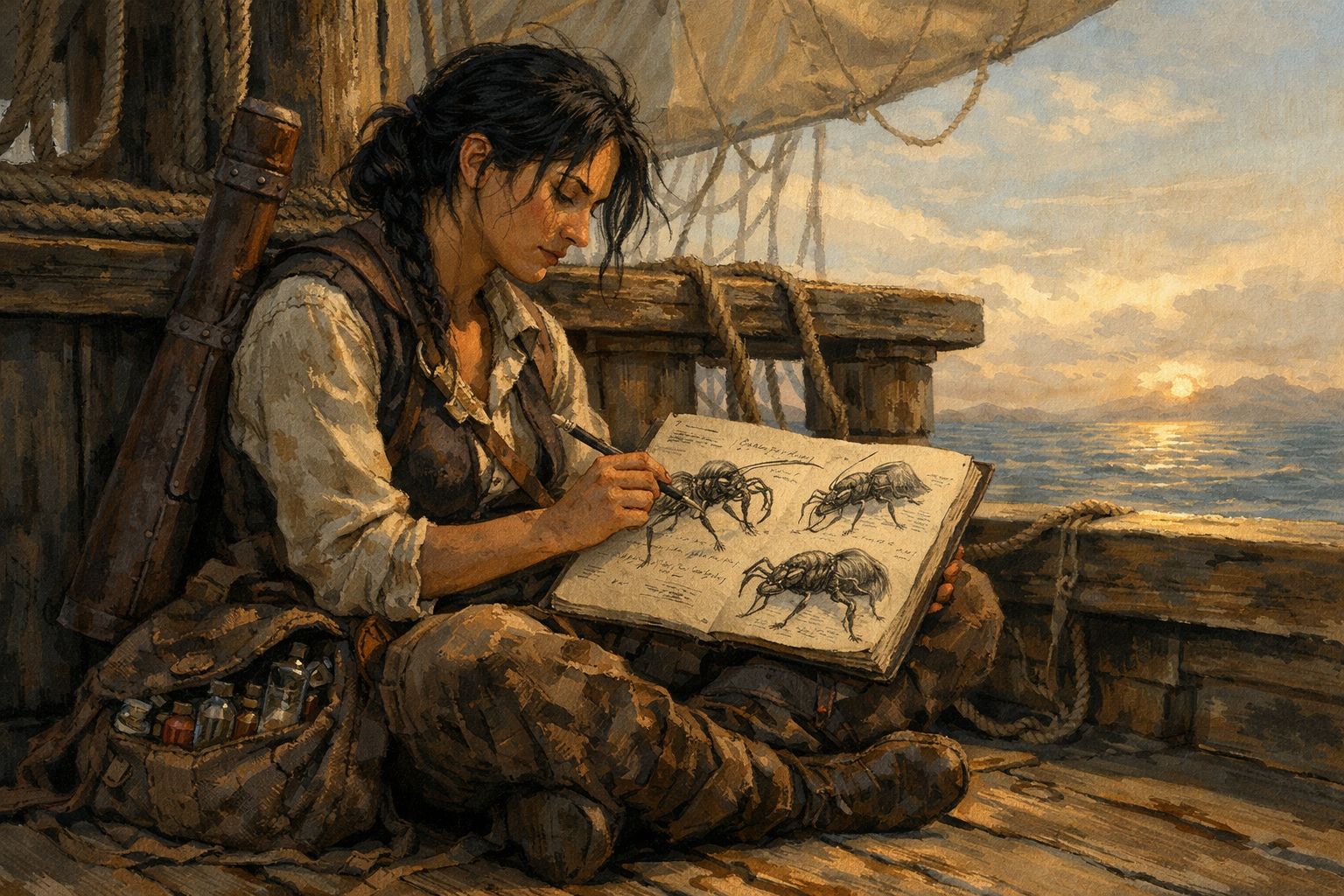
On the ledge, the crew finds the wrecked remains of a hidden camp, a skeletal arm, and a journal. The journal belonged to a well known scientist whom Thaleia has met in person.
The Journal
The journal describes the insectoids, their biology, their society, and their attitude toward outsiders. It also suggests a link to Tekrissal. It confirms that the researcher met members of the Waverider crew, and that the Waverider continued on to Tekrissal.
The journal does not explain everything. It gives the crew enough to understand the danger, while leaving some parts for Thaleia to interpret and some for the players to piece together themselves.
The Scout Party
While the crew is still on the ledge, they notice an insectoid scout party approaching. They are forced to retreat into the tunnel. From the journal, it is clear that the patrol must not be allowed to return, because the Tikirri cannot be allowed to learn that there is an entire world outside the crater.
The Escape
The crew fights the scouts in the narrow passages of the tunnel, where they have a chance to hold them back and destroy them.
Departure
After the fight, the crew returns to the ship and leaves. They take the journal with them, along with the knowledge that the Waverider went on to Tekrissal.
Foreshadowing
The Blue Marlin touched the shore with a low wooden groan, hull settling against wet stone and black sand. Ropes were already being gathered, men moving to ready the landing, when Meyrha suddenly went still by the rail.
Gastved saw it in time.
One moment she was standing there with the wind in her veil, looking toward the mountains of the Kretazh Rim. The next her knees gave way beneath her. He caught her before she struck the deck, but her body had already gone limp in his arms, sweat breaking across her skin almost instantly.
"Junia," he called.
The healer was beside them in moments, dropping to her knees as Gastved lowered Meyrha onto a coil of rope. Junia's hands moved quickly and gently, checking her breathing, feeling for her pulse, wiping the sweat from her brow with a damp cloth. Around them the crew gathered in a tight, uneasy ring. Scarnax crouched nearby, jaw set. Thaleia hovered close, pale with worry and curiosity alike. No one liked seeing visions take Meyrha this hard.
For ten long minutes she lay there unconscious while Junia watched over her.
At last Meyrha stirred, drawing in a ragged breath. Her eyes opened halfway, unfocused at first. Junia steadied her at once.
"Easy," she said. "Do not get up yet."
Meyrha swallowed and lifted a weak hand toward her temple. "There is a ringing," she whispered. "In my ears."
Thaleia leaned forward before she could stop herself. "What did you see?"
Meyrha shut her eyes briefly, gathering herself. When she spoke again, her voice was thin and distant.
"Soft things," she murmured. "Soft, shapeless demons."
No one spoke.
Then she swallowed again and forced out the rest.
"A great mind. Deafening. Moving blackness." Her gaze drifted past them, toward the mountains. "Not rage. Not madness. Something vast. Certain. Watching."
A silence settled over the deck.
Scarnax looked toward the shore, then up at the barren heights beyond it. "That," he said grimly, "is not the sort of welcome I was hoping for."

As the Blue Marlin makes landfall, Meyrha is suddenly struck by a vision. It comes without warning, at the exact moment ship and shore meet. She collapses, overwhelmed, and is left shaken, sweating and disoriented when it passes.
What Meyrha Experiences
The vision is fragmented and unclear, as visions often are. She remembers soft, shapeless demons, a vast and terrible mind, and a moving blackness spreading with relentless purpose. The images feel threatening, but not in any simple way. There is intelligence behind them, and order as much as horror.
GM Interpretation
This vision foreshadows the true nature of what is happening here. The demons are not literal fiends, but the humans and other outsiders who have come to this place. The great mind is the queen. The moving blackness is the insectoids. Meyrha does not understand this yet, but the vision points toward a reversal of expectations: what first appears monstrous may not be the true source of violence.
Arrival at the Kretazh Rim
Gray water lapped at black stone and coarse sand. Above the beach rose the Kretazh Rim, steep and barren, all broken rock and dark slopes. A little way up from the tide line lay the boat, half buried in sand and shingle. It had once been sturdy enough, but now the hull had split, the wood gone soft with rot, the ribs showing through like old bones.
Nearby were the remains of a camp. A few collapsed poles. A scatter of stones where a fire had once burned. Torn scraps of cloth pinned beneath rocks. Someone had meant to stay here for a while, but the place had long since been reclaimed by wind and weather.
Scarnax stood looking from the boat to the slope above while Gastved and Ileena spread out to search the ground.
"How long ago?" Scarnax asked.
Gastved crouched by the old fire ring, studying the ash, the wood and the settled earth around it. "Hard to say exactly," he said after a moment. "A few years, I think."
"Not recent, then," Scarnax said.
Gastved shook his head. "No."
Thaleia turned slowly, taking in every scrap of the ruined camp. "Whoever camped here did not come back."
No one argued with that.
A few paces away, Ileena had moved farther out, searching with the easy focus of a hunter. At last she stopped and pointed up the mountainside.
"There," she said.
High above them, half hidden among the rocks, was a dark opening in the slope.
"A cave," Thaleia said at once.
She was already moving toward it before anyone answered. The slope was steep and loose, but that did not slow her for more than a moment.
"Thaleia," Scarnax called.
She kept climbing.
"Thaleia."
That got her to stop and glance down at him, impatient already.
"There is a cave," she said.
"I noticed," Scarnax said. "We are not charging into a mountain hole in a dead place without a plan."
Gastved came to stand beside him and looked up at her. "Captain is right."
Ileena slipped back down toward them, light on the stones. "No fresh tracks down here," she said. "Not human, anyway. Wind has taken most of it."
Thaleia exhaled sharply, annoyed but not enough to keep climbing. "Fine. But we should not waste time."
Scarnax nodded toward the cave. "We will not. We think first. Then we go."
Above them, the dark opening waited in silence over the rotting boat and the abandoned camp, as if someone else had once stood on this same shore and made the same choice.
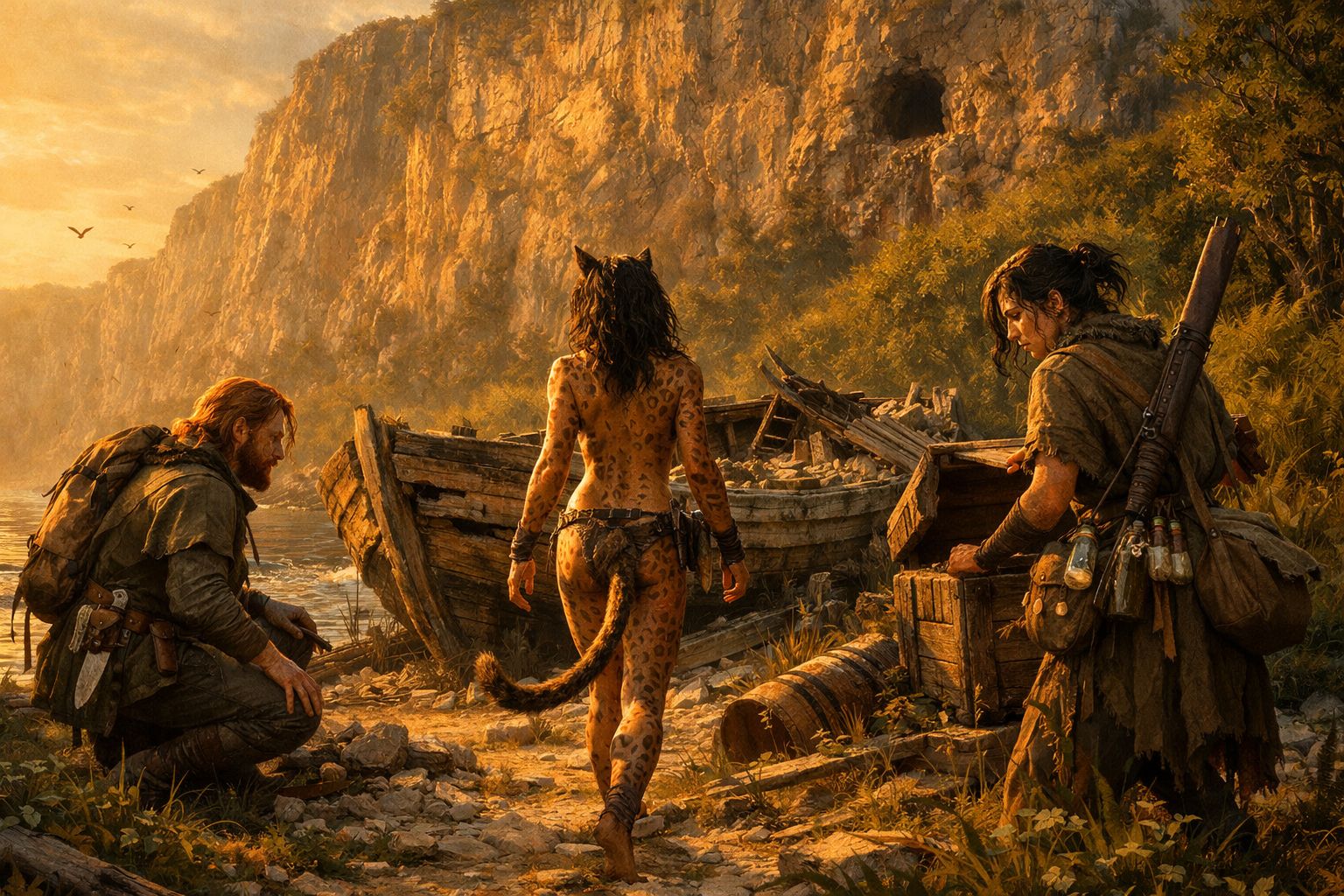
The arrival at the Kretazh Rim is quiet, sparse and immediately suspicious. There is no sign of habitation, no welcoming shore and no living presence beyond the crew themselves. What they find instead is evidence that someone came here deliberately, stayed for a time, and then left the shore behind in an organized way.
This section is simple in structure. The crew lands, surveys the terrain, finds the old boat and camp, and notices the cave high above them. The purpose is to establish that someone came here with a plan and that the next step lies up in the mountain.
The Shore and Basin
The land here is narrow and exposed. Water comes down from the mountains not in one great river, but in several smaller streams. These spread out across the rocky ground and collect in a shallow basin before reaching the sea through a slow river. Depending on season and recent weather, this basin may be muddy, stony or edged with stale water and brush.
The terrain around the basin is low scrub, brush and tough coastal growth. It is not dense, but it is enough to break sight lines and catch scraps of old material. The flat ground is limited. There is only a narrow stretch of relatively usable land before the mountains rise sharply behind it.
This helps explain why a camp would be placed here. There is fresh water, a little shelter from the immediate shoreline and direct access to the slope above. It is not a good place to live, but it is a practical place to land and stage an ascent.
The Boat
The boat should look like something that was once serviceable, not impressive. It is a small single mast vessel, the kind of craft a careful traveler could use to follow a coastline while hauling ashore at night. It was never meant for long deep water travel, but it would have been enough to reach this place if handled well.
Now it is useless. The hull is rotted through, the wood split and softened by years of exposure. Any sail is long gone. What remains should make it obvious that this is not a recent loss. No one is repairing it, no one is coming back for it and no one has used it in a very long time.
The important thing is that the boat was pulled ashore intentionally. It was not smashed in panic or broken in a storm at the waterline. Whoever came here landed successfully.
The Camp
The remains of the camp should suggest planning rather than disaster. This is not the site of a desperate flight. It looks like a place someone used as a base before moving on.
What remains can be sparse. A ring of stones for a fire pit. Scraps of cloth or leather caught under rocks. The faint remains of where gear may once have been stored or covered. A few worked stakes, a broken pole and other signs that someone spent time organizing the site.
The key point is that the camp does not look abandoned in the middle of chaos. It looks as though the occupant broke camp in an orderly way before moving on. That immediately raises the question of where they went, and the answer lies above.
Tracks and Signs
If the crew searches the area, there should be little to find in the way of useful tracks. Time, weather and the harsh ground have erased most signs. Gastved or Ileena can determine that the site is old, likely a few years at least, but not much beyond that.
That lack of track detail is useful. It keeps the scene focused on the obvious physical clues rather than turning it into a tracking puzzle. The crew is meant to understand that someone came ashore, established a camp and moved into the mountain.
The Cave
The cave opening is visible partway up the mountainside above the camp. It is not enormous, but large enough for a tall or broad man to enter upright. From below, it is clearly a usable opening rather than a crack or crevice.
Reaching it requires a real climb. It is too steep for ordinary scrambling, but not so extreme that it becomes a major obstacle for a capable crew. The Blue Marlin has several members who can manage the ascent. Once one of them reaches the opening, dropping a rope or rope ladder makes the climb manageable for everyone else.
This means the cave should feel like an intentional barrier, but not a complicated challenge. The point is not to test climbing skill for its own sake. The point is to create a sense that the previous occupant chose a hidden and defensible route upward.
What the Crew Should Conclude
By the end of this section, the crew should have a clear working picture. Someone reached this shore by small boat, established a temporary camp near fresh water, then climbed to the cave above. They did not return.
That is enough. The clues on the shore point clearly upward, and the cave becomes the next step.
Thaleia
By this point, Thaleia will insist on going with the team. She will frame it as an important scientific endavour, and will not take no for an answer.
The Rim Cave
The cave is a long, upward passage through the Kretazh Rim. It is not a worked tunnel, mine or ruin. It is natural, shaped long ago by water, and that should be obvious in its curves, hollows and worn surfaces. The route is difficult enough to feel like a real expedition, but not so dangerous that it becomes a full challenge in its own right. Its purpose is to separate the shore from the crater, to build distance from the world outside and to make the final emergence onto the ledge feel earned.
The crew should understand fairly quickly that this is not just a short climb to a lookout point. This is a real passage through the mountain.
General Structure
The tunnel runs steadily upward for roughly six hours of cautious travel. It twists, bends and narrows often enough that the crew rarely gets a long clear view ahead. In places it opens into broader chambers or sloping shelves. In others it tightens into narrower passages where movement becomes slower and more deliberate.
The route is tiring, but manageable. There are a few steep sections that require care, hands on stone and some effort getting supplies and less agile crew through, but nothing that should stop a capable expedition. The Blue Marlin has a capable crew, and the cave should feel like a strain, not a barrier.
Throughout the entire journey, the cave keeps rising. That matters. The crew should feel that they are climbing deeper into the mountain and at the same time approaching whatever lies beyond it.
The Shape of the Cave
The cave should feel strangely organic even though it is entirely natural. Water has worn it into rounded, flowing shapes that can seem almost biological in the lantern light. Smooth bulges, hollowed walls, curves that look uncomfortably like the inside of some vast body. Nothing supernatural is required here. It is simply the effect of erosion, but in this context it helps the cave feel subtly wrong before the crew ever reaches the crater beyond.
That impression should stay faint. The cave is not alive and should not feel like a monster tunnel. The point is only that it carries an uncanny resemblance to living forms in places, which can unsettle the crew and support the growing sense that they are moving toward something alien.
The Ground and Passage
The floor is uneven throughout. Some stretches are bare stone. Others are slick with mud where moisture still collects. In a few places the footing becomes treacherous enough that the crew must slow down, test each step and help one another through.
The cave does not need traps or major hazards. The challenge is endurance, caution and the simple strain of moving through a long, wet mountain passage with gear, light and uncertainty. Lanterns and torches need to be refilled and replaced along the way. Breathing space is needed at intervals. Progress is steady, but not fast.
The cave alternates between tighter squeezes and broader resting points. That keeps the journey from feeling visually flat while maintaining the sense of a natural formation.
The Wind
From the start, the crew should be able to feel a faint current of air. It is not strong, but it is steady enough to matter. That tells them there is another opening somewhere ahead.
This is a simple but important detail. It confirms that the cave is not a dead end and gives a physical sense of direction. The air ahead is not just fresher. It is a reminder that the mountain has another side.
The Midway Camp
The wider shelf of the cave came upon them almost by surprise after hours of mud, stone and steady climbing. The air was still damp, but here the ground flattened enough to stand properly, and the lantern light reached farther.
Ileena stopped first.
Her ears twitched once, then she crouched beside a dark shape half sunk in the mud. "There was a camp here," she said.
Gastved came over and lowered himself beside her. He studied the old remains without touching them at first. A bedroll stiff with age. A lantern blackened with soot. Torn wrapping, a ruined waterskin, a sack slumped in on itself where whatever had once been inside had long since rotted into uselessness.
He nodded slowly. "Not just a rest stop."
Scarnax looked around the flat section, eyes narrowing. "What do you mean?"
Gastved pointed at the arrangement of things. "See how it is laid out. This was organized once. Meant to be used again." He pressed a thumb against the bedroll, then glanced at the dust and grime settled over everything. "Base camp, I think. Someone came back here more than once." He looked up. "But not for a long time."
By then Thaleia was already kneeling on the other side of the shelf, lantern set down beside her, hands moving quickly through the old remains with barely restrained excitement. She picked up a warped length of wood with brass fittings green from age, turned it in the light, then reached for another broken piece nearby.
"This is not ordinary travel gear," she said. "Surveying equipment."
Scarnax gave her a look. "You can tell that from this wreck?"
"Yes," Thaleia said at once, as if the answer should be obvious to anyone with eyes. She held up the decayed instrument. "Or rather, I can tell what it was before time and damp did their work."
A moment later she made a small sound and leaned farther in, brushing mud away with careful fingers. From the mess she lifted a little dried ink well, its stopper gone, the inside long hardened black. Beside it lay scraps of paper fused together and ruined by water.
Her expression changed. Some of the eagerness stayed, but something else entered it too. Respect, perhaps.
"He was taking notes," she said quietly. "Proper notes."
Ileena glanced into the darkness ahead of them. "Then he went farther."
Scarnax rested a hand on the pommel at his hip and looked past the old camp into the winding dark beyond. "Then that is what we do too," he said. "Find this scientist and keep moving."
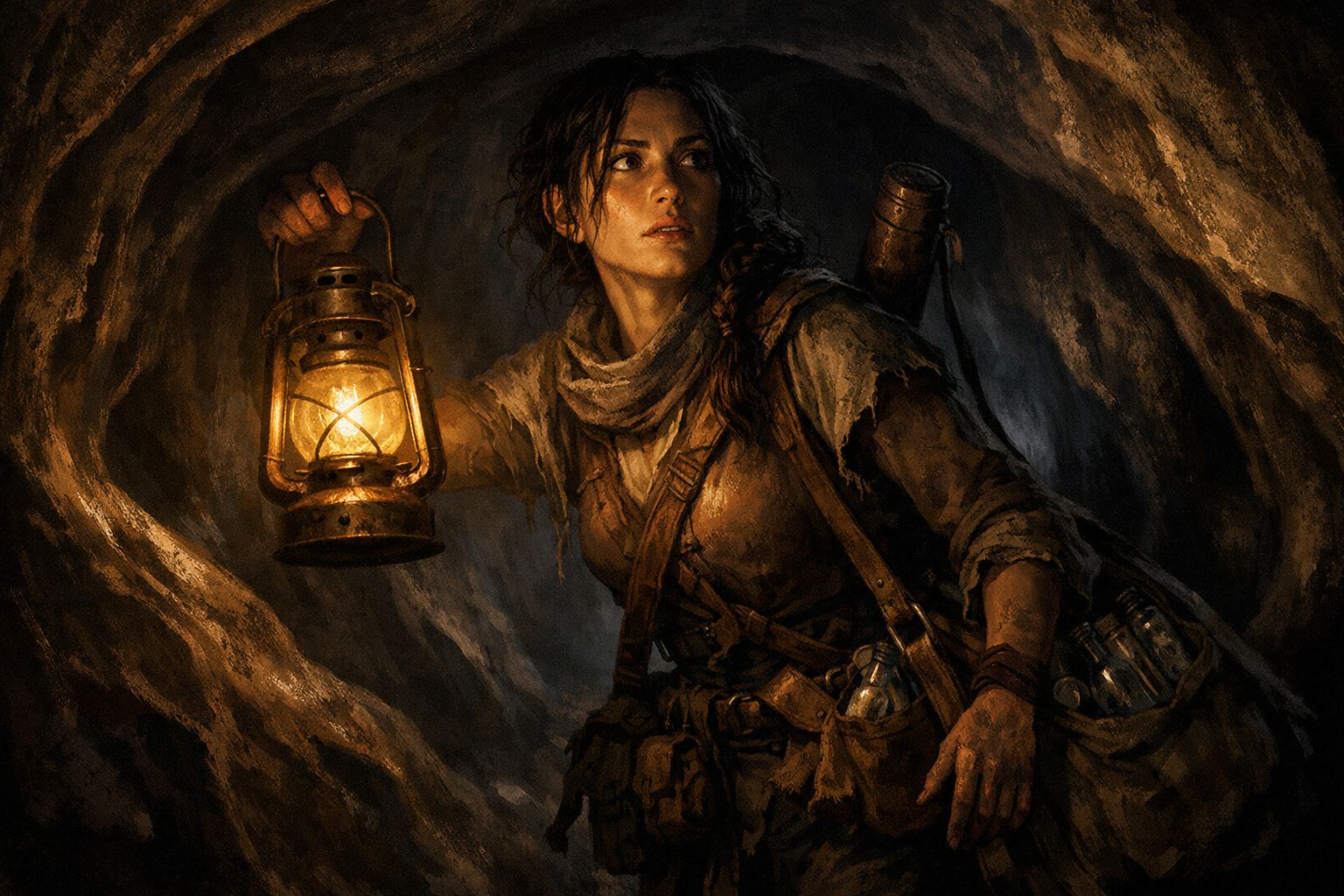
Roughly five hours into the journey, the crew reaches a broader, flatter section of the tunnel that clearly served as a resting place. Here they find the remains of an old camp.
This camp is more personal and immediate than the shore camp. It is deep inside the mountain, far enough in that whoever stayed here had fully committed to the passage. There is decayed equipment, a spoiled sack of provisions, a bedroll, an old lantern, scraps of wrapping, a waterskin gone hard and useless, and other practical supplies left where they lay. Everything should look old, untouched and long abandoned.
The camp should not feel disturbed by recent movement. No one has passed this way in a long time. That reinforces the sense that the explorer used this as a staging point on repeated journeys through the mountain, or at least as a place to stop before making the final push.
This is also a useful place for the crew to pause, regroup and understand how long this route truly is. It confirms that the cave was not entered casually. Someone lived with this journey long enough to prepare for it.
The End of the Passage
Eventually the tunnel reaches its end in an opening to the outside. This should not be a dramatic cliff reveal the instant the crew arrives. Let there first be stronger air, a change in sound and a gradual shift in light. Then the passage opens onto the ledge.
That transition matters. The crew has spent hours in a dim, enclosed route of mud, stone and lantern smoke. The sudden presence of open air and daylight should feel sharp and exposed. They have crossed the mountain. What waits outside is the next stage of the arc.
What the Crew Should Understand
By the end of the cave section, the crew should know a few simple things.
- This route was used deliberately.
- It was difficult enough to matter, but practical enough for a determined person to travel.
- The explorer spent real time here and prepared for the journey.
- The cave leads all the way through the rim and opens onto something beyond.
That is all this section needs to accomplish. Its job is to turn the cave into a threshold between the known world and the hidden world inside the crater.
The Ledge
The cave gave them up to the light all at once.
After hours of mud, stone and lantern smoke, the open air hit like a blow. Cold wind swept across the ledge and tugged at clothes and hair. The passage behind them still breathed its damp darkness, but ahead there was only space. Vast, impossible space.
Scarnax came out first and stopped so abruptly that Gastved nearly walked into him.
For a moment none of them spoke.
The ledge was broad enough to stand on without fear, but beyond it the world fell away in a sheer drop so enormous that the eye struggled to make sense of it. Far below, spread across the floor of the crater, lay a landscape of shapes too regular to be natural. Great patches of land formed in hexagons, one after another, stretching outward in eerie order. In the closest of them, tiny hard glints flashed now and then in the sunlight like bits of polished metal.
And beyond them, impossibly far away and yet still commanding the whole view, lay a lake.
From its center rose a black spire.
It stood so stark against the light that it seemed less part of the world than something driven into it.
Thaleia had stopped breathing properly. Her face had gone pale, not with fear exactly, but with the force of seeing something she had perhaps imagined in fragments and theories and now found made real before her. Her eyes darted across the crater floor, trying to take in everything at once and failing, because there was too much.
Scarnax stared out over the abyss with his jaw set hard. He was not a man easily impressed by ruins or wonders, but this was something else. This was not beauty in any simple sense. It was scale, order and wrongness all braided together.
"So," he said quietly, "that is what was hidden in there."
The wind shifted. To one side of the ledge a small waterfall spilled down the rock, thin and white against the dark stone. Not far from the cave mouth lay the remains of the camp, little more than scraps, a few broken things and the weathered signs that someone had once lived here in patience and secrecy.
Ileena was the first to move.
She slipped lightly across the stone and crouched near the old remains, her sharp eyes catching on something half hidden among them. She lifted it carefully and turned it in the light.
"A looking glass," she said.
One side of it was cracked, the frame warped by an impact, but enough remained for her to peer through it. She angled it out over the crater, one eye narrowed, head tilted. The broken lens caught the light strangely.
"I can see more movement now," she murmured. "Tiny from here. Still too far. But something is working down there."
Gastved came a step closer, though he did not take the instrument from her. "Can you tell what?"
Ileena lowered it and gave a small flick of her ear. "No. Only that this place is alive."
By then Thaleia had reached the camp remains and gone down to her knees among them.
She did not rummage. She moved with the slow care of someone approaching a shrine. For a moment her hands hovered above the scattered debris, then settled on a tightly wrapped bundle darkened by time and damp. When she lifted it, she did so with both hands, as though its weight were greater than it should have been.
Her expression changed the moment she understood what she was holding.
"A journal," she whispered.
She said it with the reverence some people reserved for relics.
The wrapping crackled faintly beneath her fingers. Parts of it had failed, and water had marked the edges, but someone had tried very hard to protect what lay inside. Thaleia brushed a thumb along it with astonishing gentleness, as if even that might be too rough.
Scarnax glanced from her to the crater below. "Can it be opened?"
Thaleia looked up at him as though he had asked whether a starving man might eat. "Of course it can be opened."
Then, softer, almost to herself, "Carefully."
For a few moments longer none of them moved to hurry her. They stood on the high ledge beneath the clouds, with the dead man's camp at their feet and the impossible world of Tikirri spread below them, while Thaleia held the journal like a holy artifact and Ileena turned the broken looking glass in her hands, trying to catch one more glimpse of the secret life far beneath them.

The ledge is the payoff for the long passage through the mountain. After hours of mud, darkness and enclosed stone, the crew emerges into open air high above the crater. This is where the hidden world of Tikirri is first revealed.
This section has two purposes. First, it gives the crew the remains of the observer's final camp and the journal that will carry much of the immediate exposition. Second, it presents the first full view into the crater and establishes the sheer scale of what lies below.
The Ledge Itself
The opening from the cave emerges onto a broad stone ledge at least ten meters wide. It is not a narrow perch, but a real shelf of rock, large enough for a small camp and for several people to move about without immediately feeling in danger of falling. Even so, the drop beyond it is immense, and the open space after the long cave should feel sudden and severe.
The ledge lies high on the inner wall of the crater, just below the clouds. Depending on light and weather, mist may drift past now and then, softening the view for a moment before clearing again. The air is colder here than below and sharply fresh after the close damp of the cave.
To one side runs a small waterfall. It is not large, but enough to show that water still cuts through the stone here. It was likely this flow, or an earlier stronger version of it, that once carved the cave. Since then the course has shifted or diminished, leaving the old passage mostly dry enough to cross.
The Observer’s Camp
On the ledge are the remains of a small temporary camp. This should feel different from the midway camp in the tunnel. That one was a staging point. This one was an observation post.
The remains can be sparse but telling. A few collapsed supports or scraps of covering, the remnants of where someone sheltered from wind and spray, perhaps the frame of a simple seat or rest. It is clear that someone stayed here for some time, but never built anything meant to last.
Among the remains is a skeletal arm, enough to make it immediately obvious that the observer died here and was never buried. The rest of the body may be lost to time, weather or scavengers, but that one piece is enough. Nearby lies a broken looking glass, another sign that this was not an ordinary traveler but someone who came here to study what lay below.
The Journal
Among the remains is a tightly wrapped journal. It has been protected as well as its owner could manage, but time and damp have still taken their toll. The outer wrapping is worn and some pages are ruined, stuck together or blurred beyond use. Even so, enough remains legible to matter.
The journal should feel like a fragile survival. It is not in perfect condition, and that matters. Missing pages and damaged sections help preserve mystery and keep the crew from learning everything at once. What survives is enough to identify the observer, reveal his purpose and begin explaining what he learned about the Tikirri and their connection to Tekrissal.
The broken state of the journal also helps make the place feel real. This is not a neat clue cache. It is the last remnant of a dead man's work.
The View Into the Crater
The most important element of the ledge is the view.
The inner wall drops steeply away, and far below spreads a landscape unlike anything the crew has seen before. The nearest visible ground is patterned with hexagonal fields laid out in an order too regular to be natural. Even from this height, the arrangement is unmistakable. This is not wilderness. This is design.
In the nearest fields, the crew can just barely catch occasional glints in the sunlight. These reflections should be subtle and distant, enough to suggest movement or hard surfaces without yet making their nature fully clear. The players should understand that something is down there long before they fully grasp what.
Far across the crater, at its center, lies a lake. Rising from it is a black spire, stark even at that distance. It should dominate the horizon of the crater, not because of size alone, but because it feels wrong in the landscape. The fields, the basin and the central spire together should make the whole place feel organized around a purpose the crew does not yet understand.
What the Crew Should Understand
By the time the crew has taken in the ledge, they should know three things.
- First, someone came here deliberately and spent time observing the crater below.
- Second, that observer died here, leaving behind only fragments of his work.
- Third, what lies below is not just a nest or a danger, but a hidden world with scale, structure and a center.
That is enough for the ledge to do its job. The cave delivered them here. The ledge now gives them their first look at Tikirri and the remains of the man who tried to understand it.
Ivy and the Spirit World
If Ivy is part of the crew and enters the spirit world anywhere near Tikirri, the experience should be immediate and deeply wrong. The spirit world here is almost completely empty. There are no familiar local spirits, no animal presences, no drifting lesser beings and no sense of a living spiritual landscape. That absence alone should feel unnatural and alarming.
In place of that normal spiritual texture, there is only one vast presence. A single powerful dark spirit overshadows everything around the crater. It does not feel like any spirit Ivy has known before. It does not feel human, natural or even properly part of the same order of existence. It feels alien in the deepest sense, as if she has brushed against something that does not belong in the world as she understands it.
The danger of that contact should be overwhelming. This is not a place for exploration, negotiation or curiosity. The sense of threat should hit Ivy almost at once, so strongly that it becomes hard to think clearly or act with confidence. Fear, pressure and spiritual wrongness should weigh on her so heavily that the experience borders on crippling. The message should be unmistakable. Whatever dominates this place is vast, hostile and far beyond anything she is prepared to face directly.
When she leaves the spirit world, it is with a feeling of having barely escaped.
The Journal

The journal is the first real source of knowledge about Tikirri. It does not explain everything, and it should not feel like a complete answer key, but it gives the crew enough to understand the scale of what they are looking at. It also creates the direct link to Tekrissal and confirms that the Waverider came this way before moving on.
The journal is damaged. Some pages are stuck together, some are blurred by water, and some sections are broken or incomplete. That damage is useful. It allows the text to reveal important truths while leaving room for uncertainty, interpretation and later discovery. Thaleia can help fill in parts of the meaning, but even she does not get a complete picture from this alone.
Full Text of the Journal, in Order
The Journal of Teren Morvail
Day 19. Shore camp establi... at basin below western rise. Boat drawn up and covered. Suppl... divided between shore, inner camp and obser... ledge. No assistants. No guards. No local help. Work proceeds alone.
Day 22. Passage through rim confirmed travers... by one man with reduced loads over repeated ... Slow. Exhausting. No better route found.
Day 28. The first error is to mistake their numbers for swarm beha... Their movem... is ordered. Repeated paths. Repeated tasks. Fixed zones of labor and return.
Day 30. The notion of a single insectoid form must be abandoned. I observe not variat... within one body plan, but diverg... so extreme that ... for separ... species.
Day 31. I have now watched long enough to reject the language of nest or breeding p... Such terms obscure more than they explain. What lies below is not frenzy, but arrang... shaped into syst…
Day 33. Returned again in thought to Tekrissal. I still lack proof, but the simil... trouble me. Not in ornament or craft, but in struct... in pattern, in the logic of use. The dead city and this crater may belong to the same hist...
Day 34. Their coordination exceeds ... swarm instinct known to me. Movem... across distant fields align too precisely. Labor shifts, guard response and mass redirec... occur with a speed and unity I ... simple signal or ...
Day 35. Certain forms are plainly made for labor. Broad, steady, many-jointed. Others are built for speed or travers... Others ... arm... and harden... as to leave little doubt of warlike purp...
Day 38. I have now ... time above the crater to note not only what is pres... but what is absent. No grazing beasts. No birds. No small furred scav... among the rocks. Nothing moves below without shell, plate or outer harden...
Day 41. I note this in case these pages survi... No second hand has checked these figures. No second eye has confirmed these obser... All ... sketches and watches are my own. There has been no one here but Teren Morvail.
Day ... absence cannot be dismissed ... or poor vantage. Even at the margins, where one would expect lesser life to persist, I observe no mammal of any kind. No feather... either. The living order below appears exclu... to chitinous forms.
Day 46. Distinct bodies appear in distinct places with distinct purp... Some till or tend. Some carry. Some guard. The fields are worked, the routes maint... the ... regularity no mere colony of beasts could sustain.
Day 47. I reject any mysti... reading of the matter. The connect... if real, is material, not spirit... Something passed between Tekrissal and the world below, or ... I cannot yet say which.
Day 48. I do not believe these peoples are divided into tribes, nor governed by local clust... alone. The whole ... to a single will, or to some central intellig... expressed through many bodies.
Day 57. I begin to ... is not merely a domin... of insect life, but an entire enclosed biol... from which softer forms have been driven, consumed or never admitted at all. The effect is deeply...
Day 58. Fuel, ink, food, line, water, instru... all carried in piec... and always alone. If I fall, if I sicken, if I am disco... there will be no rescue. Yet ... would make the whole undertak... meaningless.
Day ... rarer forms whose funct... I cannot yet determine. They move little, or move only where others carry for them. ... unlike the comm... I suspect rank, ritual or some central adminis... but this remains specul…
Day 61. The fields below and certain ruined forms at Tekrissal suggest ...
Day 63. I record this with reluct... They are not animals in any ordinary sense. They possess not merely number, but order. Not merely instinct, but a form of social des... so complete and alien that I hesitate even now to call it civiliz... and ... no better word.
... If Tikirri is to be understood at all, then Tekrissal must be studied beside it. I have seen enough to suspect a shared past, but not enough to name it with confidence. The key lies not … but also in the dead stones of Tekrissal.
Day 66. ... center ... eye for good reason. The lake, the black spire, the ordered radi... of labor and return. I cannot yet prove ... from there, yet all observ... suggest a governing principle seated ...
Day 67. Their hostility is not that of simple territo... defense. I have watched enough incurs... among lesser forms at the crater's edge to reject ... The response is too immedi... too absolute, too devoid of gradat...
Day 68. The differ... between castes is not ... nor the division between male and female such as we know it. Their order appears written into the body itself. Society here is not ... It is grown.
Day 72. Today I received unexpected visit... from the sea. A vessel lying off the outer coast, and from it ... observation camp ... The captain was named Solonex. ... Waverider ... map ...
Day 73. I judged them at first to be treasure-seekers or fools, but found neither reading... They listened with unusual patience while I set out my observ... concerning the crater and my earlier findings at Tekrissal. Solonex in particular grasped at once why the dead city may matter more than...
Day 74. I shared with them what little I can state with confidence. Not proof, but pattern. Not conclu... but converg... of signs. Phaedros and I shared our maps.
Day 75. They have resolved to continue to Tekrissal. I cannot say whether wisdom or obsession drives them ... same might be said of me. If my theor... hold, then they go not merely in pursuit of old stones, but toward the ... mystery offers ... answer.
Day 76. The crater does not feel merely hidden. It feels separate. As though the ... of living things has been replaced here by another syst... one in which only hard-shelled life endures.
Day 79. I refrain from naming the ruling form until I know more. Yet I am now persuaded that there is some cent... power below, whether ... This place is not merely inhab... It is directed.
Day 81. They do not merely kill what is unlike them. ... reject it. Soft-bodied life draws a reaction I can only describe as abhorr... though I use the term with caut... The pattern ... if the inner principle remains obscure.
Day 94. ... suspect that to these beings, outer form is not one trait among many, but ... of order itself. What lacks shell, plate or harden... is not merely prey or rival, but something erro... impure, perhaps even intoler...
Day 103. If ... is correct, then any entry into their domain by men or beasts is more than intrusion. It is defile... Their violence is not hunger ... defense. It carries the char... of revulsion.
Day 109. Movem... below no longer follows the usual patt... A small group has broken from the lower routes and begun ascending the cliff face directly. I ... whether I have been seen or only suspec... but I will not remain on the ledge. I take the journal and retreat into the cave.
Day 111. Still no sign ... The cave entrance remains quiet. If they searched, they did … left. I judge the danger suffic... reduced to resume obser... I will return to the ledge … morning.
The Author
Thaleia knelt among the scattered remains with the journal cradled in both hands, handling it with a care that made even Scarnax hold his tongue. The wrapping was stiff with age and water damage, but whoever had tied it had done so with desperate thoroughness, as if he had known the pages inside might outlast him.
Ileena watched from a crouch nearby, broken looking glass still in one hand. "Can you read it?"
Thaleia did not answer at once. She eased the covering back, inch by inch, until the first page showed through beneath it. Then she froze.
Gastved saw the change in her face before anyone else. "What is it?"
For a moment she only stared. Then, very quietly, she said, "Teren Morvail."
Scarnax frowned. "You know the name?"
Thaleia looked up at him, still half in disbelief. "Of course I know the name. Everyone with any serious interest in natural philosophy knows the name." Her voice had gone tight with astonishment. "He was respected. More than respected. People cited his work for years." She swallowed. "I met him once. Brilliant man."
That landed heavily enough to quiet the others.
Thaleia looked back down at the damaged journal in her hands, as though it had become heavier in the last few breaths. The wind moved across the ledge. Far below them, sunlight flashed on the distant fields.
Then, with slow and deliberate care, she turned to the first page.
The journal belongs to Teren Morvail, a respected natural philosopher and surveyor whose work Thaleia knows well. She has even met him once in person, enough that the name carries real weight for her. This is not the notebook of an unknown wanderer. It is the field record of a serious scholar who came here deliberately and knew how to observe carefully.
That matters for two reasons. First, it gives the journal authority. Second, it makes the discovery personal for Thaleia. She is not simply reading old notes. She is handling the final work of a man she knew by reputation and memory.
Teren Worked Alone
Day 19. Shore camp establi... at basin below western rise. Boat drawn up and covered. Suppl... divided between shore, inner camp and obser... ledge. No assistants. No guards. No local help. Work proceeds alone.
Day 22. Passage through rim confirmed travers... by one man with reduced loads over repeated ... Slow. Exhausting. No better route found.
Day 41. I note this in case these pages survi... No second hand has checked these figures. No second eye has confirmed these obser... All ... sketches and watches are my own. There has been no one here but Teren Morvail.
Day 58. Fuel, ink, food, line, water, instru... all carried in piec... and always alone. If I fall, if I sicken, if I am disco... there will be no rescue. Yet ... would make the whole undertak... meaningless.
The journal makes it clear that Teren Morvail came here alone. There are no references to assistants, guards or companions. The camp on the shore, the midway camp in the cave and the observation post on the ledge were all his.
That should make his work feel both impressive and slightly mad. He did not stumble into this place. He committed himself to a solitary study in one of the most isolated and dangerous places imaginable. It also explains the practical limits of what he achieved. However brilliant he was, there was only one man taking notes, carrying supplies and trying to survive.
The Link to Tekrissal
Day 33. Returned again in thought to Tekrissal. I still lack proof, but the simil... trouble me. Not in ornament or craft, but in struct... in pattern, in the logic of use. The dead city and this crater may belong to the same hist...
Day 47. I reject any mysti... reading of the matter. The connect... if real, is material, not spirit... Something passed between Tekrissal and the world below, or ... I cannot yet say which.
Day 61. The fields below and certain ruined forms at Tekrissal suggest ...
... If Tikirri is to be understood at all, then Tekrissal must be studied beside it. I have seen enough to suspect a shared past, but not enough to name it with confidence. The key lies not … but also in the dead stones of Tekrissal.
The journal confirms that Teren had previously visited Tekrissal. He does not claim certainty, but he repeatedly returns to the idea that there is a connection between the dead city and the hidden world below the crater.
His reasoning should feel observational rather than mystical. He has noticed patterns, similarities and traces that suggest the two places belong to the same larger history. He does not yet have proof, but he is convinced enough that Tekrissal is central to understanding Tikirri.
This is one of the journal's most important functions. It does not just describe the crater. It points beyond it. The crew learns that if they want answers, Tekrissal is the next place to seek them.
Tikirri as a Hidden Civilization
Day 28. The first error is to mistake their numbers for swarm beha... Their movem... is ordered. Repeated paths. Repeated tasks. Fixed zones of labor and return.
Day 31. I have now watched long enough to reject the language of nest or breeding p... Such terms obscure more than they explain. What lies below is not frenzy, but arrang... shaped into syst...
Day 46. Distinct bodies appear in distinct places with distinct purp... Some till or tend. Some carry. Some guard. The fields are worked, the routes maint... the ... regularity no mere colony of beasts could sustain.
Day 63. I record this with reluct... They are not animals in any ordinary sense. They possess not merely number, but order. Not merely instinct, but a form of social des... so complete and alien that I hesitate even now to call it civiliz... and ... no better word.
One of the journal's clearest revelations is that Tikirri is not a nest, breeding ground or monstrous lair. It is inhabited by a true culture of giant insects.
Teren describes patterned movement, organized labor, fixed areas of activity and signs of deliberate structure. What lies below is not animal chaos. It is a functioning society.
This should matter a great deal to the crew. It transforms the view from mere horror into something more unsettling. They are not looking at beasts. They are looking at a civilization so alien that the word almost ceases to fit.
The Castes
Day 30. The notion of a single insectoid form must be abandoned. I observe not variat... within one body plan, but diverg... so extreme that ... for separ... species.
Day 35. Certain forms are plainly made for labor. Broad, steady, many-jointed. Others are built for speed or travers... Others ... arm... and harden... as to leave little doubt of warlike purp...
Day ... rarer forms whose funct... I cannot yet determine. They move little, or move only where others carry for them. ... unlike the comm... I suspect rank, ritual or some central adminis... but this remains specul...
Day 68. The differ... between castes is not ... nor the division between male and female such as we know it. Their order appears written into the body itself. Society here is not ... It is grown.
The journal makes clear that the insectoids are not one uniform kind. They exist in castes, and those castes differ from one another so sharply that they can appear almost like separate species.
Some are built for labor, some for movement, some for war, and some for purposes Teren can only guess at. The anatomical differences are immense. Shape, size, limb structure and other visible features vary according to role.
This detail is important because it reinforces the idea that the Tikirri are ordered at a biological level. Their society is not merely organized. It appears built into their bodies.
The Central Intelligence
Day 34. Their coordination exceeds ... swarm instinct known to me. Movem... across distant fields align too precisely. Labor shifts, guard response and mass redirec... occur with a speed and unity I ... simple signal or ...
Day 48. I do not believe these peoples are divided into tribes, nor governed by local clust... alone. The whole ... to a single will, or to some central intellig... expressed through many bodies.
Day 66. ... center ... eye for good reason. The lake, the black spire, the ordered radi... of labor and return. I cannot yet prove ... from there, yet all observ... suggest a governing principle seated ...
Day 79. I refrain from naming the ruling form until I know more. Yet I am now persuaded that there is some cent... power below, whether ... This place is not merely inhab... It is directed.
Teren strongly suspects that Tikirri is ruled by some form of central intelligence. He does not fully understand what that means, and he is careful not to claim more than he knows, but he is convinced that the insectoids do not act as a loose collection of tribes or swarms.
He observes coordination on a scale too precise to be accidental. He suspects a single ruling mind, or some equivalent, directing the whole from the center.
He may not name it as a queen outright, but the journal should leave little doubt that there is a central power at the heart of the crater. This helps prepare the crew for the idea that the black spire and central lake are not simply landmarks, but part of the governing structure of the place.
A World Without Mammals
Day 38. I have now ... time above the crater to note not only what is pres... but what is absent. No grazing beasts. No birds. No small furred scav... among the rocks. Nothing moves below without shell, plate or outer harden...
Day ... absence cannot be dismissed ... or poor vantage. Even at the margins, where one would expect lesser life to persist, I observe no mammal of any kind. No feather... either. The living order below appears exclu... to chitinous forms.
Day 57. I begin to ... is not merely a domin... of insect life, but an entire enclosed biol... from which softer forms have been driven, consumed or never admitted at all. The effect is deeply...
Day 76. The crater does not feel merely hidden. It feels separate. As though the ... of living things has been replaced here by another syst... one in which only hard-shelled life endures.
One of Teren's more disturbing observations is that there seem to be no mammals here at all. In fact, he notes no living creatures without some kind of exoskeleton.
This should stand out. The absence itself is unnatural enough to be memorable. No grazing beasts. No birds. No rodents in the rocks. No signs of any familiar animal life. Tikirri appears to be a world where only hard-shelled forms endure.
That detail helps deepen the sense that the crater is not merely remote, but separate. It obeys a different biological order from the rest of the world.
Their Hatred of the Soft
Day 67. Their hostility is not that of simple territo... defense. I have watched enough incurs... among lesser forms at the crater's edge to reject ... The response is too immedi... too absolute, too devoid of gradat...
Day 81. They do not merely kill what is unlike them. ... reject it. Soft-bodied life draws a reaction I can only describe as abhorr... though I use the term with caut... The pattern ... if the inner principle remains obscure.
Day 94. ... suspect that to these beings, outer form is not one trait among many, but ... of order itself. What lacks shell, plate or harden... is not merely prey or rival, but something erro... impure, perhaps even intoler...
Day 103. If ... is correct, then any entry into their domain by men or beasts is more than intrusion. It is defile... Their violence is not hunger ... defense. It carries the char... of revulsion.
The journal also makes it clear that the insectoids do not merely ignore what is unlike them. They seem to hate it.
Teren cannot fully explain the nature of that hatred, but he is convinced that anything without an exoskeleton is viewed as wrong, corrupt or intolerable. He describes this in the language of observation rather than certainty, but the pattern is unmistakable. The Tikirri react with hostility toward beings unlike themselves.
This is a crucial point for the crew. It means that the danger here is not only physical. The Tikirri are not simply predators or defenders of territory. They appear to hold an active revulsion toward outsiders, especially toward the soft-bodied forms that define mammalian life.
The Waverider Connection
Day 72. Today I received unexpected visit... from the sea. A vessel lying off the outer coast, and from it ... observation camp ... The captain was named Solonex. ... Waverider ... map ...
Day 73. I judged them at first to be treasure-seekers or fools, but found neither reading... They listened with unusual patience while I set out my observ... concerning the crater and my earlier findings at Tekrissal. Solonex in particular grasped at once why the dead city may matter more than...
Day 74. I shared with them what little I can state with confidence. Not proof, but pattern. Not conclu... but converg... of signs. Phaedros and I shared our maps.
Day 75. They have resolved to continue to Tekrissal. I cannot say whether wisdom or obsession drives them ... same might be said of me. If my theor... hold, then they go not merely in pursuit of old stones, but toward the ... mystery offers ... answer.
The journal confirms that Teren Morvail met members of the Waverider crew. This is one of the most important direct clues in the whole text.
He records that they spoke at length, and that he shared his theories about Tekrissal with them. The Waverider crew clearly took those theories seriously enough to continue on in that direction.
This gives the crew two things. First, confirmation that they are still following the right trail. Second, a natural transition to the next stage of the arc. The journal does not just explain Tikirri. It tells the crew where the Waverider went next and why.
What the Journal Does Not Explain
Day 109. Movem... below no longer follows the usual patt... A small group has broken from the lower routes and begun ascending the cliff face directly. I ... whether I have been seen or only suspec... but I will not remain on the ledge. I take the journal and retreat into the cave.
Day 111. Still no sign ... The cave entrance remains quiet. If they searched, they did … left. I judge the danger suffic... reduced to resume obser... I will return to the ledge … morning.
The journal should stop short of full understanding. It gives patterns, suspicions and major truths, but not a complete answer.
- It does not fully explain the origin of the insectoids.
- It does not fully explain Tekrissal's fall.
- It does not remove the need for later discovery.
Its role is to illuminate the crater enough that the players can begin forming a picture, while still leaving real gaps for Thaleia to interpret and for the later Tekrissal section to answer.
What the Crew Should Take From It
By the time the crew has read the legible parts of the journal, they should understand a few central truths.
- The dead observer was Teren Morvail, a genuine scholar known to Thaleia.
- He worked here alone and died on this ledge.
- Tikirri is inhabited by a civilization of giant insects divided into radically different castes.
- That civilization appears to be ruled by a central intelligence.
- Nothing in this hidden world seems to live without an exoskeleton.
- The insectoids appear to hate beings unlike themselves.
- Teren believed there was a link between Tikirri and Tekrissal.
- He shared that theory with the Waverider crew, and they continued on to Tekrissal.
That is enough for the journal to do its work. It gives the crew knowledge, direction and a sharper sense of the danger below, while leaving the deeper answers for later.
The Scout Party
Evening had settled cold and thin across the ledge.
The last light clung to the high stone in pale streaks while the crater below darkened by degrees, its strange geometry fading into shadow. The crew had begun the quiet practical motions of making ready for the night. Gastved was filling the lanterns. Scarnax stood near the cave mouth, looking over what little could be done before sleep. Thaleia still knelt by the remains of the camp, the journal close at hand, unable to stop reading for long.
Ileena had drifted toward the edge.
At first it seemed like the restless pacing she often did when others were settling. Then she stopped. Her body went still in a way that was never a good sign. She bent slightly, peering down into the failing light, head tilted, every line of her sharpened by attention.
A heartbeat later she turned and came fast across the ledge, not with panic, but with the speed of someone who already knew panic would be useless.
"There are things coming," she whispered.
Scarnax was on his feet at once. "What things?"
"Huge bugs," Ileena said. Her voice stayed low, but there was no mistaking the urgency in it now. "Climbing straight up toward us."
Gastved stepped closer, his hand already going to his weapon. "How far?"
Ileena glanced once over her shoulder toward the edge, then back at him. "Not far."
That was enough.
Scarnax did not waste a breath on questions. "Take what matters," he said. "We leave now."
The little camp came apart in an instant. Gastved snatched up the lantern and what gear he could reach without thinking. Scarnax swept the area with one hard glance, already measuring the retreat back into the cave. Thaleia grabbed the journal and, with maddening care even now, began wrapping it again against damp and damage, fingers trying to do the work properly even as the moment ran out around her.
Ileena saw it, swore under her breath, and crossed the space in two quick strides. She snatched the journal from Thaleia's hands, clutching it to her chest.
"Run," she hissed.
And this time Thaleia did.
This scene should hit just as the crew is preparing to leave the ledge, or settling in for the night if they have chosen to stay a little longer. The important thing is that the danger comes at the moment when they have just enough time to react, but not enough time to debate at length. The ledge is no place for a stand up fight. The correct instinct is retreat into the cave.
The purpose of the scene is simple. The crew realizes they have been found, understands that the open ledge is untenable, and is driven back into the tunnel where the terrain gives them a real chance to survive.
The First Sign
The first warning should come through observation rather than noise. Any sharp eyed crew member notices movement below along the cliff face. At first it may be hard to make sense of in the failing light, but once seen properly it becomes clear that a number of insectoids are making their way upward toward the ledge.
This should feel wrong at first glance. The cliff is too steep for normal climbing, and the distance is great enough that the sight takes a moment to understand. Then the truth settles in. They are coming for the ledge.
How They Climb
The insectoids are not walking straight up sheer stone like spiders. That would make them feel too supernatural and too convenient. Instead, they are following a diagonal crack or broken line in the crater wall, using it as a route upward.
Even so, the climb should look unnerving. Their pointed limbs and hard hooked anatomy let them grip even the tiniest holds. Where a human climber would need handholds and careful footing, they can cling to fractures, ledges and broken surfaces that barely seem real. They do not move with grace. They move with terrible certainty.
This matters for tactics. Because they are spread along a diagonal crack rather than directly below the ledge, the crew cannot simply roll rocks or throw loose gear down on them and expect the problem to solve itself. The angle protects them from that kind of easy answer.
The Open Ledge Is Not Defensible
It should become obvious very quickly that the ledge is a terrible place to make a stand. It is open, exposed, and offers little room to fall back. Once the insectoids reach it, the crew risks being crowded, flanked or forced toward the drop.
The crack the insectoids follow also goes above the ledge, so they can drop straight down on the ledge all at once, should they choose to.
The players do not need to be told this outright unless necessary. The geography should make the point on its own. They have a broad ledge behind them, a steep drop in front of them and a cave mouth at their back. The cave is the only terrain that offers control.
If they need a clearer push, describe the number of approaching insectoids, the exposed nature of the ledge and how little would stop the creatures from spreading out once they reach the top. The message should be plain. Fighting here is a losing proposition.
The Cave as the Better Ground
The narrow passages of the cave are the crew's advantage. Inside, the insectoids cannot bring numbers to bear in the same way. The tighter sections turn the fight into a sequence of close engagements where only one, or at most a few, can come at the crew at a time.
This is where the terrain shifts from threat to opportunity. On the ledge the crew is prey. In the tunnel they can form a line, hold a choke point and fight almost all against one at a time. That does not make the battle easy, but it makes it possible.
The players should be allowed to realize this naturally if they can. If they hesitate, make the contrast vivid. The ledge is open death. The cave is cramped, ugly and survivable.
Why the Scouts Cannot Be Allowed to Return
This is the most important hidden logic in the encounter. The insectoids are not just attackers. They are scouts, or at least the forward edge of a discovery. If they survive, withdraw and report what they have found, the consequences could be catastrophic.
If the players grasp this on their own, good. If they do not, the GM should begin hinting hard. The journal can help here. Teren's notes have already established that these beings react with extreme hostility toward anything unlike themselves, and that their society appears centrally directed. If a scouting group confirms that there is an inhabited world beyond the crater, that knowledge may not remain local. It may be carried back into the structure of the whole civilization.
Hints can come in several ways. If the players don't connect the dots, let Thaleia use the journal's warnings to make the danger clear.
If the players still do not engage with this, then the insectoids' speed should force the matter. They should be faster than a burdened human crew moving through the cave. That means simply running for the shore will not solve the problem. Unless the crew turns and holds them somewhere in the tunnel, the scouts will catch up, and once they do, there will be a fight. At that point the players should understand that they are not escaping a fight. They are choosing where the fight happens.
Pacing the Scene
The scene works best if it moves fast.
- The crew is preparing to leave or bed down.
- The danger is spotted.
- There is a short moment of decision.
- Then the retreat begins.
Do not let the ledge turn into a long planning chamber unless the players are doing something unusually clever. This is a pressure scene. It should feel like the moment when the expedition stops being observation and becomes survival.
What the Crew Should Understand
By the time they abandon the ledge, the crew should understand three things.
- They have been discovered.
- They cannot safely fight in the open.
- They may not be able to afford letting even one of these things get back out alive.
That is enough. Once those truths are in place, the retreat into the cave and the coming fight should follow naturally.
The Escape
They ran by lantern light and breath.
The tunnel twisted downward in long wet curves, forcing them to half scramble, half slide through mud and stone. More than once Scarnax had to catch himself on the wall to keep from going down hard. Thaleia slipped once and slammed against the rock with a gasp, then pushed on with the journal clutched tight under one arm. Behind them came the dry clatter of limbs on stone, too fast, too many, drawing steadily nearer.
Ileena glanced back over her shoulder, eyes wide and bright in the dark. "Closer," she said. "They are getting closer."
Gastved was in front at that moment, lantern swinging hard from one hand as he searched the passage ahead. Then he saw it: a narrower stretch where the tunnel bent sharply, the opening pinched by rock so that anything coming through would be forced into a tight line.
"Here," he said.
Scarnax skidded to a halt beside him. "Good enough?"
Gastved nodded once. "Only one at a time through there. We can all reach it."
Scarnax looked past him, judged the stone, the mud, the angle of the bend, then gave a grim jerk of his chin. "Do it."
There was no time for anything elegant.
Gastved moved fast, hands sure despite the rush. He took line from his belt and looped it low across the narrow opening, fixing it to a jut of stone with practiced economy. Not a sailor's careful knot now, but something uglier and quicker, meant only to catch a rushing leg and ruin momentum. Ileena crouched low to one side, knife ready, body coiled. Scarnax drew steel and planted himself where he could strike over Gastved's shoulder. Thaleia pressed back against the wall, pale and breathing hard, the journal wrapped and tucked away, one hand on her weapon though she held it like a scholar trying to remember how soldiers thought.
The sound came first.
A rapid scraping. A wet click of limbs finding holds. Then a darker shape rushed around the bend and burst through the opening with frightening speed, all black shell and hooked limbs and blind forward purpose.
The snare caught it.
Its front limbs tangled and its weight pitched forward in a violent jerk. It hit the stone hard, skidding and thrashing, the sound sharp and hideous in the confined dark.
Gastved was on it at once.
He drove his blade down fast, with both hands behind the strike, forcing steel into the softer seam beneath its plates. The thing convulsed with a dry snapping cry, legs beating wildly for a heartbeat, then collapsed in a spill of twitching limbs.
"Stay ready," Scarnax barked.
He barely had the words out before the next one came.
The dead scout was shoved aside by the force of it, scraping wetly across the rock as another black form drove through the bend behind it, relentless as water through a crack.
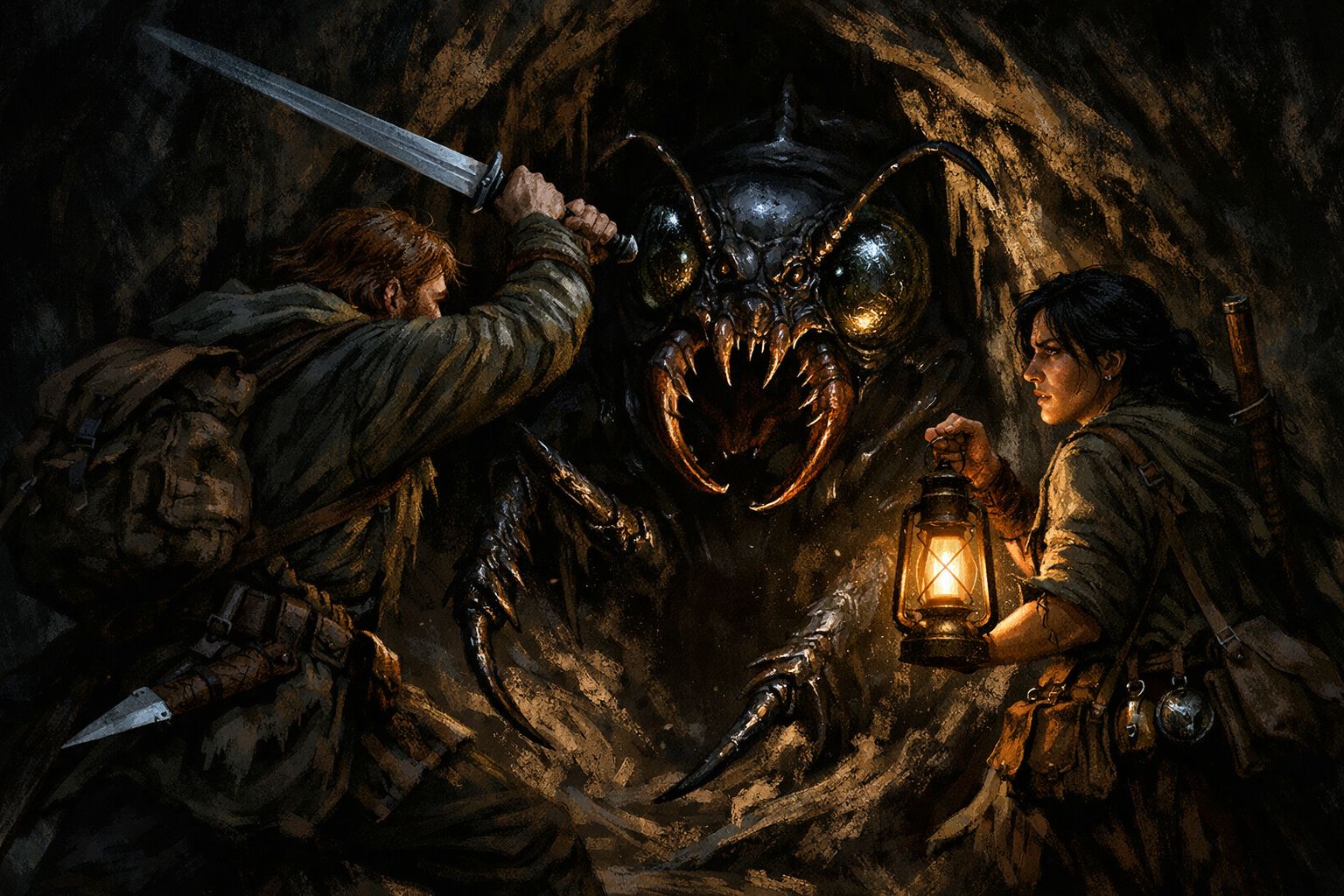
This fight should feel ugly, cramped and necessary. The crew is not facing honorable enemies, frightened animals or opponents who might break and flee. The insectoids are coming to kill. There will be no surrender, no bargaining and no pause once contact is made.
The purpose of the fight is not to create a fair contest in open ground. It is to force the crew to survive by using the cave better than their pursuers do. The tunnel is what makes survival possible. Without it, the crew would be overwhelmed.
What the Insectoids Are Like in Combat
The insectoids should feel immediately different from human opponents. They do not posture, threaten or test defenses. They attack as soon as they can reach the crew, and they do so with full commitment. There is no hesitation in them and no visible fear.
Their fighting style relies on direct aggression and momentum. They rush hard, trying to break through, drag someone down or create enough chaos for the next one to follow. They are not elegant fighters, but they are extremely dangerous. Their jaws can maim, their claws can tear, and their hard carapace makes them difficult to put down cleanly.
This matters because even a single insectoid should feel like a serious threat in close quarters. The crew should not read them as disposable enemies. They are powerful, fast and built to injure. Insectoids are tough, and the scouts are built to be agile fighters.
Why the Cave Matters
The cave is the crew's real weapon.
In open space, multiple insectoids would be punishing to fight. Their aggression, toughness and lack of fear would let them overwhelm even capable fighters through pressure alone. In the tunnel, that changes. Narrow openings, bends and steep passages create choke points where the crew can hold ground and force the enemy into a much narrower front.
This is especially important because fighting multiple opponents at once is dangerous and costly. The cave allows the crew to reduce that danger by controlling how many can come at them together. If they choose their ground well, they can turn a hopeless pursuit into a series of brutal but manageable close fights.
Good Ground for an Ambush
The cave should offer several places where the crew can make a stand. These do not need to be complicated set pieces. A tight bend, a narrow opening, a muddy slope that breaks momentum, a low section that forces the insectoids to bunch up, or a wider chamber reached through a cramped entry can all work.
What matters is that the players can identify places where numbers stop mattering as much. If only one insectoid can reach the crew properly at a time, then the whole crew can focus attacks while the enemy cannot bring its full force to bear.
That should be the tactical lesson of the fight. Do not meet them where they are strong. Make them come through bad ground one by one.
You can support this by describing the tunnel clearly. Mention where the passage narrows, where footing worsens, where a bend blocks sight, and where a line could be held. The more tangible the terrain feels, the more likely the players are to use it intelligently.
How the Insectoids Behave
The insectoids should never feel cautious in a human way. They do not probe defenses politely. They do not back off because the first one dies. If anything, the death of one simply creates the next opening for another to surge forward.
That means the fight should have pressure. Even when the crew succeeds, they should feel that success is temporary and must be maintained. A dead insectoid becomes an obstacle, but only briefly. The next one will climb over it, shove it aside or try to force through around it.
Their behavior should also reinforce the sense that surrender is meaningless. These are not enemies who want prisoners, parley or intimidation. If someone falls, the danger becomes immediate and brutal. The crew should understand very quickly that being helpless in front of these things is the same as being dead, or worse.
Running the Pressure
The fight works best if it feels like a series of short, violent collisions rather than one long neat exchange. The crew finds a defensible place, braces, survives the first rush, then has to decide whether to hold longer or fall back to the next good position.
That rhythm can make the scene much stronger than one static stand. It lets the fight feel like a retreat through hostile ground, with each position bought by effort and each pause costing breath, light and nerve.
You do not have to force several fallback points if one strong stand is enough for your group, but the cave should at least make that possible. It keeps the encounter flexible and lets you adjust pressure without making the enemy feel inconsistent.
Balancing the Difficulty
The insectoids should be formidable, but the exact danger is easy to adjust through numbers and terrain.
If the crew is strong, determined and tactically smart, you can send more of them, tighten the pressure and make the line harder to hold. If the crew is already depleted, poorly positioned or less combat focused, reduce the numbers, widen the space between attackers or make the choke point stronger.
This is the main balancing tool. Not changing what the insectoids are, but changing how many reach the crew and how quickly they do it.
You can also tune difficulty through the cave itself. A very tight bottleneck gives the crew a strong advantage. A broader opening or unstable footing makes the stand more dangerous. Mud, darkness and awkward angles can all make the fight harder or easier depending on how much pressure you want.
The important thing is that the insectoids should still feel dangerous even when the fight is winnable. The players should come away thinking they survived something ugly, not that they solved a routine encounter.
What the Scene Should Achieve
By the end of the fight, the crew should understand three things clearly.
- These creatures are lethal at close range and give no quarter.
- The cave, not raw strength, is what made survival possible.
- If the crew had faced them in the open, they likely would have died.
That is the real purpose of the encounter. It proves the danger of Tikirri in a direct and physical way, and it rewards the crew for using terrain, discipline and desperate practicality rather than heroics.
Departure
Once the scout party has been dealt with, the immediate crisis has passed. The rest of the journey back through the cave and down to the shore should not turn into another major challenge. The hard part is over. What remains is exhaustion, caution and the lingering knowledge of what the crew has just seen.
This section serves as the release after the fight. It gives the crew time to come down from the immediate danger, carry the journal back out of the mountain and begin thinking about what comes next.
The Return Through the Cave
After the fight, the rest of the journey through the cave is long and tiring, but uneventful. The same mud, narrow passages and steep stretches that made the ascent laborious now have to be crossed in reverse, this time by a crew already worn down by tension and combat.
There is no need to add a second threat here unless something has gone very wrong earlier. The cave has already done its work. On the way back, it should feel heavy, damp and endless, but not dangerous in a new way. The crew has survived the real crisis. Now they have to carry themselves, their gear and Teren Morvail's journal back to the outside world.
By the time they emerge above the basin and descend to the shore, everyone should feel the strain of the day.
The Question of Sealing the Cave
The crew may well consider sealing the cave behind them. This is a reasonable thought, and it is worth addressing directly.
Yes, it is possible to block or collapse sections of the passage, especially near the outer entrance where the route is more accessible. With time, labor and the right tools, they could make the way much harder to use.
The problem is that doing so properly would take days. The crew would need to remain here, exposed and working in difficult terrain, in a place they already know to be dangerous. Even then, the result would likely be temporary rather than permanent. The cave was shaped by water in the first place, and the same mountain weather that carved it still acts on it. Heavy rains, shifting stone and the slow force of runoff would likely reopen some usable route in time.
From what they have seen of the insectoids, it is well within their capability to clear whatever obstruction the crew could build.
So sealing the cave can be presented as possible, but not truly decisive. It is the sort of task that costs a great deal and solves less than one might hope. That helps keep the decision practical rather than turning it into an obvious moral or tactical obligation.
If the crew decides to do it, let them, but present it as a temporary measure rather than a solution.
Thaleia and Tekrissal
Thaleia should leave this section energized rather than chastened. The danger of Tikirri is real, but what it has done to her is sharpen her hunger for answers. Teren Morvail's journal, the glimpse into the crater and the repeated hints of a connection to Tekrissal all push her in the same direction.
By the time the crew is back aboard ship, she should already be speculating aloud about what Tekrissal may contain. Ruins, records, anatomical parallels, evidence of contact, signs of a shared history, perhaps even the missing pieces that Teren never lived to confirm. She does not need to know the answers yet. The important thing is that she is openly excited by the prospect of going there.
That excitement is useful. It helps shift the energy of the arc away from mere escape and toward the next destination. Tikirri ends not only with survival, but with a stronger intellectual pull forward.
Either way, they can't leave her here, alone in a dangerous land.
Act Summary
Teren Morvail and His Journal
They recover the journal of Teren Morvail, a respected Morvelyn scientist known to Thaleia. His notes become their main source of knowledge about Tikirri and their first real link between the crater and Tekrissal.
Tikirri and the Insectoids
They learn that Tikirri is not a nest or monster lair, but a true insectoid civilization. It has organized labor, fixed patterns of movement and radically different castes built for different roles.
They learn that this civilization appears to be ruled by some form of central intelligence, likely seated at the heart of the crater around the lake and black spire.
They learn that Tikirri follows a different biological order from the rest of the world. There seem to be no mammals, birds or other soft-bodied creatures there at all, only hard-shelled life.
They learn that the insectoids do not merely defend territory. They appear to actively hate beings unlike themselves, especially soft-bodied outsiders.
They learn in direct combat that the insectoids are fast, fearless and extremely dangerous, and that open ground against them is death.
Protecting the Outside
They stopped the scouts from escaping and reporting what lies beyond the crater. The danger of Tikirri is not only local. It could spread outward if the insectoids ever truly learn that there is a wider world beyond the rim.
Thaleia
Thaleia proved herself invaluable throughout the expedition. Her knowledge let the crew understand what they were looking at instead of merely fearing it. She recognized the importance of Teren Morvail's work at once, helped interpret his damaged notes and turned scattered observations into something the crew could act on. Without her, they would still have found the crater and the journal, but much of what they gained from both would have remained incomplete.
Meyrha's Vision
Meyrha's vision now makes sense in retrospect. The "soft, shapeless demons" were not demons at all, but humans and other outsiders as seen through the logic of Tikirri, where anything without shell or carapace is wrong. The great mind and moving blackness point toward the centralized intelligence behind the insectoid civilization and the ordered mass of life within the crater. What seemed at first like an abstract and unsettling omen becomes, after the expedition, a distorted but recognizable glimpse of the hidden world below.
The Waverider
The crew confirms that the Waverider came to Tikirri and then continued on to Tekrissal. Teren Morvail's journal makes that clear through his account of meeting the Waverider crew and sharing his theories with them.
They leave Tikirri with a clear next destination. Tekrissal is no longer just another ruin, but the place most likely to explain what Teren suspected and what the Waverider went there to learn.
The sea was calmer now, open and clean beneath a pale afternoon sky, and the deck had begun to settle back into its usual rhythm. Men worked lines. Wood creaked. Canvas shifted in the wind. Yet a strain still lingered in the ship, as though some part of the crew had not quite accepted that rock, cave and crater now lay behind them.
Thaleia certainly had not.
She sat cross-legged near the rail with her notebook open across one knee, a scatter of loose notes tucked under her arm and a stick of charcoal moving in quick, restless strokes. One page already held three studies of insectoid limbs and a half-finished side view of a worker caste head. Another was covered in small notations and cramped observations written so fast that only she was likely to read them later. Her hair had escaped its bindings again, and she kept blowing stray strands out of her face without noticing she was doing it.
"No, but that is exactly the point," she said, not so much speaking to the others as continuing a thought that had clearly started several minutes ago and never paused. "They are not merely different specimens of a single body plan. The divergence is structural. Foundational. It is social order written directly into anatomy, which is already extraordinary, but what matters even more is what that may mean for Tekrissal, because if there was prolonged contact, or even conflict, then the ruins may preserve adaptive responses, records, depictions, perhaps even"
Skarnulf stood beside the mast with his arms folded, listening with the fixed patience of a man enduring weather. His face had the calm, closed look it often wore after unpleasant work, though in this case there was perhaps a trace of relief under it.
"I am just happy to be out of there," he said.
Thaleia looked up, blinking once as though surprised anyone had interrupted her. "Out of there, yes, obviously, but that is not really the important thing."
"It is to me," Skarnulf said.
Scarnax gave a low snort from where he leaned against the rail. He had a mug in one hand and the look of a man recovering his good humor by slow degrees. "Stomped a cockroach this morning," he said. "Felt wonderful."
That got the ghost of a smile from Skarnulf.
Thaleia stared at Scarnax. "That is not the same thing at all."
"No?" Scarnax said. "Small black thing with too many legs. Seemed close enough."
She made an exasperated sound and went back to sketching, charcoal moving even faster now, as if indignation itself improved her line work. "You are being deliberately stupid. Their social organization alone would justify a full expedition. The crater, the castes, the central structure, the complete exclusion of all non-exoskeletal life, all of it points to a biological and cultural system unlike anything in the known world. And Tekrissal may finally tell us why."
Skarnulf looked out over the sea. "I preferred it when all we knew was that it was a bad place full of things trying to kill us."
"It is still that," Scarnax said.
"Yes," Thaleia said impatiently, "but now it is also interesting."
At that moment Ileena wandered into the edge of the conversation, loose-limbed and apparently half asleep. She stretched once, catlike and unhurried, then dropped herself onto a coil of rope with the comfortable certainty of someone who could sleep almost anywhere.
"The shells made it difficult," she said.
Scarnax glanced at her. "What did?"
Ileena settled deeper into the rope and folded one arm behind her head. "Cutting their hearts out."
There was a short silence.
Thaleia slowly stopped writing.
Skarnulf turned his head and looked at Ileena with the expression of a man checking whether he had heard correctly. Scarnax's brows went up.
Ileena opened one eye at them. "What?"