Campaign: The Steppe Orcs
Act Synopsis
Arrival on the Steppe
The Blue Marlin makes landfall on the Skarthuun steppe, a hard open country of wind, river reeds and long sight lines. Scarnax puts a careful landing party ashore, bringing Grishna as guide and cultural anchor. The first hours set the tone: the steppe is not a dungeon, it is politics at spear point, watched from far away by riders who do not announce themselves.
The River Bone Ruins
The crew follows Grishna’s memory and the Waverider’s trail toward the River Bone Tribe. They find the camp plundered and emptied, with a corpse pile left for an unnamed warrior. There are no survivors present, no chiefs to negotiate with, no clean enemy to chase. It is a warning that the steppe settles disputes by erasing camps, then moving on.
Grishna frames the horror in steppe terms. The dead are the cost of defeat, but the women and children are rarely slaughtered. They are absorbed into the victors as obligation and workforce, becoming new kin whether they want it or not. If the crew can find the victors, they can find River Bone survivors who remember the Waverider’s visit and the next port of call.
Following the River
Tracks and dragged sign lead along the river. The crew cannot use a skiff because the water is shallow and broken by gravel bars, so they commit to a tense march upstream. This travel phase should feel exposed and uncomfortable: open ground, limited cover, constant uncertainty about being shadowed, and the growing realization that every footprint on the steppe is an announcement.
During this leg, the crew’s main pressures are pace, water and steppe etiquette. The goal is not to punish them mechanically but to make it clear they are out of their element and dependent on Grishna’s judgment.
First Contact with the Victors
By evening they locate the camp that took the River Bone survivors. This is a functioning steppe settlement, not a war band bivouac, and the camp answers approach with mounted challenge and drawn weapons. The chief is Varkhul of the Storm Caller Tribe, a leader whose authority rests on harsh competence and a reputation for paying obligations even when it hurts.
Before negotiations can settle, a second tribe strikes.
The Running Wolf Raid
The Running Wolf Tribe launches a proving raid against Varkhul’s camp. They are not here to burn everything, they are here to test strength, take something visible, and leave with a story. Their timing turns the crew’s arrival into a problem and an opportunity. If the crew fights for Varkhul, they buy a seat at the fire. If they hesitate, they become suspect. If they fight against him, they become enemies of the only camp likely to hold River Bone survivors.
Grishna insists on restraint. No killing. In steppe logic, killing creates obligations, and obligations mean mouths to feed and new kin to protect. The crew does not want those obligations, which makes the “no killing” rule culturally defensible, but tactically dangerous. The Running Wolf are strong enough that the easy solution is lethal force, and the crew must win while holding back.
Tentative Hospitality
After the raid is repelled, the crew is treated as tentatively friendly. They are invited inside the camp boundary, fed, watched, and tested. The River Bone survivors are present among the absorbed, including several women who were there when the Waverider visited. They recognize the crew’s questions and confirm that the Waverider spoke of a next destination.
They do not give it freely.
The Price of Information
Varkhul offers a bargain. He will provide the next port of call, but the crew must do him a favor that fits steppe honor.
The Running Wolf Tribe has been a constant annoyance, and recently stole most of his horses. Varkhul could raid them and take the horses back, but that would mean killing Running Wolf warriors, which would force Varkhul to absorb their women and children. He does not want that burden now. More importantly, he wants humiliation, not blood. Having lowly humans steal the horses is a deeper insult than losing them in battle, the steppe equivalent of being robbed by a child in front of your own household.
The task is framed as an honor weapon. The crew is not asked to win a war. They are asked to make a point so sharp that it will be repeated in songs and jeers.
The Horse Theft
Varkhul provides the Running Wolf camp’s last known position, roughly two days away. The crew moves fast, now with a defined mission and the understanding that failing will make them disposable in Varkhul’s eyes.
Approach requires stealth and patience. The Running Wolves have sentries, dogs, and riders who can appear from nowhere. The crew must avoid being detected, choose a night entry, cut the herd loose, and force the horses to run without turning it into a stampede that gives away their route.
Once they have the horses, the balance shifts. The Running Wolves cannot easily pursue without mounts. The escape becomes a hard ride through darkness and cold wind, a sprint back to Varkhul’s camp driven by adrenaline and the knowledge that any delay lets the story change from “humiliation” into “failed thieves.”
Feast and Acceptance
The crew arrives right after nightfall. Varkhul receives them openly, turning their success into public theater. They are now treated as friends rather than tolerated strangers. The camp holds a feast, and the Running Wolves become the target of ridicule, jokes, and ritualized contempt. The crew finally receives what they came for: the next destination the Waverider spoke of, enough detail to set the Blue Marlin’s course.
The feast also locks in consequences. The crew has taken a side in a feud, whether they intended to or not.
Concerns at the Feast
During the feast, Varkhul draws the crew into a quieter talk away from the loudest joking. He speaks of a growing rumor on the steppe: a chief named Raskaahn who is trying to unite the tribes under one banner and turn the steppe into a conquering force. Varkhul refuses the idea on principle. Great kings and empires are not the orc way, and he believes any tribe that submits will be used, spent and reshaped into something lesser.
His refusal is not brave certainty. It is fear with a spine. If Raskaahn succeeds, Varkhul expects the Storm Caller Tribe to be crushed sooner or later, either for resisting or simply for being in the way. He is looking for a way out that does not involve bending the knee, and he is curious about the Grashkaar way of restraint, obligation and long memory.
Grishna explains what the Grashkaar believe, and what they demand from those who follow them. The crew gets a chance to sway Varkhul’s thinking, either toward cautious interest or hard rejection. He will not commit to any course now, but the conversation plants a direction that can shape his future choices, alliances and willingness to help later.
This scene also sets a larger shadow over the steppe. Something is rising, and the crew has glimpsed it early.
Morning Reckoning
In the morning, as the crew prepares to leave, Running Wolf warriors arrive at Varkhul’s camp. They demand the humans who stole from them, hoping to salvage face even if they cannot win a fight. Their plan likely included a surprise recovery, but they failed to achieve surprise, and now they must make a statement with words.
Varkhul refuses in deliberately insulting terms, designed to deepen the humiliation. Posturing follows. Young warriors on both sides issue challenges and counter challenges, not because war is wise but because pride is louder than wisdom.
Foreigners are beneath steppe duel honor, so the crew are not challenged directly. However, if the crew challenges the Running Wolves, they will accept the challenge.
A few duels are fought. When a duel ends, some women and children may change tribes as part of the social accounting that follows victory and defeat. Eventually the Running Wolves withdraw, having made their point without forcing a battle they cannot win.
Departure and Grishna’s Choice
With the destination secured, the Blue Marlin departs the steppe. Back aboard, after the wind and tension finally ease, Grishna asks to join the crew.
For the Game Master, this is both a character beat and a strategic choice. Grishna is a cultural bridge and an internal moral constraint. She also carries steppe complications with her, because steppe tribes do not forget insults, and working with humans is a stain that will be used against her when it is convenient.
Arrival on the Skarthuun Steppe
Crossing the Coastal Mountains
After the Blue Marlin clears the last of the coastal mountains, the landscape opens into dry steppe and hard sky. The river that seemed like a reliable route turns fickle within a few miles, flattening into shallow runs over pale stone, then pinching into narrow rapids that hiss between boulders.
Where the River Fails
The river is too shallow for a skiff. In places it is wide and thin enough to wade across, in others it breaks into rocky channels that would grind a boat apart. They will have to continue on foot, and the crew takes only what they can carry without slowing themselves into exhaustion.
Grishna advises that any camp worth finding will cling to water. On the steppe, the river is not scenery. It is survival, and it is a line that draws people to it like iron to a lodestone.
The March Upstream
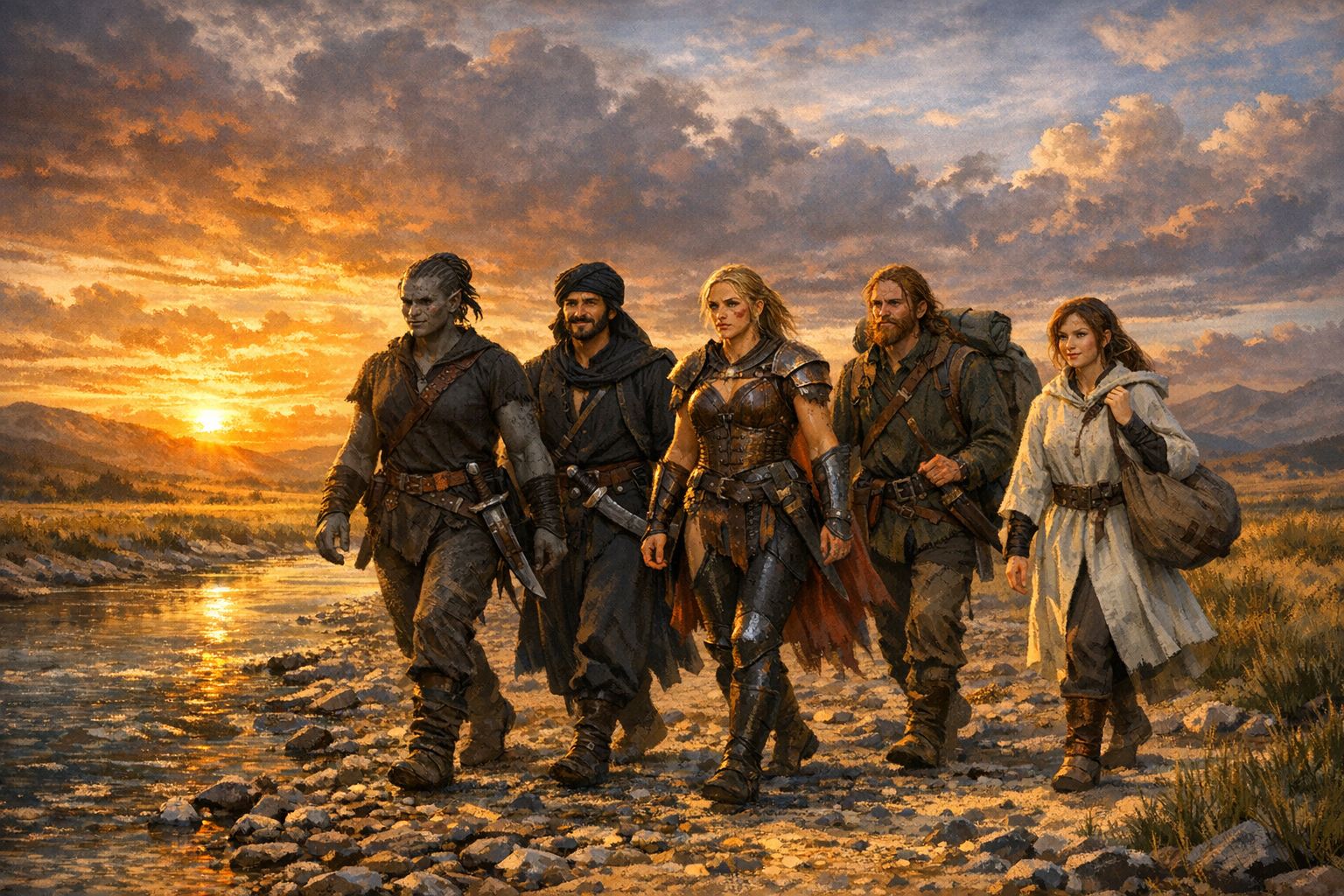
Travel is straightforward and exposed. The steppe is flat and easy to traverse, but that simplicity is its own pressure. There is little cover, long sight lines in every direction and nowhere to disappear if riders decide to watch.
The weather is harsh, with cold nights and warm days.
The crew follows the river upstream for two days. They make steady time, guided by the logic that the River Bone Tribe would have camped close to water and grazing, close enough to drink and far enough to see trouble coming.
Approach at Dusk
Late on the second day, shortly before sunset, the crew reaches the place where the River Bone camp used to be. The light drops fast, the wind cools and the river noise becomes louder in the narrowing channels.
This is where the steppe begins to feel less like distance and more like intent. The crew is no longer traveling through it. They are arriving somewhere that mattered to someone.
The River Bone Ruins
The River Bone camp had been a place once.
Now it was only a shallow ring of trampled earth in a shallow valley where tents had stood, a few stakes still driven into the ground like broken teeth. The river ran close enough that the air should have smelled of wet stone and cold water, but the first thing that reached them was not the river.
The smell was not fresh. It was old death baked into hide and earth, a dry tang that still clung to the wind.
Junia stopped without meaning to. Her hand went to her mouth, and she stared as if she could not make her eyes accept what was there. Gastved’s boots scraped over gravel and then he halted too, shoulders squaring the way they did when he wanted his body to become a wall.
Amaxia took a step forward, then another, then froze. Her face was hard, but her eyes were not. She had seen bodies before. So had all of them. This was different. This was not aftermath. This was intention.
The corpse pile rose in the center of the ruined camp like a monument. Men stacked on men, limbs tangled, picked clean in places, weathered into a pale ruin that still held its shape. It was too high to be an accident, too careful in its shape to be haste. Whoever had done it had stayed long enough to build it.
Nasheem’s gaze moved over the ground, the missing places where life had been. The absence of scattered tools. The lack of torn cloth. The way the camp felt stripped, not smashed.
Grishna walked ahead of them, slower now. Her nostrils flared. Her jaw tightened, and when she spoke her voice had the flatness of someone trying to keep a lid on anger.
“This is a warrior’s pile,” she said. “Not just dead thrown together. A pile like this is burial and honor at once. A great warrior lies at the bottom, and every body stacked above him raises his name.”
Amaxia’s head snapped toward her. “Honor. That is what you call this.”
Grishna did not look away. “It is what they call it. I'm not steppe, I'm Grashkaar. The steppe does not mourn like you do. It counts.”
She crouched and brushed her fingers over the earth near the edge of the ring. There were cuts in the ground where heavy loads had been dragged. The faint pattern of wheels. Hoof marks pressed into dried mud then hardened.
“See,” she said, pointing with two fingers. “Most of the camp was taken, not destroyed. Stakes pulled. Frames carried. Goods packed. This was not a slaughter for its own sake.”
Junia swallowed, her voice small. “Then where is everyone.”
Grishna stood again. “Taken in.”
Amaxia’s hands clenched. The tendons stood out in her forearms as if she was holding a blade she could not show. “Taken. You mean stolen.”
“I mean adopted,” Grishna said, and the word sounded like a stone. “Women and children do not get left to starve on the steppe unless someone wants them dead. If a camp is broken, if a warrior is killed, the one who dealt that death inherits responsibility for those left behind. That responsibility can be carried by his tribe, but it begins with the killer. Not as trophies. As obligation. More mouths, more work, more kin. Mercy, and burden. They will be fed. They will be watched. They will be part of the tribe that broke them.”
Amaxia stared at the bodies again, and her voice dropped. “And the men.”
“The men are the price,” Grishna said. “The steppe is cruel, but it has rules. Kill the fighters, take the rest, carry the weight of it. That is the law here.”
Nasheem had not stepped close to the pile. He stayed at the edge, scanning the ground the way he scanned decks before a storm, taking in what was missing as much as what remained. When he spoke, it was quiet, almost thoughtful.
“If the women were taken in,” he said, “then some of them may have heard the Waverider crew talk.”
Grishna’s mouth twitched, not quite a smile. “Yes. Men speak as if women are not there. Women are always there. We hear. We remember.”
Gastved shifted his weight and looked along the river as if he expected riders to crest the far bank at any moment. “Then we do not waste light,” he said.
Nasheem nodded once, decision settling on him like a cloak. He looked at the river, then at the dragged tracks, then back at the empty ring where tents had been.
“So,” he said, voice firm now, “let’s find them.”
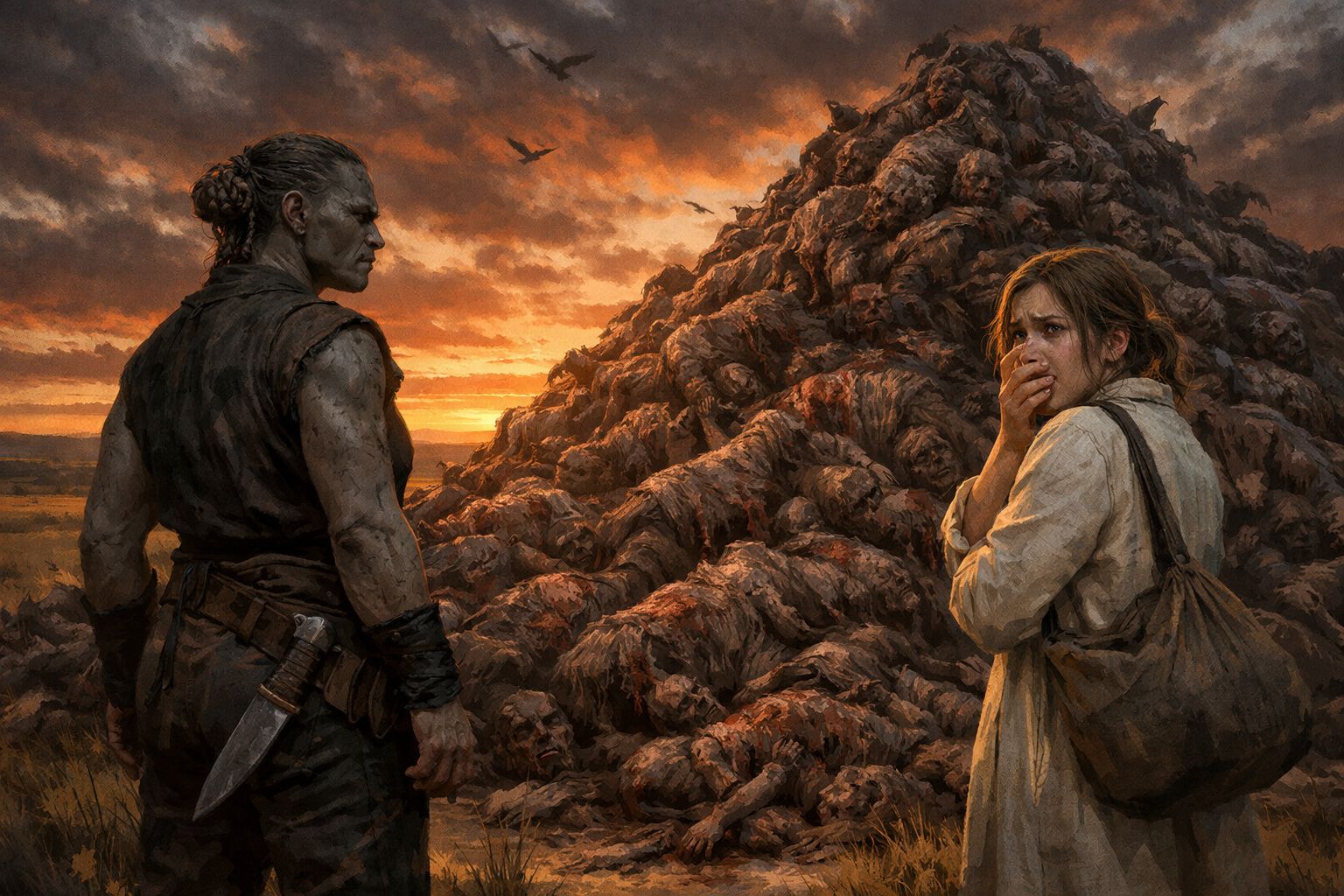
The River Bone camp lies in a shallow valley close to the river, hidden until the crew is almost on top of it. The remains are stripped rather than smashed. A few stakes, trampled earth, torn reeds and scattered ash marks show where tents and fires used to be, but most of the camp has been packed up and taken away.
The center of the site is dominated by a massive corpse pile. It is old, months weathered, but still deliberately shaped. This is not a careless heap left by scavengers. It is a constructed burial monument.
Cultural Significance of the Corpse Pile
Grishna identifies it as a warrior’s honor pile. A great warrior, likely a chief or champion, was placed at the bottom, and bodies were stacked above him to raise his honor. The higher the pile, the greater the statement. Creating this pile is the likely reason for the raid.
Grishna also explains the steppe obligation tied to killing. When a warrior is killed, the responsibility for those left behind begins with the killer. In practice the victor tribe often carries the burden together, but the logic matters: killing is not only violence, it is inheritance. This is the foundation for Grishna’s later insistence on restraint, because the crew does not want to gain unwanted obligations to an orc family or trigger a chain of debts they cannot afford.
What Happened Here
The River Bone Tribe was broken, and the camp was taken. The lack of scattered goods and the signs of hauling and dragging suggest an organized departure after the fight. The women and children were not left behind. They were taken into the victor tribe, adopted as new kin by steppe custom. This is seen as obligation and mercy, even though it is brutal by any other standards.
Likely Direction and Next Move
The crew can read the ground for the raiders’ departure. The most plausible trail leads along the river. On the steppe, water dictates movement, and a tribe that just absorbed new mouths will keep close to the river for drinking, grazing and visibility.
The most likely direction is further upstream. Following the river is the fastest way to find the victor camp and, with it, surviving River Bone women who may have overheard the Waverider’s visit and the next port of call.
Following the River
The crew continues upstream along the same shallow river, but the water narrows further. The broad gravel bars become more common, the channels cut tighter and the rapids appear more often. It remains impassable for a skiff, and the river stays the obvious line to follow through open steppe.
Travel Rhythm
This stretch should feel like more of the same. Flat ground, long sight lines and constant exposure. The river is still the anchor for navigation, water and the assumption that any camp will cling to it.
If the crew breaks camp early and starts in the morning, they can reach the next camp site by the evening the following day. The main decision points are pace and how openly they travel, since there is little cover and any watchers on the steppe will see them long before they see the watchers.
First Contact with the Victors
Smoke came first.
A thin line on the horizon that did not belong to grass fire or lightning strike, steady and patient as a signal. Junia shaded her eyes and leaned forward as if the shape of the world might change if she looked hard enough.
"There," Nasheem said. It was not a guess.
They walked toward it for another hour, the river threading beside them like a dull blade. The wind carried the camp’s smell before it carried voices. Wood smoke, boiled fat and something sharp that could have been tanning.
Then the steppe moved.
Figures rose from behind a low swell of ground and came at a trot, spreading as they approached until they formed a loose half circle. Twenty or so orcs, on foot, spears angled forward. They did not rush. They came like people who owned the open ground.
The one in front was broad even for an orc, with braids tied in leather and a scar that split his lip. He planted the butt of his spear into the earth and stared at the humans as if counting them.
Grishna stepped ahead of the others by a single pace. Not sheltering behind them, not presenting herself as a hostage. A statement.
The scarred orc spoke in The Word, thick with steppe cadence, the vowels clipped and hard. "Grashkaar with humans. That is a strange leash."
Grishna lifted her chin. "If you think I wear a leash, you have never seen a leash. Put the spear down before you poke yourself and have to pretend it was a battle wound."
A couple of the orcs snorted. One laughed outright, a short ugly sound that still meant approval.
The leader narrowed his eyes, looking past her at Amaxia, then Gastved, then Junia’s smaller shape. "No glory in cutting a few travelers," he said. "So tell me why you walked to my smoke."
Grishna spread her hands. "Because smoke means someone is alive. Because the river is smaller here and camps cling to it. Because we are looking for River Bone."
At the name, the orcs shifted. Not fear. Attention.
The leader’s mouth twisted. "River Bone is gone."
"Then you know the story," Grishna said. "And you will tell it, if you want to see how clever you sound when you do."
The scarred orc barked a laugh. "Storm Caller pride," Grishna went on, nodding at the small token tied to his spear shaft. "I have seen more frightening storms in a cookpot."
Amaxia’s jaw tightened, but Grishna kept her stance loose, her insult measured. Strong enough to prove she was not begging, soft enough that it could be taken as a joke if the mood turned.
The leader let the moment stretch, then jerked his chin toward the camp. "Walk," he said. "Hands where I can see them."
"Fair," Grishna replied. Then, louder, as if addressing the whole half circle, "If you kill guests before you learn their names, your mothers will beat you for it."
That earned more laughs, not kind, but curious.
They were surrounded, not grabbed. Spears stayed close enough to remind, far enough to avoid looking afraid. The orcs guided them over the last rise, and the camp revealed itself in a shallow fold of land near the river. Hide tents and reed shelters, low fires, tethered horses, children darting between legs like quick shadows.
Then the wind shifted.
Dust on the far horizon, a low brown smear moving fast across the grass.
One of the mounted orcs went rigid. His head snapped toward it. He shouted one word, and the whole camp seemed to hear it.
"Raid!"
Everything moved at once.
The orcs spun and broke into a run back toward the camp, spears lifted, voices rising. A horn sounded, harsh and raw. Dogs began to bark.
Nasheem did not hesitate. He looked at Gastved, then at Junia and Amaxia. "Stay close."
They ran.
By the time they crested the rise again, the fight had already begun.
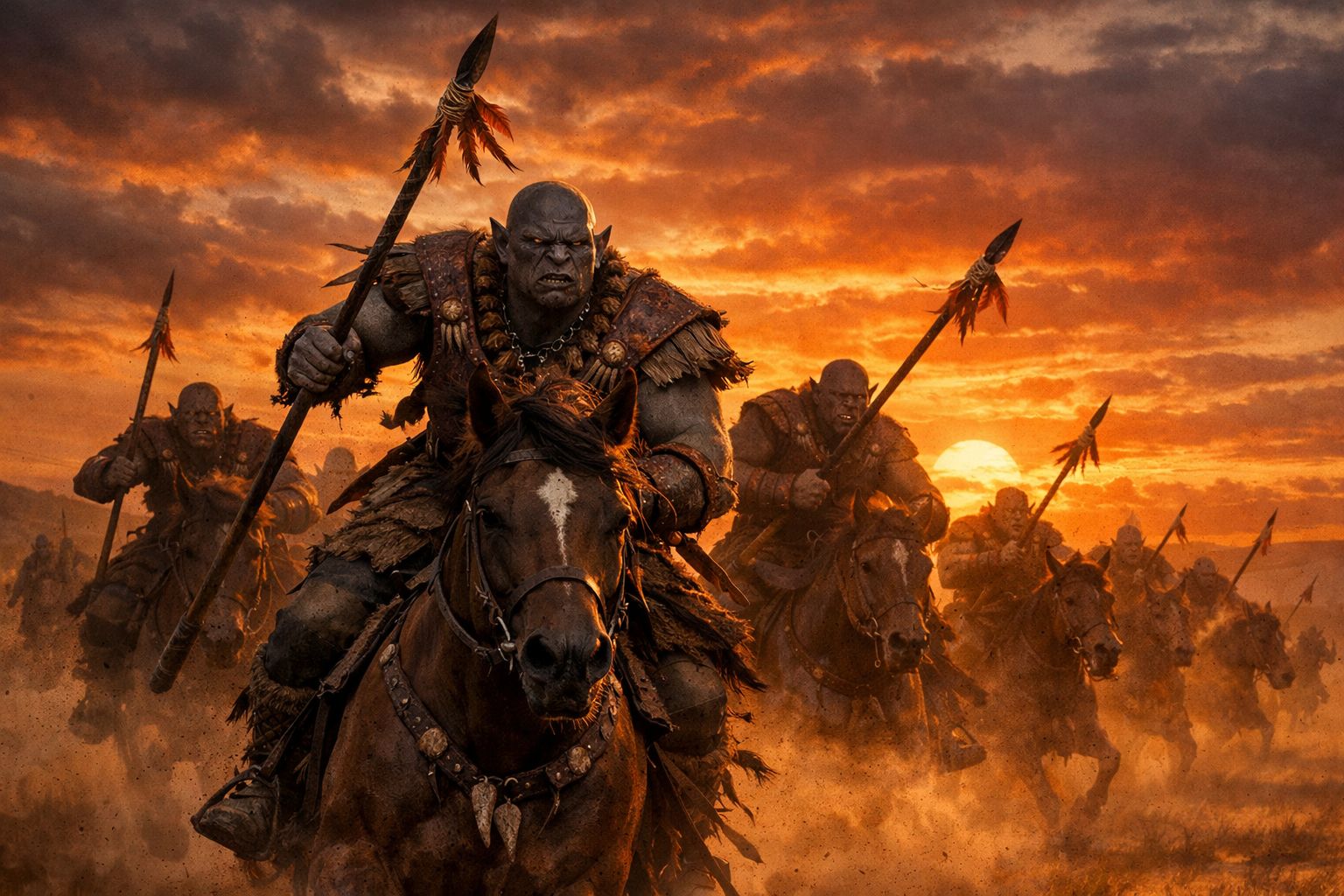
Mounted orcs were in among the tents, riding hard, hacking at ropes, yanking at tether lines, driving chaos like a wedge. Their horses gave them height and speed, and every pass of hooves forced the Storm Caller defenders to scatter or be trampled. Spears jabbed up, arrows flicked through smoke and someone screamed near a fire that had toppled.
Gastved’s voice cut through the noise as they pounded down toward the edge of the camp. "What do we do."
Nasheem’s answer came without drama. "We need these people willing to talk. So we fight their enemies."
Amaxia was already moving, teeth bared in something that was not quite a smile. Junia’s breath was ragged, but she ran too, because stopping was not an option.
Grishna sprinted beside them, and as they closed on the clash she shouted, loud enough to be heard over iron and panic.
"Do not kill anyone!"
The crew follows the river upstream and eventually spots a thin line of smoke on the horizon. This is the first clear sign of a living camp. As they close the distance, the camp remains partly hidden in a shallow fold of land near a bend in the river, which delays the reveal and prevents the crew from reading its full size until they are close.
The Storm Caller Intercept
A patrol detaches from the camp and moves out to meet them, roughly twenty orcs, on foot. They approach in a loose half circle, spears forward, projecting control rather than immediate intent to kill.
The patrol leader is Kharvak Split Lip, a warrior known for blunt humor and a scar that splits his lower lip. He is not looking for glory in killing a handful of humans, but he is curious why humans are walking the steppe with a Grashkaar orc.
Grishna handles the contact. She uses balanced insults and jokes, speaking as an equal rather than a supplicant, and making it clear she is not leashed. Her goal is to avoid looking weak without turning the patrol hostile. The patrol keeps the crew at spearpoint and marches them toward the camp as a controlled escort rather than a prisoner chain.
The Raid Alarm
As the escort nears the camp, a dust plume appears on the horizon. The patrol reacts instantly. Someone calls out and the escort breaks formation, rushing back toward the camp.
This is a rapid transition from social tension to immediate violence. The crew has only seconds to decide whether to flee, stand back or follow.
What the Crew Sees on Arrival
When the crew reaches the camp edge, the fight has already started. The attackers are mounted and have a clear advantage in speed, reach and shock impact. Their goal is likely a proving raid: create panic, take something visible such as horses or a banner, then withdraw with a story.
Storm Caller defenders are scrambling to form a line, protect the tethered animals and keep the fight from ripping through the tents. Noncombatants are scattering, and the camp is loud with horns and shouting.
The Crew’s Decision
If the crew wants Storm Caller cooperation, siding with the defenders is the simplest path.
As they run in, Grishna calls the key constraint: ‘Do not kill anyone.’ This is not a demand from the Storm Callers. It is Grishna protecting the crew from steppe obligations that begin with the killer. Victory is still expected, but lethal solutions create steppe obligations and debts the crew cannot afford. The crew must fight to disable, drive off, dismount or capture rather than kill, even against mounted raiders.
Running the Raid Fight
This fight is about belonging, not winning. The Storm Callers will do most of the fighting. The crew’s role is to step in at key moments so the camp sees them as allies who chose a side under pressure.
Grishna’s constraint matters. The crew must avoid killing, not because it is virtuous, but because killing on the steppe creates obligations and debts the crew cannot carry.
Battle Shape
Keep the fight as a series of fast, readable moments rather than a long grind. The raiders are mounted and strike in passes. Storm Caller defenders are on foot and trying to protect tents, tether lines and noncombatants.
Use Kharvak Split Lip as the visible Storm Caller point of reference in the chaos. He shouts orders, drags warriors into position and will remember who helped and who hesitated.
Key Moments for the Crew to Interfere
Pick two or three moments and let the crew solve them. Everything else happens around them.
A Rider Breaks for the Tents
A mounted raider tries to cut loose a cluster of Storm Caller tents. If he succeeds, the tents are torn down, and will burn. The crew can stop him by dismounting, tangling the horse, breaking tack, or forcing him to retreat.
A Defender Goes Down
A Storm Caller warrior is knocked into the dust and a second rider lines up to trample him. The crew can pull the warrior clear, wedge a shield, spook the horse, or strike the rider in a way that does not kill.
A Noncombatant Is Cornered
A child, an older woman, or a wounded is trapped near a tent as riders swing through. The crew can extract them, block a spear thrust, or create a distraction that draws the pass away.
Capture an Attacker
An attacker is knocked off his horse, and the crew can disable him before he gets up.
Nonlethal Tools and Tactics
Remind players early that their goal is to disable and drive off, not to slaughter. Suggested approaches include blunt strikes, leg shots, knocking riders off balance, seizing reins, cutting straps, throwing sand, forcing horses to shy and creating barriers with shields or tent poles.
If a player asks how to do it, Grishna can shout a short instruction in the moment, such as “Take the horse” or “Break the strap, not the spine.”
When the Fight Ends
End the fight when the raiders lose their momentum. They withdraw once they fail to take a visible prize or once a few of them are dismounted and the camp begins to form a coherent defense. A proving raid is satisfied by survival and story, not by total victory.
The Storm Callers will watch how the crew fought. If the crew saved lives, protected the camp and attacked raiders, they earn tentative hospitality.
If they kill, they will not be looked down upon, but they may have to adopt an orc family. If this happens, let the crew have to drag around and protect and feed the family for a while. When they leave the steppe, Grishna suggests taking the adopted orcs to Grashkaar.
Tentative Hospitality
They were brought through the edge of the camp with eyes on them the whole way, not hateful, not friendly, simply measuring. Smoke drifted low. Dogs circled and barked once then quieted. Warriors moved with the restless energy of a camp that had just been tested and was still deciding what it thought of strangers.
Varkhul waited near the largest fire ring, close enough that everyone would see who spoke with him. He was older than Kharvak Split Lip, thick through the shoulders, hair bound back with rawhide. His gear was plain but well kept. A chief who did not need decoration to be believed. Two warriors stood behind him like posts, faces unreadable.
His gaze moved over the crew, then returned to Grishna. When he spoke, it was The Word, heavy with steppe cadence.
"You fought on our side. That buys you my attention."
Nasheem stepped forward with his usual calm, hands open, voice polite as if they were discussing docking fees instead of blood. "We are looking for information. The Waverider was here, seasons ago. We need the next port of call it spoke of."
Varkhul nodded once, slow. "I have what you want."
Junia let out a breath she did not know she was holding, then stiffened when Varkhul continued.
"But you do not get it because you ran into a fight already happening. A token effort is still a token."
"Enough," Grishna said. Not loud, not pleading. Flat. "Name your price."
A few warriors smiled, not at humor, but at the familiar bite of an orc speaking as an orc. Varkhul did not. He studied her for a heartbeat, then his mouth curled in something that was not quite a smile.
"Running Wolves," he said. "They took our horses. Not one or two. Most."
Nasheem’s eyes narrowed slightly. He had the look of a man already calculating distance, time and risk.
Varkhul’s voice hardened. "I could raid them. I could take the horses back and leave their dead for their women to cry over. Then I inherit their hungry mouths. Their children. Their problems. I do not want that."
He leaned forward a fraction. "But weak humans stealing from the Running Wolves. That is shame that sticks. That is a story that makes them choke on their own pride."
Amaxia drew breath again, outrage and instinct both pushing her forward.
Grishna cut it off without even looking back. "Where is their camp."
Varkhul’s eyes flicked to Nasheem, then to Junia, then back to Grishna as if weighing whether the crew understood what they were agreeing to. He nodded once.
"Two days," he said. "Follow the river until the ground rises and the water cuts narrow. You will see their smoke at dusk if you keep moving."
Nasheem inclined his head. "Then we will go."
Varkhul’s gaze stayed on them, steady and unreadable. "Go, then. Bring me their horses. Bring me their humiliation. Then I will tell you what the Waverider told us."
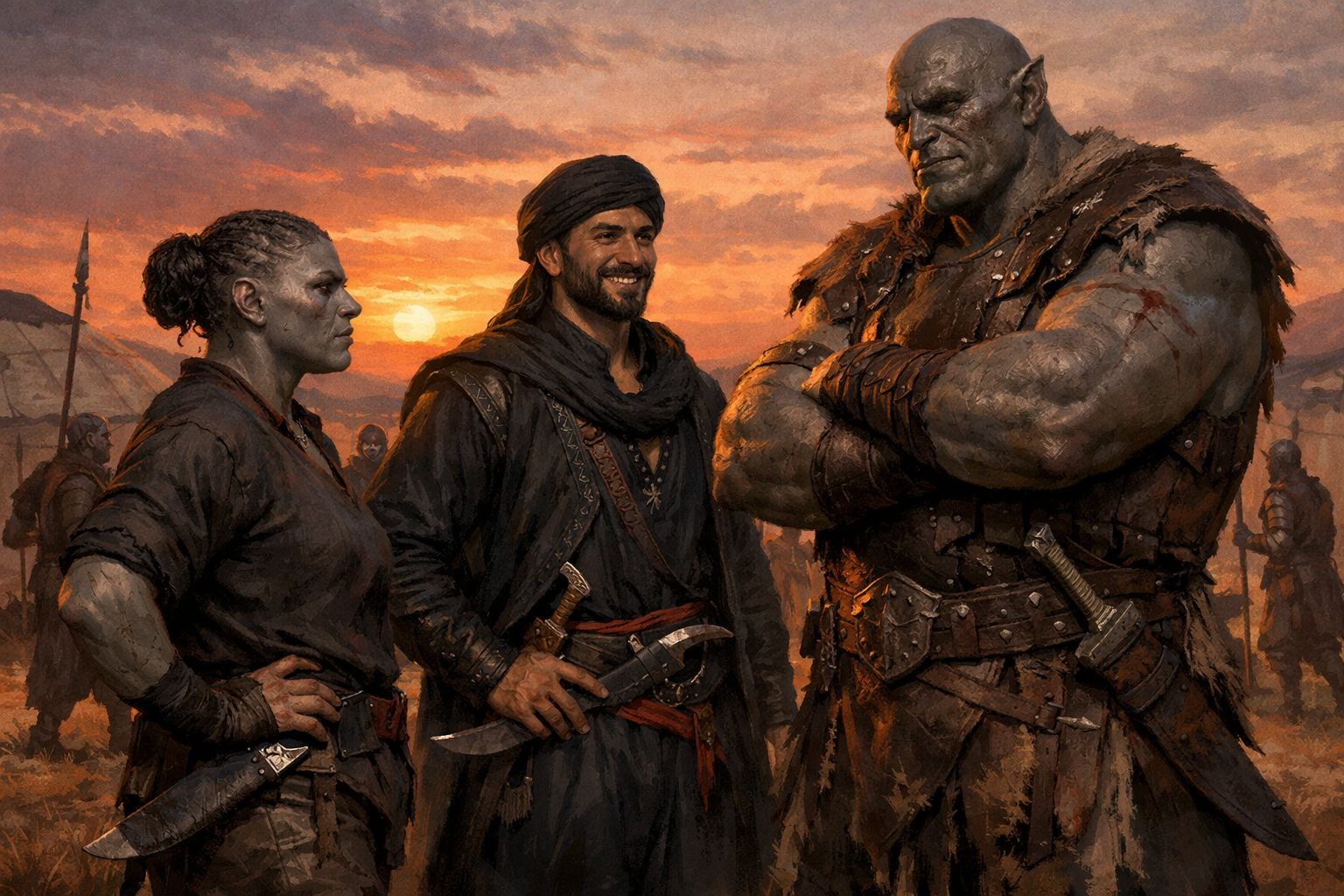
This is a direct negotiation scene that turns the crew’s battlefield choice into access. Keep it brisk. Varkhul is not here to chat. He is here to measure usefulness, set terms and secure an outcome that benefits his tribe.
Setup
After the raid, Storm Caller warriors escort the crew deeper into the camp to the main fire ring. The escort is now guiding rather than hostile. The point is to show that the crew is being granted a chance, not welcomed as equals yet.
Varkhul’s Opening
Varkhul meets them in public view with a small guard presence. He acknowledges that the crew fought on the Storm Caller side, and that this action buys them his attention.
He confirms he knows what the crew wants: the next port of call discussed when the Waverider visited.
Terms and Mission
Varkhul makes it clear that the crew’s help in the fight was not enough to earn the information. He requires a further service, and he states it as a price rather than a favor.
He explains that the Running Wolf Tribe stole most of the Storm Caller horses. He does not want to raid and kill Running Wolves because killing creates steppe obligations. He wants humiliation instead.
The mission is simple: the crew must steal the horses back. Having humans do it is the insult. If they succeed, Varkhul will give the next port of call.
Tone Notes
Varkhul is terse and practical. He speaks in statements, not conversation. Orc small talk is rare when sober, and this is not a moment for warmth. The camp watches the exchange, and the chief’s restraint is part of the theater.
The Horse Theft
This is a stealth problem with a loud ending. The crew is not trying to win a battle. They are trying to create a humiliation story and get away fast enough that the Running Wolves cannot rewrite it into “caught thieves.”
Varkhul’s Information and Timeline
Varkhul gives the Running Wolf camp’s last known position, about two days away on foot if the crew travels hard and keeps to the river.
If the crew leaves at first light, reaches the camp by the second evening and steals the horses that night, the return trip is faster because they ride. They can reach Storm Caller territory by nightfall the following day if they keep the herd moving and do not dally.
The Approach
The Running Wolf camp is watched, but not well. The sentry line is thin because the tribe is overconfident and because they believe the steppe itself is their warning system. They expect a raid, not a heist, and a large force cannot sneak across the steppe.
There is only a single sentry on the near side. The players do not know it, but he has been drugged by Brother Samden. He is asleep in a way that looks natural at a distance. The danger is not the sentry. The danger is noise, movement and confusion.
Unless the crew stalls or the Running Wolves manage to keep a few mounts, any pursuit starts on foot and will quickly fall behind.
Grishna’s Warning About Killing
If Grishna is present, she reminds the crew that killing on the steppe creates inheritance. The one who kills becomes the beginning of responsibility for those left behind. If the crew kills a Running Wolf warrior, the steppe will treat it as a claim that can follow them. The simplest version of that claim is an attached family.
This matters here because the theft will cause confusion. Confusion creates opportunities for lethal mistakes.
The Corral and the Physical Action of Theft
The horses are kept in an improvised corral made from poles on forked uprights. It is not a gate with a latch. It is a barrier that can be opened quietly if handled correctly.
To free the herd, the crew lifts two or three cross poles off their forks. The key is controlling the first minute. Once the gap exists, the crew’s priority is mounting fast and getting the first horses moving cleanly, because that first clatter is what wakes the camp.
The crew does not need to “drive” every horse. They only need to lead the first cluster. Herd behavior does the rest. If a few horses bolt, most will follow the moving mass.
When the Camp Wakes
The alarm does not happen because someone sees the crew. It happens when the horses begin moving and tack rattles, hooves strike poles or a dog starts barking.
Use the darkness and noise to make the moment tense rather than deadly. Shouting from multiple directions, half seen shapes, torchlight flaring and dying, the sound of people tripping over lines and gear. The Running Wolves are confused first, angry second, organized last.
Remember that the first thing most orcs will see as they leave their yurts is a camp fire, so they will need some time to adjust their eyes to the darkness, adding to the confusion. Hint this to the players, for example by saying that one of them is temporarily blinded after accidentally looking straight at a camp fire.
If the crew keeps moving, the camp will still be forming a response as the herd clears the immediate perimeter. If the crew stops to fight, argue or gather extra prizes, the Running Wolves have time to mount a chase, and the story shifts from humiliation to contest.
The Escape and the Full Moon Advantage
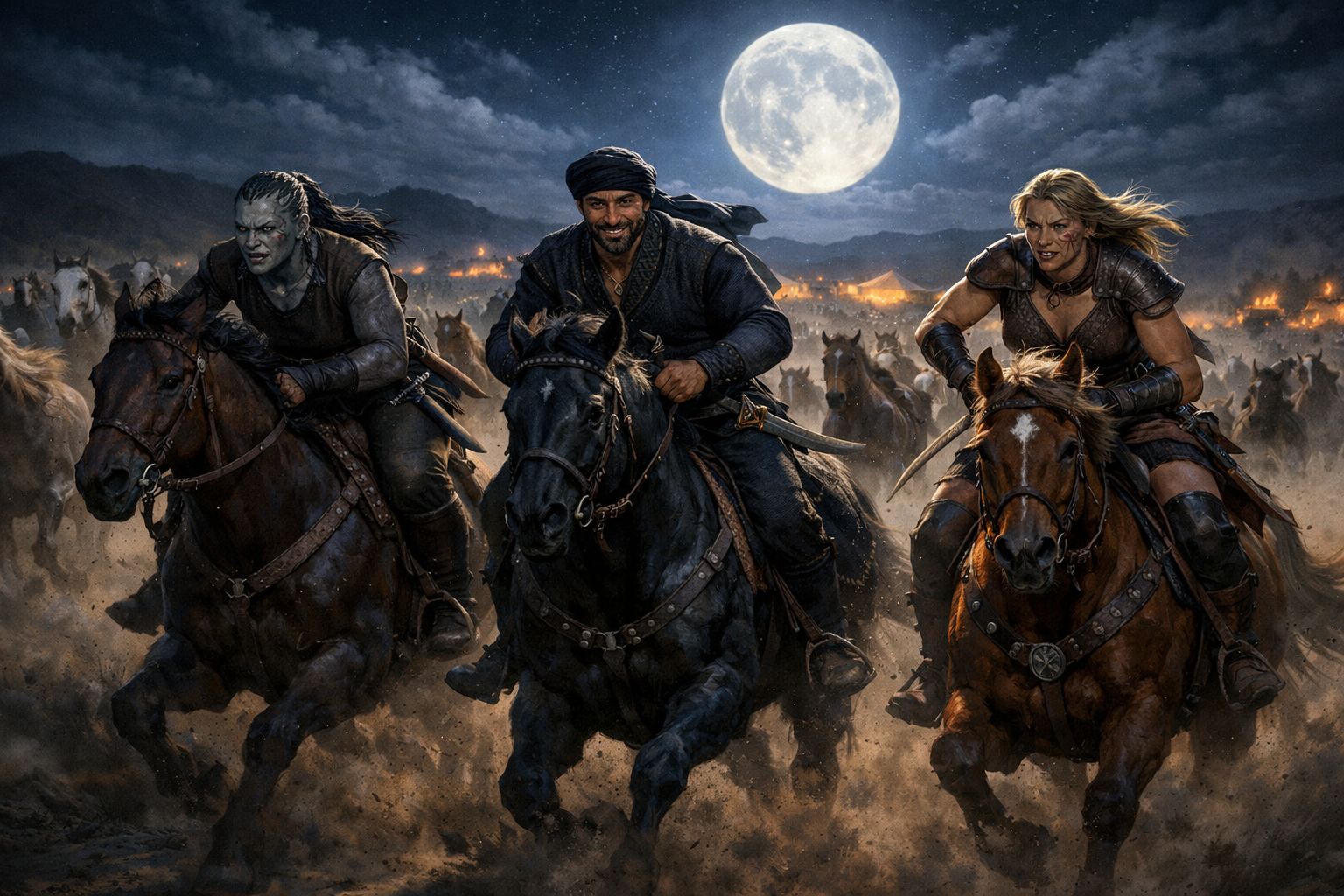
It is a full moon. Visibility is good enough for fast riding, but it also makes silhouettes easy to spot against the horizon. The crew should favor speed and low ground, keeping to shallow folds and the river’s bends when possible. Once it is daylight, the tracks of the horses will be easy enough to follow, so stealth matters less and speed more.
Once the herd is running, the crew’s job becomes shaping, not pushing. Stay in front, keep a steady pace, and prevent the lead horses from splitting. If the herd splits, it slows everything and increases the chance of being caught.
The Running Wolves will raise a lot of noise. They will look terrifying in the dark. Most of it is frustration and theater. Unless the crew has stalled, any pursuit will start late and disorganized.
Success States and Consequences
If the crew frees the herd and keeps moving, they win. They return with the horses and with a story that humiliates the Running Wolves.
If the crew is detected early or delays, the Running Wolves can force a running skirmish. This is where Grishna’s warning becomes a live constraint. The crew can still escape, but every killing blow risks attaching an obligation that complicates the rest of the steppe arc.
Feast and Acceptance
The feast was loud in the way a camp could be loud without sounding afraid.
They had dragged the biggest fire up high, fed it until it threw heat like a forge, and built a ring of hides and poles around it to keep the wind from stealing the warmth. Smoke rolled along the roof line and found its way out through gaps, carrying the smell of roasted meat and spilled mead into the night. The full moon hung over the steppe like a pale coin, watching without blinking.
The crew sat where they were told, close enough to the fire to be honored, far enough from the inner circle to remember that honor was still being weighed. Cups kept appearing in their hands. Thick mead, harsh spirits that tasted like fermented grass, and something clear that burned like a challenge.
Running Wolves were the night’s favorite joke.
Orcs leaned in and spoke too loud, as if volume could turn mockery into truth. They mimed sneaking, then tripping over their own feet. They howled with laughter at the idea of proud horse thieves waking up to empty pens, stamping around in the dark while weak humans rode away with their wealth. Even Kharvak Split Lip laughed until his scar pulled white, slapping the dirt with his hand.
Nasheem drank carefully, enough to share the moment but not enough to dull his eyes. Junia tried to smile when people looked at her, then stared into the fire when they did not. Gastved kept his cup in his hand and his back to a pole, watching the edges of the ring out of habit. Amaxia laughed once, sharp and surprised, then stopped as if she did not trust herself to enjoy it.
Grishna fit into the noise like she belonged to it. She drank, but she never lost the line of her posture. When someone threw an insult at her for walking with humans, she threw one back that made the nearest warriors bark with approval.
Varkhul sat on a hide cushion near the fire’s best heat, his presence steady even in celebration. When Nasheem brought up the River Bone camp again, Varkhul did not dodge the question. He waited for the right moment, then spoke as if telling a story everyone already knew but needed to hear one more time.
“River Bone was not raided for meat,” he said. “Not for hides. Not for their women. It was raided for a pile.”
The laughter around the fire softened, becoming listening.
“Our chief died,” Varkhul continued. “Gurm One-Ear. The one before me. He fell in battle. A great warrior does not go into the ground alone. He goes under weight. Under proof. A pile tells the steppe his death mattered.”
Grishna nodded once. “A great name needs a great foundation,” she said. There was no love in it, but there was recognition. “It is ugly, but it is logic.”
Varkhul’s eyes stayed on her a moment, then he lifted his cup as if that was enough agreement.
The night rolled on. More drink. More singing, not pretty, but loud and proud. Somewhere behind the ring, someone argued, and the argument ended with a laugh and a shove, the way steppe tempers burned and cooled fast.
Then an orc warrior, young and too full of mead, stood up to show he was fearless. He swung his cup in a wide arc, splashing half of it, then hurled it across the ring as if it were a spear. The cup bounced off a pole and rolled into the dirt.
Silence hit for a heartbeat.
An orc woman rose from where she had been sitting with two other women, her face flat as stone. She crossed the ring in three steps and slapped the young warrior hard enough to turn his head.
“Pick it up,” she said, and her voice was not loud. It did not need to be.
The warrior blinked. He opened his mouth, thought better of it, and bent down. He retrieved the cup, wiped it with the hem of his tunic like a punished boy, and held it out to her. She took it without a word and handed it back as if nothing had happened.
The camp breathed again. Laughter returned, softer, sharper. Someone muttered a joke about warriors being brave until women looked at them, and more than one man laughed too loud, trying to make sure the women heard.
Grishna watched the exchange with calm eyes. “Men lead in war,” she said to Junia, almost conversational, “but women rule the camp.”
Junia’s smile this time was small but real, and it did not reach for permission.
Varkhul rose.
He stood without hurry, and the noise died because he had decided it would. He lifted his cup high, mead catching the firelight, and his voice carried to the edges of the ring.
“Tonight,” he said, “let it be known that the Blue Marlin crew are friends of the Storm Callers.”
A beat. Then the camp exploded into acclaim. Spears struck shields. Cups lifted. Names shouted. Someone began a chant that was half praise and half mockery of Running Wolves, and the whole ring took it up.
The crew sat in the roar of it, warmed by fire and alcohol and the heavy certainty that this would be remembered. Not as a kindness, but as a claim.
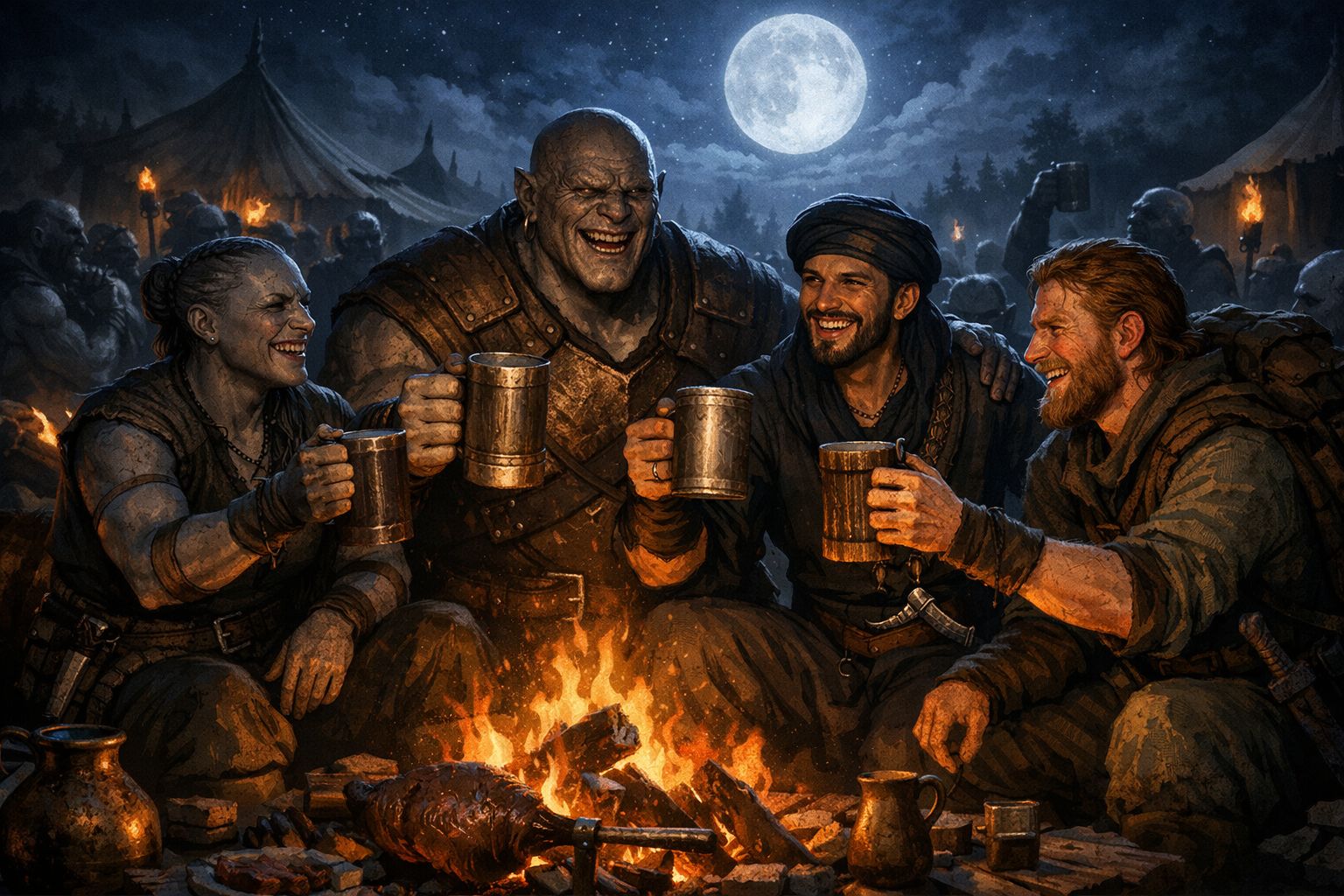
This section pays off the horse theft, delivers the Waverider information, and plants the larger steppe threat. It should feel warm on the surface, but it is still political. Hospitality is real, and it is also a claim.
Do not let it sprawl. Give the crew their win, give them what they came for, then use the feast talk to set hooks for later.
Arrival With the Horses
When the crew returns with the Running Wolf horses, Storm Caller warriors meet them with loud approval. Expect back slapping, shouted praise and public jokes at the Running Wolves’ expense. Varkhul makes sure the return is seen. The story matters as much as the horses.
A feast is announced immediately. This is both celebration and theater. It tells the camp that the crew delivered humiliation, and it tells any watchers that the Storm Callers now have allies.
Feast Tone and Table Behavior
The mood is high. Alcohol flows, boasting rises, and the Running Wolves become a punchline repeated until it becomes a shared truth.
Orc small talk is minimal while sober, but intoxication loosens tongues. Conversation is still blunt. Praise, mockery and direct questions replace polite curiosity.
Use one camp power beat to show internal hierarchy, such as a woman correcting a drunken warrior and the warrior obeying without argument. This supports Grishna’s point that men lead war, but women rule camp life.
Information the Crew Receives
Why River Bone Was Attacked
Varkhul explains that the River Bone raid was driven by honor burial. A previous Storm Caller chief, Gurm One-Ear, died in battle. A great warrior requires a great corpse pile, and the raid was conducted to create that pile as proof.
River Bone Survivors in the Camp
Many River Bone women and children are present in the camp. They are now considered Storm Callers. This is normal by steppe standards. Women and children are absorbed into the victors as obligation and mercy. A woman changing tribes several times across a lifetime is common, and these survivors have already settled into their new roles.
The Next Port of Call
Some River Bone women overheard the Waverider visit and remember the next port of call. They provide it during the feast, either directly to the crew or through Grishna, depending on how you want to stage the reveal.
Storm Caller and Running Wolf Rivalry
The feast makes it clear that this is not a one off insult. The rivalry runs long, and both tribes carry stories, grudges, and repeated humiliations. The horse theft is one chapter in an ongoing feud.
Raskaahn of the Steppe Wind Tribe
Rumors circulate about a rising chief, Raskaahn of the Steppe Wind Tribe, who is trying to unite the steppe tribes into a single conquering force aimed primarily at the Empire. Present this as rumor and worry rather than confirmed fact. The important point is that the steppe is changing, and leaders are reacting.
Varkhul’s Concern About Raskaahn
Varkhul rejects the idea of great kings. In his view, empire building is not the orc way. Orcs should roam free on the steppe, not build empires, and a tribe should not grow so large that its chief cannot know every member by name.
He will not join Raskaahn. He knows other tribes that will refuse as well. He also believes many will accept, whether from ambition, fear, or hunger.
Despite his refusal, he is worried. If Raskaahn succeeds, Varkhul expects a future where Storm Callers face a choice between joining or annihilation. He is looking for a way out that preserves his tribe without losing independence.
He is curious about the Grashkaar way, and Grishna can explain it in practical terms: restraint, limits, and responsibility that begins with the individual and spreads by obligation, not by conquest.
The crew can add arguments to sway Varkhul’s thinking. He will not commit now, but the conversation plants a direction that can shape his future choices, alliances, and willingness to help later.
This discussion has two purposes:
- Introduce the Grashkaar Way. Use this talk to deepen player understanding of Grashkaar discipline. Keep it concrete. Grishna should speak about what it costs and what it demands, not only what it forbids.
- Foreshadow the Larger Conflict. The point is to show the world in motion. Something is rising on the steppe. The crew has heard the name early, and later events can prove that the rumor was not only camp talk.
Ending the Feast
As the night deepens, the noise softens. Songs lose their edge, boasting turns into murmured talk, and the fire is fed less often. Warriors drift away in twos and threes, women gather children and cups, and the camp folds back into its usual order. One by one the yurts swallow silhouettes, and the last laughter fades into the wind. Eventually only the fire remains, crackling low as the Storm Caller camp goes to sleep.
Morning Reckoning
Morning came gray and cold, the kind of cold that lived in the ground and climbed into your boots before the sun had a chance to argue with it. The camp was quieter after the feast. Fires were smaller. Voices were lower. People moved with the slow stiffness of drink burned out and sleep not quite enough.
Junia was near the edge of the camp when the first shout went up.
Not alarm. Not fear. A call that carried contempt.
Running Wolves.
A line of them on the rise beyond the river bend, silhouettes against the brightening sky. They did not rush. They came at a measured pace, as if arriving late on purpose. As if the delay itself was part of the insult.
Storm Caller warriors stood as the Running Wolves approached. Men picked up shields and weapons with practiced ease. Women pulled children back from the open ground, not panicked, just efficient. Dogs began to growl.
Varkhul walked out to meet the riders, calm as if this was a market dispute. Kharvak Split Lip came with him, and a cluster of warriors that looked chosen for visibility as much as for strength.
The Running Wolves stopped at bowshot. Their leader, Hrokk Bear-Strangler was younger than Varkhul, broad shouldered, hair tied in a high knot, his face painted with ash that made his eyes look too bright.
He called out first, voice loud enough for the camp to hear.
"Give us the thieves."
Varkhul lifted his chin. "I have thieves," he said. "They are called Running Wolves. They steal horses and then cry when the wind takes them."
Laughter rose behind him. Not friendly laughter. The kind that sharpened.
The Running Wolf leader spat into the dirt. "We want the humans. The weak ones you hide behind."
Varkhul smiled without warmth. "Weak humans stole your horses from under your noses." He spread his hands. "If you stay longer, we will steal your goats too, and then what will you screw at night when you are lonely."
A beat of stunned silence, then the Storm Callers howled. Warriors slapped shields. Someone made a crude bleating noise. Even a few women laughed, sharp and delighted.
The Running Wolves answered with their own filth, a stream of threats and insults thrown like stones. They called the Storm Callers dog sons and dung eaters. They called Varkhul a chief of borrowed children. They called Grishna a Grashkaar leash who had forgotten her own blood.
Grishna did not move. She only watched, her expression flat, as if storing names for later.
Amaxia leaned forward, ready to step out, but Nasheem touched her wrist lightly. Not restraint, just a reminder. This was not their stage unless someone made it so.
The exchange rolled on, each side trying to outdo the other in ugliness. The Running Wolves made jokes about Storm Caller women being so desperate they had to adopt strangers to find husbands. The Storm Callers answered that Running Wolf men were so ugly their own horses had run away out of shame.
Then a young Running Wolf warrior, barely old enough to have a beard worth mentioning, stepped forwards. He pointed his spear at a Storm Caller standing near Kharvak, a lean man with a scar across his cheek.
"That one," the young warrior shouted. "I have seen reeds with more spine. He looks like he would fall over if a woman frowned at him."
A ripple went through both lines. The kind that meant blood would be spilled.
The lean Storm Caller stepped forward without waiting for permission. He held his spear upright and spoke, voice clear.
"You want to speak my name with that mouth, Running Wolf. Speak it while you bleed. I challenge you."
The Running Wolf youth grinned, teeth bright. He swung down from his horse and threw his reins to a companion. "Gladly," he said. "I will take your spear and use it as a walking stick for your mother."
Cheers erupted. Storm Callers stamping feet, shouting the lean warrior’s name, Wurf Swift-Run. Running Wolves answering with their own chant, chanting Vadaahr Dark-Eye, slapping spear shafts against shields.
The duelists walked out into the open ground between the lines. For a moment it looked almost ceremonial, two men pacing, testing distance, circling in the grass.
Then it became brutally simple.
The Running Wolf lunged fast, trying to end it in one showy thrust. The Storm Caller took a half step, let the spear glance, and drove the butt of his own spear into the youth’s knee. The Running Wolf folded with a bark of pain. Before he could recover, the Storm Caller slammed him in the mouth with the haft, then drove him down into the dirt and thrust the spear point into his throat.
It was over as quickly as it had begun.
The Storm Callers roared. The Running Wolves shouted too, half anger, half admiration, because the steppe respected a clean win.
Two women stepped out from the Running Wolf line, faces set. They did not look at their fallen youth. They looked at the Storm Caller victor.
"We leave," one said, voice hard. "We are your responsibility now. Take us in."
The Storm Caller did not smile. He nodded once, and the women crossed the line, shoulders straight. No tears. No pleading. A transfer, like a debt paid.
More challenges followed. Not a war, not a brawl, but a series of sharp contests, each one a chance to claim face and shift balance. A Storm Caller lost one, stabbed in his thigh, bleeding out on the hard ground, and a Running Wolf child was handed over with tight jawed dignity. Another duel ended with a Running Wolf victor, and a Storm Caller woman stepped forward to join him, spitting on the ground as she crossed.
It went on until both sides had enough story to carry home.
At last the Running Wolf leader lifted his spear and shouted, loud and triumphant.
"We came for our horses. We found Storm Caller cowards hiding behind humans and women. We leave with proof."
He turned his horse, as if the declaration itself was victory.
Storm Callers answered with jeers and laughter. Someone called out that the Running Wolves should hurry back before their goats ran away too. Spears rattled against shields. The Running Wolves rode off under a rain of insults, and the camp’s tension loosened only when their dust had thinned into the horizon.
Nasheem exhaled slowly. "So that is their war," he said, more to himself than anyone.
Grishna watched the empty rise and nodded once. "Words first," she said. "Then blood. Then obligation."
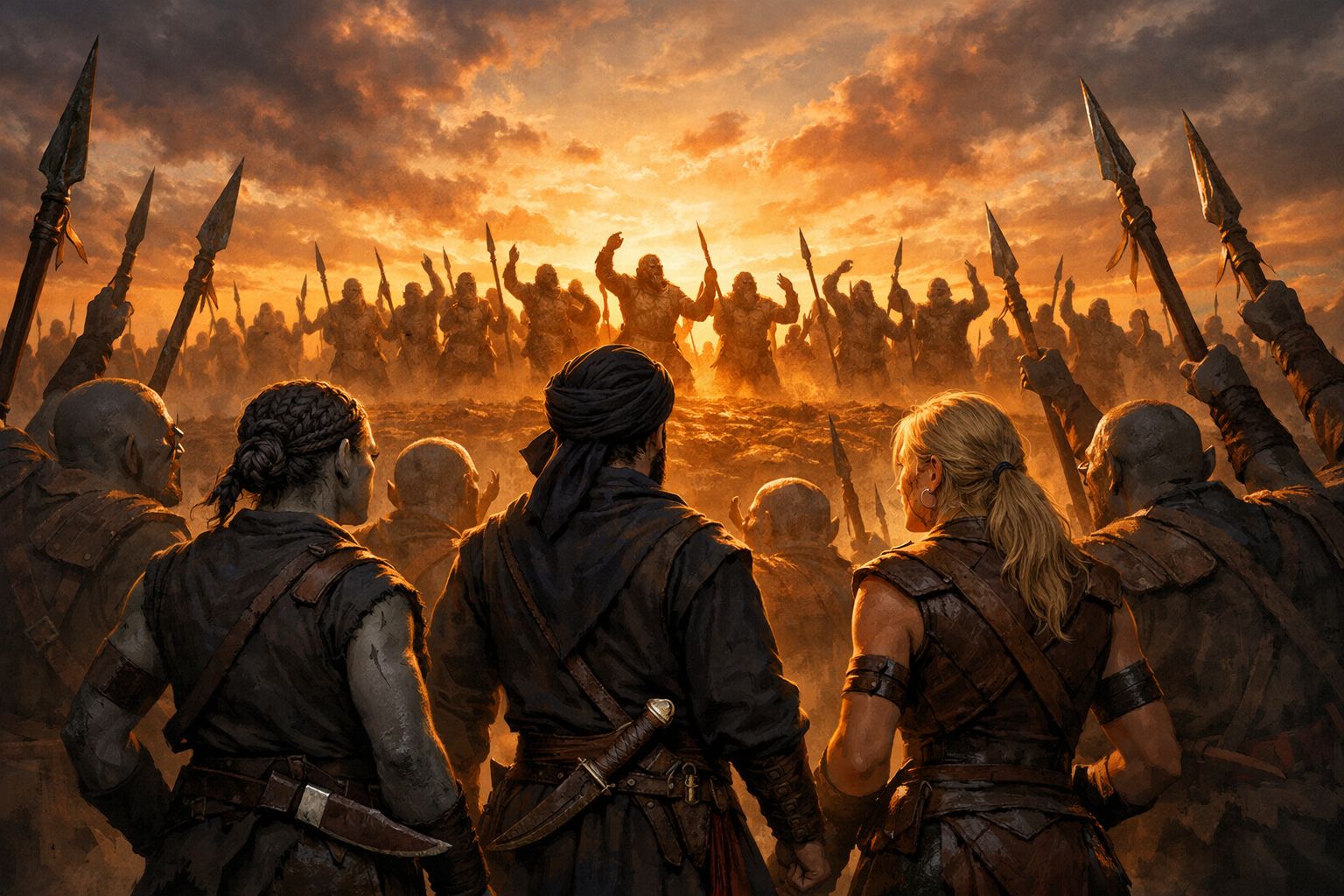
This is a controlled pressure release after the feast. It reinforces steppe honor logic, shows how duels function as social accounting, and lets both tribes exit without a full battle.
Do not treat it as a combat encounter unless the crew escalates it. It is a public ritual with sharp edges.
Why the Running Wolves Choose Bravado
The Running Wolves planned a quick raid to steal the horses back, but they lost surprise. Whether they were spotted by Storm Caller lookouts, dogs, or simple open steppe visibility, they could not hit the camp cleanly.
With the raid spoiled, they pivot into machismo theater: arrive, demand the thieves, and force the Storm Callers into a public standoff where words and duels can salvage face.
Order of Events
Insult Exchange
The two sides meet outside the camp at a safe distance. The Running Wolves demand the humans. Storm Callers refuse.
Run the insult exchange as escalating vulgarity. The goal is to win the crowd, not to convince the opponent. Varkhul leads the Storm Callers. He is crude, funny, and deliberately humiliating. A signature line can be the goat threat, implying that the Running Wolves will lose even their animal comfort if they linger.
If the crew speaks, it can escalate the exchange. Otherwise, keep them as witnesses. Witnesses matter on the steppe.
Dueling Challenges
After a few rounds, young warriors on one side call out a specific opponent as weak to provoke a duel. The challenged warrior answers with a counter insult and a formal challenge.
Duels are to the death. The point is not only violence. The point is an unarguable outcome that can be used to claim honor, settle insults, and trigger obligation shifts.
Transfers of Obligation
After each duel, the result creates a social transfer. Women and children step forward and change tribes as responsibility shifts with the killer. After a kill, they step forward, states the claim, and crosses the line without ceremony.
Treat this as matter of fact. There is no sentimental mourning. It is accounting. The camp accepts it because it is the law that prevents endless retaliation.
Transfers can go in both directions depending on who wins. Use one or two visible transfers to make the mechanism clear, then summarize the rest so it does not become repetitive.
Exit With Declared Victory
Once the Running Wolves believe they have made their point, they declare victory in loud terms, regardless of the actual duel record. This is normal. The declaration is part of salvaging face.
Storm Callers answer with jeers, crude noises, and occasional thrown objects. If you want to show how close it is to real violence without starting a fight, let a spear land in the dirt near the retreating line rather than hit anyone.
The Running Wolves withdraw on foot. The standoff ends when distance makes further insult feel weak rather than brave.
Crew Involvement
The crew will be targeted by insults, especially for being outsiders who “stole” what the Running Wolves could not protect. They can answer with their own insults if they want, and the camp will enjoy it as long as it is sharp and confident. Their words can raise the temperature, though, and the Running Wolves will use any hesitation or awkwardness as proof that the Storm Callers are hiding behind weak allies.
The Running Wolves will not challenge crew members to duels. Foreigners are seen as unworthy, and killing them gives little honor. If a crew member issues a challenge, it will be accepted, and the duel will be to the death. Remind the players what that means: orc warriors are built like gorillas and trained for war from early childhood. Grishna will warn them that this is an orc affair that does not involve them, and that the smartest role is witness, not champion.
Aftermath and Transition
Once the Running Wolves are gone, the camp tension eases. This is the clean exit point for the crew.
They have the Waverider destination. They have been publicly named friends of the Storm Callers. They can begin the trek back toward the Blue Marlin.
Departure and Grishna's Choice
Once the morning standoff ends and the Running Wolves withdraw, the Storm Caller camp settles back into routine. The crew is allowed to leave without friction. They have what they came for, and their status as friends is already public.
Uneventful Trek
The return journey follows the same river line back across open steppe. Treat it as mostly uneventful travel: long sight lines, steady pace, and the usual exposure, but no meaningful obstacles unless you want a brief mood beat.
If they leave the Storm Caller camp that morning and keep a hard pace, they reach the Blue Marlin in the evening of the fourth day.
The sea felt different the moment the steppe fell behind them.
Not warmer, not calmer, simply familiar. The deck rolled underfoot with a rhythm Scarnax trusted. Wind in canvas, salt in the air, the faint creak of wood that told him where the strain lived. The Skarthuun shore was already shrinking into a dark line, and with it the feeling of eyes on the horizon.
Scarnax leaned on the rail with Nasheem and Amaxia nearby. They spoke quietly, not because they feared being overheard, but because the steppe had taught them that loud words attracted trouble.
Nasheem’s gaze stayed on the fading land. "They turned death into bookkeeping," he said. "Not even anger. Just counting."
Amaxia gave a short laugh that held no humor. "They make our wars look sentimental."
Scarnax grunted. "I have seen ports where life is cheap. I have not seen it treated like a tool that cleanly."
"Grishna understood it," Nasheem said. "She did not flinch. She just used it."
Amaxia’s eyes narrowed. "She did more than use it. She kept us from doing something stupid."
Scarnax nodded once. "And got us what we needed."
Footsteps approached across the deck, steady and unhurried. Grishna came into view, hair bound tight, arms bare, posture as straight as a spear. She stopped at a respectful distance, then ignored the distance like it was a suggestion.
"I am not going back to Grashkaar," she said.
No greeting. No softening. Just the statement dropped between them like a rock.
Nasheem blinked once, then his mouth curled slightly. "Good evening to you as well."
Grishna’s eyes stayed on Scarnax. "I want to stay with the ship. With you."
Scarnax studied her, weighing her the way he weighed a storm line, not unkind, just honest. "You were Drogath’s guide," he said. "You sure about that."
"I am sure," Grishna replied. "Grashkaar is rules and old voices. I did my duty. I learned what I needed. I do not want to go back and pretend that is enough."
Nasheem folded his arms. "You were a big help on the steppe," he said. "You kept us alive, and you kept us from buying debts we could not pay."
Amaxia’s brow lifted. "And what do you do on a ship."
Grishna did not hesitate. "I keep camp." She jerked her chin toward the deck, as if the whole vessel was only a larger tent. "I can cook. I can mend. I can manage stores. I can read people before they make trouble. You already saw that."
Amaxia’s expression stayed hard, but her eyes were curious now. "That is not why you are asking."
Grishna’s mouth tightened, then loosened. "No."
She glanced at Amaxia, and for the first time there was something like admission in her bluntness.
"Seeing you fight," Grishna said, "I realized something I did not want to admit. Fighting is not only for men. Not even on the steppe. Not even anywhere."
Amaxia did not smile. She simply waited.
Grishna nodded once, as if sealing her own decision. "I want to train with your marines. I want to learn to be a warrior."
Scarnax exhaled through his nose, half laugh, half surprise. He looked at Nasheem. Nasheem gave the smallest shrug in the world, the kind that meant he had already decided.
Scarnax pushed off the rail and held out his hand. "So it is settled," he said. "Welcome."
Grishna took his hand, and instead of shaking like a polite guest, she pulled him in and wrapped him in a strong, friendly hug that lifted his heels a fraction off the deck.
Scarnax let out a startled sound, more air than words, and when she released him he staggered a step, coughing a laugh.
He looked at Amaxia and Nasheem, one hand on his ribs like he had been hit.
"She is strong," he said, still catching breath. "She will be a good fighter."
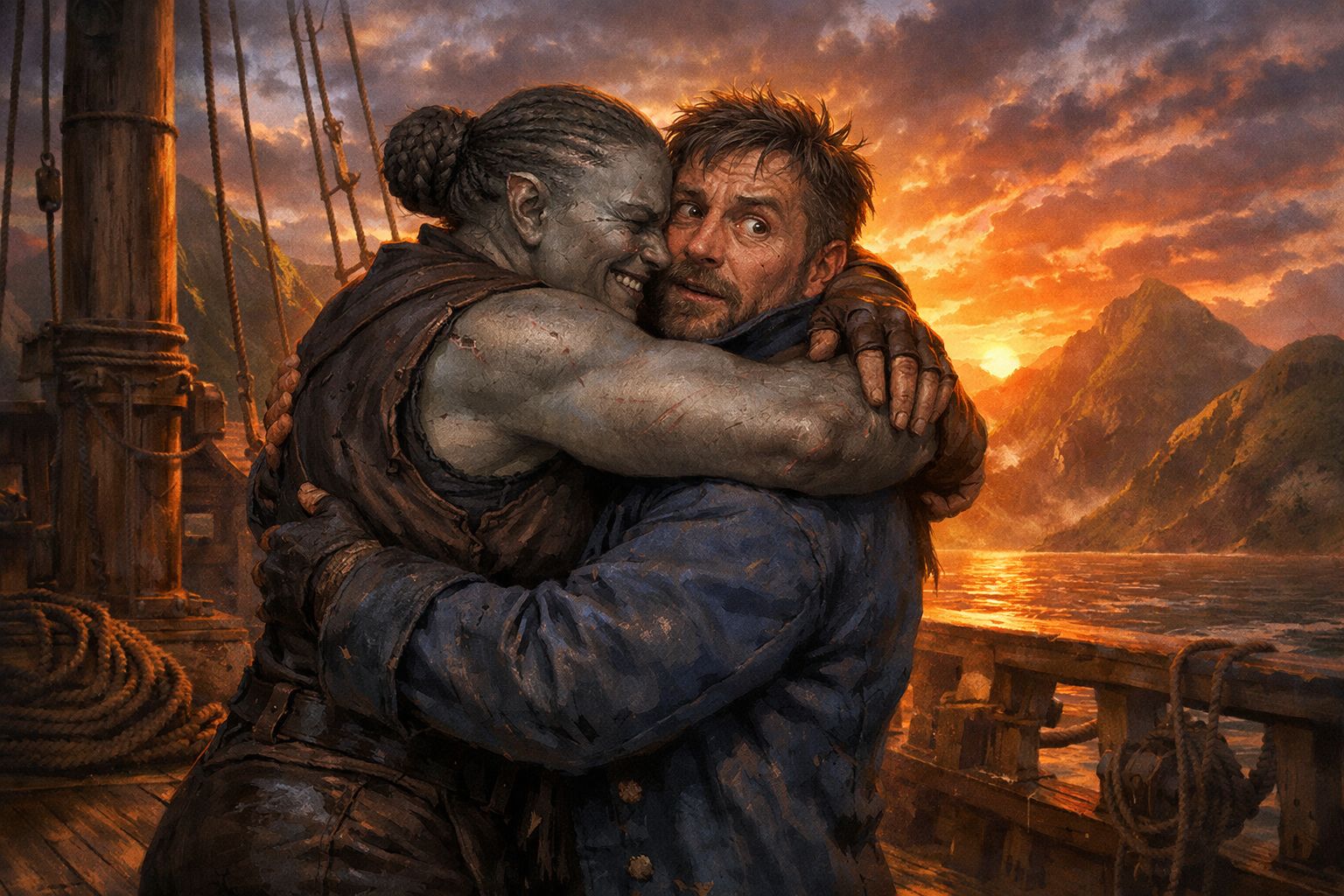
Grishna Asks to Stay
After the Blue Marlin leaves Skarthuun and the steppe coastline is shrinking behind the stern, Grishna seeks out a quiet moment on deck. She does not dress it up as gratitude or confession. She states it as a decision and a transaction: she does not want to return to Grashkaar, and she wants to join the crew permanently.
She frames it as simple truth. She guided the crew through Skarthuun, proved her usefulness, and learned the ship’s rhythm well enough to know she can fit inside it. She wants it said out loud so it becomes real, not implied. She prefers a direct answer, even if it is rejection.
Why She Leaves
Grishna has lived inside strict hierarchy long enough that she did not recognize it as a cage until she saw people living without it. The Blue Marlin does not offer softness. It offers something harsher and more intoxicating to her: belonging without being owned.
She is also carrying a personal shift. Seeing women fight, especially Amaxia, breaks a category she thought was natural law. That does not make her sentimental. It makes her curious and hungry. If her old rules can be wrong, then she wants to test what else can change.
What She Offers the Ship
Grishna’s value is not “orc muscle” first. It is competence.
She can keep camp and keep order. She reads weather, water, terrain and threat sign early. She understands orc social rules, insult boundaries, hospitality traps and what kind of strength matters to whom. She prevents problems before they become emergencies, and she can say bluntly what kind of trouble the crew is walking into when they choose to ignore warnings.
Once she settles into ship life, she naturally takes on routine work that makes everything run smoother: stores, repairs, disciplined habits, quiet corrections without ceremony. If Grishna is quiet, the ship tends to run better.
Joining the Marines
Grishna will ask to train with the marines. She does not request permission to “play at fighting.” She asks to become dangerous on purpose.
She is not a duelist. She fights like someone who has hauled loads, broken fights and survived hard seasons. Aggression, strength, relentlessness. Close distance, break rhythm, keep pressure until the opponent makes a mistake. That can make her an effective deck fighter later, and it can also create problems if she applies steppe solutions in places where restraint matters.
Relationship with Amaxia
Her relationship with Amaxia is a slow burn culture clash that can evolve. At first Grishna treats her as a contradiction that must have a hidden social explanation. If Amaxia refuses the premise and simply is what she is, Grishna’s adjustment becomes visible over time. Done well, this becomes real respect, even kinship, instead of a repeating joke.
Resolution
If the crew accepts, treat it as a clear status change, not an informal convenience. She becomes crew, with duties, expectations, and a place in the ship’s hierarchy.
If the crew refuses, Grishna does not beg. She withdraws, and the refusal becomes a lingering fracture: she will still do her job until the expedition ends, but the sense of shared purpose cools, and she becomes more strictly Drogath’s loan than the crew’s companion.
Drogath’s Reaction and the Question of Compensation
Grishna is not a slave. Drogath cannot lawfully keep her from leaving, and he knows it. If she chooses the Blue Marlin, she is making a personal decision, not being taken.
What Drogath can do is make it a matter of dignity and relationship. In his eyes, a capable guide leaving his sphere without acknowledgment makes him look weak, and weakness invites problems. He will want the situation handled in a way that preserves his standing.
Token Compensation as Good Will
If the crew reports back and presents it properly, Drogath will expect a token compensation. Not a purchase, not ransom, not “ownership money,” but a visible gesture of respect for his authority and for the loss of an asset he relied on. It should be something the ship can afford without pain, and something Drogath can point to if anyone questions him.
Good examples are practical, tradeable goods rather than coin. Since they recently visited Twin Cities, iron is the most likely gift. The exact item matters less than the fact that it is offered openly and framed as good will.
If the Crew Does Not Report It
If Grishna leaves and the Blue Marlin does not report back, Drogath will be angry when he hears. He will take it as disrespect and as a public slight, not as theft. That anger is real, but it is not a permanent feud.
Because Grishna is not a slave, Drogath will eventually let it go. Once the initial insult burns off, he will choose pragmatism over escalation. He will still remember it, and it can color future dealings, but it will not become an automatic war unless the crew adds further insults on top of it.
Act Summary
Core Outcomes
The Blue Marlin leaves the Skarthuun steppe with a new lead on the Waverider. The crew secures the next port of call from Storm Caller survivors who were present during the Waverider visit, turning a dead end at the River Bone ruins into forward momentum.
Grishna chooses to remain with the ship. After the steppe segment ends, she asks to join the crew permanently, shifting from Drogath’s loaned guide to an invested crew member with her own motivations, skills and future complications tied to orc politics.
The crew is accepted as friends of the Storm Caller Tribe. This is not casual hospitality. It is a public declaration by Varkhul, witnessed by the camp, which creates status, expectations and a remembered story on the steppe.
What Actually Moved the Arc Forward
The River Bone camp is discovered as a stripped ruin dominated by an honor burial pile, confirming that the Waverider’s trail passed through a place now erased. The crew learns the steppe’s core social mechanism: killing creates inheritance, and inheritance moves families between tribes. That single rule becomes the reason Grishna pushes nonlethal restraint and the reason steppe violence stays tied to obligation rather than pure cruelty.
The crew earns access through action. First by siding with the Storm Callers during a proving raid, then by completing Varkhul’s demanded humiliation of the Running Wolves through a night horse theft, which returns the stolen horses and delivers a story the Storm Callers can repeat. The arc’s central currency is not coin. It is reputation and who gets to laugh last.
Hidden Hand
Brother Samden intervenes without the crew realizing it. The Running Wolf sentry is drugged, creating the narrow opening that makes the horse theft feasible without immediate detection. This plants Samden as an active, quiet force in the campaign, someone whose help can shape outcomes without announcing itself.
Cultural Takeaways
The arc gives a functional view of steppe orc life rather than a superficial one. Honor is measured in visible acts, and death is treated as necessary and unsentimental. Duels to the death can be social accounting, and the transfer of women and children between tribes is framed as obligation and mercy, not sentiment or romance. Camp power is shown as gendered: men lead war, while women enforce camp order and consequences.
Varkhul also introduces a longer shadow. Rumors point to Raskaahn of the Steppe Wind Tribe, a chief attempting to unify the tribes into a conquering force aimed primarily at the Empire. Varkhul rejects empire building as unorcish, but fears the steppe may force a choice between joining or annihilation. Grishna explains the Grashkaar way in response, and the crew has a chance to influence Varkhul’s future direction, even though he makes no immediate commitment.
Status at End of Arc
The crew departs with the Waverider destination, Storm Caller friendship declared publicly, and a deeper understanding of how steppe obligation works.
Grishna is now crew, and her presence brings both advantages and future hooks: cultural fluency, blunt practicality, and steppe consequences that can follow the ship beyond the Skarthuun coast.
Raskaahn becomes a looming threat, a name tied to unification and conquest that may return later.
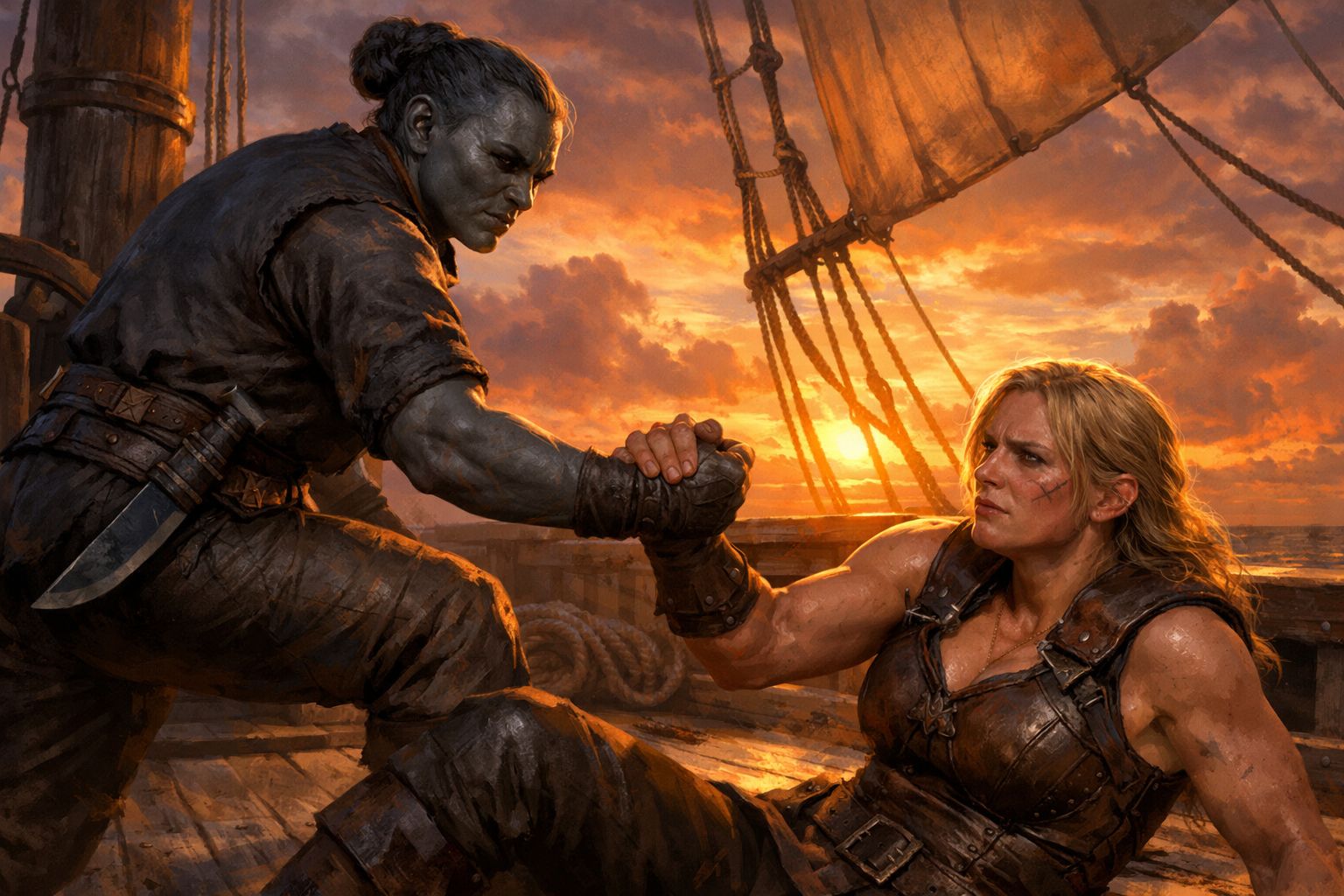
The deck was slick with salt and morning mist, the kind that made every plank feel like it was waiting to betray your footing. Amaxia moved anyway, light on her feet, sword held loose, eyes bright with the calm focus of someone used to winning.
Grishna came at her with a knife and a scimitar and no ceremony. No flourish. No testing. Just forward pressure and a stare that did not blink.
Amaxia tried to make it pretty. She angled off, shifted her weight, let her blade whisper toward Grishna’s wrist, then pulled it back, looking for the opening that would make the next strike clean.
Grishna did not give her one.
The knife snapped up like a hook, struck Amaxia’s sword aside with a sharp crack of steel on steel, and Grishna crashed into her before Amaxia could reset. Shoulder, hip, and relentless strength. Amaxia hit the deck hard, breath punched out of her in a short ugly sound as the sky spun once above her.
Grishna held her there for a heartbeat, then released and offered a hand.
Amaxia took it, pulled herself up, and brushed salt from her cheek like it offended her.
She looked at Grishna, eyes narrowed, then muttered, almost reluctant.
"You are learning."