Campaign: The Great Empire, Alborum
Act Synopsis
This arc brings the Blue Marlin into the beating heart of the Great Empire, the capital Alborum. The city is the Empire distilled. It is beautiful, cruel, arrogant and rotten. The players arrive expecting a routine stop to gather supplies and trace the Waverider’s path. Instead they walk straight into a crisis that will force them to pick their way through the Empire’s most dangerous social strata. The arc begins as calm exploration, shifts abruptly into a kidnapping, then pivots into a tense infiltration and escape from the Emperor’s private celebration aboard his floating pleasure palace.
Tone
This arc should feel like a trap made of silk. Everything gleams. Everything stinks. Alborum overwhelms with grandeur but never hides the cruelty beneath the surface. The heist is open-ended and should be driven by player choices, improvisation and the constant pressure that discovery is one breath away.
Arrival in Alborum
The Blue Marlin docks in the eastern harbour district of Alborum, a massive stone and bronze maze known as the Thalassary. Merchant barges crowd the piers. Legion patrols march between marble arches carved with scenes of conquest. The Mariner’s Gate, decorated with sea gods and chained monsters, serves as the main entrance for foreign crews. It is the busiest approach to the city and the one where foreigners are most tightly watched.
The players are free to explore early locations. Let them taste the imperial capital. Give them sights that display might and rot at the same time.
Finding the next port of the Waverider is easy, the world's largest ship leaves a wake in the local gossip. It'll take some time to stock up on supplies, though, so there is plenty of time for shore leave and exploration.
Let the players feel safe, let them experience the greatest city in the world for a while. Then hit them with the next phase: The kidnapping.
The Kidnapping
Strike when the players feel safe. A legion patrol commanded by Tribune Cassio Felorian intercepts two suitable crew members during shore leave. The legionaries comment that the Emperor wants fresh faces for his celebration. They seize the chosen crew without hesitation. The bystanders do nothing. This teaches the players the imperial hierarchy in one scene.
A single crew member escapes and returns to the Blue Marlin. This witness should emphasize the speed and discipline of the abduction. The Empire is not subtle when it does not need to be.
The Immediate Aftermath
If the players search for the patrol they find nothing. Ask around and Alborum shrugs. Some advise silence. Some laugh. Some notes that Cassio Felorian serves the Emperor’s most private whims. Eventually the players hear of the floating palace called the Aurelum. It is anchored upriver at the Emperor’s order. It will host a private celebration soon. Rumors claim the Emperor intends to present the most decadent spectacle in living memory. Rumors also claim many slaves will die for it.
From here on, the rescue turns into a heist.
Heist Structure
Once the players accept the infiltration premise, the arc becomes flexible. You should treat this as a branching maze, not a linear plan.
Entry routes may include:
- Impersonating household staff from a noble villa invited to the celebration.
- Forging papers and masks for the Aurelum’s masquerade processional.
- Sneaking aboard via the river bilges with the help of local smugglers.
- Posing as entertainers hired for the evening.
- Blackmailing or bribing a disgraced noble who desperately wants back into court.
Inside the Aurelum
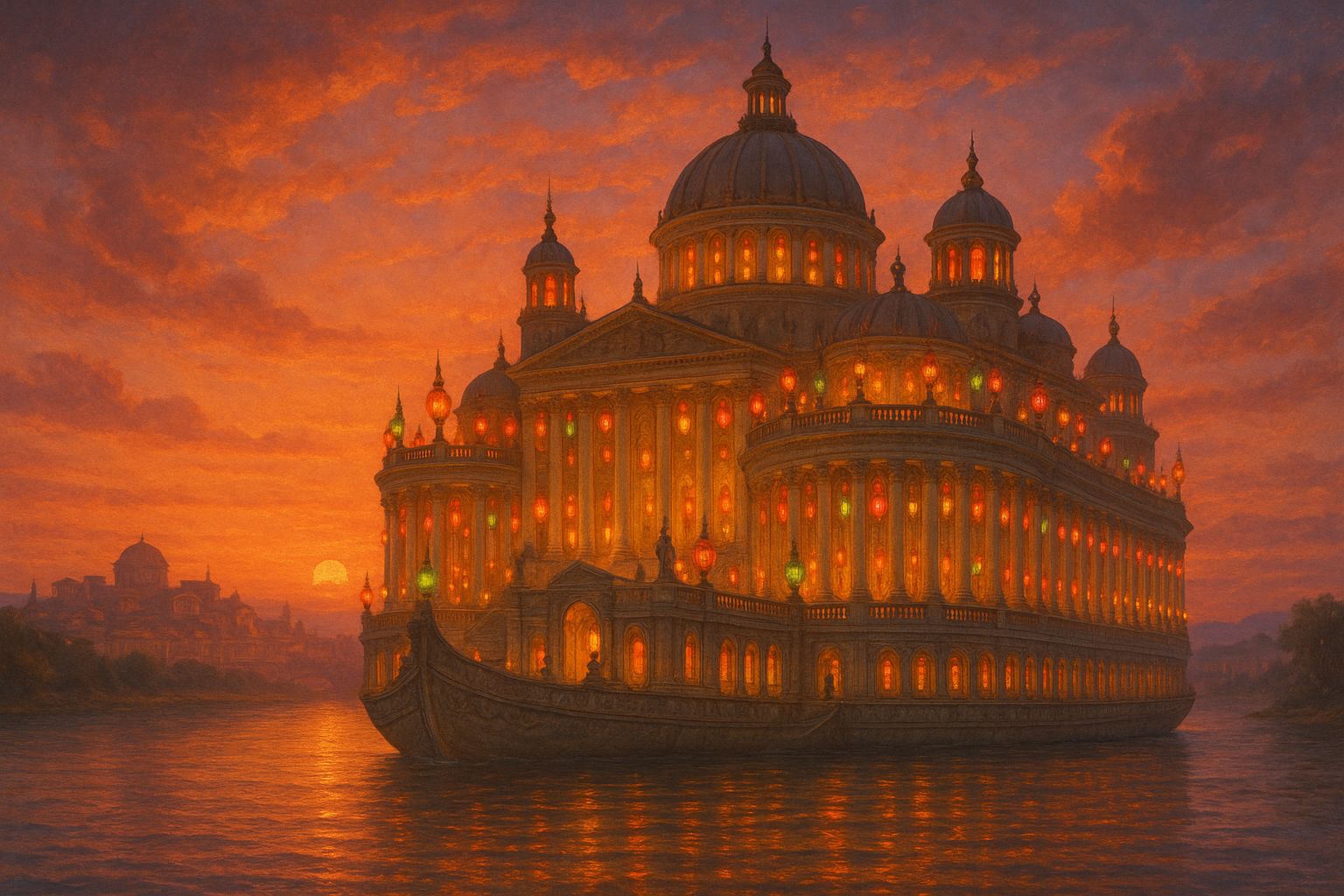
Once onboard, the players see the Empire without mask or mercy. The Aurelum is a floating palace of marble halls, lacquered doors and silken pavilions. Gold leaf is everywhere. Perfume burns in braziers. Below deck the slaves are penned like cattle.
You should overwhelm the senses. Show how nobles flaunt cruelty. They strike slaves for attention. They waste entire banquet tables because discarding food is a statement of wealth. In side chambers masked priests bless cruel orgies that rampage out into the corridors. Let the players feel anger and fear. The rescue is not just physical. It is moral.
Tension
Every action inside the Aurelum should feel dangerous. Alert the players to legionaries in ceremonial armor under every arch. Show paranoid nobles with personal guards. Let the Emperor drift through the halls at random, surrounded by masked attendants who whisper to him in voices thick with wine and madness.
If the players misstep, use consequences that escalate rather than kill at once. Suspicion. Separation. Lost tools. Detained allies. The worst mistake forces the escape to turn into a frantic pursuit.
The Emperor’s Role
Emperor Valerian IV should be present but unpredictable. He should be unsettling, not humorous. His attention is lethal. If the players interact with him, treat every word as a loaded crossbow. He may bless them, laugh at them or call for an execution.
Climax and Escape
The rescue can go many ways. The players may locate the captives in slave quarters, staging areas or even as entertainment props. Once they commit to extraction, security collapses into chaos.
Possible climaxes:
- A silent escape down a rope ladder into the river.
- Stealing a noble gondola and fleeing through the water gardens.
- Setting fire to the wine stockpile, creating chaos.
- Hijacking one of the Aurelum’s escort barges.
- Triggering a diversion by releasing captive beasts prepared for spectacle.
If things go terribly:
Samden may intervene. Keep it subtle. A sudden corridor clearance. A distracted guard at the perfect moment. A boat drifting conveniently loose. No explanations.
Aftermath
Once free, depending on circumstances. Slip away quietly and avoid the city’s wrath, or turn the escape into a furious pursuit sequence down the Arteria river and out into the Emperor Bay. Let fallout match the type of escape they used. Quiet infiltration allows a quiet departure. Chaos invites retaliation.
Closing Notes for the Game Master
This arc is open. Treat every plan as valid if it is clever and within the fiction. Do not plan outcomes. Plan reactions. Alborum is a place where cruelty is casual and danger is ceremonial. The Aurelum is a set piece that rewards boldness and punishes hesitation. Above all keep the tension unbroken. The players should feel watched even when no one is in the room, feel that they are always just one tiny mistake away from disaster.
Arrival and Exploration
| Story |
|---|
| The Blue Marlin drifted past the outer beacons at dawn. Mist clung to the river, thin as gauze, and through it rose the first arches of Alborum. White stone, bronze tips, banners drooping in the still air. For a moment it looked peaceful. |
| Then the sun lifted, and the city woke. |
| Gold flashed from temple spires. Marble terraces spilled down toward the water in layered steps. Statues of long dead emperors stared down from their columns, each carved with the same serene cruelty. The docks below crawled with life. Legion patrols clanked between bronze gatehouses. Merchants shouted over one another as slaves hauled crates up sweating ramps. Perfume smoke drifted from a shrine near the piers, sweet enough to mask the rot beneath. |
| From the deck the city seemed endless. Streets twisted like veins. Markets blazed with color. Courtyards glimmered with painted pools that reflected masked noblewomen crossing on narrow planks of polished wood. |
| It was beautiful. It was suffocating. It felt like a place that would swallow a stranger whole and never bother to spit out the bones. |
| The Blue Marlin slipped into her berth, ropes creaked, and the crew stepped onto imperial stone of the capital for the first time. |
| Alborum did not greet them. It appraised them. |
This early stretch in Alborum is meant to breathe before the descent. Let the crew settle into the city, explore its streets and taste its grandeur. The players should feel they have space to wander, shop, gossip and chase small curiosities. It is the calm before the storm, and the contrast matters. When the kidnapping hits, it should feel like a trap snapping shut on a hand that thought it was safe.
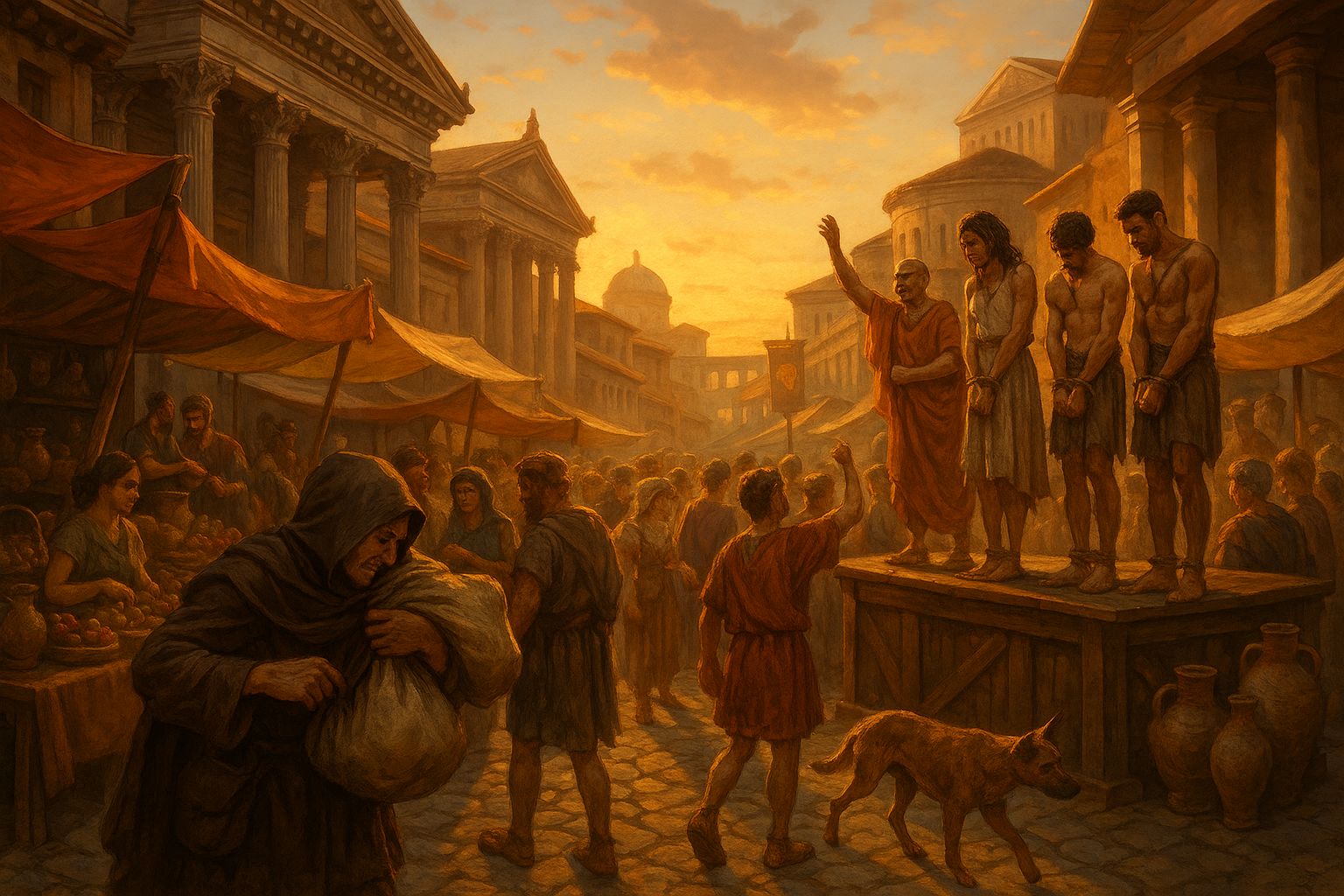
Use this calm time to show the Empire at its finest and its worst. Marble temples catch the morning light. Markets shine with silks and spices. Fountains glitter with coins tossed by hopeful citizens. And beneath all that beauty lies the rot. Slaves move like shadows. Legion patrols carry themselves with absolute authority. The nobles laugh too loudly. The cruelty is casual here, woven into daily life, and the players should notice it without yet being smothered by it.
Aim for a gentle tension. Nothing threatens them, but nothing welcomes them either. Officials speak politely with a hint of contempt. Street vendors smile while keeping a careful distance. Everyone stares a moment longer than they should. The players are free, but they are observed. This mood sets the stage for the shift to come, when observation turns into danger and the city reveals what it truly is.
Side Tracks
This is a list of some possible things the players may choose to explore, or events which can happen.
The Red Sand Matinee
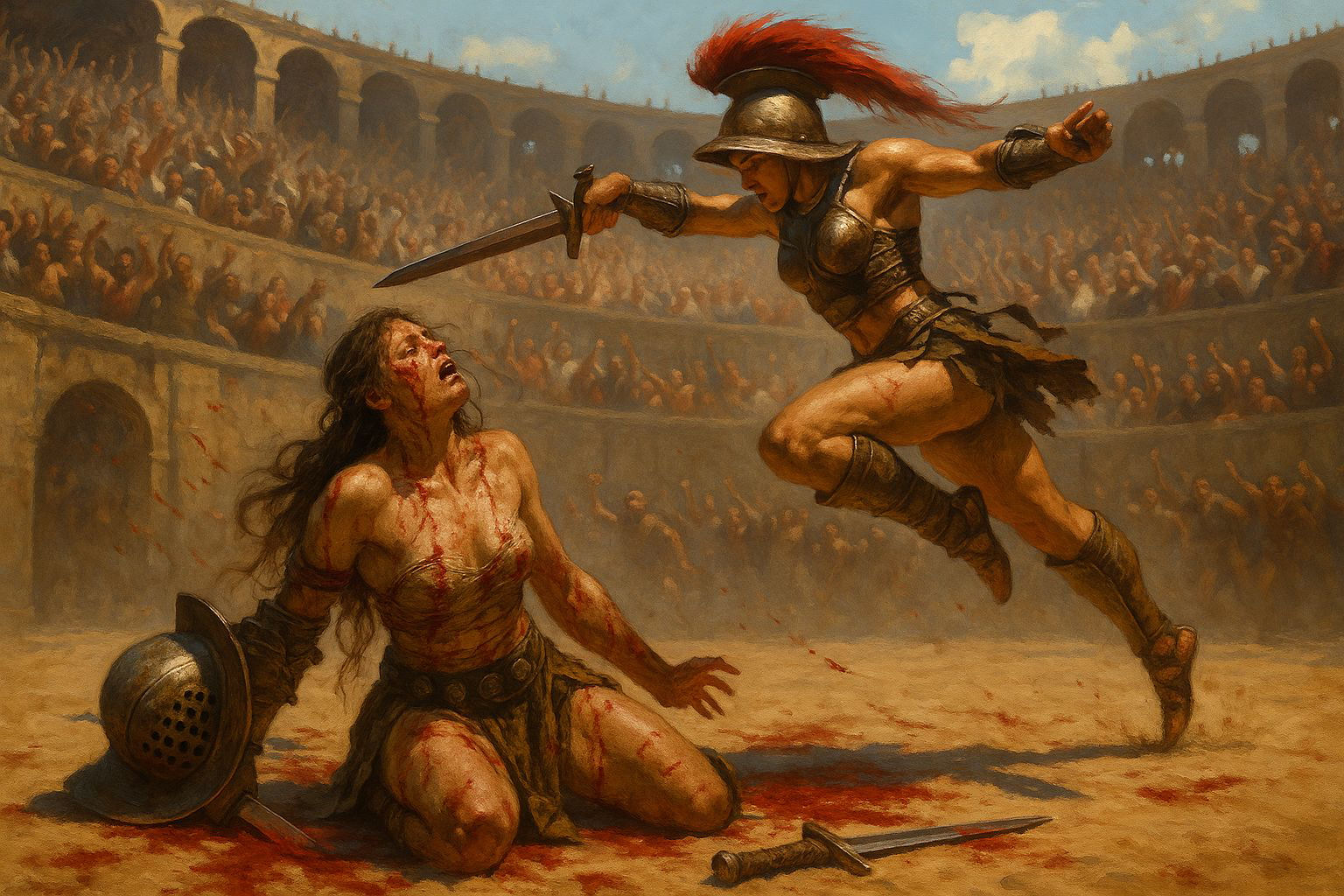
If the players visit the arena they catch a midday exhibition meant to warm up the crowd. It is small scale, sloppy and vicious. The first bout pits a chained group of unarmed slaves against a mounted legion veteran who rides them down one by one. There is no skill on display, only execution. The crowd cheers every efficient kill and jeers whenever a victim tries to crawl away.
The next act involves executions of several captured prisoners from Freevalor. The executions are drawn out, excruciating, bloody and humiliating, and the crowd howls with laughter as the sand goes red. It becomes clear fast that this is not sport. It is simple cruelty dressed as entertainment.
Street Games of the Legion
On the wide plaza near the Mariner’s Gate a group of off duty legionaries run a gambling pit. They make foreigners compete in tests of strength or balance, usually rigged. The soldiers laugh, jeer and cheat without shame. Winning earns a few coins and a grudging nod. Losing risks a bruising pride or a small brawl that must be ended fast before real trouble arrives.
The Statue of Aurex’s Thousand Eyes
A towering idol of Aurex stands near the upper harbour, covered in polished bronze plates shaped like staring eyes. Locals believe the statue judges the honesty of those who pass beneath it. Anyone who lies nearby is said to feel a ringing in their skull. The effect is real enough that even seasoned merchants avoid speaking too freely. Augurs linger here, watching crowds for ill omens.
The Velvet Board
A small garden behind a perfume house hosts a public debating platform. Anyone may climb the steps and present a speech or argument. Citizens love humiliating foreigners who try. The crowd is sharp tongued and merciless. If a player character speaks well they may earn unexpected admiration and useful gossip. If they falter, the mockery echoes for blocks.
The Slave Market at Dawn
Before the main market opens, traders inspect chained groups brought in under cover of night. Most buyers are minor nobles or contractors for villa staff. The players witness the cold bureaucracy of the trade at its least theatrical. Quiet deals, blank ledgers, and efficient cruelty. A player might recognize a foreigner from their own homeland among the chained group, which may spark an improvised rescue attempt or moral dilemma.
Encounter for Ayesha
A minor courtier named Serion Helvax recognizes Ayesha from her diplomatic days in Mataraaj. He approaches with oiled charm and a strained smile. He has fallen out of favor in Alborum and assumes Ayesha has returned to court under new patronage. He pushes for introductions she cannot give and his persistence risks attracting attention from other nobles who remember her. This can complicate or aid early stealth plans later in the arc.
Encounter for Yasmira
A noblewoman named Lady Veneria Quindra tastes a dish Yasmira prepares while the crew sells or trades provisions. Impressed, she demands to know what household Yasmira serves. Veneria tries to lure her away from the Blue Marlin with flattery and promises of wealth. If refused, she grows offended and sends a steward after the players to try to buy her from the captain. This can snowball into trouble with local officials.
The Rope Maker’s Bridge
A narrow wooden bridge spans part of the river district, lined with rope makers twisting hemp into coils that hang like drying serpents. Beneath the bridge flows a slow channel used by smugglers and fishermen. A quiet exchange unfolds as the players pass by, hinting at illicit trade routes under the city. Here, they can meet Ralex of the Three Knots, a river thief who moves contraband aboard imperial barges. Untrustworthy but useful. It is an opportunity to learn about underground paths that may later serve the heist.
The House of Warm Welcomes
A huge brothel, with criers outside offering anything for the pleasure of paying guests. Men, women, exotics from all over the world, anything goes as long as you pay for the damage. Naked men and women are chained outside as living advertisement. As the crew walk by, another dozen slaves are delivered to the brothel, the guard delivering them happily shouting "Here's your daily delivery!".
The Procession of Perfumed Flames
A ritual parade moves through the streets once every five days. Priests carry bowls of burning resin whose smoke trails in colored plumes. Citizens kneel as it passes. Foreigners often do not. A sharp eyed priest may single out a player character for perceived disrespect and demand respect and a public apology before the crowd. Doing so ends it. Refusing may escalate into a street confrontation with temple guards.
The Archivist of Whisper Court
A reclusive scholar in the Lathera district trades in forbidden texts and half legal maps. He offers information about unusual river structures being constructed upriver, telling about the Aurelum without naming it. He trades only for items of personal curiosity, such as foreign charms or sketches of non human species. His notes are reliable but riddled with dangerous assumptions.
The Hall of Quiet Wards
Near the river stands a long colonnade where slaves with visible injuries or deformities are kept chained in shallow alcoves. Each has a wax tablet describing the flaw and the price reductions it earned. Merchants inspect them as examples of poor stock. A slaver named Harkos Zeth notices any crew member who lingers too long, assuming they are scouting for purchases. He will later remember their faces.
The Bloodfountain of Karn
In a central square stands a ritual fountain where crimson water pours from a basin carved with skulls. It is dyed water rather than blood, but a priest of Karn uses the spectacle to deliver stern judgments. He calls out sins among the crowd, always directing his accusations at the powerless. Citizens applaud every sentence. Foreigners are warned that arguing with a priest here counts as blasphemy. If a player challenges him the crowd turns hostile.
Night Carriage on the Sixth Terrace
After dusk a black lacquered carriage rolls through the wealthier terraces. Inside are masked nobles collecting slaves or beggars they consider interesting. Once selected, the victims vanish into aristocratic households and are never seen again. Witnessing the carriage is not illegal but speaking of it draws sharp looks from citizens. If the players follow the carriage it leads them into a gated quarter where either Carnees or Vampires have a coven. Not that this has a potential to turn into much larger side arc.
The Feast of Broken Instruments
In the artisan district a noble house hosts a public demonstration where musicians compete. The rule is simple, play well or have your instrument smashed across your back. Some lords come specifically to watch foreign musicians humiliated. Amir al Javeen might make an appearance here. Helping him risks antagonizing the hosting noble. Leaving him to his fate shows the casual cruelty of entertainment in Alborum.
The Scribe of Empty Names
In a cramped stall near the Forum of Aurex sits a bent scribe who sells forged citizenship plaques. He speaks slowly and never raises his eyes. Rumor says he used to be a senator’s clerk before he displeased the wrong patron. His plaques look perfect but any trained official will recognize the serial marks as false. He offers information on city routines in exchange for foreign trinkets. Using his services is dangerous but tempting.
The Punishment Stair
A steep stairway runs between two crowded housing blocks. Citizens bring troublesome slaves here to be humiliated, whipped or even maimed publicly. Every punishment is cheered by the crowd. This is not an official place, it has simply evolved as a place where slave owners punish their slaves, and the crowd get a free show.
The players may stumble upon an execution in progress, performed with ritual care. If a player interferes the crowd reacts violently. Fleeing becomes the only sensible option.
The House of Tattered Offerings
A temple dedicated to Savael stands near the river markets. Devotees leave scraps of torn fabric as tokens of wagers won or lost. Slaves sweep the scraps into baskets all day. Inside the temple the priests read fortunes at exorbitant prices. A priestess offers a crew member an augury that seems eerily specific, hinting at coming danger. Whether she is a seer or a manipulator is unclear.
The River Teeth
Along a quieter stretch of the riverbank rise jagged wooden stakes where criminals and rebellious slaves are displayed. The mood here is heavy. A group of young nobles with wine cups and painted faces dare each other to reenact the executions using a beaten vagrant. If the players interfere the nobles draw concealed blades. They are not skilled but they are citizens, and killing them would bring legion fury.
The Ash Cellar
Beneath a seemingly ordinary tavern is a low stone cellar coated in soot. Here a group of aristocrats gather to burn slave clothing and laugh as the victims stand naked in the rising heat. The tavern owner sees nothing wrong with this and offers to rent the cellar for private gatherings. Discovering this by accident puts the players in an awkward position, since the aristocrats assume any foreign intruder must be staff or potential entertainment.
The Kidnapping
| Story |
|---|
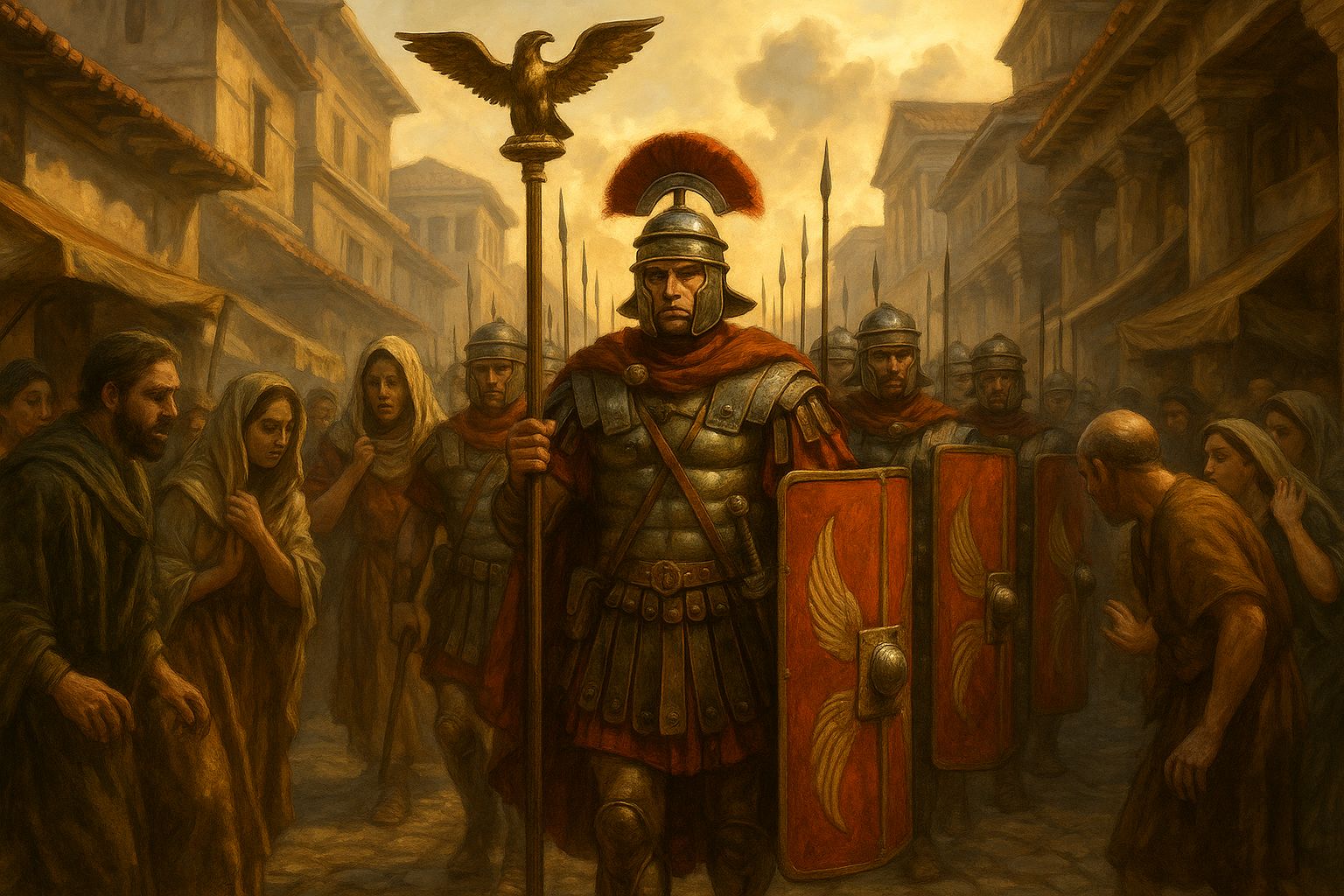
| The street was busy with late morning traffic when the sound of metal rose above the noise. Legion boots. Dozens of them. The crowd parted without being asked. People stepped aside with the ease of long practice, creating a clear path for the soldiers marching in perfect formation. |
| At their head walked Tribune Cassio Felorian. People whispered his name. His armor shone like polished bone and his eyes moved with lazy precision over the faces around him. He was not searching for threats. He was searching for beauty. His gaze slid across merchants, beggars, citizens, then stopped. |
| Yasmira froze as his attention settled on her. Beside her Mbaru straightened instinctively, confusion tightening his jaw. Cassio stepped toward them with slow, deliberate interest. He circled them as if inspecting livestock, pausing now and then to study a shoulder, a breast, a muscled arm, a cheek, a stance. The street watched in silence. |
| He nodded once. |
| "They'll do." |
| Before the words settled, legionnaires moved. Shackles clicked around wrists. Hands forced heads down. Yasmira cried out once before a hand silenced her. Mbaru fought for a heartbeat, then stopped when five blades touched his ribs. The patrol tightened ranks and marched away, their captives swallowed by the thrum of disciplined steps. |
| Junia stood rooted to the stone, breath caught in her throat. When the soldiers vanished around the corner she turned and ran, pushing through the crowd, sprinting for the docks with panic clawing at her chest. |
Choose two crem members which are NPCs for the kidnap, preferably members who are physically attractive or impressive.
Information Hunt
Once the kidnapping hits, the tone shifts sharply. The players should feel the city turning hostile without anyone raising a blade. This section is about a frantic scramble for answers. The crew knows almost nothing, time feels short and every source they approach reacts with fear, indifference or opportunism. Make the search tense, not because enemies chase them, but because the Empire simply does not care.
Where They Might Look
The players will start with the obvious. Let each path give a fragment. No single source hands them everything. The chase should feel like piecing together a shape hidden behind curtains.
City Watch Posts
These are staffed by low ranking legion clerks who barely look up from their tablets. They refuse to help and warn the players to stop asking questions. The most they will admit is that Cassio Felorian is known to carry out private tasks for the Emperor. Mentioning his name lowers their voices and makes them glance at the door.
Harbour Officials
Dock scribes maintain endless records. They know when large shipments move upriver but speak only in vague hints. One mutters that supplies for a special imperial barge were loaded last week. Another claims the Tribune oversaw a cargo of scented oils and silk without explaining why soldiers care about perfume. Their fear of saying too much is more telling than their words.
Street Vendors and Servants
These are the most talkative but also the least reliable. They repeat gossip wrapped in superstition. One says the Emperor ordered a floating palace for a celebration. Another claims he wants fresh faces for a night of wonders. A third warns that anyone taken by Felorian never comes back. Push them and they close up, suddenly remembering they have customers to serve.
Temple Steps
Priests and acolytes gather news quickly, but they guard their tongues. A priest of Savael may whisper that nobles have been whispering about a grand unveiling on the river. A temple attendant remarks that the Emperor demanded offerings of rare wines and incense, all delivered to a structure anchored upriver. None will speak openly. They fear drawing the Emperor’s attention.
Dregs and Dock Rats
Smugglers, thieves and unofficial guides know the river. They can confirm there is something large anchored beyond the city’s main bend. They call it the Aurelum. They know it is heavily guarded and that noble barges will travel there soon. They do not know details, but they know enough to warn the players not to go near it.
What They Eventually Learn
As the pieces gather the picture becomes clear.
The Emperor has commissioned a floating pleasure palace called the Aurelum. It is anchored upriver and sealed off by legionary cordons. A private celebration will be held soon. Only nobles and their retinues may attend.
Those taken by Cassio Felorian are intended as entertainment. Slaves and foreigners are often brought to imperial revels for spectacle and amusement. Rumors claim the Emperor intends a finale so extravagant that no participant survives it. Most citizens assume this is true and shrug. To them the fate of foreigners is not a tragedy. It is a footnote.
How to Present the Chase
Make the city feel wide yet unhelpful. Each answer should force the crew to push harder. They stay one step behind, always hearing what has already happened rather than what is happening now. Time pressure matters. Every hour wasted risks their crewmates being lost to the Aurelum’s debauchery.
By the time the players understand the situation they should feel the urgency of a countdown, even if no one states a clock. They must infiltrate, deceive or vanish into that floating palace. If they hesitate, the Empire will not hesitate with their friends.

The Heist
By now, it should be clear that the only option is a heist. Every important person in the Empire elite will be there, and the security will be accordingly. Brute force is not an option.
The Event
The Emperor has built a floating pleasure palace, a vast barge crowned with a full palace on its deck. He plans to unveil it with a grand celebration, and the noble elite are all invited.
Rumor says the event will display opulence beyond anything seen before. Slaves will serve the guests in every way, and at the end of the night they will be impaled in a final spectacle meant to mark the occasion as singular and unrepeatable. It is meant to flaunt the Emperor’s wealth and power. This is almost certainly the fate awaiting the captured crew members.
Getting In
Getting inside the Aurelum is the first big choice of the heist. Treat each route as a different kind of story. The crew does not have to pick only one. They can mix parts from several, but it helps if you understand the practical steps, risks and likely complications of each.
Impersonating noble household staff
The idea is simple. A noble house has an invitation. Their servants and bodyguards go with them. The crew replaces some of those servants.
First the players need a target. Use someone you have already seeded, like Lady Calistra or Lady Veneria Quindra. Gossip, invitations shown off in taverns and loose tongued valets can all confirm that this house will attend the Aurelum.
Next they need the look. That means livery, colors, maybe a house badge. They can steal or borrow uniforms from a laundry, a dressing yard or a carriage house, or bribe a wardrobe steward who is eager to pocket coin. Have them spot small details, like the matching cords on cloaks or a specific bracelet on household guards. That is what will get checked at the gangplank.
The main risk here is familiarity. Real household staff know each other. A replacement risks being greeted by name or given specific tasks. If a player cannot fake the right role, separate them in advance. One pretends to be the new hire, another plays a rented mercenary, a third pushes a supply cart.
If this route goes wrong it will be because a real servant notices a stranger using the wrong door, or a house officer suddenly remembers that his mistress never hired anyone that looks like this. When that happens, suspicion should start local, inside that noble entourage, not from the whole Aurelum at once.
Forged invitations and masquerade entry
The Aurelum is grand and the Emperor loves pageantry. A formal procession of guests, with masks and banners, is an easy way in if the crew can put their names on the list.
They need three things. A forged invitation scroll. A convincing noble identity. Proper masks and costume.
The forged document can come from the Scribe of Empty Names or a similar criminal forger. He knows the structure of imperial invitations but cannot fully reproduce the internal codes. This means the scroll will pass a quick check, but not an in depth review. Encourage the players to understand that they should join the procession near the back, where the clerks are tired and the light is bad.
The noble identity can be a minor provincial house that no one in Alborum knows, or a completely invented foreign dignitary attached to an allied state. Both are plausible and both depend on confidence. The more loudly the players behave as if they belong, the better.
Risks here are checkpoint scrutiny and random questions. A bored herald might ask about the players home estate, expecting a description. An augur might insist on a quick blessing and notice if their names are not in the ritual ledger. If you want to tighten the screws, have one clerk frown at the serial marks on the scroll, then decide he does not care enough to argue in front of nobles. That creates tension without immediate failure.
Entertainers and curiosities
The Emperor wants spectacle. Exotic performers and curiosities are always in demand. The crew can pose as a troupe of dancers, fighters, beast handlers or foreign storytellers.
They first need an introduction. Erastes Mallio the playwright or some other lower ranked patron can claim them as his latest find. The crew might have to perform a brief audition in a rehearsal courtyard near the docks. Play this scene straight. Make them dance, sing, fight or tell a story in character.
Once they are accepted, they will be brought onboard early and kept in a staging area below or near one of the side halls. They will be given a schedule, rough costumes and told to stay put until called.
The advantage is that entertainers are expected to move between halls and back passages as part of the show. The disadvantage is that they are watched closely by stage stewards and bored guards. If the crew goes missing too long, someone notices. If their act fails or offends, the Emperor may choose to make an example of them on the spot.
This route is best for groups who like social play and performance, and who accept that their cover will constantly force them into the center of attention.
River level infiltration with smugglers
The Aurelum sits on the river, anchored and ringed by smaller barges and patrol craft. The underside is less guarded than the grand gangplanks, but it is not open.
The crew can approach Ralex of the Three Knots or another smuggler who knows where the supply hatches and bilge outlets sit. The plan is to slip up river in a low boat, hugging the shadows of other barges, and latch onto the Aurelum’s hull below the main deck line.
From there they may crawl along maintenance beams, chains or drainage trenches until they find a service hatch, a kitchen chute or a rope ladder used by cleaners. This gets them directly into the working guts of the palace, among cooks, cleaners and stokers.
Silvio can be of great help here, finding and opening entrances.
The risks are physical and immediate. Currents can drive a small boat against the hull. River marines watch for swimmers and small craft. A dropped tool or a shouted warning in the dark can bring guards with lanterns to peer over the rail.
If things go wrong, the crew ends up in a cramped fight on wet wood, or forced to dive and swim under the barge while armored men throw spears into the water. Survival is possible, but stealth is finished.
Bribing or blackmailing a fallen noble
A noble on the edge of disgrace is the perfect key. They have an invitation, but their status is weak. They crave support. The crew can offer that in exchange for a place in the noble retinue.
Use Serion Helvax, Lady Veneria Quindra or create a similar figure. Someone who desperately wants back into favor. The crew presents a bribe, a secret, or a service, such as promising protection from rivals during the party. In return the noble lists them as extra bodyguards, servants or special guests on the escort rolls.
Practical details matter. The noble will want to pick how the crew looks and behaves. They might insist on house colors, on weapons peace bound at the hilt, on a false crest. The crew will have to stay near their patron on entry, at least until they slip away at a believable moment.
The risk is betrayal. A desperate noble might decide that handing a suspicious foreigner to the Emperor is a better way to regain favor than honoring a deal. Even if they do not double cross the crew, they will expect obedience. If the players cause a scene, their patron will panic and call for help, exposing them.
This route gives you a strong recurring NPC whose fear and ambition you can press on during the heist.
Temple or priestly cover
The celebration on the Aurelum will involve rites. Priests of Lustra, Malion, Karn and Aurex will be present to bless wine, battles and vows. The crew can slip in as junior acolytes or ritual assistants.
They need help from someone inside the priesthood, such as Augur Malvion, who resents the Emperor but fears him. Malvion can sign a few of them onto the festival roster as lamp bearers, incense carriers or chant leaders, provided they do not draw attention.
The practical side is all ritual. They must know when to kneel, how to respond to a chant and how to hold sacred objects. Simple mistakes can be hand waved, but repeated errors will draw stares. Funerary priests in particular are very attentive to ritual purity.
Risks here are quiet but sharp. Real clergy may react to mistakes about liturgy. Some nobles pride themselves on religious knowledge and may quiz a passing acolyte for sport. If they are exposed as impostors, the accusation will be blasphemy as well as deceit, which earns harsher reactions than simple trespass.
Using the options
You can present these as obvious routes, hinted routes or secrets discovered during legwork, depending on how proactive the players are. Make it clear that no method is safe. Each one trades one kind of danger for another.
Encourage them to combine ideas. Enter as entertainers but exit through the river. Go in as a noble retinue but arrange for smugglers to create a diversion outside. The more they shape the plan, the more the heist feels like theirs. Your job is to respond, not to herd them toward a single correct answer.
Inside
| Story |
|---|
| The Aurelum floated on the river like a vision torn from a fever dream. Lanterns shaped like lilies and serpents hung from every rail, their glass bellies glowing with warm oil. Musicians played on a terrace of red marble as noble barges approached in slow procession. One by one the Empire’s finest stepped aboard, jewels glittering on wrists and throats, perfumes pouring into the air in cloying clouds. They walked with the lazy confidence of those who believe the world bends for their pleasure. |
| When the last guest had arrived, a hush rippled through the crowd. The Emperor appeared on a balcony carved from ivory and lacquered gold. He raised his arms and the music stopped mid note. Even the river seemed to hold its breath. |
| "Welcome, children of the Empire," he said, his voice sweet and distant. "Tonight you stand above all others. Tonight you will taste delights no mortal outside these walls will ever know. Feast without measure. Drink until the stars blur. Take your pleasure from food, wine and slaves alike. This night is yours, and no god will deny you. For you, honored guests, there are no rules." He smiled, thin and bright. "Let the celebration begin." |
| The doors opened like the jaws of some vast beast. Inside lay a banquet hall that could have drowned an army. Tables sagged under mountains of roasted meats. Whole boars stuffed with figs and saffron. Fish glazed in honey and dusted with silver powder. Towers of fruit held together by candied vines. Fountains pumped red wine into pools already stained with splashes of older spills. Slaves in sheer veils moved among the guests with trembling steps, offering trays so heavy their arms shook. |
| The nobles surged forward. They grabbed whatever pleased them and dropped what bored them, letting priceless dishes shatter on the marble floor. They boasted over one another, voices rising as wine loosened their restraint. Every story became a competition in cruelty. How many slaves they had broken. Which province they had crushed. Which rival they had ruined with a single whispered lie. |
| Behind silk curtains the first side chambers filled with bodies and laughter. The nobles dragged slaves onto cushions or simply pushed them to the floor. Some treated the scenes as theater. Others as sport. What began in shadows soon spilled into the main hall. Curtains tore. Cushions slid out across the tiles. Drunken moans mixed with shouts and the shrill cries of those forced to serve the whims of the great. Power became flesh. Flesh became property. Property became a toy to be broken for amusement. |
| The Emperor moved through the revelry like a ghost trailing heat. Wherever he passed, guests bowed half drunk, half terrified. He watched everything with a child’s fascination and a tyrant’s calm. He stroked the cheek of one trembling slave as if admiring a sculpture. A moment later he stepped over another who lay crumpled on the floor, as though sidestepping a spilled cup. |
| Close to the center of the hall a noble, flushed with wine, made a remark that drifted just a little too near mockery. The Emperor stopped. The music faltered. He lifted one finger. At once the guards moved. They seized the noble, dragging him forward with quiet brutality. One guard placed a dagger in the Emperor’s hand, a blade so polished it reflected the lantern light like a shard of ice. |
| The Emperor said nothing. He drove the dagger into the man’s belly and let it stay there. The noble collapsed at his feet, gasping wetly, blood spreading across the tiles like spilled ink. |
| For a breathless moment silence held the hall. Then the guests forced cheers from their throats, quivering with fear, applauding as the Emperor wiped the blade on the dying man’s cloak. They praised him for his justice, his beauty, his wisdom. No one dared to look horrified. No one dared to stop smiling. |
| Wine kept flowing. Meat went cold on plates. Bodies writhed in corners. Slaves were snatched, discarded, snatched again. The music rose to drown the screaming. The guests reveled as if nothing existed beyond this night, as if the world itself was made to be consumed and thrown aside. |
| The Aurelum floated in the slow current, radiant and obscene, its lights shimmering across the dark water while inside the Empire revealed its true face without shame. |
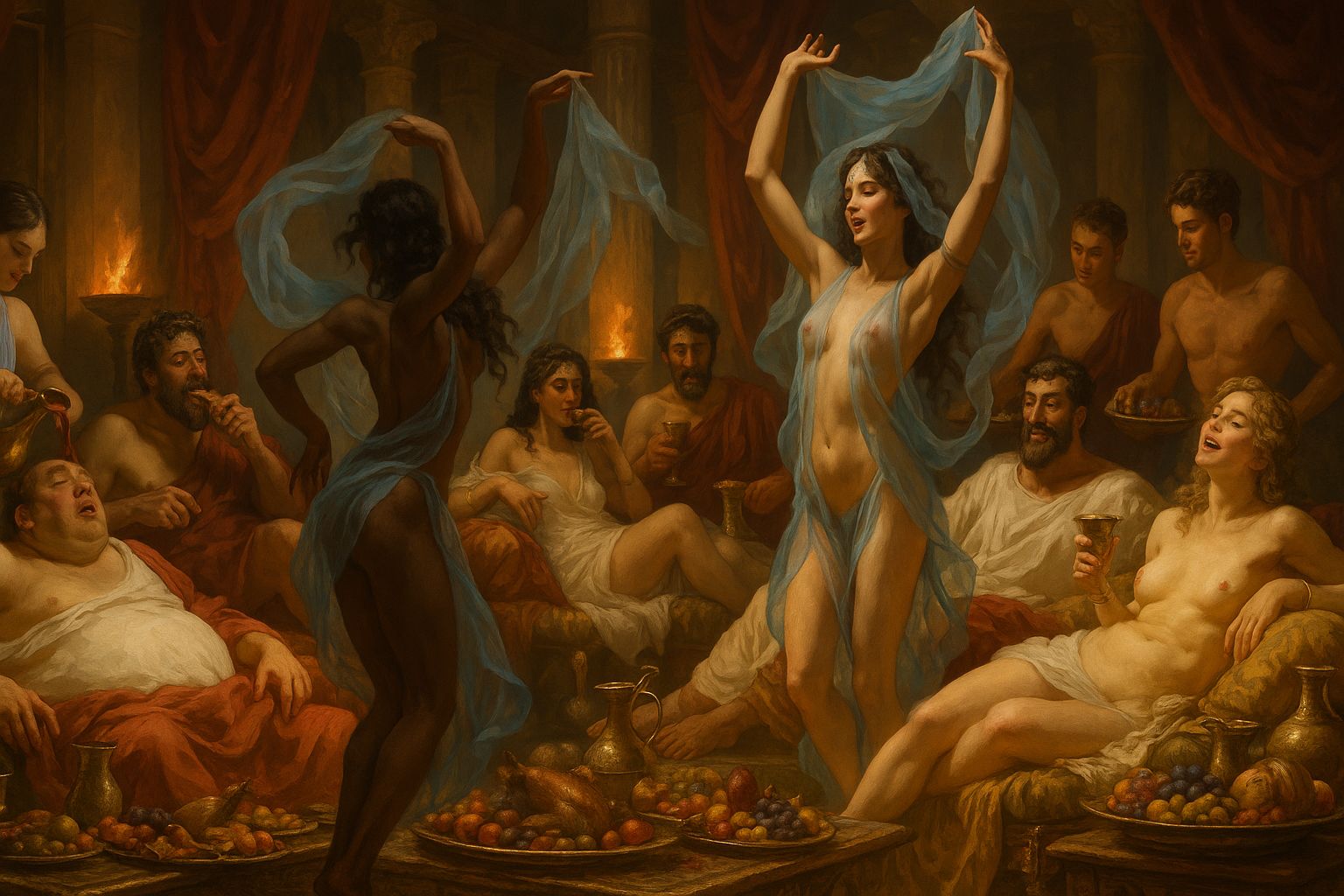
Once the crew is inside the Aurelum the heist becomes a moving target. Nothing is still. Nothing is quiet. This part of the arc should feel like trying to keep balance on shifting marble. The party is loud, chaotic and decadent, but the danger runs underneath it like a blade. The players are searching for their missing crew in the worst possible environment, one where every noble feels entitled to anything and every guard has permission to kill at the Emperor’s whim.
Use three guiding principles for this section: movement, pressure and moral disgust.
Mingling and Moving
The Aurelum is not a single hall but a maze of banquet rooms, performance terraces, silk curtained alcoves and narrow service corridors. Guests wander freely. Slaves move in hurried lines. Guards stand at choke points and drift through the halls in rotating pairs. The players can blend in with this flow if they act like they belong. Encourage them to use the movement of the crowd as cover. When one player draws attention, someone else should be slipping into a side passage or scanning faces in the next chamber.
Searching for the Captives
The missing crew members are kept somewhere unpleasant but not obvious. They may be held in a servant barrack under the main deck, a waiting room for spectacle victims or a preparation chamber where slaves are washed, painted or restrained. These rooms are not on public display. The players must eavesdrop, follow careless stewards, bribe tipsy guests or create small distractions to access restricted areas. No single path reveals everything. The search should feel like assembling clues in real time, all while pretending not to notice the horrors around them.
Risks and Consequences
Most dangers in this segment begin subtly. Use escalating suspicion rather than immediate combat. A guard frowns at an unfamiliar face. A drunken noble pulls a player aside demanding entertainment. A steward asks a pointed question. Each small moment should tighten the sense of exposure.
When the players slip or push their luck, respond with consequences that complicate rather than end the heist. A guard shadows them for several minutes. A noble demands they stay in her company, splitting the group. A servant notices they are not on the roster and hurries off to fetch someone. Only repeated mistakes or a bold failure should bring direct confrontation.
If they are discovered outright, the reaction depends on where they are. Near the main hall, exposure leads to alarm and immediate pursuit. In a side corridor, the guards may try to remove them quietly to avoid disturbing the Emperor. In backstage areas the staff might panic, creating confusion the players can exploit to escape deeper into the Aurelum.
Setting the Mood
Make decadence the backdrop, not the focus. Describe the constant waste. Food trampled underfoot. Wine pooling at the edges of rugs. Slaves stumbling from exhaustion while nobles complain about boredom. The party should feel overwhelming, a storm of color, scent and sound that never pauses long enough to think.
At the same time, keep the cruelty visible but matter of fact. Nobles grabbing slaves as if reaching for fruit. Guards dragging a limp body back behind a curtain. No one reacts with surprise. This banality of abuse does more to unsettle players than any spectacle.
The Emperor
Let him drift unpredictably through the halls. The players may see him on one side of the room and moments later find him behind them. Do not overuse him. His presence is a loaded gun. If he looks directly at a player, the tension should spike. He does not need to speak. His attention is threat enough.
Pacing
This section works best when you alternate tight, claustrophobic scenes in back corridors with sweeping, overwhelming moments in the open halls. Give players room to act clever and move, then remind them that the entire palace is a trap held together by etiquette and fear.
Most of all, ensure they always feel one mistake away from disaster. Even success should feel like slipping through fingers, never like safety. The Aurelum is not designed for visitors to survive. The players are trespassing in a place that assumes it owns every breathing thing aboard.
The End of the Party
| Story |
|---|
| The night staggered toward dawn, drunk on its own excess. Wine pooled in sticky rivers across the marble. Fruit lay crushed underfoot. The air hung thick with perfume and sweat and the low moans of guests too far gone to stand. Slaves in torn veils stumbled between toppled cushions, their faces gray with exhaustion. Music still played, broken and uneven, as if the instruments themselves were tired. |
| Then the Emperor rose. |
| He stepped onto the central dais, pale in the last lantern light. A hush rippled outward, eating the laughter, dimming the music, stilling the drunken revelers. Even the most intoxicated noble forced themselves upright as he lifted his arms. |
| "My honored children," he said, his voice soft enough that everyone leaned in to hear it. "I promised you a night no other soul would ever experience. A pleasure that belongs only to you." He smiled faintly. "I keep my promises." |
| He made a small gesture. |
| Around the hall the great tapestries jerked aside on hidden rails. Behind them waited rows of sharpened stakes, polished smooth and set in deep channels carved into the deck. A murmur rose. Then a cheer. Then a roar of delighted approval. |
| The Emperor turned, basking in it. |
| "These slaves have served you well," he said lightly. "They have given you laughter and warmth, obedience and ecstacy. Now they will give you something greater. They will give you a memory that belongs only to this night. No one else will ever enjoy them again." |
| Guards surged forward. Terrified slaves were seized where they stood. Some begged. Some froze. Some tried to flee and were dragged back by their hair or limbs. The nobles cheered louder. They raised their cups, sloshing wine across their robes and their naked bodies, shouting praise to the Emperor for his generosity. |
| One slave clawed at the floor, leaving streaks on the marble as two guards hauled her toward the nearest stake. Another fought until a blow to the head dropped him limp. The air filled with screams, muffled by the thunder of applause. |
| Outside, beyond the rails, the horizon began to pale. The first thin line of sunlight touched the river, turning the dark water a faint, shivering gold. |
| Inside, the stakes waited. |
If the crew have not escaped by this point, the moment for subtlety is gone. The Emperor’s command has stripped away the last seconds they had. Whatever plan they hoped to finish is out of time. The stakes are no longer distant threats. They are being uncovered, prepared and filled.
From here on every heartbeat matters. Any hesitation risks their friends being dragged screaming toward the sharpened poles lining the hall. Whatever the crew intend to do, they must do it now. There will be no second chance once the guards begin the executions.
This is the point where their quiet heist becomes a desperate scramble.
The Escape
Reaching their captives is only half the heist. Leaving the Aurelum is the moment where tension should peak. Even if the players entered as honored guests, they cannot simply stroll back down the gangplank. No one leaves before the Emperor chooses to end the festivities. Any attempt to do so draws suspicion at best and steel at worst.
Make this clear through the environment. Guards close the formal exits. Officers check movements. Stewards politely, but firmly, redirect anyone drifting too close to the outer decks. The Aurelum is now a gilded cage. Some of the ways in are not useful ways out.
Escape Routes
Swimming for It
The simplest escape is also the most frantic. The outer galleries are close enough to the water to allow a dive, but doing so will be seen. The jump creates noise and a splash, and the lantern light along the rails gives the guards a clear view for the first stretch. Players must swim hard until they vanish into darkness. Expect thrown spears, arrows and shouted alerts. A disguised guest has a small advantage, but not much. This escape is a matter of speed and grit, not stealth.
River Landing Chains
Massive chains and anchors run beneath the palace to keep it steady in the current. These chains drop down into shadowy water. A crew with nerve can climb over the rail, slide down the chains and drop into the river below the line of lantern light. This is quieter than a dive, but easier to slip and likely to scrape hands raw. Guards patrolling above might hear them.
Supply Chutes and Waste Channels
Kitchen refuse and wash water are drained down narrow channels into the river. These are filthy, cramped and built for waste, not people. But they feed into the river unseen, usually venting below the waterline. The players may squeeze through if they are desperate.
Stealing a Noble Gondola
Noble barges are tied to the rear docks of the Aurelum. If the players cause a distraction in the main hall, they can break away, rush to the back and cut loose a gondola or barge. These vessels are fast and silent, but boarding one requires bypassing or knocking out private guards. Once free, the craft must be steered quickly into the river’s natural curves before pursuit is launched.
Hiding among the Slave Caravans
When the executions begin, not all slaves are impaled immediately. Some are queued, restrained or herded for later spectacle. The players can disguise themselves and their captives among these groups, using chaos to slip toward storage holds or secondary decks. This is risky, since guards focus heavily on these areas, but confusion might let them drift out of sight until they reach an unattended hatch or cargo crane.
Starting a Fire
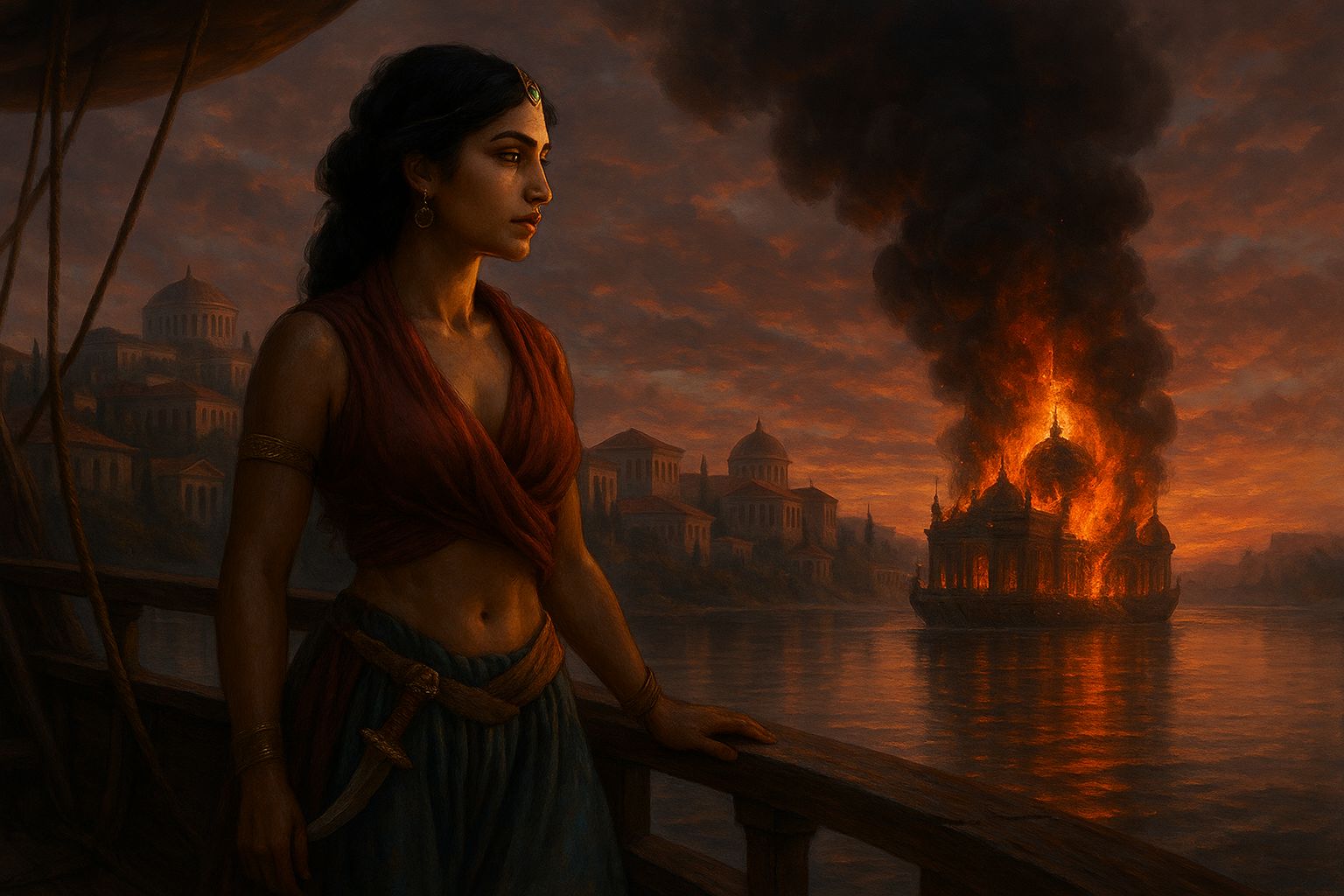
A well placed fire in the kitchens or wine stores can send smoke curling through the hallways. The Aurelum is wood beneath its marble facade. Stewards panic. Guards scatter. Guests flee. In the chaos, exits that were sealed might be abandoned. A burning Aurelum will bring river crews and watch boats racing toward it, creating further confusion that can mask an escape attempt. Fire also has the benefit of allowing some slaves to escape.
Sabotaging the Anchor Lines
If the crew can reach the central anchor winches and sabotage them, the Aurelum will begin to drift. This creates immediate alarm and forces the guards to divert attention to stabilizing the barge. The shift in balance and sudden shouts give the players a window to reach the outer decks. The drifting palace will be harder for chase boats to flank, giving swimmers or small craft a greater chance.
General Advice for Running the Escape
Do not assume one solution. Let the players combine elements. Steal a gondola but leap overboard halfway. Sabotage an anchor as a distraction before diving. Smuggle a captive in a wine cart toward a supply chute. The Aurelum is built for spectacle, not security, and creative thinking should be rewarded.
Keep pressure constant. Guards shout. Alarms rise. Lights sweep across the water. Each success should feel like sliding under a falling blade, not clearing a hurdle.
If the players completely lose control and must flee without their comrades, Samden’s quiet hand may still prevent the worst. A misplaced key. A guard looking the wrong way. A cart rolling across a corridor at the perfect moment. Nothing overt, nothing heroic, just enough for the captives to survive long enough for the crew to return.
Leaving Alborum
Once the crew reach the Blue Marlin, the final step depends entirely on how loud their heist became. If the infiltration remained unseen and the captives were recovered without incident, the city barely stirs. Alborum is too busy and too arrogant to imagine that foreigners slipped into the Emperor’s revel. The crew can finish restocking the ship, settle their affairs and depart with quiet haste. Suspicion never lands on them and the Marlin sails out on the morning tide like any other trader.
If the heist erupted into chaos and the Empire can connect the disruption to foreign intruders, the tone shifts immediately. The harbors bristle. Legion scouts are dispatched to the riverbanks. Naval officers shout orders across crowded quays. Rumors race ahead of the players. Everyone looks twice at a foreign ship preparing to leave.
This is where the Blue Marlin earns her reputation. Imperial vessels are sturdy, wide hulled and built for power and intimidation, not agility. They turn slowly and accelerate like oxen in armor. The Blue Marlin, by contrast, is lean and fast, carving through water with a hull made for long ocean runs. If the crew make a run for it, describe the chase as a tense, breathless race down the Arteria River toward Emperor Bay. Imperial galleys try to swarm from the flanks, but the Blue Marlin slips past them. Archers loose volleys that vanish harmlessly into spray. A ram strike misses by yards as the crew lean into every rope and brace.
Keep it tight. Keep it dangerous. But unless the crew make catastrophic choices, the Marlin should break free into open water. Once past the bay’s outer markers, the imperial vessels give up the pursuit. Their range is limited, their pride wounded, and the crew have escaped the Empire’s grasp.
Alborum fades behind them, bright, monstrous and shrinking on the horizon. The heist is done. The hunt for the Waverider continues.
Act Summary
By the end of this act, the players should have a clearer understanding of the Empire’s true nature. Alborum strips away any illusions of sophistication or nobility. The city shows the players a civilization that treats beauty as currency, cruelty as entertainment and human lives as disposable luxuries. Even the most privileged citizens move in fear beneath the Emperor’s gaze. The Empire is powerful, but it is sick at the core.
They should leave knowing that their presence in Alborum matters only when someone powerful decides it does. Foreigners vanish without protest. Justice bends to status. Survival depends on wit, speed and knowing when not to draw attention. The kidnapping demonstrates how insignificant outsiders are to the Empire, and how suddenly danger can strike even in daylight.
Most importantly, the crew should feel the thrill and fragility of the heist. They infiltrated a place no sane person enters willingly and walked among nobles who would kill them for a whim. They saw the Emperor up close, learned to navigate the Aurelum’s shifting dangers and rescued their own under impossible pressure. Whether the escape was clean or chaotic, they should sense that they escaped not because the Empire is weak, but because they were clever and lucky enough to slip through its cracks.
Finally, they leave with renewed purpose. They know where the Waverider went next, they have survived the Empire at its most decadent and dangerous, and they have seen how far they are willing to go for each other. The road ahead remains wide, but Alborum becomes a turning point, a reminder that the world is deeper, darker and more unpredictable than they imagined when they first set sail.