Campaign: Tazulmar
Act Synopsis
The Tazulmar arc is a journey through grief, dependence, slow belonging and deepening desert mysticism. It begins immediately after the catastrophe in Lumekhet, with the crew cut off from the Blue Marlin and forced to continue with the Dunewind Tribe under bleak circumstances. The tribe has lost people, lost one Shar'zul and is in no shape for generosity. The crew are tolerated because they must be, not because they have yet earned a place.
The central structure of the arc is simple. The crippled caravan cannot continue directly toward Ssar'et, so it must first detour east to the Vale of Shuraz to secure new Shar'zul. Once that is done, it turns west again for the long and increasingly dangerous march toward Zhess'r Village in Ssar'et. Around that spine, the arc builds emotional connection with the Dunewind, develops Nephyla from sacred symbol into confused and struggling person, and layers in growing stories of Rahim and Kethra, until the desert itself begins to answer back.
Ongoing Threads
These are themes which will run throughout the arc, which the Game Master should develop over the run of the arc.
Nephyla's Development
Running through the entire arc is Nephyla's first real stage of change. In Lumekhet, her status was broken. In Tazulmar, her social reflexes begin to fail her. Her development is no longer mainly about not knowing how to do practical things. Instead, it is about trying to become a person with no real experience of ordinary human interaction.
Her arc is built through social friction, awkward gratitude, misread intentions, failed attempts at humility and glimpses of the confused, lonely woman beneath the sacred facade. She wants to change, but does not know how. Sometimes she reaches toward connection and gets it wrong. Sometimes she falls back into old habits of rank, distance or wounded pride. What matters is that the struggle has moved inward. She is no longer simply being humbled by the world. She is beginning, clumsily and painfully, to resist the person she was made to be.
By the end of the journey, she is still difficult, still unstable and still far from fully trusted, but there should be enough glimpses of the woman she could become that keeping her aboard no longer feels absurd. It feels possible.
Waverider Stories
Throughout the journey, the crew slowly gathers stories about Rahim and Kethra from the Dunewind Tribe.
Some are only brief remarks during work, meals or watch shifts, while others are fuller memories told around the fire or during the long halts. Together, they turn the Waverider trail from an abstract pursuit into something personal. Rahim and Kethra stop being names and start becoming people who once traveled this same road, earned respect, made mistakes, left impressions and are still remembered.
These stories also help bind Nasheem more tightly to the arc, especially as Rahim's memory deepens toward the later djinn encounter.
Social Ties with the Dunewind
A major thread of the arc is the crew's growing emotional connection to the Dunewind Tribe.
Early contact is shaped by labor, grief and practical necessity, but over time this opens into trust, friendship, teasing, attraction and shared memory. The caravan should gradually shift from feeling like a group the crew travels with to a moving community they have become part of, at least for a while. Some ties remain light, others deepen into genuine affection or romance, but the overall goal is the same: by the end of the arc, the Dunewind should feel like people the crew cares about, not just guides across the desert.
Travel Plan
The route through Tazulmar is long even under good conditions, and this caravan travels under anything but good conditions. What should have been a hard but manageable crossing becomes a slower and more fragile march, first east toward the Vale of Shuraz to replace what was lost, then back west toward Ssar'et.
The itinerary below gives the planned route and travel times, but in practice every stretch is shaped by weather, illness, fraying tempers, beast handling and the simple fact that a wounded caravan moves differently from a healthy one.
- Halzun Oasis, 4 days
- Vezhet Oasis, 4 days
- Zeffir Oasis, 5 days
- Camp Uzuzu in the Vale of Shuraz, 2 days
- Rest at Camp Uzuzu for 1 to 2 weeks
- Zeffir Oasis, 2 days
- Vezhet Oasis, 5 days
- Halzun Oasis, 4 days
- Uzhari Oasis, 4 days
- Aruzan Oasis, 4 days
- Zhess'r Village in Ssar'et, 10 days
The Road Out of Lumekhet
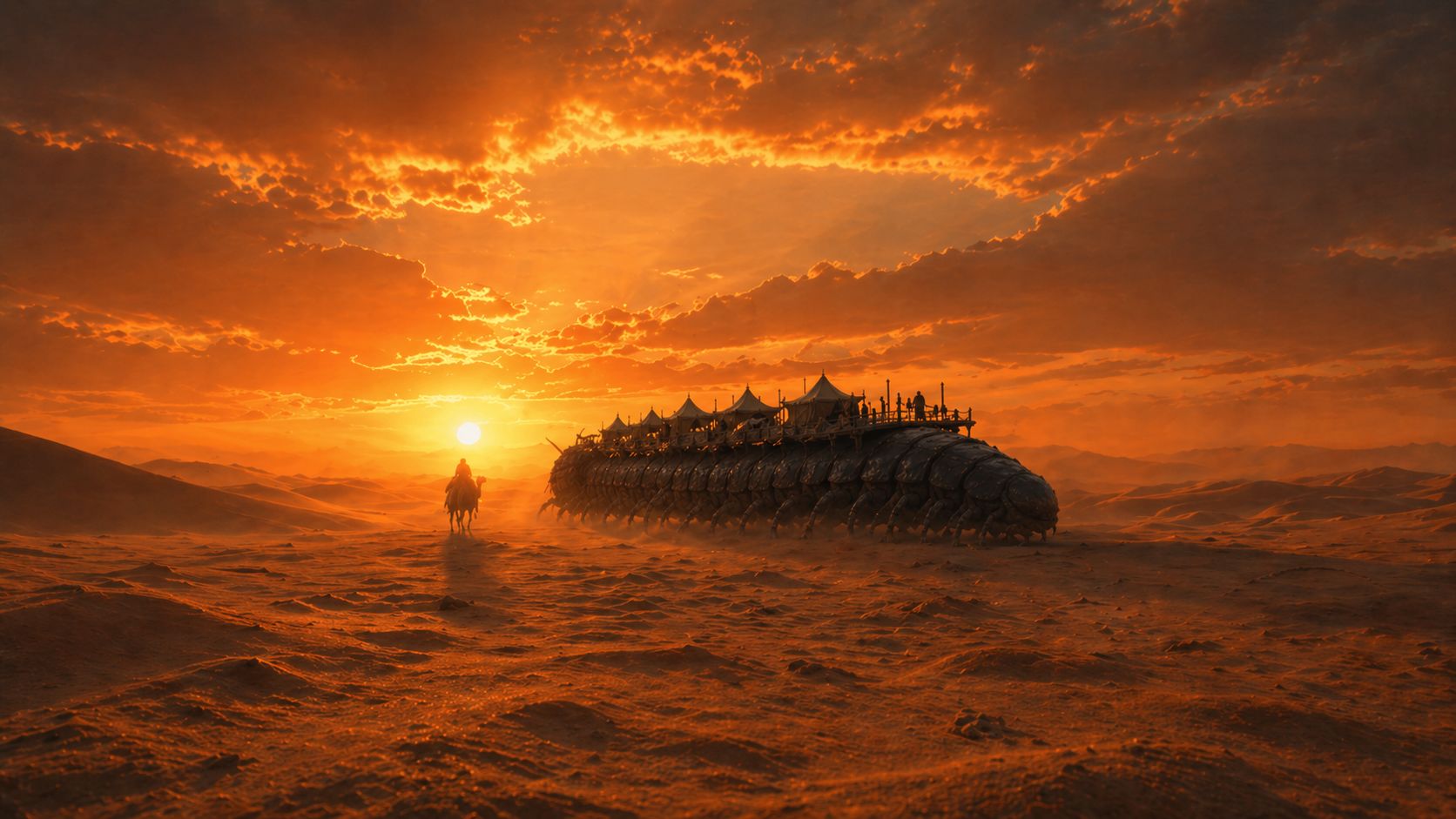
The arc opens in exhaustion and shock. The Dunewind caravan has just escaped disaster. One Shar'zul is dead, several tribe members have been killed and everything that could be salvaged was thrown together in haste. As the caravan limps deeper into the desert, Sada immediately puts the crew to work sorting the chaos left behind. What was hastily saved from the dead Shar'zul now lies in mismatched piles, and the crew must move through the caravan to find out what belongs where, who has lost what and what must be prioritized first.
This task serves as the crew's first real way into the tribe. They do not earn trust through heroics, but through labor, patience and practical usefulness. They meet the Dunewind not through formal introductions, but through grief, irritation, confusion and necessity.
On the second evening, once enough distance lies between them and Lumekhet, the tribe finally halts long enough to bury its dead properly. The funeral, held at sunset, becomes the first real pause in the arc. It gives the crew a chance to see the Dunewind as a mourning people rather than just a wounded caravan, and it begins the slow emotional work of making these desert nomads into more than escorts.
Early Caravan Life
The first stretch of the journey establishes the caravan as a moving society rather than a travel device. At Halzun Oasis, fever spreads through the tribe, forcing Junia and Mira into an exhausting struggle to keep the sick alive while the rest of the crew must step into roles they are not trained for. This period creates practical pressure, strains tempers and opens space for new emotional ties, including the possibility of attraction growing out of shared work, worry and care.
Between Vezhet and Zeffir, the young drummer boy Hadi goes missing when camp is breaking. The search that follows shows the other side of Tazulmar life. The whole tribe pulls together, and the crew become part of that effort. When Hadi is finally found by the distant sound of his drum, injured but alive, the moment becomes a small but important step toward acceptance. It also reinforces the tribe's communal structure, where children belong not only to their mothers, but in practice to the whole moving people.
Throughout this early section, the crew also begins to hear the first stories of Rahim and Kethra. Some are only passing remarks, others longer memories, but together they begin to make the Waverider trail feel human and familiar. Rahim and Kethra are no longer just names on a hunt, but people who once crossed these same sands with the Dunewind and left an impression strong enough to survive in story.
The Vale of Shuraz
After passing Halzun, Vezhet and Zeffir, the caravan reaches Camp Uzuzu in the Vale of Shuraz, sacred ground where the Dunewind comes to replenish what it has lost. Here the arc opens up. The caravan rests for one to two weeks, and what has so far been a hard march becomes a social and cultural middle section.
Another Tazulmar caravan, the Waterseeker Tribe, is already present. The two tribes are friendly, but familiarity has not erased old frictions. Past romances, unresolved deals, rivalries and present attractions create a low, shifting social tension that the crew can become entangled in over time. Because the stay is longer, these tensions are allowed to breathe instead of exploding immediately, and the crew get to see the Dunewind in relation to others of its own people.
At the same time, the practical purpose of the detour is fulfilled. Three Shar'zul eggs are found ready to hatch, and the crew participate in the rites surrounding them. Most importantly, Thaleia is chosen as the initial trainer of one of the newborn Shar'zul. The gesture has limited practical effect on the larger plot, but enormous emotional significance. It marks her as someone the tribe genuinely trusts and honors, and it strengthens the sense that the crew are no longer merely being carried along.
The Long Way Back
When the caravan leaves the vale, it begins the return journey west, now carrying its fragile new future with it. Between Zeffir and Vezhet, one of the baby Shar'zul runs off, forcing the caravan into a difficult search. The event reinforces how precarious the tribe still is. Even recovery brings new responsibilities and new danger.
As the journey continues, the mood shifts again. The desert is no longer merely harsh and beautiful. It has become known territory, and that allows the arc to turn more fully toward mysticism. During a night stop between Halzun and Uzhari, Nasheem is drawn out into the dunes by a voice in the wind. There he encounters a djinn who tests him not only as a fighter, but in honor, grief and worthiness as a keeper of story. The reward is not treasure but tale and recognition. For Nasheem, a man shaped by Zarhalem and by loss, being judged by a djinn and found worthy is a profound mark of meaning. The encounter also deepens the Rahim thread and leaves him with a cryptic charge that will matter later.
Two days after Uzhari, the caravan is locked down by a sandstorm that lasts more than a day. The crew are warned that if they hear or see something in the storm, they must not answer it, must not look at it, must not even think about it. The danger is tied to bad djinns in the storm, predators of attention and weakness rather than simple weather spirits. The scene reinforces the deeper desert as a place where discipline is not only practical, but spiritual.
The Dry Oasis and the Final Push
At Aruzan Oasis, the caravan reaches the point where hardship sharpens into crisis. The oasis is almost dry. The water they expected to find is gone, or near enough to gone that the final stretch to Ssar'et suddenly becomes uncertain. The tribe now faces a genuine choice. Divert south toward the Desert Rim, with all its warlords, slavers and violent uncertainty, or press on through thirst and discipline toward Zhess'r Village.
This becomes a late arc payoff scene. By now, the crew know the Dunewind well enough to argue not in the abstract, but person by person, using what they have learned of pride, fear, grief, practicality and trust. The outcome should feel like the room being won gradually rather than by a single speech.
The Last Approach
Once the decision is made and the caravan presses on, the final stretch becomes a test of endurance. Water is short, tempers are brittle and the margin for error is nearly gone. A few days out from Zhess'r Village, lizardmen bandits begin shadowing the caravan from a distance. They do not attack. They recognize weakness and simply wait, patient and predatory, for thirst to finish the work.
This leaves the arc with a strong unresolved threat. The Tazulmar journey does not end in triumph, but in survival under pressure, with danger still circling as the caravan reaches Ssar'et. That threat will carry directly into the next arc.
Tone and Function
The Tazulmar arc is not about conquest, revelation or dramatic victory. It is about becoming part of a wounded moving people long enough to help carry them forward. The journey begins in disorder and grief, opens into deeper ties and desert culture at the Vale of Shuraz, then tightens into mysticism, thirst and argument as Ssar'et draws near.
By the end, the crew should feel changed by the Dunewind. They have not simply crossed the desert. They have lived inside it, and inside the lives of those who know it best.
Running the Tazulmar Arc
Do not run this arc as a day by day journey. The caravan is traveling for a long time, and most of that time is routine, repetition and slow movement. If every day is played out, the desert will flatten into noise and the important material will lose weight.
Instead, run Tazulmar as an event by event sequence. The journey advances through an irregular pulse of moments that matter. Some are large, such as the funeral, the fever, the stay at Camp Uzuzu, the djinn encounter, the storm and the debate at Aruzan. Others are small, such as a quarrel at dinner, a Waverider story by the fire, an awkward moment with Nephyla, a romantic advance or a quiet act of kindness. Those moments are the real shape of the arc. Everything between them can usually be skipped, summarized or handled in a few lines of travel texture.
Skipping the Slow Travel
When you move between events, make it clear that time is passing. People settle into routines, tensions cool or deepen, injuries heal, attraction grows, habits form and the desert keeps wearing at everyone.
A simple transition is often enough. A few hard days pass. The heat grows worse. The caravan falls into a rhythm. Hadi drums badly at dusk. Sada snaps at someone over water. Zahra sings one of the old road songs. Then move to the next scene that actually changes something.
Running Long Player Goals
Use the same approach for anything the players want to pursue over time. If someone wants to charm a caravan member, do not try to resolve it in one scene unless that is clearly the right result. Let it develop across the road. Play the first meaningful moment, skip the uneventful days, then return to it later when something shifts.
The same is true for social mysteries, personal tensions, slow friendships, romance and Nephyla's development. Handle them as long threads with key moments, not as continuous minute by minute play.
Why This Matters
This matters especially in Tazulmar because the arc is about a long journey with many slow stretches. The players should feel that they have lived with the Dunewind Tribe for weeks, but they do not need to roleplay every camp setup and every meal to get that feeling.
What they need are the important interruptions. The fever that forces new roles. The search for Hadi. The long stay at Camp Uzuzu. The first real Waverider story that lands. The awkward gratitude from Nephyla that comes out wrong. The flirtation that turns into something more serious later. The sandstorm that changes the mood of the desert. The late argument at Aruzan where everything learned about the tribe finally becomes useful.
The Road as Context
Think of the road as context, not content. The desert is always there, and it should always be felt, but it is not the point of most scenes. The point is what happens to people while they are trapped inside that long road together.
That also means smaller scenes matter. Not every event needs to be a crisis. A quiet talk, an insult, a shared joke, a moment of vulnerability, a story about Kethra or Rahim, or a failed attempt by Nephyla to act like an ordinary person can be just as important as a major set piece. These smaller beats are often what make the larger ones land.
The Core Approach
Run Tazulmar as a sequence of meaningful moments across a long span of time. Let the empty days stay empty. Let the slow days blur. Let the important days stand out.
That is what will make the journey feel long without making it feel slow.
Ongoing Threads
Nephyla's Development
Nephyla's role in this arc is not mainly to fail at practical things. That part has already done its work. It continues, but as background. In Tazulmar, the focus shifts inward. She is no longer only being stripped of rank and comfort by the world around her. She is now trying, badly and unevenly, to become a person.
That is the center of her development here.
She wants to change, but has no real practice in ordinary human interaction. She knows ritual, posture, distance and sacred authority. She does not know friendship, gratitude, intimacy, apology, teasing, shared labor or being treated like one difficult woman among many. Tazulmar is a very good place to expose this, because the Dunewind Tribe is socially close, practical and not much impressed by her old status. They do not hate her. They simply do not organize themselves around her.
The Game Master should treat her arc as a repeating pattern of friction, awkward effort and brief glimpses of the person she could become.
What Her Arc Should Feel Like
Nephyla should not feel like comic relief, and she should not feel like a redemption story that is already underway in a clean, obvious way. She is proud, unstable, lonely, badly socialized and trying not to need people even as she increasingly does need them.
Most of her scenes should contain at least two things at once.
A social mistake or misreading.
A real attempt underneath it.
That second part matters. The point is not that she gets things wrong. The point is that the wrongness now comes from trying. She reaches toward people, gratitude, concern or humility, and it comes out badly because the only tools she has are the tools of someone raised as sacred property.
Sometimes she should fall back into old habits. Sometimes she should snap, posture, command, judge or retreat behind injured hauteur. Those moments are important too. They stop her from progressing too smoothly and keep the conflict alive inside her rather than only outside her.
What Tazulmar Should Do to Her
Tazulmar should wear down her social reflexes.
The Dunewind Tribe does not bow.
Romantic interest, if it appears, will likely confuse her more than open dislike.
This is good. It forces her into a world where she cannot rely on the old scripts. That does not mean she immediately becomes humble. It means she increasingly has moments where the old script fails and something more human slips through.
How to Use Her in Play
Do not make her a fixed scene at each stop. She should be modular.
Drop her into other events. The funeral. The fever. Meals. Watch shifts. Packing. Stories. The stay at Camp Uzuzu. Moments of attraction. Quiet pauses in the road. Let her development happen inside the life of the caravan, not beside it.
Most of her scenes should be short. A few lines. A brief exchange. An awkward moment that leaves an impression. Do not over-explain them. Let the players notice the pattern.
Use other people to reflect different sides of her.
- Sada brings out defensiveness and resentment.
- Mira brings out awkward dependence.
- Zahra brings out curiosity and uncertainty.
- Sereh or another gentler figure can bring out confused tenderness or misread intimacy.
- Children can expose how little she understands informal warmth.
- Nasheem can bring out pride, teasing and moments where she reacts more honestly than she means to.
- Thaleia may see too much, which can irritate or unsettle her.
- Junia is especially useful because she represents care without rank. Nephyla can neither dominate her nor dismiss her easily.
What the Arc Should Achieve
By the end of Tazulmar, Nephyla should not be easy, stable or fully trusted. That would be too fast and too soft.
What should change is this.
The crew should start seeing that there is a person under the sacred shell.
The Dunewind should have seen her fail often enough to stop expecting much from her, but also succeed just enough to notice.
She should have shown flashes of gratitude, concern, shame, humor, hurt and real desire to change.
She should still backslide.
She should still frustrate people.
But keeping her aboard should no longer feel absurd. It should feel like a difficult possibility.
Running Patterns
Use these patterns repeatedly, but vary the details.
Awkward Gratitude
Someone helps her, and she tries to thank them. It comes out too formal, too elevated, too cold or too unequal. The important thing is that she tried.
Example: "I am grateful for your service to me."
Failed Apology
She realizes she was wrong or hurtful and tries to repair it, but only knows how to apologize in terms of status, ritual or over-serious phrasing. It lands badly, but the effort is visible.
Example: "I apologize that I didn't know you were unable to do this."
Misread Warmth
Someone is kind to her in an ordinary way. She misreads it as reverence, pity or romantic intent. This reveals how warped her expectations still are.
Misread Desire
Someone is attracted to her, or simply flirts. She mistakes it for mockery, manipulation or a test, because she cannot easily imagine being wanted as a woman rather than used as a symbol.
Facade Crack
She begins with pride or hauteur, then something real breaks through. Fear. Hurt. Shame. Loneliness. Gratitude. The shift should be brief and a little embarrassing.
Unwanted Humanity
She notices herself caring before she can stop it. She checks on someone, worries, comforts clumsily or reacts protectively, then seems almost offended with herself afterward.
Glimpse of Growth
She gets something almost right. Not perfectly, but enough that someone can see who she might become.
Short Scene Examples
These should be used as brief beats dropped into the journey where they fit naturally.
Badly Phrased Thanks
Mira hands Nephyla water after a hard march. Nephyla pauses, then says something like, "Your attentions are noted." It sounds terrible. Mira stares at her. Nephyla, realizing this too late, adds stiffly, "I did mean that kindly."
The Wrong Kind of Gift
After someone helps her with a practical task, Nephyla tries to repay them with something too grand, intimate or inappropriate for the situation. A bracelet. A formal blessing. A promise spoken as if she still had the authority to grant fate. The receiver is confused, amused or embarrassed.
Snapping at a Child
A child asks her a blunt question about Lumekhet, beauty or why she walks the way she does. Nephyla reacts sharply by reflex. Later, she brings the child something small and awkward, not really knowing how to repair the moment.
Misreading a Joke
At dinner, someone teases her lightly as one would tease anyone else in the caravan. She goes cold and walks out, assuming insult or challenge. Only later does she realize nobody else took it seriously, and that unsettles her more than the joke did.
The Awkward Thank You to Sada
Sada gives her an order, or corrects her sharply, in a way that accidentally prevents a worse mistake. Later Nephyla attempts gratitude. Sada thinks she is being sarcastic. Nephyla then gets angry because she was trying to be sincere.
Watching Junia Work
During the fever, Nephyla sees Junia exhausted, dirty and still caring for people without any recognition or status. She tries to offer help and only succeeds in being in the way. Later, more quietly, she asks Junia why she keeps doing it.
Misread Flirtation
Someone from the tribe, perhaps shy Sereh or someone bolder, shows interest in her. Nephyla first assumes manipulation. Then, once it becomes clear it is genuine, she becomes more uncomfortable, because she does not know what genuine desire directed at her is supposed to mean.
Trying to Comfort Someone
After the funeral or a later grief moment, she sees someone crying and tries to speak in the only language of consolation she knows, one full of ritual, destiny or sacred imagery. It does not help much, but she remains beside them instead of fleeing. That matters.
The Failed Apology
She wounds someone with a careless remark, realizes it later and returns to apologize. The apology is too ceremonial, too stiff and slightly self-centered, but the simple fact that she came back is new.
Brief Jealousy
She sees someone she has begun to rely on laughing easily with someone else. She reacts with coldness she does not understand in herself. This is especially useful if tied to Junia, Nasheem or a tribe member who has been kind to her.
Asking a Real Question
One evening she asks Zahra or Mira something very simple and very revealing, such as how people know when they are friends, why mothers let children roam so freely, or why no one seems frightened of being ordinary. Maybe she asks someone she trusts about romance, revealing that she doesn't really grasp it. She tries to sound detached. She fails.
Helping Before Thinking
Someone stumbles, drops something or looks close to collapse, and Nephyla moves to help before she has time to decide whether that is beneath her. She then becomes stiff and defensive the moment anyone notices.
Silence Instead of Command
A task is going badly and her old reflex is to issue a command in the tone of someone obeyed by right. She starts to do it, then stops herself. The scene matters because she notices the impulse and resists it.
Hurt at Being Ignored
During some piece of caravan life, no one includes her, not out of hostility, but because they simply forget her. She reacts first with pride, then later reveals real hurt. This is useful because it shows that losing sacred centrality also means losing easy attention.
Almost Getting It Right
At the end of a difficult day, she thanks someone simply. Not elegantly, not comfortably, but plainly. "Thank you." She seems almost startled by her own words. The other person may not even comment. That is enough.
Using Romance Carefully
If romance or attraction touches Nephyla, it should not become a clean love subplot. It is more useful as confusion, destabilization and revelation. She comes from a life where romance didn't exist, and neither did choice. For her, it is a power game, and she will assume that there is a hidden motive.
Mistaking kindness for flirtation, or flirtation for mockery, should reveal how little she understands ordinary intimacy.
Any such thread should stay secondary to her broader struggle to become a person rather than a sacred object.
Final Guidance
Do not push every scene toward growth. Some should end in failure, embarrassment or retreat. Some should show real movement. Some should do both.
The important thing is cumulative effect. By the end of Tazulmar, Nephyla should feel less like a symbol being dragged along and more like a difficult, wounded, strangely earnest woman who might, someday, become worth the trouble.
That is enough for this stage of her arc.
Waverider Stories
How to Use These Stories
Do not dump them in one scene. Scatter them.
- Some should be one sentence during work.
- Some should come during meals.
- Some should be told badly by one person and corrected by another.
- Some should come only after trust has grown.
The point is not to lecture the crew about Rahim and Kethra. The point is to let the Dunewind remember them naturally, until the Waverider trail feels inhabited by people instead of clues.
Stories About Rahim

The Man Who Spoke Only When He Meant It
The Dunewind remember Rahim as quiet, watchful and sparing with words. This story can be simple. He spends days saying almost nothing, until one moment when he gives a warning, an observation or a decision that proves exactly right. The point is not mystery for its own sake, but that he earned trust by seeing clearly and speaking only when it mattered. This is a good early story because it is brief and helps establish his basic character.
Rahim and the Wrong Song
A small but useful story about the Tazulmar's songs to the djinn. Someone sings part of a travel song badly, either in ignorance or arrogance, and Rahim, though an outsider, is the one who notices that the caravan's mood has changed around it. Maybe he says little, but he takes the matter seriously when others are half laughing. This is a good way to foreshadow his connection to the deeper desert and to the djinn thread.
The Night He Stayed Awake
A more atmospheric story. The caravan sleeps, but Rahim stays awake on the edge of the firelight, listening to the dunes. In the morning he cannot explain what he heard, only that they should break camp earlier than planned or avoid a certain route. He is right. This can be told as memory, rumor or argument among the Dunewind, depending on how mystical you want him to seem.
Rahim and the Water Skin
A simple character story. Water is short, someone is weaker than they admit and Rahim gives up some of his own without turning it into a gesture. The Tazulmar remember that because in the desert, generosity with water matters more than grand declarations. This is a good story if you want him to feel quietly decent rather than only enigmatic.
The Djinn That Did Not Take Him
A later, more complicated story. The Dunewind do not all agree on what happened. Some say Rahim met a greater djinn and refused a bargain. Some say he accepted a bargain and paid a price nobody could see. Some say he only sat out in the dunes all night and came back changed. This story should stay uncertain. Its purpose is to make Nasheem's later encounter feel like part of a larger pattern, not an isolated event.
Stories About Kethra
The Woman Who Listened
The Dunewind remember Kethra as harder-edged, more openly marked by life and quick to listen when it mattered. A simple story can be built around that. She begins mistrustful or sharp, but when the tribe explains something practical, dangerous or sacred, she actually hears it and adjusts. That earns respect fast. This is a strong early story because it frames her as competent and disciplined rather than just dangerous.
Kethra and the Knife Under the Stars
This is a good Tazulmar-flavored story. There is a dispute in the caravan or between two people near the caravan, and Kethra finds herself challenged to a duel. She does not escalate for pride, but neither does she flinch from the desert's harder customs. This story is useful because it lets the crew understand how the Tazulmar settle serious matters, while showing that Kethra could function inside that world.
The Child Who Would Not Leave Her Alone
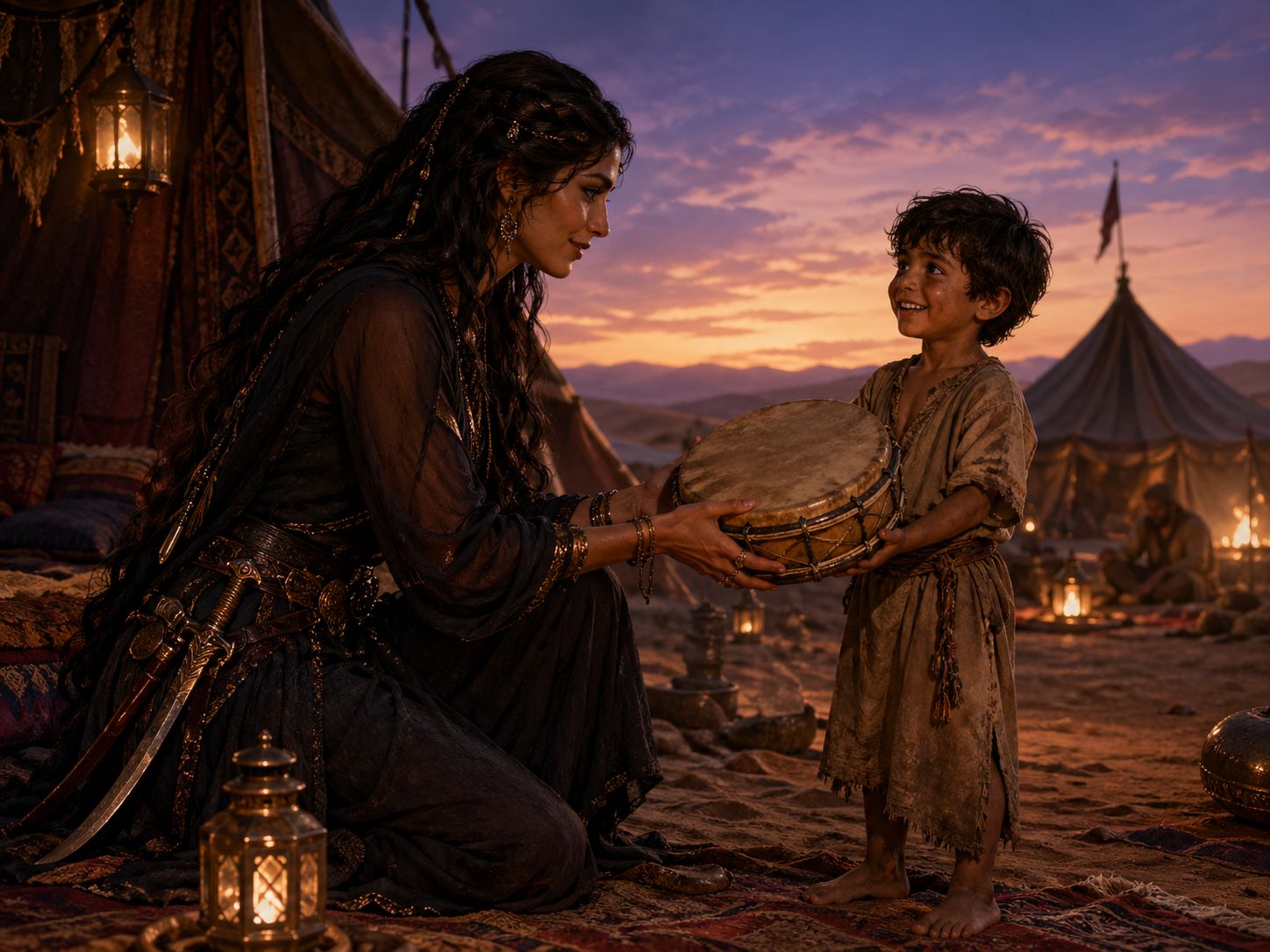
A softer story. Hadi becomes attached to Kethra despite her severity. She is awkward with it, does not know what to do with it and clearly does not want the responsibility, but she never actually pushes the child away. This works well because it complicates her image without softening her too much. Hadi will tell the crew that Kethra gave him his drum.
Kethra and the Runaway Load
A practical story. Something goes wrong in motion. A load slips, a rope fails, a platform lurches or a beast shifts badly. Kethra reacts instantly, harshly and effectively. Afterwards she is angry not because she was frightened, but because she knows exactly how close things came to disaster. This is a very good story to remind the players that life on a Shar'zul is not exotic scenery. It is a demanding way to live.
The Night Someone Tested Her
A more involved story about reputation. Someone in or near the caravan assumes that Kethra's hardness is bluff, outsider pride or wounded vanity and decides to test her. That was a mistake. The point is not necessarily violence. It may be enough that she does not bend, does not flinch and leaves the other person embarrassed. This is a good story if you want the tribe to remember her with a little amusement and a lot of respect.
Stories About Rahim and Kethra Together
They Were Never What People Expected
A simple paired story. The Dunewind expected the quiet one to be the easier companion and the hard one to be the difficult one. In some ways the opposite proved true. Rahim was harder to read and carried strange weather around him. Kethra was sharper, but easier to rely on once trust was established. This kind of story is good because it compares them without turning them into opposites.
The Night of Three Moons
A useful cultural story if you want to involve another caravan or tribal feast memory. During one of the inter-tribal feasts, both Rahim and Kethra react to the Tazulmar's openness in ways people remember. Maybe Rahim sits back and watches everything. Maybe Kethra is wary of the freedom, but gradually relaxes. Maybe one of them gets pulled into dancing, drumming or a lovers' misunderstanding. This is a good story because it shows them trying to live inside Tazulmar customs rather than only crossing the desert beside them.
The Sandstorm Argument
A stronger shared story. A storm is coming or already breaking, and Rahim and Kethra disagree over what kind of danger it is or how to handle it. The point is not that one is right and one is wrong, but that the Dunewind remember how they argued. Rahim sees something uncanny in it. Kethra sees the immediate practical danger. Both are useful, and both are needed. This is a strong way to show their different instincts.
The Stranger and the Blade
A social story. An outsider, trader or opportunist tries to manipulate the caravan while Rahim and Kethra are with them. Rahim sees the lie first. Kethra is the one who makes sure the liar regrets it. The tribe remembers this because the two worked well together, each covering the other's weakness.
The Day They Became Part of the Tribe
At some point, after enough strain and shared travel, the Dunewind stop treating them as temporary companions and begin speaking of them as if they belong. This does not have to be formal. It may be as small as being trusted with a task, included in a song, seated differently at a meal or given leave to touch what outsiders normally do not. The story matters because the campaign text already says they crossed enough desert to be considered part of the tribe, and this gives that fact a lived moment.
More Complicated Stories to Use Sparingly
The Story That Changes Depending on Who Tells It
Make one story deliberately unstable. Ask three different Dunewind about the same event and get three different versions. In one, Rahim saved the day. In another, Kethra did. In a third, both bot a real beating, but managed to turn it around and win. This is useful because it makes memory feel real and keeps the Waverider stories from becoming too neat.
Rahim Heard Something in the Dunes
This should be used later, closer to Nasheem's encounter. Someone remembers Rahim going quiet for a day after a night alone outside camp. He never explained it properly. Some think it was grief. Some think it was a greater djinn. Some think he was deciding whether to leave. This story should feel like a warning and an invitation at once.
Kethra Chose Not to Kill
A more morally interesting story. Kethra had every reason to kill someone, perhaps in a feud, a theft dispute or an insult under desert law, and did not. The Dunewind remember this not as softness, but as control. That is useful because it makes her feel dangerous in a disciplined way.
The Secret They Respected
Rahim and Kethra learned something about the Dunewind that outsiders are not meant to know. A route encoded in song, the full truth of a ritual, a private grief, a compromise with another tribe, something like that. The important part is not the secret itself, but that they kept it. That is one of the best ways to explain why the Dunewind speak of them with warmth instead of mere tolerance.
The Last Story Before They Parted
A late, bittersweet story. The Dunewind remember the moment the journey with Rahim and Kethra ended. This story should not be grand. In fact, it is stronger if it is ordinary. A farewell, a last shared drink, a promise to remember a route, a joke, a warning. The weight comes from hindsight.
Social Events for Building Ties with the Dunewind
Sitting With the Child After the Broken Foot
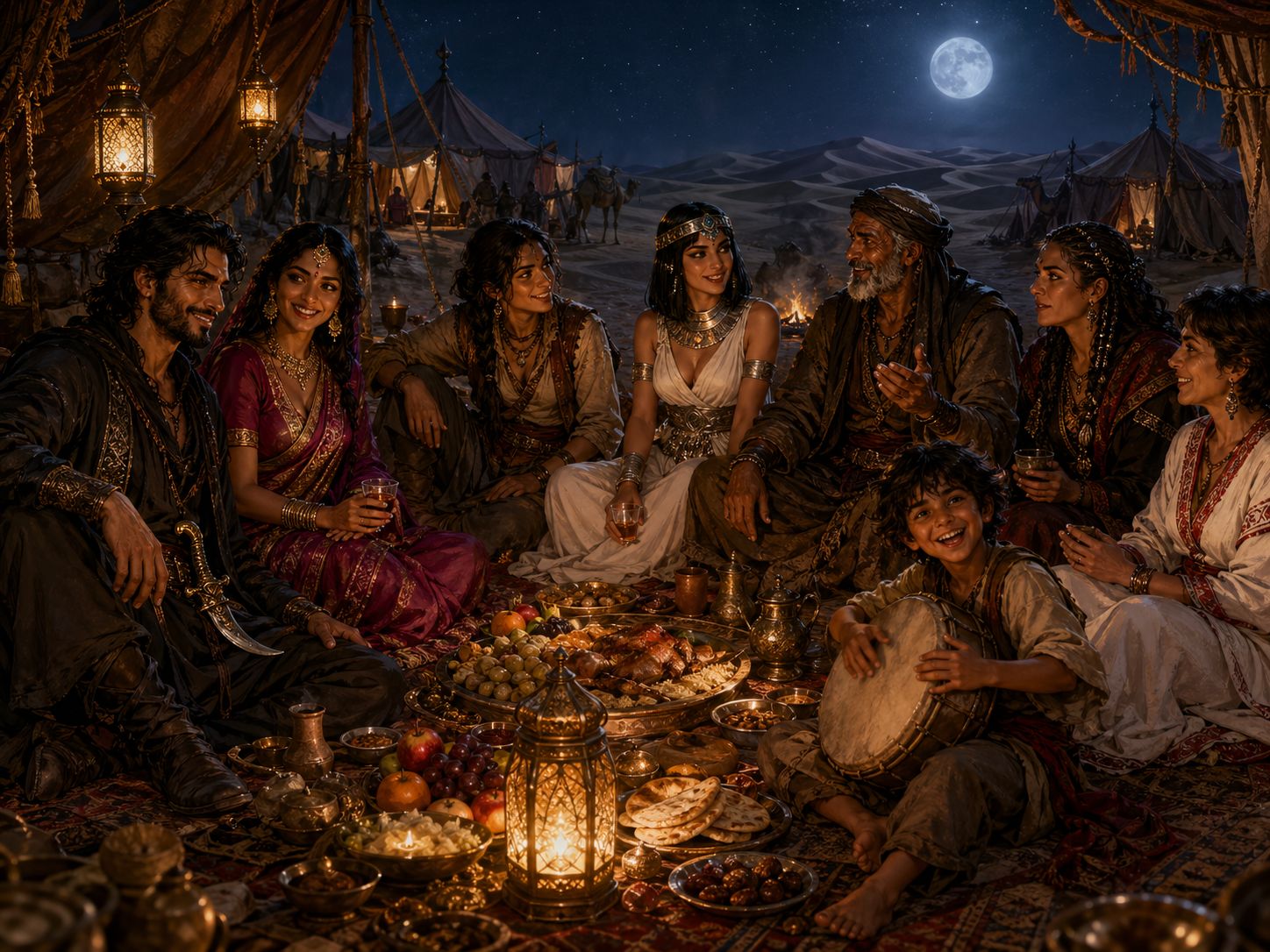
After Hadi's foot is set, someone has to keep him occupied, calm and still while he sulks, complains or tries to be brave. A crew member can tell him stories, listen to him drum badly on a water jar, or simply sit with him while the others work. This creates connection not only with Hadi, but with the women and older people watching who notice that the crew are willing to do unglamorous care.
Shared Night Watch
A crew member is paired with a Dunewind guard for night watch. There is little to do except sit in the wind, listen to the Shar'zul breathe and talk quietly. This is a natural place for personal stories, awkward silences, small confessions and the kind of conversation people only have when there is nowhere to go and nothing to look at but stars.
Helping With the Shar'zul Care and Harness Check
At an oasis stop, Rashad has people cleaning, checking and rebalancing the Shar'zul loads. It is hard, dirty, specific work. A crew member who joins in is corrected sharply, then slowly treated with more respect as they learn. The event gives a clean way into practical connection, especially with Rashad and anyone else involved in the beasts.
The Meal After the Hard Day
The tribe cook manages to produce a surprisingly good meal after a difficult stretch. People relax. Jokes come out. Someone sings. Someone flirts. Someone mocks the way a crew member carried a load earlier. This is a good place for acceptance to become visible, because teasing only really happens once people have stopped treating the crew like a burden.
A Small Gift With No Ceremony
A member of the tribe quietly gives a crew member something minor but personal. A charm against heat, a better head wrap, a carved spoon, a waterskin repair, a strip of dyed cloth, a bit of sweet dried fruit saved from trade. The gift is not announced. It is just given. That makes it stronger than a grand gesture.
Learning the Right Way to Greet Another Caravan
At Camp Uzuzu, the Waterseeker Tribe are present, and the Dunewind do not want the crew embarrassing them. A crew member is pulled aside and taught the proper way to greet, sit, refuse politely, accept shared food and not step into old friction by accident. This creates connection through inclusion into tribal etiquette.
Being Pulled Into Someone Else's Grudge
A crew member is mistaken for taking sides in an old Dunewind and Waterseeker quarrel simply because they were seen talking too long with the wrong person. Now they have to navigate the situation, calm someone down or deliberately choose a side. This creates involvement through social entanglement instead of formal invitation.
The Egg Hatch Vigil
Before the Shar'zul hatch, people keep watch in turns and speak more softly than usual. Someone from the tribe invites a crew member to sit the late watch near the eggs. The mood is quiet, reverent and tired. This is a very good event for trust, because being included in a sacred waiting space means a lot.
Carrying a New Hatchling
When the eggs hatch, everything is joy, panic and fragile chaos. One of the hatchlings stumbles, bites, squeals or refuses a handler, and Thaleia ends up holding, guiding or shielding it for a brief moment. Everyone present will remember that. Shared delight is often a faster route to closeness than shared suffering.
Joining the Women's Work Circle
At an evening halt, women are mending, sorting, cleaning, braiding hair, gossiping and watching children all at once. A woman from the crew, or someone accepted into that space, is drawn in. Information flows more freely there than in formal talk. So does teasing. This is one of the best ways to create connection with the tribe's social core.
Sharing a Story in Return
After hearing several stories about Rahim and Kethra, someone in the tribe asks a crew member for a story of their own. Not a useful story. A real one. About a home, a fear, a lost person, a mistake, a strange place. The moment matters because the relationship stops being one sided. The tribe are no longer only telling. They are also listening.
Helping Sereh With a Quiet Task
Sereh needs help with something small and private. Washing cloth, securing a load, fetching water late, keeping a child distracted, packing away her mourning veil before a wind takes it. The task itself is not dramatic. The importance lies in the privacy. Helping her there opens a softer, more personal kind of trust.
Nisrine's Matchmaking Scheme
Nisrine quietly decides that two shy young people in the caravan belong together and enlists a crew member to help make it happen. The task is not to declare feelings or force a confession, but to create the right chances. Seating them together at a meal, sending them on the same errand, making sure they end up side by side during watch, steering conversation away when it turns awkward and back toward them when it starts to work. Nisrine treats the whole thing with absolute seriousness and infuriating confidence, as if she is arranging trade goods rather than hearts. The event builds connection because the crew member is being trusted with something intimate, silly and deeply social, and because success or failure will immediately entangle them in caravan gossip.
The Song No One Knows Properly
One evening someone starts a song and falters. A crew member tries to join in and gets it wrong. Instead of being mocked out of the circle, they are corrected, made to start over and pulled back into the rhythm. A minor dispute starts among the tribe about what the correct lyrics actually are. This is a small but effective acceptance event, because it shows the tribe choosing to include rather than merely observe.
The Sandstorm Lockdown
When the storm comes and everyone is shut in tight, fear and closeness sharpen at once. A crew member ends up in the same shelter as people they do not know well enough yet. There is no privacy, no escape and too much wind. Someone shakes. Someone mutters prayers. Someone tells a story to keep a child from listening to the voices outside. Shared fear can create very fast intimacy.
The Aruzan Private Conversation
Before the debate over whether to press on or turn toward the Desert Rim, a tribe member takes a crew member aside for a frank conversation. Not a speech to the room, but a private confession of fear, grief, anger or stubbornness. This is a strong tie building event because it shows that by late arc, the crew are no longer only influencing the tribe from the outside. They are being trusted with real doubts.
Travelling Beside the Same Person for Days
Not every social event needs a scene with a clear beginning and end. A crew member simply falls into the habit of travelling beside the same tribe member during the slower stretches, watching the horizon together. They trade remarks, complain, share water, point things out and eventually reach the point where silence is easy. Then, when a real crisis comes, the connection is already there.
Being Included in the Last Night Meal Before Ssar'et
Near the end, with water low and the bandits shadowing from afar, the caravan stops for one grim evening meal. Space is tight, nerves are worn and nobody has patience for strangers. If the crew are included without discussion, given a place, handed food and spoken to as part of the circle, that is a major sign of how far the connection has come.
Helping With the Dead Person's Things
After the funeral, someone eventually has to sort or carry the belongings of one of the dead. A crew member helps with that task. It is quiet, difficult and intimate in a way that normal labor is not. This event can create a very strong bond, because it places the crew inside grief rather than merely beside it.
The First Real Teasing
A crew member does something awkward, vain, brave or foolish, and instead of being judged in silence, they are openly teased about it by the tribe. This is easy to miss, but it is one of the strongest signs of acceptance. People rarely tease those they still think of as outsiders.
Being Remembered at the End
Late in the arc, a tribe member refers back to something the crew member said or did weeks earlier. A joke, a mistake, a kindness, a question. That callback matters because it proves the relationship has history now. The crew are no longer passing through the Dunewind. They have become part of its memory.
The Road out of Lumekhet
The road out of Lumekhet should feel wounded from the first step. The Dunewind Tribe is moving because it must, not because it is ready. One Shar'zul is dead, several people are gone and everything that could be saved was thrown together in haste. The early part of the arc is therefore not about smooth travel, but about a damaged caravan forcing itself onward while grief, confusion and practical disorder are slowly brought back under control.
This stretch is where the caravan puts itself together again. Loads are sorted, roles are covered, the dead are buried, the sick are tended and the crew begin to find a place inside a society that is too strained to welcome them properly. The point is not simply that the desert is hard. It is that the Dunewind begin this journey hurt, diminished and barely held together, and that the first part of the arc is about surviving long enough to become whole enough to continue.
Sada's Task
The caravan had found motion again, but not order. The dead Shar'zul lay behind them somewhere in the pale haze, while everything that had been on its back now seemed to be everywhere else. Water skins were tied in with bedding, cooking gear buried under cloth, spare harness mixed with mourning bundles. The whole moving village looked shaken apart and hastily tied back together.
Sada stood in the middle of it like a drawn blade. Her sleeves were rolled up, her hands full and her patience long gone. She yanked open a badly tied bundle, found bronze bowls mixed with medicines and swore under her breath.
Then she looked at the crew.
"You have hands and no proper work yet," she said flatly. "Good. Then this is your work."
Nasheem inclined his head. Sada pointed at the piles around her.
"What came off the dead Shar'zul was thrown wherever there was space. Now everything is wrong. Water, medicine, beast gear and cooking things first. The dead people's belongings kept together. Nothing sacred lost, nothing important buried under trade goods. Ask. Carry. Sort. I want this organized and properly secured."
Around them, the strain showed everywhere. Someone shouted about a missing kettle. A child cried over a lost shawl. Further back, a man was already arguing over a bundle that was not his. The caravan was not only grieving. It was fraying.
Nasheem rolled up his sleeves.
"Very good," he said. "I will get the crew on it at once."
Sada gave him a hard look. "Do that. And if anyone decides to be clever instead of useful, I will bury them in the sand with the rest of the confusion."
"I will preserve the spirit of your instructions exactly."
"The spirit is simple," she said. "Do not be clever. Be useful."
Then she turned away, already dragging another bundle into place and shouting at someone else.
Nasheem looked once over the mess, then clapped his hands sharply for attention.
"You heard her. We are now stewards of chaos. Let us distinguish ourselves."
That earned him a few tired looks and one low laugh from somewhere in the tribe. Good enough. He crouched by the nearest pile, found a healer's satchel under a cracked basket and passed it toward Mira's tent.
All around him, the Dunewind were still wounded, still shaken and still badly disordered. But people were moving now with purpose instead of shock, and the broken shape of the caravan was beginning, awkwardly, to gather itself back together.
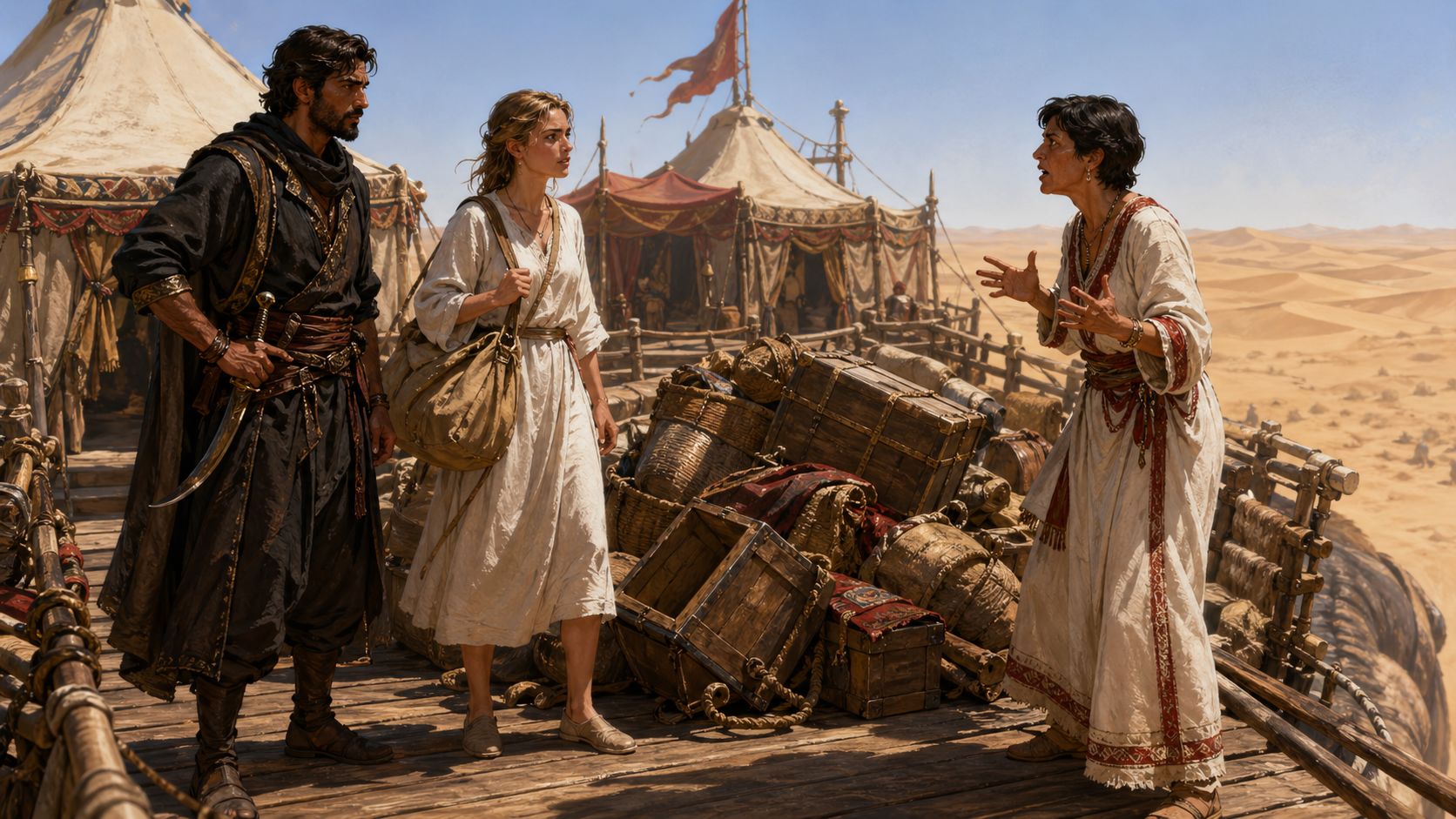
This early task is not about logistics for its own sake. It is about throwing the crew into the living, irritated, grieving middle of the Dunewind Tribe at a moment when everyone is tired, upset and badly in need of order. After the loss of one Shar'zul during the escape from Lumekhet, everything that could be salvaged was shifted in a hurry. Nothing was packed properly. Important items are buried under the wrong bundles, fragile things have been shoved into rough loads, and half the tribe is too tired, angry or distracted to explain clearly what belongs where.
Sada puts the crew to work because they are the obvious spare hands. Everyone else already has a role. The crew do not yet. That makes this an excellent opening event. They are not invited into the tribe with warmth or ceremony. They are handed a problem and expected to be useful.
The Real Purpose of the Task
The practical goal is to get the caravan functioning again. Water, medicines, food, repair tools, beast gear, tent gear and mourning bundles all need to be sorted into a form that can actually be lived with.
The dramatic goal is to force the crew to move through the caravan and talk to people. They have to ask questions, make judgments, calm arguments, carry things, take blame, correct mistakes and discover which items matter to whom. This is the first real chance for the players to meet the Dunewind not as scenery, but as a wounded society under strain.
Run this as a chain of social encounters with physical objects as the excuse.
What Sada Wants Done First
Sada's priority is not tidiness. It is function.
- She wants water where it can be reached quickly.
- She wants Mira's medical supplies found and gathered.
- She wants food separated from everything that can spoil, crush, contaminate or delay it.
- She wants Rashad and the other handlers able to reach harness, ropes, spare straps and beast care items without digging through sleeping bundles.
- She wants tent poles, cloth sections, pegs and cordage sorted so camp can be raised quickly when needed.
- She wants the dead people's possessions kept together and marked, not scattered among ordinary loads.
- She wants trade goods packed securely and deeper, where they are safe and not in the way.
- She wants the caravan able to survive the next few days without having to stop every hour and dig through chaos.
That should be the logic behind every conversation.
The Problems the Players Will Run Into
Hamid Wants His Tools
Hamid needs his repair kit immediately. He has leather straps to patch, buckles to reset, bindings to check and rough damage from the rushed transfer that will only get worse if ignored. The problem is that his tools were packed together with cooking utensils, scrap metal, lamp oil and someone's domestic goods. He knows what he needs, but not where it ended up. He is frustrated, impatient and in no mood for polite conversation. If the players help him quickly, they earn his respect. If they delay him, something breaks later that could have been prevented.
This is a good first complication because it is concrete and urgent. It also teaches the players that practical items are not interchangeable. A bag of tools is not "stuff." It is the difference between a functioning caravan and one slowly coming apart.
Mira Needs Her Supplies
Mira has wounded to treat. She needs her satchels, clean cloth, needles, herbs, poultice jars, bone saw, cord, clean water bowl and specific wrapped bundles that should never have been packed under rough goods. Some are missing. Some are mixed with cooking items. One sealed jar has cracked. One of the children has been playing with a roll of bandage cloth without understanding what it was.
Mira is not dramatic about this, but she is focused and short with anyone who wastes her time. She needs these supplies to treat the wounded. Helping her is a direct way for the crew to become useful quickly. It also lets them see who in the tribe is already hurt, frightened or holding themselves together badly.
Food Is Mixed With Everything Else
Dried dates are in with tent pegs. Salted meat has been packed beside lamp oil. Grain sacks are under heavier goods and may be splitting. Someone's spice pouch burst into a blanket roll. The caravan cook wants food sorted now before more is ruined, but others keep pushing their own needs ahead of it.
This is a good place for arguments over priority. Food matters to everyone, which means everyone believes their interruption is justified. The players may have to decide whether to support the cook, placate someone else or impose order without real authority.
People Think Their Things Are Gone
Because the loading was done in panic, many people are convinced something important was lost. Sometimes they are right. Sometimes the thing is only buried, tied into the wrong load or claimed by mistake. A widow thinks her husband's bundle is gone. A child cannot find a shawl. An older man swears that his wife's copper kettle has been stolen. A rider is convinced that someone threw out a charm tied to a harness.
These fears matter because people are not only worried about inconvenience. They are worried about memory, ritual and survival. A missing bowl is annoying. A missing mourning token, prayer strip or family tool can feel like a fresh wound. The players need to recognize that not every missing item has the same meaning.
Small Necessary Things Keep Becoming Important
The caravan is full of objects that seem minor until the moment they are needed. A missing camel harness buckle. A peg bag for one of the larger tents. A length of treated rope used to secure water jars. A shade cloth hook. Needle cases. Spare sandal thongs. Fire striker kits. A ladle. A whetstone. A child's sling that keeps him occupied. A leather funnel for transferring water cleanly.
These are excellent complications because they let the Game Master make importance feel lived rather than announced. The players should repeatedly discover that what looked like clutter matters intensely to someone.
People Disagree About What Comes First
Not everyone agrees with Sada's priority order, or they agree in principle and not in practice. Hamid thinks tools come before food because if the loads fail, nothing else matters. Mira thinks medical supplies come before everything except water. Rashad wants harness and beast gear now. The cook thinks everyone underestimates how quickly food becomes a mess. Someone grieving is desperate to find the belongings of their loved one. Someone else wants all mourning bundles gathered immediately.
Do not make this a single big argument. Make it a series of overlapping smaller ones. The players are not there to solve the caravan's hierarchy. They are there to navigate it.
Someone Is Quietly Hoarding
One useful complication is that one tribe member, frightened by the chaos, has quietly gathered a few things into their own sleeping bundle to make sure they are not lost. Nothing malicious, just fear. A coil of good cord. A tool. A packet of herbs. A child's spare sandals. When this is discovered, it can easily become an ugly argument about selfishness, grief and mistrust.
This works especially well because nobody is entirely wrong.
The Dead Person's Belongings
At some point, the players come across a bundle that clearly belonged to one of the dead. No one wants to deal with it yet. No one wants it mishandled either. This is one of the strongest emotional beats in the task. Sorting ordinary goods is work. Sorting the dead person's things is something else. It lets the players step into grief rather than merely witnessing it.
The Wrong Thing Was Made Easy to Reach
Because of the rushed transfer, something useless is accessible while something vital is buried. Decorative cloth is on top while water funnels are missing. A crate of trade goods is perfectly tied while tent pegs are scattered. The absurdity should be obvious. It makes people angry because it reminds them how badly the escape went.
How to Run It
Keep It Moving
Do not run this as an accounting exercise. The players do not need to catalogue every bundle or optimize load distribution. The task exists to create encounters, not inventory management.
Move from problem to problem. Let each pile or argument reveal a different person, pressure point or emotional truth. A few well chosen encounters will do more than exhaustive realism.
Use Objects as Emotional Anchors
Every item should mean something more than itself.
- A tool kit means repair and usefulness.
- A medicine satchel means pain and survival.
- A missing kettle means domestic continuity.
- A mourning bundle means the dead still matter.
- A harness strap means movement tomorrow.
This is how the scene avoids becoming dry logistics. The objects are the language through which the tribe's strain, grief and dependence become visible.
Let Players Make Small Judgments
The players should be forced into small decisions. Not life or death decisions, but priority decisions.
- Do they help Mira first or Hamid first?
- Do they calm the grieving widow or chase the missing rope bundle?
- Do they tell Sada about the hidden hoard or quietly resolve it?
- Do they risk opening a mourning bundle to confirm whose it is?
These small judgments are good because they have social consequences without requiring plot altering choices.
Let the Tribe React
The important reward here is not sorted supplies. It is reaction.
- Someone who was suspicious becomes slightly more cooperative.
- Someone who was already tense snaps harder.
- Someone is grateful and remembers the help later.
- Someone decides the crew are at least not useless.
- Someone resents that outsiders touched their things at all.
Those reactions are the real outcome of the scene.
Mix Friction and Helpfulness
Not everyone should be difficult. If every interaction is irritation, the tribe will feel one-note. Let some people be helpful, some curt, some distracted, some grateful, some offended and some too overwhelmed to behave consistently. This gives the Dunewind texture.
Show that the tribe is under pressure. Things are not going well.
End With Partial Order, Not Perfection
The task should improve the caravan, not solve everything. By the end, people should be able to find what matters most, tempers should have cooled a little and the crew should have spoken to enough people that the caravan now feels inhabited. But it should still feel like a wounded tribe putting itself back together under pressure, not like a neat camp restored to perfect order.
That is the point of the scene. Not order restored, but life resuming.
The Funeral
The caravan stopped at sunset without needing the order spoken twice. Voices fell. Loads were lowered carefully. Children were pulled close and hushed. Even the Shar'zul seemed to settle more quietly, their great bodies folding down into the sand as the last hard light of day turned gold and red.
The dead were brought forward wrapped in cloth, each bundle marked with family colors, trade cords or a small token tied at the fold. No grand priesthood stepped in. This was the Dunewind's work, and they did it themselves. Zahra al Duneveil began the first song in a low voice, dry with dust and grief, and others joined her until the air itself seemed to hum. The song named the dead by what they had done. The hands they had used. The burdens they had carried. The small pieces of life that made them theirs.
Miraz Khalim spoke next, plain and steady. He named each of them and thanked them without ornament. One died holding a load in place so others could escape. One died with blade in hand. One had still been little more than a boy. At that name, something tightened across the gathered tribe. An older woman bowed her head into her hands. A man beside her stared into the sand as if he could not bear to look anywhere else. Sada stood rigid and silent, her face hard enough to break on, which only made the grief around her feel sharper.
Nasheem said nothing. For once, he had no easy word ready. When one of the men carrying a body faltered, he stepped in and took some of the weight without ceremony. Ayesha stood with her arms folded, expression controlled, but her eyes missed nothing. She watched the tribe mourn in the open, without distance, without polished ritual to soften it, and let the rawness of it stand.
Nephyla stood very still at first. No one looked to her. No one bowed. Yet as the bodies were laid down and the song faded, one of the younger women broke, falling to her knees beside the wrappings with both hands pressed to her mouth as if she could hold the grief inside by force. For a heartbeat no one moved.
Then Nephyla stepped forward.
Her voice, when it came, was quiet, but it carried.
"They are not lost," she said.
The words were simple, but they changed the air. Heads lifted. Even the crying woman looked up.
Nephyla knelt beside her, not as a queen and not as something sacred above the rest, but with a strange, careful solemnity that seemed to come from somewhere deeper than pride.
"They have gone where all must go," she said, her eyes on the wrapped dead. "What leaves us is not what is ended. They are carried now. They are not alone."
She hesitated, as if unused to speaking this way without a court to shape her meaning, then placed her hand lightly on the mourner's shoulder.
"Grieve for them," she said. "But do not fear for them."
It was not a speech. It was only a few words. But they were the right words, and because they came from her, they carried a weight none of the others could have given them.
The woman beside her bent forward and wept openly then, but not with the same frantic edge as before. Now, it was tears of release, not tears of pain. Others bowed their heads. Zahra picked the song up again, softer now, and this time it felt less like defiance and more like release.
Ayesha watched Nephyla with a new expression, smaller than surprise and sharper than approval. Nasheem, standing with one hand still on the burial cloth, looked at her for a moment and then away again, as if choosing not to make too much of it.
The graves were filled by many hands. A cup. A knife. A strip of cloth. A carved toy. Small things were laid with the dead, then covered. By the time the sun had fully died behind the dunes, the tribe was crying openly, quietly, or not at all, but all of them were grieving together.
When it was done, they rose because the living still had to eat, still had to measure water, still had to go on. But something had settled. Not peace. Not healing. Only this: the dead had been named, the grief had been shared and for a little while, beneath the darkening sky, even the wounded caravan felt whole enough to keep moving.

The funeral is one of the first real pauses in the arc. Up to this point, the caravan has been moving because it has to. People are tired, shocked and still acting inside the immediate logic of survival. The funeral is where grief catches up. It should feel like the moment when the Dunewind Tribe finally stops long enough to admit what has been lost.
This is not a scene about exotic ritual detail for its own sake. The ceremony matters, but its main purpose is social and emotional. It is an opening for the crew to see the tribe as people rather than as a damaged caravan, and it is one of the first times the crew can be present in something intimate without being given a practical task to hide behind.
Setting the Mood
Run the funeral at sunset. The light should be changing while the scene unfolds, with the heat loosening, the colors deepening and the movement of the caravan slowing into something quieter and more deliberate. The tribe should not become suddenly theatrical. The mood should come from restraint. Voices lower. Loads are handled more carefully. Children are hushed. People stop arguing for a while.
Keep the atmosphere simple and human. Wrapped bodies. Family colors. Small tokens. Zahra's song beginning in a low voice and being joined by others. Miraz naming the dead plainly. Sada holding herself together through practicality and silence. That is enough. The funeral should feel like something this people have always done, not like a spectacle performed for the players.
The important emotional note is openness. The Dunewind do not hide grief behind polish. Some people cry openly. Some go very still. Some stay busy with their hands because stopping would break them. Let all of that exist side by side.
What the Scene Is For
Do not treat this as a scene where the Game Master performs a long ceremony while the players watch respectfully. That would waste it.
The funeral is mainly an opportunity for interaction.
- They can carry a body when someone's strength falters.
- They can stand beside someone who is grieving and does not want to be alone.
- They can help with small practical acts that matter emotionally, such as bringing tokens, straightening wrappings or returning an item to the dead person's bundle.
- They will receive honest thanks for the things they have done so far. For fighting bravely, for taking care of the injured, for sorting out the messy supplies.
- They can hear small stories or fragments of memory.
- They can make mistakes, show respect, hold back when needed or step in when the moment allows it.
The point is not that the players learn every step of the rite. The point is that they are allowed into the emotional life of the tribe.
Keep the Ritual Clear but Not Overwritten
The ceremony itself should be easy to follow.
- The dead are brought forward.
- Zahra begins the first song.
- Miraz names the dead and gives them plain thanks.
- Others step forward, touch the wrappings, speak a few words or say nothing at all.
- Small personal items are laid with the dead.
- The graves are filled by many hands.
That is enough structure. Do not overload the scene with too many sacred explanations unless a player specifically asks. A funeral becomes powerful faster through detail and emotion than through lore.
After the ritual, the tribe gathers around a meal, talking about the lost, remembering them.
Use Specific Reactions Around the Tribe
This scene is a good place to deepen the named Dunewind members.
- Miraz should be steady and plain.
- Sada should be rigid, silent and visibly holding herself together through control.
- Zahra should shape the mood through song.
- Mira may still be watching the living as much as honoring the dead, checking who is about to fall apart.
- Farah or another grief marked figure can show what mourning looks like when words are no longer enough.
This helps the tribe feel like individuals under shared loss, not a single block of mourners.
Give the Crew Space, Not Obligation
The crew should not all be forced to react in big visible ways. Some may step forward. Some may help quietly. Some may simply witness. That is fine.
What matters is that the scene gives openings. Carrying weight. Offering a hand. Sitting beside someone. Saying something awkward but sincere. Remaining respectfully silent. All of these are valid ways to engage.
The funeral should not become a test of whether the crew says the perfect thing. It should become a moment where they are allowed to be present while the tribe grieves.
Let Nephyla Contribute
This is one of the most important opportunities for Nephyla in the arc.
She should not be forced to dominate the scene, and she should not suddenly become its center. But this is a place where she has something real to offer. She was the one who guided the dead into new life. Death rites are not foreign to her. She understands this territory in a way almost nobody else present does.
That means the funeral is a chance for her to do good.
The best version is not a long speech. It is a small moment. Someone breaks. Someone fears for the dead. Someone cannot let go. Nephyla steps forward and speaks with quiet certainty. She does not need to explain theology or make herself grand. She simply needs to offer the one thing she can truly give here, assurance that the dead are not abandoned, not lost and not alone.
- It lets her be useful in a way that is true to her history.
- It lets the crew see that there is more to her than pride and disorientation.
- It lets the Dunewind receive something from her without needing to revere her.
It also shows a different side of her struggle. She is not only the woman who cannot adapt. She is also someone whose old life left her with one or two things that still have real value.
How to Handle Nephyla's Tone
When Nephyla speaks, keep it simple and sincere. She should sound like someone reaching for something real, not performing sacred grandeur. This is not the moment for court language or mystical excess. A few quiet, certain lines are much stronger.
She should still feel slightly awkward in human terms, because that remains part of her arc, but here awkwardness is less important than truth. This is one place where the old self and the emerging self can briefly align instead of clashing.
Keep the End Modest
Do not end the funeral with healing or resolution. The tribe is not better. The caravan is still wounded. The road still lies ahead.
What should change is smaller and more believable. The grief has been shared. The dead have been named. The crew have been allowed inside something intimate. Nephyla may have done one genuinely good thing. The tribe rises and returns to the tasks of the living because it has to.
That is the right ending.
Not comfort. Not closure. Just the sense that, for one evening, the Dunewind stopped being a damaged machine and became fully human in front of the crew.
Early Caravan Life
Early caravan life is where the Dunewind Tribe stops feeling like a wounded mass and starts becoming people. The first stretch of the journey should be used to build familiarity through work, meals, arguments, small kindnesses, shared strain and the simple fact of living close together while the caravan keeps moving. This is where the crew begin to understand how the tribe functions, how its members differ from one another and what place they themselves might earn within it. The tribe is still grieving and still diminished, but it is not broken. It works, adapts and carries on, and that steady forward motion is just as important to show as the pain it carries.
The Fever
The morning heat had barely begun to rise when Mira pulled Junia aside between the swaying loads and the muttering tents. Nahla lay under a folded shade cloth, her skin slick with sweat, lips dry, breathing too fast for sleep and too shallow for comfort. Mira had already loosened her clothes and cooled her with water, but the girl's eyes would not quite focus, and every answer came a heartbeat too late.
Junia crouched, touched Nahla's forehead, then her throat, then looked at Mira with a sharpness that cut through the tiredness in both of them.
"Keep her apart," she said. "And keep yourself apart with her."
Mira let out a humorless breath and glanced at the crowded caravan around them, at the surviving Shar'zul bowed under too much weight, at the tents packed too close and the people moving in too little space.
"That will be difficult," she said. "But we will do what we can."
Before Junia could answer, footsteps pounded over the sand. Tarek came fast, breath rough, eyes hard.
"Thalida's down," he said. "She just fell."
Junia was already rising. "Stay with Nahla," she told Mira.
Then she was running after Tarek through the wounded, groaning caravan, while behind her the morning still looked ordinary, and the day had only just begun.
The fever should feel like the first time the caravan is truly forced to stop pretending that movement alone will carry it through. The Dunewind Tribe is already wounded, short on strength and running on discipline. Now sickness enters that weakness and turns it inward. This is not only a question of who will live and who will die. It is also a question of how much more the caravan can bear before something in it gives way.
Run this as both practical strain and personal dread. People are frightened because fever is dangerous, but also because they have no room for it. They are one Shar'zul short, already overburdened and carrying grief from Lumekhet. Every new sickbed means one less pair of hands, one more interruption, one more reminder that the caravan is still not whole.
How It Begins
The fever starts with Nahla. At first it can be mistaken for ordinary exhaustion, bad water, sun exposure or the strain of the road. Then others begin to sweat, shiver, stumble or lose focus. By the time the caravan understands what it is facing, more than a dozen people are sick.
This should happen quickly enough to feel alarming, but not so quickly that it becomes plague panic. The fear comes from watching the number grow. One person is worrying. Three is serious. A dozen means the caravan has a real problem.
Mira sees the pattern first and moves at once. Junia becomes essential immediately. Between them they organize shade, isolation where possible, water, cloths, herbs, cooling and the grim work of deciding who needs attention first.
Mood and Tone
The fever section should be emotional and harrowing, but not theatrical. The fear should come from repetition and accumulation.
- More sick people.
- More work.
- More quiet voices.
- More signs that the caravan is stretched beyond what it can comfortably carry.
At the same time, keep it personal. This is not just "the caravan has twelve fever cases." It is Nahla burning under a cloth while someone tries to keep her still. It is Azhar sitting beside his brother. It is Mira and Junia too tired to hide it. It is someone asking for water in a voice that no longer sounds like them. It is another person not showing up for the task they always do, because now they are shaking under a blanket instead.
The players should feel both kinds of pressure at once. How bad will this get. And what is this doing to the people around us.
What It Does to the Caravan
The tent had turned into its own little world of heat, wet cloth and low voices. Fever made everything smell wrong. Sweat, herbs, old breath, sour blankets, the sharp bite of whatever Mira had boiled into the last pot of water. Bodies lay too close together beneath patched shade cloth, some muttering, some shivering, some so still that Junia kept having to look twice to make sure their chests were still moving.
Mira was kneeling beside Nahla again, wringing out a rag with hands that trembled from exhaustion. Junia sat on the other side of the tent with one sleeve dark from spilled water and someone else's sweat, tying off a strip of cloth around a jar of crushed herbs. Neither had slept properly. Neither had the strength left for anything except the next task.
The flap shifted and Nasheem's head appeared in the gap.
He took one look at the tent and whatever lightness he had brought with him thinned at once.
"Tell me what you need."
"Water," Mira said immediately.
"Clean rags," Junia added without looking up.
Nasheem nodded once. "Consider it done."
Then he was gone again, already calling for someone outside before the flap had fully fallen closed behind him.
For a few breaths there was only the sound of sick people breathing.
Junia moved to Azim and touched the side of his neck, then his chest, then looked at Mira. Her voice dropped until it was barely more than air.
"He's going."
Mira closed her eyes for a moment, then opened them again and glanced across the tent. Azhar sat beside his brother's bedding, folded in on himself like a man trying to take up less space than his grief. Fever had him too. Sweat ran down his temples, his lips were cracked and there was no strength left in how he held himself. But he had not moved from Azim's side. Tears kept slipping down his face unchecked, and he seemed not to notice them.
"He knows," Mira whispered.
Junia said nothing. There was nothing worth saying.
A cough broke somewhere deeper in the tent. Someone muttered in delirium. Outside, feet thudded past in the sand and a Shar'zul gave a low restless groan.
Then Azhar's voice tore through the heat.
"Come quick. My brother..."
Both women were moving before he finished. Junia dropped to one knee by Azim's side and reached for him, already knowing. Mira came in close on the other side, her hand hovering uselessly for a moment before settling on Azhar's shoulder.
Azim had gone still in the wrong way. No shiver left in him. No ragged pull of breath. No fight.
Junia stayed there a heartbeat longer anyway, fingers at his throat, because there are some truths the hand checks even when the heart already knows.
Then she looked up once at Mira.
Mira bowed her head.
Azhar made one small sound, not loud, not dramatic, just the broken sound of something inside him giving way. He bent over his brother's body and wept with the helplessness of a sick man who could no longer even hold himself upright in grief.
Around them, the fever tent went on breathing. Someone moaned. Someone turned and coughed. Someone asked for water in a cracked voice. But for a few moments, all of it seemed very far away.
Junia put a hand gently over Azim's eyes.
Mira kept her hand on Azhar's shoulder.
And the heat pressed down without mercy.
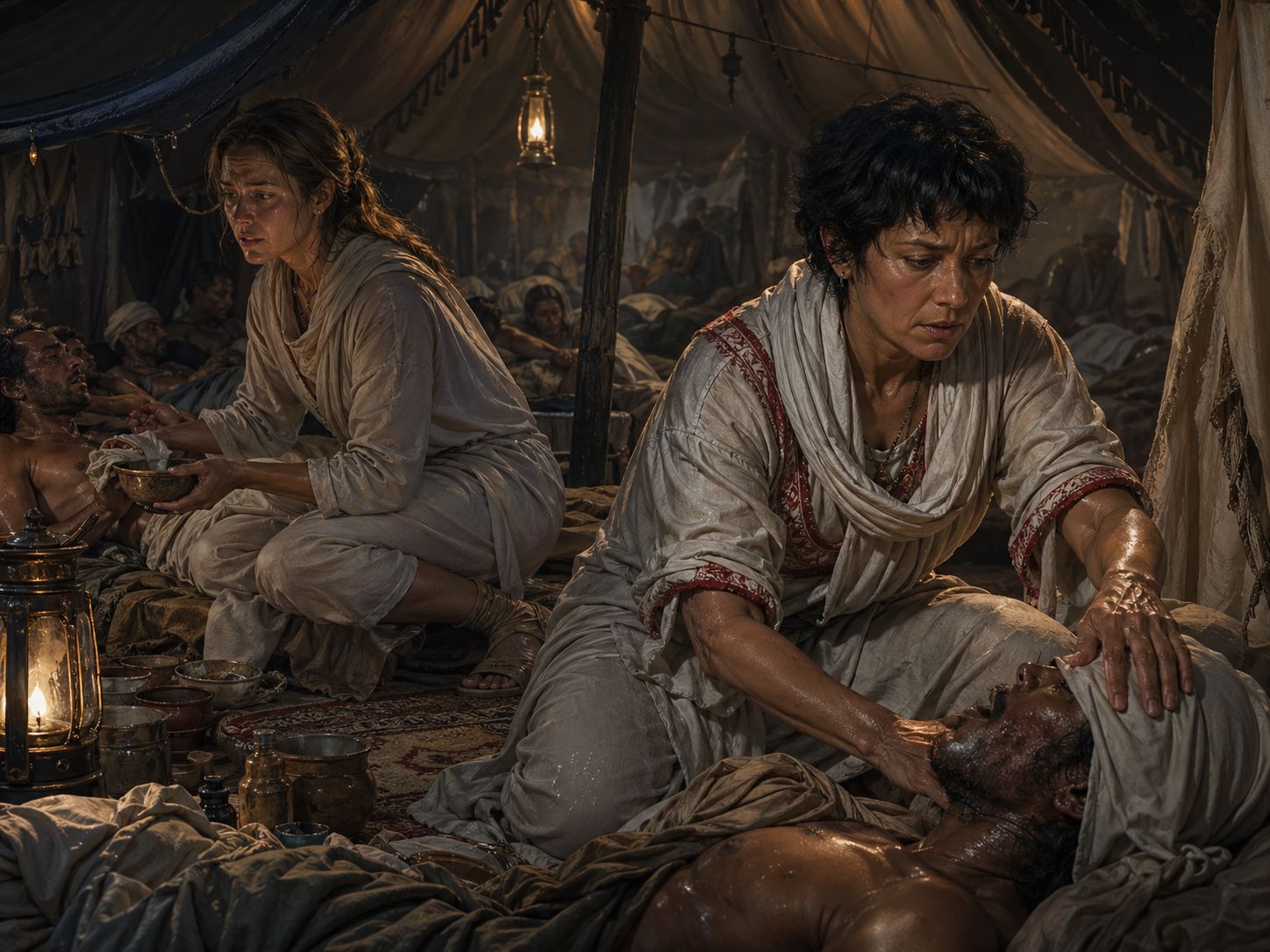
The most important practical effect is not only that people are sick. It is that the sick are missing from the caravan's ordinary life. Every one of them had a role, a skill, a rhythm, some small necessary function. Taking care of them requires more people, taken from their ordinary tasks.
A dozen people down means more than a dozen tasks uncovered.
- Someone has to haul water for the healers.
- Someone has to watch children whose usual caretaker is flat on a blanket.
- Someone has to cook for people who still have to work.
- Someone has to patch gear because Hamid is needed elsewhere.
- Someone has to help with the Shar'zul because the usual hands are gone.
- Someone has to carry messages, measure rations, calm arguments, clean bedding or sit with the delirious.
This is where the scene becomes more than illness. The whole caravan feels the absences. Meals are rougher. Tempers shorten. Mistakes increase. Useful people are suddenly unavailable, and everybody else has to bend around the missing pieces.
The Crew's Role
This is the point where the crew stop being passengers and become part of the caravan's survival.
Junia should be pushed hard. She belongs in the fever tent with Mira, overworked, under-rested and making decisions that matter. This is one of the clearest ways for her to earn deep gratitude from the tribe.
Thaleia can be pulled into Shar'zul care and support work around the beasts. This is good for her because it ties her into practical caravan life and strengthens the emotional ground for her later role with the hatchlings.
The rest of the crew should be drawn into whatever the caravan most urgently lacks. Hauling water. Carrying bundles. Cooking badly. Sitting with frightened children. Delivering supplies. Covering missing labor. Taking over simple tasks under instruction. None of this needs to be glamorous. In fact, it is better if it is not. The point is that the tribe sees them helping where help is actually needed.
Running Mira and Junia
Mira and Junia should feel exhausted, capable and never fully in control. They are not miracle workers. They are keeping people alive as best they can.
Use them to anchor the fever emotionally. They see too much. They work too long. They are short with interruptions, grateful for competence and painfully aware of who is worsening. Their space should feel crowded, hot and constantly in need of one more thing. Water. Clean cloth. Hands. Quiet. A little more time.
Mira knows the tribe and what each sick person means to the caravan. Junia brings clarity, discipline and outside skill. Together they work well, but neither should feel unshaken by the cost.
Running Nephyla
The fever tent had taught the caravan a new kind of silence. Not sleep, not mourning, but the silence of people trying not to listen too closely to breathing.
Nephyla sat just outside the shade cloth, where the air moved a little. No one had told her where else to be. One by one, grieving people had started coming to her because she had said the right thing once at the funeral. She answered them with the old phrases. The dead are not lost. They are carried onward. They are not alone.
Azhar came in the afternoon and sat beside her without looking at her.
"He was my other self," he said. "I knew my own face because I saw his first. Now he is gone, and it feels wrong. Like the world has slipped."
She knew what to say. That was the horror of it.
"What leaves us is not what is ended," she said quietly. "He has gone where all must go. He is not alone."
Azhar bowed his head, breathed unevenly and, after a long moment, thanked her. He left steadier than he had come.
Nephyla felt colder.
Soon Sereh came, veil crooked, voice soft with fear. Azhar had told her Nephyla helped him. So Nephyla said the phrases again, old smooth words about roads not ending when they vanished from sight, about the dead not being abandoned. And Sereh, too, lifted a little. The weight went out of her face.
But it felt as if it had gone nowhere. As if it had only landed in Nephyla instead.
When Sereh left, Nephyla sat alone with her hand pressed to her ribs. Around her, the caravan still breathed, coughed, muttered, carried water, whispered names. These people matter, she thought with sudden, terrified certainty. And because they mattered, the phrases she had always used now felt terribly small.
Nasheem passed by at a run, saw her face and stopped.
"Nephyla? Are you well?"
She tried to answer. Nothing came out properly. He leaned closer to hear, and she caught hold of him with both hands and pulled herself into him like someone drowning.
For one heartbeat he froze. Then his arms came around her.
He did not ask anything. He only held her while she cried with the shock of discovering that grief could stop being ceremony and become real. Around them the desert wind moved softly over the tents, and somewhere far off someone called Nasheem's name and got no answer.
Nephyla clung to him and felt something in the old moon queen crack.
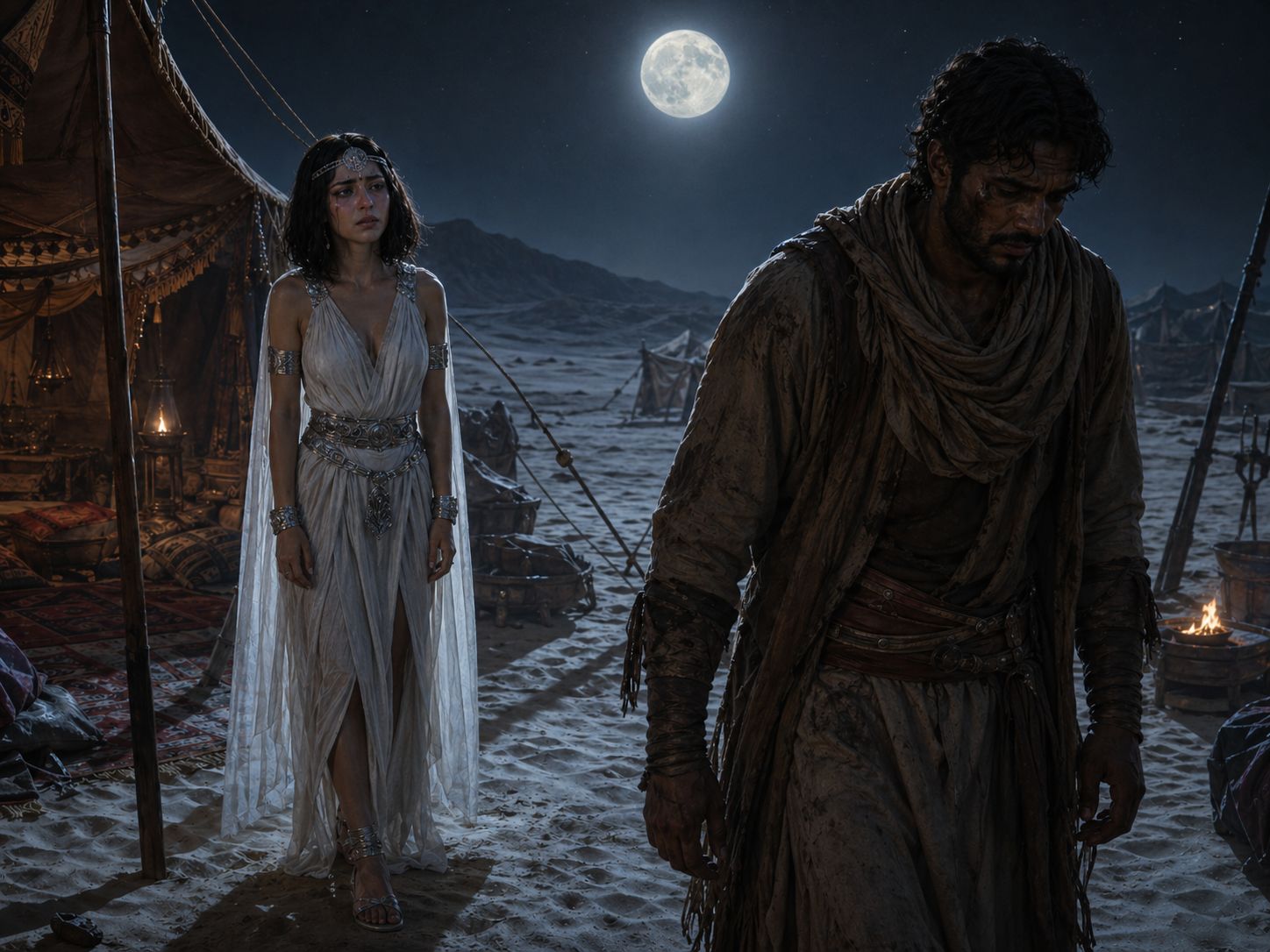
This is one of the most important pressure points in Nephyla's arc.
As grief and fear spread through the caravan, people begin seeking her out. Not because she is fully trusted or revered, but because word has spread that she said the right thing once, and because in moments like this people reach for whoever seems to know death. She does know it. Or at least she knows the language around it.
So she gives them the old phrases. The dead are not lost. They are carried onward. They are not abandoned. The words help. That matters.
But for Nephyla, this becomes a breaking point.
The phrases no longer feel like certainty. They feel like empty ritual, or at least like something too small for the pain in front of her. She says them because they are what she has, and because they are expected to work. And they do work. But now they no longer shield her. She finds herself actually caring for these people, and that means their grief begins to wound her.
This is not yet a true step toward becoming human. It is not growth in a clean upward sense. It is the god queen breaking. The old distance fails. The practiced words stop floating above sorrow and start passing through it. What appears in the crack is only a spark, a tiny glimpse of possibility, but it matters.
Run this quietly. Do not overstate it. A few grief conversations are enough. The real event is not that she comforts people. It is that she is no longer protected from what comfort costs.
Sereh
Sereh is especially useful in the fever section because it strikes directly at an old wound. She is a young widow whose husband died of fever, and that history makes the new sickness feel cruel in a different way than battle or accident. She is not loud in her fear, but it shows in hovering attention, strained composure and the way old grief rises under new worry.
This also makes her one of the strongest possible romance threads in the arc. Not because the fever creates romance by itself, but because it exposes loneliness, vulnerability and the need to hold on to someone before they are gone. Any attraction connected to Sereh should therefore feel hesitant, intimate and a little fragile, shaped as much by fear and remembered loss as by desire.
The Deaths
After several days, the fever breaks. Most of the sick recover, slowly and badly, but they recover.
- Azim dies.
- Alala the rope maker dies.
These deaths matter because they give the fever real cost without overwhelming the arc. The tribe has lost more people, but not so many that the whole caravan becomes a ruin. The mood afterward should be tired, bruised and changed. The survivors live, but the caravan has been reminded again that survival is not something it receives for free.
Azim's death is especially useful because it gives Azhar's grief a face and lets the players see what a fever death does to those left behind. Alala the rope maker's death is useful because it creates a more ordinary absence. Not dramatic, but practical and human. Clothes will not be repaired as well. Someone else's hands will have to learn. A place in the caravan is simply empty now.
Aftermath
When the fever lifts, do not make the recovery feel triumphant. Let it feel like life returning in tired pieces.
- People sit up.
- Appetites come back.
- Tasks slowly find owners again.
The sounds of the caravan change from groans and whispered updates to ordinary work, complaint and low conversation.
The tribe is deeply thankful for the help. Junia most of all. Nephyla too, in a strange and more uncertain way. Thaleia also, because she proved useful where it mattered. This gratitude does not need to become speeches. It can be quieter than that. A softer tone. A remembered kindness. A place made at a meal. A task entrusted more easily next time.
Then the caravan moves on.
Still wounded. Still diminished. Still carrying grief. But moving.
That is the correct end to the fever section. Not restoration. Endurance.
Finding Hadi
This event is a small crisis, but an important one. Its purpose is not danger on the level of bandits, djinns or the dry oasis. Its purpose is to show the Dunewind Tribe as a living community, to let the crew become part of that community's effort, and to create one more step in the slow movement from tolerated outsiders to trusted hands.
Hadi is not just a child who goes missing. He is one of the caravan's children, and an orphan at that, and that matters. In Tazulmar life, fathers are often absent because relationships between tribes may be temporary and people usually remain with their own caravan. Mothers are present, but children are in practice raised by the whole moving tribe. That means Hadi's disappearance is not a private family problem. It is everyone's problem at once.
What the Scene Is For
The point of this scene is shared effort.
- The whole caravan reacts.
- People search without being told twice.
- The crew joins in without hesitation.
When Hadi is found, the relief belongs to everyone.
That is why it works so well in the early arc. Up to now, much of the Dunewind's interaction with the crew has been shaped by strain, grief and usefulness under pressure. This event shows another side. Concern. Urgency. Communal care. It gives the players a chance to help in a way that feels human rather than merely practical.
It should also help with acceptance. Not dramatic acceptance, not a speech about belonging, but a quiet shift. The crew were there when the tribe needed all hands. People remember that.
When to Use It
This scene fits best after the fever, once the caravan has started to settle into motion, but before later mysteries and harder desert pressures take over.
That placement matters. By then, the players have met some of the tribe, understand the basic rhythm of caravan life and are ready for a smaller event that strengthens connection rather than deepening damage. It works especially well on the stretch after Vezhet, when routine has begun to form and that routine can suddenly be broken.
How It Begins
The caravan is breaking camp in the morning. People are moving with the usual half sleepy rhythm of a tribe that lives on the road. Tents are being lowered. Water is being checked. Loads are being tied down. Someone is shouting for a misplaced peg sack. Rashad is already in a foul temper over harness order. Children are being pushed out of the way and then forgotten again as adults move on to the next task.
Then someone notices that Hadi is missing.
This should not begin with immediate panic. It begins with irritation and assumption.
- Someone thinks he is hiding.
- Someone else thinks he wandered off to avoid work.
- Someone says he was there a moment ago.
Then enough people fail to find him that the tone changes.
That change in mood is important. It lets the players feel the shift from ordinary caravan irritation into real alarm.
Why Hadi Is Missing
He wandered farther than he should have while chasing a small private purpose a kid might find. He followed a sound into the dunes. Then, he saw a lizard and followed that. One thing led to another, and he got lost. It should feel like the kind of mistake a child in a moving caravan might plausibly make.
The important thing is that he was not foolish in a cartoon sense. He was a child inside caravan life, and caravan life is full of ways to disappear from sight at the wrong moment.
The Search
Once the caravan understands that Hadi is really gone, the response should be immediate and communal.
- Some search the tents and the loads.
- Some check around the Shar'zul.
- Some fan out across the nearby dunes.
- Some stay back to keep the rest of the caravan functioning.
This gives the Game Master several kinds of scene to play.
Inside the camp, the search reveals how crowded and improvised caravan life is. People push aside bedding, open bundles, argue over where he was last seen and call his name with voices already tightening.
Outside the camp, the search becomes quieter and more frightening. Wind. Sand. Distance. Tracks half there and half gone.
This is a good place to involve the crew directly. Let them choose how they help. Searching the dunes. Checking loads. Coordinating. Calming someone. Following the faintest clue.
The Drum
The dunes had swallowed the camp behind them.
Nasheem and Junia pushed deeper through the sand, calling Hadi's name into the bright emptiness, while Ileena ranged ahead with that unnerving lightness of hers, head turning now and then as if she were listening to something too faint for human ears.
Then she stopped dead.
"Do you hear that?"
Nasheem looked up. "Hear what?"
Junia shook her head, breath short from the climb.
Ileena narrowed her eyes toward the next line of dunes. "That rhythm. I've been hearing it since we joined this caravan."
And then she ran.
She vanished over the next ridge in a spray of sand.
"Ileena, slow down!" Junia shouted, already scrambling after her with Nasheem beside her.
At first Junia heard nothing. Then, faintly, unevenly, a soft tapping reached them between the gusts.
They found Hadi in the curve of a dune, sitting in the sand with his drum beside him, face tight with pain and sweat streaking the dust on his skin. He had been trying very hard not to cry.
Ileena dropped beside him and let out a shaky breath. "I never thought I'd be happy to hear that drum again."
She hugged him, and Hadi yelped.
Ileena jerked back at once. "Oh."
By then Junia was already at his side. "Where does it hurt?"
"My foot," he said, voice trembling now that he no longer had to be brave alone.
Junia looked once and knew it was worse than that. The lower leg was wrong in a way no healer ever mistook.
"It is broken," she said. "Don't move."
Nasheem crouched beside her. "What do you need?"
"Your scabbard."
He drew the blade free and handed it over without hesitation. Junia set the leg as gently and firmly as she could. Hadi made one sharp, helpless sound through his teeth. She bound the scabbard against his leg, then pressed a twist of herbs into his hand.
"Chew these. They will help. They taste bad, but they ease the pain."
When she was done, she looked at Nasheem. "Can you carry him?"
Nasheem's face softened. "To the end of the world if need be."
That earned a broken little laugh from Hadi. It was enough.
Nasheem lifted him carefully into his arms. Ileena snatched up the drum before it could fall.
Nasheem looked at her. "Run ahead. Tell them we've found him."
She was gone at once, racing back over the dunes.
For a moment Junia stood there with one hand on Hadi's shoulder, Nasheem holding the boy steady, the desert stretching silent around them.
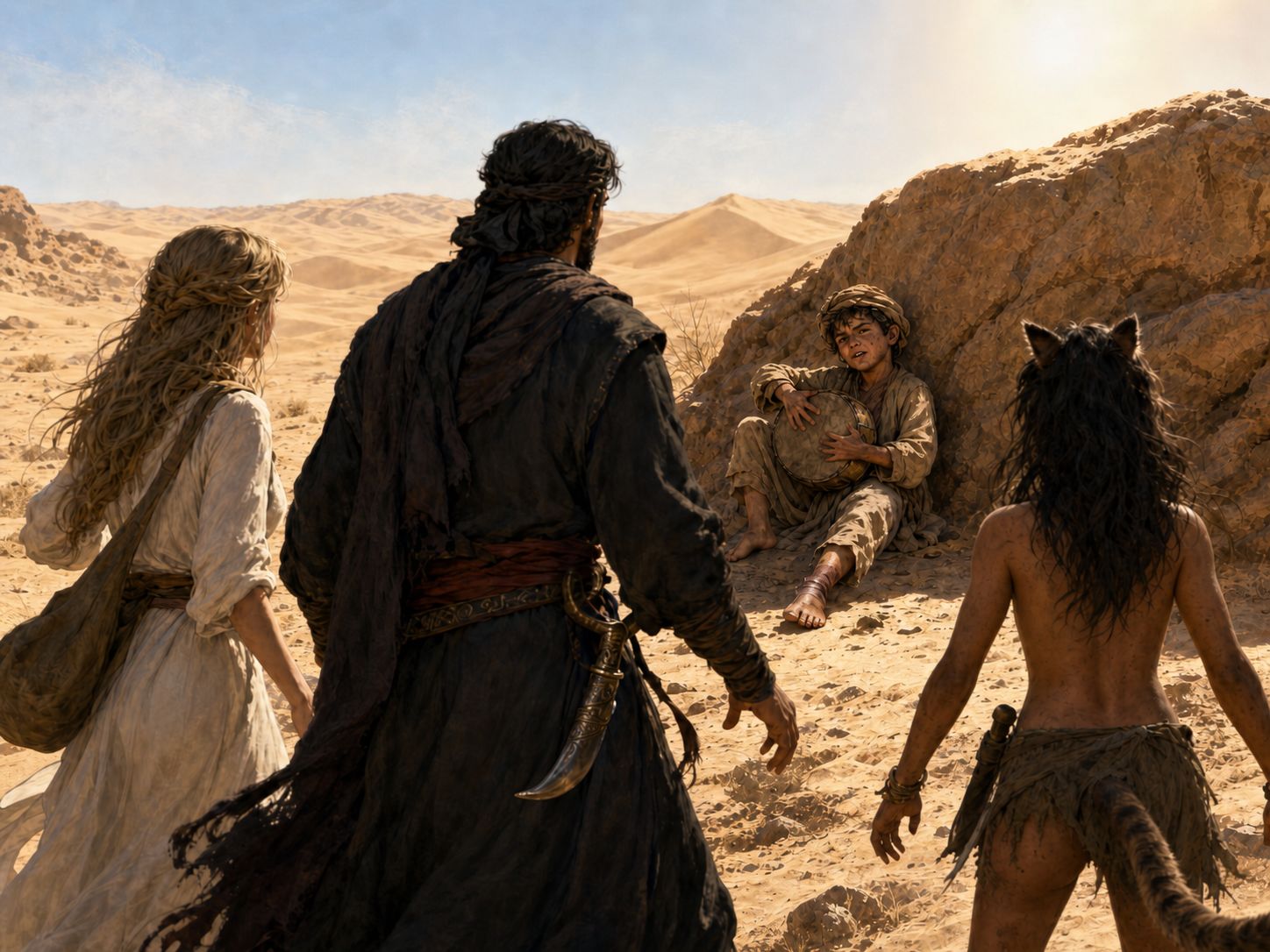
The key part of the scene is the drum.
After enough searching that worry has become real and search is extended further into the dunes, someone in the crew hears it. If Ileena is present, she will probably be the one who hears it, as she has superior hearing.
Faint at first. A small, uneven tapping somewhere out in the dunes. A rhythm they recognize, because they hear it all day, to an annoying level.
That should instantly change the emotional direction of the scene. The fear is no longer the vast blank fear of disappearance. It has become a direction. A voice. A hope.
The searchers follow the sound and find Hadi with a broken foot, frightened, dirty and trying very hard not to cry. The drum is what led them to him, whether because he was trying to call for help, keep himself brave or simply hold on to something familiar.
Keep that image. It makes the event memorable.
Finding Him
Hadi should be found alive, but not whole. The broken foot matters because it gives the event consequence beyond relief.
- Junia or Mira can set it.
- Others carry him back.
- Someone scolds him through tears.
- Someone else is too relieved to scold him at all.
This is where the tribe's communal nature should become clear. Many people react as if they have all been missing him, because in a real sense they have.
The broken foot also helps the event linger afterward. Hadi will need attention. He cannot simply vanish back into the background immediately. That is useful, because it gives the scene afterlife.
Running the Mood
The emotional curve should be simple.
- Ordinary camp routine.
- Annoyed confusion.
- Realization that he is truly missing.
- Gathering alarm.
- Urgent search.
- The first faint drumbeat.
- Relief mixed with fear.
- Then practical care.
Do not overcomplicate it. The strength of the scene comes from how ordinary and human the crisis is.
Social Opportunities
This scene gives many chances for players to connect with the Dunewind.
- They can search beside tribe members who are frightened enough to speak honestly.
- They can calm someone whose fear is turning into blame.
- They will be the one who hears the drum first.
- They can help carry Hadi back.
- They can sit with him afterward.
They can become associated, in the tribe's mind, with having been useful when it mattered.
All of that is more important than the broken foot itself.
How to Run It
Do not turn this into a tracking puzzle unless your group especially enjoys that. The point is emotional participation, not clever deduction. A few signs are enough. A line of footprints. A half buried mark in the sand. A glimpse of movement that turns out to be nothing. Then the drum.
Likewise, do not make it a near death epic. Hadi should not be moments from being devoured or carried away by something huge. That would distort the tone. The power of the scene is that this is the kind of thing that could happen in ordinary caravan life, and that ordinary things can still terrify.
Keep it small, urgent and shared.
What It Changes
After Hadi is found, the caravan should feel subtly different.
- A few people who were distant toward the crew soften.
- Someone who would not normally thank them does.
- Children may become less wary.
- A tribe member may refer back to the search later.
- Hadi himself may form a stronger tie to whoever helped him most.
This is not a turning point in the grand sense. It is one of the smaller steps by which belonging becomes possible. That is exactly why it matters.
Final Note
The scene works because it shows what the Dunewind are protecting. Not only goods, routes and Shar'zul, but each other. The tribe is still hurt, still grieving and still under strain, but when one of their children goes missing, all of that falls into the background at once.
For a little while, the whole caravan has only one task.
Find Hadi.
For that moment, the crew were part of the tribe.
The Vale of Shuraz

The Vale of Shuraz is one of the deepest secrets of the Tazulmar. Hidden far inside the Great Desert and protected as much by remoteness as by silence, it is a flat green valley caught between barren mountains, a place that feels impossible after so much sand and stone. To outsiders, it should seem almost unreal, not a lush paradise, but a hard won pocket of life that has no business existing where it does. The Tazulmar do not speak of it lightly, and those who know the way have every reason to keep that knowledge close. This is not just a useful refuge. It is one of the foundations of their way of life.
For the Dunewind Tribe, the Vale of Shuraz matters for two reasons above all others. It is where they go to rest and recover when the desert has taken too much from them, and it is where they come to renew their bond with the Shar'zul. After the losses suffered leaving Lumekhet, this makes the vale more than a destination. It is the one place that can truly answer what the tribe has lost.
Approaching the Vale
The entrance to the valley lies at Zeffir Oasis. This is the last outer threshold before the hidden world within, and it should feel like one. The land narrows, the mountains begin to gather close, and the route becomes more confined and deliberate. The desert does not end at once, but it starts to give way. Wind changes. Echoes behave differently. The sense of exposure that defines so much of Tazulmar begins to ease, replaced by the feeling of being enclosed.
The players should feel that they are crossing from ordinary desert travel into a place set apart, not magically sealed, but protected by geography, memory and tradition.
The Shape of the Valley
The Vale of Shuraz itself is broad and flat, lying like a hidden floor between high mountain walls. Life here is built around one source. At the far end of the valley, a spring rises from the stone and feeds a lake, and that lake is the source of everything else. From it comes the water that makes the valley possible. Around it grows the sparse but vital green that supports the Shar'zul and gives the Tazulmar a place to breathe, repair and wait.
Do not describe the vale as abundant in the settled sense. It is not a rich farming valley or a soft oasis paradise. It is a desert sanctuary. Life exists here because it is protected and because it is enough. That is what makes it precious.
Camp Uzuzu
At the lake stands Camp Uzuzu, a semi permanent Tazulmar camp used by tribes when they come to the vale. There are no permanent residents. The camp exists as a place of return, not a settled home. Tents, storage structures, beast pens, fire pits and the remains of older stays give it a lived in but temporary character. Tribes come, stay for a time, do what they must do, then leave again. The camp is never empty in spirit, even when few people are present, because it carries the marks of repeated use by many tribes across many years.
For the Game Master, Camp Uzuzu is important because it changes the rhythm of the arc. Until now, the caravan has been defined by motion. Here, it stops. That means people have time to settle into tensions, friendships, flirtations, rivalries and small habits. It is the social and cultural middle of the arc, the place where things can breathe.
The Shar'zul
Most importantly, the Vale of Shuraz is where the Shar'zul live and where the Tazulmar renew their bond with them. This should not be treated as mere animal handling or caravan logistics. The Shar'zul are central to Tazulmar life, and the vale is therefore central to Tazulmar identity. Without the Shar'zul, the desert could not be crossed in the same way. Without this hidden place, the tribes could not sustain that way of life over generations.
For the Dunewind Tribe, arriving here means hope. They are one Shar'zul short. They have lost people. They are carrying damage in every sense. Camp Uzuzu and the lake at the heart of the vale offer the first real chance to rest, recover and begin replacing what was lost. This is why the valley should feel emotionally significant as well as geographically important.
How to Use It
The Vale of Shuraz should feel like relief, secrecy and significance all at once. It is a pause in the desert, but not a release from the arc. Instead, it is where many of the arc's social threads deepen. The crew should feel that they have reached a place that matters deeply to the Dunewind, and that simply being allowed here means something. At the same time, the players should understand that this is not a safe town or a neutral stopover. It is a hidden tribal place, important, guarded and alive with meanings they only partly understand.
In practical terms, use the vale as the point where exhaustion gives way to recovery, where tribal life opens up, and where the caravan can begin to become whole enough to continue west toward Ssar'et.
The Waterseeker Tribe
The Waterseeker Tribe should be presented as another Tazulmar caravan tribe, familiar to the Dunewind and broadly on friendly terms with them, but carrying all the old frictions that grow between people who meet, trade, flirt, quarrel and part over many years. The important thing is that they are not enemies. Camp Uzuzu should not become a tribe war. Instead, it should feel like a long visit between people who know each other well enough to be warm, rude, resentful, flirtatious and competitive all at once.
This works especially well at the Vale of Shuraz because the place is already rare, sacred and socially important. Tazulmar tribes only come here occasionally, when a Shar'zul must be renewed and the pilgrimage becomes necessary, so meeting another tribe here should feel meaningful rather than random. This is a place where old ties resurface.
What the Waterseekers Are For
The Waterseekers exist to widen the arc.
Until Camp Uzuzu, the crew only know the Dunewind from inside. The Waterseekers let the Game Master show that the Dunewind are not the whole of Tazulmar. They are one tribe among others, with their own habits, reputations and unresolved history. This immediately makes the world feel larger.
They also provide slower conflict. The road events before the vale are driven by injury, fear, fever and survival. The Waterseekers let you shift into social heat instead. Old romances, trade grudges, music disputes, children taking sides, boastful rivalries and marriage politics all fit here. The Dunewind are a moving community full of desires, grudges and long memory, and another tribe gives those things room to surface.
Tone
Keep the tone friendly first.
The two tribes greet each other with familiarity, hospitality and a sense that this is normal. They share food, compare road conditions, ask after births, deaths and beasts, and settle into each other's presence quickly. The friction should not erase that warmth. It should live inside it.
The important feeling is this: if a stranger watched from a distance, they would think the tribes were getting along very well. Only after time passes do the frictions become visible.
How the Waterseekers Should Feel Distinct
Give the Waterseekers one or two clear contrasts to the Dunewind, not a whole second people.
The Waterseekers are a little more polished socially and a little more willing to turn every interaction into a performance. They are still Tazulmar, still practical desert people, but they are more theatrical in flirtation, prouder in trade and quicker to make an audience out of an argument. That makes them a good foil to the steadier, work worn Dunewind.
Do not overdo the difference. They should feel like cousins, not foreigners.
Leadership and Face of the Tribe
The two most prominent members of a Tazulmar tribe are the sulmar and the quartermaster. For the Waterseekers, this is:
- Sulmar Farid ibn Mazar should be their practical leader, calm, sun dark and publicly cordial with Miraz Khalim. He knows how to keep peace and how to pretend he is not enjoying the drama around him.
- Layla Reed-Eyes should be their quartermaster counterpart, sharp enough to trade insults with Sada bint Miraz without ever quite crossing the line into open hostility.
The Nature of the Friction
The Waterseeker material should be run as overlapping tensions, not as one main plot.
Let several things simmer at once.
The Promise
Rafiq al Saffron is confronted by Amira soft-of-voice, who says he promised to move to the Waterseekers and live with her and their daughter, little Hani. Rafiq insists there was no promise, only warmth and desire. Both may believe their own version. The point is not who is right. The point is that the past has arrived in public.
The Two Suitors
Nisrine catches the attention of Nadim and Faruq, two Waterseeker young men who both believe they are handling the matter with dignity. They are not. She flirts with both and enjoys the attention, and the situation starts pushing toward a duel. This is especially useful because Tazulmar duel customs are already established, often to first blood, which makes the threat real without forcing immediate tragedy.
Trader Pride
Nahla keeps up her long running feud with Hameed Copper Cups. Each is convinced the other cheated in an old trade, and both brag about how well they cheated the other back. This is a good recurring comic thread because it mixes resentment and admiration.
Rule Dispute
Old Samir of the Long Song and Umar of the Bent Knee begin a game of Khalif that turns into a rules dispute. Neither is willing to concede, and soon half the old people in both tribes have opinions. This is good because it feels small while still becoming social business.
The Child War
One of Danya Sun-Bitten's children, Mariq, gets into a fight with Basim, a Waterseeker boy of similar age. The adults dismiss it at first, but the children on both sides begin collecting themselves into little camps, and before long a full child war is threatening to break out. This is excellent because the stakes are low, but the tribe pride involved is very real.
The Stolen Song
Yusef Hollow-Reed is accused by Sabir Two-Songs of stealing a melody. Yusef admits, with painful honesty, that he may once have heard it and reshaped it without knowing. That is not good enough for Sabir. People start arguing about when they first heard the tune and from whom. This should end not in punishment, but in a public jam session where Zahra al Duneveil joins in and the rivalry turns into shared music. Yusef is shy, gentle and easy to overlook, which makes this a good way to bring him into focus.
Positive Effects
The Waterseekers should not only bring friction. They also make Camp Uzuzu feel socially alive.
Trade for Necessities
They bring trade. The Dunewind can exchange stories, goods, repair help, dyes, herbs, rope, preserved foods and small luxuries at a moment when they badly need relief.
Romance and New Blood
They bring romance. Samra Moon-Braid chooses to leave with the Dunewind because of Jalir Dust-Laugh. They have met before, and decide it is time to make it permanent. This should not be treated as scandalous in itself. It is a practical and emotional shift, and it gives the Dunewind one more pair of hands they genuinely need.
Knowledge
They bring knowledge. Thaleia Myrinos should absolutely pepper them with questions and notes, comparing song, custom, Shar'zul handling and route memory with fascinated intensity.
Contrast
They bring comparison. The crew can now see what is specifically Dunewind and what is more widely Tazulmar.
How the Crew Get Involved
Do not make the crew passive observers of tribe drama. The whole point is that the two weeks at Camp Uzuzu give time for entanglement.
This is where the social middle of the arc comes alive. The players are no longer only helping the Dunewind survive. They are getting pulled into the ordinary human nonsense that proves the tribe is alive.
How to Run the Friction
Do not resolve everything quickly.
You have a week or two at Camp Uzuzu. Use that.
- Let one dispute flare, cool and then return later in a different form.
- Let one romance advance by glances, gossip and badly chosen errands.
- Let one argument look silly until it suddenly exposes something real beneath it.
The value of the Waterseekers is that they let social tension breathe. On the road, everything is pressed by movement. At the vale, people have time to continue being themselves.
Most important, do not turn this into something big. These are small social frictions and bits of personal drama which matter greatly to the people involved, but not much in the larger picture. Their purpose is to deepen the people involved.
Final Guidance
The Waterseekers should feel like a story tool to the Game Master. They provide warmth, contrast, history, humor, jealousy, flirtation and low stakes conflict with real emotional texture. They are not there to replace the Dunewind. They are there to reveal the Dunewind more clearly.
If Camp Uzuzu is the social and cultural middle of the arc, then the Waterseekers are the reason that middle feels full. The crew should come away understanding not only the Dunewind better, but Tazulmar life itself a little better too.
The New Shar'zul
At the far edges of the Vale of Shuraz, the valley felt empty of people and full of waiting. Camp Uzuzu and the lake lay far behind them. Out here there was only pale sand, heat held between mountain walls and the long silence of a place the Tazulmar did not treat lightly. Rashad Year-Without-Rain walked ahead of the camel with his usual scarred, heavy steadiness, but there was something different in him now. He was not merely searching. He was approaching something sacred. Even Thaleia Myrinos, usually all questions and scribbling excitement, seemed to feel it, though that did not stop her from pestering him every few steps.
"How deep do they bury them?"
"Deep enough."
"How do you tell one clutch from another?"
"You learn."
It should have annoyed her. Instead it delighted her. She clutched her journal against her ribs and followed him over the sand like an eager student chasing a priest who refused to admit he was one.
Then Rashad slowed.
He crouched, brushed the sand with his hand and went still. To Thaleia, there was almost nothing to see. A faint turn in the grains. A shallow disturbance. But Rashad looked at it with the seriousness other men gave to graves or altars.
"Here," he said.
They dug carefully, not with the haste of treasure hunters but with the care of people uncovering something alive and easily lost. The sand grew cooler below the surface. Then Rashad's hand found the first egg.
Thaleia forgot to speak.
More lay beneath, large and pale ochre under the dust, cradled together in the hidden warmth of the valley floor. Rashad touched each one in turn, listening through his palm in a way Thaleia could not understand, rejecting some, choosing others. When at last he selected three, he lifted them with a reverence almost too gentle for such rough hands. They wrapped them, loaded them carefully onto the camel and turned back toward Camp Uzuzu, carrying not cargo, but the tribe's future.
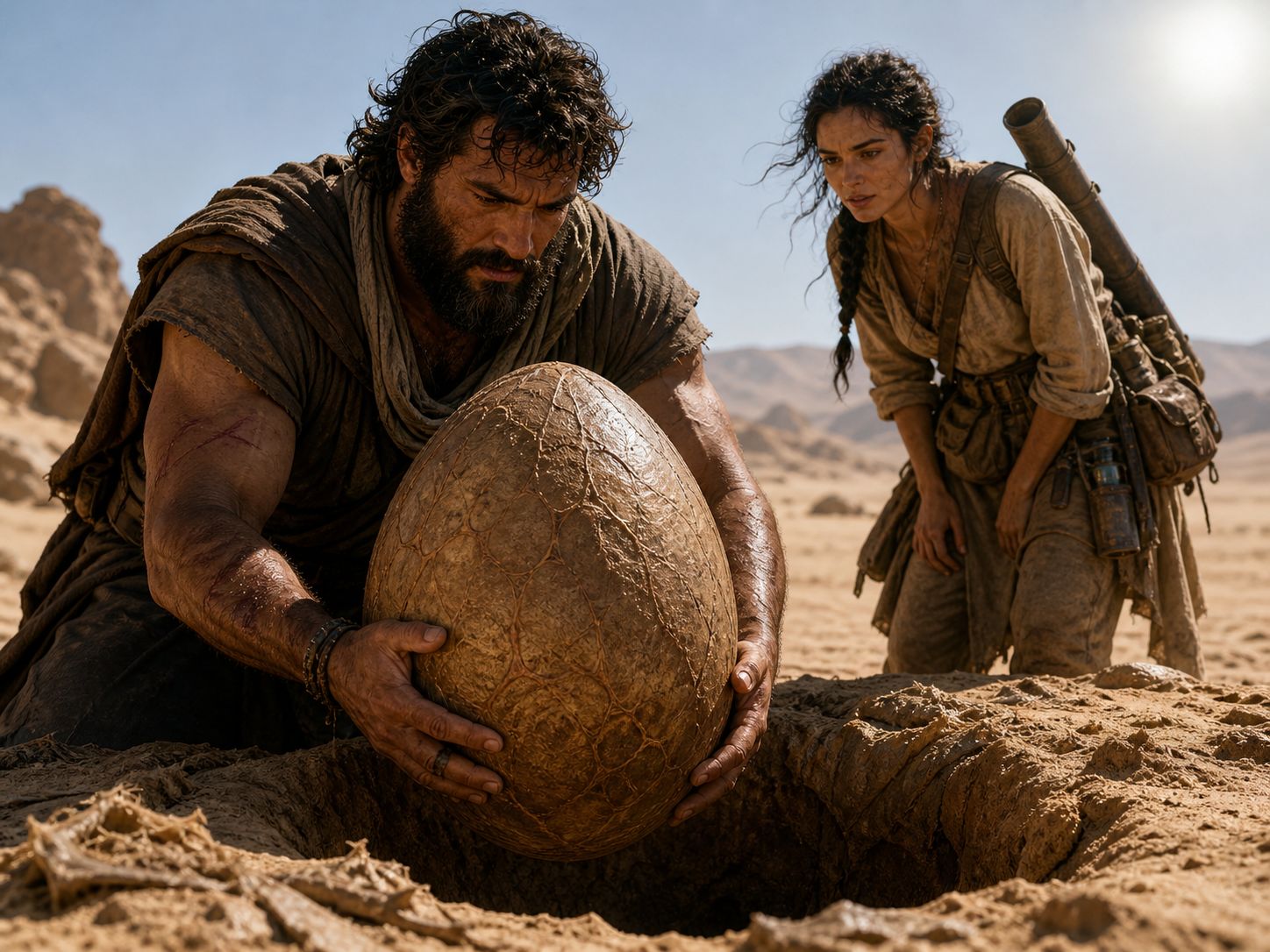
This section should be run mainly as emotional story rather than as open problem solving. The important thing is not whether the players can change the outcome, but that they get to be present for something deeply important to the Dunewind Tribe. The search for the eggs and the hatching ritual are both about renewal after loss. The caravan came into the vale wounded, diminished and uncertain. Here, for the first time, the future becomes visible again.
The search itself should feel quiet, reverent and slightly secret. Rashad Year-Without-Rain treats it almost like a sacred duty, and that tone should shape the scene. Thaleia is the natural point of focus because she is curious enough to ask questions and perceptive enough to understand that this matters. The players may help, watch, ask and take part socially, but the purpose is to let them feel the tribe's hope and see how much trust and meaning is bound up in the Shar'zul.
The Hatching Ritual
The hatching ritual should feel intimate, communal and old. The whole tribe gathers. The song matters. The handling of the eggs matters. The first touch matters. Do not rush it, but do not overload it with explanation either. Let the ritual itself carry the meaning. This is one of the clearest moments in the arc where the crew stop feeling like guests and begin feeling like people allowed to witness something real.
The emotional center of the scene is Thaleia. When the third hatchling chooses her, that should not feel random or cute. It should feel like a moment of genuine significance to the tribe. Rashad guides her quietly, she does what must be done and the tribe marks what has happened through their respect. This is not about making Thaleia important in a plot sense. It is about showing that she has been accepted deeply enough for this moment to happen at all.
What This Should Achieve
By the end of this section, the Dunewind should feel less like a caravan the crew travels with and more like a people whose losses and hopes now matter. The new Shar'zul are not just replacements for what was lost. They are proof that the tribe will continue.
Thaleia should be allowed to name the hatchling that chose her. She names it Hich'ma, "wisdom" in Tazulmar lore. That choice fits both her nature and the tribe's recognition of her. It gives the moment a lasting shape without making it too large.
In practical terms, this whole section is mostly on rails. Let the stories do the work. The players do not need major agency here. They need presence, feeling and the sense that they were there when the wounded caravan first became capable of imagining tomorrow.
By the time the sun had gone low over the Vale of Shuraz, the whole Dunewind Tribe had gathered in a wide circle around the three eggs.
No one spoke loudly. Even Hadi kept his drum silent in his lap. Zahra al Duneveil began to sing first, low and soft, and the others joined her until the air seemed full of wind made into human voices. It was not performance. It was memory. The kind of song people sang because it had always been sung.
At the center of the circle, Rashad Year-Without-Rain knelt beside the eggs.
With people he was often gruff, but here there was nothing rough in him. He lifted each egg as if lifting something already alive and laid it on the heated blankets, turning them slowly, warming them with scarred hands that moved with almost painful care. Watching him, Thaleia forgot even to write.
The first egg trembled, then cracked. A pale hatchling pulled itself free, long already, soft and wet and strange, nearly twice the length of a man. It lifted its head, antennae trembling, tasting song and air. Rashad and Tarek Sandnose called softly to it, and it crawled toward them. They caressed its head and antennae with reverent hands, then fastened a tiny harness around it.
The second egg followed soon after, breaking more quickly. This hatchling made for Mira Bone-Needle and Farah Ash-Marked, who received it with the same quiet care. Around them, the tribe kept singing, never hurrying, never breaking the circle of sound.
Then the third egg opened.
This hatchling emerged more slowly, pausing as if listening. Rashad called softly. So did Tarek. But instead of going to them, it crawled past both and crossed the circle with calm certainty until it reached Thaleia.
Then it pressed itself against her and curled there.
For a moment, she only stared.
Her eyes flew to Rashad. He was already watching her with grave intensity.
"Slowly," he whispered. "Touch the head first. Then the antennae. Let it learn you."
Thaleia swallowed and obeyed. Her hand came down on the pale plates of its head, then along the antennae. The hatchling stilled beneath her touch, then brushed its feelers against her wrist and cheek as if learning her by scent and skin.
Rashad moved closer and held out the tiny harness.
"You do this part."
Her hands trembled, but she took it and fastened it with as much care as if she were handling a sacred relic. When she was done, the hatchling remained pressed against her, entirely at ease.
Only then did the song come to its end.
The silence afterward felt enormous.
Then Miraz Khalim bowed his head to her. Sada bint Miraz followed. Rashad. Mira. Tarek. Zahra. Old Samir of the Long Song. One by one, as the tribe turned away toward the evening meal, each member of the Dunewind passed Thaleia and gave the same short, respectful nod.
No one explained it. No one needed to.
Thaleia remained where she was in the fading light, one hand still resting on the hatchling's head, while Camp Uzuzu slowly returned to ordinary life around her. Fires would be lit. Food shared. Voices would rise again.
But for that one long moment, she sat at the center of something ancient and living, and the tribe no longer looked at her as a guest. The desert had chosen, and they had seen it.
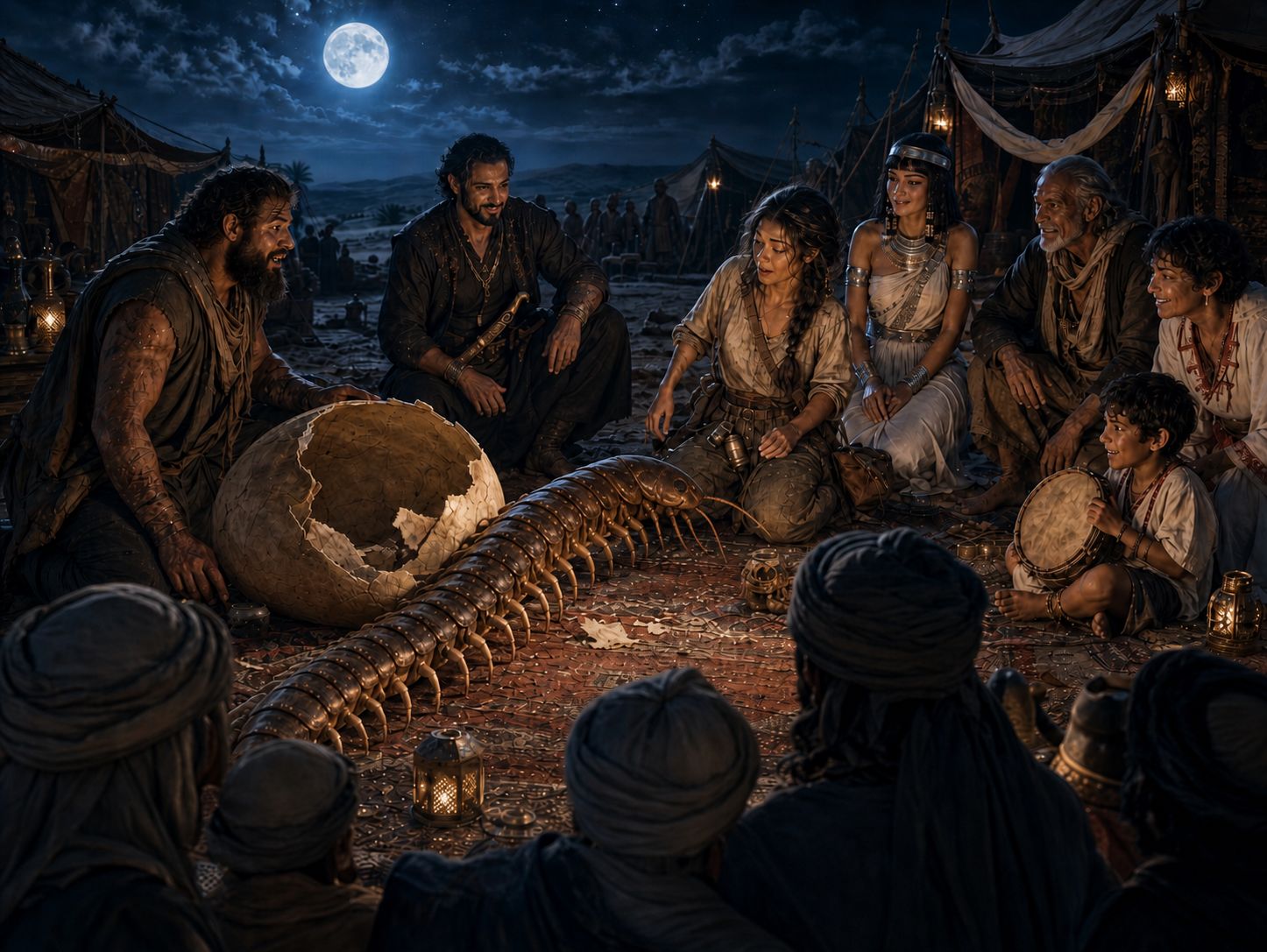
The Long Way Back
The long way back should mark a clear change in the arc. The caravan is no longer only wounded and recovering. It is moving forward again, but now with something fragile and precious to protect. That makes the return journey less about rebuilding and more about carrying new hope through a desert that is still dangerous, demanding and increasingly strange.
This is also where the tone turns more mystical. The desert is no longer just hardship and beauty. It has become known territory, and that allows its deeper spiritual presence to emerge. Together, these events shift the arc from social rebuilding toward mystery, omen and the sense that the deeper desert is now answering back.
The Runaway Shar'zul
The dinner fire was burning low when the camp began to fold itself back into motion. Bowls were emptied. Blankets were rolled. Ropes were gathered. The three young Shar'zul had been penned close beside the tents, pale shapes in the dusk, shifting and clicking softly to one another.
Rashad glanced that way as he always did.
Then he stopped.
For a heartbeat he said nothing. He only stared at the pen, at the two hatchlings still there, and at the empty space where the third should have been.
"Hich'ma," he called.
No answer.
Now everyone looked, noticing the worry on his tone.
Thaleia was on her feet at once, her whole face changing before she had even crossed half the camp. Rashad was already moving, crouching by the pen, one scarred hand brushing the sand, reading what the rest of them could not. Around him, the first unease spread through the camp, quick and cold, too much like the moment they had realized Hadi was missing.
Rashad rose.
"She went toward the dunes."
That was enough. The whole mood of the camp shifted at once. Miraz began giving orders in his calm, hard voice. Sada was already driving people into motion. Search the tents. Check the loads. Spread out. Move quickly.
And as the half packed camp broke apart around that one new purpose, Thaleia stood for one small frozen moment, staring at the darkening sand beyond the firelight, before she followed the others into the growing dark to help find Hich'ma.
This event should be run as a clear echo of the search for Hadi. The shape is similar on purpose. A member of the moving community is suddenly missing, the mood of the camp changes all at once and the whole tribe turns toward one urgent task. The difference is what that missing member is. By treating the search for Hich'ma with the same fear, speed and shared effort as the search for Hadi, the Game Master shows that the Shar'zul are not just beasts of burden. They are part of the tribe's life, future and identity.
That is the real purpose of the scene. It deepens the place of the Shar'zul in the story and reinforces how emotionally important the hatchlings are after the losses suffered leaving Lumekhet.
How It Begins
The scene should begin just as the caravan is preparing to move again after a meal stop. People are packing, gathering bowls, checking loads and settling into the rhythm of departure. Then Rashad Year-Without-Rain notices that one of the young Shar'zul is gone. It is Hich'ma.
The first reaction should be sharp disbelief, then immediate alarm. This should feel very much like the moment when Hadi was discovered missing. People stop what they are doing. Voices change. Orders begin. The camp shifts from routine into urgent shared effort without needing argument about whether the matter is serious.
How the Search Works
Run the search much like the search for Hadi.
- Some check tents, loads and the edges of camp.
- Some spread into the nearby dunes.
- Some stay behind to keep the caravan from completely falling apart.
The point is not to make this into a difficult tracking challenge. The point is the shared response. Everyone understands that Hich'ma must be found quickly, before the hatchling wanders too far. The players should again feel the tribe reacting as a single body to the loss of one of its own.
If the crew includes a scout, tracker or similarly skilled wilderness type, let them be useful here. They can help pick up the first real sign in the sand, confirm the direction of travel and guide the search more efficiently than the frightened, hurried tribe can on its own. This is especially useful if you want to lead the search naturally toward Thaleia's group. The tracker does not have to solve the scene alone, but they should be allowed to matter.
Eventually, Hich'ma should be found by whatever search group Thaleia is with. That matters. Hich'ma chose her earlier, and the reunion should confirm that bond rather than create doubt around it.
What It Shows
This is a vulnerable moment for the Dunewind Tribe. They are still carrying losses, still rebuilding and now one of the fragile signs of their future has slipped away into the dunes. That makes the scene emotionally useful. The tribe is not only protective of children, but of the Shar'zul too, because both represent continuity. Both must be carried forward.
That vulnerability opens social possibilities. People may speak more honestly while searching. Fear may turn into blame, prayer, brittle humor or confession. Someone may reveal how much Hich'ma already means to them. Someone may show unexpected trust in the crew. Someone may watch how Thaleia reacts and begin seeing her differently.
What the Scene Should Achieve
By the end of the scene, Hich'ma is safely recovered and the caravan can continue. But the real effect is social and emotional. The crew should understand more clearly that the Shar'zul are treated as members of the tribe, not equipment. Thaleia's bond with Hich'ma should feel strengthened. And the Dunewind should once again have seen the crew searching beside them when something precious was at risk.
Keep it small, urgent and heartfelt. Let the earlier search for Hadi echo through it, and let that echo teach the players what the Tazulmar truly value.
The dunes had gone quiet around them.
Thaleia kept calling Hich'ma's name, her voice thin against all that sand and fading light. Each time it seemed to vanish at once, swallowed by the wind and the long folds of the desert. Nasheem stayed a little behind and to one side, watching the slopes, letting her call, saying nothing that would make the silence worse.
Then something pale moved beyond the crest of the next dune.
Thaleia froze.
A small head rose first, then the long pale body of the young Shar'zul came scrambling awkwardly over the ridge, all too many legs and desperate determination. Hich'ma saw her, let out a soft clicking sound and came straight for her, hurrying down the slope with the blind certainty of something that had finally found what it was looking for.
"Oh, you little idiot," Thaleia whispered.
She dropped to her knees in the sand just as Hich'ma reached her and pressed itself against her with shameless trust. Thaleia wrapped both arms around the hatchling's neck and head and held it close, laughing once and then breaking into tears so quickly she could not have said where one ended and the other began. Hich'ma clicked softly and pushed closer, content now that the world was back in the right shape.
Nasheem let the moment breathe for a heartbeat, then stepped nearer, his expression gentler than his words.
"We had better get back to camp before Rashad decides to search all the way to Ssar'et."
Thaleia gave one wet, shaky nod, still holding Hich'ma close before at last gathering herself enough to rise. Together they turned back toward the waiting camp, the hatchling pressed against her side as if it had no intention of getting lost again.
The Djinn's Test
The caravan had stopped for the night in a hollow between dunes where the wind moved less cruelly and the cooking fires could hold their shape. People sat in small knots around bowls and low talk. Hadi's drum was quiet for once. Somewhere beyond the firelight, one of the young Shar'zul clicked softly in its sleep. Nasheem sat with the others, eating little, listening more, when something brushed the edge of his hearing. Not sound exactly. More like a voice that had forgotten how to become words.
He lifted his head.
No one else seemed to notice. The tribe kept eating. Zahra spoke softly to someone near the fire. Junia was bent over a bowl, tired enough to forget her own hunger. But the whisper came again, just beyond the reach of the flames, borne on the wind as if the dunes themselves had leaned close to murmur his name.
Nasheem rose without a word and stepped out into the dark.
The camp fell away behind him. Firelight dimmed. Sand shifted cool beneath his feet. He followed the whisper over one dune and then another until the night around him felt vast and listening. There, on the crest of a high ridge, the wind gathered itself into shape.
At first it was only movement, a pale turning in the air like moonlight caught in dust. Then it stood before him, tall and robed in streaming sand, with eyes like embers seen through smoke. Its form changed even while he looked at it, now lean as a man, now too long limbed, now almost only wind again.
Nasheem bowed his head and lowered himself to one knee in the sand.
The djinn inclined its head in return.
When it spoke, its voice seemed to come from both the figure before him and the darkness all around.
"It is time for you to be tested."
Nasheem lifted his eyes, steady despite the cold that had gone through him.
"I am honored," he said.
For a moment the djinn only watched him, the desert whispering through its shifting shape.
Then it smiled, and the night seemed to sharpen.
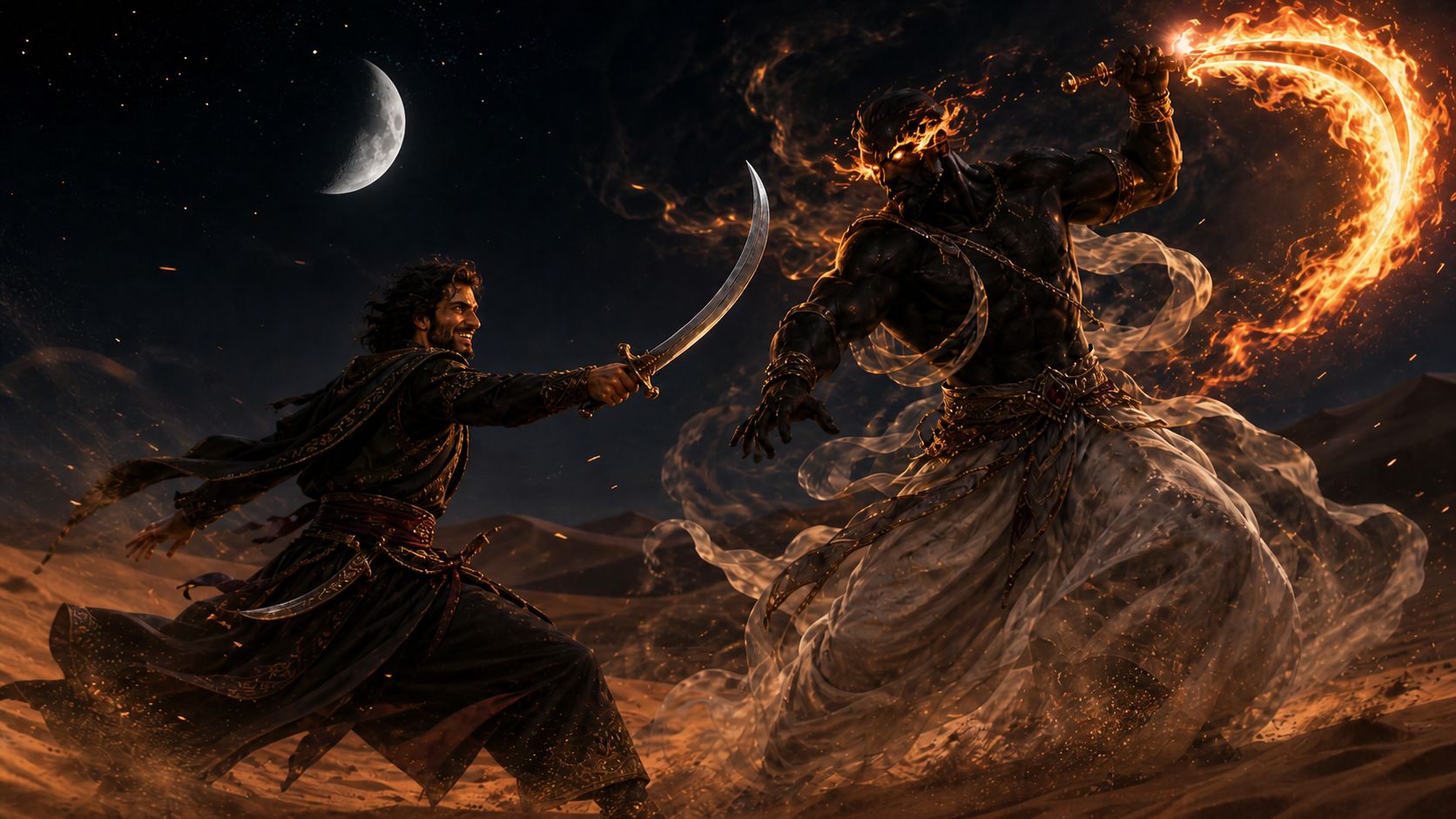
This scene is a personal trial, not a group challenge. Its purpose is to strip Nasheem down to the parts of himself that matter most: honesty, guilt, love, loyalty, courage and the honor he has rebuilt since losing everything in Zarhalem. Nasheem is a fallen noble who loved Safina, fled without being able to save her, now rejects slavery entirely and measures himself by the honor and fairness he has chosen since joining the Blue Marlin. That history is what the djinn presses on.
The desert context matters as well. For the Tazulmar, djinn are not simple spirits or monsters. They are dangerous desert powers tied to wind, song, oath and testing, and greater djinn are the kind of beings people bargain with only at real cost. That gives the encounter weight before a word is spoken.
Who Plays the Scene
If Nasheem is a player character, that player should play the encounter directly.
If Nasheem is an NPC, do not run the whole scene off screen. Instead, choose one player character to notice him leaving and follow at a distance. Prefer someone perceptive enough to understand that this is Nasheem's moment and disciplined enough not to interfere unless something goes catastrophically wrong. That character becomes the witness through which the scene is experienced. They do not become the focus. They are there to see, remember and later carry the story back to the others.
If they approach, Nasheem will notice, and wave them away with a discreet gesture.
This matters because the encounter is too important to disappear entirely, but it should still remain Nasheem's.
Tone and Structure
The tone should be solemn, intimate and slightly uncanny. The djinn does not rant, threaten or explain itself too much. It speaks with calm certainty, like a force that already knows the shape of the man before it. It never names the tests. It never praises too early. It simply asks, judges quietly and moves on.
The whole sequence should feel like ritual without ceremony. Question, answer, question, answer, until finally steel replaces words.
Do not rush the pauses. Nasheem should have to answer from himself, not from wit.
Running the Questions
The djinn's questions are not riddles. They are confrontations. Each one is simple on the surface and cutting underneath. The djinn should never sound curious. It already knows the answers. Its questions are not asked to learn, but to force Nasheem to speak the truth aloud and hear himself say it. The challenge is not guessing the clever answer. The challenge is telling the truth.
The djinn speaks with perfectly polished courtesy, but does not waste words, each statement is short and to the point. It may give clarifications in the form of follow up questions if the player gets stuck.
The Test of Honesty
The djinn says that Nasheem follows two people it once met, Rahim and Kethra. Why?
To pass, Nasheem must answer honestly. Not with a polished speech, not with a convenient excuse, but with the real reason. He follows because he seeks the Waverider, because Rahim matters, because Kethra's trail has crossed his own losses, because the search now means something personal. The point is not one exact phrasing. The point is whether he answers plainly and without hiding behind form.
This works especially well because Rahim and Kethra are already tied to the Tazulmar route and to Nasheem's emotional thread.
The Test of Accountability
The djinn says that Safina, died. Why?
To pass, Nasheem must acknowledge his failure. Not total blame for the world that killed her, but his own inability to protect her. He must not make himself innocent by pointing only at Rashid al Mazhar or fate. The truth is that he fled and could not reach her, and that this failure has marked him ever since. Safina was the one person he loved inside a structure he now sees with shame, and he has carried guilt over leaving her behind from the moment he ran.
The Test of Compassion
The djinn notes that Safina was property. Did he want property, or love?
To pass, Nasheem must declare clearly that it was love, and that he no longer keeps slaves. This matters because his past came from a world where hierarchy and ownership were normal, but his present self rejects that entirely. He now treats others with the respect he wishes he had shown those beneath him in Zarhalem, and his rejection of ownership is part of who he has become. Safina was never valuable to him because she was his. She mattered because she was herself.
The Test of Sacrifice
Use this only if the daughter thread exists and Safina's child survived in the care of Zuleikha.
The djinn asks why Nasheem left his daughter with a stranger. Why?
To pass, he must admit the harder truth. The child did not know him. She saw Zuleikha as mother, and he was the stranger. Leaving her was not abandonment born of indifference, but a painful choice made because tearing her from the only life she knew would have been for his sake more than hers. This only works if he says it as a wound, not as a clean moral answer. The point is that he chose for the daughter, not for his own claim.
The Test of Loyalty
The djinn says that Nasheem fled, abandoning Safina. Has he learned. Can he show that he will not abandon anyone again?
To pass, he must answer with examples. Let him name people from the Blue Marlin crew he has stood by, saved or refused to leave behind. The answer should come from lived loyalty, not abstract principle. This is where the djinn forces him to show that his present life has not been built only on regret, but on changed action. Nasheem's core traits now are fairness, loyalty, calm under pressure and honor chosen rather than inherited.
The Test of Strength
Only after the answers are given does the djinn declare that strength must also be measured. A flaming sword appears in its hand. Nasheem draws his own blade. They exchange courteous nods. The duel begins.
Do not run this as a long tactical fight. This is a mythic duel, a dance of death, fast, dangerous and full of emotional meaning. The djinn should be clearly superior, but not mocking. It is not playing with him. It is measuring him.
Eventually Nasheem is struck down. His sword is knocked from his hand and flung across the sand.
The Test of Courage
The djinn stands over him and says that he fought well, and now has the chance to die well.
To pass, Nasheem must not beg for mercy.
He may answer with pride, dignity, acceptance or defiance, but he must not plead. This is the final measure. After truth, guilt, love, loyalty and strength, what remains is whether he can face death without surrendering the self he has built.
The Judgement
The purpose of this scene is drama, not riddles. Make allowances for mistakes, and try to lead the player onto the right path through follow up questions from the djinn. Nasheem is meant to succeed, even if it should feel like a tough test, emotionally and physically.
Success
If Nasheem passes, the djinn tells him to rise.
It touches his chest with the tip of the flaming sword, leaving a small burn mark. It says that this is the mark of the djinni, proof that he has been tested and found worthy.
Only then does it speak of Rahim. It says that it tested him too, and found him worthy. It tells Nasheem to keep searching.
If He Fails
Do not turn failure into death unless you are deliberately ending the character, which this scene generally should not do.
If he fails one of the spoken tests, the djinn should not immediately strike him down. Instead, let the failure land as judgment. It may call him unready, turn from him and vanish, or refuse him the mark. That is punishment enough. The scene should wound pride and spirit, not derail the campaign.
If he fails only the final courage test by begging, I would still avoid killing him. Better that the djinn dismiss him as unworthy and leave him alive with that knowledge.
The point of the scene is transformation through testing, not random removal from play.
Leaving
Then the djinn turns away, walks a few steps and disappears in a whirlwind of sand. As it vanishes, Nasheem hears the whisper clearly through the hiss of the wind.
"Protect the moon."
That final line should not be explained. Let it remain an omen, a burden and a future instruction all at once.
If Nasheem Is an NPC
If a player character is the witness, keep them physically separate and emotionally secondary. They see Nasheem leave, follow at a distance and watch him face the djinn alone. They should not be tempted to intervene unless something has gone very wrong. The value of the witness is that the players get to experience the gravity of the moment without stealing it from Nasheem.
Afterward, decide how much Nasheem tells the rest of the crew himself.
He may speak plainly, or only show the mark and repeat the command to protect the moon. Either way, the witness can fill in the silence if needed.
What the Scene Achieves
This scene gives Nasheem something larger than information. It gives him judgment, recognition and a scar that means something in the desert. It also binds his private grief to the Waverider trail through Rahim, and ties his past in Zarhalem to his chosen life on the Blue Marlin. By the end, he should feel heavier, steadier and more marked by purpose than before.
That is the heart of the encounter. Not treasure. Not power. Meaning.
"Rise," the djinn said.
Nasheem pushed himself up from the sand with slow care. The duel still shook through him. His breath was uneven, his chest ached from the fall and his sword lay somewhere behind him in the dark. He stood anyway, straightening by effort rather than strength, and bowed his head.
The djinn stepped close with the flaming sword held low. Its shifting form no longer felt threatening. The judgment had already been made. When the tip touched the center of Nasheem's chest, pain flashed through him, sharp and absolute. Cloth burned. Skin burned. He did not move.
When the blade drew back, a small dark mark remained over his heart.
"The mark of the djinni," the spirit said. "Those who know it will know that you were tried and found worthy."
Nasheem gave one slow, respectful nod.
The djinn watched him for a moment, then spoke again.
"I tested Rahim. He also was found worthy."
At that, something tightened in Nasheem's face. Not surprise. Not quite grief. He lowered his head once more.
"Keep searching for Rahim and Kethra," the djinn said.
Again, Nasheem only nodded.
The spirit turned away and walked a few steps into the moonlit sand. Then its form broke apart into a rising whirlwind, a column of dust and pale light that spun once and vanished into the night.
For a heartbeat there was only silence.
Then, clear through the hiss of the shifting sand, Nasheem heard the whisper.
"Protect the moon."
He stood very still after that, alone beneath the full moon, the new mark burning faintly on his chest. At last he crossed the dune and found his sword half buried where it had fallen. He drew it free, slid it back into the scabbard and sank down onto the sand instead of turning for camp at once.
He sat there for a long while, watching the full moon in silence.
The night air cooled the sweat on his skin, but not the ache in his body. Safina rose in his thoughts. Then Rahim. Then Kethra. Then the faces of the crew sleeping below, unaware that the desert had laid a hand on him and left its sign. He felt wrung out, physically and emotionally, as if the djinn had stripped him down to the truth and left him standing in it.
It did not feel like triumph.
It felt like burden. Meaning. Exhaustion.
Protect the moon. He turned the words over in his mind as he sat beneath the full moon. Protect the moon. Nephyla's face rose there at once, painted and proud and lost beneath it all, but so did the older meanings, the moon as fate, as sorrow, as the part of the world that carries the dead and watches what the sun leaves behind. He could not tell whether the djinn had given him a warning, a command or a burden that would only make sense too late. Perhaps that was the nature of such things. The desert had spoken, and understanding could come later. Obedience came first.
When at last he rose, it was with the slow care of a man carrying more than weariness. He adjusted his sword belt, looked once more at the moon and then began the walk back toward the camp, leaving only a line of footprints behind him in the silver sand.
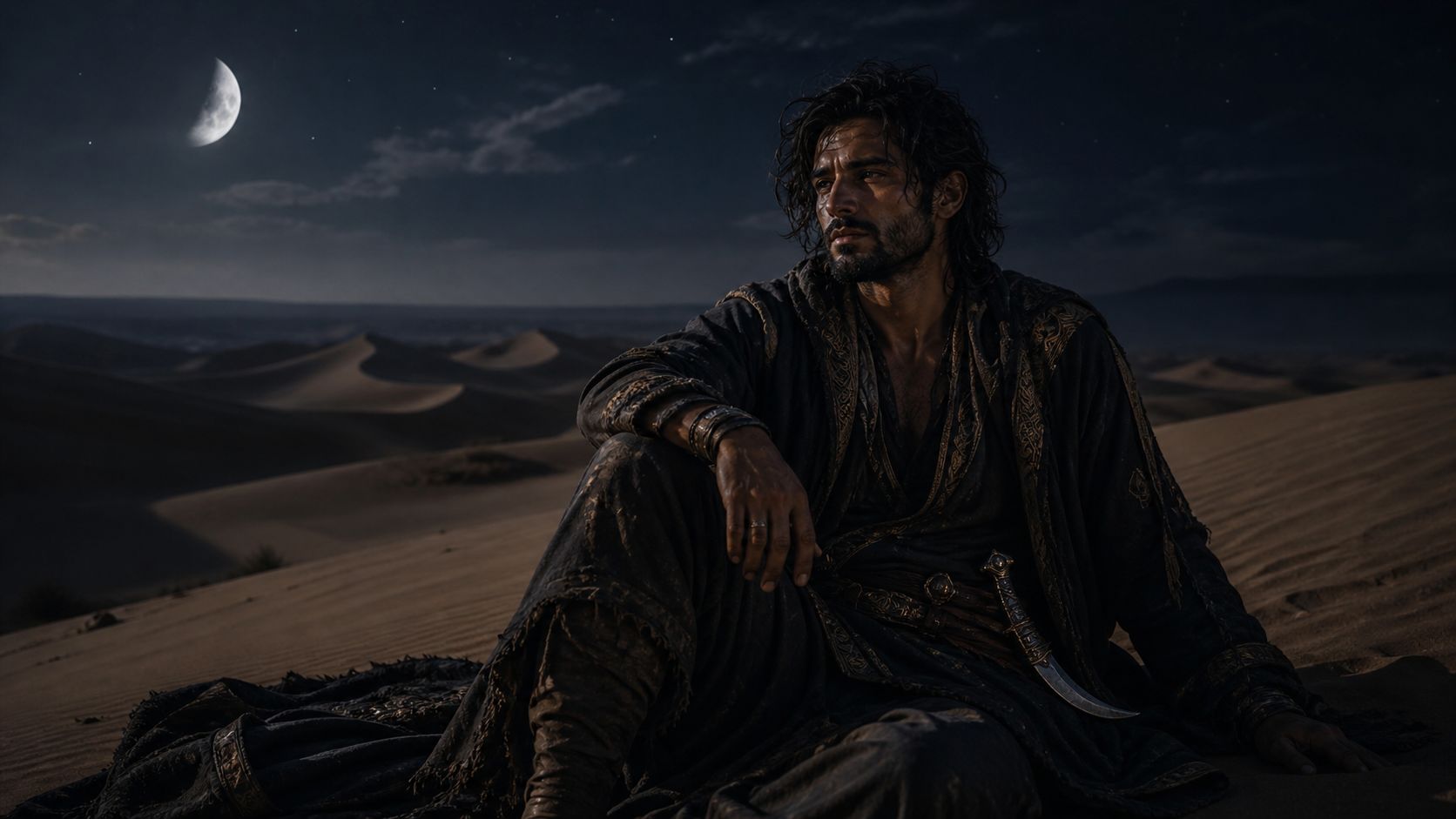
Sandstorm
The sandstorm should not be treated as weather with spooky decoration. Its real purpose is to turn the caravan into a pressure cooker. The Dunewind Tribe is already tired, worn down and emotionally exposed, and now they are trapped together while being told that their own senses cannot be trusted. That makes the storm a test of obedience, trust and self control, not just endurance. For the Tazulmar, bad djinn, the Zhuril, are tied to sandstorms and thirst, while greater djinn are older powers bargained with at real cost, so the tribe's fear should feel culturally grounded rather than theatrical.
How the Storm Begins
Miraz Khalim was the first to see it.
He stood on the back of the lead Shar'zul with one hand resting on the worn wood rail, looking west over the late light, when his face changed by only a finger's width. Far out across the dunes, where the horizon should have remained clean and open, a wall of haze was beginning to rise. Not cloud. Not ordinary wind. Sand, lifting in a long low line that thickened even as he watched.
He did not shout. He only turned and called down, his voice cutting clean through the camp.
"Storm camp. Now."
The effect was immediate. Sada bint Miraz was already moving before the last word had settled, snapping orders and driving people into place with hard precision. Rashad Year-Without-Rain hauled one of the Shar'zul into position and began checking restraints with scarred hands that missed nothing. Camels were led in tight. Proper tents vanished almost at once, stripped down and stowed with practiced speed. Boxes, barrels and bundled cargo were dragged into the sheltering ring between the beasts while cloth was thrown across them and lashed down low. Children were scooped up, bowls snatched away, tools gathered, fires stamped out.
No one asked if it was really needed. No one wasted breath on doubt. The Dunewind Tribe folded itself inward with the speed of long habit, every person finding their place as if the order had been given a hundred times before.
By the time the first hard gust hit the camp, the Shar'zul were already crouched low in the sand, their many legs dug deep, and the people of the caravan were crawling into the cramped low shelters beneath stretched cloth and stacked cargo. Over it all, Miraz stood for one moment longer, watching the storm come on like a living thing across the desert, then dropped down into the circle as the world outside began to disappear.
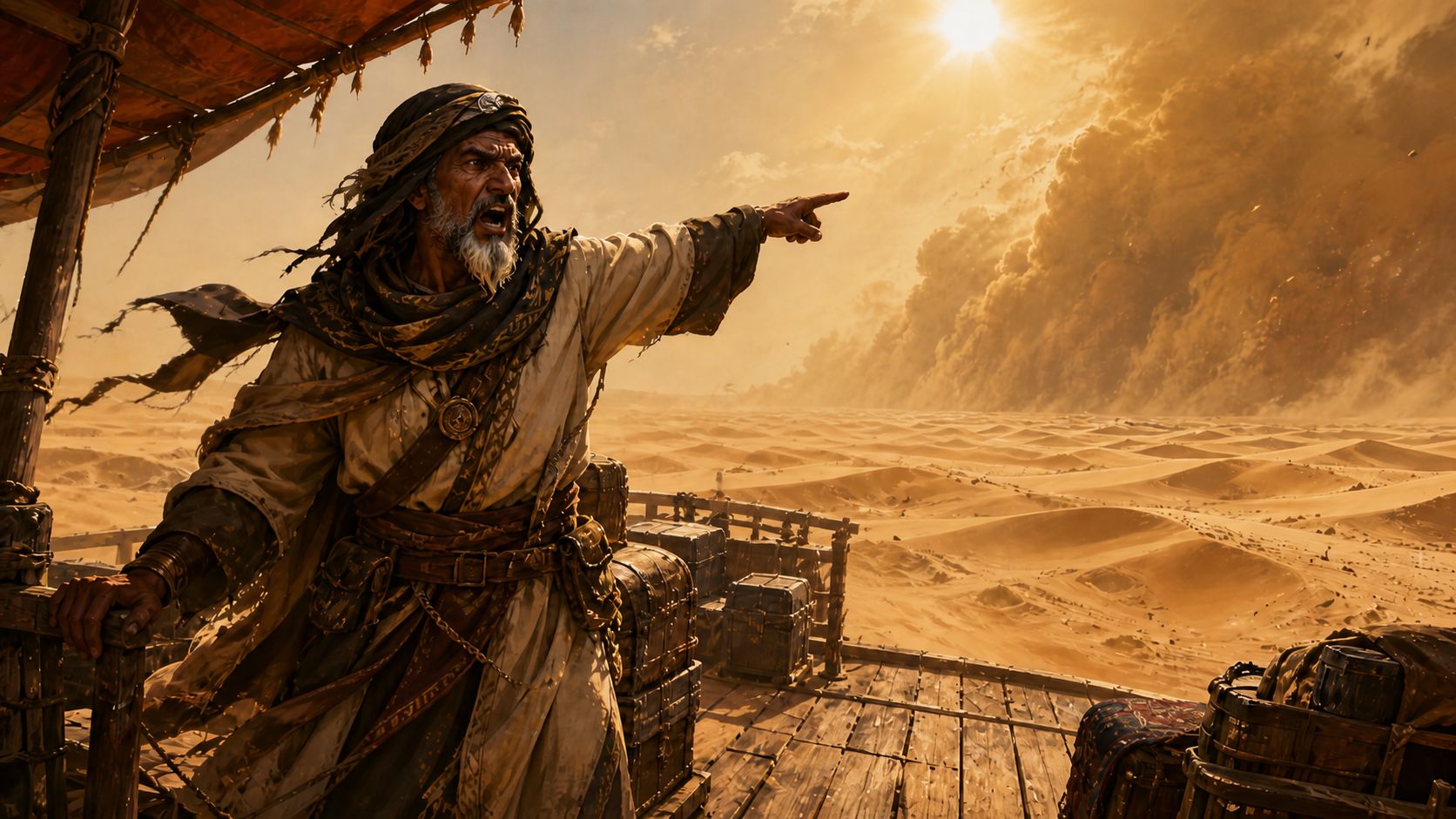
When the storm starts building, the Dunewind should react with unusual seriousness.
Miraz Khalim stays calm and starts directing people at once, because he is the sort of leader who does not waste words or show panic. Sada bint Miraz becomes even sharper than usual, not because she is losing control, but because fear makes her tighter. Rashad Year-Without-Rain checks bindings, tent lines and Shar'zul restraints again and again, all rough competence and controlled unease. Zahra al Duneveil, who usually shapes mood through song and presence, should go noticeably quiet.
The crew have seen the tribe under grief, pressure and attack. This is different. This is something the Tazulmar know and genuinely respect.
The Camp
In the storm, the camp flattens itself into survival shape.
The Shar'zul are drawn into a circle and settle low into the sand, digging their many legs down for purchase while the proper tents are stowed away entirely. Inside that living ring, boxes, barrels and bundled cargo are arranged into low walls, with heavy cloth stretched and tied across them to make improvised shelters.
These are not tents people can stand or even kneel in properly. Everyone has to crawl inside, and once there, the space is cramped, hot and crowded enough that it always feels as though someone is pressed against your shoulder or climbing over your legs. The whole storm camp should feel temporary, practical and claustrophobic, a tight little world of cloth, cargo and bodies huddled inside the protection of the Shar'zul circle.
The Rule
The warning should be given plainly and without explanation beyond what is needed in the moment.
- Do not answer anything you hear.
- Do not look too long at anything you think you see.
- Do not dwell on it.
- Do not even let your mind lean toward it if you can help it.
The rule should sound absolute because, to the tribe, it is. This also gives you the first social pressure in the scene. Most of the Dunewind accept the rule immediately. The crew may not. Someone may want an explanation. Someone may treat it as superstition. Someone may be annoyed that nobody will explain while the storm is already hitting. That social irritation is good. The storm should divide people before the voices do.
What the Storm Does
The improvised storm shelter was barely high enough to crawl into and not nearly wide enough for everyone forced inside it. Boxes and barrels made the walls, heavy cloth sagged low overhead and every gust made the whole cramped space shudder. Sand hissed across the outside in long hard rushes. Inside it was all dust, sweat, camel leather and the hot closeness of too many bodies trying not to move.
Junia had one knee jammed against a crate and the other pressed into somebody's blanket roll. Mira Bone-Needle sat folded around Hadi, his silent drum trapped against her side. Sereh crouched near the back wall with her veil crooked and her hands clenched white. Thaleia had given up trying to keep her journal open and now sat holding Hich'ma's tiny harness in both hands. Nasheem had to half crouch to fit, shoulders brushing the low cloth. Beside him, Nephyla sat too straight for the space, face set in brittle composure as if dignity alone could make the shelter larger.
Outside, someone shouted. Every person inside froze.
Then Sada's voice came through the storm, hard and close. "Stay down."
No one moved. The cloth roof snapped. Sand sprayed through a seam and made Hadi flinch into Mira. Another gust hit so hard the whole shelter seemed to tighten around them.
Then Sereh lifted her head.
"Did you hear that?" she whispered. "Someone called my name."
Mira caught her wrist at once. "No one is out there."
For a moment Sereh looked as if she might rise anyway. Then the wind gave a long low cry that sounded just enough like a voice to make the whole shelter go tighter with fear.
A little later Hadi jerked upright. "My drum. I heard it outside."
"You did not," Mira said.
"I did."
He started to move. Nasheem reached across the cramped dark and held him still. "Storms say many things," he said quietly. "That does not make them true."
Then something in the wind made Nephyla flinch like a struck thing. Her mouth parted, and Junia, without thinking, reached over and took her hand. Nephyla looked down at their joined fingers with something like shame, then held still.
After that, no one spoke. The storm battered the world outside, whispered at the cloth and pressed at the minds of everyone inside. Hadi trembled. Sereh stared at nothing. Thaleia breathed too carefully. Mira held the child and kept one hand braced against the floor as though she meant to hold the shelter down herself.
And in that low, crowded space, with knees pressed together and fear moving from one body to the next, crew and tribe stopped feeling like separate groups.
They were only people in a storm, trying very hard not to listen.
At first, the storm should do almost nothing but confinement. Heat, grit, noise, flapping cloth and too many people in too little space. Then it starts pressing on the cracks in people.
What is heard should be personal. Never random. The storm offers what each person is vulnerable to. Sereh may hear her dead husband. Nephyla may hear reverence, title or the old language of being needed as something divine. Someone else may hear a child crying, a wounded person calling or a promise they cannot let go unanswered. The voices should always be just plausible enough to tempt. That is the danger. Bad djinn are not at their most frightening when they attack. They are at their most frightening when they know exactly what will make someone turn toward them.
This is also where Nephyla can be used well. She does not need a big scene. It is enough if the storm offers her the old self she is already losing, and that temptation unsettles her badly. The storm is not progress for her. It is pressure on a breaking facade.
The Concrete Incidents
Do not let the storm remain entirely passive. Give it some real problems inside the lockdown.
The best kind of problem is practical but surrounded by untrustworthy perception.
- A tether comes loose.
- One of the camels starts to panic.
- A child thinks they heard Hadi's drum outside.
- A sick person tries to rise because they heard a familiar voice calling them by name.
The point is that the problem itself is real, but what surrounds it is not. That forces action without breaking the structure of the scene. People must move, calm, restrain, tie down, comfort or fetch things while also trying not to answer, listen or fixate too much.
Nasheem's Exception
If Nasheem has passed the djinn's test, he should not hear the voices at all.
He does not know why. He only notices the absence. Others tense, flinch or go still at the wrong moments, while the storm remains for him only a storm.
The mark of the djinni makes the bad djinn leave him alone. That difference is useful. It reinforces that his encounter with the greater djinn mattered, and it quietly separates scavenging storm spirits from the more honorable power that tested him.
Nasheem's past with Safina, his rebuilt honor and the mark he now carries make this silence feel significant even if he does not yet understand it.
What the Scene Should Leave Behind
When the storm passes, after almost two days, do not make everyone eager to talk.
The best aftermath is embarrassed, unsettled and slightly exposed. Someone almost answered. Someone did answer softly and now pretends they did not. Someone heard something they cannot stop thinking about. Someone in the crew now understands that the tribe's rule was not folklore after all.
The caravan moves on, but the mood should have changed. The deep desert now feels less like hard country and more like a place that notices who travels through it.
Do not explain too much afterward. Let the tribe speak in fragments. The dunes call in some storms. Most times it is only wind until you answer. If you look long enough, the storm learns your face. That is enough. The mystery is part of the power.
The Final Push
At last, the caravan is making real progress, and the end of the journey feels close. Only one oasis remains, followed by the final stretch of desert. For the first time in a long while, the mood begins to lift.
The Dry Oasis
Relief reached the caravan before the water did.
When the first palms of Aruzan showed against the glare and the line of green began to separate itself from the dunes, the whole Dunewind Tribe seemed to breathe differently. People stood straighter. Voices rose. Even the Shar'zul felt less burdened, their great bodies carrying the camp toward the oasis with that slow, tireless certainty that had become the rhythm of the journey. After so many days of dust and rationing and measured hope, the sight of water felt almost like mercy. The first loads were already being loosened before they had fully stopped.
Camp began to take shape with practiced speed. Bowls came out. Children ran too far and were shouted back. Someone laughed, the sound sharp and almost disbelieving in the dry air. Nasheem stood beside Ayesha watching the first movements of arrival, and for once neither of them looked like people bracing for the next blow. It was not safety exactly, but it was close enough to make the body remember what ease had once felt like.
Then Sada bint Miraz appeared with Khalida Reed-Braids beside her.
Neither woman moved quickly, but both wore the same look, and that was enough to hollow the relief out of the moment. Sada's face had gone hard in the way it did when some practical truth had turned ugly. Khalida looked thinner than usual somehow, all severity and dry discipline, like she had already begun counting losses no one else had accepted yet. They went straight to Miraz Khalim, who was standing near the first water skins being brought down.
Nasheem and Ayesha were close enough to hear when Sada spoke first, low and flat.
"There is water," she said. "But not what we counted on. The storm buried part of it."
Miraz said nothing at once. He only looked past them toward the oasis, toward the shallow shine of it between the reeds and mud.
Nasheem stepped nearer. "Will it be enough?"
Miraz turned his head and looked at him, not coldly, not even sharply, but with the kind of expression that asked whether such a question could honestly be answered by a man who had already come this far in the desert.
Khalida gave the answer instead.
"If every skin is measured properly, if nobody wastes a mouthful, if the weather stays with us, if the beasts hold, if there is no delay and no trouble, then yes." Her voice was as dry as the sand around them. "It can be done."
Sada folded her arms.
"There has not been a single stretch of this journey without trouble," she said.
That settled over the four of them harder than bad news should have needed to. Around them, the camp was still half inside its relief, still making ready to drink, wash, rest and believe for a few moments that the worst lay behind them. But the shape of the next problem was already there now, standing between them and the final stretch west.
Miraz looked once more toward the water, then back to his daughter and Khalida. His voice, when it came, was quiet and steady.
"We must decide this as a tribe."
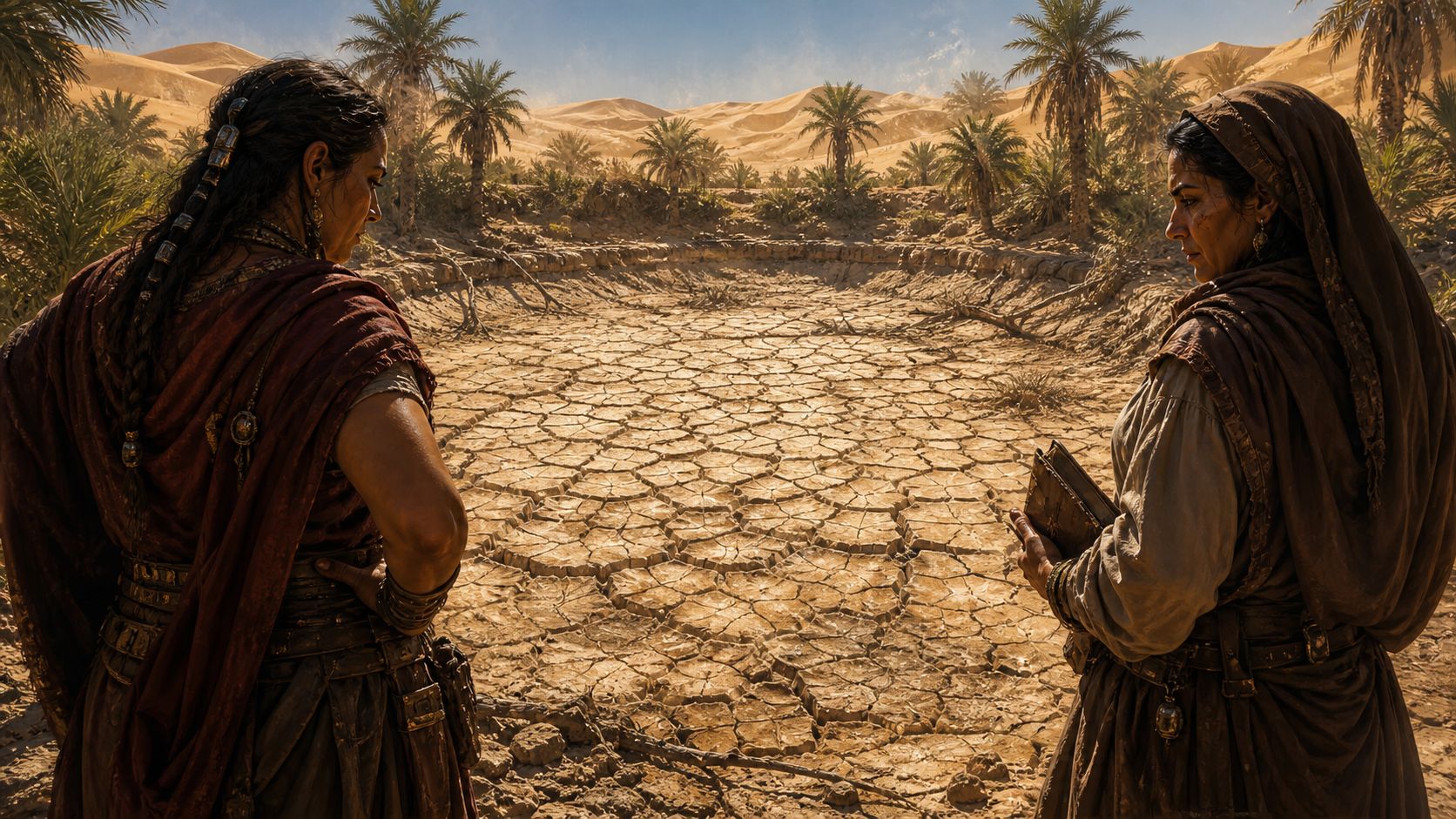
This scene is the point where hope turns into argument. The caravan reaches Aruzan expecting relief, and for a brief moment that relief feels real. People straighten, voices rise, loads begin to come down and everyone acts like the worst is finally behind them. That good mood matters. Let the players feel it before it is taken away.
Then the truth arrives. There is water in the oasis, but not enough. Whether the storm buried part of it or the dry season bit harder than expected does not matter much in play. What matters is that the expected safety is gone. From that moment on, Aruzan stops being a reward and becomes a choice.
How to Run the Turn
Do not make the shortage public all at once. Let it pass first through the right hands. Sada bint Miraz and Khalida Reed-Braids bring the concern to Miraz Khalim. Some of the crew are close enough to hear. The conversation should be quiet, practical and immediately grim. Khalida gives the hard truth. Sada gives the harder one, that this journey has not given them a single stretch without trouble.
That is the emotional drop of the scene.
The camp around them should still be half inside its relief while this happens. Children are moving, bowls are coming out, people are thinking about rest. That contrast is what makes the news land.
Miraz's Decision
Miraz does not decide the route alone. He is the leader, but this is too large, too dangerous and too shared to be settled by one man's will. He decides that the whole tribe must hear it and that the choice must be made together.
This matters for two reasons. First, it shows that the Dunewind is a real community rather than a command structure. Second, it opens the door for the next scene, where persuasion, trust and personal ties become decisive.
What the Scene Is For
This scene is short, but important. Its job is to transform the final leg of the journey from endurance into debate. The tribe now has to weigh fear, distance and trust rather than just surviving the road
The players should come away understanding three things. The caravan is close. The water is not enough. And from this point on, the road ahead will depend as much on people as on supplies.
The Choice of Path
This scene is the last major social test before Ssar'et. Up to this point, the caravan has survived through endurance, discipline and improvisation. At Aruzan, survival stops being only a matter of hardship and becomes a matter of judgment. The water is not enough. The road ahead is still long. Whatever happens next will be chosen, not simply endured.
That is what makes this scene important. It is the point where everything the crew has learned about the Dunewind Tribe can finally be used.
The Problem
The caravan reaches Aruzan expecting relief and finds only partial relief. The sandstorm has turned part of the spring into mud, and the amount of usable water is far below what was hoped for. Some can still be drawn, filtered and saved, but not enough to make the final leg comfortable or safe.
The next stretch to Zhess'r Village in Ssar'et is about ten days if things go according to plan. That means hard rationing, strict discipline and very little tolerance for delay, injury, bad weather or beast trouble. It is possible, but only just.
The Two Paths
There is now a choice between two options.
- Press on toward Ssar'et. This keeps the caravan moving toward its intended destination and, for the crew, keeps them on the right mission. It is possible, but only if the tribe accepts very tight water discipline and the risk that anything going wrong could turn a hard march into a disaster.
- Divert south toward the Desert Rim. That route is much shorter, only three or four days, and offers a better chance of reaching water before the caravan begins to fail. But it takes the tribe into dangerous territory. The Desert Rim means warlords, raiders, slavers and unstable politics. It is also the wrong market for the goods the Dunewind has prepared to trade, which means a serious financial loss even if the caravan arrives safely.
So this is not safety against danger. It is one kind of danger against another.
Miraz's Decision
Miraz Khalim refuses to make this choice alone. He is the Sulmar, but this problem is too large and too shared to be settled by rank alone. The whole tribe will live with the outcome, so the whole tribe will have a voice in it.
There is also no need to decide immediately. It will take a full day to draw, settle and preserve what water can still be taken from Aruzan. That gives the tribe time to think, argue quietly, worry, approach the crew and weigh what matters most to them.
The formal decision will be made at the evening meal.
What the Scene Is Really About
This should not be run as a single speech or a simple strategic vote. It should be run like "12 Angry Men", as a process of gradually turning people one by one. Some tribe members begin wanting to press on. Some want the Desert Rim. Some are uncertain. The crew's job is not to win an abstract argument. It is to find the personal argument that matters to each person.
That means this scene is the payoff for earlier social play. Who grieves. Who fears risk. Who thinks practically. Who cares about trade. Who is proud. Who is tired. Who has children. Who trusts the crew. Who distrusts them. This is where all of that starts to matter.
How to Run the Day Before the Vote
Use the day as a series of short private conversations, not one long council.
The tribe should be represented mainly through a set of key figures, each with a position and a reason for that position. The crew can approach them, overhear them, be invited into conversation or get pulled into arguments already in motion. Some people should speak openly. Others should need coaxing. A few may not change their minds at all.
The important thing is that the crew should feel they are shaping a room that has not gathered yet.
Do not make this about logic alone. People rarely change their minds because of the cleanest argument. They change because the argument speaks to something personal.
If the crew seems to stumble, have the key people voice their concerns, allowing the crew to address their concerns specifically.
The Stance of the Tribe
Each key figure should be treated as the voice of a small part of the tribe. Winning them over does not only shift one opinion, but also the opinions of the family members, work partners, close friends and fellow travelers who naturally look to them. This keeps the scene manageable while preserving the sense that the whole tribe is deciding together.
That also makes the final vote feel much better. It is not isolated people raising hands. It is the visible result of the fulcrum points where the tribe's weight has gradually shifted.
This uneven weight also gives the Game Master quiet room to bend the outcome a little if needed. Because each key figure represents a different amount of social influence, the vote does not have to feel like strict arithmetic. One person may carry a spouse, a few younger relatives and two work partners with them, while another mostly speaks for themselves. That lets you favor the crew slightly if they have done good social work overall, even if the exact count would otherwise come up short. As long as it feels natural and tied to relationships already shown in play, the players will experience it as the tribe's mood shifting, not as the Game Master changing the numbers. A single tribe member won over might mean many nods in agreement.
Miraz Khalim, Sulmar
- Position: Undecided, but leaning towards pressing on. He will only state his opinion if it becomes the swing vote.
- Concern: The tribe's unity, dignity and long term future. He knows the route is dangerous, but he also knows that turning aside late can break confidence and waste the entire journey.
- Likely Sway: Arguments that frame pressing on as the harder but more coherent path. He will respond to seriousness, shared responsibility and signs that the crew understand the cost rather than just their own need to reach Ssar'et.
Nahla Three-Moon, Trader
- Position: Pressing on.
- Concern: Trade loss, wasted planning and the humiliation of arriving at the wrong market with the wrong goods.
- Likely Sway: Profit, pride and momentum. If pressing on preserves the journey's purpose and avoids a bad market, she will support it strongly.
Old Samir of the Long Song, Storykeeper
- Position: Pressing on.
- Concern: Continuity, memory and what kind of people the Dunewind are when tested.
- Likely Sway: Arguments about endurance, honor and how this choice will be remembered later. He is more likely to support the road that feels true to the tribe's self image.
Jalir Dust-Laugh, Young Warrior
- Position: Pressing on.
- Concern: Pride, courage and not looking weak.
- Likely Sway: Anything that frames pressing on as brave, worthy and impressive. He is easy to move if someone he admires makes the hard road sound glorious.
Zahra al Duneveil, Dahrim
- Position: Pressing on.
- Concern: Meaning, omen and whether the road already chosen should be trusted.
- Likely Sway: Spiritual or emotional language rather than dry logic. If pressing on feels like faith in the journey rather than fear of turning aside, she will favor it.
Nisrine Laughing-Eyes, Dancer and Matchmaker
- Position: Pressing on.
- Concern: Energy, social momentum and avoiding the souring effect of fear.
- Likely Sway: Confidence, charm and the sense that the caravan can still carry itself forward without becoming smaller inside. She is not moved by ration numbers as much as by how people are holding together.
Rafiq al Saffron, Perfumer and Would-Be Seducer
- Position: Pressing on.
- Concern: Opportunity, social adventure and not wasting a rare journey.
- Likely Sway: Arguments about reaching the intended destination, avoiding dreary retreat and preserving the excitement and prestige of the road. He will also dislike the roughness and ugliness implied by the Desert Rim.
Qamar ibn Sadeq, Guard Captain
- Position: Pressing on.
- Concern: Security and raiders. The Desert Rim is tough territory, and a wounded caravan is an asset to be raided.
- Likely Sway: A convincing case that the longer route is still safer overall than the Desert Rim and that the caravan can maintain discipline and defense while thirsty.
Sada bint Miraz, Quartermaster
- Position: Diverting.
- Concern: Arithmetic. Water, burdens, delays, equipment and the reality that romantic decisions become other people's suffering.
- Likely Sway: Hard numbers, a believable ration plan and proof that pressing on is not just wishful thinking. She will not be moved by speeches.
Rashad Year-Without-Rain, Shar'zul Master
- Position: Diverting.
- Concern: The Shar'zul, the hatchlings and the physical toll of a ten day stretch with too little water.
- Likely Sway: Clear assurances about the beasts' survival, especially the newborns. If pressing on feels likely to break the animals, he will oppose it hard.
Tarek Sandnose, Camel Scout
- Position: Diverting.
- Concern: Odds. He knows what a thin margin looks like, and he distrusts plans that depend on nothing going wrong.
- Likely Sway: Route specific confidence. If the crew can show that the path ahead is unusually favorable and that delays can realistically be avoided, he may shift. Otherwise he will prefer the shorter road.
Mira Bone-Needle, Healer and Midwife
- Position: Diverting.
- Concern: The weak, the recovering and the first people thirst will start to break.
- Likely Sway: Concrete talk about how children, the sick and the hatchlings will be protected. She will be very hard to move if the plan sounds like heroics imposed on vulnerable bodies.
Khalida Reed-Braids, Water Keeper
- Position: Diverting.
- Concern: Water itself. She is the purest voice of desert realism in the tribe.
- Likely Sway: Very little will sway her. Only a brutally credible ration plan, no tolerance for waste and confidence that the journey can stay disciplined enough to survive.
Danya Sun-Bitten, Potter and Mother of Four
- Position: Diverting.
- Concern: Her children. She will not lightly risk a ten day dry march when there is a shorter option.
- Likely Sway: Personal reassurance about how children and families will be protected, plus evidence that pressing on is not just a gamble made by people without dependents. Framing the Desert Rim as a worse alternative, a hunting ground for slavers, also works.
Farah Ash-Marked, Widow of the Dunes
- Position: Undecided.
- Concern: Human cost on both sides. She understands thirst, grief and what fear does to people.
- Likely Sway: Trust, seriousness and whoever sounds like they understand loss without posturing. She is likely to listen closely to people rather than plans.
Laleh Soft-Step, Weaver and Tent Keeper
- Position: Undecided.
- Concern: Domestic strain, sleeping arrangements, children, cloth, heat and all the small ways hard travel becomes misery.
- Likely Sway: Arguments about how people will actually live through the next stretch, not just survive it in principle. She will value practical comfort and emotional steadiness.
Parvin Salt-Hair, Elder Aunt
- Position: Undecided.
- Concern: Ending nonsense efficiently. She is less concerned with glory than with whether people are thinking clearly.
- Likely Sway: The side that sounds least foolish. She will be moved by sharp, grounded reasoning and by exposing whichever option is being romanticized too much. She might voice her opinion at the last moment to affect the vote through sheer authority.
Little Hadi, Drum Child
- Position: Undecided, though not formally decisive unless you want to make him symbolic rather than mechanical.
- Concern: Immediate feelings rather than strategy. He will put on a brave face, but will be worried.
- Likely Sway: The emotional weather around him. If he is included and reassured by someone he trusts, he may become an accidental pressure point on adults who care about what the children feel.
Sereh of the Blue Veil, Young Widow
- Position: Undecided.
- Concern: Fear of losing more people, loneliness and the memory of helplessness.
- Likely Sway: Compassion and steadiness. She may lean toward whichever path feels less likely to kill, but she can also be moved by whoever makes her feel the tribe can endure together.
Hamid Crooked-Tooth, Leatherworker
- Position: Undecided.
- Concern: Material strain. Harness, skins, sandals and all the things that fail under hard use.
- Likely Sway: Whichever side seems to understand the practical wear of the road. He will not care about honor much, but he will care whether leather, water skins and gear can carry the plan.
Yusef Hollow-Reed, Flute Player
- Position: Undecided.
- Concern: Morale and the emotional shape of the caravan.
- Likely Sway: Tone more than logic. He is likely to follow trust, feeling and the people whose judgment he sees as steadier than his own.
Azhar, Twin Drover
- Position: Undecided, leaning with his brother.
- Concern: Beasts, labor and the ordinary strain of making camp and moving again under bad conditions.
- Likely Sway: Practical arguments about whether the animals can manage the road and whether the labor burden remains survivable.
How to Run the Meeting
At the evening meal, the tribe gathers and the issue is named plainly. Miraz does not dictate. He moderates. People speak briefly. Some repeat what they have been saying all day. Some reveal sharper emotion now that the choice is real. The crew gets one final chance to intervene, answer, persuade or steady someone who is wavering.
Keep this discussion fairly short. The real work should already have happened during the day.
After that, the tribe votes.
The crew should only carry the vote if they have spent the day actually shifting minds. The meeting is the final turn of the screw, not the whole mechanism.
The evening meal at Aruzan did not feel like a meal.
People sat in the usual circle, bowls in hand, but the small sounds that normally belonged there were missing. No teasing. No drifting songs from Zahra al Duneveil. No old muttering from Samir of the Long Song about how the food had been better twenty years ago, even if everyone knew he would say it anyway. The water skins stood too close to the center, too visible, and too many eyes kept drifting toward them.
Miraz Khalim waited until the last bowl had been passed and the last child had been hushed. Then he rose.
Firelight caught the white in his beard and the deep lines at the corners of his eyes. He did not raise his voice. He did not need to.
"There is less water here than we hoped," he said. "Enough that we have a choice to make."
No one moved.
"If we press on to Zhess'r Village, we go the right way. But we go thirsty, and if anything goes wrong, thirst will be waiting for us before the village is. If we turn south to the Desert Rim, the road is shorter. But the land is cruel, the markets are wrong for what we carry and we invite another kind of danger."
He let that sit among them for a moment.
"Tonight the tribe decides."
Sada bint Miraz spoke first, because of course she did.
"This is not a matter for brave words," she said. "It is water, distance and burden. Ten days with too little water is not courage. It is arithmetic, and bad arithmetic kills people."
Rashad Year-Without-Rain grunted once in agreement. He sat with one forearm over one knee, face lined deeper than usual by the firelight.
"The grown folk can choose to suffer if they like," he said. "The Shar'zul do not choose. The hatchlings do not choose. We drag them with us whatever we decide."
Nahla Three-Moon lifted her chin at that.
"And if we turn north, what then? We limp into the Desert Rim half spent, carrying the wrong goods for the wrong buyers and praying that men who smell weakness do not decide to profit from it. We lose money, yes, but also face. We show the desert we lost our nerve at the last stretch."
Qamar ibn Sadeq gave her a flat look across the circle.
"The Desert Rim itself is not my fear," he said. "It is men with blades who see a thirsty caravan and think themselves blessed by fortune. There are too many of those north of here."
Mira Bone-Needle had Hadi tucked close against one side, though the boy tried hard to sit like someone who did not need it. Her voice was quiet when she spoke, and that made people listen harder.
"The children do not care about face," she said. "The weak do not care about pride. Bodies care about water."
Danya Sun-Bitten answered before anyone else could.
"Good," she said sharply. "Then say it plainly. I have four children. I do not intend to bury one in the sand because grown people wanted to feel noble."
Across the fire, Old Samir clicked his tongue.
"And I do not intend to spend my last years listening to how the Dunewind turned aside at the door because fear had a louder voice than sense."
"Sense?" Sada snapped. "You call a ten day thirst march sense?"
"I call it the road we came to walk," Samir said.
For the first time, Zahra spoke. Her voice was soft, but in the hush that followed it carried cleanly.
"The desert does not care which road we call wise," she said. "It only cares which price we are ready to pay."
That made nobody happier.
Farah Ash-Marked sat with her hands wrapped around her bowl, though the food inside had long since gone untouched. "That is the truth of it," she said. "There is no safe road here. Only the road that kills us one way, and the road that may kill us another."
Silence settled again after that, heavier than before. Firelight moved across tired faces, across hollow cheeks and dust-stiff cloth, across people who had already come too far to pretend this was only trade and travel now. Near the edge of the circle, Nasheem sat beside Ayesha without speaking. Thaleia held Hich'ma's harness in both hands without seeming to know she was doing it, as if some part of her still thought of it as the small hatchling that had once curled against her. Even Jalir Dust-Laugh, who normally wore confidence like perfume, had nothing ready.
Miraz looked around the circle, taking in each face in turn.
"We all know the roads," he said. "We all know the cost. Now it is time."
He drew one slow breath.
"It is time to vote."
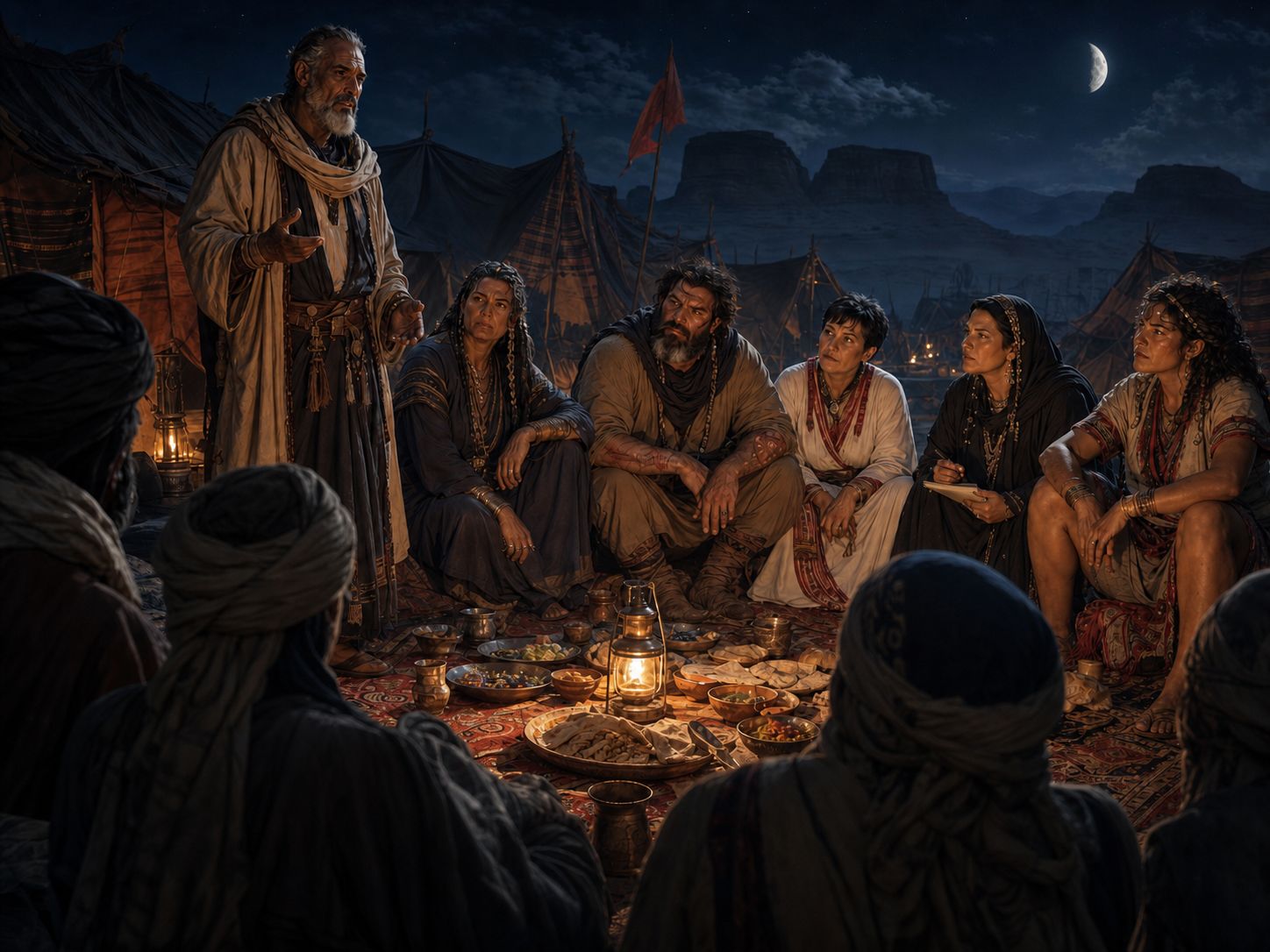
What the Scene Should Achieve
If this scene works, the decision to press on will feel earned rather than convenient. The crew will not have won because they were obviously right, but because they understood the tribe well enough to speak to what mattered to its people.
That is the heart of the scene. Not strategy alone, but belonging. By this point, the crew should know the Dunewind well enough to help decide its fate.
The Last Approach
The last stretch toward Zhess'r Village had rubbed everyone raw.
Dust had worked its way into every seam of cloth, every fold of skin, every mouthful of breath. Faces were greyed with it. Hair was stiff with it. Tempers were short, not because anyone had the strength for anger, but because nobody had enough strength left to hide irritation anymore. The Shar'zul moved on with patient, grinding steadiness. The people atop them did not. Even the ordinary sounds of caravan life had thinned into something meaner and more brittle, a world of dry throats, narrowed eyes and words spoken only when necessary.
Nephyla broke the silence first.
"This is unbearable," she said, for perhaps the third time that hour. She sat with one hand lifted uselessly away from her own silk, as if the dust might somehow insult her less if she touched it less. "I can feel it in my hair. In my clothes. In my skin. When we stop, I am going to wash until I no longer resemble a potter's floor."
Ileena, crouched barefoot near the edge of the platform with her cloak fallen half open and her ears twitching at every gust of wind, did not even turn her head.
"Shut up," she said.
Nephyla stared at her.
"I beg your pardon?"
Ileena finally looked back over one shoulder, yellow eyes flat with exhaustion. "You are dirty. We are dirty. The whole desert is dirty. Be quiet."
That should have ended it. It did not.
"I only said that a person ought to be able to clean herself without first surviving some fresh indignity."
"Still talking," Ileena said.
Nephyla drew herself up, or tried to. It was hard to look regal when one had dust in one's eyelashes and a water ration one could smell more easily than drink.
Nasheem, sitting nearby with one knee drawn up and his forearms resting loosely across it, let out the smallest breath through his nose. He looked tired enough that even his elegance had gone spare around the edges, but his voice remained mild.
"Nephyla," he said, "it may be wise to take Ileena's advice seriously."
She looked at him as though betrayal should at least have been delivered with more ceremony.
Junia was on the other side of the platform, checking the lips and eyes of one of the younger tribe children before letting the girl drink. When she spoke, she did not look up.
"People are getting dehydrated," she said. "Not dying yet. Not failing yet. But they are getting there. If we keep the pace, we should make it."
Ayesha had listened to all of it in silence, eyes half lidded, conserving herself the way clever people conserved water.
Now she opened them fully and said only one word.
"If."
By this point, the caravan is functioning on discipline rather than comfort. Water is measured tightly, food is chosen for how little preparation it needs and almost all unnecessary effort has been cut away. People stay in shade whenever they can, speak less, move less and save their strength for what matters. Meals are dry, simple and joyless. Bodies are dirty, lips are cracked and tempers sit close to the surface, not because anyone wants conflict, but because everyone is tired enough that patience has become expensive.
The Dunewind are not in full crisis yet, and that matters. This is not collapse. The caravan still works. The Shar'zul still move. Camp is still raised and struck with practiced efficiency. But everyone knows the margin is now very small. A lost skin, a bad delay, a sick child or a panicked beast could turn strain into danger very quickly. That shared awareness should shape the mood. People are quieter, sharper and more easily irritated, and even ordinary inconveniences feel heavier than they should.
The Rhythm of the March
To preserve strength and water, the caravan adjusts its rhythm. Stops become shorter, and greater use is made of the cooler night hours. During the day, the tribe minimizes effort wherever possible. Tasks are done, but only the tasks that must be done. This should make the whole journey feel leaner and more focused, as if the caravan has stripped itself down to the bare essentials of survival.
Progress and Interruption
Despite the tension, the caravan makes good progress. For six days, nothing goes wrong. That matters, because it allows hope to return in a hard, cautious way. The tribe begins to feel that the gamble may actually work.
Then, at noon on the seventh day, someone spots a dust cloud.
The Bandits
Tarek Sandnose came back fast enough to make people look up before they had even seen what he had seen.
His bad tempered camel was lathered dark at the neck, foam flecking the reins, and Tarek did not bother with dignity when he reached the caravan. He swung down before the beast had fully stopped, boots hitting the sand hard, and strode straight through the moving lines of people and cargo.
"Miraz," he called. "Qamar."
That was enough. Miraz Khalim turned at once from where he had been speaking with Sada. Qamar was already moving, one hand going to the hilt at his side out of old habit more than fear. Around them, the mood of the caravan shifted in one sharp instant. Not panic. Readiness. Voices dropped. Hands went to straps, spear shafts and harness lines.
Tarek stopped in front of them, still breathing hard from the ride.
"Dust plume to the north east," he said. "Lizardmen. Not the honorable kind. Bandits."
Qamar did not waste a heartbeat. He turned half sideways and barked the order across the nearest stretch of caravan.
"Ready for defense. Spears out. Keep the children in."
That order traveled fast. Men and women moved at once, practiced enough in danger that no one needed the second instruction. Loads were checked. Positions shifted. A few of the crew were already looking toward the horizon, trying to make out the shape in the distance where the light trembled over the sand.
Tarek lifted one hand.
"Not a war band," he said. "A scout party. Too few to strike us cleanly."
Qamar looked at him. "Too few for cleanly does not mean too few for stupidly."
Tarek spat dust from the corner of his mouth and shook his head. "Even lizardmen would bleed badly if they came in now. They know it."
That settled things, but not much.
Far off, the dust plume moved with an ugly steadiness, neither closing fast nor falling away. It was enough to be seen. Enough to be counted. Enough to say that the caravan had been found.
Miraz looked toward it for a long moment, eyes narrowed against the glare.
"We have no choice," he said at last. His voice was quiet, but people nearest him still seemed to straighten when they heard it. "We push on."
He turned to Qamar and Sada alike.
"Make sure everyone is ready. If they want to watch us thirst, let them watch us moving."
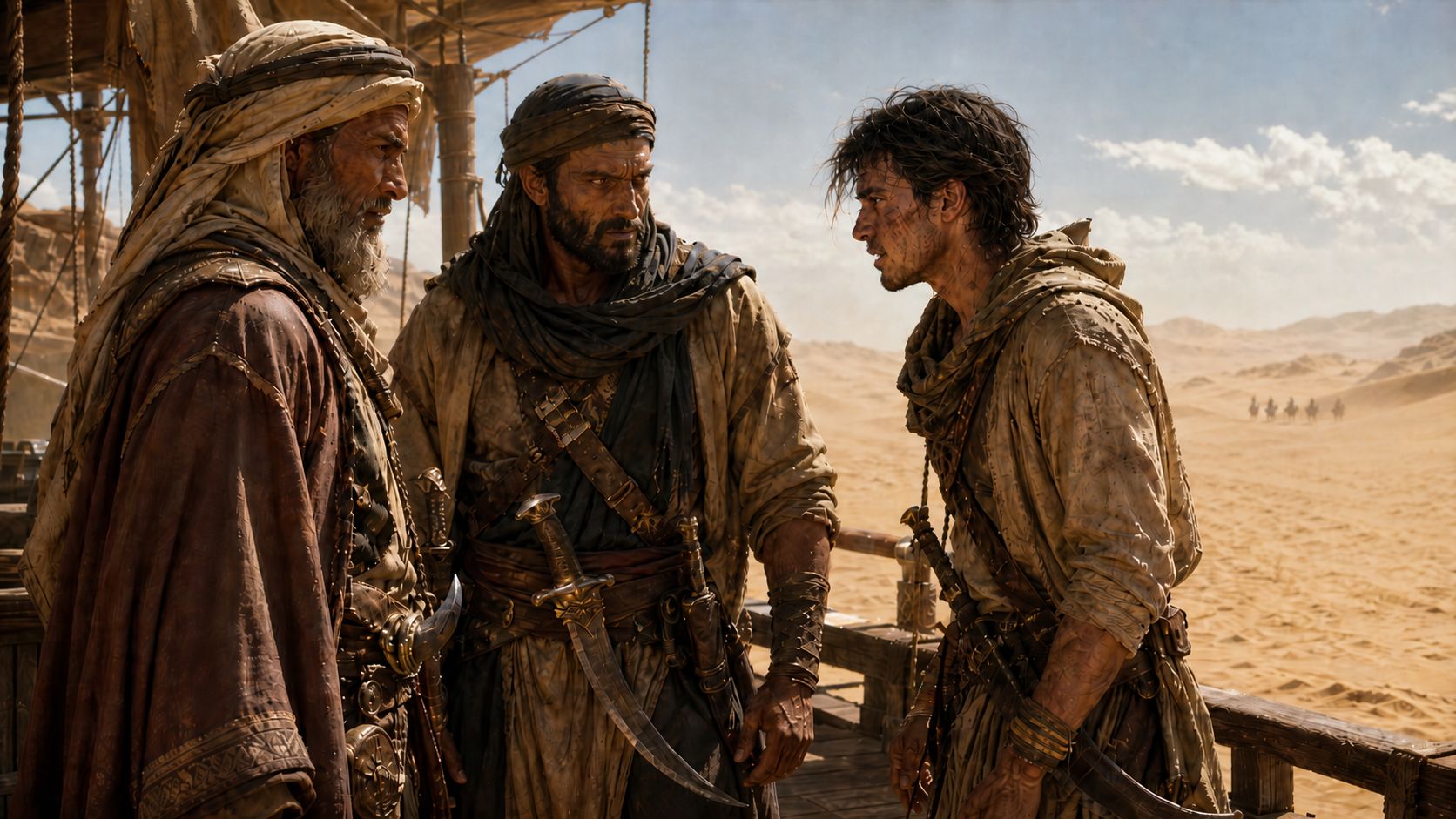
This is not a battle scene. It is a pressure scene.
The lizardmen bandits appear as a small mounted scout party, about a dozen strong, riding varrek lizard mounts. They are heavily armed and dressed for desert raiding in thick leather armor, which should make them look dangerous even at a distance. The important thing, however, is not that they are charging. It is that they are not.
They see the state of the caravan clearly. The Dunewind are thirsty, strained and moving on narrow margins. The bandits understand that. They have no reason to spend lives attacking a caravan that may soon begin to fail on its own.
How to Present Them
When the scouts are first identified, the tribe reacts with the right seriousness. Qamar orders readiness. Miraz decides to keep moving. Everyone understands that this is danger, but not immediate impact.
The bandits should stay at a distance where they can be seen and tracked, but not easily reached. They are patient. They are watching. They are testing pace, formation and weakness. That patience is what makes them unsettling. They are not here for glory. They are here for profit.
They do not need to fight. The desert will fight for them.
Why the Caravan Cannot Attack
Do not let this turn into a player led assault unless the group deliberately forces a bad decision.
Attacking them is not really a viable option. The bandits are on their own terrain, mounted on fast desert beasts and operating in open terrain where hidden approach is impossible. A charge out from the caravan would mean fighting tired, thirsty and exposed against an enemy built for hit and run movement. Even if the crew could kill some of them, the likely cost would be too high, and the caravan would lose more strength than it can afford.
That should be obvious to Miraz, Qamar and Tarek, and they should make that clear if the crew starts talking about a preemptive strike.
The Real Function of the Scene
The purpose of these two days is to add one last layer of pressure before Ssar'et.
The caravan is already near its limits. Now it is being watched by predators who know exactly how little margin remains. That changes the mood. People sleep worse. Guards look outward more often. Water discipline becomes even tighter. Every stumble, delay or sign of weakness feels more dangerous because someone is now there to notice it.
This also reinforces that the final approach is not only about thirst. It is about being visibly vulnerable in a land where vulnerability attracts violence.
How to Run the Two Days
Keep the bandits present, but not constant.
- Sometimes they are clearly visible as a line of moving shapes on the horizon.
- Sometimes they disappear behind dunes for hours, which is worse.
- Sometimes someone spots sunlight on metal, a varrek crest or a rider watching from far off.
That uncertainty matters. The tribe should never fully relax, but the bandits also should not become so active that they steal the scene from the caravan's internal strain.
Use these two days to deepen tension, not to create repeated skirmishes.
Where to End the Arc
End this arc with the threat unresolved.
The caravan is still moving. The bandits are still there. Water is still tight. Ssar'et is close, but not close enough to feel safe. That is the right cliffhanger.
Tazulmar should end not in resolution, but in the feeling that the journey has succeeded only in carrying the Dunewind and the crew into the next danger. The lizardmen do not close the arc. They lean on it, and their shadow should carry directly into the opening of the Ssar'et arc.
Act Summary
Tazulmar is the long crossing between rescue and reunion, a desert arc about dependence, slow belonging, sacred danger and the emotional cost of surviving under pressure. The crew follows the overland branch of the Waverider trail, because Rahim and Kethra are not vague names here but remembered travelers whose journey with the Tazulmar still lives in story and memory. At the same time, the crew is cut off from the Blue Marlin, one Shar'zul short, forced to cross the desert with a wounded caravan that has every reason to see them as burden before it begins to see them as its own.
What the Crew Gains
By the end of the arc, the crew is still on the Waverider's track, but that track now feels personal. Rahim and Kethra have become people rather than clues, and the stories about them give the pursuit warmth, weight and continuity.
Just as important, the Dunewind Tribe is no longer just a guide across the desert. Through grief, labor, illness, shared danger and ordinary social entanglement, the crew becomes something close to an accepted part of the tribe.
Their inclusion in the journey to the Vale of Shuraz matters because that pilgrimage is rare, sacred and normally kept close within Tazulmar life. Being allowed there is not only practical trust, but real belonging.
Nasheem's Trial
Nasheem's encounter with the djinn becomes one of the emotional peaks of the arc. He is tested in truth, loyalty, grief, compassion, strength and courage, and he is found worthy. For a man from Zarhalem, shaped by lost love, exile and the long attempt to become more honorable than the world that formed him, this means a great deal. It is not power he gains, but recognition, and that matters more.
The mark left on him and the djinn's final command, "Protect the moon," give him a burden that feels both personal and prophetic, tying his private history to the road ahead. The larger Tazulmar world already frames djinn as ancient, dangerous and costly powers, which makes that judgment feel spiritually real rather than merely symbolic.
Nephyla's Movement
Nephyla's role in this arc is not redemption, and not yet growth in any clean upward sense. Tazulmar continues the breaking of her old life. She is still proud, difficult and often absurdly ill suited to ordinary human interaction, but the pressure of caravan life begins forcing new feelings into her. She comforts others badly, reaches toward people awkwardly and discovers that grief, gratitude, dependence and attachment now hurt her in ways they never did before.
She is not climbing yet. She is still falling. But there are now real glimpses of the woman who might one day emerge from the wreck of the Moon-Goddess Queen.
Thaleia's Place
Thaleia proves that usefulness and wonder can live in the same person.
She earns the Dunewind's respect not only by helping under pressure, but by meeting the tribe's world with real seriousness rather than detached curiosity. The search for the Shar'zul eggs, the hatching rite and the moment when the hatchling chooses her all give her a very special place in the heart of the caravan. By naming Hich'ma, she does not merely observe Tazulmar life. She becomes part of it.
Where the Arc Ends
Tazulmar does not end in comfort. It ends in exhausted survival.
The tribe has endured, recovered some hope and carried its fragile future forward, but the final approach strips away any easy sense of safety. Water runs thin, tempers harden and the caravan reaches the edge of Ssar'et still thirsty, still strained and now shadowed by bandits patient enough to let the desert do the killing for them.
That is the final image the arc should leave behind: not triumph, but a moving people who have survived this much only to arrive at the next danger together. The lead toward Varr'thol remains alive, but it has been purchased with fatigue, intimacy, spiritual pressure and the knowledge that the road never became gentle, only meaningful.
The night was cold at last, though the day's heat still clung faintly to the wood beneath them. Nephyla and Nasheem sat side by side on the deck of the Shar'zul, both too tired to pretend they were comfortable. Below them, the great creature moved with its slow, relentless rhythm, carrying the tribe onward through the moonlit desert while the rest of the caravan lay in uneasy quiet. Far off across the dunes, the bandits were only a few dark moving specks against the pale sand, never close enough to strike, never far enough to forget. They followed with the patience of vultures.
For a long while, neither of them spoke. Nephyla sat with her knees drawn slightly in, her fine white silk long since defeated by dust and travel, no longer divine enough to resist the desert. Nasheem looked no better. Whatever elegance he had once worn so easily had been worn down by thirst, sweat and too many hard days. Yet in the moonlight, with the caravan quiet around them and danger held at a distance for the moment, there was a kind of stillness between them that did not feel empty.
At last Nephyla said, "You used to be powerful."
Nasheem turned his head a little. "I still have my moments."
She gave him a small, tired look that might once have become a sharper one, but she no longer seemed to have the strength for it. "That is not what I mean. Before. In Zarhalem. People obeyed you. They listened when you spoke."
He was quiet for a moment, then nodded. "Yes. They did."
Nephyla looked back out toward the distant bandits. "How did you bear it?"
He frowned slightly. "Bear what?"
She took a little while to answer, as if even now the words did not come naturally to her. "Power." Her voice had gone softer than usual. "When people fear you, or need something from you, they never show themselves as they are. They bow. They agree. They become careful. They speak to what you are, not to who you are." She swallowed, eyes fixed on the horizon. "They listen, but they do not become friends."
Nasheem let out a slow breath through his nose. "Yes," he said. "I know that feeling."
That answer seemed to land more heavily on her than if he had argued. She sat very still after it, hands folded too tightly in her lap. When she spoke again, the words came in a voice so small that for a moment it scarcely sounded like her at all.
"I have never had a friend."
The desert went on around them, immense and silver under the moon. Somewhere further back in the caravan, a tether creaked. The bandits were still there, dark and patient on the edge of sight. Nasheem looked at Nephyla for a long moment before he answered, and when he did, his voice was gentle in a way that asked nothing from her.
"Here it is the other way around," he said. "People do not obey. They argue. They complain. They say exactly what they think, usually at the worst possible moment." The corner of his mouth bent, not quite into a smile. "But when they stand beside you, they do it for real."
Nephyla's lips parted slightly, though she did not look at him.
Nasheem rested his forearms on his knees and looked out over the moonlit sand with her. "You are our friend now, my friend," he said. "Whether you know what to do with that or not."
She said nothing.
But after a moment he saw her eyes shine in the moonlight, and then fill. She made a tiny sound in her throat, angry at herself for it already, and turned her face away as if that might somehow preserve what little pride she had left.
Nasheem looked at her, then down at himself, then gave a tired little huff of amusement. "I would offer a hug," he said, "but I smell like a man who has not washed in a week while being dragged across the desert."
That got the smallest, strangest breath of laughter out of her, wet and shaky and almost more painful than tears.
"It is all right," she said, her voice unsteady. "We can just sit here."
So they did.
And in the moonlight, with the desert around them and the tribe asleep below, Nephyla sat beside another person in silence and, perhaps for the first time in her life, did not feel alone.