Campaign: Ssaret
Act Synopsis
The Infiltrator in Zhess'r
Alongside the siege, the crew discovers that Rhazkor has eyes inside Zhess'r. Dead scout markings, mirror flashes from within the village, target signs scratched into walls and the hidden archer nest that wounds Hadi all reveal a pattern: someone is helping the bandits aim their attacks.
The crew must investigate discreetly among frightened villagers, false suspects and dangerous rumors, because a careless accusation could break the village from within.
Arrival at Zhess'r
The crew enters Ssar'et with the Dunewind Tribe after the long desert crossing. They are thirsty, exhausted, dust-choked and still aware of the bandits shadowing them from a distance. The caravan is no longer merely traveling toward safety. It is limping toward it, with people counting water skins, watching the horizon and measuring every rise of sand for movement.
As they approach Zhess'r Village, the bandits finally commit. A mounted group breaks from a camp outside the settlement and charges across the sand on Varreks, hoping to strike before the caravan reaches the walls. The Dunewind prepare for a desperate fight, but before the attack lands, seven heavily armored Ssar'et knights emerge from the village. Their armor is unlike anything the crew has seen, heavy fitted steel over scales, shaped for shock and endurance rather than speed alone. Mounted on Varreks and moving with terrible discipline, they force the bandits to break away without risking a full engagement.
The seven knights hurriedly escort the caravan into Zhess'r. Only then does the crew learn the truth. The village is under siege. The bandits have cut off trade, trapped the settlement and begun starving it slowly. Zhess'r has water in abundance, but food is running short. The Dunewind have food, but their water is nearly gone. A practical alliance forms at once, not out of sentiment but necessity. The caravan, the crew and the village are now bound by the same enemy, captured behind the same walls.
The Battle
The battle will take place over several confrontations in sequence, each with practical and emotional implications.
First Confrontation: Scouts at Sunset
The first real test comes at sunset, when a crew member spots bandit scouts moving on foot through the dunes. They are probing the village, counting defenders and searching for weak points before nightfall.
The knights ride out and kill them with brutal efficiency. This is a showcase, not a balanced battle. The crew sees what Ssar'et knights are when they have open ground, heat in their blood and a visible enemy. Varreks thunder across the sand. Steel catches the last light. Leather-armored bandits are cut down before they can regroup.
The scene should impress the players, but also warn them. If the bandits are still besieging Zhess'r despite these defenders, then the problem is not courage or fighting skill. The problem is numbers, patience and time.
Afterward, Isskhan, the cunning knight speaks privately with the village leader. He tells her the truth plainly. Seven knights can buy time, but they cannot destroy the bandit force alone. The next village, Ssa'zulul, is more than a day away. If help is to come, a messenger must leave that night.
She agrees. A messenger slips out under cover of darkness. No one knows if he passes the bandits.
Second Confrontation: Knives in the Night
The second confrontation comes the following night. The bandits use the weakness of cold-blooded defenders against them. A small group enters the village undetected or almost undetected, moving while the knights are slow and while most villagers are exhausted.
They kill Isskhan, along with several villagers, and set fires before being driven off. This is the first sign that the siege will not be won by magnificent charges alone. The bandits are willing to strike at sleep, shelter and trust. The death of the cunning knight matters because he was the one most able to think around the siege. His loss removes the village's best chance at a clever solution.
The crew and Dunewind should matter here. They can spot movement, raise alarms, drag people from burning homes, fight infiltrators in alleys, save stores from fire or fail to save enough. This is one of the clearest places where humans are not lesser than knights. In the cold night, they are faster.
The Plan of Three Gates
After the night attack, Vorrak assumes a larger assault will follow. Zhess'r has three entrances in the village wall. The remaining knights cannot hold all three permanently, so the plan is built around delay, signals and concentration.
Two knights are assigned to each entrance. They are not expected to stop the bandits alone. They are expected to slow them, fall back in order and keep the attackers committed long enough for the rest of the defense to move.
Hadi volunteers for the most dangerous and important noncombat role. From the highest building in the village, he can see all three gates. With his drum, he will signal which gate is under attack. Each gate has a different rhythm. The plan depends on him.
Shessra hesitates, because he is a child. The logic is undeniable. Hadi is quick, brave, trusted by the Dunewind and already skilled enough that the signals will be understood under pressure. He is not being asked to fight. He is being asked to guide fighters.
Villagers, Dunewind and crew take supporting positions. They prepare arrows, spears, stones, water jars, fire blankets, barricades and routes for moving wounded. The knights will break the charge. Everyone else must make that breaking matter.
Third Confrontation: The Drum Falls Silent
The expected attack does not come the next day. The delay makes the village worse, not better. People watch the walls, sleep badly and listen for a messenger they cannot hear. Food is counted again. Water is plentiful, which only makes the hunger sharper.
At noon the day after, the attack finally comes. Hadi signals the gate. The plan works at first. Knights delay, villagers pelt the attackers from above and the crew helps direct pressure where it matters most. The bandits seem committed.
Then Hadi's rhythm changes frantically. Another gate. The first attack was a diversion.
The defense begins to shift, but an arrow strikes Hadi. His drum falls silent.
For a moment, no one knows what is happening. The knights and villagers rush toward the real attack. The crew must reach Hadi, get him to safety or bring aid to him. This should be one of the highest stress moments of the arc.
Krazh, the wildhead, remains at the diversion gate too long, caught in a fury of combat. He destroys the attackers there, but by the time he tries to join the main fight, he is badly wounded. He bleeds out before reaching the place where he was needed.
At the main gate, the fighting becomes confused and ugly. Vorrak and Kess die holding the line long enough for the rest of the village to regroup. Their deaths should be seen in fragments: the old knight surrounded, the young knight refusing to leave him, steel vanishing in dust and bodies.
The bandits withdraw, bloodied but not broken.
Hadi survives. The arrow struck his arm. He is hurt, frightened and shaken, but alive. His drum saved the village, even when it fell silent.
Aftermath of the Broken Assault
Zhess'r has survived, but the cost is terrible. Four knights are dead. Only the second in command, the green knight and the expert remain. Several villagers are dead.
The village leader must manage grief before it becomes paralysis. The Dunewind share food with people they barely know, because by now there is no meaningful difference between guest and villager. The crew helps with wounded, fires, repairs and morale.
This is a key Nephyla segment. She sees leadership without distance. The village leader does not mourn abstract losses. She knows who died, who has no father now, which household lost its last strong worker and which child watched too much. Nephyla begins to understand that command is not glory, ceremony or obedience. Command is being the person who agrees to plans that will kill people, because the alternative is worse.
Fourth Confrontation: The Last Charge
Three knights cannot defend an entire village. The bandits know it. The village knows it. Thassk proposes an attack.
Tikkar out the obvious. They cannot win. They are three against too many.
Rhazzi answers that winning is no longer the only purpose of fighting.
The charge is not empty suicide. It has a tactical goal. Before the bandits can gather for another full assault, the three remaining knights ride out to create havoc in the siege camp. They kill handlers, scatter Varreks, break weapons, burn prepared arrows, ruin shade covers, disrupt command and force the bandits to spend precious hours restoring order. They are buying time for a messenger who may be dead, for help that may not come and for a village that has nothing left but endurance.
They fight magnificently. They also die.
From the walls, the crew, Dunewind and villagers watch the last Ssar'et knights fall one by one. The green knight goes down afraid but still charging. The expert dies surrounded by bodies, exact and terrible to the end. The second in command lasts longest, not because he is the greatest fighter, but because he understands when to spend his life and when to spend one more heartbeat.
When the dust settles, Zhess'r has no knights.
The night that follows is nervous but quiet. There is no attack. The bandits are reorganizing. The village is breathing on borrowed time.
The Crew Takes Up the Empty Space
With the knights dead, the crew and Dunewind cannot pretend they are merely guests. They take up parts of the defense because no one else can. They are not replacements for the knights, and the story should not treat them as such. They are smaller, weaker and less armored. But small parts can keep a great engine moving.
They organize watches. They move food. They reinforce gates. They place archers. They keep children away from walls. They help the village leader maintain order. They remind terrified people what must be done next.
This is where the arc's central theme becomes visible. The knights were needed. They were not enough. The village survives because everyone else carries what the knights can no longer carry.
Fifth Confrontation: Dust on the Horizon
By noon the next day, the bandits gather openly for the final attack. They know the knights are gone. They are in no hurry. They prepare within sight of the walls, letting the village watch.
The defenders are exhausted. The crew, Dunewind and villagers prepare anyway. There is no heroic certainty here, only the knowledge that if the gates open, people will die in alleys and courtyards.
As the bandits begin their charge, a dust cloud appears on the horizon.
At first, no one knows what it means. Then shapes emerge. Varreks. Steel. Banners. A force from Ssa'zulul, led by its own leader and twenty Ssar'et knights, thunders across the sand.
The bandits try to flee, but they are caught between panic and armored pursuit. Without siege position, without surprise and without the patience that made them dangerous, they break. The arriving knights make short work of them.
The messenger made it. Help came. The village lasted long enough.
Farewell to the Dunewind
The farewell with the Dunewind should be emotional but not cleanly sentimental. They have survived thirst, pursuit, siege and grief together. The crew entered the desert as outsiders. They leave this part of the journey as people the Dunewind will remember.
Nephyla leaves with a deeper wound and a deeper lesson. She has seen leaders who were obeyed because they were needed, not because they were divine. She has seen warriors die without controlling the outcome. She has seen a child help save a village without becoming what he admires. These things will stay with her.
Hadi's Choice
Before the crew parts from the Dunewind, Hadi speaks with childish certainty about wanting to become a warrior. He has seen the shine of armor, the awe in people's faces and the power of being named in a story. He does not yet understand what he is asking for.
This should ideally be a moment for a player. If no player takes it up, a crew member or Dunewind elder can do so. The answer should not mock him, scold him or reduce his courage. It should honor what he did while separating bravery from the glamour of battle.
Hadi's drum was not less important than a sword. It was the thing that let swords move together. A warrior sees one gate. Hadi saw all three. A warrior's blade reaches the enemy in front of him. Hadi's hands reached the whole village.
The Dunewind respect the crew more because Hadi listens. He has proven himself under fire, and if he accepts the crew's words, then they have spoken into the tribe's future without harming it.
Journey to Varr'thol
After Zhess'r, the crew travels toward Varr'thol. The trip is uneventful compared to what came before, first with the rescuing Ssar'et force and then by river ship. This should feel like release rather than anticlimax. The danger has passed. The body only now understands how tired it is.
Along the way, the legend of Zhess'r moves around them. It may arrive in altered form, carried by riders, traders and village talk. Some versions exaggerate the knights. Some misplace the crew. Some claim Hadi died. This is not a joke, but a sign that history has begun its work.
The Legend Begins
Once the fighting ends, the story begins to change. The seven knights of Zhess'r become more than defenders. The village speaks their names. The rescuing knights carry the tale onward. The Dunewind remember their own part. Hadi becomes the Drum on the Roof before he is old enough to know what to do with such a name.
The legend spreads through Ssar'et faster than the crew travels. By the time they approach Varr'thol, fragments may already be moving ahead of them. The tale belongs first to the seven knights, as it should, but those who were there know the truth is wider. The village leader held the people together. The Dunewind fed the starving. The crew stood where they were needed. Hadi's drum moved warriors.
The victory does not belong to the dead alone. It belongs to those who survived and made the dead matter.
Reunion With the Blue Marlin
In Varr'thol, the separated crew reunites with the rest of the Blue Marlin. After Lumekhet, the desert crossing, the siege and the long uncertainty, the return to the ship should feel deeply emotional. The Blue Marlin is not just transport. It is home, safety, continuity and identity.
The reunion should give space for relief. Crewmates see one another again. Faces are counted. Names are called. Yasmira feeding people too much because she does not know another way to express fear. The ship's deck becomes the first place in many days where the crew can stop enduring and simply be together.
The arc ends with the Blue Marlin whole again, carrying the next piece of the Waverider trail and the memory of a village where seven knights died so others could finish the work.
Waverider Track
While waiting for months, the crew on the ship has followed the earlier lead, and found out where the Waverider went next, the mysterious Kaelthir. This keeps the Waverider investigation moving even while the separated crew has been trapped in Zhess'r and in the desert, and gives the reunited Blue Marlin a clear next heading.
Act Themes
Tone and Mood
This arc is a siege story about exhaustion, honor, hunger and borrowed courage. It should feel dry, tense and increasingly desperate, with moments of awe when the Ssar'et knights fight and moments of dread when even they are not enough.
The mood should not be triumph until the very end. Most of the arc should feel like delay against a future everyone can see coming.
Understanding Ssar'et
The crew sees Ssar'et through crisis. The knights are honorable, terrifying and bound to a martial tradition unlike anything elsewhere in Heroica. The village leader shows that Ssar'et society is not ruled by warriors alone. The bandits show that the same people can produce predators who understand honor only as a weakness to exploit.
The Varrek-mounted knights become one of the clearest showcases of Ssar'et culture: powerful enough to seem almost unbeatable, yet still shaped and limited by land, climate and duty.
The Dunewind Bond
The Dunewind are not background guides here. Their food keeps Zhess'r alive. Their presence changes the village's chances. Hadi's role ties them directly into the defense, and his survival gives the farewell emotional focus.
By the end of the arc, the Dunewind's respect for the crew is personal. They trust them not because the crew are mighty heroes, but because they have seen them carry hard things without claiming ownership of the story.
Nephyla's Development
Nephyla's central lesson is leadership. Not divine command, not court politics, not ceremonial obedience. Real leadership, close enough to hear the names of the dead.
The village leader becomes her mirror. Through her, Nephyla sees that authority means responsibility for people who may die because of decisions you make. This does not complete Nephyla's transformation, but it deepens it.
The Core Theme
The arc's core theme is that one can be a hero without being the main character.
The seven knights are the figures of legend, and rightly so. Yet Zhess'r survives because of many smaller acts: a messenger in the dark, food shared by the Dunewind, a village leader who refuses collapse, crew members holding gaps, civilians throwing stones and a small boy beating a drum from a rooftop.
The knights were needed, but the villagers made it a victory. The crew leaves understanding that sometimes heroism is not standing at the center of the song. Sometimes it is being the small cog that keeps the engine moving.
The Village and Its Defenders
Zhess'r is a trade village built around the desert route to Tazulmar. It is not a fortress city, but it has walls, three defended entrances and enough storage, wells and shaded courtyards to function as a hardened caravan stop. It survives because it matters to trade, and because the Ssar'et system gives even an isolated village defenders of terrifying quality.
The village is led by a female civic leader, Shessra, who controls food, water, shelter, work details and all orders given to the villagers. She is not a battlefield commander, but she is the ruler of the community. The knight leader, Vorrak, commands the defense, but instructions to civilians pass through her. This distinction matters. The knights are the village's blade. She is the village's will.
The seven knights are Zhorai, armored Varrek riders and warriors by way of life rather than mere profession. To outsiders, they seem almost impossible. Their armor is heavier than the best armor found elsewhere in the world. Their mounts are strong, fast and disciplined. Their scales make them tougher still. In the heat of day, they fight in a different league from ordinary soldiers.
Yet Ssar'et has its own limits. Lizardmen are cold-blooded. At night, both knights and bandits become slower, stiffer and less reactive. This gives the human crew and the Dunewind a vital role. When the sun falls, they are the ones who keep watch, react quickly, carry warnings, fight fires and move through the village while the strongest warriors are at their weakest.
Village Layout
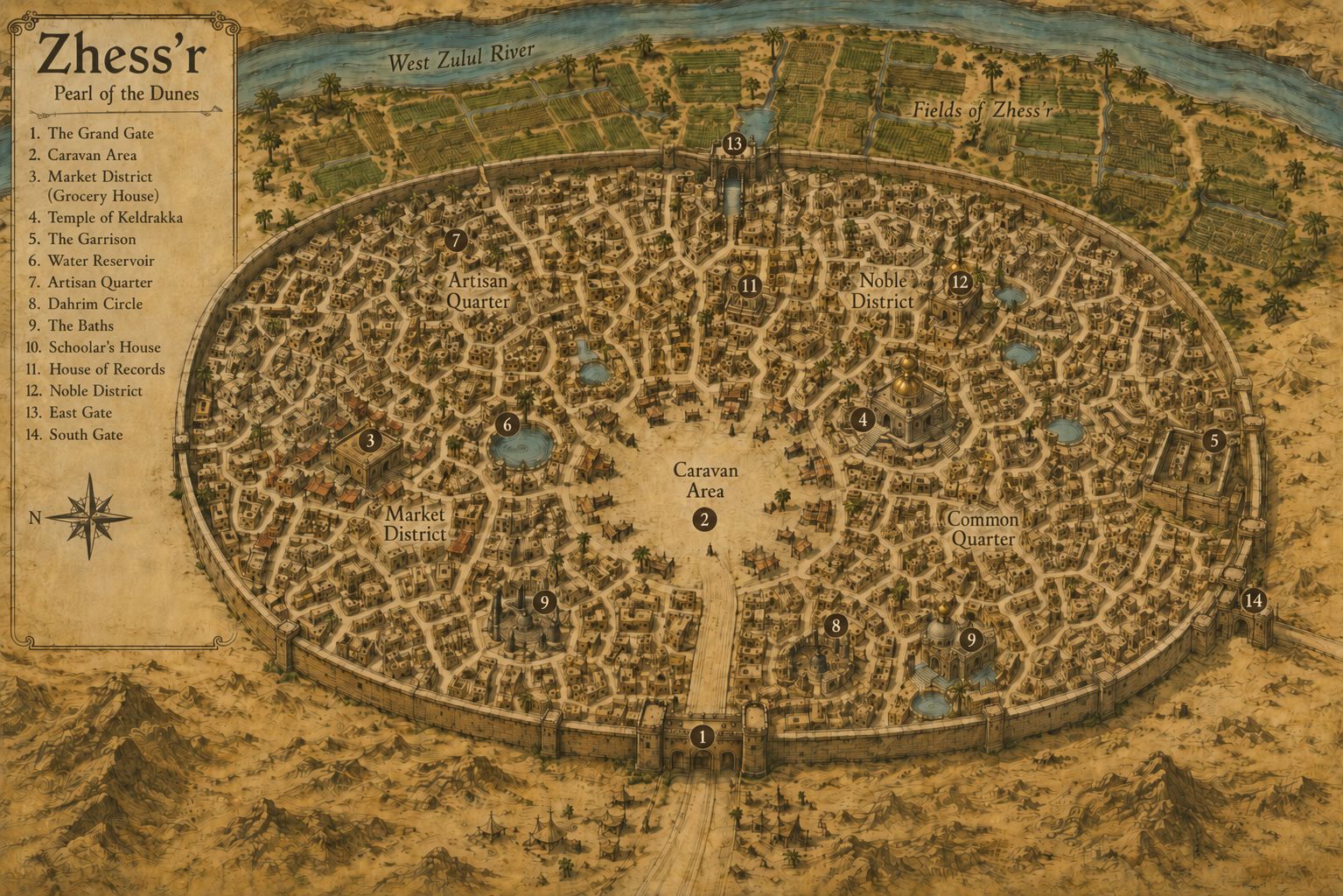
Zhess'r is a hard, sun-baked trade village built from stone, packed earth and necessity. Its houses are low, blocky structures of pale rock and mud mortar, with flat roofs, narrow windows and shaded doorways cut deep against the heat. Nothing is delicate. Walls are thick, corners are blunt and most buildings look as if they were made to endure sand, sun and the occasional raid rather than impress anyone. Cloth awnings stretch between rooftops and alleys, casting strips of shade over streets worn smooth by claws, sandals, hooves and Varrek feet.
At the center of the village lies a broad plaza large enough to receive an entire caravan, including Shar'zul. This is the village's heart: market ground, meeting place, loading yard, emergency camp and public forum all in one. Stone troughs stand near the wells, fed by a reliable underground source that makes Zhess'r valuable far beyond its size. Around the plaza are the storehouses, the leader's hall, shaded trade stalls and ramps wide enough for pack beasts and heavy loads. When the Dunewind enter, the Shar'zul can coil and settle there, turning the plaza into a crowded, tense refuge of tents, cargo, exhausted people and restless giant beasts.
The outer wall is a practical mix of fitted rock, timber bracing and heavy wooden sections repaired many times over. It is not beautiful and not truly military, but it is strong enough to keep raiders from simply riding through. Three gates pierce the wall, each broad enough for trade traffic and Varreks, each now reinforced with carts, beams, stones and whatever else the villagers can drag into place. From the rooftops, the defenders can look over the wall toward the open sand. The village feels built for trade in peace, but forced into war by people who know every corner of it.
Shessra, the Village Leader
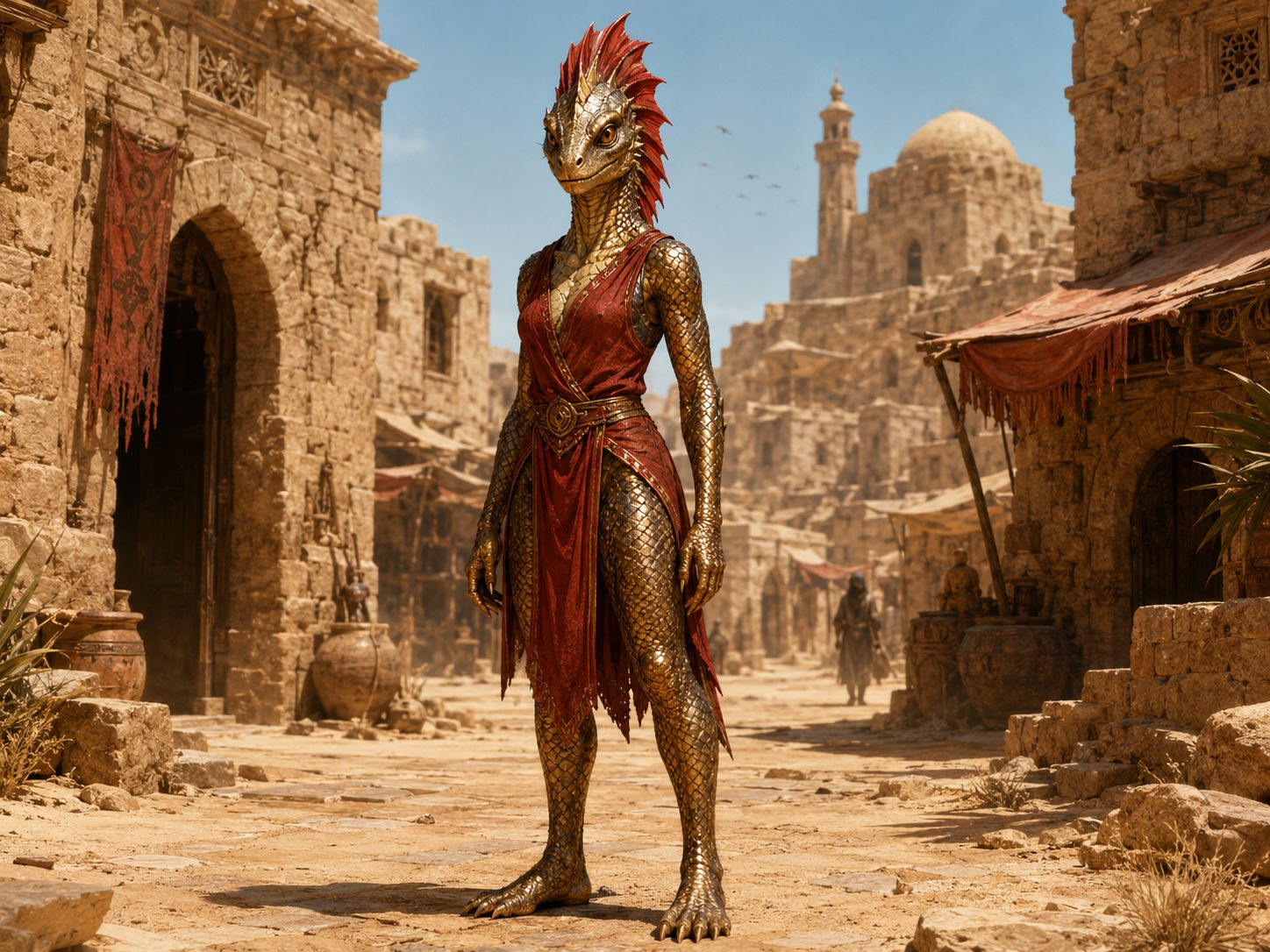
Shessra of Zhess'r is the civic leader of the village, a stern, clear-eyed woman in late middle age, with a voice trained by years of speaking over market noise, water disputes and frightened crowds. She is not a knight and does not pretend to be one. She does not carry herself like someone who expects songs. She carries herself like someone who knows exactly how many grain jars remain, which roofs will burn fastest, which families are closest to panic and which children need to be kept busy before fear spreads through them like fever.
During the siege, Shessra becomes the hinge between the knights and the village. Vorrak commands the defense, but Shessra commands the people, and no order to the villagers becomes real until she gives it. This is not vanity. It is responsibility. She trusts the seven knights, respects them deeply and knows they may be the only reason Zhess'r survives, but she also knows that a village is not a battlefield map. It is wells, food stores, old bones, frightened children, stubborn traders and the living memory of everyone who has ever passed through its gates. For Nephyla, Shessra is an uncomfortable mirror: a leader with no divinity, no ceremony and no distance from the consequences of command.
The Seven Knights
The seven knights should be introduced as familiar presences before their deaths matter. They do not need long scenes at first, but each have a clear emotional role.
Together, they are the visible heroes of Zhess'r. The arc should let the players admire them without making the crew irrelevant. The knights are the ones songs will name first. The crew, the Dunewind and the villagers are the ones who make those songs true.
Though Vorrak is the leader, they are all loyal to Shessra first and foremost, and he is second in command to her, even if he makes the military decisions.
Vorrak, the Leader
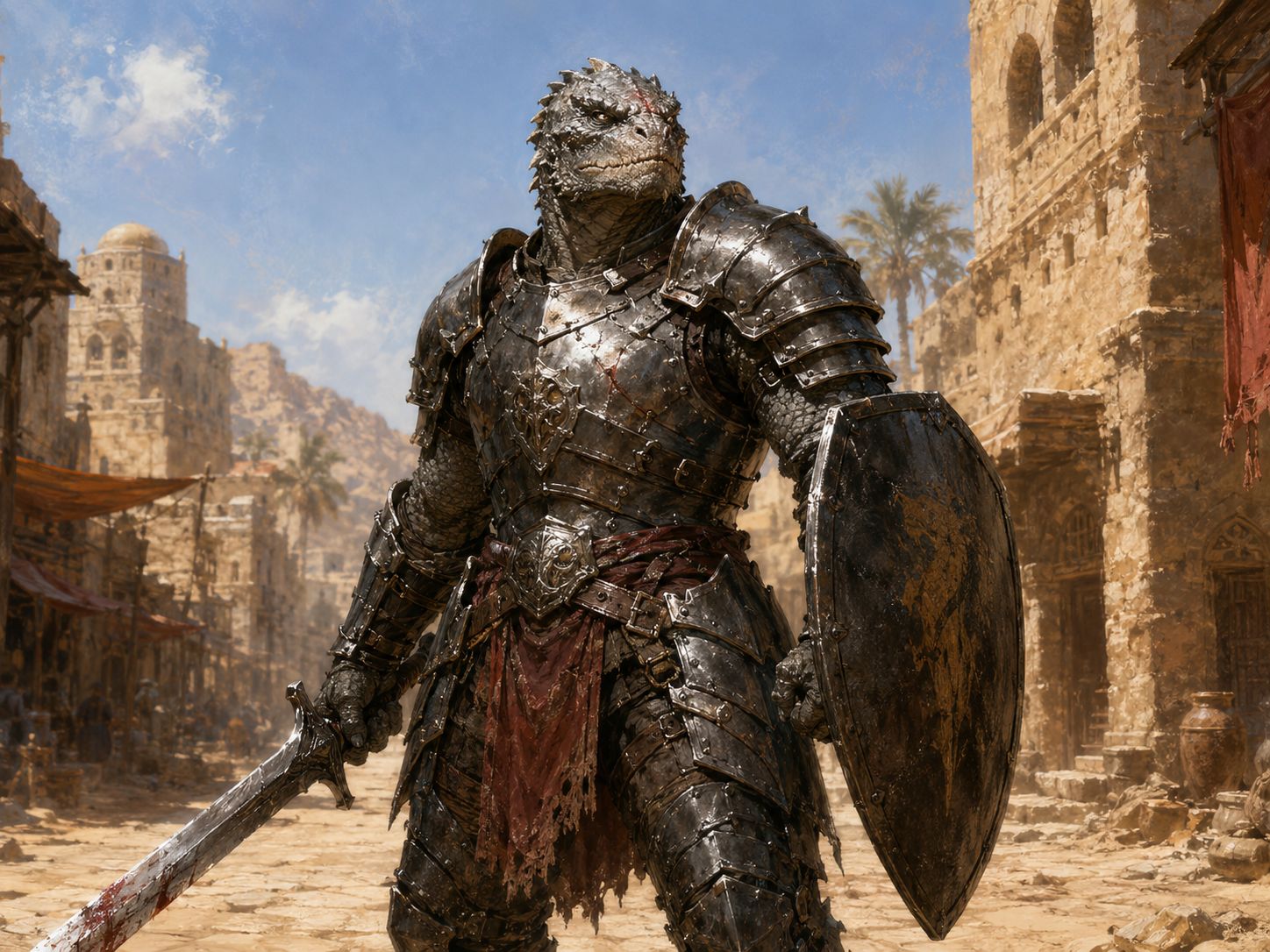
The leader is old, experienced and war-weary. He has survived too much to romanticize battle, but still believes in duty.
Thassk, the Second in Command
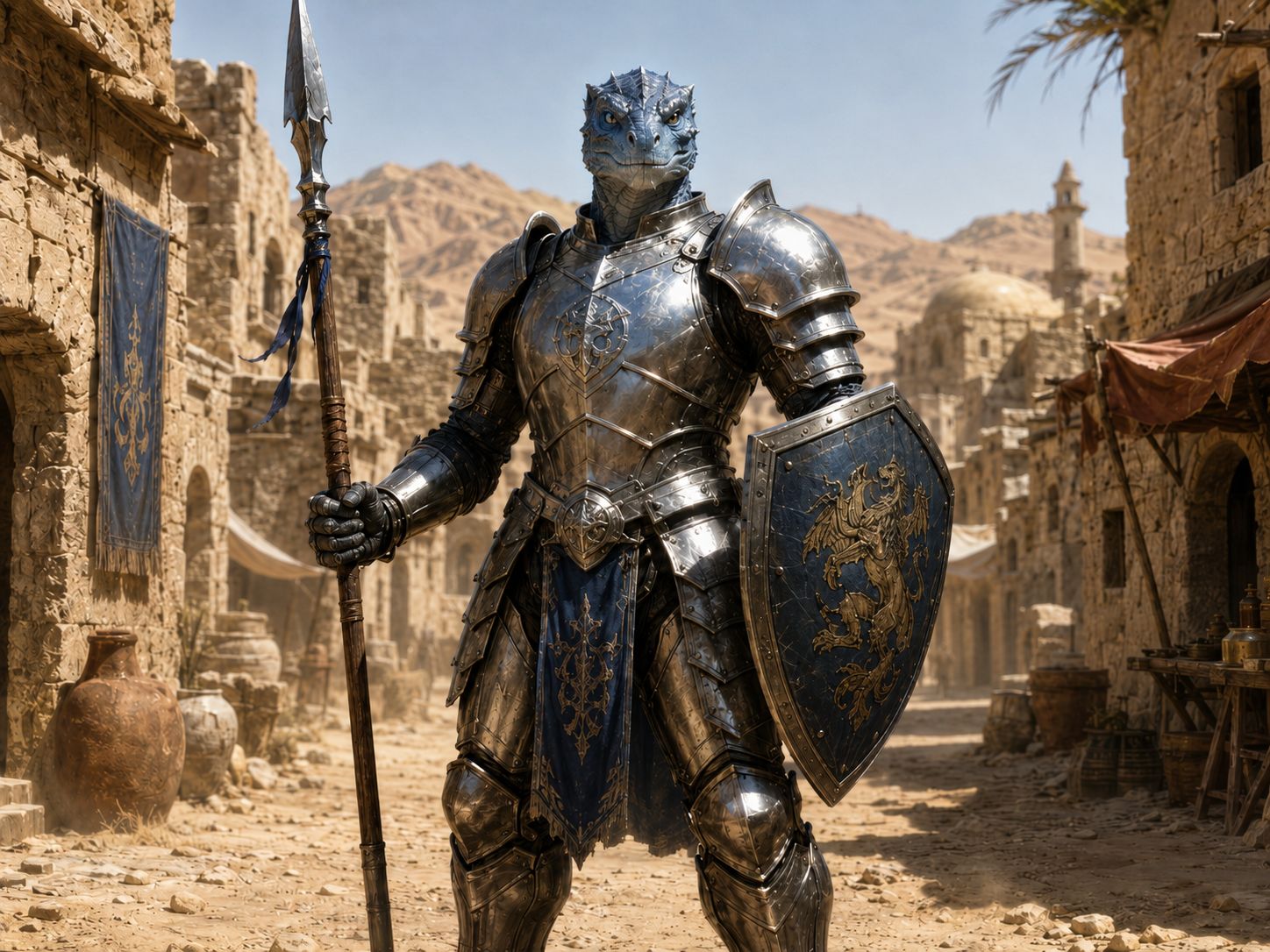
The second in command is loyal, wise and philosophical. He sees the larger shape of events and thinks in terms of meaning as well as tactics.
Kess, the Young Disciple
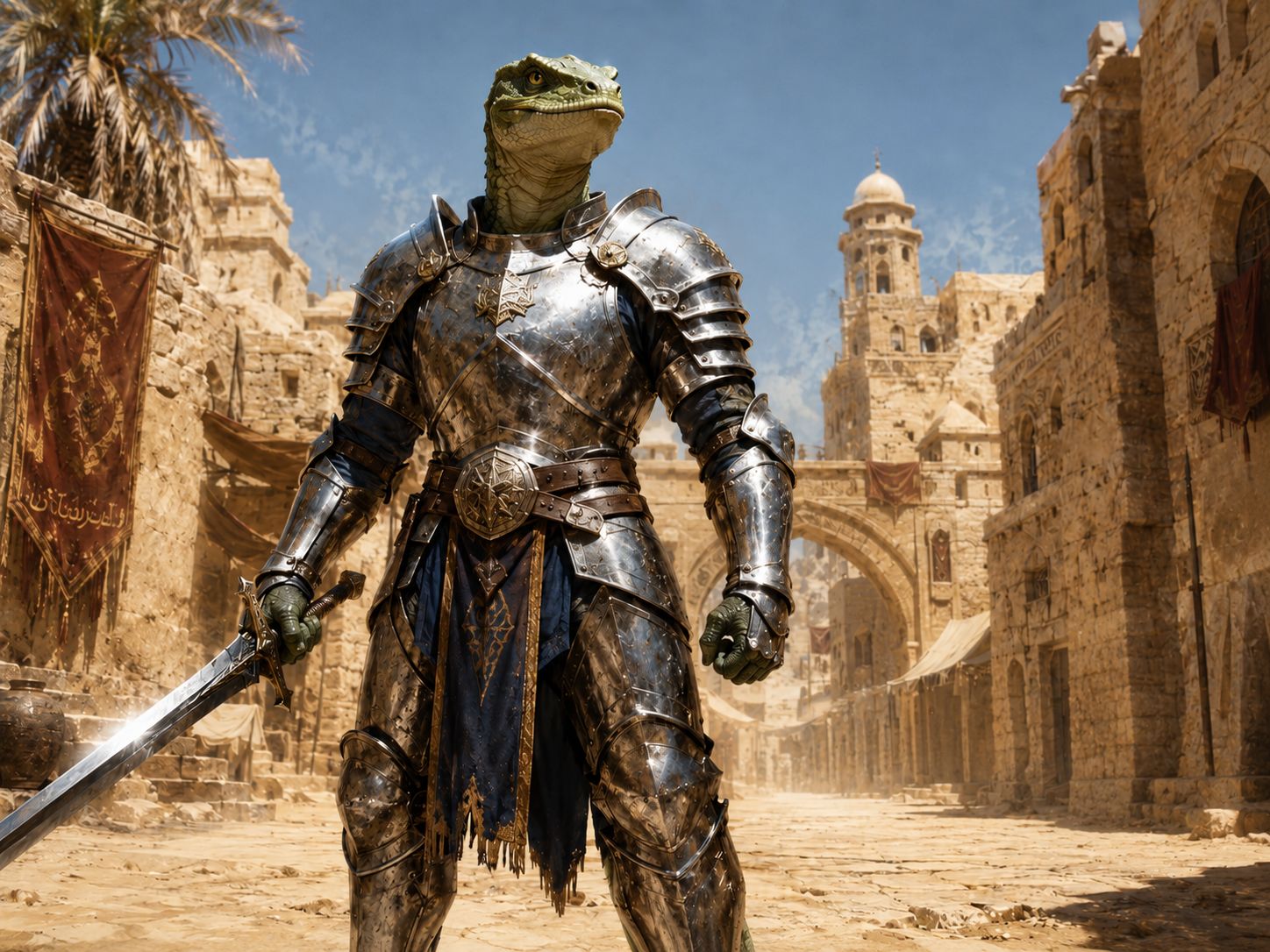
The young knight is the leader's disciple, eager to prove himself and not yet fully aware of what proof may cost.
Isskhan, the Cunning
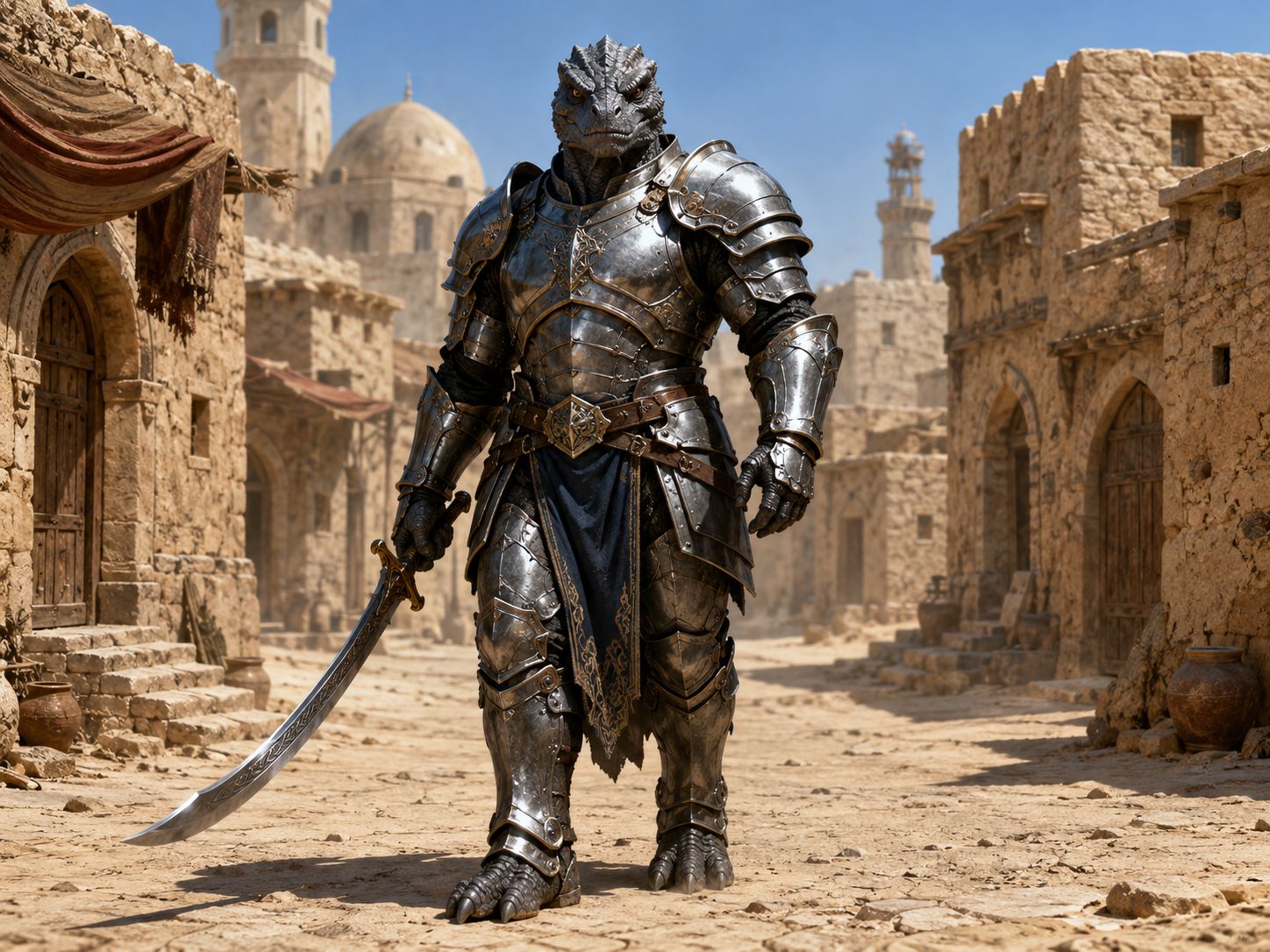
The cunning knight is an old friend of the leader, practical, careful, diplomatic and willing to win by thought where others would charge.
Tikkar, the Friendly

The green knight is inexperienced but warm, friendly, brave and good at keeping spirits alive.
Rhazzi, the Martial Expert
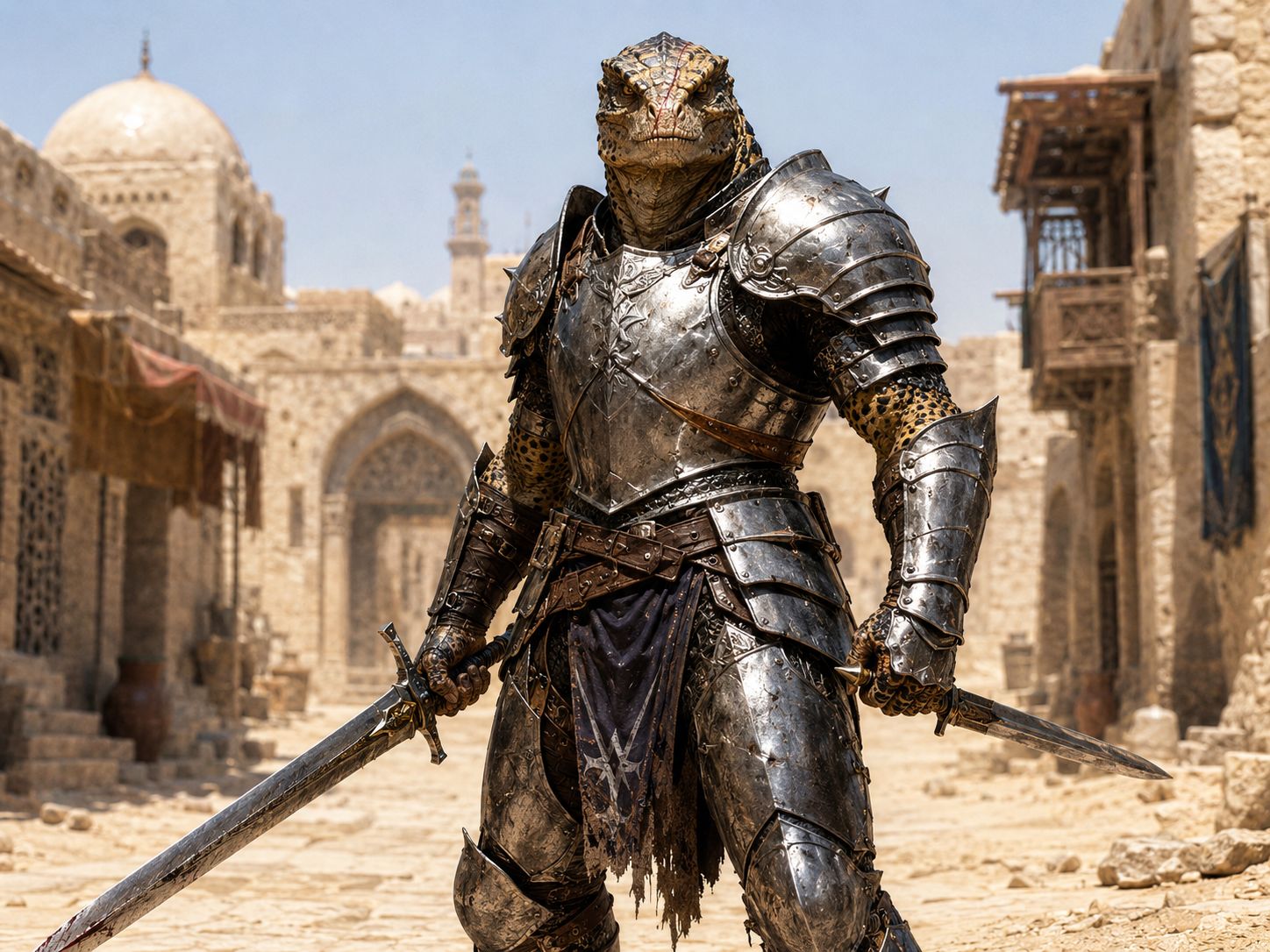
The expert is stone-faced, precise and terrifying, the greatest fighter among them.
Krazh, the Wildhead
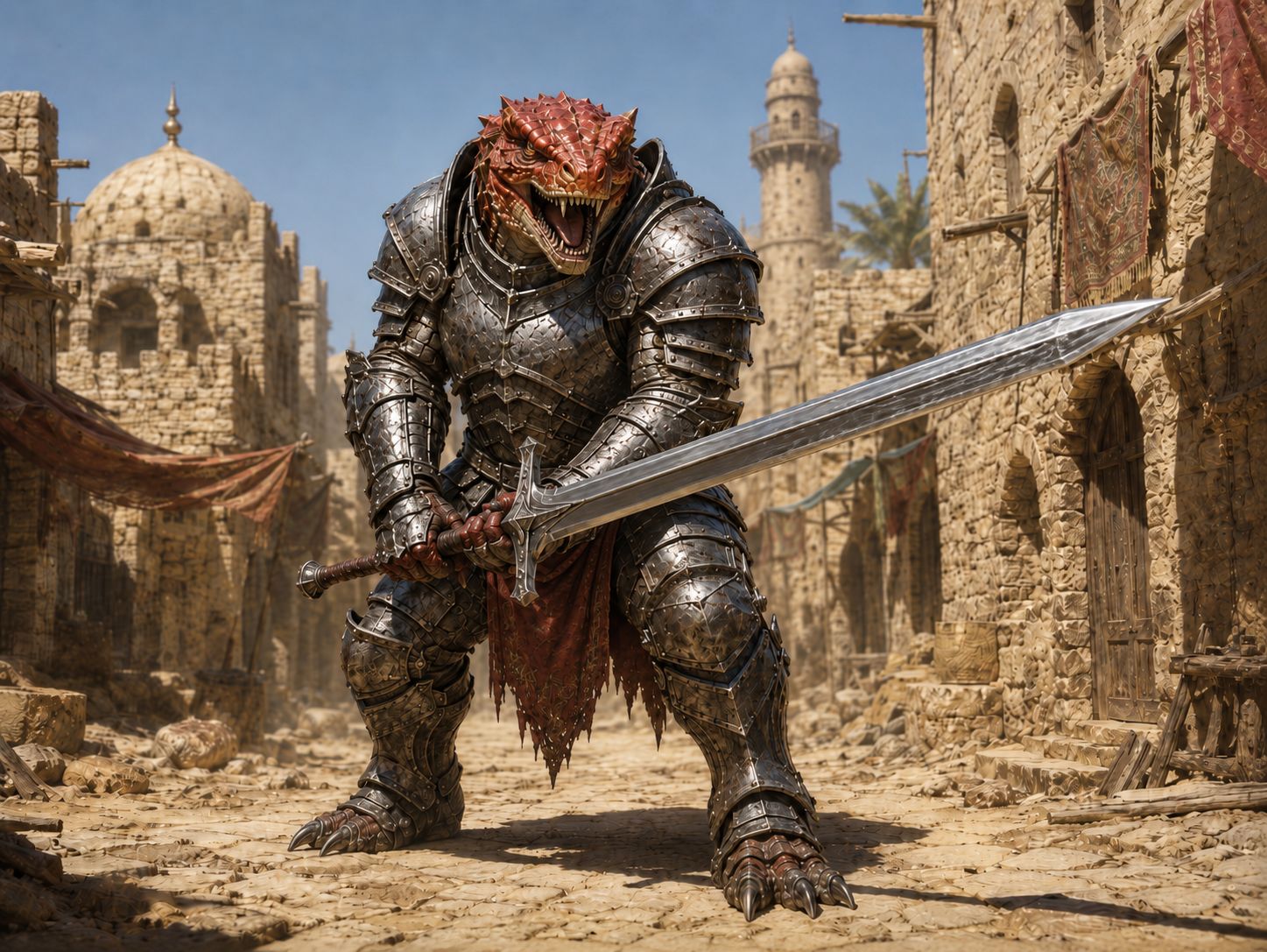
The wildhead is large, reckless, loud and full of fire. He lacks refinement compared to the others, but makes up for it with energy, courage and impossible momentum.
The Bandits
The bandits are lizardmen too, but they represent the opposite face of Ssar'et. Where the knights are honor, discipline and duty, the bandits are patience, hunger and dishonorable survival. They do not need to beat the knights in open battle. They need to burn food, kill messengers, strike at night, shoot children from rooftops and wait for fear to weaken the walls.
The bandits must not feel like fools simply because they lack steel armor. They are outmatched in honorable combat, but they have shaped the situation so honorable combat is not offered.
Rhazkor, the Leader
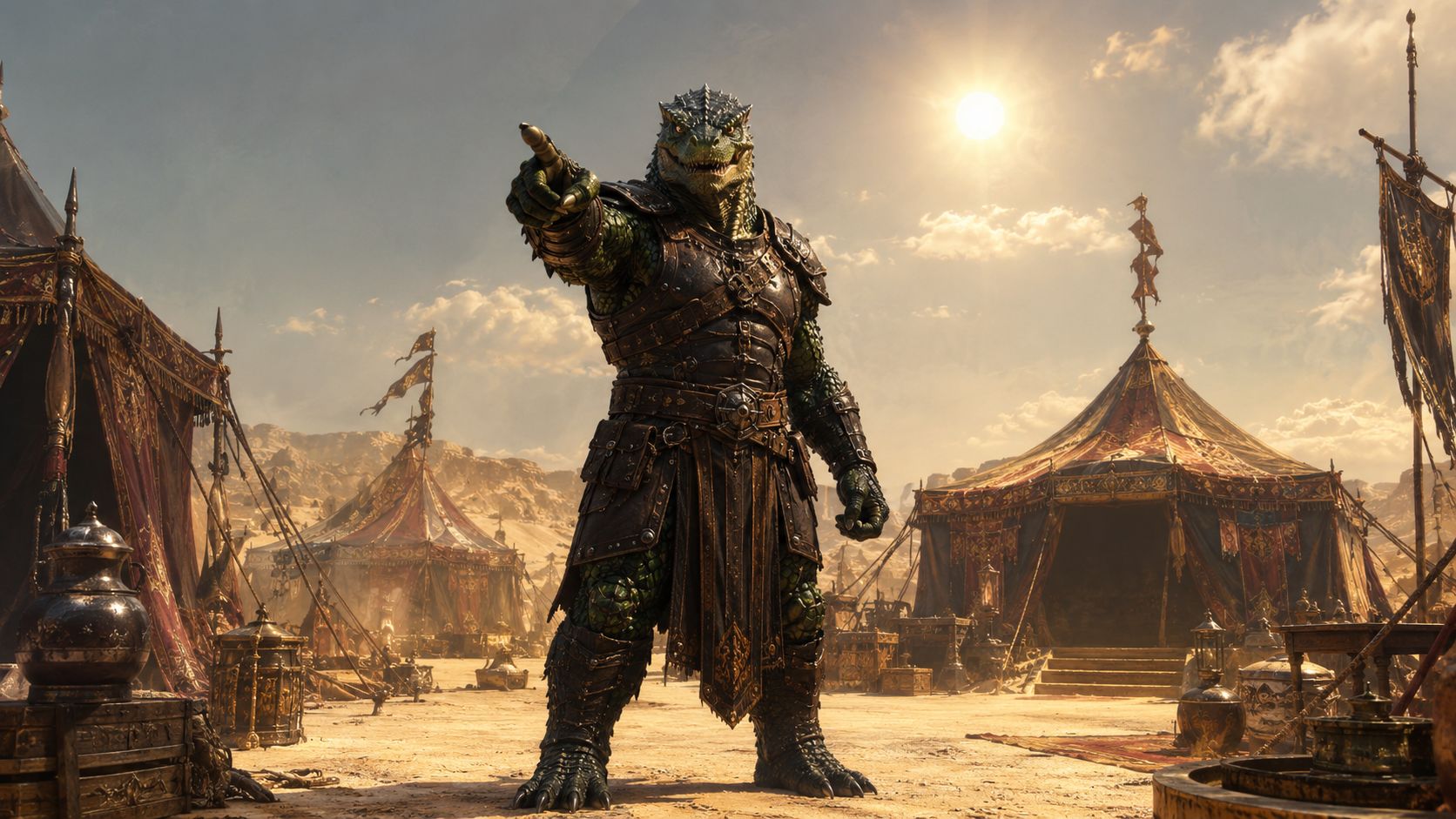
Their leader is patient rather than theatrical. He has kept Zhess'r trapped because he understands starvation better than glory.
Issreth, the Second in Command
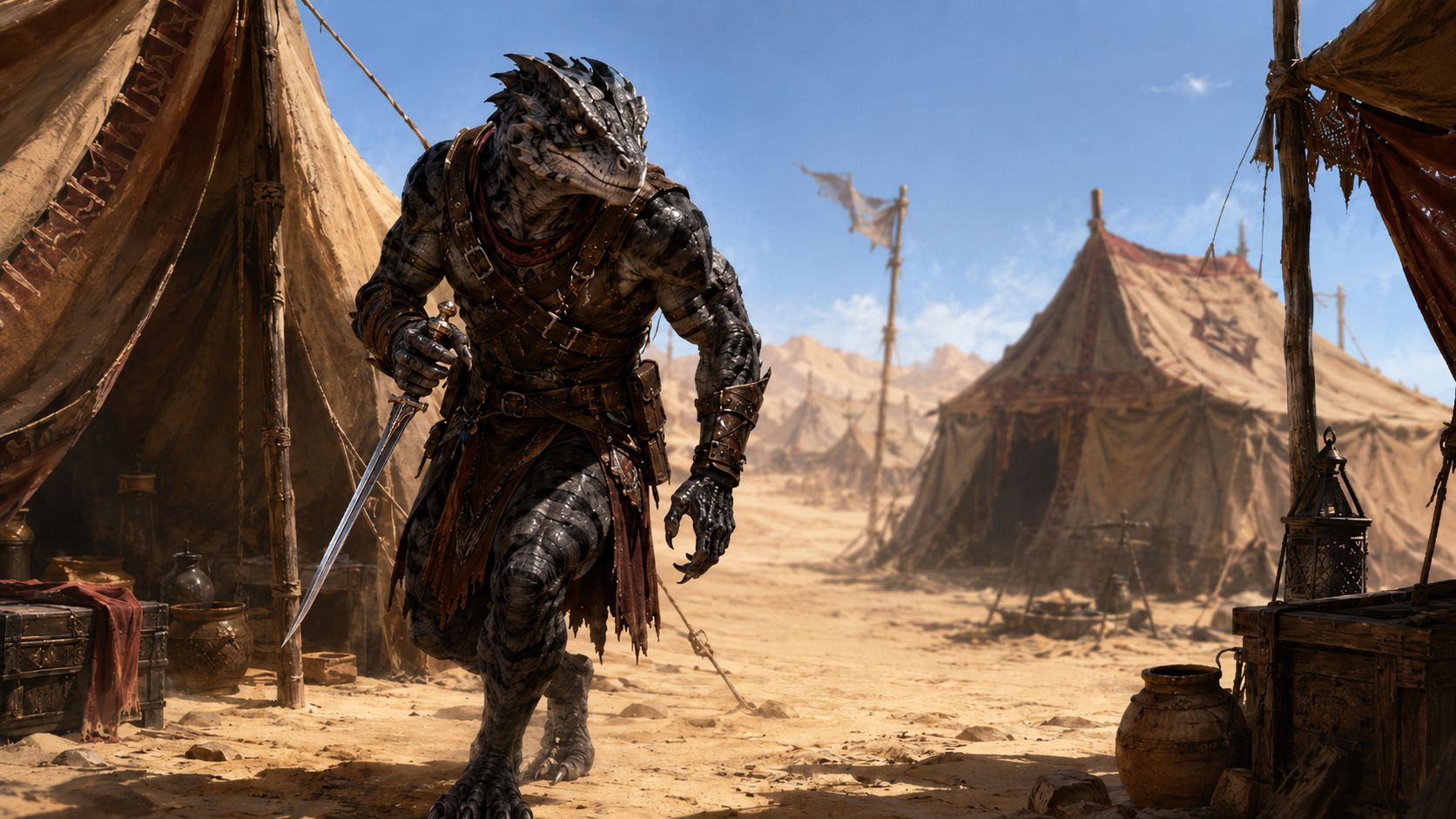
His second is a night knife, responsible for infiltration, fire setting and attacks made when cold slows the defenders. He also has ambitions to rise in the ranks.
Krozhan, the Champion
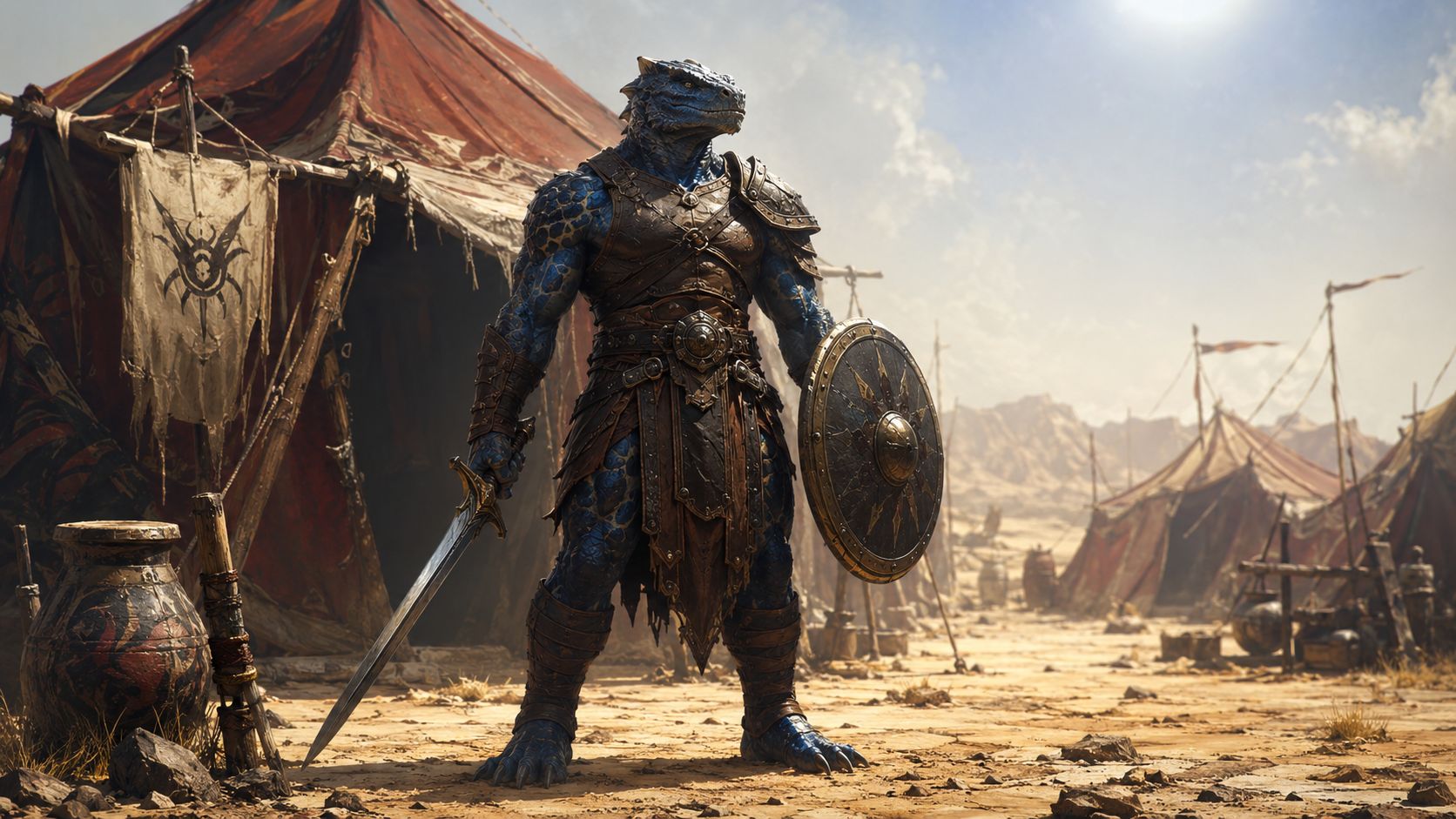
Their champion is a dangerous contrast to the expert knight. Not equal in a fair duel, but deadly in broken ground, ambush and dirty fighting.
Thissik, the Scout Leader

Alert and sharp, good for someone who reads sand and distance. A little nervous and fast, perhaps good for a scout who survives by never standing still.
Kessh, the Heavy Hitter

Big, strong and unsophisticated in battle, but one hit from him is sufficient.
Side Arc: The Infiltrator in Zhess'r
This side arc gives the crew a problem the knights cannot solve by force. Rhazkor is not only besieging Zhess'r from outside. He is reaching through the wall with signals, fear and desperate people. The knights can break charges, kill scouts and hold gates, but they cannot accuse villagers at random without damaging the trust that keeps Zhess'r alive.
The crew becomes vital because they are outsiders, observers and problem solvers. They notice patterns others miss. They can question people without being tangled in old village grudges. They understand sailors' signals, scout marks, smuggling habits and the difference between panic and intent. This is their fight inside the larger fight.
The hunt should unfold gradually. At first, it looks like good bandit scouting. Then it becomes clear that someone inside the village is communicating. Then the crew realizes the signals have shaped attacks, fires and Hadi's injury. The final reveal should be painful, not triumphant.
Running the Infiltrator Hunt
Run this side arc as a pressure under the pressure. The mood is not a neat mystery, but the sickening realization that Rhazkor has eyes inside the walls and no one knows whose eyes they are.
Let clues appear during practical work, fire response, rationing, rooftop watches and battle aftermath rather than as separate investigation scenes. Add red herrings freely: a real clue can point toward a guilty secret without pointing toward treason, and not every mark, lie or strange movement has to belong to the infiltrator.
Keep Vhessra out of the first wave of suspicion. Let Marrat, Vassik, Chathak and other louder suspects draw attention first, while Vhessra remains useful, quiet and forgettable in the background. When the crew finally notices her, the discovery should feel less like a sudden reveal and more like a horrible pattern that was always there.
The Infiltrator
The infiltrator is Vhessra Reed-Hands, a widow who works around the wells and water troughs. She is practical, quiet and familiar enough that no one notices her moving through the village. She has access to water jars, rooftops near the plaza and shaded storage areas. She is not important enough to attract attention, but useful enough to be everywhere.
Rhazkor has her son, Kethik. He was taken outside the walls before the siege fully closed, while helping drive goats back from the old flood road, and the village presumes him dead. However, Rhazkor promised Vhessra that Kethik would live if she sent signals, marked routes and gave warning of troop movements. She believes him because the alternative is admitting her son is already dead.
She does not hate Zhess'r. She is betraying it because fear has narrowed her world to one child.
This makes her dangerous, but not monstrous.
Recruiting Vhessra
Rhazkor recruited Vhessra before the siege became complete, during the last days when villagers still risked short trips outside the wall for goats, wood, herbs and water-road work.
Kethik was taken first. He had gone out with two others to help bring back goats from the old flood road after dusk. The other two escaped and reported bandits, but Kethik did not return. For most of Zhess'r, that made him another likely dead child in a bad season. For Vhessra, the uncertainty became the hook.
The first message came the next morning in a water jar.
Vhessra found it near the outer troughs, where she worked before dawn. A strip of cloth from Kethik's tunic was tied around the jar's neck, and inside was a small flat bone scratched with a simple message: "He lives. Show the sun from the roof if you want him to stay living."
She did not know what it meant at first. Then, later that day, she climbed to a roof with a polished basin and reflected sunlight toward the dunes. A mirror answered.
From then on, Rhazkor never needed to speak with her directly. The system was deliberately simple. One flash meant yes. Two meant no. Three meant danger. Longer pulse patterns were taught slowly, over several days, each tied to a visible threat or promise. When she refused or delayed, a glimpse of Kethik behind a dune convinced her. After the Knives in the Night confrontation, a small carved charm he carried was left in the dust outside her door.
The clever part is that Rhazkor did not ask for betrayal at first. He asked for things Vhessra could tell herself were harmless.
- "How many knights are at the gate?"
- "Where is the food stored?"
- "Which roofs can see the dunes?"
- "Where does Shessra speak with Vorrak?"
By the time the requests became dangerous, Vhessra had already crossed the line several times. She was not recruited in one dramatic meeting. She was pulled in by inches, each answer making the next refusal harder. By the time the village was fully sealed, she was already Rhazkor's eye inside the wall.
Rhazkor's Signal System
Rhazkor uses two systems.
The first is outside the wall. Perched scouts on a dune ridge use small polished mirrors during daylight, sending brief flashes to the siege camp. These signals mark movement, gate changes and visible preparations.
The second is inside the village. Vhessra uses a small bronze hand mirror hidden under a water jar. She signals from rooftops, alleys and shaded roof gaps when the sun angle permits. When direct mirror flashes are impossible, she leaves colored cloth markers under the guise of laundry where outside scouts can see them.
The system is crude, but effective. It does not need long messages. It only needs to answer simple questions.
- Which gate is reinforced?
- Where are the knights?
- Where is the food?
- Where is the signaler?
- Where is Shessra?
Stage One: The Dead Scout's Message
After the first confrontation, one of the dead scouts carries a leather strip marked with cuts, dots and small notches. At first it looks like a charm or crude tally. In truth, it is a count of what the scouts saw.
The marks record three gates, seven knights, rooftop defenders, Shar'zul in the central plaza, food bundles and the granary. The granary is marked twice. The Shar'zul are marked with a spiral sign. The knights are marked as large cuts, while villagers are dots.
This turns the knight victory into a clue scene. The bandits were not merely testing courage. They were building a map of the village's survival points.
The crew can decode this by comparing the marks to visible village features. Ileena, Shaedra, Nasheem, Ayesha, Pelonias or any observant character can notice that the marks are not decorative. Thaleia can overcomplicate the interpretation at first, then realize the marks are a practical shorthand rather than a language.
The key takeaway is simple: the bandits care about the granary, the Shar'zul and the gates more than random killing.
Stage Two: The Glint From Inside
The evening light made liars of every surface in Zhess'r.
Copper pots flashed near cookfires. Water jars caught the sun in brief, harmless sparks. Dust turned gold along the rooftops, and the pale stone walls gave back the day's heat in wavering sheets.
Ileena still saw the wrong glint.
She stopped on a roof above the well court, one hand resting on the parapet, ears angled toward the far side of the village. Thaleia nearly walked into her, too busy examining a roof tile with a crack in it.
"What is it?" Thaleia whispered.
Ileena did not answer at once. Her eyes stayed fixed on a roof beyond the plaza, near a row of drying cloth and stacked water jars.
There.
A flash.
Gone.
Then another.
Not sunlight wandering. Sunlight speaking.
"That," Ileena said.
Thaleia followed her gaze, squinting hard. "A reflection?"
"Three times."
"That could be accidental."
Ileena's tail moved once, slow and irritated. "Accidents do not answer."
Across the wall, far out on the dune ridge, a second glint winked back.
Thaleia's expression changed completely. The scholar vanished. The fascinated idiot remained, unfortunately, but now with alarm attached.
"Oh," she said. "That is not good."
"No."
"That is extremely not good."
Ileena was already moving.
They crossed the roofline fast, Thaleia half crouched and profoundly unsuited to speed, Ileena silent ahead of her. By the time they reached the far roof, the signaler was gone.
Only small things remained.
A water jar shifted from the shade into sun. Dust disturbed beside it. A wet handprint drying on the parapet. Fine grain dust where no grain should have been.
Thaleia knelt, breathless, staring at the marks.
"Someone inside the village is talking to them," she said.
Ileena looked toward the dune ridge, where the answering light had vanished.
"Yes," she said. "Quietly."
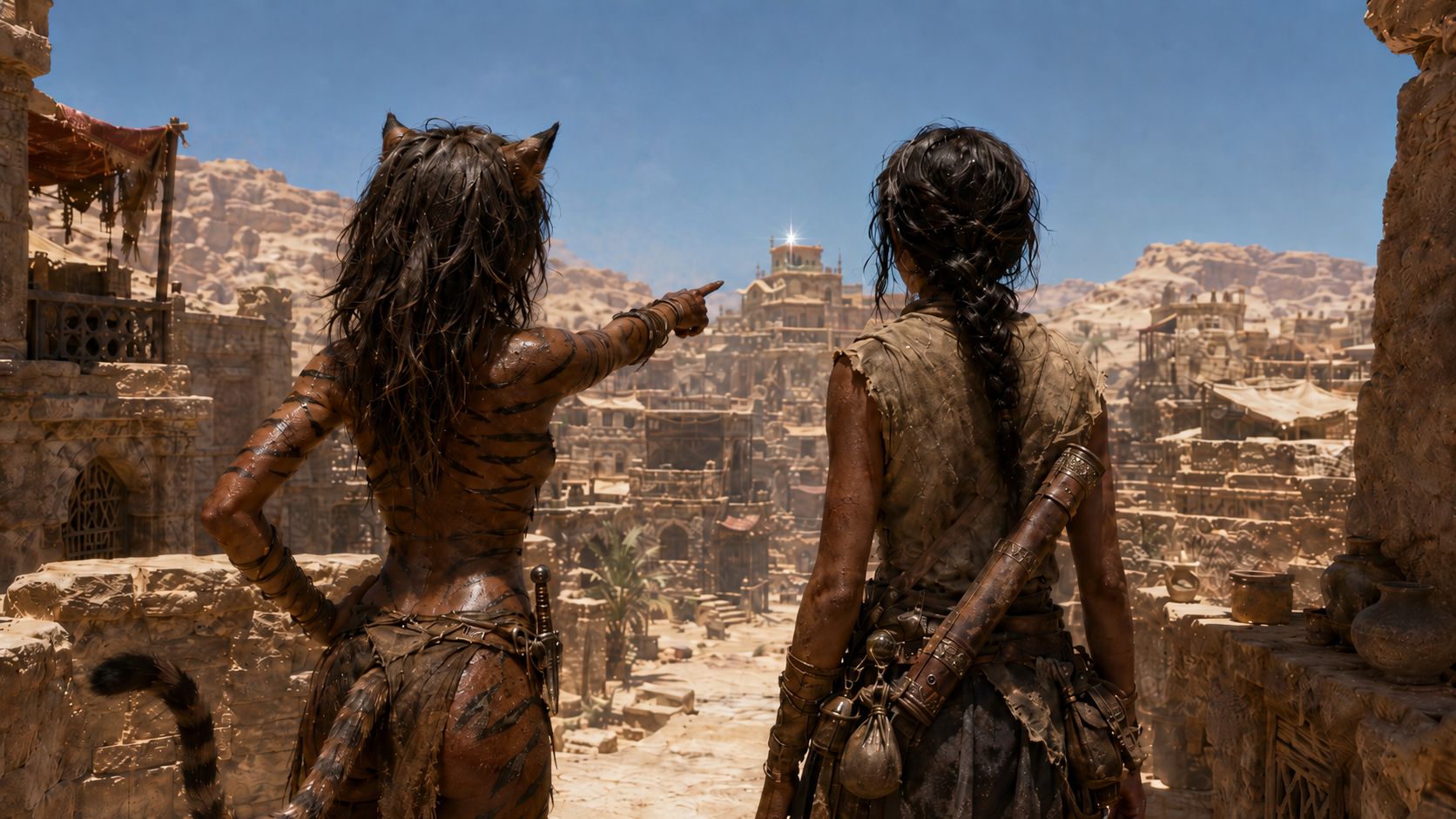
During the first evening or the next morning, someone in the crew spots a brief glint from the far side of the village. It comes from a rooftop near the well court, not from outside the wall. A moment later, a matching glint answers from the dune ridge.
The crew reaches the roof too late. The signaler is gone.
The scene leaves evidence.
- A water jar has been shifted from its normal place.
- The roof dust is freshly disturbed. The tracks are not human.
- A wet handprint marks one edge of the parapet, but has dried enough to not be matchable to an individual.
- Fine grain dust clings to the rooftop, though no grain is stored there.
A child named Tivik says he saw "the water woman" nearby, but adults dismiss him because half the women in the village carry water.
The crew now knows someone inside Zhess'r is communicating with Rhazkor.
This discovery must be handled carefully. Shouting "traitor" in the plaza will damage the defense more than the signal itself. Shessra understands this immediately. Vorrak wants the culprit found, but he also knows that knights are blunt instruments in a crowded village.
This becomes the crew's responsibility, and discretion must be absolute.
Stage Three: Suspects and False Trails
The hunt begins with too many possible suspects.
Marrat Beamhand, the Carpenter

Marrat Beamhand, the carpenter, knows the wall, the roof paths, the old repairs and every blocked alley in Zhess'r. He has reasons to be near gates, granaries, ladders and storage rooms at odd hours, and his tools explain scratches, wedges, loosened tiles and fresh marks in wood. He argues openly with Shessra after the night attack, which makes him look like someone angry enough to betray her.
Vassik Three Dates, the Trader
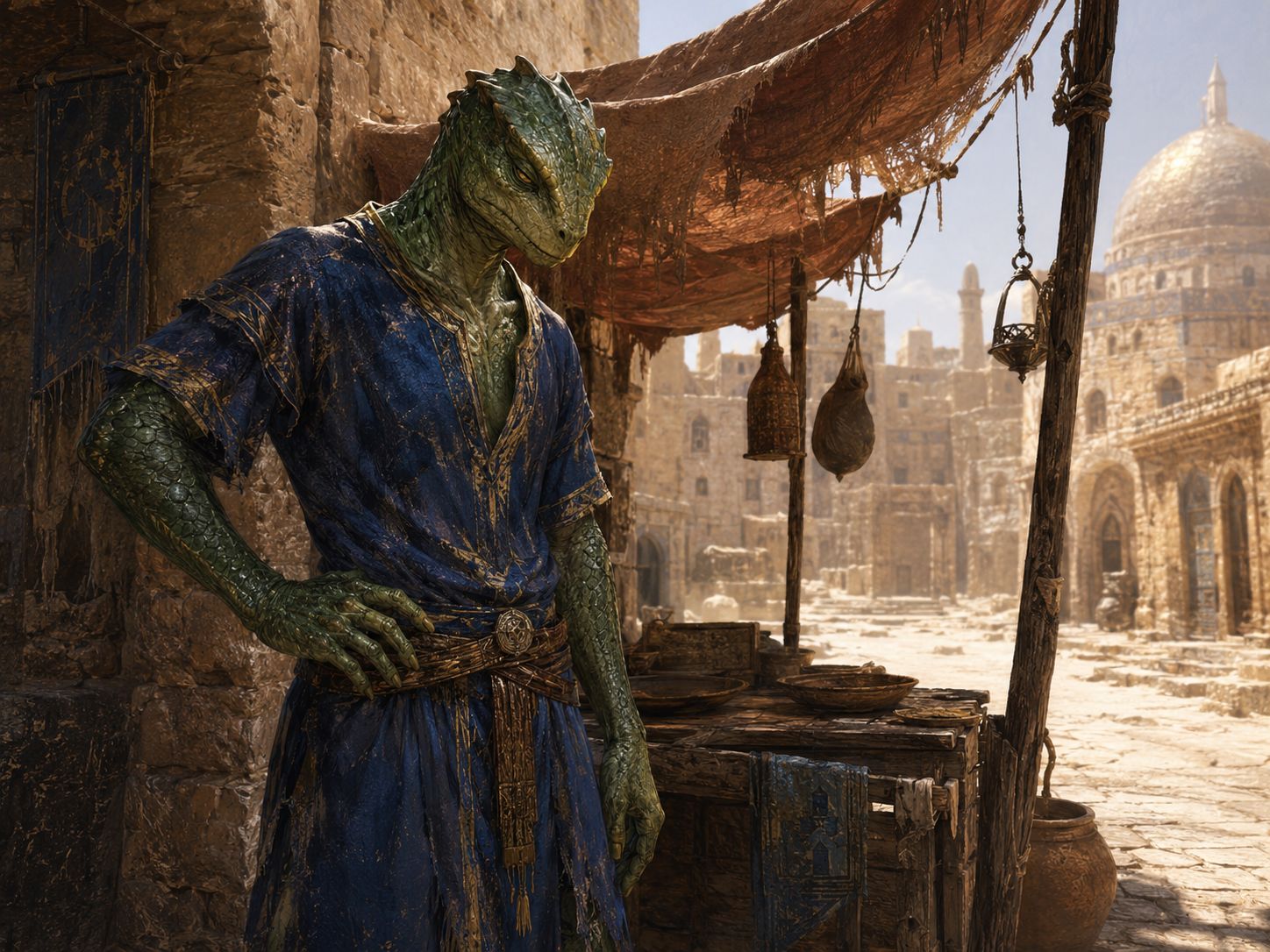
Vassik Three Dates, the trader, has lost almost everything to the siege. His stall is empty, his ledgers are worthless and he loudly argues that Rhazkor's mercy offer should at least be heard. He knows trade codes, mirror flashes and caravan hand signs, and his polished bronze plate could easily serve as a signal mirror.
Chathak Roof-Eye, the Old Roof Keeper
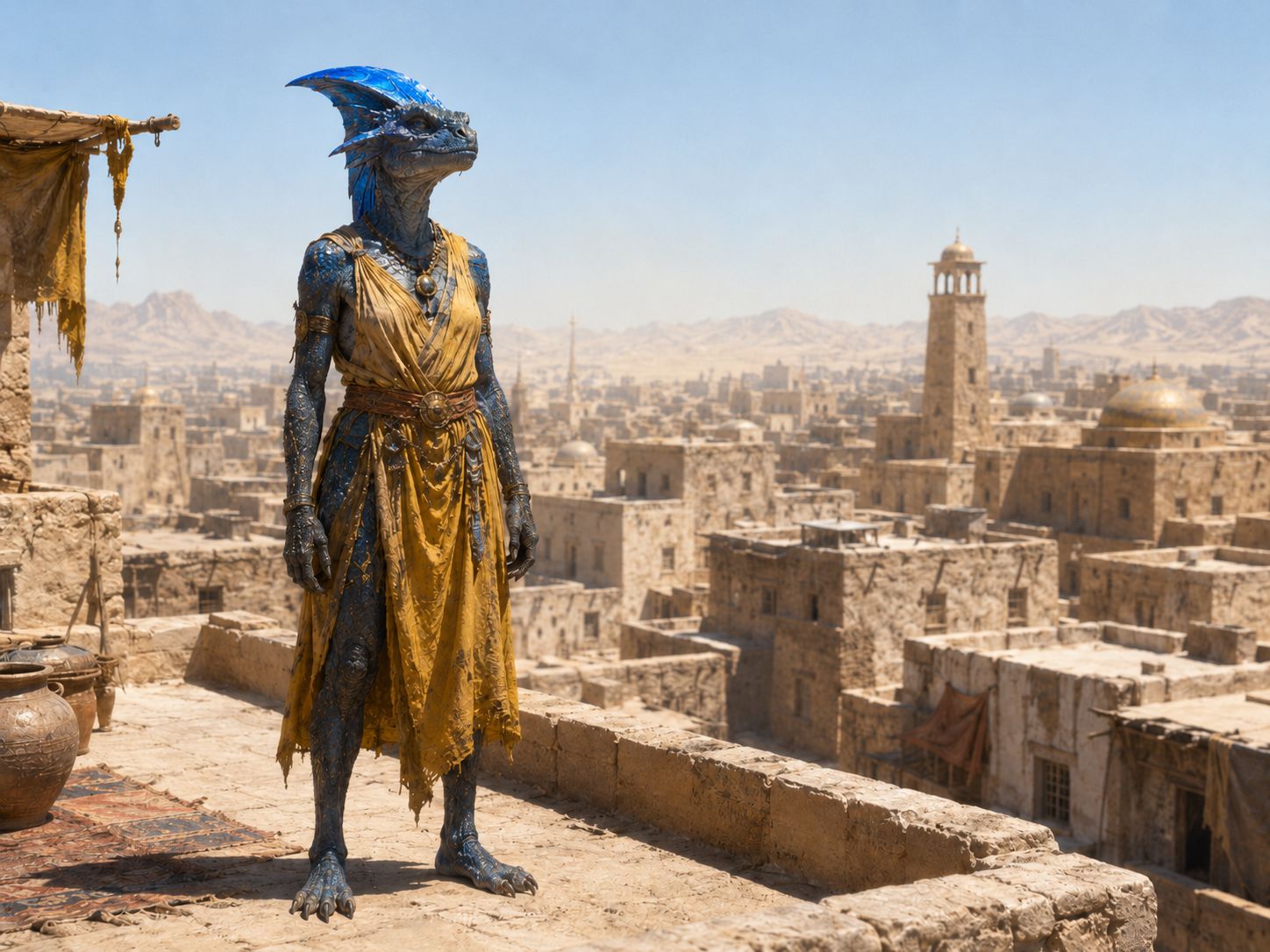
Chathak Roof-Eye, the old roof keeper, knows every roof, ladder, awning hook and parapet in the village. She is half blind, bitter and easy to dismiss, which makes it more suspicious when a child reports seeing her near the place where the glint came from. In truth, she saw the signaler too, but kept quiet because she wanted proof before speaking. She was once Shessra's rival for the position as village leader.
Eshrik Salt-Tongue, the Former Caravan Broker
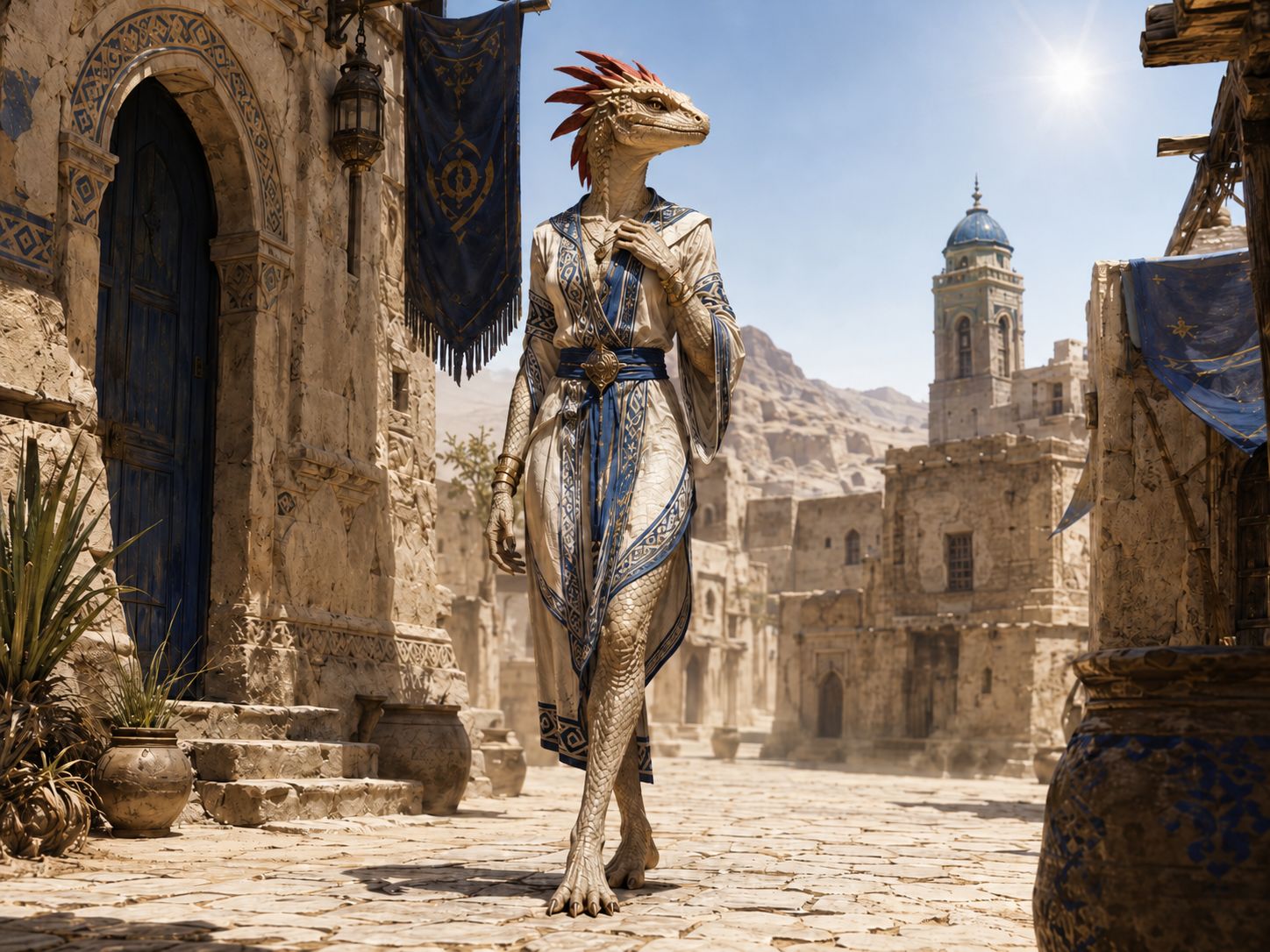
Eshrik Salt-Tongue, a former caravan broker, used to negotiate with desert traders, rough companies and caravans before Shessra stripped her of authority for cheating weights during a dry year. She understands coded marks, supply counts and how to talk to raiders without looking frightened. She answers questions too smoothly, as if she prepared for suspicion.
Rukhash the Gate Cousinis
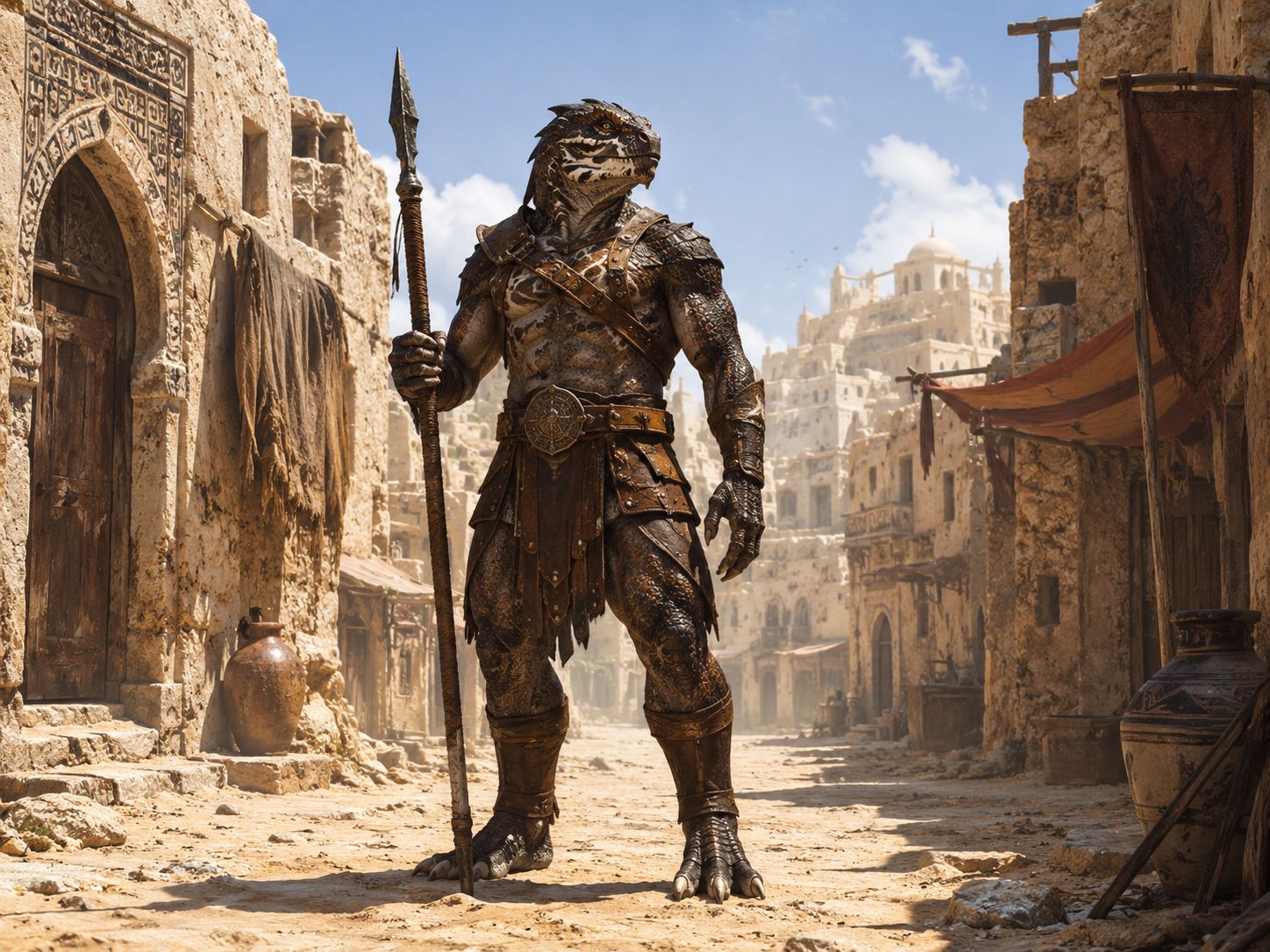
Rukhash the Gate Cousinis related to one of the gate guards killed in the night attack. His grief comes out as accusation, and he loudly blames outsiders, Dunewind and anyone who questions him. He had access to gate schedules through family, and his anger makes him look unstable enough to have betrayed the village out of spite.
Vhessra Reed-Hands
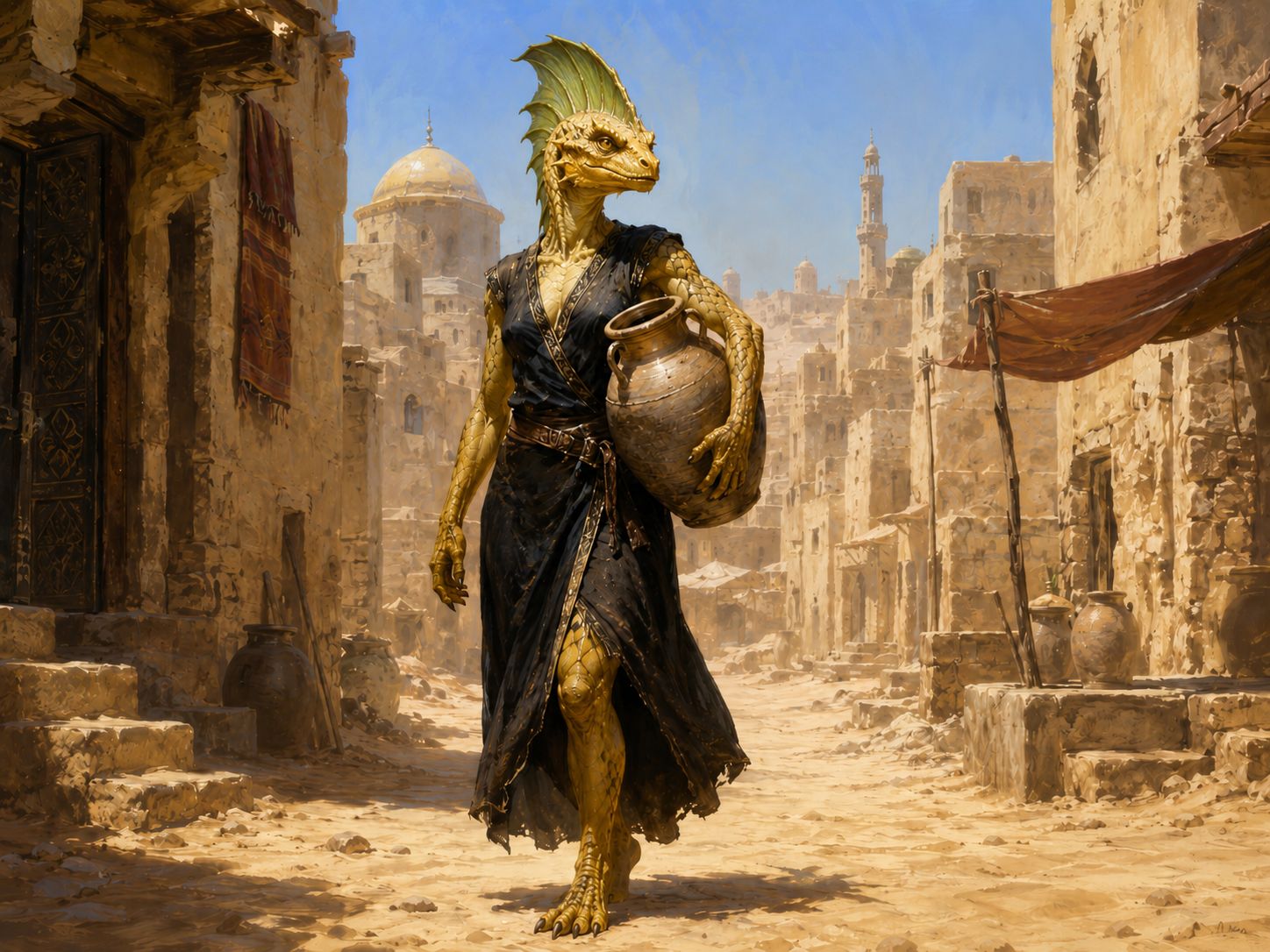
Vhessra Reed-Handsis a quiet widow who works around the wells, troughs and water jars. She is practical, familiar and almost invisible, the sort of person everyone sees every day and no one watches closely. Rhazkor has her son, Kethik, outside the walls, and every signal she sends is paid for with the hope that he still lives.
The crew can question, observe and compare stories. The goal is not to solve it immediately, but to build pressure. The wrong accusation has consequences. The village is hungry, frightened and ready to blame someone.
Shessra gives the crew authority to ask questions, but not to arrest without proof.
Stage Four: The Map in the Dust
The crew finds a map scratched into the dusty floor of a sheltered storage room near the plaza. It shows the three gates, the granary, the storehouses, the Shar'zul space and two rooftop routes. It was not drawn by a bandit outside. Someone inside Zhess'r explained the village.
Several people had reason to pass through the room. Children played there before the siege. Sada stored baskets there. A Dunewind group slept nearby. Villagers carried beams through it during preparations.
The mistake in the map is the clue. It marks the Old Rope Alley as open, but that alley was blocked three weeks ago by a collapsed stone wall. Anyone who moves through the village daily knows this. Someone who remembers the village from older habits but has avoided that side recently could make the error.
Vhessra's well routes keep her close to the plaza and troughs. She once used Old Rope Alley every morning, but since the collapse her work never takes her there.
The crew does not yet have enough proof, but the suspect field narrows.
Stage Five: The Marks for Knives and Fire
After Knives in the Night, the crew finds discreet marks scratched into walls, door frames and hard-packed ground. At first they look like scuffs from claws, tools or panic. Then the pattern becomes clear. Small arrows, broken lines and simple symbols have been placed near alleys, roof ladders, storehouses and sleeping spaces. Someone inside Zhess'r marked the targets before the attack.
The marks are not a full map. They are battlefield instructions for infiltrators moving quickly in the dark. One arrow points toward the grain store. Another marks the shortest route from the weak wall section to the knights. A cut symbol near a doorway marks a house crowded with sleeping refugees. A double notch near a rooftop ladder shows a way to reach the roofs without using the main stairs. A spiral scratched near the plaza points toward the Shar'zul.
This changes the meaning of the night attack. The bandits did not simply enter and improvise. They moved through Zhess'r with guidance. Someone walked the village beforehand and showed them where to kill, where to burn and where to spread panic.
The crew can compare the marks with the dead scout's leather strip and the map in the dust. The symbols match. This proves that the scout marks outside the wall and the target marks inside the village are part of the same system. Rhazkor's people counted the village from outside, but someone inside turned that knowledge into routes.
The marks also narrow the suspect list. They are low to the ground, made quickly and mostly placed near water routes, troughs and service alleys rather than formal streets. They avoid crowded watch paths and favor places used by workers who move before dawn. That points away from obvious public figures and toward someone familiar, practical and unnoticed.
Vhessra becomes more suspicious, but not proven guilty. Marrat has the tools to make such marks. Chathak knows the roof routes. Vassik understands trade symbols and could have adapted them. The crew now has something concrete to investigate, and every new mark found feels like another small betrayal carved into the village itself.
Stage Six: The Hidden Archer Nest
When Hadi is hit during the main assault, the first assumption is that the arrow came from outside the wall. It did not. The angle is wrong.
The arrow came from inside Zhess'r, from a second story window near a torn awning overlooking the granary. The archer used a narrow slit in a cracked window shutter and vanished in the confusion after firing.
This becomes urgent. The same archer can target Hadi again, or any other important person, such as Shessra or the knights.
The crew can find the nest by tracing the arrow angle from where Hadi fell. The clues are clear once they look.
- A broken window shutter.
- A dropped arrow with black fletching.
- Footprints in spilled grain dust, the same dust found near the first signal roof. A skilled tracker sees that the shooter was hurt, slightly dragging one leg.
This ties the archer to the signaler.
Stage Seven: The Captured Archer
The cistern door breathed.
Not much. Not enough for most ears. Just a faint shift behind the swollen wood, a careful drag of air through teeth, then silence held too tightly.
Ileena stood beside the door with one hand raised. Nasheem waited on the other side, sword drawn, dark clothes still powdered with dust from the granary roof. Behind them, Thaleia held a lantern too high and too nervously, while Junia stood ready with bandages she clearly hoped not to need.
"There is someone inside," Ileena whispered.
Nasheem nodded once.
"Alive?" Thaleia breathed.
Ileena shrugged. "Breathing..."
Nasheem stepped back, then drove his boot into the latch.
The door cracked inward with a hard wooden scream. The cistern room beyond was cold, low and sour with old water. A young bandit crouched beside the dry basin, one leg bound in filthy cloth, bow within reach, black-feathered arrows scattered beside him.
He lunged for the bow.
He was too slow.
Nasheem crossed the room in two strides and put the curve of his blade beneath the bandit's throat.
"Do not make this honorable," Nasheem said. "Surrender."
Rikketh froze, eyes wide, breath sharp against the steel. Then his hands opened and rose in surrender.
"I surrender."
Ileena stepped into the doorway, saw the bow, saw the black fletching, saw the blood crusted on his leg and the fear all over him.
Her ears flattened.
"That was disappointing."
Nasheem did not look away from the prisoner. "For whom?"
"I wanted his heart."
Thaleia made a small, strangled sound behind the lantern.
Nasheem sighed. "No one is taking anyone's heart."
Ileena stared at Rikketh as if deciding whether that ruling had force.
Nasheem pressed the blade a hair closer. "You shot the drummer."
Rikketh swallowed against the steel. "Orders."
"From Rhazkor?"
A quick nod.
"Who hid you?"
The bandit's eyes flicked, just once, toward the empty water jars stacked by the wall.
Ileena saw it.
Her disappointment faded.
"Water woman," she said.
The archer is not Vhessra. It is Rikketh, a young bandit infiltrator who entered during the night attack and never escaped. His leg is injured, but not badly. Vhessra hid him in an unused cistern, feeding him from stolen ration scraps, treating his leg as needed and moving him only when necessary.
Rikketh shot Hadi because Rhazkor's orders were clear: break coordination.
After the shot, he escaped back to the cistern.
The crew can catch him in several ways. They can search storage spaces near Vhessra's route. They can notice that a water jar outside the cistern room has been refilled too often. They can question Vhessra and see her fear shift from guilt to terror when the search nears the right door. A dropped black feather fletching lies in the dust outside the door.
Rikketh fights if cornered, but he is cold, hungry and injured. He is dangerous because he is desperate, not because he is strong.
If captured alive, he confirms that someone inside helped him.
He does not know Vhessra's name. He knows her only as "the water woman".
Stage Eight: The Reveal
Shessra did not look at Vhessra at first.
She looked at the things laid on the low stone table between them. The bronze mirror wrapped in water cloth. The black-fletched arrow. The scrap of marked leather taken from the dead scout. The grain dust sealed in a small clay cup. The little carved charm that Rikketh had left outside the cistern door.
Nasheem stood beside the table, one hand resting on his sword hilt, his face grave and tired.
"The evidence leads to her," he said. "Not by one road. By all of them."
No one in the leader's hall spoke.
Vhessra Reed-Hands stood with her wrists bound before her, shoulders bent, eyes fixed on the floor. She looked smaller than she had by the wells, where she had always seemed part of the village machinery, quiet, useful and forgettable. Here, under Shessra's gaze, there was nowhere left for forgettable to hide.
Shessra touched the bronze mirror with two fingers.
"This carried our deaths to Rhazkor."
Vhessra flinched.
Shessra looked at her then. No shouting. No mercy either.
"Why?"
For a moment, Vhessra held herself together by force alone. Her mouth trembled. Her claws curled against her palms. She tried to answer like someone still defending a choice.
Then the strength went out of her.
"My son," she whispered.
Shessra's face did not change, but something in the hall shifted.
"Kethik," Vhessra said, and the name broke her. "They took him by the flood road. They sent me his cloth. Then his charm. They said he was alive. They said if I helped, he would stay alive."
She sank to her knees before anyone touched her.
"I told them small things. Only small things. Gates. Roofs. Where the food was. Where the knights moved." She pressed her bound hands to her face. "I told myself no one would die from small things."
Nasheem closed his eyes.
Shessra stood very still.
Outside, Zhess'r waited for judgment. Inside, Vhessra wept like a woman who had finally run out of lies and found no mercy waiting in the truth.
The crew confronts Vhessra after gathering enough proof.
- The bronze mirror is found wrapped in cloth beneath a water jar.
- Her hands carry grain dust from the storage room.
- Tivik identifies her as the woman he saw near the roof.
- She knows details of the false map mistake before anyone says them aloud.
- Rikketh can identify her.
When cornered, she does not deny for long. She breaks when Kethik's name is spoken or when she realizes Rikketh cannot protect the lie.
She says Rhazkor has her son. She says she only sent small things. Gates. Food. Which roofs were watched. Where the knights moved. She insists she never meant for Hadi to be shot. She insists Rhazkor promised Kethik would live.
The truth is left uncertain. Rhazkor may still have Kethik. He may already be dead. The crew cannot leave the village to find out. The siege remains a prison.
This is the cruelty of the side arc. The crew can solve the mystery, but they cannot fix the wound that caused it.
Shessra's Judgment
Do not let this become a simple punishment scene. Vhessra is guilty, and her actions killed people. Isskhan is dead. Fires burned. Hadi was shot. The wall nearly failed. At the same time, she acted under the terror of a mother whose child was in enemy hands.
Shessra asks the crew what they found, then makes the judgment herself. This preserves her authority.
She does not execute Vhessra during the siege. Zhess'r cannot afford a public spectacle, and Shessra refuses to let Rhazkor turn the village against itself. Vhessra is bound, guarded and kept away from wells, roofs and stores. Her final punishment waits until after survival.
This is hard enough. Vhessra must sit alive while the village fights with the damage she helped cause.
Nephyla should witness this. Shessra does not forgive because forgiveness is not hers alone to give. She also does not kill in anger. Command means holding judgment until judgment can serve more than grief.
Turning Vhessra
Ayesha understood it before the others did.
Not the grief. Not the guilt. The system.
She stood in the leader's hall, looking at the bronze mirror, the marked leather strip and Vhessra Reed-Hands trembling on her knees before Shessra. Everyone else saw betrayal. Ayesha saw a channel still open.
"Rhazkor trusts your fear," she said.
Vhessra looked up, eyes wet and hollow. "He has my son."
"Then he believes you will obey," Ayesha said. "That makes you useful one last time."
Nasheem frowned slightly. "Ayesha."
She raised one hand, not taking her eyes from Vhessra. "No lies to her. No promises we cannot keep." Her voice softened, but did not become gentle. "Rhazkor will not spare Kethik because you helped him. Men like that do not reward obedience. They spend it."
Vhessra shook her head. "No. No, if I stop, he dies."
"If Rhazkor wins," Ayesha said, "your son dies anyway. So does Shessra. So does Hadi. So do the people whose doors you marked."
Vhessra folded around the words as if struck.
Ayesha knelt in front of her, silk and dust settling together. "You cannot undo what you did. But his mirror is still waiting for yours. Send him something he wants to believe."
"What?"
"That Shessra is hiding in the leader's hall. That the plaza has been cleared. That the roof above the west lane is unwatched."
Vhessra stared at her. "He will know."
"No," Ayesha said. "He will think fear finally made you perfect."
For a long moment, Vhessra only breathed.
Then she whispered, "If there is even a chance Kethik lives..."
"Then Rhazkor must lose quickly," Ayesha said. "Help make him wrong."
If the crew exposes Vhessra before the final attack, they can do more than stop her. They can turn Rhazkor's own system against him. This requires care. Threats make her obey for a moment, but fear is already what made her betray Zhess'r. To make her useful, the crew must reach the part of her that still belongs to the village. They must convince her that Rhazkor will not spare Kethik because she obeys, and that the only thing she can still save is the people inside the walls.
Vhessra does not become brave all at once. She breaks first. She argues, weeps, denies and clings to the idea that one more signal might keep her son alive. The crew can turn her by showing the marks that led attackers to sleeping families, by naming Hadi, by making her look at the grain store Isskhan died to protect or by having Shessra confront her without rage. The strongest argument is not that she can earn forgiveness. It is that she can stop Rhazkor from using her again, and that Rhazkor's defeat is the only remaining chance Kethik has.
If convinced, Vhessra sends one final false message before she is bound and removed from the wells. The signal should be simple enough for Rhazkor to believe: the strongest defenders are moving to the Dust Gate, the granary roof is unwatched or Shessra has taken refuge in the leader's hall. The message does not win the battle by itself, but it changes details that matter.
During the final attack, show one or two moments where the lie helps. A bandit group rushes toward the wrong roof and finds empty stone instead of Hadi or archers. Kessh leads heavy fighters toward a blocked lane because Rhazkor believes the plaza has been cleared. A wave of attackers reaches the leader's hall expecting Shessra and finds only overturned tables, oil jars and villagers waiting above with stones. These moments should feel like the crew's work paying off inside the larger chaos.
This also matters after the battle. Vhessra is still guilty, and Shessra does not erase what she did. People died because of her. But if Vhessra chose to send false information when she could have remained useful to Rhazkor, Shessra has a reason to show mercy without making mercy look weak. Vhessra's punishment can become exile rather than execution. She did not undo her betrayal, but at the end, she turned back toward Zhess'r.
If the Crew Solves It Early
If the crew identifies Vhessra before Hadi is shot, Rikketh still makes the attempt. The drum still goes silent for a moment, but the crew's work clearly matters.
If they expose the archer nest before the main battle, a bandit in the attacking force takes the shot instead. The crew has prevented the worst version, not erased the problem.
If the Crew Solves It Late
If the crew does not solve the mystery until after the final battle, the side arc still works. They uncover how Rhazkor knew so much, and the reveal becomes part of the aftermath. Vhessra's betrayal is then one more wound the village must carry while rebuilding.
The emotional difference is important. Solving it early saves lives. Solving it late gives truth, but not relief.
If the Crew Accuses the Wrong Person
A wrong accusation creates immediate danger. The village is hungry, frightened and ready to punish someone. Shessra stops mob violence if she can, but trust suffers. The actual infiltrator becomes more careful. Vhessra hides the mirror elsewhere. Rikketh moves before the archer nest is found.
This should not end the mystery. It should make it harder and make the crew feel the cost of careless certainty.
How the Side Arc Intersects the Main Arc
After First Confrontation, the crew decodes the dead scout's leather strip and learns what the bandits are counting.
Before Second Confrontation, the crew spots the inside glint and begins the infiltrator hunt.
After Second Confrontation, the markings and dust map prove the bandits had inside information.
During Third Confrontation, Hadi is shot from inside the village, turning the mystery into an urgent threat.
After Third Confrontation, the crew captures Rikketh or traces the archer nest.
Before Fifth Confrontation, Vhessra is exposed, removing Rhazkor's eyes inside the wall.
During Fifth Confrontation, Rhazkor attacks with less precision because the crew solved the problem. He still nearly breaks the village, but not as cleanly as he planned.
Why This Matters
This side arc makes the crew essential without making them stronger than the knights. The knights fight the siege outside the wall. The crew fights the siege inside the wall.
They save Zhess'r not by replacing heroes, but by solving the hidden problem that would have made heroism useless.
Arrival
The dunes had stopped looking like landscape and started looking like a sentence no one could finish.
For days the caravan had moved under a sun that seemed to press every thought flat. The Shar'zul crawled on, patient and immense, their legs moving in ripples beneath wooden decks heavy with tents, cargo, tired people and the last guarded skins of water. Dust coated cloth, hair, teeth and tongues. Even speech had become expensive.
Ahead, low shapes broke the shimmer of heat. At first they might have been rocks. Then walls. Then roofs. Then the pale, hard outline of Zhess'r Village rising from the desert like something hammered into place and left to bake.
A murmur passed through the Dunewind. Not joy. Not yet. Relief was too dangerous to spend before reaching the gate.
Tarek Sandnose stood on a forward deck, one hand shading his eyes. His body went still.
"Riders," he said.
The word carried faster than a shout. Hands moved to weapons. Sada began snapping orders before anyone asked for them. Rashad cursed and struck a harness line, urging one of the Shar'zul to tighten formation. Miraz turned slowly toward the distant rise where dust had begun to lift.
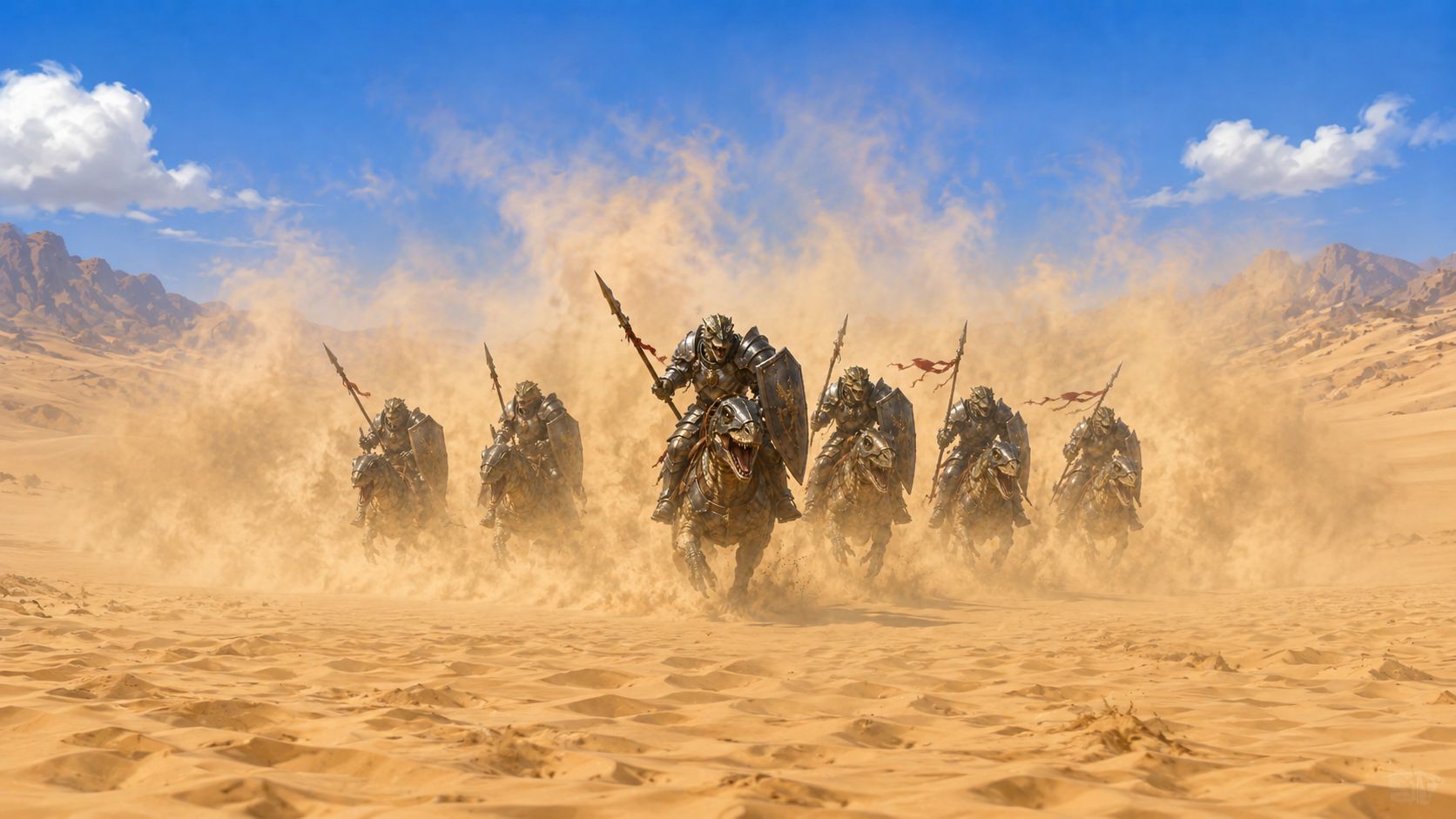
The bandits came down from the sand in a loose wedge, mounted on Varreks, leather armor dark against their scales, spears angled low. They had waited until the caravan could see the village. Until hope had become a weakness.
On the Shar'zul decks, the Dunewind prepared to die badly.
Then the village gates opened.
Seven riders emerged from Zhess'r in a line of steel and thunder. Their Varreks were larger, better fed and more disciplined than the bandits' mounts. The riders themselves seemed impossibly heavy, armored in fitted plates of darkened steel over scale, helms low, lances steady. They did not shout. They did not hurry. They simply came.
The bandit charge faltered.
The seven knights spread with practiced precision, not rushing to meet the enemy but cutting the shape of the battlefield into pieces. The bandits saw it too. They broke away before contact, wheeling hard in a spray of sand and retreating toward their camp beyond bowshot.
Only then did the lead knight raise one mailed hand.
"Inside," he called. "Now."
The Approach
The arrival should feel like the last stretch of a journey that has already taken too much and is not finished taking. The Dunewind are not merely tired. They are functioning through discipline because they cannot afford collapse before reaching water. The crew should feel the same pressure. Even hardy sailors should be worn down by desert travel, crowding, heat and constant pursuit.
Zhess'r should appear as salvation before it is revealed as another trap. Describe the village in practical, physical terms. Low rock houses. Flat roofs. Cloth awnings. A broad central plaza large enough for the Shar'zul. A wall of fitted stone, timber and rough repairs. It is not beautiful, but it is solid. After the open desert, even a hard wall looks like mercy.
The bandit charge should happen before the players can settle into relief. It is not meant to be a full fight. It is a threat that reveals how vulnerable the caravan still is and how carefully the bandits have been waiting. Let the bandits get close enough for a few arrows to be exchanged and the danger to feel real, but do not turn it into a battle.
The Seven Arrive
The seven knights should make a strong first impression. They are not flashy heroes. They are disciplined, heavy and terrifying. Their armor should look almost excessive compared to what the crew has seen before. In much of the world, elite warriors rely on shields, mail, leather, bronze or armor comparable to legionary gear. These knights look like walking fortresses mounted on predators.
The important contrast is not just equipment. It is purpose. The bandits charge like hunters closing on weakened prey. The knights emerge like a system activating. They do not need to kill anyone to end the first attack. Their arrival is enough to force calculation.
Use this scene to establish that the knights are vastly superior in open, honorable combat. The bandits survive because they refuse to offer that kind of fight.
Entering Zhess'r
The escort into the village should be fast and tense. Vorrak, the old leader of the knights, does not pause for formal greetings until the gates are shut. The caravan is brought directly into the central plaza, where the Shar'zul can settle in a coil of tired legs, creaking wood platforms and slumped bodies.
Zhess'r has water. That should matter immediately. Stone troughs are filled. People drink under the supervision of Mira and Junia, because too much too quickly will sicken the exhausted. Rashad tends the Shar'zul before himself. Sada begins counting skins, stores and mouths before she has finished drinking. Miraz thanks the village formally, but his eyes already measure the fear around him.
The villagers of Zhess'r are thin. Not dying yet, but close enough that the signs are visible. Children watch the Dunewind food bundles with too much attention. Adults notice the food bundles, then look away from them. Traders who should be curious are silent. The market stalls around the plaza stand half empty, and food is not among the wares displayed.
This is where Shessra enters.
Shessra of Zhess'r should not arrive like a queen. She arrives like a woman interrupted from five emergencies at once. She knows which storehouse still has grain, which families are too hungry to trust near open supplies and which wells can handle the sudden strain of Shar'zul. She speaks with Miraz as an equal, not because they are socially alike, but because both understand logistics as a form of command.
The Practical Alliance
The truth comes quickly. Zhess'r is under siege. Rhazkor's bandits have cut off trade and prevented caravans from entering or leaving. They are patient, not reckless. They do not need to storm the village today. They only need the village to run out of food.
The Dunewind have food but cannot cross the remaining distance without water. Zhess'r has water but cannot survive much longer without supplies. This creates the alliance.
Do not frame this as generosity at first. It begins as necessity. The Dunewind and villagers need each other. The crew is trapped with both. Sentiment can grow later, but the first bond is practical survival.
Important First Impressions
Vorrak and his knights are respectful toward Shessra in front of outsiders. He commands the defense, but he does so under authority given by Shessra, and he does not command the village. If he needs villagers moved, he tells Shessra. She gives the order. This immediately teaches the players how authority works here. There is a chain of command, and Shessra is the top link.
Nephyla will notice Shessra. Not because Shessra is majestic, but because she is obeyed without divinity. That is the first seed of the leadership theme.
Hadi should be present in the plaza, tired but alert, carrying or protecting his drum. He does not need a major role yet. Let the players remember that he is there.
First Confrontation: Scouts at Sunset
Sunset turned the sand red.
The heat loosened its grip by slow degrees, and Zhess'r exhaled into the first bearable air of evening. Villagers moved along the rooftops with baskets of stones. Dunewind children sat close to the Shar'zul, too tired to play but too restless to sleep. Somewhere near the wells, Sada argued with a storehouse keeper in a voice that made both sides sound guilty.
From the wall, the desert looked almost peaceful.
Then Ileena saw movement.
Not riders this time. Figures on foot, low against the dunes, moving between shadows where the falling light broke the ground into gold and black. They were not charging. They were counting. Watching. Learning.
Vorrak listened to the report without expression. Beside him, Isskhan narrowed his eyes.
"Scouts," Isskhan said.
Vorrak nodded once.
The seven knights mounted without a word.
The gate opened just wide enough. Varreks pushed through, claws scraping stone, steel riders folding into the saddle as if beast and warrior had been forged together. Then they were out in the sand.
The scouts ran.
It did not matter.
The knights hit them before the last light left the sky. Lances dropped. Varreks twisted. Steel flashed once, twice, again. A bandit tried to dive behind a rock and was trampled before he could crawl. Another hurled his spear. It struck Rhazzi's breastplate and skidded away with a dull thud. Rhazzi cut him down without slowing.
It was over almost before fear could become sound.
From the wall, the villagers watched in silence. There were no cheers. Only the heavy knowledge that if such warriors had not ended the siege already, then the siege was worse than it looked.
This scene shows the knights at their strongest. Open ground. Dying heat. Visible enemies. Room to ride. Under those conditions, they are almost unbeatable. The point is awe, not uncertainty.
The confrontation should be short, sharp and one-sided. Do not turn it into a prolonged fight. The players should not think, "We could have done that." They should think, "Why are the bandits still here?"
This is also a chance to let the players notice the bandits' intelligence. Scouts on foot are not brave raiders looking for glory. They are there to count defenses, learn routes, watch gate movement and prepare something worse.
Player Involvement
Let a crew member or player character be the one to spot the scouts if possible. This gives the players a useful role without diluting the knight showcase. If no crew member takes up the task on their own, have Shessra tell them to ask Vorrak if something needs to be done, and have Vorrak suggest the task.
Useful actions include watching from rooftops, identifying patterns, alerting Vorrak, warning Shessra, tracking whether any scouts escape and checking if the scouts were signaling anyone else.
The knights kill the visible scouts, but crew members with military experiance will notice that the bandits were also studying village geography, gates, walls or storage buildings. This can foreshadow the night attack.
After the Fight
The knights return without celebration. Their armor is marked with dust and dark blood. Tikkar tries to smile at Hadi or some frightened children, but the others remain quiet.
This is when Isskhan asks to speak with Shessra.
Shessra stood in the shade of the leader's hall, arms folded, while Isskhan spoke in a voice too low for the plaza. Vorrak stood nearby, saying nothing. His silence made Isskhan's words heavier.
"They are not testing the wall because they think it is weak," Isskhan said. "They are testing how long we can keep answering."
Shessra's jaw tightened. "Say what you mean."
"We are seven." Isskhan glanced toward the gate, where the last of the blood was being washed from steel. "Now that the caravan is inside, Rhazkor will wait less patiently. We can kill anyone foolish enough to fight us properly. He will not fight us properly."
"Can you hold?"
Isskhan did not soften the answer. "For a time."
Vorrak finally spoke. "Not forever."
Shessra looked toward the plaza, where the Dunewind were lowering food bundles beside villagers who tried not to stare. "Ssa'zulul is more than a day away."
"Then someone leaves tonight," Isskhan said. "Or no one comes at all."
For a moment, Shessra looked old. Then the moment passed.
"I will choose the messenger," she said.
The Messenger
The messenger leaves at night with minimal ceremony. Too many witnesses risk panic and betrayal. Shessra chooses Vhessik, a young Ssar'et runner with lean limbs, quick eyes and a habit of checking the the horizon frequently. He knows the dry wadis between Zhess'r and Ssa'zulul better than anyone else in the village.
The players know enough to care, but not enough to know the outcome. They can help with distraction, route planning, false tracks or a brief watch at the gate. Once Vhessik leaves, uncertainty takes over.
Do not reveal whether the messenger survives.
Second Confrontation: Knives in the Night
Night made Zhess'r smaller.
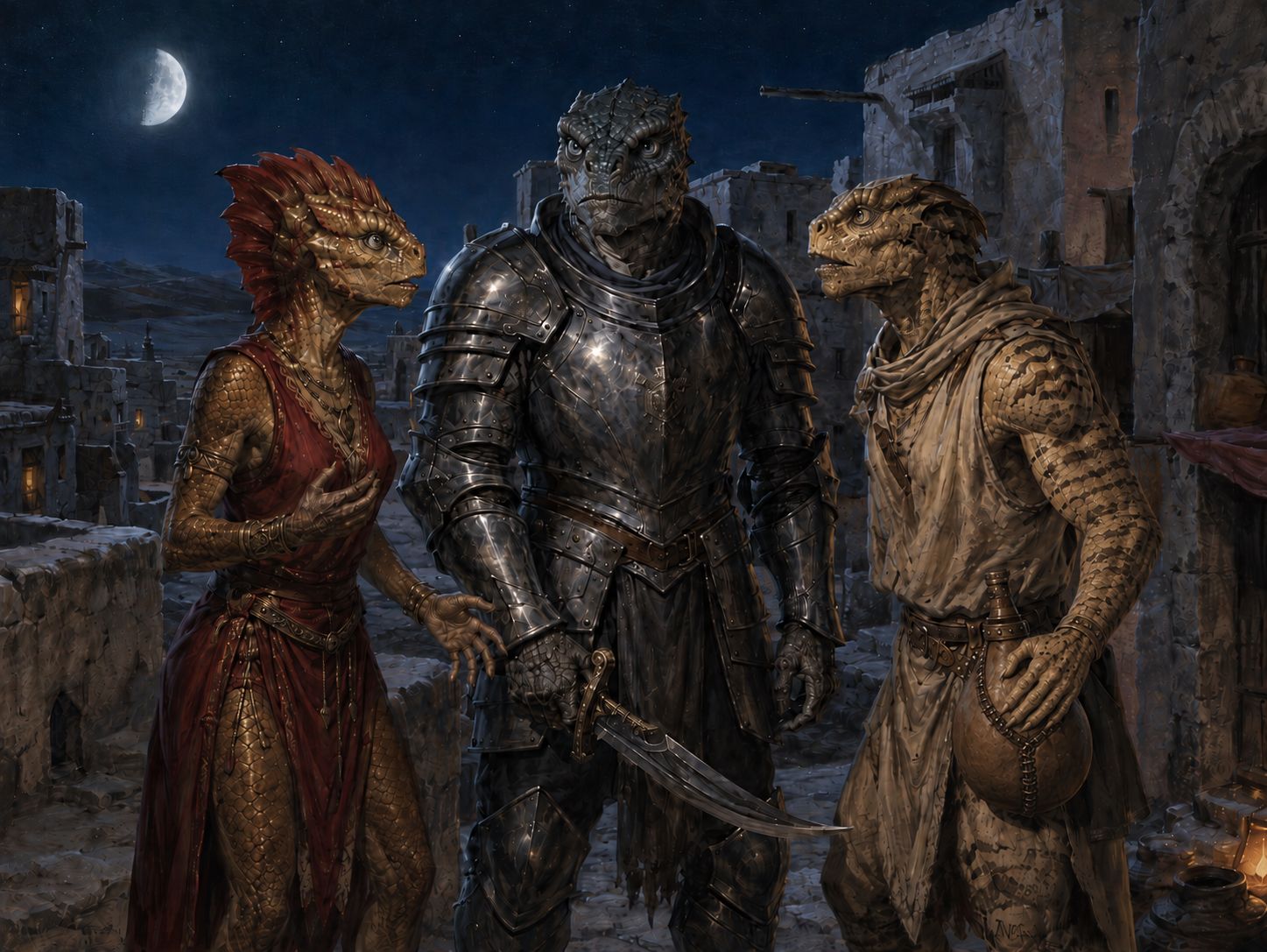
The desert beyond the walls became a black bowl filled with stars, and the village withdrew into narrow sounds. Cloth stirred. Varreks breathed heavily in their pens. Somewhere in the plaza, a Shar'zul shifted its weight and made the deck above it creak like an old ship.
The lizardmen moved slowly after dark. Not helplessly, not weakly, but with a stiffness that daylight hid. The knights remained armored, standing their posts with discipline, yet even Vorrak's turns were heavier. Even Rhazzi's stillness seemed less like stone and more like cold metal waiting for dawn.
Ileena noticed first, her sharp eyes penetrating the dark.
A shadow where no shadow had been. A scrape beneath an awning. A small orange bead of flame under a storehouse door.
Then the shouting began.
Fire climbed a wall in a sudden sheet. Villagers stumbled from doorways, coughing. Dunewind voices cut through the panic, sharp and practical. Someone screamed that the grain was burning. Someone else screamed because they had found the first body.
Isskhan was already in the east alley.
He had understood the night before anyone named it. He had known Rhazkor would not waste darkness on fear alone, and when the first flame rose, he was there between the bandits and the grain store, sword drawn, armor black against the fire.
The cold had slowed him. Blood warmed him again.
Three bandits lay dead at his feet before the alarm reached the plaza. A fourth tried to slip past him with a torch, and Isskhan cut him down against the storehouse door. The torch fell into the dust and died there. Smoke rolled over him. Firelight struck his helm. For a moment he looked less like a warrior than a gate given flesh.
Then Issreth's knife found the gap beneath his arm.
Isskhan staggered, but did not fall. He dropped his sword, seized the bandit by the throat and drove him back into the wall with both hands. The knife went deeper. Isskhan pressed harder. The bandit clawed at him, kicked, thrashed and choked, but Isskhan did not let go.
When the others reached the alley, they found him on his knees, head bowed, one hand still locked around Issreth's throat.
Both were dead.
Behind him, the grain store stood untouched.
The night filled with knives.
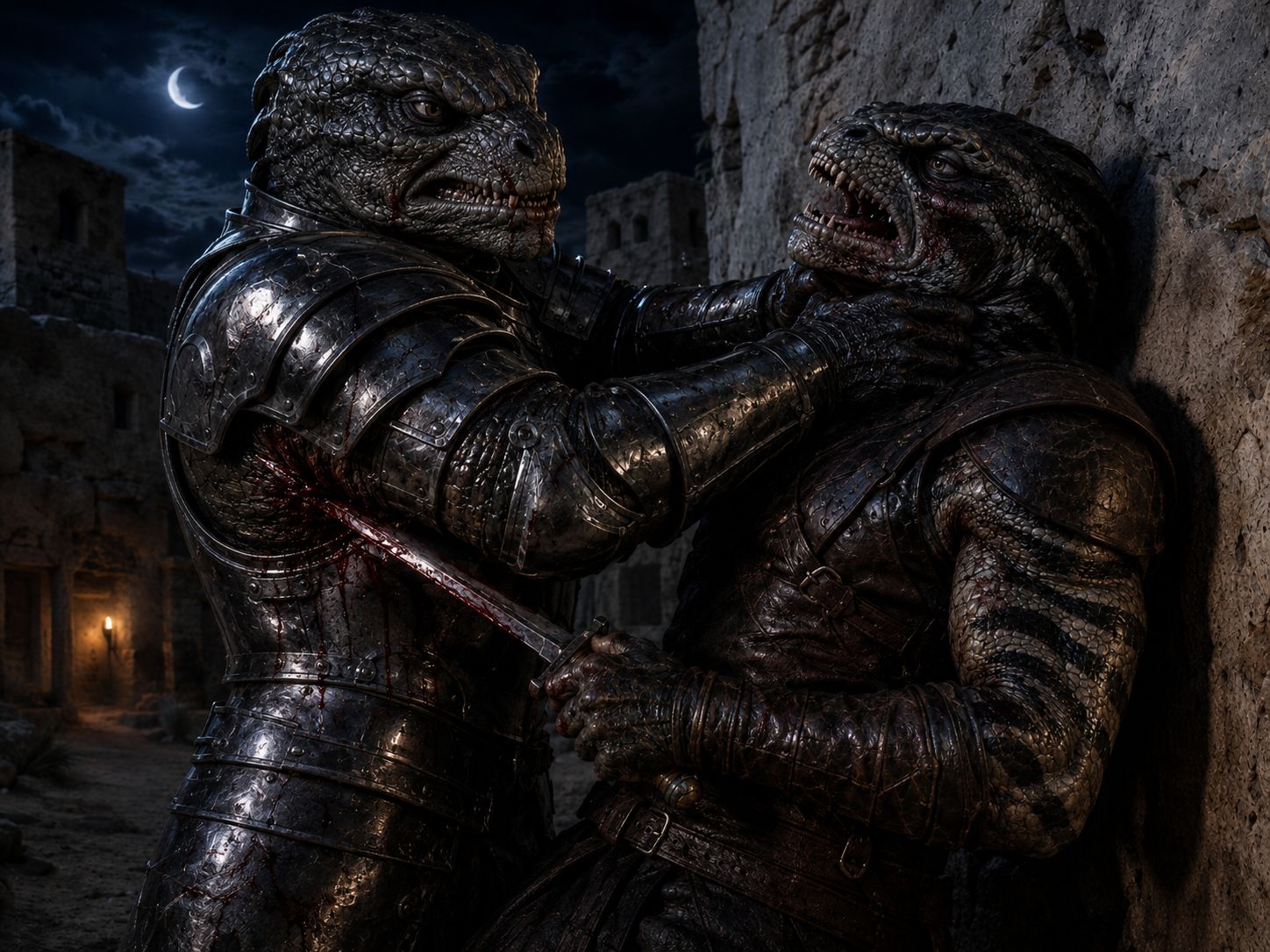
This is the moment the crew learn that the bandits understand the same weakness everyone else does. At night, cold slows the lizardmen. The knights are still dangerous, but reaction time matters in alleys and fires. Humans, Dunewind and the crew can move faster, think faster and respond sooner.
This confrontation should feel chaotic rather than grand. It is not a battlefield. It is smoke, shouting, dark alleys and sudden movement.
What the Bandits Are Doing
Issreth has led a small infiltration group into Zhess'r. They climbed a weak section of wall the scouts identified earlier.
Their goals are practical.
- They kill any isolated knight they find.
- They set fires near grain, roof routes and crowded sleeping spaces.
- They create enough panic that the villagers lose confidence in the wall.
- They escape if possible, but survival is less important than damage.
The bandits are not random murderers in this scene. They are saboteurs. Every act should either remove leadership, burn resources or spread fear.
Player Actions
The players are surrounded by problems that cannot all be solved at once.
- They may see a storehouse catch fire.
- They may hear fighting in an alley.
- They may find children trapped behind smoke.
- They may need to wake a slowed knight.
- They may have to choose between chasing infiltrators and saving food.
- They may need to protect Sada or a Dunewind group trying to drag supplies away from flame.
Do not make all of these mandatory. Choose what fits the players and where they are when the attack begins.
The Death of Isskhan
Isskhan does not die foolishly. He was in a position to counter the attack before anyone else, intercept the infiltrators and kills several before being overwhelmed. His death should feel like the loss of the person who might have out-thought Rhazkor.
If the players are nearby, they arrive moments too late. If they are far away, they see his body later, with clear evidence that he fought well even in the cold.
His death removes the village's best strategic mind and confirms that the bandits are targeting more than walls.
Shessra in the Fire
Shessra is active during the chaos. She does not fight, but she moves where fear is thickest and turns panic into tasks.
- She orders water lines.
- She assigns families to clear alleys.
- She commands people to save grain before homes if the choice must be made.
- She speaks harshly when needed.
This is a good place for Nephyla to see leadership as something ugly and necessary. Shessra will have to tell a crying villager that a burning house cannot be saved because the storehouse must be saved first. That moment will do more for Nephyla's development than any formal lesson.
After the Night Attack
By dawn, the fires are out. Some food has been lost, some saved. Several villagers are dead. Isskhan is dead.
The village is quieter now, and the silence is worse than panic. Everyone understands that the wall did not keep the enemy out.
Vorrak assumes a larger assault will follow. He calls for the defense of the three gates.
The Plan of Three Gates
Vorrak lays out the military problem in the central plaza, but Shessra translates it into village action. This distinction should remain visible.
Zhess'r has three gates. The North Gate faces the open desert approach. The Dust Gate opens toward the caravan road. The Stone Gate faces the old flood road toward the river, which lies beyond the village at a safe distance from seasonal flooding.
The remaining six knights are divided in pairs. They are not expected to hold forever. They are expected to delay, fall back and keep attackers committed long enough for the rest of the defense to move.
Hadi volunteers to drum signals from the highest building, a high granary beside the plaza, taller than the surrounding roofs and with lines of sight to all three gates.
Shessra refuses at first.
Vorrak laid three stones on the plaza floor.
"North Gate," he said, touching the first. "Dust Gate. Stone Gate."
Around him stood Shessra, Thassk, Rhazzi, Tikkar, Nasheem, Miraz, Sada and a handful of villagers who had not yet learned how to stop looking at the smoke stains on the walls. Hadi sat nearby with his drum across his knees, close enough to listen, too small for anyone to think of him as part of the council.
Vorrak placed two small pieces of broken pottery beside each stone.
"Two knights at each gate," he said. "Enough to delay. Not enough to hold."
Thassk nodded. "If Rhazkor strikes one gate, the other four knights can move and close from the sides. Villagers can assist with bows, spears and stones."
"If we know which gate he strikes," Nasheem said.
No one answered immediately.
The plaza seemed too large in the silence. Beyond the council, villagers carried water jars, dragged beams and stacked stones on rooftops. The Dunewind moved among them with tired precision. Everyone was preparing for a plan that did not yet exist.
Sada folded her arms. "A runner?"
"Too slow," Shessra said. "The alleys are crowded. If there is smoke, slower still."
"Flags from the roofs," Miraz said.
"At noon, yes," Nasheem said. "In smoke, dust or dusk, no."
The argument tightened, not loud, but hard. Every answer failed somewhere. A signal too slow. A signal too unclear. A signal blocked by smoke. A signal that worked only if the bandits behaved like fools.
Then Hadi spoke.
"I can do it."
No one looked at him at first. Not because they had not heard, but because everyone hoped he had meant something else.
Hadi stood, clutching the drum strap in both hands. His face did not look like a soldier's face. It looked like a boy trying not to blink.
Then he began to drum. One rhythm. Then another. Then a third.
"I can see all three gates from that roof," he said. "I can beat a different rhythm for each one."
"No," Shessra said.
Hadi swallowed, but did not sit down. "It will be loud enough."
"No," Shessra repeated.
Nasheem looked from Hadi to the granary, then to the three stones on the floor. He did not speak quickly. That made it worse.
"He is right," Nasheem said at last. "A drum carries farther than a voice. Faster than a runner. Clearer than shouting."
Sada began to speak, then stopped. That silence did more damage than any argument. Miraz looked at the granary, then at the gates, then at Hadi. Rashad cursed under his breath and turned away.
Vorrak lowered his head slightly. "He is right."
Shessra looked at the old knight with something close to anger. Then she looked at Nasheem, as if daring him to make it easier. He did not. Finally, she looked back at Hadi.
"You do not fight," she said.
"No."
"You do not leave the roof unless it is burning."
"No."
"If there is smoke, you keep beating."
Hadi nodded.
"If arrows strike the wall, you keep beating."
His fingers tightened on the strap. "Yes."
"If you are afraid, you beat the drum anyway."
Hadi swallowed. "Yes."
"Trust me, he never stops drumming," Ileena muttered quietly.
Shessra held his gaze for one more moment, then gave a single sharp nod.
Then she looked at Nasheem.
"And someone from your crew stays close enough to reach him."
Nasheem nodded. "Done."
Hadi looked proud.
Preparing the Village
Use the preparation phase to give players jobs. They do not merely wait for the next confrontation. The plan of three gates only works if the village is ready to move, signal, fall back and survive fire.
The gates need reinforcement. Carts, beams, stones and broken market stalls are dragged into place, leaving narrow gaps where knights can fall back without trapping themselves. The players can help decide which gates receive the strongest barricades, where the fallback lanes run and which alleys must stay clear.
The rooftops become fighting positions. Villagers carry baskets of stones upward, along with spare spears, water jars and cloth for smothering flames. The players can help place archers, check roof access, mark unsafe roofs and make sure Hadi's line of sight from the granary remains clear.
The plaza becomes the village's working heart. Sada and Shessra ration food, assign sleeping space and move the most vulnerable people away from the gates. Junia and Mira organize wounded stations in shaded doorways near the wells. The players can carry supplies, calm frightened families and keep useful people from being swallowed by panic.
The fire plan matters as much as the battle plan. The bandits have already shown what they can do with flame. Villagers tear down awnings where fire can jump between buildings, soak cloth near the storehouses and prepare bucket lines from the troughs. Anyone who thinks only about weapons is missing half the fight.
This is also a good place to make the village feel inhabited. Let the players meet people who will later be hurt or saved. Dheras the potter carries stones to the roof with arms made strong by clay and kiln work. Vassik the date trader guards his last sacks with shaking hands. Marrat the carpenter knows where old beams are stored and complains about every one that is wasted on barricades. Children stare at Hadi as if he has become something larger than himself.
Third Confrontation: The Drum Falls Silent
The first rhythm rolled across Zhess'r like a second heartbeat.
Three deep beats. A pause. Three again. North Gate.
Hadi stood on the granary roof with the drum strapped tight against him, small against the white sky and the open desert beyond the wall. Dust rose outside the North Gate, where bandits came hard over the sand, steel flashing between the beams of heat.
Nasheem heard the beat and turned at once.
"North Gate," he said, calm enough that the words cut through panic better than shouting. "Stones up. Spears behind the carts. Keep the lane clear."
Villagers surged toward the rooftops. Dunewind hands passed baskets upward. Sada barked at two men until they stopped arguing and started carrying water jars. At the gate, Krazh and Tikkar took position in the gap, heavy with steel, Varreks hissing beneath them.
The bandits hit the barricade like a wave of teeth and leather.
For a moment, the plan worked.
Stones fell from above. Spears thrust between cart wheels. Nasheem moved through the street below the roofline, sword drawn but low, guiding people with gestures, words and the sheer force of refusing to hurry. A panicked trader stumbled into the fallback lane. Nasheem caught him by the shoulder, spun him aside and pointed toward the plaza.
"Not there. There. Live first, apologize later."
Above him, Hadi kept drumming.
Then Ileena's head snapped toward the Stone Gate.
Her ears flattened beneath the hood. Her tail lashed once.
"Wrong hunt," she hissed.
Nasheem looked up.
The drum changed.
Fast beats now. Sharp. Urgent. Stone Gate. Stone Gate. Stone Gate.
For one breath, no one understood. Then the second dust cloud rose beyond the far wall, half hidden by the old flood road toward the river. More bandits. More than the first. The North Gate was bait.
Nasheem's face hardened.
"Stone Gate!" he shouted. "Move!"
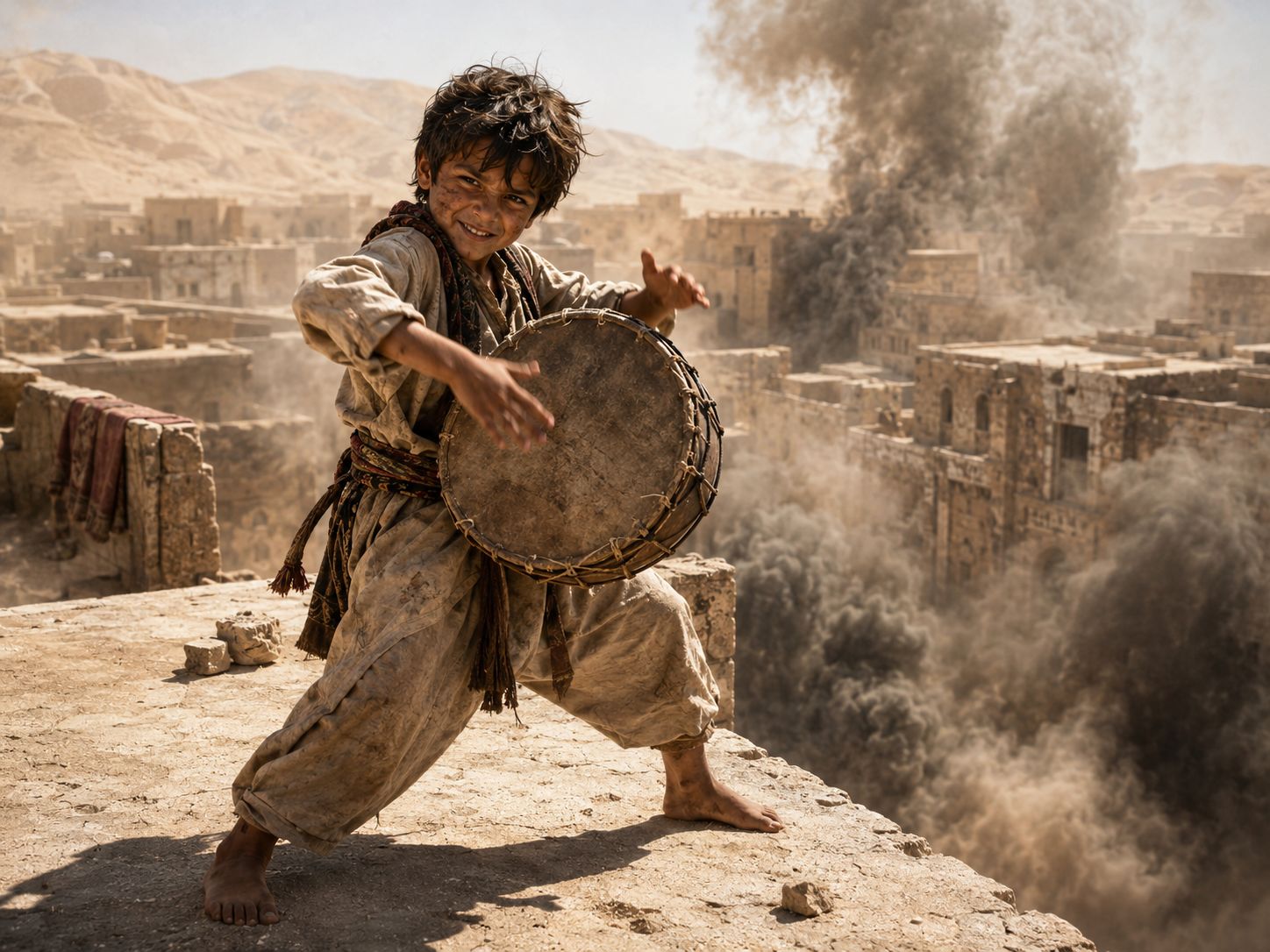
This is the major battle of the arc. It should feel planned at first, then increasingly unstable. The crew should experience the difference between a good plan and a plan under pressure.
The bandits are not simply attacking a gate. They are attacking coordination. Hadi's drum is the center of the village defense, and Rhazkor sees it for what it is.
The False Attack
The first assault looks convincing. The bandits send enough riders and foot attackers at the North Gate to force a response. The knights there are pressured but not overwhelmed. Villagers throw stones from rooftops. The crew can help by reinforcing barricades, striking attackers from above, hauling wounded back or keeping nervous civilians from crowding the fallback lanes.
Let the players feel that the plan is working.
The Real Attack
Ileena saw the arrow before anyone else did.
A dark flicker crossing the white glare. Wrong angle. Wrong prey. Her head snapped upward just as it struck the granary roof.
Hadi jerked back and vanished.
The drum stopped.
For one heartbeat, the whole village seemed to miss its next breath.
Someone shouted North Gate. Someone else shouted Stone Gate. Both were right, and that made it worse.
Nasheem looked up, face suddenly empty of everything but calculation.
Then Junia saw the roof.
Her hands flew to her mouth. "Hadi."
She did not move. Not at first. The shock pinned her where she stood, eyes fixed on the empty edge of the granary where the boy had been a moment before.
Ileena did move.
She crossed the street in three quick steps, seized Junia by the wrist and pulled hard enough to make her stumble.
"You're needed," Ileena said.
Junia blinked once. The healer returned before the fear left her face.
"Where?"
Ileena was already dragging her toward the granary stairs.
"Up."
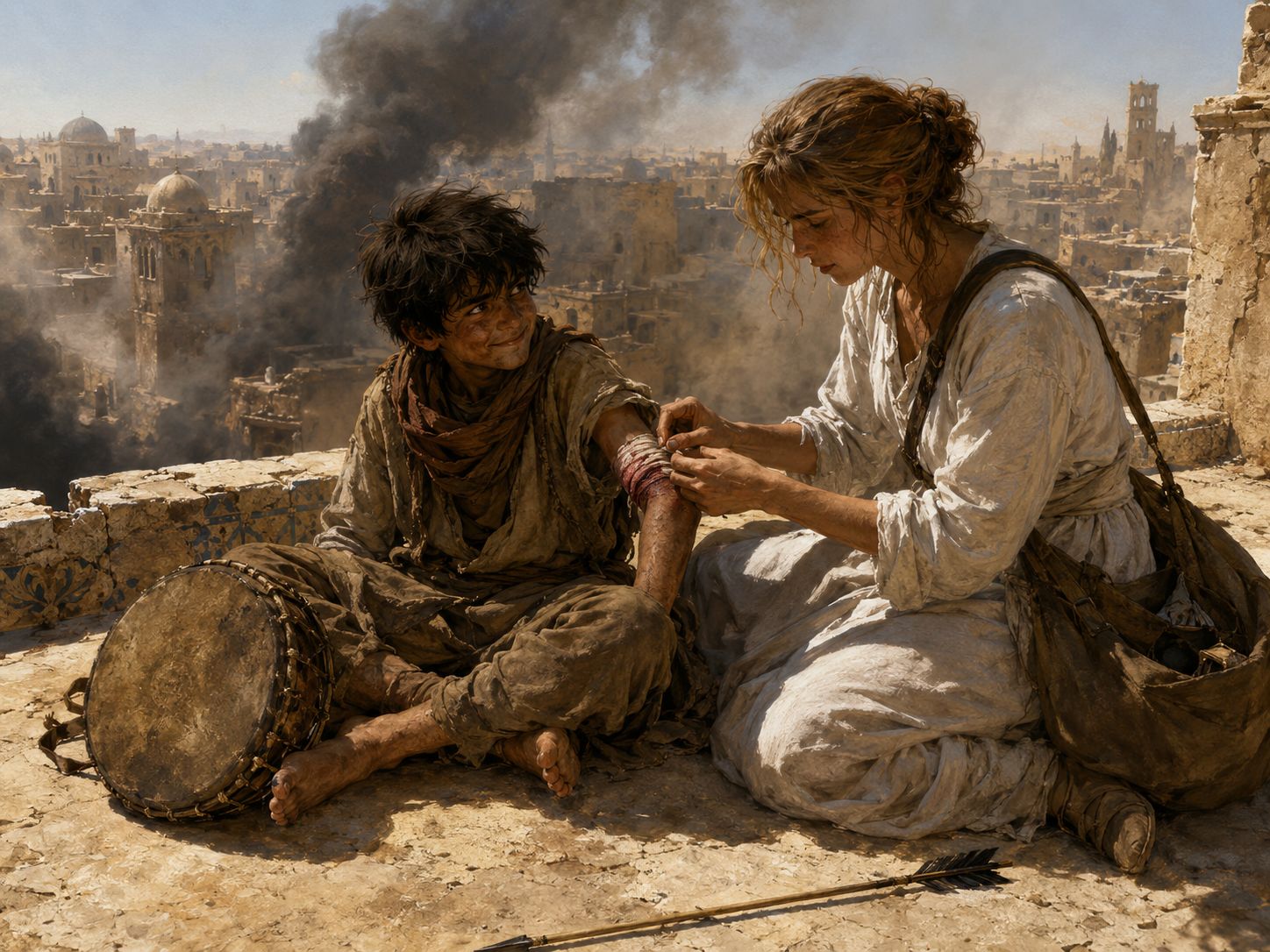
The real assault comes at the Stone Gate, where the terrain outside allows attackers to gather partly hidden in a rocky wash. Hadi sees them because of his height. That makes him essential.
When he changes the rhythm, the defense begins to shift. Knights move. Villagers shout. Dunewind runners cut across the plaza. The plan is still alive.
Then Hadi is hit by an arrow.
The silence lands hard. Not because everyone believes he is dead, but because no one knows what is happening.
Reaching Hadi
This is one of the best player agency points in the arc. Do not specify one solution. The crew must reach Hadi, bring aid to him, get him down, protect the stair, take up the drum or find another way to restore communication.
Complications can include smoke, panicked villagers, bandit arrows, a blocked stair, a wounded guard below the watch-house or a bandit trying to climb after him.
Junia is the strongest obvious healer, but not the only answer. Mira can bind the wound. Another crew member can stop the bleeding.
The goal is not only to save Hadi. The goal is to keep the defense from losing its eyes.
Krazh at the Diversion Gate
Krazh did not hear the drum change.
Or he heard it and the battle in front of him answered louder.
At the North Gate, the diversion should have broken away once its purpose was spent. Instead, it found Krazh waiting in the gap, enormous in his battered armor, Varrek screaming beneath him, sword rising and falling like a butcher's moon. He did not fight like Rhazzi, clean and exact. He fought like a storm trapped inside steel.
A bandit climbed the cart barricade. Krazh smashed him back down with the rim of his shield. Another came under the Varrek's neck with a hook spear, and Krazh leaned from the saddle, caught him by the throat and hurled him into the gate stones hard enough to crack bone. Arrows struck his armor. One found the meat under his arm. Another sank into his thigh. He laughed then, or roared, or made some sound too full of blood to be either.
Tikkar shouted from behind him, "Krazh! Stone Gate!"
Krazh turned at last.
The North Gate was still standing. The villagers above it were alive. The bandits before it were broken, crawling, fleeing or dead.
Krazh dragged his Varrek around, but the beast tilted and went down after three steps, blood pouring from its neck. Krazh tore himself free of the saddle and staggered on foot, one hand pressed to his side, sword dragging against stone behind him.
Across the plaza, the real battle screamed.
He tried to reach it.
He made it halfway.
His knees struck the ground near the well troughs. For a moment, impossibly, he pushed himself up again. His helm turned toward the Stone Gate, toward the place where he was needed, where Vorrak still fought, where Kess had not yet fallen.
"Hold," Krazh rasped, though no one knew if he spoke to them or to himself.
Then the wildhead fell forward onto the stone.
Blood spread beneath him, dark and fast.
At the North Gate, the people he had saved were still alive.
At the Stone Gate, the fight went on without him.
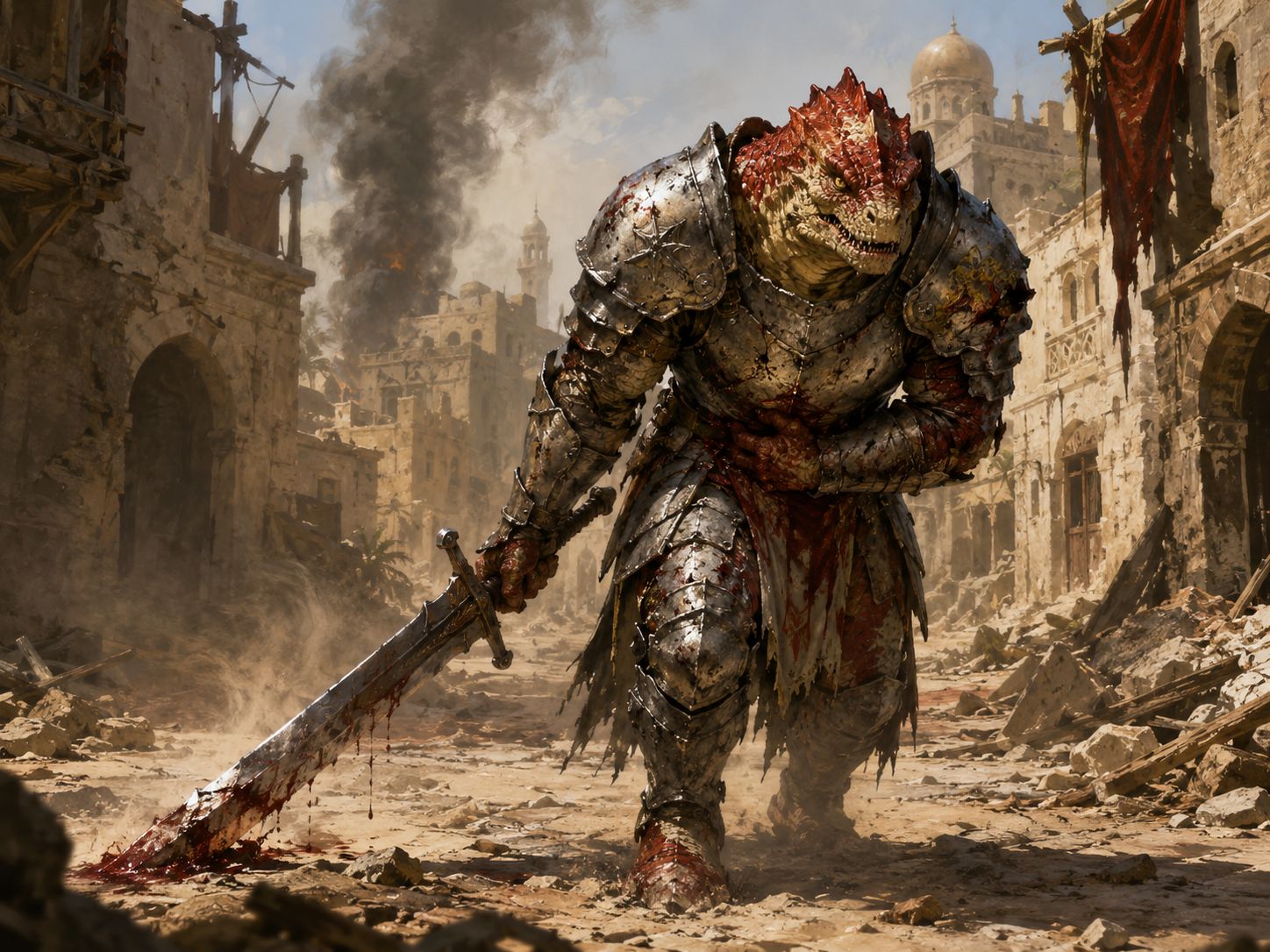
Krazh, the wildhead, dies because of who he is. The diversion is still an attack. It cannot be ignored. He stays too long at the false attack, not because he is stupid but because the fight grips him, and someone needs to do it. He sees enemies in front of him and destroys them. The villagers at that gate survive because of him, but his fury costs him the chance to reach the main battle in time.
When he finally turns toward the Stone Gate, he is already badly wounded. Let the players see him crossing the plaza or a side street, armor dented, blood trailing behind him, still trying to run. He falls before reaching the place where he was needed.
This death should be painful because it is both failure and success. He saved people. He also could not become what the larger battle needed.
Vorrak and Kess
Vorrak knew the gate was lost before anyone else did.
Not the village. Not the battle. The gate.
The Stone Gate had become dust, screaming and bodies pressed too close for courage to look clean. Varreks snapped and reared in the crush. Bandits climbed over their own dead to reach the gap. Vorrak stood in the center of it, old armor dark with blood, shield locked forward, sword moving with the tired certainty of a lifetime spent doing exactly this.
Beside him, Kess fought too fast.
Too eager. Too close.
"Back," Vorrak growled. "Fall back to the plaza."
Kess struck a bandit across the face and did not turn. "No."
A spear hit Vorrak's shield hard enough to drive him half a step down. He answered with a cut that opened the attacker from throat to chest, then shoved the corpse into the press.
"Kess!"
The young knight looked at him then. Only for a heartbeat. Dust streaked his scales. Fear stood plainly in his eyes, but so did something harder.
"You taught me where to stand."
Then the bandits came again.
For a little while, old steel and young fire held the gate together.
Vorrak killed with no wasted motion. Kess moved around him like a blade around an anvil, striking where the old knight made openings, covering the side he could no longer turn toward quickly enough. Together they made a wall out of two bodies.
But walls break.
A hook caught Vorrak's shield and dragged it low. Another spear punched into the joint above his hip. He killed the spearman. A blade struck his helm. He killed that one too. Then three bandits hit him at once, and the old knight finally went down beneath them.
Kess roared.
Not a word. Not a name. Just a sound torn raw from the chest.
He threw himself over Vorrak's body and fought on foot, shield lost, sword in both hands. The bandits surged at him, and he met them like grief given teeth. One fell. Then another. A third stumbled back with his throat open. Kess stood above his teacher and would not move.
Behind him, the defenders were coming. Nasheem's voice cut through the dust. Villagers shouted. Stones began to fall from the roofs. The line was reforming.
Kess saw none of it. Blood ran from the seams of his armor. He dropped to one knee, rose again, and struck until the sword slipped from his hands.
Kess sank down beside Vorrak, one hand searching blindly until it found the old knight's armor.
The Stone Gate held.
Kess did not.
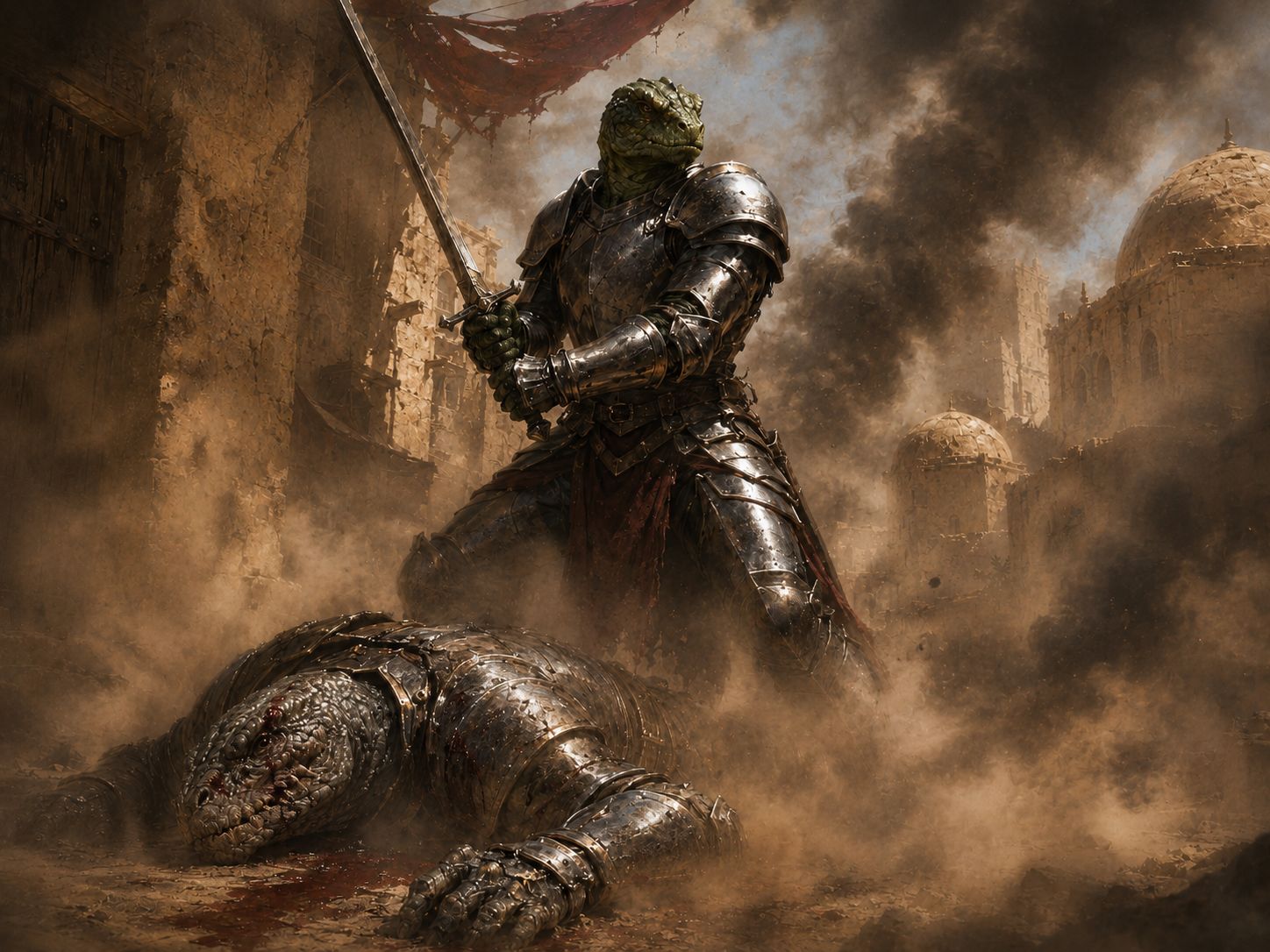
At the Stone Gate, Vorrak and Kess hold the line while the defense reforms. Kess refuses to abandon his teacher. Vorrak orders him back. Kess may ignore it.
Their deaths should be seen in fragments, especially if the players are occupied saving Hadi or fighting elsewhere.
- A glimpse of Vorrak's helm above the crush.
- Kess pushing into the gap.
- A Varrek screaming.
- Steel vanishing under bodies.
- The old knight still standing after he should have fallen.
- Then nothing visible but dust and movement.
Do not turn their deaths into a long duel unless the players are directly there. The battle should feel too large to fully witness.
The Bandits Withdraw
The bandits do not retreat because they are defeated utterly. They retreat because the experiment is complete. Rhazkor has tested the village's new defense and learned what he needed. The drum matters. The villagers can move faster than expected. The crew and Dunewind are not passive mouths behind the wall. The knights can still hold a gate, but only at terrible cost.
He does not mourn the dead bandits. He spent them to measure the wall, and the wall answered.
By the end of the confrontation, four knights are dead. Isskhan died in the night. Krazh, Vorrak and Kess die in the battle. Only Thassk, Tikkar and Rhazzi remain.
Hadi lives. His arm is wounded. He is frightened, pale and possibly angry in the confused way of a child who has done something brave and been hurt for it.
Aftermath of the Broken Assault
The village did not cheer when the bandits pulled back.
No one had enough breath for it.
The wounded filled the shaded side of the plaza. Junia worked with anyone who could hold cloth, boil water or follow instructions. Sada moved through the crowd with a list in her head and blood on one sleeve, sending people to carry, fetch, bind, dig and stop crying until there was time for it.
Hadi sat against a wall with his arm bound tight, eyes fixed on nothing. His drum lay beside him.
Shessra knelt near a dead potter and spoke to the man's daughter. The girl could not have been more than ten. Shessra did not say the words softly enough to make them harmless. There was no way to make them harmless. She said what had happened. She said who would take care of the kiln. She said where the girl would sleep tonight.
Nephyla watched from a few paces away, face still beneath dust and silver. She could not bring herself to say the rehearsed words.
This was leadership stripped of gold. No throne. No priests. No hymns. Only names, bodies, food, fear and the next thing that had to be done.
The aftermath should linger long enough to matter. Zhess'r has survived, but it has lost much of what made survival feel possible.
Shessra's role here is central. She must keep grief from becoming paralysis. She may be harsh. She may be unfair in small ways because there are too many needs and not enough mercy. That makes her more believable, not less sympathetic.
The Dunewind share food with the village. This is not a sentimental feast. It is rationing under pressure. Sada and Shessra will argue hard over numbers before agreeing, but it is mostly a formality, they can both see plainly what the need is. Miraz supports the decision because there is no longer a meaningful separation between "their people" and "ours" inside the walls.
Nephyla should see the cost of command. If she speaks with Shessra, Shessra should not offer a lesson. She is too busy. That is the lesson.
Fourth Confrontation: The Last Charge
At dawn, only three knights stood in armor.
Thassk, with dust gathered in the seams of his plates and eyes turned toward a future no one else wanted to name.
Tikkar, too young to hide his fear properly, smiling at children who were old enough to know he was doing it for them.
Rhazzi, silent as a sealed tomb, sharpening a blade that had not dulled.
Shessra met them at the gate. No crowd had been called, but people gathered anyway. Villagers. Dunewind. Crew. Hadi stood with his arm in a sling, pale and furious that no one had asked him to drum.
"Three cannot hold the village," Thassk said.
Shessra's mouth tightened. "No."
"Then three must buy what three can."
Tikkar looked toward the bandit camp. "We cannot win."
Rhazzi slid his sword into its sheath. "We cannot win, but we can fight."
No one answered that.
The gate opened.
The last three knights of Zhess'r rode out.

This confrontation removes the last knights but gives their deaths a tactical purpose. It should feel like an act of honor, but not a mindless one.
The knights know the bandits will attack again. They also know the village cannot hold if the bandits attack before help arrives, assuming help arrives at all. Their charge is meant to disrupt the siege camp, ruin preparations and buy time.
The Decision
Thassk proposes the attack calmly, without eagerness. His philosophy is practical here. A life held too long can become useless. A life spent at the right moment can change the shape of the day.
Tikkar voices fear and reason. He is not a coward. He says what everyone knows. Three against many cannot win.
Rhazzi answers with the hard truth. They do not need to win. They need to make the enemy late.
Shessra does not command them to go. This matters. She accepts their choice because she understands it. For Nephyla, this is another leadership moment. Sometimes authority means allowing a sacrifice you did not order because refusing it would waste what is being offered.
The Charge
The charge should be seen mostly from the walls. The crew is unlikely to ride with them unless the table forces it, and the arc works better if the crew watches the knights do something only knights can do.
The three knights hit the bandit camp before the bandits are fully arranged for attack. Their goals are visible.
- They kill Varrek handlers.
- They scatter mounts.
- They break spear bundles.
- They burn prepared arrows.
- They strike command points and create confusion.
Rhazkor responds by pulling warriors back to contain them. Krozhan moves to meet Rhazzi in the broken ground.
The Deaths
Tikkar dies first. He is afraid, but not intimidated. Once the charge hits the camp, the fight takes hold of him. He sees enemies breaking toward the scattered Varreks and rushes after them, too far, too fast, too alone. He kills the first. He drives the second back. Then the bandits close around him. His death is brave without pretending fear vanished. He dies doing the right thing with too little experience to know where the edge of the right thing lies.
Rhazzi dies in the center of the camp, surrounded by bodies. He should be terrifying to the end. Krozhan will help bring him down through dirty tactics, not by beating him cleanly. A thrown net to trap his movement. Rhazzi dies because war is not a duel.
Thassk lasts longest. He rides not toward the greatest kill, but toward the thing that buys the most time. Perhaps he sets fire to the bandit supplies, then turns to face the bandits. His final moments should feel chosen. He understands exactly what he is buying.
From the Walls
The crew, Dunewind and villagers should watch in helpless awe and dread. This is not a place for cheering. People whisper names. Hadi, for once, is silent. Shessra stands completely still, because if she moves she will break.
Nephyla sees that warriors can die without controlling the outcome. This is important for her. Heroic sacrifice does not make the world obedient. It only gives others a chance.
The Night After
When the dust settles, Zhess'r has no knights.
The bandits were meant to attack at noon. The charge ruins that attack. Their Varreks are scattered, their prepared arrows are burned, their assault bundles are destroyed and their command structure is disrupted. Rhazkor does not abandon the siege, but he must rebuild the assault from broken pieces.
The village gets one more night.
It is not a peaceful night. It is a night of waiting without protectors. Everyone knows what comes next. The bandits will return at noon, when blood is warm, muscles are quick and the last defenders have nowhere left to hide.
The Crew Takes Up the Empty Space
This is where the crew and Dunewind must step forward. They cannot become knights. They should not be framed as equal replacements. Their strength is different.
- They organize watches because human eyes and human bodies remain quick in the cold.
- They reinforce gates with carts, stone and broken beams.
- They help position villagers on rooftops.
- They move food and water to places where defenders can reach them.
- They create fire breaks.
- They place wounded in safer buildings.
- They keep children away from the walls.
- They support Shessra when people begin asking whether surrender is possible.
The Game Master should give the crew real tasks here. This section is the emotional and practical proof of the arc's theme. The great warriors are gone. The smaller people must make the survival possible.
Fifth Confrontation: Dust on the Horizon
Noon returned like judgment.
The bandits came with everything.
Not probing this time. Not testing. Not measuring. Every rider, every foot fighter, every blade Rhazkor still commanded came out of the heat and dust in one wide, ugly surge. Leather armor. Hooked spears. Hooks for tearing down gates. Shields patched from stolen wood. Varreks shrieking as they were driven forward under the full sun.
At the North Gate, the first barricade split.
A cart overturned. A beam snapped. The gate mouth filled with dust and bodies as bandits forced their way through. For one moment the defenders held them there, packed tight between stone walls, but then a Varrek reared over the wreckage and came down inside the village.
Someone screamed, "They are through!"
The words broke something.
Villagers stumbled back from the roofs. A water line collapsed as people scattered. One of the wounded stations emptied into panic. The bandits poured through the broken gate, not many at first, but enough. Enough to be inside. Enough to make the wall meaningless.
Shessra stood in the plaza, pale and rigid, watching the shape of the village come apart.
Nasheem reached her side, sword red to the hilt. "Where do you need us?"
For a heartbeat, she did not answer.
Then her jaw tightened.
"The plaza," she said. "If they take the plaza, they take everything."
The bandits came on.
There was no line now. No plan. No knights. Only exhausted people and children, waiting for the final blow.
Then Tarek shouted from a rooftop.
"Dust!"
No one listened at first. There was dust everywhere. Dust from the gate. Dust from the broken carts. Dust from feet, claws, hooves and death.
Then the bandits began to turn.
Beyond them, out past the broken North Gate, a new cloud rose across the sand. Too straight for wind. Too fast for traders. Too ordered for panic.
Varreks.
Steel.
Banners.
The knights of Ssa'zulul came out of the haze like the end of the world arriving for someone else.
Twenty armored riders thundered over the sand, the sun flashing from their plates, their formation tightening as they struck the rear of Rhazkor's force. The bandits trapped inside the village heard the impact before they understood it. The sound rolled through Zhess'r like a wall collapsing.
This time, the panic belonged to them.
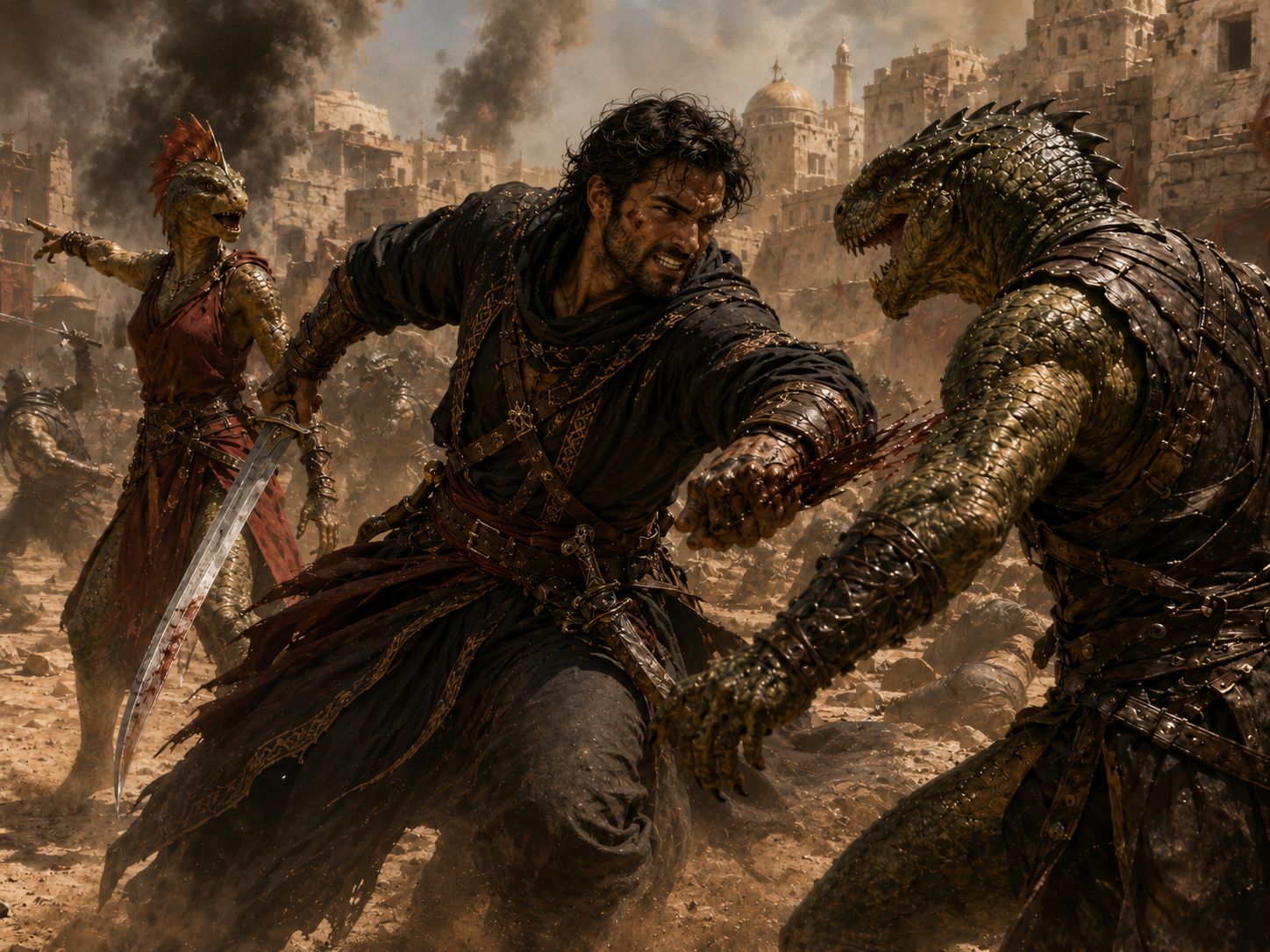
This is the release of the countdown. It should feel almost impossible when it happens, but it must also feel earned. The village survived long enough. The messenger reached Ssa'zulul. The last charge bought time. The crew and villagers held the empty space.
The rescue should not erase the cost. It comes after the seven are dead, after Hadi is wounded and after the village has nearly broken.
Before the Dust
Let the bandits prepare openly. This is psychological warfare. They know the knights are gone. They want the village to watch its death organize itself. Rhazkor will offer mercy if the village surrenders, but no one believes it.
The defenders should be exhausted. This is a good moment for small details.
- A villager making an improvised spear.
- A Dunewind child carrying stones because no one has the heart to stop her until Sada does.
- Nephyla helping move water jars without being asked.
- A player character standing where a knight stood the day before.
- Shessra walking the line without promising victory.
The Arrival of Ssa'zulul
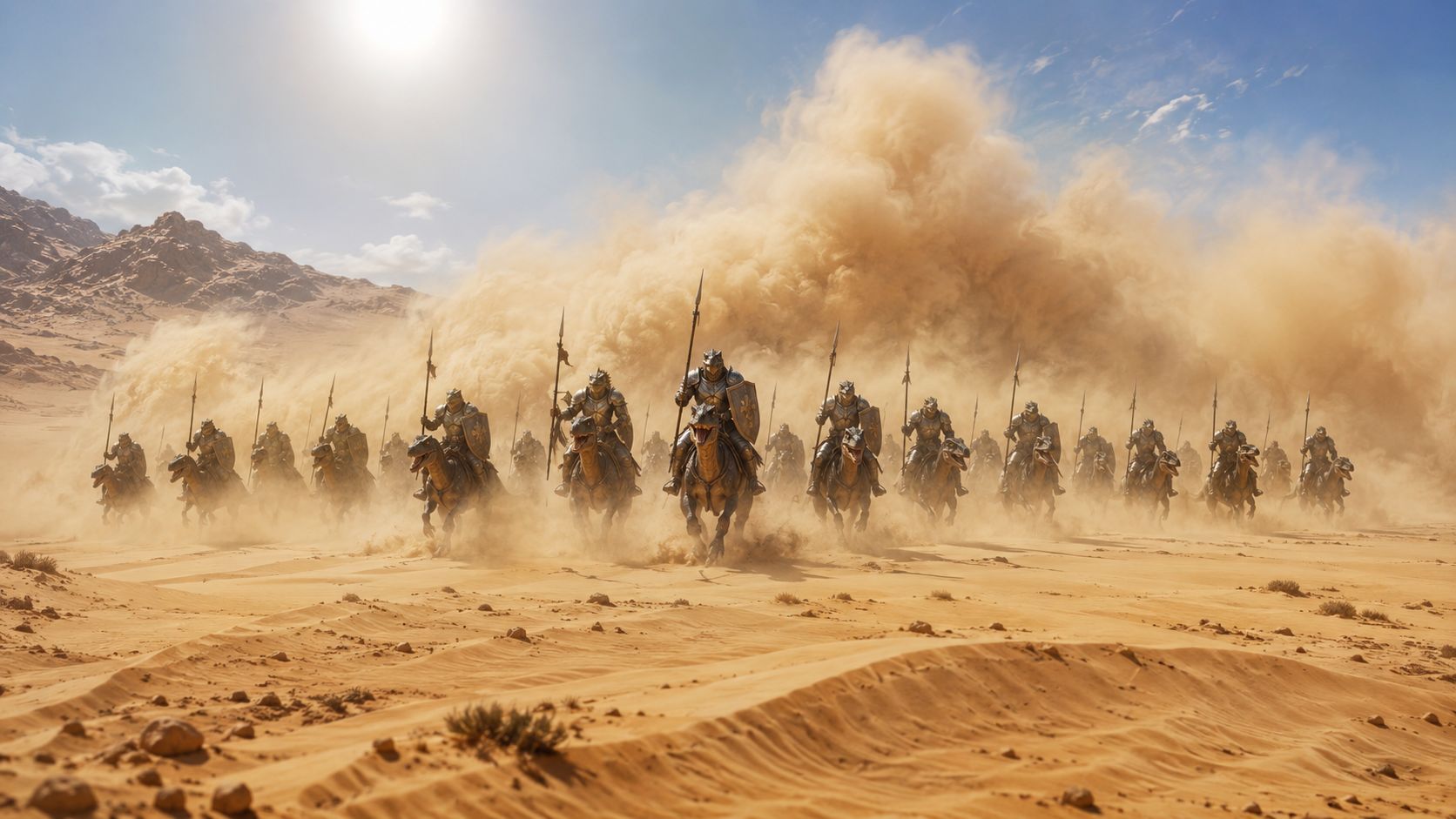
The final attack begins before help arrives. The bandits break through one gate and force the defenders back toward the plaza. This is the moment when the village feels lost. The wall has failed, the knights are dead and the last defense forms around the wells, storehouses and children. The dust cloud appears only when defeat has already entered Zhess'r.
The rescue force becomes visually unmistakable once the dust resolves. Twenty Ssar'et knights on Varreks, armored in heavy steel, thunder across the sand in formation. Behind them comes the leader of Ssa'zulul, Vazheera, with her attendants and guards, close enough to command, but not part of the charge. The knights arrive as the blade. She arrives as the hand that sent it.
They do not arrive as a neat parade. They arrive at speed, crossing the sand in formation.
The bandits try to adjust, but they are badly positioned. Their camp has been damaged. Their morale depends on attacking a knightless village, not facing a fresh knight force. Rhazkor may attempt to withdraw in order, but panic spreads faster.
The arriving knights destroy the bandit formation. This is best described in broad strokes rather than played as a detailed battle. The important point is that Rhazkor's advantage was always siege, patience and dishonor. Once forced into open ground against prepared knights, he loses.
The Messenger Returned
Vhessik is carried behind the Ssa'zulul knights on a spare Varrek, half conscious, lips split, one leg bound from ankle to thigh. His survival is not glamorous. He looks like someone who paid for every step.
Shessra acknowledges him publicly. Not with a grand speech, but with a simple statement that makes the village understand what he did.
After the Battle
Zhess'r survives.
The relief should come slowly. At first, people do not believe they are allowed to stop. Then someone sits down. Someone begins to cry. Someone laughs once and is ashamed of it. The Shar'zul shift in the plaza. Water is poured. The dead remain dead.
The knights of Ssa'zulul will ask for the names of the seven. This is the beginning of the legend.
Shessra tells her people to rest for a short while. Then they have heroes to bury, bandits to burn and a village to rebuild.
Seven Knights
After hearing the story of the defense, seven knights of Ssa'zulul go to Shessra before the gathered village. They do not offer pity, and they do not speak of replacement. They kneel because they have heard how she held Zhess'r together, how she accepted sacrifice without hiding from its cost and how she kept faith with villagers, guests and warriors alike. To the Zhorai, such honor demands allegiance.
Vazheera does not forbid it. She hears their oath, studies Shessra for a long moment, then gives a single approving nod. The choice is not a loss to Ssa'zulul, but recognition of what Shessra has proven herself to be.
By sunset, Zhess'r has seven knights again.
Not the same seven. Never that.
But seven who chose Shessra with open eyes.
Farewell to the Dunewind
Hich'ma nosed at Thaleia's sleeve with trembling antennae.
The young Shar'zul had grown since the hatching, though not enough for Thaleia to stop thinking of her as impossibly small. Her pale plates were hardening into sand-colored armor, and her harness already bore the scuffs of travel. Yet when Thaleia touched the smooth curve of her head, Hich'ma stilled the way she had on the night she first crawled across the singing circle and chose her.
Thaleia tried to say something sensible.
Nothing came out.
"Oh, don't do that," she whispered, though Hich'ma had no eyes to plead with. "You are making this impossible."
Rashad stood nearby, arms folded, face stern and voice softer than usual.
"I will take good care of her."
"I know," Thaleia said too quickly. "You know every harness knot, every feeding sound, every little foot twitch. I know."
Hich'ma brushed her antennae against Thaleia's wrist.
Thaleia's eyes filled at once.
Rashad cleared his throat. "I need something from you. Cloth, worn close to the body."
Thaleia blinked. "Rashad."
He looked confused. "Yes?"
"Are you asking me for my undergarments?"
For one terrible moment, neither of them moved.
Then Rashad's face tried to become angry, embarrassed and horrified all at once.
"No," he said, far too loudly. "No. A scarf. A sleeve strip. Anything with your scent."
"My scent?"
"Shar'zul learn by smell," he muttered, glancing around as if praying Danya had not heard. "She knows you. Something that smells of you makes the change easier. Less searching. Less calling."
Thaleia stared at him.
Then she laughed, unevenly, half tears and half relief. She hugged him before he could retreat. Rashad froze, then patted her once on the back with the grim care of a man handling glass.
Thaleia untied the soft inner scarf from beneath her sun wrap and placed it in his hands.
Then she knelt before Hich'ma and stroked her head slowly.
"You are good," she whispered. "You will grow into a great Shar'zul, and you will safely carry tents, water and people across the desert. Probably several people who do not appreciate your excellence."
Hich'ma made a soft clicking sound.
"Yes," Thaleia said, voice breaking. "Exactly."
Rashad tucked the scarf into the hatchling's harness. Hich'ma tasted it with her antennae and settled.
Thaleia rested her forehead against the smooth plate of Hich'ma's head.
For once, she had no notes to take.
Only a goodbye.
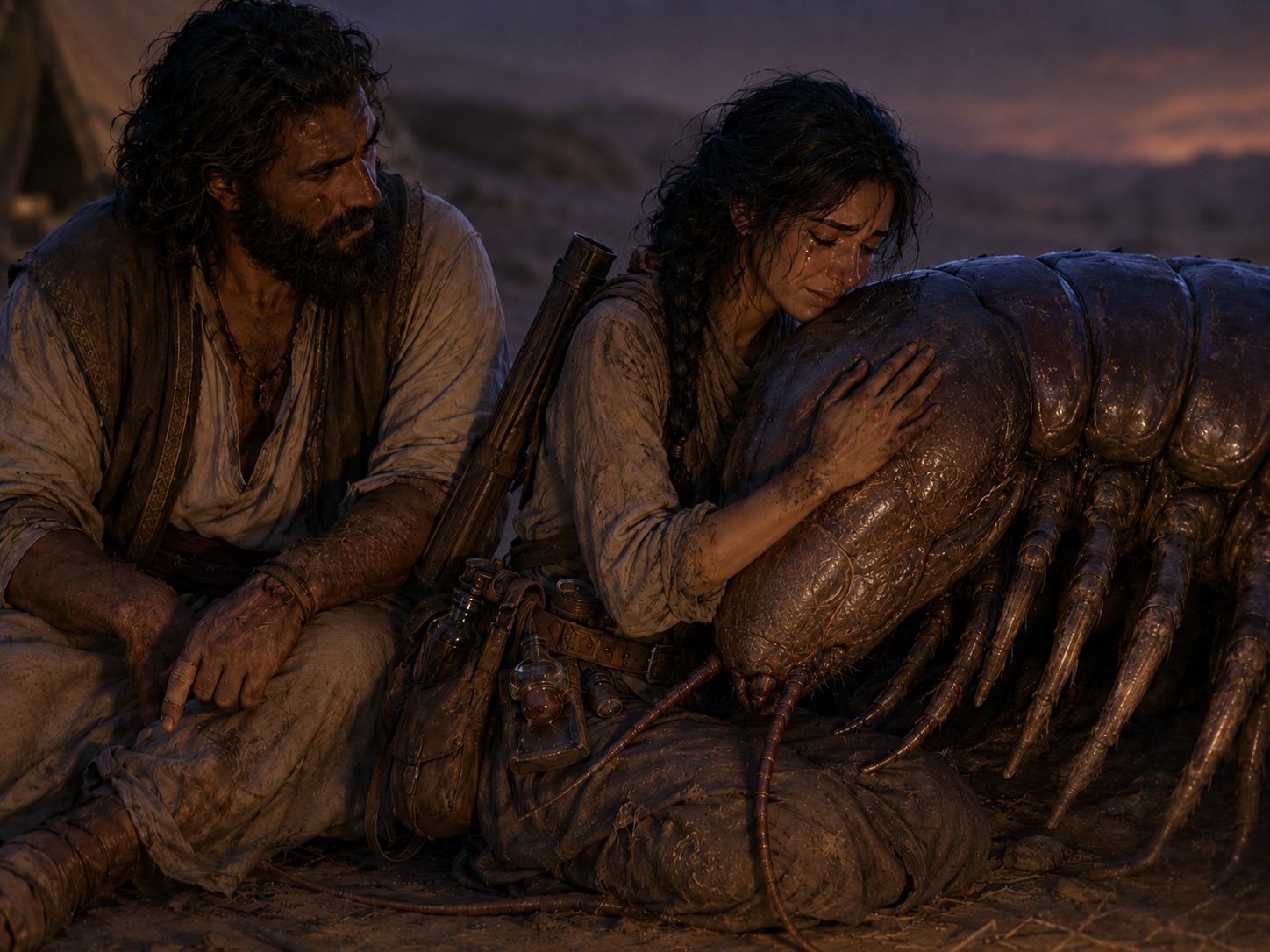
The farewell should close the Dunewind relationship and let the emotional consequences of the siege settle. It should not feel like a neat celebration. The Dunewind and the crew have survived too much together for a simple goodbye.
This section should also give Hadi's arc its emotional resolution and give Nephyla one last reflection point before leaving Ssar'et.
Hadi's Choice
The morning after survival did not look heroic.
It looked like broken beams, blood scrubbed from stone, smoke stains on pale walls and people too tired to speak loudly. It smelled of dust, boiled grain, wet cloth and old fear.
The Dunewind prepared to leave in the slow, careful way of people who had nearly become part of the place they were departing. Cargo was counted. Harness was checked. Shar'zul were watered until Rashad was satisfied, which meant long after everyone else thought they were done.
Hadi sat on a low wall near the plaza, arm bound, drum beside him. For once, he did not beat it. He watched the knights of Ssa'zulul move through the village in heavy steel, calm and magnificent, while villagers lowered their heads as they passed.
"I think I will be a knight," Hadi said.
He said it with the simple certainty of a child deciding that tomorrow he might become a sailor, a king or a bird if the mood struck him. There was no weight in it for him yet. Only shine. Armor. Courage. People speaking names with awe.
Around him, the adults went still.
Sada's mouth tightened. Miraz looked down at the rope in his hands. Rashad turned his head sharply, then looked away again as if the words had bitten him.
Nephyla flinched.
It was small, but clear. As if someone had slapped her across the face. Her eyes went at once to Hadi's bandaged arm, then to the places where the dead knights had fallen, then back to the boy who did not understand what he had just reached for.
Nasheem crossed the plaza before anyone else found words.
He did not crouch as if speaking to someone foolish, and he did not smile as if the idea were harmless. He stood before Hadi the way he would stand before someone whose courage deserved respect.
"Some heroes carry swords," Nasheem said. "They stand where the blow falls and meet it with steel."
Hadi looked up at him, solemn now.
Nasheem nodded toward the granary roof. "Others guide the swords. They see where courage is needed and send it there. The warriors were where they had to be because your drum told them. Without you, they would have fought blind."
Hadi looked down at the drum beside him.
Nasheem's voice softened. "You do not need a sword to be brave. You already proved that. And I think you will be a better hero with your drum than with a blade."
Hadi was quiet for a while. His fingers touched the drumskin, tracing the familiar surface.
Then he nodded, slowly.
"I probably like drumming better," he said.
Nasheem smiled then, warm and tired. "Good. You are a much better drummer than warrior."
Hadi thought about that, then gave a small, almost proud nod, as if the matter had been settled sensibly.
Around them, the Dunewind began breathing again. Sada turned away before her relief could become visible. Rashad wiped one hand across his face and pretended it was dust. Miraz looked at Nasheem with quiet gratitude and said nothing, because saying nothing was sometimes the only way to keep a thing dignified.
Nephyla closed her eyes.
When she opened them again, Hadi was tapping a soft rhythm with two fingers against the side of the drum. Not a battle rhythm. Not a warning.
Just a boy remembering who he was.
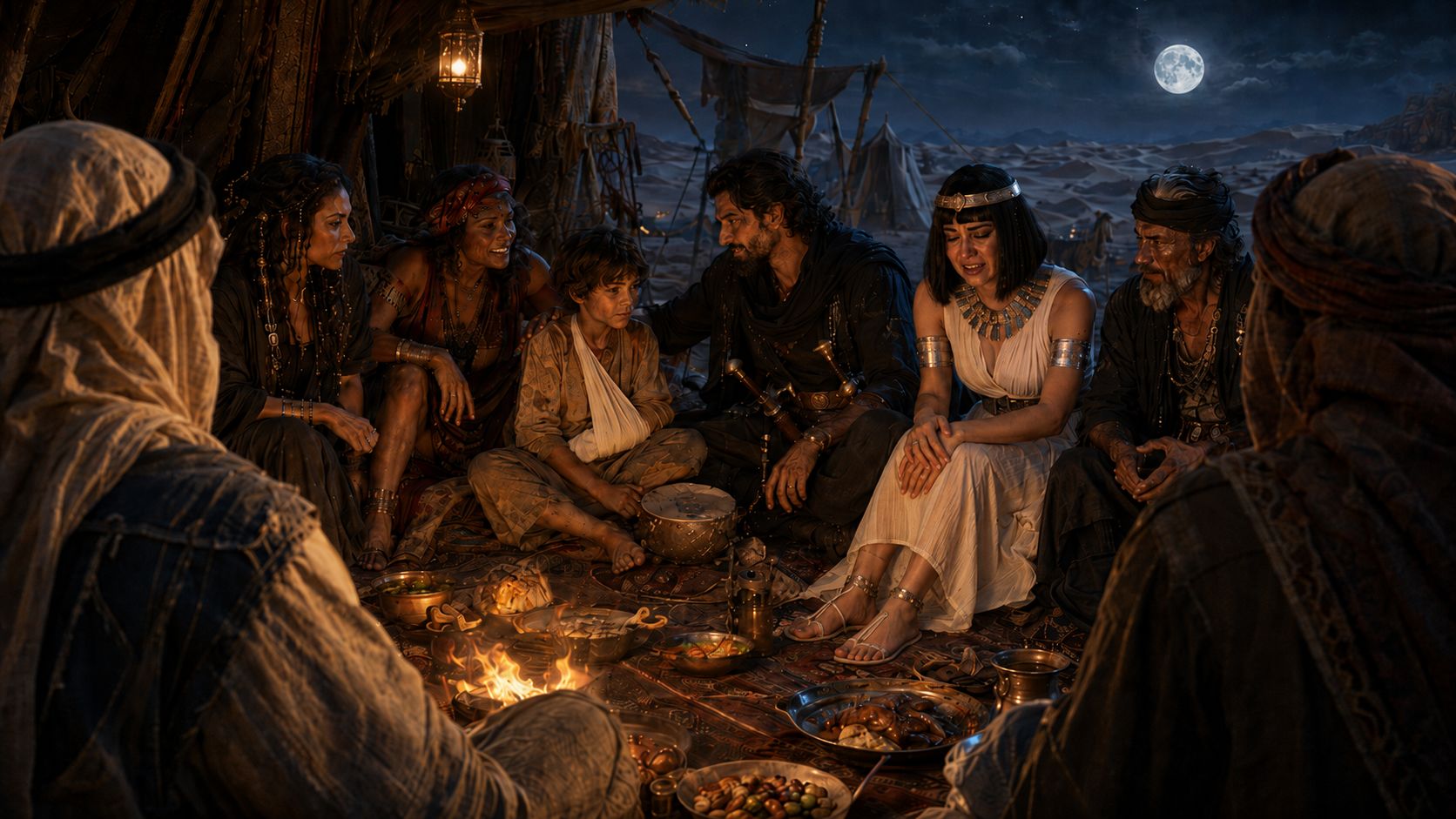
Hadi's wish to become a warrior should be played as childlike, sincere and naive. He has seen splendor, courage, armor and sacrifice. He has seen people speak the names of the knights with awe. He does not yet understand what he is asking for.
Ideally, this becomes a player moment. A player character can talk to him. The best response is not to scold him, laugh at him or tell him war is ugly in a way that makes him feel foolish. The best response honors what he did while turning him away from the glamour of battle.
The core idea is simple. His drum mattered. It was not lesser than a sword.
- A warrior sees the enemy before him. Hadi saw all three gates.
- A sword reaches one body. His rhythm reached the whole village.
- A knight moves where he is needed. Hadi told the knights where need was.
If no player takes up the moment, use another crew member or Dunewind elder. Nasheem can speak gently about the difference between courage and glory. Junia can speak from the healer's side, telling him that warriors leave wounds others must close. Sada can be blunt and powerful. Miraz can make it a lesson in caravan survival. The best version is the one that fits the table.
The important result is that Hadi listens.
The Dunewind respect the crew more because of that. Hadi has proven himself. He is not just a child being corrected by outsiders. If he accepts the words, then the speaker has reached him in a way the tribe values.
Nephyla's reaction to Hadi's announcement surprises her because it is personal before it is thoughtful. She does not merely understand that the boy is being naive. She feels it hurt. Hadi has become part of the world around her without her noticing, a familiar voice, a familiar drum, a small living presence she expected to continue. When he says he wants to become a warrior, she realizes she is afraid for him, not as a symbol, not as a lesson in leadership, but as Hadi. The feeling unsettles her. It is ordinary, immediate and painfully human, and that makes it important. Nephyla has spent much of her life being cared for by others as a duty. Here, for once, she discovers care moving the other way.
Gratitude of the Dunewind
Miraz does not become emotional in an obvious way. His gratitude should be measured, but unmistakable. He will say that the desert tests who is guest and who is kin, and that the crew has crossed that line in ways not easily uncrossed.
Sada offers approval through practical trust. She will tell them they wasted less water than she expected. For Sada, that is almost affection.
Rashad thanks the crew for Hadi in the rough way of a man who does not want to say the boy frightened him. Zahra and Old Samir may already be arguing about how the story should be told.
Romance
Romance with the Dunewind is shaped by the road, not by promises of permanence. For the caravan people, affection often belongs to a crossing, an oasis, a shared tent wall, a dangerous night or a few days of laughter before routes divide again. This does not make it shallow. It makes it honest within a life built around movement. A Dunewind lover can be warm, direct and deeply present while also understanding that the caravan will leave, the ship will sail and neither life bends easily around the other.
For the crew, this can hurt more than expected. Sailors know partings, but the Dunewind treat parting almost as part of the romance itself: a song sung before dawn, a bracelet tied around a wrist, a last private joke, a kiss given without asking it to become a future.
Some crew members may accept this and carry it as a beautiful memory. Others may feel abandoned by someone who never meant to abandon them. The farewell after Zhess'r makes these romances sharper, because everyone has survived enough together to know the feeling was real, even if it was never meant to stay.
Nephyla and Shessra
Before departure, Nephyla has a brief moment with Shessra. It does not become a long philosophical exchange. Shessra is still busy. That is part of who she is.
Nephyla thanks her awkwardly and says she understands more now than she did before. Shessra is not impressed by former divinity, but she recognizes effort when she sees it.
"Understanding leadership does not make it easier," Shessra says. "It only removes the excuse of ignorance."
For Nephyla, the farewell to Zhess'r feels like leaving a lesson unfinished. She has not become Shessra. She has merely seen enough to know that her old idea of command was shallow.
Parting From Zhess'r
The Dunewind stay for a week, then leave for leave for the deep desert with more water and less innocence. Zhess'r keeps enough food to survive until trade resumes. They also receive needed supplies from Ssa'zulul. The village is not healed, but it is alive.
The armor of the seven knights remain in Zhess'r, where the village builds a shrine honoring them.
The crew departs with the Ssa'zulul escort. Either way, they leave as witnesses to something already becoming larger than memory.
Journey to Varr'thol
The road away from Zhess'r was quieter than the road toward it.
No bandits followed. No dust rose behind them except their own. The Shar'zul moved with full water and weary patience, carrying people who slept as soon as they sat down. The desert did not become kind, but it stopped pressing its knife against their backs.
At the next stop, a trader had already heard the story.
Not correctly.
He had heard that seven knights held Zhess'r for seven days without food. He had heard that a boy drummer died on the roof and kept beating after death. He had heard that foreign sailors opened the gates by mistake and then redeemed themselves with blood. He had heard that Shessra killed Rhazkor with her own hand.
Ileena stared at him with his mouth open.
Ayesha said, "Do not correct every fool. You will die tired."
This section is a release from siege pressure. Do not replace the siege with another major threat. The point is exhaustion, distance and the first strange experience of hearing recent trauma become story.
The trip toward Varr'thol should feel much easier than the journey to Zhess'r. The crew may travel first with the rescuing force from Ssa'zulul, then by river ship once they reach Ssa'zulul. The shift from sand to water should feel significant. For the Blue Marlin crew, water means orientation returning.
The Legend Begins
The legend of Zhess'r spreads faster than the crew because Ssar'et riders, traders and the Ssa'zulul knights carry it.
Use the distorted versions carefully. They should not become comedy, though a little dry humor can help. The distortions should show how history begins.
- Some say Hadi died.
- Some say the seven knights never dismounted.
- Some say the Dunewind fed the village from three grains of blessed millet.
- Some say strangers from the sea fought like spirits.
- Some omit the crew entirely.
- Some name Shessra as the true savior.
- Some say the knights of Ssa'zulul arrived before the last charge, because people prefer stories where help comes sooner.
Let the crew hear fragments and decide what, if anything, to correct.
Transition to Varr'thol
Once the crew reaches the river route, the tone should shift. The air changes. The horizon changes. The smell of water, reeds, mud and trade replaces the dry open desert. The crew is moving back toward the sea and toward the Blue Marlin.
This should feel like returning to themselves.
Reunion With the Blue Marlin
Varr'thol smelled wrong at first.
Too much water. Too much fish. Too much tar, rope, wet wood, river mud and crowded bodies. After the desert, the air felt thick enough to drink.
Then the Blue Marlin came into view.
Her hull rode low and familiar against the quay, blue paint weathered, rigging neat under Caelin's eye, deck alive with movement. For a moment, no one from the desert party spoke. The ship looked impossible. Not because she was grand, but because she was home and had somehow continued existing while they were gone.
Someone on deck shouted.
Then the ship erupted.
Names were called. Ropes were dropped before they were needed. Sailors crowded the rail. Yasmira appeared with a ladle in one hand as if she had been fighting the galley itself and winning. Caelin tried to keep order for three breaths, failed and decided the disorder could live.
Faces were counted. Hands gripped shoulders. Hugs were exchanged. Someone laughed too loudly. Someone cried and pretended not to.
For the first time in many days, the crew did not have to keep moving.
The Blue Marlin had them again.

The reunion should feel emotionally generous. The arc has been harsh, and the campaign has separated the crew for a long stretch through Lumekhet, the desert and Zhess'r. The return to the Blue Marlin should feel like safety, identity and continuity.
Do not rush this scene. Let the crew enjoy being back among familiar faces.
What the Ship's Crew Has Been Doing
While the desert group was gone for months, the crew remaining with the Blue Marlin did not sit idle. They followed the earlier lead in Varr'thol and learned where the Waverider went next: the mysterious Kaelthir.
This keeps the campaign investigation moving without forcing the Zhess'r arc to carry Waverider clues directly. It also gives the reunited crew a clear next destination as soon as they are ready.
The waiting crew should have their own stories, but keep them brief at this stage unless the players ask. They have dealt with suspicious harbor officials, river traders, false Waverider rumors and difficulties keeping the ship supplied in an unfamiliar port.
The Emotional Shape
The reunion works best if it mixes practical and emotional responses.
- Caelin counts people and checks who is injured before allowing herself relief.
- Yasmira feeds everyone too much because fear has nowhere else to go.
- Galenor wants to know what the Shar'zul decks were like and whether anyone took proper notes.
- Junia will be pulled immediately into treating old wounds that were badly patched during travel.
- Scarnax has a quiet moment where command gives way to visible relief.
- Ayesha will begin asking for political details almost at once, then stop herself when she sees how tired everyone is.
- Ormun will hug everyone, willing or not.
The ship should feel like a living community snapping back into shape around missing pieces.
Nephyla and Thaleia
Nephyla and Thaleia both remain with the crew after Zhess'r because there is nowhere sensible to leave them. Nephyla cannot stay in Ssar'et, a lone human who barely knows who she is in a land of lizardmen.
Thaleia is no better suited to remain behind. She has seen enough of the desert, has no reason to linger in a battered siege village and is already more interested in what lies downriver.
For now, both continue with the crew to Varr'thol, then onward aboard the Blue Marlin, not as permanent crew in the full sense, but as passengers who have become entangled in the journey and cannot yet be safely set down.
Nephyla Aboard
Nephyla returning to the Blue Marlin should matter. She left Lumekhet as a fallen divine figure and crossed the desert as someone still learning how to be ordinary. She returns having seen Shessra lead, Hadi guide warriors, knights die and common people carry the victory.
She is not transformed completely, but she is different.
She may help carry supplies without being asked. She may thank people awkwardly. She may stand at the rail that night and realize that the ship is not a court and not a temple, yet people obey its rhythms because they trust them.
This is a quiet step, not a declaration.
Closing the Arc
The arc ends with the Blue Marlin whole again. The crew carries memories of thirst, desert dust, the names of the seven knights and the next heading on the Waverider trail.
The story of Zhess'r remains behind them, but it does not stay still. It travels through Ssar'et, changing with every telling. In some versions, the seven knights are everything. In others, the Drum on the Roof becomes the heart of the tale. In a few, careful tellers remember the Dunewind, the village leader and the strangers from the sea who stood where they were needed.
The crew does not leave as the main heroes of the song.
They leave as part of the reason the song exists.
Act Summary
Reunited on the Blue Marlin
The arc ends with the crew reunited aboard the Blue Marlin in Varr'thol. After Lumekhet, the desert crossing and the siege of Zhess'r, the ship feels like home, safety and continuity. The crew has been separated long enough that the reunion matters emotionally, not just practically. Faces are counted, wounds are checked, food is pressed into tired hands and the Blue Marlin becomes whole again.
The Waverider Trail Continues
While the desert group was gone, the crew remaining with the Blue Marlin followed the earlier lead in Varr'thol and learned where the Waverider went next: the mysterious Kaelthir. This gives the reunited crew a clear next heading and lets the campaign move forward without making the Zhess'r siege carry the investigative burden.
The Dunewind Farewell
The crew leaves Ssar'et with the friendship of the Dunewind Tribe. That bond was earned through thirst, travel, siege, shared food, battle and grief. The farewell is not clean or easy. The Dunewind return to the deep desert, while the crew returns to the sea. Hadi's survival, his choice to remain a drummer rather than chase the shine of battle and the tribe's gratitude give the parting its emotional center.
The Lesson of Zhess'r
Zhess'r shows the crew honor and sacrifice in their most visible form.
The seven knights stand as true heroes, armored, disciplined and willing to spend their lives so others have time to live.
Yet the village survives because heroism is not theirs alone. Shessra holds her people together. The Dunewind share food. Hadi guides warriors with his drum. Villagers throw stones from rooftops. The crew fills the spaces left when greater warriors fall.
The lesson is not that anyone can replace heroes, but that even the smallest part can keep the whole from breaking.
Nephyla's Development
Nephyla leaves Zhess'r changed. She has seen leadership without divinity, command without ceremony and care moving through ordinary people rather than flowing only toward her.
Shessra shows her that leadership means carrying the names of the dead and still deciding what must be done next.
Hadi shows her that she can care for someone personally, not as a symbol or responsibility, but simply because he matters.
This does not complete her transformation, but it deepens it.
Zhess'r marks the bottom of her fall from godhood. From here, Nephyla is no longer merely losing what she was. She is ready to begin learning how to become a person.
The Core Theme
One can be a hero without being the main character. The knights become the heart of the legend, but Zhess'r survives because many smaller acts made their sacrifice matter. The crew does not leave as the main heroes of the song. They leave as part of the reason the song exists.
The coastline of Ssar'et faded behind them in a long black line beneath the moon.
The Blue Marlin moved quietly over dark water, her sails full, her rigging breathing in the night wind. Behind her lay Varr'thol, Zhess'r, the desert, the dead knights and the Dunewind songs already beginning to change into memory. Ahead lay Kaelthir, still only a name.
Nephyla stood near the stern rail, silver bracelets bright in the moonlight, white dress moving softly around her ankles. She had been there a long while when Scarnax came up beside her. He did not ask if she wanted company. He simply rested his hands on the rail and looked back toward the vanishing coast.
For a time, neither spoke.
At last Nephyla said, "In Ssar'et, I thought a great deal about command."
Scarnax glanced at her. "Bad habit."
She almost smiled. Almost.
"Shessra gave orders and people died. Vorrak gave orders and people died. You give orders, and one day people will die because of them." She looked down at her hands. "How do you bear it?"
Scarnax was quiet for so long she thought he would not answer.
"I don't know that I do," he said.
That surprised her enough to make her look at him.
He kept his eyes on the dark line of shore. "In Ozukari, there was a man named Hayato Tsukahara. Castellan of a stronghold. Good manners. Good house. Good order. A demon came every night and killed his people because of a wrong he had done years before. In the end, he believed the only way to end it was to let his house die with him."
Nephyla listened without moving.
"He killed his infant son," Scarnax said, voice rough and low. "Then he opened his own belly. His second, Genji, finished it for him. Everyone wept. No one stopped it."
The ship creaked under them. Somewhere forward, a sailor laughed softly, then fell quiet.
"It worked," Scarnax said. "The next night was calm."
Nephyla looked at him sharply.
"I am not saying it was right," he said. "I still wake sometimes thinking about it. About that child. About Hayato's hands shaking. About Genji doing what his lord needed, because in that place loyalty meant finishing the blade stroke when love made it too hard."
He swallowed.
"Before Ozukari, I thought I knew what being a captain meant. Keep the crew fed. Keep the ship moving. Make the hard calls. Don't rule through fear. Don't waste lives." His mouth tightened. "Then I watched a man spend everything he had because he believed command meant answering with blood. His own. His son's. I don't know if I could do that. I don't know if I would want to be the kind of man who could."
Nephyla turned back toward the coastline.
"In Lumekhet, I was a commander," she said. "Not a leader. A commander moves pieces. A commander says go there, die there, stand there, remain silent there. If the game is won, the pieces were well used."
Scarnax said nothing.
She closed her eyes. "I thought of people as pieces in a game of Khalif. Priests. Servants. Guards. Messengers. Even my own advisors. Some were valuable pieces. Some were expendable. I did not think that made me cruel. I thought that made me trained."
The words seemed to disgust her as she spoke them.
"Then in Zhess'r, I saw Shessra learn names before spending lives. I saw Hadi sit with his bandaged arm and still worry about being useful. I saw knights die because they chose to give others time." She opened her eyes again. "It is unbearable once you know they are people."
Scarnax gave a short, humorless breath. "I have the opposite problem."
Nephyla looked at him.
"I don't like giving orders," he said. "Not the ones that matter. Sail that way, take in sail, ready weapons, that's work. But telling someone to stand where the killing will be worst? Sending someone into an alley because they are the only one quick enough? Ordering a charge when I know some won't come back?" He shook his head. "I do it when I must. I hate it every time."
"That sounds like weakness," Nephyla said.
"It is," Scarnax replied.
She studied him.
He turned his head and met her eyes. "It is also why they trust me."
The answer troubled her more than she expected.
"A commander gives orders," she said slowly. "A leader pays for them."
Scarnax nodded. "Sometimes with blood. Sometimes with sleep. Sometimes by being the one everyone looks at when there is no good answer."
"I do not want to lead again," Nephyla said.
The words came too quickly. Too honestly.
"Now that I see them, I do not want it. People are too heavy. Their faces stay. Their names stay. It was easier when they were pieces."
Scarnax looked at her for a long while.
"Maybe it should be hard," he said.
Nephyla's throat tightened.
The moon hung low over the distant coast, bright and cold, laying a silver road across the water behind them. For a moment she could almost imagine it leading back to all the lives she had once ruled without understanding. Servants waiting for orders. Priests waiting for signs. Guards waiting to be spent. Hadi with his drum. Shessra with her dead. Vorrak and Kess at the gate.
"Yes," she said at last. "Maybe it should."
Scarnax said nothing more. Neither did she.
Together they watched the coast recede beneath the moon, while the Blue Marlin carried them onward.