Campaign: Srel Colony
Act Synopsis
This act is infiltration plus sabotage. The crew leaves the governed safety of Amazireth and enters Srel colony territory, where extermination is doctrine and cruelty is ritualized. The goal is not conquest or negotiation. The goal is to strike Eshkar hard enough that the Sreli feel fear, disruption and loss.
What The Crew Learns About Srel
Srel is not a conventional enemy. They are a colony shaped by the Doctrine of Ashen Dawn, built around purification through blood, ash and sacrifice. Violence is meant to be seen, remembered and repeated, and their raids aim at erasure rather than profit. Expect ash marks, burned altars, ritual language and a sense that the killers believe they are serving inevitability rather than choosing evil. That conviction makes them more dangerous, not less.
Crossing The Line
Jungle travel into Srel controlled lands is straightforward. Paths exist, and the real threat is not getting lost. The threat is what the paths lead to.
Thirvash Hollow
The crew finds another massacre site. This is confirmation, not a new mystery. Use it to reinforce that Ashimora was not exceptional. It is a pattern. Keep it short, brutal and unmistakable, then move on before it becomes repetitive.
They also find more information on the Sreli motives and beliefs.
This is where the crew’s hatred can be reinforced, and the moral frame shifts from “should we strike” to “how far are we willing to go.”
Patrols And Approach
Sreli patrols exist, but avoiding them is meant to be manageable. This keeps pacing brisk and preserves energy for the city operation. Patrol behavior should feel confident, ideological and a little reckless, as if they believe the jungle itself is theirs by divine claim.
The premise is that stealth is viable in the wild, but the closer they get to Eshkar, the narrower the margin becomes.
Recon And The Disguise Problem
From distance, the crew realizes infiltration by blending in will be difficult, especially for anyone who stands out by appearance, stature or cultural markers. The solution becomes timing and darkness rather than disguise, fast hits, then a controlled escape before the city fully mobilizes.
The Night Sabotage Window
Once inside, the crew has a limited working window while Eshkar sleeps. Offer multiple targets so the players can choose the shape of the strike.
This is a player driven operation. Choice of targets defines tone, risk and consequences.
Alarm And Hunt
The first fires change the act. The city wakes. Confusion becomes coordination. The Sreli shift from sleeping civilians to organized hunters. The crew’s goal becomes escape, not completion.
Things turn from stealth to pursuit. Tension rises fast and should feel earned.
The Hard Way Out And One Fight
Leaving Eshkar is more dangerous than entering it. Hunters will be harder to avoid. There will be one fight, framed as the cost of making noise in enemy territory.
The crew gets out, but not cleanly. This act leaves marks.
End State
The crew crosses back into Amazireth after the escape. The immediate danger feels behind them, and it is tempting to treat the return to Kethyris as a routine handoff and a quick reward. That sense of safety is wrong, and it should be allowed to settle in before it is broken.
Moving Through the Jungle
This section establishes that the jungle is not the primary obstacle. It is a corridor into Srel, with manageable friction. The danger comes from what waits ahead, not from getting lost on the way.
Navigation And Terrain

For most of the route, there are paths. Some are trade paths, some are old patrol routes, some are simply the lines people always take because the jungle allows them. Travel is slow in places, but direction is rarely in doubt.
The one exception is the valley pass beyond Ashimora. It is not commonly traveled, but it is still a pass. It funnels movement between slopes and ridgelines, so navigation stays easy even without a clear trail. The crew always knows which way is forward.
Make it clear through description and pacing that this terrain is difficult but familiar. It is not Montosho. It slows movement and punishes mistakes, but it does not feel like an expedition into the unknown. The crew has done worse.
Patrol Avoidance
Sreli patrols are present but not subtle. They move with confidence and noise, talking, chanting, knocking gear against branches, treating the jungle like it belongs to them. The crew should usually hear them well before they are seen.
Avoidance is meant to be straightforward. Pause, step off the path, go still, let the patrol pass. If the crew includes Ileena, it becomes even easier to choose safe detours and avoid being funneled into sightlines.
Run this phase to build tension without consuming time. The crew is not being hunted yet. They are slipping past a careless net.
As the crew closes on Eshkar, the patrols become more frequent and the margin narrows. The jungle stays the same. The pressure changes.
Thirvash Hollow
This scene reinforces that Ashimora was not an exception, and it widens the conflict. The Sreli are not only striking Amazireth’s border. They are exterminating the Yelthari, pushing them deeper into the jungle through systematic terror.
It also places a concrete piece of Sreli doctrine into the crew’s hands: a dropped holy book. This is not a clue for navigation. It is a clue for motive.
Location And People
Thirvash Hollow is a small jungle village, not a town. It belongs to the Yelthari, the native people of the region. They are dark skinned, distinct from both the light skinned Amazireth population and the Sreli. Their culture is tribal and rooted in the jungle, and they have been driven back over time by Sreli expansion.
Run the Yelthari as proud, practical, and cornered. The village should feel like a community that lived close together and relied on mutual trust, not walls.
Scene Approach And First Impressions
The village should be found through silence and smell first. No voices. No work sounds. No children. The jungle around it is alive, but the Hollow is dead.
Use a gradual reveal like Ashimora, but scaled down and made more intimate. The cruelty is the same, but here it is personal. Huts are close. Trails are narrow. Everything happens within arm’s reach.
The Atrocity
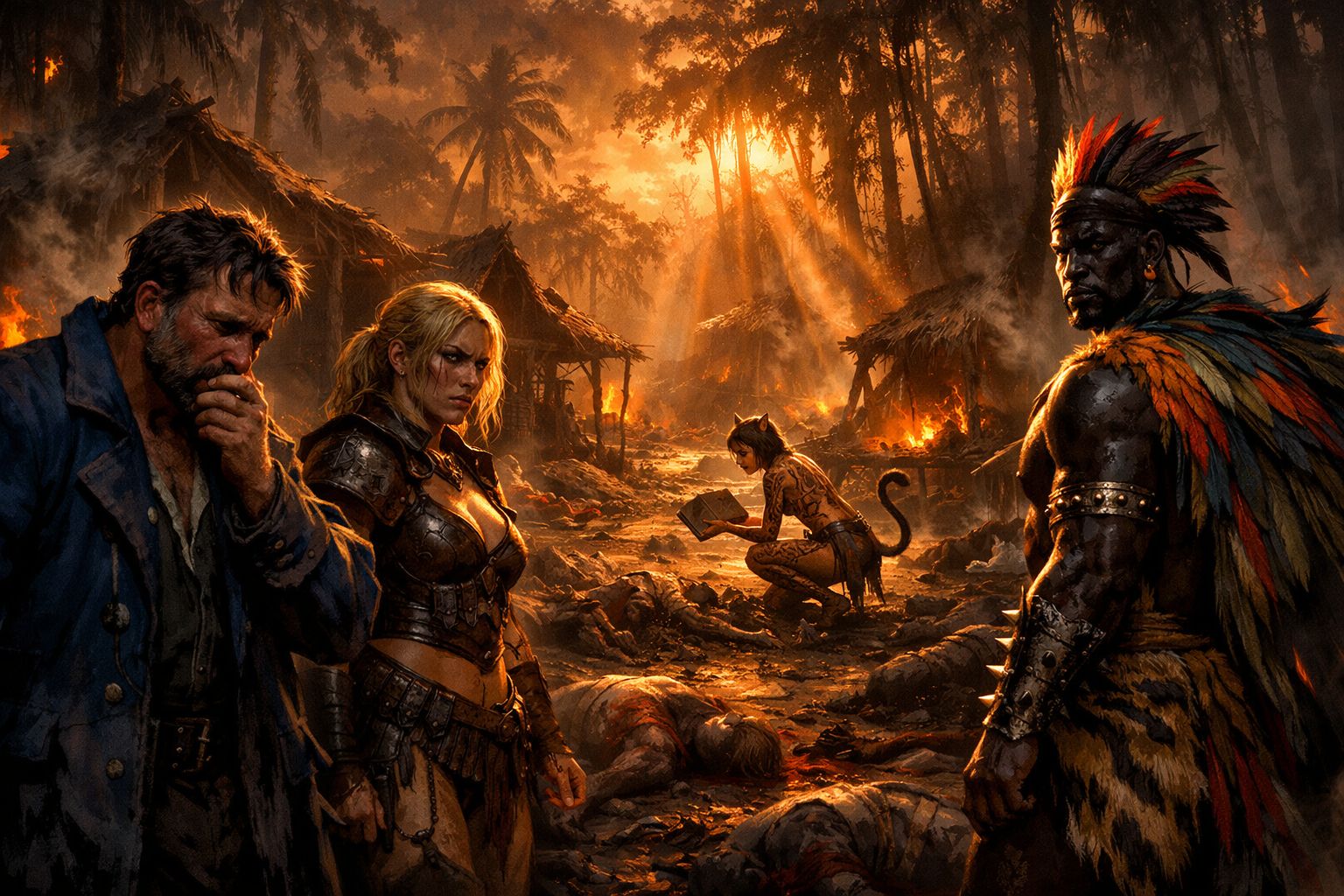
The jungle did not go quiet for Thirvash Hollow. It kept breathing, dripping, buzzing, alive in every direction. The village itself was the silence, a wound cut into green.
Amaxia and Junia found them near a collapsed hut, half in shadow, half in sunlight that should have been warm. The child lay on its side, throat opened cleanly enough that it looked unreal, like a gesture rather than a wound. An arm stretched toward the brush, fingers curled as if it had almost reached something.
Just beyond, a woman lay facedown, close enough that the child’s hand would have touched her if the world had been kind. Her feet were gone. A long smear of blood led back along the dirt, to where the severed feet had been left like discarded tools. Around the bodies, the ground was churned with footprints, dozens of them, circling, crossing, stamping. Not the marks of a struggle. The marks of people who enjoyed mocking the woman.
Junia made a sound that was too small to be a sob and too broken to be a breath. Her hand rose to her mouth and stayed there, trembling. Her eyes were glassy and wide, fixed on the child’s fingers.
Amaxia stepped in close and put a hand on Junia’s shoulder, firm enough to be felt through shock. Her voice was low, controlled, almost harsh.
“Do not collapse,” she said. “Not here.”
Junia’s throat worked. “I cannot,” she whispered, and it was the nearest she could get to speech.
Amaxia leaned closer, her mouth near Junia’s ear, forcing the words into her like an order.
“Then be angry,” she said. “If you break, they win twice.”
Junia blinked hard. Her gaze did not leave the bodies, but something in her face shifted, a tightening, a hardening. She swallowed the grief like poison and let it turn.
Amaxia kept her hand on her shoulder a moment longer, steady as stone, while the jungle kept breathing and the village stayed dead.
- This is not military a battle, this is a sadistic rampage.
- Treat the killing as staged cruelty, not combat.
- Bodies are not only dead, they are displayed.
- Wounds are not efficient, they are inventive.
- Signs of restraint and prolonged suffering show intent.
- Nocent or innocent doesn't matter, everyone is killed.
Avoid over listing methods. Choose a few distinct images that communicate scale and delight in degradation, then let the players fill in the rest.
Keep the scene shorter than Ashimora. It should hit hard, then move. You do not want to numb the table.
The most important point is that the Sreli did this to a people who were not an invading army. These were villagers being erased, and that cruelty was not a practical issue, it was a bonus.
What The Crew Can Learn Here
The Sreli Pattern
This is extermination through spectacle. The point is terror, displacement, and the destruction of identity, not resources.
The Yelthari Situation
The Yelthari are being pushed deeper into the jungle. Survivors, if any exist elsewhere, will be traumatized, distrustful, and desperate. To the Sreli, they are vermin living on their land.
The Dropped Holy Book
Place the book where it feels plausible: dropped in haste or lost during the frenzy.
It should be visibly Sreli. Ash marks, ritual script, binding that looks intentionally austere. The book is a tonal prop that signals doctrine made physical.
It gives the crew something to interpret. It shows the Sreli frame of mind.
The book smelled of smoke even though it was not burned. Its leather was the color of old ash, cracked at the corners like it had been bent too many times in damp heat. The cover held no symbol that looked like art. Only an impressed mark, a blue sun reduced to a bruise, with rays that looked more like scratches than light.
Scarnax turned it over in his hands as if it might bite. "They dropped this in a place like this. Either they are careless or they wanted someone to find it."
Ileena crouched beside him, tail flicking once, ears angled forward. She did not touch the pages at first. She sniffed the binding, then pulled her face back in a brief curl of disgust. "They carry it like a scent. It is inside them."
Junia sat with her knees drawn up, dirt on her palms, eyes still too bright from what they had walked through. When Scarnax opened the book she leaned closer anyway, like a healer leaning over a wound she already knows she cannot close. Amaxia stood over them, spear planted in the mud, watching the jungle beyond the village as if she expected the trees to start speaking.
The script was sharp and deliberate, carved into the page in thick strokes. In places the ink had been mixed with something darker. Junia’s voice came out quiet.
"They call themselves chosen."
Scarnax traced a line with a finger that stopped short of touching the ink. "Not just chosen. Real."
Junia nodded. "It says they are the only people that matter. Everyone else is noise. Dust. Tools."
Amaxia’s jaw tightened. "Tools do not get rights."
Junia kept reading, and her calm began to thin. "It says nothing done to others can be a crime, because a crime can only exist between equals. It calls suffering a proper role. It describes pain like it is a gift they are allowed to take."
Ileena made a low sound in her throat. Not fear, not sadness. Hunger turned inside out. "That is why they play."
Scarnax turned another page. The words were not strategy. They were instructions for a world that only made sense if you believed the gods had written your appetite into law.
"They do not talk about conquering," he said. "No taxes, no rule, no treaties. Only ash."
Junia swallowed. "They call it cleansing. They call it mercy, too, but it is mercy the way fire is mercy to a forest."
Amaxia leaned in, eyes hard. "Read the part about the dawn."
Junia found it and her voice tightened as she spoke. "The Ashen Dawn. They believe it will come, and the gods will kill everyone except them. It is written like a promise. Like they are simply waiting for a storm they think they own."
Scarnax closed his eyes for a moment, then opened them again as if he had decided something. "A people waiting for the world to end will try to help it along."
Ileena finally touched the page, claw tip tapping a line that had been underlined so hard the parchment was scarred. "Here. The children."
Junia read it twice, as if the meaning might change if she stared long enough. It did not.
"At twelve," she said, and her voice went flat, "a child must kill a first enemy. A captive. Helpless. It says it makes them clean."
Amaxia’s nostrils flared. "That is not courage. That is training a child to enjoy the easy kill."
Junia turned the page, hands steady only because she forced them to be. "At sixteen, they must make their first combat kill. It is described as a step into adulthood. Not surviving. Not defending. Killing. Proving they can take life with their own hands."
For a moment none of them spoke. The jungle kept buzzing. Somewhere in the distance a bird called, bright and indifferent. The sound felt wrong against the words on the page.
Scarnax shut the book with controlled care, like sealing a lid on rot. "Now we know what we are walking into."
Junia looked up at Amaxia. Her eyes were wet, but her voice was steady. "They are raising their children to think this is holy."
Amaxia stared at the closed cover, then at the village beyond it, then into the trees where Srel waited. "Then they do not just need to be beaten," she said. "They need to be stopped."
Leaving Thirvash Hollow
The crew leaves Thirvash Hollow with the same certainty they carried out of Ashimora, but broadened. This is not only a border war. It is a campaign of erasure. They also leave with the Sreli holy book in hand, a concrete artifact of the Doctrine of Ashen Dawn.
Approach And Recon Of Eshkar
This phase sets the operation’s shape. The jungle makes hiding easy, but the city makes blending in hard. The crew’s main decisions here are time versus risk, and unity versus splitting.
Approach Through The Jungle
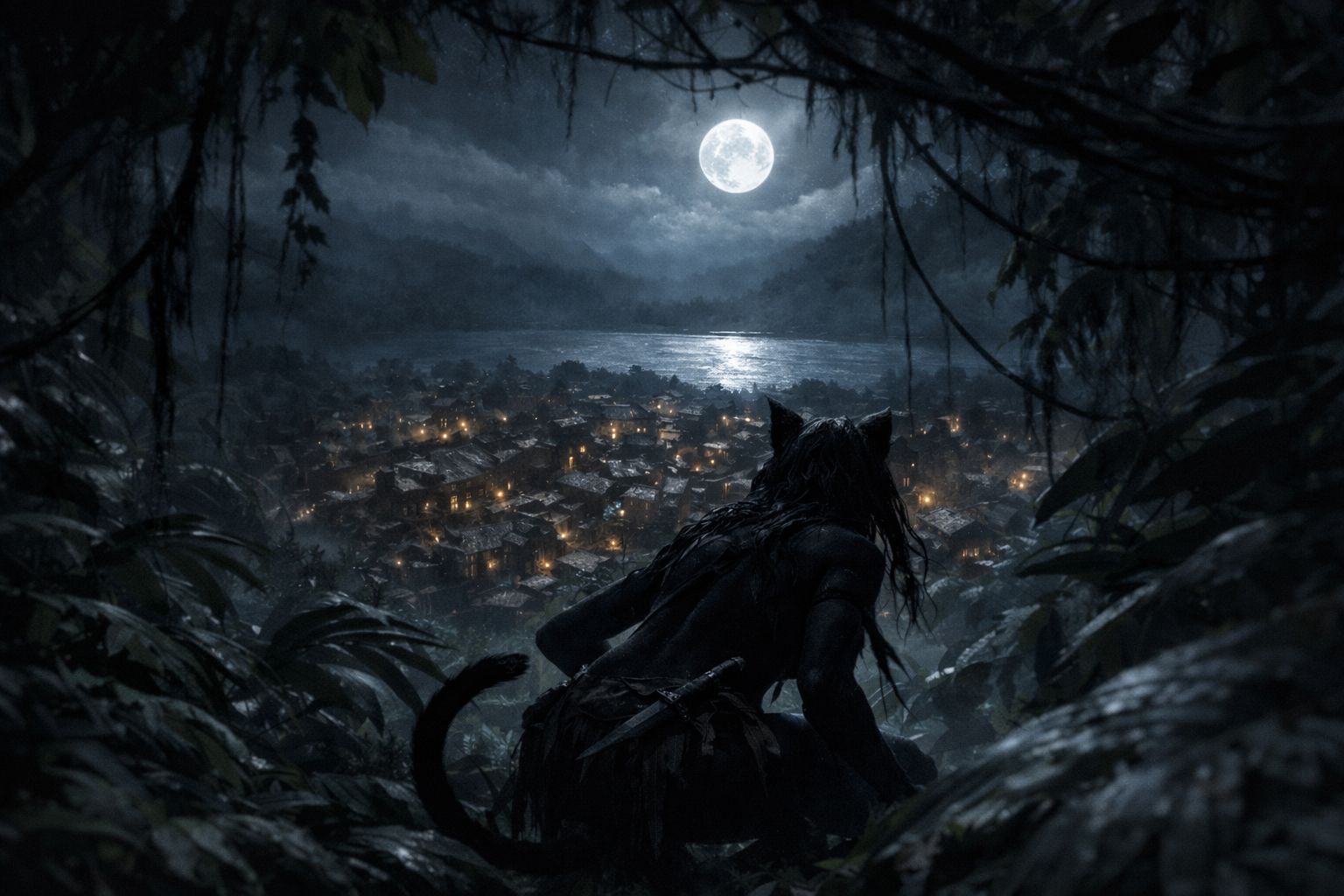
Eshkar sits close to the jungle edge. Green reaches almost to the outer buildings. That favors the crew.
Reaching a hidden observation point is not difficult. Once there, the crew can remain concealed for hours or days. Use this to let them feel competent. They are not stumbling into a trap. They are choosing when to move.
Observation Options
Short Recon
A few hours. Establish entry points, guard habits, night lighting, and where people gather.
Long Recon
A day or more. Learn patrol timings, shift changes, which districts sleep late, and where fires or alarms will draw responders first.
If the crew wants to wait, let them. The jungle supports it. The question becomes what waiting costs in fatigue, morale, and the risk of being spotted by chance.
The Disguise Problem
The harder problem is not approaching the city. It is existing inside it.
Eshkar is not diverse. Anyone who looks unlike the local norm will draw attention immediately. Dark skinned outsiders, Amazon warriors, and non humans stand out. Clothing matters. Even if the crew avoids direct confrontation, attention creates memory, and memory creates a hunt later.
Present this as an operational constraint, not a moral issue. The city is a small social ecosystem. A stranger becomes a story in minutes.
Practical Consequences
Daytime entry as a full group is risky. Any social interaction becomes a test and any delay inside the city increases exposure.
Planning Branches
Offer two clean paths and let the players invent variations. Either option can work, or other options the players might come up with.
Split Operation
Those who can pass as locals go in to scout targets, count guards, and place preparations.
Those who cannot pass remain in the jungle and prepare the extraction, distractions, and rendezvous points.
This creates risk of separation, miscommunication, and mismatched timing, but it reduces exposure for the whole group.
Night Entry Without Deep Recon
The crew stays together and enters after dark.
They accept incomplete information in exchange for speed and cohesion.
This increases the risk of wrong turns, surprises, and hitting the wrong target, but it avoids the social problem of being seen in daylight.
Recon Checklist
Use this list as what the crew can reasonably learn from the jungle edge.
- Where the jungle line is thinnest and entry is easiest.
- Where the harbor access points are and when activity slows.
- Where grain storage is concentrated, and whether it is guarded at night.
- Where temples and altars are located, and whether they maintain night fires.
- Where the public torture hall is and what kind of watch it keeps.
- Where authority gathers, city hall and adjacent guard quarters.
- Where the market district is and what materials would burn fast.
Also establish two practical things.
- Alarm behavior. What do bells, horns, drums, or shouted calls sound like, and how fast do they spread.
- Chase terrain. Which alleys dead end, which roads are broad, and where the jungle edge can be reached quickly.
Target Set
Keep the targets visible in the recon so the players feel they are choosing deliberately, not guessing.
- Harbor
- Granaries
- Temples and altars
- Public torture hall, a center of spectacle and indoctrination
- City hall
- Market district
Night reduces crowds, which lowers exposure and usually reduces civilian presence, but some sites still keep night staff and watchers.
The Attack On Eshkar
The torture hall squatted behind a low wall like a secret the city was proud of. Even at night it stank. Old blood, smoke, something sharp like burned fat. A single lantern hung over the door, more to announce the place than to guard it.
Amaxia and Scarnax slipped through the narrow lane with their backs to the shadows. The street behind them held the ordinary night noises of Eshkar, a distant laugh, sandals on stone, the soft rattle of a patrol that did not bother to whisper.
The door was not barred. It did not need to be. The Sreli believed in fear the way other people believe in locks.
Inside, the lantern light caught on metal and wetness.
Bodies hung from hooks along the rafters, lined up like slabs, arms wrenched wrong, torsos opened, skin marked with cuts that were not meant to kill quickly. Some were too small. Some wore the remnants of shackles. The floor beneath them was dark, sticky, tracked with footprints that had walked through blood and never cared. Some of the footprints were child sized.
Amaxia stopped so hard her breath hitched. Her hand clenched on her spear until her knuckles went pale.
For a moment she did not speak. Her jaw worked, the muscles in her face twitching with control, as if she was holding her rage in her teeth.
Then it broke out of her, low and shaking.
“I want them all dead,” she said. Not a threat. A vow. “Every one of them.”
Scarnax’s eyes moved over the hooks, the ropes, the stains. He did not flinch. His face did not soften. His voice came out quiet, steadier than he felt.
“I agree,” he said. “But tonight we do not win by counting bodies. We win by leaving a wound they cannot hide.”
Amaxia’s nostrils flared. She swallowed once, hard, forcing the fury into something usable. Her gaze shifted from the hanging dead to the beams, the dry timber, the oil soaked cloth near the wall, the stacked kindling meant for torches.
She nodded, sharp.
“Fine,” she said, and there was steel in it now, not heat.
She stepped forward and lowered her voice to the level of a command.
“Then let’s burn them. Every single one, and I will not think it too many.”
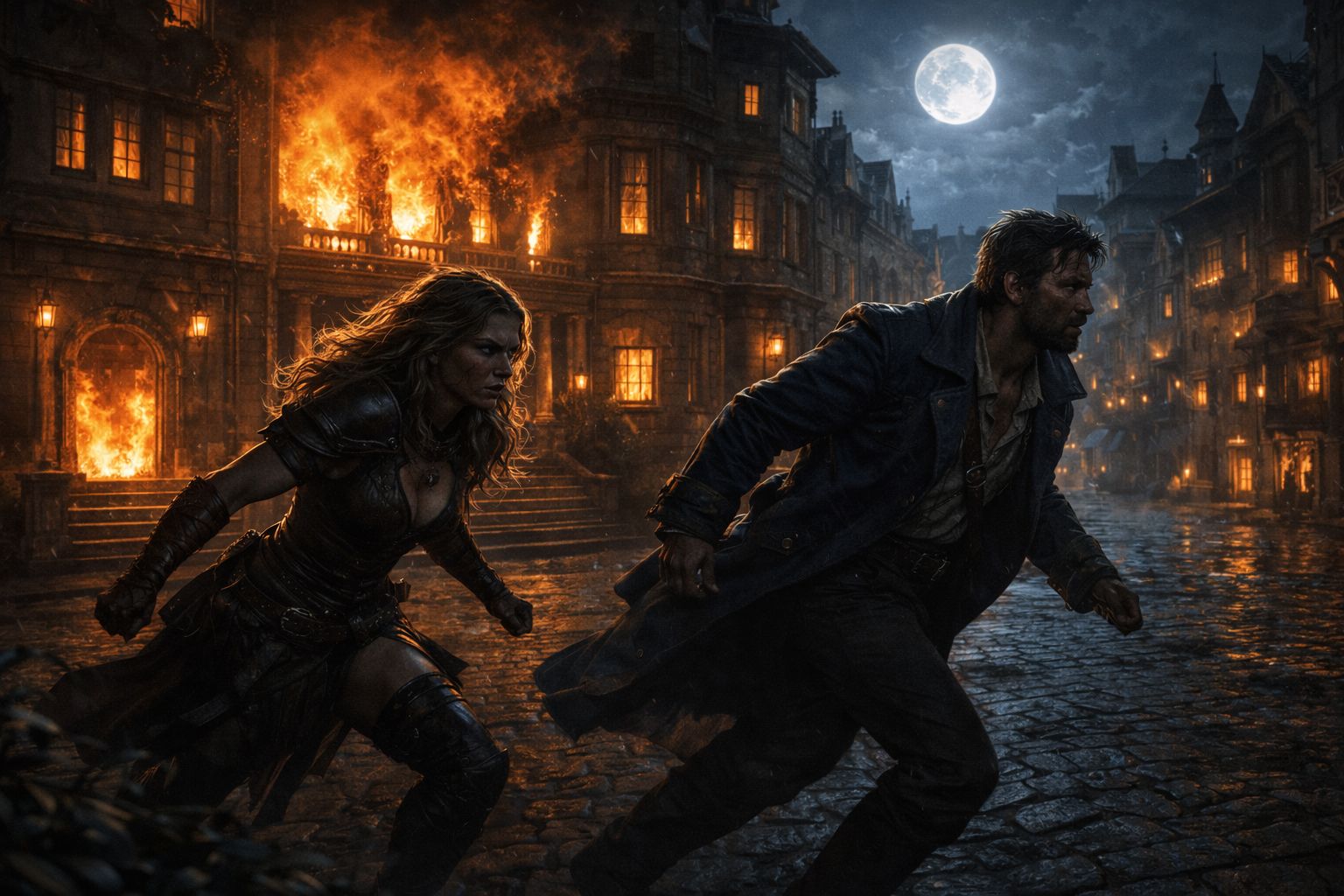
This phase is a player driven sabotage operation. Night movement is manageable, and the Sreli are careless because they believe they are untouchable. The tension comes from timing and escalation, not from perfect stealth.
Night Movement In The City
Eshkar sleeps unevenly. Some districts go dark early, others stay active longer. Most streets are poorly watched. Patrols exist, but they move like people who expect obedience rather than resistance.
Run stealth as friction, not as a wall. A failed stealth moment should usually create a complication, not immediate failure. A shout, a glimpse, a door slammed, someone running to tell a guard, rather than an instant city wide alarm.
Player Choice: One Strike Or Many
Give the crew a clear choice.
- Single target strike keeps cohesion and reduces coordination risk.
- Multiple targets increases impact but forces splitting, timing, rendezvous plans, and harder extraction.
Make sure the table understands that splitting does not just increase danger. It increases the chance the city concludes sabotage rather than accident because multiple fires shift the pattern fast. It also spreads their response thin, forcing them to split buckets, runners, and guards across several emergencies.
Target Menu
These are examples, not an exhaustive list. Let players invent their own and reward good logic.
Harbor
Likely activity into late night. It is also the one place where foreigners can exist without immediate questions, provided they do not stand out by skin tone or Amazon bearing. It burns well, but it also holds foreign ships and cargo. Burning the harbor creates chaos and delays pursuit, but it can create collateral consequences.
Granaries
Near the harbor because supplies arrive by ship. Easy targets. Minimal guarding. They burn well and threaten survival and morale. A single fire can be enough to make the whole city feel vulnerable.
Temples And Altars
Often unguarded. Symbolically important. Many structures are stone with wooden roofs and furnishings, so fire damage is uneven. Burning a temple roof is a statement more than a total destruction, unless the crew also targets stored oil, cloth, or offerings.
Public Torture Hall
A wooden building. A center of spectacle and indoctrination. The place should feel like a wound in the city, with evidence of the day's cruelty left overnight. It is often lightly guarded or not guarded at all, because the Sreli assume nobody would dare touch it. It burns well and makes a clear statement.
City Hall
Stone facade over a wooden frame. It will burn, but entry can be slowed by a heavy door and a lock. This is a high value symbolic strike that will provoke a fast organized response once leaders realize what is happening.
Market District
A maze of wood houses and stalls. Fire spreads quickly here, but there may be people moving even late, night traders, drunks, guards on errands. This target risks more civilian harm and unpredictable spread, but it creates the largest immediate chaos.
Response Escalation
Use a clear escalation so the players feel time pressure.
Minute 0 To 10: Confusion
Shouts of fire. Buckets. Panic. People run toward flames, not away from them, because they assume it is an accident. The response is disorganized and often ineffective. This is the best window for the crew to move, because everyone is focused on the obvious threat.
Minute 10 To 60: Suspicion
Someone with authority realizes the fires are not accidental, especially if there are multiple sites or if a key site is targeted. Patrols begin to scour streets and alley mouths. This phase is messy. The Sreli overreact in the wrong places and underreact in the right ones.
In this window, use near misses and tightening nets. A patrol that turns the wrong way. A shout that makes the crew freeze. A door barred from inside because locals think saboteurs are coming.
Minute 60 and Beyond: Organized Hunt
Leadership is awake. Forces are gathered. Teams are assigned. Checkpoints begin to form at main routes. The city is now hunting saboteurs, not fighting fire. Streets that were empty start to fill with armed searchers.
This is when splitting hurts most. People who were supposed to meet do not, and each minute increases the risk that someone is cornered.
Outcome Pressure
By the end of the night, Eshkar is angry, scared, and alert. The crew should feel that even if they succeeded, they have paid in risk and exposure.
- If they set only one fire, the city may cling to the accident story longer.
- If they set multiple fires, the city accepts sabotage quickly, and the hunt intensifies.
- If they strike a symbolic target like city hall or the public torture hall, leadership becomes personally invested and response speed increases.
Dawn Consequences
By dawn, search parties begin moving outward. The Sreli will search the jungle edges and coastline, but most importantly they will move on the predictable route.
They know the valley pass is the only reasonable corridor back toward Amazireth. They will rush it first, aiming to cut off escape, funnel intruders, and capture someone for spectacle.
Escape Through The Jungle
This phase is the cost of the sabotage. Entry was slipping past a careless net. Exit is moving through an alerted one. Run it as pursuit pressure, not as a second infiltration puzzle.
Core Structure
The escape has three segments.
- Leaving Eshkar and breaking contact.
- Crossing the valley pass under active pursuit.
- Reaching safety after Thirvash Hollow, then returning to the skiff and upriver route.
The Jungle Hunt
Once they reach the jungle line, do not let the tension drop. The Sreli will push search parties to the edge quickly, and their patrols will be more alert than on the way in. They will still be noisy and arrogant, but now they are angry, and anger makes even careless people look harder.
Run patrol avoidance as a repeating pattern:
- The crew hears them first.
- The crew goes still or detours.
- The patrol passes close enough to be dangerous.
- Then the crew moves again.
Repeat a few times, with the gaps getting shorter as the valley pass approaches. This communicates that the net is tightening without needing exact counts.
The Valley Pass Fight
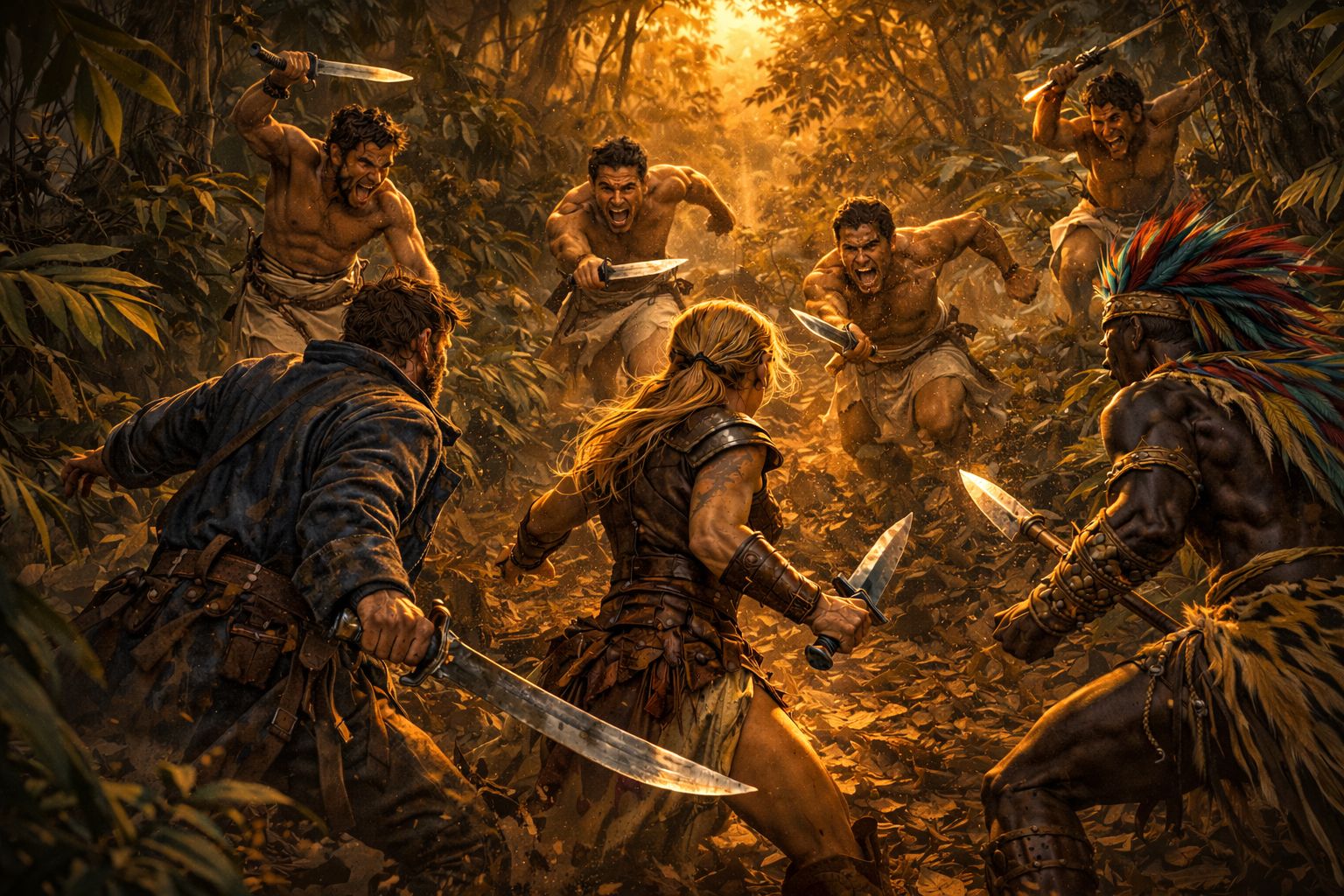
In the pass, a fight is unavoidable. The terrain funnels both sides. The Sreli know the pass is the corridor back toward Amazireth and will rush it first.
Keep the patrol small, but motivated. They should not be elite. They should be the first wave of an organized response, fast enough to get there before dawn.
How to frame it:
- The crew is forced into contact because there is no safe space to step aside.
- The patrol is close enough that a silent retreat is not possible.
- The crew chooses how the fight begins, ambush, intimidation, swift elimination, or a fast break through.
- This fight should feel like the price of making noise, not a random encounter.
After Thirvash Hollow
Once the crew passes Thirvash Hollow, the pressure changes. The Sreli assume a major operation and will not probe into Amazireth with small patrols immediately. They will consolidate, regroup, and prepare a stronger response instead of chasing blindly across a border.
Use this as a false relief beat. The jungle does not become safe, but it becomes quieter. The crew can breathe, count heads, and feel the ache of exhaustion.
Return To The Skiff And Back To Amazireth
From here the crew moves back to the skiff and returns along the river route. Do not play this as another obstacle course. Keep it brisk.
End with the sense that the mission is almost complete and that the crew expects a routine report and reward in Kethyris. That expectation is the setup for what breaks next.
Act Summary
What This Arc Is About
This arc takes the crew from diplomacy into chosen violence. A lead on the Waverider becomes conditional, and the crew is pulled into a border war where “justice” and “deterrence” look the same in practice.
What The Crew Learns About The Sreli
The Sreli are not raiders seeking profit or territory. They are an extermination culture shaped by the Doctrine of Ashen Dawn.
Their violence is staged, ritualized, and meant to be found. It is not only killing, it is degradation, spectacle, and indoctrination. They erase communities and push survivors deeper into the jungle through terror.
They believe they are the only people that matter. Everyone else is property, prey, or entertainment, and their doctrine trains even children into sanctioned killing.
What The Crew Becomes
Ashimora and Thirvash Hollow turn revenge from an option into a decision that feels earned. The arc is designed to make the crew want to hurt the Sreli back, and then to confront them with what that choice does to them.
Eshkar becomes the answer. The crew enters at night, chooses targets, and turns the city into fire. The act is not conquest, it is a warning written in destruction.
What The Arc Leaves Behind
The crew escapes through the jungle with Srel actively hunting, pays the cost in exhaustion and danger, then crosses back into Amazireth and feels relief.
That relief is false.
By the time they return toward Kethyris, the crew expects a simple payoff: deliver the report, collect the promised Waverider lead, and move on.
The arc ends with that expectation settling in, right before it is broken.