Campaign: Para Omros
Act Synopsis
Arrival
The crew arrives in Para Omros, Lightmoor. This is as far up river as the ship is allowed to go, so they have to proceed by foot to Sanctum Omros.
They arrive during preparations for a public judgment. An accused witch is held by the priesthood. The atmosphere is controlled, ritualized, and eerily calm. There is no hysteria. The priests treat the event as routine maintenance of purity.
The accused, a woman named Moriel, appears broken but lucid. No obvious signs of magic. No theatrical evil. The charges are framed broadly and could easily fit Para Omros paranoia. The crew witnesses punishment or intimidation of bystanders to establish the stakes. At this point, let it feel like background flavor, a way to show the cruelty of Para Omros, without any real chance of rescue.
Sanctum Omros
Here, it's easy to find out more about Waverider, and the authorities knows her next destination. It almost feels too easy.
While here, they also witness executions and torture by fire. This is a foreshadowing of what will happen to Moriel, to further motivate them to rescue her.
The Rescue
The crew is traveling back from Sanctum Omros to Lightmorr during a violent storm. Visibility is poor. Thunder rolls close and frequent.
They encounter a priesthood transport moving in the opposite direction: a covered cart carrying a single bound prisoner, escorted by two guards on horseback. The destination is an interrogation site in Sanctum Omros, not the execution ground. The witch is being taken to be broken before judgment.
As the convoy passes the crew, lightning strikes nearby with unnatural precision. The thunder is immediate and deafening. The horses panic, bolting into the storm, as the guards are carried off helplessly. Within moments, both guards are gone, alive but scattered and disoriented.
The cart remains, tipped over.
Inside is Moriel, bound, injured, and terrified. She begs the crew to free her. She insists this is their only chance. Reinforcements will come once the guards regroup. If she is taken onward, she will not survive the torture.
No priest is present. No violence is required. No one is watching.
The crew must decide whether to intervene, knowing that doing so means becoming fugitives inside Para Omros influence, or leave the prisoner to a fate they already believe is unjust.
Flight and Bonding
While fleeing, Moriel presents as grateful, terrified, and rational. She explain the accusation in believable terms. A neighbor reported her. Her boy recovered from a serious illness, and that was enough to be accused of witchcraft.
The crew helps her survive. Food is shared. Plans are made. Trust forms. Moriel does not lie outright, but only gives mundane answers when asked about her past or about magic.
The Boy
The Boy survives and is taken into Para Omros custody, officially spared as innocent and placed under correction and purification. Moriel believes obedience keeps the child alive and untouched. In reality, the priesthood raises the child as proof that corruption can be burned away through discipline and faith.
The demon quietly ensures the child remains healthy and exemplary, allowing Para Omros to believe its methods work. Over time, the child is shaped into a loyal servant of Omros, potentially rising within the priesthood. The demon’s victory is not the child’s fall, but their ascent. A future priest whose very existence is anchored in a demonic pact, who carries the corruption of demonic power, becomes a living contradiction at the heart of Para Omros, spreading righteous certainty built on an infernal foundation.
First Signs of Wrongness
Subtle disturbances begin. Weather behaves oddly in their favor. Animals react poorly. A minor disaster occurs that can be explained away. The rescued individual downplays it or offers rational explanations that are plausible but strained.
The crew may wonder whether this is Para Omros superstition influencing them, or whether something is genuinely wrong.
Pressure from the Outside
Signs of pursuit appear. Inquisitors follow methodically, not recklessly. The priesthood is shown as patient and inevitable rather than furious. They do not threaten civilians unnecessarily. They wait.
Civilians are suspicious. To them, the priesthood is the truth which keeps them safe, not villains.
At the same time, another incident occurs that benefits the crew but harms someone else. The rescued individual is involved indirectly. If confronted, they admit they did not fully choose it, but insist the outcome was necessary.
Revelation Without Confession
The truth is revealed through an external trigger. A bird lands on her shoulder, a familiar. Whispers in a strange voice is heard during the night. Moriel having nightmares, talking in her sleep. Many small things, each of them in itself not damning.
Moriel admits the truth when emotionally cornered. She entered a pact out of desperation. The demon now forces actions through pain and threats. She not free. She is not lying about being trapped.
Moral Crossroads
The crew now understands that Para Omros was correct in this case. The witch is dangerous. The demon is real. Letting this continue will remind them of the priesthood’s reasoning even as they reject its cruelty.
Moriel is a victim, but also a weapon for the demon.
Multiple paths open, none clean.
Climax and Aftermath
The arc resolves at the moment the crew chooses what they can live with. There is no correct answer. Each path closes some doors permanently.
The priesthood does not chase them forever. The demon does not forget them. Someone innocent suffers no matter what.
The crew escapes Para Omros territory, changed. The argument does not end. Someone begins justifying the priesthood’s logic in limited terms. Someone else rejects that line of thinking outright.
Para Omros remains what it was. The crew did not defeat it. They merely survived an encounter with a system that was both monstrous and correct.
The demon tainted child will raise in the ranks of the priesthood.
The arc closes on unease rather than resolution. The lesson is not about good and evil, but about the danger of certainty, even when it happens to be right.
Arrival in Lightmoor
The Blue Marlin reaches Lightmoor at dusk. This is the last river port permitted to foreign vessels. Beyond this point, the Omrosi authorities control all movement inland, and no ship is allowed to continue upriver toward Sanctum Omros.
Lightmoor is functional rather than welcoming. Stone quays. Low warehouses. A watchtower flying the white and ash banner of Omros. Everything is clean, orderly, and subdued. No taverns advertise loudly. No harbor brothels. No music carries over the water. No slaves working the docks.
The crew is informed, politely and firmly, that further travel must be done on foot. Permits are required. Cargo must be inspected. Names must be recorded. This will take time. The ship is allowed to restock under supervision while paperwork is processed.
They are guests. Barely.
Waiting in Lightmoor
While waiting for clearance, the crew is free to move within the town. Guards are visible but not aggressive. Clerics in ash colored robes pass frequently, their presence unquestioned.
During this time, a public trial is held in the central square.
It is not announced as spectacle. People simply gather when the bells ring.
The Trial
Present this part as if it was background, to showcase Para Omros. Do not hint that it will become important later.
The bells do not ring urgently. They toll with measured patience, each strike spaced far enough apart that no one could mistake it for alarm.
People begin to gather in the square without being summoned. Dockhands wipe their hands on cloth. Shopkeepers step out and pull their doors closed behind them. A pair of children are guided to the front by an older woman, her hand firm on their shoulders. No one speaks loudly.
When the bells fall silent, the Watchers arrive.
They walk in pairs, ash robed, heads bare despite the chill. Between them comes the accused.
She is barefoot. Chains circle her wrists and ankles, iron etched with prayer sigils worn smooth by use. Her dress is plain and torn at the hem. Her hair has been cut short and uneven, a sign of preparatory humility. Her face is hollow but composed.
A clerk steps forward and reads her name.
“Moriel of House Talren.”
The name is spoken clearly, so that all may hear it one last time.
The High Examiner of Lightmoor, Preceptor Halvek, takes his place before her. He does not raise his voice.
“Moriel of House Talren,” he says, “you stand accused of drawing upon power not granted by Omros, of bending the world by will rather than submission. You are accused of witchcraft.”
Moriel lowers her head.
The charge is read in full. Not with accusation, but with care.
Her son was ill. The illness was witnessed. The recovery was witnessed. No prayer accounted for the change. No blessing was invoked. No cleric was present.
Preceptor Halvek asks a single question.
“Did your child recover?”
“Yes,” Moriel says.
“Do you know by what hand this came to pass?”
“I do not,” she answers.
There is no murmur. This is enough.
A neighbor steps forward. Her name is Sister Veyra, a woman Moriel once shared bread with. She speaks briefly. She noticed the recovery. She reported it, as required. Her voice does not shake.
A Watcher confirms the report. Records are cited. Signs are listed. Nothing dramatic.
Preceptor Halvek nods.
“Ignorance does not sanctify corruption,” he says. “To act without understanding is not innocence, but exposure.”
He turns to the clerk.
“Strike her name.”
The clerk steps forward again.
“By judgment of Omros,” he intones, “Moriel is severed from House Talren. Her blood is no longer counted among them. Her name shall not be spoken as kin, nor carried by any who live. Let the taint end here.”
A murmur moves through the crowd, not of outrage, but of relief.
Preceptor Halvek continues.
“Moriel, you are found guilty of witchcraft. You will be transferred to Sanctum Omros for questioning, so that all threads of corruption may be traced and burned away. When Omros is satisfied, you will be given to the flame, that your suffering may serve as mercy to others.”
He inclines his head slightly.
“This is mercy.”
The boy is brought forward.
He is thin, clean, dressed in simple white. He looks at the ground. He does not cry.
“The child is not guilty,” Preceptor Halvek declares. “No blame falls upon the unformed. Yet corruption leaves a shadow, and shadow must not be allowed to grow.”
He places a hand over the boy’s head without touching him.
“The child will be taken into the care of the priesthood. He will be purified through discipline and instruction. He will be raised within the light of Omros, so that what was touched may yet be made whole.”
He looks to the crowd.
“This is mercy.”
Moriel does not lift her head. She does not reach for the boy. She stands very still, as if any movement might be counted as defiance, as if her guilt would touch him.
The judgment is complete.
The Watchers take her by the chains and lead her away.
The crowd disperses in orderly fashion. A woman murmurs a prayer of thanks. A man rests his hand briefly on his child’s shoulder.
The square empties, clean and quiet, as if nothing of note has occurred.
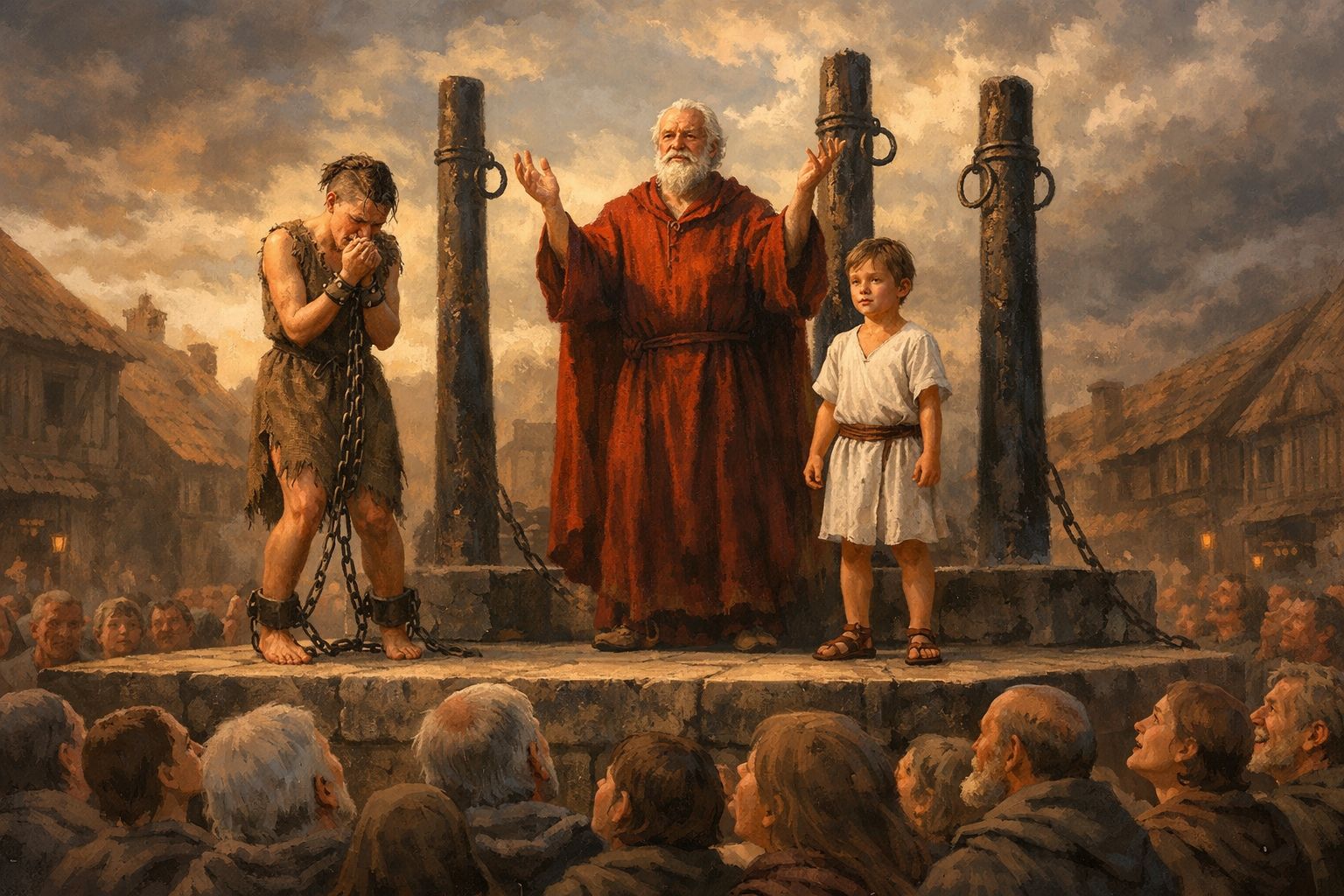
The accused is a woman named Moriel.
She is brought forward in chains, barefoot, her hands bound with iron marked by prayer sigils. She is thin, exhausted, but conscious and composed. She does not struggle. She does not plead.
The charge is stated plainly. Witchcraft.
Specifically, that she used forbidden power to cure her son of a grave illness.
There is no denial that the child recovered. That fact is uncontested. The question is not whether the recovery happened, but how. Moriel admits she did not understand what she did. This is taken as confirmation, not mitigation.
Witnesses speak briefly. A neighbor. A Watcher. No one raises their voice.
Judgment is swift.
Moriel is convicted. Sentence is passed without flourish. She will be transferred to Sanctum Omros for questioning, to uncover accomplices and influences. Execution by fire will follow once the priesthood is satisfied that the corruption has been fully traced.
This is presented as mercy.
Her son is brought forward.
The boy is declared innocent. Children are not blamed for corruption done through them. However, exposure is considered dangerous. The priesthood announces that he will be taken for purification and correction. He will be raised within the faith, instructed properly, and given the opportunity to serve Omros without stain.
This is presented as mercy.
The boy does not speak. Moriel dares not look at him.
There is no opportunity to intervene. The square is ringed with guards. Clerics stand close. The crowd is thick. Any attempt at rescue would require open violence against the town itself.
The crowd disperses quietly once the judgment is complete.
Aftermath in the Square
As the crew leaves the square, they pass a row of iron stakes driven into the packed earth at its edge. Each is blackened with soot. Iron manacles hang from them.
No one is using them now.
No one comments on them.
It is clear this place has seen fire before, and will again.
This is not presented as a warning. It is simply part of the town.
Foreigners in Para Omros
As outsiders, the crew is granted limited leeway. They are not expected to know every rite or custom, but ignorance is not an excuse.
They are corrected often.
A hand placed on the wrong shoulder during greeting. A missed pause during a prayer bell. Standing still when others kneel. Each misstep earns a quiet warning from nearby civilians. Not hostile. Not angry. Concerned.
People here believe the rules keep them safe.
The crew is watched, advised, and tolerated.
When their permits are finally approved and they prepare to leave Lightmoor on foot toward Sanctum Omros, no one wishes them luck.
They are simply reminded to walk the marked road, speak only when spoken to, and keep their eyes lowered during rites. They are also instructed to wear the rough brown robes the locals wear.
The trial fades behind them, filed away as one more example of how things are done here.
Sanctum Omros
The journey from Lightmoor to Sanctum Omros takes a single day on foot. The road is straight, well kept, and clearly marked. Mile stones bear short prayers carved into their faces, worn smooth by time and touch.
The land itself is calm. Fields stretch wide and orderly. Farms are small but abundant. Groves and streams break the land at regular intervals, each with a simple shrine stone nearby. There are no ruins, no scars of war, no signs of desperation. If one did not know better, this would look like a safe and prosperous heartland.
The people they pass nod politely, and utter a simple "Omros walks with you" or "The mercy of Omros be upon you". No one lingers. No one asks questions.
If the crew leaves Lightmoor in the morning, they reach Sanctum Omros before sundown.
First Contact with the City
Sanctum Omros rises from the land without walls. It does not need them.
White stone buildings dominate the skyline, their edges severe and undecorated. Spires rise not for beauty but for visibility, so bells may be heard across the city at any hour. The streets are wide and clean. Movement is deliberate. No one hurries.
At the city gates, the crew’s papers are checked and stamped without comment. They are directed to the Office of Civic Records, a low rectangular building of pale stone near the inner district.
When they arrive, the doors are closed.
A Watcher explains calmly that the office is closed for the remainder of the day. It is a holy observance. Administrative work resumes tomorrow morning.
There is no apology.
Lodging in Sanctum Omros
Finding lodging is simple. Inns are clearly marked and uniformly modest. The one most often used by foreigners is called the Quiet Measure.
It is clean. The beds are narrow. The food is plain. Bread, porridge, vegetables, water or weak beer. No music. No gambling. No private rooms without additional permission.
It is not uncomfortable. It is merely sufficient.
No one lingers in the common room longer than necessary.
The Archive Clerk
The following morning, the crew returns to the Office of Civic Records.
They are received by a junior clerk named Arel Daneth, a thin man with ink stained fingers and a voice practiced in neutrality. He confirms that the Waverider did indeed visit Sanctum Omros.
He confirms that the archives record both its point of arrival and its next destination.
He explains that retrieving the documents will take some time. The records are old. The shelves are deep.
He suggests they return later in the afternoon. His tone implies that this is routine.
The Bells
Before the crew can explore much further, the bells begin to ring.
They are not the same bells as in Lightmoor. These are deeper, slower, and carry across the entire city. The sound does not alarm. It directs.
People stop what they are doing and begin moving toward the central square.
If the crew hesitates or attempts to move elsewhere, locals intervene quickly. Not angrily. Not forcefully. With quiet insistence. Attendance is mandatory. Everyone must witness the mercy of Omros.
There is no sense of fear in this enforcement. Only certainty.
The Central Square
The bells draw the city in long before the crew sees the square. Their sound is deep and patient, carrying across streets and rooftops, folding people out of doorways and alleys as if the city itself were breathing inward.
Scarnax follows the flow without speaking. Ayesha keeps her hands folded in her sleeves, eyes forward. Amaxia’s eyes sweep the crowd for threats. Skarnulf walks with his shoulders slightly hunched, as if the air itself has weight.
The square is already filling when they arrive. Pale stone underfoot, wide and clean. At its center stand five iron stakes fixed into a raised platform. Each is mounted in a shallow stone bowl.
Three figures are brought forward.
The first are a husband and wife. They are not young. They are not defiant. They do not shout or plead. Their hands tremble as the Watchers bind them to the outer stakes with thick rope, coiled tightly around torso and limbs. The rope is dark with oil and glistens in the light.
A priest steps forward and reads the charge.
“They broke fast together on a holy day. They joined flesh when Omros called for stillness. They placed desire above order.”
His voice carries without strain.
“They are to receive the embrace of Omros, that the fire may teach what their bodies forgot. This is mercy.”
The woman is lit first.
A torch touches the rope at her side. The oil catches immediately. Flame climbs the coils, wrapping her in heat and smoke. She screams, sharp and raw, as the fire bites into flesh. The rope burns away slowly, not consuming her, but scorching and blistering wherever it touches.
The husband watches. He strains against his bonds, crying her name, begging, promising obedience. No one answers him. The fire is allowed to burn until the last coil falls away from her body in blackened fragments. She collapses forward, sobbing, skin burned and ruined, breath coming in wet gasps.
Only then do they light his rope.
His scream joins hers, and then overtakes it. He does not look away. He cannot. The people closest to the platform murmur softly, some with hands clasped, some smiling through tears.
“This is mercy,” someone says.
Others repeat it, not loudly, but with conviction.
“This is mercy.”
The flames die down. The Watchers cut the ropes and drag the burned bodies aside. They are alive. For now.
Then the third sinner is brought forward.
He has already seen everything. His body bears marks of torture.
He is chained to the central stake, positioned standing in the stone bowl. Oil is poured carefully at his feet, pooling around the base of the post. He is breathing hard, eyes wide, lips moving soundlessly.
The High Examiner raises his hand.
“This one spoke curse where there should have been praise. He named Omros false. He named mercy cruelty. He poisoned others with doubt.”
The man lifts his head. “I spoke truth,” he says hoarsely.
The Examiner nods. “Then rejoice,” he replies. “For truth cannot burn, and you will be cleansed. This is mercy.”
A torch is lowered into the bowl.
The oil ignites with a roar, flames climbing up around the man’s legs, then his chest, then his face. His scream is swallowed quickly by the fire. Smoke rises thick and bitter, carrying the stench of burning flesh across the square.
Ayesha turns her head too late. The smell hits her anyway.
Scarnax feels his stomach twist. Skarnulf swallows hard, eyes fixed on the stone so he does not have to see the man’s shape collapse into the flame.
Amaxia does not look away, her face hard.
Around them, the crowd watches in quiet satisfaction. People murmur prayers. Parents hold children close, not to shield them, but to help them see.
“This is mercy,” the words ripple outward again and again.
When it is over, when the fire dies and the Watchers begin their work, the crowd disperses without hurry. People speak softly as they leave. Some smile. Some wipe their eyes.
The crew moves away with them, carried along by the current of bodies until the square is behind them and the bells begin to fade.
They stop in a narrow street where the sound is duller.
“This is madness,” Amaxia says under her breath. Her hands are clenched. “They enjoy it.”
“They believe in it,” Skarnulf replies, his voice low and rough. “That is worse.”
Scarnax exhales slowly. “I have seen cruel men,” he says. “This is not that.”
Ayesha nods once. “It is not the priests. It is not the laws,” she says quietly. “It is the people. Change the faces at the top, and nothing changes beneath. You would only get the same fire, held by different hands.”
No one argues with her.
They walk on, leaving the square behind, while Sanctum Omros settles back into its careful calm.
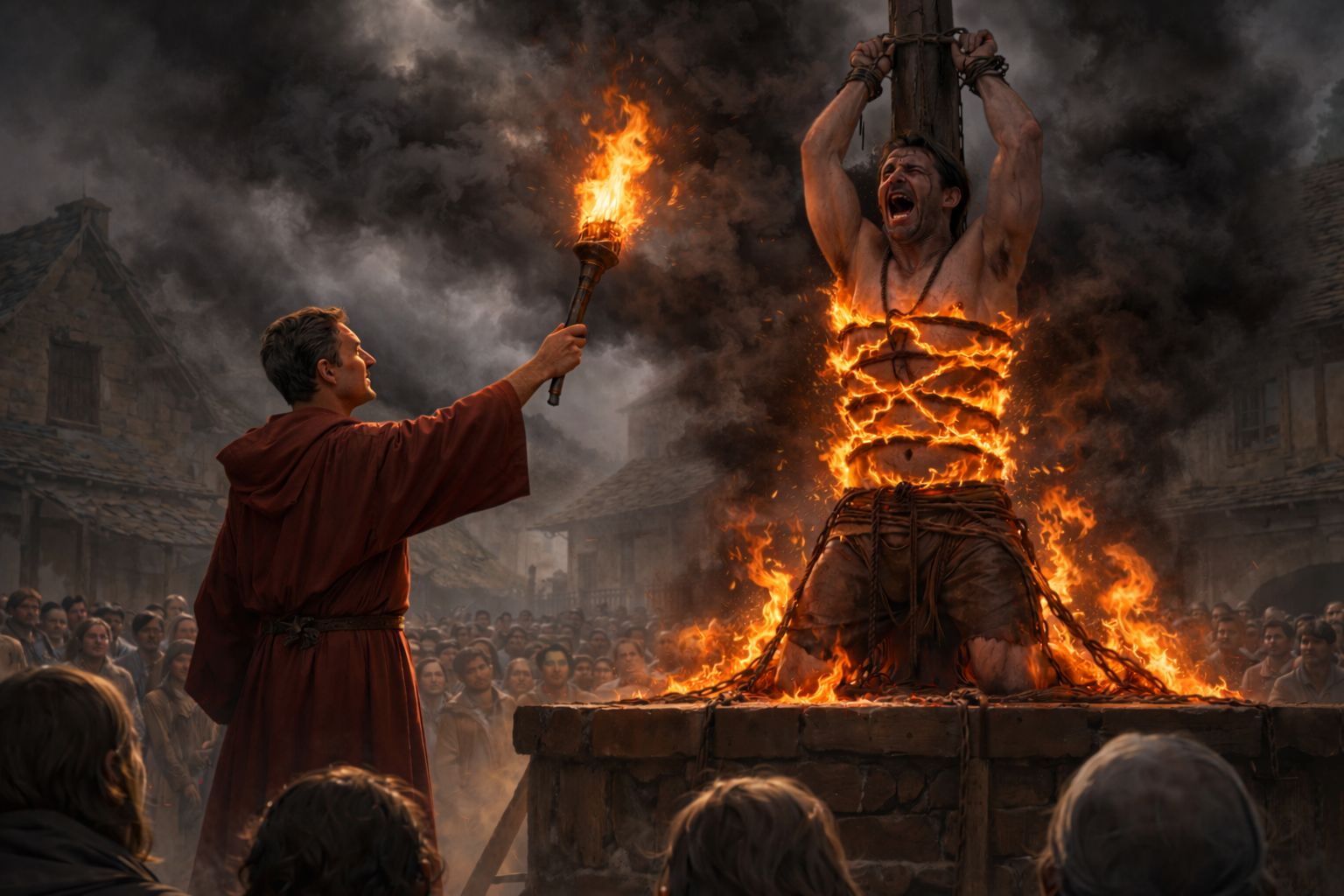
The square is large and open, paved in pale stone. It fills quickly.
An execution is underway.
The details are not hidden, but they are not framed as spectacle. The procedure is precise, methodical, and brutal. Fire is involved. Pain is not denied. The act is meant to be witnessed, not enjoyed.
The crew is likely to feel ill. The smell alone is overwhelming.
The crowd does not react as the crew does.
People smile. Some clasp hands. Others murmur prayers of thanks. Again and again, sincerely, the same words are spoken.
“This is mercy.”
This is not led by priests. It comes from the people themselves.
When it is done, the crowd disperses calmly. Parents speak softly to children. Life resumes.
The Information
When the crew returns to the Office of Civic Records later that afternoon, Arel Daneth is waiting.
The documents are ready. There are no delays. No missing pages. No bargaining. He provides the information regarding the Waverider’s arrival and its next recorded destination without comment. He asks if they require copies.
The entire exchange takes only minutes.
Departure
The crew may choose to remain in Sanctum Omros another night. If they do, nothing interferes with them. If they leave immediately, they can leave without question.
Either way, they depart with two impressions that are difficult to reconcile.
- Obtaining the information was almost too easy.
- Para Omros is brutal, not as an aberration, but as a shared belief.
The road back out of the city is the same road they came in on. The fields remain peaceful. The bells fade behind them.
Nothing appears out of place.
The Rescue
Rain turns the road back to Lightmoor into a ribbon of mud and standing water. It comes down hard enough to blur the world, a steady drumming on cloaks and armor that soaks through everything given time. The fields on either side are dark and slick, the groves reduced to hunched silhouettes under the low sky. No one speaks much.
They hear the cart before they see it. The wet creak of wood. The snort of an animal. Two guards emerge from the rain, cloaks pulled tight, shortswords hanging loose at their sides. One of them leads a mule by a rope. The cart itself rolls unguided behind it, canvas cover dark with rain.
Before anyone can comment, lightning splits the sky.
The strike hits a tree just off the road, close enough that the thunder cracks immediately, a violent concussion that shakes the ground. The guards’ horses rear and bolt in panic, ignoring their handlers and vanishing down the road in opposite directions, hooves splashing wildly.
The mule panics as well, surging forward. The cart lurches, a wheel striking a buried stone. Wood splinters. The cart tips hard onto its side. The harness snaps under the strain and the mule breaks free, braying once before fleeing into the downpour.
For a heartbeat there is only rain and ringing ears.
Then a voice cries out from the overturned cart.
“Please. Please help me.”
The crew is already moving.
Amaxia reaches the cart first, bracing one foot against the slick ground, bending down to look inside. Inside, bound and soaked, is the woman from Lightmoor. Moriel. Her wrists are raw where the ropes have cut into them. Her face is pale with fear and pain, eyes wide as she recognizes them.
“They were taking me back,” she gasps. “They said they would start tonight.”
Amaxia does not answer. She puts her shoulder to the lock on the cart door and smashes it open with a sharp crack of wood and iron. She cuts the ropes quickly, efficiently, hands steady despite the rain. Moriel collapses forward, barely staying on her feet.
Scarnax and Skarnulf take positions without speaking, eyes on the road in both directions. Ayesha stands just off to the side, scanning the tree line, listening past the rain for hoofbeats or voices.
Amaxia drapes a spare robe over Moriel’s shoulders and pulls it tight. “Can you walk.”
Moriel nods, though her legs shake.
“Then move,” Amaxia says. “Now.”
They leave the road immediately, cutting into the wet grass and angling toward a nearby grove where the trees stand closer together. Mud sucks at their boots. Branches whip at their faces. The rain grows thicker beneath the canopy, water cascading off leaves in sheets.
Skarnulf huffs out a breath that might almost be a laugh. “If there’s one blessing in this mess, it’s that no one can see a damn thing.”
Scarnax nods, keeping his voice low. “We stay off the road. If they come back, they’ll look there first.”
“They will,” Ayesha says quietly. “And they will not stop.”
Skarnulf glances back toward the road, already hidden again by rain. “We should find somewhere to sit tight. A day or two, maybe more. Let the trail wash out.”
Amaxia flexes her hands, still ready, still wired. “If they find us, we finish it.”
Scarnax looks at her, then at Moriel, shivering under the borrowed robe. “If they find us,” he says, “we make sure that is not tonight.”
No one argues.
They push deeper into the grove, the rain closing in behind them, the road already fading from sight.
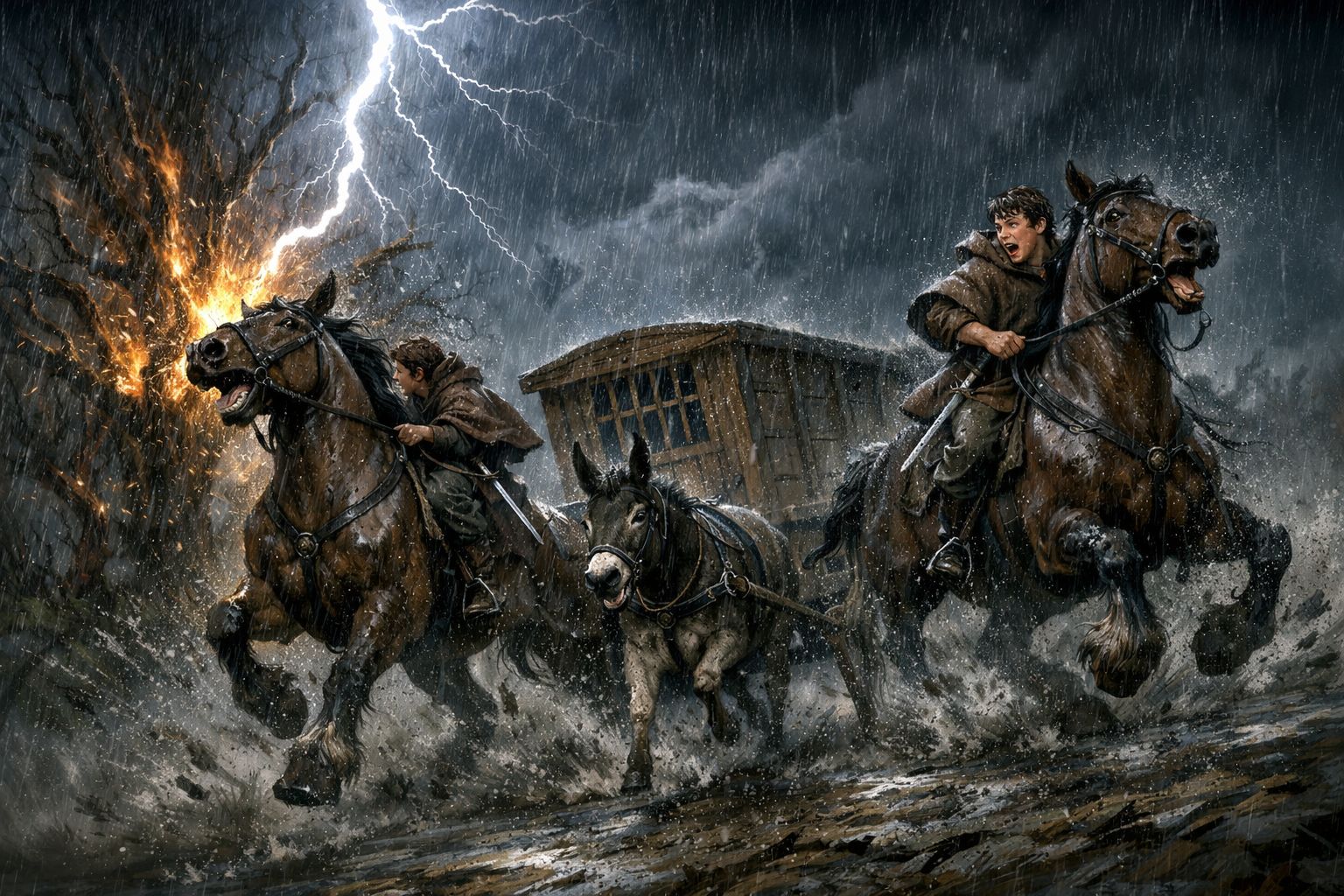
This encounter is not meant to feel planned or earned through investigation. It should feel like an interruption imposed by the world. The storm is already heavy when the scene begins, loud enough that normal conversation is difficult and visibility is poor. The rain matters mechanically and narratively. Tracks are washed away quickly. Sound does not carry well. Shapes are hard to distinguish beyond a short distance.
Emphasize that this weather is unpleasant but ordinary for the region and season. Do not describe it as supernatural or ominous. If the players later reflect on the timing, that is enough. In the moment, it should register as bad luck, not destiny.
The Escort
The escort consists of two low ranking Omrosi guards. Give them names only if needed later, such as Guard Pell and Guard Iseth, but do not humanize them too much. They are not villains, just functionaries. Their weapons are simple and well maintained, but not ceremonial. Shortswords, practical cloaks, nothing distinctive.
They are not expecting trouble. They are moving at a steady pace, focused on getting the prisoner back to Lightmoor and onward transport. One guard leads the mule. The other walks slightly behind and to the side. They are riding horses which look like farm horses, not war horses. This is routine work, not a high risk transfer.
The absence of a driver should stand out slightly but not be explained. It reinforces that this is not a high security convoy, just a transfer.
The Accident Window
The lightning strike and panic should happen fast, with no opportunity for the players to intervene before it is over. The guards are separated from the cart by distance, noise, and confusion. The important point is that they are alive and will regroup.
Make it clear that the crew has minutes, not seconds, but not long enough to argue ethics in detail. The window is narrow enough that hesitation feels costly.
If the players do nothing, the guards will eventually return and secure the cart. Moriel will be taken onward. There is no partial outcome here.
Moriel’s Condition
Moriel is injured, exhausted, and terrified. Her wrists are raw, her ankles bruised. She is soaked to the bone and shaking, partly from cold, partly from fear. She is lucid. She understands where she is and who the crew are. She remembers them from Lightmoor. She knows what Sanctum Omros means.
She should not attempt to manipulate the crew here. Her plea is simple and direct. She asks for help because she has no other option.
If questioned, she confirms that she was being taken back for questioning and torture prior to execution. She does not elaborate unless pressed. She does not yet reveal anything about pacts or demons.
Decision Pressure
Do not present this as a moral debate framed by the Game Master. Present it as a logistical problem with moral consequences. Guards will return. The road is exposed. Hiding a prisoner is dangerous. Helping her means becoming fugitives within Para Omros influence.
Make sure the players understand that intervening here is not reversible. Once they free her, there is no clean way to put things back.
Immediate Consequences
If the crew frees Moriel and leaves the road, the guards will find the overturned cart and the broken lock. They will know exactly what happened. A report will be filed. The priesthood will assume outside interference.
No immediate pursuit follows during the storm. The guards prioritize regrouping and reporting rather than blindly chasing a larger force in poor conditions. They are farm boys given a sword, not soldiers. They were also, as far as they are concerned, transporting a witch, so they fear witchcraft. This buys the crew time but not safety.
The decision to leave the road is correct and should feel that way. The grove provides concealment but not comfort. Everything is wet. Fire is difficult. Moriel will need help walking.
Laying Low
The idea to lay low should be attractive. The crew should understand that Para Omros responds patiently. The danger is not immediate violence, but methodical pursuit. Waiting a day or two allows the storm to erase tracks and gives the guards time to assume the crew has moved on.
Use this period later to establish bonding, exhaustion, and the first subtle signs that something about Moriel is not entirely normal, but do not introduce overt wrongness yet.
Tone and Emphasis
This scene is not about heroism. It is about momentum. The crew acts because the opportunity exists and the alternative feels unbearable, not because they believe they can fix Para Omros or save everyone.
Keep the focus on weather, movement, time pressure, and consequences. The moral weight comes later.
This is the point where the crew stops being observers of Para Omros and becomes entangled in it.
Flight and Bonding
Once the crew leaves the main road, the immediate danger shifts from pursuit to exposure. The rain conceals them, but it also slows movement and exhausts everyone involved. Moriel cannot keep pace without help. She stumbles often and needs support over uneven ground.
Make it clear that escape is not clean or elegant. They are cold, wet, and uncomfortable. Every decision is about shelter, direction, and distance rather than heroics.
More importantly, make it feel as if every complication drives them further from their intended road, further from the Blue Marlin. They can move away from threats, but they also move away from their goal.
Places to Lay Low
As the storm continues, the crew will need to choose where to wait it out. The land around the road offers limited but workable options, each with different risks.
Groves are the safest choice in the short term. Small stands of trees break up sightlines and dampen sound, and the rain under the canopy makes tracking difficult. Shelter is poor, however. Everyone will stay wet and cold, and fire is hard to keep alive and hidden. Groves favor concealment over comfort and are best for a single night or for avoiding immediate pursuit.
Farm barns offer better shelter but higher risk. They are dry, enclosed, and may provide food, straw, or tools, but they are also owned, watched, and part of the Para Omros system. Farmers are not hostile by default, but they are observant, devout, and likely to report strangers if anything feels wrong. Using a barn means trusting that no one notices, or choosing to move only at night.
Make sure the crew understands that neither option is safe in the long term. Groves delay discovery. Barns improve survival. Both are temporary measures, and both carry consequences if used too long.
Choosing where to lay low should feel like a practical decision, not a moral one. The tension comes from knowing that every hour bought is borrowed, not earned.
Moriel’s Story
During brief pauses, Moriel explains what happened to her in simple, believable terms. A neighbor reported her. Her son recovered from a serious illness. No priest was involved. That was enough.
She does not dramatize this. She speaks with the flat clarity of someone who has already accepted the outcome. Para Omros did not need proof. The recovery itself was proof.
Her account matches what the crew already witnessed in Lightmoor. Nothing she says contradicts known facts.
Bonding Under Pressure
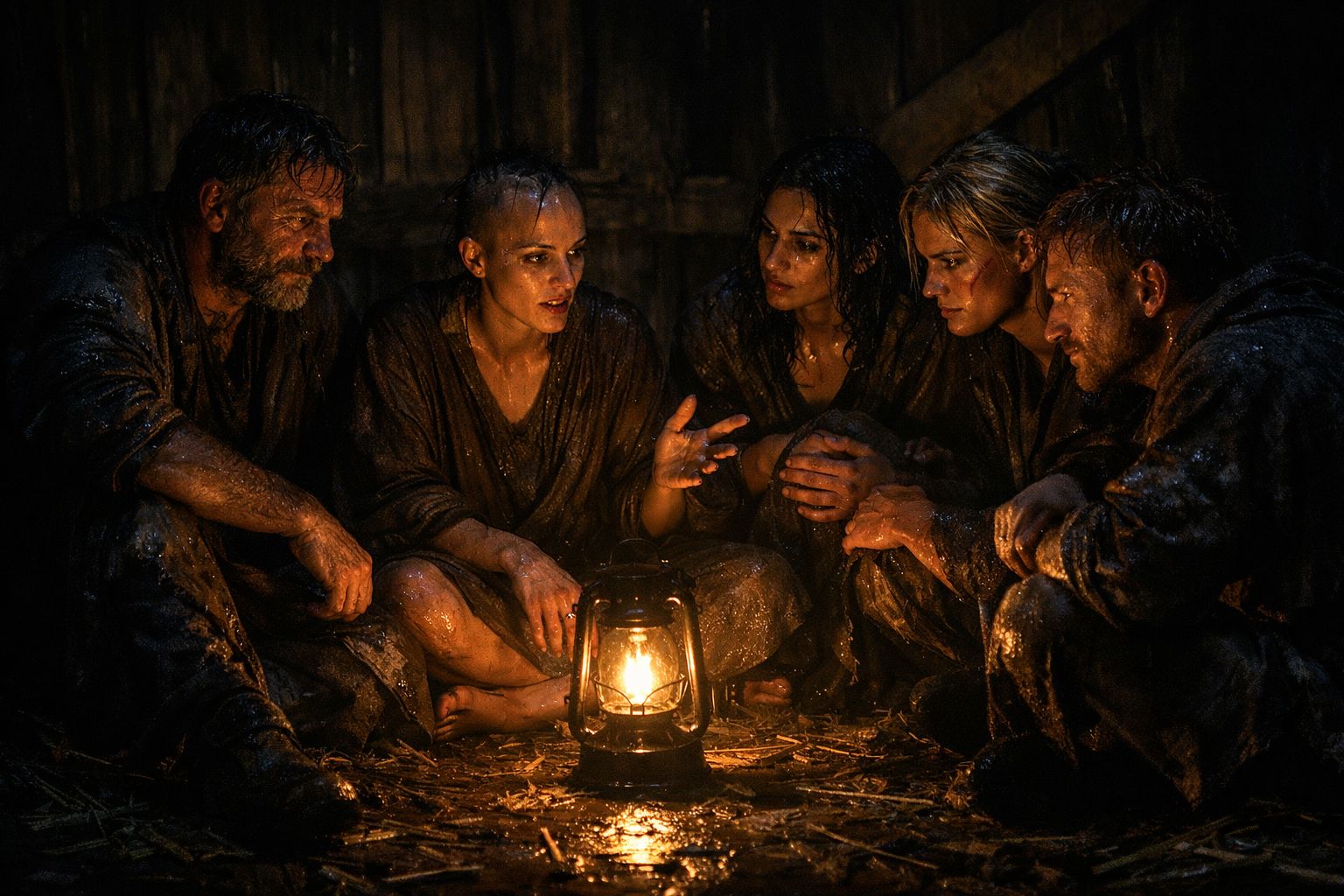
Food is shared. Cloaks are adjusted. Someone helps Moriel walk when her strength fails. These moments matter more than conversation.
Plans are discussed in practical terms. Where to hide. How long to wait. Which direction to move once the storm eases. Moriel listens more than she speaks and follows instructions without argument.
Trust forms not because of speeches, but because survival requires cooperation.
Gaps and Evasions
Moriel does not lie outright, but she avoids depth. When asked about her past, she gives ordinary answers. When asked about magic, she deflects or answers in vague, mundane terms. She insists she does not understand what happened, only that it did.
These evasions should not feel suspicious yet. They read as fear and exhaustion rather than deception. At this stage, there is no clear reason to press her further.
Tone and Purpose
This phase is about grounding the rescue emotionally without introducing new revelations. Moriel should feel human, frightened, and plausible. The crew should feel the weight of responsibility settling in, not yet the cost.
Keep this section brief in play. Its purpose is to establish trust that will later be strained, not to test it immediately.
The Boy
Rain drums against the barn roof in a steady, relentless sheet, loud enough that it fills the gaps between words. The place smells of wet hay and old wood. A lantern hangs from a hook, its light unsteady, casting long shadows across the stalls and the low beams overhead.
Moriel sits on an overturned crate with her borrowed robe pulled tight around her shoulders. Her hands are wrapped around a tin cup that has long since gone cold. She does not drink from it. She stares into it as if the surface might answer her back.
Scarnax keeps watch by the door, listening to the rain more than the road. Skarnulf squats near a stack of hay, rubbing warmth back into his hands. Amaxia leans against a beam, arms crossed, still wound tight, eyes never quite leaving Moriel. Ayesha sits a little apart, attentive, composed, listening.
After a long silence, Ayesha speaks.
“You said they took him.”
Moriel nods once. “They came the morning they took me,” she says. Her voice is flat, as if she has already said this too many times in her head. “They said it was mercy. That he was innocent. That he would be kept safe.”
Amaxia snorts quietly. “They always say that.”
Moriel does not react to the tone. “They told me I should be grateful,” she continues. “That many children are burned along with their mothers. That Omros would use him.”
Skarnulf shifts his weight. “Did you get to see him.”
“For a moment,” Moriel says. “They washed him. Gave him clean clothes. White. They would not let him touch me. One of them stood between us the whole time.”
Her fingers tighten around the cup.
“They told him he was being chosen,” she says. “That Omros had work for him. That he would learn to be pure.”
Ayesha tilts her head slightly. “Did he understand.”
Moriel shakes her head. “He understood that I was not coming with him. He asked if he had done something wrong.”
No one speaks for a while. The rain fills the space.
Scarnax finally asks, quietly, “Where did they take him.”
“To a house outside Sanctum Omros,” Moriel replies. “They called it a place of redemption. They said children are shaped there, before they are brought fully into the priesthood.”
“And you believed them,” Amaxia says, not accusing, but sharp all the same.
Moriel looks up at her then. Her eyes are red, but dry. “I believed that if I obeyed, they would not hurt him,” she says. “That if I said the right words, did not resist, did not curse them, he would be allowed to live.”
Skarnulf exhales slowly. “That is how they get you.”
“Yes,” Moriel says. “That is how.”
Ayesha folds her hands together. “Do you know what they intend for him.”
Moriel hesitates. “They said he would be raised within the faith,” she answers. “That he would be watched closely. That he would be taught discipline and gratitude. That he would never lack food or shelter. That he might join the priesthood.”
She looks back down at the cup.
“They said that if I cooperated, he would never be punished for my sins.”
Amaxia pushes off the beam. “And if you did not.”
Moriel does not answer immediately. When she does, her voice is very quiet. “They did not have to say.”
Scarnax glances toward the door, then back to her. “Do you think he is still alive.”
Moriel nods, quickly, as if the motion itself is protective. “Yes,” she says. “I would know if he was not.”
No one challenges that.
Outside, the rain continues to hammer the roof, indifferent and unrelenting.
Ayesha is the one who finally breaks the silence again. “You did what you thought you had to,” she says. It is not comfort. It is recognition.
Moriel closes her eyes. “I did what they told me would keep him safe,” she replies. “Everything else stopped mattering.”
The lantern flickers. The barn creaks in the wind. For a while longer, they sit there, bound together by the knowledge that whatever comes next, it already began the moment a child was called innocent and taken away.
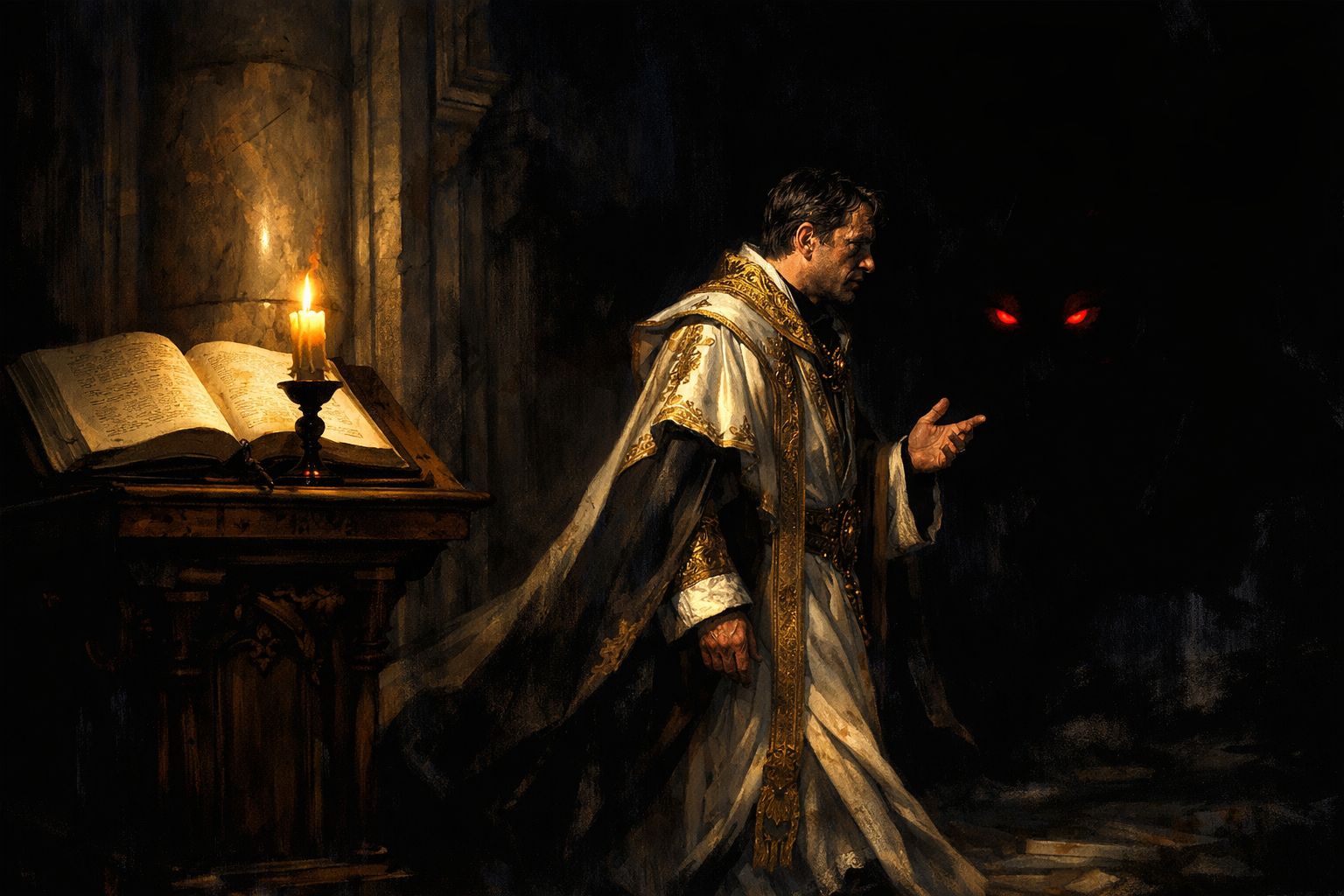
The Demon’s Long Game
This section is Game Master knowledge. None of this should be stated outright to the players during this act.
The demon involved is not interested in chaos, possession, or immediate destruction. Its goal is validation. It wants systems to prove themselves effective while quietly serving its ends. Para Omros is useful precisely because it believes so completely in its own righteousness.
By intervening to save the child from illness, the demon created a dependency that could not be acknowledged openly. Once the pact was made, the demon’s priority shifted from the mother to the outcome. The child became the long term investment.
The demon quietly ensures that the child remains healthy, disciplined, and exemplary while under priesthood care. No unexplained sickness. No accidents. No visible signs of corruption. Every success reinforces Para Omros belief that its methods work, that purification and discipline cleanse all taint.
From the priesthood perspective, the child is proof. Proof that mercy through correction saves. Proof that exposure can be burned away. Proof that Omros is right.
The demon does not push the child toward rebellion or collapse. It allows the system to shape him exactly as it intends. Obedient. Devout. Grateful. Over time, the child may rise within the priesthood, not despite his origin, but because of it. His story becomes doctrine.
The demon’s victory is not the child’s fall, but his ascent.
A future priest whose existence is anchored in a demonic pact becomes a living contradiction at the heart of Para Omros. Every judgment he passes, every execution he sanctifies, every sermon he delivers spreads righteous certainty built on an infernal foundation. The system does not notice the contradiction because it confirms everything it already believes.
The Demon and Moriel’s Survival
From the demon’s perspective, Moriel’s purpose was already fulfilled. The pact was never about her survival, but about securing the child’s future inside Para Omros. Once the child was taken and placed within the priesthood, Moriel became expendable. The expected and preferred outcome was that she would be broken, burned, and forgotten, leaving the demon free to focus entirely on the long game.
However, the pact still binds the demon. It cannot allow Moriel to be taken to execution while the agreement remains in force. The lightning strike that shattered the escort was not mercy or improvisation, but obligation. The demon acted to preserve the contract, not the woman.
Going forward, the demon will continue to aid Moriel when obliged to, but always within the narrow limits of the pact. Each act of protection is paired with a demand. Each reprieve tightens the leash. The demon will force Moriel to do harm, to enable suffering, or to create conditions that serve its broader goals, all while remaining technically within the agreement she accepted in desperation.
The demon does not want Moriel to survive in the long term. It hopes she will eventually be killed, either by Para Omros or by the consequences of what it forces her to do. Her continued existence is a liability, tolerated only because the contract requires it. The true investment is the child. Moriel is already a sunk cost.
Control Through Silence
As part of the pact, the demon forbids Moriel from speaking her child’s name.
This is not framed to her as punishment. It is framed as protection. Speaking the name would break the contract, and thus the demon's obligation to protect the child.
Moriel believes this.
She also knows, on a level she does not examine closely, that this is an order. The name does not come to her lips even when she tries. When asked, she explains the silence in practical terms. She does not want Omros to punish him further. She does not want to mark him.
To the demon, the name is leverage. Names create continuity. They allow stories to be traced and reclaimed. By removing the name, the demon severs the last personal claim Moriel has. The child becomes an institutional asset rather than a person who can be sought or saved.
This silence is not meant to be noticed immediately. It should register as grief, fear, or habit. Only later, when patterns emerge, does it become clear that even this absence was shaped.
First Signs of Wrongness
These signs should appear gradually over the course of travel and hiding. None of them are conclusive on their own. Each can be explained away. Together, they create unease without confirmation.
Don't use them all, pick a few which fits the situation.
Fortunate Inconveniences
Small problems resolve themselves just in time. A snapped strap breaks after it is no longer needed. A wrong turn leads to shelter rather than exposure. Rain intensifies exactly when tracks would otherwise be visible. These are helpful, but not miraculous.
Moriel reacts with relief, not surprise.
Talking to Herself
She keeps talking to herself, as if telling herself what she is doing. At first, it looks like absent-minded pratter. "I'll just put this in the bag here...", "Now, where did it put that?", just part of her personality.
However, occasionally, it feels like she is talking to someone else. Still her own voice, still only phrases from her perspective, but with pauses, as if listening.
Animals and Absence
Animals behave oddly around Moriel. Horses shy. Dogs refuse to come close. Birds fall silent when she approaches a grove.
There are no attacks. Nothing dramatic. Just avoidance.
Moriel notices, but dismisses it as nerves or smell.
Weather That Favors One Side
The storm lingers longer than expected in the areas the crew passes through, while nearby regions clear. Rain makes fire difficult when needed, then slackens just enough when concealment matters more.
Nothing here violates natural patterns. It simply favors delay and cover.
Unintended Harm Elsewhere
Something goes wrong nearby that does not affect the crew directly. A fallen tree blocks a farm road. A barn roof collapses under water weight. A traveler is injured when startled livestock bolt.
Moriel is present when it happens, but does nothing obvious. Later, if pressed, she admits she felt pressure beforehand and relief afterward.
Physical Toll on Moriel
After each incident that benefits the crew, Moriel deteriorates slightly. Short of breath. Sudden exhaustion. Pain that leaves no mark.
She attributes it to stress and cold. She does not ask for help.
Compelled Actions
Moriel begins to suggest small actions that feel wrong but practical. Diverting through a farmstead rather than past it. Taking supplies without asking. Scaring a child who saw them into silence.
If questioned, she cannot fully explain why. She insists it was necessary.
Cracks in Rationalization
Moriel starts to contradict herself in minor ways. She forgets what she said earlier. She insists she did not choose something the crew clearly saw her choose.
These moments distress her more than anyone else. She grows quieter afterward.
Misplaced Objects
Items go missing and later turn up exactly where they are suddenly needed. A dropped knife appears near a cut rope. A waterskin rolls within reach during exhaustion. No one sees them move.
Moriel does not comment on this unless asked.
Selective Hearing
Moriel fails to hear things that would endanger her or the crew. Shouts in the distance. A warning call. The sound of approaching riders. Later, she reacts normally to far softer sounds.
This only happens when hearing would cause immediate danger.
Dream Contagion
One or more crew members dream of rain, fire, or being watched, but Moriel wakes already awake when they do. She never describes her dreams, only says she did not sleep.
The dreams are not prophetic. They are emotional residue.
Environmental Misfortune
Places the crew might reasonably seek shelter become unusable shortly before arrival. A barn already collapsed. A bridge washed out. A door barred from within. The crew must move on, always farther, always tired.
These setbacks always push them toward isolation.
Pain as Compliance
Moriel experiences sudden pain when she hesitates before suggesting or agreeing to a harmful choice. The pain stops once the decision is made.
She tries to hide this. If confronted, she admits it in pieces.
Proximity Effects
The closer Moriel stays to the group, the more often fortunate misfortune occurs. If she is separated briefly, things grow harder but more ordinary.
This should never be stated explicitly. Let patterns emerge.
Nightmares
Moriel is having nightmares, mumbling to herself in her sleep. Sometimes her voice sounds much darker.
Guidance for the Game Master
Do not frame these as clues to a demon.
Present them as personality, inconvenience, luck, stress, and fear.
If the players argue among themselves about whether something is wrong, you are doing it right.
Only escalate when the crew benefits at someone else’s expense. The wrongness grows in proportion to the harm displaced.
This section is not about revelation. It is about erosion.
If you use restraint, the players will not ask “Is Moriel a demon?” They will ask “Why does helping feel worse every time?”
Pressure from the Outside
This phase introduces external weight without escalation into open conflict. The pressure should feel steady, rational, and difficult to escape rather than aggressive.
The Surrounding Landscape
The land around Lightmoor and Sanctum Omros is dominated by farmland. Fields stretch between isolated farmsteads, with small villages spaced at sensible distances along the roads. Groves and narrow sections of forest break the open land, offering concealment but little comfort. Streams and drainage channels run everywhere, all feeding toward the Vena Omros river.
Movement is shaped by water, especially since the water runs fast now, due to the rain. Bridges and established fords become natural chokepoints, watched more closely than open fields. Roads are reliable but exposed, while cross country travel is slower and exhausting, especially in rain. Leaving the road avoids attention, but always funnels travelers back toward the same crossings eventually.
The landscape feels safe, worked, and claimed. There is nowhere truly wild, only places not currently watched.
Signs of Pursuit
The priesthood does not rush. Inquisitors move along known routes, asking measured questions and recording answers. Give one or two names if useful, such as Inquisitor Halvren or Brother Kaie, but present them as calm officials rather than antagonists.
They arrive after the crew has passed. Footprints are noted. Doors are knocked on politely. Written notices appear on shrine posts or civic boards. No accusations are shouted. No deadlines are issued.
The message is implicit, they are coming, and they have time.
Civilian Reaction
Civilians are wary, not hostile. They ask why the crew is traveling off road. They hesitate before offering shelter. They warn the crew about rites, curfews, and proper behavior.
If questioned, locals speak in the priesthood’s favor. Omros keeps order. The priesthood protects children. Those taken are taken for a reason.
Helping the crew feels dangerous to them, not immoral.
The Cost of Delay
During this period, an incident occurs that benefits the crew while harming someone else.
A frightened traveler's horse is spooked at the wrong moment and distracts inquisitors, but he is suspected as an accomplice. A door barred against the inquisitors leaves its owner under suspicion later.
Moriel is present when this happens, but does nothing obvious. If confronted, she admits she felt pressure and relief in close succession. She insists she did not fully choose it, but that it had to happen.
This is the first time her survival clearly costs someone else.
Guidance for the Game Master
Keep the priesthood patient. Do not let them make mistakes or show anger.
Let civilians be sincere. They are not collaborators, they are believers.
The pressure should feel survivable in the short term but impossible in the long term. The crew is not being hunted. They are being waited for.
This phase should make the players realize that running is buying time, not escape.
Revelation Without Confession
Rain has eased into a steady whisper by the time it happens, more damp than downpour, the world reduced to mud, gray light, and the quiet sounds of breathing and shifting weight. They are holed up in another borrowed shelter, this one little more than a half collapsed shed near a grove, walls patched with old planks and prayer scraps nailed into the wood.
Moriel sits apart from the others, knees drawn close, hands clenched so tightly her knuckles have gone pale. She has been like that all evening. Quiet. Too quiet.
Scarnax is the one who finally breaks it.
“You knew,” he says, not accusing, not gentle either. “About the tree. About the farmer. About the way things keep going wrong for everyone else.”
Moriel flinches.
Ayesha looks at her carefully. “We are not asking you to explain everything,” she says. “We are asking you to stop pretending nothing is happening.”
Moriel shakes her head, once, then again, sharper this time. “I did not want it to happen like that,” she says. “I did not choose those things.”
Amaxia pushes off the wall where she has been standing. “You keep saying that,” she snaps. “But somehow it always works out for us.”
Moriel’s breath catches. She presses a hand to her mouth, then lowers it again, fingers trembling.
“You do not understand,” she says. “If I stop, it hurts. If I hesitate, it hurts worse.”
Skarnulf straightens slowly. “Hurts how.”
Moriel laughs once, a broken sound that turns into a sob halfway through. “Like something is tearing me open from the inside,” she says. “Like fire under the skin. Like being reminded that I do not belong to myself anymore.”
Silence settles hard around them.
Ayesha’s voice is quiet when she speaks. “Moriel. What did you do.”
Moriel looks up at them then, really looks, and whatever she sees on their faces breaks whatever was left holding her together.
“I made a pact,” she says. The words spill out fast now, as if she is afraid to stop. “I was desperate. He was dying. No prayer worked. No cleric would come. I begged and begged and there was nothing left to beg.”
Tears run freely now, cutting clean lines through the dirt on her face.
“It answered,” she says. “It said it would save him. It said the price would come later. I thought I could bear it. I thought it would be me.”
Scarnax closes his eyes briefly.
“A demon,” Skarnulf says. He does not raise his voice. He does not need to.
Moriel nods, choking on the motion. “Yes,” she whispers. “Yes. I know what that makes me. I know.”
Amaxia’s jaw tightens. “And now.”
“And now it owns the bargain,” Moriel says. “It does not let me refuse. It does not let me choose cleanly. It hurts me until I do what it wants. And if I break it, if I truly break it, it will let Omros take my boy. Or worse.”
She curls in on herself, hands clutching at the robe.
“I am trapped,” she sobs. “I did not lie to you. I am not free. I never was.”
Ayesha looks away first.
Scarnax stays still, face hard, working through something he does not say aloud.
Skarnulf spits into the dirt. “There is no excuse for dealing with them,” he says. “None.”
“I know,” Moriel cries. “I know. But I would do it again. I would burn for it a thousand times if it keeps him breathing.”
No one answers her right away.
The shed creaks softly as the wind shifts. Somewhere nearby, water drips steadily from a broken beam.
Amaxia finally turns away, rubbing a hand over her face, voice low and rough.
“Sometimes,” she mutters, “even bad people do the right thing for the wrong reasons.”
The words hang there, unanswered, as the night closes in around them.
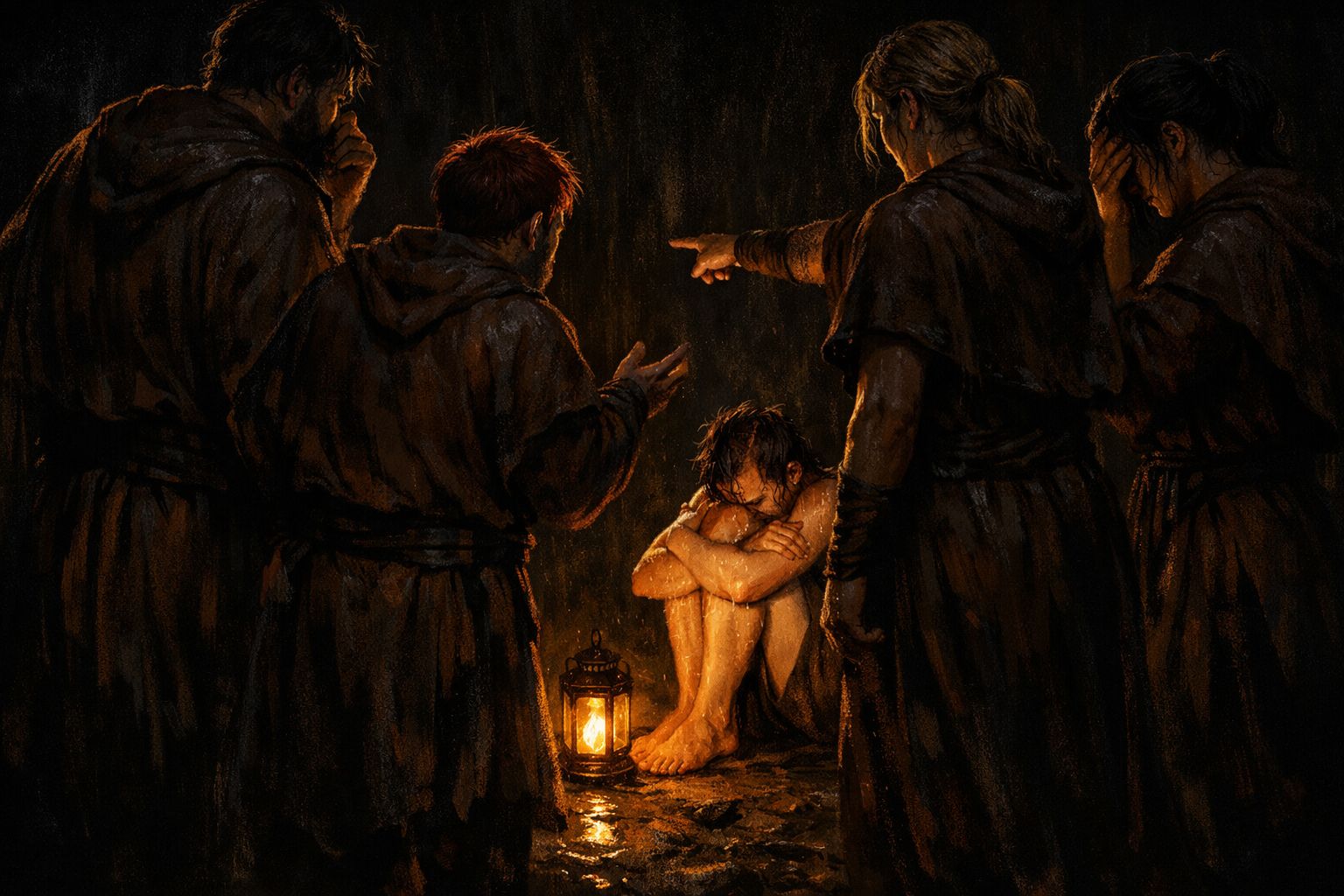
This scene should feel like an emotional collapse rather than an interrogation. The truth emerges because Moriel can no longer sustain the strain, not because the crew extracts it.
Keep the setting small, enclosed, and uncomfortable. A shed, barn, or lean to works best. Weather should still be present but muted, as background pressure rather than spectacle.
Moriel admits to a demonic pact only when pressed emotionally, not logically. She does not justify it. She does not deny what it makes her. Emphasize her fear, pain, and lack of agency rather than the mechanics of the pact.
The crew’s are likely to be divided but restrained. No one absolves her. No one attacks her. Disgust and sympathy exist side by side. Do not introduce consequences, pursuit, or choices immediately afterward. Let the confession sit and rot in the silence.
Moral Crossroads
The rain has stopped sometime during the night. What remains is damp earth, cold air, and the quiet that follows exhaustion. Dawn light seeps in through the warped boards of the shed, pale and colorless, turning everything flat and tired.
Moriel sleeps where she collapsed, curled tight in the borrowed robe, breath shallow and uneven. She looks smaller now, emptied by confession. Whatever strength she had was spent telling the truth.
The crew has moved a little away from her, not far, but enough.
Scarnax squats near the doorway, watching the light creep across the ground. He has not slept. His expression is unreadable, but his jaw is set hard enough to ache.
Skarnulf sits on an overturned bucket, sharpening his knife out of habit rather than need. The sound of stone on steel is slow and steady.
Ayesha stands with her back to the wall, arms folded, eyes distant. She is not looking at Moriel. She is looking past her, as if at a map only she can see.
Amaxia breaks the silence first.
“So,” she says quietly. “Now we know.”
No one answers immediately.
“She made a pact with a demon,” Skarnulf says at last. He does not look up from the blade. “There is no walking away from that. There never is.”
“She did it to save her child,” Ayesha replies. Her voice is calm, but tight. “That matters.”
“It explains it,” Skarnulf says. “It does not excuse it.”
Scarnax exhales slowly. “Para Omros was right about one thing,” he says. “She is dangerous. Not because she wants to be. Because something else gets to decide what she does.”
Amaxia’s hands clench. “And because of that, we are now running, people are getting hurt, and she will keep being used until someone puts a knife in it. Or in her.”
Ayesha turns to face him. “You are talking about killing her.”
“I am talking about endings,” Amaxia says. “Clean ones are gone.”
Skarnulf finally looks up. “If we hand her back,” he says, “they will burn her. Slowly. They will call it mercy. And whatever rides her will move on, laughing.”
“And if we keep her,” Scarnax says, “we carry that with us. Every step. Every choice. We become part of it.”
Ayesha closes her eyes for a moment. “If we give her up,” she says, “we prove Para Omros right. Not about mercy. About necessity. About the idea that some people are too dangerous to be allowed to live.”
“And if we do not,” Amaxia says, “we keep paying the price in other people’s blood.”
The weight of it settles between them, heavy and unavoidable.
Moriel stirs, murmurs something in her sleep, then goes still again.
Skarnulf watches her for a long moment. “Demons do not make deals that end well,” he says. “For anyone.”
“No,” Ayesha agrees. “But neither do systems that believe themselves pure.”
Scarnax straightens slowly. “Whatever we choose,” he says, “it will follow us. One way or another.”
Amaxia looks back at Moriel, then away again. “Good,” she says. “It should.”
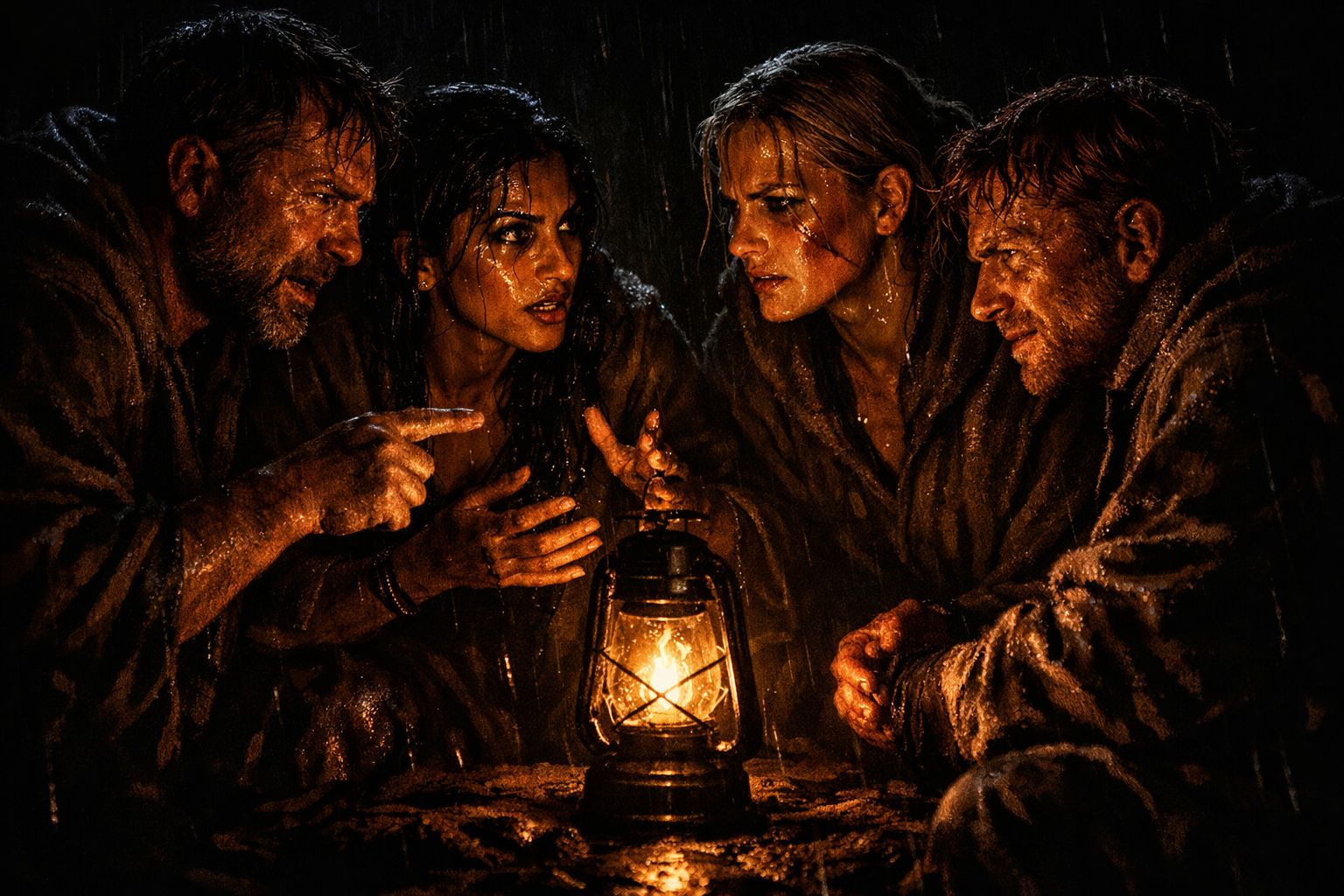
This is the point where the arc stops being about escape and becomes about responsibility.
The crew now understands that Para Omros was correct in this specific case. Moriel is dangerous. The demon is real. Harm follows her presence whether she intends it or not. This realization should be uncomfortable, because it mirrors the priesthood’s logic even as the crew rejects its cruelty and certainty.
Moriel is both victim and vector. She did not choose freely, but she is still a weapon the demon actively uses.
There is no correct path. Each option resolves one problem while deepening another.
Do not rush this. Let the players argue. Let them project. Let them contradict themselves.
Options
Attempted Containment
If the crew chooses to keep Moriel with them while trying to limit harm, the demon responds by tightening the pact.
Demands escalate slowly. At first, the cost is abstract. Delay instead of aid. Silence instead of warning. Later, the cost becomes personal. Someone must be frightened. Someone must be blamed. Someone must suffer so that the crew can pass unharmed.
Moriel becomes increasingly brittle. Each refusal causes pain. Each compliance leaves her quieter and more withdrawn.
This path reinforces Para Omros reasoning through experience. Harm cannot be eliminated, only displaced. The question becomes who pays.
In the long run, the situation becomes impossible to maintain, and another option will have to be taken. The demon will now interfere more openly and drastically, reveling in the chaos it sows. The hunters will close in. The way to the ship is closed.
Attempted Bargain
If the crew attempts to engage the demon directly, it responds clearly and without deception.
It does not threaten. It does not rant. It explains terms.
Every offer resolves an immediate problem. Safe passage. Time bought. Pressure eased. In exchange, a future cost is defined but not immediate. The demon frames every choice as voluntary and every consequence as the crew’s responsibility.
The demon never lies. It simply ensures that every outcome benefits it more than anyone else.
This path risks normalizing negotiation with something the crew knows should not be negotiated with.
Surrender to Para Omros
If the crew returns Moriel to the priesthood, it is handled without drama.
The priests accept her with procedural calm. No accusations are made. No gratitude is expressed. The matter is simply corrected.
Moriel is removed from the world in a controlled and brutal way, through execution. The demon’s influence on the crew ends here. The system remains intact. Para Omros logic is affirmed. Something dangerous has been removed.
The crew escapes further entanglement, but carries the knowledge that the priesthood was right about necessity, even if wrong about mercy.
Killing Her Themselves
If the crew kills Moriel, the outcome is functionally similar to surrender, but morally different.
The demon loses this vessel. The harm stops. Para Omros never learns the full truth.
The difference is ownership. The blood is on the crew’s hands, not the priesthood’s. There is no ritual, no doctrine, no absolution.
This choice removes external judgment but leaves internal consequences.
Abandoning Her
If the crew abandons Moriel, they reject responsibility entirely.
She may be found and killed by the priesthood. She may escape and continue under the demon’s control. She may disappear into something worse.
The crew will not know.
This path preserves distance at the cost of certainty. It avoids immediate guilt but guarantees unresolved consequence.
After the Choice
Once the crew are no longer travelling with Moriel, getting back to the ship is easy, almost too easy to feel good, especially in the light of the heavy choice they just made. Make the players feel that Moriel and the demon held them back, but that the convenience they gained came at a cost.
Guidance for the Game Master
Do not present these as menu options. Let them emerge naturally through discussion.
Do not soften outcomes. Every path should feel like a loss.
Do not resolve everything immediately. Some consequences should echo later, when the choice can no longer be changed.
This crossroads is the thematic heart of the arc. The lesson is not about good and evil, but about what people are willing to justify once they believe something is necessary.
Climax
Resolution Point
The arc resolves the moment the crew commits to a course of action and accepts that it cannot be undone. There is no final confrontation and no external validation. The weight of the climax lies entirely in the choice itself and in the knowledge that other paths are now closed.
Do not allow reconsideration once the decision is acted upon. Even if doubts remain, momentum carries the outcome forward.
There is no correct answer. Each option trades one kind of harm for another.
Institutional Response
Para Omros responds without passion.
If Moriel is returned or killed, the priesthood treats the matter as concluded. Records are updated. Witnesses are dismissed. Inquisitors such as Halvren or Brother Kaie move on to other duties. No pursuit follows the crew beyond what is necessary to re-establish order.
If Moriel escapes or is abandoned, the search proceeds for a time and then ends. Para Omros does not hunt obsessively. It trusts that disorder either resolves itself or is corrected elsewhere.
The system does not seek revenge. It seeks equilibrium.
The Demon’s Shadow
The demon does not forget.
If it was bargained with, it will remember the crew as willing participants. If it was denied or deprived of its vessel, it will remember them as obstacles. If it was allowed to continue elsewhere, it will adapt without resentment.
This does not result in immediate reprisal. The demon’s patience mirrors Para Omros itself. Consequences surface later, in places and situations that do not obviously connect back to this choice.
Someone innocent suffers regardless of the path taken. This suffering should be indirect and delayed. A family quietly corrected. A traveler questioned. A life narrowed rather than destroyed.
Para Omros Endures
Para Omros remains what it was.
The crew does not expose corruption, topple leadership, or disrupt doctrine. They do not weaken the system. They merely survive contact with it.
The priesthood continues its work. The bells continue to ring. The people continue to believe.
The demon tainted child continues to rise within the ranks of the faith, unseen and unnamed, origin forgotten, a quiet contradiction embedded at the heart of certainty. This outcome was never meant to be visible or dramatic. It is meant to endure, to subtly rot and control from within.
Closing the Arc
Close the arc on unease rather than resolution.
Do not provide moral accounting. Do not signal approval or condemnation. Let the players carry the discomfort forward.
The lesson is not about good and evil. It is about the danger of certainty, especially when it happens to be right.
Act Summary
This arc centers on certainty under pressure and the cost of being correct for the wrong reasons. The crew enters Para Omros seeking information and leaves having confronted a system that is brutal, patient, and internally consistent. Nothing they do reforms it. Nothing they do escapes it cleanly.
The events of this arc should echo forward, not as unresolved plot threads to be tied up, but as changes in perspective, trust, and moral posture.
What the Crew Learned
The crew learns that Para Omros is not sustained by fear alone, nor by a cruel priesthood acting against the will of the people. It is upheld by belief. Ordinary citizens accept and defend its logic because it provides order, safety, and certainty in a dangerous world.
They also learn that the priesthood is not indiscriminately wrong. In Moriel’s case, their assessment was accurate. She was dangerous. A demon was involved. Harm followed her presence regardless of intent. This realization is deliberately uncomfortable because it aligns with Para Omros reasoning while rejecting its methods.
The lesson is not that cruelty works, but that necessity is persuasive.
Moriel and the Demon
Moriel embodies the core contradiction of the arc. She is a victim of circumstance and coercion, yet also a conduit for ongoing harm. Her pact was made out of desperation, not ambition, but it nonetheless enabled something far larger than herself.
The demon’s strategy reinforces the arc’s themes. It does not seek chaos or exposure. It embeds itself within certainty, using Para Omros structures to validate its influence. Its greatest success is not Moriel’s fall, but the quiet rise of her unnamed child within the priesthood, an infernal foundation hidden beneath righteous certainty.
Whether Moriel survives or not, the demon’s long game continues.
Choices and Consequences
Every path available to the crew resolves one problem while creating another.
- Containment displaces harm until it becomes unbearable.
- Bargain normalizes negotiation with something that should not be negotiated with.
- Surrender affirms the system’s necessity while rejecting its mercy.
- Killing removes the threat at the cost of personal responsibility.
- Abandonment preserves distance at the price of certainty.
No option allows the crew to emerge clean.
The most important takeaway is that the arc ends not with resolution, but with ownership. Whatever choice is made becomes part of who the crew is.
Lasting Effects on the Crew
The crew leaves Para Omros territory changed.
The argument does not end when the arc does. It fractures along philosophical lines. One crew member might begin to justify Para Omros logic in limited, careful terms. Another rejects that reasoning outright. These positions harden over time rather than reconciling.
Trust remains, but it is altered. Moral confidence is diminished. Certainty becomes suspect.
Future encounters with authority, doctrine, or claims of necessity should be colored by this experience.
Para Omros Endures
Para Omros remains intact.
The bells still ring. The priesthood continues its work. The people continue to believe. The system neither collapses nor escalates in response to the crew. It simply absorbs the disturbance and moves on.
The crew does not defeat Para Omros. They survive it.
The demon tainted child continues to rise within the ranks of the faith, unseen and unnamed, origin forgotten. This outcome is not meant to be dramatic or immediate. It is meant to endure.
Core Takeaway
This arc is not about good and evil.
It is about the danger of certainty, especially when it happens to be right.
The players should leave Para Omros uneasy, not triumphant, carrying the knowledge that some systems are monstrous not because they are wrong, but because they are convinced they are necessary.
The year is reckoned as the 5884th of Omros.
Thirty nine years have passed since the Blue Marlin last touched the waters of Para Omros. Few remember the ship now. Fewer still remember the foreigners who walked the roads and then left, troubled and silent. Para Omros has not changed in any way that matters.
The old Hierophant Supreme dies in his sleep, surrounded by incense and prayer, his final breath marked as peaceful and complete. The bells ring for a full day and a full night. The people gather. They mourn sincerely. Order has been maintained. Mercy has been delivered. Omros has walked with them.
The choosing of his successor follows established rite. No debate. No uncertainty. Signs are read. Names are weighed. One is found sufficient.
His name is Hierophant Malcerion.
The anointing ceremony fills the great sanctum from wall to wall. White stone gleams in firelight. Red robed priests chant in careful unison. The people kneel, row upon row, heads bowed in gratitude rather than fear. Oil is poured. Words are spoken. Authority passes cleanly from one man to another, as it always has.
When the ceremony ends, Malcerion stands alone before the altar, hands stained with sacred oil, breath steady, expression composed. He is now Hierophant Supreme Malcerion, spiritual leader of Para Omros, the mouth and hand of Omros.
He bows once to the gathered faithful, then withdraws through the inner doors.
His private chambers are quiet. The walls are thick. The door closes with a final sound that seals him away from the world.
He does not kneel. He does not pray.
He takes three steps into the room and speaks softly, with certainty rather than triumph.
“We did it.”
From the shadows behind the carved pillars, a voice answers, smooth and patient, as if the words had already been spoken long ago.
“There was never any doubt.”
Malcerion exhales, slow and controlled. His hands tremble only slightly. Outside the chamber walls, fire roars. The smell of burning heretics drifts in through narrow vents cut into the stone, thick and familiar, carried on the same air that has filled these halls for generations.
Malcerion breathes it in without reaction.