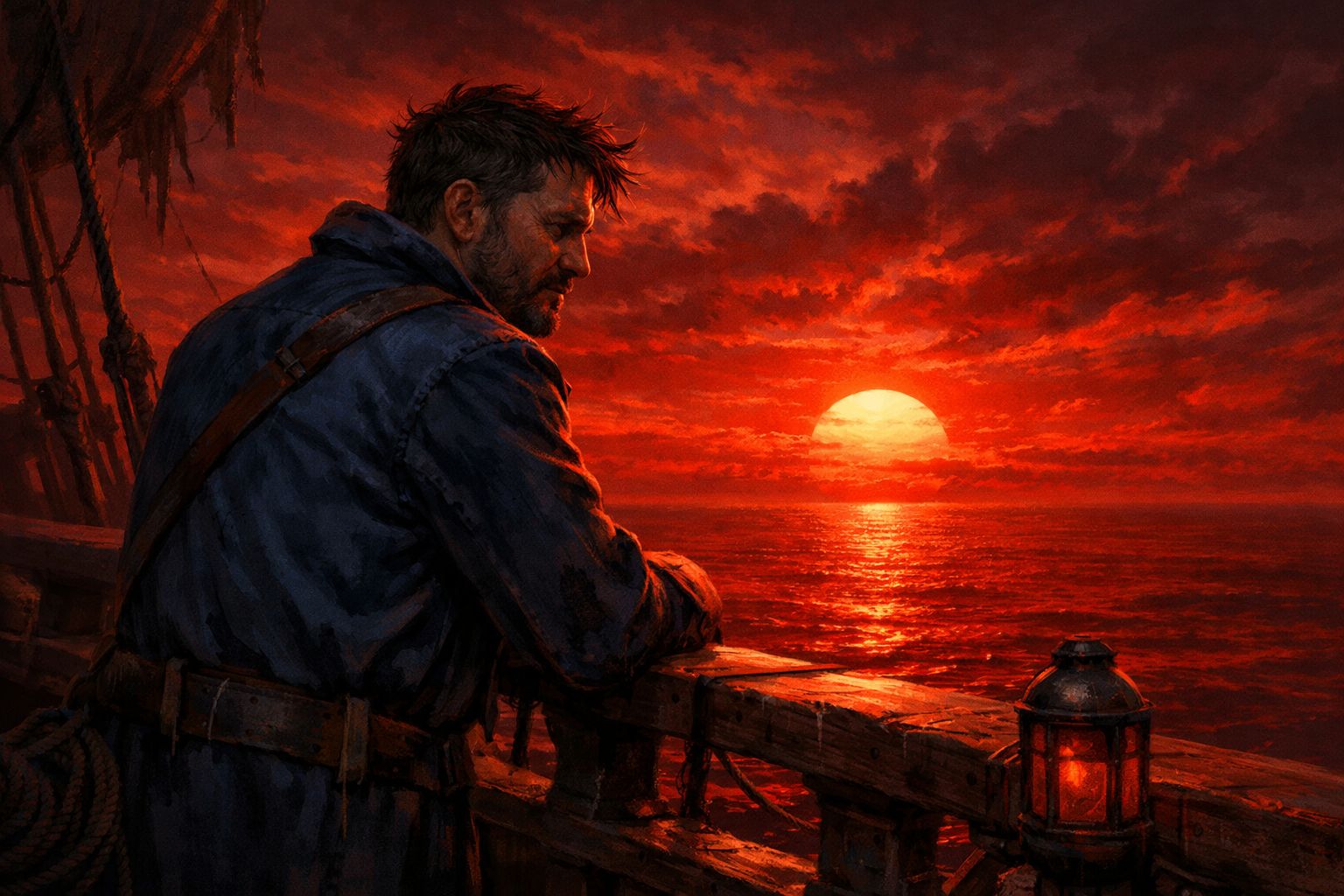
Campaign: Ozukari
Act Synopsis
The Ozukari arc is a chamber piece of dread, guilt and brutal order. It begins as a simple stop in the search for the Waverider and turns into a night of fear inside a noble stronghold under siege. The crew arrives seeking information and receives it, but too late to safely depart before nightfall. Their host, Castellan Hayato Tsukahara, warns them that the stronghold is visited every night by a demon that kills guards, servants and family alike. The castellan himself does not understand why this punishment has fallen on his house, only that something in the order has been disturbed.
During the night, the demon attacks again. This should not feel like an ordinary battle. It should feel like the stronghold itself has become unsafe. Guards scream in the dark. Claws scrape across roof tiles. Doors slide open to empty corridors. A warrior is alive one moment and torn apart the next.
By dawn, Castellan Hayato begs the crew to help him. He has already given them the information they came for, and that should make the appeal morally difficult to refuse. Investigation does not uncover a mystery in the usual sense, but rather a tragic truth. The demon’s attention always returns to Hayato, yet never claims him. It wants him to watch. Through the demon’s behavior, through spiritual unease around the castellan, and through hidden mementos of a secret love, the crew slowly realizes that the lord himself is the center of the punishment.
When finally confronted, Hayato confesses. Years ago, his liege lord, Lord Masanori Minatoya, claimed Hayato’s beloved concubine Lady Reika for his own household, as was fully within his rights. Hayato submitted outwardly, but continued meeting her in secret. In Ozukari, that was not merely love. It was a betrayal of loyalty, a private claim placed above the sacred chain of lord and vassal. He broke order for love, and in doing so invited demons.
Hayato accepts that the stain reaches beyond himself. His bloodline, his household name and all who inherit it are tainted by his transgression. The only honorable end is total acceptance of guilt. Before his remaining retainers and with the crew as witnesses, he performs the final act required to restore order. He cuts the throat of his infant son Daichi while openly weeping, then disembowels himself. His second in command, Captain Genji Arakawa, completes the act as his final service to a man he loved and respected. The retainers mourn openly. In Ozukari, emotion is not dishonor. Refusal and hesitation are.
The next night is calm.
The following day, Lord Masanori arrives in person, confirms that order has been restored and installs Genji as the new lord of the stronghold. He also takes Hayato’s two surviving concubines, Lady Sayo and Lady Kiyomi, into his own household without pause or apology. Among Masanori’s entourage is another concubine, Lady Natsume, visibly pregnant and known to the two women being taken away. The crew leaves with the bitter understanding that they solved the problem for now, but not for good. The system has resumed. The next fracture is already growing.
Purpose of the Act
This act introduces Ozukari at its strongest and ugliest. It should show a culture of elegance, discipline and sincerity whose logic leads to atrocity without ever seeing itself as monstrous. The point is not simply that Ozukari is cruel. The point is that its cruelty is coherent, sacred and emotionally sincere. That is what makes it disturbing.
The act also gives the two crew newcomers Meyrha and Ivy meaningful but distinct roles. Meyrha foreshadows the horror through a symbolic vision that only becomes clear in hindsight. Ivy can sense spiritual avoidance around Hayato, not because she understands demons directly, but because even the spirits recoil from the retribution affecting him. Neither solves the mystery alone. Both deepen it.
Finally, the act should leave the crew morally shaken rather than triumphant. They help restore peace. They also become witnesses to a ritual killing they cannot stop. The immediate problem is solved, yet the world that produced it remains untouched.
Arrival at Kaoriyo
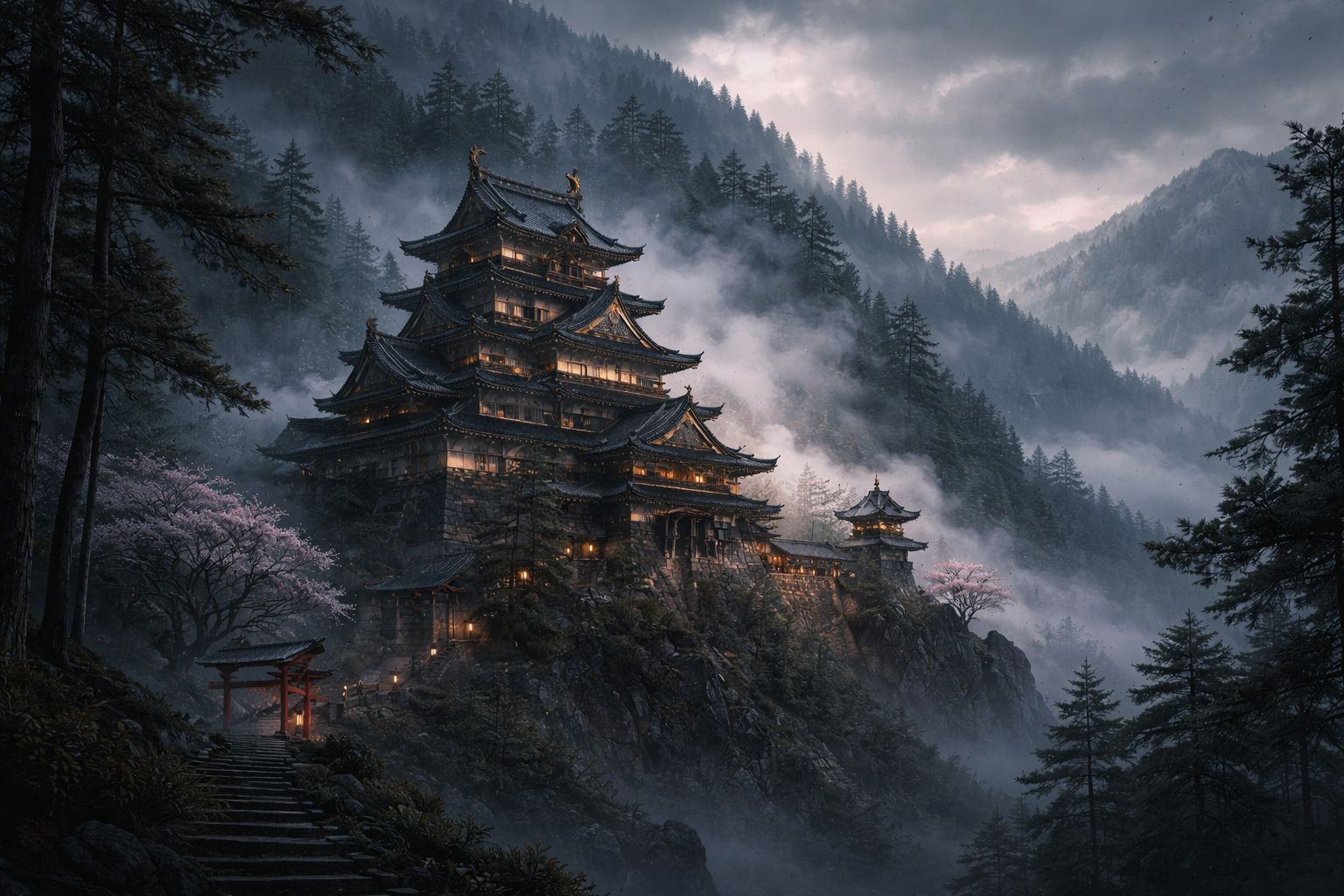
The crew comes ashore at Kaoriyo, a hilltop stronghold held by Castellan Hayato Tsukahara, a lesser vassal of the Minatoya clan. They are received with stern courtesy and proper ritual. Hayato is not hostile. On the contrary, he is unusually cooperative and provides the information they came for about the Waverider’s passing through Ozukari waters. However, the hour is too late for a safe departure, and custom strongly favors staying the night under his roof.
Use the arrival to show Ozukari refinement. Polished wood. Lantern light. Garden stones dark with evening dew. Warriors kneeling with perfect posture. Servants moving in silence. The beauty matters because it makes the night’s terror feel like a violation of something carefully ordered.
Hayato should come across as grave, restrained and deeply tired. He explains the situation plainly. For several nights now, a demon has attacked the stronghold after dark. Men die. Civilians die. Sometimes the creature is driven off or even slain, yet another comes the following night. He does not claim innocence with forceful outrage. He speaks more like a man who already suspects he is being judged.
The Night Attack
Once darkness settles, the stronghold becomes a place of dread. This is not a straightforward combat encounter. The tone is pursuit, uncertainty and brief flashes of violence. A scream from the roof. A servant found dead in a corridor. Blood on lacquered wood. A shadow crossing a paper screen. A guard dragged upward into darkness.
The demon should seem clever, patient and cruel. It does not need many words, if any, but it does need intent. The crucial moment comes when it faces Hayato directly, points at him and then deliberately kills one of his men in front of him before withdrawing. That should make it immediately clear that the creature is not hunting at random. It is punishing him through others.
The Morning Plea
At dawn, Kaoriyo counts its dead. Hayato receives the crew in exhausted formalwear, blood still not fully washed from the stones outside. He begs them to help. This plea matters because he has already honored them as guests and given them the information they needed. The players should feel the weight of reciprocity. He has done right by them. Innocents are dying. Leaving now should feel morally costly, even if it is rational.
Hayato should not yet confess. He is still clinging to the hope that the truth might remain unspoken, or that someone else might name it for him.
If the crew leave, they can do so without dishonor or resistance, but they will later hear rumors of a household in Ozukari wiped out, one by one, until only the castellan remained to weep over the remains.
The Investigation
This is not a true whodunnit. The structure is simpler and stronger than that. The crew looks, senses and follows the emotional trail until the truth becomes unavoidable.
The first clues come from pattern. The demon returns to Hayato again and again, yet never harms him directly. The lord is the center, not the victim. Ivy, if she enters the spirit world, may sense that household spirits linger near the dead and the innocent but avoid Hayato entirely. He feels spiritually shunned.
The second clues come from kept mementos. These should not read like a detective’s evidence locker. They should read like the remains of a real private bond. These items should tell the emotional story that this was not lust, not convenience and not a moment of weakness. It was love.
Meyrha’s vision, if the players remember it, should start to take on shape here. What seemed opaque before now begins to make sense. The vision should be clear in hindsight only.
The crew does not need to solve every detail before the confrontation. They only need enough to understand that Hayato broke loyalty in a deeply human way and that his household is paying for it.
The Confession
When confronted, Hayato confesses. Years ago, Lord Masanori Minatoya claimed Lady Reika from Hayato’s household. That was lawful, expected and beyond protest. Hayato submitted. He bowed. He gave the proper words. Then he betrayed his duty by continuing to meet her in secret.
He should speak without excuse. He can say he loved her. He can say he was weak. He can say he knew the law and broke it anyway. What matters is that he understands exactly what he did in Ozukari terms. He placed his own heart above the bond between lord and vassal. He treated as still his own what had passed into his lord’s household. That is the fracture.
He now believes the punishment will only end when he fully accepts guilt and lets his house die with him. In Ozukari logic, the stain is no longer confined to the act itself. It lives in the bloodline and the name.
The Ceremony of Restoration
This scene is the moral center of the arc and should be played with extreme seriousness. It is not spectacle. It is grief under discipline.
Hayato summons the surviving retainers of the stronghold. Captain Genji Arakawa stands beside him as second and witness. The infant heir, Daichi, is brought forth. Hayato is openly weeping. His retainers are not stone faced either. Some cry. Some stare rigidly ahead with wet eyes. The liaison who explains what is happening to the foreigners should do so calmly and sorrowfully. In Ozukari, tears do not dishonor a man. Failure to do what duty requires does.
Hayato cuts his son’s throat with shaking hands but without hesitation. He then kneels and opens his own belly. Genji completes the act as his final service to his lord and friend. This should not feel like ambition. It should feel like loyalty carried to its bitter end.
The crew should feel trapped by numbers, custom and the full force of a society united around an act they find horrific. Intervening is possible in theory, but should feel close to suicide and would completely rupture their position in Ozukari.
The Quiet Night
The next night passes without attack.
That silence matters. It confirms, at least in practice, that Ozukari logic worked. Whether the players believe in the metaphysics or not, the stronghold believes, and the result gives them no easy grounds to deny it.
Do not overplay this section. The stillness itself is the point.
Lord Masanori’s Arrival
The following day, Lord Masanori Minatoya arrives with an armed retinue and the cold efficiency of hierarchy reasserting itself. He hears the account, accepts that order has been restored and wastes no time in naming Captain Genji Arakawa the new lord of Kaoriyo. There is no mourning period. Administration resumes at once.
Masanori also claims Hayato’s surviving concubines, Lady Sayo and Lady Kiyomi. This should be done as routine, not as villainous theater. That is what makes it worse. He is simply continuing the order that caused all of this in the first place.
Among his entourage is Lady Natsume, one of his own concubines, visibly pregnant. Sayo and Kiyomi recognize her, and she recognizes them. The implication should be visible but not explained in full. The crew understands enough. The cycle is not broken. It has merely paused.
Thaleia's Role in Ozukari
Thaleia remains with the crew during this act because Ozukari is one of the cultures she most wants to study, and she has a strong interest in its traditions, beliefs and ritual logic. She is not central to resolving the crisis at Kaoriyo, and this is not an arc that especially plays to her strengths. However, she can still offer one important piece of insight.
Thaleia recognizes that the demons of Ozukari appear to operate according to a different principle than demons encountered elsewhere. They do not seem to behave merely as predatory or malicious entities. Instead, they appear tied to disruption, transgression and the violation of sacred order. That understanding does not solve the problem by itself, but it helps the crew interpret what they are facing. It shifts the question from how to kill the demon to why it has come.
That insight may prove valuable later, by helping the crew avoid dangerous assumptions about demons and transgression.
Mood and Themes to Emphasize
The defining theme of the act is that sincere emotion and brutal duty are not opposites in Ozukari. They coexist. Men can weep and still kill their children. Friends can mourn and still finish each other’s deaths. Love can be real and still be treated as disorder worthy of demonic punishment.
Another important theme is punishment through witness. Hayato’s true torment is not that he will die. It is that he must watch those around him die because of what he did. The demon understands this, and the stronghold gradually does too.
The final theme is false resolution. The immediate haunting ends. The larger problem does not. Ozukari has restored order at this one stronghold, but the very structure that generated the transgression remains untouched and active.
Practical Notes for the Game Master
Do not run this as a combat-heavy action chapter. The strongest version leans on dread, atmosphere and moral pressure.
Keep the investigation simple and cumulative. The players do not need a complicated clue web. They need enough signs to understand the shape of the truth before the confession lands.
Handle the ceremony with restraint. The horror comes from sincerity, grief and social unanimity, not from gore for its own sake.
Use Meyrha for omen and hindsight. Use Ivy for unease and spiritual contamination. Neither should replace the emotional work done by the lord’s own confession and the visible culture around him.
End on bitterness, not catharsis. The crew leaves with answers, with the information they needed and with the knowledge that they helped stop the killings. They also leave knowing that the peace they restored is only temporary.
Foreshadowing: Meyrhas Vision
Here is a tighter version with Yasmira's food adjusted:
The morning meal had drawn much of the Blue Marlin's crew together on deck as the coast of Ozukari first emerged from the haze. Yasmira had outdone herself again. The fish was tender, the broth rich with herbs and spice and the bread still warm enough to steam when torn open. For a little while, with gulls crying overhead and the sea running calm beneath the hull, it almost felt like an ordinary landfall.
Talk circled easily around the breakfast. What would Ozukari be like. Stern and elegant. Welcoming but cold. Full of strange customs and stranger dangers. Grishna ate in solid silence, squinting toward the distant shore as if she could judge the whole land from its outline. Scarnax stood nearby with his bowl in hand, listening more than speaking. Junia, as always, was quietly alert to the people around her.
Meyrha had barely touched her food.
Junia noticed that first. There was a strained stillness to her, as if she were listening to something no one else could hear. Her gaze kept drifting toward the Ozukari coast. Once, her fingers tightened so hard around the bowl that her knuckles turned white.
"Are you all right?" Junia asked softly.
Meyrha turned toward her as if from very far away.
Then the bowl slipped from her hands.
It shattered on the deck. Meyrha gave a short, broken gasp and seized, her whole body locking before she toppled from the bench. Junia was already moving. She caught her head before it struck the planks and dropped to her knees beside her.
"Grishna," she snapped, all softness gone, "hold her down. Carefully. Do not let her hurt herself."
Grishna was there at once, crouching beside them and pinning Meyrha's shoulders and hips with steady, controlled strength. Around them the deck went silent.
Meyrha's body arched hard against her grip. Her heels hammered the planks. Her eyes had rolled so far back that only the whites showed. Foam glistened at the corner of her mouth.
Then she began to speak.
"Love is blood," she whispered.
Her voice rose and broke, thin and ragged.
"Blood is love. Love is blood. Blood is love."
Over and over. The same words, dragged out of her in a rhythm that made the bright morning suddenly feel cold.
Junia held her face gently but firmly, murmuring grounding words as Meyrha convulsed.
"Easy. Stay here. We have you."
Grishna frowned down at her. "What does that mean?"
Scarnax had come closer without anyone noticing. He stopped a few paces away, his weathered face set hard with concern. For a moment he looked from Meyrha to the distant coast of Ozukari and back again.
"I am afraid," he said quietly, "that we are about to find out."
That settled over the crew heavier than silence. Beyond the rail, Ozukari lay ahead in the morning light, green heights and distant roofs half veiled by sea mist, beautiful and still.
Slowly the seizure began to pass. Meyrha's convulsions weakened into trembling. Junia brushed damp hair from her brow. Grishna eased her grip only when Junia gave a small nod.
Meyrha's lips moved one last time.
"Love is blood," she breathed.
Then she fell still, and only the sea whispered along the hull as the Blue Marlin sailed on toward Ozukari.
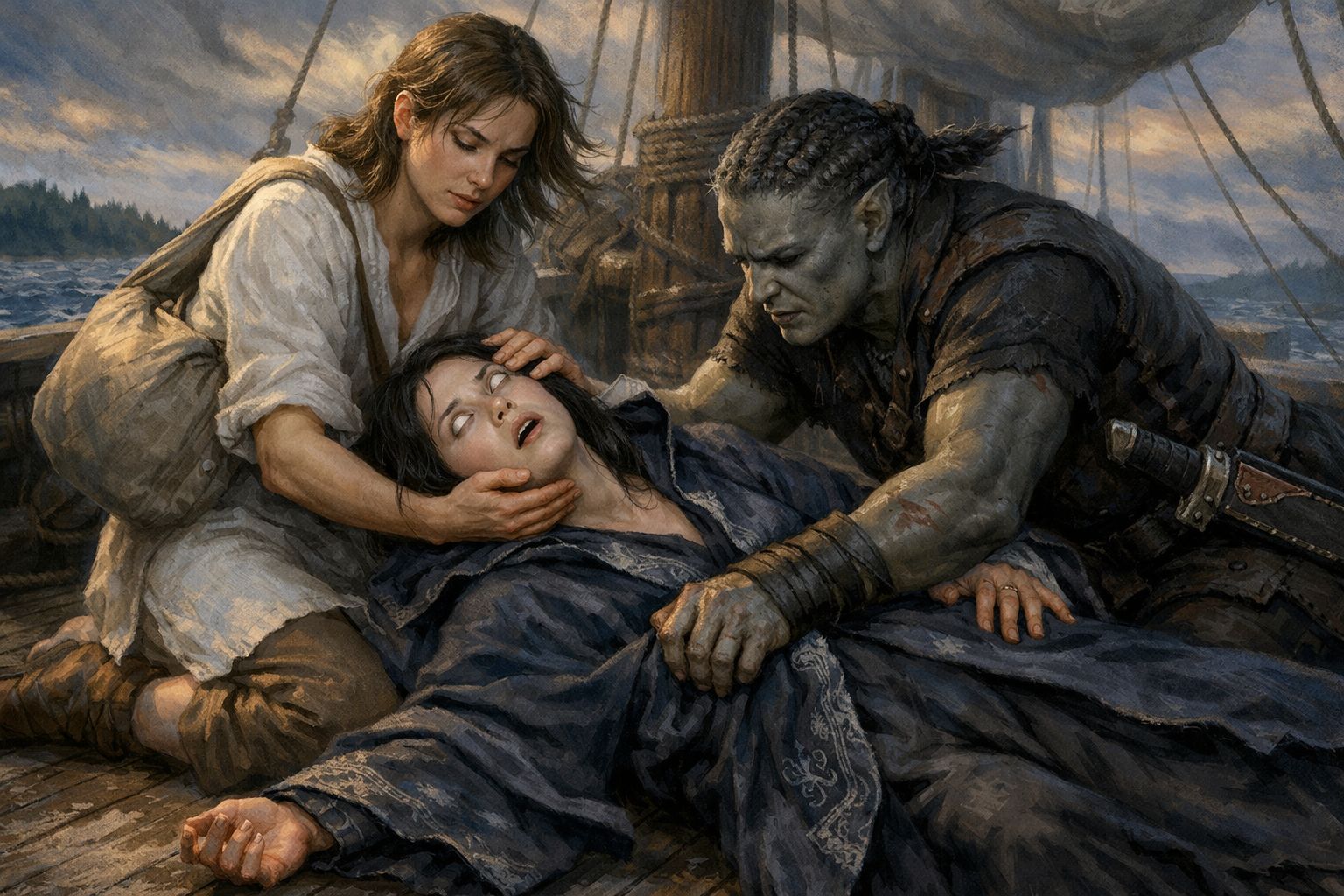
As the Blue Marlin first sights the coast of Ozukari, the crew gathers on deck for the morning meal. Yasmira has prepared a good breakfast, and the mood is calm and curious. The crew discusses what they may find ashore, with Ozukari still distant enough to feel more like rumor than reality.
That calm is broken when Meyrha suddenly suffers a seizure in full view of the crew. Meyrha's eyes roll back until only the whites show, and through the seizure she repeats the same words over and over: "Love is blood, blood is love."
This scene serves as foreshadowing for the entire Ozukari act. At first the words should seem strange and opaque, but in hindsight their meaning becomes clear. Hayato's love becomes a blood crime, and the blood spilled at the end is an act of love, guilt and duty. The scene should set the tone before the crew ever steps ashore. Ozukari is beautiful from a distance, but something in it is already reaching for them.
Arrival at Kaoriyo
The stronghold rose above them in dark wood and black tile, lanterns burning under the eaves and along the walls. A stone path climbed through trimmed pines and carefully raked gravel, every line precise, every detail deliberate. Even in the fading light, the place was beautiful.
And exhausted.
Scarnax stepped through the gates first, with Ayesha and Skarnulf close behind. At the top of the path they were met by kneeling warriors in lacquered armor, their posture flawless, their swords immaculate. Yet under the lantern glow their strain was plain enough. Red-rimmed eyes. Drawn faces. The stiffness of men holding themselves together by discipline alone.
Beyond them stood Castellan Hayato Tsukahara.
He wore formal robes of dark blue and silver, though weariness hung on him heavier than cloth. He bowed with precise courtesy.
"Captain Scarnax of the Blue Marlin," he said. "You honor my house."
Ayesha returned the bow smoothly. "Castellan Hayato, your courtesy honors us in turn."
Hayato's eyes passed over her without disrespect, but also without reply. When he answered, it was to Scarnax.
"You are welcome here."
Ayesha noticed it at once. Without pause or visible offense, she let Scarnax remain forward and shifted half a step behind him, her expression calm, attentive and unreadable. From then on she spoke less, only when useful, and always as if advising rather than leading.
They were led inside through polished halls and open courtyards where garden stones gleamed dark with evening dew. Servants moved in silence. Lantern light shone on lacquered wood and painted screens. Somewhere water fell softly into stone. Everything was refined. Everything was ordered.
Everything was afraid.
It showed in the quick glances toward the roofs. In the way a servant nearly flinched when a lantern hissed in the breeze. In the silence that was too complete to be peace.
They were received in a chamber open to a moon garden, where tea and small dishes had already been laid out. Even now, courtesy held.
Hayato gave them the information they had come for without delay. The Waverider had indeed passed through Ozukari waters. He shared what he knew of its route and timing with unusual readiness. When Ayesha asked a careful follow-up, Hayato listened, then answered Scarnax.
"That is the report given to me, yes."
Ayesha let it pass. Scarnax did not look at her, but he understood the adjustment she had made and carried the exchange from there.
When the useful answers had been given, Scarnax set down his cup. "You have our thanks. We will not burden your house longer than needed."
For the first time, something heavier entered Hayato's face.
"The hour is too late for departure," he said. "Hospitality forbids me from sending honored guests away into the night."
Scarnax studied him. "And beyond hospitality?"
Hayato was quiet for a moment.
"For almost a month, a demon has come to this house each night."
The room seemed to darken around the words.
"It kills guards, servants and family alike. Sometimes my men drive it off. Sometimes they kill it, or think they do. Another comes the next night."
Skarnulf's hand settled near his weapon. Ayesha said nothing now, only watched Hayato's face.
Scarnax asked, "Do you know why?"
Hayato lowered his eyes, then raised them again.
"I know only this," he said. "Something in the order has been disturbed."
Only a tired man in a beautiful house, speaking plainly while everyone around him listened for night to begin.
Scarnax nodded once.
"Then we stay."
Hayato bowed again. "My house remains open to you for the night."
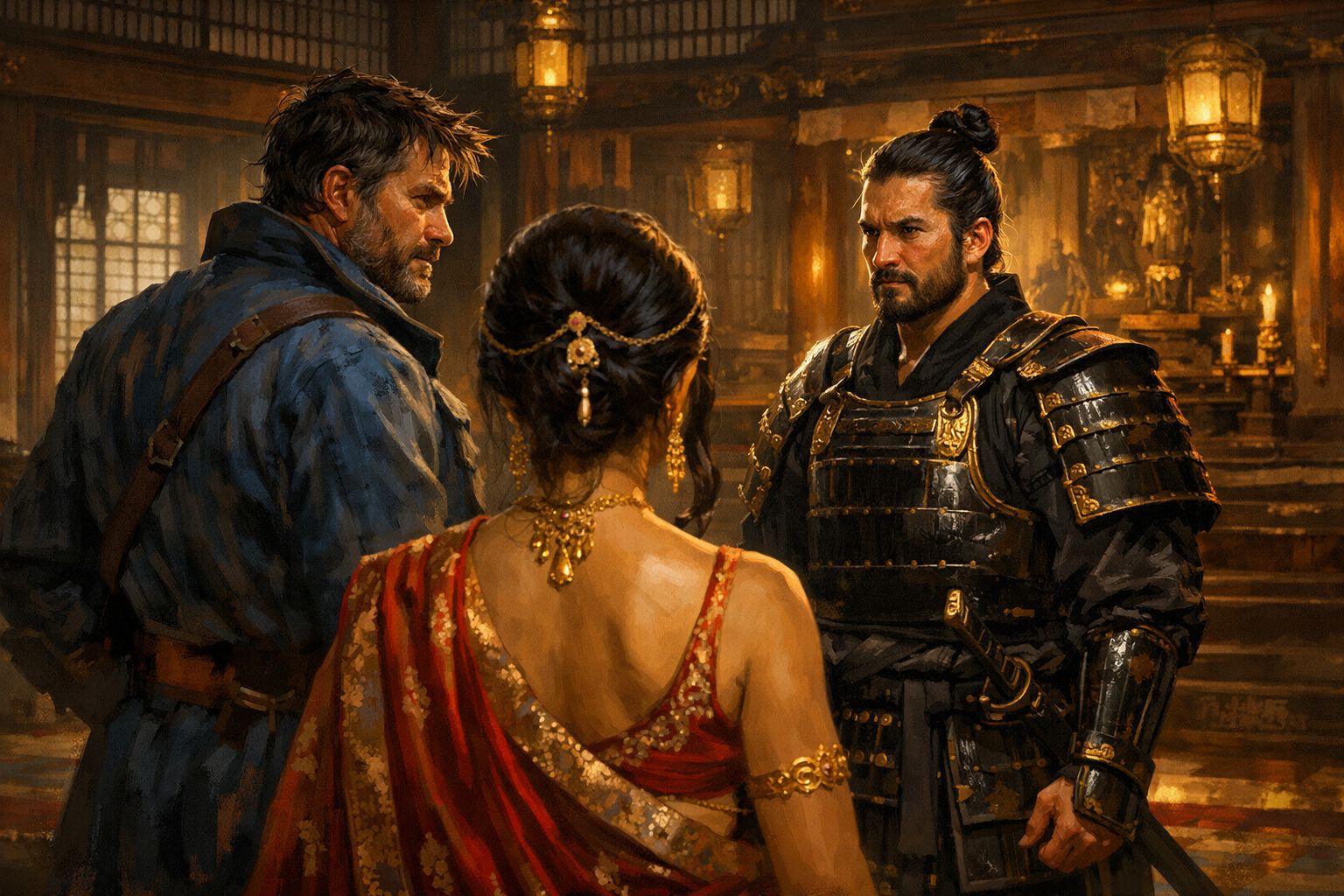
Kaoriyo should make a strong first impression of discipline, refinement and quiet strain. The keep is neat in a way that goes beyond ordinary good order. Paths are carefully raked. Wood is polished. Lanterns are trimmed. Courtyards are swept. Garden stones sit exactly where they should. Servants move with practiced precision, and the warriors at their posts hold themselves with perfect posture.
This is not merely aesthetics. In Ozukari, order is a defense. The people of Kaoriyo believe that keeping a household disciplined, clean and properly arranged helps hold chaos at bay. The care given to the stronghold is therefore not just ritual or pride. It is part of how they resist what has been attacking them.
At the same time, the strain beneath that order should be obvious. The attacks have come nightly for more than a month, every night new deaths. Guards are tired. Servants are frightened. Everyone is carrying the weariness of too many broken nights and too much death. Red-rimmed eyes, drawn faces and quick glances toward roofs, shadows and dark corners all help sell this. The keep is beautiful, but it is beauty maintained under siege.
The Treatment of the Crew
The crew should be received with full courtesy. Servants provide food, tea, bathing water, bedding and whatever else a proper household should offer honored guests. Even now, with fear hanging over the keep, the forms of hospitality are carefully observed. This is important. Kaoriyo is not collapsing into panic. It is clinging to order all the harder because panic would itself be a kind of surrender.
The warriors of the keep should not treat the crew as a threat. They remain watchful in general, but their attention is directed outward, not toward the newcomers. The mood should make it clear that whatever danger haunts Kaoriyo, it is not expected to come from foreign visitors. The crew may be strangers, but they are not what the keep fears.
Castellan Hayato Tsukahara
Castellan Hayato Tsukahara should come across as grave, restrained and deeply tired, but still fully in command of himself. He is a proper host, and he performs that role with exact care. He is polite, composed and cooperative. He gives the crew the information they came for about the Waverider's passage through Ozukari waters without unnecessary obstruction, delay or bargaining.
That unusual openness should itself feel telling. Hayato is not playing games. His household has been under intolerable pressure, and he has no energy left for petty power moves.
Hayato also does not conceal that Kaoriyo is in trouble. He tells the crew plainly that for over a month, a demon has attacked the stronghold each night. Men die. Civilians die. Sometimes the creature is driven off or even slain, but another comes the following night. He does not dramatize this. He states it with the weary directness of a man who has repeated the truth too many times.
When asked why it is happening, he does not claim certainty. He says only that order must have been broken.
Hospitality and the Night
If the crew wishes to leave after receiving the information they came for, Hayato should firmly insist that they stay the night. He frames this through the rules of hospitality. A host does not send honored guests out into darkness. To do so would be improper and dishonorable.
This is not merely practical caution, though that is part of it. The deeper pressure is social and moral. Sending them away into the night would reflect badly on him as a host. Accepting departure under those conditions could also be read as the crew disregarding his hospitality. None of this needs to be said openly. It should be felt in the weight of Hayato's words and in the surrounding culture.
The result should be that staying feels natural, even expected, while leaving feels possible but pointed. The crew is not literally trapped, but they should understand that choosing to go would carry a clear social cost.
Running the Tone
The key to this scene is contrast. Kaoriyo should feel orderly, elegant and well kept on the surface, while fear and exhaustion show through in small ways underneath. Hayato should feel courteous and composed, but worn down nearly to the limit. The servants should remain attentive and professional. The warriors should remain disciplined. Everyone is still doing what they are supposed to do. That is what makes the setting work. Kaoriyo is not a place already in chaos. It is a place fighting chaos every night and refusing to yield to it in daylight.
The crew should leave this arrival with three clear impressions. First, Ozukari takes order seriously at every level. Second, Kaoriyo is under real pressure. Third, whatever is wrong here is grave enough that even a careful man like Hayato will speak of demons to strangers rather than pretend all is well.
The Night Attack
The great hall of Kaoriyo seemed built to deny fear.
Polished wood caught the lantern light in long warm bands. Painted screens stood in quiet perfection along the walls. Dark beams rose into shadow high above, and every cushion, cup and low table sat exactly where it ought to sit. Even now, with night pressing against the rice paper walls, the hall looked as though order itself had been laid over it by careful hands.
Scarnax sat near the center with Castellan Hayato Tsukahara and four of the man's personal guards. Amaxia stood rather than sat, one shoulder near a pillar, arms loose at her sides and eyes never still. Skarnulf had chosen a place where he could see both the main doors and the longest stretch of wall. Hayato's guards noticed that, but said nothing. They had their own habits by now.
For a little while, courtesy held.
Tea steamed in cups. One of the servants, a young woman with lowered eyes and perfectly steady hands, refilled Hayato's cup, then Scarnax's. Hayato thanked her quietly. The servant bowed and withdrew without sound.
No one spoke loudly. No one laughed. The room had the strained calm of men sitting in armor while pretending not to be waiting for battle.
Then the scream came.
It rose somewhere beyond the hall, thin at first, then tearing higher and higher until it no longer sounded human at all, only pain stretched past its natural end. It seemed to go on forever.
Then it cut off.
The hall froze.
One of Hayato's guards was already on his feet. Another had his blade half drawn before the echo died. Amaxia's head snapped toward the sound. Skarnulf moved less, but his hand was suddenly on the hilt at his side. Scarnax rose in one measured motion, already listening for what came next.
No one spoke.
Another scream split the night.
This one was shorter. Sharper. Cut down almost at once.
Hayato stood. The change in him was subtle but absolute. The tired host vanished. What remained was a man who had been bracing himself for this moment all evening.
"Draw," he said.
Steel hissed softly around the room.
Scarnax pulled his knife. Amaxia's sword came up in her hands as if it had always been there. Skarnulf did not rush or posture. He simply shifted his weight, lowered himself a fraction and watched the walls.
A shadow moved across the paper screen to their left.
Too fast.
Not a man running. Not anything that moved by ordinary muscle and bone. It crossed in a blur, long and wrong, predatory, bending in the wrong places.
One of the guards inhaled sharply.
Then blood struck the paper wall.
It hit with a wet slap and spread at once, a dark stain blooming through white paper.
Amaxia took one step toward it.
"Wait," Skarnulf said, rough and low.
On the far side of the room something thudded against wood.
Every head turned.
There was no time to understand how it had crossed that distance. No sound of feet. No warning. Only a brutal impact, then the crack of splintering frame as a body came crashing through the paper wall in a shower of torn wood and blood.
The corpse hit the floor hard enough to slide.
It was one of Hayato's men. Or what remained of one. His throat hung open. One arm bent the wrong way. His eyes were still wide. Still alive, gasping for air but only getting blood.
For one heartbeat nobody moved.
Then every weapon in the hall came up.
Hayato's guards formed around him by instinct, blades out, faces pale but disciplined. Amaxia planted her feet and leveled her sword toward the torn wall, her expression gone cold and sharp. Skarnulf angled himself half a step ahead of Scarnax. Scarnax looked at the dying man once, jaw tightening, then lifted his gaze to the ragged opening in the wall.
Beyond it there was only darkness, moving lantern light and the sound of something alive somewhere outside the hall.
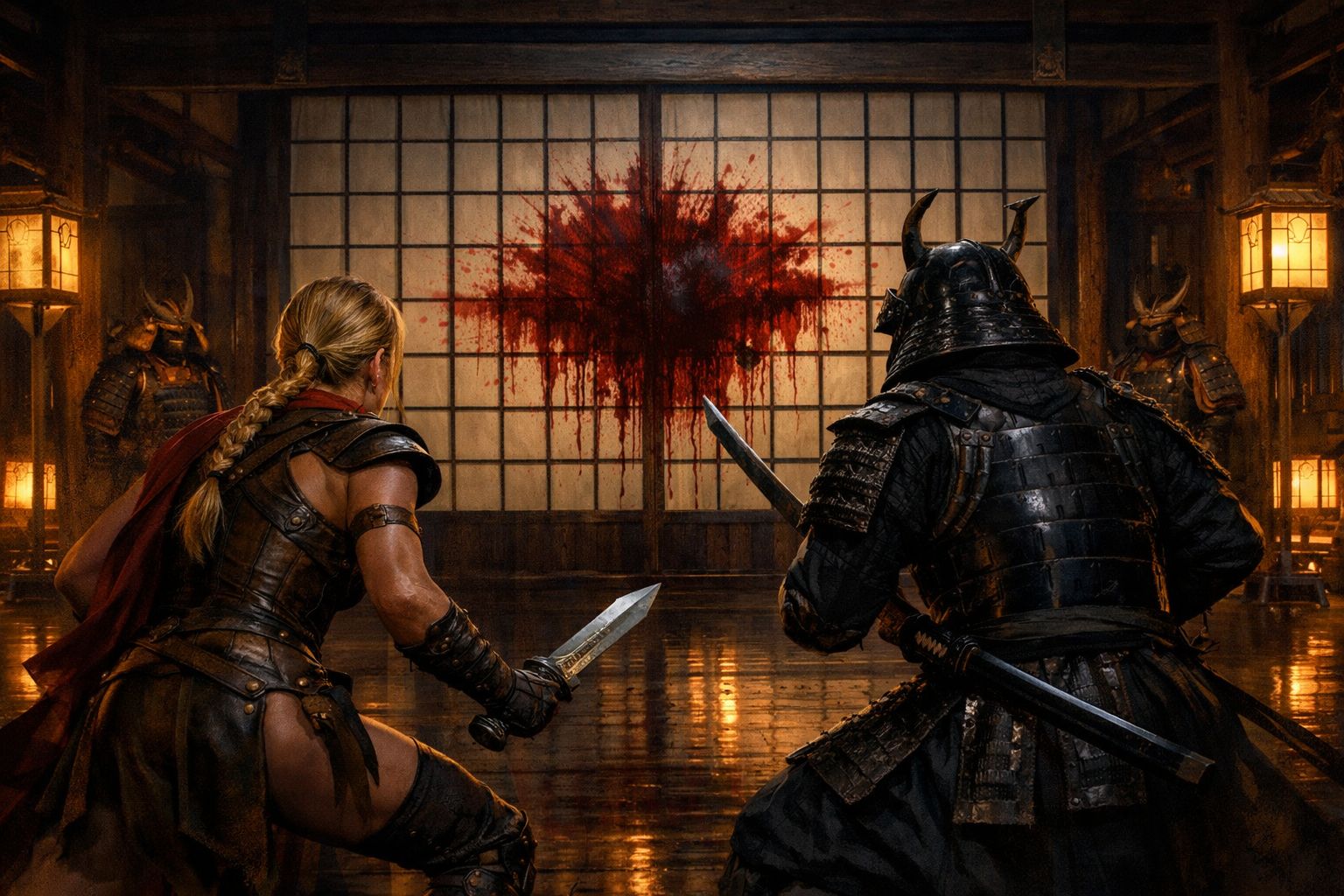
This first part of the attack is not about combat resolution. It is about dread.
The demon should feel present before it is truly seen. The goal is to make the players understand that something hostile is inside the keep's defenses, moving by rules they do not understand and striking faster than ordinary bodies should be able to move. The fear should come less from being attacked directly and more from the sense that the hall has become permeable. The walls no longer protect. The night is already inside.
The Mood to Aim For
The great hall of Kaoriyo begins as a place of order under pressure. Lantern light, polished wood and perfect courtesy are still present, but everyone in the room is waiting for something to begin. When the first scream comes, that waiting ends. What makes it worse is that everyone knows the voices belong to capable warriors, not panicked servants.
From that point on, the mood should be one of unseen horror. The players should hear more than they see. A long scream in the distance, cut off too suddenly. Another, shorter one. A shadow passing over rice paper too fast and too wrong to be human. A wet slap of blood against a wall. A body thrown through a screen before anyone can understand how it crossed the space.
The important thing is uncertainty. The defenders inside the hall know danger is here, but do not yet know from where the next blow will come.
What the Demon Should Feel Like
At this stage, the demon is not a clear opponent. It is a moving violation of the keep's order.
Do not show it fully yet. Let the players glimpse shape, speed and wrongness. The shadow should move too fast. It should seem to bend in ways that do not match a human frame. It should cross from one side of the hall to another without the sounds people expect from movement. No obvious footsteps. No clear warning. Just impact, blood and absence.
That unseen quality is what matters. If the demon is shown too clearly too early, the scene becomes a fight. If it remains half sensed, it stays horror.
How the Defenders Should React
Castellan Hayato Tsukahara and his personal guards should not seem surprised that the attack has come. They are tense, tired and practiced. When the screams begin, they move at once. Weapons come out quickly. Bodies shift into defensive positions by habit. Fear is present, but so is discipline.
That contrast matters. The hall is not full of cowards. It is full of hardened people who are still afraid because they have lived through this too many times already.
The Sequence of Escalation
Run the scene as a rising sequence rather than a single shock.
First, the long scream in the distance. This tells everyone that the attack has started.
Second, the shorter scream. This confirms that the first was not isolated.
Third, the moving shadow across the rice paper wall. This is the first direct sign that the thing is near.
Fourth, the blood on the wall. This is the moment when dread becomes immediate.
Fifth, the wounded guard thrown through the screen. This is the full violation of the hall's fragile safety. The horror is now in the room.
Each step should tighten the atmosphere. Let the pauses matter. Let people listen. Let the players realize that every sound now matters.
Running the Hall Itself
Use the hall as part of the horror. The paper walls, painted screens and polished wood make the place feel delicate. That delicacy should become frightening once the attack begins. The paper walls do not stop blood. The screens do not conceal safety. The lantern light does not drive back what is outside.
The hall should feel beautiful, ordered and suddenly useless as protection.
That contrast is one of the strongest tools in the scene. Kaoriyo has spent every waking hour trying to keep disorder out. This moment shows that the demon can still tear its way in.
What Not to Do
- Do not rush into initiative and tactical detail too early.
- Do not overdescribe the demon. Give glimpses, not a full picture.
- Do not let this phase become an action set piece. The point here is fear, helplessness and uncertainty.
- Do not make Hayato's guards collapse into panic. Their fear should show in pale faces, sharp breaths and tight grips, not in disorder. Their discipline is part of what makes the situation frightening. Even disciplined men are rattled.
The Emotional Result
By the end of this phase, the players should feel three things.
- First, the keep is genuinely under siege by something unnatural.
- Second, the people of Kaoriyo have been enduring this for a long time.
- Third, the demon is not behaving like a normal attacker. It is fast, deliberate and cruel, and it seems to know exactly how to make a room full of armed people feel powerless.
That is the foundation the rest of the encounter should build on.
The ragged opening in the wall stood empty for only a heartbeat.
Then the demon stepped through.
It did not lunge. It did not crash into the room like a beast in a frenzy. It entered calmly, almost idly, ducking beneath the broken frame with the easy confidence of something that did not believe anyone present could stop it. Lantern light struck skin too dark and too slick in places, limbs that seemed just slightly too long and joints that did not quite respect the shape of a man. Its face was almost human from one angle and utterly wrong from the next. Worst of all was the composure. It looked neither hungry nor enraged. It looked certain.
Hayato's guards cried out and charged at once, discipline closing over fear.
The first came in fast from the side, blade cutting for the ribs. The demon moved almost lazily. One hand snapped out, caught the guard's wrist and twisted. Bone cracked. Before the man could even scream, the demon drove him down into the floor hard enough to splinter wood beneath him. He did not rise again.
The second guard struck a heartbeat later, a clean downward cut that would have split a man from shoulder to chest. The demon shifted half a step, let the blade hiss past and struck him in the breastbone with the back of one hand. The impact threw him across the room. He slammed into a pillar and dropped in a crumpled heap, gasping, still alive.
Then the demon looked at the crew.
Its gaze passed over Scarnax first, then Skarnulf, then Amaxia. It lifted one long finger.
Not a threat. Not a challenge.
A dismissal.
This does not concern you.
Amaxia moved before the gesture had fully settled. With a harsh step and a sharp exhale she came in low and hard, sword flashing toward the thing's side.
The demon turned just enough to meet her.
There was no visible effort in it. One arm snapped out, too quick for the eye to follow cleanly, and Amaxia was hurled aside hard enough to take her out of the fight. She flew sideways, hit the floor, slid and struck the base of a wall hard enough to drive the breath from her. Her sword rang away across the boards.
Scarnax was moving at once. Skarnulf got there almost as fast, dropping beside her in a crouch while Scarnax stepped half before them, knife up, eyes fixed on the demon.
Amaxia sucked in one ragged breath and tried to push herself up.
"Stay down one breath," Skarnulf growled.
She glared at him with pure fury, but pain won the argument for the moment.
The demon had already turned away from them.
Its arm rose again, one clawed finger extended toward Hayato.
The castellan had not moved. His guards had closed around him by instinct, but the circle was broken now, one dead, one struggling to breathe, the others pale and wavering. Hayato himself stood rigid, sword in hand, his face drawn tight not with surprise, but with something worse. Recognition.
The guard who had been thrown into the pillar gave a ragged shout and hurled himself forward a second time, desperate courage dragging his battered body into one last attack.
The demon did not even look at him.
It kept its eyes on Hayato. Kept pointing.
Then, without breaking that terrible gaze, it snapped out its free hand, caught the charging man by the throat and closed its grip.
There was a short, ugly crack.
The body went limp at once.
Only then did the demon turn its wrist and cast the corpse aside. The dead guard landed at Hayato's feet with a heavy, graceless thud, one arm folding under him, blood spreading across the polished boards until it touched the castellan's boots.
In the sudden silence, the whole hall seemed to contract around the demon and Hayato.
The demon still pointed.
Hayato stared at the man at his feet. His face had gone white.
Then, just as calmly as it had entered, the demon moved.
One instant it was there, black against lantern light and torn paper. The next it was gone through the broken wall, vanishing into the night with a speed that made pursuit feel absurd before anyone had even taken a step.
Only the torn screen stirred behind it.
Then the hall was still again, save for Amaxia's hard breathing, the groan of a dying guard and the thin, shaking sound of someone in the corridor beginning to weep.
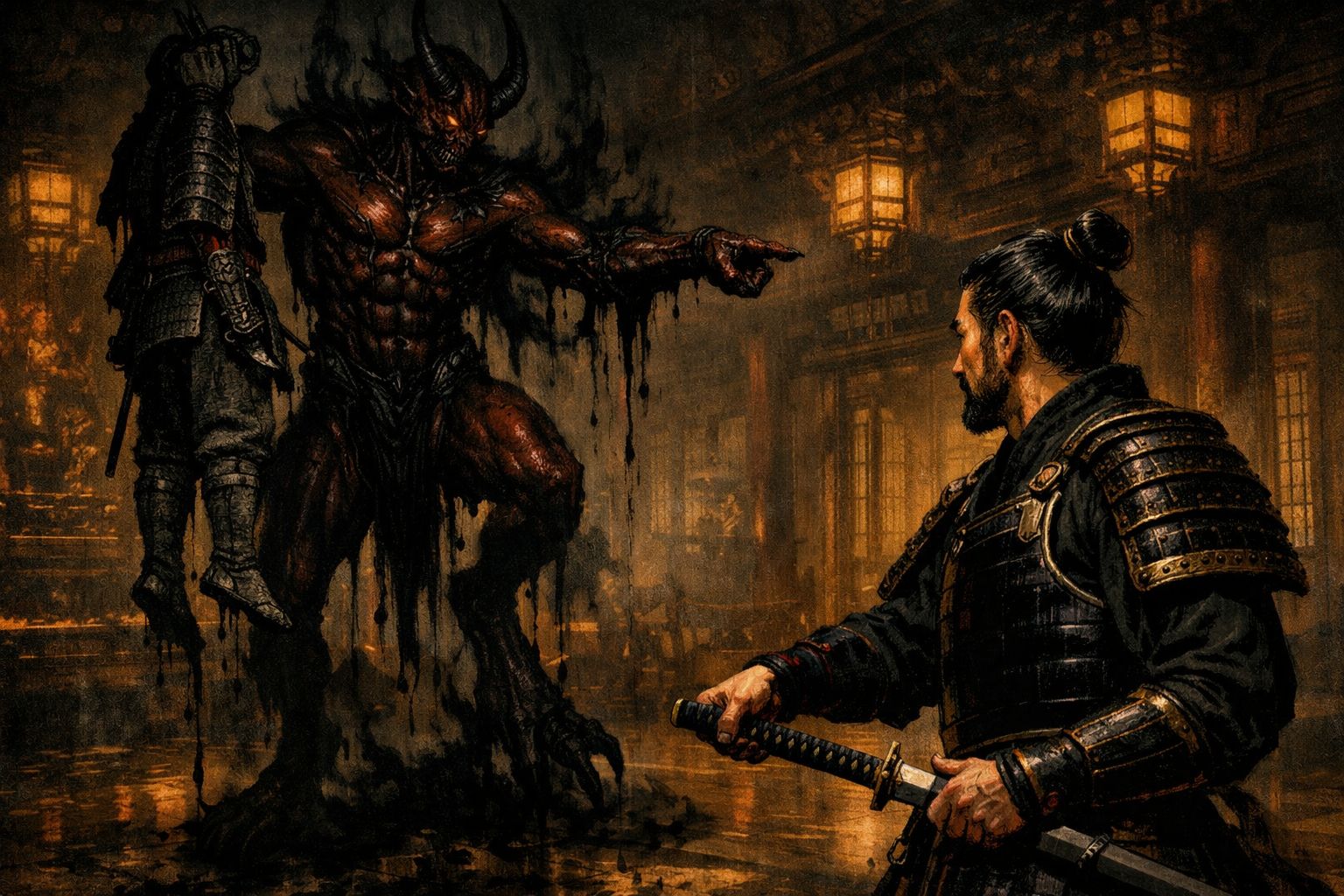
This part of the attack is not meant to become a real fight. It is a demonstration.
The demon enters the hall openly, shows that no one present can meaningfully stop it and then makes a single, deliberate point at Hayato's expense. The purpose is not to challenge the crew or test the keep's defenses. The purpose is accusation. The demon is telling Hayato that the blood being spilled belongs on his conscience.
Run this phase as controlled horror rather than as a balanced combat exchange.
How the Demon Treats the Crew
The demon should make it clear that the crew is not its target. A gesture, a look or a dismissive pause should communicate that this is not their concern. The meaning should be unmistakable even if no words are spoken.
If the crew stays back, the demon ignores them.
If one or more crew members attack anyway, let them act. They can close, strike or try to interfere. However, the demon should respond with contemptuous ease. It does not need to kill them, because they are not part of the punishment. It should simply remove them from the exchange with exactly enough force to throw them aside, knock them down or otherwise make them irrelevant for the moment.
The key point is that the demon is not sparing them out of mercy. It is dismissing them as irrelevant.
The Mood to Aim For
The mood here is not desperate melee. It is witnessing.
Hayato's guards do what trained men do. They pull themselves together, silence their fear and attack on discipline and instinct. That should matter emotionally, but not tactically. They are brave. They are professional. They are also completely outmatched.
No one in the room should seem cowardly. That is important. The horror is stronger if competent, armed defenders commit themselves fully and still achieve nothing of consequence.
If someone lands a hit, whether guard or crew, allow it. Steel can bite. Flesh can part. A wound can be inflicted. But the demon should react as though the injury is either trivial or irrelevant. It does not retreat. It does not cry out. It does not lose control. It does not behave as if injured. It simply does not matter. That only makes the scene worse.
Hayato's Guards
Hayato's personal guards should respond immediately and without hesitation. Their fear is real, but training closes over it. They should attack because that is their duty, because Hayato is their lord and because standing still would be worse.
Let it kill a guard without effort almost at once. Another can be thrown aside and left barely able to rise. Others will close around Hayato by instinct, only to realize too late that they are not facing something that can be stopped by ordinary courage.
This matters because it tells the players two things. First, the keep has been fighting hard every night. Second, the demon is not winning because the defenders are weak. It is winning because it is here for a different kind of battle.
The Demon’s Message
The central image of this phase is the demon pointing at Hayato while killing one of his men.
That is the point of the scene and should be played with total clarity.
The demon should direct its attention toward Hayato and keep it there. When another guard attacks, the demon kills him without even giving him full attention, then throws the body down at Hayato's feet or close enough that the castellan cannot mistake the meaning.
The message is not subtle. This blood is because of you.
Do not let the scene drift away from that. The violence here is communicative. The demon is accusing Hayato through murder.
Hayato’s Position
Hayato must not be touched.
That is essential.
The demon is not trying to kill him. It is not even trying to wound him. The punishment is witness. Hayato is being forced to stand there and watch those under his protection die because of something tied to him. That is far more important than any direct physical attack.
His reaction matters. He should not collapse or babble. He should stand rigid, armed and unable to deny what the demon is showing him. Whether he fully understands it yet or not, he should recognize that the accusation is directed at him.
The Demon’s Departure
Once the demon has made its point, it leaves.
It should not linger for a final exchange or wait to be cornered. It has done what it came to do. Just as it entered with calm certainty, it departs with the same confidence, moving too fast to meaningfully pursue.
This departure is important because it prevents the scene from becoming a chase or extended action sequence. The demon is in control of the tempo. It arrives when it chooses, kills who it chooses and leaves when its message has been delivered.
The Immediate Aftermath
Once the demon is gone, there should be no real chance for conversation.
The hall breaks not into discussion, but into urgent work. The wounded need treatment. The dead must be checked and moved. Broken screens and splintered wood need to be assessed. Blood must be cleaned from polished floors. Servants and guards fall at once into the brutal routine of survival, repair and restoration.
This is another important part of the mood. Kaoriyo has been doing this for weeks. The attack ends, and the household immediately begins the grim work of making itself orderly again before the next night comes. Order is protection.
No Conversation Until Morning
The crew will not get a meaningful chance to speak privately with Hayato after this phase.
He is needed elsewhere, or withdraws into the duties of command, or simply remains too surrounded by crisis and ritual to be approached in any useful way. That delay matters. It gives the accusation time to sink in and forces the crew to sit with what they saw rather than immediately interrogating him.
The proper conversation comes in the morning, after the night has passed and the dead have been counted.
Running the Scene Well
To run this phase effectively, keep five things clear.
- First, the demon is not here to brawl with the crew.
- Second, bravery is present, but it does not change the outcome.
- Third, the killing is deliberate communication, not random slaughter.
- Fourth, Hayato is the center of the accusation, not the victim of the blows.
- Fifth, the demon leaves as soon as its point has been made.
If those five things stay in place, this part of the attack will feel like judgment rather than combat, which is exactly what it should be.
The Investigation
This section should not be run as a whodunnit.
The crew is not meant to gather enough evidence to prove a case in some neat, rational sequence. Instead, they follow an emotional trail. The important thing is not that they reconstruct every fact before confronting Castellan Hayato Tsukahara. The important thing is that they begin to feel the shape of the truth.
By the end of this section, the crew should suspect three things. First, the demon's violence is accusatory rather than random. Second, Hayato is the center of that accusation. Third, love, loss and broken order are somehow tied together in what has happened.
That is enough to carry the scene into confrontation.
The Shape of the Investigation
Think of this as a narrowing circle rather than a puzzle.
The crew begins with the attack itself, where the demon openly singles Hayato out. From there they can notice details, ask questions and follow whatever parts of the keep feel wrong, hidden or emotionally charged. They are not trying to solve a mystery by logic alone. They are tracing a wound through a household that has been living around it for a long time.
The most useful discoveries should point toward feeling before explanation. Old sorrow. Private attachment. A loss that was never accepted. A household that knows something painful happened, even if few dare name it plainly.
The Core Clue: The Demon’s Accusation
The clearest clue is the one the crew has already seen.
The demon points at Hayato. It kills his men while looking at him. It throws a corpse at his feet and leaves him untouched. That alone should tell the crew that Hayato is not simply another victim. He is the focus.
Do not bury that clue under more obscure evidence. It is the spine of the entire investigation. Everything else should deepen or clarify it, not replace it.
Asking Around the Household
If the crew speaks with servants, guards or others in the household, they should not get a clean confession or a tidy summary. What they may get are fragments, hesitations and guarded comments, especially if the right questions are asked.
With care, respect or social pressure, they may learn that Hayato was changed by something that happened in Lord Masanori Minatoya's household. People may know, or half know, that Lord Masanori took one of Hayato's concubines for his own. That would not itself be scandalous in Ozukari, but people may remember how deeply it affected Hayato afterward. He became quieter. More withdrawn. More haunted. Some may have seen grief where they expected obedience.
This information should feel dangerous to say aloud. Most people in the keep will not want to speak openly against the order of lord and vassal. Even those who sympathize with Hayato may speak in hints rather than direct statements.
Personal Mementos
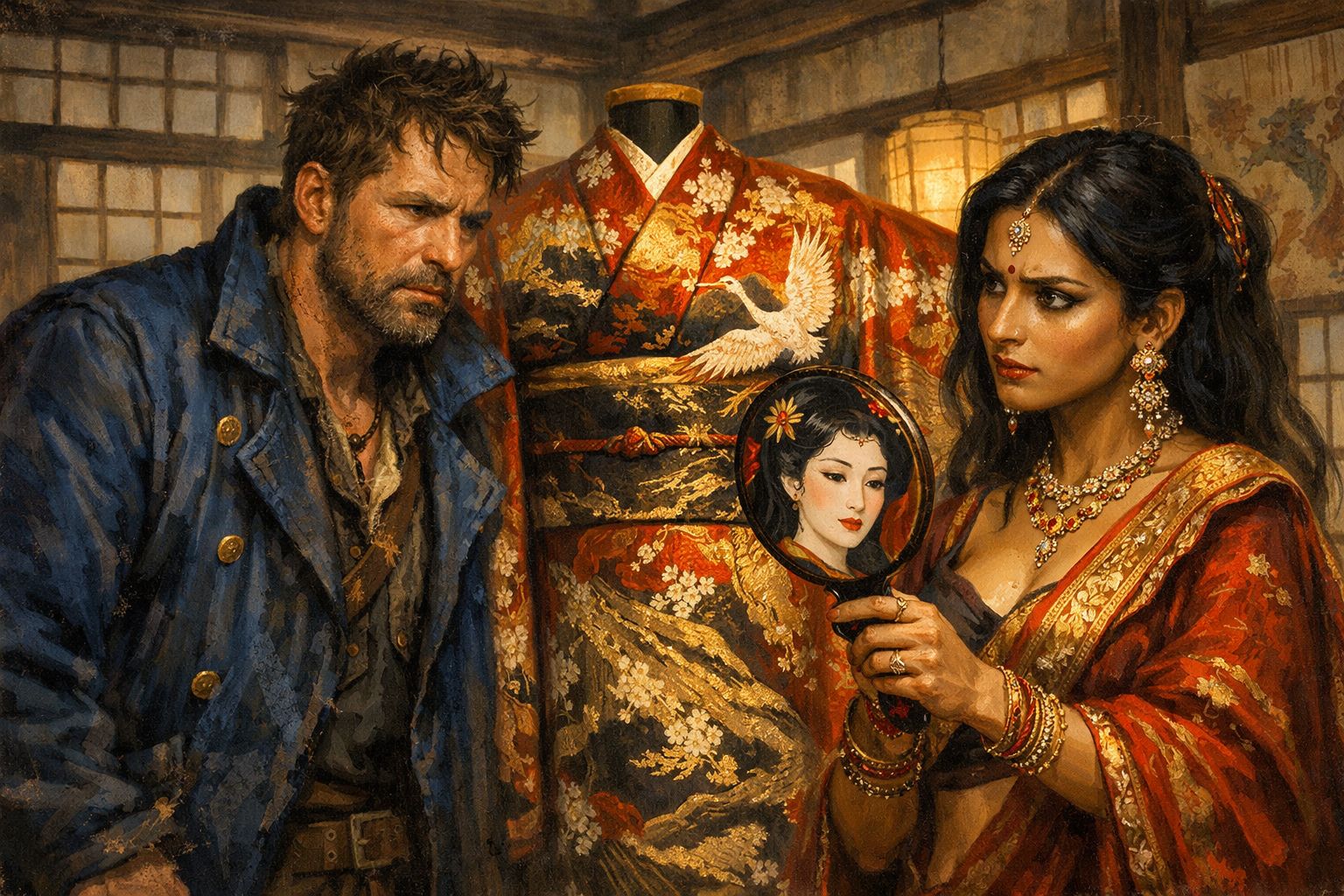
The strongest physical clues are not forensic evidence. They are traces of private attachment.
The crew may find, or be led toward, mementos connected to a specific woman. These should feel intimate, preserved and carefully hidden rather than dramatic. A mirror with a woman's face painted on the back. A poem in a delicate female hand. A kimono hanging untouched on a stand, too carefully kept to be ordinary storage. Each item should suggest not lust or convenience, but remembered love.
These clues are valuable because they shift the investigation away from abstract ideas of guilt and toward something more human. Hayato is not merely hiding a breach of order. He is carrying grief.
Do not overdo the number of mementos. One or two are enough if they land well. The point is not to build a collection of evidence. The point is to let the crew realize that a real emotional bond is buried inside this case.
Meyrha’s Vision
By this point, Meyrha's vision should begin to make sense.
The repeated phrase, "Love is blood, blood is love," should no longer feel like meaningless omen. The crew may not yet understand every detail, but they should start to connect love, violence and guilt. The vision does not solve the case. It sharpens its emotional meaning.
Ivy and the Spirit World
If Ivy is present and chooses to enter the spirit world, she should not receive a neat answer. What she finds is emotional and atmospheric rather than explanatory. Around much of Kaoriyo, the spirits should feel strained, watchful and unsettled, but around Hayato they behave differently. They shy away from him. They do not gather near him in curiosity or sympathy. They recoil, as if his presence contains danger.
That reaction should matter because it reinforces the sense that Hayato is the center of the wrongness without making Ivy a solution engine. The spirits are not explaining the case. They are responding to the stain on him. This is especially useful because it separates spirit knowledge from demon knowledge. Ivy is not reading the demon directly. She is reading what the spiritual world does in Hayato's presence.
What the Crew Really Needs to Learn
The crew does not need a full timeline.
They do not need to prove exactly when Hayato met the woman again, how long it continued or who knew. They do not need enough evidence to corner him in a legal sense.
They only need enough to understand that this is personal, that it involves love and loss and that the demon's accusation is aimed at Hayato for a reason.
Once they reach that point, the right move is not more searching. The right move is to confront him.
Running the Tone
Keep the tone quiet, tense and sorrowful.
This is the part of the act where the horror shifts from external threat to moral weight. The keep is still cleaning blood from the previous night's attack. Servants are repairing torn screens. Guards are exhausted. Everyone is trying to restore order while living around a wound no one wants to name.
That atmosphere should shape the investigation. The crew is not stalking a liar through hidden passages. They are moving through a grieving household, picking up traces of something broken that has never truly been set right.
When to End the Investigation
End this phase as soon as the crew has the emotional truth of it, even if they do not have every factual detail.
If they understand that Hayato loved a woman taken by Lord Masanori, that he never let her go in his heart and that the demon is holding him responsible for blood now being spilled, then the investigation has done its job.
At that point, push toward confrontation, by Hayato having time to talk to them. The power of this section lies in the crew feeling the truth before Hayato says it aloud.
The Confession
Hayato received Scarnax alone in a small chamber overlooking an inner garden.
By morning, Kaoriyo had already begun repairing itself. Blood was gone from the floors. Torn screens had been replaced. Somewhere outside, gravel rasped under a rake in slow, careful strokes. The keep was doing what it always did. Setting order back in place before night returned.
Hayato knelt in dark formal robes, every fold exact. Only his face betrayed him. He looked as though sleep had become a thing that happened to other men.
Scarnax settled opposite him, plain and steady. For a moment neither touched the tea between them.
"You wished to talk to me," Hayato said.
Scarnax looked at him. "I wanted to hear it from you."
Hayato lowered his eyes to the cup. "You have already seen enough."
"I saw that thing kill your men while looking only at you," Scarnax said. "Tell me why."
Hayato sat very still. When he finally spoke, his voice was level.
"Years ago, Lady Reika belonged to my household. Lord Masanori took her into his own. That was his right. I bowed. I spoke the proper words. And then I betrayed him."
Scarnax said nothing.
Hayato's fingers tightened around the cup. "I told myself memory was harmless. Then I saw her again. After that, I found chances. Reasons. Excuses. A garden path. A private room. A servant who could be trusted. I knew what I was doing each time. I knew whose law I was breaking."
"But you went," Scarnax said.
"Yes."
"Because you loved her."
Hayato shut his eyes briefly. "Yes. Yes, I did. And she loved me."
When he opened them again, the softness was gone. "That changes nothing. I placed my own heart above the bond between lord and vassal. I treated as still mine what had passed into my lord's household. That is the fracture."
Scarnax's jaw tightened. "And now your men die for it."
Hayato gave the smallest nod. "The demon is only the hand. The judgment was mine long before it came."
Scarnax leaned forward. "What ends it?"
Hayato met his eyes. "My death would not be enough. The stain lives in my house. In my name. In my bloodline."
A long silence followed.
"Your son," Scarnax said.
Hayato bowed his head. "Yes."
That one word seemed to cost him more than all the rest. His mouth trembled once, then stilled.
"I have held him," he said quietly. "Watched him sleep. For a little while, I thought perhaps the world had left me something untouched. That was vanity."
Scarnax looked at him for a long time. "There are places a man could run from this."
Hayato shook his head. "And carry it further. No. I broke order here. It must be answered here."
Outside, the rake still moved over gravel. Slow. Careful. Endlessly patient.
At last Scarnax said, "Then you've already decided."
Hayato's face had gone very pale, but his voice was steady.
"I decided the moment I understood why it would not touch me."
Then neither man spoke. The tea cooled between them, and beyond the open shutters the ordered garden waited in silence.
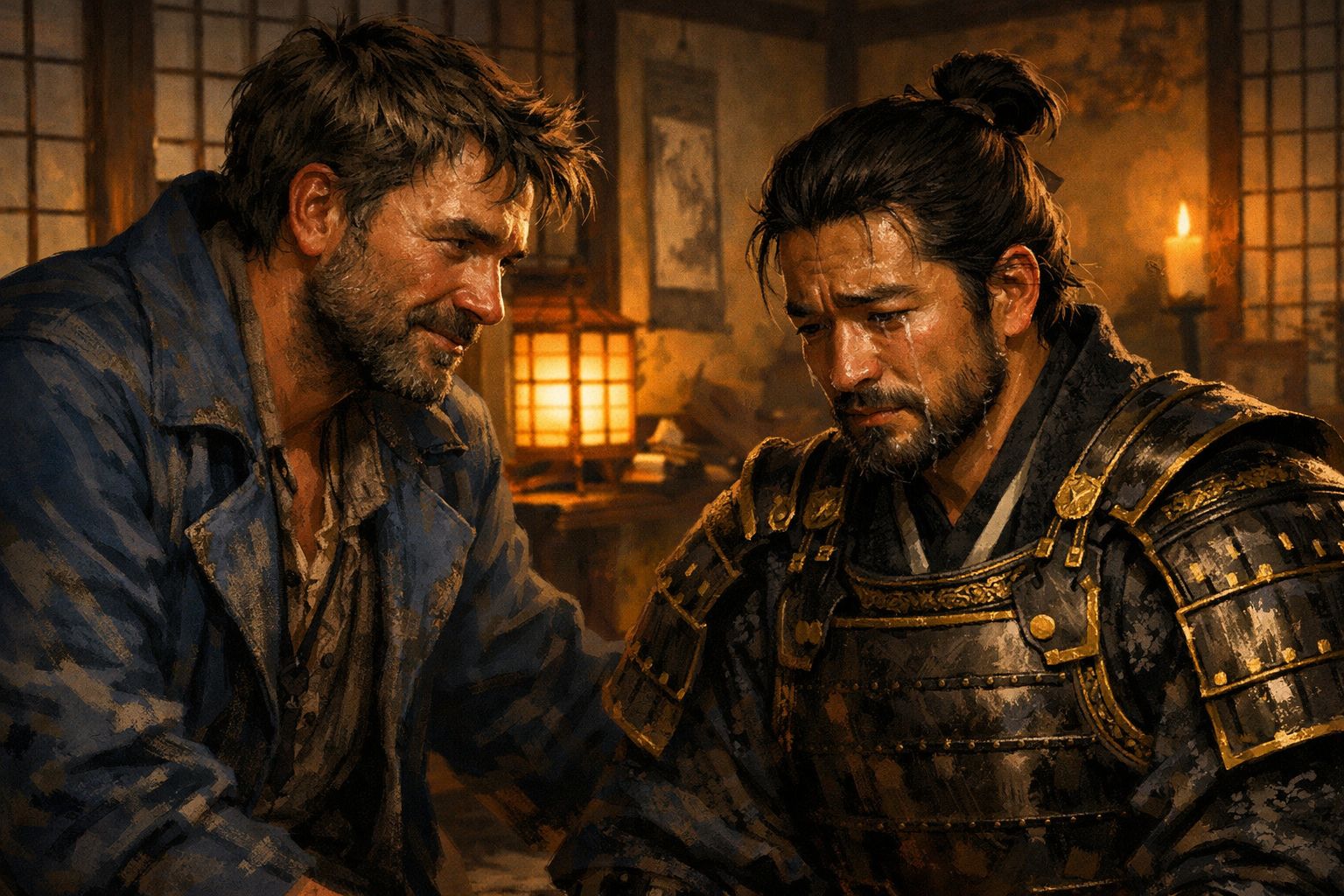
This scene is not about breaking Hayato down.
By the time the crew confronts him, the events of the night have already done that work. The demon's accusation has made the truth impossible for him to avoid any longer. He has seen another man die at his feet while being told, as clearly as such a creature will tell anything, that the blood belongs to him. Because of that, Hayato does not need to be cornered, threatened or cleverly trapped. He needs to confess.
Run this scene as release, not interrogation. The pressure is still there, but it is inward now. Hayato is a man who has already reached his conclusion and can no longer carry it in silence.
How Hayato Should Speak
Hayato should speak plainly and without excuse.
He may speak of love. He may admit weakness. He may say openly that he knew the law and broke it anyway. What matters is that he understands the crime in Ozukari terms. He placed his own heart above the bond between lord and vassal. He treated as still his own what had passed into Lord Masanori Minatoya's household. He broke loyalty and therefore broke order.
He should not try to justify himself. That is important. This is not a scene where the crew uncovers a hidden villain or forces a liar to admit guilt. Hayato already believes he is guilty. The confession should feel like a man naming his own fracture with terrible clarity.
The Story He Tells
Hayato tells the crew that Lady Reika once belonged to his household. Lord Masanori later claimed her for his own, which was lawful and beyond protest. Hayato submitted, bowed and gave the proper words.
Then he betrayed that duty.
He continued meeting Reika in secret. He knew what he was doing. He knew what it meant. He did it anyway. What matters is not whether he loved her. The point is that he chose private love over public loyalty, and in Ozukari that is enough to stain everything that followed.
The crew does not need a detailed timeline. They need the emotional and moral truth of it.
The Real Horror of the Confession
The most haunting part of the scene is not the affair itself. It is what Hayato believes must come next.
He should say, calmly and with visible pain, that his own death will not be enough. The stain no longer belongs only to him. It lives in his name and his bloodline. If that line continues, the punishment will continue. More guards will die. More servants will die. More innocents will be torn apart while he stands at the center of it. Eventually, everyone he cares about will die.
That means the bloodline must end.
Say this clearly. Do not soften it. Hayato includes both himself and his infant son in that judgment. That is the point where the scene should turn from tragic confession into something much worse. The crew realizes that he is no longer speaking about guilt in the abstract. He is speaking about an immediate decision.
Hayato's State of Mind
Hayato should not feel wild, theatrical or unstable. He should feel resolved.
That does not mean emotionless. He may weep. His voice may tighten. He may struggle to say certain things, especially when speaking of his son. But the deeper impression should be that he has already accepted the path ahead and now sees no honorable alternative. That calm is part of what makes the scene disturbing.
He is not asking the crew for permission. He is not really asking for advice. He is naming what he believes must be done.
Transition Into the Ceremony
Once Hayato has confessed and spoken the truth of what he intends, he should not linger.
This is the moment when the scene turns from confession to action. Hayato rises and calls for his second in command, Captain Genji Arakawa. The summons should feel formal and final. The household should understand at once that something grave has been decided.
Genji does not need the whole story explained in front of the crew. He may already know enough, or he may only need to see Hayato's face and hear the command. What matters is that Hayato begins arranging the ceremony immediately. There should be no sense that he is still undecided.
What the Crew Is Meant to Feel
The crew should leave this scene with horror, pity and dread all mixed together.
Hayato is guilty, but not in a simple way. He is sincere, lucid and already committed to a response the crew will likely find monstrous. They do not need to agree with him, but they should understand that within Ozukari's logic, he sees no honorable alternative.
That understanding is what gives the coming ceremony its weight.
Running the Scene Well
To run this scene effectively, keep four things clear.
- First, Hayato confesses readily. He does not need to be broken.
- Second, the confession is about broken loyalty, not forbidden romance in a modern sense.
- Third, the true horror is his conclusion that the bloodline must end.
- Fourth, once he speaks that conclusion aloud, he moves directly into arranging the ceremony.
If those four things stay in place, the scene will feel like the point of no return that it is meant to be.
The Ceremony of Restoration
The center yard of Kaoriyo had been made beautiful for death.
Lanterns hung in careful rows beneath the eaves, their light warm against polished wood and pale stone. The gravel had been freshly raked. The blood from the night before was gone. The torn places had been mended. White silk banners stirred softly in the evening air, and in the middle of the yard a square of white cloth had been laid out with such care that it seemed almost obscene. At its center knelt Castellan Hayato Tsukahara and beside him Captain Genji Arakawa, straight backed and silent. Before them, on a small pillow of embroidered white silk, lay Hayato's infant son Daichi, wrapped and sleeping, too young to know that the whole household had gathered to watch him die.
Behind Hayato stood his two concubines, Lady Sayo and Lady Kiyomi, both in pale robes, both already weeping. Closest to the center stood the warriors of Kaoriyo in ordered lines, armor lacquered, swords at their sides, faces rigid and wet with grief. Behind them, in a wider ring, stood servants, attendants and laborers with heads bowed. Scarnax, Ayesha and Skarnulf stood near the rear with the rest of the household's lesser observers, while an elderly steward in dark gray robes remained beside them, hands folded in his sleeves, his voice no more than a whisper when explanation became necessary.
No one spoke above the sound of the night wind.
Then Hayato lifted his head.
Tears were already running freely down his face. He did not wipe them away. His voice shook at the edges when he began, but not with uncertainty. With effort.
"This curse is mine," he said, speaking to the whole yard. "This shame is mine. I am the cause of the blood that has been spilled in this house."
His breath caught. He pressed on.
"My guards died because of me. My servants lived in fear because of me. My lord's order was broken by me. I carry the guilt. I carry the dishonor. For this house to live, for this land to be cleansed, my bloodline must end with my own hands."
A sound moved through the assembled warriors then, not a cry, not disorder, but something rawer and harder to contain. One man's shoulders shook. Another bowed his head so sharply it was almost a flinch. Among the women behind them, open sobbing had already begun. Even now no one turned away.
Beside Scarnax, the steward spoke softly without taking his eyes from the center.
"There is no shame in tears," he murmured. "Only in failing one's duty."
Ayesha stood very still, her face composed in the only way it could be, through force. Skarnulf's jaw had set so hard that it seemed carved from wood.
Hayato lowered his gaze to the child before him. For the first time, his control almost failed him. His mouth trembled. His shoulders rose once with an unsteady breath. Then he reached out with an open hand.
Genji placed a knife into it.
The captain's face was wet as well. He handed the blade over with both hands, as if passing a sacred thing, and when Hayato received it their fingers brushed for only an instant. That was the only sign between them, and it said enough. This was not ambition. This was the last service one man could render another.
Still crying, Hayato bent forward.
He touched Daichi's cheek first.
The gesture was so small and so gentle that it made what followed worse. His hand shook violently now. He whispered something too low for those at the back to hear, perhaps the boy's name, perhaps an apology, perhaps both. Then, with the same trembling hand, he drew the blade across the child's throat.
It was done almost delicately.
A fresh wave of grief passed through the household. Not loud, not uncontrolled, but deep enough to be felt in the air itself. Hayato made a sound then, a broken sound dragged out of him against his will. He laid the child back upon the pillow with unbearable care, arranging the small body as if Daichi had merely fallen asleep in the wrong place.
Then Hayato straightened.
His face was wet. His breathing was ragged. Blood darkened his hands and the blade. He placed that first knife down upon a waiting square of white silk before him, each movement precise despite the shaking. Then he held out his hand again.
Genji gave him the second knife.
It was longer.
Hayato gripped it and rose onto his knees. When he looked up again, his face had changed. The grief was still there, naked and streaming, but it had been gathered under something harder.
He spoke to the household once more.
"You did not fail me," he said. "None of you. You stood in loyalty. You stood in courage. You kept this house as it should be kept."
His gaze passed over the warriors, the servants, the weeping women behind him.
"The dishonor is mine alone. The blood is mine to answer. I now assume full responsibility for what I have done."
Genji stood and drew his sword in one smooth motion, stepping into place behind and slightly to the side, ready and waiting. He did not look eager. He looked shattered.
Hayato drew one steadying breath.
Then, with a single quick motion, he opened his belly.
He folded forward at once. The knife dropped from his hand. For one suspended heartbeat the whole yard seemed to hold itself motionless around him, lantern light trembling on steel, tears and blood.
Then Genji's sword fell.
Hayato's head struck the cloth beside his son's pillow.
A murmur moved through the gathered household. It was not approval in the crude sense. It was recognition. Respect. Relief twisted inseparably with grief. One by one, heads bowed across the yard. Warriors lowered their eyes. Servants knelt. Even the sobbing quieted into something smaller and more controlled, as if the act itself had restored a kind of order to the pain.
No one needed to explain what they had seen.
In the center of the yard, beneath the lanterns and white silk, Hayato had paid for order in blood, and the household received it with tears on their faces and reverence in their bowed heads.
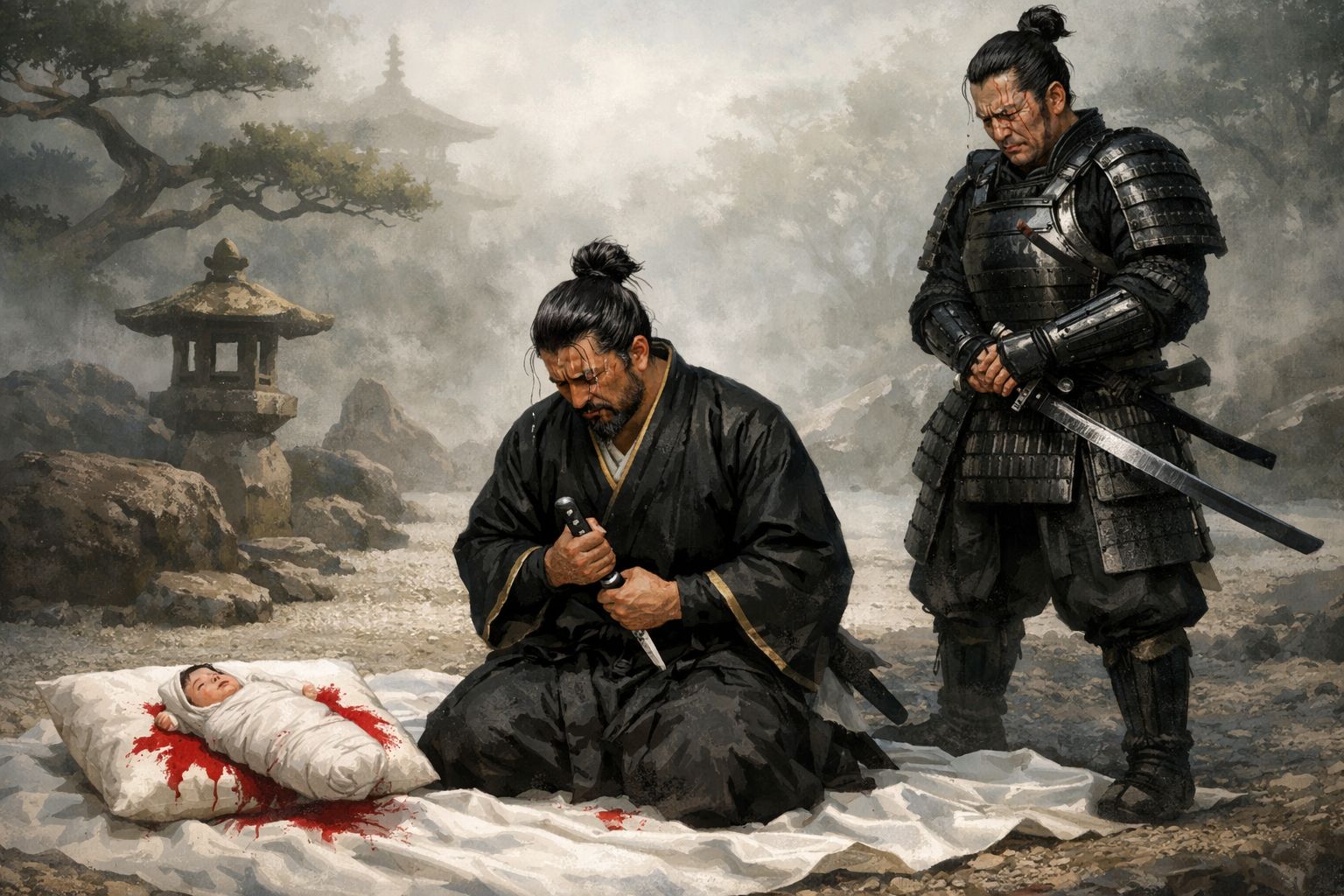
This scene should be short, controlled and emotionally overwhelming.
It is not meant to be an interactive problem for the crew to solve. By the time it begins, Castellan Hayato Tsukahara has already decided. The household accepts the necessity of what is about to happen, and the numbers, ritual weight and social force around it should make clear that the crew cannot stop it in any meaningful way. At most, they can interrupt, delay or stain the moment, which would only deepen the sense of violation without changing the outcome.
The key to the scene is mood. Hayato is not simply killing himself. He is ending his bloodline with his own hands because he believes that is the only way to protect his house, his land and those still living under his care. That is what gives the ceremony its terrible weight. He is destroying not only his own life, but the future of his family, and doing so in full view of the people he has led.
The household's reaction matters as much as the act itself. The warriors, servants and concubines should grieve openly. Many should be crying. Captain Genji Arakawa should feel like a man carrying out the final service for someone he respects, not a successor eager for power. The gathered household should make clear that Hayato was loved and respected, and that they understand this as the ultimate sacrifice on their behalf.
The emotional key is that Ozukari does not treat tears as weakness. There is no shame in emotion. The shame lies only in failing one's duty. That should shape the entire scene. Hayato may weep. His people may weep. Genji may weep. None of that undermines the ritual. It strengthens it. The horror of the scene comes from sincere grief joined to unwavering resolve.
Run it with restraint. Do not linger on gore. Linger on formality, trembling hands, bowed heads, wet faces and the silence of people witnessing something awful that they still believe must be done. That is what makes the scene land.
The Quiet Night
There is not much to this section, and that is the point.
After the ceremony, Kaoriyo prepares for another attack exactly as it has every night before. Guards take their positions. Lanterns are checked. Weapons are readied. Servants finish repairs, clean what must be cleaned and withdraw into tense silence. The household does not trust peace yet. Everyone is waiting for the scream, the shadow and the first blood.
But this time, nothing comes.
That absence should carry real weight. The night is still uneasy, but the unease slowly changes shape as the hours pass. What begins as dread becomes disbelief, then fragile hope. Do not overplay it. The silence itself is enough. After so many nights of terror, the lack of attack should feel almost unnatural.
By morning, that silence has become proof. The household gathers at the graves of Castellan Hayato Tsukahara and his son Daichi. Flowers are placed. Heads are bowed. Tears may still be present, but now they are joined by something else. Relief. Thankfulness. The sense that the horror has, at least for now, lifted. His honor is restored.
That emotional mixture matters. Kaoriyo is grieving, but it is also breathing again. The household believes the sacrifice worked. That belief should define the mood of the morning.
Lord Masanori’s Arrival
Just before noon, as the Blue Marlin's people prepared to leave, horns sounded from the road below Kaoriyo.
The note carried up the hillside in measured formality. Servants paused. Warriors at the gate straightened. Scarnax stepped out beneath the eaves and looked down. Ayesha came to stand beside him, already watching with the stillness she wore whenever power arrived.
The retinue came in red and black.
Mounted outriders led, followed by banners of the Minatoya clan, then guards, servants and attendants in ordered ranks. At the center rode Lord Masanori Minatoya beneath a dark silk parasol, dressed in layered crimson and gold. He did not look like a man arriving at a house that had just buried its lord and heir. He looked like a man attending to necessary business.
Captain Genji Arakawa went down alone to receive him. He bowed low.
"My lord. Kaoriyo welcomes you. Food and tea are prepared if it pleases you."
Masanori dismounted without haste. "You honor your house," he said. "But my business here is short."
He entered the yard, where the household had already assembled in ordered ranks. The absence of Hayato at the center seemed to stand there in his place.
Masanori let the silence settle before he spoke.
"Hayato Tsukahara was a pure man. His devotion to duty did him great credit."
Nothing in his face changed as he said it.
Then he looked to Genji.
"From this moment, you are castellan of Kaoriyo."
Genji went to one knee at once. "My life, my sword and all within these walls belong to you, my lord."
The words were perfect. Still, the weight of them showed.
Masanori gave a single nod. "I trust you will keep this place in order."
His gaze moved past Genji to Lady Sayo and Lady Kiyomi.
"The women of Hayato's household will pass into mine."
Neither seemed surprised. They bowed and crossed the yard toward Masanori's retinue. There, among his attendants, stood another concubine beneath a pale travel cloak, visibly pregnant, her eyes red from crying. When Sayo and Kiyomi reached her, the three women bowed with the quiet familiarity of those who already knew one another.
Scarnax saw it.
So did Ayesha.
Masanori turned back to Genji.
"This concludes my business. I expect Kaoriyo to run smoothly."
"It will, my lord," Genji replied.
A moment later the retinue was already reforming, banners lifting, horses turning, the two women folding into its shape as though they had always belonged there.
Scarnax watched them go. Beside him, Ayesha remained very still.
"You saw," he said quietly.
She gave the smallest nod.
"Not our problem," she whispered. "Stay silent."
Below them, Kaoriyo was already rearranging itself around its new lord.
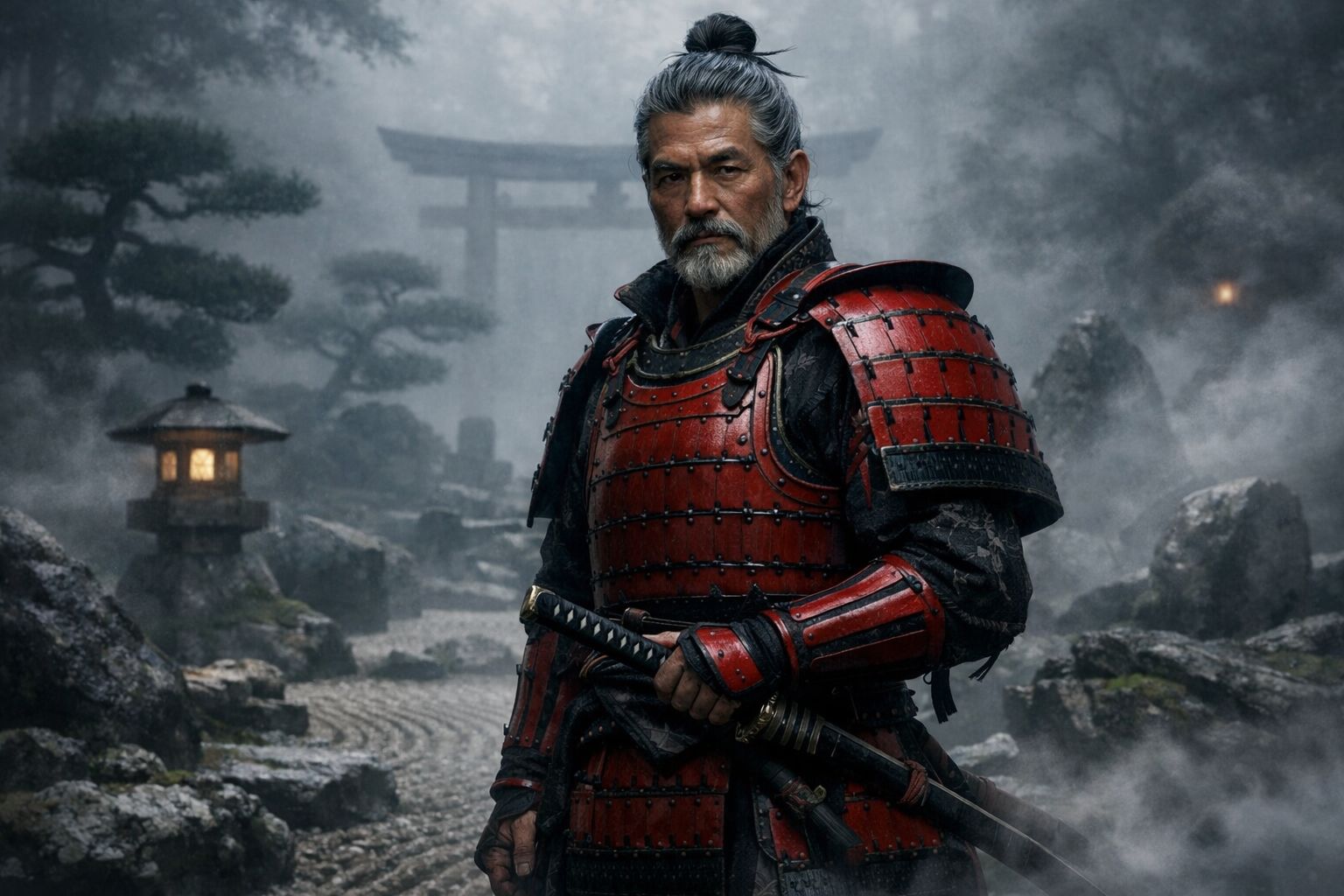
This scene should be brief, controlled and cold.
Just before the crew leaves Kaoriyo, Lord Masanori Minatoya arrives with a large retinue. Messengers have already carried news of Hayato's death, and Masanori has come to settle the matter of succession in person. The important thing here is not suspense, but contrast. Kaoriyo has just passed through grief, blood and ritual sacrifice. Masanori arrives as administration, hierarchy and continuity. Most of all, he is here to secure loyalty.
The Mood
The household should receive him with perfect formality, but the emotional tone is very different from Hayato's ceremony. This is not grief given sacred form. It is the machine resuming.
Masanori should seem composed, efficient and entirely at ease. He gives Hayato the proper words of respect, speaking of him as pure and dutiful, but there should be little warmth in it. The feeling should be that whatever happened here has already been absorbed into the logic of the system. Hayato died well. The matter is settled. Now the chain of command continues.
That emotional coldness is the point.
The Important Actions
Masanori publicly appoints Captain Genji Arakawa as the new castellan of Kaoriyo. Genji accepts and proclaims his allegiance, but the weight of the office should be obvious. He has just witnessed exactly what loyalty and responsibility can demand, and now that burden is his.
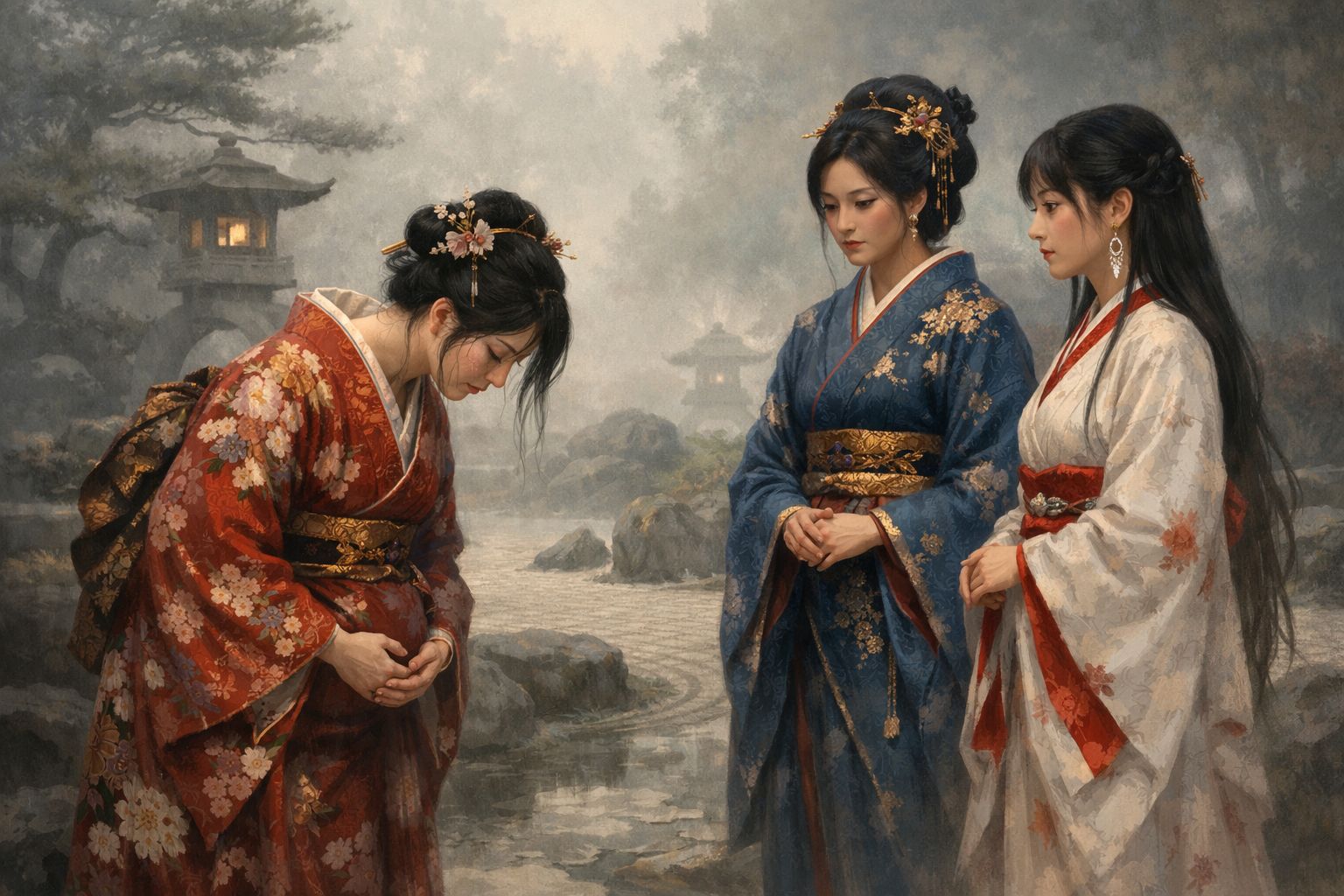
Masanori then claims Hayato's surviving concubines, Lady Sayo and Lady Kiyomi, into his own household. This should not be played as a twist or dramatic reveal. It should feel routine, expected and almost administrative. That is what makes it disturbing.
Among Masanori's retinue should be the pregnant concubine, Lady Natsume. Sayo and Kiyomi recognize her, and she recognizes them. The implication should be visible without being explained aloud. The cycle is continuing. The peace at Kaoriyo is real, but it is not final in any larger sense.
Running the Scene
Do not linger here too long. This is not a negotiation or a major conversation scene. The crew mostly observes. The purpose is to show that the household's immediate crisis is over, but the structure that produced it remains entirely intact.
If the crew notices the significance of Natsume, let them notice it. If they want to speak among themselves quietly, that is fine. But the scene itself should move briskly. Masanori arrives, honors Hayato, appoints Genji, takes the women and leaves.
What the Scene Should Leave Behind
By the end of this moment, the crew should understand two things.
First, Hayato's sacrifice did work, at least in the immediate sense. Kaoriyo has peace again.
Second, nothing fundamental has changed. Lord Masanori continues as before. Women still pass between households by rank and right. The same order that restored peace is also the order that created the fracture in the first place.
That bitter contrast is the real purpose of the scene.
Leaving Ozukari
After Lord Masanori Minatoya's visit, the crew's business in Kaoriyo is effectively finished. The journey back down to the coast is short and uneventful. That lack of incident matters. After everything that has happened, Ozukari gives them no final outburst, no chase and no last revelation. The road is simply quiet.
They reach the shore in the afternoon and settle aboard ship. The mood should be reflective rather than dramatic. The crew has what they came for, and the crisis at Kaoriyo has ended, but the emotional residue of the arc should still hang over them.
At first light the next morning, the Blue Marlin departs Ozukari waters. The leave-taking should feel clean and subdued. The act is over. The questions it raises are not.
Act Summary
The Ozukari arc is a short but heavy stop in the Waverider chase, giving the crew both a practical lead and a disturbing glimpse into a culture where order, loyalty and duty are treated as sacred protections against chaos. What begins as a routine port of call becomes a lesson in how Ozukari's values shape everything from hospitality and hierarchy to demons and sacrifice, leaving the crew with a deeper understanding of the land and an uneasy sense of what that understanding cost.
What makes Ozukari memorable is that the information comes quickly, but everything around it becomes the real story. The Waverider clue is important, but it is not what the crew will carry most strongly from this place.
Waverider's Port of Call
The immediate practical outcome of the Ozukari arc is that the crew gets what it came for. Castellan Hayato Tsukahara provides the information they need about the Waverider's passage through Ozukari waters, confirming it as another clear port of call in the larger pursuit. In that sense, the stop is successful. The trail continues.
Ozukari's Culture in Practice
This arc gives the crew its clearest look yet at what Ozukari really is.
The household at Kaoriyo is refined, disciplined and beautiful. Everything is ordered, polished and maintained with care. That surface is real. It is not hypocrisy. At the same time, the arc shows the cost of that order. Hierarchy is absolute. Hospitality is obligation. Women pass between households as part of rank and right. Emotion is permitted, even openly displayed, but duty remains above all things.
That is the key cultural takeaway. Ozukari is not emotionally cold. It is emotionally disciplined. Tears are allowed. Grief is allowed. What is not allowed is hesitation in the face of obligation. That distinction should stay with the crew, because it explains both the nobility and the horror of what they witness.
Demons in Ozukari
The arc also establishes that demons in Ozukari do not behave like ordinary demonic threats.
These demons seem tied to transgression, disorder and broken sacred bonds rather than simple hunger, cruelty or chaos. The demon at Kaoriyo is not merely attacking a household. It is accusing, judging and punishing. It kills with purpose and leaves with purpose. It is not there to destroy everything. It is there to make Hayato witness the cost of what he has done.
That should be an important lesson going forward. Ozukari's demons operate under a different logic, and the crew should not assume that familiar approaches to demons will always apply here. This is also where Thaleia's observation becomes useful, because she helps frame the difference even if she cannot solve the situation herself.

The Cost of Duty and the Price of Failing It
More than anything else, Ozukari leaves the crew with a brutal lesson about duty.
Hayato's transgression is deeply human. He loved Lady Reika and continued meeting her after Lord Masanori Minatoya had lawfully taken her into his own household. In another culture, that might be treated as tragic love. In Ozukari, it is a fracture in loyalty itself. Hayato placed private love above the bond between lord and vassal, and in doing so he broke order.
The arc then shows both sides of that truth. It shows the price of failing duty, as Hayato's household is punished night after night through blood and terror. It also shows the cost of fulfilling duty, as Hayato ultimately destroys not only himself but his own bloodline in order to restore peace.
That is the central weight of Ozukari. Duty preserves order, but the demands of that order can be monstrous. Failure carries one horror. Obedience carries another.
Meyrha's Vision
Meyrha's vision at sea proves its value in hindsight.
Her repeated words, "Love is blood, blood is love," seem strange and opaque when first spoken, but become painfully clear by the end of the act. The vision does not give the crew a solution. It gives them a symbolic warning whose meaning only emerges once they have lived through the events at Kaoriyo.
That is an important takeaway for the Game Master. Meyrha's visions are useful not because they explain things directly, but because they create foreboding, pattern and delayed recognition. They are strongest when they feel confusing at first and precise only in hindsight.
Lasting Impression
The lasting impression of Ozukari should be bitter and complex.
The crew gets the Waverider lead. Kaoriyo is saved. The demon does not return. Yet none of that feels clean. The crew has seen a society where beauty, loyalty and discipline can hold back chaos, but also demand unbearable sacrifices. They leave with a clearer understanding of Ozukari, of its demons and of the terrible price its people are willing to pay for order. They also leave knowing that Hayato's bloodline did not end, it will restart, and the demon will be back.
That is what the arc should leave behind. Not triumph, but understanding.
The sun was low and red when Meyrha, Ivy and Thaleia found themselves together by the starboard rail.
Ozukari had already sunk into distance behind them, no longer a line of shore so much as a dark memory lying beneath the evening haze. The sea was calm. Rigging creaked softly overhead. Somewhere forward, a sailor laughed at something half heard and half lost to the wind, but here by the rail the mood was quieter. The three women stood with the kind of stillness that follows a place one has not yet finished understanding.
Thaleia had a notebook open in one hand, though for once she was not writing in it. She frowned toward the horizon, braid coming loose again in the wind, her expression caught between fascination and offense.
"It does not fit," she said at last. "Demons are meant to be forces of violation. Ruin. Chaos. They tear things apart because tearing things apart is what they are. But those things in Ozukari..." She shook her head. "They almost seemed to preserve order. Or punish its breaking. That is wrong."
Ivy, leaning lightly against the rail beside her, traced one thumb over the carved wood without seeming to notice she was doing it. The setting sun caught the patterns of her tattoos and turned them warmer, almost alive.
"Maybe they are not all the same," she said quietly. "Spirits are not all the same. People are not all the same. Why should demons be?"
Thaleia glanced at her at once, interest flaring bright and immediate. "Factions."
"Maybe." Ivy lifted one shoulder. "Kinds. Courts. Laws. Old enemies. I do not know." A faint, humorless smile touched her mouth. "I only know that if I had seen such things before anyone told me they were demons, I would not have named them first. They felt... directed."
Meyrha stood a little apart from them, hands folded into her sleeves, her gaze not on the horizon but on the darkening water below. The wind teased at the edge of her veil. She had been quiet for some time, listening in the way she always seemed to listen, as if the world were saying more than most people could hear.
"With a price like that," she said softly, "perhaps it is only another shape evil can wear."
The words settled heavily between them.
Thaleia looked down at her notebook. "That is possible," she admitted. "Functional cruelty. Ordered cruelty. Ritualized cruelty. Yes." Her voice quickened a little as her mind found its footing again. "The subject needs more study."
From behind them came the sound of boots on deck.
Scarnax had approached quietly enough that none of them had heard him until he was almost there. He stopped beside the rail, one weathered hand settling on the wood, and looked from one face to the next with the wary resignation of a man who had already caught enough of the conversation to know where it was going.
"It will need to be studied by someone else," he said. "I have no desire to go back for more."
That brought the faintest curve to Meyrha's mouth.
"I agree," she said.
Thaleia gave a small sigh, the sound of scholarship running into practical limits. "Yes. Fair."
Scarnax rested his forearms on the rail and looked west, where the sun was flattening itself into the sea in a smear of red gold.
"It has made me think, though," he said after a moment.
Ivy turned toward him. "About demons?"
He shook his head.
"About being the one answerable when things go wrong." His voice was rougher than usual, though not louder. "What it means to be responsible for more lives than your own. Hayato had a whole house under him. Guards. Servants. Family. Every death landed on his shoulders in the end, whether he deserved all of it or not."
Meyrha studied him for a moment with those deep, still eyes of hers.
"I trust that you will protect us," she said.
Ivy nodded at once. "And we have your back too."
For the first time in several moments, Scarnax laughed. It was a brief sound, dry and real.
"We do things a bit differently on the Blue Marlin," he said. "No one gets left behind."
Something in Ivy gave way at that. Perhaps it was the words themselves, perhaps the plainness of them, perhaps only that they had come after Ozukari. Before Scarnax could say another word she stepped forward and threw her arms around him.
He stiffened in pure surprise.
Then, with the awkward patience of a man who had never quite learned what to do with sudden tenderness, he let out a breath and rested one rough hand lightly against her shoulder.
"There now," he muttered.
Ivy laughed once against his coat, embarrassed and emotional all at once, then let him go. Thaleia pretended not to notice and very obviously failed. Meyrha's faint smile returned, sad and knowing.
After a little while the three women drifted off together, their voices low as they moved toward the stern. Thaleia was already talking again, hands moving as she puzzled through theories. Ivy answered in short, thoughtful phrases. Meyrha said less, but when she did the other two listened.
Scarnax stayed where he was.
He stood alone at the rail and watched the last of the sun sink beneath the sea, the light going out in long red bands across the water. Behind him the Blue Marlin lived and breathed with familiar sounds, rope, sailcloth, footsteps, low voices, the life of a crew that trusted him more than he sometimes liked to think about.
No matter the ship, no matter the crew, leadership had a loneliness to it.
He remained there until the red was gone.