Campaign: Olydrian Isles, Ostranos - Ostranos
Act Synopsis
Arrival and Sanctuary
The Blue Marlin arrives in Ostranos during a season of lots of visitors. The city presents itself as a place of safety, renewal, and ritual calm. Sacred baths steam beneath white stone terraces. Priestesses of Irythe guide supplicants through cures both physical and spiritual. The ship undergoes maintenance and resupply, and the crew is encouraged to rest.
Several crew members take advantage of the city’s openness. Junia immerses herself in local healing traditions and rare remedies. Yasmira explores markets and kitchens, gathering unfamiliar ingredients and techniques, tasting local food. The overall tone is relaxed and unguarded, a rare moment of peace in the campaign.
Disappearance
During this lull, two crew members vanish. There is no violence, no witnesses, and no obvious sign of struggle. They simply fail to return. At first, the assumption is mundane delay or indulgence, but the absence stretches into unease.
The city remains welcoming. Authorities are polite but unconcerned. No alarm is raised. The contrast between the city’s serenity and the sudden loss creates a sense of violation rather than danger.
Investigation
The crew begins to investigate, moving through Ostranos’ baths, markets, temples, and docks. The investigation is open and nonlinear. No single lead points directly to the truth.
Various citizens provide fragments. A bath attendant recalls the missing crew speaking with a refined stranger. A slave trader remembers an intermediary who buys quietly and pays well. A healer recalls strange herbs being bought in quantity. A priestess tells of horrific visions. Slaves vanishing, which is mostly seen as waste, rather than a crime.
Suspicion gradually shifts toward the wealthiest district of the city, where opulent mansions stand above the rest of Ostranos.
False Expectations
As the trail narrows, the likely explanation appears to be familiar cruelty. A decadent noble. A private torture ring. Illegal pleasures hidden behind wealth and influence. The evidence supports this assumption, and nothing yet contradicts it.
This expectation is wrong.
The Hidden Feast
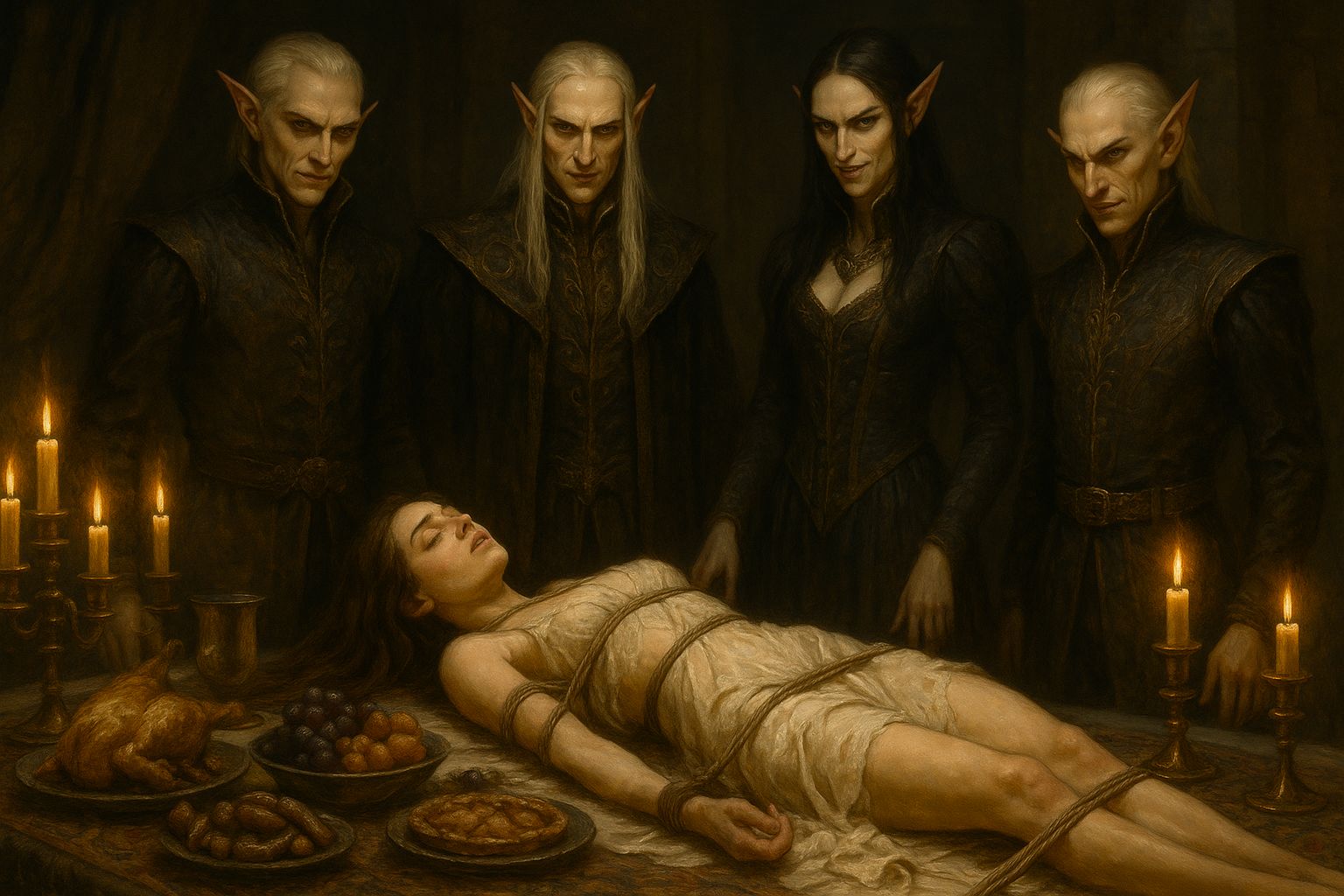
The truth is a Carnee coven operating beneath a respected household. The missing crew members were noticed by a procurer returning from the slave market and taken deliberately. They are held alive in the cellars, not yet consumed.
They have been forced to witness a banquet. Not as participants, but as future courses. Their fear is cultivated, not incidental. The coven values anticipation and ritual over efficiency.
During this phase, Thaleia Myrinos is also taken. Her curiosity and investigation into strange disappearances led her too close to the truth. She survives only because the coven intends to decide her fate later.
Confrontation
Once the coven is discovered, the situation escalates rapidly. The Carnees rely on secrecy, illusion, and social camouflage. When exposed, they do not fight as conquerors but as predators driven into the open.
The confrontation is violent and chaotic. Some members of the coven are killed. Others may escape if not contained. The cellars are revealed. The missing crew members are rescued, traumatized but alive. Thaleia is freed, shaken but already attempting to rationalize what she witnessed.
Aftermath
The exposure of the coven sends shockwaves through Ostranos. Publicly, the city condemns the atrocity. Privately, there is pressure to minimize the scandal. Some officials fear damage to the city’s reputation as a place of healing and sanctuary.
The priesthood of Irythe is unsettled. Healing was used as a mask for predation, and this leaves scars that rituals cannot easily cleanse.
Thaleia requests passage with the Blue Marlin. She claims scholarly reasons, but it is clear she no longer feels safe remaining in the city. She is not intended as a permanent crew member, but will occasionally cross paths with the Blue Marlin.
The captured crew members will bear mental scars from the experience, which will take time to heal.
The arc ends with the crew leaving Ostranos having restored what they could, but aware that refinement and horror often share the same table, and that even sanctuaries can rot from within.
Possible Recurring NPCs
Several familiar figures may plausibly cross paths with the crew during their stay in Ostranos, without drawing focus away from the investigation.
Amir al Javeen may surface intermittently, performing in streets, baths, or markets. His constant movement and attention to crowds make him a useful accidental witness, able to mention who lingered, who followed, or who asked the wrong questions.
Samden may be present in the city, watching the crew. He is not part of the investigation, but if the crew becomes trapped in an unsolvable situation, his hidden intervention can provide a way out.
The Licentius couple are among the many visitors drawn to Ostranos, but unlike most they are here to take rather than receive. They drift through crowds, baths, and markets, skimming coin from the inattentive, cheating tourists, and setting up minor schemes. Their activities may intersect the investigation only tangentially, but their appetite for gossip, leverage, and easy profit makes them useful sources of rumor or trouble.
The Silver Moon may find Ostranos fertile ground for trade, as wealthy visitors are more willing to indulge in curiosities and questionable artifacts. His presence reinforces the sense of a city saturated with outsiders and quiet transactions.
Sandros may be operating in the background. With tensions high between the Olydrian Isles and the Empire, Ostranos attracts influential figures worth observing. He gathers information, not allies. To the crew he remains a passing shadow, creating a feeling of something big about to happen. If the Albirica arc has been played, he might approach them and collect the favor he is owed.
Arrival in Ostranos
| Story |
|---|
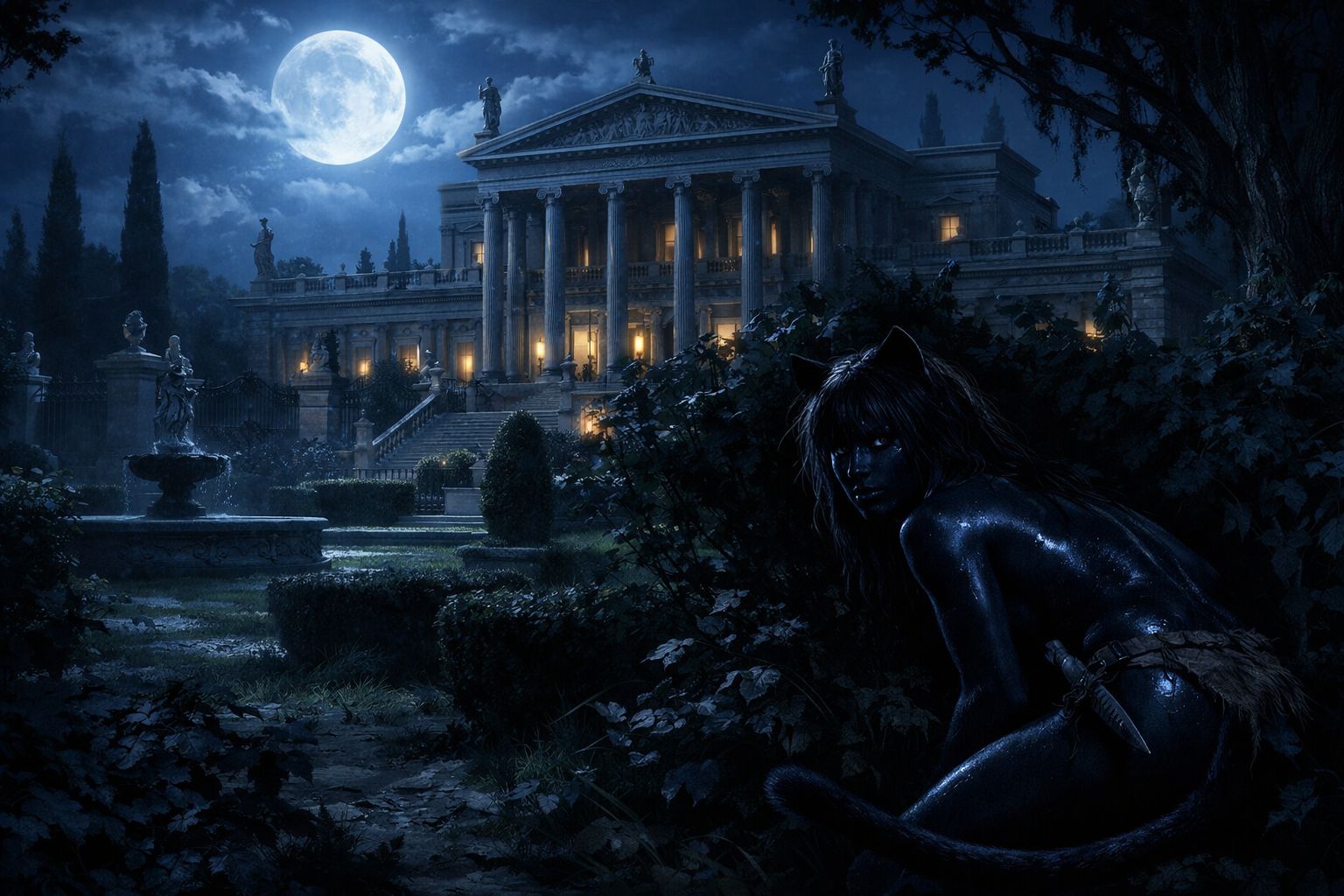
| The Blue Marlin enters Ostranos at dawn, her hull cutting through pale steam that rises from the sacred springs along the shore. White stone terraces climb the cliffs above the harbor, streaked with mineral stains in green and rust red, and everywhere there is water. Channels carry it through the streets. Fountains spill it into basins. Baths breathe it back into the air. The city smells of salt, herbs, hot stone, and clean skin. |
| Pilgrims, patients, and idle visitors crowd the docks. Some arrive leaning on canes, others borne on litters, most seem healthy and rich. All leave slower, lighter, or at least hopeful. Priestesses of Irythe move through the press in linen robes, calm and focused, directing newcomers with practiced ease. Ostranos does not celebrate. It works. Healing and relaxation is its industry, and it never sleeps. |
| The Blue Marlin is welcomed without ceremony and without suspicion. The docks are used to strangers. The ship is taken in for maintenance, her hull scraped and checked, her rigging repaired by local hands, under the supervision of Galenor. For once, no one is in a hurry to leave. |
| Junia vanishes into the upper terraces within hours of arrival. She spends her days in the lesser sanctuaries, observing treatments, trading notes, and listening. The healers of Ostranos do not hide their knowledge, but they do not simplify it either. Remedies here are precise, seasonal, and bound to ritual timing. Junia returns each evening with ink stained fingers, new herbs wrapped in damp cloth, and questions she does not yet have answers to. For the first time in a long while, she is surrounded by people who understand her work without fear or cruelty. |
| Yasmira treats the city as a living pantry. She moves through markets heavy with steam and spice, with Mbaru in tow, tasting broths ladled from copper pots, biting into fruits grown in mineral rich soil, watching cooks prepare meals meant to restore strength rather than impress. She talks with bathhouse kitchens, where food is designed to support healing, and with street vendors who know which flavors calm nerves or settle fever. She buys, tastes, argues, laughs, and returns to the ship with baskets full of unfamiliar roots, salts, and oils. The crew eats better here than they have in months. |
| The rest of the crew settles into a rhythm that feels almost unreal. Mornings in hot pools carved into the rock. Afternoons wrapped in linen, drinking cooled wine or mineral water while muscles loosen under practiced hands. Evenings spent eating slowly, talking without urgency, sleeping deeply. Laughter comes easier. Old scars ache less. The ship feels lighter, as if some of its weight has been set down on the warm stone of Ostranos. |
| For a brief span of days, the world feels distant. Chains, blood, and pursuit seem like stories told by someone else. The Blue Marlin rests. Her crew heals. And the city goes on with its work, watching strangers arrive and depart with the mild interest reserved for business, not people. |

Purpose of the Segment
This opening segment is meant to lower defenses. Both the characters’ and the players’. Ostranos should feel genuinely safe, pleasant, and restorative. This is not false cheer or hidden menace yet. It is a place where nothing bad seems likely to happen, and where vigilance feels unnecessary.
Emphasize comfort, routine, and abundance rather than spectacle. Ostranos is not exciting. It is reassuring.
Ship and Timeline
The Blue Marlin requires routine service after the journey. Hull inspection, scraping, minor repairs, resupply, and local maintenance will take approximately one week. This timeline is firm and known to the crew.
There is no pressure to rush. No looming threat. No external demand to leave early.
This gives the crew several uninterrupted days where they are free to disperse, pursue personal interests, and settle into a relaxed rhythm.
Tone to Establish
Ostranos should feel like a town sized luxury spa resort.
The baths are clean and professional. Treatments are efficient and ritualized. Food is excellent and plentiful. Lodgings are comfortable. The city is busy but calm, focused on service rather than celebration.
Strangers are normal here. Visitors come and go constantly. The crew should not feel watched, judged, or out of place. Authorities are polite, distant, and uninterested in minor concerns.
Encourage scenes of rest. Bathing. Massage. Eating well. Sleeping deeply. Casual conversation without urgency. Let characters linger in moments they normally would not have time for.
Character Focus
This is an opportunity to reinforce relationships and habits.
Junia spends long days among healers, learning and exchanging knowledge.
Yasmira explores markets and kitchens, usually accompanied by Mbaru, returning with food and stories.
Galenor oversees work on the ship closely, never far from the hull, making it clear he does not truly relax when the Marlin is out of his hands.
Other crew members should be encouraged to relax in ways that fit them. Drinking. Training lightly. Socializing. Wandering the city. Doing nothing.
Nothing bad happens during this time.
Recurring NPCs
This is an excellent time to introduce some familiar faces. Amir performing, Silver Moon selling, the Licentius couple being up to no good. Don't make a big thing out of it, let it just be part of the background.
Disappearance
Purpose of the Segment
This segment breaks the illusion of safety without replacing it with open danger. The city does not change. Ostranos remains calm, pleasant, and efficient. What changes is absence.
The goal here is unease, not panic. The crew does not witness violence. They discover that something has quietly gone wrong in a place where nothing was supposed to go wrong at all.
Target Selection
The Carnees select victims based on appearance, vitality, and social invisibility. They prefer young, attractive people who will look good on the banquet table.
Choose victims from the crew who are not player characters.
Suitable targets include Silvio, Yasmira, Ayesha, Nasheem, Amaxia, Mbaru, Junia, Cassandra, and Nera.
If Ormun is present in the crew, strongly consider choosing Cassandra as one of the victims. Her capture creates immediate emotional stakes and reinforces Ormun’s role as protector rather than brute, and deepens their relationship.
Silvio is also a good choice, based on the long plan for him, as it keeps the players emotionally invested in him.
Select two victims. Do not take more. Fewer makes the loss personal and focused.
What Has Happened Off Screen
The Abduction
The abduction should feel ordinary until it is too late.
The Carnee procurer had been returning from the slave market without success. He is low in the coven hierarchy, and returning empty handed is a failure he cannot afford. On his way back through the city, he notices the future victims dining at a crowded outdoor tavern.
He approaches openly. The tavern is busy. Sitting at a shared table is normal. He is polite, cultured, and mildly charming. He asks harmless questions. Where they are from. How long they are staying. Whether they are enjoying Ostranos.
After a short while, he suggests continuing the evening elsewhere. A quieter place. Better wine. Nothing exclusive or private. Just another tavern.
The second location is smaller. A back room is offered. Drinks are poured. The victims are drugged quickly and efficiently. They do not realize what is happening until strength fades.
Paid accomplices assist with removal. They are not Carnees. Just local thugs hired for muscle. The tavern keeper is paid a small sum afterward as compensation for “friends who drank too much and caused trouble”. This is not the first time for either the thugs nor the tavern keeper, and they believe the victims are sold on the slave market.
The victims are taken away in a covered cart.

At the Mansion
The victims awaken in cages beneath a wealthy mansion.
Other captives are present. Some are resigned. Some are broken. Some whisper stories of feasts and screaming guests who never return. None truly understand what the Carnees are, only that something refined and monstrous owns them now.
The victims are kept alive, fed enough to remain healthy, cleaned, and made aware of what awaits them. They are not harmed yet. Fear is intentional. Anticipation is part of the ritual.
At least once before rescue, they are forced to witness a banquet from concealment or restraint. They are not yet participants. They are courses waiting to be served.
Discovery
Do not announce the kidnapping.
Let absence speak first.
The victims fail to return to the ship. Or they miss a planned dinner. Or they do not show up for an agreed errand. At first, this is easy to rationalize. Ostranos encourages indulgence.
Only later does concern settle in.
The city offers no help. Authorities are polite but unconcerned. Visitors disappear here all the time. Most reappear. Some leave early. A few do not.
This is the moment the investigation begins. The city has not turned hostile. It has simply stopped caring.
From here, the crew are the ones who care.
| Story |
|---|
| The tavern by the harbor had emptied and filled again twice by the time Amaxia stopped counting cups. |
| The sun had gone, replaced by the steady glow of lanterns strung along the quay. Steam drifted from the bathhouses farther up the slope, carrying the sharp scent of herbs and minerals even this close to the water. Sailors laughed at the next table. A pair of pilgrims argued softly over wine gone thin. Everything sounded normal. |
| Too normal. |
| Amaxia sat with her back to the wall, arms folded, eyes tracking the door each time it opened. She did not fidget. She never did. Mbaru sat opposite her, broad shoulders hunched slightly forward, hands wrapped around a mug he had long since stopped drinking from. He watched the street instead, the flow of people past the open shutters, measuring gaps between footsteps. |
| “They said they would be back before dark,” Mbaru said at last. |
| Amaxia nodded once. “Nasheem does not forget meetings. And Cassandra would not leave him waiting.” |
| Another hour passed. The tavern keeper changed shifts. The lamps were trimmed. Someone began singing badly near the docks. Still no sign of them. No laughter drifting in. No familiar voice cutting through the crowd. |
| Amaxia rose first. “We’re done waiting.” |
| Mbaru stood without comment. He left a coin on the table that was more than enough and did not look back as they stepped into the night air. The harbor felt different now. Quieter. Not threatening, just empty in the wrong places. |
| They walked to the Blue Marlin in silence. |
| By the time they reached the gangplank, Amaxia’s jaw was set and Mbaru’s hands were clenched tight at his sides. Whatever ease Ostranos had offered earlier was gone. |
Thaleia Myrinos
Purpose of the Incident
This incident serves as escalation, confirmation and leads. The disappearance of Thaleia Myrinos reinforces that what is happening is not random and not limited to beasts or chance. Curiosity itself is being punished.
Her trail is meant to be easy to follow. This is not a second mystery. It is a signal that the investigation is moving in the right direction and that someone noticed.
Thaleia’s Theory
Thaleia becomes convinced that a previously undocumented predator is active in Ostranos. Not supernatural in her mind, but rare, intelligent, and territorial. She theorizes a beast that hunts selectively, removes victims cleanly, and avoids attention.
She speaks about this theory constantly.
To healers. To bath attendants. To cooks. To guards who are trying to eat. She sketches diagrams on scraps of parchment. She asks irritatingly specific questions about where people vanished, at what time, and under what conditions. She is excited, convinced she is close to something important, and entirely unconcerned with how dangerous her conclusions sound.
Her enthusiasm leaves a trail.
Following Thaleia
Thaleia’s investigation leads her steadily uphill, toward the wealthiest districts of Ostranos. Her reasoning is flawed but directional. She believes the creature nests near abundance and concealment. Large buildings. Private grounds. Quiet streets.
Many people remember her.
A bath attendant recalls a woman asking about screams and insisting they were not human pain. A street vendor mentions a scholar arguing that too many slaves were sold. A guard recalls a thin woman with ink stained hands sketching mansion layouts in the dust.
None of these people are concerned. Thaleia was odd, loud, and clearly a tourist. They remember her as an annoyance.
Capture
Thaleia gets too close.
Whether through observation, careless questioning, or being noticed by a masked Carnee, her interest is flagged. Unlike the crew victims, she is not chosen for beauty or presentation, but because she is asking the wrong questions in the wrong place.
Her capture is quiet and efficient. No tavern. No accomplices. She vanishes between streets, taken into a private residence under cover of night or invitation.
The coven recognizes her as a liability. They intend to decide her fate later.
Local Reaction
No one looks for Thaleia.
She has no fixed lodging, no powerful patrons, and no local ties. To Ostranos, she is another visitor who arrived, asked questions, and disappeared back into the flow of the world.
Her absence generates gossip, not concern.
For the crew, however, her trail is clear. Her noise makes her easier to follow than the careful silence surrounding the earlier disappearances.
This incident should reward investigation rather than replace it. Thaleia does not provide answers yet. She provides direction.
Investigation
This is an open investigation segment. There is no correct order, no required scene sequence, and no single source of truth. The players are meant to move freely through Ostranos, ask questions, follow instincts, and assemble fragments into a coherent picture.
No one in the city understands the full situation. Each person knows something small, partial, or misinterpreted. The truth only emerges through accumulation and comparison.
Do not rush this phase. Let uncertainty breathe. Don't let every person they talk to have information. Let the frustration build with people who don't know anything, then sprinkle some leads.
Structure and Flow
The investigation is intentionally diffuse.
Players may visit taverns, bathhouses, markets, temples, docks, private homes, or official offices. They may speak to locals, visitors, slaves, priests, merchants, guards, and criminals. Most conversations will not feel immediately useful. That is intentional.
Clues should overlap, contradict, or reinforce each other indirectly. Avoid any single conversation that solves the mystery or points directly to the coven. Instead, allow patterns to emerge gradually.
If players pursue a line of questioning that makes sense, reward it with information. If they pursue something irrelevant, let it consume time but not punish them.
This phase tests patience, judgment, and synthesis rather than cleverness.
Ramping It Up
Use Thaleia Myrinos as a pacing lever. Introduce her name, theories, or disappearance when you need to either break a dead end or deepen unease. This moment should feel like an expansion of the mystery, not a solution, and should reinforce that the crew is no longer alone in noticing something is wrong.
What the Crew Knows at the Start
At the beginning of the investigation, the crew knows very little.
The missing crew members were last seen in the old quarters near the harbor. This area is a popular tourist district filled with taverns, inns, and bathhouses.
Another crew member encountered them earlier that evening while they were looking for a place to eat. They appeared relaxed and unhurried. They did not express concern or urgency.
That is all.
There are no witnesses to violence. No signs of struggle. No known enemies. No demands or messages.
Everything beyond this must be uncovered through investigation.
Tone to Maintain
Ostranos does not become hostile during the investigation.
People are polite. Conversations are civil. Most are mildly helpful. A few are evasive. Almost none are alarmed.
Disappearance is not treated as extraordinary here, especially among visitors. This indifference should be unsettling without becoming obstructive.
The horror of the situation lies not in resistance, but in how easily absence is absorbed into routine.
Guidance for the Game Master
Do not gate progress behind specific NPCs or locations.
If players ask reasonable questions in reasonable places, give them something. It may not be useful immediately, but it should feel true.
Avoid revealing the Carnees directly during this phase. The goal is not identification, but convergence. By the end of the investigation, the players should feel that something refined, wealthy, and carefully hidden is involved, even if they do not yet know what.
Let the city remain beautiful, busy, and unconcerned while the crew digs beneath its surface.
Person Gallery
Old Quarters Tavern Staff
These NPCs are cooperative, mundane, and unconcerned. They are witnesses, not suspects.
The Tavern
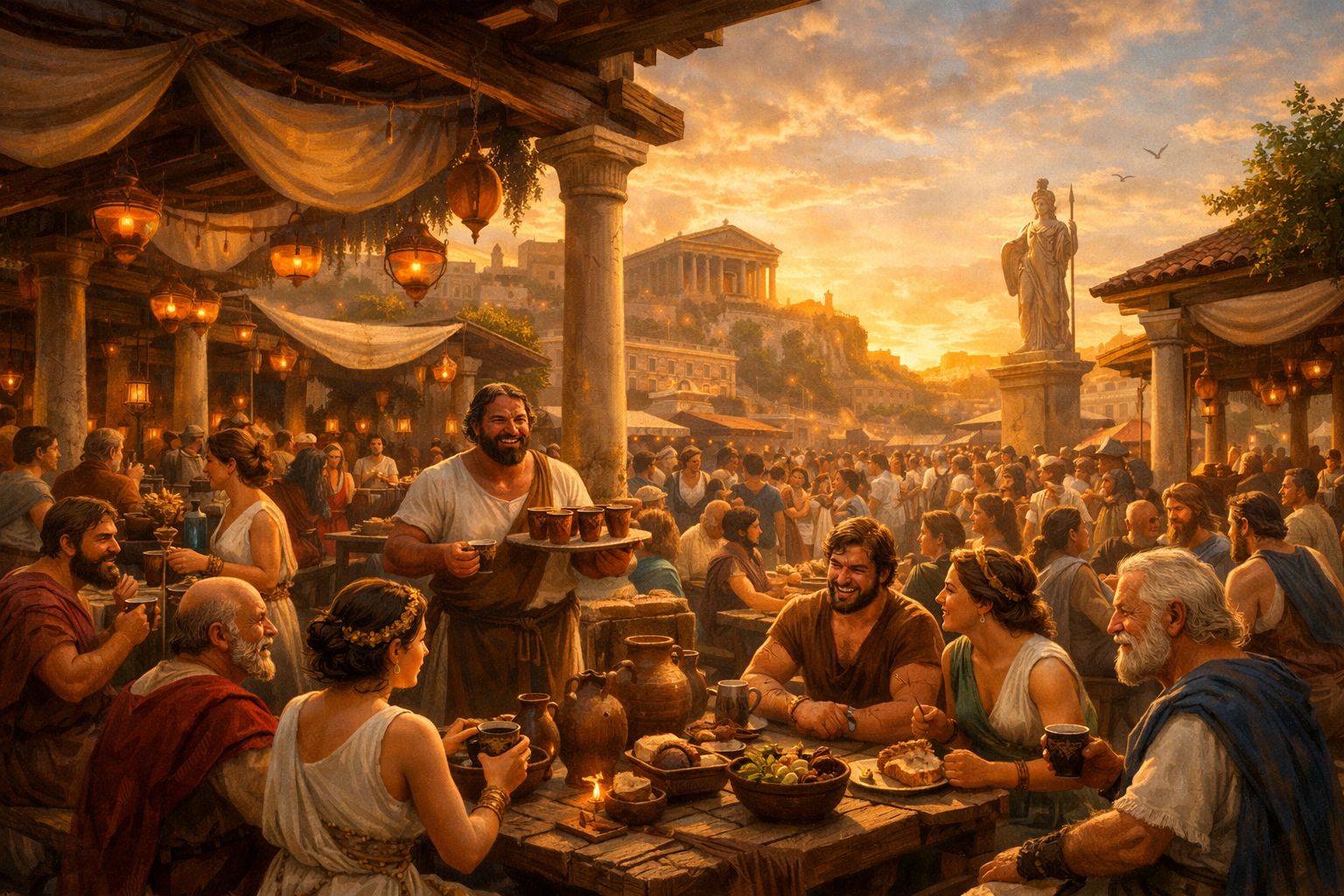
The tavern is one of several along the main streets of the old quarters, catering to visitors and sailors. Outdoor tables, cheap wine, better food than it looks, and constant foot traffic. Nothing about the place stands out beyond being busy and forgettable.
Staff here are used to tourists lingering, overspending, and leaving together with people they just met.
Tavern Keeper, Leonas Keryth
Leonas is a broad shouldered man in his late forties with thinning hair and a permanent look of mild exhaustion. He runs the tavern competently and without curiosity. He remembers faces when they matter to business and forgets them when they do not.
He clearly remembers the missing crew.
They ate well, paid promptly, and did not cause trouble. Leonas recalls that they were joined by a man he did not recognize, well dressed, polite, and wearing a wide brimmed hat. Leonas thought it odd but not suspicious. Visitors dress strangely all the time.
He remembers that the man laughed easily, spoke softly, and let the crew do most of the talking. When they left, it was together, unhurried, and in good spirits.
Serving Girl, Phera
Phera is a young slave, sharp eyed and bored. She has worked the tavern long enough to recognize patterns even if she does not think much about them.
She remembers the table clearly.
She recalls the man’s hat more than his face. Too big. Too careful. She remembers thinking he was hiding from the sun. She assumed he was some kind of performer or minor noble, as his face had makeup.
Phera saw them leave together and remembers the direction. Uphill, toward the quieter streets and better wine shops. Not toward the docks.
She does not recall any argument, pressure, or discomfort. If anything, the missing crew looked amused.
Kitchen Runner, Tomaso
Tomaso, also a slave, is a boy barely old enough to work, tasked with carrying dishes and scrubbing tables. He saw very little, but what he did see stuck with him.
He remembers the man’s voice.
Soft. Educated. Pleasant. Not local. Tomaso recalls that when the man stood, he bent slightly to keep his hat from brushing the doorframe, and that he held it in place with one hand as if it mattered a great deal.
Tomaso also recalls that the man paid for the last round before they left.
Street Merchants of the Old Quarters
These NPCs reinforce movement and mood. They confirm direction, timing, and emotional state. None of them perceive danger. Their testimony collectively strengthens the idea that the victims left willingly and without distress.
They are incidental witnesses, not informants. Each knows very little, but together they remove doubt about where the trail leads.
The Market Street
This stretch of road rises gently away from the harbor, lined with stalls selling food, cloth, trinkets, and tourist luxuries. It is busy most of the day and well into the evening. People slow down here. They browse. They linger. It is not a place where panic or force would go unnoticed.
Nikareon the Cloth Seller
Nikareon is a middle aged merchant with careful hands and a habit of smoothing his wares even when no one is looking. He remembers faces that pause in front of his stall.
He recalls the missing crew walking uphill with a well dressed man wearing a wide brimmed hat. They stopped briefly at his stall. One of them ran a hand over a bolt of dyed linen and joked about the color being too bold for the sea. Nikareon remembers laughter.
The man in the hat did not touch the cloth. He stood slightly back, watching. Nikareon noticed his slim hands with expensive rings and assumed he was wealthy or vain.
They moved on together at an unhurried pace, continuing uphill.
Ione of the Spice Table
Ione sells small jars of spices and scented salts meant for visitors to take home. She is sharp eyed and quick tongued, used to reading moods to judge prices.
She remembers the group clearly because they smelled the wares rather than buying them. One of the missing crew asked what a green salt was used for. Ione explained it was good for aching muscles after bathing.
The man in the hat smiled and paid for a jar anyway, saying it would be useful later.
Ione recalls no tension. The group looked relaxed, curious, and in no hurry. She watched them go because they walked toward the richer streets, where her own customers rarely linger.
Philemon the Fruit Monger
Philemon is old, sun darkened, and slow moving. He remembers patterns more than details.
He saw the group pass by, laughing, heads close together. He recalls that one of the missing crew tasted a slice of fruit and made a face at the sourness. The man in the hat laughed softly and paid for the slice anyway.
Philemon noticed the hat because it cast too much shadow. He remembers thinking the man must burn easily.
They continued uphill, away from the noise of the docks and toward quieter streets with fewer stalls and better stonework.
Entertainers
Amir al Javeen
Amir provides the first indication of a second location. His information narrows the trail from public streets to a specific kind of place without revealing what happened there.
He is not investigating. He simply saw something while doing what he always does.
What Amir Saw
Amir was performing in the old quarters that evening, moving between small crowds and taverns as he usually does. He remembers the missing crew because they were familiar faces, who paused to watch for a short while, smiling, relaxed, and clearly in good spirits.
He also remembers the man with them.
Wide brimmed hat. Careful posture. Standing just a little apart from the crowd. Amir thought him a wealthy patron slumming it or a noble hiding from attention. Nothing about him felt threatening.
After a time, Amir saw the group peel off from the main street and turn into a narrow side alley. This caught his attention only because people usually go uphill along the main road, not into that particular lane.
The alley leads to a small bar rather than a proper tavern. Fewer tables. Dimmer light. Mostly locals and heavy drinkers. The kind of place people go to keep drinking rather than to eat or be seen.
Amir did not follow them inside. He had an audience waiting.
What Amir Does Not Know
- Amir did not see them leave the bar.
- He did not hear raised voices, argument, or alarm.
- He does not know what happened inside.
To him, it looked like a natural continuation of a pleasant evening.
The Back Alley Bar
This location confirms the method rather than the motive. It explains how the victims vanished without witnesses and why no alarm was raised. Everything that happened here fits accepted, if ugly, norms.
No one here believes a crime occurred, and if it did, they don't care.
The Bar Itself
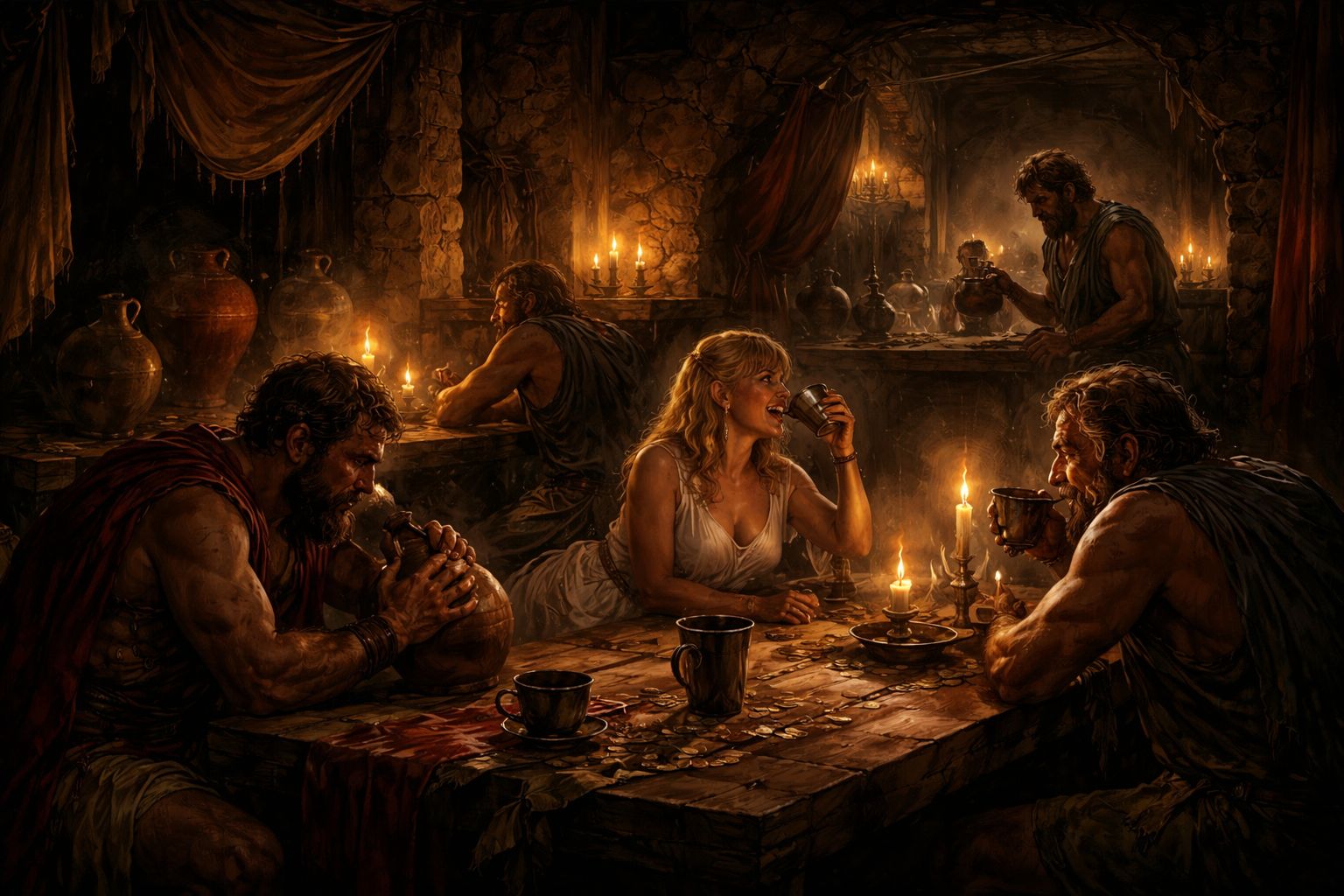
The bar occupies a former private home tucked into a narrow side alley. Its sign is small, its windows shuttered, its entrance easy to miss unless you know it is there.
Inside is one main room with a low ceiling and four narrow side rooms once meant for family living. Now they serve as places to drink away from noise, gamble quietly, or sleep off excess wine. The air smells of sour drink, sweat, and old stone.
This is not a place for meals or conversation. It exists for intoxication.
Bar Keeper, Kleitos
Kleitos is a thin, sharp featured man with a permanent squint and little interest in anything beyond coin and order. He remembers faces poorly but remembers trouble very well.
He recalls the missing crew arriving late, already drinking, accompanied by the well dressed man in the wide brimmed hat. They took a side room. Drinks were ordered. More than usual.
According to Kleitos, they became very drunk very quickly. Too quickly, in hindsight, but at the time it seemed like visitors overindulging.
When the time came to leave, the crew could barely stand. Kleitos assumed they had drunk themselves senseless.
He remembers no shouting, no argument, no resistance.
The Bar Maid, Thessa
Thessa is young, tired, and uninterested in questions that do not involve payment, and it is implied that she also provides personal services for payment. She remembers carrying empty cups and wiping spilled wine from the floor.
She recalls the man in the hat being careful. He checked on the victims repeatedly. Spoke softly. Apologized for the mess. Paid extra.
She remembers him asking if there was a way to get them home without drawing attention.
When the victims could not walk, help was fetched.
The Locals, Paid Muscle
Two local men, Dravos and Petros assisted in removing the victims. They were known to the bar as casual labor, doing any work, legal or not, the kind who can be found nearby most nights.
They remember helping carry the unconscious foreigners outside and loading them into a covered cart. The man in the hat directed them and paid promptly.
They assumed the victims were being sold.
Foreigners disappear this way often enough for it not to be remarkable.
They did not ask questions and would not now, unless pressured.
The Slave Market
This group establishes scale, pattern, and normalcy. What happened to the crew is not unusual here. It only feels unusual because the victims mattered.
The slave market does not provide outrage or alarm. It provides routine.
The Market Itself
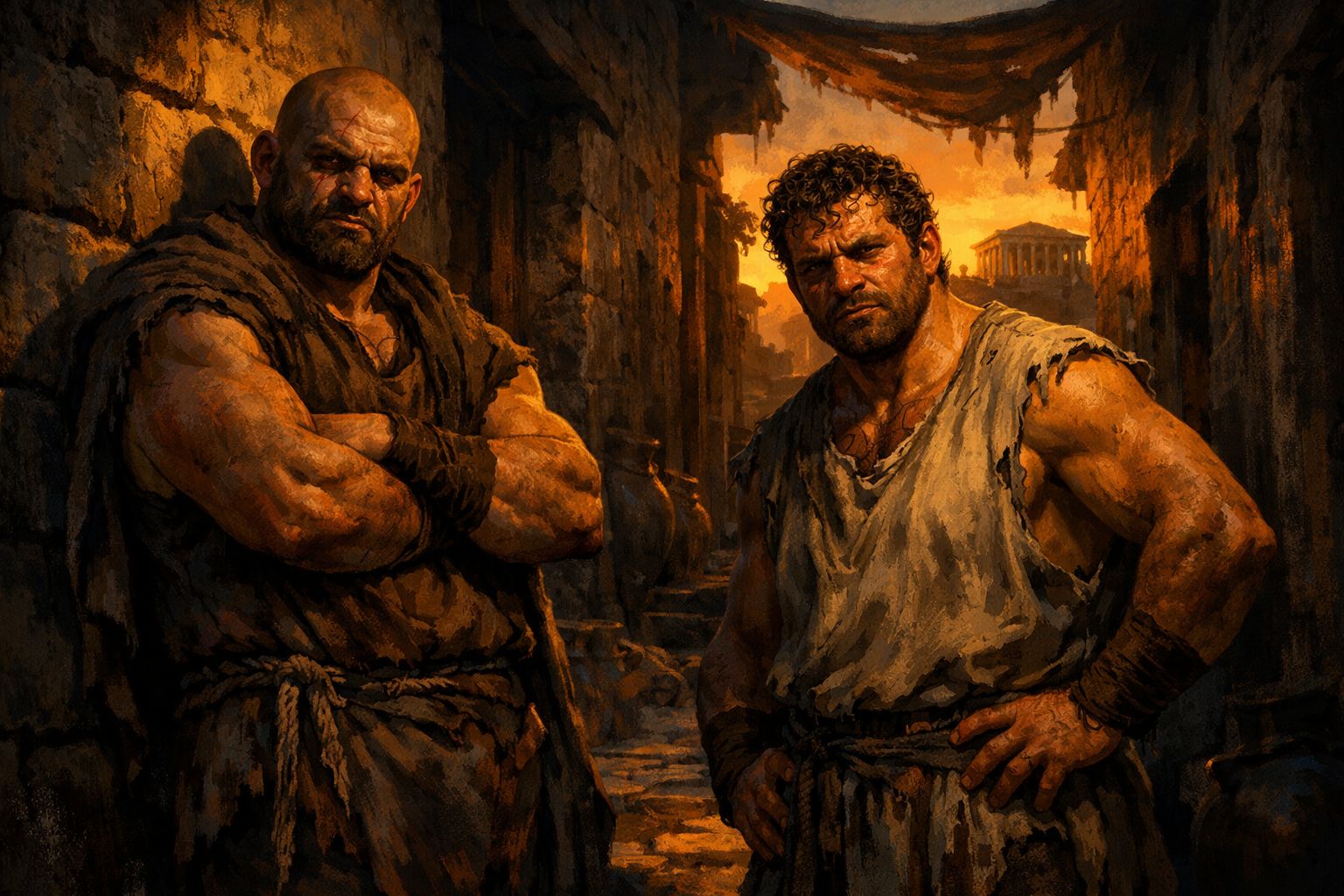
The slave market sits on the edge of the commercial district, far enough from the baths to keep suffering discreet, close enough to profit from traffic. Stone pens, shaded awnings, ledgers, and guards who look bored rather than cruel.
Business is steady. Buyers come and go. Slaves are inventory.
No one here thinks they are doing anything wrong.
The Merchants
All merchants here know the man in the wide brimmed hat.
He is a valued customer.
He visits regularly, often several times a month. He buys small numbers, never in bulk. Always young. Always attractive. Always quiet about purpose. He pays well and never haggles.
Most merchants assume he runs a private brothel or hosts discreet gatherings for wealthy clients. A few believe he buys for foreign nobles. No one asks.
On this particular day, several merchants remember him clearly because he did not buy anything. He browsed, asked questions, inspected stock, and left empty handed. If he doesn't find something which catches his eye, he will not buy, and that happens every few weeks.
They recall the hat because it never comes off. Even indoors. Even in shade. His skin is pale beneath powder, but many wealthy buyers are vain.
To the merchants, he is respectable. Reliable. Profitable.
They do not consider him dangerous.
The Slaves
The slaves know him by rumor.
They whisper about the man in the hat when guards are not listening. They know that those he buys are never seen again. Not sold onward. Not returned. Simply gone.
Some say he owns a house where music never stops. Others say he feeds people to strange pets. Most do not speculate aloud. Fear thrives better without detail.
None of them have seen what happens after purchase.
To the slaves, he is not a buyer. He is an ending.
They know nothing useful beyond that.
City Officials and Guards
This group reinforces institutional indifference. They provide no new leads, but they close off the expectation that authority will help. Their presence defines what Ostranos will not do.
They are obstacles through apathy, not opposition.
The Officials
Clerks, registry keepers, and minor magistrates are polite, orderly, and dismissive. They listen long enough to appear professional, then redirect responsibility elsewhere.
Visitors come and go constantly. Records are incomplete. Names are misspelled. Lodgings change daily. Without proof of a crime, there is nothing to act on.
If pressed, officials will suggest the missing crew may have left the city early, sought treatment elsewhere, or joined another vessel. All of these explanations are delivered calmly and without malice.
They do not lie. They simply do not care enough to check.
The City Guards
The guards of Ostranos are visible but uninterested. Their duties focus on crowd control, keeping trade flowing, and preventing public disorder.
They recall no disturbances in the old quarters on the night in question. No fights. No screams. No reports. This confirms rather than contradicts earlier information.
To the guards, foreign visitors disappearing is not remarkable. Some leave without notice. Some get drunk and miss ships. Some vanish into the wider world.
Unless a body is found in the street or a noble complains, it is not their concern.
Attitude and Tone
Officials and guards should not be hostile.
They are mildly annoyed at being interrupted, but never threatening. They will answer questions briefly, offer procedural explanations, and encourage the crew to move on.
Any attempt to escalate the matter is met with shrugs, paperwork, or referrals to another office that will be equally unhelpful.
Temple Healers and a Noticing Priest
This group introduces the first hint of preparation rather than opportunity. It does not identify a culprit, but it suggests intent and planning behind the disappearances.
The information here feels incidental, not investigative. It surfaces because the crew is asking the right kinds of questions in the right kinds of places.
The Temple
The temple complex of Irythe is busy, orderly, and overstretched. Healers move between baths, storage rooms, and consultation chambers in a steady rhythm. Supplies are tracked carefully. Waste is discouraged. Excess is noticed.
Most priests are focused on treatment, not patterns.
One is not.
Priest of Irythe, Melanthios
Melanthios is a senior temple attendant rather than a visionary. He is methodical, precise, and deeply irritated by inefficiency. He remembers numbers, orders, and deviations from routine.
He recalls a woman purchasing unusually large quantities of coagulant herbs over several visits.
Not poisons. Not stimulants. Herbs used to stop bleeding, slow shock, and keep wounds from becoming fatal.
The quantities were excessive for personal use. Too much even for a household healer. Enough to treat multiple patients repeatedly. He suspects that a noble house is trying to cover up a hereditary bleeding illness, as she had garments of noble style.
Melanthios did not challenge the purchase. Wealthy patrons often buy in bulk. He recorded it, approved it, and moved on.
What struck him was repetition.
The woman returned more than once. Always calm. Always well dressed. Always precise about what she wanted. She paid without question and did not ask about alternatives.
He remembers her because the orders were unnecessary unless someone expected prolonged bleeding.
Description Given
Melanthios recalls that the buyer was elegant, softly spoken, and clearly accustomed to authority. He cannot recall her face clearly, only that it was carefully composed and unremarkable.
He remembers her jewelry more than her features. Simple, tasteful, and expensive.
Docks and Harbor Authorities
This group closes off an obvious line of inquiry. It confirms that the disappearances did not involve transport out of Ostranos and that the man in the wide brimmed hat operates entirely within the city.
They provide certainty by absence.
The Harbor
The docks of Ostranos are busy, regulated, and well observed. Cargo is logged. Ships are inspected. Slaves are counted. Movement through the harbor leaves paper trails and witnesses.
If someone is exporting people, someone here would know.
No one does.
Dock Workers
Stevedores, rope handlers, and lighter crews are blunt and practical. They remember unusual cargo, difficult clients, and repeat customers.
None recall the man in the wide brimmed hat.
They have not seen slaves loaded under his direction. They have not seen covered carts arriving late at night for shipment. They have not been paid to look away.
Several dock workers note that men who traffic in slaves usually announce themselves here. Quiet buyers are rare, but they still leave marks. This one did not.
To them, the absence is notable.
Harbor Clerks and Inspectors
The clerks who keep shipping manifests and slave ledgers find nothing relevant. No entries match the descriptions. No permits were issued. No irregular shipments were recorded.
Inspectors confirm the same. No vessels left with undocumented passengers. No complaints were filed. No bribes offered.
If slaves were sold onward, it did not happen through the harbor.
Bathhouse Ushers and Side Staff
This group introduces the first note of discomfort. It does not reveal a crime, but it reframes the man in the wide brimmed hat as unsettling rather than merely refined.
This is the first place where someone noticed him and did not like what they saw.
The Bathhouse
The bathhouse sits close to the hill, a combination of public baths, private rooms, and discreet services for visitors with coin. Steam, perfumes, and murmured voices fill the corridors. Slaves and attendants are part of the business, rented by the hour or by arrangement.
Nothing here is illegal. Everything here is negotiated quietly.
The Usher, Kallixe
Kallixe is a middle aged woman who controls access to the bathhouse and keeps order among guests and staff. She is experienced, practical, and used to reading intentions quickly.
She remembers the man in the wide brimmed hat.
He did not enter.
Instead, he lingered outside on more than one occasion, watching who came and went. He asked questions politely but persistently. Were any of the slaves for sale rather than hire. Were there young ones available. Were there arrangements for permanent transfer.
Kallixe refused him each time. The bathhouse does not sell slaves. It rents them. She made that clear.
What unsettled her was not the questions, but the way he asked them. Calm. Patient. As if he expected the answer to change if he waited long enough.
She describes him as courteous and unnerving.
What the Staff Noticed
Other attendants remember him as well, mostly because Kallixe warned them.
He never raised his voice. Never threatened. Never lingered long once refused. He simply returned on another day.
They noticed his hat because it never came off. They noticed his stillness, the way he stood without fidgeting even while waiting.
No one saw him with the missing crew. No transaction took place.
They simply remember him as someone who did not belong.
The Silver Moon
This ship sails the world, gathering strange and possibly profitable goods. It does not advance location or method, but it reinforces who the man in the wide brimmed hat is and how he moves through the city.
Captain of the Silver Moon, Kiran
Kiran remembers the man clearly because the purchase was made without haggling.
The man in the wide brimmed hat visited the Silver Moon during daylight hours, when most customers are browsing rather than buying. He showed interest in curiosities, handled items with care, and asked informed questions.
He purchased an ornate silver dagger.
The blade was decorative rather than practical. Filigreed hilt, worked guard, silver chased along the fuller. Expensive, but not rare. The kind of piece bought for presentation rather than combat.
Kiran remembers that the man did not ask the price until after he had decided to buy it. When told, he paid immediately and without comment.
There was no attempt to bargain.
What Kiran Noticed
The man’s taste was precise. He rejected several items quickly and chose the dagger without hesitation.
He did not discuss why he wanted it. He did not seem interested in resale value or utility.
To Kiran, it felt like the purchase of an accessory rather than a tool.
Rumors of Thaleia Myrinos
This marks a transition point in the investigation. The crew has moved uphill, both physically and socially. Here, the trail becomes louder, clearer, and more specific.
Unlike earlier witnesses, these people remember Thaleia vividly. She made herself memorable.
Her presence turns rumor into direction.
General Pattern
Once the crew begins asking questions in the wealthier districts, Thaleia’s name surfaces quickly.
- “She asked too many questions.”
- “She was drawing.”
- “She would not stop talking.”
Most remember her as an irritation rather than a threat. No one thinks her disappearance is important. Several assume she simply left.
Together, their accounts form a clear path.
Bath Attendant, Eirene
Eirene works at a smaller private bathhouse serving wealthy clients. She remembers Thaleia clearly because she would not stop asking about screams.
Thaleia insisted that certain sounds heard at night were not human pain, but something else entirely. Eirene laughed it off and told her all cities make strange noises after dark.
Thaleia sketched while they spoke.
Eirene remembers Thaleia asking which nearby houses were rarely entered and which had private courtyards. She gestured uphill while asking.
Street Vendor, Damon
Damon sells sweets and preserved fruits along the road leading deeper into the rich quarters. He remembers Thaleia because she argued with him.
She accused the district of having too few children for its wealth. Damon thought this was nonsense and told her so. Wealthy families travel. Children are sent away. It meant nothing to him.
He remembers her standing still afterward, staring at the hilltop mansions as if counting.
Junior Guard, Kleon
Kleon is a young guard assigned to foot patrol in the upper streets. He remembers Thaleia because she asked about patrol patterns.
She wanted to know which streets were watched at night and which were not. Kleon assumed she was a scholar studying city planning or crime.
He recalls pointing out a cluster of older estates with private walls and limited guard presence. He gestures toward the same direction Eirene mentioned.
Groundskeeper, Myrrhos
Myrrhos tends gardens and stonework for several wealthy homes. He remembers Thaleia because she watched him work for a long time.
She asked whether certain houses received deliveries at odd hours and whether carts came and went without announcement. Myrrhos answered casually. Rich people value privacy.
He recalls her asking about one particular mansion more than once.
A large house with high walls, minimal decoration, and limited staff. A place that pays well and asks no questions.
Myrrhos can point it out.
Laundry Mistress, Thyra
Thyra oversees a communal laundry used by several wealthy households. She remembers Thaleia because she asked the wrong questions in the wrong place.
Thaleia wanted to know which houses sent linens most often, which requested replacement sheets rather than cleaning, and which paid extra for discretion. Thyra found the questions strange and slightly insulting.
She recalls pointing out one household that always sent linens wrapped and sealed, already washed, and paid for disposal rather than cleaning. Thyra assumed it was about blood or illness and did not press.
Thaleia became very interested after that.
Night Watch Runner, Pyrros
Pyrros carries messages between watch posts after dark. He remembers Thaleia because she followed him for part of a street without realizing she was doing it.
She asked where the watch changed shifts, which routes were avoided at night, and which alleys stayed quiet even during festival weeks. Pyrros answered out of boredom.
He assumed she was lost.
Wine Steward, Kallistrate
Kallistrate manages deliveries for a small vineyard that supplies the upper district. She remembers Thaleia because she asked about volume rather than taste.
Thaleia wanted to know which houses ordered wine regularly. Kallistrate found this odd but answered that it could be any of the mansions.
Thaleia wrote that down carefully.
Child Courier, Niko
Niko runs errands for coin, carrying messages between households. He remembers Thaleia because she paid him twice to walk the same route.
She wanted him to deliver notes to houses in a particular area, then asked which doors opened and which stayed shut. Niko thought it was a game. It didn't show anything, though, as servants or slaves answered the door everywhere.
Thaleia watched closely from hiding and took notes.
Street Sweeper, Orestes
Orestes is a slave owned by the city, who cleans the upper streets at dawn. He remembers Thaleia because she was awake when most people were not.
She stood near a fountain, scribbling notes while he worked. She asked him whether carts ever passed before sunrise. He said some did.
She nodded, thanked him, and kept writing.
He does not know what happened to her. He assumes she left.
Bath Towel Attendant, Lyka
Lyka folds towels at a private bathhouse serving wealthy homes. She remembers Thaleia because she talked while Lyka worked.
Thaleia asked whether guests ever arrived injured. Whether attendants were told not to ask questions. Lyka said sometimes.
Thaleia smiled, as if that confirmed something.
Lyka did not think much of it at the time.
Shrine Keeper, Iason
Iason tends a small roadside shrine near the upper district. He remembers Thaleia because she asked about offerings.
She wanted to know which houses made offerings regularly and which did not. Iason said rich people rarely come themselves.
She wrote that down.
Iason thought she was cataloging superstitions.
Door Watch Slave, Pytha
Pytha stands outside a noble house announcing guests. She remembers Thaleia because she stood across the street watching.
Thaleia did not approach. She simply observed for a long time, then left.
Pytha assumed she was counting arrivals.
Wine Drinker, Menon
Menon drinks at a corner wine stall most afternoons. He remembers Thaleia because she bought him a cup and asked questions.
She wanted to know which streets were quieter than they should be. Menon laughed and said rich people sleep better.
She thanked him and left.
Tavern Keeper, Philokles
Philokles runs a quiet wine house on the lower edge of the rich quarters. It caters to household staff, lesser officials, and merchants who do not want the noise of the old quarters. He prides himself on order and discretion and has little patience for scholars.
He remembers Thaleia clearly because she annoyed him.
She took a corner table, ordered watered wine, and proceeded to talk at him while he was trying to manage the room. She asked about missing people, strange sounds at night, and whether certain houses ever sent servants to drink there. Philokles told her he ran a tavern, not a gossip hall.
At some point, she spread a table cloth flat and began drawing on it with charcoal.
Philokles protested. She apologized absently and kept drawing.
She sketched the surrounding streets, the slope of the hill, and several large estates. She marked one house repeatedly, adding notes and arrows. Philokles does not know what they meant and did not care enough to ask.
He still has the cloth.
He has not yet had the slaves wash it because it is large and awkward, and because no one had time. The drawing is smudged but readable. It clearly focuses on a single mansion uphill, the same one mentioned by other witnesses.
Philokles is irritated, not frightened. To him, Thaleia was a nuisance who damaged his linens and left without paying for the cloth.
He assumes she moved on.
Confrontation
| Story |
|---|
| The house stands quiet behind its walls, stone pale in the lamplight, gates closed more out of habit than defense. There is no alarm. No sense of danger. The Carnees do not expect a fight. |
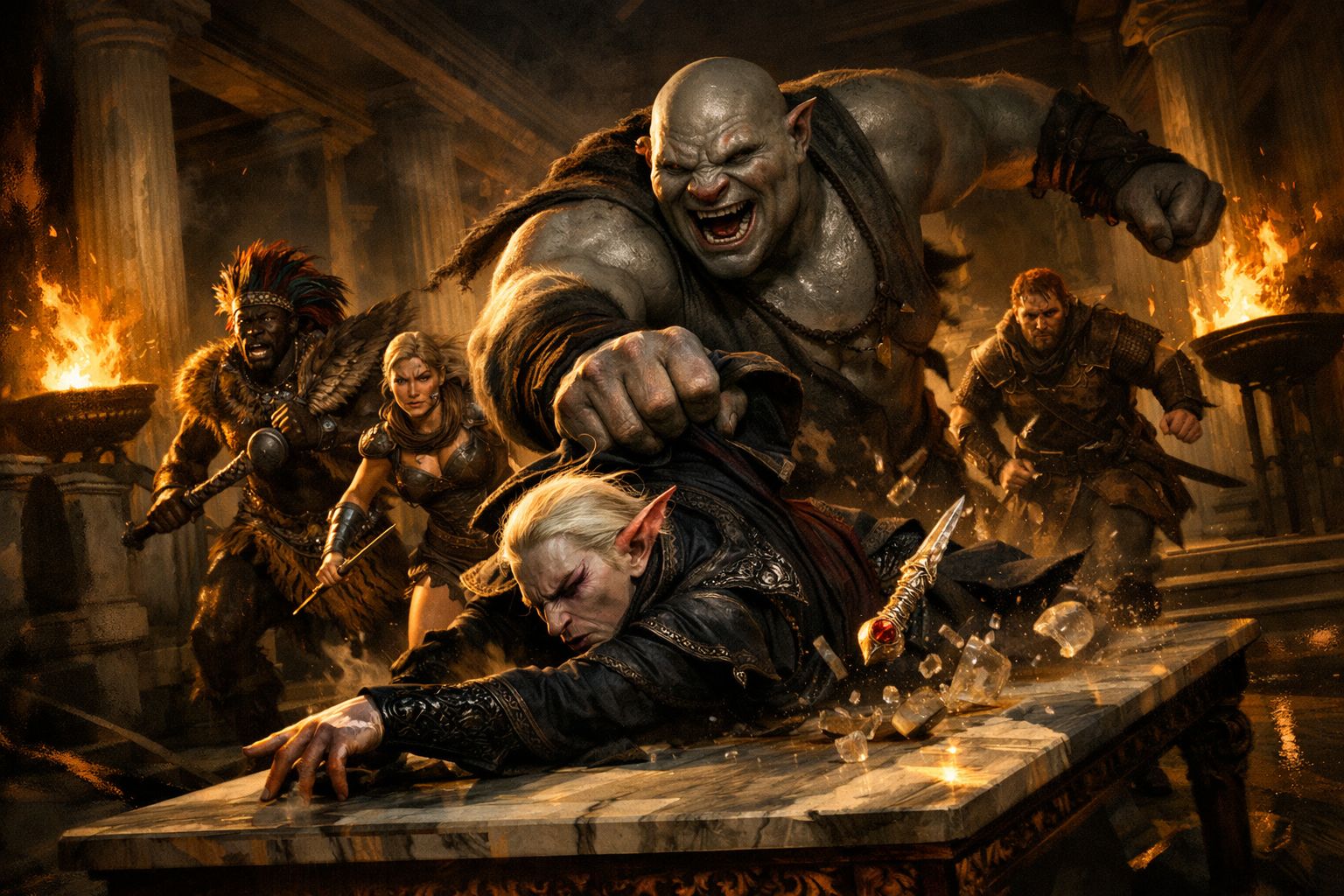
| The front doors explode inward. |
| Wood splinters and iron hinges scream as Ormun hits the doors at a run, shoulder first, rage and fear burning together. The sound echoes through the house like thunder. He does not slow. He does not look back. |
| Mbaru and Amaxia surge in after him, clubs and blades already moving, Skarnulf low and fast between them. The plan was to stay together. It lasts seconds. |
| Ormun crashes through corridors and side chambers, ripping doors from frames, smashing through startled figures dressed in silk and perfume. Carnees scatter, decorum breaking under panic, refinement dissolving into shrieks and flight. One lunges with a blade and dies against Ormun’s fist. Another tries to flee and is cut down by Amaxia without breaking stride. |
| They try to keep up. |
| Mbaru moves like a wall, smashing anything that stands long enough to register as a threat. Amaxia fights with brutal precision, every strike meant to end, not impress. Skarnulf slips through the chaos like a hunting animal, knives flashing, eyes cold, cutting down those who hesitate a heartbeat too long. |
| Ormun is already gone. |
| He bursts into the banquet hall. |
| The table is set. Silver, crystal, candles. At its center lies a bound figure, cut and alive, breath ragged, eyes rolling in terror. Blood gleams on polished stone. Wine has been spilled and mixed with it, turning the floor dark. |
| For a heartbeat, everything freezes. |
| Then Skarnulf sees the table. |
| He shouts Junia’s name with raw urgency and throws himself back into motion, cutting down a Carnee who had been reaching for something on the table. His face is pale, jaw locked, eyes hard. He does not look again. |
| Ormun is already moving past it. |
| At the far end of the hall, chained to iron rings set into the wall, Cassandra and Nasheem struggle helplessly, gagged, eyes wide with fear and disbelief. They have been forced to watch. |
| Ormun stops. |
| The rage drains out of him like water poured onto hot stone. In its place is something tighter and more dangerous. |
| He is suddenly gentle. |
| He moves to Cassandra first, hands careful as he tears the chains free, ripping metal from stone rather than risking her wrists. He pulls the gag away and she breaks, a sob tearing out of her as she clings to him. Ormun wraps himself around her without hesitation, one massive arm holding her close, the other still free, still ready. |
| His eyes never stop moving. |
| Nasheem is freed a breath later, shaking but alive. Ormun positions himself between them and the room, body a living shield, breathing steady, presence absolute. |
| The Carnees are running now. |
| Some die trying to escape. Others vanish into the labyrinthian mansion, and out into the night, leaving blood and silk behind. The hall empties of enemies, filled instead with the sounds of breathing, of pain, of Junia’s urgent voice as she works at the table, hands already red, magic and skill fighting to keep the victim alive. |
| When it is over, the house feels hollow. |
| Cassandra presses her face into Ormun’s chest, fingers clenched in his tunic, shaking as the fear finally breaks through. Ormun holds her and does not let go, murmuring low, steady sounds meant only for her. He is still watching. He will keep watching. |
| Scarnax surveys the wreckage, jaw tight. |
| “Some of them got away,” he says quietly. |
| Mbaru wipes his weapon clean on a fallen tablecloth and looks toward the darkened exits. |
| “They won’t come after us again.” |
| Scarnax does not look away from the hall, from the blood and the broken table and the chains still hanging empty on the wall. |
| “They won’t need to,” he says. “They’ll always find someone else.” |
| Ormun tightens his hold on Cassandra, just a little, as Junia works on saving a life that was never meant to be spared. |
Purpose of the Segment
This segment resolves the investigation through action, but it is not meant to feel like a tactical showcase. It is a release of pressure. Confusing, violent, fast, and emotionally charged.
The goal is rescue, not eradication. The Carnees are not meant to be fought cleanly or honorably. They are meant to scatter.
Let this feel like a sudden rupture in a carefully maintained illusion.
Timing and Being Late
Do not punish delay with death.
No matter how long the crew takes to reach the mansion, their captured crew members are always alive when the assault begins. The Carnees have other victims. There are always more captives than tables.
The crew victims are being saved for later. They are always next when the players arrive.
Emphasize dread rather than consequence. The banquet is already underway when they arrive. Another victim is suffering. The crew victims are forced to watch.
The Mansion
The mansion is large, old, and expensive. It was built to impress and to contain.
There are many rooms. Guest chambers, salons, storage rooms, servant corridors, private stairwells. It is not a deliberate maze, but it is sprawling and confusing in motion.
The banquet hall sits at the center of the structure. Thick stone walls. Heavy double doors meant to keep sound inside. Silver and crystal. A place of ritual rather than comfort.
Back doors. High windows. Roof access. The Carnees have escape routes and they will use them.
The basement is extensive. Cells. Chains. Cleaning rooms. Drainage channels. Storage for drugs and herbs. Over twenty cells in total. Many empty. Some not.
This place has been in use for a long time.
The Carnees
The Carnees are predators, not soldiers.
They are cruel, refined, and confident when in control. They are fragile when surprised.
Most are not trained fighters. Faced with sudden violence, they panic. They run. They hide. They flee through the many passages of the mansion.
If cornered, they will fight desperately, using daggers or short swords, but they are not a serious threat to trained combatants in a fair fight. They rely on secrecy and fear, not force.
Once the assault begins, cohesion collapses. Decorum fails. Civility vanishes. The coven scatters.
Do not let this turn into a drawn out tactical slog. The threat is chaos, not lethality.
Running the Fight
Play the fight fast and disorienting.
The Carnees outnumber the crew, but most will not stand their ground. Encounters should be brief and decisive. Enemies die quickly or escape. They know there is no mercy if caught, so they will not surrender.
Use movement. Doors breaking. Figures darting through corridors. Screams cut short. Sudden silences.
Do not track every Carnee. Track moments.
This is not about clearing the house room by room. It is about reaching the center before it is too late.
The Crew and NPC Involvement
This is a moment where NPC crew participation is appropriate.
Signal this by having NPCs insist on coming along. Demand it. Especially those with personal stakes.
If Cassandra is one of the captives, Ormun will come. He cannot be stopped. He will rush ahead once the doors are breached, acting on fear and rage rather than plan.
Ileena and Silvio are natural choices for preparing the path inside. They can make sure the assault will not be noticed until the fighters storm the building.
Mbaru, Amaxia, and Skarnulf should naturally take point in the fighting. They know how to move in chaos and will push hard.
Let the players decide how tightly they try to control this. They may fail. That failure is part of the scene.
Other Victims
Thaleia Myrinos is alive in the basement.
She is locked in a cell with two other slaves. She has been there long enough to talk with the captured crew members through the bars. They know each other now. They are frightened together.
The basement should be shocking in scale.
Rows of cells. Cleaning facilities. Chains. Tools. Evidence of routine.
This is not a one off operation.
At the banquet table lies another victim. She is alive. Cut. Bleeding. The wounds are deliberate but not fatal yet. Pain without release.
If Junia is present, she can save this victim. The damage so far is meant to hurt, not to kill.
Make this moment urgent and human.
Resolution and Aftermath
Some Carnees escape.
They vanish through passages, windows, and doors. The crew will know this happened. They will not know what it means.
Do not resolve this immediately. Let it sit.
The rescued crew members are alive but shaken. They will need time.
Thaleia is shaken but already processing. She survived because they needed to track down who she had spoken to. That knowledge will sit with her.
The mansion is ruined as a secret. What happens to it afterward is not immediately important.
What matters is that the illusion of safety is broken.
Aftermath
| Story |
|---|
| The official’s office smells of hot stone and clean water, like everything else in Ostranos. Sunlight spills through high shutters, catching on polished marble and neatly stacked scrolls. Nothing here is hurried. Nothing is raised in voice or gesture. |
| The official speaks calmly, hands folded, eyes never quite meeting Scarnax’s. |
| “What happened was... regrettable,” he says. “And unnecessary. You should have come to us.” |
| Ayesha smiles politely, the kind of smile that shows understanding without agreement. “We did consider that.” |
| The man inclines his head, accepting the answer as sufficient. “The matter will be handled. Quietly. Ostranos takes its reputation seriously.” |
| Scarnax says nothing. His jaw is tight, his scarred hands resting flat on the table as if to keep them still. |
| “The city appreciates your concern,” the official continues. “And your restraint afterward. You will not be charged. There is no reason for this to become a story.” |
| Ayesha’s smile does not change. “Of course not.” |
| When they leave, the doors close softly behind them, sealing away the calm, measured voice and the faint sound of flowing water. |
| Outside, the city is unchanged. Baths still steam. Linen still dries in the sun. Laughter drifts from terraces where visitors sip mineral wine and talk about their aches easing. Everything looks as it did before. |
| It just does not feel the same. |
| --- |
| Later, aboard the Blue Marlin, Junia sits on a crate near the infirmary, sleeves rolled, hands still smelling faintly of herbs and blood despite her scrubbing. Nasheem stands nearby, staring out toward the city, posture composed but brittle. Scarnax leans against the rail, watching the white stone climb the cliffs. |
| “I don’t like it here anymore,” Junia says quietly. |
| Nasheem exhales, a sound halfway between a laugh and a breath let go. “Neither do I. It’s strange. Nothing changed. And yet...” |
| “It feels thinner,” Junia says. “Like the warmth was only skin deep.” |
| Scarnax nods once. “A place can heal the body and still rot underneath. I’ve seen that before.” |
| They watch a procession of visitors heading toward the baths, faces hopeful, unknowing. The city receives them with the same patient efficiency it always has. |
| “We came here to rest,” Nasheem says. “And we did. For a while.” |
| Junia looks back toward the city, then down at her hands. “I don’t think I could sleep here again.” |
| Scarnax turns from the view. “Then we won’t.” |
| The decision settles easily between them. Not dramatic. Not angry. Just necessary. |
| The Blue Marlin has taken on water and supplies. Her crew is alive. The city has returned to its routines. The facade is intact. |
| But the warmth is gone. |
| By the time the sun begins to lower, casting long shadows across the harbor, the ship is ready. And the crew, quietly, is ready to leave. |
Purpose of the Segment
This segment is about letting consequences settle rather than resolving everything cleanly. The immediate danger is over, but the weight of what happened remains. This is a pause for recovery, discomfort, and reflection, not a victory lap. Give the crew space to breathe and to talk, and allow unresolved issues to linger without forcing immediate decisions.
The Rescued Crew
The kidnapped crew members are alive and physically safe. They are dehydrated, bruised, exhausted, and shaken, but there is no lasting bodily harm. Emotionally, they are far from whole. They were caged, observed, and made to understand exactly what was going to happen to them. That knowledge does not fade quickly.
Over the following days, show small signs of this. Trouble sleeping. Avoidance of enclosed spaces. Sudden silences in conversation. A need to stay close to familiar people or routines. Let these reactions surface naturally over time rather than resolving them immediately. They are safe, but they are changed, and the crew should feel that.
Thaleia Myrinos
Thaleia is alive and physically unharmed. Her reaction to the ordeal is likely unsettling to others. She speaks about the Carnees clinically, describing their habits, pressure points, and mistakes with the detachment of a scholar. She explains that the Carnees questioned her extensively about who she had spoken to and what she had learned. That is why she was kept alive. They needed to know how exposed they were before deciding what to do with her.
She shares this information freely, without drama or visible fear. After learning more about the Blue Marlin and its travels, Thaleia asks to accompany the crew to their next destination. She frames it as an opportunity rather than a necessity, mentioning a rare creature she wants to study there. She does not present herself as a permanent addition to the crew, but as someone whose path will cross theirs again.
The Slaves
All surviving slaves are recovered, including the victim who was on the banquet table. She is alive but badly hurt. The wounds were meant to inflict pain rather than kill, and under Junia’s care she will recover, though it will take time. The basement makes the scale of the operation impossible to ignore. Rows of cells, tools, cleaning facilities, and routines all point to long term use rather than an isolated crime.
The slaves are frightened, exhausted, and alive. What happens to them next is where the situation becomes uncomfortable.
The Authorities
The city authorities investigate thoroughly. The evidence is clear and undeniable. The mansion, the bodies, the cells, and the records all point to crimes Ostranos cannot ignore. The crew is not treated as criminals. They are gently reprimanded for taking matters into their own hands and reminded that proper channels exist. This is said for form rather than conviction.
Privately, the city watch is relieved. They did not want to handle this situation themselves and are quietly glad it is resolved. They will not make trouble for the crew.
The real issue lies with the slaves. The treatment of the slaves is seen as wasteful and disgusting, but not illegal. They were legally purchased. With the crimes of their owners, ownership reverts to the state. From the authorities’ perspective, the options are straightforward. The slaves will either be put to work or sold, with the proceeds going to the city. This is legal and routine, and it is very likely to sit poorly with the crew. Let that discomfort linger rather than resolving it immediately.
Thaleia’s Solution
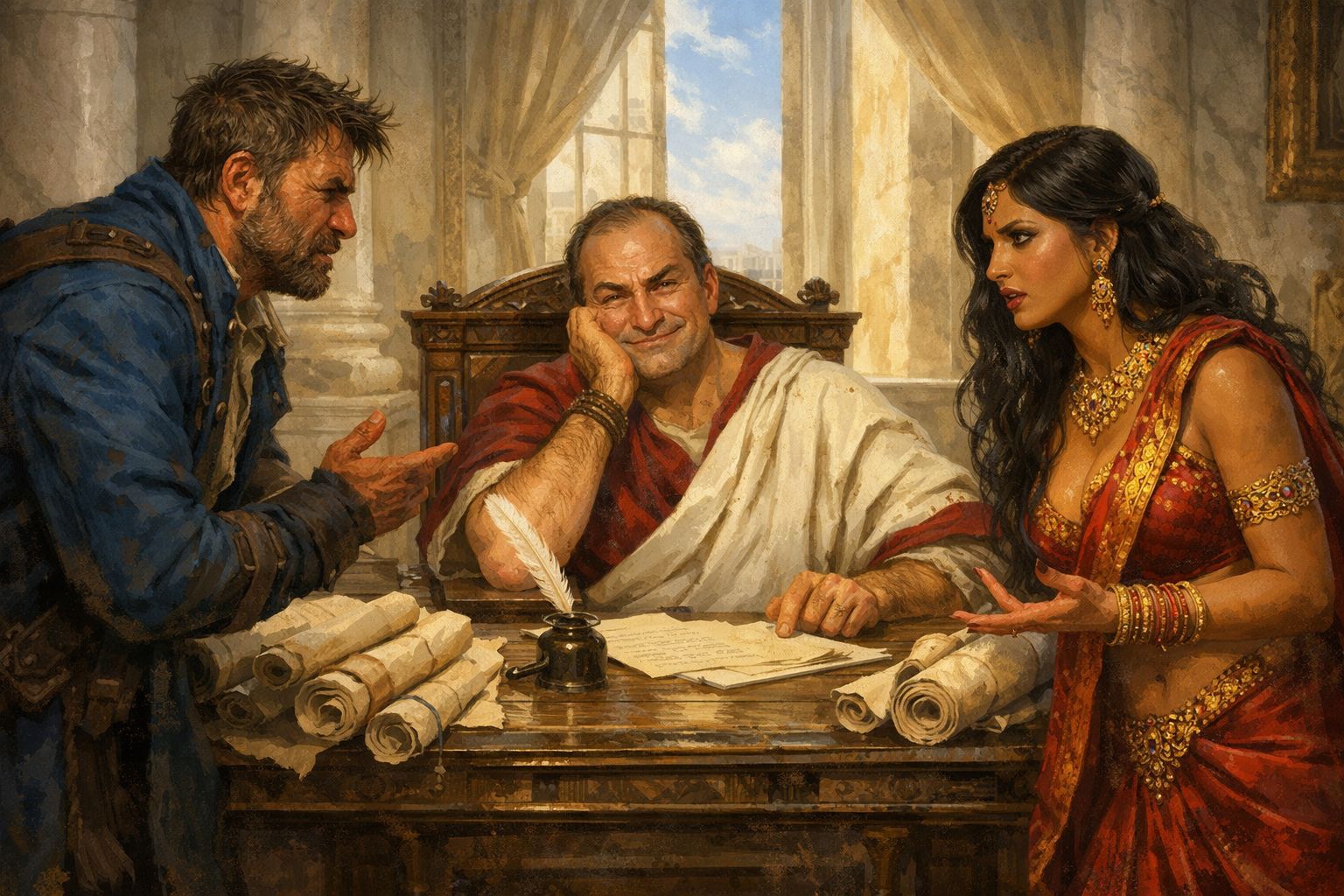
After the crew has had time to wrestle with this, Thaleia offers a solution. Her family is wealthy and owns vineyards that always need workers. If the crew purchases the slaves and frees them, she can arrange transport, shelter, and employment. The authorities may accept a closed sale rather than a public auction, preferring a quiet resolution that does not draw attention.
If the Game Master wishes to have things a bit darker, and more in line with how the worlds thinks, this offer could instead be an offer to buy them as slaves for the vineyard, where slaves are valued and treated well, according to Thaleia.
Thaleia presents this as practical rather than heroic. If the crew hesitates about giving her passage to the next destination, she may remind them of this shared opportunity. It is not framed as a threat, but as a reminder of what cooperation could achieve.
Secrecy
Ostranos depends on its reputation as a place of healing and rest. The authorities make it very clear, without stating it outright, that this must not become a story. Visitors come here to recover and relax, not to hear about hidden horrors beneath fine stone houses. The city will manage the narrative, and the crew is expected to cooperate by saying little. This is not a request so much as an expectation.
Waverider Clues
If the crew already has a clear destination, do not introduce anything new here. If they do not, a dock worker speaks chats with Galenor during ship repairs. Casually and without emphasis, he mentions a rumor or a sighting connected to the Waverider. This information comes through Galenor rather than directly to the players, and it should feel incidental rather than urgent.
Unbeknownst to the players, this is the invisible hand of Samden, gently opening the path for them.
Psychological Scars
The rescued crew members carry this experience with them. Nightmares, sudden mood shifts, irritability, and a need to talk or a need to avoid talking altogether should appear over time. Let these reactions become part of ongoing play rather than something resolved in a single scene.
Thaleia does not share this response. She appears untouched by the experience, already in observer mode, discussing it as data rather than trauma. She does not dwell on risk or fear. This contrast should feel unsettling rather than reassuring.
The Escaped Carnees
Some Carnees escaped. No trace of them can be found, and it is likely they left the city as soon as secrecy failed. They will not trouble Ostranos again, and they will not pursue the crew. At least, they will not do it soon. For now, their absence should linger without explanation.
The illusion of safety is broken, but the city repairs itself quickly. The Blue Marlin leaves Ostranos with wounds that are invisible, decisions that still ache, and the understanding that some evils do not need victory to survive.
Act Summary
This arc is about contrast, violation, and aftermath rather than mystery or combat. Ostranos is presented as a place of rest and renewal, and the investigation and confrontation exist primarily to strip that sense of safety away. The core takeaway is not that the crew defeated an enemy, but that they learned how easily refinement and horror can coexist, and how systems built for comfort will quietly absorb atrocity as long as it remains discreet.
The investigation reinforces that evil here is not loud or chaotic. It is polite, wealthy, and routine. No single NPC understands what is happening. Everyone knows something small and insignificant, and only by caring enough to assemble those fragments does the truth emerge. This should linger as a lesson for future arcs. The world rarely hides monsters behind roaring gates. It hides them behind closed doors and good manners.
Long Term Consequences
The crew rescues their people and survives, but the cost is internal rather than external. The kidnapped crew members are alive and physically whole, yet they carry psychological scars that should surface naturally over time. Nightmares, aversions, changes in mood, and a need for reassurance or distance should become part of ongoing play. This arc should subtly change how the crew relates to places that present themselves as safe.
Ostranos itself remains intact. The city does not fall. Its systems work as designed. That is part of the discomfort. The authorities quietly close the matter, protect the city’s reputation, and move on. This establishes a recurring theme that many places the crew visits will be functional rather than just, and that justice is often a matter of convenience and optics.
The escaped Carnees are a lingering shadow rather than an active threat. They do not pursue the crew and they do not immediately resurface. Their survival reinforces that not all evils are cleanly ended, and that exposure alone is sometimes the only victory available. This should sit unresolved rather than become a hook right away.
The Slaves and Moral Friction
The handling of the rescued slaves is meant to create discomfort rather than provide closure. Legally, the city’s response is correct by its own standards. Morally, it is hollow. This is a deliberate friction point. The solution offered through Thaleia’s family provides an out that feels practical rather than triumphant, allowing the crew to act without pretending the system itself has changed.
This moment is important because it establishes that doing the right thing often requires navigating flawed structures rather than overthrowing them. It also reinforces that help often comes with negotiation and compromise.
Thaleia Myrinos as a Recurring NPC
Thaleia’s role going forward should be carefully considered. While she is intelligent, curious, and thematically aligned with exploration, she is not well suited to life aboard the Blue Marlin as a permanent crew member. She provides little direct utility to the ship’s operation and has a strong tendency to attract danger through curiosity and disregard for personal safety. In practice, she would create problems rather than solve them.
Her strength lies in being a recurring presence. She works best as someone whose path crosses the crew’s at key moments, bringing information, complications, or perspective. She can travel with them for a leg, pursue her own interests, then separate again. This keeps her interesting without turning her into a liability that constantly needs to be managed.
It is strongly recommended that she not become a permanent crew member at this stage of the campaign. If she is ever to join more fully, it should be later, once the Blue Marlin leaves the familiar central seas and the tone of the campaign shifts toward deeper unknowns. At that point, her curiosity and detachment may fit better with the dangers involved. The Game Master may choose otherwise if she resonates strongly with the table, but delaying that decision preserves narrative flexibility.
Campaign Impact
This arc should leave the crew more cautious, more aware, and slightly less willing to take comfort at face value. It reinforces the campaign’s core theme that survival and decency are not guaranteed by civilization, and that the crew’s greatest strength is not force but willingness to care when others do not.
Ostranos should be remembered not as a place of horror, but as a place that smiled while horror hid beneath it. That memory should travel with the Blue Marlin as she sails on.
| Story |
|---|
| The Blue Marlin rides a calm sea, her wake silvered by moonlight, the shore of Ostranos already a dark shape behind them. Dinner is loud and warm, plates passed, voices overlapping, the sound of people trying to convince themselves that everything is back to normal. Laughter comes a little too quickly. Cups are refilled a little too often. |
| Cassandra rises without a word. |
| No one notices at first. A story is being told. Someone interrupts it. Another laughs. Cassandra slips away like a thought that never quite forms. |
| Ormun notices. |
| He waits only a heartbeat, long enough to be sure, then stands and follows her out onto the deck. |
| She is at the rail, hands resting on the wood, looking out over the moonlit water. The ocean is dark and endless, the moon broken into shards across its surface. For a moment he simply stands there, giving her space, the way he always does. |
| “Are you all right?” he asks, gently. |
| She turns toward him, and her face crumples. |
| “No,” she says, very softly. |
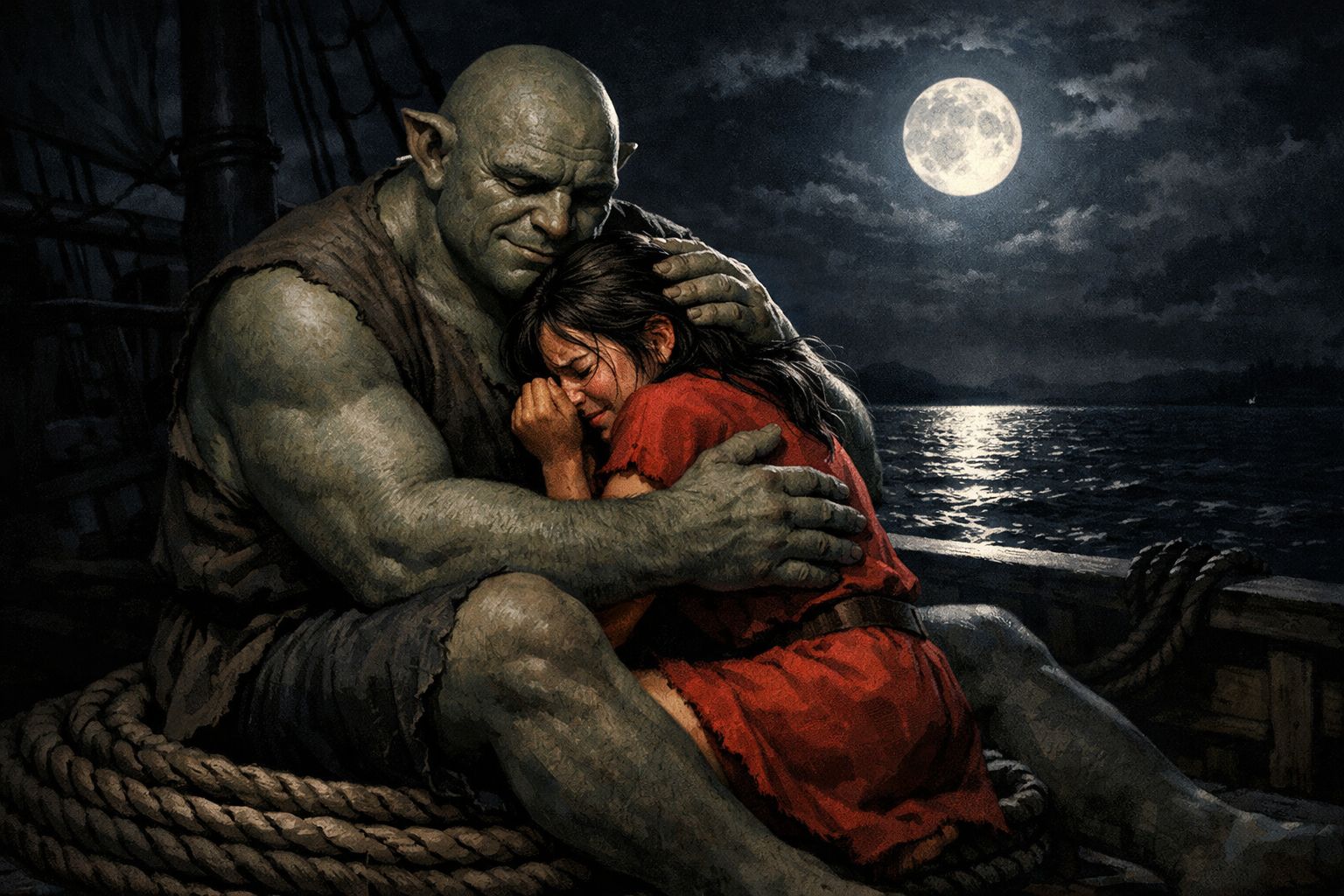
| The word seems to empty something out of her. She takes a step toward him and then another, and suddenly she is crying, deep and shaking, the kind that has been waiting too long. Ormun catches her without thinking, lowering himself to sit on a coiled rope, pulling her into his arms. He cradles her against his chest, one hand steady at her back, the other resting where her hair meets her neck. |
| He does not speak. He does not rush her. He simply holds her and breathes, a solid thing in a world that has been anything but. |
| Her tears soak into his tunic. Her fingers clutch at him like he might vanish if she lets go. Ormun rocks her slightly, a slow, unconscious motion, eyes fixed on the dark horizon while the moonlight paints them both in pale silver. |
| When the crying finally slows, it leaves her hollow and exhausted. She draws a shaky breath and wipes her face with the heel of her hand, still leaning against him. |
| “Thank you,” she murmurs. After a moment, she adds, “I knew you would come for me. I just... I was afraid you wouldn’t find me.” |
| Ormun tightens his arms around her, just a little. |
| “The world is too small,” he says, quietly, “for me not to find you if you need me.” |
| She lets out a weak, broken laugh at that, then leans back into him, resting her head against his shoulder. |
| They sit there together, saying nothing, watching the moon and the slow, steady rise and fall of the sea. The ship creaks softly around them, a living thing carrying them forward, away from warm stone and hidden horrors, into open water and honest danger. |
| Eventually, she fell asleep, and he sat there, holding her gently, protecting her, until the sun rose. |