Campaign: Ngazama
Act Synopsis
The River Into Mist
The Blue Marlin follows the Waverider's trail upriver into N'gazama. The river narrows as the ship moves inland, winding between dense vegetation, half drowned roots and banks that seem to shift when no one is looking directly at them. The air grows warm, damp and metallic. Pale mist gathers above the water in thin strands, then thickens until the riverbanks become shadows.
At first, the mist causes only minor disorientation. Distances become difficult to judge. Familiar voices seem to come from the wrong direction. Shapes appear briefly among the trees, often wearing masks, then vanish when approached. The crew continues cautiously, uncertain whether they are seeing inhabitants, reflections or tricks of the fog.
The mist eventually becomes too dense to navigate. It closes around the Blue Marlin, swallowing the river and separating the crew from one another despite the confined space aboard the ship.
The Dreams
Each crew member experiences a private dream shaped by their own past, fears and unresolved questions. These dreams are symbolic rather than literal. People appear through masks. Places shift without warning. Events from different parts of a character's life blend together, exposing emotional truths without providing simple explanations.
The dreams do not heal wounds or resolve trauma. They force each character to confront what has shaped them and decide, through their own actions, how they intend to move forward. There is no single correct response. Some emerge with new clarity. Others emerge with uncertainty, anger or quiet resolve.
Only player character dreams are played in full. Non player characters experience their own dreams, but these remain mostly unseen. Their reactions after waking suggest that the mist reached everyone aboard.
Waking on the River
The crew returns to consciousness gradually. The Blue Marlin is still afloat, caught against reeds and exposed roots along the riverbank. The mist has thinned but not disappeared.
The aftermath is physical and undignified. Some crew members vomit over the rail. Others shake, cry, stare into silence or cling to practical tasks because ordinary work feels safer than reflection. No one is immediately certain how much time has passed. The river appears unchanged, but confidence in reality has not returned.
The crew gathers itself slowly. People check the ship, count heads and confirm that no one has vanished. Some speak about what they saw. Others refuse. The atmosphere remains uncertain and exposed.
The Masked People
Before the crew has fully recovered, masked figures appear among the roots and along the riverbank. Their arrival creates immediate tension because they resemble the symbolic figures seen within the dreams. It is not clear whether the mist has truly released the crew or whether the dreams have simply changed shape.
The people of N'gazama wear masks at all times. They speak calmly and behave with practical competence, but their understanding of reality feels deeply strange. They believe the waking world is a dream and that the visions within the mist are real. They treat the crew's experiences as events rather than hallucinations.
Their words often sound like madness, insight or both. They do not explain themselves cleanly and do not seem interested in proving anything. To them, the crew's confusion is understandable but misplaced.
The Waverider's Trail
Once the initial tension settles, the masked people speak of the Waverider. They remember its arrival, its crew and the dreams it carried into N'gazama. Their account is fragmented and strange, but it contains enough practical information to identify the Waverider's next destination.
The conversation should remain unsettling without becoming hostile. The masked people are neither enemies nor guides in the ordinary sense. They provide what they know because the Blue Marlin has entered their world, dreamed within it and emerged changed.
The crew leaves N'gazama with the next course established, but without certainty about what truly happened upriver.
Thaleia's Request
After the Blue Marlin returns to open water and the river mist falls behind them, Thaleia asks someone she trusts to accompany her when she speaks to Captain Scarnax. She wants to ask whether she can join the crew permanently.
Her request is accepted.
Nephyla's Home
Thaleia's request raises the question of Nephyla's place aboard the Blue Marlin. What began as temporary shelter until a safe destination could be found has gradually become something else.
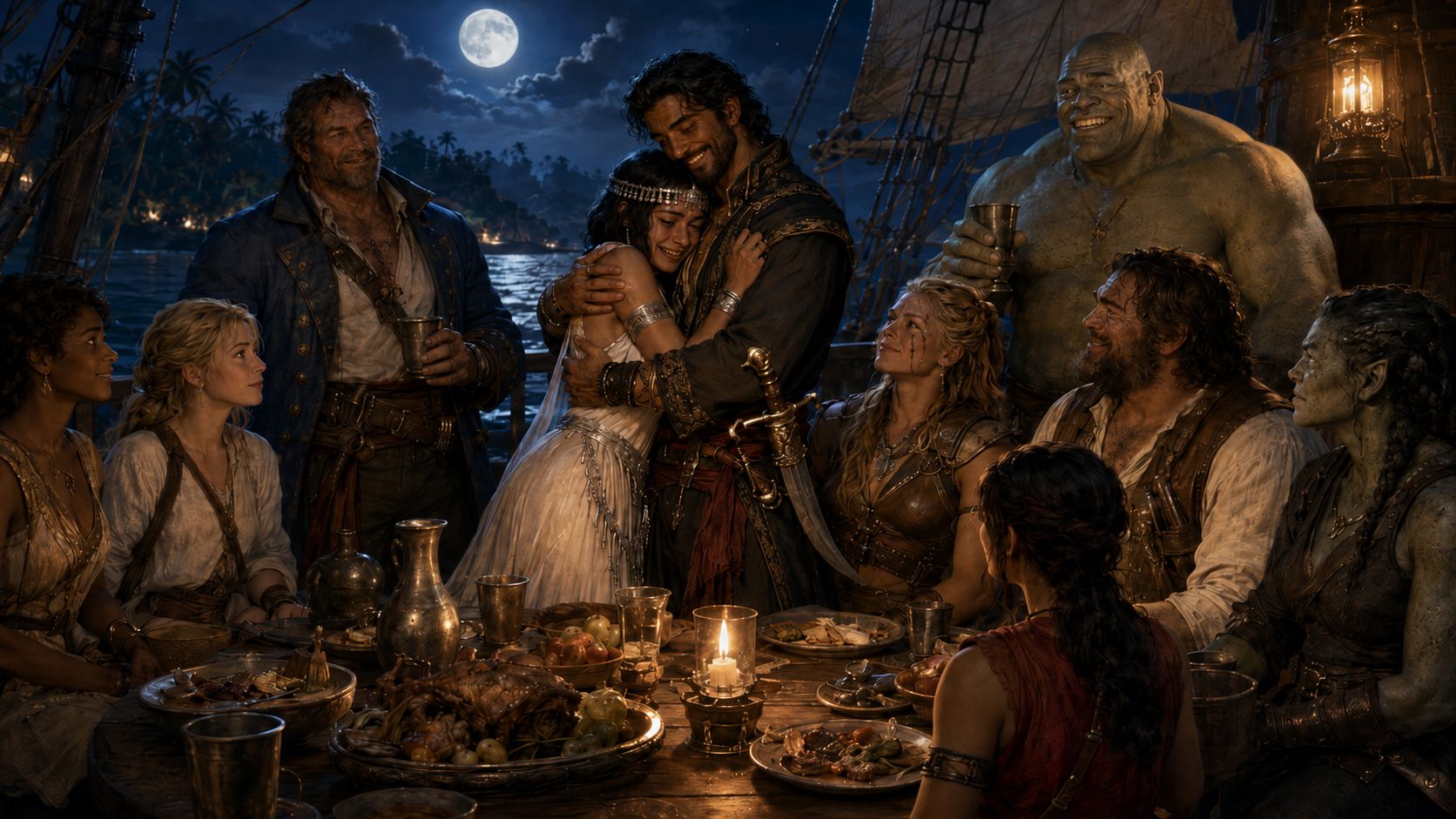
The crew realizes that Nephyla is already one of them. Nasheem is the natural person to raise the issue, especially since the mist has reinforced the sense that she matters, but another crew member can do so.
They approach Nephyla with a choice. When they ask whether she wants to remain permanently, she realizes that the Blue Marlin is no longer merely shelter. It is her home.
Overwhelmed by the acceptance, she breaks down in happy tears.
Departure
The N'gazama arc ends quietly. The crew leaves with a new destination and no clear explanation for what happened in the mist. The dreams remain personal, unresolved and difficult to discuss.
What has changed is not the past. It is the direction each character chooses to face.
The Blue Marlin sails onward with two permanent additions to its crew and a clearer sense of what the ship has become. It is no longer only the vessel carrying them along the Waverider's trail.
It is home.
Meyrha and Ivy in N'gazama
Meyrha's Role
Meyrha receives no additional visions in N'gazama beyond her experience in the blue mist. The place does not reveal a new prophecy or provide clear answers about the journey ahead.
She is, however, uniquely qualified to help the crew understand what happened. In the days that follow, many crew members seek her out privately to discuss their dreams. Meyrha does not interpret every symbol with certainty. She listens, asks questions and helps each person find their own meaning in what they saw.
These conversations can happen off screen unless a player wants to explore one in detail.
Ivy in the Spirit World
If Ivy enters the spirit world in N'gazama, she finds it strange but not hostile. Permanent mist covers the landscape, muting distance and direction. Familiar shapes are difficult to recognize.
The spirits here do not appear as ordinary ghosts. They drift through the fog as floating masks, each carrying its own patterns, colors and expression. Some watch Ivy silently. Others bow or follow her for a time. None threaten her unless provoked.
The experience reinforces that N'gazama's masks are more than a cultural custom. They are tied to how the people understand identity, dreams and the spirit world.
The River Into Mist
The Blue Marlin moved upriver in a lazy wind. The distant banks were barely visible on either side, dense with roots, reeds and trees that leaned over the water as if listening.
The mist had begun as a pale blue haze near the surface. Now it curled over the rail in slow strands, clinging to ropes and pooling around boots. It smelled of burnt stone after rain. Every breath left a metallic taste on the tongue.
Scarnax stood at the bow, one hand gripping the rail. Beside him, Pelonias leaned forward and narrowed his eyes into the blue gloom.
"Can you still see the banks?" Scarnax asked.
"Sometimes," Pelonias said. "That is worse than not seeing them at all."
A dark shape drifted past in the mist. A tree trunk, perhaps. For an instant it looked like a carved face watching from the water, then it was gone.
Behind them, Ileena climbed down from the rigging with less grace than usual. She landed lightly, but swayed when her feet touched the deck.
"The air tastes wrong," she said. Her ears twitched uncontrollably. "I feel..."
She blinked, looking almost puzzled.
Then her knees folded beneath her.
Scarnax turned sharply. "Junia!"
Junia hurried across the deck, dropping beside Ileena before she had fully settled against the planks. She pressed two fingers to Ileena's throat, then leaned close to listen to her breathing.
"She is alive," Junia said. "Her pulse is steady. I do not know what this is."
Pelonias stared into the mist. The river ahead had vanished completely. No banks. No sky. Only blue fog and the wet creak of the hull.
"Furl the sail. Drop anchor," he ordered. "We move no farther blind."
Caelin repeated the order, but her voice sounded distant and strangely muffled.
A sailor reached for a rope and missed it. He looked down at his hand with quiet confusion, then sagged against the mast. Another dropped beside him. Yasmira stumbled out from below deck, one hand pressed to her mouth, and collapsed before she could speak.
Junia looked up at Scarnax.
"The mist," she said.
Pelonias took one step toward the tiller, then stopped. His fingers tightened around the rail. For a moment, he seemed to be looking at something far beyond the ship.
Scarnax caught his shoulder as he began to fall, but the weight dragged them both down.
The last thing Scarnax heard was the anchor chain rattling through the hawse.
The last thing he saw was a pale mask floating in the mist beyond the rail.
Then the river became the world.
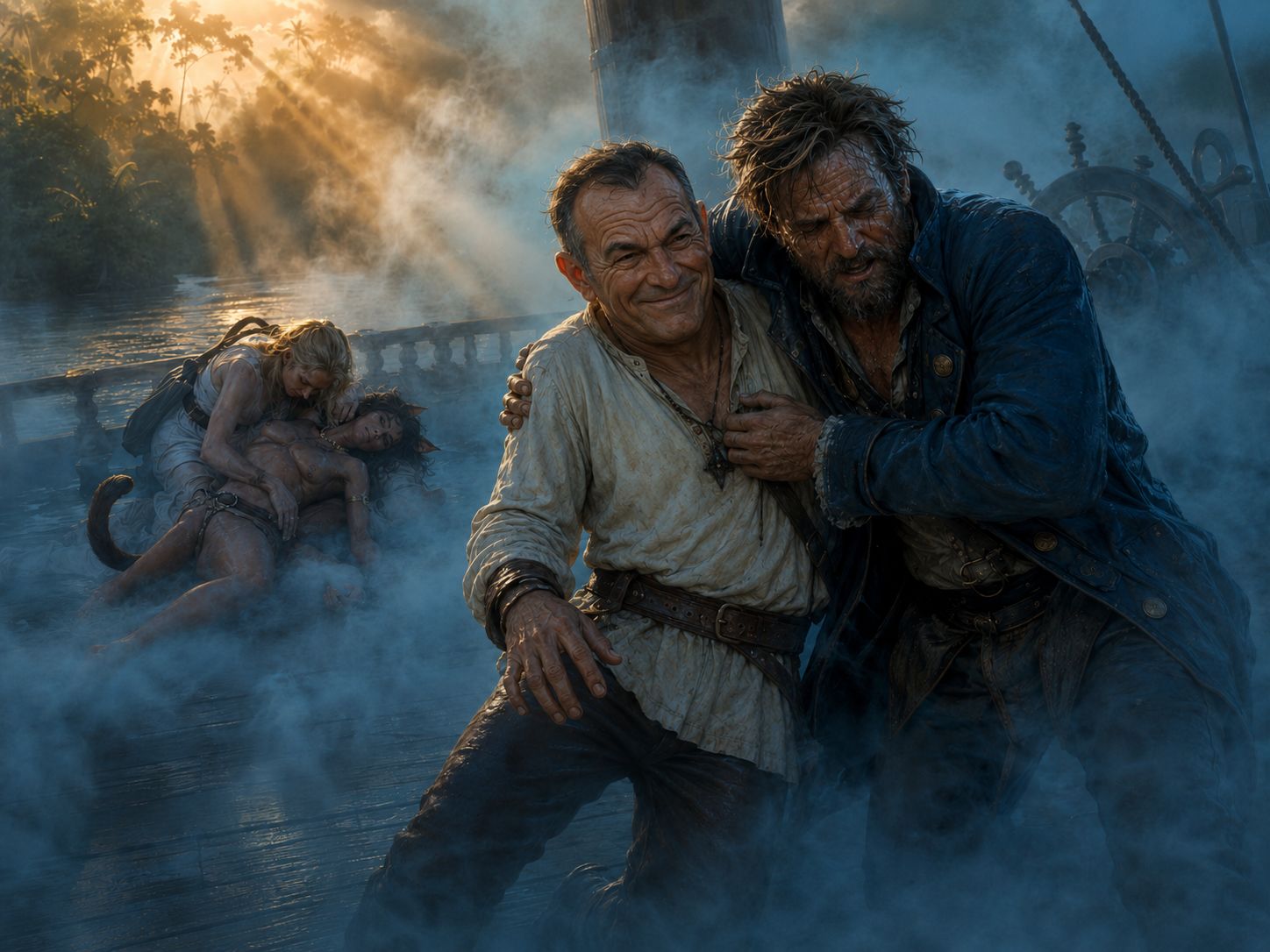
The journey upriver is quiet and uneventful until the Blue Marlin reaches the blue mist. It thickens gradually, carrying the smell of burnt stone and a metallic taste.
There is no time to retreat. The river is too narrow for a clean turn, and stopping the ship does not help. Even if the crew drops anchor before visibility is lost, the mist drifts over the deck and takes everyone aboard one by one.
The Dreams
Each crew member experiences a separate dream shaped by their past, fears and unresolved questions. The dreams are symbolic rather than literal. People appear through masks, places shift without warning and different memories blend together.
Each dream section contains a short flavor story followed by a brief description of the situation and its possible outcomes.
If the character is a player character, play the dream as a personal scene and let the player decide how they respond.
If the character is a non player character, do not play the dream in full. Use the short summary of their reaction after waking to show what the experience has changed or brought to the surface.
Scarnax
Blue mist lay across the center yard of Kaoriyo.
Lanterns burned beneath the eaves, their light blurred into pale halos. The gravel had been freshly raked. White banners shifted in a wind Scarnax could not feel.
The household stood in ordered rows around the courtyard.
Every face was hidden behind a mask.
At the center knelt Castellan Hayato Tsukahara. His black lacquered mask was streaked with red tears. Beside him waited Captain Genji Arakawa, wearing a mask split cleanly down the middle.
Between them lay a square of white cloth.
Hayato's infant son rested upon it, wrapped in embroidered silk.
Scarnax knew what came next.
He pushed through the silent crowd, but the courtyard stretched beneath his feet. Gravel became planks. Banners became sails. Lanterns swung from ropes and rigging.
The Blue Marlin stood in the center of Kaoriyo's yard.
Hayato looked up.
"This blood is mine," he said. "The guilt is mine. The price must be mine."
He reached toward the child.
Scarnax caught his wrist.
"No."
A scream cut through the mist.
Something moved across the roof tiles. Claws scraped wood. A shadow slipped behind a paper screen and dragged a masked sailor into the dark.
Another scream followed from the ship.
Then another.
Scarnax ran.
The courtyard folded into the passages below deck. Sliding doors opened onto cabins that should not have been there. Blood spread across lacquered wood, then vanished beneath blue mist.
Each time Scarnax reached a scream, he arrived too late.
A rope-bound mask lay beside the mast.
Caelin.
A cracked porcelain mask rested near the galley door.
Junia.
A dark mask scattered with shifting stars floated beneath the tiller.
Pelonias.
Scarnax gathered them against his chest and kept moving.
The demon waited on the quarterdeck.
Its face shifted with the mist. Lord Masanori Minatoya. Hayato. Scarnax himself.
"Captain," it said in the voices of the crew.
Scarnax charged.
The demon stepped backward into the fog.
Scarnax followed and found himself once more in the courtyard.
Hayato still knelt upon the white cloth, but the child was gone.
In its place rested a tiny table knife, the knife he used to escape slavery. Masked figures stood upon her deck. Chains ran from the hull into the mist.
Hayato held out the knife.
One chain tightened.
A tiny figure vanished from the deck.
Then another.
Scarnax seized the chains and pulled. The iron cut into his palms. The little ship stopped sliding toward the fog, but the strain dragged him to his knees.
He understood the question now.
Not whether Hayato had been right.
Whether Scarnax could give himself when the ship needed him to.
He took the knife.
The crew stood before him in the mist, each behind a mask shaped by the way he saw them. Nasheem in polished brass. Ayesha with a knowing smile. Galenor carved from scarred ship timber. Ileena with feline eyes and sharp teeth. Nephyla behind a pale moon disc.
Scarnax looked at them.
He did not want to leave them.
That truth hurt more than fear.
The demon stepped into the lantern light wearing his face.
"And when the price is your life?"
Scarnax pressed the blade against his belly.
His hand trembled.
"When that day comes," he said, "I will be afraid."
He looked at the crew.
"But I will not run."
He drew the knife across himself.
Pain opened through him, bright and terrible.
The chains shattered.
The little Blue Marlin rose from the white cloth, growing until her deck filled the courtyard. The crew's masks broke apart and fell across the planks.
Beneath them were familiar faces.
Alive.
Scarnax collapsed against the rail as the mist closed around him.
Somewhere far away, Meyrha's voice whispered through the fog.
"Love is blood. Blood is love."
Then the lanterns went out.
Scarnax's Choice
The flavor story presents one possible outcome. Scarnax accepts that he may one day need to sacrifice himself for the crew, even though the thought terrifies him. The important point is not fearlessness, but that he chooses not to run from the burden of command.
Other outcomes are possible. Scarnax may reject the sacrifice, deciding that his duty is to remain alive and lead the crew through what comes next. He may hesitate, unable to make the choice, which leaves him shaken by the fear that he could fail when the moment comes. He may attempt to find another price, refusing the dream's demand and searching for a way to protect the crew without accepting its terms.
He may also attack the demon directly. This turns the dream into an act of defiance. Rather than accepting the choice placed before him, Scarnax tries to destroy the thing demanding payment. Whether the attack succeeds matters less than what it reveals: he refuses to let fear, fate or any outside power decide which lives must be spent.
None of these outcomes are wrong. The dream is not testing whether Scarnax is brave enough to die. It is forcing him to confront what leadership may demand and decide what kind of captain he wants to become.
If Scarnax is an NPC
If Scarnax is a non player character, assume that he chooses to accept the burden.
He wakes shaken, but steadier in a way that is difficult to explain. The dream does not remove his fear of failing the crew or of dying for them. Instead, it makes him stop pretending that leadership can ever be safe.
From this point onward, Scarnax carries command with greater clarity. He is slower to make reckless promises, more willing to share burdens before they become crises and more honest when a decision frightens him. His protectiveness remains, but it becomes less instinctive and more deliberate.
Nasheem
Blue mist drifted across the deck of the Blue Marlin, thick enough to swallow the rails. It smelled of burnt stone and tasted of iron.
Nasheem stood alone at the bow.
Ahead, a pale light moved through the fog.
A woman walked across the water as though it were polished stone. Her face was hidden behind a great round mask, smooth and luminous, shining like the full moon.
Nephyla.
She did not speak. She only turned her moon face toward him, then continued onward.
Nasheem followed.
The deck became a marble courtyard in Zarhalem. Water ran through narrow channels. Jasmine climbed the walls. Silk curtains stirred in a breeze that carried no warmth.
Safina waited beside the fountain.
She wore a pale wooden mask carved with a gentle smile. Around her throat hung the locket Nasheem had once given her. A thin chain ran from it into the mist.
"Safina."
"You came back," she said.
The chain tightened.
Nasheem seized it and pulled her toward him. The links cut into his palms.
"I should have returned sooner."
Safina touched his hands.
"You could not save me."
"I left you."
"You survived."
The words struck harder than blame.
She placed the locket in his hand.
"Do not make my memory another chain."
The links slipped free.
Mist swallowed the courtyard.
Nasheem stood high in the rigging of the Blue Marlin.
A slight figure clung to a spar ahead of him.
Silvio.
His white mask had wide eyes and a mouth forever on the edge of apology. A rope twisted around his ankle.
Nasheem climbed toward him.
"Hold still. I am coming."
Silvio looked down into the fog.
"You were too late."
For an instant, Nasheem saw the frame in Thessa Vael's house.
Then Silvio was alive again, trembling in the ropes.
Nasheem cut him free.
"I should have protected you."
"You did."
"It was not enough."
"It was, for a while."
The answer was gentle.
The rope curled around Nasheem's wrist.
Silvio loosened the knot.
"You do not have to follow me where I went."
The rope fell away.
Silvio vanished into the mist.
Far ahead, the moon mask shone again.
Nasheem followed.
The rigging became sand. Wind moved across a dune beneath a black sky.
The djinn waited at the crest, its face hidden behind burning brass.
"You carry the dead," it said.
"I remember them."
"You punish yourself with them."
Nasheem looked back. Safina and Silvio stood in the mist. Neither reached for him.
"I failed them."
"Yes."
The answer was immediate.
Nasheem lowered his gaze, then looked again toward the pale moon face beyond the djinn.
"I failed them. But I will not make failure the only thing I carry."
The djinn drew a blade of flame.
Nasheem drew his sword.
Steel met fire.
The duel crossed the dune in bursts of light. The djinn drove Nasheem backward, then struck him to one knee. Its blade rested against his heart.
"You cannot save everyone," it said.
"No."
"Then why continue?"
Nasheem looked toward the shining mask in the mist.
"Because I can save some."
The fire dimmed.
The brass mask cracked apart.
"Protect the moon," the djinn said.
Then it was gone.
Nasheem stood alone on the dune, one hand pressed against the burn on his chest.
Ahead, Nephyla turned her shining mask toward him once more.
This time, Nasheem followed without looking back.
Nasheem's Choice
The flavor story presents one possible outcome. Nasheem accepts that he failed Safina and Silvio, but refuses to let guilt become the only thing he carries forward. He keeps their memories without turning them into chains, then answers the djinn's challenge by choosing to continue because he can still save some.
Other outcomes are possible. Nasheem may cling to Safina or Silvio, unwilling to let go of the guilt. He may reject the djinn's judgment, insisting that honor demands he carry every failure with him. He may refuse the duel, deciding that the djinn has no right to measure his integrity. He may also follow Nephyla's light immediately, recognizing that his path now lies with the living rather than the dead.
None of these outcomes are wrong. The dream is not asking Nasheem to forget those he lost. It is asking whether guilt will guide him, burden him or consume him, and whether he can continue to act with honor despite knowing that he cannot save everyone.
If Nasheem Is an NPC
If Nasheem is a non player character, assume that he accepts the release offered by Safina and Silvio, then faces the djinn and chooses to move forward.
He wakes quieter than usual, but less weighed down. He does not stop grieving Safina or Silvio, and he does not excuse his own failures. Instead, he becomes more capable of separating guilt from duty.
From this point onward, Nasheem focuses more clearly on the people still beside him. His protectiveness remains, but it becomes less driven by the need to make up for the past.
He also pays closer attention to Nephyla, carrying the djinn's final words without fully understanding them.
Pelonias
Blue mist drifted across black water.
Pelonias woke chained to the deck of a pirate ship.
Iron circled his wrists and ankles. Around him, masked captives knelt in silence beneath a starless sky.
A pirate stood at the helm. His mask was carved with a compass rose, but every needle pointed in a different direction.
"Chart the course," he said.
Pelonias looked toward the horizon.
There was none.
Only mist.
A chart lay before him. Coastlines shifted across the parchment. Islands moved when he blinked. Rivers flowed backward into mountains.
"Chart the course."
Pelonias looked at the chains.
"No."
He pulled hard against the iron ring until the bolt tore free from the deck.
Then he ran.
The pirate ship vanished behind him.
Pelonias found himself in a stolen skiff beneath a white sky. Broken chains still hung from his wrists. His palms bled against the oars.
He rowed through the mist.
Dark shapes rose around him, cliffs, trees, masts, each becoming something else when he tried to fix its position.
There was no sun.
No stars.
The compass in his hand spun in slow circles.
Pelonias kept rowing until the water seemed to turn beneath him. He no longer knew whether he was moving forward, backward or not at all.
At last, he lowered the oars.
He had escaped the chains.
He had escaped the pirates.
But now there was no wind to read, no current he understood and no horizon to follow.
For a long while, he listened only to the water.
Then a voice came through the mist.
"Pelonias."
Scarnax.
Another followed.
"Port side, unless you plan to stay out there forever."
Caelin.
Then Nasheem's laugh. Galenor striking metal with a tool. Junia calling his name. Yasmira shouting that the food would be cold. Ileena complaining about the smell of the mist.
Pelonias closed his eyes.
The voices did not form a course. They did not point north or south.
They were simply there.
Waiting.
Beneath them, he heard something familiar.
The creak of the Blue Marlin's timbers.
Pelonias took up the oars.
Not toward the compass.
Toward the sound of home.
A lantern appeared ahead.
Then the curve of a blue hull.
Scarnax reached down as the skiff drew alongside.
Pelonias took his hand.
The broken chains slipped from his wrists and sank into the dark water.
Pelonias's Choice
The flavor story presents one possible outcome. Pelonias escapes the chains, but finds himself unable to navigate through the mist. When every familiar tool fails him, he stops struggling long enough to hear the voices of the crew and follows them home.
Other outcomes are possible. Pelonias may continue rowing blindly, refusing to admit that he is lost. He may cling to the useless compass, trusting knowledge and habit even when they no longer offer direction. He may try to return to the pirate ship, choosing a known prison over an uncertain path. He may also call out for help immediately, accepting that navigation does not always mean finding the way alone.
None of these outcomes are wrong. The dream is not asking whether Pelonias is still a capable navigator. It is asking whether he can trust the crew when his own certainty fails him, and whether he understands that home is more than a place he can plot on a chart.
If Pelonias Is an NPC
If Pelonias is a non player character, assume that he stops rowing, listens for the crew and follows their voices back to the Blue Marlin.
He wakes unsettled, but with a quieter understanding of his place aboard the ship. Pelonias remains careful, independent and proud of his skill, but he becomes less reluctant to admit uncertainty. He begins to rely more openly on the crew when he lacks a clear course, recognizing that he no longer has to find every way forward alone.
Caelin
Blue mist lay over the river, cold against Caelin's face.
The Blue Marlin moved beneath a sky without sun, her deck stacked with crates and barrels. Grain. Salted meat. Medicine. Seed.
Both banks were crowded. To port stood the people of Ardwych. To starboard waited the people of Braigh. Thin figures in patched cloaks watched from behind hollow wooden masks. Children stood among them, silent and still.
Ropes ran from the cargo to both shores. Every line was taut.
Caelin crossed the deck, checking knots, shifting weight and calling orders. Each time she loosened one rope, another pulled tight enough to creak.
"Unload here," called a woman from the Ardwych bank.
"No," shouted a warrior from the opposite shore. "The need is greater upriver."
Caelin opened a sack of grain and divided it between two crates. When she looked again, both were empty.
She opened another sack.
Ash spilled across the deck.
A horn sounded behind them. An imperial patrol boat emerged from the mist, bronze plated and closing fast. At its prow stood a steel-masked legionary holding a torch and hooked spear.
Caelin knew this river. She knew the hidden channels through the reeds. She had run them years ago in a smaller boat, carrying medicine north while imperial patrols searched the water behind her.
"Starboard," she ordered.
The Blue Marlin turned. The ropes snapped tight and the mast groaned. Caelin seized two lines and pulled until the fibers cut into her palms.
"Caelin," Scarnax called.
His face was hidden behind a captain's mask carved from scarred wood.
"Give the order."
"I have it," she said.
Another rope tightened around her wrist, then another. The ship dragged both shores behind it. Ardwych and Braigh slid through the mist like islands torn loose from the earth.
Galenor appeared beside the mast, his mask carved from patched timber.
"She cannot carry all of this," he said.
"She has to."
"So do you," he replied. "That does not mean alone."
A rope snapped. Gastved stumbled as the line whipped across the deck, his plain mask too large for his face. Caelin caught him before he went overboard.
Her mother stood near the rail, wearing a cooper's mask made from curved staves bound with iron hoops.
"A barrel holds because every stave bears weight," she said. "Not because one tries to become the whole barrel."
Caelin looked at the ropes cutting into her hands.
Then she let go.
"Nasheem, port lines. Galenor, brace the mast. Gastved, cut anything still tied to the banks. Scarnax, take us through the reeds."
The crew moved.
Gastved hesitated.
Caelin met his gaze.
"Do it properly."
He cut the ropes. The banks drifted away into mist and the Blue Marlin surged forward.
The imperial hook caught the stern rail.
Caelin brought down her axe.
The hook broke free. The patrol boat vanished among the reeds.
The river widened.
Most of the cargo was gone. One small medicine chest remained near the rail.
Ahead, a single dock emerged through the fog. A thin child waited there in a patched cloak.
Caelin lifted the chest. It was heavier than it should have been. Scarnax took one handle and Gastved took the other.
Together, they carried it toward the gangplank.
There had never been enough.
There might never be enough.
But one chest of medicine had reached the shore.
Caelin's Choice
The flavor story presents one possible outcome. Caelin accepts that she cannot carry every burden alone and that no amount of effort can make limited resources sufficient for everyone. She chooses to trust the crew, cut loose what the ship cannot carry and focus on getting what remains to the people she can still help.
Other outcomes are possible. Caelin may refuse to release the ropes, trying to drag both shores with her until the ship begins to break. She may choose one bank and abandon the other, accepting the pain of a necessary decision. She may order the cargo thrown overboard to save the ship, deciding that protecting the crew comes first. She may also hand command to someone else, admitting that she is too entangled in the burden to choose clearly.
None of these outcomes are wrong. The dream is not asking whether Caelin cares enough to save everyone. It is forcing her to confront the limits of responsibility and decide whether leadership means carrying every burden herself or trusting others to bear part of the weight.
If Caelin Is an NPC
If Caelin is a non player character, assume that she lets go of the ropes, gives clear orders and accepts the crew's help.
She wakes tired and emotionally raw, but less tightly wound. The dream does not make scarcity easier to accept, and it does not lessen her instinct to protect the crew. It makes her more willing to share responsibility before exhaustion turns into anger.
From this point onward, Caelin delegates more readily, asks for help sooner and becomes less likely to treat every failure as a personal one. She remains demanding, but the demands become clearer and more measured. She begins to understand that holding a ship together does not mean becoming its only support.
Galenor
The cleanest fix is to let Nera's danger become personal before Galenor chooses the crew over the ship. She should not merely represent one crew member among many. She should be the moment where he understands what he has already become to her, and what she has become to him.
Blue mist filled Galenor's workshop.
Tools hung from the walls in perfect rows, far neater than he had ever kept them. Beneath his boots, the Blue Marlin creaked softly.
"Easy, girl," he murmured.
A crack split the hull.
Black water poured through the planks. Galenor dropped to his knees and pressed both hands against the gap. The wood shifted beneath his fingers like something alive and afraid.
He reached for a brace, but another crack opened farther down the hull. Then another near the mast. Ropes snapped somewhere above him.
Galenor worked faster.
Each repair created another wound.
A small figure stood in the doorway. Nera wore a clockwork blackbird mask, its brass feathers clicking softly as tiny gears turned behind the dark glass eyes.
"Galenor," she said. "The crew is below deck."
Behind the walls, fists struck wood. Caelin shouted orders. Scarnax called for calm. Junia cried out for light.
Galenor grabbed his tools and ran.
The passage stretched farther than the ship should have allowed. Water climbed around his boots. Every door opened onto another broken part of the Blue Marlin. A cracked beam. A torn sail. A split outrigger dragging through black water.
Each time he stopped to repair something, the voices grew fainter.
Nera followed him through the mist.
"You cannot fix everything," she said.
"I built her."
"She needs you," Nera replied. "So do they."
The passage opened onto the deck.
The Blue Marlin lay stranded in a vast shipyard beneath a colorless sky. Ropes bound the masked crew to the rails and rigging.
At the far end of the deck, the mainmast leaned dangerously.
Nera stood beneath it.
Her clockwork mask tilted upward as the timber groaned. She looked small beneath its shadow. Smaller than she should have been. A child waiting for someone to make the world safe again.
Galenor saw the answer at once. If he braced the mast, the ship might survive. If he cut it loose, the falling timber would smash the supports and free the crew, but the Blue Marlin would break apart.
The mast shifted.
Nera looked at him.
"Galenor?"
Something in her voice struck deeper than the cracking wood.
He had taught her tools, watched her hands grow steadier and pretended not to notice how often he checked whether she had eaten or slept. He had called it responsibility. Habit. Affection.
It was more than that.
She was his daughter.
Galenor gripped his axe and placed one hand against the mast.
"I am sorry," he whispered.
Then he swung.
The mast cracked and fell into the mist. Supports splintered. Ropes snapped free. The crew stumbled away as the Blue Marlin settled into the black water, her hull splitting along the seams Galenor had shaped with his own hands.
Nera reached him first and took his hand.
Galenor watched the ship sink.
"I could have saved her."
"You did," Nera said.
For a moment, he heard the familiar creak of the Blue Marlin's timbers. Soft. Tired. Content.
Then the mist closed over the ship.
Galenor's Choice
The flavor story presents one possible outcome. Galenor chooses the crew over the Blue Marlin, accepting that the ship he built matters because of the people it carries, not the other way around. In the same moment, he recognizes that his feelings for Nera are no longer merely protective. She has become like a daughter to him.
Other outcomes are possible. Galenor may try to save both the ship and the crew, refusing to accept the dream's terms even as the damage spreads. He may brace the mast, choosing the Blue Marlin and trusting that the crew can endure the cost. He may freeze, unable to destroy the thing he loves with his own hands. He may also cut the ship loose immediately, treating the choice as simple and only realizing afterward how much the loss hurts.
None of these outcomes are wrong. The dream is not asking whether Galenor loves the Blue Marlin too much. It is asking whether he understands what the ship is for, and whether he is ready to admit what Nera has come to mean to him.
If Galenor Is an NPC
If Galenor is a non player character, assume that he sacrifices the Blue Marlin in the dream to save the crew and realizes that Nera feels like a daughter to him.
He wakes shaken by the imagined loss of the ship, but clearer about his priorities. His bond with the Blue Marlin remains deep, yet he becomes less possessive of it and more willing to accept damage, change and imperfection when the crew's safety is at stake.
His relationship with Nera also shifts. He becomes more openly protective, more patient when teaching her and less inclined to hide affection behind jokes or practical excuses. He still treats her as capable, but he no longer pretends that she is merely an apprentice aboard his ship.
Junia
Blue mist filled the apprentice house.
Junia stood beneath pale curtains in a room that smelled of herbs, heated metal and blood scrubbed from stone. Every instrument rested in its proper place.
A woman lay on the treatment table behind a porcelain mask shaped into a placid smile. Bruises darkened her skin. One arm bent where no arm should bend.
Domina Valeria Morn stood beside her in a smooth white mask traced with silver.
"Heal her," Valeria said.
Junia set the bone. Cleaned the wounds. Closed the cuts.
The woman rose and walked through the far door.
A scream followed moments later.
Another patient took her place.
Junia looked down at her hands, covered in blood.
The room stretched into a corridor of beds, each holding a broken figure behind the same smiling mask. Junia moved from one to the next. Her hands knew the work. That was the worst part.
Valeria watched from the mist.
"You are gifted," she said. "Soon you will understand that bodies are only material."
A scalpel rested in one hand.
A key rested in the other.
The mist shifted.
Amaxia sat on the treatment table, chained at the wrists. Her bronze warrior mask was cracked down one cheek.
Junia stepped back.
"I healed you so they could hurt you again."
Amaxia lifted her face.
"You healed me until you chose to save me."
"I kept sending you back."
"Until you did not."
Junia looked at the key.
Valeria waited behind her.
"Heal her," she said.
Junia crossed the room and unlocked the chains.
The chains fell away.
Amaxia stepped into the mist.
Silvio stood behind her.
His mask was pale and delicate, with a small, uncertain smile. He looked as he had aboard the Blue Marlin, before Luminara, before the villa, before Junia saw what had been done to him.
Junia stopped breathing.
Silvio held out one hand.
"You knew," he said softly.
Junia looked down.
"I did not."
"You knew enough."
The words hurt because they were gentle.
Junia remembered the way he lingered near the infirmary without reason. The way his voice changed when he spoke to her. The way he looked away when she caught him watching.
She had seen it.
She had been too frightened to name it.
"I am sorry," she whispered.
Silvio tilted his mask.
"For what?"
Junia looked at him through the mist.
For not seeing him clearly. For not saying anything. For understanding only after there was no time left.
Painted tears appeared beneath the eyes of her porcelain mask.
"I loved you too," she whispered.
Silvio smiled behind the mask.
Then he stepped backward into the mist.
Junia reached toward him, but he was already gone.
The apprentice house dissolved around her.
Nephyla stood where the treatment table had been, her face hidden behind a shining moon mask.
"Do you truly believe you could become like her?" she asked.
Junia looked toward Valeria's white mask in the fog.
Silently, she shook her head.
The scalpel slipped from her fingers.
Meyrha appeared beside her, wearing a dark wooden mask carved with closed eyes.
"Can you continue to bear the pain of others?"
Painted tears appeared beneath the eyes of Junia's porcelain mask.
She looked along the endless corridor of beds.
Then she nodded.
The corridor folded inward.
Junia stood alone in the infirmary aboard the Blue Marlin. Herbs hung drying from the beams. Bandages waited beside the basin.
Her hands still trembled.
But they were her hands. Clean.
Junia's Choice
The flavor story presents one possible outcome. Junia accepts that her skill was once used to prolong suffering, but refuses to believe that this makes her like Valeria. She remembers that she chose to free Amaxia when it mattered. She also admits, too late, that Silvio loved her and that she loved him in return. Finally, she accepts that continuing to heal means continuing to feel the pain of others.
Other outcomes are possible. Junia may hesitate before unlocking Amaxia's chains, unable to separate healing from the harm it enabled. She may refuse to admit her feelings for Silvio, retreating from a truth that now feels too painful to face. She may cling to him, unwilling to let him disappear into the mist. She may reject Nephyla's reassurance, still fearing that enough suffering could hollow out her compassion. She may also refuse Meyrha's question, admitting that she cannot bear every pain placed before her and that she needs limits.
None of these outcomes are wrong. The dream is not asking whether Junia is strong enough to endure endless suffering. It is asking whether she can continue to heal without confusing compassion with self destruction, whether she can grieve Silvio honestly and whether she can trust that her humanity lies in the choices she makes with the skills she carries.
If Junia Is an NPC
If Junia is a non player character, assume that she unlocks Amaxia's chains, admits that she loved Silvio, rejects the fear that she will become like Valeria and accepts that she can continue to bear the pain of others.
She wakes exhausted and tearful, but more certain of herself. The dream does not erase the shame of how her healing was once used or the grief of understanding her feelings for Silvio only after his death. It allows her to stop hiding from both.
From this point onward, Junia speaks of Silvio with more openness and tenderness. She remains deeply empathetic, but becomes more willing to recognize her own limits. She asks for help sooner, rests before exhaustion turns into numbness and becomes less likely to treat every wound as a burden she must carry alone.
Yasmira
Blue mist filled the halls of the ambassador's residence.
Yasmira stood in a kitchen that was far too large and far too quiet. Copper pots gleamed above the hearths. Rare spices filled open jars along the walls. Platters waited for dishes she had once prepared with pride.
Beyond the kitchen doors, laughter drifted through the mist.
Qadir ibn Faruq al Mazhar Abd al Rasid stepped inside.
His face was hidden behind a polished gold mask, smiling with the smooth confidence of a man who had never been refused anything that mattered to him.
"There you are," he said.
Yasmira set down the knife in her hand.
"I left."
Qadir crossed the room and took hold of her arm.
Yasmira struck him hard in the chest and tore herself free. She ran through the nearest door.
The corridor beyond stretched impossibly far, lined with silk curtains and painted tiles. Her footsteps echoed through the mist. She turned left, then right, then forced open another door.
Qadir waited on the other side.
His gold mask still smiled.
Yasmira shoved past him and ran again. The halls twisted around her, folding back into themselves. Each door opened onto the same room. Each corridor returned her to the same polished mask.
At last, Qadir caught the fabric of her clothes.
The cloth tore sharply behind her.
Yasmira stumbled, pulled free and ran on with one hand clutching the torn fabric against herself. The laughter beyond the walls grew louder.
She turned a corner.
Qadir stood there.
Another.
Qadir again.
Yasmira seized a kitchen knife from a passing table and held it before her.
The blade trembled.
Qadir stepped closer.
Yasmira backed into a locked door.
For one terrible moment, the corridor seemed to shrink around her. The mist pressed close. The knife felt small in her hand.
Then she shouted.
"Help!"
The door behind her shattered outward.
Mbaru stepped through the splintered wood, broad and silent, his stone club resting against one shoulder. His mask was carved from dark stone, decorated with colorful feathers.
He moved between them and swung once.
The club struck the gold mask with a sound like a bell breaking.
Gold fragments flew into the mist.
Qadir vanished.
The corridor vanished with him.
Yasmira stood on the deck of the Blue Marlin, breathing hard. The torn cloth had become her familiar apron. The mist still drifted across the rails, but it no longer pressed against her skin.
Mbaru lowered his club.
Yasmira stepped forward and wrapped both arms around him.
For a moment, Mbaru remained still.
Then he held her close.
The mist moved around them.
Yasmira closed her eyes.
For the first time since the dream began, nothing followed her. She felt calm. She felt safe.
Yasmira's Choice
The flavor story presents one possible outcome. Yasmira fights back, runs and tries to protect herself, but the nightmare keeps forcing her into the same trap. When she finally calls for help, Mbaru is the one who answers. His arrival reveals something she has not fully admitted to herself: she trusts him deeply and feels safe with him.
Other outcomes are possible. Yasmira may continue running, refusing to call for help even as the halls close around her. She may turn and fight Qadir herself, choosing anger over fear. She may freeze, overwhelmed by the sense that escape is impossible. She may also call for help earlier, accepting that relying on someone else does not make her weak.
None of these outcomes are wrong. The dream is not asking whether Yasmira is capable of defending herself. It is asking whether she can let someone else stand beside her when fear becomes too much to carry alone, and whether she is ready to recognize what Mbaru has come to mean to her.
If Yasmira Is an NPC
If Yasmira is a non player character, assume that she calls for help and that Mbaru answers.
She wakes shaken, but with a new clarity about her feelings. The dream does not erase the fear tied to Qadir or the memories of what might have happened. It gives her a stronger sense that she no longer faces those fears alone.
From this point onward, Yasmira becomes more openly affectionate toward Mbaru and more willing to seek him out when she feels unsafe or overwhelmed. Her confidence remains, but it loses some of its defensiveness. She begins to trust that asking for help is not the same as surrendering control.
Ayesha
Blue mist filled the audience hall.
Ayesha stood before a long table covered in maps. Silk curtains stirred around her. Across the table sat masked rajas, envoys and generals, their faces carved from ivory, lacquer and silver.
Ayesha held a brush.
"Move the border east," said one.
"Leave the road open," said another.
"Close it," said a third. "The villages can be supplied from the south."
Ayesha moved the black line by the width of one finger.
The hall vanished.
She stood on a battlefield beneath a gray sky.
Soldiers lay in the mud where the line had moved. Some wore armor. Some wore farmers' clothes. A child sat beside a burned cart, holding a wooden mask split down the middle.
Blue mist drifted across the dead.
Then the audience hall returned.
A new agreement waited before her.
"Sign," said a silver masked envoy.
"This will hold," said another.
Ayesha read the terms. Grain. Safe passage. Prisoners exchanged at dawn.
She signed.
The mist swallowed the table.
A village gate stood broken before her. Grain sacks lay split across the road. Bodies hung from the walls behind plain wooden masks.
A soldier knelt nearby, clutching the agreement against his chest.
"They broke the terms," Ayesha said.
The soldier looked up.
"They knew where we would be."
The hall returned again.
Another map. Another line. Another agreement.
Ayesha set down the brush.
"If you do nothing," one mask said, "people die."
"If you choose badly," said another, "people die."
"If you choose well," said a third, "other people die."
Ayesha looked at her hands.
Ink stained her fingers.
Blood ran from beneath her rings.
The hall opened into a plain crowded with soldiers, servants, farmers and children. Some masks were cracked. Some were burned. Some had no mouths.
They did not accuse her. That made it worse.
One of the dead held out a map. Ayesha took it.
Every road led to another battlefield.
Beyond the mist, waves broke against a shore.
She folded the map carefully and placed it on the ground.
Then she turned away.
The marble beneath her feet became sand. The voices behind her faded beneath the sound of the sea.
Ayesha walked toward the water.
She did not look back.
Ayesha's Choice
The flavor story presents one possible outcome. Ayesha faces the people whose lives were shaped by negotiations, borders and agreements made during the Mataraaj civil war. She accepts that even successful diplomacy can leave blood behind, then turns away from the endless cycle of maps and compromises and walks toward the sea.
Other outcomes are possible. Ayesha may keep redrawing the map, trying to find a perfect solution that does not exist. She may defend her choices, insisting that fewer deaths still mattered even if the cost remains unbearable. She may refuse to sign another agreement, rejecting the role entirely. She may also remain among the dead, unable to leave the guilt behind.
None of these outcomes are wrong. The dream is not asking whether Ayesha's diplomacy was good or bad. It is asking whether she can accept that some choices leave scars even when they are necessary, and whether she can keep moving without letting guilt trap her forever in the decisions of the past.
If Ayesha Is an NPC
If Ayesha is a non player character, assume that she sets down the map and walks toward the sea.
She wakes quieter and more reflective, but not broken. The dream does not make her regret every agreement she helped shape. It makes her more honest about the human cost hidden behind careful words and polished negotiations.
From this point onward, Ayesha remains sharp, persuasive and willing to make difficult deals, but she becomes more reluctant to treat compromise as an abstract exercise. She asks more questions about who will pay the price and becomes less willing to hide behind the idea that a necessary choice is therefore a clean one.
Amaxia
Blue mist filled the brothel.
Amaxia was chained in a stone cell beneath red lamps. A line of figures wearing different expressionless masks was lined up at the door.
One stepped forward.
Hands seized her wrists.
Another mask appeared behind it.
Then another.
Pain came in flashes. Iron against skin. Laughter without mouths. Invasion. The ceiling spinning above her. The cold floor beneath her back.
Amaxia fought until her strength failed.
The masks kept coming.
Then a small hand reached through the mist.
Junia stood beside her, pale and trembling, her porcelain mask cracked but unbroken. A key rested in her hand.
"Run," she whispered.
The cell dissolved into blue fog.
Amaxia stood beneath an empty sky with a spear in one hand and a sword in the other. Her body was strong again. Armor covered her skin. The masks from the brothel waited before her in a silent line.
She charged.
The first mask split beneath her blade.
The second mask smashed by her shield.
Then the next.
Then the next.
They did not resist. They did not cry out. Each broken mask vanished into the mist, only for another to step forward behind it.
Amaxia kept killing.
Her breath grew ragged. Her arms burned. Still the line did not end.
At last, she stopped.
The masks waited.
Amaxia looked down at the weapons in her hands. Each shattered face had brought the brothel back for another heartbeat. Each strike had carried her into the same cell again.
She dropped the sword. Then the shield.
The masks remained where they were, but she turned away and walked into the mist.
Silvio waited ahead.
His mask was pale and delicate, carved with the faintest uncertain smile. He stood as he had aboard the Blue Marlin, slight and awkward, hands folded before him.
Amaxia stopped.
Silvio tilted his head. "You have to dare to be soft," he said.
Her face tightened. "I failed you."
"No."
"I should have protected you."
"You gave me years of freedom."
Amaxia looked away.
"I frightened you."
Silvio was silent for a moment.
"You did," he said gently. "But I knew you did not mean to."
Amaxia forced herself to meet his gaze.
"It was not really you I feared," Silvio continued. "It was what you looked like. Strength used without kindness. I had seen too much of that."
The blue mist drifted between them.
Amaxia's weapons lay somewhere behind her. For once, she did not reach for them.
"May I hold you?" she asked.
Silvio nodded.
Amaxia stepped forward and wrapped her arms around him carefully.
He felt small against her. Warm. Real.
For one brief moment, he hugged her back.
Then Silvio vanished into the mist.
Amaxia stood alone, arms empty, tears running down her face.
Behind her, the masks waited in silence.
She did not turn around.
Amaxia's Choice
The flavor story presents one possible outcome. Amaxia confronts the violence done to her, then turns that pain into rage. She destroys the masks again and again until she understands that the killing does not free her. It only drags her back into the cell. She chooses to walk away.
When Silvio appears, Amaxia faces a different kind of pain. She admits that she failed to protect him and that her strength frightened him. By asking permission before embracing him, she chooses softness, care and restraint rather than force.
Other outcomes are possible. Amaxia may keep attacking the masks, unable to stop even when the line never ends. She may refuse to fight at all, overwhelmed by the return to the brothel. She may turn away from the masks immediately, rejecting the dream's attempt to drag her back into rage. She may also refuse to approach Silvio, too ashamed to face what happened between them.
None of these outcomes are wrong. The dream is not asking whether Amaxia has a right to be angry. It is asking whether rage still serves her, and whether she can allow herself to be gentle without feeling weak.
If Amaxia Is an NPC
If Amaxia is a non player character, assume that she stops attacking the masks, walks away and embraces Silvio after asking his permission.
She wakes shaken and tearful, but less tightly bound to her anger. The dream does not make her forgive what was done to her or diminish her hatred of those responsible. It helps her recognize that violence is not the only way to reclaim control.
From this point onward, Amaxia becomes more deliberate in how she uses her strength. She remains fierce and dangerous when needed, but becomes less defensive about moments of vulnerability. She also carries Silvio's memory with more tenderness, allowing herself to remember the freedom he had rather than only the way he died.
Mbaru
Blue mist moved through the jungle.
Mbaru stood knee deep in a river of blood.
It flowed between roots and stones, warm around his legs, carrying flower petals, ash and small carved charms toward the coast. On both banks, masked priests stood beneath torchlight. Their masks were painted red and black, with crocodile teeth and wide staring eyes.
A drumbeat rolled through the trees.
One by one, the figures kneeling along the shore bent their heads.
Stone blades flashed.
Throats opened.
The river rose.
Mbaru waded forward, gripping his stone club in both hands. He tried not to look at the faces beneath the masks. Tried not to hear the choking breaths behind him.
The current caught him.
Blood carried him through the jungle.
Trees blurred into smoke.
The river became mud beneath a burning sky.
Mbaru stood in the ruins of a Karuun village. A short spear rested in one hand. His club hung from the other, dark with blood. Masked rebels moved through the flames around him, shouting victory. Beyond them lay masked imperial soldiers, villagers and prisoners, all broken together in the same red earth.
A rebel stepped from the smoke.
His mask was painted with a raised fist.
"We won," he said.
Mbaru looked at the bodies.
A child lay beside a fallen wall, one small hand curled around a burned wooden toy. Nearby, a wounded soldier tried to crawl away through the mud.
The rebel pointed toward him.
"Finish it."
Mbaru lifted the club.
The soldier turned his mask toward him. It was not imperial.
It was Mbaru's own face.
The club felt impossibly heavy. Mbaru lowered it.
Behind him, the drums began again.
The ruins dissolved into jungle. The jungle became blood. Zanakwe priests waited on one shore. Karuun rebels waited on the other. Both held out their hands.
Mbaru stood between them, trapped in the red current.
Then someone touched his fingers.
Yasmira stood beside him.
Her mask was painted in warm colors, bright as spices in sunlight. Her clothes moved softly in the mist. She did not pull at him. She simply held his hand.
Mbaru looked at the blood flowing around them.
"I keep walking away," he said.
Yasmira stepped closer.
"Then walk with me."
The drums faded.
The river thinned beneath their feet, blood becoming water, water becoming the sun warmed deck of the Blue Marlin.
Yasmira led him forward.
Behind them, the jungle remained dark with smoke and red mist. The priests still waited. The rebels still shouted. The river still carried everything away.
Mbaru did not look back.
Yasmira's hand stayed in his.
For the first time in a very long while, he did not feel as though he was fleeing.
He felt as though he had found his way home.
Mbaru's Choice
The flavor story presents one possible outcome. Mbaru faces the blood rituals of Zanakwe and the violence he carried through the Karuun rebellion. When both pasts call him back, he refuses to keep defining himself through shame and flight. He takes Yasmira's hand and walks with her toward the Blue Marlin.
Other outcomes are possible. Mbaru may remain in the river of blood, unable to stop carrying responsibility for everything he witnessed and did. He may return to the rebels, deciding that leaving was cowardice and that he still owes a debt to the cause. He may turn on the priests or rebels in rage, trying to destroy the past rather than leave it behind. He may also refuse Yasmira's hand, believing that someone marked by so much blood has no right to a home.
None of these outcomes are wrong. The dream is not asking whether Mbaru can erase what happened in Zanakwe or Karuun. It is asking whether he can stop treating every step forward as an escape, and whether he can believe that belonging is still possible for him.
If Mbaru Is an NPC
If Mbaru is a non player character, assume that he takes Yasmira's hand and follows her toward the Blue Marlin.
He wakes quiet and deeply affected, but with a steadier sense of where he belongs. The dream does not remove his shame or excuse the violence of his past. It helps him understand that leaving Karuun was not only flight. It was also the beginning of a different life.
From this point onward, Mbaru becomes more openly attached to the Blue Marlin and more comfortable showing care through presence rather than protection alone. His feelings for Yasmira deepen. Around her, he begins to act less like a man waiting to leave again and more like someone who has finally allowed himself to stay.
Skarnulf
Blue mist lay across the arena sand as Skarnulf stood beneath the roar of an unseen crowd.
The gates opened and a man stumbled into the arena wearing a plain wooden mask. He had no armor, no weapon and one ankle dragged behind him.
A voice boomed from above.
"Make it entertaining."
Skarnulf looked down at his hands. He wore the leather bracers of Ursulus, and a short sword rested in one fist. The crowd began to clap in rhythm.
The masked man raised both hands.
Skarnulf stepped forward.
The sand shifted beneath his feet. The man became an old woman with a cracked mask, then a boy, then a chained prisoner who could barely stand. Each time, the crowd laughed.
Skarnulf struck because the guards waited at the gates. Because refusal meant pain. Because he had learned to survive.
The masks fell one after another until the sand grew dark.
Then Silvio stood before him.
His pale mask was small and uncertain, carved with the faintest apology. His hands were bound behind him.
Skarnulf froze.
The crowd roared.
"Do it."
Silvio looked at him.
Skarnulf's sword slipped from his hand.
"I am sorry," he said.
The mist moved.
For one terrible moment, the blade was back in his grip and Silvio lay at his feet.
Skarnulf dropped to his knees, covered his face with both hands and wept.
The crowd vanished.
Two figures stepped onto the sand. Livina and Cassia wore simple masks painted with small flowers. They moved carefully, as if approaching a frightened animal.
Livina took one of Skarnulf's hands and Cassia took the other.
"You were his friend," Livina said.
"You didn't kill him. You tried to save him," Cassia added.
Skarnulf shook his head.
"I killed too many."
"The choice was not yours," Livina said.
"You did not choose the arena," Cassia said.
Behind them, the dead waited in silence. Soldiers, prisoners, slaves. Silvio among them.
Skarnulf looked at the bodies, then at the two sisters holding his hands.
Slowly, he stood.
The arena gates opened into blue mist, and Livina and Cassia led him away.
The crowd began to howl and boo behind him.
Skarnulf did not turn around.
Skarnulf's Choice
The flavor story presents one possible outcome. Skarnulf faces the people he killed in the arena, including those who never had a chance to defend themselves. When Silvio appears among them, his guilt overwhelms him. Livina and Cassia remind him that he was Silvio's friend, that he tried to save him and that the arena never gave him a real choice. He allows them to lead him away from the dead.
Other outcomes are possible. Skarnulf may keep fighting the masks, unable to stop treating guilt as something he must punish himself for. He may refuse Livina and Cassia's comfort, believing that accepting forgiveness would dishonor the dead. He may remain beside Silvio, unwilling to leave him behind. He may also turn on the unseen crowd, directing his rage toward the people who demanded blood and laughter.
None of these outcomes are wrong. The dream is not asking whether Skarnulf is innocent. It is asking whether he can accept that surviving the arena does not make him responsible for everything it forced him to do, and whether he can carry the dead without letting them drag him back into the sand.
If Skarnulf Is an NPC
If Skarnulf is a non player character, assume that he accepts Livina and Cassia's hands and lets them lead him away.
He wakes emotionally drained, but less trapped by shame. The dream does not erase the people he killed or the horror of Silvio's death. It helps him separate guilt from responsibility and understand that the arena shaped him without defining everything he is.
From this point onward, Skarnulf becomes more willing to speak about the arena without hiding behind anger or jokes. He remains fierce and dangerous, but his protectiveness grows quieter and more deliberate.
Shaedra
Blue mist drifted between the trees of Elarune.
Shaedra woke to screams.
The village burned beneath a moonless sky. Shadowy figures moved through the smoke behind black masks without eyes. They dragged people from living platforms, cut rope bridges and set fire to branches shaped into homes.
Shaedra raised her bow and loosed an arrow.
A mask shattered.
There was no face beneath it. Only darkness.
More masks emerged from the smoke.
Shaedra ran.
The forest folded around her. Every path led to another ruined village. Every clearing held broken masks, abandoned clothing and blood dark against the roots.
She called the names of her family until her voice grew raw.
No one answered.
A child's cry sounded ahead.
Shaedra followed it into a slave market beneath bright lanterns. Rows of figures stood behind bars, each hidden behind a different mask. Some wore painted smiles. Some had no mouths. Some looked almost familiar.
She searched cage after cage.
"Ivy?"
"Alyra?"
"Mother?"
Every time she reached for someone, the mask dissolved into mist.
The cries continued.
The market narrowed into a small room in Zarhalem.
A slight figure sat chained against the wall, her body covered in dense patterns that shifted like vines beneath water. Her face was hidden behind a mask carved with geometric patterns and painted in too many colors to follow.
Shaedra stopped.
"Ivy?"
The figure lifted her head.
Shaedra reached for the chains, but they curled around her own wrists. The harder she pulled, the tighter they became.
"I should have found you sooner," Shaedra said.
"You found me," Ivy answered.
"I should have protected all of you."
Ivy placed one hand over hers.
"You would have died. You came back."
The chains loosened.
The room dissolved into blue mist.
Shaedra stood once more beneath the trees of Elarune. The burning village remained behind her. Voices still called from somewhere beyond the branches.
Ivy stood beside her, her many colored mask glowing softly in the dark.
Shaedra looked toward the cries.
Then she lowered her bow.
Ivy took her hand.
Together, they walked away from the burning village and onto the warm deck of the Blue Marlin.
Shaedra tightened her grip on Ivy's fingers.
She had thought she had rescued her niece. Only now did she understand that Ivy had rescued something in her as well.
Shaedra's Choice
The flavor story presents one possible outcome. Shaedra searches desperately for the people she lost, moving from one ruined place to another until she finds Ivy. When Ivy reaches for her, Shaedra accepts that the rescue did not move in only one direction. She brought Ivy home, but Ivy also gave her a way to stop living entirely inside the search.
Other outcomes are possible. Shaedra may keep running toward the voices, unwilling to leave any loved one behind even when the dream offers no end to the search. She may refuse to lower her bow, choosing vigilance and anger over rest. She may reject Ivy's hand, believing that accepting comfort means abandoning the others who were lost. She may also turn away from the burning village immediately, recognizing that the dead cannot be recovered through endless searching.
None of these outcomes are wrong. The dream is not asking whether Shaedra cares enough about the people she lost. It is asking whether she can allow herself to live for the people she has found, and whether she can accept that being rescued does not make her love for the missing any less real.
If Shaedra Is an NPC
If Shaedra is a non player character, assume that she lowers her bow, takes Ivy's hand and walks away from the burning village.
She wakes grieving, but less consumed by the need to keep searching every shadow. The dream does not erase the missing or make the loss easier. It gives her permission to recognize that Ivy's return matters in the present, not only as proof of what was taken.
From this point onward, Shaedra becomes more openly protective of Ivy without treating her only as someone who must be saved. She allows more tenderness into their relationship and becomes more willing to build a life around what remains, rather than measuring every moment against those who never came home.
Thaleia
Blue mist moved across a page.
Thaleia stood alone in her old study, surrounded by shelves of journals, pressed plants, labeled bones and carefully stoppered jars. Notes covered every surface in her own hurried hand. Years of work. Years of questions pursued patiently, one specimen and one theory at a time.
She opened a fresh notebook.
The mist flowed from between the pages.
Hexagonal fields spread beneath her feet, stretching across the floor of Tikirri's crater. Vast insects moved through the fog in ordered lines, their limbs clicking softly against the earth. Workers carried impossible burdens. Soldiers turned their armored heads toward her in perfect unison.
Thaleia lifted her pen.
Before the ink touched the page, the crater folded inward.
She stood in the silent chambers of Tekrissal, where dead architecture and ancient stone vanished into darkness. Shapes shifted beyond the edge of her lantern. Something skittered across the ceiling. The air felt old, empty and wrong.
Thaleia wrote faster.
The page filled with ink, then blurred beneath blue mist.
The dead city became desert.
The Dunewind Tribe moved across the dunes aboard the Shar'zul, tents rippling in the hot wind. Zahra sang somewhere beyond the fog. Hadi drummed. Rashad shouted at someone who had tied a harness badly.
Hich'ma crawled toward Thaleia through the sand.
The young Shar'zul wore a tiny mask shaped like a black insect face, its antennae trembling with recognition.
Thaleia dropped to her knees.
"Hich'ma."
She reached for the creature, but the desert vanished before her hand could touch its plated head.
The mist carried her into Ssar'et.
Knights charged through dust and smoke, their masks carved into fierce reptilian faces. Steel flashed. Villagers pulled one another from burning homes. Someone laughed in relief and began crying at the same time.
Then came Murkwater.
Fibians crowded around her beneath the reeds, wearing round masks with bulging eyes and solemn expressions. One held out a damp bundle of reeds with great ceremony. Another slipped in the mud and brought three others down with him.
Thaleia laughed.
The sound surprised her.
The images circled around her now. Tikirri's terrible order. Tekrissal's silence. The Dunewind songs. Hich'ma's antennae against her wrist. The knights of Ssar'et. The absurd, earnest Fibians of Murkwater.
There had been horror.
There had also been friendship. Warmth. Loss. Affection. Wonder.
Thaleia looked down at her notebook.
The pages were full, but none of the words felt large enough.
Her old study waited behind her through the mist. Shelves. Labels. Quiet mornings spent examining specimens brought back by other people from journeys she had not taken.
The work had mattered once.
Now it felt distant.
Ahead, the Blue Marlin emerged through the fog. Her blue hull cut across the visions, carrying ropes, tools, voices and familiar footsteps. She was not a place of safety. She was a moving question.
Thaleia held the notebook against her chest.
Then she closed it.
The visions did not disappear. They moved around the ship, gathering at her wake and stretching toward places still unseen.
Thaleia stepped aboard. The deck settled beneath her feet as if it had been waiting for her.
She looked toward the horizon. For the first time, the path ahead was clear.
Thaleia's Choice
The flavor story presents one possible outcome. Thaleia looks back on the places she has seen and understands that her old life of isolated research no longer feels sufficient. The work still matters, but the Blue Marlin is where discovery is happening now, at the edge of the known world and among people she has come to care about. She chooses to step aboard.
Other outcomes are possible. Thaleia may return to her old study, deciding that careful reflection matters more than constant movement. She may hesitate at the gangplank, torn between the safety of observation and the uncertainty of belonging. She may try to keep both lives, refusing to choose between the ship and her former work. She may also board immediately, recognizing that the decision was made long before the dream forced her to admit it.
None of these outcomes are wrong. The dream is not asking whether Thaleia values knowledge enough. It is asking whether she is still content to study the world from a distance, or whether she is ready to accept that exploration, risk, friendship and belonging have become part of the same path.
If Thaleia Is an NPC
If Thaleia is a non player character, assume that she steps aboard the Blue Marlin and accepts that her place is with the crew.
She wakes with unusual certainty. The dream does not lessen her curiosity or make her old research meaningless. It clarifies what she wants from it. She no longer wants to remain on the edge of other people's journeys, collecting fragments after the fact.
From this point onward, Thaleia becomes more openly invested in the Blue Marlin and its future. She still studies everything with the same intensity, but the work feels less detached. She begins to see the ship not merely as transportation, but as the place where her life, research and relationships now meet.
Cassandra
Blue mist filled the room in the fortress.
Cassandra danced beneath torchlight while warlords and bandits watched from cushions and low benches. Praxon sat above them all, his mask carved into a heavy, satisfied smile. Around him, other masks laughed, drank and leaned forward whenever Cassandra's movements slowed. If she got close enough to her, they groped her.
She knew this dance.
Every step had been learned through fear. Every turn meant watching the room. Every smile meant survival.
The drums beat faster.
Cassandra moved with them.
Then something changed.
Now, she danced because she wanted to, for the pure joy of it.
The stone beneath her feet became the warm deck of the Blue Marlin. The torches softened into lantern light. The harsh drumbeat became clapping, laughter and the familiar creak of timber beneath the sea.
The masks faded one by one.
Scarnax leaned against the rail. Caelin watched with a crooked smile. Yasmira laughed openly. Ileena spun once in place, imitating Cassandra badly enough to make someone groan.
Cassandra kept dancing.
The blue mist thickened.
The lanterns vanished.
Cassandra stood in a stone cellar beneath Ostranos. Chains circled her wrists. Rows of locked cells disappeared into darkness. Somewhere beyond the bars, something screamed and fell silent.
A shadow moved through the corridor.
Cassandra pulled against the chains, but they held fast.
Footsteps thundered above her. A door shattered. Then another. The whole house seemed to tremble.
Ormun came through the mist like an earthquake, broad shoulders filling the corridor, stone and iron breaking beneath his hands. His mask was simple and friendly, carved with warm eyes and a gentle smile that looked almost out of place on someone so large and fearsome.
He saw Cassandra.
Everything else ceased to matter.
Ormun tore the cell door from its hinges and snapped the chains from the wall. Cassandra stumbled forward.
He caught her carefully.
For a moment, she could not speak.
The fear drained out of her all at once, leaving something softer behind. She rested both hands against his chest and looked up at the friendly mask.
She trusted him.
Completely.
The realization frightened her less than it should have.
Cassandra stepped closer and wrapped her arms around him. Ormun held her as though nothing in the world could pull her away again.
The cellar dissolved into blue mist. Only the warmth of his arms remained.
Cassandra's Choice
The flavor story presents one possible outcome. Cassandra begins by dancing because fear demands it, then finds the same movement becoming joyful once the watching masks fade into the crew. When the dream turns to her captivity in Ostranos, Ormun breaks through the cellar and frees her. In his arms, Cassandra realizes that she trusts him completely and that her feelings for him have become more than friendship.
Other outcomes are possible. Cassandra may keep dancing for the masks, unable to separate performance from survival. She may stop dancing entirely, rejecting something that once belonged to fear even though it could now belong to joy. She may try to escape the cellar without Ormun's help, unwilling to trust anyone with her vulnerability. She may also reach for Ormun immediately, recognizing that the trust between them has already grown deeper than she allowed herself to admit.
None of these outcomes are wrong. The dream is not asking whether Cassandra is capable of surviving alone. It is asking whether she can reclaim something once shaped by fear, and whether she is ready to trust Ormun with the parts of herself she usually keeps guarded.
If Cassandra Is an NPC
If Cassandra is a non player character, assume that she dances with joy, accepts Ormun's rescue and recognizes that her feelings for him have deepened into love.
She wakes shaken, but warmer and less guarded. The dream does not erase the fear tied to the Desert Rim or the helplessness of Ostranos. It helps her separate her past from the life she has now.
From this point onward, Cassandra becomes more openly affectionate around Ormun. She seeks him out more often, allows herself to lean on his strength without feeling trapped by it and responds to his gentleness with growing affection. Her independence remains, but it no longer requires keeping everyone at a distance.
Grishna
Blue mist moved across the steppe.
Grishna stood inside a ring of campfires while masked orcs circled from every side. The men wore warrior masks carved with fangs, scars and snarling mouths. The women wore plain masks marked with pots, needles, rope and grain.
A warrior stepped forward.
"You carry a sword."
A woman followed.
"You train with warriors."
Another voice came from the circle.
"You left the place suitable for a woman."
Grishna stood still and listened, head low.
The masks spoke over one another. Fighting belonged to men. Camp belonged to women. A woman who wanted both weakened both. A guide served the authority that sent her. A useful person did not walk away because another life seemed more appealing.
The words settled over her like chains. For a moment, they felt familiar enough to be true.
Then Amaxia appeared at the edge of the firelight. Her mask was bronze, scarred and stern. A sword rested against one shoulder.
The circle turned toward her.
"Exception," said one mask.
"Outsider," said another.
"Wrong," said a third.
Amaxia did not answer. She simply looked at Grishna.
Grishna raised her gaze and straightened her back. "She fights well," she said.
The masks murmured. "That is not the point."
"It is the point," Grishna replied. "If she can fight, she is a fighter."
The warrior mask leaned closer. "And you?"
Grishna looked down at her hands. They carried the scars of rope, cooking stones, knives and hard work. Then a scimitar appeared in one hand and a heavy brass knuckle in the other.
"I keep camp," she said. "I fight. I do both well."
The masks began shouting again. Rules. Order. Shame. Duty.
Grishna answered at first. She argued each point with the blunt certainty she used when correcting a dangerous knot or stopping someone from making a stupid mistake.
Then she stopped.
The circle fell quiet.
Grishna looked from one mask to the next.
"You can disapprove," she said. "It changes nothing. Your words do not matter. I'm an orc, orcs do not need or ask for approval."
She turned away.
Behind her, the campfires dimmed. The shouting returned, louder now, but the words had lost their weight. They were only noise carried across the grass, soon swept away by the steppe wind.
Ahead, the blue mist opened onto the deck of the Blue Marlin. Amaxia waited near the rail.
Grishna stepped aboard.
The planks settled beneath her boots. Wind filled the sails. Somewhere nearby, someone had stored a coil of rope badly. Grishna frowned and reached for it.
Then she laughed. She was home.
Grishna's Choice
The flavor story presents one possible outcome. Grishna listens to the condemnation of the other orcs, argues against their narrow expectations and finally realizes that their approval has no value. She turns their own values against them, then walks away without asking for permission.
Other outcomes are possible. Grishna may keep arguing, determined to make the others understand her. She may accept part of their judgment, still believing that she has failed some essential duty. She may lash out physically, answering the circling masks with violence. She may also walk away immediately, refusing to grant their accusations any weight at all.
None of these outcomes are wrong. The dream is not asking whether Grishna is a proper orc. It is asking whether she can define that for herself, and whether she can stop measuring her life against people who would never have accepted her choices.
If Grishna Is an NPC
If Grishna is a non player character, assume that she confronts the masks, rejects their judgment and walks away.
She wakes with a firmer sense of herself. The dream does not make her less orcish or less aware of the traditions she broke. It makes her more certain that those traditions are not the whole of orcish identity.
From this point onward, Grishna becomes less defensive when her choices are questioned. She still argues when it matters, but she no longer feels compelled to justify herself to everyone. Her loyalty to the Blue Marlin deepens because it is the first place where she feels accepted without being reduced to a role.
Nephyla
Blue mist filled the temple palace.
Nephyla stood beneath columns of black stone and painted gold. Incense drifted through the halls. Priests bowed behind smooth masks of sunlit bronze.
Her father waited above them all.
Ka-Ra towered over the chamber, impossibly tall, his face hidden behind a blazing sun mask. Light poured from it in harsh white rays, flattening every shadow and leaving nowhere to hide.
"Come here," he said.
Nephyla stepped backward.
The palace had no doors.
No windows.
Only walls.
Ka-Ra reached toward her.
Nephyla looked at the priests. None moved. None spoke. Their masks turned toward her in silent obedience.
"No," she whispered.
Her father's hand descended.
Nephyla screamed.
"No!"
She ran.
The wall opened before her, and she stumbled into moonlight.
The world outside was vast and confusing.
Sand stretched beneath a sky too wide to understand. Wind tore at her dress. Strange voices called from distant camps. Nothing followed the rhythm of the temple. No bells marked the hours. No priests explained where she should stand or what she should become.
Nephyla looked up.
The moon waited above the desert.
Not a mask. Not a throne. A pale light, distant and patient.
She followed it.
The dunes shifted beneath her feet. Giant Shar'zul moved through the mist, their many legs pressing deep tracks into the sand. Dunewind riders called greetings as they passed. Someone offered her water. Someone laughed when she held the flask incorrectly, then showed her how.
The desert became dry grass and broken stone.
Ssar'et knights rode through the fog behind reptilian masks, armor bright beneath the moonlight. One raised a blade in salute. Another pointed toward the horizon.
Nephyla kept walking.
The world remained strange. Markets blurred into forests. Rivers crossed deserts. Voices she recognized appeared and vanished through the mist.
But she was not alone.
A hand steadied her when she stumbled.
A voice called her name when she lost the path.
A small fire waited whenever the night grew cold.
At last, the dunes opened onto dark water.
The Blue Marlin rested beneath the moon, her hull rocking gently against the shore.
The crew waited on deck. No one bowed. No one knelt. No one called her Ka-Iah.
Nasheem stood near the rail. Junia held out a hand. Ormun smiled. Scarnax watched quietly from the quarterdeck.
Nephyla stepped aboard.
The planks settled beneath her feet. For the first time, the world outside the palace did not feel like exile. It felt like a beginning.
Nephyla looked up.
The moon shone ahead of the bow, painting a bright path in the ocean. Its light found her.
Something within her answered.
The moon was still calling. It still needed her.
Nephyla's Choice
The flavor story presents one possible outcome. Nephyla rejects the role forced upon her by Ka-Ra and runs from the palace that trapped her. The world beyond is confusing and frightening, but she accepts the help offered along the way and follows the moon until it leads her to the Blue Marlin. There, she realizes that belonging does not require obedience or worship.
Other outcomes are possible. Nephyla may remain in the palace, unable to defy her father. She may escape but become overwhelmed by the world outside, longing for the certainty of the life she knew. She may refuse the hands offered to her, still expecting every kindness to conceal a demand. She may also follow the moon without boarding the Blue Marlin, sensing that her path leads somewhere beyond the crew.
None of these outcomes are wrong. The dream is not asking whether Nephyla is ready to understand her connection to the moon. It is asking whether she can choose her own path, accept support without surrendering herself and believe that the Blue Marlin can be home without becoming another cage.
If Nephyla Is an NPC
If Nephyla is a non player character, assume that she escapes the palace, follows the moon and steps aboard the Blue Marlin.
She wakes deeply affected, but with a stronger sense that her life is no longer defined by Ka-Ra or by the role of Ka-Iah. The dream does not make the outside world less confusing. It gives her the confidence to keep moving through that confusion.
From this point onward, Nephyla becomes more willing to accept help without interpreting it as obligation. She grows more comfortable aboard the Blue Marlin and begins to treat the ship as a place she belongs rather than a temporary refuge. The moon remains present in her thoughts, not as an answer, but as a quiet call toward something still waiting ahead.
Ormun
Blue mist filled the courtyard of the Pelagos household.
Ormun stood beside the gate with an iron collar around his neck. A chain ran from it into the house behind him.
The collar was uncomfortable, but familiar. He had food, work and a place where people knew him. The world outside treated free ogres as threats. The chain was wrong, but it was not the worst thing he had known.
Then a figure appeared beyond the gate.
Phaedros.
His mask was dark and scattered with stars. A compass needle turned slowly across its surface.
"Ormun," he called. "Find me, help me!"
Phaedros disappeared in the swirling mist.
Ormun stepped forward.
The chain tightened. He pulled against the collar until the iron bit into his neck.
"I need to go," he said.
Alepos looked at the chain in his hand, then let it fall.
The courtyard dissolved.
Ormun stood on the deck of the Blue Marlin beneath a bright sky. Ropes creaked. Sails snapped in the wind. Scarnax called orders from the quarterdeck. Caelin answered sharply. Yasmira laughed near the galley. Ileena dropped from the rigging where she was not supposed to be.
There was work to do. Heavy work. Clear work. Ormun liked that. When he lifted something, someone else no longer had to.
Cassandra stood near the rail. She turned toward him and smiled.
Ormun felt the sea air against his face and understood something simple.
No chain held him here. He stayed because he wanted to.
The deck darkened.
Cassandra vanished.
A scream rose from below deck.
Ormun ran.
The stairs became a stone passage beneath Ostranos. Locked doors lined the walls. He smashed through them one by one, wood and stone breaking beneath his hands.
"Cassandra!"
Her voice came faintly through the mist.
"Ormun!"
Panic filled him. He tore the last door from its hinges.
Cassandra lay chained against the wall, her bright mask faded almost gray with fear.
Ormun crossed the room and ripped the chains free.
She reached for him. He lifted her carefully and held her against his chest.
The cellar vanished.
They stood once more on the deck of the Blue Marlin beneath open sky.
Ormun looked down at Cassandra and understood another simple truth.
Freedom mattered because it let him choose where to go.
The crew mattered because they were his family.
Cassandra mattered more than anything else in the world.
He held her close as the Blue Marlin sailed onward into the light.
Ormun's Choice
The flavor story presents one possible outcome. Ormun recognizes that freedom was once only an abstract good to him. It becomes real when he needs to follow Phaedros, then precious once he understands that the Blue Marlin is where he chooses to remain. When Cassandra is taken from him, he realizes that she is not merely someone he protects. She has become the most important person in his world.
Other outcomes are possible. Ormun may remain in the Pelagos household, accepting the familiar safety of the chain. He may follow Phaedros but still struggle to understand why freedom matters beyond practical necessity. He may search for Cassandra in blind panic, unable to think clearly enough to reach her. He may also rescue her without admitting what she means to him, continuing to treat his feelings as simple protectiveness.
None of these outcomes are wrong. The dream is not asking whether Ormun is strong enough to break chains or smash doors. It is asking whether he understands what freedom has given him, whether he recognizes the Blue Marlin as a chosen home and whether he is ready to admit how deeply he loves Cassandra.
If Ormun Is an NPC
If Ormun is a non player character, assume that he follows Phaedros, embraces his freedom and rescues Cassandra.
He wakes shaken by the panic of losing her, but clearer about his place aboard the Blue Marlin. Freedom no longer feels like the absence of a collar. It feels like the ability to choose his family and remain beside them. Freedom feels important.
From this point onward, Ormun becomes more openly devoted to Cassandra. His affection is still simple, steady and without calculation, but he no longer treats it as ordinary friendship, even if he is too shy to say it outright. He also grows more attached to the Blue Marlin itself, not as a ship, but as the place where the life he chose became possible.
Ileena
Blue mist moved through the trees.
Ileena crouched above a moonlit camp, painted black from head to toe. Panther paint swallowed her body until only her eyes remained.
Below, masked men whispered beside a fire. Spears leaned against a tree. Chains lay coiled near the tents.
One pointed toward the river.
"The ship is close."
Ileena smiled.
Bad men. Loud men. Slow men. Prey.
She slipped down without a sound.
The first mask broke before its owner understood she was there. The second turned too late. Ileena caught him beneath the jaw and lowered him gently into the grass.
A heart beat hot in her hand.
She bit into it.
Soft. Frightened. Not much strength.
The moon vanished.
Sunlight spilled through the canopy. Her paint shifted, black stripes breaking into leopard spots.
Masked hunters searched for the Blue Marlin's trail.
One crouched to study footprints. Ileena dropped behind him.
Another reached for his bow. She was already gone.
Their hearts were better. Alert. Quick. She saved two in a leather bag.
The world changed again.
The jungle opened beneath a red sky. Masked warriors charged through smoke, blades raised toward the ship behind her.
Ileena's paint burned orange and black. Tiger. She laughed and ran straight at them. There was no need for hiding now.
Claws. Teeth. Knife.
The fight became rhythm.
Leap. Turn. Kill. Stab.
The last warrior fell.
The Blue Marlin emerged through the mist behind her.
Scarnax stood at the rail. Caelin watched from the quarterdeck. Pelonias leaned against the rigging. Junia searched Ileena for wounds.
Ileena trotted toward them with the bag swinging from one hand.
"I brought gifts."
She climbed aboard and dropped the bag onto the deck.
The crew gathered around her.
Ileena purred.
The world was simple.
The crew was hers. The dangers were dead. There were hearts enough to share.
Ileena's Choice
The flavor story presents one possible outcome. Ileena moves through the dream exactly as she moves through the world: she hunts dangers, kills them before they can reach the crew and saves the best hearts as gifts. Unlike the others, she does not need to confront guilt, fear or uncertainty. Protecting the crew already gives her a clear sense of purpose.
Other outcomes are possible. Ileena may stalk the threats more cautiously, treating the dream as a hunt rather than a battle. She may ignore lesser prey and focus only on the greatest danger. She may choose to return to the Blue Marlin before every enemy is dead, deciding that guarding the crew matters more than finishing the hunt. She may also become distracted by the pleasure of the chase, forcing herself to remember why she is hunting in the first place.
None of these outcomes are wrong. The dream is not asking Ileena to change who she is. It is asking what truly guides her instincts when the world becomes uncertain: hunger, the thrill of the hunt or her fierce attachment to the crew.
If Ileena Is an NPC
If Ileena is a non player character, assume that she hunts the threats, returns to the Blue Marlin with her gifts and wakes satisfied.
The dream does not disturb her in the way it disturbs the others. To Ileena, its meaning is simple. The crew is hers, dangers should be hunted and protection and gifts are a form of affection.
From this point onward, Ileena becomes even more attentive to threats around the Blue Marlin. She scouts more readily, watches unfamiliar people more closely and treats the safety of the crew as a deeply personal responsibility. Her affection remains playful, physical and sometimes unsettling, but beneath it lies complete loyalty.
Ivy
Blue mist filled the artist's room.
Ivy lay chained to the table beneath bright lamps. The air smelled of ink, sweat and metal. Her wrists ached against the restraints. Her skin burned beneath the needle.
The artist leaned over her behind a smooth painted mask. His eyes moved across her naked body with the cold curiosity of someone examining an object. His free hand followed without shame, turning her, pressing against her skin and deciding where the next pattern belonged.
Ivy stared at the ceiling.
She felt small. Dirty. Powerless.
The needle bit again.
The artist hummed softly as colors spread across her skin. Lines. Shapes. Symbols she had never chosen.
Then his hand moved toward the mark beside her breast.
His signature.
The mist shifted revealing Cassandra beside the table.
Her mask was bright and graceful, decorated with a dancer's silks. In one hand she held a small pot of ink. In the other, a needle.
Ivy remembered a different room. A tattooist working carefully while Cassandra sat close beside her, talking about nothing important until the emotions became manageable.
New colors had covered the signature.
Not hiding what had happened. Claiming it.
Ivy looked down at her body.
The patterns moved across her skin, no longer fixed beneath the artist's hand. Colors flowed through them like living things. Deep blue. Gold. Red. Green. Violet.
The artist reached for her again.
Ivy pulled against the chains.
"These are not your colors anymore!"
The room shattered. The table vanished beneath her. The chains fell away.
Ivy stood in the spirit world.
Gray mist stretched in every direction. Shapes moved within it, faint at first, then clearer. Spirits drifted toward her through the fog, their forms broken, ancient and strange.
Ivy's first instinct was to step back. She did not. She planted her feet and raised her head.
Color spread from her skin into the mist. The patterns glowed softly, flowing across her body in shifting waves until the gray world around her shone with reflected light.
The spirits stopped.
For one long moment, they watched her.
Then the first bowed. Another followed. Then another.
Soon the spirits stood around Ivy in silence, their forms touched by the colors of her aura.
Ivy breathed slowly.
The artist's mark was gone. The colors remained. They were hers.
Ivy's Choice
The flavor story presents one possible outcome. Ivy confronts the humiliation of being treated as an object and recognizes that the patterns on her skin no longer belong to the artist who forced them upon her. With Cassandra's help in her memory, she reclaims the colors as her own. When the spirits approach, she stands her ground and allows them to see what she has become.
Other outcomes are possible. Ivy may remain trapped on the table, unable to separate her body from what was done to it. She may focus on breaking the chains through anger, rejecting every mark rather than reclaiming them. She may call for Cassandra's help directly, accepting that the act of reclaiming herself was never something she had to do alone. She may also retreat from the spirits, still uncertain whether her growing connection to them is a gift or another force trying to claim her.
None of these outcomes are wrong. The dream is not asking whether Ivy can erase the past. It is asking whether she can claim ownership of herself, accept the strength she has found and stand before the spirit world without allowing fear or shame to define her.
If Ivy Is an NPC
If Ivy is a non player character, assume that she rejects the artist's claim, breaks free of the room and stands her ground before the spirits.
She wakes shaken by the memory of the artist, but more secure in her body and identity. The dream does not remove the humiliation of what happened. It helps her separate the patterns from the man who imposed them and recognize that the colors now carry meanings he never intended.
From this point onward, Ivy becomes more confident in the spirit world and less hesitant when spirits approach her. Her bond with Cassandra also deepens, because Cassandra helped her transform one of the artist's marks into something chosen. Ivy no longer sees the colors only as scars. They are also hers.
Meyrha
Blue mist filled the tower chamber.
Meyrha stood before an iron cage. Inside, Samden crouched in the shadows, his body jerking against restraints that no longer seemed necessary. His face was hidden behind a bronze mask shaped with too many mouths, each whispering in a different voice.
"Meyrha," he said.
The word began in Samden's voice and ended in something deeper.
She stepped closer and gripped the bars.
"You took too long," the mask said. "You watched through his eyes. You felt him breaking. You did nothing."
Meyrha closed her eyes. The accusation hurt because she had already said it to herself a thousand times.
When she looked again, the mask had cracked.
Behind it was Samden as she remembered him. Ochre robes. Quiet eyes. The wooden bead of Khazra resting against his chest.
The cage dissolved into mist.
They stood together in the Hall of Still Waters, their reflections close beneath the surface of the pool. Samden reached out and Meyrha took his hand.
"I loved you," he said.
Her breath caught.
"I always loved you."
Samden smiled, and for a moment there was no demon behind his eyes, no chains and no blood. Only the man remained.
Meyrha rested her forehead against his.
Mist began to pass through him.
"I cannot follow you," she whispered.
"No."
"I do not know the way without you."
Samden looked past her.
"You already found it."
The hall vanished.
Meyrha stood on the deck of the Blue Marlin beneath a dark sky. The sea stretched around her, black and immense. Ahead, the mist opened in brief visions.
Villages freed from chains. Wounded people carried aboard. The crew standing together against fire, hunger and fear. The Blue Marlin sailing into places where cruelty had convinced itself that nothing could change.
Then came storms. Blood. A distant shore beneath unfamiliar stars.
The visions promised no victory and no safety.
Only that the path mattered.
Samden stood beside the mast, already fading into the mist.
"You cannot sail blindly into fate," he said.
Meyrha looked toward the bow.
The crew waited there, their faces hidden behind familiar masks. The Blue Marlin moved forward.
Meyrha followed.
Behind her, Samden vanished into the mist.
This time, she did not turn back.
Meyrha's Choice
The flavor story presents one possible outcome. Meyrha confronts Samden first as the possessed man she could not save, then as the man he truly was. She allows herself to admit the love they shared and accepts that she cannot follow him into death. When he points her toward the Blue Marlin, she chooses to continue with the crew rather than remain trapped in grief.
Other outcomes are possible. Meyrha may remain before the cage, unable to separate Samden from the demon that consumed him. She may reject the tenderness of the dream, believing that admitting their love only deepens the pain. She may try to follow Samden into the mist, unwilling to let him go. She may also turn toward the Blue Marlin immediately, accepting that the path ahead matters even without certainty.
None of these outcomes are wrong. The dream is not asking whether Meyrha can stop grieving Samden. It is asking whether she can carry that love forward without allowing loss to become her only direction, and whether she is ready to accept that her place is with the Blue Marlin.
If Meyrha Is an NPC
If Meyrha is a non player character, assume that she admits her love for Samden, lets him go and follows the Blue Marlin into the mist.
She wakes emotionally drained, but with a clearer sense of purpose. The dream does not lessen her grief or make the future easier to see. It helps her accept that Samden's death was not the end of her path.
From this point onward, Meyrha becomes more willing to trust her connection to the Blue Marlin and less hesitant to speak when her visions concern the crew. She remains uncertain about where the journey leads, but becomes more certain that she is meant to follow it.
Nera
Blue mist moved through the streets of Necropolis.
Nera lay where the broken stones had thrown her, one leg twisted beneath her. Pain pulsed through her ankle whenever she tried to move. The ruins folded around her in every direction, alleys returning to the same courtyards, stairways climbing into darkness and descending back to where she had begun.
The sun was sinking.
A chain dragged somewhere in the mist.
Nera pressed herself against the wall and tried to stay quiet. Quiet had always been safer.
Footsteps approached.
A man in simple robes emerged from the fog, his face hidden behind a plain white mask. He knelt beside her.
"It will be all right," Samden said.
He reached toward her, then paused.
The chain scraped closer.
Nera placed her hand in his.
Samden helped her stand. Pain flashed through her leg, but his grip remained steady.
"Keep moving," he said.
They limped through the ruins together. Masks watched from broken doorways, smooth imperial faces marked with numbers instead of names.
Nera looked back once.
Samden was gone.
Fear closed around her.
For a moment, she almost sat down and stopped trying.
Then voices came through the ruins.
Scarnax calling her name. Junia asking for bandages.
Galenor louder than all of them.
"Nera!"
She answered.
The walls shifted.
Stone became timber. Broken arches became shelves. Nera stood in Galenor's workshop aboard the Blue Marlin.
Her leg no longer hurt.
Tools gleamed everywhere. Hammers, gears, chisels, springs and tiny screws covered every surface. To Nera, it looked like a treasury. The tools whispered as she passed.
Take me apart. Learn me. Make something new.
Galenor sat at the workbench wearing a mask carved from warm ship timber, patched with brass plates.
He held out a broken lock.
Nera reached for it, then stopped.
A chain ran from the clasp around her wrist.
Beyond the workshop door, Necropolis waited in the mist. Varro stood there behind a polished mask, holding the other end.
"Useful things belong to someone," he said.
Nera looked down at the lock.
She could fix it. She could prove her value. She could make herself useful enough to keep.
Galenor rested one hand on the bench.
"You do not have to earn the chair," he said.
Nera looked at the empty place beside him.
The chain tightened.
She set the lock down.
The links slipped through her wrist like smoke.
Nera sat beside Galenor. He made room for her without comment.
For a moment, neither spoke. The workshop creaked softly around them.
Then Galenor placed the lock between them.
"Do you want to fix it?"
Nera looked at the tools, then at him.
This time, the choice was hers.
She nodded.
Galenor handed her the tool she needed.
Necropolis faded into blue mist.
The workshop remained.
Nera's Choice
The flavor story presents one possible outcome. Nera chooses to leave the chain behind and sit beside Galenor without first proving her usefulness. When he offers her the broken lock again, it is no longer a test or a demand. She fixes it because she wants to.
Other outcomes are possible. Nera may try to repair the lock immediately, clinging to the belief that she must earn her place through usefulness. She may follow Varro back into Necropolis, unable to trust the safety offered to her. She may refuse the lock entirely, rejecting any task that feels too much like the work once forced upon her. She may also call for Galenor directly, admitting that she is frightened and wants his help.
None of these outcomes are wrong. The dream is not asking whether Nera is clever enough to fix a lock. It is asking whether she can believe that she is wanted for who she is, not only for what she can do.
If Nera Is an NPC
If Nera is a non player character, assume that she lets the chain fall away, sits beside Galenor and accepts the lock only when the choice is truly hers.
She wakes quieter than usual, but more secure in her place aboard the Blue Marlin. The dream does not remove her fear of being abandoned or used. It gives her a clearer sense that Galenor's care is not conditional.
From this point onward, Nera becomes more willing to ask questions, admit uncertainty and accept help without apologizing for it. Her bond with Galenor deepens. She still learns eagerly from him, but she no longer treats every lesson as something she must master to justify staying.
Gastved
Blue mist moved through the snow.
Gastved stood before the Strongaxe longhouse.
Fire burned behind the barred doors, but the timbers never collapsed. The flames only rose and fell, filling the night with smoke and the smell of wet ash.
Figures emerged from the mist around him.
Strongaxes.
His father. His cousins. The hunters who once laughed about leaving him naked in winter with only a knife. Women, elders and children. Every face was hidden behind a mask of blackened wood, cracked by heat.
They circled him slowly through the snow.
"You were not there," one said.
"You did not avenge us," said another.
"You hid in the forest while our blood cooled."
Gastved stood quietly, his hands empty at his sides.
"I came back," he said.
"Too late."
A child stepped forward, the edges of her mask glowing faintly with embers.
"Where is our honor?"
Gastved looked toward the longhouse. The fire still burned behind the doors. It had burned every night since he returned from the hunt. No trap could catch it. No blade could kill it. No amount of blood could smother it.
The masks moved closer.
"Avenge us."
"Take Frostvein blood."
"Do not let them call us cowards."
Gastved lowered his head.
For a moment, the words settled over him like snow. Heavy. Cold. Familiar.
Then someone laughed.
It was a deep, rough sound, warm enough to cut through the winter.
Ulfar Strongaxe stepped from the mist.
His mask was carved from oak and iron, broad and battered, with a beard worked into the wood. He stood beside Gastved and looked at the dead.
"Enough," Ulfar said.
The masks turned toward him.
Ulfar folded his arms.
"There is only one Strongaxe left he can still do anything for."
The dead stood silent.
Gastved looked at his uncle.
Ulfar held out his hand.
"The Strongaxes have always been a troublesome bunch," he said. "Always arguing. Always fighting. Always making things worse."
Gastved took his hand. Ulfar's grip was firm, strong and familiar.
"Find me," Ulfar said.
The masks began to fade. The burning longhouse dimmed behind them until only the smell of ash remained.
Ulfar released Gastved's hand and stepped backward into the mist.
Gastved stood alone in the snow.
Ahead, tracks appeared beneath his boots, clear and deep, leading away from the ashes. He followed them.
Gastved's Choice
The flavor story presents one possible outcome. Gastved faces the dead of the Strongaxe clan and the accusation that he abandoned his honor by refusing to continue the feud. When Ulfar steps forward, he reminds Gastved that vengeance cannot help the dead. There is only one Strongaxe left he can still act for. Gastved chooses to follow the tracks and find him.
Other outcomes are possible. Gastved may accept the clan's demand and turn back toward vengeance. He may remain before the burning longhouse, unable to leave the dead behind. He may reject Ulfar's defense, believing that finding his uncle is too small an answer for so much blood. He may also follow the tracks immediately, recognizing that the feud has already taken enough from the clan.
None of these outcomes are wrong. The dream is not asking whether Gastved still honors the Strongaxes. It is asking whether honor must be expressed through revenge, and whether he can choose to preserve what remains instead of feeding the fire that destroyed the rest.
If Gastved Is an NPC
If Gastved is a non player character, assume that he takes Ulfar's hand and follows the tracks away from the burning longhouse.
He wakes with the grief still heavy in him, but with a clearer purpose. The dream does not make him forgive the Frostveins or forget the dead. It helps him accept that revenge would not rebuild the clan.
From this point onward, Gastved becomes more focused on finding Ulfar and less consumed by the demand to avenge everyone he lost. His loyalty to the Strongaxe name remains fierce, but it shifts toward protecting the living rather than answering every wound with another.
Waking on the River
The first thing Scarnax heard was someone retching over the rail.
He opened his eyes to white light.
The deck beneath him felt unfamiliar for a moment. His cheek rested against warm planks. One hand gripped a rope so tightly that his fingers had gone numb.
The blue mist was gone.
A thin white fog still curled low across the river, drifting around reeds and exposed roots. Tropical sunlight broke through the canopy in sharp beams, turning droplets on the rigging into tiny sparks.
Scarnax pushed himself upright.
Pelonias lay beside him near the rail, breathing hard, one hand clenched around nothing. His eyes were open, but fixed on something far away.
"Pelonias?"
The navigator blinked and looked at him.
"We stopped," he said.
Scarnax glanced toward the bow. The anchor chain stretched taut into the river. The Blue Marlin had drifted sideways until reeds pressed against the hull.
"Aye," Scarnax said. "We stopped."
Across the deck, people began to wake.
Junia knelt beside Ileena, checking her pulse with trembling fingers. Ileena sniffed the air and blinked up at her.
"The bad mist is gone," she said.
Junia nodded without speaking. Her eyes were wet.
Near the mast, Caelin pushed herself upright and immediately bent over the rail to vomit. When she straightened, she looked around as if expecting the ship to be falling apart.
"Galenor?"
"Here."
He sat against the hull with Nera beside him. One hand rested on the planks. The other covered Nera's small fingers.
Nera looked across the deck, counting faces.
"Everyone?"
"Keep counting," Galenor said.
Nasheem woke near the bow and pressed a hand against his chest as though expecting a wound. His gaze found Nephyla.
She sat against the rail, staring upward. Tears ran freely down her face. Nasheem watched her for a moment, then looked away and gave her the privacy of silence.
Yasmira woke with a gasp and reached for a knife that was not there. Mbaru knelt beside her without speaking. She seized his arm with both hands and held on.
Nearby, Cassandra touched Ormun's cheek.
"I'm here," she whispered.
Ormun nodded, but did not move away.
Shaedra woke with Ivy's name on her lips. Ivy lay only a few paces away. Shaedra crawled to her and pulled her close.
Meyrha sat alone near the mainmast, tears streaking her face as she stared toward something beyond the river.
No one asked what had happened.
Not yet.
Scarnax forced himself to his feet and gripped the rail until the deck stopped swaying.
"Count heads," he said.
Caelin nodded and moved through the crew. Junia followed, checking breathing, injuries and pupils with hands that still shook.
The Blue Marlin creaked softly against the reeds.
Several people flinched.
Birds called cautiously from the canopy. Somewhere in the distance, something splashed into the river.
The ordinary world had returned. It did not feel ordinary anymore.
The Changing Fog
The thick blue mist has passed. In its place, a low white fog drifts across the river, moist and apparently harmless. It clings to the reeds, curls around exposed roots and gathers close to the water while tropical sunlight begins to break through the canopy.
The smell of burnt stone is gone. The metallic taste fades slowly.
The Blue Marlin
The ship is safe.
The anchor holds. The hull is intact. The river has carried the Blue Marlin sideways into reeds and roots, but there is no serious damage. No one has fallen overboard and no one is missing.
The crew may need time to confirm this for themselves. Counting heads, checking the rigging and inspecting the hull gives them something practical to focus on while they recover.
The Crew
Everyone wakes gradually. Some are disoriented and slow to recognize the deck around them. Some are crying without fully understanding why. Others vomit over the rail, shake or struggle to stand.
The dreams have left emotional marks. Some crew members feel wiser. Some feel frightened. Some have reached conclusions they are not ready to speak aloud. Some still need time to understand what the experience means. Even those who seem calm are affected.
Do not push the crew to explain what they saw. Let reactions come naturally. Some will want silence. Some will seek out someone close to them. Others will bury themselves in work until they feel steady again.
Let the Moment Land
Give the aftermath room to breathe.
Allow the crew to count heads, drink water, help one another and sit with the confusion. Let the ordinary sounds of the river slowly return: birds in the canopy, water against the hull and the creak of the ship against the reeds.
Do not introduce the people of N'gazama immediately. Wait until the crew has had enough time to understand that the danger seems to have passed, but not enough time to feel certain that the world is real again.
The Masked People
The white mist lay low across the river, drifting between reeds and exposed roots while tropical sunlight filtered through the canopy. The Blue Marlin rested against the bank with her anchor chain taut, her hull creaking softly whenever the current pressed her into the vegetation.
Scarnax stood near the bow with one hand against the rail. The deck beneath his boots felt solid, but his head still felt wrong. Too light. Too full. Every thought seemed to arrive a moment late, as though some part of him remained trapped in the blue mist.
Nearby, Junia sat with a bundle of bandages in her lap, folding and refolding the same strip of cloth without noticing. Ivy rested against the mast with her knees drawn close, watching the pale fog along the shore. None of them spoke. The ordinary sounds of the river had begun to return, but they felt distant and uncertain.
A bird called somewhere above the canopy.
Junia straightened.
"There," she whispered.
Scarnax followed her gaze. At first, he saw only roots, reeds and low white fog. Then a face emerged from the mist.
A mask.
It was carved from dark wood and painted with curling white lines. Narrow openings watched the ship from between the roots. Another masked face appeared farther along the bank, then another. Some were smooth and pale. Others were painted in bright colors or carved into strange, elongated expressions. No faces showed beneath them.
Scarnax's hand moved toward his sword.
Junia rose slowly beside him.
"Are they real?" she asked.
Her voice sounded distant, as though she were speaking from the far end of a corridor.
The figures did not advance. They stood half hidden among the roots, silent and still, while the white mist curled around their legs.
One tilted its head.
Scarnax remembered the masks from the blue fog. Kaoriyo. The demon. His crew standing behind carved faces.
He blinked hard.
The figures remained.
Junia drew a shaky breath.
"I saw masks too," she said.
"So did I."
Ivy pushed herself upright, one hand resting against the mast for balance. Faint colors seemed to move across the patterns on her skin, then disappeared when the sunlight shifted.
"I do not know if we woke up," she said.
The nearest masked figure stepped forward. Water rippled around bare ankles. Its mask was painted with a quiet smile.
The figure raised one hand, palm open.
Scarnax looked at Junia. Junia looked at Ivy.
The masked people waited in the mist.

The masked figures along the riverbank are cautious but friendly. They do not approach with weapons raised and react calmly if the crew remains calm. Their manner is gentle, curious and slightly unsettling. They speak as though they already understand what happened aboard the Blue Marlin, even though they could not have witnessed the dreams.
The first to speak is Aroko, a tall woman wearing a narrow wooden mask painted with white spirals and small blue dots around the eyes. Beside her stands Tembe, an older man with a broad mask carved into a faint smile. Several others remain farther back among the roots and reeds, watching in silence.
Aroko raises one hand in greeting and addresses the crew as "the faceless."
The Faceless
The people of N'gazama wear masks at all times. To them, the crew appears strangely incomplete because their faces are exposed. They do not say this with contempt. They feel genuine concern for people forced to walk through the world without proper faces.
A mask is not a disguise or an object chosen for a particular occasion. It is an expression of the person beneath it, as much a part of their identity as a voice or name. Each person wears the same mask throughout their life. The locals find the idea of changing masks as strange as the crew would find the idea of changing faces.
They are particularly interested in Ivy. Her colorful patterns and connection to the spirit world make her seem less faceless than the others. Aroko may study her for a long moment before saying that Ivy's face is "trying to wake."
The people of N'gazama do not understand why the crew finds masks unsettling. To them, a mask is a face made visible. Not having a mask, to them, is like wearing a mask to us, it is hiding who you are.
The Blue World
The locals refer to the hallucinatory mist as the blue world. They do not treat the crew's experiences as dreams, visions or hallucinations. To them, the blue world is more real than the ordinary riverbank around them.
They speak of the waking world as a thin and unreliable dream. A person eats, sails, works and grows old within it, but only glimpses deeper truth when the other worlds open.
Aroko explains this with quiet sympathy.
"The blue world is not always kind. It shows what follows you when you believe you have left it behind. It shows where your feet still wish to go."
If asked whether the dreams were real, the people of N'gazama answer without hesitation.
"More real than this."
Other Worlds
The people of N'gazama know of other altered states beyond the blue world. They speak of them as other worlds rather than different kinds of mist. Their descriptions are poetic and incomplete.
Tembe mentions a red world where fear becomes visible, a yellow world where the dead speak without words and a green world where memories grow into places that can be walked through. There is also the bitter world, which just makes you sick.
It is unclear whether these are real phenomena, spiritual beliefs or metaphors that lose something when explained. The locals do not see a meaningful distinction.
Do not overexplain this. The purpose is to suggest that N'gazama contains more than the crew has experienced without opening a larger investigation.
The Waverider
Once the crew begins asking about the Waverider, the people of N'gazama remember the other faceless who arrived on a much larger ship.
The Waverider entered the mist as the Blue Marlin did. Its crew also passed through the blue world and emerged shaken. The locals remember them as loud, curious and sadly faceless, but friendly.
Aroko recalls that the captain spoke often of continuing onward. Another member of the Waverider crew asked many questions about the mist and the other worlds. The locals found the questions amusing, since the answers were already present in the blue world for anyone able to listen.
Before leaving, the Waverider crew spoke of travelling to another place they called Raka'tepa.
This gives the Blue Marlin its next destination.
The Gift of Faces
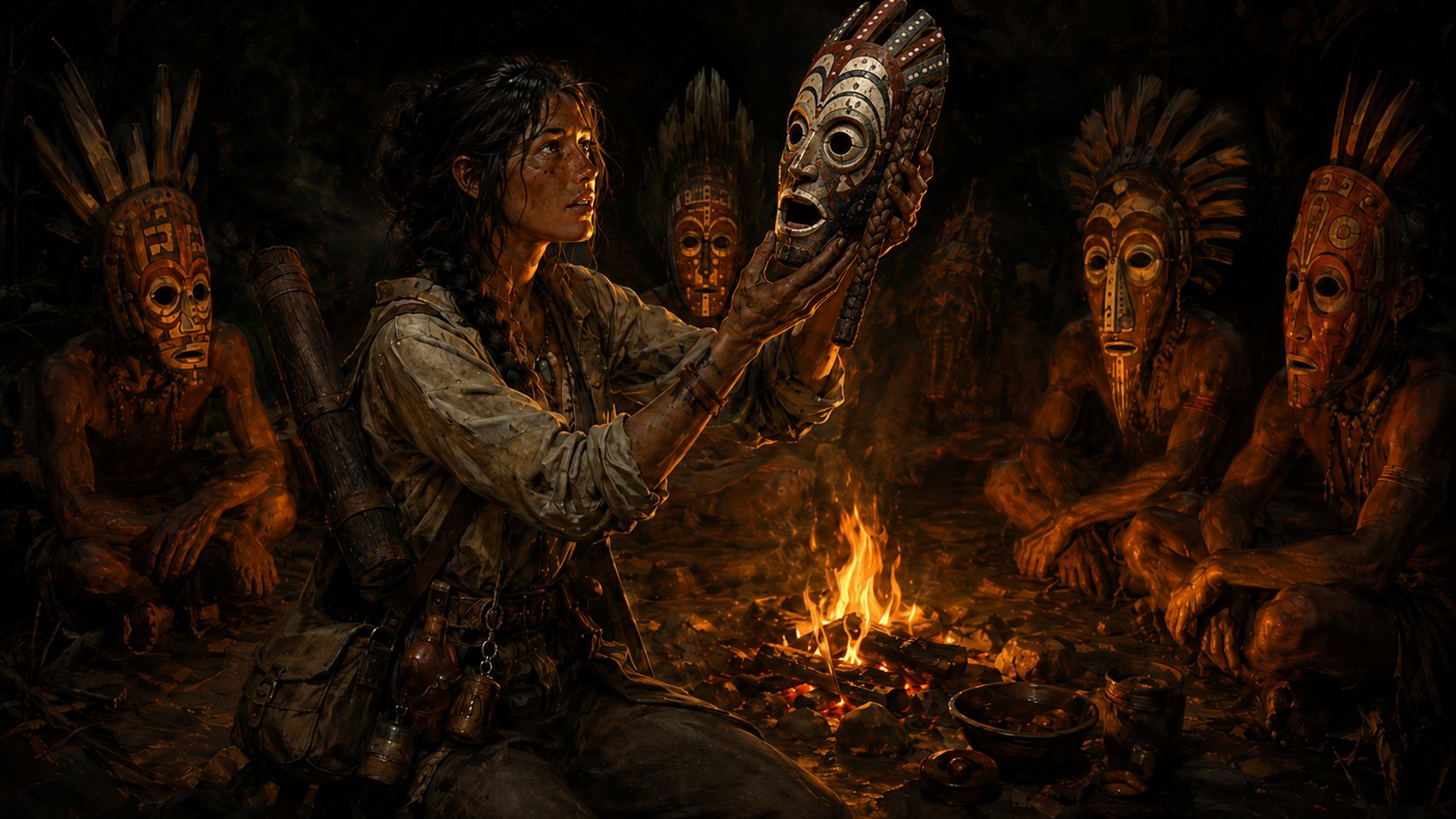
The people of N'gazama feel sorry for the crew and offer them masks before they leave. Each is handmade from light wood, bark, woven fibers, shell or painted clay. The locals prepare them carefully, choosing each mask for a specific crew member rather than handing them out at random.
They do not explain the choices clearly. Aroko may say only that a mask "looked toward" a particular person or that it "remembers the face waiting beneath the dream."
The masks carry no obvious magic. However, each crew member receives a mask strangely similar to the one they wore in the blue world. Scarnax receives a scarred wooden captain's mask. Nasheem receives a polished brass face. Caelin receives a mask bound with rope. Nephyla receives a pale moon disc. Other masks echo the same symbolic faces seen in the dreams.
The people of N'gazama do not consider this surprising. It is their real face, how could they else look?
Thaleia immediately understands that the masks are invaluable scientific and cultural treasures. Their resemblance to the dream masks gives her even more reason to study them carefully, though she treats the gifts with unusual respect.
Whether the masks have a deeper meaning can remain uncertain.
Staying in N'gazama
The people of N'gazama welcome the crew as guests if they choose to remain. They offer fruit, smoked fish, cool water and simple shelters built among raised roots. No one attempts to trap or threaten them.
The longer the crew stays, the stranger the settlement feels.
The locals speak casually about dreams as though describing recent journeys. They sometimes pause mid-conversation to listen to something no outsider can hear. Some greet crew members by names they were never told. Others refer to events from the dreams in indirect ways, then seem surprised when the crew reacts.
Families can often be recognized through shared patterns, materials or symbols, but no two masks are identical. No one reveals the face beneath.
The Risk of Another Mist
The crew has no reliable way to predict when a mist will happen. The locals do not consider this a danger worth avoiding, but the Blue Marlin crew is unlikely to agree.
Aroko does not discourage departure. She simply tells them that the other worlds come when they are needed, not when they are wanted.
The crew has the next destination, new questions and little reason to risk a second passage through the mist.
Let them leave while the people of N'gazama watch silently from the riverbank, their painted faces fading gradually into the white fog.
Thaleia's Request
Thaleia found Nasheem near the bow, polishing his curved sword while the riverbank slipped past beneath a veil of white mist. She approached with unusual hesitation, clutching a notebook against her chest.
"Nasheem," she said. "Will you come with me when I speak to the captain?"
He looked up.
"Of course. Is something wrong?"
"No." Thaleia glanced toward the stern. "I want to ask Captain Scarnax if I may join the crew permanently."
Nasheem paused.
"I thought you already had."
Thaleia stared at him, then laughed.
"Nobody told me."
They found Scarnax near the stern, watching the river. Thaleia opened her mouth, but for once the words did not come easily.
Nasheem inclined his head toward her.
"Captain, Thaleia wishes to request a permanent place aboard the Blue Marlin."
Scarnax looked confused.
"I thought that was already understood."
"It was not understood by me," Thaleia said.
Scarnax scratched his beard.
"You have crossed deserts, faced demons, studied insects and filled half the hold with specimens. I assumed the invitation was obvious by now."
Thaleia smiled.
"My research began in libraries. I thought that was where knowledge lived. I was wrong. The edge of understanding is here. The spear piercing the unknown is here, aboard this ship. I would like to remain with it. With all of you."
Scarnax held out his hand.
"Then welcome aboard."
Thaleia took it.
"We will announce it at dinner," Scarnax said.
She left with a lighter step, already opening her notebook as some new thought caught hold of her.
Nasheem watched her go, then turned back to Scarnax.
"There is one other matter," he said.

Thaleia has decided that her place is aboard the Blue Marlin. The frontier of knowledge is no longer in an Olydrian library, but wherever the ship sails next.
She approaches a trusted crew member and asks for support when speaking to Scarnax. In game terms, choose a player character who has developed a good relationship with her. That character can speak on her behalf if Thaleia becomes too nervous to explain herself clearly.
There is no real obstacle. Scarnax already considers her part of the crew and accepts the request without hesitation. Let the scene remain brief, warm and lightly humorous. The important point is not whether Thaleia is allowed to stay, but that she finally chooses to ask.
Nephyla's Home
"There is one other matter," he said.
Scarnax leaned against the rail.
"Nephyla."
The captain nodded thoughtfully.
Nasheem looked across the deck. Nephyla sat near the mast with Junia beside her, still carrying herself with the dignity of someone who had once expected the world to kneel.
"We cannot keep speaking as though we will leave her at the next convenient port," Nasheem said. "That stopped being true some time ago."
Scarnax nodded again.
"My encounter with the djinn made me believe she has some important role to play," Nasheem continued. "The mist made me more certain."
"What role?"
Nasheem shrugged.
"I have no idea."
Scarnax smiled faintly.
"She is not especially useful in the usual sense," Nasheem admitted. "She cannot tie a proper knot. She would not survive long in the wild. She still looks offended whenever reality expects effort from her."
"Strong arguments."
"But she has changed," Nasheem said. "She listens now. Sometimes. She helps people grieve. She notices things others miss. And I have seen officials lose the will to argue because she looked at them as though their existence required explanation."
Scarnax glanced toward her.
"That is useful."
"You weren't there during the desert trek," Nasheem said. "I had more time to notice."
Scarnax was quiet for a moment.
"She has potential," he said. "And she clearly needs a home."
Nasheem nodded.
Scarnax looked sideways at him with a teasing smile.
"Do you have feelings for her?"
Nasheem paused for a long while, considering the question.
"I do not know. Sometimes, perhaps. Other times she is the most frustrating person I have ever met."
Scarnax laughed.
"That sounds fairly typical."
Nasheem gave a reluctant smile.
"We will tell her at dinner," Scarnax said. "The Blue Marlin is her home now, if she wants it to be."
Across the deck, Nephyla lifted her head.
Nasheem looked away before she caught him.
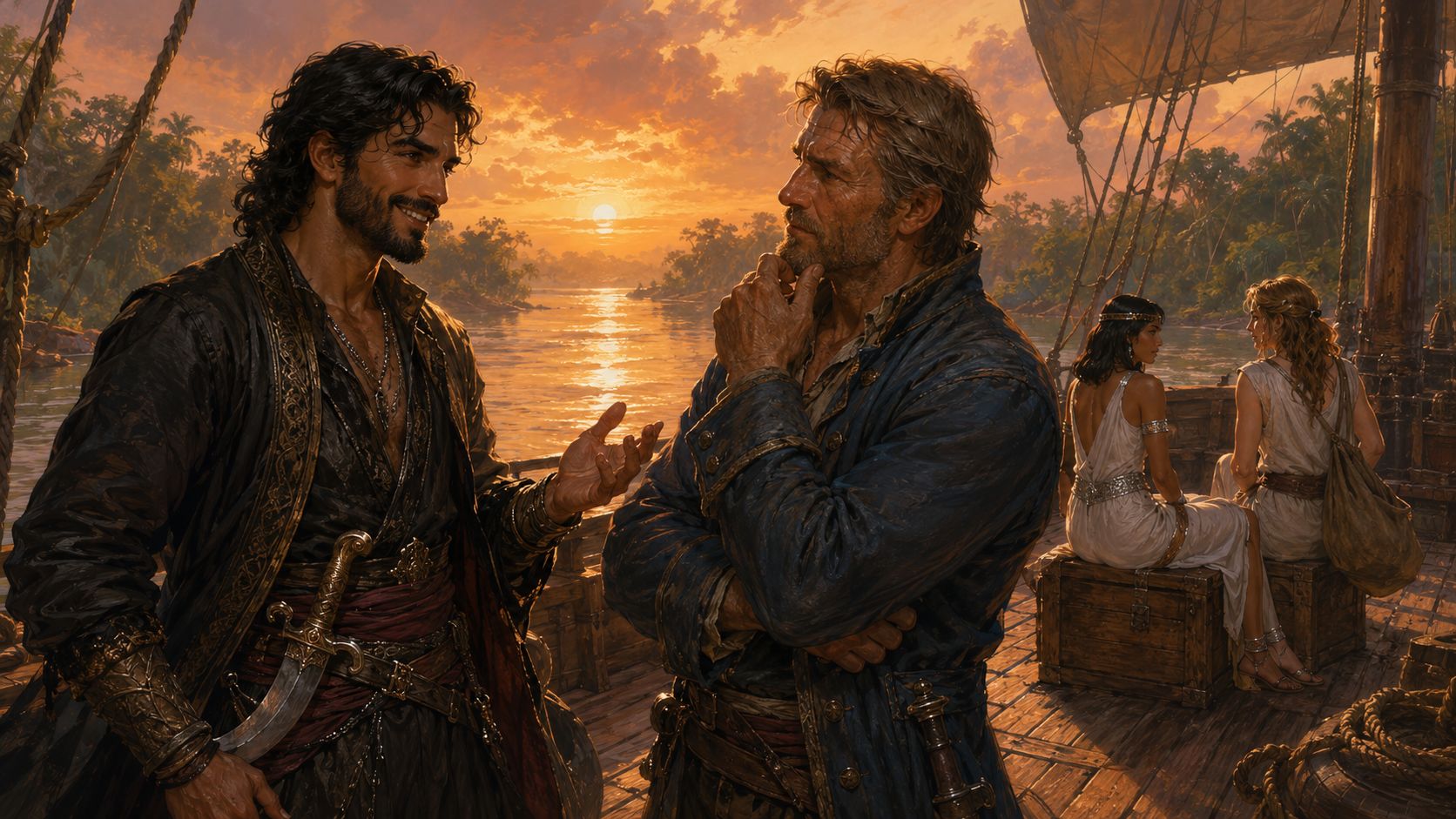
The important part of this scene is not whether Nephyla is accepted. By this point, the answer is clear. The issue is who takes the initiative and how naturally the subject reaches the captain.
If Nephyla Has Already Been Invited
If the crew has already offered Nephyla a permanent place aboard the Blue Marlin, skip this section. The emotional development has already happened at the table and should not be repeated.
Nasheem's dream can still reinforce that Nephyla has an important role ahead of her, but there is no need for another discussion about whether she belongs aboard. Move directly to the dinner scene and let Thaleia's announcement stand on its own.
If Nasheem Is an NPC
If Nasheem is a non player character, let him raise the matter directly after Thaleia leaves. This is especially useful if Scarnax is a player character, since it gives the captain room to decide how the conversation develops without requiring the players to guess the intended next step.
Nasheem explains that the original plan no longer fits reality. Nephyla is not someone the crew is carrying until they find a convenient place to leave her. She has become part of the life aboard the Blue Marlin. His experience with the djinn and the blue mist has also left him convinced that she still has an important role to play, even though he cannot explain what that role is.
If Nasheem Is a Player Character
If Nasheem is a player character, give the player a chance to take the initiative. His dream already provides a strong hint through the djinn's words and Nephyla's moon mask.
If the player does not act immediately, let another crew member nudge him gently. Junia might ask what he thinks the djinn meant. Ivy might remark that Nephyla seems to stand at the edge of something important. Ayesha might point out that the crew has behaved as though Nephyla belongs aboard for some time, without ever saying so aloud. As a last resort, Meyrha can have a vision that clearly indicates Nephyla's importance.
These prompts should feel like natural conversation, not instructions.
If No One Raises the Matter
If the players do not bring it up, have an NPC state the obvious. Nasheem is the best choice if available. Otherwise, Junia, Ayesha, Ivy or Meyrha can raise the issue.
Do not let the scene stall. The purpose is not to test whether the players notice the intended development. The purpose is to give Nephyla a home and let the crew recognize something that has already become true.
Departure
The Blue Marlin leaves N'gazama without incident. The river widens, the white mist thins and the masked figures along the bank fade into the distance.
At dinner, Scarnax formally welcomes Thaleia and Nephyla into the crew. The mood is warm and relieved. For a while, the Blue Marlin feels less like a ship carrying strangers through danger and more like a family gathered around the same table.
The dreams still linger. Some questions have been answered, but many remain. The crew sails on with a clearer sense of who they are, what they carry and why they remain together.
Act Summary
The Blue Mist
The Blue Marlin sails upriver into N'gazama and becomes trapped in the blue mist. The crew falls into a trance, and each person faces a symbolic dream shaped by past wounds, guilt, fear or longing.
The visions do not heal them or provide simple answers. Instead, they force the crew to look back at what has shaped them and consider how they want to move forward.
The People of N'gazama
When the mist clears, the ship is safe, but the crew wakes shaken, confused and changed by the experience.
The masked people of N'gazama appear along the riverbank and explain that the blue world is more real than the ordinary one. They call the crew "the faceless" and gift them masks resembling the faces they wore in their dreams.
The Waverider's Trail
The people of N'gazama remember the Waverider. Its crew passed through the mist before continuing onward to a place they called Raka'tepa.
This gives the Blue Marlin its next destination.
A Growing Crew
Before departure, Thaleia formally asks to join the crew. She has realized that the true frontier of science lies aboard the Blue Marlin rather than in an Olydrian library. Her request is accepted immediately.
The question of Nephyla's place aboard is also resolved. What began as temporary shelter has become something deeper. The crew offers her a permanent home and a family, and she accepts through tears.
Departure
The Blue Marlin leaves N'gazama with a stronger sense of unity. The dreams still linger, and many questions remain unanswered, but the crew sails onward with a clearer understanding of themselves and of one another.
The ship leaves the dreams behind. Or, does it leave reality behind and sail into dreams?
The evening meal had begun noisily.
Yasmira had stretched the remaining fresh supplies into something generous, with bowls of spiced fish, flatbread warmed over the galley fire and fruit brought aboard from N'gazama. Conversation moved easily around the table. The crew still carried the weight of the mist, but for a little while laughter came more naturally.
Scarnax tapped the rim of his cup with a spoon and rose.
The talking faded.
"I have an announcement," he said. "Thaleia has asked to join the Blue Marlin as a permanent member of the crew. I am proud to say that she is welcome. Her knowledge, courage and inability to leave anything unexplored have already made this ship stronger."
There was a brief silence.
Then several people looked confused.
"I thought she was already crew," Caelin said.
"So did I," Junia added.
Thaleia sat very still, caught between embarrassment and amusement.
"Apparently," she said, "this was understood by everyone except me."
Laughter moved around the table.
Thaleia rose awkwardly, notebook still tucked beneath one arm.
"Thank you. I have learned more aboard this ship than I ever learned in a library. I hope to continue doing so for a very long time."
She sat down quickly.
The crew began reaching for food again.
Scarnax lifted his spoon and tapped the cup a second time.
A chorus of mock groans answered him.
"One more announcement."
His expression softened as he looked toward Nephyla.
"Nasheem believes that you still have an important role ahead of you. None of us know what that role is, but we want the Blue Marlin to be part of it."
Nephyla straightened slightly.
Scarnax continued.
"More importantly, you are our friend. We do not want to leave you at the next convenient port. We want you here."
The table had gone quiet.
"Nephyla," Scarnax said, "would you like to call the Blue Marlin your home, and this crew your family?"
For a moment, she did not move.
Then her composure broke.
She tried to answer, but no words came. Tears filled her eyes. She stood too quickly and swayed as if the deck had shifted beneath her feet.
Nasheem caught her before she fell.
Nephyla seized him and held on tightly, sobbing against his shoulder with the relief of someone who had never expected to be wanted simply for herself.
Nasheem looked over her head toward Scarnax.
"I believe that is a yes."
The crew erupted into cheers.
Cups struck the table. Someone began clapping. Ormun laughed loudly enough to shake the lanterns.
Ileena waited until the noise began to settle.
"Can we eat now?" she asked.