Campaign: Murkwater
Act Synopsis
Murkwater is a short, lighter arc after the darkness of the Drowned Marshes and Lumekhet. It gives the crew a strange social problem, a comic misunderstanding, a sacred theft and a tense escape without turning into another long swamp survival story. The tone is humorous, suspicious and wet, with the Fibians presented as primitive but not foolish. They lack outside context, misunderstand tools and imitate what they have seen, but in Murkwater they are the masters. Befriending them is useful. Betraying them is dangerous.
Arrival in Murkwater
The Blue Marlin reaches the edges of Murkwater expecting a brief stop in the Waverider’s trail. Instead, Fibian scouts surface around the ship almost immediately. They do not attack. They ask for things.
Their requests come in thick, croaking common, half words and half descriptions. "Rrropp" means rope. "Sharrp shiny" might mean knife. "long-eye" means telescope. They are not begging. They are trading, testing and demanding all at once, with the confidence of people who know the swamp belongs to them.
This becomes a small shipboard puzzle. The crew has to search stores, negotiate with ship officers and decide what can be spared. This allows the entire crew to be used when sourcing gifts. Galenor knows which tools are useful but replaceable. Yasmira resists giving away galley equipment. Nera may be drawn in if the Fibians become fascinated with one of her small inventions. A generous crew earns interest. A clever crew earns respect. A crew that gives trash and assumes the Fibians will not notice plants the first seed of danger.
The First Bargain
The Fibians do not fully understand what they are asking for, but they understand value. Rope binds better than vine. Metal cuts better than shell. Hinges move like living joints. A compass needle spins with hidden purpose. A lute sings without a throat. These objects are powerful because they do things Murkwater objects do not.
The leader of the greeting party, Slib of the Reed-Eyes, is young, quick and excitable. He keeps calling humans by names from the Waverider because, to him, most dry-skins look almost the same. He asks whether Scarnax is "Solonex now" and whether Nera is "small Otto." This is funny, but it also creates confusion. The Fibians are not certain whether the Blue Marlin crew are new visitors, returning spirits or the same strange people in slightly different shapes.
If the crew handles the first exchange well, the Fibians agree to guide them deeper into Murkwater. If the crew handles it poorly, the guide is still offered, but under watchful eyes and with more hunters in the water.
The Journey Inward
The passage into Murkwater is short and atmospheric rather than a major travel challenge. The crew moves by skiff and narrow channel, through mangrove roots, black pools, hanging moss and half-submerged ruins of old Fibian platforms. Croaks pass through the swamp ahead of them, carrying news faster than speech.
Along the way, the crew sees Fibian imitations of Waverider objects. A fake compass made from shell and reed, spun before decisions like a prayer wheel. A "spyglass" made from hollow bone, useless for seeing far but treated as a tool of authority. A carved wooden thing with sails and no hull, apparently meant to represent the Waverider but also perhaps a god, ancestor or hunting charm.
These details establish the central misunderstanding before explaining it. The Fibians copied the outward form of what they saw, but without understanding function. That does not make the copies meaningless. To the Fibians, the act of imitation has become ritual.
The Faux Pas
Thaleia Myrinos complicates the meeting before the crew reaches the inner sanctum. Her curiosity gets ahead of her caution. She examines one of the Fibian imitations too closely and corrects its construction aloud. To her, she is trying to understand and perhaps help. To the Fibians, she has insulted a sacred object and declared the work of their priests false.
The scene is not meant to become a fight. It is a test of diplomacy and humility. The crew has to repair the insult. Solving the faux pas earns the crew permission to continue. Failing to solve it means they continue as tolerated guests, not trusted ones.
The Inner Sanctum
The Fibians bring the crew to Ulmba, an inner village hidden among ancient mangrove roots and dark water. The place is not grand in an outsider’s sense, but it has weight. Bone charms hang from branches. Canoes rest in shadow. Watchers sit half-submerged in pools. The air smells of mud, wet leaves and old offerings.
Here the named Fibians come into focus. Vrroth-Kal is the village leader, old, scarred and suspicious, with one golden eye clouded by an old wound. He does not believe easily and does not forgive quickly. Krothik is the high priest, draped in reeds, bones and polished shells, convinced the Waverider’s objects are fragments of a great visitation. Gribba is a practical collector and craft-minded trader, more interested in rope, knives, hinges and mechanisms than theology. Takk-Takk and Urrm guard the altar with perfect stillness, comic in their solemnity until someone gets too close.
The Altar of Dry-Skin Wonders
The altar is the pivot of the arc. Until now, the Fibians have been curious primitives demanding odd objects. At the altar, the crew understands that something larger happened.
The Waverider did not merely trade with the Fibians. It transformed their politics and religion. Objects taken, traded or misunderstood from the Waverider are arranged as sacred treasures. A chisel hangs as a holy fang. A bottle of old brandy is sealed as "vision-water." A rusted hinge is tied between bones as a symbol of hidden movement. A false compass spins before prayers. If Nera gave the Fibians a music box, it now sits near the center, wound only by Krothik and treated as a singing spirit.
At the center of the altar is a folded map stolen from the Waverider crew. It clearly shows part of the Waverider’s route, and the crew can see enough to guess that it contains the next destination. The problem is that the relevant portion is hidden inside the fold, and no outsider is allowed close enough to touch it.
The Factions Around the Shrine
The altar also reveals the internal disagreement among the Fibians. Krothik and the priests believe the Waverider crew were divine or semi-divine beings, and that the Blue Marlin crew might be their return. Gribba and the practical Fibians care less about spirits and more about acquiring useful objects before the outsiders leave. Vrroth-Kal suspects both groups are wrong, but he cannot ignore the power the shrine has gained over his people.
This disagreement gives the players room to act. They can appeal to reverence, trade, curiosity, suspicion or rivalry. Any one faction can create an opening. Betraying one too openly risks uniting all of them.
The Map Problem
The crew must learn what is hidden on the folded map. The Game Master should not provide a fixed solution. The players are expected to invent one.
They might steal the map, distract the guards, persuade Krothik to perform a ritual that unfolds it, convince Gribba that the map must be studied beside a better tool, use Nera’s music box as a sacred distraction, have Galenor offer to "repair" a Waverider object near the altar or find a way to observe the fold from a distance. Thaleia may notice layout details. Ayesha may manipulate factional tension. Ileena or Shaedra may identify guard routines. Nera and Galenor are especially useful here because tools, mechanisms and misunderstood craft sit at the heart of the problem.
The clue itself should not be at risk. This is the campaign path forward. The variable is cost. A clean solution preserves relations. A messy solution causes outrage, pursuit or the loss of valuable goods. A crude theft gives the crew what they need but makes enemies in Murkwater.
The Heist
Once the crew acts, the arc becomes a short heist. The Fibians’ altar routines matter. Krothik winds or blesses sacred objects. Guards change positions without speaking. Priests face the water during chants. Practical Fibians inspect new offerings. Vrroth-Kal arrives at intervals to count and judge.
The crew’s plan determines the shape of the scene. This should feel tense but not overbuilt. The important question is not whether the crew can fight through the village. They cannot do that safely. The question is whether they can exploit misunderstanding, timing, factional tension and their own talents long enough to see the map.
However it happens, the hidden part of the map reveals the next destination in the Waverider’s trail.
The Alarm
If the crew earns access cleanly, the alarm may not come until after they leave, or even not at all, and it may amount to little more than offended croaking, frantic argument and demands that they return with better gifts next time. If they trick, steal or offend the Fibians, the alarm comes more quickly, but Murkwater does not become a battlefield. It becomes a confused, noisy scramble through a swamp full of people who know the ground better than the crew, but who are also excitable, and distractible.
This escape should not repeat the Drowned Marshes swamp flight. It is not about navigation, exhaustion or terrain survival. It is about sneaking away from a village whose guards are dangerous in their own territory, but not disciplined soldiers. The Fibians vanish beneath the water, signal by croak and appear in inconvenient places, but they also argue, overreact, lose focus when sacred objects are threatened and sometimes stop to protect the shrine rather than pursue.
The crew must escape a loose and chaotic net, not a perfect one. Skiffs are blocked by hunters who surface too early and spoil their own ambush. Silent heads rise from black water, then begin croaking demands for more gifts. Bone darts strike the wood beside hands, more warning than execution. A path that looked open suddenly contains altar guards, but those guards can be distracted by a thrown tool, a false offering, a loud insult, a broken imitation or the promise of more "rrropp." The crew can hide, bargain, create decoys, split attention, use noise, sacrifice supplies or exploit the Fibians’ misunderstandings of ship tools.
The scene should feel tense, comic and messy. The Fibians are not harmless, but this group is more possessive than murderous, more outraged than organized. The players should leave thinking that Fibians are strange, greedy, stubborn and manageable if treated carefully. That impression is useful later, when the Fibians of Tideforest prove how wrong such comfort can be.
The Cost of Escape
The crew escapes with the clue, but the cost depends on their choices. If they respected the Fibians and found a graceful solution, they leave with awkward goodwill, suspicious blessings and perhaps a demand that they return one day with more proper gifts. If they deceived the Fibians but avoided desecration, Murkwater remembers them as clever tricksters, irritating but impressive. If they stole openly or mocked the shrine, they leave with angry croaks behind them, hunters in the water around them and a promise that the swamp will remember their smell.
Possible costs include lost supplies, a damaged skiff, surrendered tools, a promised future gift, a minor injury or one of Nera’s creations becoming part of the altar forever. The outcome should be concrete, memorable and slightly ridiculous rather than catastrophic.
The important point is that Murkwater should not teach the players to fear Fibians too deeply yet. It should teach them that Fibians are odd, territorial and dangerous if pressed, but also negotiable, funny and easier to survive than they first appear. The real danger of that lesson comes later.
How Fibians Speak
Fibians speak the Word with difficulty. Their voices are wet, throaty and rhythmic, with many rolled sounds, repeated syllables and croaking pauses. They favor sounds made deep in the throat, especially "rrr," "grr," "krr," "urr," "glub" and "thok." Their speech should be understandable, but strange enough that the players have to listen carefully.
Do not overdo the accent. A few repeated words and altered names give more flavor than rendering every sentence phonetically. The goal is to make the Fibians memorable and funny, not difficult to understand.
Fibians often repeat important words, especially when excited, offended or trying to make sure dry-skins understand them. This makes their speech sound more croaking and rhythmic without making it unreadable. A Fibian might say, "Rrropp, rrropp, good binding. Dry-skin bring rrropp." Or, "No touch, no touch world-skin." Repetition should emphasize desire, warning or ritual importance, not replace ordinary sentences.
Fibians often confuse names with roles. They do not fully understand that "Solonex" is one person’s name rather than the title of the dry-skin in command. To them, Scarnax is "Solonex" because he is the one who commands the watervillage. Likewise, they believe "Otto the Dwarf" meant "maker dwarf," so Nera becomes "Otto the Dark," a dark skinned maker who works with hidden things. Ormun is "Larrrgeman." Ileena is "Tadpole," because she has a tail and is therefore obviously not fully grown. Nephyla is called "Shemoon," a name that lands with uncomfortable accuracy even though the Fibians have no way of knowing her past.
This habit should be used for both humor and unease. Sometimes it is simply funny. Sometimes it is insulting by accident. Sometimes it is strangely perceptive.
Fibians also name objects descriptively, usually based on appearance and misunderstood function. A bell is a "throatbowl," because it has a voice inside it. A lute is a "singshell." A telescope is a "longeye," and they believe it is a mark of authority because important Waverider crew looked through one before giving orders. A ship is a "watervillage." Rope is "rrropp," a word they say with great seriousness because rope is one of the most useful dry-skin wonders they have ever seen.
Their words are often wrong, but rarely random. A Fibian name usually tells the Game Master what the Fibian noticed first and what they misunderstood. This makes their speech a small puzzle. When they ask for "bite-metal," they might mean a knife, saw, chisel or fishhook. When they demand "whistle-tube," they might mean a speaking horn or flute. When they speak of "world-skin," they mean the map.
The Fibians do not speak like fools. They speak like people translating an alien world through swamp logic. Their mistakes are practical, literal and strangely consistent. They know what things do in Murkwater. They just do not know what dry-skins think those things are.
Arrival in Murkwater
The first Fibian appeared just after dawn, when the Blue Marlin lay at anchor where the brown river widened into the first fingers of Murkwater. The swamp waited ahead in a wall of mist, roots and low green shadow. Scarnax stood at the rail, arms folded, watching the water with the stillness of a man who disliked being watched and knew he was.
A pair of round golden eyes broke the surface.
Then another pair followed.
Then six more.
Ileena was in the rigging above him, tail twitching slowly. "They were there before the anchor dropped," she said. "Quiet things."
The nearest Fibian rose until only its wide head and narrow shoulders showed above the water. Slick green-brown skin shone in the morning light. Its throat swelled once, twice, then it spoke.
"Solonex."
Scarnax looked down at it. "No."
The Fibian blinked. Water ran over its broad mouth. "Solonex," it repeated, more firmly. Then it pointed one webbed finger at the ship. "Big watervillage. Solonex stand high. Solonex say."
Ayesha, standing beside Scarnax with her hands folded, tilted her head slightly. "I believe it thinks Solonex is a title."
"I gathered," Scarnax said.
More Fibians surfaced around the hull, staring up at the Blue Marlin with open hunger and wonder. One touched the side of the ship, then jerked its hand back as if expecting the hull to answer. Another croaked softly to itself while counting the mast lines. A third pointed at the rigging and whispered, "Many rrropp. Many many rrropp."
The first Fibian slapped both hands against the water. "Rrropp. Give rrropp."
Scarnax glanced at Ayesha.
She smiled politely down at the water. "You wish to trade."
The Fibian stared at her. "Give rrropp."
"And what do you offer."
The Fibian sank for a moment. Bubbles rose. Then it came up holding a wet bundle of shells, swamp pearls and something that might once have been a dried eel. It pushed the bundle toward the hull with great pride. "Good-good. Wet treasure. Give rrropp. Slib brrring. Slib trade."
Nera had come up from below during the exchange, still holding tools. She stopped beside Ayesha and stared down at the Fibians with wide eyes. One of them stared back at her just as intently.
"Otto," it said.
Nera froze. "What?"
"Otto the Dark," the Fibian said, pointing at her with sudden excitement. "Otto. Make-make. Fix-fix. Good hands."
Nera looked helplessly at Scarnax. "I don't know what that means."
"It means they like you," Ileena called from above.
The Fibian nearest the hull noticed Ileena and went very still. Its throat pulsed. "Tadpole."
Ileena’s ears twitched.
The Fibian pointed at her tail. "Tail. Tadpole. Not grown dry-skin yet."
For a moment, nobody spoke. Then Ayesha covered her mouth with two fingers and looked very hard at the swamp.
Ileena crouched lower on the rigging, eyes narrowing. "I could eat that one."
"No," Scarnax said.
The Fibian did not understand the threat. It had already turned back to the ship, pointing now at the brass bell near the rail. "Throatbowl. Give throatbowl."
"No," Scarnax said again.
The Fibian pointed at a coil of rope. "Rrropp."
"Maybe."
It pointed at Nera’s tool pouch. "Bite-metal."
Nera clutched the pouch to her chest. "Absolutely not."
It pointed toward the open hatch leading below. "More? More gift? Watervillage full-full."
Ayesha stepped forward before Scarnax could answer. Her voice became smooth, warm and very careful. "We have gifts. Good gifts. But gifts are chosen. Not grabbed."
The Fibian considered this. Its throat inflated slowly, then released with a wet croak. Around the ship, the other Fibians echoed it, some confused, some delighted, some already whispering "gift, gift, gift" to one another.
At last the first Fibian nodded with exaggerated solemnity. "Dry-skins choose. Slib watch. No bad gift. Bad gift make bad water."
Scarnax looked at the eager golden eyes around his ship, at the webbed hands gripping the hull, at the mist waiting beyond them.
Then he turned to Nera.
"Find Galenor. See what we can spare."
Nera nodded, still clutching her tools. "Not my good springs."
"No one is giving them your good springs."
Ayesha’s smile sharpened. "And I will make sure they learn that a bargain has two sides."
From above, Ileena watched Slib sink and rise again, as if unable to stay still from excitement.
"Tadpole watch too," Slib croaked.
Ileena bared her teeth in something that was not quite a smile.
The Fibian beamed back, entirely pleased with itself.

This segment introduces the Murkwater Fibians as strange, eager, funny and slightly invasive. The crew should not feel attacked, but they should not feel fully in control either. The Fibians are fascinated by the Blue Marlin, impressed by its size and hungry for the objects it contains. They do not understand the ship as a machine so much as a floating settlement full of wonders.
The goal is to establish three ideas quickly. The Fibians want gifts. The Fibians speak in confusing descriptive terms. The Fibians are not looking for a fight, but the crew are still strangers in their waters, and their friendliness depends on respect.
First Impressions
The Fibians appear from the water before any formal landing. They surface around the hull, staring with wide golden eyes, touching the planks, counting ropes and croaking to each other in excitement. They should feel like curious swamp scavengers and ambassadors at the same time.
They are not awed in a humble way. They are impressed, but bold. They know Murkwater belongs to them. The Blue Marlin is wondrous, but it is also a guest inside their waters.
Use their first reactions to show how they misunderstand what they see. The players should understand the meaning most of the time, but not always immediately.
Slib of the Reed-Eyes
Slib is the first Fibian to speak for the group. He is young, eager and self-important, chosen more because he is bold than because he is wise. He is fascinated by the ship and by the possibility of acquiring new wonders for Ulmba.
Slib should be annoying, funny and useful. He asks for things constantly, but he also opens the path inward once the crew has given enough to prove they are worth showing to the elders.
The Gift Demands
The Fibians begin with simple demands, then escalate as they realize the ship contains more wonders. They start with rope, tools and shiny metal. Then they ask for stranger things: the throatbowl, a roundeye, bite-metal, a singshell, a cooking shell, hard fishbone nails, colored cloth or anything that moves, rings, shines or makes sound.
Do not make every demand clear. Some should require interpretation. The players should have to ask what Slib means, search the ship and decide what objects can be spared.
The Fibians are not asking politely in the human sense. They push, point, repeat words and treat hesitation as confusion. At the same time, they do offer things back: shells, swamp pearls, herbs, carved bone tokens, dried fish, odd swamp liquor and small objects they consider valuable.
No matter what the crew offers, Slib should always believe there is one more wonder still hidden somewhere aboard.
Running the Trade
Let the players decide how the crew handles the requests. They might give useful gifts, bargain hard, offer harmless trinkets, search for damaged tools, ask Galenor what can be spared, bring in Nera’s inventions or let Ayesha turn the exchange into a formal negotiation.
Reward effort and imagination. A coil of old rope is a good gift. A damaged but usable tool is acceptable. A clever object with no obvious use can fascinate the Fibians. An insultingly worthless object may be accepted at first, but it creates suspicion once the Fibians realize the crew tried to fool them.
Ayesha can keep the exchange from becoming simple looting. Slib and the other Fibians need to understand that gifts go both ways. If the crew says no firmly and offers something else, the Fibians grumble but accept the shape of the bargain.
When to Move On
This scene should be lively, not long. Let the trade continue while the players are having fun interpreting requests and choosing gifts. When the exchange starts to repeat itself, or once the crew has given enough to show generosity, cleverness or usefulness, move on.
Slib should become visibly satisfied before the scene goes stale. He gathers the gifts, croaks to the others and announces that the dry-skins must come to Ulmba. The invitation should feel like a reward, but also like a new complication.
The crew has impressed the Fibians enough to be taken deeper into Murkwater. They have not yet earned trust.
The Journey Inward
Once the first bargain is settled, the Fibians make it clear that the Blue Marlin cannot continue deeper into Murkwater. The channels ahead are too narrow, too shallow and too tangled with roots. The crew must proceed by skiff, with swimming Fibians guiding them through the swamp.
The journey to Ulmba takes about a day. It is not meant to be a survival challenge or a navigation problem. The Fibians know the way, and the crew is under escort. Use the journey to show Murkwater’s atmosphere, the Fibians’ odd behavior and Thaleia’s growing curiosity.
Choosing the Shore Team
Thaleia Myrinos insists on coming. She is fascinated by the Fibians, their speech, their imitations of Waverider objects and their obvious interest in outside tools. She does not ask meekly. She argues that this is exactly the sort of living culture she joined the journey to study.
Let her be excited, intelligent and slightly too eager. Her curiosity should feel useful, but also dangerous. She watches everything, asks questions at the wrong moments and has to be reminded that the Fibians are not specimens.
The skiff has place for one more extra NPC, and the players can choose who they want to accompany them. The rest of the crew remains aboard the Blue Marlin.
Bring More Gifts
Before the skiff departs, someone should suggest bringing more gifts. If the players think of this themselves, reward it. If not, Ayesha, Nephyla or Nera can point it out. The Fibians clearly value gifts, and arriving at their inner village empty-handed would be foolish.
The best gifts are simple objects beyond Fibian craft. Rope, nails, hinges, needles, knives, fishhooks, small mirrors, bells, glass beads, metal cups, simple tools and colored cloth all work well. The Fibians are a little beyond stone age in skill, so almost any worked metal, glass, clockwork or finely made ship object impresses them.
If Nera has not already offered one, she may reluctantly suggest a small music box. This is an excellent gift. The Fibians will not understand it, but they will understand that it is wondrous. It makes sound without breath, mouth or hand, which gives it immediate ritual value.
Do not let this become a second long trade scene. The point is preparation. The players choose what to bring, then the journey begins.
The Skiff and the Guides
The skiff is guided by swimming Fibians who move easily through water too tangled for outsiders to read. They vanish under roots, reappear ahead, tap the hull to steer and croak warnings when the skiff drifts too close to hidden snags.
Slib sometimes climbs aboard if allowed. He enjoys the status of riding with the dry-skins and makes a show of giving orders to the swimmers, even when they ignore him. When giving orders, he raises a hollow wood tube to his eye. He asks for more gifts, points at objects and invents new demands. He is not trying to sabotage the journey. He simply believes a watervillage must contain endless wonders, and that asking is how one discovers them.
Use Slib sparingly during the journey. He is funny in small doses. When he starts to repeat himself, have him leap back into the water, sulk on the bow or become distracted by some object he has already been given.
What the Crew Sees
The trip inward should be atmospheric and brief. Describe black water, mangrove roots, floating leaves, still pools, insects, distant croaks and shapes moving beneath the surface. The Fibians are everywhere for a moment, then nowhere at all.
Show signs that Murkwater belongs to them. Hidden platforms in the roots. Bone charms tied beneath branches. Nets stretched where no outsider would see them. Narrow paths through reeds that vanish from sight after the skiff passes. Small watching faces in the water, gone when looked at directly.
Also show their fascination with dry-skin objects. A Fibian hunter wears a spoon as a chest ornament. Another carries a broken key on a cord. A reed hut has a crude false bell hanging from it, carved from shell and struck solemnly despite making almost no sound.
The Faux Pas
The journey is mostly uneventful, except for Thaleia’s faux pas. It interrupts the trip and creates a social problem before the crew reaches Ulmba.
Until then, the journey should feel safe, strange and slightly absurd. The crew is being led deeper into a place where they are guests, curiosities and potential sources of treasure all at once.
The skiff slid out from the last screen of hanging roots, and Ulmba opened ahead.
It was not a city in any dry-skin sense. It was a gathering of platforms, reed huts and dark pools woven through the mangroves, half hidden by leaves and shadow. Bone charms hung from branches. Canoes rested nose-first in the mud. Golden eyes watched from the water, from roots, from gaps between woven walls.
Thaleia Myrinos leaned forward so far that Mbaru put one hand on the back of her belt without looking at her.
"Do not," he said.
"I am only looking," she whispered, already reaching for her notes.
On a raised root near the water stood an old Fibian draped in reeds, polished shells and strings of small bones. His skin was dark with age, his throat pouch marked with pale streaks of clay. He looked first at the skiff, then at Scarnax, then at the gifts bundled near Ayesha’s feet.
Slib bobbed proudly beside the skiff. "Krothik," he croaked. "Dry-skins bring rrropp. Bring bite-metal. Bring gift-gift."
Krothik did not answer at once. Instead, he turned to a little object set on a flat stone beside him.
It was a compass, or rather, something that wanted very badly to be a compass. A round shell had been carved into a shallow bowl. A sliver of bone lay across the middle, pinned on a thorn. Around it were scratches meant to be markings, though none aligned with anything Thaleia recognized. Krothik touched the bone with one webbed finger and spun it.
The bone turned twice, wobbled and stopped.
Krothik watched it gravely. Then he lifted both hands toward the skiff.
"Dry-skins come. Water opens."
Thaleia’s expression changed from fascination to physical pain.
"Oh, no," she said.
Ayesha turned her head slightly. "Thaleia."
"But that is not..." Thaleia stopped herself for half a breath, failed and pointed at the object. "That is not how a compass works. It will not tell direction unless the needle is magnetized, and even then spinning it defeats the entire purpose. Also, that is bone. It cannot possibly..."
The air changed.
The croaking stopped first. Then the small movements in the water. Then even Slib sank lower, eyes wide.
Krothik turned his head slowly toward Thaleia.
Mbaru’s hand left her belt and moved to the haft of his club. Scarnax did not draw steel, but his fingers settled on his sword hilt.
Thaleia finally noticed the silence.
"...possibly be improved without study," she finished weakly.
Krothik’s throat swelled once. His voice came low and wet.
"Dry-skin says world-eye false."
"No," Ayesha said at once.
She stepped forward in the skiff with perfect calm, one hand raised as if correcting a matter of ceremony rather than preventing a murder.
"She says your world-eye is powerful, but difficult. Among our people, old custom says it is spun with the left hand."
Krothik stared at her.
Ayesha continued, smooth as oil on water. "And against the sun’s path. Not with it. That is said to make the hidden knowing settle better."
Thaleia opened her mouth.
Mbaru’s hand closed around her shoulder.
Thaleia shut her mouth.
Krothik looked from Ayesha to Thaleia, then back to the crude compass. Slowly, with visible suspicion, he placed his left hand over it and spun the bone in the other direction.
It wobbled, turned once and stopped pointing somewhere entirely new.
Krothik leaned close. His golden eyes narrowed. For several long breaths, no one moved.
Then he gave a reluctant croak.
"Works."
He nodded once. "Dry-skins come. Loud-thought woman no touch world-eye."
"No touching," Scarnax said.
Thaleia nodded quickly. "No touching. No correcting. No explaining unless asked."
Krothik stepped aside.
Around the skiff, the water began moving again. Slib surfaced fully, relief written across his wide face though he clearly did not understand half of what had nearly happened.
"Good-good," he said. "Dry-skins clever. Loud-thought woman dangerous."
Scarnax gave Thaleia a sharp look.
She swallowed, then nodded once, this time with understanding rather than curiosity.

This incident shows, for the first time, that the Waverider objects and their Fibian imitations have religious importance. Until now, the Fibians have seemed greedy, curious and funny. Here, the crew sees that some objects are sacred, and that treating them as mere curiosities can cause real offense.
The second purpose is to warn the players that the Fibians must not be disrespected. They are odd and often comic, but they are not harmless pets or foolish locals. A careless word can make the water go still.
Running the Moment
Place the incident just as the skiff reaches Ulmba. Krothik, later named as the high priest, uses a crude imitation of a compass before formally welcoming the crew. He looks at the dry-skins, spins the false compass, reads the result and only then allows them forward.
Thaleia reacts because she cannot help herself. She understands tools, maps and observation too well to watch a false compass treated as functional without correcting it. Her mistake is not malice. It is curiosity without respect.
The reaction should be immediate. Croaking stops. Fibians in the water go still. Krothik becomes cold. Slib grows nervous. Crew members with combat instincts realize at once that the situation has become dangerous.
Resolving the Insult
The flavor story suggests one solution: Ayesha reframes Thaleia’s correction as a ritual variation rather than an insult. She does not say Krothik is wrong. She says there is another tradition, one that spins the world-eye with the left hand and against the sun’s path. This gives Krothik a way to accept the correction without losing authority.
This is not the only possible solution. Let the crew handle it. They might apologize, offer a gift, ask Thaleia to show humility, claim a misunderstanding, praise the world-eye, invent a compatible ritual or demonstrate respect for the object. The important thing is that the solution must preserve Krothik’s dignity.
Outcome
If the crew handles the insult well, Krothik remains wary but permits them to enter Ulmba. He may even respect their quick thinking. If they handle it poorly, they are still allowed in, but under colder watch and with less goodwill.
Do not let this incident derail the arc. It is a warning, not a failure point. It teaches the players that the altar objects matter, and may be taboo to touch, before they reach the altar itself.
The Inner Sanctum
Ulmba
Ulmba is the inner village of the local Fibians, hidden where the mangroves grow thick and the water turns dark and still. It is not planned in any orderly sense. Platforms cling to roots at odd angles. Huts lean over pools. Rope bridges sag between branches. Shallow basins serve as paths, meeting places and sleeping places depending on water level. Everything looks temporary at first, but nothing is accidental. The Fibians know exactly which platform holds weight, which pool hides a tunnel and which bridge collapses if the wrong knot is pulled.
The crew should feel that they have entered a place that makes sense to Fibians and only to Fibians. Dry-skins must walk carefully, duck under branches, step over sleeping pools and follow paths that seem to change from one glance to the next. Fibians move through the same space easily, sliding into water, climbing roots and appearing from beneath platforms without warning.
Do not make Ulmba grim. It is strange, damp, noisy and crowded. Fibian children stare. Hunters compare the crew’s gifts. Old Fibians croak from shaded pools. Someone tries to wear a spoon as a forehead ornament. Someone else argues that a nail is clearly a tooth and must be tied to a spear. The place should feel alive and funny, but never fully safe.
People and Factions
Ulmba’s people are united by curiosity about the dry-skins, but not by agreement.
Together, these three pull the scene in different directions. Krothik wants reverence, Gribba wants useful wonders, and Vrroth-Kal wants the dry-skins contained until he understands them.
Vrroth-Kal the Village Leader

He is old, broad and scarred, with one clouded golden eye and a slow way of speaking that makes other Fibians quiet down. He does not trust the crew, but he is too practical to reject useful outsiders. He watches more than he speaks. His main concern is control. If the dry-skins are powerful, he wants their power contained. If they are fools, he wants their goods taken without causing trouble.
Krothik the High Priest and Keeper of the Altar
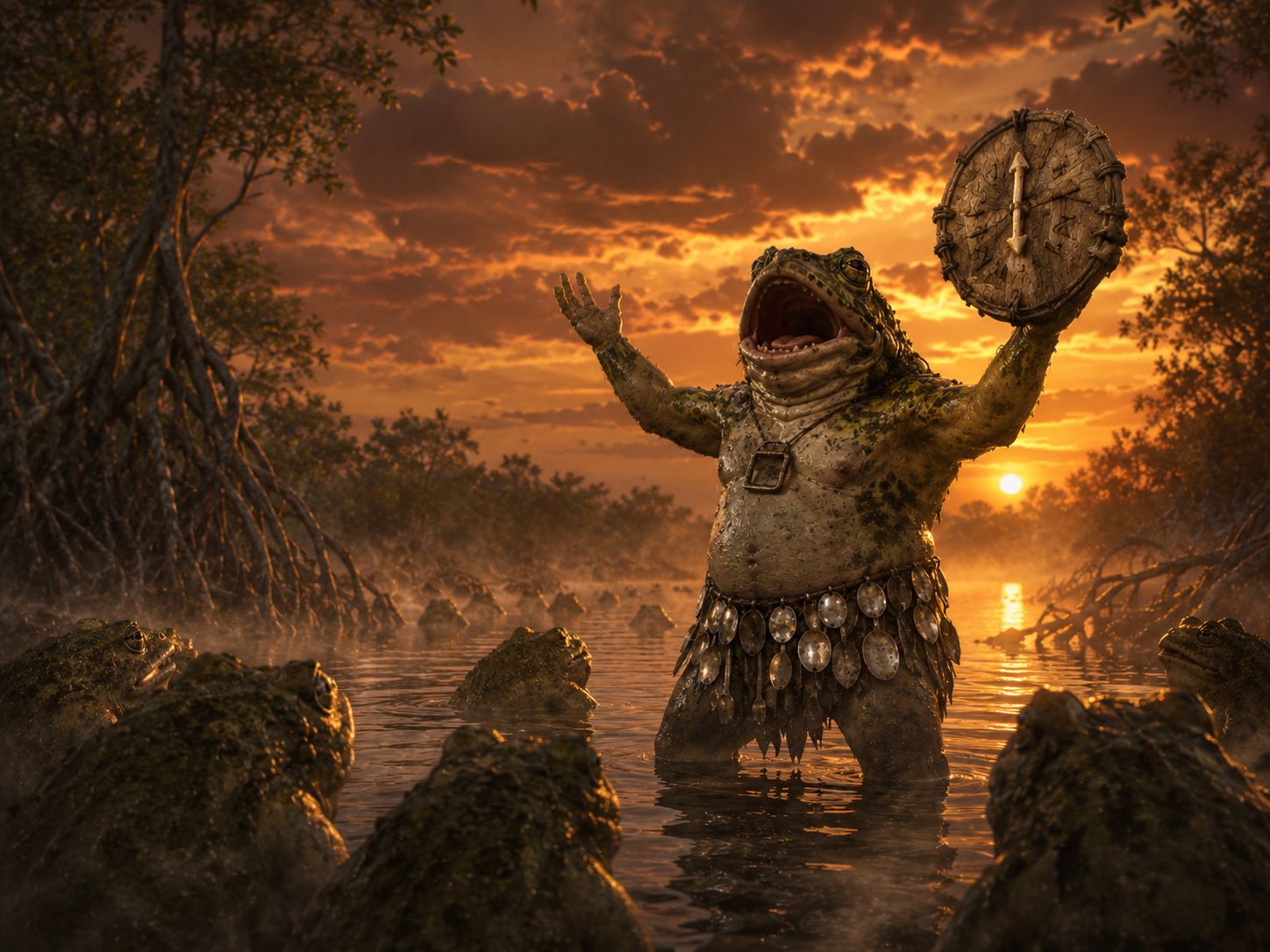
He believes the Waverider’s objects are sacred signs left by powerful dry-skin spirits or ancestors. He is solemn, proud and easily offended when holy objects are treated as mere tools. He is not cruel, but he is dangerous because he mistakes reverence for truth. He wants the crew to confirm his interpretation of the objects without challenging his authority.
Gribba the Practical Collector

She cares less about theology and more about use. Rope binds. Metal cuts. Hinges move. Bells speak. To her, the dry-skins are not gods, but they are makers of useful impossibilities. She is the easiest Fibian to bargain with and the most likely to help the crew if they offer something genuinely valuable.
Slib of the Reed-Eyes, the Guide

He remains the crew’s eager guide. In Ulmba, he becomes more self-important, because bringing the dry-skins inward gives him status. He should keep asking for gifts, explaining things wrongly and trying to stand near important people.
Takk-Takk and Urrm the Altar Guards
They are mostly visual presences unless needed. They float in a pool surrounding the altar, only their eyes visible, very still, half comic and half threatening, watching hands more than faces.
The Altar of Dry-Skin Wonders
The altar is the center of the village’s new religious tension. It stands on a raised root platform above a still black pool, surrounded by hanging bones, shells and strips of old sailcloth. There is no dry path to it. It stands in the center of a pool. Some items are real Waverider objects. Some are Fibian copies. The Fibians do not always distinguish between the two. To them, both belong to the same revelation.
The altar should change the mood. Until now, the Fibians have seemed greedy and amusing. Here, the crew realizes that the gifts and stolen objects have become sacred. The joke remains, but it gains weight.
The map is the important object. It lies near the center, folded and bound under a polished shell weight. The crew can see enough to recognize route marks, coastline lines and Waverider notation, but not enough to read the hidden destination.
No outsider is allowed to touch any of it.
Krothik climbed onto the root platform with the care of a priest entering a temple, though the temple was a twisted mangrove root and the congregation was half submerged in mud.
He spread both webbed hands.
"See," he croaked. "Dry-skin wonders."
The crew stood below the platform while Slib puffed himself up beside them, as if he had personally invented the altar. Vrroth-Kal watched from a pool in the shade. Gribba crouched near a basket of gifts, already sorting them with quick, greedy fingers.
Krothik lifted the first object. It was a rusted hinge tied with reed cord between two small bones.
"Opening bone," he said. "Makes dead wood remember how to move."
He bent it back and forth. It squealed.
Several Fibians murmured in awe.
Nera looked as if she wanted to say something. Ayesha touched her elbow very lightly. Nera said nothing.
Krothik placed the hinge down and lifted a cracked brass bell.
"Throatbowl. Voice inside. No lungs. No tongue."
He struck it with a fishbone. The bell gave a dull, wounded clang. Krothik nodded gravely, as if it had answered a difficult question.
"Still speaks."
Next came a chisel, dark with age.
"Holy fang. Bites stone. Bites wood. Bites not-flesh unless foolish."
He looked meaningfully at Slib, who looked away.
On the rear of the altar sat a bottle sealed with wax and wrapped in strips of stained cloth. Krothik did not touch it, only bowed his head.
"Vision-water. Fire in belly. Otto drank. Then Otto sang battle-song to mud."
"That sounds like Otto the Dwarf," Thaleia murmured.
Scarnax gave her a look.
Krothik moved to a small shell bowl holding the false compass from earlier. He spun the bone sliver with his left hand, against the sun’s path. It wobbled, stopped and pointed at nothing useful.
"World-eye," he said. "Now better."
Ayesha inclined her head. "Clearly."
At last Krothik stepped aside and revealed the object beneath the polished shell weight.
The map.
It was old, creased and stained at the edges. Part of it showed coastlines, careful marks and the unmistakable habits of a trained navigator’s hand. The rest was hidden inside the fold. A line vanished beneath the crease, continuing toward a name the crew could not see.
Krothik touched the shell weight, not the map itself.
"World-skin," he said, quieter now. "Dry-skins leave. Swamp keep. Water remember path."
For the first time, the altar did not seem funny.
It was still absurd. Still wrong in a dozen ways. But the Fibians around them had gone silent, and Krothik’s pride had become something harder than pride.
"Dry-skins see," he said. "No touch."
Takk-Takk and Urrm shifted at the edges of the platform, just enough for everyone to notice their spears.
Slib whispered, delighted and afraid, "Big wonder."
Scarnax looked at the folded map, then at Ayesha.
Ayesha did not move.
"Yes," she said softly. "A very big wonder."
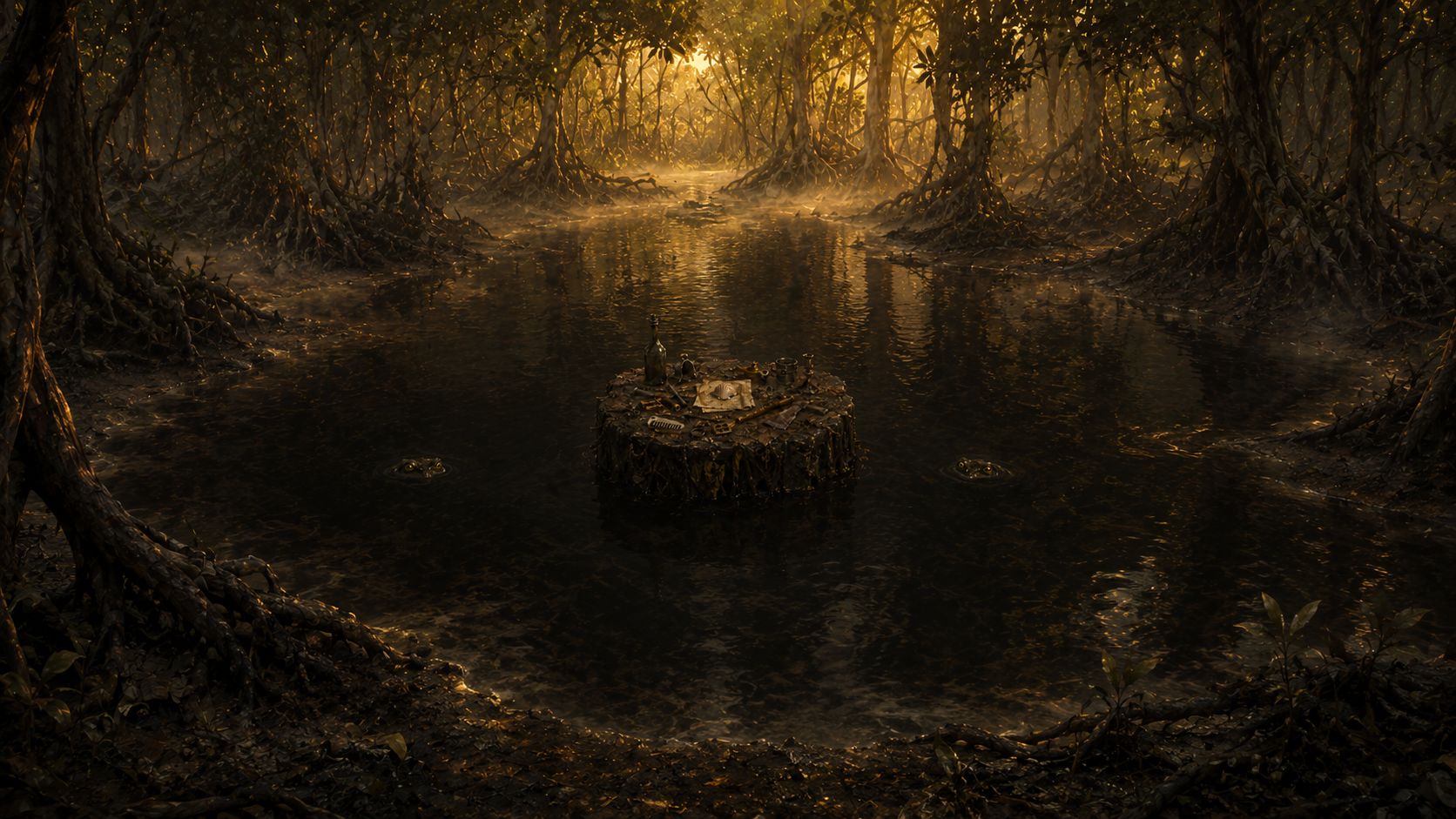
Use the altar to reveal the truth of the arc. The Waverider objects are not just trophies. They have become holy objects, political leverage and proof that Krothik’s interpretation of events matters.
Let Krothik proudly explain each object. Keep the explanations short, serious and wrong. The humor comes from his certainty, not from mockery.
Important objects can include a hinge, bell, chisel, bottle of old liquor, false compass, brass lantern, coil of rope, broken lens, metal cup and any gift the crew has already given. If Nera gave a music box, place it near the center and have Krothik treat it as a singing spirit, winding it with great reverence.
The map must be visible but not accessible. The crew should understand that it matters, and that the hidden fold contains what they need. They should also understand that touching it openly will cause immediate outrage.
The guards in the pool make the taboo practical. Reaching the map means entering Fibian ground, even if it is only a few steps away.
Do not solve the map problem here. This scene creates the problem. The heist begins when the crew starts planning how to see the hidden part.
The Heist
The crew has seen the map, but the Fibians will not allow outsiders to approach the altar. The task is simple: learn what is hidden inside the folded world-skin without turning Ulmba hostile.
Do not present this as a puzzle with one intended answer. Present the situation clearly, let the players argue, observe and improvise, then reward any plausible plan. The clue should be gained. The question is what it costs.
The Altar Is Forbidden
No dry-skin is allowed onto the altar platform or into the pool around it. Krothik explains this bluntly if asked. "Dry-skin eyes see. Dry-skin hands no touch."
The taboo applies to every object on the altar, not only the map. Even leaning too close draws warning croaks from Takk-Takk and Urrm. The guards float in the pool with only their eyes above the surface, watching hands more than faces.
The map is close enough to be seen, but not read properly. The fold hides the important section.
The crew does not need to take the map. They only need the information hidden inside its fold. A plan that lets them read the next destination, memorize the visible name once revealed, glimpse it from above, trick Krothik into opening the world-skin or distract the Fibians long enough for someone to see the relevant section is enough. Stealing the map is possible, but it is the bluntest and most dangerous solution.
Daily Routine Around the Altar
The altar is busy during the day. Krothik visits often to croak over the objects, spin the world-eye, strike the throatbowl and show new gifts to watching Fibians. Slib lingers nearby whenever possible, hoping to seem important. Gribba comes to inspect useful objects and argue quietly about whether some holy items would be better used than worshipped.
Vrroth-Kal visits less often, but his appearances matter. When he comes, other Fibians grow quieter. He checks the gifts, watches the crew and studies who speaks to whom.
At dusk, Krothik performs a longer ritual. This draws attention away from the village, but not from the altar. At night, the altar has no formal guards, but Ulmba never truly sleeps. Fibians move through pools, under platforms and across roots at odd hours.
Further Gifts
More gifts improve mood but do not grant direct access. Krothik accepts offerings, Gribba evaluates them and Slib becomes excited, but the rule remains. Gifts can create opportunities, not permission.
A good gift might make Krothik perform a ritual with it, causing movement around the altar. A practical gift might draw Gribba into conversation. A strange gift might make Slib brag that he knows the dry-skins best. None of these let the crew simply walk up and unfold the map.
Talking to the Important Fibians
Krothik will not provide access. To him, touching the altar without ritual authority is pollution. He is proud, not flexible.
Gribba will not provide access either. She is practical enough to understand the crew wants something, but she will not openly cross Krothik unless the trade is extraordinary and the risk small.
Vrroth-Kal will not provide access. He suspects the crew wants the world-skin and sees no reason to make that easier. If anything, direct requests make him more watchful.
Talking still matters. These conversations can reveal routines, tensions and openings. They just should not solve the problem by themselves.
Bribing the Guards
Takk-Takk and Urrm cannot be bribed in any simple way. They are altar guards, and guarding the altar is the one thing they understand clearly. Gifts may distract them for a moment, but not buy permission.
If players try to bribe them, let the guards become interested, confused and tempted, then have one of them croak for Krothik before accepting anything. This makes bribery dangerous without making the guards seem too clever.
Deception
Deception is one of the most natural approaches. Gifts combined with a convincing story can create access, movement or distraction.
The crew might claim an object must be blessed beside the world-skin. They might say a gift only sings if placed near other wonders. They might convince Krothik that the world-eye must be spun while the folded world-skin is opened. They might persuade Gribba that a tool can help preserve the map. They might invent a dry-skin ritual which requires the map to be shown but not touched.
The lie does not have to be perfect. It has to respect Fibian logic and preserve Krothik’s dignity.
Stealing
The altar is not formally guarded at night, but stealing is still risky. Fibians move through Ulmba constantly. Some sleep in pools. Some hunt at night. Some watch the altar from habit, curiosity or suspicion.
A theft plan can work if the crew accounts for water, noise, watchers and escape. The map is weighted, folded and surrounded by other sacred objects. Disturbing too much may be noticed even if no one sees the thief.
A clean theft gets the information and delays the alarm. A clumsy theft gets the information but starts the escape immediately.
Using the Trees
The mangrove canopy is almost unbroken over Ulmba. Most dry-skins cannot use it safely, but Ileena can. She is skilled enough to climb above the village, move through branches and look down onto the altar from an angle the Fibians may not expect.
This does not solve everything automatically. Leaves, shadows and the fold still make the map hard to read. However, Ileena can scout routines, identify blind spots, help lower a tool or position herself to see the map if someone else creates an opening below.
Using the canopy is a good way to reward the crew for involving the right person.
Violence
Violence is a bad solution. It may work for a moment, but it leaves the crew deep in Murkwater, outnumbered by people adapted to the pools, roots and darkness. Even if the crew defeats the Fibians near the altar, they still have to escape through hostile water.
Make this clear through the environment rather than warning the players directly. Show how many eyes watch from pools. Show how quickly croaks carry. Show how easily Fibians vanish under platforms. A fight here is not impossible, but it is a decision to turn the entire village into enemy territory.
Running the Heist
Describe the altar, the guards, the routines and the three important Fibians. Then step back.
Let the players build their own plan. Do not shut down reasonable ideas because they do not match an expected solution. If the plan uses established facts, named characters, gifts, routines or the environment, let it work.
Success should reveal the hidden destination, Tazenga in N'Gazama. Complications can still follow. A guard sees too much. Krothik becomes suspicious. Gribba demands payment. Slib misunderstands and makes the lie worse. Vrroth-Kal realizes the crew wanted the map all along.
The goal is not to stop the crew. The goal is to make them earn the clue in a way that feels clever, risky and properly absurd.
The Alarm
If the crew handles the heist cleanly, no alarm is needed. If they managed to get a sneak peek unnoticed, no one will know, and no alarm will be raised.
The Fibians may only become suspicious later, after the Blue Marlin has already left Murkwater. If the crew is seen touching the altar, caught near the world-skin or exposed in a lie, the alarm spreads through Ulmba as a rising chain of croaks.
Do not make the alarm sound organized. This is not a military response. Fibians shout over one another, leap into pools, argue about what was stolen, demand more gifts, accuse Slib of trusting the dry-skins and ask Krothik what the omens mean. The danger comes from numbers, terrain and confusion, not discipline.
The first sign is silence. Then one Fibian croaks. Then another answers. Then the whole village seems to ripple.
The Fibian Response
Krothik’s first concern is the altar. He rushes to the root platform, checks the world-skin and the other holy objects, then begins furious ritual croaking. If the map remains in place, he is angry but not panicked. If an object is missing or disturbed, his outrage becomes the center of the village.
Vrroth-Kal tries to restore order. He does not want a massacre unless the crew forces one. He wants the dry-skins contained, questioned or driven out without further damage.
Gribba looks for the practical angle. If the crew still has valuable gifts, she may shout for them to drop tribute and go. Slib panics, defends himself badly and may accidentally make things worse by insisting that the dry-skins are "good-good" while pointing directly at wherever they are hiding.
Takk-Takk and Urrm pursue only if the altar has been touched or insulted. Otherwise, they stay near the sacred pool, which means the crew can escape more easily if they did not desecrate anything.
Escaping Ulmba
The escape should feel messy, comic and tense, not deadly and grim. The Fibians know the swamp better than the crew, but they are not hardened soldiers. They surface too early, shout warnings too loudly, block paths that were already blocked, demand gifts and get distracted by thrown tools, dropped gifts or arguments about who gets to keep what.
Use the village terrain. Skiffs are moored under platforms. Bridges sag and sway. Pools connect beneath roots. Mangrove branches form a tangled roof overhead. A dry path may end suddenly at black water. A water path may be blocked by two angry Fibians who forgot that dry-skins need a skiff.
The crew can flee, hide, bargain, create distractions, throw gifts, split pursuit, use the canopy or let Slib’s confusion buy time. Clever improvisation matters more than speed.
Keeping the Tone Right
Murkwater Fibians should remain dangerous in principle but manageable in this arc. A bone dart landing in the skiff is better than a lethal ambush. A hunter surfacing with great menace, then demanding a gift, is better than a perfect tactical trap.
Let the players feel pressure, but do not turn the escape into another Drowned Marshes survival sequence. This is a noisy scramble out of a village that feels insulted, not a desperate flight through horror.
Possible Costs
The crew gets away with the clue. The cost depends on how badly the alarm was raised.
They might lose gifts, tools, damage to a skiff, a pack, a weapon or one of Nera’s creations. A crew member might take a minor wound. Thaleia might have to publicly apologize again. Ayesha might have to promise a future tribute. Slib might declare that the dry-skins now owe Ulmba "three rrropp and one song-box" before letting them pass.
If the crew behaved with some respect, the Fibians remain offended but not enemies. If the crew desecrated the altar or mocked the objects, Murkwater remembers them badly, though even then the escape should stay short. The real lesson is not that the Fibians are terrifying. It is that they are strange, touchy, persistent and not as harmless as they first seemed.
Act Summary
Tone and Mood
Murkwater is a short comic heist in a strange swamp, meant to give the campaign room to breathe after darker arcs. The tone is odd, damp and suspicious rather than grim. The Fibians are funny because they misunderstand the outside world, not because they are stupid.
The crew should leave amused, slightly exasperated and aware that the swamp was more dangerous than it first appeared.
Understanding the Fibians
The crew learns that Murkwater Fibians are basically friendly if treated with respect. They are greedy for gifts, difficult to understand and quick to attach strange meanings to ordinary objects, but they can be bargained with. They are not disciplined warriors or sophisticated diplomats, but they know their swamp and cannot be dismissed as harmless.
They confuse names with roles, misunderstand tools, value simple worked objects and interpret dry-skin behavior through their own swamp logic. Rope, bells, tools, hinges, music boxes and maps all become wonders because the Fibians lack the context to separate function from meaning.
The Waverider as Revelation
The crew discovers that the Waverider did not merely pass through Murkwater. It accidentally became the foundation of a new Fibian cult. Objects traded, stolen or misunderstood from the Waverider have become holy artifacts, kept on the altar in Ulmba and explained through Fibian ritual.
Solonex, Otto and the others are no longer only remembered as visitors. To the Fibians, they are roles, omens or half-divine dry-skin figures whose objects changed the village forever.
The Blue Marlin’s New Gospel
By bargaining with the Fibians, correcting rituals, leaving gifts and interfering with the world-skin, the Blue Marlin likely adds a second revelation to the same growing religion. Whatever the crew leaves behind may become sacred. Nera’s music box, a broken sextant, a cooking pan or even a misunderstood promise can become part of the altar’s future meaning.
The crew may suspect that, one day, the Fibians will speak of them the way they now speak of the Waverider: wrongly, reverently and with absolute confidence.
Clue and Direction
The important clue comes from the folded map on the altar. Whether the crew reads it through deception, stealth, trade, canopy scouting or another clever plan, they learn the next destination in the Waverider’s trail.
The trail now leads to N’Gazama, Tazenga.
Lingering Consequences
If the crew treated the Fibians respectfully, they leave Murkwater with strange goodwill and perhaps a promise of future gifts. If they deceived or offended them, Murkwater remembers them as tricksters or thieves. Either way, the arc should not end with hatred unless the crew acted cruelly or violently.
The main consequence is expectation. The players have now met Fibians as confusing, comic and manageable. That impression matters later, when other Fibians may not be so forgiving.
The Blue Marlin sailed east under a dark evening sky, leaving Murkwater behind as a green smudge on the horizon. The deck still smelled faintly of swamp mud. A coil of damp rope lay near the rail, marked with little webbed handprints where the Fibians had tried to claim it one last time before departure.
Ormun stood near the bow, one massive hand resting on the rail. Beside him, Nephyla watched the waves with her silver headband catching the light. For a while neither spoke. The sea did enough talking for both of them.
Ormun gave a low chuckle.
Nephyla glanced at him. "What is funny?"
"I was thinking," he said. "We are gods now."
Her mouth curved faintly. "I have been a god. It is overrated."
"Yours was not much like freedom."
That made her look at him properly.
Ormun kept his eyes on the water. "All those people bowing. Priests speaking for you. Servants touching your clothes before you moved. Everyone saying you were divine." He shrugged one shoulder. "Still sounds like a cage."
Nephyla’s first response was almost anger. Habit brought it to the surface, sharp and ready. Then it faded before she spoke.
"I had power," she said.
"Yes."
"I had jewels. Servants. Rooms no common person could enter. Men and women lowered their eyes when I passed."
"Yes."
She looked back toward the horizon. "And I had no choice."
Ormun nodded slowly.
The words seemed to settle into her only after she had said them. Her face changed, not with surprise, but with recognition arriving late.
"That is it," she said quietly. "That is what I have not been able to name."
Ormun looked embarrassed now, as if he had accidentally done something clever in public.
"I have seen enough slavery to recognize it," he said. "Even when it has gold on it."
Nephyla did not answer at once.
He continued, voice low and plain. "I was part of a family once. Truly. They loved me. I loved them. Phaedros was my brother in all but blood. But I was still owned. If someone had asked whose I was, there would have been an answer."
Nephyla’s fingers tightened on the rail.
"My father owned me," she said. "Not by law, perhaps. By blood. By godhood. By fear. By the shape of the world around us." She swallowed. "For all practical purposes, I was his property."
Ormun turned his head toward her.
She gave a small, bitter smile. "It seems we are more alike than we look."
"There is more to a person than the outside."
"Yes." She looked at him then, fully. "Once, I would never have considered being friends with an ogre. I do not say that with pride. I barely understood friendship at all. People were servants, rivals, tools, threats or decorations."
Ormun said nothing.
"But you," she continued, and the words came more carefully now, as if each one had to be chosen by hand. "You are none of those things. You are my friend. A very special one."
For a moment Ormun only stared.
Then his face split into a grin so wide and unguarded that Nephyla almost stepped back from the force of it.
"Good," he said. "That is mutual."
He took her hand in both of his and shook it with such earnest force that her bracelets rattled up her wrist.
Nephyla stared at their joined hands, startled, then began to laugh. Not a court laugh. Not a practiced sound. Something smaller, stranger and real.
At the rail, Ormun laughed with her, deep and warm, while the Blue Marlin carried them onward toward N’Gazama and whatever waited beyond the next horizon.