Campaign: Mataraaj
Act Synopsis
This arc brings the Blue Marlin into Mataraaj at the height of the War of the Peacock Throne, a land of white marble, incense, ritual and courtly beauty hollowed out by years of civil war. The crew arrives looking for information about the Waverider’s passage, but the truth is held by Maharaja Samyra Devi, and she will not part with it freely. To gain what they need, the crew must let themselves be drawn into palace intrigue, covert violence and moral compromise in a country where refinement and brutality live side by side. Mataraaj is ruled from splendid halls, but the war is visible everywhere, in wounded soldiers, anxious bazaars, delayed couriers and the quiet understanding that rulers decide the deaths of thousands while dining in comfort.
This is also one of the most personal arcs for Ayesha. She was raised in the courts of Mataraaj and knows instinctively how this world speaks, flatters, tests and lies. Her return should feel useful and painful at the same time. She can open doors, read codes of status and help the crew survive the social layers of the court, but she is also stepping back into the very world she fled, a world where diplomacy became warfare and every polished room concealed a trap. This makes her a natural guide through the arc, but never a simple solution. Her knowledge is cultural and instinctive, not omniscient.
The emotional destination of the arc is not triumph, but contamination. The crew should leave Mataraaj with the information they came for, but also with the lasting sense that privacy inside the mind is fragile and that they have let themselves be used by people who can justify almost anything in the name of rule. That fits the campaign’s broader structure well, where each stop on the search for the Waverider reveals not only a new clue, but also another piece of what the crew is becoming.
Arrival in Vardhana
The Blue Marlin reaches Vardhana, capital of Mataraaj and seat of the Peacock Palace. The city should feel magnificent and wounded at once. Bazaars still blaze with color, dancers still perform, priests still chant, nobles still move through marble courtyards in silk and jewels, but the war presses in from every angle. Begging veterans limp through the streets. Public criers proclaim royal promises of grain and victory while the crowd answers with a mix of hope, cynicism and calculation. Armed patrols move through districts where every conversation pauses just a little too long when soldiers pass. The city is functioning, but the strain is obvious.
Ayesha is the crew’s best route into this first layer. Through old names, remembered protocols or surviving contacts among minor courtiers and servants, she can secure the crew an audience that outsiders would struggle to obtain. This should immediately establish both her value and the emotional cost of her return. The old rhythms of Mataraaj come back to her easily, which is precisely why they should feel dangerous.
Audience with Samyra
Maharaja Samyra Devi receives the crew in splendor. She should come across as intelligent, composed and more fit to rule than many of her enemies, but also as a woman shaped by palace life to the point that she cannot truly see beyond it. She likely does care about the common people in the abstract, but she understands them only through reports, policy and symbols of rule. She has repaired canals, maintained supply lines and cultivated the image of a dutiful ruler, but she also delays urgent matters for ceremony, keeps luxury around herself while the country bleeds and treats the preservation of her throne as identical to the preservation of the realm. She feels that she is the rightful heir, and thus the rightful ruler, and thus the best person for the people. She is the least bad option, not a good one.
Samyra confirms that she has the information the crew wants about the Waverider, but she demands payment in deeds rather than coin. Her terms are twofold. First, a rival raja, Raja Devraj of Manpur, has taken her mentalist, Ruhen Vesh, a thought-weaver used to interrogate prisoners and expose hidden knowledge, and is now putting that same man to work for the enemy. Samyra wants him returned. Second, she wants the rival’s spymaster, Rajiv Varma, killed. The crew does not need to perform the murder themselves. She has already arranged for a specialist, the White Lily, to carry out the assassination. The crew’s role is to get the White Lily into position and support the broader operation.
This is the point where the crew is drawn fully into Mataraaji politics. They are no longer just investigators following the Waverider’s trail. They are now acting as deniable tools of a ruler who may indeed be the better claimant, but who still employs assassins and mind mages as instruments of state.
The Job Samyra Wants Done
The target is Manpur, the capital of the rival raja, a court still functioning behind walls, ceremony and status despite the surrounding war. The crew must travel there carrying two objectives hidden within one operation. The first is to extract the captured mentalist alive. The second is to infiltrate the White Lily so that she can reach the rival spymaster. These goals align at first, but they create tension later once the operation begins to break apart.
The White Lily should enter the arc as an unnerving professional, not as an ally in the ordinary sense. She is courteous, exact and unreadable, a figure who treats murder as craft and expects competence from those around her. She does not explain herself, does not invite closeness and should never lose her mystique. Even when cooperating, she feels adjacent to the crew rather than part of them.
The First Heist: Getting In
Once the crew reaches the rival capital, the arc opens up. This phase should be run as a social and logistical search rather than a single puzzle. The crew must identify who can secure them access to a major palace function or courtly gathering where the White Lily can disappear into the machinery of the household and where the crew can begin their own search for the captive mentalist. Progress can come through bribery, seduction, negotiation, forgery, social performance, manipulation of rivalries or the quiet use of old Mataraaji etiquette that only Ayesha truly understands.
This phase should feel elegant and controlled. The tension comes from preparation, timing and the fear of being seen through, not from open panic. The crew is making a plan, building a disguise, arranging introductions and choosing which lies to tell. Ayesha shines here, not by solving everything alone, but by recognizing details the others would miss, which official matters more than he seems to, which servant is listening for someone else, which invitation is too convenient and which compliment is actually a test. The goal is not just to get inside, but to feel the seductive pull of competence in a dangerous court.
The Palace Interior
Once inside the event, the crew and the White Lily split up. This separation is important. It preserves her mystique and makes it clear that although their goals align, they are pursuing different tasks by different methods. The crew now has to navigate a living palace full of guards, servants, nobles, hidden loyalties and silent observation.
During this phase they spot a familiar face, a courtier named Ishvar Dain they saw earlier at Samyra’s palace. He is not merely a background functionary, but someone whose presence immediately tells the crew that both courts are saturated with spies. This moment should force a quick decision. They can eliminate him, misdirect him, avoid him or race ahead before he can act, but from here on the operation is under pressure. The crew is no longer simply sneaking through hostile territory. They are moving through a web of watchers.
The Mentalist
The crew eventually reaches the captured mentalist. He should not feel grand or theatrical. He is best played as an ordinary looking man with a sordid appetite and a dangerous gift. He is not a cackling villain or a tragic mystic. He is a peeping tom of the soul, a man who snoops because he likes it and who has survived by attaching himself to powerful patrons who can protect him from the hatred his kind inspires. He is frightened, practical and cooperative, but there should be something immediately wrong about him. He notices too much. He seems to know things he should not. He slips into private thoughts almost by reflex.
Mentalists are already treated as figures of violation rather than wonder. Their power is feared not simply because it is useful, but because it strips dignity and privacy from its victims and corrodes the mage’s own identity as well. That should shape how every court in this arc treats the man, including Samyra’s own.
The Collapse of the Plan
Just as the crew is about to leave with the mentalist, the plan breaks. A commotion erupts elsewhere in the palace. The White Lily has been captured.
This is the key tonal turn of the arc. Everything up to this point should have felt careful, designed and somewhat graceful. Now all of that falls away. The perfect operation is gone. The crew has one dangerous asset in hand, one elite assassin in enemy custody and a hostile palace that is rapidly waking up around them. This is where the second half of the arc becomes improvisational.
It is important that the White Lily’s capture does not damage her mystique. A chance sighting, one raised alarm and a badly chosen escape route are enough to trap even someone like her once the palace begins to close around her. When the crew eventually reaches her, she should reveal almost nothing. Even freed from a cell, she remains composed, turns her face away and asks for something to cover it. She does not become emotionally available. She remains the White Lily.
The Second Heist: Improvised Rescue and Escape
The second heist should feel completely different from the first. There is no longer a polished plan. The crew now has to invent one under pressure, with fewer options, less certainty and more moving parts. They must locate the White Lily, adapt to tightened security, decide how much chaos they are willing to create and still keep the mentalist alive while ensuring that the assassination objective is completed.
This phase should feel like desperate invention inside a beautiful machine. Locked doors, service corridors, rooftops, shrines, water channels, servant routes and panicked nobles can all become tools or obstacles. The crew may need to divide, improvise disguises, bluff officials, create diversions, exploit rivalries or turn palace routines against themselves. The first half of the arc asked, "How do we get in unnoticed?" The second asks, "How do we get out after everything has gone wrong?"
The Voyage Back
The voyage back to Samyra is quiet in all the wrong ways. Ruhen Vesh does not leer, threaten or pry with any open malice. He is polite, even subdued, and for a time that almost makes him easier to bear. Then the crew begins to notice him where he should not be. A half remembered dream shifts, and there he is, standing in the background of a childhood home he has never seen. A daydream turns for a moment toward some private fear or longing, and his face appears at the edge of it, not fully present, but close enough to poison the thought. It is never enough to prove, never anything they can seize and confront, but it happens too often to dismiss. Little by little, an awful understanding settles over them. He is in their heads, not like a knife, but like a hand slipping through an unlocked door.
That is what makes him so unbearable. He does not seem able to leave them alone. A glance lingers too long after someone wakes. A faint smile touches his mouth when no word has been spoken. Once or twice he apologizes with genuine embarrassment, as if he knows he has crossed a line, and yet it changes nothing. He keeps looking. He keeps listening. By the time the crew returns to Samyra, they no longer think of him as a man to be rescued or delivered, but as something unclean that has ridden beside them in their most private hours. It becomes painfully clear why rulers use men like him and why they keep them far from their own chambers. A mentalist is useful, but no one who understands what he is would ever want him truly near.
Return to Samyra
If the crew succeeds, they return to Samyra with both outcomes delivered. The mentalist is back in her hands. The rival spymaster is dead. Only now does Samyra finally provide the information about the Waverider that the crew came to Mataraaj to seek.
This return should not feel triumphant. It should feel stained. The crew has done ugly work for a ruler who can justify almost anything in the name of statecraft, and the war around them has never once paused to acknowledge their cleverness. Couriers still bring news of slaughter. Rulers still make calm decisions in polished rooms. The contrast between the pleasant palace world and the bodies feeding it should remain visible until the end.
Leaving Vardhana
As the crew are about to leave, an old friend appears, asking for a ride. The crew then leaves Mataraaj with the next lead on the Waverider, but also with a lingering sense that parts of them were exposed and handled by people who considered that acceptable.
Foreshadowing
Very early morning lay over the Blue Marlin in that thin gray hour before sunrise, when the sea looked like hammered metal and every sound seemed too loud. Caelin had the watch. She stood near the rail with her dark cape pulled close against the chill, one hand resting on the rigging as she scanned the water with the steady patience of someone who trusted routine more than luck.
The hatch behind her banged open.
Meyrha stumbled onto the deck as if something had thrown her there. Her blue veils had come loose. Sweat darkened her robes. For one terrible instant she looked blind, or drunk, swaying with one hand pressed hard against her temple. Caelin was moving before she had fully thought, crossing the deck in three quick strides and catching Meyrha by the shoulders before she could pitch forward. Meyrha’s body was trembling under her hands, not with fear exactly, but with the aftershocks of something that had passed through her and left her raw. Meyrha’s visions strike without warning and leave visible strain, and her otherwise calm nature breaks under their force only in these moments.
“Easy,” Caelin said, brisk but not unkind. “What happened? Are you hurt?”
Meyrha tried to answer at once and failed. She swallowed, drew one shaking breath and another, then said, “I will be all right.” Her voice was thin, as though it had been scraped raw from the inside. “But I saw something.”
Caelin tightened her grip and guided her the last few steps to a coil of rope near the mast. Meyrha sank onto it without grace, pale and drenched, one hand still pressed to her forehead.
“What did you see?” Caelin asked.
Meyrha looked up at her then, dark eyes dazed and full of the kind of dread that made ordinary fear seem childish.
“In the vision,” she said, “I learned that dreams will be destroyed.”
Caelin stared at her for half a heartbeat. Then her practical mind moved ahead of understanding, which was how she kept ships afloat and people alive.
“Stay there,” she said. “Do not try to walk. I am waking the captain.”
And before Meyrha could say another word, Caelin was already striding across the deck, boots hard on the planks, moving with the quick certainty of a woman who knew when a dawn had just become everyone’s problem.

As the crew approaches Mataraaj, Meyrha is struck by a vision.
Keep this brief and unsettling. Like her visions in general, it should be confused, fragmentary and without any clear practical instruction. The point is not to give the players a solvable prophecy. It is to plant dread.
The one phrase that comes through clearly is this:
Dreams will be destroyed.
Do not explain it yet. Meyrha does not understand what it means, only that it matters. The vision should feel like a warning without a shape, something that will only make sense later.
Arrival in Vardhana
The market of Vardhana pressed around them in a tide of silk, spice and heat. Bright awnings snapped overhead. Merchants called from behind sacks of saffron, pepperleaf and dried fruit. Sweet smoke drifted up from braziers, and the air was thick with cardamom, roasting meat and the sharp bite of pickled mango.
Yasmira looked delighted. She paused every few steps, staring at trays of sweets, fried lentil cakes and jars of preserves glowing in the sun.
“No,” she said, pointing at one stall, “look at that. I need to know how they made that.”
Nasheem smiled. “You say that in every port.”
“Yes,” Yasmira said. “Because too many cooks insist on keeping their secrets.”
Ayesha walked a little ahead of them, moving easily through the crowd, but her eyes kept measuring the street. She knew this rhythm, these voices, these colors. That was exactly why the changes stood out so sharply.
Nasheem’s gaze shifted away from the silks and spice stalls. At the edge of the street, a widow kneeled in the dust, forehead pressed against the ground, with two children pressed against her side, hand outstretched. A little farther on, a gaunt soldier leaned against a wall with a begging bowl, one trouser leg pinned up where the limb was gone.
“You could miss it,” Nasheem said quietly, “if you only looked at the beautiful parts.”
Ayesha followed his gaze, and something in her expression tightened.
“Yes,” she said. “That is how Mataraaj works.” She was quiet for a moment. “Or how it works now. This is not the Mataraaj I left.”
They found seats beneath a faded awning and were served rice, flatbread and goat stew rich with clove and onion. Yasmira tasted it and closed her eyes for a moment.
“That,” she said, “is worth crossing an ocean for.”
Nasheem gave a faint laugh, but it faded as drums rolled through the market. A column of soldiers marched past the tables, returning from some distant battle. Some were wounded, some were carried between their comrades and some simply stared ahead with the empty look of men who had left too much of themselves elsewhere. The market did not fall silent, but it softened around them.
Ayesha watched them pass.
“We will not simply be given an audience with Samyra,” she said. “Not now. We need someone who can vouch for us. Someone who can make us seem useful, or at least interesting.”
Yasmira glanced at her over the rim of her cup. “And do you know such people?”
A faint, humorless smile touched Ayesha’s mouth.
“I have a few ideas,” she said.
Farther down the avenue, another column emerged, fresh troops marching out of the city beneath bright banners, their armor catching the sun. For a moment the two lines shared the same street, one going to war and one returning from it, and Vardhana carried on between them.

The arrival in Vardhana should establish the core truth of Mataraaj immediately. The city is still beautiful. The white stone still gleams, the spice markets still roar, silk still catches the light and temple bells still ring above the street. But the war is visible everywhere once the crew looks past the surface. Beggars due to the war, public criers argue over grain and loyalty, soldiers march both into and out of the city and every market conversation seems to brush against news of betrayal, shortages or death. The mood should be layered splendor with fatigue underneath, a country still performing refinement while slowly bleeding through the fabric.
Do not run this as a danger scene. Run it as a pressure scene. The crew should feel watched only in the general sense that all capitals watch strangers, not in the sense that a knife is already at their throat. The point is not immediate threat. The point is that this is a functioning court city under wartime strain. People still buy sweets, argue over cloth and flirt in the bazaar, but everyone also knows the war is close. That contrast matters because the whole arc rests on it.
The Immediate Problem
The crew cannot simply request an audience with Maharaja Samyra Devi and expect the palace to indulge them. Vardhana is the center of a civil war. Petitioners are many, spies are everywhere and the court has little reason to trust foreign sailors with vague claims and private business. Someone must vouch for them. More specifically, someone must present them as worth Samyra’s time, whether as useful outsiders, interesting curiosities or people tied to a matter of advantage.
This is where the segment gets its structure. The crew arrives, takes in the city and then realizes they need a social bridge into the palace. The rest of the scene is about finding that bridge.
If Ayesha Is Involved
If Ayesha is present and active, this section should strongly reinforce both her value and the emotional cost of returning home. She grew up in these courts, learned to read rooms before speaking and lived through the period when diplomacy in Mataraaj curdled into camouflage and trap work. She should immediately understand that access here does not come from formal requests. It comes from the right whisper in the right ear.
Let her start with old contacts.
The first two should fail.
Not because Ayesha is suddenly ineffective, but because the war has been grinding on for years and this is what that means in human terms. One contact has died in battle despite never really being a soldier, pressed into command and buried after a defeat nobody now mentions. Another has died when a convoy was burned on the road. These failures should make the war feel personal, not procedural. They are reminders that Mataraaj has been consuming its own people for a long time.
After those failures, let Ayesha find someone still living who can help. This is a widow who now runs her husband's household, and has the Maharaja's ear. The important thing is that Ayesha’s knowledge gets them through the wall eventually, but not cleanly and not without making the city’s losses felt first.
If Ayesha Is Not Involved
If Ayesha is absent, sidelined or the players simply do not lean on her, the problem becomes slower and much more transactional.
In that version, the crew must work through the noble houses of Vardhana. They can ask, flatter, bribe, investigate and maneuver, but most houses will be cautious or dismissive. The war has made every gatekeeper more suspicious. Foreign sailors with a private request to the Maharaja could be useful, but they could just as easily be liabilities, spies or bait. Noble houses should not just be suspicious. Some should be offended. Some should see the crew as prey. Some should try to sell them onward.
Run this as a social search. The crew moves from house to house, servant to servant and intermediary to intermediary until they find one family willing to help. That help should not be free. The house may demand a substantial bribe, a favor, a compromising piece of information on a rival or proof that the crew can be useful.
This version should feel more cumbersome and less elegant than the Ayesha route. It still works, but the players should feel the absence of someone who actually belongs in this world.
Recurring NPC Opportunities
This is a good place to bring in one or two recurring NPCs, not as the center of the scene but as useful crossings in the city’s social web. Do not stack all of them into one scene. Choose one or two that fit the players’ energy and the current needs of the arc.
Amir al Javeen
Amir works well if you want energy, noise and a route into soft blackmail or leverage. He is the kind of man who stumbles into things while performing for the wrong crowd in the right district. He may know which noble son is secretly bankrupt, which household officer is visiting the wrong lover, which noble’s wife he shared a bed with or which merchant is paying twice for the same shipment. He is not a planner and should not become a clean solution, but he is exactly the sort of person who might have heard or seen something socially compromising while entertaining people too vain to notice him. Use him if you want the crew to obtain blackmail material, social gossip or an introduction through chaos rather than elegance.
Prophet Samir the Radiant
Samir works well as either comic relief, a complication or a small rescue. He may be in the middle of a fraudulent miracle when the crew spots him, already one mistake away from being beaten or arrested. He can provide a lighter tone for a moment, but he can also create immediate trouble that earns the gratitude of a local contact if the crew intervenes. Samir is excellent at reading crowds, misdirecting attention and hearing rumors in temple courtyards and taverns. If used well, he can give the players a thread toward a useful house or a corrupt servant, though never in a fully reliable or tidy way.
The Silver Moon
The Silver Moon is especially useful if the non Ayesha route needs material leverage. Captain Kiran Dhalapati is Mataraaji by origin, opportunistic by instinct and often stuck with cargoes that are bizarre, costly or surprisingly useful. He might have luxury curiosities, rare imports or strange items that can serve as a bribe cheaper than hard coin would be. He might also know which houses are hungry enough to trade dignity for novelty. If the crew wants to buy access rather than charm it, the Silver Moon can provide the sort of object a hungry for novelty court might value far above its practical worth. Keep Kiran slippery and cheerful. He should help if profit smiles on him, not out of loyalty.
How the Search Should Feel
Whether Ayesha is involved or not, this section should feel like social maneuvering under the shadow of war. The crew is not solving a mystery so much as navigating a hierarchy. Let them meet polished servants, suspicious gatekeepers, lesser nobles living behind fading grandeur and traders who smell fear beneath court perfume. Every conversation should carry a little uncertainty. Is this person cautious because they fear insult, because they fear spies or because they are waiting to sell the crew to someone else.
The scene should not bog down into endless refusals. Give the players movement. Each dud contact should reveal something, even if that something is only the war’s human toll. Each successful interaction should open the next layer. The point is to make the audience with Samyra feel earned, not delayed, and to make sure the war strain is shown.
Palace Security and Why Sneaking Is a Bad Idea
Make it clear early that simply sneaking into the Peacock Palace is a terrible idea. This is not a soft civilian residence. It is a ruler’s seat in the middle of a civil war. Assassins are a real concern. Guards are alert, nervous and under orders. Visible approaches are watched. Unknown petitioners are screened or turned away. Anyone probing the grounds too openly risks being taken for a spy or killer long before they ever reach anyone important.
That does not mean infiltration is literally impossible, but it should be framed as reckless and high risk. If the players insist on a sneaky approach, present it honestly. The walls may perhaps be climbed, servants shadowed or rooftops used, but discovery here is not a tavern brawl problem. It is a palace security problem in wartime. The likely result is pursuit, imprisonment or sudden violence from professionals who assume the worst because that is their job. The intended route here is social access, not stealth.
What Success Looks Like
Success in this segment is simple. The crew gains a credible path to Samyra.
That might mean a written introduction from a minor house, an advisor willing to speak their names at the right time, a courtier prepared to present them as useful outsiders or a noble willing to sponsor them in exchange for coin, leverage or favor. However they achieve it, the result should be the same. The crew is no longer merely standing outside the machinery of Mataraaj. They have found a place to put a hand into it.
That should feel satisfying, but not comfortable. Even at the moment of success, the city around them should still remind them what sort of place this is: splendid, wounded and entirely willing to dress necessity in silk.
Audience with Samyra
The harem of Maharaja Samyra Devi was not quiet.
It was all silk, perfume and motion. Courtiers murmured behind carved screens. Advisors waited in little clusters, watching everything. Guards stood along the walls in lacquered armor. Between them moved the young men of Samyra’s harem, oiled skin gleaming in the lamplight, beautiful in the polished way of things kept for display and pleasure. One massaged scented oil into her shoulders. Another held a silver tray of sugared figs and spiced almonds. A third fanned her with peacock feathers. A fourth waited with chilled wine.
Ayesha took it all in without showing a flicker of reaction.
Scarnax was less pleased. He kept his face flat, but his eyes had gone hard. Too many men on their knees. Too much comfort wrapped around power.
Samyra reclined on a low couch piled with embroidered cushions, gold at her throat and wrists, pearls in her hair. She barely glanced at them when their names were announced.
“Ayesha Marindar,” she said. “I had heard the sea stole you.”
Ayesha bowed smoothly. “The sea has many virtues, Maharaja. Theft is not one of them.”
That earned the faintest hint of amusement. Samyra’s gaze shifted to Scarnax.
“And this is your captain.”
“Captain Scarnax of the Blue Marlin,” Ayesha said. “A discreet man, and a capable one.”
Samyra drank from a crystal cup while one slave adjusted her cushions and another fed her fruit. She seemed only half interested.
“You have come a long way,” she said. “That usually means someone wants something.”
“Only information,” Ayesha said. “We are following the trail of the Waverider.”
For the first time she looked up with real attention.
“The Waverider,” Samyra repeated. “Yes. I know where it came from, and where it went.”
Scarnax said nothing, but the words hit like a thrown hook.
“I can tell you,” Samyra said. “But first, I require a service.”
Before she could continue, a dust stained messenger hurried in, dropped to one knee and bowed his head.
“Maharaja, word from the south. Malvek of Aranjaya's army is broken. The field is ours.”
A murmur ran through the room. The messenger went on.
“The losses were...”
“Later,” Samyra said.
Not sharply. Not cruelly. Barely looking at him.
She turned back to Ayesha and Scarnax as a slave lifted a slice of melon to her lips.
“Raja Devraj of Manpur turned against me some time ago,” she said. “In the process, he took something of mine. My chief interrogator, a mentalist named Ruhen Vesh. He is likely working for Devraj now. I want him back.”
She folded her hands.
“And Devraj’s spymaster, Rajiv Varma, has become too competent. I want him dead.”
Scarnax’s expression did not change.
“You will not be asked to do the killing,” Samyra said. “I have hired a professional for that. What I require is a neutral ship and a neutral crew to carry her where she needs to go. You will escort her. You will bring Ruhen Vesh back to me. Rajiv Varma will die. Do this, and I will give you everything I know of the Waverider.”
Silence stretched for a moment.
Scarnax did not like any of it, but the name Waverider hung between them like bait too valuable to refuse. He looked at Ayesha and gave the smallest nod.
She bowed again.
“You honor us with the opportunity to assist, Maharaja,” she said. “We look forward to returning with the mission completed.”
Samyra smiled, slow and satisfied.
“I thought you might.”
At the edge of the room, the messenger still knelt waiting with news of the dead, while one of the harem boys offered Samyra a sugared fig and she accepted it without hurry.

This scene should feel like entry into the center of power, but not into quiet dignity. Samyra’s court is active, layered and guarded. Before the crew reaches her, they pass through a bustle of chamberlains, guards, attendants and lesser officials, all of whom make it clear that access to the Maharaja is tightly controlled. Weapons are checked, suspicious items are taken away and the crew is warned not to step beyond the foot of the raised steps leading to her platform unless invited. Creases in their clothes are smoothed, and dust brushed off, with theatrical sighs of disapproval. The sense should be of a ruler who lives under constant wartime pressure and expects assassination attempts as part of ordinary governance. Samyra’s broader setting already supports this mixture of splendor, vigilance and political strain, with Vardhana functioning as the heart of a civil war while still performing courtly refinement.
Once they are admitted, the harem should establish the tone immediately. This is not a private, tender space. It is a luxurious political chamber dressed in intimacy. Male harem slaves attend Samyra constantly with snacks, wine, fans and sensual massage while guards, advisors and courtiers continue their work around her. That contrast matters. It shows indulgence, insulation and appetite without needing Samyra to speechify about her power. The room should feel fragrant, crowded and expensive, but never relaxed. Even pleasure here is part of status.
Samyra’s Demeanor
Samyra begins the scene only half interested. She receives the crew because they have successfully reached her, not because she expects much from them. At first she treats them as one more petition among many. Her attention should drift between them and the rest of the room. She drinks, listens selectively and lets them feel that they are being weighed for usefulness, not welcomed. She is not openly monstrous, but who has lived so long inside palace logic that she measures people by function before humanity.
That changes when the Waverider is mentioned.
The moment Ayesha or the crew makes it clear that this is not an ordinary petition, Samyra’s attention should sharpen. Do not make this theatrical. A slight stillness, a focused gaze or a subtle silencing of the room is enough. From that point on, she is interested because they may solve a problem for her. This is the key turn in the audience. The crew does not win her warmth. They win her attention.
The interruption by the battlefield messenger is central to the scene. He arrives with urgent news, confirms a victory over Malvek of Aranjaya and begins to continue, but Samyra cuts him off with a curt instruction to report the rest later. The point is not merely that she is cold. The point is that she hears what matters most to her first, victory, and postpones the human cost. That tells the Game Master exactly how to frame her. She is not cartoonishly cruel. She is insulated, strategic and entirely able to defer suffering when it is inconvenient.
The Mission Offer
Once engaged, Samyra lays out the bargain clearly.
She knows where the Waverider came from and where it went after leaving Mataraaj. She will share that information, but only after the crew performs a mission for her that must remain deniable.
The mission has two connected objectives.
First, Raja Devraj of Manpur turned against Samyra and took her chief interrogator, the mentalist Ruhen Vesh. He is now most likely in Devraj’s service. Samyra wants him brought back alive.
Second, Devraj’s spymaster, Rajiv Varma, has become too effective and too dangerous. Samyra wants him dead. The crew will not be asked to perform the assassination themselves. She has already hired a specialist for that work. What she needs from the Blue Marlin is neutrality, mobility and plausible deniability. They are to transport the assassin to Manpur, help enable the strike and extract Ruhen Vesh during the same broader operation.
This is where the tone of the arc should become clear. Samyra is the least bad option, perhaps, but she still uses assassins and mind-violators as instruments of rule. The crew is not being asked to do something noble. They are being invited into statecraft dressed in silk.
How to Present the Job
Present the mission as practical and unpleasant, not dramatic. Samyra should speak about it the way a ruler discusses grain routes or border disputes. That makes it colder. Ruhen Vesh is not framed as a person to be saved. He is a stolen asset to be recovered. Rajiv Varma is not framed as a hated enemy. He is a competence problem to be removed.
If the crew hesitates, do not have Samyra threaten them immediately. Let the weight of the Waverider clue do the work. She has what they need. She knows it. They know it. The room should make clear that this is a bargain offered from overwhelming advantage.
Leaving the Audience
When the crew leaves, do not let the transition feel casual. The machinery of the court should remain active around them. They are not ushered out as friends. They are processed as operatives.
A court official hands them a written brief containing the practical details Samyra is willing to share at this stage. It should include the names of the two main targets, Raja Devraj’s capital at Manpur and the likely palace locations where each objective is usually found. Ruhen Vesh is most likely held in an inner secured section tied to interrogation rooms, records chambers or guarded administrative quarters. Rajiv Varma is more likely to move through the political heart of the palace, near audience halls, private offices or elite reception spaces. The paper does not solve the heist for them. It gives them a starting frame and confirms that Samyra’s court has real intelligence inside Manpur.
Meeting the White Lily

This is the right moment to bring in the White Lily.
As they leave, a courtier named Ishvar Dain begins to make the introduction in the usual polished fashion. Before he gets more than a few words out, the White Lily cuts him off with a calm, economical: "We’ve met."
She is controlled, polished and economical in speech, even when cornered, and she treats work as craft rather than melodrama. She respects skill, dislikes amateur disruption and tends to speak in short measured phrases.
She then turns to the crew and says, "So, let’s get going, then." She draws a scarf before her face to conceal the mask beneath and takes the lead without waiting for ceremony to catch up. That preserves two things at once. It keeps her mysterious and it makes clear that, unlike the rest of the court, she is already mentally in the next scene.
The White Lily on the Voyage to Manpur
From this point on, the White Lily should remain adjacent to the crew rather than joining them emotionally. She is courteous, precise and fundamentally professional, not warm. She may cooperate without hesitation when goals align, but she never becomes ordinary company.
She never reveals her face.
She keeps the mask hidden behind a scarf, hood or other covering when in ordinary view, and if she must adjust anything she does so in private. Even during tactical discussions she does not unmask. That matters because once she becomes visually ordinary, part of her mystique evaporates.
When not discussing the job, she keeps to her cabin. She eats there as well. She does not linger socially with the crew, does not swap stories and does not invite familiarity. If spoken to casually, she may answer with brief courtesy, but she gives nothing away. Let the Game Master preserve the sense that the crew is transporting a legend, not gaining a new companion.
In tactical conversation, she should be useful and exact. She talks about timing, routes, routines and escape possibilities. She never boasts and never threatens. If asked how she works, she redirects toward what the crew needs to do. If pressed on who she is, she simply declines to answer. The point is to make her presence feel professional and slightly unreal all the way to Manpur.
What the Scene Should Accomplish
By the end of this audience, the crew should understand four things clearly.
- Samyra has the information they need.
- She will only trade it for ugly work.
- The job is real, dangerous and politically sensitive.
- The White Lily is not a normal ally, but a contained force moving beside them.
If those four truths are in place, the audience has done its job.
The First Heist: Getting In
Once the crew reaches Manpur, the arc should open up rather than narrow down. This is not a lock with one key. It is a social maze. The crew knows what they need: a way into a major palace function, feast, reception or private celebration where movement is possible, faces blur together and the White Lily can slip into the household without arriving as herself. Their real task is to find the person, opening or pressure point that gets them there.
Run this phase as a search through layers of society rather than as a single clue chain. The crew should move through salons, courtyards, merchant houses, servant routes, shrines, pleasure gardens and private dinners, learning who matters, who pretends to matter and who can actually open a door. The point is not simply to gain entry. The point is to let the players feel clever while moving through a court that rewards poise, timing and nerve.
This part of the arc should feel elegant and controlled. The tension is not "Will the guards attack" but "Will the wrong person notice a flaw." The crew is preparing disguises, choosing names, arranging sponsors, planting lies and deciding which version of themselves to present. If they succeed, it should feel like a dance performed over a pit.
The Mood in Manpur
Manpur should feel different from Vardhana.
Vardhana is weary splendor under strain. Manpur should feel tauter, more suspicious and a little sharper at the edges. The rival court is still rich, still ceremonial and still beautiful, but there is less softness in it. Raja Devraj’s capital should feel like a place where everyone assumes betrayal is possible and many quietly assume it is likely. Guests are observed more carefully. Servants are more afraid. Courtiers smile with greater effort. Success here feels harder won.
The palace itself should feel too large to brute force. The crew should understand quickly that they are not sneaking over the walls and just wandering until they find what they need. They need a legitimate reason to be inside, or at least the appearance of one. Even the White Lily needs that.
The Core Problem
The crew needs access to a major event inside the palace or one of its attached elite compounds. It should be large enough for crowd flow, status confusion and parallel agendas. A feast, a reception for officers returning from campaign, a religious observance attended by the court, a wedding negotiation, a poetry evening for favored nobles or a formal celebration of some recent victory all work well.
The event matters because it creates cover.
The White Lily needs the kind of environment where servants, entertainers, visiting merchants, lesser nobles and functionaries overlap long enough for her to slip inward.
The crew needs the kind of environment where they can plausibly move, observe, split up and begin working toward Ruhen Vesh.
Without such an event, the palace is too rigid. With one, it becomes a machine under strain.
How to Run the Search
Run this as accumulating leverage and access.
Each contact, favor, bribe, lie or performance should move the crew one layer closer to the palace. Do not make them guess one exact solution. Let them build one from the tools they find. A bribed servant might reveal which noble house has been slighted and wants a guest to embarrass a rival. A flirtation might uncover that a chamberlain is desperate for imported perfume. A forged letter might only work if paired with the right accent, clothes and etiquette. Ayesha may recognize which household still follows old court forms and which has embraced Devraj’s harsher style.
Ayesha should shine strongly here if she is present. This is her terrain. She can notice that the wrong servant is too well dressed, that a compliment contains a threat, that a gatekeeper is from an old household and can be appealed to through obsolete forms of respect. She should not solve everything for the crew, but she should keep turning uncertainty into actionable detail.
If Ayesha is not involved, the phase becomes rougher and more expensive. The crew can still succeed, but they will lean more on bribery, forgery and luck, and they are more likely to offend someone without realizing it.
The White Lily’s Role
The White Lily should be involved in planning, but not in social charm.
She is best used as a specialist whose requirements shape the plan. She can tell the crew what kind of access she needs, how much time she wants between entry and strike and what kinds of escape routes she prefers. She may point out weak assumptions in a plan. She should not be the one sweet talking gatekeepers or playing court games. That would dilute both her mystique and Ayesha’s value.
She is the blade the crew is carrying into the room. The challenge is getting the blade close enough.
What Success Looks Like
Success does not mean the crew is safe.
Success means they obtain a believable route into the chosen event, with enough social cover to enter the palace and enough information to begin the next phase. They should know what role they are playing, who is sponsoring or admitting them and what their first moves are once inside.
By the end of this section, the players should feel that they built the plan themselves. Even if the Game Master supplied many of the ingredients, the final shape should feel like their own lie.
Possible Ways In
Use these as options, ingredients or backup routes. Do not present them all at once unless the players are truly stuck. Let the city reveal them through play.
Not every route is equally easy to combine with the White Lily. Some routes are excellent for getting the crew in, but awkward for concealing her.
This list is not exhaustive, if the players come up with a good plan, go with it.
Through a Slighted Noble House
A lesser noble house has been insulted by Devraj’s inner circle and wants to embarrass a rival by arriving with exotic guests, expensive curiosities or useful specialists. The crew can secure entry by offering status, novelty, gossip or leverage. This is one of the cleanest routes because it gives them a sponsor, but it also ties them to a house that may expect repayment later.
Through a Servant Network
A senior servant, quartermaster or wardrobe mistress can be bribed, blackmailed or persuaded to slip additional personnel into the palace staff for a major event. This route is good for disguises and backstage access, but it places the crew among people who notice practical details. A wrong knot, accent or tray carrying technique may expose them faster than courtly conversation would.
Through Entertainers
The palace is hiring musicians, dancers, storytellers, beast handlers, illusionists or foreign curiosities for the event. The crew can attach themselves to an entertainment troupe, replace one or sponsor one. Traditional Mataraaj theatre makes heavy use of masks, which gives the White Lily unusually good cover. This gives strong cover for bringing unusual people in, possibly including the White Lily, but it also means being watched while performing a role in public.
Through Merchants and Luxury Delivery
A merchant house is delivering silk, wine, carved ivory, perfumes, weapon gifts or ceremonial offerings to the palace. The crew can buy in, hijack the route socially, pose as caravan guards or attach themselves as specialists overseeing rare cargo. This is a good route if you want entry through logistics rather than nobility.
Through a Religious Function
A court observance, temple rite or memorial for fallen officers is drawing priests, donors and honored guests into palace grounds. With the right robes, donations or endorsements, the crew can enter under sacred cover. This route offers dignity and some protection from crude scrutiny, but any mistake risks sacrilege as well as exposure.
Through Forged Invitation
The crew acquires or creates invitations to the event and builds identities to match them. This works best if paired with another layer, such as the right clothing, a plausible sponsor or information from a servant. On its own, forgery is brittle. It gets them to the gate, not necessarily past the second question.
Through Blackmail
A chamberlain, steward or minor courtier is vulnerable. Perhaps he gambles, keeps the wrong lover, skims funds or quietly corresponds with someone he should not. The crew can use that weakness to secure invitations, staff placement or silence. This route is effective, but dangerous if the target decides betrayal is safer than obedience.
Through Seduction
One of the palace connected figures, a bored noble, ambitious aide, lonely widow or reckless officer, can be charmed into offering access. This should never be a simple seduction roll. It should be about reading appetite, vanity and loneliness correctly. If it works, it can open elegant doors. If it fails, it can poison the whole operation quietly.
Through the Silver Moon’s Cargo
Captain Kiran Dhalapati of the Silver Moon may have exactly the sort of rare gift that buys access, a mechanical luxury, strange imported animal, exquisite weapon, rare perfume or some absurd prestige object that a court peacock would crave. The crew can use the item to attach themselves to the gift presentation or to secure favor from someone who can get them invited, but it only works if they buy the item before leaving Vardhana.
Through an Officer’s Celebration
A victorious or politically rising officer is being honored, and the event creates a looser, more martial atmosphere than a purely aristocratic gathering. Old soldiers, naval captains and foreign adventurers may be more acceptable here than at a poetry salon. This is a strong route for Amaxia or other martial crew members, but it also puts them under the eyes of veterans who notice falsehoods quickly.
Through a Household Feud
Two branches of the same great family are trying to outmaneuver one another. One side sees advantage in slipping the crew into the event under borrowed legitimacy. This route is excellent if you want the players caught between competing hosts, each assuming loyalty can be bought.
Through Ayesha’s Old World
If Ayesha is present, she may identify an old custom still observed by one household and use it to force a narrow opening. Perhaps an ancient courtesy must be honored, an old alliance still carries ceremonial weight or a widowed matriarch remembers Ayesha’s family name. This should feel especially satisfying because it turns memory and cultural fluency into access.
Useful Complications
Even if the crew secures a route in, add one or two complications to keep the phase alive.
- The event date is moved with little notice.
- The sponsor loses nerve and must be reassured or pressured.
- A rival guest list appears, forcing the crew to adjust their assumed identities.
- A servant recognizes Ayesha’s name.
- The White Lily rejects the first plan as too noisy.
- An invitation is real, but intended for someone recently dead.
- A chamberlain demands a gift on the spot.
- A show of etiquette is needed at the entrance.
These complications should not cancel the plan. They should refine it.
What This Phase Should Leave Behind
By the time the crew has entered the palace, they should feel three things at once.
- Confidence in the plan.
- Awareness that the plan is fragile.
- A dangerous satisfaction at how good they are becoming at this kind of work.
That last part matters. The first heist should seduce them a little. The second one will punish that confidence.
The Palace Interior

Once the crew is inside, the first heist changes shape.
Outside, the challenge was access. Inside, the challenge is control. The lie has worked, but now they have to live inside it. The palace should feel crowded, active and disciplined all at once. Servants move in practiced streams. Courtiers drift from conversation to conversation. Guards do not loom, but they are never idle. Music, prayer, gossip, flirtation and ceremony all continue around the crew, which is exactly what makes the place dangerous. They are not sneaking through an empty stronghold. They are moving through a living institution that notices irregularities.
The mood should be elegance under pressure. The crew can move, but never freely. Every corridor serves someone. Every closed door belongs to someone important. Every servant may be the wrong servant to be noticed by. The palace is not hostile in the obvious sense. It is worse than that. It is attentive.
Splitting from the White Lily
The White Lily should separate from the crew quickly once they are inside.
This is necessary. If she stays with them, she becomes ordinary. If she becomes ordinary, she loses much of what makes her work. She should not trail after the crew like another accomplice. She is pursuing her own part of the operation by her own methods.
Keep the exchange brief. A time. A place. A signal, if needed. Then she is gone.
That disappearance should feel easy, almost unsettlingly so. One moment she is part of the group. The next she has dissolved into the palace traffic. Once she vanishes, the crew should not see her again until the operation begins to fail.
The Feel of the Palace
The palace should have layers.
The outer and ceremonial spaces remain full of light, movement and plausible excuses to be present. Reception halls, balconies, courtyards, shrines, dining chambers and side rooms allow the crew to circulate, overhear things and test boundaries without immediately drawing suspicion.
Farther in, the tone changes. The deeper they go, the less ornamental the palace becomes. Silk and music give way to records, guarded stairwells, offices, secured corridors and people who know exactly why they are there. This transition matters. It tells the crew when they are leaving the social body of the palace and entering its working organs.
Do not run this like a trap filled maze. That would flatten the setting. This is still a court. People are still eating, serving, whispering, scheming and competing. The tension comes from passing through functioning human order, not from avoiding pressure plates in silk slippers.
What the Crew Needs to Do
Inside the palace, the crew has several problems at once.
- They must maintain the role that got them inside.
- They must begin narrowing down where Ruhen Vesh is likely kept.
- They must decide when to stay together and when to divide.
- They must avoid becoming memorable too early.
Run this as a chain of choices, not as a fixed path. Let them probe, improvise and test how much space they really have. Early on, the operation should still feel clean. They are not panicking yet. They are learning the rhythm of the place and trying not to step out of it.
The Palace Watches
This is the central truth of the interior phase.
The palace is full of watchers, but most of them are not formal spies. They are simply people whose survival depends on noticing what should not be there. A senior servant recognizes faces. A clerk notices a seal that is almost right. A guard remembers who passed through a corridor ten minutes ago. A courtier hears the wrong turn of phrase in an otherwise polished exchange.
That is how pressure should work here. Not as instant alarm, but as accumulation. A glance held too long. A servant who pauses after passing them. A question asked twice in slightly different words. A door that was unwatched a moment ago and is not unwatched now.
If the Game Master gets this right, the players should feel the palace tightening before it ever openly turns against them.
Ishvar Dain
Ishvar Dain is the hinge of this phase, and he should appear only after the crew has had enough room to start believing the plan is working.
Then they see him.
That should be enough.
He is not just a familiar face from Samyra’s court. His presence here means the two courts overlap far more than the crew may have hoped. News travels. People travel. Loyalties travel. So does treachery. The players should immediately understand that they are not operating in some neatly separate enemy camp. They are inside a political world already threaded through with other eyes.
As far as the crew knows, Ishvar might be here for Devraj. He might be here for Samyra. He might be here for himself.
That uncertainty is what makes him dangerous.
Do not play him as a melodramatic spy who points and shouts. Play him as a man who notices, thinks and chooses. The danger is not merely that he recognizes them. The danger is that he may respond well.
Possible Responses to Ishvar
Do not force a correct answer. The value of Ishvar is that he turns a smooth infiltration into a pressured one. Whatever the crew does, the air should change afterward.
Avoid Him
The crew breaks line of sight, uses the crowd and leaves him uncertain. This is quiet and practical, but it leaves him active somewhere else in the palace. He remains unresolved pressure.
Misdirect Him
The crew leans into the social game. A false identity, a casual greeting, a planted assumption or a quick lie may persuade him that he saw something other than what he saw. This buys time, not safety.
Race the Clock
The crew assumes the operation has become fragile and accelerates. Less caution. More urgency. This is a good choice if the players want momentum, but it means accepting that the palace may begin tightening around them sooner.
Silence Him
The crew tries to remove him. This should be possible, but never clean. A dead courtier is not just one less problem. It is a disappearance, a stain, a delay in some expected routine or a body someone will eventually notice.
Follow Him
This is the most interesting option. If Ishvar belongs to the palace intelligence web, he may lead the crew toward exactly the private and administrative spaces they need to understand. This can reward sharp players, but it is also dangerous, because following a watcher often means walking into the place where watchers report.
Running the Pressure
Once Ishvar appears, begin tightening the palace around the crew.
Do not leap straight to alarm unless they have been reckless. Make the pressure visible in smaller changes first.
- A guard station that seemed relaxed grows attentive.
- A servant who passed alone returns with someone else.
- A chamberlain asks a polite question that is really a verification.
- A route that was open a few minutes ago is now occupied.
- A host becomes suddenly more interested in where the crew intends to go next.
This is where good play should matter. If the players respond quickly and intelligently, give them space. If they hesitate, the palace should become steadily less forgiving.
How the Palace Can Help Them
The palace should not be only an obstacle. It should also be a tool.
- Crowds create cover.
- Music hides movement and fragments of speech.
- Servants know routes that guests do not.
- Balconies, shrines and side rooms create places to separate or regroup.
- Social spaces justify presence.
- Administrative spaces point toward Ruhen Vesh.
This matters because the players should feel clever when they use the palace against itself. The setting becomes more interesting once it is both danger and opportunity.
What This Phase Should Accomplish
By the end of this phase, the crew should feel that they have crossed a line.
They are no longer just intruders inside a beautiful court. They are inside a network of attention, pressing toward Ruhen Vesh while at least one intelligent observer may already be moving in response.
That is what Ishvar Dain is for. He is not just a complication. He is the moment the palace stops being scenery and starts pushing back.
The Mentalist
The corridor outside the interrogation wing was narrower than the halls they had crossed to reach it, quieter too, the sounds of the palace reduced to a distant murmur behind stone and carved wood. One guard sat on a stool beside the door, head bowed forward, chin nearly on his chest. For a heartbeat Amaxia thought he was pretending.
Nasheem crouched beside him, one hand near his blade. The man was breathing deep and slow, not dead, not drugged in any ordinary way that he could see.
“He is asleep,” Nasheem murmured.
Amaxia frowned. “At a post like this.”
“Which means either fortune has smiled on us,” Nasheem said, rising, “or someone has.”
Amaxia gave him a hard look. “I trust fortune less.”
Nasheem’s mouth twitched. “A wise habit.”
He eased the door open.
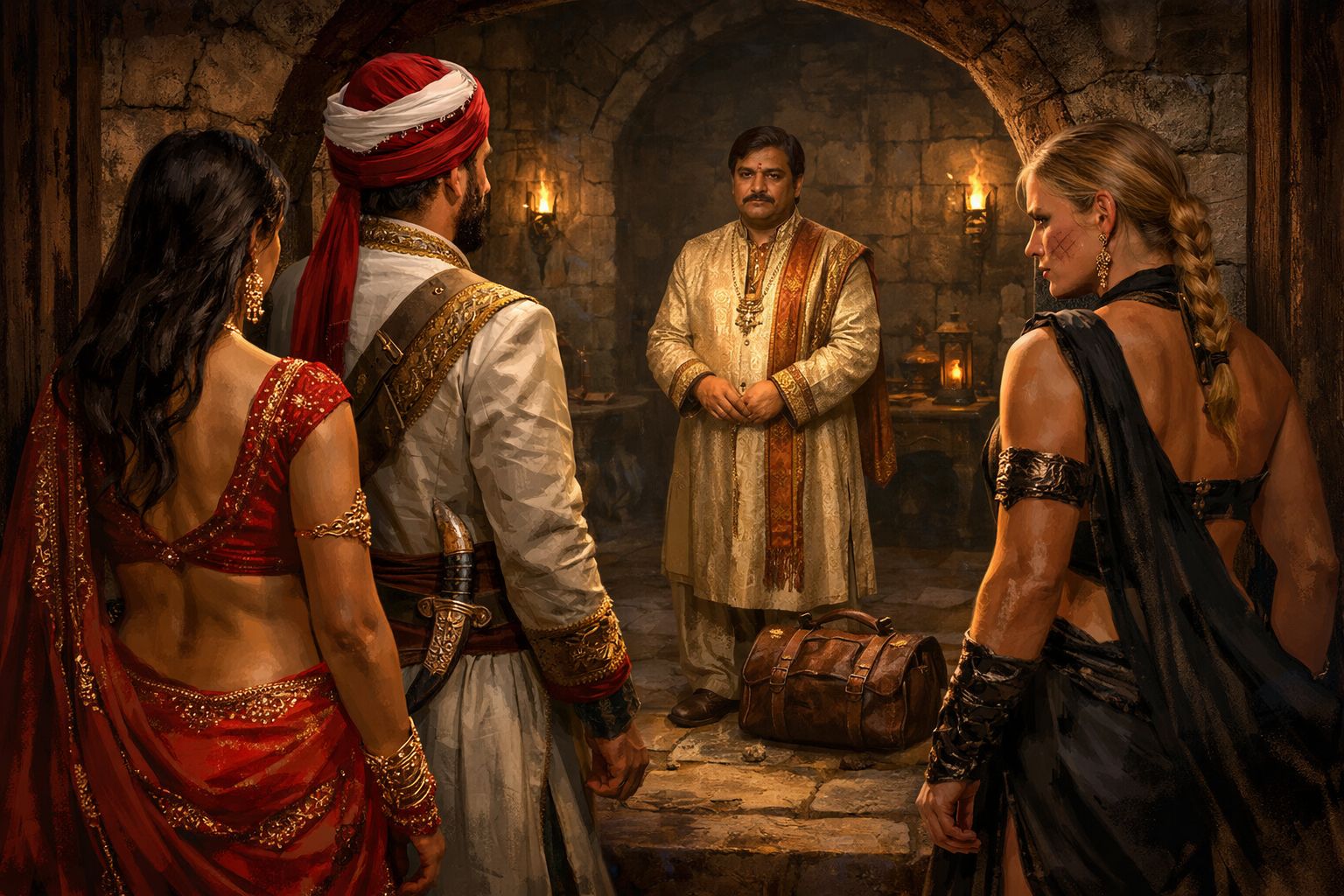
The room beyond was smaller than Amaxia had expected. Shelves lined one wall. A table stood beneath a hanging lamp. There were no chains, no iron cage, no hooded nightmare waiting in the shadows. Just a short man in his late forties, slightly overweight, dressed plainly, with a soft face and neatly packed satchel at his feet. He looked more like a clerk woken too early for work than a terror of courts.
He looked up as they entered and smiled faintly.
“You took your time,” he said. “I knew you were coming, of course. I took the liberty of making the guard tired.” He nudged the satchel lightly with one foot. “I have packed a few essentials. I am ready to leave.”
Amaxia stared at him. Somehow that ordinary softness made him worse.
Nasheem recovered first. “Then we had better move fast.”
Ruhen Vesh rose, dusted off his sleeves and turned toward the door. As he passed Amaxia, he looked up at her and let a small, knowing smile touch his mouth. It was not flirtation. Not quite. Something more intimate and less welcome than that, as though he had seen a thought she would rather have kept to herself.
Amaxia’s hand tightened on her spear.
“Move,” she said.
Ruhen inclined his head politely and obeyed.
This section should begin with relief, then immediately curdle into unease.
The crew has reached the right part of the palace. They have crossed the social layers and made it into the place where Samyra’s missing mentalist is kept. At first glance, it is almost disappointingly modest. There is no grand dungeon and no theatrical chamber of horrors. That understatement matters. Ruhen Vesh is not being displayed. He is being used. The place should feel practical, private and quietly ugly.
The aim of this beat is not a hard tactical challenge. It is a tonal reveal. The crew expects one kind of danger and finds another.
The Interrogation Wing
The interrogation wing should feel small, self contained and deliberately unobtrusive. It is not a sprawling prison. It is a tucked away working space meant for private extractions of truth.
There are only a few rooms.
- A short holding corridor with three secure cells, currently empty.
- Ruhen Vesh’s quarters, plain but reasonably comfortable.
- A questioning room with a table, two chairs, one of them fitted with restraints.
- A small cabinet for notes, names and orders.
Do not overbuild it. The wing is more disturbing if it feels routine. Someone designed this place to be used regularly.
The strongest visual element is the questioning room. It should not be filled with torture devices. Two chairs are enough. One ordinary. One not.
The Guard
The outer door to the wing is locked from the outside, which is why only one guard is posted there. He has the key.
When the crew arrives, he is asleep.
Not dead. Not drunk. Not obviously drugged. Just deeply asleep.
This should create a brief moment of uncertainty. If the players investigate, the answer is simple and unsettling. Ruhen made him tired.
It tells the crew several things at once. Ruhen is not helpless. His influence is subtle. His way of solving problems is invasive and difficult to pin down.
The sleeping guard should also remain a practical problem. He still has the key, and the crew still has to decide what to do with him.
Ruhen Vesh
Ruhen should be surprising.
For such an important and feared figure, he is strikingly ordinary. He is short, slightly overweight, in his late forties and has a soft, almost forgettable face. He looks more like a minor clerk or accountant than a man rulers send into other people’s minds. That ordinariness is part of what makes him unsettling.
When the crew opens the door, he is already prepared. He has packed a few essentials and is ready to leave. He should greet them as though they are late to an appointment, calmly acknowledging that he knew they were coming and that he took the liberty of making the guard sleepy.
From the first moment, something about him should feel slightly off. Not through spectacle or overt menace, but through small details. He answers a question just before it is fully asked. His gaze lingers a fraction too long. He smiles at the wrong moment. He handles personal boundaries as though they do not fully exist. None of this should be dramatic enough to confront directly. The discomfort should begin lightly here and build over the course of the mission.
What This Scene Should Accomplish
By the end of this beat, the crew should feel three things.
- Relief that they have found the target.
- Unease that the target found them first.
- The first hint that bringing Ruhen with them may be worse than leaving him behind.
If the scene lands, the players should leave the interrogation wing with the objective in hand and the sense that something has already gone subtly wrong.
The Collapse of the Plan
They were back in lamplight, perfume and courtly noise.
The deeper corridors of records and locked doors had given way again to perfume, lamplight and the soft shimmer of courtly noise. Music drifted through carved screens. Servants passed with trays of wine and saffron sweets. Nobles stood in little circles of silk and jewels, speaking too softly to be heard and too intently to be harmless. Ayesha moved through it all with easy composure, a glass in one hand and a sweet in the other. Nasheem stayed close enough to seem engaged in low conversation. Amaxia walked on Ruhen’s far side, silent and watchful, looking as though court silk had no business existing.
Ruhen Vesh carried his satchel as if he were leaving a dull office at the end of a long day rather than being stolen out of an enemy palace. He seemed almost content.
Then the room changed.
Not all at once. A whisper crossed one knot of guests, then another. A servant stopped in mid-step. Somewhere ahead a woman gave a short cry and was hushed at once. The musicians faltered, recovered, then stopped altogether. In the thinning of sound, words began to rise from the crowd.
"Murdered."
"An assassin."
"Trapped."
Ayesha turned her head just enough to listen.
Two guard officers stood near a pillar, speaking in urgent undertones.
"She bolted for the storage room off the east gallery."
"Is she still in there?"
"Guards on the door. The captain will deal with it later. Get the guests moving first."
Nasheem and Amaxia looked at each other. Ruhen said nothing, but the corner of his mouth shifted faintly, as though the news interested him more than it should.
At the far end of the hall, guards were already moving. Not running. Worse than that. Controlled. Efficient. They began guiding guests toward the exits with formal apologies and hands too close to sword hilts. More soldiers appeared at the entrances. One officer was already telling the crowd that the palace could not rule out additional attackers.
Nasheem leaned closer, his voice barely more than breath.
"We need her out."
Ayesha did not look at him. "Yes."
"If they take her, we are done for."
Amaxia’s jaw tightened. "Then move."
Ayesha’s eyes flicked once toward the nearest guard line, once toward the flow of departing guests and once toward a narrow service arch half hidden behind a hanging of embroidered silk.
Nasheem turned to Ayesha. "Take him and go with the crowd."
Her eyes met his for one hard instant. She understood immediately.
"You and Amaxia?"
"We get her out."
Ayesha gave one short nod, caught Ruhen by the arm and turned into the stream of departing guests.
Nasheem and Amaxia were already moving the other way.
This is the moment the first heist stops being elegant.
Up to now, the crew has been moving inside a fragile but functioning lie. They got in, kept their roles and reached Ruhen Vesh. Now the palace begins to shift around them. The players should feel that shift quickly. Not as panic, but as order changing shape.
The guests become uneasy before they become afraid. Whispers spread faster than facts. People repeat fragments, guesses and half heard warnings. No one seems to know the full story, but everyone understands that something has gone wrong.
The guards are more dangerous than the guests because they remain controlled. They do not start shouting. They organize. They tighten movement through the hall, start guiding guests toward the exits with polished urgency and put more men at doors, intersections and side passages. The palace is no longer hosting an event. It is containing one.
The Mood in the Hall
Run the hall as confusion under discipline.
Guests whisper about murder, assassins and hidden accomplices. Some nobles try to preserve dignity and fail. Others are already irritated at being inconvenienced. Servants move faster and speak less. Music falters or stops. Courtiers begin watching one another more carefully than before.
The important contrast is simple. The guests do not know what is happening. The guards are beginning to take control of it.
That tells the players immediately that the window for a clean solution is closing.
What the Crew Overhears
The crew should be able to piece together the core problem from fragments.
The White Lily succeeded. Rajiv Varma is dead.
But she was seen in the aftermath. In trying to escape, she chose the wrong door and ended up in a storage room or service chamber with no second exit. The guards have not taken her yet, but they have the room contained and are deciding how to deal with it.
That distinction matters because it preserves her competence. She is not beaten. She is trapped.
Do not deliver this as a neat summary. Let the crew catch it in scraps from officers, frightened servants or hurried household staff. The information should feel overheard, not handed over.
Getting Ruhen Out
This is the cleanest chance the crew is likely to get to move Ruhen out of the palace.
Once the guests are being pushed toward the exits, a socially covered crew member can take him out with the flow if they keep their nerve and their story intact. Ruhen looks ordinary enough not to draw attention on his own. In a palace that is suddenly focused on clearing the hall and securing itself, that matters.
This should be a real option, not a false one. If the crew decides to extract Ruhen now, that path should work.
The cost is final. Anyone who leaves with him is effectively out of the palace operation. Once outside, the guards will be shifting fully into counter assassination posture. Doors will tighten, faces will be remembered and getting back in should be close to impossible.
That makes this a natural split point. One path leads outward with the objective already secured. The other leads deeper into a palace that is becoming less forgiving by the minute.
If Ruhen Stays
If the crew keeps Ruhen with them, do not make him openly helpful.
He does not volunteer. He does not explain. He does not offer solutions.
Instead, his influence is felt in small, unnerving ways. A guard accepts a plausible lie a little too easily. A servant hesitates when she should have spoken. A suspicious question softens into uncertainty if the crew gives an answer that is at least half credible.
Keep this subtle. Ruhen should not erase consequences or solve scenes. He should simply make weak lies hold together better than they ought to. That should feel useful, but wrong.
The crew may begin to suspect what he is doing. He will never confirm it.
The Choice in Front of the Crew
This beat works best if it forces a hard decision quickly.
The crew now has two priorities. Ruhen is the recovered objective, and this is the best moment to move him out. The White Lily is alive, but trapped, and every passing minute makes her rescue harder.
If the crew splits, the scene opens cleanly into two tracks: extraction and rescue.
If they stay together, make the cost real. More bodies make concealment harder. Ruhen complicates every movement. The palace is becoming tighter, quieter and less tolerant of mistakes.
What This Beat Should Accomplish
By the end of this moment, the players should understand three things clearly.
- The assassination succeeded.
- The White Lily is alive, but trapped.
- Ruhen can be moved out now, but doing so may divide the crew.
If that lands, the first heist is over and the rescue phase can begin.
The Second Heist: Improvised Rescue and Escape
They found the right corridor only after doubling back through servant routes and half lit marble passages where the air smelled of lamp oil, old stone and stored linen instead of perfume. The palace felt different here. No music. No laughter. Just distant footsteps, muffled voices and the hard stillness of a place being held.
At the far end of the passage stood the door.
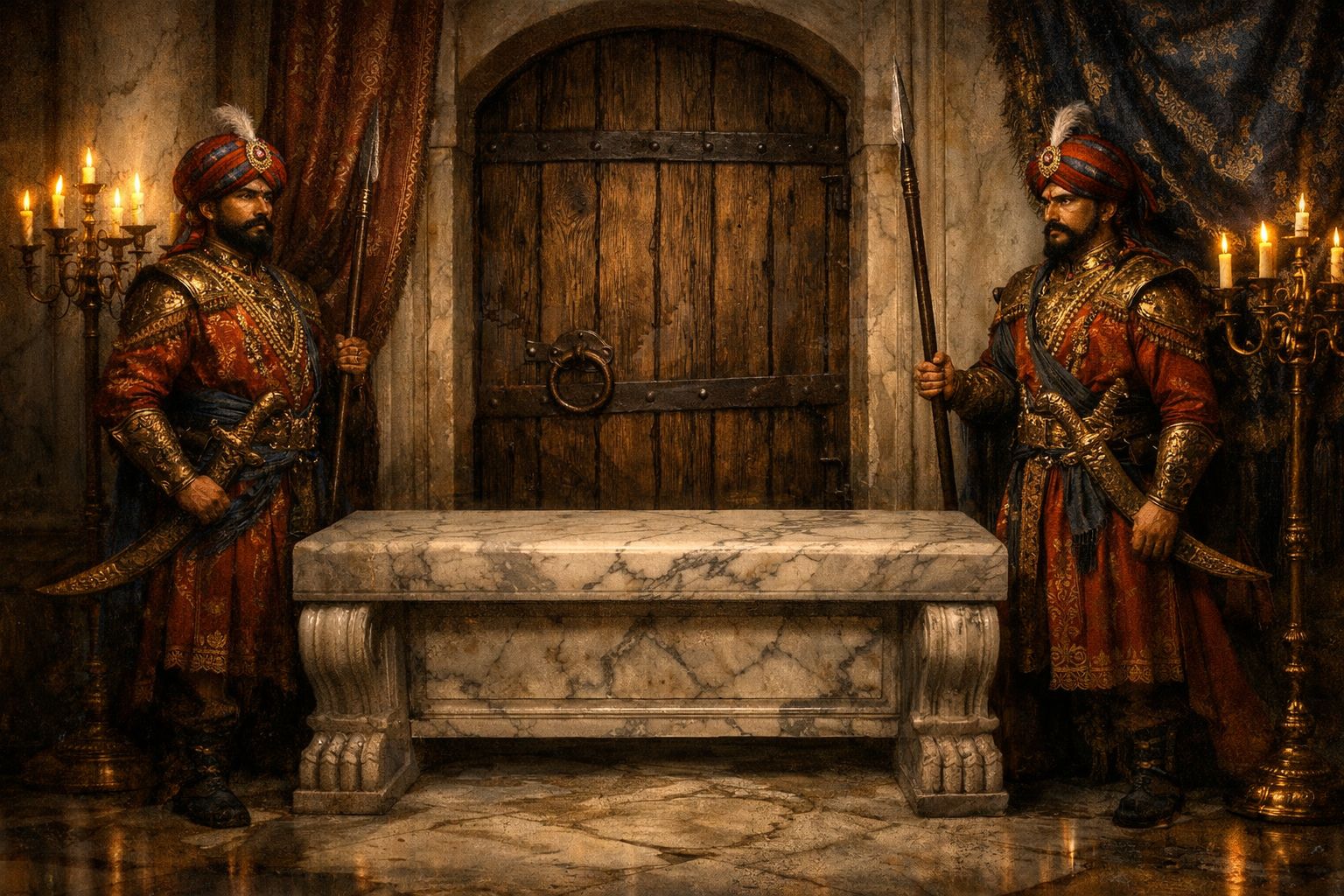
A heavy marble bench had been dragged across it, its legs screeching scars into the floor. Two guards stood watch beside it, sabres at their hips, eyes fixed more on the corridor than on each other. Nasheem slowed, glanced once at Amaxia and said under his breath, "Follow my lead."
Then he smiled.
It was the easy, charming smile that had carried him through taverns, courts and customs houses from one end of the world to the other. He walked up to the guards with the loose confidence of a man too harmless or too foolish to be dangerous.
"My friends," he said, spreading one hand as if mildly embarrassed, "forgive me. Which way to the ballroom? I seem to have developed an impressive talent for getting lost in rich men's houses."
One of the guards blinked, thrown off balance for just a heartbeat.
"Back the way you came, then right at the colonnade," he said.
"No," said the other at once, frowning. "Left after the stairs."
They turned toward each other.
That was enough.
Nasheem moved first. The smile vanished as his knife flashed up and in, punching hard into the nearer guard’s neck. Amaxia followed and crashed into the other man before he could cry out, driving her blade into his chest and slamming him back against the wall. He bucked hard under her, one hand clawing for the hilt at his hip, while she clamped a hand over his mouth and held him there until life left him. The first guard made a wet choking sound and folded at Nasheem’s feet.
For one heartbeat the corridor held still again.
Then Amaxia bent to seize one end of the bench.
Nasheem grabbed the other. "We should have brought Ormun," he muttered as they dragged the marble slab aside with a harsh scrape.
Amaxia gave him a flat look. "You say that every time something is heavy."
"Because I am always right."
Nasheem pushed the door open.
A blade flashed in the dark.
A dagger stopped a finger’s width from Amaxia’s throat.
The White Lily stood inside the storage room, balanced and ready, masked face half turned toward the light. For a moment no one moved. Then she stepped back smoothly, lowering the dagger.
"My apologies," she said. "I was expecting someone else."
The room behind her was narrow and crowded with shelves, folded cloth and sealed jars. One shuttered window stood open at the far side, letting in a stripe of night air.
"I have a rope fixed outside," she said. "A window not far from here. If the rope is still there, we can get out that way."
Amaxia glanced toward the open shutter, then back to Lily.
"Then move."
This phase should feel completely different from the first heist.
The earlier operation depended on elegance, timing and social control. This one depends on speed, nerve and improvisation. The palace is no longer watching for impropriety. It is reacting to murder. Guards are focused on two priorities: protecting Raja Devraj and clearing the remaining guests. That leaves parts of the palace thinner than before, but not safer.
Corridors that were busy an hour ago are now half deserted. Music has stopped. Servants vanish into side passages. Elsewhere come bootsteps, shouted orders and the scrape of doors being shut or barred. As the crowd drains away, the palace feels bigger, emptier and far less forgiving.
The Palace After the Assassination
Do not run the palace as uniformly locked down. Run it as unevenly tightening.
The guards are concentrating where they think the danger matters most. Public halls, key intersections and the Raja’s inner security are getting attention. That leaves some side corridors and service routes more open than before, but also more brittle. A wrong turn now is more likely to lead to a hard encounter, because the people still moving through these parts of the palace are guards, officers and trusted staff rather than drifting guests and servants.
Before the crew reaches the White Lily, give them one or two brief encounters that prove the danger is real.
- A patrol crosses an intersection ahead, forcing a pause, a bluff or a retreat into shadow.
- A frightened servant nearly screams on seeing strangers in the wrong corridor.
- A junior officer demands to know why anyone is still moving through this wing after the evacuation order.
Keep these encounters short and sharp.
Finding the White Lily
The crew has enough to work with. They know she is trapped in a storage room off the east gallery or some similar service corridor, and they know the room is being held rather than stormed.
Do not turn this into blind wandering. Let the players use what they overheard, ask sensible questions and build a plausible route through the palace. When they form a plan that genuinely follows from what they know, reward it.
There can still be friction. Two corridors may both seem likely. A half heard direction may need interpreting. A dragged bench, a blocked passage or a guard position that makes no sense may point them the right way. The search should reward reasoning, not exhaustive trial and error.
The Blocked Door
When they reach the correct corridor, the setup should be immediate and clear.
A heavy bench or similar piece of furniture has been dragged across the storage room door. Two guards remain there to watch it. They are alert, but not braced for trouble from this side. Their attention is fixed on containing the trapped assassin, not on the possibility that rescue will come from elsewhere inside the palace.
As long as the crew is not already waving weapons around or acting like obvious attackers, the guards should not expect violence at conversational distance. That gives the players room for bluffing, distraction or a sudden strike.
Rescuing the White Lily
Once the guards are dealt with and the door is opened, the White Lily should still feel like herself.
She is not panicked. She is not emotionally demonstrative. She is contained, precise and ready. If she nearly kills the first person through the door before recognizing them, that is good. It reinforces that she was dangerous the whole time, not helpless.
Her first concern is the escape. She explains quickly that she prepared a rope route in advance through a window in another room not far from here. She does not know whether it is still usable, because she placed it before the assassination and has not been able to check it since.
Keep her cool and exact. This was a bad break, not a collapse.
The Route to the Rope
Once the White Lily rejoins the crew, she should take the lead.
There should be no more guards directly in their path. The tension now comes from movement, noise and the fear of discovery, not from another obvious obstacle fight. Empty side halls, open service doors, distant boots and shouted commands should do the work here. The palace is still active, but somewhere else, which is often more unnerving than being actively chased.
The room with the rope is still accessible. The rope is still there. The hard part is over. Now the danger lies in how exposed the escape feels.
Climbing Down

The descent should be nervous, but successful.
As the crew starts down the rope, let the palace realize what has happened. A shout from inside. Running feet in a nearby corridor. A door thrown open too close for comfort. Perhaps someone has found the dead guards. Perhaps the storage room was finally checked.
This is not the place for arbitrary failure unless the players have been especially reckless. The tension comes from exposure. The descent is slow. The stone is cold. The drop is awkward. Noise grows above them. Let them imagine pursuit leaning out over the sill. Let them feel the gap between knowing they have a route and not yet being safely on the ground.
If Ruhen Vesh is present, remember that he is not fit enough to handle the rope well on his own. Someone may need to lower him, guide him or descend first and support him from below. That should make the escape more stressful and more awkward.
Then let them reach the ground.
Reaching the Ship
Once on the ground, the escape should loosen quickly.
This window is on the back side of the palace, away from the confusion building at the main entrance. The crew should be able to slip into the night rather than fight through a full alarm response. There may still be distant shouting, torches moving on walls and more activity than usual in the city beyond, but this should not become a running battle through the streets.
The way back to the Blue Marlin should feel tense, but no longer doubtful. Let them move through shadowed back streets, garden walls, service alleys or narrow lanes until the palace is behind them and the night opens up.
What This Phase Should Accomplish
By the end of the rescue and escape, the players should feel three things.
- They saved the White Lily from a bad break without diminishing her competence.
- They escaped by speed, nerve, improvisation and a little luck, not by control.
- They are out, but the operation no longer feels clean.
That last part matters most. The rescue succeeds, but it should feel like the kind of success that leaves everyone more exposed than before.
The Voyage back
Sleep did not take Amaxia cleanly.
One moment she was in her bunk with the sea under her and the quiet groan of the Blue Marlin in the dark. The next she was back in Luminara.
Not the city. The room.
The air was too warm, too perfumed, thick with oil and the sweet scent once used to cover filth. Lanternlight glowed through painted silk. Somewhere beyond the walls men were laughing. She knew the bed before she saw it. Knew the rough blanket, the old helpless fury, the sick certainty of what was coming.
No, she thought. No. Not again.
But dreams did not care.
Hands were on her. Weight pinned her. The old humiliation came back whole, not as memory but as presence. Somewhere inside the panic a colder part of her tried to force itself awake. This is not real. This is the ship. Wake up.
She could not.
Then she saw him.
Ruhen Vesh stood in the corner, watching.
He looked exactly as he had in the palace. Same soft face. Same mild, almost pleasant expression. Not younger. Not changed. Just Ruhen, standing inside a piece of her past where he had no right to be.
That was worse than the rest.
She tried to shout at him, tried to lunge, tried to tear her way out of sleep, but the dream held fast.
She woke with a violent jerk, sucking in air like a drowning woman breaking surface.
Someone was pounding on the door.
"Amaxia." Junia’s voice, sharp with worry. "Amaxia, are you all right?"
She realized then that her throat hurt. She had been screaming.
Amaxia dragged herself upright, crossed the cabin and opened the door. Junia stood there in a nightshift and hastily thrown shawl, eyes wide.
"You sounded like you were being murdered."
"Bad dream," Amaxia muttered.
Junia waited, but Amaxia gave her nothing more.
"I am fine."
It was not convincing. Junia hesitated, then nodded once. "Call if it happens again."
Amaxia shut the door and did not sleep again.
In the morning she stood by the rail with a mug she had not touched when Cassandra came to her, moving with unusual care.
"You look tired," Cassandra said softly.
Amaxia let out a humorless breath. "You look worse."
Cassandra lowered her eyes to the water. "I dreamed of the Rim. Praxon’s hall. The music. The watching." She swallowed. "Ruhen was there."
Amaxia turned to her.
"In the dream?"
Cassandra nodded. "Just standing there. Watching, like he belonged."
For a moment neither spoke. Then Amaxia’s mouth hardened.
"If he is not off this ship soon," she muttered, staring out over the water, "I am going to strangle the bastard."

The voyage back should be calm on the surface and wrong underneath.
Nothing chases them. They get clear of Manpur, slip back into open water and leave the palace turmoil behind. For a few days, the sea is calm enough that there is little to do but eat, sleep, keep watch and live with what they have brought aboard. That quiet should make the discomfort worse. The operation succeeded. The White Lily is alive. Ruhen Vesh is recovered. None of it feels clean.
The White Lily
The White Lily remains precise, private and professionally dangerous.
She does not become warm, talkative or familiar. She keeps to herself, speaks when needed and treats the ship as temporary shelter rather than company. But she does acknowledge the rescue. Keep it brief. A private line is enough. She says that she owes the crew one, or that she will remember the debt. From her, that should feel significant. It is not friendship. It is gratitude from someone who does not spend it lightly.
Ruhen Vesh
Ruhen is the real problem on the voyage.
He cannot keep out of people’s minds, especially where shame, fear, grief or humiliation are concerned. Sensitive memories catch him. Old wounds draw his attention. He is not merely brushing against thoughts by accident. He likes looking. He is a peeping tom of the soul.
Keep the effect intimate and cumulative.
The crew begins to feel watched even while awake. A thought turns private and Ruhen glances over with the wrong expression. Someone says more than they meant to, and his face shows that he already knew. He lets slip a detail he should not know, then moves past it as if nothing happened. He smiles at the wrong moment. He apologizes too late.
But it should not stop there.
He enters and directs dreams. Crew members relive old humiliations, old abuse, old helplessness, and Ruhen is there in the dream watching as he is now, not as some figure from the past. He does not belong in those memories.
The ship should begin to feel too small with him aboard.
How Ruhen Behaves
Ruhen should never present himself as openly malicious. That would make him simpler and weaker.
If confronted, he acts embarrassed. He claims that he cannot help it, that he cannot fully shut it off, that thoughts brush against him and some are simply louder than others. Do not make him a simple liar. The uglier version is that he is telling enough truth to make his excuses plausible. He really cannot turn it off completely, but he also does not resist very hard when the thought is shameful or intimate and therefore interesting to him.
He may say he is sorry. He may look genuinely uncomfortable. He may even seem ashamed. None of that should make the crew trust him more. If anything, it should make him worse. He knows what he is doing is vile. He keeps doing it anyway.
Running the Pressure
Do not dump the whole effect into one scene.
Start small. A look. A stray remark. Then another. A dream. Let different crew members notice different pieces before they compare notes. Once they do, the picture becomes much uglier.
Ruhen should not feel like a monster in the horror sense. He should feel like a boundary violation that has been given a cabin and a place at table. He is ordinary, polite and impossible to be comfortable around.
What the Voyage Leaves Behind
By the end of the voyage, the crew should understand three things clearly.
- The escape from Manpur succeeded.
- The White Lily remains dangerous, but now indebted.
- Ruhen Vesh is useful, disgusting and far too close.
The voyage home should leave the sense that the crew carried something contaminated onto their own ship, and had no choice but to live beside it until land.
Return to Samyra
The return audience should be smooth, fast and slightly ugly in what it reveals.
The crew has done what Samyra asked. Ruhen Vesh is back. Rajiv Varma is dead. Because of that, there is very little resistance now. The same layers of chamberlains, guards, attendants and court bustle remain around the audience, but this time the machinery is working for them rather than against them. Doors open faster. Names carry more weight. The crew is no longer being measured as petitioners. They are being received as useful people who delivered results.
Samyra should be pleased, but not warm. She is satisfied, not grateful in any ordinary sense. This was a transaction, and the crew fulfilled their side of it.
Ruhen’s Removal
The clearest detail in this return is what happens to Ruhen.
The moment the crew reaches the palace, guards take him from them at once. Not roughly, but decisively. There is no ceremony to it, no conversation and no sense that he is being welcomed home. He is removed like something dangerous that must be contained.
That should stand out.
Ruhen is useful enough that Samyra wanted him back badly. Yet even here, in the palace of the woman who sent the crew to recover him, he is not allowed near anyone important. He is handled as though he were a form of contamination. An asset, but also an infection. That tells the players everything they need to know about what kind of man he is and what mentalists mean in this world.
The Audience Itself
Once inside, the audience should feel familiar in form and different in tone.
The same bustle surrounds Samyra. Advisors murmur, servants move, guards watch and luxury continues as if the war outside were something to be managed between courses. But this time Samyra’s attention is easier to hold. The crew did not merely arrive with a request. They returned with proof of usefulness.
She should confirm the bargain cleanly. No games. No new conditions.
She gives them both pieces of information they came for:
- The last port the Waverider sailed from before reaching Mataraaj.
- The next port it sailed to after leaving her waters.
Keep this direct. The point of the scene is payoff, not delay.
What This Scene Should Convey
This return should leave three impressions.
- The mission succeeded, but did not feel noble.
- Samyra keeps her word when it suits her.
- Ruhen may be valuable, but even his own side treats him like something foul.
That last detail is the sharpest one. The crew has already felt what it is like to have him aboard. Seeing Samyra’s court react the same way, only more disciplined and more ruthless, confirms that their disgust was not paranoia.
Leaving Vardhana
The last lines were already being called along the deck when a voice came flying down the quay behind them.
"Wait. Wait, damn you, wait."
Scarnax turned at once. Half the crew had already reached for rope and sail, but he lifted a hand before the cast-off could begin.
Across the dock came Thaleia Myrinos at a breathless run, braid half undone, journals bouncing against one hip and a leather satchel thumping against the other. She looked as though she had packed in the middle of a thought and nearly lost the argument to it.
She skidded to a halt at the foot of the gangplank, bent over for one breath, then looked up with bright, determined eyes.
"I heard you are sailing for Ozukari," she said. "Please tell me that is true."
Scarnax gave her a long look. "It is."
Thaleia lit up at once.
"Then I must come with you. I have spent the whole morning asking questions, and the stories are absurd. Demons of chaos. Ritual order. Purity tied to obedience. I need to see how much of it is true and how much is the usual nonsense people tell foreigners to frighten them."
Cassandra leaned on the rail.
"She comes aboard," she said.
Scarnax glanced up at her.
Cassandra met his eyes. "She was key to rescuing me. That counts."
Ormun, standing nearby with a coil of rope over one shoulder, nodded so hard it seemed to involve his whole body. He pointed at Thaleia, then at the deck, then looked at Scarnax with open expectation.
Scarnax exhaled through his nose and looked back at Thaleia, then at the collection of bags hanging from her shoulders.
"At least someone will have some idea what sort of madness we are sailing into," he said. "Come aboard."
Thaleia straightened at once.
"Captain, you have my profound thanks. I promise I will be useful."
Scarnax’s face suggested that he had heard many dangerous promises in his life and liked very few of them.
Before she could start wrestling with her luggage, Ormun was already moving. He lumbered down the gangplank with a broad smile, scooped up her bags as if they weighed nothing and turned back toward the ship.
Thaleia followed after him, still breathless.
"Thank you. Both of you. Truly. I have notes already, but I suspect half of them are wrong, which is what makes it interesting."
Scarnax snorted.
Then he lifted his voice.
"Cast off."

Just as the Blue Marlin is about to cast off from Mataraaj, Thaleia Myrinos comes running down the quay and calls for the ship to wait. She has learned that the crew is sailing for Ozukari and wants passage with them. Her reason is simple and entirely in character: she has heard enough wild and contradictory things about Ozukari’s beliefs, laws and demon fears to become intensely curious, and now she wants to see for herself how much of it is true.
Keep the scene light, but useful. Thaleia is not trying to manipulate anyone. She is excited, earnest and a little reckless in the way scholars sometimes are when curiosity overrides caution. Once they agree, Thaleia is profoundly grateful, and steps aboard before anyone can reconsider.
What the Scene Does
This beat should do three things quickly.
- It gives Thaleia a natural way into the next arc.
- It reminds the crew and the players that Ozukari is strange enough to attract serious curiosity.
- It adds one more intelligent outsider to the journey, someone who will ask the kind of questions the crew might not.
Keep it brief. It is a departure note, not a major negotiation. The important thing is that Thaleia arrives as an eager, slightly chaotic complication whose presence feels both plausible and potentially useful.
Act Summary
By the end of the Mataraaj arc, the crew should leave with more than just the next clue. They should feel that they have passed through a beautiful, dangerous court and come away dirtier than when they entered.
They now have the Waverider clue they came for, both the last port before Mataraaj and the next port after it. That gives the campaign its forward motion again and justifies the risks they took. At the same time, they leave with a new connection in the White Lily. She remains distant, dangerous and unreadable, but she now owes them a debt, and from someone like her that matters.
They should also leave feeling personally violated by Ruhen Vesh. The voyage back makes clear that mentalist magic is not only useful or feared, but intimate, ugly and contaminating. Ruhen is not a grand monster. He is something worse in a quieter way: a man who enjoys trespass and wears embarrassment like a thin excuse. Through him, the crew learns what mentalists really are in practice, and why even those who employ them keep them at arm’s length.
More broadly, the arc should teach the players what Mataraaj is. It is not simply exotic splendor or civil war backdrop. It is a country where refinement, appetite, cruelty and statecraft all sit in the same room without contradiction. Samyra may be the least bad option, but she is still a ruler who uses assassins and mind violators as instruments of policy. That should leave the crew with a clearer understanding of Mataraaj’s moral texture.
Finally, they leave with a temporary new passenger in Thaleia Myrinos. She is curious, intelligent and reckless in a useful way, and her presence should feel like both a complication and an asset. As the crew sails toward Ozukari, she gives them one more set of eyes and one more mind eager to ask the questions they might otherwise miss.
Mataraaj was already paling behind them, white walls and domes fading into the bright wash of morning until the city looked thin and far away, as if the sea had begun erasing it the moment they turned their bow from shore.
Cassandra stood at the rail with both hands around the wood. Beside her, Amaxia leaned forward on her forearms, staring out over the water with that hard, fixed stillness that usually meant she was holding something down by force. The Blue Marlin moved steadily beneath them, lines creaking, sails full, the whole ship settling back into the honest rhythm of sea and wind.
For a while, neither of them said anything.
Then Cassandra let out a breath she had clearly been holding for too long.
"I am glad he is gone."
Amaxia gave a short, ugly snort.
"He would not have lasted one more day on this ship," she said. "I would have made sure of it."
Cassandra laughed, but only for a moment.
"That is strangely comforting."
Amaxia’s mouth twitched, then went flat again. Her eyes never left the horizon.
"The worst part was not that he was in my head," she said quietly. "It was that he made me live it again."
Cassandra’s smile disappeared.
She knew exactly what she meant. Not the shame alone. Not even the helplessness. The being dragged backward into something you had survived, and forced to wear it again as if all the years since had been nothing.
"Yes," Cassandra said.
Her voice was soft now.
"That was the worst part. And that he liked it."
Amaxia’s jaw tightened. For a heartbeat she looked like she might put her fist through the rail.
"If I ever see that creep again," she said, "I kill him immediately."
Cassandra folded her arms on the wood and stared out at the water beside her.
"I will distract the captain."
Amaxia turned then, just enough to look at her.
Before she could answer, a familiar voice came from behind them.
"There is no need," said Scarnax. "I support that entirely."
They both looked back.
He had come up without either of them hearing him, one hand resting on the rail, sea wind stirring his coat. There was a trace of dryness in his face, but no real joke in it. Only the plain, steady look of a man who had seen enough of Ruhen Vesh to reach the same conclusion.
Amaxia held his gaze for a moment.
"I will hold you to that."
Scarnax nodded once.
"I would expect you to."
The three of them stood together at the rail in silence, watching the morning widen over the sea while Mataraaj shrank behind them, and for the first time since leaving its harbor, the ship felt a little cleaner.