Campaign: Khazryn
Act Synopsis
Purpose of the Act
This is a short, quiet arc meant to feel almost suspiciously easy. The crew suffers for the climb, reaches Tseradun, gets a clean answer about the Waverider, and leaves with very little resistance. That simplicity should feel faintly wrong rather than reassuring.
Arrival in Khazryn
The Blue Marlin makes landfall in Khazryn, and the crew begins the three day trek inland toward Tseradun. The main obstacle is not danger, but the mountain itself. Thin air, steep paths and relentless fatigue turn the journey into an ordeal. They stop for the night in two small cliffside villages before finally reaching the monastery, high on Mount Khazra.
The Monk at the Gate
As the crew arrives, a monk comes out through the front gate already dressed for travel. This is Samden, though they do not know it. When asked about the Waverider, he confirms that he helped them a couple of times and says they continued on to Goldgate, south of Elarune. He only gives vague details, then excuses himself, saying he must continue on pilgrimage to Mount Khazra before nightfall.
If the Crew Pushes Further
If the crew tries to follow him, he remains visible only until they lose sight of him for a moment. When they catch up, he is gone. If they ask questions at the monastery, they are treated with courtesy but gain nothing more. No one is hostile. No one is useful. The whole place feels calm, closed and impossible to pry open.
Return to the Ship
The crew treks back to the coast over another three uneventful days. Nothing attacks them, nothing blocks them and nothing dramatic happens. That is the point. They came to a remote holy place, got the answer they needed and left. On paper, it was simple. Almost too simple.
End Beat
The crew leaves Khazryn with the next lead. The Waverider went on to Goldgate, south of Elarune. More quietly, this arc gives them their first direct brush with Samden, without revealing who he is or why he is helping. That answer comes later.
Arrival in Khazryn
The Blue Marlin rocked gently behind them as Scarnax stepped onto the stony shore and looked up.
For a moment he said nothing. The mountains rose so high that they did not seem real, vast walls of gray and white thrust into the sky until their upper reaches vanished into cloud. Here and there black cliffs showed through the snow like old bone. A narrow path, hardly more than a scar cut into the mountainside, wound upward in cruel turns until it disappeared into the heights.
Skarnulf came down beside him, squinting upward. "That is not a path," he said at last. "That is an insult."
Gastved snorted softly and adjusted the pack on his shoulders. "It is a path," he said. "The mountain just dislikes us."
Scarnax let out a low breath, half laugh and half disbelief. "I have sailed storms, fought pirates and crossed seas I did not trust. I am not ashamed to say this place makes me feel small."
"Good," said Gastved. "Means you are paying attention."
They stood a heartbeat longer, three hard men beneath something so immense it made all talk feel thin. Then Scarnax set his jaw, hitched his coat into place and started toward the steep rising trail.
"Come on," he said. "If the Waverider crew went up there, then so do we."
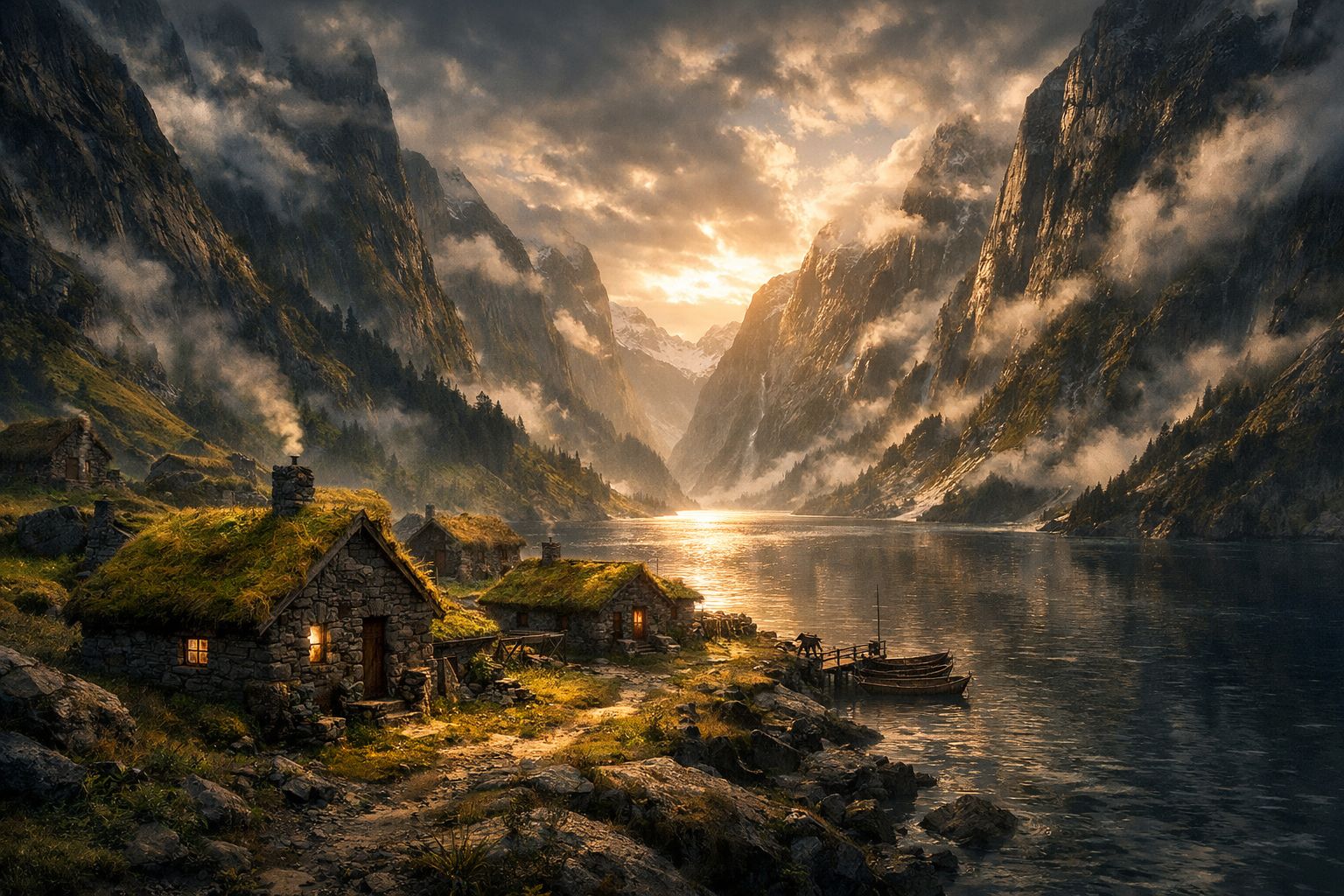
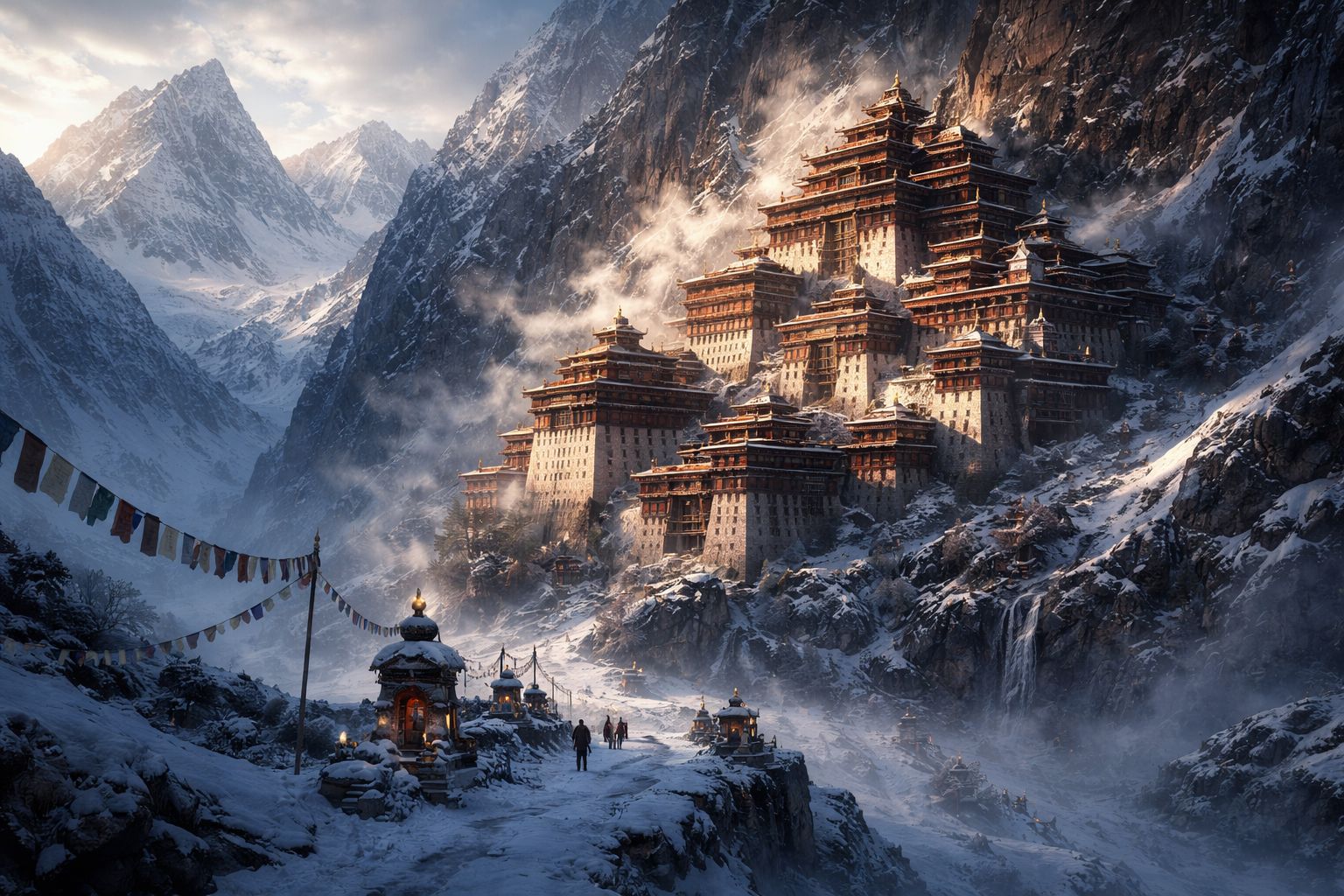
Khazryn should feel overwhelming before it feels difficult. When the crew steps ashore, the first impression is scale. The mountains are not just tall. They are so vast that they seem to break the rules of the world, rising in sheer walls and impossible heights until their upper reaches vanish into cloud. The path to Tseradun should look less like a road and more like a wound cut into the mountain, narrow, steep and exposed. The goal here is awe first, then unease. The land should make even seasoned travelers feel small. Khazryn’s villages are described as clinging to cliffs like lichens, and Tseradun itself is carved high into Mount Khazra, a place that already carries the sense of altitude, spiritual distance and harsh survival.
Play up verticality constantly. The crew should look down and see drops that make the stomach tighten, then look up and realize they still have far to go. Sound carries strangely in the heights. Wind moves through stone channels and prayer flags, and distant paths can sometimes be seen far above or below, tiny against the mountain. The land should feel sacred, severe and almost indifferent to human effort. Khazryn’s religion reinforces that mood, since every peak is believed to hold a living spirit, and high places are treated with reverence rather than conquest.
The Structure of the Climb
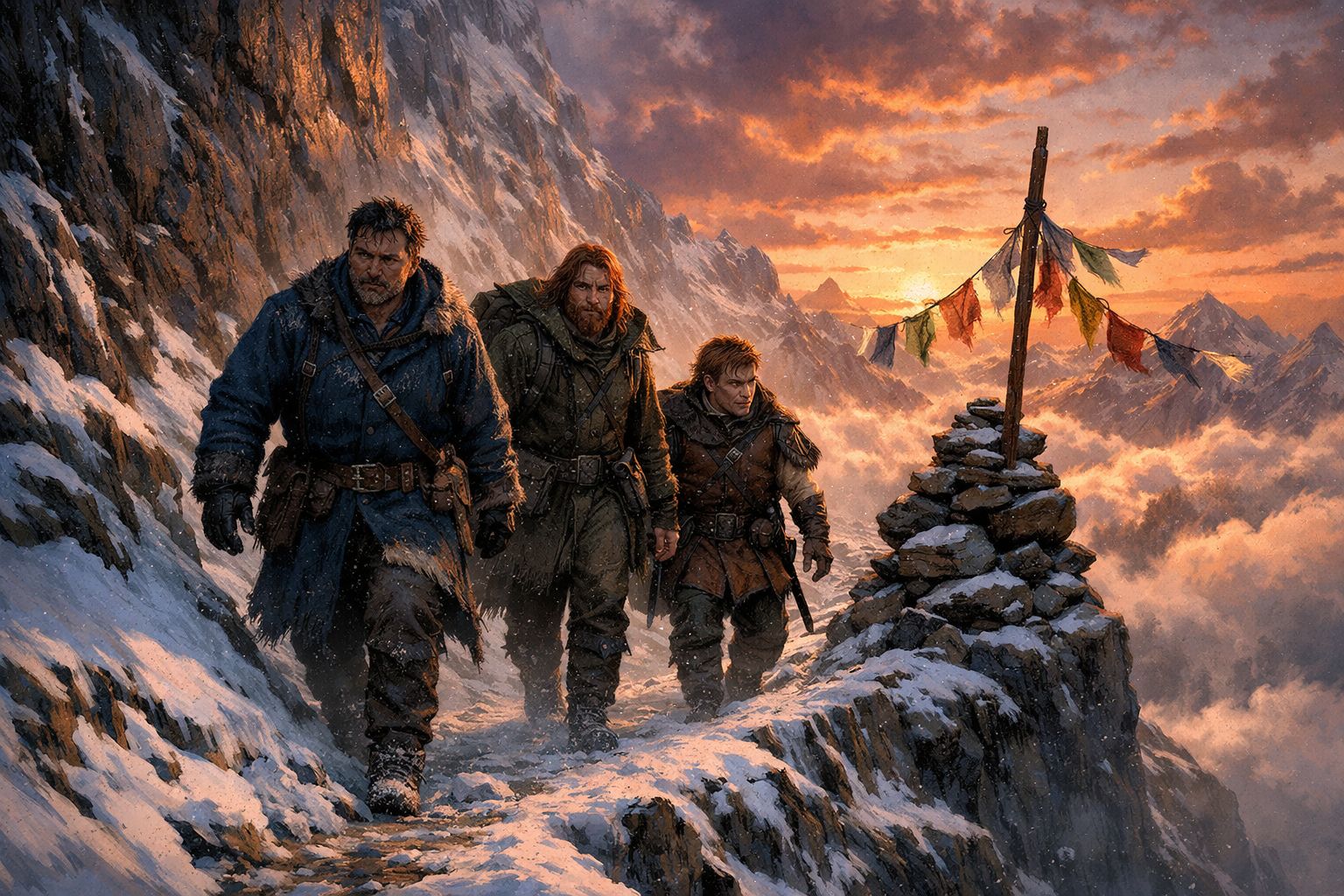
The trek to Tseradun takes three days and should be treated as a slow ascent into another world. There is no major action sequence here. The hardship comes from gradient, exposure and altitude. The path keeps rising, often in switchbacks, occasionally narrowing where the mountain has half reclaimed it. The crew passes a few villages along the way, each little more than a cluster of stone homes and terraces cut into the cliff. These settlements exist because people here endure, not because the mountain welcomes them. Khazryn’s agriculture is meager, based on barley, yak pasture and hardy tubers that can survive in thin air and cold winds, which helps set the tone for what hospitality looks like.
The visual progression should matter. On the first day there is still some life on the slopes, though it is already sparse and stunted. By the end of that day, large vegetation is gone. After that, the land gives way to moss, bare rock and wind worn ground. On the second day the world grows emptier and colder. By the third, the path lies in snow and the crew has climbed above the clouds. That transition should make Tseradun feel earned. They are not just traveling inland. They are ascending out of the ordinary world.
Hospitality on the Mountain
There are no inns, taverns or roadside comforts on this route. Travelers on the mountain are assumed to be pilgrims, wanderers or people with serious purpose, and local custom is to receive them into the home. This hospitality should feel quiet, practical and without ceremony. A family makes room by the stove, serves a simple meal, offers blankets and speaks a little about the news of the world. No one discusses payment directly. Instead there is a bowl by the door with a few coins already in it, and the expectation is clear without being voiced. The guest who understands the custom leaves a donation before departing.
This works well with Khazryn’s broader spiritual culture. Villages along ridges and passes maintain shrines where travelers leave offerings to appease the watching spirits, so the idea of modest, unspoken giving is already built into daily life. Hospitality here is not warmth in the tavern sense. It is duty, reverence and custom in a hard land where everyone depends on forms older than any one household.
Markers Along the Way
The path should be punctuated by signs of devotion. Stone cairns stand at bends, ridges and overlooks, some no higher than the knee, others waist high or more, built up by generations of passing hands. Prayer flags hang from poles or are strung on ropes to the mountainside, snapping and fraying in the wind. Small shrines appear on passes and ledges where travelers can stop to burn incense or leave yak butter for the spirits. These details matter because they make the mountain feel inhabited not only by villagers and monks, but by belief itself.
Use these markers to break up the climb and to reinforce that the crew is entering a culture that treats the heights as watched. Even in silence, the landscape should feel observed.
Other Travelers
They will also meet a some other travelers. These fall into two categories:
- Pilgrims, who aren't very talkative, but can provide some light talk.
- People carrying supplies to the villages on yaks, and these are very talkative.
The Physical Toll
The journey should be exhausting in a way that is difficult to argue with. Every rise costs breath. Packs feel heavier than they should. Conversation shortens. Strong characters do not become helpless, but they do become aware of their own bodies in an unpleasant, grinding way. Thin air is the real enemy here. It wears them down without drama. That matters because the act is supposed to feel simple on the surface. The mountain provides the price, so the monastery does not need to. Khazryn is explicitly a land of thin air, cold winds and eternal snowfields above, and that should define the travel experience from beginning to end.
Let the fatigue accumulate naturally. The first day is hard. The second day is worse because they wake already tired. By the third, even the beauty of being above the clouds should be undercut by numb fingers, aching legs and the knowledge that they still have to descend later.
Nights on the Route
The crew passes several villages, but two are suitable stopping points before Tseradun. These should not feel identical. The first can still have some trace of ordinary mountain life, with small terraces, tethered yaks and children peering at strangers from behind stone walls. The second should feel barer and harsher, more exposed to wind and cold, with houses that seem almost dug into the slope for shelter. Both nights rely on household hospitality rather than any public lodging.
These evenings are good places to show local reserve. The villagers are not hostile, but they are restrained, deeply respectful of the mountain and accustomed to receiving pilgrims without making much of it. They do not need to be mysterious in an artificial sense. Their silence, endurance and routine are enough.
Arrival at Tseradun
The crew reaches Tseradun in the evening of the third day. This timing matters. It means the monastery is visible at last, high on the mountain and painted in crimson and gold, but not yet available to them. Tseradun should feel magnificent when first seen, a fortress and temple carved into living rock, crowned by tiers and prayer flags and standing above the world they climbed through. Its great height and sacred role are already established in the setting, and the arrival should pay off the long ascent with a final image of something distant, severe and beautiful.
But the gates are closed for the night.
That is a good ending beat for this stretch of the journey. The crew has finally arrived and still does not get immediate access. Instead they must once again rely on local hospitality, likely in the pilgrim quarter or among villagers clustered near the outer approaches. This keeps the tone grounded. Even at the threshold of something great, Khazryn remains a place of discipline, patience and small practical customs rather than dramatic welcomes.
The Monk at the Gate
By the time Scarnax, Gastved and Skarnulf reached the last stretch below Tseradun, the mountain had already made fools of their sense of scale twice over. What had seemed near from below had taken half the morning to reach, and what had looked like a building from a distance now loomed above them like a piece of the cliff itself, its walls painted in deep red and faded gold, prayer flags snapping in the cold wind.
They were still climbing the final slope when the monastery gate opened and a monk stepped out.
He was a lean man in dark red robes with a traveling cloak over one shoulder and a staff in hand, dressed not for ceremony but for the road. He came down the path with calm, unhurried steps, as though meeting strangers halfway up a mountain was the most ordinary thing in the world. When he reached them, he pressed his palms together and inclined his head.
"Travelers," he said. "You have come far."
Scarnax returned the greeting as well as he knew how, then got to the point. "We are looking for a ship called the Waverider, and the people who sailed on her. Have they passed this way?"
The monk nodded at once. "Yes. I met them. Helped them a few times."
That brought all three men a little more awake. Scarnax glanced at Gastved, then back at the monk. "You did? How?"
The monk gave the faintest shrug, as if the answer hardly mattered. "Once they lost their way in the hills. Another time there was a door that would not open."
Gastved frowned. "What door? Where was this?"
The monk smiled, polite and apologetic at the same time. "Forgive me. I am already late. I am making pilgrimage to Mount Khazra, and the mountain does not reward wasted daylight." He shifted his staff lightly and added, "They continued to Goldgate, south of Elarune. That is the road you want now."
He bowed once more, then moved past them and started down the path without another word.
The three of them stood in the wind and watched him go.
At last Skarnulf let out a breath through his nose and hitched his pack higher on one shoulder. "Well," he said, "that was easy."
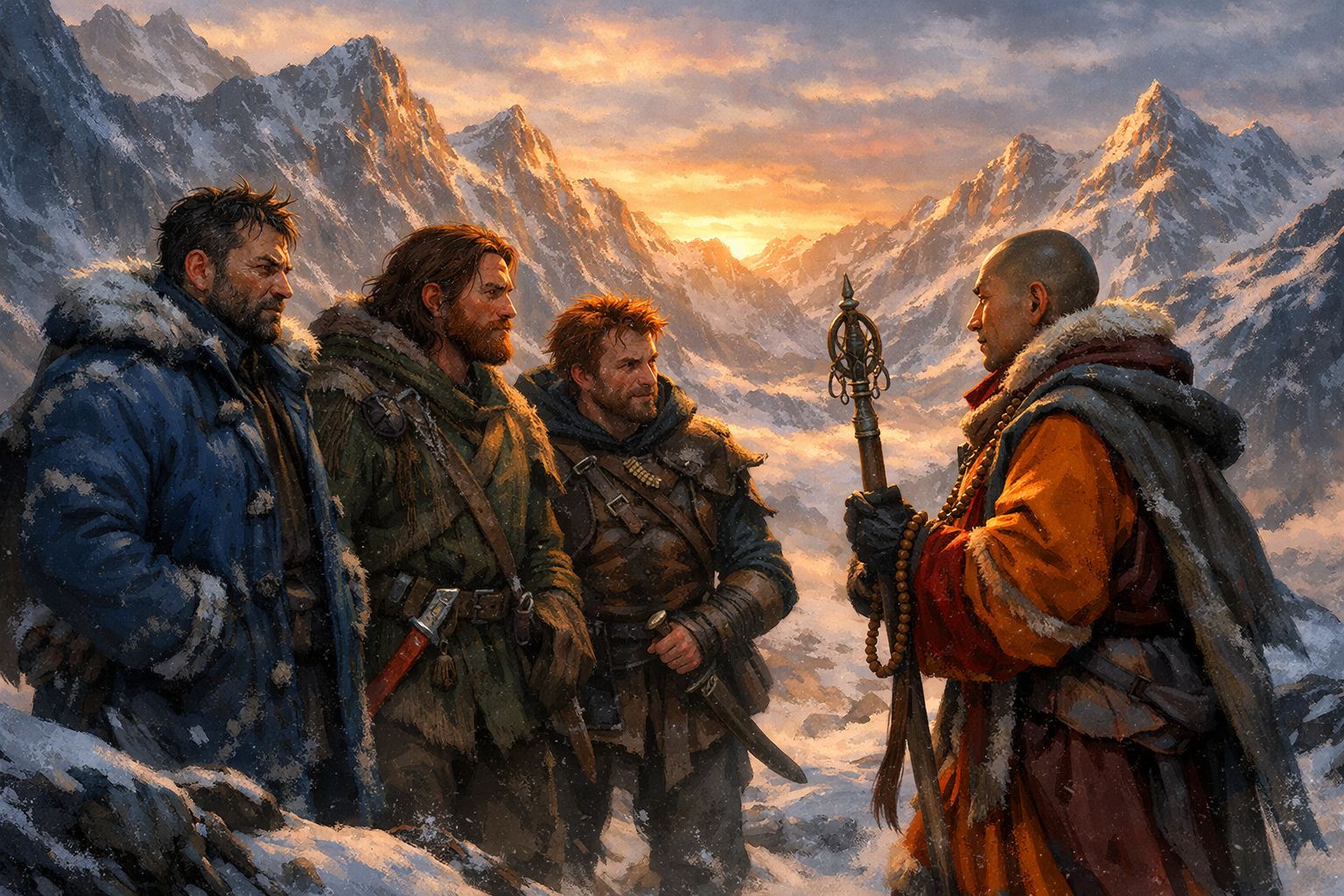
This scene is meant to feel surprisingly easy. After the hard climb and the delayed arrival, the crew finally gets the answer they came for almost at once. That should create relief, but also a faint sense that something is off. The monk gives them exactly what they need and almost nothing else. He is not obstructive, not sinister and not memorable in any dramatic way. That restraint is important.
Behind the scene, this monk is Samden. The players should not know that. He does not introduce himself by name, rank or office. He presents himself only as a pilgrim on the move, one more disciplined traveler in a land full of them.
The Encounter
As the crew approaches the monastery, a monk exits the gate already dressed for travel. He should not seem like someone sent to receive them formally. He simply appears at the right moment, calm and self-possessed, as though this meeting is ordinary.
If they ask about the Waverider crew, he confirms that he met them and helped them a couple of times. He then gives the next lead plainly. They continued to Goldgate, south of Elarune.
If asked what kind of help he gave, he answers in the same understated way as in the flavor scene. He helped them when they got lost. Another time he helped them with a stuck door. These answers are true, but frustratingly vague. He does not elaborate unless you want to give a little color, and even then he should stay general rather than specific.
If pressed for more details, he apologizes politely and says he is on pilgrimage to Mount Khazra and cannot afford to lose the daylight. He then takes his leave.
How to Play the Monk
The monk should come across as courteous, practical and completely unruffled. He is not evasive in the obvious sense. He simply gives no more than he means to. That difference matters. The crew should not feel openly refused. They should feel that they have run into someone who has already decided the proper shape of this meeting and sees no reason to go beyond it.
He should not feel mystical, theatrical or knowingly cryptic. The best version of the scene is one where the players are left thinking that they just met a very ordinary monk who happened to have the information they needed. Only later should the memory feel strange.
Searching for More
If the crew tries to get more information from the monastery, they will not gain anything useful.
The monks receive them politely. They answer in a measured and respectful way. They do not deny that the traveler exists, and if asked about him they say only that he is reliable and very devout to his training. This should sound like genuine respect, not suspicion or defensiveness. The monks simply do not offer more. If pushed, they will simply and respectfully state that lying is not their way, they are committed to truth.
No one at the monastery can add any meaningful detail about the Waverider, the monk’s exact role or where he may be going beyond what he already said. The place feels closed without being hostile. That is the correct tone.
If the Crew Tries to Push
If the players keep probing, let them do so for a little while, but make it clear through play that the well is dry. The monks remain calm. They do not become angry. They do not slip. They do not suddenly reveal a hidden clue. The scene should gradually flatten rather than explode.
This is important for pacing. The point is not to create a puzzle they can solve here. The point is to let them understand that they have already received the answer this location is meant to provide.
The Exit Beat
Once the players realize there is nothing more to get, it is time to leave.
Do not add a late twist, hidden passage or extra confrontation. The scene works because of its simplicity. They climbed to a remote holy place, met a quiet pilgrim who pointed them onward and found that the monastery had nothing further to say. That neatness is what gives the act its faintly uneasy feeling.
They now have the next lead. Goldgate, south of Elarune. The mountain has given them what it meant to give.
Return to the Ship
The return trip should feel like the climb to Tseradun in reverse, but lighter in tension. The crew has their answer now. There is no mystery to pursue on the road and no new complication waiting in the passes. The point of this stretch is simply to let the mountain remain itself: vast, exhausting and indifferent.
That lack of incident matters. The act is meant to feel strangely simple. The crew climbed to a remote monastery, got the information they needed and now goes back down again without drama. That plainness is part of what makes the whole experience feel slightly off in hindsight.
The Journey Down
The path back follows the same route they used on the way up. Snow gives way to bare stone and moss, then to harsher scrub and finally to the lower slopes where villages cling to the mountainside. The air grows thicker with every stage, and the crew should feel the difference. Descending is easier than climbing, but it is still tiring, hard on the knees and slow in places where the path is narrow or broken.
Use the same landmarks in reverse. Prayer flags snap in the wind beside old cairns. Shrines stand at bends in the trail. The same villages offer the same quiet hospitality if the crew stops again on the way down. Nothing has changed, and that sameness helps sell the sense that this part of the world simply endures.
Tone and Pacing
Keep the journey calm. Do not add ambushes, arguments, hidden clues or sudden revelations. The mountain gives them no final test. The weather does not turn dramatic. No monk comes running after them. The path is just the path.
That quietness is the scene’s value. It gives the players space to think about how easy the meeting was, and whether that ease was reassuring or not. Let them talk among themselves, compare impressions and decide how much significance to place on the monk and the monastery.
Return to the Blue Marlin
After three uneventful days, the crew reaches the coast and the Blue Marlin. The ship should feel warmer, lower and more human after the cold severity of the heights. Khazryn remains behind them, immense and remote, while the next lead lies ahead.
They leave with what they came for. The Waverider went on to Goldgate, south of Elarune. Nothing more has been added, and that is exactly how this stretch should feel.
Act Summary
The Khazryn arc is brief and intentionally sparse. Its main purpose is to place the crew in front of the next clue while giving them a quiet first visible brush with Samden without revealing who he is.
The Monk
At Tseradun, the crew is met by a monk already leaving the monastery. This is Samden, but he presents himself only as a pilgrim. He is calm, courteous and gives them exactly what they need with almost no resistance.
He confirms that he met the Waverider crew and helped them a couple of times. When asked for details, he only gives vague examples, such as helping them when they got lost and helping with a stuck door. If pressed further, he politely excuses himself and leaves.
The important thing is that he should not feel sinister, mystical or dramatic. He should feel ordinary enough that the scene only becomes strange in hindsight.
The Clue
The clue is simple and direct. Samden tells them that the Waverider continued to Goldgate, south of Elarune.
That is the real function of the arc. The crew climbs to a remote monastery, gets the next lead almost immediately and finds nothing more when they ask around. The whole thing should feel almost too easy.
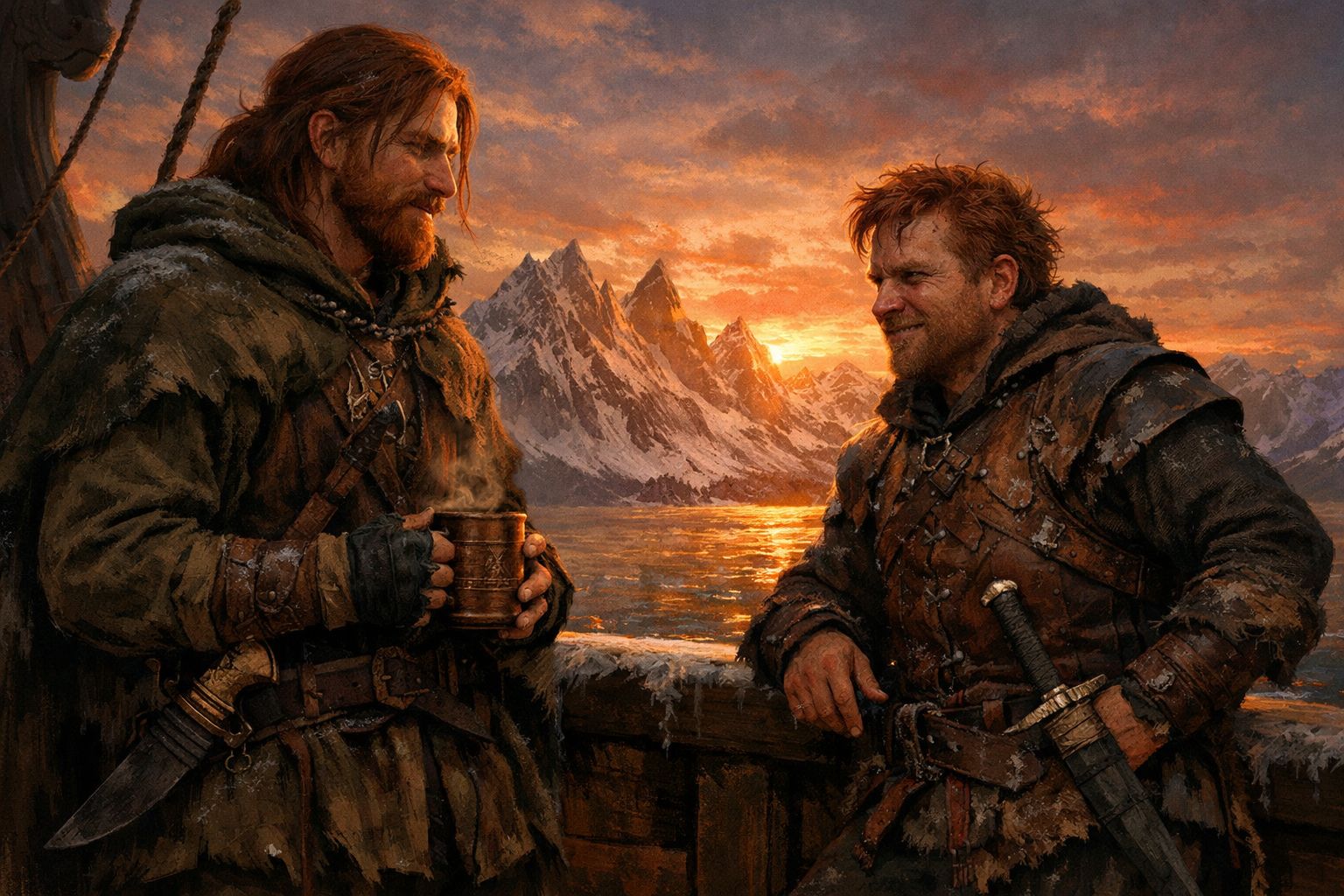
The Blue Marlin rolled gently on the dark water as Khazryn faded behind her. The mountains were only pale shapes now, half swallowed by evening haze, but they still looked impossibly high, as if some part of them remained above the world of ordinary men.
Skarnulf stood at the rail with his arms folded, staring back at the white peaks. Gastved leaned beside him with a cup of hot broth in both hands, letting the steam rise into the cold air.
"This sits wrong with me," Skarnulf said at last. "Not because it was hard. Because it was easy. Too easy. We climbed halfway to the heavens, asked our question, and got our answer like it had been waiting for us."
Gastved glanced back toward the mountains.
"Maybe that is because we did not just make a journey," he said. "Maybe we made a pilgrimage and came back with enlightenment."
Skarnulf gave a short laugh.
"That sounds like monk talk."
"Does it?"
Gastved smiled faintly.
Skarnulf looked out over the water again. The laughter faded. After a moment, he gave a slow nod.
"No," he said. "You may be right."
They stood in silence for a while, the ship creaking softly beneath them.
Then Gastved spoke again, quieter now.
"I have never felt so close to my gods as I did up there. Above the clouds. It was as if the world had thinned."
Skarnulf nodded.
"Aye. I know what you mean. The wind up there... I could almost feel wingbeats in it."
Gastved turned his head slightly.
"Wingbeats?"
Skarnulf scratched at his beard, still watching the fading mountains.
"Maybe that monk was more than a monk," he said. "Maybe he was a dragon in disguise."
Gastved shrugged.
"Let us first see whether he told the truth," he said. "After that, you can decide whether he had scales under the robes."
That drew another laugh from Skarnulf, quieter this time.
The two men fell silent again, watching Khazryn sink into distance behind them.