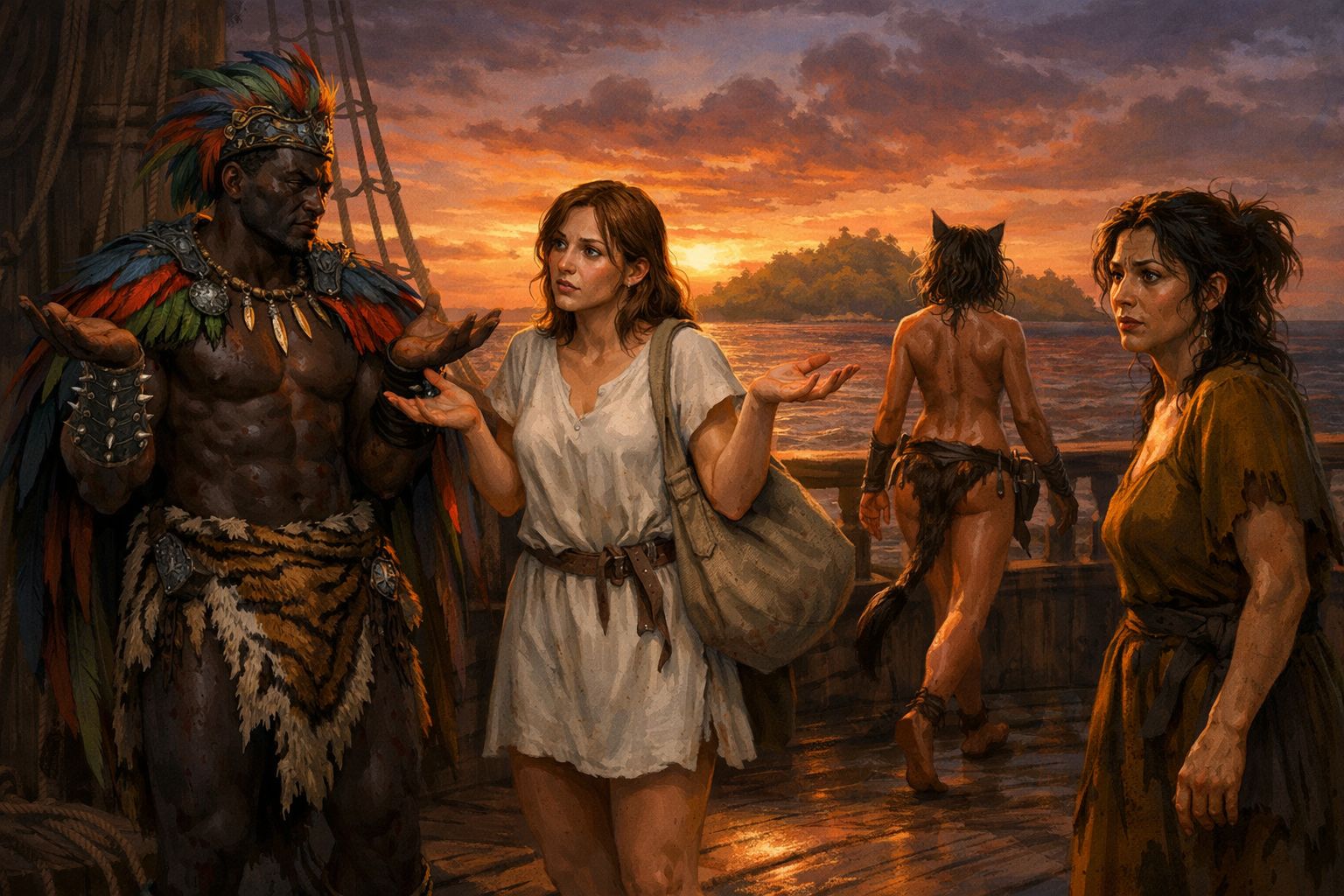
Campaign: Karuun Rebellion
Act Synopsis
This arc is a clear reminder that “right side” and “good people” are different things. The Great Empire is a brutal colonial machine that survives by extracting wealth, bodies and obedience from its edges. The Karuun rebellion is a just resistance to that machine, but it is also ruthless, vengeful and willing to cross lines that the crew may not be willing to cross.
Play the rebellion as emotionally convincing in its grievances and morally alarming in its methods. The arc’s pressure point is not “should we oppose the Empire” but “what do we do when the people opposing the Empire are also capable of atrocities.”
Imperial Context in the Delta
Southern Montosho is an imperial extraction zone: manatee oil, timber, ivory and slaves moved through river stations under constant fear of ambush. The Empire holds only a few fortified stations now, with many abandoned outposts and overcrowded forts where paranoia and cruelty grow sharper by the week. Forts hold the river, patrols punish villages, taxes and requisitions happen on schedule, then the jungle takes everything between those points.
The stations relevant to this arc are Lomarek, Orvannis and Marothis. Lomarek is a diseased, overcrowded manatee hunting post. Orvannis is a river fork station that still clings on with a strong garrison. Marothis is the last stone built bastion in the region and has become an overcrowded refuge.
In the background, Karuun’s uprising is the reason the region is slipping from imperial control. His legend is growing, his lieutenants are feared and the imperial governor Serathin Varro is a man trying to keep the whole thing from collapsing on his watch.
Key Player Facing Themes to Keep in Mind
- The crew is forced to decide what “saving people” means in a war zone.
- The crew is forced to decide what they will tolerate from allies when they need something from them.
- The crew is forced to decide whether prisoners of the Empire deserve rescue even when rescuing them endangers everyone.
- The crew is forced to confront a form of spiritual violence that mirrors imperial slavery, only turned inward and justified as revenge.
The arc is designed to create distrust, not of the rebellion’s goals but of its appetite.
Primary Cast and Why They Matter
Regardless of if Mbaru is a player character or not, he should accompany the crew on this mission, and will insist on it. Ileena will be another logical choice to include, and the Game Master should consider allowing both to accompany the team, even in the case of them both being NPCs.
Mbaru
Mbaru has direct history with the Karuun rebels. He fought alongside them briefly, learned their methods, then left because he believed the rebellion would burn everything it touched. This makes him the bridge into the camp and also the loudest internal warning sign once he remembers what they are willing to do.
Ileena
Ileena is a predator native to Montosho’s edges, built for jungle movement, tracking and silent violence. If she is present, stealth escape becomes a real option rather than a fantasy.
Cornelia Silvana
Cornelia is the hook that ties this arc to the Waverider trail. She is the best healer in Marothis, a woman in her early forties who once escaped danger aboard the Waverider, later returned, then left again for Orvannis because they needed her. She is practical, tired of politics and focused on the wounded in front of her.
Arrival at Marothis
The Blue Marlin reaches Marothis after the region’s immediate panic has settled. The legion has secured the town and the atmosphere is tense but controlled.
Marothis is an imperial refuge and pressure cooker, overcrowded and resentful. It is also a place that remembers the Waverider clearly. People here do not know where it went, but they remember the ship as a rescuer during the worst panic.
The crew learns about Cornelia Silvana’s connection to the Waverider and her later departure to Orvannis. Locals are bitter about losing her and will emphasize that the remaining healers are only apprentices. This sets emotional stakes and establishes that Orvannis is worse off than Marothis, not better.
Transition Through the Delta and Past Lomarek
The Blue Marlin sails onward toward Orvannis. On the way, they pass Lomarek, a manatee rendering station. Do not make this a full stop unless the players insist, but do let it scar the crew’s memory: the smell, the grease sheen, the casual industrial cruelty, the imperial logic of “necessary lamp oil” purchased with suffering. The setting supports this tone, with the delta full of smaller rendering plants under constant threat.
They will have seen such a station in the Montosho arc, so they should know what it is, even from afar.
Approach to Orvannis and the Raid Aftermath
The Blue Marlin cannot travel upriver. The crew transfers to a skiff and arrives at Orvannis in the morning, in the immediate aftermath of a rebel raid.
The scene should look like chaos in the process of becoming order: parts still burning, the garrison trying to secure a perimeter, wounded everywhere, the dead left where they fell because there has not been time. The Empire’s strength is visible, but it is a tired strength. The jungle has been winning the rhythm of this war for a long time.
The crew will likely assist with medical aid, fire control and basic security.
The garrison confirms the key fact: rebels took prisoners, roughly a dozen, including Cornelia Silvana. Several kidnapped are ordinary station workers or slaves. Some are legionnaires, taken alive. This matters later.
The Decision to Enter the Jungle
Once the crew commits to pursuit, the arc shifts from political tension to survival tension.
You want the jungle to feel like it has agency. The rebels move easily. The crew moves slowly. The Empire’s structures drop away behind them. Even Mbaru, who is physically built for hard environments, treats the jungle as a place you respect rather than conquer.
First Contact with a Karuun Patrol
The crew encounters a Karuun patrol sooner than they want to. This is where Mbaru’s history matters.
Because Mbaru fought alongside the rebellion in the past, he will be recognized and knows how to speak to them without triggering immediate violence. They do not trust the crew, but they accept them in a watchful, predatory way and escort them to a larger camp.
If Mbaru is an NPC, play him as controlled and careful, choosing words that sound loyal without making promises. He left once because he saw where this could go. Now he is walking back into it.
Arrival at Camp
The escort reaches the rebel camp at sunset. The camp is disciplined in its own way, but it is not “nice.” It is a war camp full of hunger, resentment and triumph.
The crew meets Masengo, a commander who is an old friend of Mbaru from his time among the rebels. This relationship buys limited freedom of movement. It also creates a trap: Masengo expects loyalty from Mbaru, and any hesitation reads as betrayal.
Within the camp, the crew hears constant anti Empire talk, bragging about killing legion soldiers and stories of imperial brutality. Most of it is true. That truth is what makes the next parts land harder.
They also learn the rebels sort prisoners by story and usefulness. Legion prisoners are caged. Station workers are forced into labor. Enslaved locals taken from the station are freed and has chosen to go back into the rebellion.
Cornelia in Captivity, but Working
The crew quickly confirms Cornelia is here. She is not treated as a guest, but she is allowed to work because the rebellion needs healers badly.
Cornelia’s stance is simple: she heals people. She does not care about politics. She does not want to be here. She will share information and help the crew, but only if they get her out. She refuses to be recruited into anyone’s cause.
Masengo refuses to give her up. He frames it as necessity, justice and the Empire getting what it deserves. He sees Cornelia as a resource the war cannot afford to lose.
Spirit Enslavement Ritual
During the night, the crew witnesses a spirit enslavement ritual.
This is the moment the arc reveals its real teeth. The rebellion’s grievance against the Empire includes slavery and extraction. The rebellion’s answer has become an inversion of that crime: where the Empire shackles bodies, the jungle shackles souls.
Make it clear the crew cannot interfere openly. They are massively outnumbered. The ritual is protected, normalized and treated as righteous.
After the ritual, the crew learns the remaining prisoners are five wounded legionnaires kept alive for later spirit enslavement. They are not dead yet. They will not remain merely prisoners.
Planning the Rescue
The rescue plan becomes a question of objectives, where only the first is a necessity.
- Free Cornelia Silvana
- Free the legion prisoners
- Free the enslaved captives taken in the raid
This presents a moral burden. Cornelia is the only required objective, and freeing anyone else will increase the risk greatly, but not freeing them will have a moral cost.
The Escape Problem
Getting out of camp is not the hard part. Getting out of the jungle is.
If the crew extracts only Cornelia, the group can move fast and quiet, with a realistic chance of evasion, especially with Ileena and Mbaru to handle stealth and silent takedowns.
If the crew also extracts the five wounded legionnaires or the enslaved station workers, the crew becomes slow, loud and trackable. They leave a trail and cannot take the hardest routes.
That leads to the arc’s core moral choice.
- The clean escape: save Cornelia, leave the legionnaires.
- The hard escape: save Cornelia and the legionnaires or the enslaved station workers, accept pursuit and likely violence.
- The brutal escape: release the legionnaires or enslaved station workers as decoys, then separate, deliberately sacrificing them to draw the hunt away.
Any of these choices should land. Do not soften them. The point is that war makes “good choices” scarce.
The Chase Through the Jungle
Run the escape as hide and seek through darkness, broken by short bursts of violence.
If the crew took only Cornelia, the chase can be mostly tension, near misses, scent and sound, with one tight moment where a sentry or patrol must be handled silently.
If the crew took the legionnaires or slaves, the chase becomes escalation: trackers, torches, shouted signals, arrows and ambush points. The rebels fight like shadows and they know the ground.
If the crew chose to use the other captives as decoys, getting out is easy, some close calls, but no fighting. They will find some bodies on the way out, though, and it is clear that rebels wanted to make an example out of them.
Cornelia’s Waverider Information and Aftermath
Cornelia does not give the Waverider’s next destination until she is safe, out of immediate danger and convinced the crew will not hand her back.
Once safe, she shares what she knows about the Waverider’s crew and the time she spent with them. Use this as a controlled drip of Waverider intel that builds emotional investment in the missing crew.
Cornelia also asks for passage out of the region to a civilized port. She will not join the Blue Marlin long term, but she will become a lasting ally wherever the crew drops her off.
For Junia, Cornelia becomes a professional mentor and peer during the travel. They exchange methods, herbal knowledge and field practice. Junia benefits from seeing a healer who has survived without becoming numb. Cornelia benefits from Junia’s raw talent and her willingness to work without ego.
Arrival at Marothis
The first thing Nasheem noticed was the smell.
Not one smell, but layers. Hot tar and wet rope. Fish left too long in the sun. Smoke from low fires that never quite went out. Sweet rot from spilled fruit and sour beer seeping into boards that had not dried in years. Under it all, the oily tang of rendered fat and lamp oil, thick enough that it clung to the back of the throat.
Marothis sat in a shallow curve of coast like a bruise. Long piers reached out into brown water where small boats crowded in rows, their hulls scraping, their crews shouting, their decks stacked with crates and bundled timber. Beyond them, larger ships waited, high sided and patient, the kind that could swallow a season’s worth of misery and sail it north under clean flags.
Junia paused at the top of the gangplank and looked over the harbor with an expression that was careful and blank, as if she was trying not to breathe too deeply.
"Busy," Nasheem said, and the word came out dry.
Junia let out a small sound that could have been agreement. "People still call this a port. It feels more like a mouth."
"More like an asshole," Mbaru muttered.
"A body," Nasheem said, "Eats everything, and out comes shit."
Ahead of them, legionnaires stood in pairs, helmets bright, red cloth clean enough to look offensive. They watched the flow of bodies the way fishermen watched currents. A man with a slate board and a stylus moved down the pier counting crates as dockhands hauled them past. He shouted at a boy to lift properly, like it mattered.
Mbaru stepped off the gangplank last.
He did not look around the way visitors did. He kept his eyes low for a heartbeat, then lifted them slowly, as if the town might strike if he moved too fast. His shoulders were set, but not in pride. More like someone bracing to walk into smoke.
A legionnaire turned, saw him, and held the look a second longer than politeness allowed. Another followed the line of that gaze and the two of them exchanged a glance that said recognition without certainty.
Mbaru saw it. Nasheem saw him see it.
"It is your skin," Nasheem murmured, not quite to Junia, not quite to Mbaru. "And the way you hold yourself."
Mbaru’s mouth tightened. "And the scars. And the fact that I look like I belong in the jungle more than I belong here."
Junia said quietly, "Do you want me to walk next to you?"
He shook his head once. "No. Let them watch. If they are going to decide who I am, they will do it no matter how close you stand."
Ileena had walked off the pier already, unbothered by the attention. In most towns, even in rough ones, people stared at her like she was a knife set down on a table. Here, eyes slid over her and did not linger. Catlings were common here, and several could be seen moving in the docks, offering their services as guides.
She stopped at the edge of the pier where a man was cutting strips of dried fish from a rack, held one up between finger and thumb, sniffed it, then made a face.
"That is not meat," she said.
The fish seller blinked at her, uncertain whether he was being insulted.
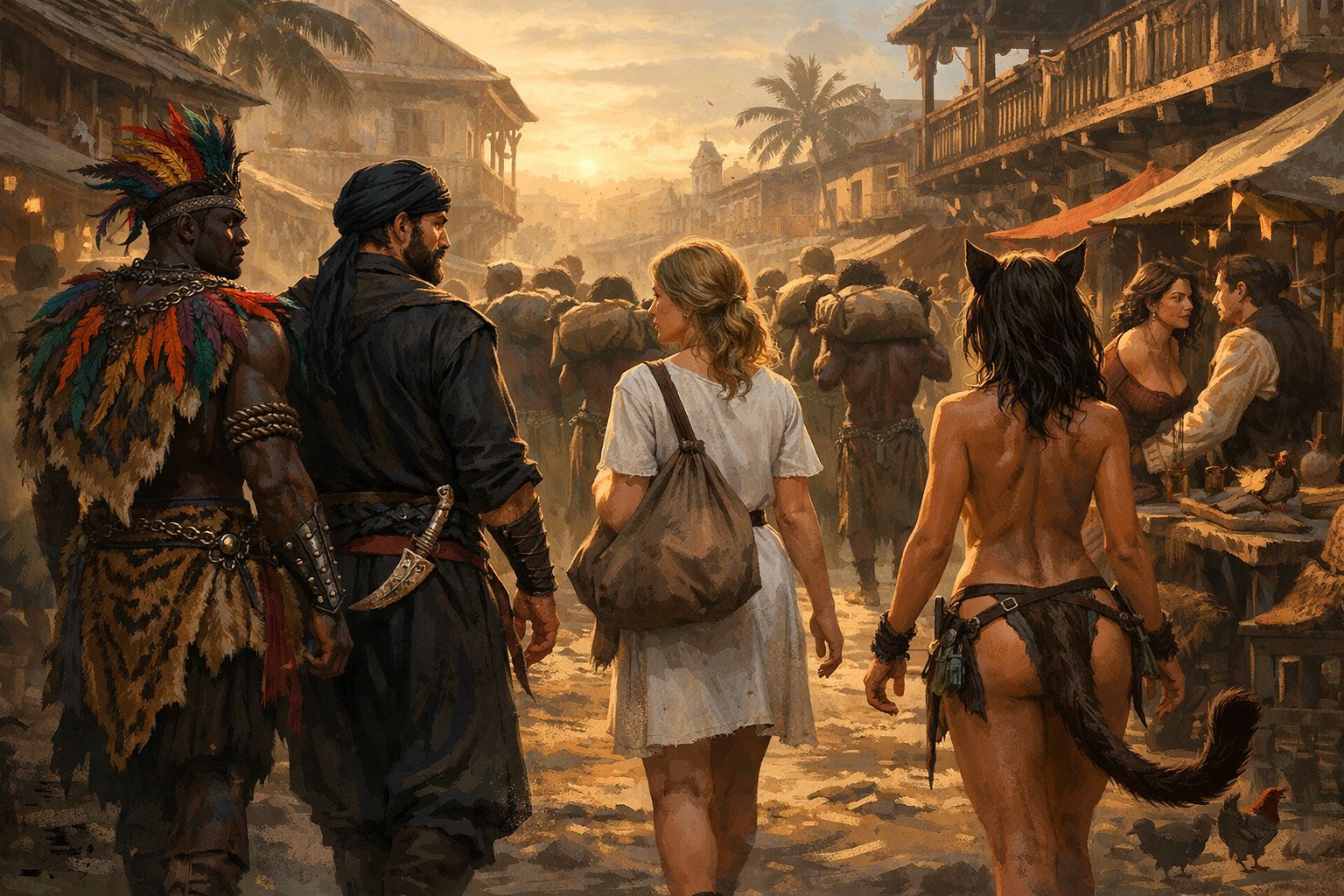
Nasheem moved his gaze away from the harbor and toward the town proper. The market started immediately, as if the docks were only a vein feeding it. Stalls pressed into each other. Men leaned on stacks of crates and haggled wholesale, not over single objects but over entire shiploads. A group of traders in pale linen argued with a broker whose hands never stopped moving, fingers counting invisible coins.
Farther in, the street narrowed. Mud became the main material. Filth baked into it until it was less mud than history.
A wagon creaked past carrying bundled timber as thick as men. Behind it, chained bodies moved in a line, ankles linked, wrists locked, guided by a bored guard with a pole. Their faces were turned down. One woman looked up when she heard laughter from a nearby tavern, and her eyes went flat again when she remembered where she was.
Junia’s hands flexed once at her sides. She did not speak, but Nasheem could see her jaw harden.
"The town does not even pretend," Junia said at last. Her voice was calm, which made it worse. "No curtain. No sermon. Just a ledger and a whip."
Nasheem watched a sailor stumble out of a doorway, shirt half untucked, grin wide, arm around a girl who looked far too young to be laughing with him. A man in a bright sash took their coins and pointed them toward another door with a painted sign that promised a wide menu of pleasures.
Nasheem pointed at the sign. "I don't even know what half of those are."
"I do," Amaxia said, roughly. "If you did, you wouldn't be my friend."
Nasheem opened his mouth to say something, but a sharp glance from Junia stopped him.
In the street ahead, a ring of shouting men formed around a patch of trampled ground. Someone pushed through the crowd carrying a bucket of water. Nasheem caught glimpses of movement inside the circle, quick and desperate. A man yelled a name. Another shouted odds. Coins flashed. A heavy thump hit the dirt and the crowd roared as if it had been waiting all day for permission to feel alive.
"Slave fights," Nasheem observed. "They bet on them. Seen as legitimate business here."
Junia’s eyes flicked toward it, then away. "We are not going to look," she said.
Mbaru’s voice was low. "There are worse rings than that one. They don't have knives, and they both get to live. Usually."
Ileena had been drifting along the street’s edge, head turning at smells rather than sights. She paused, inhaled, then turned sharply down an alley with the certainty of someone following a trail.
"Smoke," she said. "Blood. Salt. Fat. That one."
Nasheem followed her gaze. The alley mouth was narrow, shadowed. A sign hung above it, painted with a crude knife. The air there was different, cooler, and under the rot of the town there was something more honest. Raw meat. A butcher’s shop, or something close enough.
Junia looked as if she wanted to argue on principle, but hunger had its own priorities on a ship, and Ileena’s hunger came with consequences.
"We need supplies," Nasheem said. "Food. Information."
Ileena glanced back, impatient. "Food first."
Mbaru hesitated as they approached the alley. A pair of legionnaires at the corner watched him again, eyes narrowing, not hostile but measuring. One of them, a sergeant with a scar across his cheek, shifted his weight and let his hand rest on the hilt of his short sword. He did not draw it. He simply made sure Mbaru saw he could.
Mbaru stopped, met the sergeant’s eyes, and gave a nod that was not submissive, not challenging. Just acknowledgement.
The sergeant’s gaze flicked to Junia, then to Nasheem, then to Ileena. He said nothing. His silence was a verdict without a sentence.
As they turned into the alley, the noise of the market dulled behind them. The air tightened. Somewhere deeper in the town, someone laughed too loudly, and someone else screamed in a way that was cut off quickly.
Junia exhaled slowly, like she had been holding it since the gangplank.
"Remember why we are here," she said.
Nasheem nodded. "We find the trail. We follow it. We leave with what we came for."
Mbaru’s voice came softly, almost to himself. "And we do not let this place decide what we become."
Ileena pushed open the butcher’s door with her shoulder and stepped inside as if she owned it, already searching for a chunk of meat with her eyes.
"Also," she called back over her shoulder, "if any of you try to feed me fish again, I will eat the person who suggests it."
Nasheem almost smiled, but the expression did not last. The town had a way of swallowing light.
Mood Tips
Order has been restored in Marothis, but it is the brittle kind. The town is overcrowded, tense and watchful, with legion patrols everywhere and a constant sense that violence is only waiting for an excuse.
Lean into the town’s function as a colonial funnel. Everything is here to be shipped out: oil, timber, ivory, slaves, pelts, rare beasts. The harbor and wholesale market are the beating heart, and everything else exists to serve them. Dirt is physical, social and moral. If the crew looks for kindness, they can find it in individuals, but the system around them is openly ugly.
Mbaru should draw suspicion rather than immediate confrontation. Let the legion watch him longer than they watch others. Let locals look away rather than stare. Ileena can move more openly than usual because Catlings are a common sight, often hired as jungle guides.
Waverider Rumors
Most people have heard of the Waverider. The story is simple and half mythologized: it showed up during the worst panic and helped get refugees out. Few can provide firm details, and anyone who claims certainty is either embellishing or trying to sell the crew something.
A smaller number remember Cornelia Silvana personally. They know she escaped on the Waverider, later returned and spoke often about the crew. Some are convinced she “knows things,” even if they cannot say what.
They also know she later left for Orvannis because the station desperately needed a healer. Locals are bitter about this. They do not blame Cornelia for being compassionate, but they resent being left behind with only a couple of apprentices, especially in a town where injuries are common and help is never free.
Transition Through the Delta and Past Lomarek
The delta looked like it was trying to forgive the world.
Beyond Marothis the coast broke into islands and sandbars, white beaches and palms leaning over water so clear it felt unreal. The Blue Marlin slid forward with the slow patience of a heavy ship, and for a while the only sounds were rope creak and gull calls.
Nasheem stood by the rail, eyes on the horizon. “It would be easy,” he said, “to pretend this is all it is.”
Junia watched the wake close behind them. “People build their ugliest work in beautiful places,” she replied. “It makes it easier to live with.”
Mbaru said nothing, but his shoulders stayed tight, as if the town’s filth had followed him out to sea.
They rounded a point of land and Lomarek came into view.
From a distance it could have been any station: a pier, a few structures, flags in the wind. Then the wind shifted and the smell hit them across the water, thick and hot. Rot, blood, fat boiling.
A small boat emerged from behind the pier, low in the water. Two manatees were lashed alongside it, harpoon lines still buried deep. Another boat came in from the open sea with the same load, the same ropes, the same calm urgency. Below the jetty the bay was stained and alive with circling sharks.
Junia’s face went flat with recognition. Nasheem’s hand tightened on the rail until his knuckles showed.
“We are not stopping,” Nasheem said.
Ileena sniffed once, disgusted in a way that had nothing to do with mercy. “They waste everything,” she muttered. “They cannot even hide the smell.”
Mbaru’s voice was low. “They do not need to. No one here can stop them.”
The Blue Marlin kept moving, Lomarek sliding past like a door they refused to open.
Not far beyond, the water changed. Blue thinned into brown. The open sea narrowed into channels, and the channels narrowed again until the jungle pressed in from both sides, wet and heavy. Where the ship could not go, they took a skiff upriver, the hull low and the banks close enough to touch.
Junia looked at the green walls closing around them. “It is beautiful,” she said, and it was not comfort.
“It is also a weapon,” Mbaru replied. “Out here, it belongs to whoever knows it.”
Ileena’s shoulders loosened, her eyes sharpening as if she had finally stepped into her world. “Good,” she said. “Here, things make sense.”
Nasheem kept his gaze on the river ahead. “Then lead,” he told her, “and do not let us drift into the wrong kind of silence.”
This is a mood bridge between Marothis and the upriver approach to Orvannis. The point is contrast: tropical beauty on the surface, industrial cruelty at the stations, then the tightening green corridor of the jungle.
What Happens
The Blue Marlin sails along a calm, idyllic archipelago coast. The crew experiences a brief sense of distance from Marothis, but the tension does not fully leave them.
They pass Lomarek without stopping. From offshore they see the manatee boats coming in and feel the stench carry over the water. Let this be a reminder of what the Empire’s extraction looks like when it is routine.
Soon after, the route narrows. Blue water becomes brown river, open sea becomes channels, and the jungle closes in. The crew transfers to a skiff to continue upriver.
Tone and Pacing
Keep it uneventful in terms of events. No encounters, no complications, no new information. The tension is internal and environmental, not tactical. Use this to let players breathe while reinforcing the arc’s themes before the Orvannis aftermath hits.
Approach to Orvannis and the Raid Aftermath
Morning in the delta did not arrive clean.
It seeped in through mist and wet heat, turning the river into a pale ribbon between walls of green. The skiff slid forward with a soft scrape of hull on water, insects sewing noise into every gap. Nasheem watched the bends ahead. Ileena watched the banks. Junia checked her bag by touch alone. Mbaru sat still, eyes on the treeline as if it might move.
The first sign of Orvannis was not a flag or a watchtower.
It was smoke.
Not cooking smoke, but the thick, sour stink of pitch and timber burned hard in the night. Under it lay blood, damp ash, something sharp and metallic that made Junia’s breath catch before she forced it steady.
They rounded a bend and the station came into view.
Orvannis sat tight against the riverbank, timber walls and watch platforms with a squat fort behind them. One corner of the palisade was blackened and chewed away. A roof had collapsed inward, beams still smoldering under wet ash. Steam rose where men threw river water onto stubborn embers.
The gate stood open.
That alone said enough.
Inside, chaos was turning into order by sheer will. Legionnaires moved in short, controlled bursts, not panicked, just exhausted. Two squads were pulling a rough perimeter outside the walls, spears set, eyes fixed on the jungle line. Others formed bucket lines, boots slipping in mud and blood.
The dead lay where they had fallen. A soldier near the threshold with one arm bent under him, face down as if sleep had taken him mid crawl. A dockhand against the wall, eyes open, staring at nothing. No one had covered them. No one had moved them. There had not been time.
Junia stepped forward without a word and knelt beside the first wounded man she saw. Her hands went sure and fast. She spoke softly, gave short instructions, and people obeyed because her calm was the closest thing to safety in the yard.
Nasheem followed her in, not to help with wounds, but to keep the space around her from collapsing. He kept one eye on the gate, one eye on the crowd, and grabbed a bucket when a line faltered, because fires did not care who was right.
Mbaru paused at the threshold. A legionnaire at the gate stared at him a moment too long, tired eyes trying to turn suspicion into certainty.
Nasheem met the look first. “We are here to help.”
The man’s gaze shifted to Junia already working in ash and blood, then to Ileena’s poised stillness, then back to Mbaru. Need won over doubt. He stepped aside.
Ileena moved along the inside of the palisade like a hunting cat, reading the damage instead of the people. She stopped where the wall had been hacked and burned, ran her fingers along a gouge, then looked into the jungle with a look that said the night had not truly ended.
Mbaru went where he was useful without pushing himself forward. He helped drag a beam away from a trapped man. He carried a body to the side. He kept his mouth shut.
Fragments of words passed between soldiers like sparks.
“Raiders.”
“Late night.”
“Taken alive.”
Junia looked up once, eyes sharp. “Who?”
A man with soot smeared across his face swallowed. “A dozen. Maybe more. They took the healer too.”
The centurion came through the yard with his helmet off and his voice already worn raw. He saw strangers working in his ruin and did not ask where they came from. He only pointed.
“You,” to Junia, “keep my men alive.”
“You,” to Nasheem, “keep that fire from taking my stores.”
Then his gaze held on Mbaru a beat longer than it should have. “And you stay where I can see you.”
Mbaru did not flinch. “That is fair.”
Beyond the walls the jungle stood bright and indifferent, birds calling as if nothing had happened.
Inside, the Empire tried to force itself back into shape with hands that shook from exhaustion.
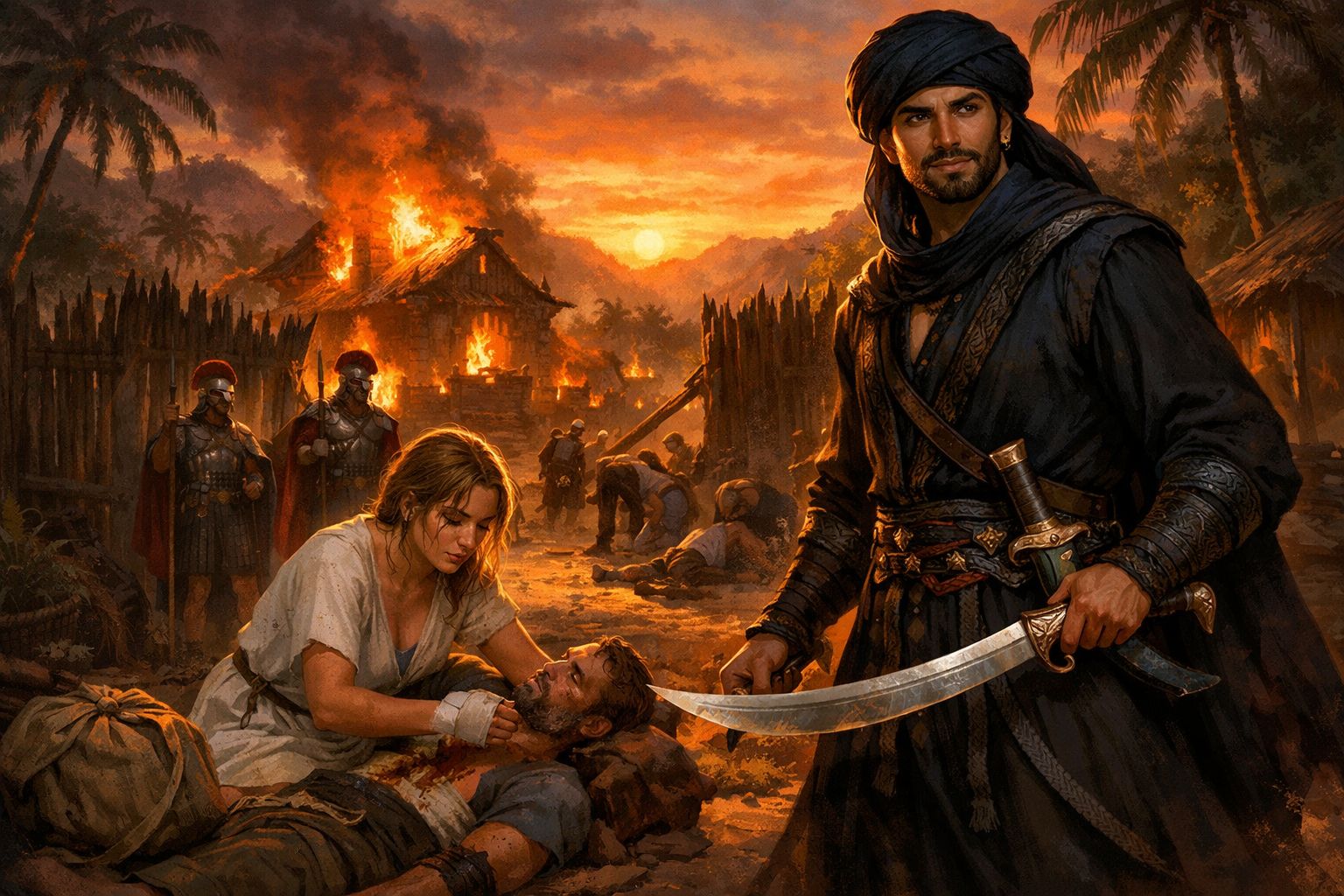
This is the hard landing after the quiet transit. The players should feel that the war is real, close and ongoing. The Empire is present and dangerous, but also tired. The jungle is not scenery here. It is the side that has momentum.
This scene also establishes the immediate objective: prisoners were taken, including the healer, and time matters.
First Impressions and How to Describe Orvannis
Lead with smell before sight. Burned pitch and wet smoke on the river air.
Then the open gate. It should read as wrong on instinct, even to players who do not know imperial procedure.
Inside the walls, frame it as chaos becoming order. Soldiers are moving with drilled purpose, but their discipline is stretched thin. There are still small fires. There is a bucket line. There are wounded everywhere. The dead are still where they fell because treating wounded and perimeter come first.
Make the strength of the Empire visible: armor, formations, commands, logistics. Then undercut it with exhaustion: hoarse voices, shaking hands, sleepless eyes, and anger that has nowhere safe to go.
What Happened, Short Version
Late at night, a Karuun rebel raiding party hit Orvannis fast, with the jungle as cover. They struck a weak point in the palisade, set fires to create confusion, killed those who resisted and grabbed prisoners in the chaos.
They withdrew before the garrison could fully organize a counterattack. The station survived, but barely, and the raid left it damaged, bloodied and humiliated.
Who to Talk to
Centurion Varron Cade, Acting Station Commander
The station commander was killed during the raid, and the responsibility now lands heavily on Varron.
A career officer running on no sleep. He is focused on restoring perimeter security, protecting stores and keeping his wounded alive. He is suspicious of outsiders by default, and especially suspicious of anyone who looks like the rebels, but he will accept help because he has to.
He can provide the cleanest timeline of the raid and a rough count of dead and missing.
He complains that they have a legion made to fight armies, not shadows.
Quartermaster Dalia Rusk, Stores and Ledgers
Practical, sharp, and furious about the fires. She knows exactly what was burned, what was stolen and what cannot be replaced. She can also confirm how dependent Orvannis was on Cornelia’s skills.
She can be a useful contact if the crew needs supplies, a guide or leverage with the centurion.
Sergeant Hesto Marik, Gate and Perimeter
A tired, suspicious noncommissioned officer who has been putting bodies into lines since before dawn. He saw the aftermath directly and will give the most visceral account: where the breach was, where people died, and what direction the raiders retreated.
If you want the players to feel watched, he is the one doing it.
Orderly Sella Imbray, Improvised Medical Aid
A dockside worker pressed into helping the wounded. She is shaken, but she knows who is missing among the noncombatants and will speak about names, families and panic rather than strategy.
Use her to humanize the cost.
What the Crew Can Do Here
- Medical aid: Let Junia or any healer stabilize the wounded. This earns trust and information, and it also gives the players time in the scene to ask questions while doing something constructive.
- Fire control: Bucket lines, moving stores, cutting burning thatch away. Physical tasks help sell the setting and keep the players engaged while exposition happens naturally.
- Basic security: Rotating watches, closing the breach, helping form a perimeter, posting a lookout. If Mbaru is present, the centurion will likely keep him in sight.
What Was Taken
Give a rough number: about a dozen, possibly more, taken alive. Split them into categories the Empire cares about:
- The healer, Cornelia Silvana: Taken because she is valuable and portable.
- Legion prisoners: Probably taken because they are enemies to be used as examples.
- Noncombatants: Dock workers, station staff, enslaved locals. Taken because they can be used as labor, traded, recruited or punished as examples.
What Likely Happened to the Taken
Do not confirm everything immediately. Let the garrison speculate, because fear and rumor are part of the tone.
- Cornelia Silvana is almost certainly alive and being forced to work. The rebels need healers too.
- Legion prisoners are likely injured, restrained and kept for later. The garrison fears execution, mutilation or worse, but the truth is more strategic: prisoners are leverage and resources. Mbaru knows about spirit enslavements.
- Noncombatants are the bleak unknown. Some may be freed and pushed to join. Some may be forced into labor. Some may be used to send messages. The Empire assumes the worst, and in this arc, the worst is often not wrong.
Key Information to Deliver Before the Crew Leaves
- The raid happened late at night.
- The rebels retreated into the jungle quickly.
- The breach point and the likely direction of withdrawal.
- The prisoner count and the fact Cornelia was taken.
- The garrison cannot spare a pursuit force without risking a second strike.
- The Legion is unwilling to go into the jungle. They are trained to fight in formations, in open terrain, against armies.
- If the crew chooses to go, they are doing what the Empire cannot.
Into the Jungle and First Contact
The river let them go, and the jungle took them.
The last timbers of Orvannis fell behind the bend, and with them went the last clean lines of the Empire. No palisade. No road. No clear horizon. Only wet green stacked on wet green, trunks like pillars, vines like ropes, leaves broad enough to hold a day’s worth of rain.
The air felt alive in a way the sea never did. It pressed against skin. It carried sound oddly, swallowing some things, throwing others back from directions that made no sense. Nasheem kept his hand close to his blade not because he expected steel to save him, but because it gave his body something familiar to hold.
Junia moved carefully, boots sinking into leaf rot, eyes flicking to every smear of red on bark, every torn frond that might be a sign or a trick. She was not afraid of wounds. She was afraid of being unseen.
Ileena was the opposite. Her shoulders loosened as the canopy closed. She slowed, not from caution, but from attention, reading the ground the way sailors read currents. Once, she lifted a hand and the others stopped without thinking. Ahead, a branch hung broken, the sap still wet.
Mbaru did not lead, even though his body could have. He walked as if the jungle had rules older than strength.
“Do not fight it,” he murmured, barely moving his lips. “You only tire yourself.”
They had been moving for less time than it felt like when the jungle shifted.
Not a sound. A pressure. The sense of eyes that were not there a moment before.
Ileena froze, head angled slightly, listening with her whole face. Nasheem felt it then too, the change in the air, the sudden wrongness of their own breathing.
A voice spoke from the green, close enough that it could not have walked there without them noticing.
“Stop.”
Shapes unfolded from leaves and shadow. Not men stepping into light, but the jungle deciding to show what it had been holding. Three, then five, then more. Dark skin, braided hair, damp cloth and bone charms. Spears and bows held ready but not yet loosed. Their feet were bare or wrapped in strips, and they stood with the effortless balance of people who belonged here.
The nearest one looked past Nasheem and Junia and fixed on Mbaru.
His eyes narrowed. Recognition without welcome.
“Mbaru,” he said, like a name that had to be tested in the mouth. “You walk with river folk now.”
Mbaru lifted both hands, empty, palms out, not pleading, not proud. He gave a small nod.
“Kaseko,” he replied, and his voice was steady. “I did not come to bring trouble to you.”
A low murmur moved through the patrol. The spears did not lower. The bows stayed half drawn.
Kaseko’s gaze slid to Ileena and held there a beat, then away. He did not look afraid. He looked calculating, as if deciding how many problems she represented.
“You left,” Kaseko said. “And you came back.”
Mbaru did not deny it. He chose his words the way you chose footing on slick stone.
“I left before I became useful to the wrong kind of victory,” he said. “I am not here for your war. I am here for the people you took from Orvannis.”
Junia’s throat tightened. Nasheem felt the urge to speak, to explain, to negotiate. He kept quiet. This was not his language, not his ground.
Kaseko’s expression did not change, but something in the patrol did. Interest, sharp and hungry.
“Orvannis burns,” Kaseko said. “Good.”
“It burns with people inside,” Junia said before she could stop herself.
A spear tip lifted an inch toward her, not a threat, a reminder.
Mbaru’s head turned just enough that Junia could see the warning in his eyes. Not fear of the rebels. Fear of saying the wrong thing.
Kaseko studied them in silence, then gave a small gesture.
“Walk,” he said. “Not fast. Not slow. As we decide.”
Two of the rebels moved behind them without sound. Another stepped ahead, not guiding, steering. The patrol did not surround them like guards. It surrounded them like hunters.
Ileena glanced at Nasheem once, the smallest flick of eyes, then looked forward again. She could run. They all knew it. None of them moved.
Mbaru lowered his hands and started walking, shoulders tight, face calm. The others followed.

Mood And Pacing
The jungle should feel like an active presence, not a backdrop. It muffles sound, redirects it, hides distance and makes direction uncertain. The crew is not traveling through the jungle, they are being absorbed by it.
Keep the pace slow and tense. Progress is measured in careful steps, not miles. Emphasize wet heat, insects, slipping footing, sudden quiet, and the feeling that they are never alone.
The rebels should feel fast and effortless by contrast. The crew is loud even when they try not to be. Every snapped twig feels like a signal.
Suspicion As The Default
The crew should feel watched long before they see anyone. Use small signs: a shifted leaf, a branch that was not broken before, a bird call that stops too abruptly.
Mbaru’s presence changes the texture. He looks like the rebels and knows their ways, which makes the crew safer and also more suspect. If the players ask why they are not attacked, the answer is simple: the rebels are choosing the moment, and they want to decide what the crew is worth.
The Patrol Contact
Run it as an ambush that is not immediately violent. A voice from the green. Shapes resolving from shadow. Weapons ready but not loosed.
The patrol’s first decision is simple: kill them where they stand, or take them alive and decide their value later.
Kaseko leads the patrol. He recognizes Mbaru and treats that recognition as leverage. He will not speak to anyone but Mbaru. The patrol’s suspicion is controlled and predatory, not angry. They are not trying to scare the crew away, they are trying to measure them.
Mbaru should do most of the talking. If he is an NPC, he is careful, respectful and deliberately noncommittal. He sounds loyal enough to avoid a fight, but never offers promises that bind him.
Ileena, if present, should read as dangerous even to the rebels. They respect her, and they track her closely.
Outcome
The patrol does not decide trust. It decides control.
The crew is accepted in the only way the rebels accept strangers: watched, escorted, and kept from making their own choices.
Arrival at Camp
The trees opened, not into a clearing, but into a decision. Smoke rose in thin columns. Fires glowed low. Voices carried in a steady murmur that said war had become routine.
Nasheem caught the first sentry only when he stopped trying to look. A shape wrapped to a branch, bow held easy, watching. Then another. Then a third. The camp had eyes before it had walls.
It was disciplined, but it was not clean. Weapons were stacked neatly beside sleeping mats. Cooking pots simmered. Men and women moved with purpose, lean bodies marked by old cuts and fresh bruises. Faces turned as the crew passed, not curious, assessing.
Mbaru stiffened, then forced himself to relax. He knew this rhythm.
A man stepped out from behind the largest fire with a grin that was too wide to be only welcome. Older than most here, braided hair, scarred arms, a machete hanging at his hip like a habit.
“Mbaru,” he said, and grabbed him hard by the shoulders. “You disappear and come back with river strangers at your heels.”
Mbaru let the embrace last a heartbeat, then stepped back. “Masengo. You look like you have not slept since I last saw you.”
Masengo laughed. “Sleep is for people who think tomorrow belongs to them.”
His eyes flicked over Nasheem, Junia, Ileena. When they paused on Ileena, they did not soften.
“Friends?” Masengo asked.
“Crew,” Mbaru replied, careful.
Masengo nodded as if he had heard a promise. “Then they are under my roof. For now. Come. Eat.”
As they were led deeper, the camp spoke its truth in fragments. Anti Empire curses. Bragging about killed legionnaires. Stories of imperial brutality told with a certainty that made them hard to dismiss, and laughter that held no joy, only triumph.
Then the other truth.
A cage of lashed poles held legion prisoners, wrists bound, faces swollen. One lifted his head as they passed and tried to speak. A guard struck the bars, not to injure, only to silence.
Beyond that, station workers hauled water and split wood under spear watch, hands raw, eyes down. Not beaten now, not spared either. Kept moving.
Near a smaller fire, freed locals sat with bowls in their hands, wrists unbound. They looked exhausted, listening to a rebel speak softly about home and revenge. One of them met Nasheem’s eyes and looked away fast, as if the wrong glance could put chains back on.
Masengo stopped by his own fire pit and sat like a man who belonged there.
“You came at sunset,” he said to Mbaru. “That means choices are already made. Tell me what you want.”
“People were taken from Orvannis,” Mbaru said. “One is a healer.”
Masengo’s smile returned, but it did not reach his eyes. “A healer,” he repeated. “Those are hard to find.”
Junia’s voice stayed controlled, but sharp. “She is not a prize.”
Masengo turned to her slowly, then looked back to Mbaru as if Junia had not spoken at all.
“Everything stays willingly,” he said softly, “once it understands why.”
He clapped his hands once. “Food for our guests. Let them eat. Let them look. Let them remember who the Empire made us.”
The fires cracked. The sky darkened. The camp settled around the crew like a net thrown with care.

This scene flips the moral lens. The rebels are not the Empire, and many of their grievances are true, but they are still building power through violent coercion. The crew arrives expecting enemies, finds hospitality, then realizes the hospitality has teeth.
This is also the scene where the rescue stops being an abstract plan and becomes a social problem. Cornelia is here, alive, needed, and not being let go.
First Impressions And Mood
Hit sunset first. The light failing under the canopy makes the camp feel like it appears by choice, not by accident.
The camp is disciplined, but not pleasant. It is organized scarcity: stacked weapons, strict sentries, rationed food, hard eyes. It should feel more alive than an imperial station and less clean. Hunger, resentment and triumph are all present at once.
The camp should feel like it has “eyes before walls.” The crew is watched before they are greeted.
Structure Of The Camp
Give the players a quick read of how the rebellion works in practice.
- Guard posts in the trees and at the perimeter.
- A central fire for leaders and announcements.
- A work area where forced labor is kept moving.
- A holding area for legion prisoners.
- A healing area where Cornelia works under watch.
This layout helps the players plan later without you having to draw a map yet.
Masengo And The Social Trap
Masengo is a commander and an old friend of Mbaru from his time among the rebels. He greets Mbaru warmly and publicly. That warmth is real, and it is also a claim.
The friendship buys limited freedom of movement for the crew. Masengo allows them to eat, talk, and move within certain bounds. It also creates an expectation: Masengo assumes Mbaru is still “one of them.” Any hesitation or moral refusal reads as betrayal, and betrayal in this camp is not debated politely.
Play Masengo as charismatic, practical, and morally convinced. He believes the Empire made him what he is. He does not see cruelty as corruption. He sees it as necessity.
What The Crew Hears
Let the camp’s background noise do heavy lifting.
Constant anti Empire talk. Bragging about killing legion soldiers. Stories of imperial brutality told with certainty and anger.
Most of it is true. That truth matters because it makes the rebellion’s later crimes feel like choices, not cartoon evil.
Prisoners And Sorting
Make it clear early that the rebellion has its own system.
- Legion prisoners are caged. They are enemies. Mbaru knows what that means.
- Station workers are forced into labor. They are useful and disposable.
- Enslaved locals taken from the station are freed and have chosen to return to the rebellion. This can be voluntary, pressured, or simply the least bad option, but the camp treats it as proof of righteousness.
This sorting is the first clear sign that the rebellion is becoming what they oppose.
Cornelia Silvana, Confirmed Alive
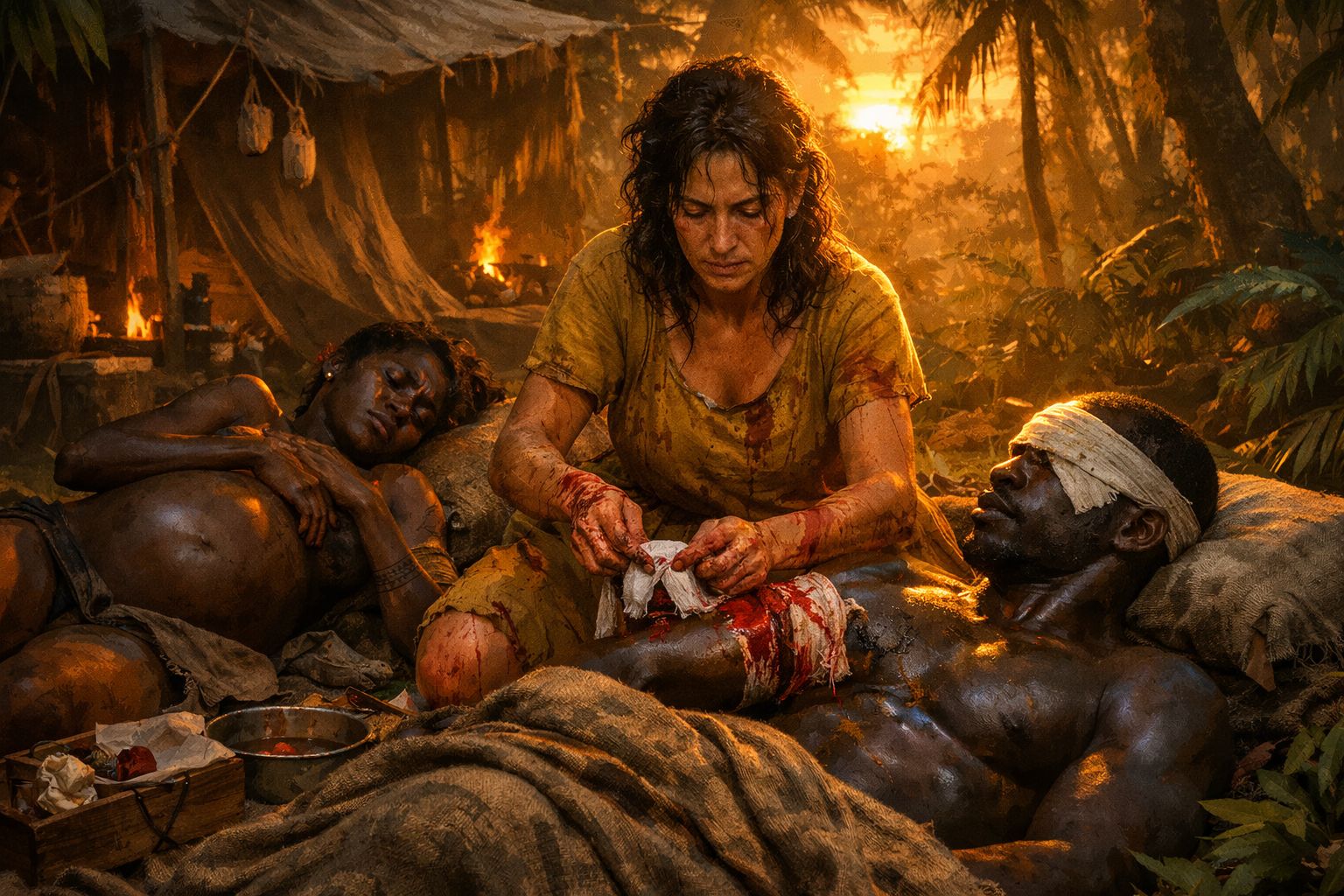
The crew quickly confirms Cornelia is in the camp. She is not treated as a guest, but she is allowed to work because the rebels need a healer badly. She is watched. Her mobility is limited. Her usefulness is her protection.
Cornelia’s stance is simple. She heals people. She does not care about politics. She does not want to be here. She will help the crew with information and cooperation, but only if they get her out.
She refuses recruitment and refuses to become a symbol for anyone’s cause.
Masengo’s Refusal
Masengo refuses to give Cornelia up. He frames it as necessity, justice, and the Empire getting what it deserves. He will likely offer rationalizations that sound reasonable in a war camp.
She is needed and she will be treated well. The Empire would never release a rebel healer. The crew should understand sacrifice.
He is not lying about the need. He is lying about the freedom.
The important point is that Masengo sees Cornelia as a resource the war cannot afford to lose, and he believes that makes his choice righteous.
What This Scene Sets Up
- A rescue is possible, but it is no longer a simple stealth problem.
- The crew must navigate hospitality that is also surveillance.
- Mbaru is manipulated between loyalty and conscience.
- Cornelia becomes the human center of the next decision.
- The camp becomes a place the crew can move in, but only on terms set by the rebellion.
Once this is set up, let night reveal what the rebellion is willing to do.
Spirit Enslavement Ritual
Night in the camp fell like a lid. The fires were fed low, smoke trapped under the canopy, and the jungle’s noise kept going as if it refused to witness.
A sharp knock on wood called people from their mats. Not a shout, not alarm. A summons. Rebels rose and drifted toward the central fire with the quiet certainty of a routine.
Nasheem watched from the edge as a ring formed, bodies closing ranks, sentries shifting in the branches above. In the center, ash had been spread and marked with careful lines, pale powder drawn into a pattern too precise to be decoration.
They dragged a legion prisoner into the circle.
He was injured, wrists bound. He tried to speak. A hand struck his mouth, not in rage, in discipline. Then a woman stepped forward with a bowl and a bundle of charms that clicked softly against her chest. She cut symbols in his forehead and chest with a small knife, but the wounds barely bled.
Mbaru’s posture changed. Not fear. Recognition.
The woman began to speak. The language, if it even was words, was not for the ears. It sounded like it was meant for something in the dark between breaths. The circle answered in a low hum, and the ash marks seemed to sharpen, as if the ground itself had been waiting.
The prisoner jerked as if he had felt a hook inside his ribs. The woman tipped liquid onto the symbols cut into his skin, and it ran into the cuts with unnatural obedience.
Then the air tightened.
Junia felt it as a pressure behind her eyes, a sudden cold that had nothing to do with night. She clamped her jaw and stayed still.
The woman spoke a final phrase and cut a large slash across the prisoner’s chest.
He arched. For a heartbeat the firelight flickered, and something tore loose from him. Not smoke, not shadow. A presence, strained thin, pulled out like a thread of pain. The woman grabbed at it, held it, commanded it.
As if on a cue, a warrior stepped forward and crushed his skull with a heavy club.
But the thing above the ash pattern did not collapse. It fought, soundless and desperate, and the woman’s voice snapped again, sharp as a cord pulled tight.
The pattern on the ground flared with a faint sheen, and the presence folded inward as if forced into a shape it did not want. The hum from the circle deepened into satisfaction.
The woman lowered her hand. Her expression was calm, almost gentle, as if she had finished a careful piece of work.
The rebels dispersed without celebration, only quiet certainty. Two men dragged the dead legionnaire away by the ankles, leaving a dark smear on the ash.
The crew did not speak until the ring had broken and the camp’s attention had drifted elsewhere.
Nasheem leaned close, voice barely there. “That was not vengeance.”
Junia swallowed. “They are doing it like it is ordinary.”
Mbaru’s eyes stayed on the scuffed pattern in the dirt. When he answered, it was almost without sound.
“That is why they take prisoners,” he murmured. “The body is nothing. The spirit is the prize. It is enslaved to serve them.”
Junia’s breath came shallow. “How long do we have?”
Mbaru did not look at her. “Less than you want.”
Nasheem’s nod was small and final. “Then we stop watching,” he whispered. “We move.”
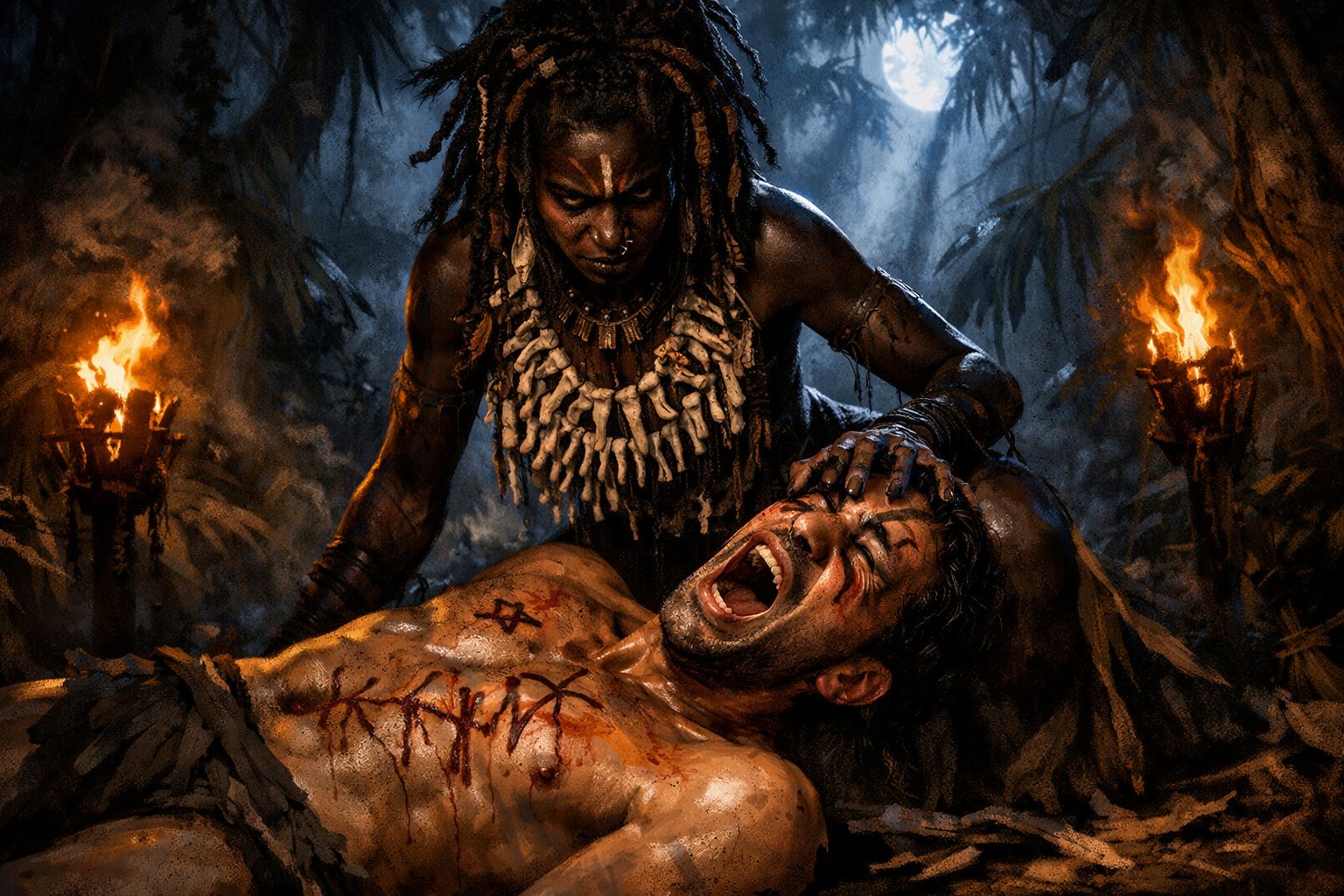
This scene is the moral turning point for the Karuun rebellion. The point is not that the rebels are hypocrites in an abstract way, but that they have built a practiced atrocity into their war routine. The players should leave the scene thinking “these people may be fighting the right enemy, but they are not safe allies.”
It also raises urgency. If the crew delays, the legion prisoners will not remain prisoners.
Mbaru recognizes what is happening and what it implies for the remaining prisoners.
Mood And Presentation
Play it like a ritual everyone knows, not a spectacle.
Keep voices low. Keep movements practiced. Make the circle form without argument. Let sentries tighten quietly. Let the jungle noise continue around them, as if nature refuses to intervene.
Describe concrete details, not explanations. Ash lines. Bone charms. A knife that cuts but barely bleeds. Liquid that is absorbed by wounds. Firelight that falters at the wrong moment. A sensation of pressure, cold, and hair rising.
Do not invite interruption. The crew is outnumbered, watched, and any sudden move is met by drawn weapons and a hard, silent stare.
What The Ritual Does
The goal is not to punish the body. The body is disposable.
The ritual is designed to tear the spirit loose, bind it, and keep it as a tool. The killing blow after the separation is deliberate. It destroys the body as a possible anchor, so the spirit cannot return. It is a one way gate.
The result is a captured spirit that can be forced to serve the rebellion. It is not “summoning.” It is enslavement, which does not end at death.
What This Sets Up Next
After the ritual, the rescue becomes time sensitive. The crew is no longer choosing whether to intervene in politics. They are choosing whether to leave people to a fate worse than death, and whether they can get Cornelia out before the camp decides she is too useful to lose.
Planning the Rescue
This is the decision point of the arc. The camp establishes that the rebellion is brutal. The ritual establishes that delay has a cost. This section is where the crew choose what kind of people they are willing to be under pressure.
Do not turn it into a puzzle with a correct answer. Treat it as a moral commitment with consequences.
Objectives
Only one objective is required for the campaign to move forward.
- Free Cornelia Silvana
The rest are optional, and that is the point.
- Free the legion prisoners
- Free the enslaved captives taken in the raid
Make sure the crew understand the categories in camp.
- Legion prisoners are caged, injured, and being kept for a reason.
- Station workers are being used as forced labor.
- Enslaved locals taken from the station are freed and rejoin the rebellion they once fought with.
What Makes This Hard
Getting out of the camp is possible. Getting out of the jungle is uncertain.
Inside the camp, the crew can exploit routine, darkness, and the rebels’ confidence. Outside the camp, the rebels own the terrain. They track well, move quietly, and can choose when to press and when to disappear.
The more people the crew extracts, the more the jungle becomes a clock.
The Escape Variables
- Speed: Cornelia can move. Wounded prisoners cannot.
- Noise: A struggling captive, improvised stretchers, whispered arguments, accidental cries, all carry farther than they should.
- Trail: Blood, broken branches, displaced mud, and disturbed undergrowth create a path the rebels can follow even in the dark.
- Time: The longer the crew spends getting people out, the more likely the camp shifts from sleep to alarm.
The Three Core Options
The Clean Escape
Save Cornelia. Leave the others.
This is the lowest risk path. It keeps the group fast and quiet and makes evasion plausible. It also leaves the crew carrying the knowledge of what they did not do.
This option will test the crew’s ability to live with a choice they can justify but cannot feel good about.
The Hard Escape
Save Cornelia and also attempt to extract the legion prisoners or the enslaved station workers.
This is a high risk path. The group becomes slow, loud, and trackable. Pursuit is likely. Violence is likely.
If the crew chooses this, reward them with moments of heroism and cooperation, but do not protect them from the cost. They chose to make the world heavier, the people they saved are likely to once again become part of the imperial machinery.
The Brutal Escape
Release the legion prisoners or the enslaved station workers as decoys, then separate, deliberately sacrificing them to draw the hunt away.
This is the darkest option and it should not feel clever. It should feel like a decision that will follow the crew.
Run it as effective in the short term and corrosive in the long term. Even if the crew escapes cleanly, they will later learn what “decoy” meant.
Running the Decision at the Table
Make sure the crew understand the trade.
More rescues means more risk and more blood.
Less risk means leaving people to a fate the crew has now seen with their own eyes.
Let them debate. Let them plan. Then require commitment. Once the first step is taken, do not allow rewinds.
Tools and Advantages
If Ileena is present, stealth and route choice become stronger. She can reduce noise, reduce trail, and find paths that others would miss.
If Mbaru is present, he can anticipate rebel habits and blind spots. He knows what would be watched and what would be taken for granted.
Do not make these automatic successes. Make them advantages that shift odds, not guarantees.
Consequences to Carry Forward
Whatever they choose, it should matter.
If they leave people behind, that choice returns as guilt, rumor, or later consequences.
If they bring extra captives, the Empire may reward them, resent them, or exploit them.
If they use decoys, the crew’s self image changes, and so does how some NPCs treat them if the truth comes out.
The point is not punishment. The point is that war makes “good choices” scarce, and the crew will not remain unchanged.
The Chase Through the Jungle
Night in the jungle was layered darkness, the canopy turning moonlight into thin threads. Ileena stopped and raised two fingers. The crew froze. Cornelia’s breath came fast and shallow.
“Down,” Ileena mouthed.
She pulled them off the path into a hollow between roots and fallen wood, pressing Cornelia close and covering her mouth with a firm hand. No air wasted. No sound given.
Footsteps came, soft and practiced. A search party moved through the trees, outlines broken by leaves. A hooded torch dipped low, painted the ground in dull orange, then vanished again.
Voices drifted past, quiet and certain.
“Here.”
“No. Too clean.”
The light slid across the path, paused near their hiding place. Junia held her breath until her chest burned. Cornelia trembled once. Ileena’s grip tightened and the tremor stopped.
A voice spoke, almost amused. “They are trying to be shadows.”
Then the torch moved on. Footsteps faded. The jungle noise returned like it had been waiting.
Ileena held them still for several heartbeats more before releasing Cornelia.
Cornelia drew in air without sound, eyes wide.
Nasheem whispered, “How close?”
Ileena’s answer was barely breath. “Close enough. Move when they stop believing.”

Run the escape as hide and seek through darkness, broken by short bursts of violence. The jungle is an ally to the rebels and an obstacle to everyone else. Use sound, scent, and sudden silence as the primary tools.
Keep scenes short. One decision, one near miss, one consequence, then move.
If Only Cornelia Was Taken
This is a tension chase, not a battle.
Use near misses and close passes. Hooded torches sliding over leaves. Voices close enough to understand. A moment where someone almost coughs, slips, or panics.
Include one tight obstacle where the crew must deal with or avoid a sentry or small patrol silently to avoid an alarm. If Ileena is present, she shines here.
If Additional Captives Were Taken
This is an escalation chase.
The crew is slower, louder, and leaves a trail. The rebels shift to active pursuit with trackers, torch teams, and shouted signals. Arrows from darkness. Ambush points at narrow crossings and obvious paths.
Keep the rebels smart. They do not rush. They herd, cut off, and force choices.
If Decoys Were Used
This is an easy escape with an ugly cost.
Run it with a few close calls, but no direct fights. The crew gets out because the hunt goes elsewhere.
On the way out, let them find evidence of what happened to the decoys. Maimed bodies, blood, or a warning display. Make it clear the rebels wanted to make an example, not just kill.
Cornelia’s Waverider Information and Aftermath
The skiff slid into open water, the river widening as the jungle pulled back a little. Behind them, Lomarek’s stench still clung to the air, even at distance, as if the station had found a way to follow.
Nasheem kept his eyes on the bends ahead. Junia sat low, arms wrapped around herself, listening for anything that did not belong to the river. Ileena watched the treeline with the quiet patience of someone expecting teeth.
Mbaru looked back once, long enough to fix the shape of the shoreline in his mind, then turned forward again.
The arrow came without sound.
One moment the skiff was cutting through brown water, the next a shaft was buried in the gunwale with a dull thock, fletching trembling. No shout. No warning. Just proof.
Ileena’s head snapped toward the trees. Nasheem’s hand went to his blade.
Mbaru reached out and plucked the arrow free like it was a splinter. A strip of cloth was tied beneath the head, wrapped tight around the wood.
He untied it slowly, eyes narrowing as he read.
For a moment his face did nothing at all.
Then he threw his head back and laughed, loud enough to scare birds out of the branches.
Nasheem stared at him. “What.”
Mbaru held up the cloth so the others could see the cramped, careful letters.
“Because you are a friend, I let you leave. Do not come back.”
Signed, Masengo.
Mbaru’s laughter rolled out again, half relief, half disbelief. He turned toward the wall of green and raised the note like a toast.
“I leave in respect, friend!” he shouted into the jungle. “A can't be your ally, but I'm not your enemy. Keep your knives sharp!”
A single word answered. "Friend!" No movement. Only leaves and shadow and the steady noise of insects pretending they had been alone all along.
Ileena watched the treeline a moment longer, then looked away as if satisfied.
Nasheem took the oar and pushed the skiff onward. The river carried them away, and the jungle closed behind them without a sound.
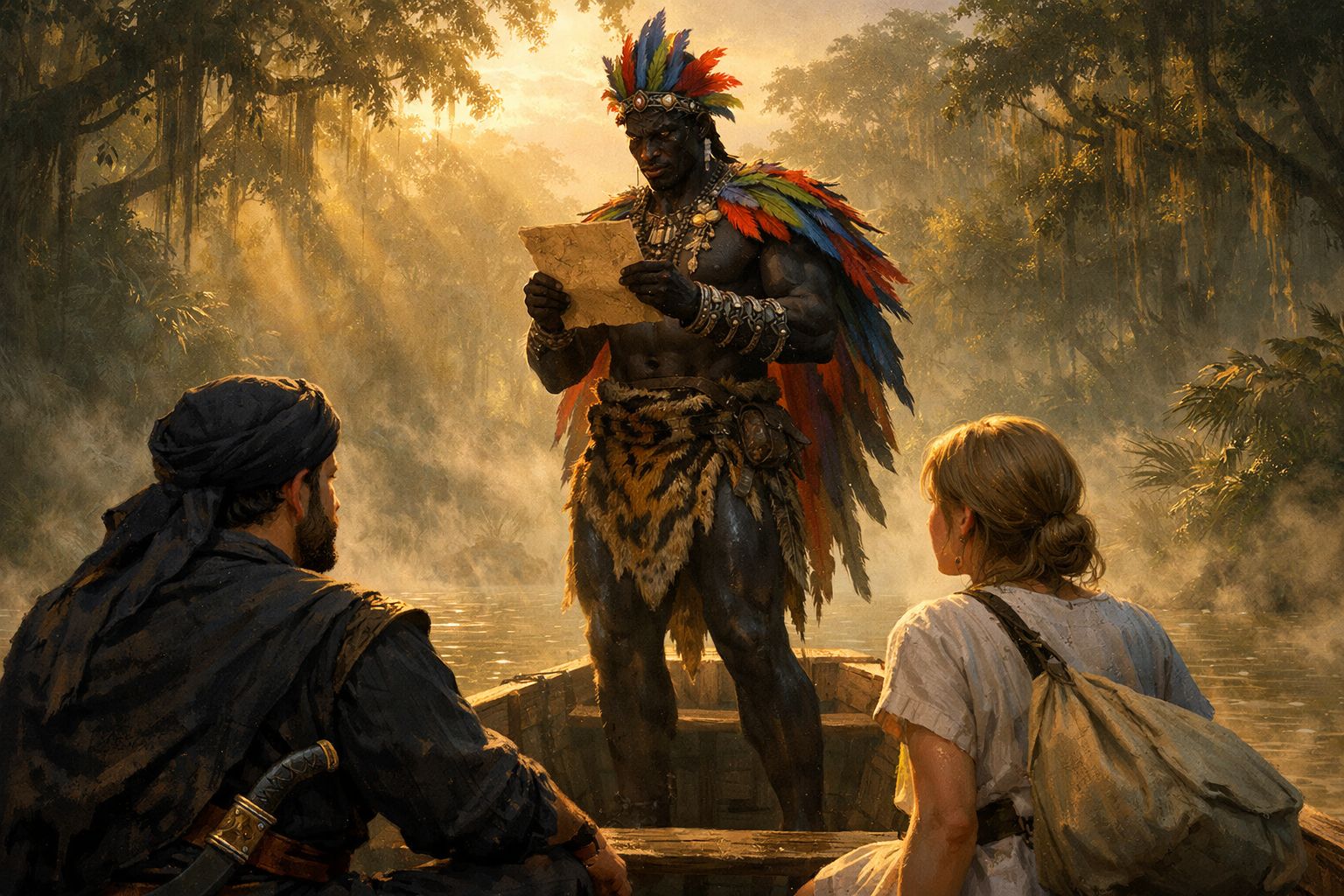
This is the exhale after the jungle. It pays off the rescue, advances the Waverider trail, and reframes the conflict as something that keeps eating people even when you escape the jungle.
It also sets up Cornelia as a recurring ally rather than a permanent crew member.
Immediate State on Board
The ship is safe, but not comfortable.
Cornelia is exhausted, dirty, and running on stubborn professionalism. She will wash, eat, and then want sleep, but she will also want to confirm she is not being taken back. Treat her as wary until the ship is clearly moving away from the delta.
The crew may be injured, shaken, or morally raw depending on how they escaped. Give them a quiet moment to take stock before you deliver plot information.
Cornelia’s Terms and Priorities
Cornelia is cooperative, but conditional.
She gives Waverider information once she is convinced she is safe and the crew is not bargaining with her life. She does not care about politics, and she refuses recruitment into any cause. If pressed, she becomes cold and practical. She will not be guilted.
Her primary request is simple: passage out of the conflict zone to a civilized port.
Waverider Trail, Information Drop
Once Cornelia feels safe, she provides the next port of call for the Waverider trail. Deliver it cleanly, with one or two concrete details that make it feel like lived memory rather than a quest marker.
Then give a small set of stories that create attachment. Focus on moments that make the Waverider crew feel real. She mostly socialized with Selene, Venera and Solonex, so her stories cluster around them.
Keep these as short, vivid anecdotes. Use many short anecdotes. The more you can connect the Blue Marlin crew with the Waverider crew as people, the better. The purpose is emotional investment and continuity.
Passage Deal and Additional Stories
If the crew agrees to take Cornelia to a civilized port, reward that choice with more Waverider stories during the voyage. Do not dump everything at once. Treat it as travel conversation that happens over days.
Cornelia and Junia exchange practical knowledge about field treatment, delta herbs, and how to keep working when fear is constant, and it should feel mutual rather than mentorship.
Cornelia as a Continuing Ally
Cornelia will not join the crew long term. She is not an adventurer and she does not want to live on the edge of violence.
Wherever the crew drops her off, she becomes a future contact. A healer with local standing, a source of information and introductions and a safe place to send messages or seek aid.
If the crew returns later, her reaction should reflect how they treated her. If they respected her boundaries and kept her safe, she helps. If they used her, lied, or treated her like a prize, she becomes distant and cautious.
Act Summary
This arc is a reminder that “right side” and “good people” are different things. The Great Empire is a brutal colonial power, but the rebellion fighting it has built its own machinery of coercion and atrocity. The central pressure is not whether the crew opposes the Empire, but what the crew is willing to do when the people resisting the Empire are also capable of horrors.
Information Gained
The Waverider trail advances decisively through Cornelia. She provides the Waverider’s next port of call once she is safe. She provides multiple short stories that make the Waverider crew feel real, with emphasis on Selene, Venera, and Solonex, the people she knew best.
If the crew grants her passage to a civilized port, they gain additional Waverider stories over time, delivered naturally through travel conversation rather than as a single dump.
Cornelia becomes a durable future contact wherever she is dropped off.
Mbaru Character Growth
This arc is a reckoning for Mbaru.
He returns to the rebellion he once fought beside and sees it is still what drove him away, confirming that leaving was the only choice he could live with.
Mbaru is forced to choose who he is now, not who he used to be. He must speak carefully, act decisively, and accept that his old ties can be used against him.
When the crew escapes, the note from Masengo is the final twist of the knife. Mbaru is still seen as “friend,” but not an ally. That should harden his resolve and clarify his path.
By the end of the arc, Mbaru has one less illusion. He can oppose the Empire without romanticizing its enemies. He can carry old loyalty without being owned by it.
Consequences to Carry Forward
The crew leaves, following the Waverider trail and with knowledge that will shape future choices.
They have seen a war that eats everyone involved, and they have felt how quickly “necessary” becomes “normal.”
Whatever choices they made during the rescue, those choices should echo later, through guilt, reputation, or future complications.
Cornelia is safe, but the delta is not solved. The Empire remains brutal, the rebellion remains dangerous, and the crew has learned that the world is not waiting to reward anyone for being decent.
The delta fell away in pieces, islands shrinking to green smudges, then to nothing. The air tasted of salt again instead of smoke.
Cornelia stood at the rail with a cup she had not finished, fingers tight around it as if she could hold herself together by force. Junia rested beside her, eyes on the horizon. Mbaru leaned a step away, watching the last line of land vanish.
Cornelia spoke first, voice low. “I thought it would feel cleaner once we were out.”
Junia did not look away. “It never does.”
“The Empire is a machine,” Cornelia said. “Built to grind people down.”
Mbaru nodded once. “And war teaches everyone the same language.”
Junia glanced toward him. “That people are tools.”
“That people are fuel,” Mbaru said. “If you are lucky, you burn slowly.”
Cornelia’s mouth tightened. “The rebels told themselves they were saving something.”
“They are,” Junia said. “That is what makes it worse.”
Mbaru’s gaze stayed on the empty sea. “The Empire makes monsters, then points at them. The rebellion looks at the Empire and learns.”
Cornelia swallowed. “So what is left when both sides do this?”
Junia’s voice was quiet. “Individuals. Trying...”
Mbaru exhaled. “And discovering how hard that is.”
Footsteps crossed the deck behind them. Ileena walked past, looking faintly pleased, the wind tugging at her hair.
“Good,” she said, almost to herself. “To be back in the jungle for a while.”
She paused long enough to add, casually, “Even if I did not get to eat the hearts of the bad men.”
Cornelia froze, cup halfway to her mouth.
Mbaru and Junia looked at each other, shrugged, and the sea took the last of the delta away.