Campaign: Grashkaar, Act 2
Act Synopsis
Close the chase and pay out the bargain.
Deliver the Waverider port-of-call information.
Show the consequence of the book in Grashkaar, changing the regional balance against the Empire.
Return to Urganmaar
The crew returns to Urganmaar with the book and is received with controlled attention rather than open welcome. They are no longer strangers, but they are still being measured.
This act should feel quieter than Estoria. Not safe, but settled, as if the spring is still under tension and now the crew has proven they understand that.
The Hand-Off
High Father Drogath receives the book in the common hall under his rules. He verifies it is intact, then reads enough to confirm what it is.
He is not amused. His reaction should feel like restrained anger, not theatrical rage. It settles into acceptance. He accepts the book, but the crew should sense that bringing it here has done something irreversible.
Payment and Debrief
Drogath honors the bargain. He gives the promised Waverider port-of-call, enough to launch the next leg of the hunt. He also gives a level of acceptance. Not friendship, but trust, which in Grashkaar matters more.
Let the crew feel it in small ways. Fewer eyes following them. A gate opened without delay. A meal offered without being a test. They have become known.
Consequences
The book hardens Grashkaar against the Empire.
Drogath announces a tightening posture. Borders closed completely. No sales to the Empire. No talk with imperial envoys. No public entanglement. Long-term demographic pressure into Estoria. When Grashkaar needs land for its growing population, the border stops being a limit and becomes a suggestion. It should feel like a decision made to protect the people, even if it is also pride and anger.
End Beat
End the act on motion and consequence. The crew leaves Grashkaar with a new lead and a new reputation, and the region behind them has shifted into colder resistance against the Empire.
The Hand-Off
| Story |
|---|
| The common hall had not changed, but the crew had. This time, when Scarnax and Pelonias were admitted, the eyes that followed them did not ask who they were. They asked what they had brought. |
| High Father Drogath waited at the far end, seated as before, huge and unmoving. The room felt built around him. The silence around him was not emptiness. It was discipline. |
| He watched them cross the floor, watched the way they carried the book, and his gaze was steady enough to be weight. |
| Scarnax placed the volume on the low table between them. For a moment it looked small, a bundle of paper and leather that could not possibly matter as much as it did. Pelonias kept his hands away from it now, as if the thing had heat. |
| Drogath did not reach for it immediately. He let the pause stretch. He let them feel the cost of waiting. |
| Then he took it. |
| He turned it in his hands with a care that did not belong to tenderness. It belonged to a man checking a blade for cracks. He checked the binding, the spine, the edges. He opened it and stared at the first lines as if measuring whether the ink was honest. |
| He read. |
| At first there was only the sound of paper shifting, a slow rhythm, the hall holding its breath around it. Drogath’s brow tightened. His jaw set. The muscle in his cheek jumped once. His fingers clenched hard enough to crease the page. |
| Then he made a sound that was not a word. It came up from his chest, raw and controlled at the same time, and the men at the door straightened as if a cord had been pulled. The room did not become violent. It became ready. |
| Drogath rose. |
| It was not sudden, but it was massive. The chair complained under the movement. His shadow climbed the wall behind him. He held the book in one hand and it looked ridiculous there, like a child’s toy, like an insult. |
| He spoke, and the calm from earlier meetings was gone. His voice filled the hall like smoke. |
| “This is what they wrote,” he said, and the words sounded like he was spitting out grit. “This is what they call truth.” |
| His hand shook once, not with weakness, with contained fury. |
| Scarnax held his ground, but he could feel the room narrowing, the spring under tension, the choice that kept them alive becoming thinner. |
| Scarnax spoke carefully, not pleading, not defiant. A question placed like a tool on a table. |
| “High Father,” he said, “is your life better or worse since Celestius.” |
| The words did not stop Drogath. Not immediately. |
| But they made him blink. |
| The question cut across the anger and forced it to look at something else. Drogath’s breath came heavy. His gaze was hard. Then, slowly, he turned his head, as if the hall itself had asked him. |
| He spoke again, quieter now, but still dangerous. |
| “Better,” he said at last, and the word sounded like it hurt. |
| He looked back down at the pages, then up again, and the anger in him shifted shape. It did not vanish. It became thought. |
| “We fought each other until we had nothing left to win,” Drogath said. “Clan against clan. Blood calling for blood. We were brave and stupid and proud of it.” |
| He tapped the book with a thick finger, once, as if accusing it. |
| “Then Celestius came and the fighting stopped. Not because we became soft. Because we became bound. We became one people. We learned to plant and keep and build.” |
| His mouth twisted. |
| “And the Empire tells itself it tamed us,” he said. “It tells itself it gave us a gift. It writes a report to its Emperor so he can sleep with the belief that his hands are clean.” |
| He looked at Scarnax and Pelonias as if weighing them, as if deciding whether they were allowed to hear the next part. |
| “Perhaps,” Drogath said slowly, “they stumbled into a truth.” |
| He held the book up, then turned it slightly, as if seeing it from another angle. |
| “But they are so used to lies that they did not recognize it,” he said. “So they served the truth as a lie, and thinking it poison, but it wasn't.” |
| He moved to the fire, and stared into the coals as if he were staring into a mouth. |
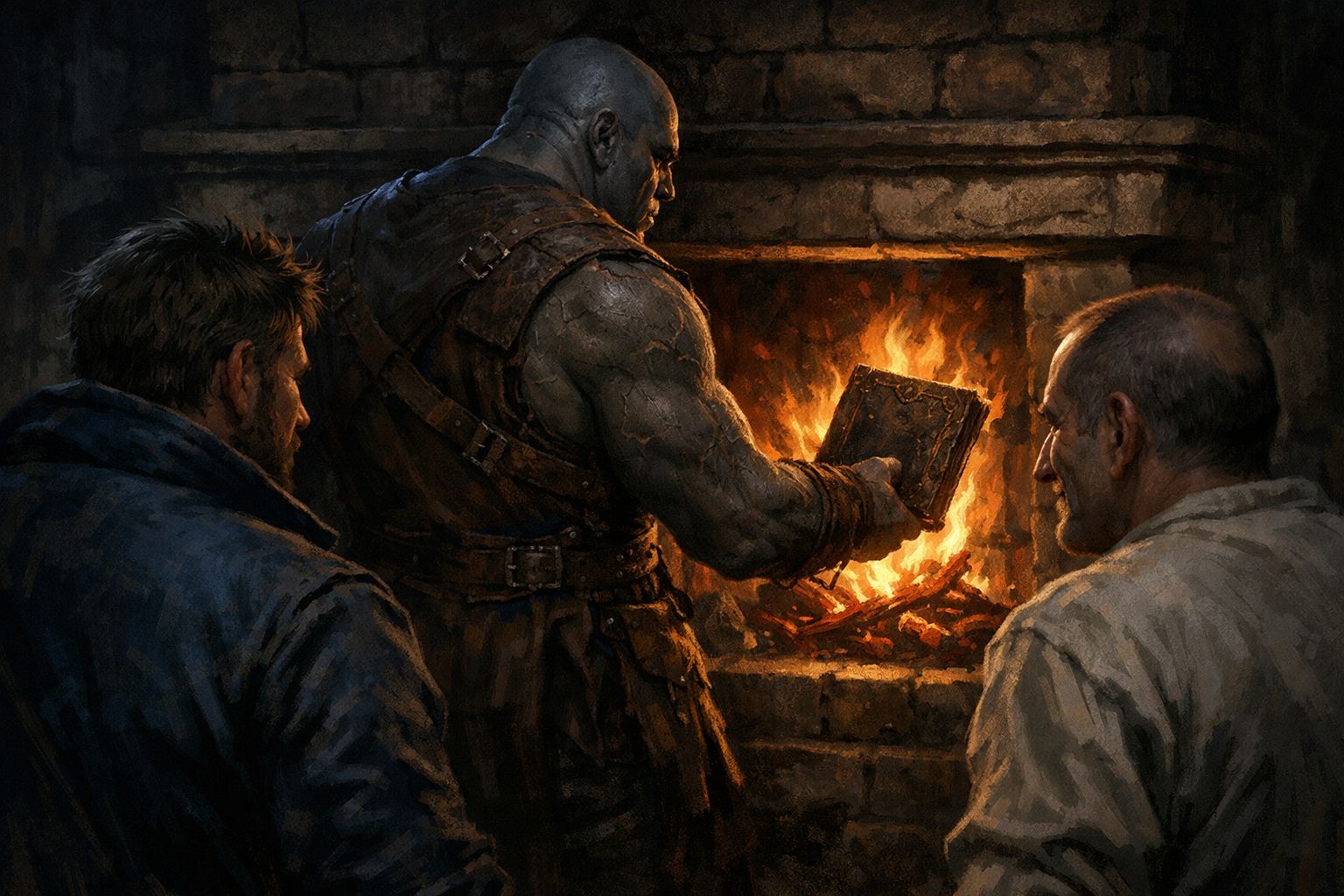
| Then he threw the book in. |
| The pages blackened at the edges, ink turning to smoke. The report, the journal, the story, whatever it truly was, became ash in seconds. |
| Drogath watched it burn without blinking. |
| When he spoke again, his voice was low, final. |
| “You will never speak of this,” he said. “Not here. Not in Estoria. Not in the Empire. Not to anyone who would carry it like a banner.” |
| He turned back to them. |
| “You did what you promised,” Drogath said. “You brought it. You did it without making my name a song in their streets.” |
| He studied them for a long moment, then nodded once. |
| “That makes you trustworthy,” he said. “More than can be said about the Empire.” |
| Drogath’s gaze held Scarnax and Pelonias like a seal pressed into wax. |
| “You have the respect of the orcs of Grashkaar,” he said. “Do not waste it.” |
Mood
Run this as controlled heat. The hall is quiet, the men are still, and the danger is in what is restrained rather than what is shown. Drogath’s anger should feel real enough to scare the crew for a moment, then turn into something worse, thought. The burning of the report is not spectacle, it is a decision.
Drogath should reach the same conclusion regardless of what the crew says, but if they do speak, make it feel like they swayed his mind.
Outcome for the Crew
Drogath honors the bargain. He gives the Waverider port-of-call information clearly enough to launch the next leg of the hunt.
He also gives trust, which in Grashkaar is rarer than kindness. The crew should feel it in small practical ways rather than praise. Fewer eyes tracking them, fewer tests, a door opened without delay, a friendly joke. They are still outsiders, but they are known outsiders.
The Next Port and the Guide
The next port of call is in the Skartuun Steppe, orc country. This is not the peaceful Grashkaar orcs, these are the wild steppe orcs. Drogath does not recommend going there without a guide. He says that a male orc wouldn't serve under a human, but offers one of his women, Grishna, as a guide, provided they bring her back afterwards.
He frames this as a bonus for their honesty, as well as a way to pave the way for the teachings of Celestius among the Steppe orcs.
Outcome for Grashkaar and Estoria
Grashkaar is closed to the Empire. Diplomatic contact ends. Trade ends. Any tolerated imperial presence is cut off completely. The border becomes closed in principle and enforced in practice.
Long-term, Grashkaar’s population pressure makes the border less meaningful. Over years and generations, Grashkaar will grow into Estoria as land becomes necessary, not as an invasion but as settlement that does not stop at old lines. This is a slow shift and it is not meant to be an active campaign problem, but it is a permanent change in the regional balance.
Act Summary
What Happened
The crew entered Grashkaar for Waverider answers and earned an exchange instead of a purchase. That bargain dragged them into Estoria, where the hunt became a chase through merchants, collectors, gamblers and professional theft. The crew returned to Urganmaar with the book, delivered it under Drogath’s rules, and watched the truth of it ignite a decision.
Key Outcomes
- Waverider Port-of-Call. Drogath pays what he promised and gives the next port-of-call, enough to launch the next leg of the hunt.
- Grashkaar Respect. The crew leaves Urganmaar with something rarer than welcome, trust. Grashkaar remains rough and restrained, but the crew is now treated as known outsiders who kept their word.
The Shadow of Celestius
This arc should leave a bitter taste. The crew did not just carry paper, they carried a lever. Were they just another foreign hand reaching into Grashkaar, becoming the next Celestius, shaping orcs into a tool for someone else’s plan? Even when the crew did the right thing, the world still shifted, and they can feel the weight of that.
| Story |
|---|
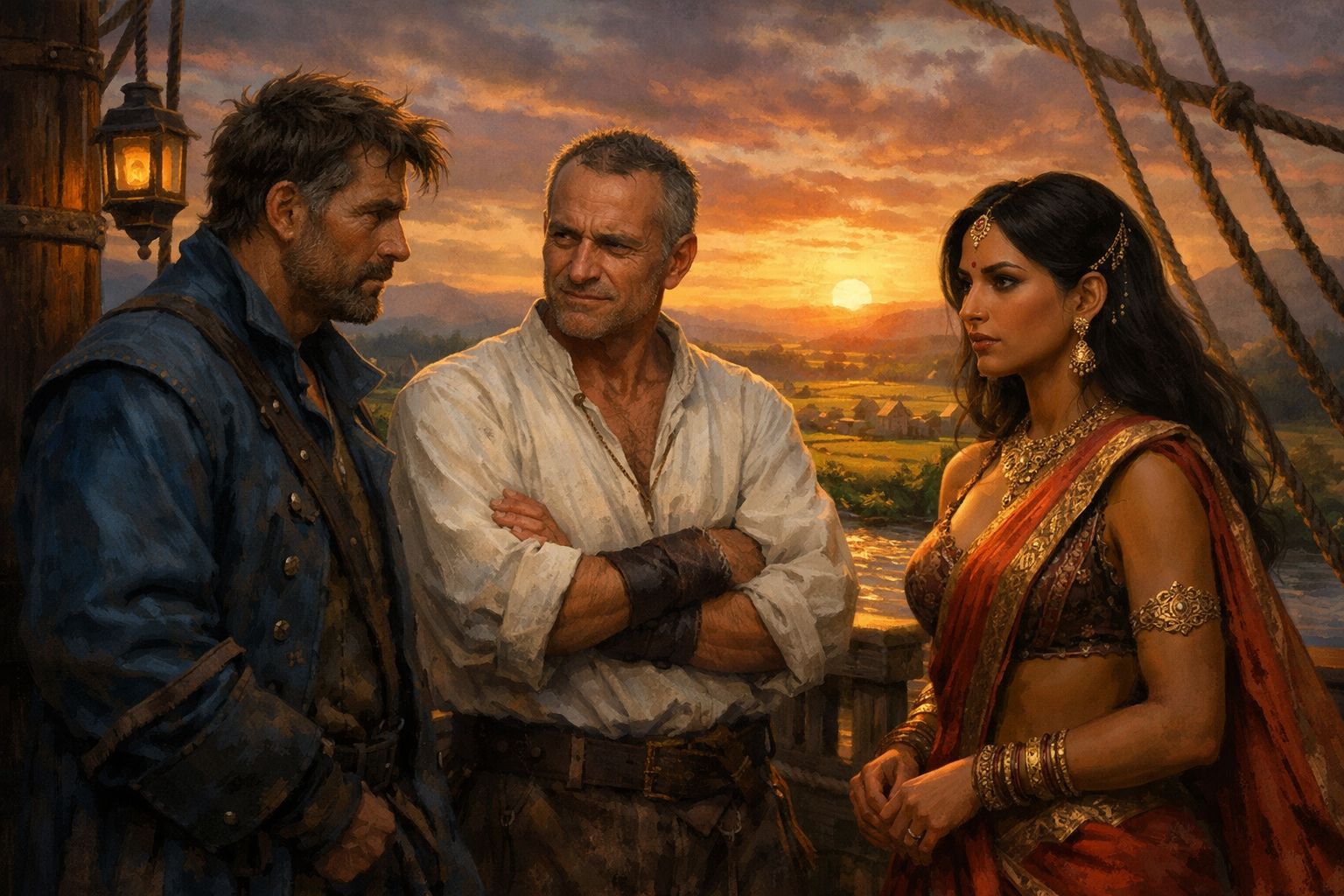
| Grashkaar fell away behind them in slow layers, fields turning to scrub, scrub turning to dark line, the dark line dissolving into horizon. The air tasted cleaner once the river smell faded, but the silence it left behind felt heavier than the harbor noise of Estoria ever had. |
| Scarnax stood at the rail, hands resting on worn wood. Pelonias watched the coastline with the same calm he used for charts, as if distance could be measured into safety. Ayesha leaned near them, eyes on the far water, expression unreadable in the pale light. |
| After a long stretch, Scarnax spoke without looking away. |
| “Are we just another Celestius.” |
| Pelonias did not answer immediately. He shifted his weight, listening to the creak of the ship, to the small sounds that told him the sea was steady. |
| “We did not come to change them,” he said at last. “We came to trade a book for a truth.” |
| Scarnax’s mouth tightened. |
| “And the book was a lever,” he said. “Sandros knew it. Someone wanted it to land in Drogath’s hands, and we carried it there. If the Empire lied with it, then we did not even need to lie. We just needed to deliver.” |
| Ayesha’s gaze stayed on the horizon. |
| “You are asking if we shaped them,” she said, voice low. “Or if we were used to shape them.” |
| Scarnax nodded once. |
| Pelonias exhaled, a sound between impatience and resignation. |
| “If we had refused,” he said, “someone else would have brought it. Or the Empire would have kept it. The only choice we truly had was whether we would know what we were doing.” |
| Scarnax did not seem satisfied by that, and he did not pretend to be. |
| Ayesha turned her head slightly, just enough to show she was listening to both of them. |
| “The orcs chose what to do with it,” she said. “Drogath read it, and he burned it. He closed his border because he wanted to, not because we told him to.” |
| Scarnax stared at the thinning line of land, as if trying to decide whether that was comfort or excuse. |
| Ayesha let the silence sit for a moment, then spoke with the calm of someone who had seen too many levers and too few clean hands. |
| “This is how diplomacy works,” she said. “You move what you can, and you live with what it moves in return.” |