Campaign: Grashkaar, Act 1
Act Synopsis
Purpose of the Act
- Introduce Grashkaar as controlled, proud and deliberately separate from imperial influence.
- Frame information as something earned through behavior and usefulness, not bought.
- Hand the party a clear bargain that advances the Waverider hunt while setting up later political fallout.
- End with a clean transition into Estoria and the chase structure of the next act.
Arrival in Urganmaar
The party lands at Urganmaar and immediately feels the social temperature: outsiders are tolerated but assessed. The settlement is functional and disciplined, with an emphasis on order, routine and restraint rather than intimidation.
What the party learns here is mostly tone and boundaries. They can ask questions, but every question costs patience and draws attention.
Asking About the Waverider
The party begins inquiries. They receive partial rumors and evasive answers that imply someone in authority is deciding what may be shared. The more the party pushes, the more the locals close down the conversation. The more the party stays calm and respectful, the more they are allowed to remain in the conversation.
The point is not to solve the mystery here. The point is to be noticed, evaluated and then approached.
The Leader Offers a Bargain
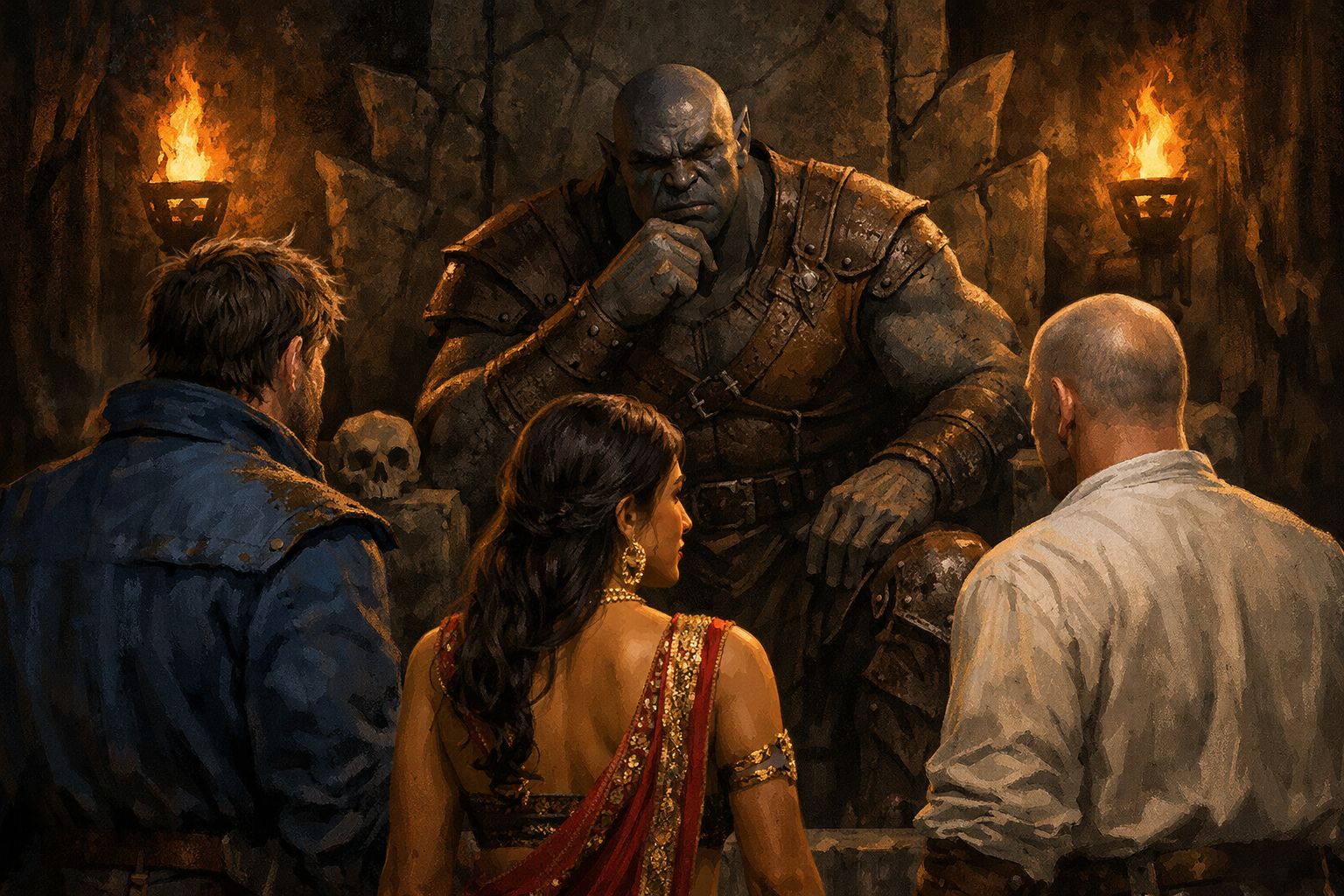
High Father Drogath, the local orc leader, approaches with quiet authority and offers a straightforward deal. If the party retrieves a specific book from Estoria, he will provide the information they want about the Waverider.
He cannot send orcs because orcs are not welcome in Estoria, and because Grashkaar does not want any public entanglement that could be used against them.
The Job Is Named
The target is a book said to be the journal of Celestius.
The leader does not explain why he wants it now, only that it must be delivered intact and discreetly.
This establishes that the task is simple on the surface but carries identity level weight for Grashkaar, with the potential to shift their attitude toward the Empire regardless of what the journal contains.
Close
The party accepts and departs for Estoria with a single concrete lead, enough move to the next act quickly.
The act ends with two pressures established.
- The party is now responsible for a politically sensitive object.
- Success will not preserve the status quo, it will change it.
Arrival in Urganmaar
Urganmaar is young by the standards of old coast cities. It has grown fast, built more for function than for permanence. Most buildings are timber, clay and thatch, repaired often and rebuilt without sentiment. Stone exists but rarely, saved for a few communal structures and whatever the local leadership deems worth anchoring.
The town sits in an agricultural landscape that looks worked rather than tamed. Fields, drainage ditches and fenced grazing strips push outward into scrub and low forest. The river is the spine. Docks, barges and shallow boats make the place feel connected even when it insists on isolation.
Most people do not live in the town proper. They live on small farmsteads close to their fields and animals, coming into Urganmaar on market days or for rites, disputes, trade and news. That rhythm matters. The town feels busy in pulses, then oddly quiet.
First Impressions and Mood
The first thing the party should feel is order without softness. This is not a welcoming port where strangers are noise. This is a place where strangers are a problem to be managed.
The second thing they should feel is restraint under pressure. The orcs here are not performing calm. They are practicing it. Their politeness is a lid held down by habit.
If the party watches the men, especially the younger men, they will see the tension in the body. Weight held forward. Hands idle but never slack. Eyes that do not wander. A stance that says they could become violence quickly, not because they are enraged, but because they are ready.
The core feeling you want at the table is this. I could kill you, but I choose not to. Do not assume that choice lasts longer than the moment.
Use this as a constant background signal rather than a single threat. Nobody needs to draw weapons. Nobody needs to snarl. The mood should come from what is not done.
Where the Party Lands
Bring the Blue Marlin in at the river docks, because it gives you faces, rules and an immediate reason to interact.
The dockside is practical. Rope, nets, barrels, crates, smoked fish, sacks of grain. Everything is labeled, weighed and stored with care. It feels like a place that expects shortages and refuses to be caught unprepared.
The party is met by a dock foreman, Varka Moss Eye, an older orc with a scarred eyelid and a voice that does not rise. Varka is not hostile. He is controlling the situation. He asks what they want, how long they will stay and whether they will trade. He asks if they are from the Empire, and does not care where they are from as long as it isn't the Empire.
If the party pushes past him or acts as if the docks are public ground, Varka does not threaten. He signals. Two or three men drift closer. Not aggressive, just nearer. They make room smaller. They make exits feel conditional.
The Town Layout and Social Flow
Urganmaar has three parts the party will naturally touch.
The Docks and Store Yards, where visitors are noticed and assessed.
The Market Green, a wide hard packed space with stalls on busy days and empty space on quiet ones. This is where farmstead families come in. It is also where the party can be seen by many eyes at once.
The Common Hall District, a cluster of larger buildings used for rites, dispute hearings, communal meals and leadership meetings. This is where the party should not wander without invitation.
Keep stone rare. A single stone storehouse near the docks is enough to show what the town considers worth protecting. A stone foundation under the common hall is enough to show permanence where authority sits.
The key is that Urganmaar feels built to endure hard years rather than to impress outsiders.
Urganmaar has no walls or palisade. They don't need it, their people are all the defense they need.
How the Orcs Treat Outsiders
The orcs offer minimum courtesy because it costs them little and buys them control. Water, a place to stand out of the way, directions to the market. They do not offer friendship.
The orcs avoid direct lies. They prefer silence, omission and polite deflection. This is important for the mood. It is not a den of liars. It is a place where truth is guarded like grain.
Most will not answer a question on first ask. They will pause. They will look at the party. They will decide whether the question is safe to answer. Often, the answer is a question in return.
- "Why do you want to know that?"
- "Who told you that name?"
- "How long are you staying?"
If the party is patient, they get small practical truths. If they are pushy, they get nothing and the town becomes colder around them.
Asking Around About the Waverider
The party can ask about the Waverider anywhere, but the results should follow a consistent pattern.
They receive rumor, not confirmation. Fragments, not timelines. The party should feel the shape of a story without being allowed to hold it.
Use three kinds of responses.
- The Empty Courteous Response: Never heard of it. Might be a southern thing. Ask at the market. This is the default answer when someone does not want to engage.
- The Cautious Hint: A pause, a look, then a small directional clue. Someone strange came upriver once. Someone asked questions like that before. The party should feel they are close, but not be given enough to act on.
- The Warning Response: If the party pushes too hard, someone tells them, quietly, that their questions are noticed. Not as a threat, as a fact. It should feel like being informed that the town has closed its fist, even if it has not yet swung.
Who They Meet While Asking
Give the party three named locals that serve as different social textures.
- Varka Moss Eye at the docks, who controls movement and makes it clear they are being measured.
- Edrun of the Granaries, an older farmer who comes in to trade. He speaks slowly, asks questions back and treats information like a commodity that is weighed carefully.
- Heshra River Watch, a young lookout near the river path. Curious, disciplined, eager to be useful but terrified of being caught being helpful.
None of these people should give the answer the party wants. Their function is to show the culture and to help the party understand how to behave if they want anything at all.
Escalation Without Violence
If the party pushes, the town tightens. Do not escalate into a fight unless the party forces it.
Use social and spatial escalation instead.
- Conversations end mid sentence.
- They are ignored, even when trying to initiate conversations.
- People stop making room for them.
- A stall closes early.
- A group of men begins following at a distance that is not far enough to ignore.
- A child is pulled behind a parent’s leg, not because the party is monstrous, but because the adults have decided the safest posture is fear.
The point is to make the party feel that they are in a place that could become lethal quickly, but is choosing not to, for now.
The Moment They Get Noticed
At some point, make it clear that the party has crossed from background noise to known variables.
Pick one simple, visible sign.
- A runner leaves the market at a quick walk when they ask the wrong question.
- A man the party spoke to earlier is later seen speaking to someone important near the common hall.
- Varka looks at them differently, less like strangers and more like a file that has been opened.
This should not be dramatic. It should be quiet. The dread comes from understatement.
How to End This Section
End this segment when the party understands two things.
- First, they will not get real Waverider information by asking around.
- Second, their questions have reached the ears of someone with authority.
Once those two points land, you are ready to transition into the approach by leadership, with the party already primed to feel the spring under tension and to understand that restraint here is a choice, not a weakness.
The Bargain
| Story |
|---|
| The common hall smelled of old smoke trapped in new timber. Fresh beams, fresh lashings, clay still pale in the seams, yet the air already carried the weight of meetings that ended with decisions. |
| Two men waited at the door without armor or insignia. They did not need either. As the crew stepped inside, the hall did not turn hostile. It simply tightened, like a rope taking strain. |
| High Father Drogath sat at the far end. Huge, even for an orc, built like a loaded cart. He did not rise. He did not need to. |
| Three women were near him, hands busy with bowls and cloth. Drogath watched the newcomers for a long moment, then flicked two fingers. The women gathered their things and left without a word. The door closed behind them, loud in the quiet. |
| Now it was only men and whatever rules Drogath believed belonged to men. |
| "You have been walking my town with questions," Drogath said. His voice was slow and steady. "My people have felt you pulling at threads." |
| He leaned forward slightly. The room felt smaller. |
| "Why?" |
| Scarnax answered without haste. They were looking for a ship, not his, not the Empire's. A ship that came before. They were following its wake. |
| "What ship?" |
| "The Waverider." |
| One of the men by the wall shifted, not a flinch, more like a muscle remembering work. Drogath noticed and did nothing. That made it worse. |
| When Drogath asked what they wanted, Ayesha began to speak. He cut across her as if her voice had never mattered. |
| "Why does your woman speak for you?" |
| The words landed flat and sharp. Ayesha stopped. She lowered her eyes by the smallest amount and went quiet, not yielding, choosing the moment. |
| Scarnax kept the discussion where Drogath wanted it. They wanted to know where the Waverider went. |
| Drogath held the silence, then nodded once. |
| "I know. But my knowledge is not a gift. A favor for a favor." |
| There was a book in Estoria, he said, in the hands of people who would never give it to an orc without blood. He could not take it himself. He would not send his own. |
| Pelonias asked which book. |
| Drogath's mouth tightened, the first real edge of feeling. |
| "The personal journal of Celestius." |
| He said it like a claim, not a title. It was his to read. It belonged in Grashkaar, not on an imperial shelf. The crew could buy it, steal it, hide it in their clothes, he did not care. Only that it was done quietly. |
| "No songs," he said. "No witnesses carrying my name." |
| Scarnax glanced at the others, a quick check, then met Drogath's eyes again. |
| "You will have the book," he said. "And you will tell us what you know." |
| Drogath nodded, satisfied, as if a blade had finally been set in the right place. |
| Outside, Urganmaar kept working in calm rhythms. Inside, the spring stayed under tension, not broken, only held down for now. |
Purpose of the Scene
- Confirm the party has been noticed and is now being handled by authority.
- Establish Grashkaar restraint as real but conditional, held down by choice.
- Deliver the bargain that pushes the party toward Estoria.
Tone and Staging
Controlled threat, not open hostility. No raised voices. No weapons drawn unless the party forces it. The feeling should be simple. We could kill you. We will not, for now.
Use the common hall. New timber, old smoke, a room built for decisions.
Two silent men at the door act as gatekeepers. They are not introduced as guards, but their posture says otherwise.
Drogath sits at the far end. He is huge and does not rise.
At the start, several women are present. Once the party is inside, Drogath sends them away, making it clear the meeting will be conducted under his rules.
If a woman in the party speaks early, Drogath cuts her off and challenges the man leading the discussion for allowing it.
Do not turn this into a debate. It is a dominance test and a declaration of how Drogath runs the room. If the party argues, the room tightens and the meeting shortens.
The Negotiation
Drogath opens by stating the party has been asking questions in town. He asks why.
He is not curious. He is demanding an explanation, phrased as a calm question.
Once the party asks for Waverider information, Drogath confirms he knows.
He offers a trade. A favor for a favor. He wants a book retrieved from Estoria. Orcs are enemies there, so he cannot send his own people. It must be done discreetly. If asked which book, he names it as the personal journal of the prophet Celestius.
Do not give Waverider details in this meeting. The details come only after the party accepts the job.
If they demand proof or details, Drogath refuses and repeats the bargain. If they threaten or oppose him, Drogath ends the meeting and has them escorted out.
The Deal
After the meeting, Drogath does not linger. There is no warmth, no toast, no bonding. The agreement is acknowledged and the party is dismissed.
Use one simple sign that the bargain is real. A nod from a gatekeeper, a door that opens without being challenged, a runner already waiting outside to deliver a name. The hall loosens by a fraction, not because trust has been earned, but because the party has become useful.
The party should leave feeling their safety was a decision, not a guarantee.
Ending Act 1
- Close the Grashkaar chapter cleanly with a decision, not with lingering conversation.
- Hand the party one concrete lead that launches the next act immediately.
- Lock in the two pressures that will shape the rest of the arc, even if the party succeeds.
The Estoria Lead
Give the party exactly one starting point, a single name that is enough to get the next act moving.
Marcia Vellumhand, a book dealer in the harbor quarter of Estoria, is the last known owner of the journal. She is a reachable person, not a mystery, and the party can find her by following harbor trade, scribes, or book gossip.
Departure from Urganmaar
Make the departure feel watched.
No shouting. No farewell. People do not wave. They observe. The party should feel the town letting them go with the same restraint it showed when it chose not to harm them.
They leave with silence that feels like a warning and a permission at the same time, but it also feels like a threat postponed.
Act Summary
What the Party Knows Going Forward
Drogath knows where the Waverider went, but he will not speak until the book is delivered.
The book is the personal journal of Celestius, which makes it culturally explosive inside Grashkaar and politically provocative anywhere the Empire can hear of it.
The job must be discreet. Public spectacle risks consequences.
The Two Pressures That Carry Forward
Political Sensitivity
The party is now responsible for an object that multiple groups have reasons to control. Even before they reach Estoria, treat the journal as the kind of thing that attracts interest once its name is spoken. The party may not understand why yet. That is fine. The pressure is felt before it is explained.
Change as the Cost of Success
If the party succeeds, they do not restore balance. They alter it.
Returning the journal to Drogath hardens Grashkaar. It will shift how the orcs trade, travel, negotiate and tolerate outsiders. That change may be quiet at first, but it is lasting.
This is important to communicate early, so the party understands that even a clean win carries consequences.
Closing Beat
End Act 1 on motion.
The party has accepted the bargain. The lead is in hand. The river and coast open toward Estoria. The tension in Grashkaar remains behind them, unbroken, held down by choice, and waiting for the book to decide what it becomes.