Campaign: Estoria
Act Synopsis
This act turns the errand into motion. The crew arrives expecting a simple purchase, gets immediate contact with Curio Maximus, then spends the rest of the act chasing a book that keeps slipping into new hands.
The act should feel loud, fast and crowded compared to Urganmaar. The threat is not silence and restraint. The threat is attention, paperwork, money, pride and opportunists who smell value.
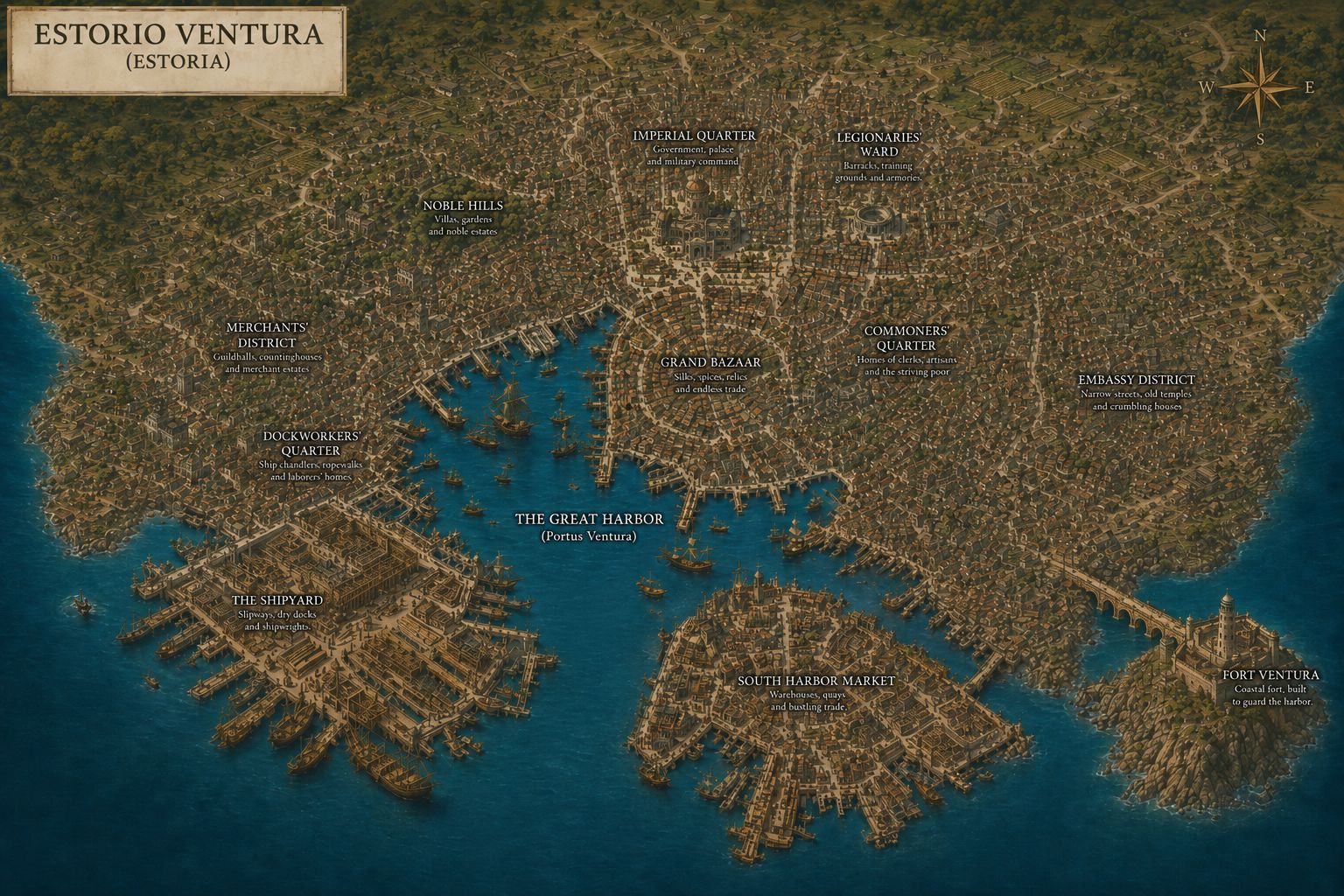
Arrival in Estoria
The ship ties up in Estoria’s harbor, which is never quiet. Noise, trade and watchfulness are constant. The crew is immediately back in imperial systems, where everyone wants a name, a reason and a slice.
Within ten minutes, Curio Maximus arrives at a run, his usual composure visibly cracked. He wants to hear everything at once. It is not risk that drives him. It is devotion. This is the project he burns for.
Curio regains control as he speaks. He sits with the crew, listens and becomes genuinely impressed by how far they have already pushed the trail. He offers practical support, including a full restock, because he wants momentum and he wants the crew to succeed.
The Chase
From this point onward, the act is a chain of leads where each success creates the next problem. The crew is not solving mysteries so much as keeping pace with a moving object.
The book has changed hands repeatedly and the crew keeps arriving one step late. Each stop reveals a different slice of Estoria, showing how knowledge becomes currency in a city where everything can be bought, stolen or gambled away.
The Book Dealer
The crew tracks down Marcia Vellumhand, a harbor quarter book dealer. She is not a villain and not a hero. She is a merchant first. Everything else is secondary.
Marcia confirms she had the journal and sold it. She gives the crew the next name, partly because it is true and partly because she does not want trouble lingering near her shop.
The Collector
The collector, Florian Domitus, is a respectable figure with a private obsession, the kind of person who treats rare texts as trophies. He confirms he bought the journal, but admits he no longer has it.
He lost it in a dice game. The admission should feel humiliating to him, not funny, even if the crew finds it ridiculous. This is Estoria. Even the respectable can be weak.
The Small Time Crook
The dice game points to Varro Licentius. He is a parasite with a smile, petty, cruel, and always looking for leverage. The crew can find him through his habits, his small time crook buddies or the trail of petty humiliations he leaves behind.
Varro confirms he had the journal and sold it quickly, because he recognized it as easy money. He sold it to the Silver Moon.
The Trader
The Silver Moon is still in port, making the chase feel like it is about to end cleanly. Kiran Dhalapati, the ship’s captain, is ever cheerful and slippery, selling luck as if it were cargo.
But the journal is already gone. Someone broke into the Silver Moon during the night and stole it. The mood shifts here. The crew realizes they are no longer chasing merchants and gamblers. They are chasing professionals. They are also out of leads.
Sandros Pellaios Intervenes
Sandros Pellaios approaches the crew when they hit this wall. He plays it as courtesy and coincidence, but it is not. It never is with him. He has been tracking the same currents.
He claims an imperial agent stole the book. He also reframes what the book is. Not a private journal, but a report written for the Emperor, which makes the stakes sharper and the politics more dangerous. Until Sandros intervenes, everyone calls it a journal. After that, it becomes a report, and the crew should feel the air change.
Sandros offers the agent’s name and location. He frames it as a favor. It benefits his employers if the book reaches the orcs, and it is a bonus if the agent is removed from play. This creates a debt the crew can repay later, and it introduces a quiet question. Why does Sandros want Grashkaar to have it?
The Retrieval
The crew confronts the agent and retrieves the book through theft or violence. This is the act’s climax and should feel like a decisive shift from social chasing to direct action.
However it is handled, the crew should understand that they have stepped into imperial machinery. Even a clean theft has consequences. A violent solution creates ripples that will follow them out of the city.
If the crew leaves tracks, they may have to make a run out of Estoria.
Leaving Estoria
This act ends when the crew has the book in hand and a clear path back to Grashkaar.
The crew should leave Estoria with two feelings. They won, but they were seen. Also, the book is not what it pretended to be, and that difference matters.
Arrival in Estoria
The harbor of Estoria never stopped moving. Even at rest it felt like motion, a city that breathed through rope and canvas, through shouted numbers and creaking pulleys, through the constant scrape of hull against timber. Barges slid past like insects on water. Dock slaves ran with loads that looked too heavy for their backs. Clerks in clean tunics hovered at the edge of work, watching with ink-stained fingers, ready to turn a shouted promise into a written obligation.
The Blue Marlin came in with salt on her sides and river mud still stubborn in the seams. The moment her lines were thrown, the dock claimed her. Men stepped in to take the rope as if it had always been theirs. Someone called out for the manifest. Someone else asked where the captain would be found, and did not wait for an answer before asking again, louder.
In Urganmaar, the silence had been a warning. In Estoria, the noise was the same.
Scarnax had barely set his boots on the planks before a commotion threaded through the crowd. Not the usual quarrel of traders, not the bark of a foreman. This was a ripple of recognition. Heads turned. A path opened in the way a street opens for authority.
Curio Maximus came running.
It looked wrong on him, the haste. Curio was a man built for controlled rooms and measured words, for the careful patience of someone who understands how to make other people wait. But now he ran as if the harbor itself had offended him by being slow. His hair was wind ruffled, his breath unpolished, his usual composure cracked just enough to show what lived under it.
His eyes found the crew and latched on. Not with suspicion, but with hunger.
“You are back,” he said, and it was not a greeting. It was relief disguised as impatience. He stepped in close enough that the dock noise fell away around them, as if his urgency made its own silence. “Tell me you did not spend your weeks trading pleasantries for nothing. Tell me you have something.”
Scarnax gave a short nod, the kind that did not promise more than it could pay. Pelonias was already unrolling a folded map case, not on the dock, not yet, but in his hands like a held breath. Ayesha watched Curio’s face, measuring the way his restraint fought his eagerness.
“We have a trail,” Scarnax said. “It runs through Grashkaar, next.”
Curio’s expression tightened, then softened, like a man biting down on a reaction and choosing a better one. “On board,” he said immediately. “Not here.”
He followed them up the gangway with the speed of someone who could not stand still. On deck the harbor smell became stronger, tar and fish and wet wood, and Curio looked around as if noticing the ship properly for the first time. There was something almost boyish in it, a flicker of genuine interest that did not fit his reputation. Not admiration. Attention. Like every detail might matter.
They went below into a small cabin that still held heat from the day. The noise of the docks dulled into a distant thrum, as if the ship had put a hand over the city’s mouth.
“Now,” Curio said. He sat, but it was not a settling. It was a perch. His hands were on the table, fingers spread, as if he could pin the conversation in place. “Start at the beginning. Do not spare me the dull parts. The dull parts are where truth hides.”
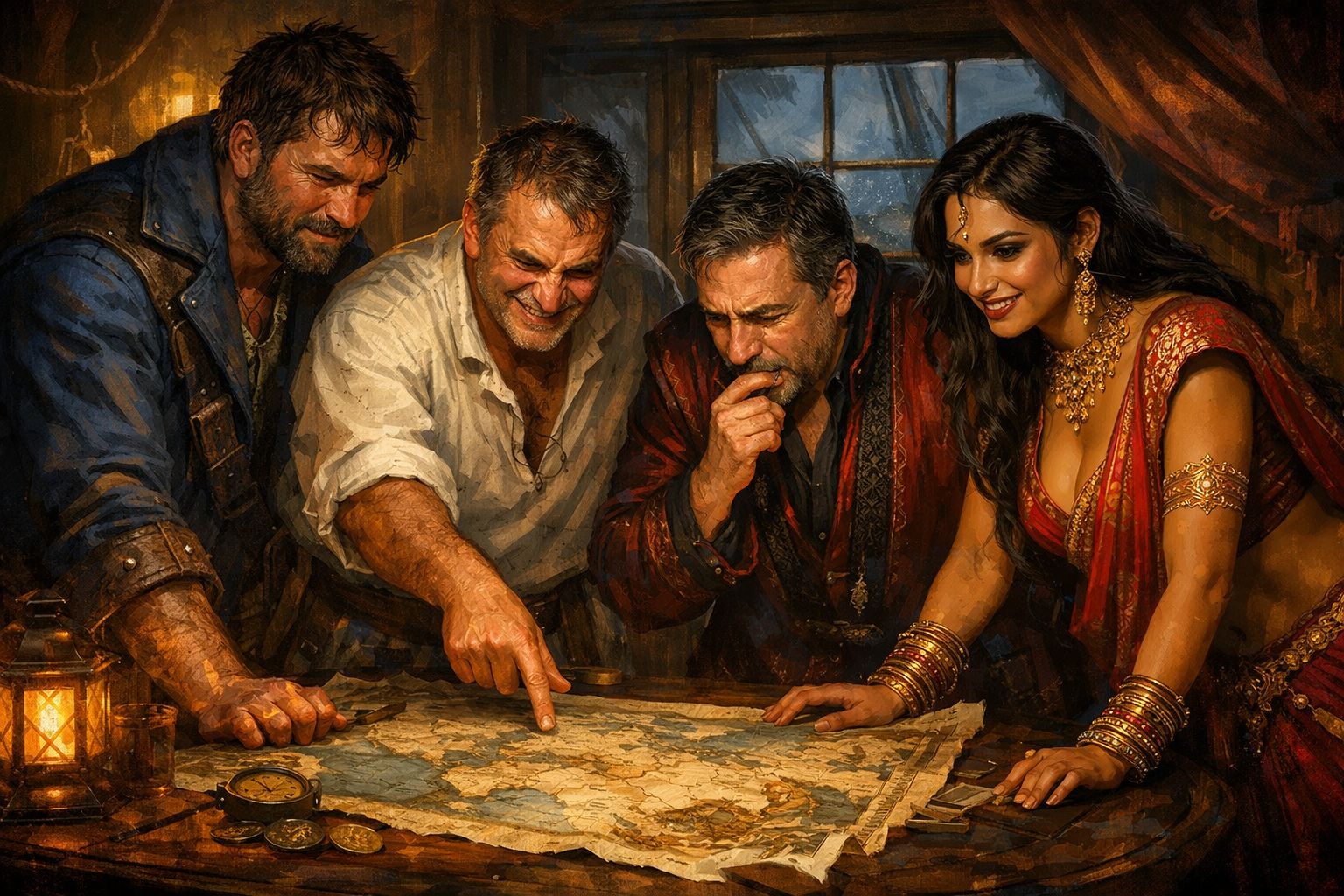
Scarnax spoke plainly. The Desert Rim, Montosho, Ardenvale, Olydria, the Empire, Draknir, every port they had visited, every straight sailed, each name a different kind of trouble. He moved on to Urganmaar, the questions that earned silence, the sense of being measured. The way authority arrived without announcing itself. The name of High Father Drogath, the bargain offered, the price.
As Scarnax spoke, Pelonias laid the map out and placed a finger on the river bend, then slid it along the coast, showing distances, showing paths, showing the simple fact that the crew had not been wandering. They had been tracking.
Curio listened with an intensity that was not performance. When Scarnax mentioned the journal, Curio’s eyes sharpened so fast it could have been mistaken for alarm, but it was not fear. It was focus. A man hearing the name of something he has wanted for too long.
“The journal of Celestius,” Curio repeated softly, as if tasting the words. He leaned forward, elbows on the table, and the mask of the harbor official dropped just a fraction. “You have done more in a short span than most do in a lifetime.”
He caught himself, straightened, and let a small breath out through his nose, half laugh, half exhale of tension. “Good. That is good.”
Ayesha waited until the momentum dipped, then spoke into the space with practiced calm. “Can you provide assistance. Anything that makes this faster.”
Curio answered before she had finished the sentence.
“Yes.”
No hesitation. No bargaining. No testing. The word came out like he had been waiting to offer it.
“I will have your supplies replenished,” he said. “Food, water, lamp oil, sailcloth, rope, salt and medical supplies. Whatever you need that can be bought in this city, consider it already on its way to your deck.”
He stood, suddenly restless again, as if the act of committing resources had reignited the fire in him.
“This matters,” Curio added, and for a moment his voice was not the voice of a bureaucrat. It was personal, almost intimate. “You do not understand how much it matters, but you will.”
Scarnax rose as well. The cabin felt smaller with Curio standing, not because of size, but because of intent. Scarnax extended his hand.
Curio took it at once. His grip was firm, warm, human. Not the handshake of a man sealing a contract. The handshake of a man trying to pass something of his own conviction through skin.
“Luck,” Curio said, and there was no irony in it. “And return swift. I want you back in this harbor with answers, not ghosts.”
He released the hand, already turning, already moving toward the gangway as if he could run back into the noise and bend it to his will.
Above them, Estoria kept shouting and counting and hauling. The city did not care what the crew carried in their heads or what they were about to chase through its streets. But Curio Maximus cared enough to come running, and in a place like this, that alone meant something.
Purpose of the Scene
Re-establish Estoria as loud, crowded and full of systems and eyes.
Show Curio as genuinely invested, not merely an official. He is curious, hungry for detail, and emotionally involved in the expedition’s progress.
Give the crew immediate practical help, so the act can move straight into the chase.
Curio's Arrival
Curio arrives with his composure cracked. He is not afraid. He is impatient with distance, starving for news, and briefly unable to perform his usual calm. His demeanor is like a child about to open a present.
His curiosity should feel personal. He is not collecting a report. He is feeding an obsession.
Curio arrives within minutes of docking, pushing through the harbor like someone who has been watching the water. Let the harbor react. People recognize him and make room, not because they like him, but because they understand what he can do.
Keep the first exchange short and public, then move it aboard quickly. The docks are full of ears.
Running Curio
Ask for the story, not the summary. Curio wants sequence, names, and the dull parts. He wants it all.
Use a physical tell. Hands on the table. Leaning in. Interrupting only to clarify. He catches himself when he talks too much, then immediately asks for more.
When the journal is mentioned, let his focus sharpen because the name carries weight everyone recognizes. If asked, Curio can give a brief, common-knowledge recap of Celestius and Grashkaar, framed as the story Estoria tells about it, and why that makes the journal politically dangerous. This should make the players realize the importance of the journal.
What Curio Provides
Curio offers help without bargaining. No hesitation. No testing.
He can arrange a full restock of supplies, delivered to the ship quickly, and he can smooth over minor harbor bureaucracy so the crew does not lose time in paperwork.
If you want one extra small edge, he can provide a stamped receipt or a quartermaster token that makes dockside purchasing faster. Keep it simple and practical.
Play his help as reflexive generosity. It is not business to him, it is passion, and he cannot resist making the road smoother.
Ending the Scene
End on momentum. Curio shakes hands, wishes luck, and asks for a swift return.
The crew should leave the interaction with one clear impression. Curio cares about this project as a person, not as a job, and his support is real.
The Chase
Run this chase like a race through living systems rather than a mystery that needs solving. The crew should feel constant forward motion, real progress at every stop, and the persistent frustration of arriving just after the book has moved again. The tension is not that the lead is unclear. The tension is that Estoria is faster than them.
One Step Behind
The core pattern is simple. The crew reaches the right person, asks the right questions, and gets a clean answer. Then they learn the book is no longer there. It sold last night. It changed hands this morning. It was taken an hour ago. They are one step behind, not because they are failing, but because the book is already moving through the city’s bloodstream.
Make sure each scene pays out before you pull the rug. They should always get the next name, the next location, the next social layer. What they lose is the satisfaction of catching the object. That is what keeps them chasing.
Avoid making the pattern feel mechanical by changing why it moved. The seller let it go because profit came first. The collector lost it because pride met weakness. Varro flipped it because he sensed profit. The Silver Moon lost it because someone professional decided to take it. As the act advances, the reasons shift from ordinary commerce to deliberate interference, and the crew should feel that shift even before it is stated aloud.
Keeping the Tension Without Over-Complicating
Use time pressure that the crew can sense without a visible clock. Harbor rhythms work well. The tide, the next sailing window, the time it takes to load, the moment a ship can slip away. Bureaucracy works too, not as a barrier, but as friction. A clerk who returns after midday, a permit that takes an hour, a gate that closes at dusk. Social schedules also help. A gambling den that only fills after dark, a collector who is never home before late afternoon, a noble who only receives when it suits him.
The key is to make waiting feel like a choice with a cost. Do not punish curiosity. Do not hide the ball. Simply show that Estoria does not pause for them.
Keep Obstacles Human, Not Abstract
Do not block progress with missing clues. Block it with people who have reasons. Someone wants to avoid trouble. Someone wants to save face. Someone wants to be entertained, obeyed, paid, flattered, or left alone. Each stop is less about deduction and more about navigating tone, status, money, and patience in a city where everyone is trading something.
Escalation and Gravity
As the chase continues, make the book feel heavier even before its contents matter. The crew starts to notice small changes. Conversations get shorter. Prices rise suddenly. Doors that were open become cautious. A dockside watcher appears twice. A scribe asks one question too many. Nothing is overt, but the crew should begin to suspect that this book is not just valuable. It is watched.
Pacing
Keep scenes tight. Resolve each location in one strong exchange and then move. If the crew stalls, let the city push them forward with a natural nudge, something that feels like Estoria talking through rumor. A runner with a message, a clerk casually mentioning a name, a drunk gambler laughing about losing a book he never read. These nudges should not hand them victory. They should keep the chase alive.
Where the Chase Turns
Early on, the crew is late because commerce moves fast. Later, the crew is late because someone is staying ahead of them. That is the emotional spine of the act. It sets up the break-in, the intervention, and the final retrieval, and it makes the crew feel that the city itself has begun to notice them.
The Path of the Journal
Marcia Vellumhand, The Book Dealer
This is the clean first link in the chain. It should feel easy to find and quick to resolve, establishing the chase rhythm. The crew gets confirmation the book was here, learns it is already gone, and walks away with the next name.

Where to Find Her
Marcia works the harbor quarter, close enough to the docks that sailors can wander in with damp pockets and dock clerks can slip in on an errand. Her place is small and dense, more storage than showroom, a shop that smells of paper, salt, and wax.
The crew can locate her through obvious routes. Ask any scribe, chandler, map seller, or dock clerk where books are bought and sold. If they mention the journal or Celestius, people get cautious. If they ask for a dealer who handles old texts, they are pointed to Marcia quickly.
Marcia Vellumhand
Marcia is a merchant first. She is not romantic about knowledge and she is not sentimental about history. She likes clean transactions, clear boundaries, and problems that end at her door.
Play her as brisk, polite and watchful. She is used to sailors who exaggerate, collectors who lie, and officials who pretend they are not officials. She does not fear the crew, but she will not let them take control of the conversation.
What Happened
Marcia acquired the book through ordinary harbor trade. A bundle of used texts, a sailor’s sale, a small auction, something unremarkable.
She sold it quickly to a known collector, Florian Domitus, because he paid well and because she prefers dealing with one buyer she understands rather than letting rare items draw crowds and questions.
She did not read it. If pressed, she admits she glanced at the first page, enough to recognize the name Celestius and enough to decide it was safer as merchandise than as curiosity.
What She Tells the Crew
She confirms she had the journal and that it is no longer in her possession.
She gives the next lead. Florian Domitus.
She gives one practical detail that makes the next stop playable. Florian is wealthy and he does not receive anyone who looks like harbor dirt. He is well known, and finding his home is easy.
How She Handles Pressure
If the crew is polite and clear, she is cooperative and fast. She wants the conversation done.
If the crew threatens, she becomes colder and the shop becomes less private. A neighboring clerk appears. A runner is sent. Marcia will still give the next name, but it will come with the sense that the crew has created attention for themselves.
If the crew tries to buy the journal from her, she insists it is sold and does not entertain negotiation. The chase moves forward.
Close of the Scene
End this stop with motion. The crew leaves with the next name and a sense that the city is already moving around them.
If you want a small tension hook, have Marcia end with a warning delivered as business advice. "Do not say that name loudly in Estoria. People listen here."
Florian Domitus, The Collector
Florian Domitus lived in the sort of house that made the street behave.
The late afternoon light caught on polished stone and gilded trim, on ironwork shaped into leaves that had never seen a season, on windows so clean they looked like open air. Even the gate had manners, swinging inward with a soft weight when Scarnax pushed it, as if it had been trained to never make a sound that might disturb its owner.
A slave in a plain tunic appeared long enough to take their names, then vanished into the house as if swallowed by it. The crew waited on a tiled threshold that felt more like a stage than a doorstep. Somewhere inside, something shattered. Not loudly, but with the unmistakable crispness of expensive ceramics giving up.
A heartbeat later, the door opened.
Xantippa Domitus stood there like a storm wearing a silk house-robe. Her hair was pinned with the kind of care that usually belonged to calmer women, but her face was flushed and her eyes were bright with the violent clarity of someone who had been angry for hours and had not yet run out of anger.
She looked them up and down once, fast, and without invitation.
“Yes,” she said, as if daring them to be worth her time.
Scarnax asked for Florian. The words barely left his mouth before Xantippa laughed, sharp and humorless.
“Florian,” she said, tasting the name like it was something stuck between her teeth. “You mean my husband. My brilliant, delicate, precious husband. The man who thinks he is a pillar of culture because he can read a title page without moving his lips.”
Her hand tightened on the doorframe, knuckles whitening. She leaned forward, as if she might step out and drag the street itself into her argument.
“He bought another book,” she said. “Another. Book. Do you know what it costs to keep a man like that feeling important. Do you know what it costs to keep this house standing so he can prance through it like a peacock in a scholar’s robe.”
Ayesha started to speak, careful, diplomatic, but Xantippa did not give her the space. The words kept coming, unstoppable, gathering speed.
“And it was not even new,” Xantippa spat. “Not a fresh copy, not some clean little vanity with a ribbon. No. Some old thing. Smelling like dust and damp. Pages that have been touched by a hundred dead hands. He paid for it like it was made of gold, carried it home like it was a holy relic, and then the fool could not even keep it long enough to put it on a shelf.”
She drew a breath that should have ended the tirade.
It did not.
“He had to show it,” she continued, voice rising. “Had to parade it in front of his friends. Had to hear them make their little appreciative noises. Oh Florian, oh Florian, what a find. As if any of them have ever found anything in their lives except excuses to spend money that is not theirs.”
Pelonias asked, quietly, what happened to the book.
Xantippa’s smile was a flash of teeth, all heat and contempt.
“What happened,” she said. “What happened is that on his way home, my husband decided he was lucky. Lucky. A grown man with a house like this and he decides he is lucky. He sat down with his gambling friends, those well dressed rats, and he put that book on the table like it was nothing. Like it was a token. Like it was a damned coin.”
She made a small gesture with two fingers, as if flicking something worthless into the gutter.
“And then,” she said, voice trembling with outrage, “he lost it. In a dice game. A dice game. He lost an expensive book that was not even new, because he thought he could win back the insult of his own stupidity with a throw of bones.”
Scarnax watched her carefully, the way one watches a fire to see where it might jump next. Ayesha’s eyes were steady, but her posture had shifted, ready to step back if the heat came closer.
Xantippa’s voice dropped suddenly, dangerous now, quieter but sharper.
“I chased him out,” she said. “I told him if he loves his little friends and his little games so much, he can sleep in their taverns and drink himself brave enough to come crawling back. He is probably with them now. Drinking. Laughing. Pretending he is charming while they pick his pockets and pat his back.”
She inhaled again, shoulders rising, and you could see another wave building behind her eyes.
“I hope he stays away for a week,” she said. “A month. A year. Let him rot in a gambling den. Let him learn what it means to lose something that matters.”
She opened her mouth to continue.
Ayesha moved faster than courtesy usually allowed. She stepped in with a smoothness that did not challenge Xantippa, only redirected the moment.
“Thank you,” Ayesha said, voice calm, precise. “You have been very helpful.”
For a fraction of a second, Xantippa looked startled, as if someone had pulled a curtain across the stage while she was still speaking.
Then her anger found a new target, as anger always does, but the crew was already moving, already stepping back from the doorway.
Scarnax gave a short nod. Pelonias kept his eyes down, memorizing details without inviting more. Ayesha held Xantippa’s gaze just long enough to make the thanks feel real.
The door began to close.
Xantippa’s voice followed them out like thrown stones.
“And tell him,” she snapped, “if you find him, tell him I will not let him back in until he remembers how to be ashamed.”
The latch clicked.
The house went quiet again, expensive and orderly, as if it had never raised its voice at all.
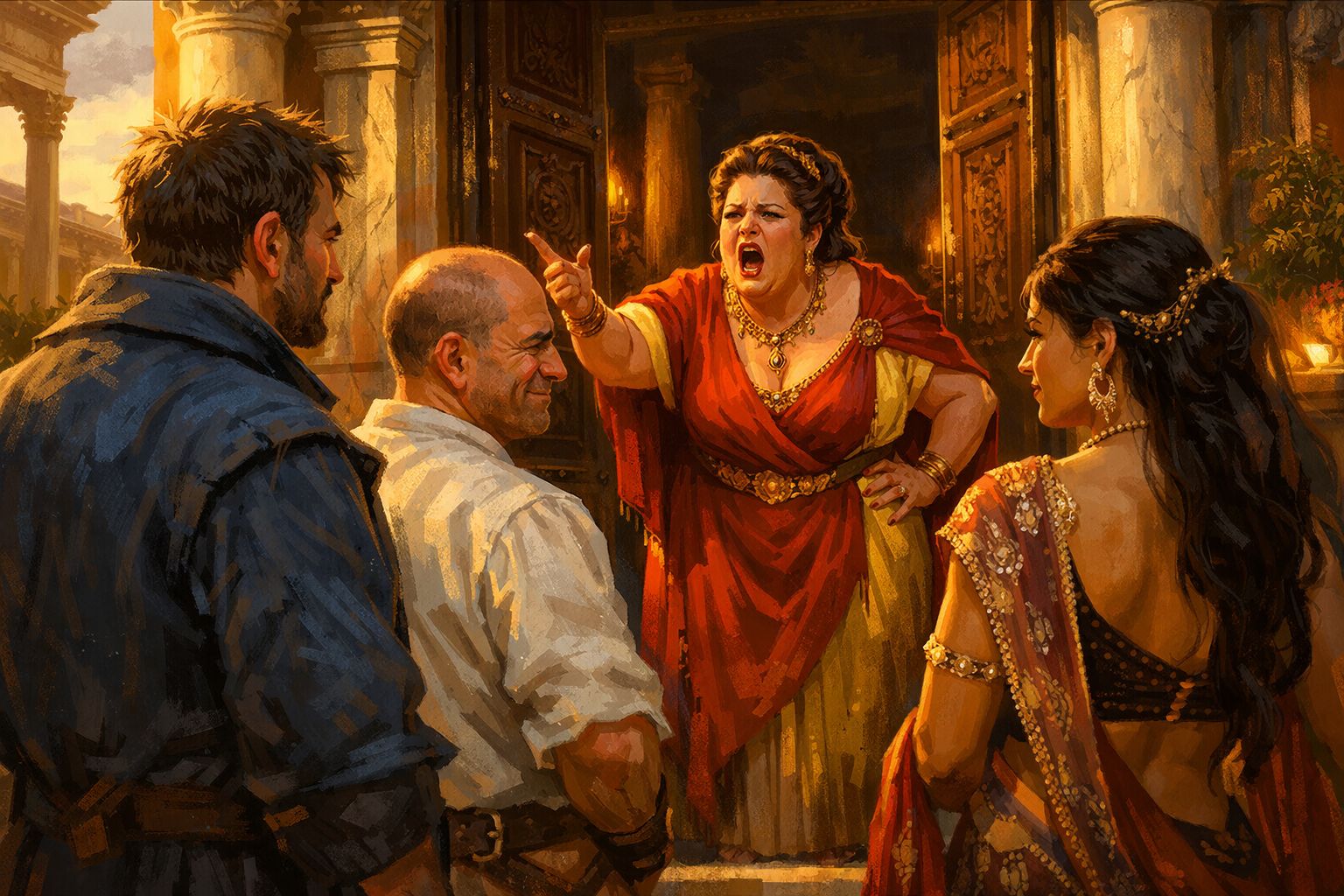
This stop shifts the chase from harbor trade into Estorian domestic drama and social status. The crew learns two things quickly. The book did reach Florian, and it is already gone. The scene also gives you a strong emotional push into the next leg, because the crew leaves with a clear target and a little disgust.
Finding Florian’s House
Finding Florian is easy. He is wealthy, visible, and the kind of man whose address can be obtained without effort.
Point the crew to the right street through any clerk, scribe, courier, or neighbor. If the crew asks in the harbor, the directions come with a smirk. If they ask in a respectable quarter, the directions come with polite disapproval.
The House and the First Beat
The house should feel expensive and controlled, with the faint sense that it is expensive because someone is constantly trying to keep it from falling into chaos.
The door is opened by Xantippa Domitus, Florian’s wife. She is furious, already mid argument in her own head, and the crew has simply arrived at the right time to become her audience.
Running Xantippa
Play her as intense, sharp, and unashamed of her anger. She does not need to be reasonable. She needs to be honest. She talks, she does not listen.
She is not trying to help the crew. She is venting. The crew gets information because she cannot stop herself from saying it.
She is vulgar when she gets going. Not as comedy, as heat. Keep the swearing colorful and repetitive, like someone who has said the same insults all afternoon and still means them.
Let her talk. Do not turn it into a negotiation. The crew does not need to win her over. They only need to survive the storm long enough to hear the key facts.
If the crew interrupts, she talks over them. If they flatter her, she does not soften, but she may give one extra detail out of spite. If they try to defend Florian, she escalates and the scene becomes shorter.
Go wild here. Do not hold back. Be creative in the insults. Mention everything bad Florian did. Mention everything good he didn't do. Rage, rave, ramble. Unleash your inner angry Captain Haddock. Most important: do not stop. If you can keep the rambling going for half an hour with creative insults and intense tempo, it'll be a memorable game experience, even if the players do not get a word in edgewise. Do not hold back.
What Xantippa Reveals
- Florian bought the journal recently and paid too much for it.
- He showed it off to other collectors.
- On the way home, he lost it in a dice game.
- She threw him out and hopes he stays away.
- He is probably drinking with his gambling friends right now.
Closing the Door Cleanly
When Xantippa reaches a breath that signals she is about to begin a second tirade, give the crew an exit.
A quick thanks, no debate, no questions, and immediate withdrawal. This keeps Xantippa as a force rather than a conversation partner.
If the crew tries to continue the conversation, she will simply call some servants to tell them to go away and slam the door.
Finding Florian Afterward
From here, the chase becomes grimy. The crew must find gambling places by asking around, then go there and ask for Florian.
Point the crew toward dingy gambling dens, not glamorous salons. Florian slumming it is part of the humiliation.
Run it as a short sequence of three stops:
- The Widow’s Luck. The crew does not find him here. They get a direction.
- House of Ormenos. They do not find him here either. He has been here and was drunk when he arrive, and more drunk when he left. They get another direction, and a little more contempt.
- The Snake's Eyes. This is where they find him.
Each place should feel worse than the last. More smoke, more wine of less quality, more sweat, more desperation, less pretense.
Meeting Florian in the Den
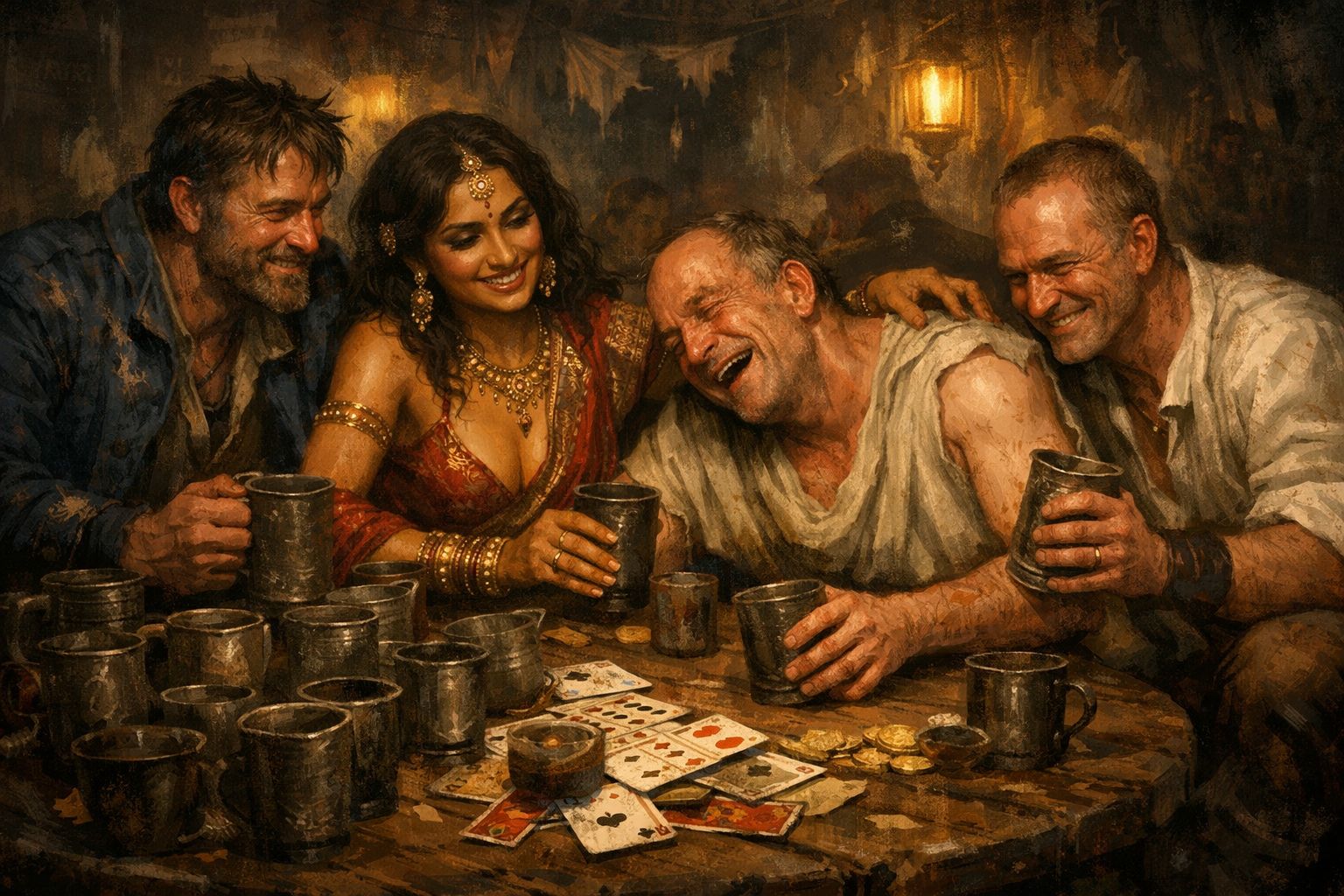
When they find him, Florian is very drunk. He is not pathetic in his own mind. He is wronged, misunderstood, and unfairly treated.
He confirms his wife’s story in facts but frames himself as the good guy. He bought the journal because he is a patron of culture. He showed it because it deserved appreciation. He gambled because he was among friends. He lost because luck can betray even a careful man.
If the crew sits down for a few drinks with him and strokes his ego, he admits he lost the journal to Varro Licentius.
If pressed, he describes Varro as a charming little snake, the sort of man who smiles while counting your money. He will also insist that Varro cheated, because Florian needs that to protect his ego.
What the Crew Leaves With
A confirmed chain. Marcia to Florian to Varro.
A clear next target. Varro Licentius.
A stronger sense of Estoria. Even respectability here has rot under it, and the chase is dragging the crew downward through layers.
Varro Licentius, The Small Time Crook
Varro Licentius chose places where he could be seen.
Not admired, not respected, just seen, because seen meant safe. He stood beneath a striped awning outside a wine shop that sold watered reds by the jug, laughing too loudly at a joke nobody had told, letting the street do what it always did in Estoria. Watch. Listen. Remember.
When he spotted the crew, the laugh died halfway through his throat.
His eyes flicked left, then right. He shifted his weight, subtly angling himself toward a knot of people nearby. A fruit-seller. Two dock clerks. A man with a crate on his shoulder who looked like he did not want trouble but would stay for it. Varro’s smile came back, thin and quick, a shield he could raise while he searched for an exit.
“Well,” he said, voice bright, hands spread as if greeting old friends. “This is unexpected. We meet again. You are far from the places you like to threaten me.”
Scarnax did not match the smile. Pelonias did not offer one at all. Ayesha watched Varro the way one watches a rat deciding which hole is closest.
“We are looking for a book,” Scarnax said. “A journal.”
Varro blinked, then tilted his head with practiced innocence. “A book. In Estoria. How tragic. There are so many. You should try Marcia, she loves books, does she not. Or perhaps you should try a library, if you can find one that will tolerate your manners.”
His eyes kept moving, checking faces, checking distance, checking the alley mouth behind the wine shop.
"You won it from Florian Domitus," Pelonias stated flatly.
Varro’s mouth opened, already forming another slippery denial, and then he paused. Just a fraction too long. Something changed behind his eyes, not understanding, but recognition of weight, the sudden realization that he had stumbled into something that mattered to people who could afford to make it matter.
He leaned in, lowering his voice as if he were doing them a kindness.
“Ah,” he said softly.“ That little thing.”
Ayesha saw it happen and let him have the space to make his own mistake. She took one step back. Not retreat, just distance. She looked at Scarnax and Pelonias, then at Varro, and spoke with calm certainty.
“Talk to him.”
Varro flinched as if she had struck him.
His gaze snapped to Scarnax, then to Pelonias, then to the alley again. His breathing quickened. The street noise did not change, but he seemed to hear it as threat now, not protection.
“I do not have it,” he blurted. “I never had it for long. I sold it, all right. Quick. Good coin. No questions. That is my virtue, I do not ask questions.”
He swallowed, then tried to pull his smile back onto his face, failing.
“I sold it to a ship,” he said, too fast. “The Silver Moon. In the harbor. Captain Kiran Dhalapati. Cheerful bastard. Smells like spice and lies. He paid. I took the money. That was the end of it.”
Scarnax held his gaze for a moment longer than Varro could stand.
“Go,” Scarnax said.
Varro did not wait for a second invitation. He turned, almost tripping over his own feet, and slipped into the alley like water finding a crack, moving fast, head down, vanishing into the city that had never cared if he lived or died as long as he kept his debts small and his mouth useful.
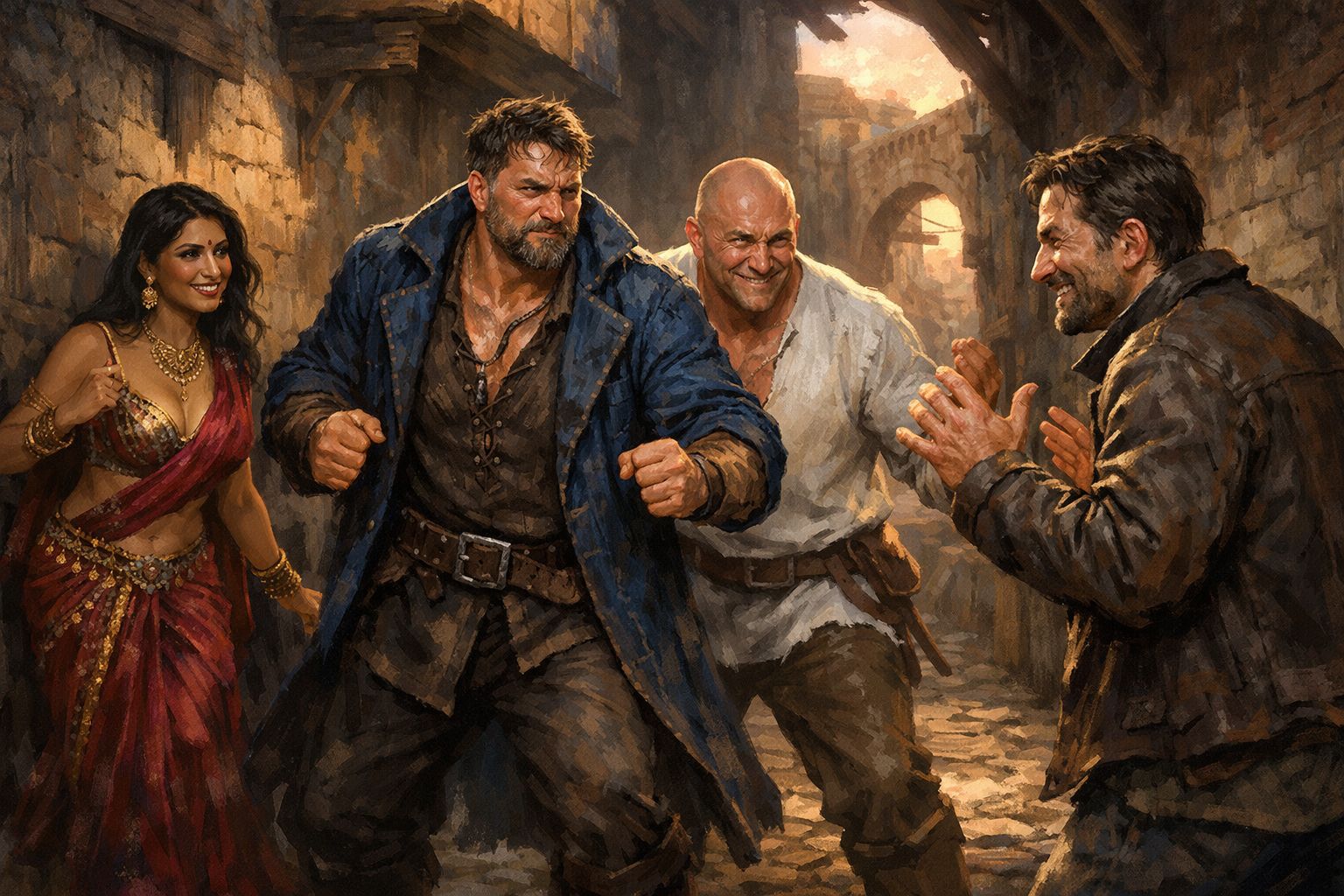
This stop shifts the chase from social friction to leverage. Varro is not a mystery, he is a coward with a mouth. The crew’s job is to find him, isolate him, then decide whether to pay, threaten, or humiliate him into talking.
How to Find Varro
Varro is well known among lowlifes, which means he is easy to locate and hard to pin down. He has enemies who would happily point the crew toward him, and he has friends who are not really friends, the kind who will sell him out for a drink or a laugh.
The simplest path is through his wife, Livia. Livia runs the sleaziest brothel, a back alley basement where the cheapest slaves she can buy are worked hard and replaced often. If the crew asks for Livia, they will find the place quickly. If they stake it out, Varro will appear, because he is drawn to the one place where he thinks he has access, protection and influence.
If the crew avoids the brothel, let ordinary street leads carry them into the right quarter. They follow rumors, debt talk and petty scams until they see Varro in motion, trying to pull some scheme in public where witnesses make him bold.
Running the Interaction
Play Varro as a man who performs confidence and lives on escape routes. He chooses places where he can be seen. He positions himself near bystanders, merchants and anyone who might become an accidental shield.
He starts defensive because the crew has threatened him before. He will bluff, joke and pretend not to know what they mean. He is testing whether he can make them look unreasonable.
As soon as he realizes the crew cares about the journal, his posture changes. He still wants safety, but now he also wants profit. He realizes that he sold it too cheaply, and will try to correct that mistake. He will try to turn information into coin, favors or social advantage.
How to Get Him to Talk
Varro responds to two things, fear and opportunity.
If the crew offers money, he will bargain. The more the crew signals the book matters, the higher the price climbs. He is not pricing the information. He is pricing their desperation.
If the crew threatens him, it works only if he is cornered without witnesses. If he has a crowd, he will try to weaponize it. He will shout, accuse, claim he is being robbed, and make the crew look like violent outsiders. He will not fight, but he will try to make the city fight for him.
The cleanest approach is to control the environment. Draw him into an alley, a back room, or a quiet corner. Cut off his ability to perform. Then apply pressure. He cracks fast.
Information Gained
- Varro confirms he obtained the journal from Florian Domitus, but he frames it as luck and charm rather than predation.
- He admits he sold it quickly for cash.
- He did not realize its full value at the time.
- He gives the next lead. He sold it to the Silver Moon, and he can name the ship and the captain.
If pressed, he can describe when and where the sale happened, enough to make the next scene in the harbor feel immediate.
Close of the Scene
End with Varro fleeing. He does not linger once he has given the information. The crew should feel that they have squeezed a weak man and extracted what they need, and that Estoria will remember how they did it if anyone was watching.
The Silver Moon, The Trader
This stop feels like the chase is about to end cleanly, then it snaps into a dead end. The crew reaches the right ship, meets a familiar face, and learns the book is already gone. It is also a chance to remind the table that the Silver Moon is a recurring presence, occasionally useful, tempting and never fully trustworthy.
Finding the Silver Moon
The Silver Moon is easy to locate. She is anchored in the harbor and she is noticeable.
The crew can find her by searching the harbor directly or simply by asking an official which ships are currently in port. Any dock clerk, harbor watchman, or customs runner can point them to her.
Approach and Tone
Run the approach as friendly friction. The Silver Moon is not hostile, but it is guarded in the way a ship is guarded when it carries profitable secrets.
Let the crew feel the contrast to Urganmaar. Here, strangers are not a problem, strangers are customers. The threat is not violence. The threat is being sold something.
Captain Kiran Dhalapati
Kiran is cheerful, slippery and eager to turn every conversation into trade. He talks like a man who has never been surprised in his life, even when he clearly has been.
Play him as welcoming, quick to laugh, quick to compliment and always steering back toward deals. He enjoys the crew, but he is not loyal to their goal. He is loyal to his own purse.

The Key Information
Kiran confirms he bought the book from Varro for a small sum, because Varro did not understand its value and Kiran assumed it might be useful.
Kiran then delivers the turn. During the night, someone slipped aboard and stole the book, and nothing else. No coin, no jewelry, no cargo, no weapons. Only the book.
He does not know who did it. There were no clear traces, no witnesses and no obvious sign of how the thief entered or left. Nothing was broken, the lock was neatly picked.
Keep this blunt. The crew has arrived at the right place and is still too late.
How to Run the Questioning
If the crew presses, Kiran stays cooperative but not helpful. He answers what he can, but he has little to give.
He can describe where the book was kept, who knew it was aboard and when he last saw it. None of these details identify the thief. They only confirm that this was targeted and professional.
If the crew implies Kiran is lying or complicit, he becomes wounded and amused at the same time. He would respond with phrases such as "I'm a trader. If I had it, I would be trying to sell it to you right now." He does not escalate to violence. He escalates to politeness and distance. He will end the conversation if it stops being profitable.
The Sales Pitch
After delivering the bad news, Kiran pivots. He is happy to sell them something else.
He offers exotic wares and curios. Spices, perfumes, strange fabrics, tools, small bone carvings and especially other books. Nothing he offers is relevant to the journal chase.
The point is not to tempt the crew into a shopping session. The point is to show Kiran’s nature. Even at a dead end, he is still trading.
Ending the Meeting
End this stop with the crew feeling stuck. The obvious lead has failed. The trail has gone cold.
Let them try to solve it for a while. Give them room to ask questions around the ship, check the gangway, speak to dockhands, look for rumors. Let their effort produce only ambiguity and frustration.
Then, once they have felt the dead end, Sandros Pellaios intervenes and offers a new direction.
Sandros Pallaios Intervenes
The harbor kept moving as if nothing important had happened, as if a stolen book was no different than a lost crate or a broken mast. Dock slaves hauled rope. Clerks argued over stamps. A fishmonger shouted prices that changed with his mood. Somewhere, a bell rang for a ship casting off, and the sound made time feel like something that could leave without you.
Scarnax kept the questions practical. Who had been on the gangways last night. Who saw a stranger on the Silver Moon. Who handled the locks, who handled the papers, who handled the bribes. Ayesha listened for inconsistencies, watching faces more than words. Pelonias watched the harbor itself, the flows of attention and avoidance, the moments when a person stopped answering and started measuring.
It was work, slow and gritty, and it produced nothing you could hold. Shrugs. Half-stories. A dockhand who was certain he saw a shadow but could not tell you whose. An official who insisted the harbor was safe while checking over his shoulder. It was the kind of uncertainty that felt deliberate, as if someone had already paid for the silence.
Sandros Pellaios approached like he belonged there.
He did not run, he did not hide, and he did not announce himself. He simply appeared in the space that opened between two passing carts, dressed too well for dockside grime and too casually to be a noble. His smile was mild, almost friendly, which made it worse.
"I hear you are looking for a book," he said, voice pitched for their ears alone. "A book that was stolen in the night."
Ayesha turned her head as if she had been expecting him all along. "As usual, your information is correct," she said. "So tell me what you want this time."
Sandros’s smile widened by a fraction, approval instead of warmth. "Straight to it. Good. It saves us both effort."
"It was an imperial agent," Sandros said. He made the words sound like a simple fact, not an accusation. "Not a thief looking for coin. Someone with a task."
He named the agent, Titus Valens, then named where the man could be found, and the details were delivered with the calm precision of someone reciting a route he had walked himself.
"And there is another thing you should know," Sandros continued. "You keep calling it a journal. It is not a journal. It is a report, written for the Emperor. That distinction matters, even if the paper looks the same."
Pelonias’s hand drifted to his map case as if the new information had weight and needed somewhere to sit.
Sandros watched their reactions with quiet satisfaction, then tilted his head as if considering how much more to say.
"It benefits my employers if that report reaches the orcs," he said. "Not the Empire. And it benefits them even more if the agent is removed from the board before he can explain himself to the wrong people."
Ayesha stiffened momentarily, before regaining her composure. "You talk about a man like a token."
Sandros' reply came softly. "If you prefer, call it a life. The result is the same."
He let that hang for a moment, then lifted one hand, palm open, offering generosity like a coin he knew they could not refuse.
"I gave you the name and the location for free," he said. "For now. You can repay me later. A favor, when it is convenient."
Scarnax’s eyes narrowed. "The favors seem to stack up."
Sandros gave a small shrug, a gesture so light it looked like mockery wearing polite clothes. "I scratch your back, you scratch mine," he said, and the smile returned, easy and unbothered.
Behind him, the harbor kept shouting and counting and hauling. In front of them, the chase had teeth again, and it had Sandros’s fingerprints all over it.

This scene exists to restart momentum, reframe the stolen book as something far more dangerous, and bind the crew more tightly to Sandros without forcing obedience. The crew should leave with clarity of direction and discomfort about the source of that clarity.
Sandros is not here to help out of kindness. He is here because the situation aligns with his interests. The crew should feel that accepting his information is practical and necessary, and that refusing it would be foolish rather than heroic.
The goal is forward motion with a price tag attached.
What Sandros Knows and Why
Sandros Pellaios is acting as a broker for opponents of the Empire operating along the trade routes. His employers will not be named.
The stolen book is not a personal journal. It is an imperial intelligence report compiled by Celestius about his mission, written for eventual delivery to the Emperor or his inner circle. Titus stole it, to ensure it did not end up outside the intended recipients.
Sandros knows this because one of his agents inside the imperial network flagged the document before it changed hands.
Sandros wants the report to reach the orcs. He believes it will accelerate internal conflict and weaken imperial leverage. He also wants Titus silenced before the man can explain himself, identify contacts, or reach the Empire.
The Imperial Agent
His name is Titus Valens, and he is working under a cover identity as a harbor logistics inspector. His true role is to watch ships and cargo moving through Estoria, and report to the Empire.
He currently lives in a small house near the eastern quay, next to the Sea Horse tavern.
Sandros’s Offer
Sandros provides the following information freely:
- The agent’s true identity
- The agent’s current location
- The true nature of the book
- The strategic importance of preventing Titus from reporting back
He explicitly frames this as an advance, not a gift. He expects repayment later in the form of a favor. The favor is undefined, which is intentional. Sandros prefers flexible debts.
If pressed, Sandros will not define terms. If threatened, he will disengage calmly and allow events to unfold without him. He is confident the crew will act regardless.
How Sandros Should Be Played
Sandros is relaxed, precise, and unhurried. He never raises his voice. He never rushes the crew. He does not argue facts, only interpretations.
He sees the power struggle between nations as a game. If accused of cruelty, he will not defend himself. He will simply point out outcomes.
He should never say he wants Titus killed. He should speak in terms of preventing reports, stopping explanations, and denying further moves. The implication should be clear without explicit instruction.
Tone and Table Feel
This should feel like a professional conversation, not a villain monologue. Sandros is not threatening the crew. He is demonstrating that the world is already moving and they are choosing how to move within it.
The harbor noise should continue throughout. This is not a private chamber scene. The indifference of the world is part of the pressure.
Players should feel informed, not reassured.
What the Crew Should Leave With
- A clear next target and location
- A redefined understanding of the book’s importance
- A sense that Sandros is useful but he plays his own game
- A debt they did not formally agree to but have already incurred
- Momentum restored, with consequences attached
The Retrieval
This scene turns the investigation into a tight, local problem with immediate consequences. The crew has the target, the location and the stakes. Now they must choose what kind of people they are when the answer is behind a cupboard door and the wrong shout can bring the Empire running.
The scene is designed to feel solvable but never clean. Any path that leaves Titus alive carries future risk. Any path that removes him can feel morally wrong, even if practical.
Location Overview
The Street
The house is on Saltcask Street, a busy lane of rope sellers, lamp oil merchants and cheap taverns. Foot traffic is steady. Carts pass often enough that short moments of cover exist. Windows face the street. People look without meaning to.
Street NPCs you can use as pressure
- Pella the Lampwife, runs a stall just across the way. She watches everything.
- Jorun Saltlip, a one eyed porter who hates inspectors and asks questions if he recognizes Titus.
- Two imperial dock watch patrols pass each hour, one pair of constables at a time.
The House
A narrow two floor rental with whitewashed walls and a small back yard that smells of brine. The front door opens directly to the street. The back yard has a low fence and a shared alley with other yards.
House Interior:
- Front room with a desk, ink, stamped papers, a cheap iron lockbox.
- Narrow kitchen, clay stove, cupboard that holds the book behind ordinary jars and dried fish.
- Upstairs sleeping room, travel satchel, boots by the bed, a short sword under the mattress.
If you want a discreet entry point, a back window over the yard can be forced, but it squeals.
Titus Valens
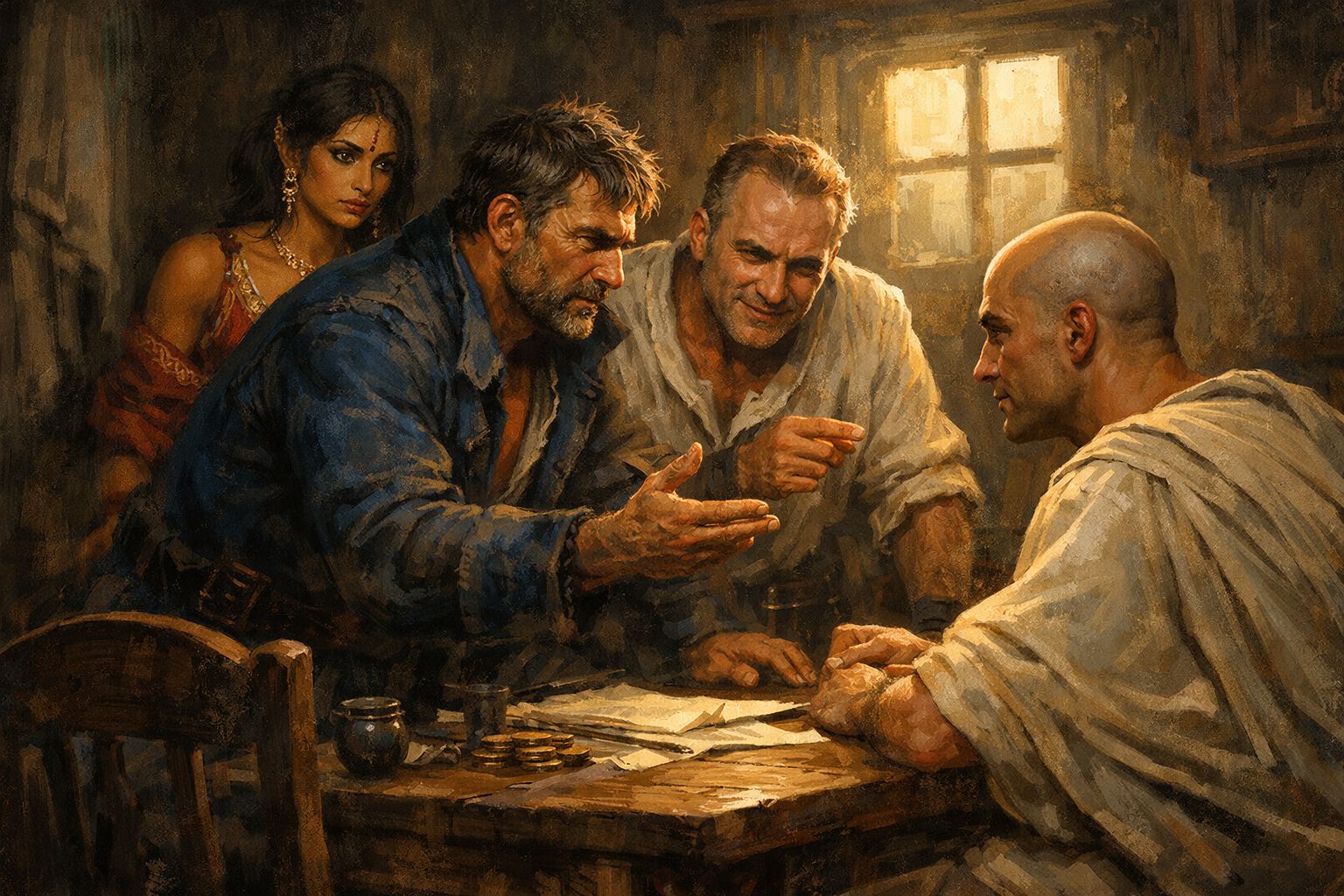
As far as he is concerned, Titus recovered imperial property from thieves. As far as the Empire is concerned he did nothing wrong. He is about to arrange secure transfer to the Empire, because the Emperor is far away on another continent, and this cannot be shipped casually.
He wants to survive and remain unexposed. He also wants to make sure the Empire gets the report.
He denies knowledge of the book and acts offended. He does not act like a cornered street thief. He acts like a man who believes he can win by procedure, delay and authority.
He tries to steer the exchange toward the street. He wants the crew visible. If they are visible, they cannot do anything harsh without consequences.
If the crew hesitates, he tries to slip away. Not dramatically. Efficiently. He moves toward a door, a window, a shout.
If pinned, he surrenders. He tries to look reasonable. He makes it hard to justify killing him in the moment.
If allowed to live, he will report. Not necessarily immediately, but soon. He will go to imperial help the moment he believes he can do so safely.
Titus’ Leverage
He knows the local chain of command. He can summon constables and dock watch quickly.
He can ruin the crew in bureaucracy if the Empire wants it, blocked permits, delayed supplies, inspections, tariffs, warrants. If the crew draws imperial attention that jeopardizes the report’s path to the orcs, Sandros might act in the shadows to keep the mission alive. If he does, it is not mercy. It is asset management, and it creates a heavy favor.
He also has fear. He knows if he hands over the book and the Empire finds out, he will be marked for death. That fear makes him stubborn but also exploitable.
Opening the Scene
- Open Approach. They knock, present themselves, force a conversation. This is quickest but puts the crew on a timer the moment voices rise.
- Quiet Approach. They use the back yard and try to control the interior before Titus can step outside or shout.
- Blended Approach. One or two crew members distract Titus at the door while others slip in from the back.
If you want immediate tension, have Pella the Lampwife notice unfamiliar faces and stare too long. If you want a short window of opportunity, have a cart rattle past loudly, masking footsteps for a moment.
Titus’ First Moves
If the crew is visible from the street, Titus keeps the door half open so his voice can carry.
If the crew enters the house, Titus angles toward the front room where his desk and papers can support his authority.
If threatened, he brings up the Empire as a shield, not as loyalty but as inevitability. He implies that even if he dies, the Empire will investigate.
If he sees a gap, he tries one of these:
- Dash to the street and shout for dock watch.
- Slip to the back yard and climb the fence.
- Run upstairs, grab the satchel, then jump out the back window.
If cornered, he offers surrender with hands visible and eyes steady. He wants the crew to hesitate.
The Retrieval Problem
The book is not on his person. It is in the kitchen cupboard. He expects that if he can keep them talking and searching visibly, he buys time to escape or summon help.
Once Titus is out of the way, finding the book is straightforward. A quick search of the kitchen cupboard reveals a wrapped packet tucked behind jars. It's not well hidden or locked, he did not expect the theft to be connected to him.
If the crew searches while Titus is present, he will try to move them, interrupt them, call it unlawful, push toward the door, raise his voice.
Leaving Titus Alive
If Titus lives and remains free, he will report to the Empire quickly. This can come back later as warrants, harassment at sea, pressure on friendly ports, a bounty or a targeted imperial response.
If Titus lives but is compromised, he may try to protect himself by reporting in a way that frames the crew as the primary criminals and himself as the victim of coercion. That shifts heat onto the crew while keeping his failure hidden.
Discreet Removal
If the crew eliminates him discreetly and removes obvious evidence, the street does not notice. They leave without immediate trouble.
Discreet does not mean painless. Make it feel wrong. He is not pleading like a monster. He is human, scared and trying to live.
If they do it and it gets seen or heard, it becomes worse than leaving him alive. It becomes an imperial murder in an imperial city.
Stealing the Book Without Removing Titus
Possible but hard. Titus knows his home, the street and the rhythms of the patrols. If the crew tries to get the book and leave him alive, he will remember faces, voices, accents, ship details and he will move fast afterward. If they can be traced, imperial guards will appear at the Blue Marlin, asking questions and wanting to search the ship.
Complication Timers
Street Attention Timer
Any fight, crash, or drawn out argument brings eyes to windows. Within minutes, someone goes looking for a constable.
If the crew is seen entering and later leaving in a hurry, Pella the Lampwife can describe them later, even if she does not know what she saw.
Imperial Response Timer
If Titus reaches the street and shouts, a patrol can arrive quickly. Dock watch will respond fast to an inspector calling for help.
If a patrol arrives, they prioritize containment. They block the street ends, question witnesses, then move to the harbor to identify the ship. The crew has a narrow window to run.
Escape and Chase Structure
If It Stays Quiet
The crew exits calmly, blends into street flow, returns to the ship. No immediate pursuit.
If It Turns Loud
Stage it in three beats.
- Beat One: Street burst. Titus shouts or a neighbor reacts. People scatter. The crew must decide whether to run, fight, or lie.
- Beat Two: Patrol contact. A pair of dock watch appear, then more. They are not elite, but they have whistles and authority.
- Beat Three: Harbor sprint. The crew races back to the Blue Marlin, tries to cast off fast, or tries to disappear into the city. The Empire can respond at the docks faster than on the water, so the ship itself is both refuge and liability.
What the Crew Should Leave With
- The report recovered.
- A clear sense that leaving Titus alive has a future price.
- Either a clean exit earned by discretion, or a messy flight that marks them in Estoria.
- A reminder that Sandros’s help always pushes them toward choices they would rather avoid.
Leaving Estoria
This is a quick fallout check that turns the Titus scene into a practical outcome. Resolve it fast, then get the Blue Marlin back to sea.
Clean Departure
If the crew kept it quiet, departure is routine. Papers get stamped, fees get paid, lines get cast off, and the harbor barely notices them. Sandros does not appear. Success means silence.
Messy Departure
If the crew made noise or left witnesses, the harbor turns sticky. A clerk “can’t find” a form, a dock watch pair lingers too close, and a petty official named Althis Rhorne asks polite questions while watching for a wrong answer. The crew can talk their way through, pay to smooth it over, or bluff authority, but every minute increases the chance that someone sends a runner.
If the situation is truly hot, leaving becomes a run for it. Cut lines, shove off early, abandon cargo, and accept that Estoria will remember faces and ship details. If they escape this way, later consequences are not personal grudges, they are procedure.
Act Summary
This act takes the crew from a chase that keeps slipping out of reach, to stalled investigation, to decisive action, then locks in consequences. They recover the book, but the method matters, and so does the source of their new direction.
The Report Is Secured
The crew now possesses the stolen document. It is not a private journal. It is an imperial report tied to Celestius and the Grashkaar situation, and its existence alone can shift the balance between the Empire and the orcs if it reaches the right hands.
This changes the campaign’s texture. The crew is no longer chasing rumors. They are carrying something that can redirect policy, belief, and violence in the region.
The Sandros Debt Deepens
Sandros Pellaios provided the leverage that broke the dead end, and he did it to push the report toward the orcs. The crew now owes him another favor, and the favor is undefined. This is the point. Sandros is accumulating flexible debt that can be cashed in later when it costs.
Sandros is again confirmed as both useful and dangerous. He is an ally of convenience, nothing more.
Relationships and Recurring NPCs
The crew’s circle of familiar faces expands and deepens.
- Sandros Pellaios, information broker and debt collector.
- The Silver Moon and its captain, a recurring point of trade, rumor, and quiet temptation to overshare.
- The Licentius couple, petty crooks with grand ambitions and small capabilities.
Operational Consequences in Estoria
How the retrieval played out determines the crew’s short term standing.
- Clean outcome means Estoria remains usable. The crew can return later with limited friction.
- Messy outcome means Estoria becomes inconvenient. Paperwork delays, hostile clerks, dock watch attention, higher fees, and quiet watching.
- Hot outcome means Estoria becomes dangerous. Descriptions circulate. Dock watch remembers. The crew may be unwelcome for a time, or forced to approach via intermediaries and bribes.
This should not feel like punishment. It should feel like state memory, but memory fades. Estoria does not forgive. It gets distracted. Papers get misfiled, faces blur, personnel rotate, and the harbor’s attention moves to the next crisis.
Curio’s Response
The crew has reported progress to Curio. Curio is pleased, and it is clear that he has a deep personal interest in the mission. The crew delivered results, proved competence, and moved the expedition forward. This strengthens Curio’s trust and increases the likelihood that Curio will back them with resources, access, and patience when complications arise.
Curio’s satisfaction is also a pressure. It raises expectations.
The deck was quiet in the way a ship is quiet only when it has decided it is done with a place.
Estoria still sat behind them, a smear of lights and smoke on the horizon, the harbor noise reduced to a memory of bells and shouting. The Blue Marlin moved with steady purpose, as if the sea itself was glad to put distance between them and stone.
Ayesha leaned on the rail beside him, her gaze fixed forward, not at the water but at whatever lay beyond it.
Scarnax exhaled through his nose, a sound that was half laugh, half disgust.
“So that is it,” he said. “Celestius. An imperial lie to stop raids.”
Ayesha’s mouth curled by a fraction. Not amusement. Appreciation, the way a craftsperson might respect a tool even while hating what it was used for.
“As such things go,” she said, “it was a beautiful ruse. It did what it was meant to do.”
He taps the rail with two fingers, as if counting points.
“And it backfired,” he said. “It worked too well. Estoria did not get safety. It got a neighbor. An army, if the wrong man decides he wants one. Not occasional raids. Something that can march.”
Ayesha’s eyes stayed on the dark line where sea met sky.
“Peace can be the most devastating weapon of all,” she said, “if you know where to wedge it.”
He glanced at her then, and the look carried more unease than accusation.
“You are starting to sound like Sandros.”
Ayesha did not flinch at the name. She let it sit between them like salt on the tongue.
“Sandros is not wrong,” she said. “He is only ruthless about what his facts are allowed to mean.”
“What do you think the Grashkaar will do with it,” he asked, “when they learn what it says.”
Ayesha finally looked at him, and for a moment her expression was not cold. It was attentive, like someone listening for a crack in a wall.
“That depends,” she said, “on how we hand it to them.”
Scarnax frowned.
“It is ink,” he said. “It says what it says.”
Ayesha’s gaze lifted back to the horizon.
“It is a story,” she replied. “Ink only pretends it is not.”
The wind shifted. The sails adjusted with a soft groan. Somewhere below deck, someone laughed at something small, a brief spark of life that had nothing to do with empires.
Ayesha spoke again, quieter, as if she was speaking to the sea rather than him.
“If we present it as proof that the Empire wanted to tame them,” she said, “some will burn with shame. Some will burn with rage. If we present it as proof that Celestius chose them anyway, despite the Empire, others will cling harder to him than before. If we present it as proof that the Empire fears what they could become, then the ambitious will hear opportunity.”
Scarnax stared at the horizon as if it might change shape when he looked long enough.
“So we are not only delivering a picture,” he said. “We are delivering the frame.”
Ayesha nodded once.
“And frames decide what people see,” she said. “Sandros would tell you that. He would also tell you he does not care what they see, as long as they move.”
Scarnax’s jaw worked, slow.
“And you,” he asked.
Ayesha’s eyes narrowed slightly, not in anger, but in thought.
“I care,” she said. “That is the difference between me and Sandros. I care, and I still know that the world moves on what people believe, not on what is true.”
Behind them, Estoria shrank into darkness. Ahead, the sea waited, indifferent and patient.
“Then when we give it to them,” he said, “we choose our words carefully.”
Ayesha’s expression softened by a fraction, and for the first time that night she looked almost tired.
“Yes,” she said. “Because if we do not, someone else will.”