Campaign: Drowned Marshes
Act Synopsis
The Drowned Marshes arc is an oppressive rescue arc about debt, fear and the limits of what one ship can change. The Blue Marlin does not come here to save the swamp or overthrow the Crimson Synod. They come because Samden saved them more than once, because Meyrha can feel him again and because leaving him in the hands of the Synod is impossible. The arc gives the players a hostile problem rather than a planned route. Samden is somewhere in the marsh. The people are terrified. Questions are dangerous. Compassion is dangerous. Disobedience, even the smallest kind, can destroy a family.
Ivy and the Spirit World
Ivy can enter the spirit world, but here that becomes truly dangerous. The spirits of the Synod’s victims cling to her like drowning people, desperate for release and unable to understand that they may drag her down. Predatory demons stalk the edges of that suffering, drawn by disturbance and spiritual light.
The Facade
Arrival in Rotmere
The Blue Marlin arrives at Rotmere, one of the coastal villages maintained as a facade for outsiders. Trade happens here. Strangers can buy fish, swamp pearls and supplies. People answer simple questions with rehearsed politeness, but anything deeper makes them visibly afraid. The village is gloomy, silent and watchful, but its misery has been arranged into something outsiders can understand: poor huts, bad water, sullen fishers and nothing worth investigating. Its purpose is to make strangers believe they have seen all there is to see, take what they came for and leave before curiosity becomes dangerous.
Meyrha is already struggling. Since approaching the marsh, she has begun receiving fragments from Samden again. They are faint, broken and mixed with nightmare images of black water, indifferent faces, pain and a voice that is not entirely his. She insists on joining any mission inland and refuses to be left behind. For her, this is not a clue hunt. It is personal.
The Note
The crew’s questions unsettle Rotmere. No one answers them openly, but eventually someone slips them a note warning them to stop asking and meet after dark. The note is not a solution. It is the first crack in the facade.
At the meeting, a broken villager tells them enough to understand the shape of the danger. The Crimson Synod rules the marsh through terror, magic and generations of punishment. They took his daughter, his son and his wife. He has nothing left except revenge. He confirms that the Waverider came here, that its crew saw enough to understand the horror and that they went no deeper than they had to. He can point the Blue Marlin toward the inner marsh, but from there, they are on their own.
The Search
The Inner Village
The crew eventually reaches one of the inner villages, where the facade is gone. Here, the Synod’s rule is visible in everyday life. Punished victims are kept in public as lessons. Some have been reshaped by magic. Others have been silenced, mutilated or transformed into living warnings. No one helps them. No one dares even look too long.
While the crew is there, a Synod mage arrives with masked enforcers. The faceless rank and file are called Custodes. Their iron masks are blank, their loyalty absolute and their hybrid nature hidden. Officers, called Vigiles, wear individual iron masks and speak with authority. The mage casually selects three youths from the village. Their families do not protest, weep or plead. They only endure. This scene makes clear that the Synod does not merely rule the marsh. It has trained fear into the bones of its people.
The Open Search
From this point, the arc becomes open. There is no single intended solution and no fixed chain of clues. The Game Master knows the underlying truths, but the players decide how to uncover them. Samden is held in one of the Synod’s towers. The mage who captured him is using a summoned demon to break his mind and turn him into a vessel. Three youths will be taken from an inner village for another ritual. The swamp is watched, and every local knows that helping outsiders can be fatal.
Possible leads can come from frightened villagers, punished victims, boat traffic, overheard Custodes, strange lights in the swamp, Meyrha’s visions, Ivy’s spirit sight, discarded experiment waste, supply movements or the families of the recently taken youths. Most people will not help directly. They flinch, lie, freeze or beg the crew to leave them alone. The people of the Drowned Marshes are like beaten dogs, loyal out of fear, always expecting the next blow.
Into the Swamp
The route to the tower is not a stealth crawl through reeds. The swamp is too noisy, wet and difficult for that. Stealth happens in moments and places: watching boats from trees, hiding beneath nets, waiting under rotting docks, moving along raised walkways or lying still while patrol boats pass.
The swamp itself becomes a source of pressure. The crew may encounter listening reeds, plants which villagers believe report disobedience, boats carrying prisoners, abandoned shrines to Old Mother Fen or places where Meyrha’s visions strike hard enough to endanger them.
The Base Attack
The Tower
The Synod tower rises from the mangrove swamp, built upward because nothing can be safely buried below. Its lower level is the barracks of the Custodes. Above that are servant quarters and stores, then the apprentices’ level, then the holding pens, the laboratory and finally the private quarters of the mage.
The tower is not a dungeon full of wandering monsters. It is a private laboratory, prison, archive and ritual house. Its security is not magical wards, but geography, secrecy, procedure, masked hybrid enforcers and the terror of everyone around it. The mage values privacy and does not want constant disturbance. Most movement inside serves experiments, prisoner handling or ritual preparation.
The Ledgers
Inside the tower, the crew can discover ledgers and correspondence showing the true nature of the Crimson Synod. The tone is mundane, bureaucratic and organized. Bodies are listed as resources. Prisoners are recorded by age, condition, origin and usefulness. Ritual failures are categorized. Requests are made between towers. Compensation is owed in research, specimens, infernal material and access to methods.
These ledgers reveal that the Synod is not a collection of isolated madmen. It is a professional network of monsters. They hoard power and knowledge together. They do not compete internally because they understand that it is them against the world. Apprentices serve their masters for decades or centuries, sustained by life-extending magic while waiting for a place in the inner circle. If a Synod mage dies, another will eventually take the mask, the tower and the work.
The Blood Pact
The tower also contains blood bottles from the seated members of the Synod. These are not communication devices in the ordinary sense, but tokens of the pact that binds the inner circle together. When a mage is initiated, bottles of their blood are made and distributed to the others. If a mage is wounded, the blood bubbles. If a mage dies, it turns black.
This means that killing the tower’s master matters immediately. The Synod may not know every detail at once, but they know one of their own has fallen. From that moment, the swamp begins to wake.
Samden
At the top of the tower, the crew finds Samden. He has been trapped for a long time in a mental struggle with the demon forced into him. The mage’s notes show the method clearly. Whenever Samden gained the upper hand, the mage helped the demon through pain, deprivation and emotional torment. The process is almost complete. Samden has not merely been imprisoned. He has been resisting every day.
When the crew reaches him, he begs them to kill him before the demon takes full control. His final moments are not clean. The demon may try to bargain, lie or speak in his voice. Samden uses what strength remains to speak to Meyrha, absolving her of guilt and finally confessing what discipline and vows had kept buried. After his death, Meyrha hears the next Waverider destination in the silence where his presence used to be: Zuth’Morra.
The Escape
The Rescue That Cannot Hold
The crew may be able to free some prisoners, but unlocking a cage is not the same as saving a life. Most captives are too broken, altered or terrified to escape. The three youths taken from the village offer the clearest immediate rescue, but even that victory is poisoned.
One is killed by the swamp as the escape begins, proving that the land itself has become hostile. One turns on the crew in terror, believing that betraying them might buy mercy from the Synod. One carries the result of the ritual inside her, a demon hybrid growing impossibly fast. She reaches the Blue Marlin, but she cannot be saved. The horror follows the crew out of the tower and proves that the Synod’s evil does not end at its walls.
The Swamp
Whether the crew fights openly or avoids most conflict, the escape becomes the arc’s climax. If the mage dies, the blood bottles reveal it to the Synod. If an alarm is raised before then, the hunt begins even faster. The swamp changes around the crew. Routes become unreliable. Waterways seem to close. Villagers shut doors. The Custodes and Vigiles move with purpose. Demons stir in the spirit world.
The escape should feel like a collapsing window, not a battle to win. The crew can survive through speed, planning, sacrifice and discipline. They can kill pursuers, mislead them or avoid them, but they cannot defeat the swamp. The Blue Marlin leaves because it is ready, fast and lucky enough to slip away before the full weight of the Synod falls.
Departure
The Blue Marlin escapes the Drowned Marshes with Samden dead, Meyrha shattered and the name Zuth’Morra burned into the next stage of the trail. The crew may carry ledgers, proof and the memory of what they saw. They may have killed one Synod mage. They may have saved someone for a few hours, or no one at all. Whatever they achieved, the Drowned Marshes remain.
That is the final point of the arc. In this world, one can stop a bad person, but one cannot break an entire system in one night. The tower has been wounded. A mage may be dead. The Synod will remember the Blue Marlin. But the Custodes still wear iron, the apprentices still wait, the ledgers still continue and the people of the marsh still lower their eyes when bronze appears. The crew mattered. The system endured.
What Is Known About the Crimson Synod
The Crimson Synod is remembered differently depending on who tells the story. To imperial priests, it was a corruption purged by righteous authority. To old scholars, it was a forbidden school of magic erased from the records. To most common people, it is little more than a half-believed nightmare: red robes, bronze masks and mages who bargained with demons before the Empire cast them down.
The important point is uncertainty. Almost no one outside the Drowned Marshes knows the Synod still exists. Even those who know the old stories usually believe the group was destroyed centuries ago.
The Common Version
This is what the crew knows about the Crimson Synod at the start of this arc.
Two or three centuries ago, a group of imperial mages began working together in secret. They wore red robes and bronze masks, and their experiments reached into forbidden powers: demon binding, flesh alteration, soul magic, immortality and other practices condemned by imperial religions.
At first, they were only rumors. Then they became a faction. They shared methods, protected one another and gathered influence. Some stories say nobles consulted them in secret. Others say priests used them while publicly condemning them. Some claim they infiltrated imperial institutions. Others say they were simply too useful to stop until they became too powerful to ignore.
Eventually, the emperor turned against them. The official reason was religious purity. The Synod had defied the gods, consorted with demons and violated the sacred order of flesh and soul. The practical reason was power. They had become a rival center of authority inside the Empire.
The purge was brutal. Legions struck their laboratories, villas and hidden sanctuaries. Priests declared them enemies of civilization. They were burned, their apprentices were burned, their patrons executed, their books seized and their names erased. The Crimson Synod was crushed, and the world was freed from their evil.
The Purge of Memory
After the purge, the emperor ordered the records destroyed. This was not mercy. It was control.
He did not want their methods studied, copied or revived. He did not want future mages inspired by them. He did not want proof that such a powerful organization had grown under imperial rule. He also did not want later generations asking why the Synod had been allowed to rise in the first place.
As a result, most surviving knowledge is secondhand. Fragments in forbidden libraries. Children’s stories. Priest warnings. Sailor rumors. Notes copied from books that no longer exist. Even educated people disagree on whether the Synod was a real organization, a name applied to several unrelated cults or imperial propaganda used to justify a purge.
What Most People Believe
Most people who have heard of the Crimson Synod believe three things.
- They wore red robes and bronze masks.
- They practiced forbidden magic.
- They were destroyed by the Empire long ago.
Anything beyond that is uncertain. Some tales say there were twelve mages. Others say thirteen. Some say each bronze mask held a demon. Some say the masks hid deformity, immortality or stolen faces. Some say the Synod was never a cult at all, but a group of imperial researchers who went too far and were sacrificed when politics turned against them.
For the players, this means the name might sound familiar without being useful. A scholar might know the Synod as history. A priest might know it as heresy. A sailor might know it as a ghost story. Almost no one knows it as a current political reality.
The Truth
The official story is mostly true, but incomplete.
The Crimson Synod did rise inside the Empire. They did wear red robes and bronze masks. They did conduct forbidden experiments and they did gather enough power to alarm the emperor. The purge was real, and many of them were destroyed.
But not all.
Several members escaped. They fled beyond the Empire’s reach and disappeared into the Drowned Marshes, a miserable settlement region at the edge of the known world. It was not a prize. It had no great harbor, no rich mines, no fertile fields and no place on any route worth protecting. It was poor, wet, hungry and far from every center of power. For fugitives who wanted to vanish, it was perfect. For the rest of the world, it was worthless.
There, the survivors rebuilt.
The Synod in the Marsh
In the Drowned Marshes, the Synod became worse.
Inside the Empire, they had needed patrons, secrecy and some caution. In the marsh, there was no restraint. The settlers became subjects, then resources. Villages became breeding grounds, labor pools and experiment stock. Fear replaced law. Silence replaced religion. The Synod rebuilt itself as a closed society of occult scientists, apprentices, Custodes, Vigiles, ledgers, towers and rituals.
The marsh offered no real resistance. Its villages were scattered, hungry and isolated, with no army, no central authority and no reason to expect help from outside. Within a decade, the Synod stopped being fugitives and became rulers. The people of the marsh learned not to speak their names. Outsiders were shown only facade villages like Rotmere. The inner marsh became theirs completely.
Long Memory
The Synod has not forgotten the Empire.
Their grudge is old, patient and institutional. They do not see themselves as defeated criminals. They see themselves as visionaries interrupted by lesser minds. To them, power taken is power deserved. The Empire tried to erase them, so they intend to outlive it, surpass it and eventually answer the purge.
Their long-term ambitions are not local. The Drowned Marshes are a refuge, laboratory and fortress, not the final goal. They want knowledge, power, revenge and expansion. Whether that means conquering the Empire, corrupting it from within or using it as the first test subject for something larger depends on which Synod mage is speaking.
Using This in Play
Do not explain all of this at once.
Early in the arc, the crew should know only fragments. The name Crimson Synod may sound old, half-mythical and uncertain. Gurm knows them as bronze masks and taken children, not as history. Villagers know consequences, not origins. Imperial records are unreliable because the Empire deliberately purged them.
The truth should emerge through ledgers, old symbols, bronze masks, mage correspondence and the realization that this is not a local horror. This is an old imperial evil that survived its own official death and has spent centuries growing in the dark.
Ivy and the Spirit World
In the waking world, the village path was warped planks over black water. Here, it was drowned earth winding through mist and mangrove roots. The swamp was lead-grey and bruised black, the huts only sagging shapes with no doors, no lamps and no voices.
Ivy moved slowly, her aura glowing in shifting patterns. Spirits always saw her first.
Here, that felt like a mistake.
A woman stood on the path ahead. Thin, grey, hair hanging wet around her face. When she lifted her head, Ivy saw that her mouth had been smoothed shut. No lips. No opening. Only skin where a voice should have been.
The woman reached for her.
"I see you," Ivy said softly. "I will listen."
The answer pressed straight into her thoughts.
Help me.
More spirits emerged from the mist. A boy with his chest stitched shut wrong. A mother carrying something wrapped in cloth that dripped black water.
Then more.
Faces half-formed. Bodies altered. Souls twisted around wounds they no longer had flesh to hold. They came because she was color and warmth and perhaps a door.
Help me. Please. Take me away. Make it stop. Where is my child.
"Wait," Ivy said, stepping back. "One at a time. I cannot understand you."
They did not hear her. The mouthless woman caught her wrist. The boy grabbed her tunic. Cold hands closed around her ankle.
The water rose without ripples. Their pleas pressed closer, pouring into her.
Help me help me help me help me.
She pushed one spirit back and another took its place. Hands clutched her arms, waist and hair. The dead were light as smoke and heavy as drowning bodies. Together, they dragged at her with the desperate force of people sinking beneath dark water.
"I cannot carry all of you," Ivy said, and her voice broke.
They did not stop. Their need filled her mouth. Their fear entered her lungs. Panic cracked through her chest. For one terrible moment she hated them for needing her so much.
Then the pleading changed.
Protect us.
The spirits crushed in behind her, still clinging, now hiding.
The mist parted.
Something moved between the mangrove roots. A long back. A low head. Teeth where no mouth had fully opened. A shadow too dark for the spirit world, circling with slow and patient certainty.
Protect us. Hide us. Do not let it take me.
The thing’s teeth showed, not in a snarl, but in recognition. Ivy felt it look at her color.
Then warm hands seized her shoulders.
"Ivy."
The swamp tore open.
Ivy jerked back into her body with a strangled gasp. The hut slammed into existence around her, all warped planks, low smoke, fish oil and rot. She was on her knees, clawing at the reed mat.
Junia gripped her wrists. Meyrha held her shoulders. For a moment, Ivy tried to pull away, certain the dead were still holding her.
"You are here. Breathe," Junia said.
Ivy dragged air into her lungs. It came too fast.
Scarnax stood near the doorway, guarding it, one hand clenched at his side.
"What did you see?" he asked.
Ivy opened her mouth, but there were no words large enough for what she had seen.
"It is bad," Ivy gasped.
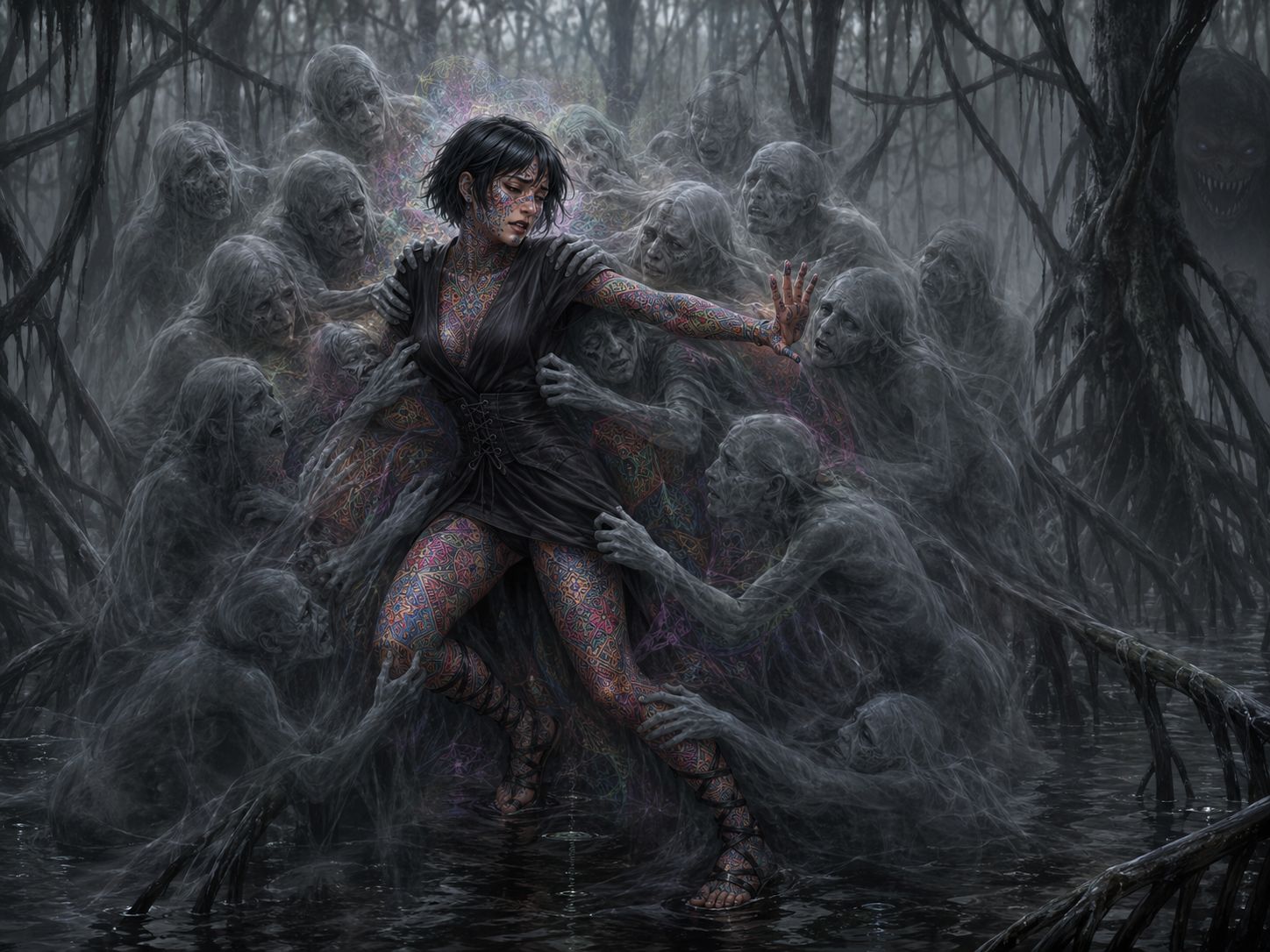
Ivy can use the spirit world to scout parts of the Drowned Marshes, but it is not a safe shortcut. Her aura makes her visible in a way few living beings are. In most places, that makes spirits notice her. Here, it makes them come running.
The spirit world can reveal things the real world hides: traces of suffering, places where rituals were performed, where prisoners were taken, where demons passed and where the Synod’s work has scarred the land. Ivy can use this to find clues, confirm danger and sense when something is spiritually wrong. She can be useful, but every use carries risk.
The Victims of the Synod
The spirits here are not hostile. They are desperate.
They are the dead and broken victims of the Crimson Synod, souls damaged by torture, experiments, possession, forced transformation and fear. Many no longer understand where they are or what they need. They see Ivy’s aura as warmth, color and perhaps release.
They cling to her like drowning people. They beg, crowd, pull and overwhelm. They do not mean to harm her, but they can still drag her down. Treat this as emotional and spiritual pressure rather than combat. The danger is panic, exhaustion, confusion and losing the ability to leave cleanly.
Demons in the Marsh
There are demons in the spirit world of the Drowned Marshes. They are not everywhere, and they should not dominate every spirit scene, but their presence matters.
They stalk the edges of suffering. They feed on broken souls, follow disturbances and notice anything bright. Ivy’s aura can draw them if she stays too long, helps too openly or becomes surrounded by desperate spirits. A demon encounter should feel predatory, not chaotic. It watches, circles and chooses its moment.
Movement and Limits
The spirit world reflects the real swamp. It is distorted, symbolic and emotionally heightened, but it does not remove normal movement restrictions.
Ivy cannot walk on water unless there is something there to walk on. She cannot fly. She cannot pass through solid walls, sealed doors or tower stone. A flooded channel, locked gate or broken walkway remains an obstacle unless the spirit world gives her a real equivalent path around it.
This keeps spirit scouting useful without making it a way to bypass the whole arc.
Returning to the Body
When Ivy snaps back to the real world, she returns to her body where she entered the spirit world.
No matter how far she seemed to walk, crawl or flee in the spirit world, her body has not moved. If she entered from a hut, she wakes in that hut. If she entered from a boat, she wakes on that boat. This makes scouting safer in one sense, but also limits escape. She can flee spiritually, but her real body remains vulnerable, helpless and dependent on the crew guarding her.
The Facade
The first part is about the crew’s first impression of a village built for one purpose: to serve as a facade, hiding what happens deeper in the marsh.
Arrival in Rotmere
This segment introduces the Drowned Marshes through restraint, silence and the feeling that something terrible is being hidden in plain sight. Rotmere is not the heart of the horror. It is the mask placed over it.
The purpose of the village is to let outsiders trade, see nothing useful and leave.
Meyrha Comes Ashore
Meyrha insists on joining the shore party. She does not ask permission and does not accept being left behind. Samden’s presence has become faintly reachable again, and for her, staying on the Blue Marlin while others search for him is unbearable.
This creates a practical problem. Meyrha is useful because she receives fragments from Samden, but those fragments are not reliable tools. They strike without warning and can leave her shaking, confused or unable to continue for a short time. They are weaker than the first vision, but sharper in effect: a flash of black water, a hand against stone, an emotionless face turned away, pain that is not hers or a whispered word that vanishes before she can repeat it.
Because of this, allow the crew to select one additional NPC crew member to accompany them. This keeps the group functional if Meyrha is overwhelmed and gives the players some control over the shape of the expedition. The extra crew member can be chosen for protection, scouting, negotiation or practical skill, depending on how the players read the situation.
First Sight of Rotmere
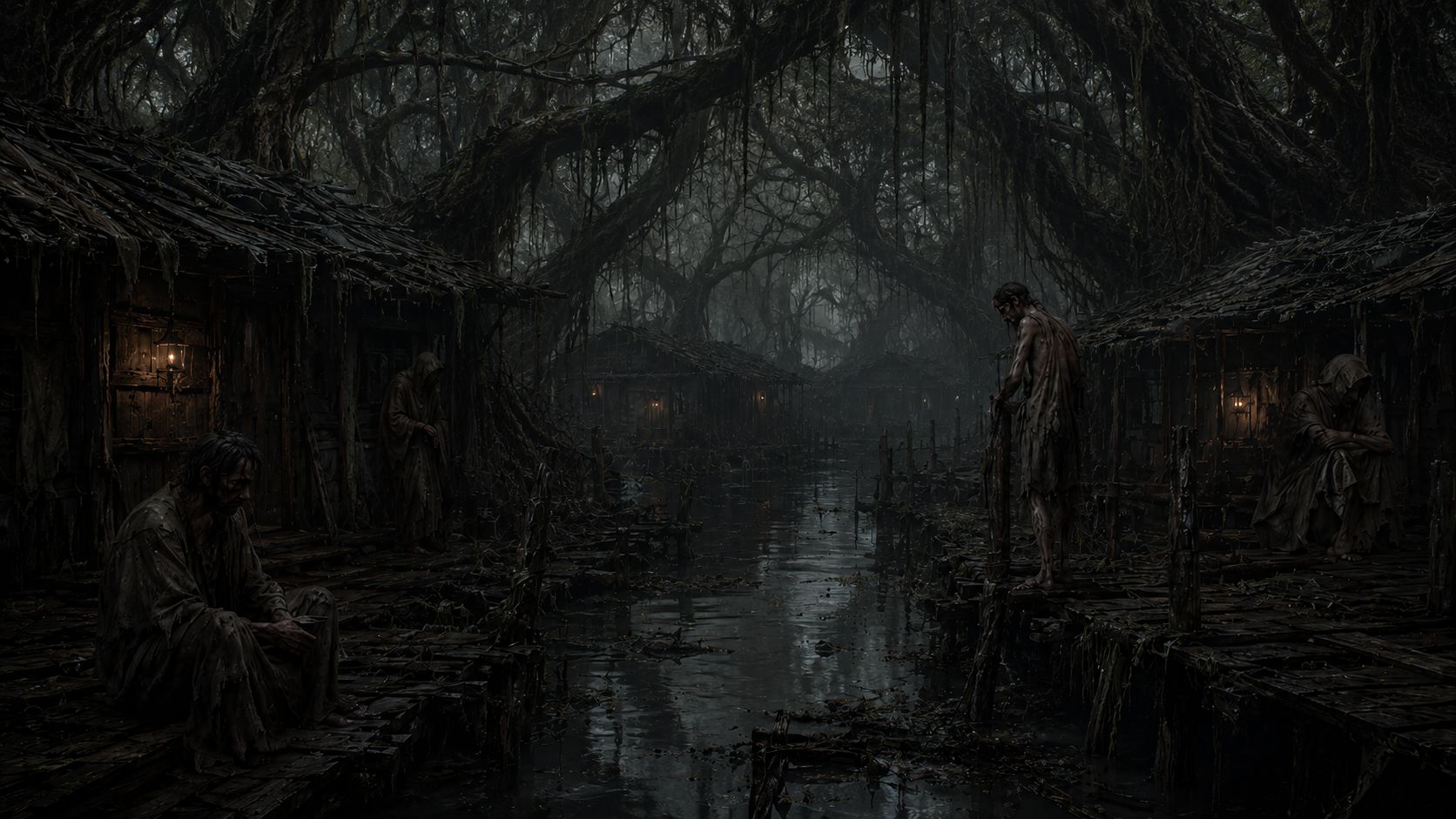
Rotmere squats along the black water, half village and half refuse heap. Its huts stand on warped stilts above mud, slick planks and slow pools filmed with green scum. Fishnets hang from poles, stained dark as if they had been soaked in old blood. Roofs sag under wet moss. Smoke clings low instead of rising, turning the air sour with fish oil, damp ash and rot.
Everything is wet. Walls sweat. Rope frays. Wood softens underfoot. The village feels as if it has been decaying for years but has never been allowed to die.
The people are poor, thin and quiet. Their clothes are patched, their hands stained by water and fish guts, their eyes lowered before strangers can meet them. Children do not run. Dogs do not bark. No one laughs. Work continues, but slowly and without rhythm, as if every movement is being done for someone else’s benefit.
Rotmere should feel miserable, but not openly monstrous. It is a facade, and the facade is practiced.
The locals know how to look poor, harmless and uninteresting. Its purpose is to make outsiders believe they have seen all there is to see, take what they came for and leave before curiosity becomes dangerous.
Trading With the Villagers
Basic trade is possible. The villagers sell dried fish, eel meat, swamp pearls of poor quality, patched baskets, rope, water in sealed jars and crude maps of the safe coastal channels. They do not haggle much. They accept fair prices. They avoid conversation.
- Questions about goods are answered.
- Questions about the weather are answered.
- Questions about safe water, tides and where not to pole a boat are answered.
Anything beyond that closes doors.
If the crew asks about the inner marsh, the Synod, missing people, strange lights, towers, punished villagers, Samden or the Waverider, the villagers become visibly afraid. They do not threaten the crew. They do not argue. They simply stop speaking. If pushed, they leave. A seller abandons a stall. A boatman unties his skiff and poles away. A woman gathers her children and disappears inside a hut. No one explains. No one apologizes.
This should feel more frightening than hostility. These are not people guarding a secret with pride. They are people terrified that even hearing the question may be enough to condemn them.
The Wrongness
Rotmere’s wrongness should be hard to define at first. Do not explain it too quickly. Let the players feel it through details.
- People stop talking before the crew comes close.
- A child begins to answer a harmless question and is pulled away so sharply that she nearly falls.
- A man flinches when the Waverider is mentioned, though he gives no sign he recognizes it.
- A woman spills fish from a basket and does not pick them up until the crew has passed.
- Several villagers glance at the same empty stretch of boardwalk, as if someone is standing there, but there is no one.
- Quick glances toward the inner marsh.
Even ordinary silence feels arranged. The village is not merely quiet. It is holding its breath.
Meyrha’s Fragments
Use Meyrha’s visions sparingly during this segment. They should add pressure, not solve the mystery.
When the crew first steps onto the dock, she might stop suddenly, one hand gripping the rail, and whisper that she heard someone breathing in stone.
When the name Samden is spoken too loudly, she might flinch and see a flash of a face under black water.
When the villagers refuse to answer, she might hear a voice, weak and distant, saying only, "Do not let him in."
The fragments are not directions. They are proof that Samden is near enough to hurt her and far enough that she cannot reach him.
Running the Scene
Keep this segment slow and uncomfortable. Rotmere is not a combat scene and not yet an investigation with clear clues. It is the first pressure chamber.
Let the players trade, ask questions and test boundaries. Reward careful observation more than direct interrogation. The more forcefully they question the villagers, the less they get. The more quietly they watch, the more they understand.
The scene should end with the crew knowing three things.
- Rotmere is hiding something.
- Everyone here is terrified.
- If anyone helps them, that person is risking everything.
The Note
Yasmira bought crabs because there was nothing else worth buying.
Rotmere’s market was only three tables beneath a sagging reed awning, slick with rainwater and fish slime. A woman sold eels from a bucket. A boy watched a basket of tubers as if he expected them to be taken from him. At the last table, a narrow man with a bad limp stood beside a crate of mud crabs tied in bundles of reed.
Yasmira crouched, lifted one crab, turned it over and sniffed.
"Old water," she said. "Too much mud. Still, the meat will do."
The man said nothing.
Mbaru stood behind her with an empty basket in one hand. His eyes moved slowly across the market, then back again. No one looked at them for long. No one spoke unless trade required it.
Yasmira counted out coins. "How many?"
The man swallowed. His fingers twitched against the edge of the crate.
"All," he said.
Yasmira looked up at him. "That was not my question."
"All," he repeated, barely above a whisper.
His eyes flicked once toward the inner marsh. Then down. Then away.
Yasmira’s expression did not change. She placed more coins on the table than the crabs were worth. "Then I will take all."
The man moved clumsily, his bad leg dragging as he shifted the bundles into her basket. A crab snapped at his thumb. He did not react. When the last layer came up, Mbaru saw the folded scrap of oilskin tucked beneath the reeds.
The man’s hand brushed it, quick as a frightened insect.
Mbaru did not look at the note. He looked at the man.
The man lowered his head, took the coins and limped away without another word.
Yasmira lifted the basket. "Heavy."
Mbaru took it from her before she finished the word. "Yes."
She glanced at him. "You saw something."
"Yes."
"What?"
"Not here."
They walked back through Rotmere without hurry. A woman mending a net stopped moving until they passed. A child stared at the crab basket and was pulled inside a hut by the back of his shirt. Somewhere, water dripped steadily through rotten boards.
Only when they reached a narrow space between two empty sheds did Mbaru set the basket down. He moved the crabs aside with care, avoiding the claws, and took out the folded oilskin.
Yasmira watched the lane while he opened it.
The message inside was written in a cramped, shaking hand.
Stop asking. Come at dusk. Small island south of Rotmere. Bring no villagers. Speak to no one.
Yasmira read it twice.
Mbaru folded it again.
For a moment neither of them moved. The crabs shifted softly in the basket, claws scraping against reed and shell.
Yasmira looked toward the black water beyond the huts.
"We tell the captain," she said.
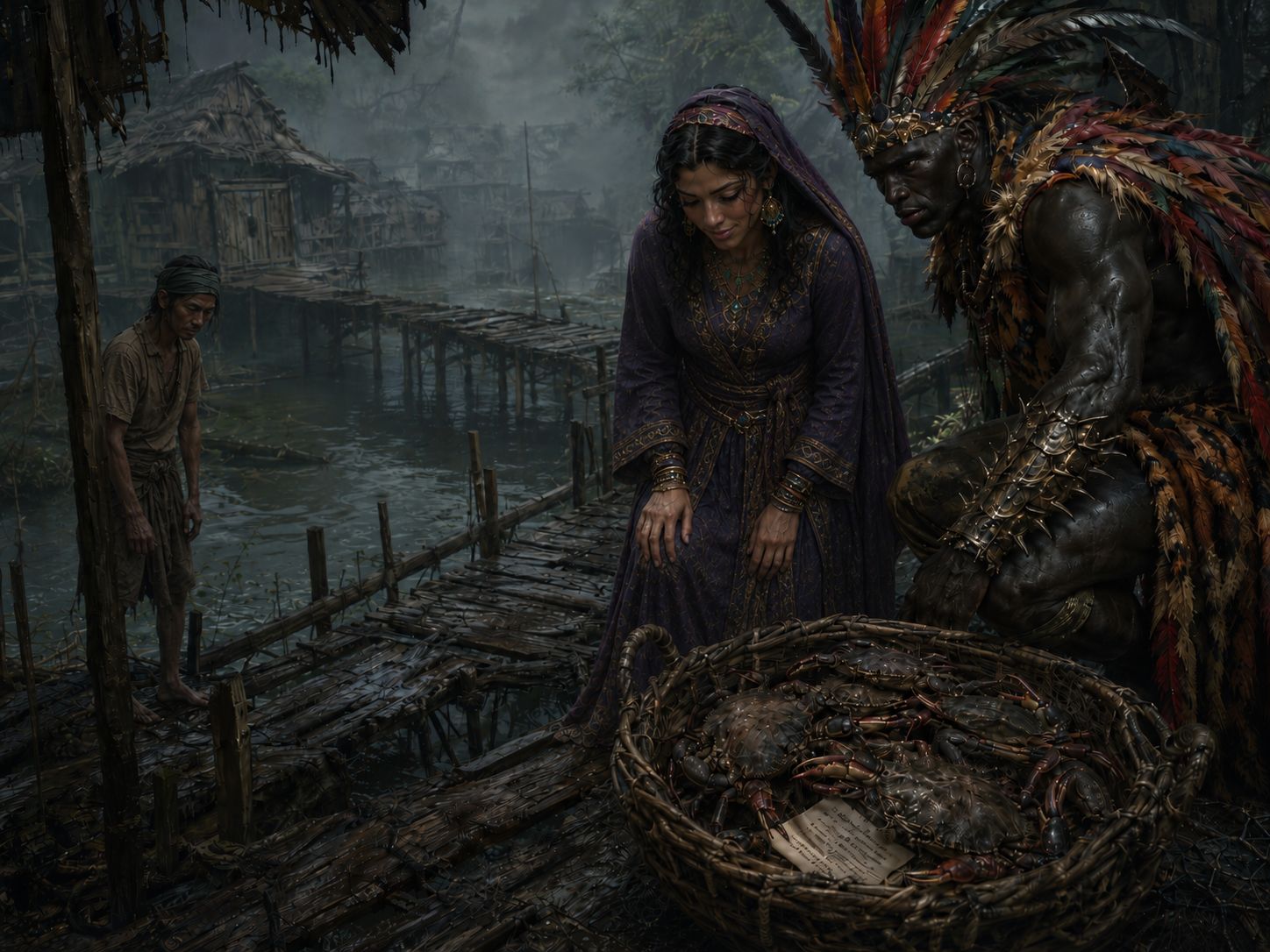
This encounter gives the crew their first real opening in Rotmere. It should feel small, risky and easily missed. The man with the limp is not brave in a heroic sense. He is terrified, but his hatred of the Synod has finally become stronger than his fear.
Do not make him speak openly in the market. The note is the point. When the crew notices it, they get a meeting.
The note should not answer questions yet. It only tells them that someone in Rotmere is willing to risk contact, and that even this much help must happen away from the village, at dusk, where fewer eyes can see.
Run the market afterward as normal. No one reacts. No one admits seeing anything. The man with the limp disappears into the village and cannot be found again until the meeting. The mood should be that the crew has just received something valuable, dangerous and unwanted by everyone around them.
The Meeting
The island was hardly an island at all.
It was a hump of mud and mangrove roots south of Rotmere, barely higher than the black water around it. A few reeds bent in the night wind. Frogs called from somewhere unseen, then fell silent for no reason anyone could name. The Blue Marlin’s skiff rested half pulled onto the mud, its rope tied around a root that looked too much like a hand.
Scarnax stood beside it, coat dark with damp. Pelonias watched the water, one hand resting near his knife. Mbaru stood still as a post, listening. Meyrha had not spoken for some time. Her face was pale in the dusk, her eyes fixed on nothing.
Ileena crouched on a fallen trunk, hood drawn low, toes flexing against the wet bark.
"He is late," she said.
"He is frightened," Scarnax answered.
"Frightened people should move faster."
Then Mbaru raised one hand.
A shape slid through the mist. A small swamp raft, low and narrow, poled by a man whose body leaned hard to one side with every push. The limping crab seller guided it between the roots, stopped short of the mud and stood listening before he stepped ashore.
His eyes moved over them. Scarnax. Mbaru. Pelonias. Ileena. Meyrha last, and there he hesitated, as if he saw pain in her and recognized it.
"My name is Gurm," he said. His voice was thin from disuse. "You did not meet me."
Scarnax nodded. "Then we did not."
Gurm swallowed. "I want him dead."
"Who?"
"The bronze bastard took my daughter first. Sixteen years old. Good hands. Quiet girl. He said she was suitable." His mouth twisted. "Then my son. Then my wife."
Meyrha’s breath caught softly.
"When they took my wife, I shouted." Gurm looked down. "I called him what he was. In front of Rotmere. In front of everyone."
He bent with some effort and unwrapped the cloth around his bad foot.
What remained was not a foot. It was thick, flattened and rigid, the skin stretched and slick, the toes fused into a stiff flipper of dead-looking flesh. It could support weight badly, but it could never run, never climb, never forget.
Ileena’s eyes narrowed under the hood.
Gurm wrapped it again. "That was mercy, they said. A lesson, they said. They wanted me alive enough to remember."
Scarnax’s jaw tightened. "The Waverider."
"They came." Gurm looked toward the dark inland water. "Not all of them. Some stayed with the ship. Some went deeper. They asked too many questions too. They found something, or something found them. They left fast."
"Where?" Pelonias asked.
"I do not know the place of the mage. I swear it." Gurm’s voice shook, but not from lying. "Rotmere does not know. Rotmere is a face. A dead fish held up to hide the rot behind it. Traders come here, buy pearls, buy fish, see poor people and bad water and leave. That is why Rotmere exists."
He pointed inland.
"Go to Ashmere. Not openly. Do not walk in like fools with clean boots and questions. Watch. Listen. Let the village show you where fear looks. What you seek is in this part of the marsh, the trail begins there."
Meyrha stepped forward. "A man was taken. A monk. Samden."
"Then may Old Mother Fen pity him, if she still pities anyone." He looked down. "I have not heard the name."
Ileena slid from the trunk. "I can sneak in."
Gurm turned on her sharply. "Trust no one."
"I do not."
"Not villagers. Not children. Not the crying ones. Not the ones who help you." He leaned closer, eyes wide in the dark. "Not even the reeds. People say things near reeds. Then the Custodes come."
The frogs had gone silent again.
Scarnax held Gurm’s gaze. "You risked much to tell us this."
Gurm gave a small, bitter sound. "Risk is for those with something left to lose."
"We will do what it takes," Scarnax said. "If this mage is the one who took your family, we will give you your revenge."
Gurm’s face did not soften. "Do not give it to me," he said. "Give it to him. Slowly, if you can."
He stepped back onto the raft and pushed away before anyone could answer.
"I must check my traps," he said. "If I come back without crabs, they will wonder."
Then he pushed away before anyone could answer.
The mist took him almost at once. Then only the soft sound of wood against water remained.
"We never spoke."
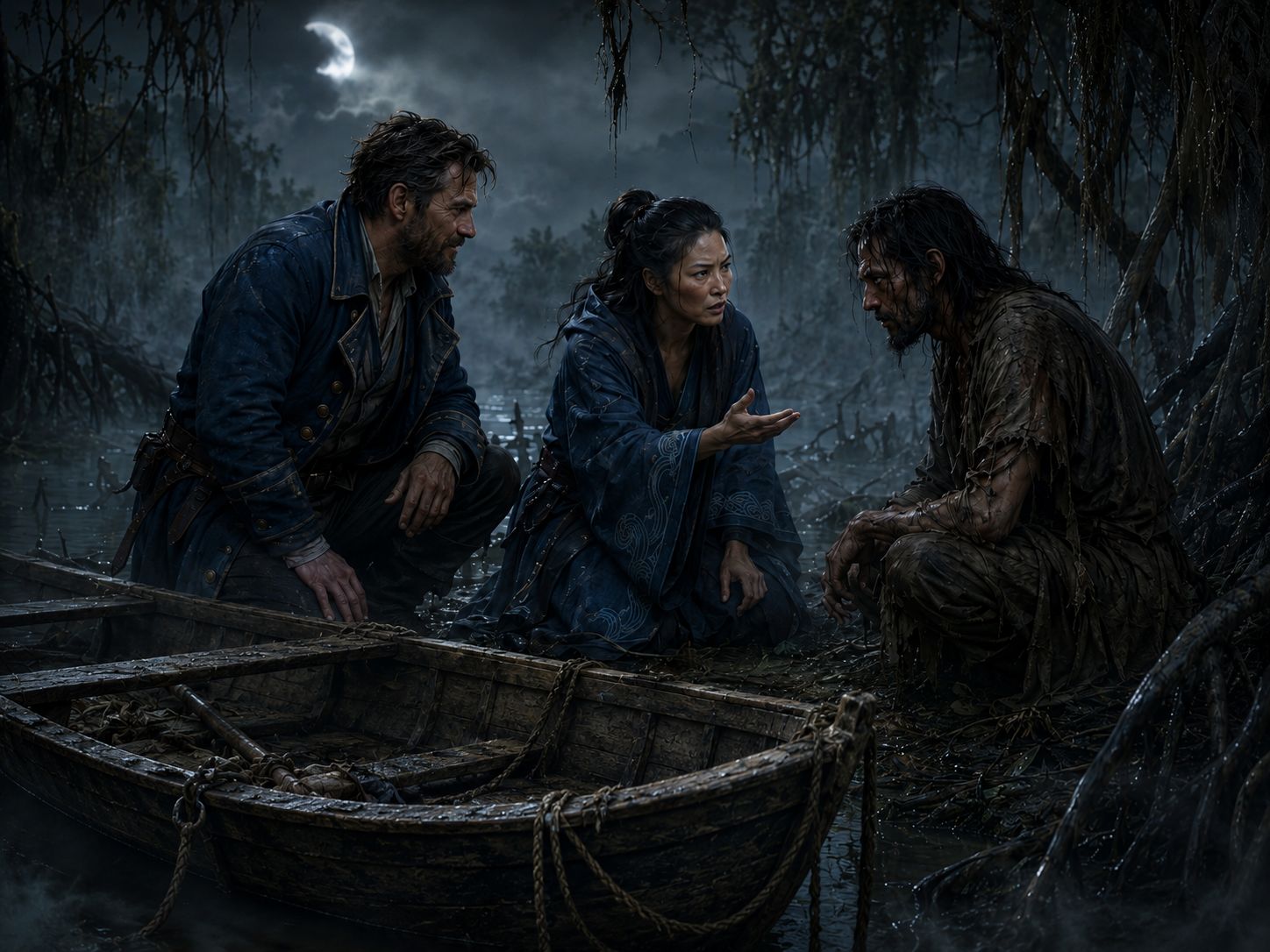
This meeting gives the crew their first real lead beyond Rotmere. Gurm is not a guide, rebel leader or hidden expert. He is a ruined man taking one desperate risk because revenge is the only thing keeping him alive.
What Gurm Knows
Gurm knows that the Waverider came to Rotmere, that some of its crew continued inland and that they left in a hurry. He also knows that Rotmere exists as a facade, a place where outsiders can trade, see nothing useful and leave before they notice what lies deeper in the marsh.
He does not know where the mage’s tower is. He does not even know that it is a tower, just that the mage has some kind of hidden place deep in the marsh. He does not know about Samden. He cannot explain the structure of the Synod beyond what every terrified villager knows: bronze masks rule, Custodes enforce and questions destroy lives.
The Lead to Ashmere
Gurm’s useful information is Ashmere.
He believes the crew should go there next because Ashmere is deeper inland, closer to where the Synod’s rule becomes visible and more likely to show where fear points. He warns them not to enter openly, not to ask questions and not to trust help too easily. The crew will have to observe, infer and choose their own next steps.
Running the Scene
Do not make Gurm evasive. He is telling the truth and offering everything he has. The frustration is that everything he has is not much.
The scene should still feel like progress. The crew now knows that Rotmere is a mask, that the Waverider went inland, that Ashmere is the next place to watch and that even small contact with outsiders can mean death. Gurm does not solve the mystery. He gives the crew enough to keep moving.
The Search
The Inner Village
Ileena came back without a sound.
One moment the crew waited beneath the leaning mangroves, the skiff hidden under cut reeds and hanging moss. The next, Ileena was crouched on a root above them, body marked in leopard paint and mud streaked across her bare legs.
Skarnulf’s hand went to his blade before he recognized her.
"What did you see?" Scarnax asked.
Her smile faded.
The change was enough to silence everyone.
"Ashmere burned," she said. "Not recently. Long enough for weeds to grow through the black wood. Some huts rebuilt. Badly. Crooked boards. Roofs patched with reed and hide. They live there because they have nowhere else to go."
Pelonias looked toward the trees, though the village was still hidden by swamp and dusk. "How many?"
"Enough to be a village. Not enough to be alive properly." Ileena crouched lower. "They are thinner than Rotmere. Quieter. Rotmere is afraid. Ashmere is beyond afraid."
Shaedra’s eyes narrowed. "Watched?"
"Always." Ileena tapped one finger against the root. "They look before they move. They listen before they speak. Children hide when birds startle. Old women stop breathing when anyone steps on a plank too hard."
Junia’s face tightened. "Sick?"
"Hungry. Dirty. Some sick." Ileena paused. "And punished."
No one spoke.
"I saw a man beside the old well," she continued. "Thin. Flies on him. Mud on his face. He tried to reach a bowl with his mouth."
Mbaru’s jaw moved once.
"He could not feed himself. Could not clean himself. His arms were fused to his sides."
Skarnulf frowned. "Fused how? Tied down?"
Ileena looked at him.
"No. Not tied."
She pressed her own arms tight against her ribs.
"Flesh to flesh. From shoulder to wrist. Skin grown over. No gap. His hands were still there, but turned inward, useless, like things forgotten by the body."
Junia made a small sound and turned her face away. Whatever she whispered was too low for anyone but the swamp to hear.
Skarnulf stared at Ileena for a moment, then looked toward the dark water. His usual grin was gone.
Scarnax rubbed one hand over his mouth. "What is going on here?"
Shaedra adjusted the bow across her shoulder. "We watch before we act. No questions. No contact unless we understand more."
Scarnax nodded slowly. "Good plan."
Ileena looked back toward Ashmere. For once, she did not seem eager.
Then she touched the small pouch of paints at her belt.
"Panther," she said.
Mbaru glanced at her. "For silence?"
Ileena shook her head.
"For patience."
Ashmere is the first place where the facade of Rotmere falls away completely. This is not a village pretending to be normal. It is a punished village, kept alive as an example.
The crew does not yet need to know exactly what happened, who ordered it or where the responsible mage lives. The first impression is enough: Ashmere tried to resist, Ashmere was broken and everyone who survived learned the lesson.
The Burned Village
Ashmere was once larger. Now it is a half-rebuilt ruin of blackened posts, warped walkways and crooked huts patched together from reed, scrap planks and salvaged wreckage. Burned beams still stand where homes used to be. Some huts lean against the remains of older structures because no one had the strength or material to rebuild properly.
The village revolted at some point in the past. The Synod answered by burning it, killing or taking the leaders and reshaping several survivors into public warnings. Afterward, the rest were forced to rebuild. Not well. Just enough to continue producing and breeding.
Ashmere should feel like a wound that was ordered to heal wrong.
The People
The people of Ashmere are beyond ordinary fear. They do not merely avoid questions. They fear being seen noticing the question.
They look before they speak, then become afraid because someone may have seen them look. They stop working when a stranger comes near, then panic because stopping might itself seem suspicious. Children hide without being told. Adults pretend not to see what is directly in front of them.
No one wants help. Help creates attention. Attention brings punishment.
Public Punishments
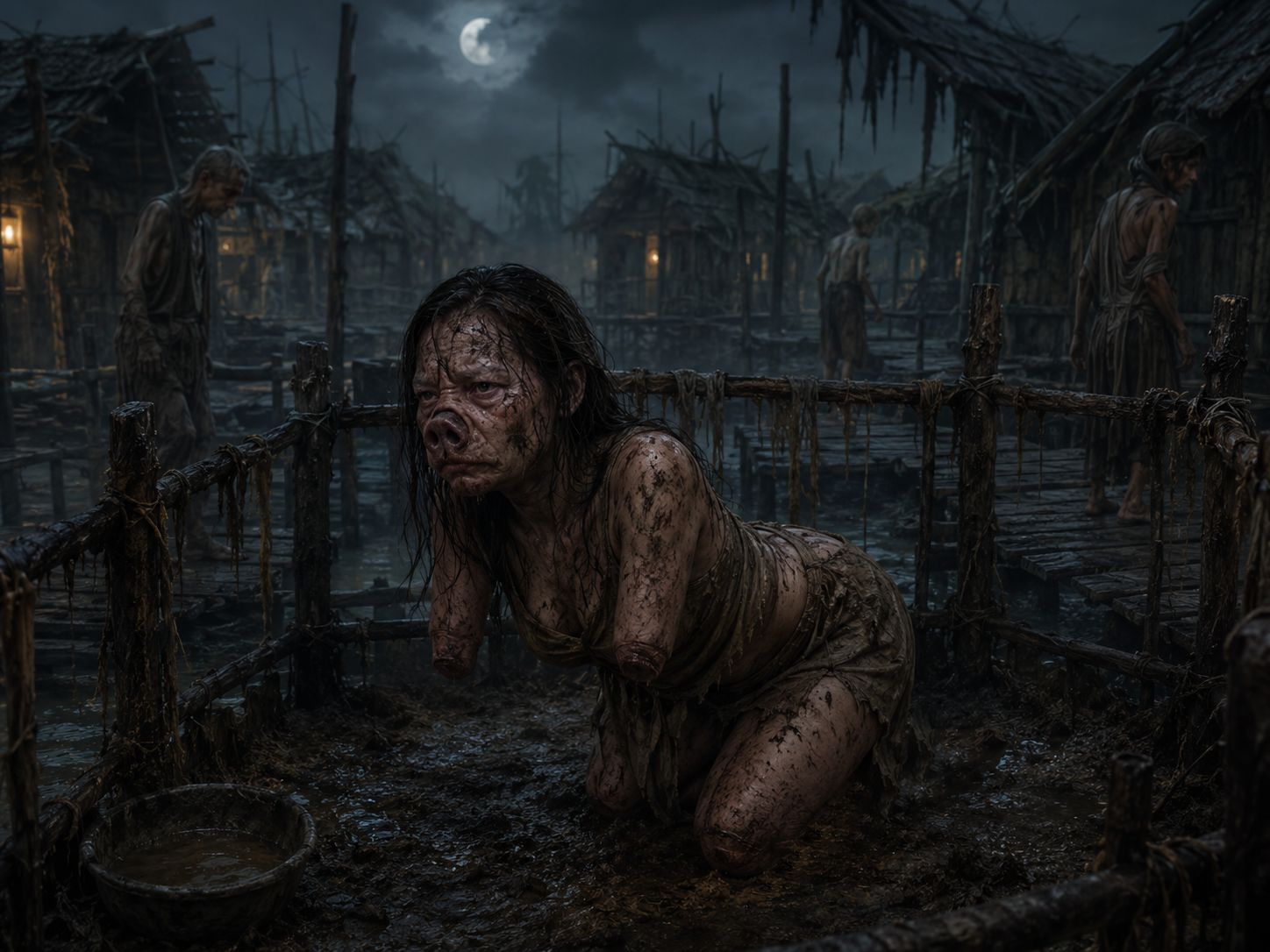
The punishments in Ashmere are left visible. They are not hidden because hiding them would defeat their purpose.
- A man sits near the old well with his arms fused to his sides, too helpless to feed or clean himself properly.
- A naked woman is kept in a pen, her face mutilated into a snout and her arms and legs cut short at knees and elbows. She is forced to eat pig feed while the village pretends not to see her.
- Another man has had his mouth locked permanently open, jaw fixed wide until speech, eating and sleep have become constant torment.
None of them are helped. Not because the villagers lack pity, but because pity has been made dangerous. A cup of water, a blanket or a kind word could be treated as defiance.
No Clear Trail Yet
At this stage, Ashmere does not hand the crew a simple answer. There is no obvious sign pointing to the mage’s location, no named villain shouted in the street and no clear witness ready to speak.
The useful information is atmospheric and behavioral. This is a place under active terror. Someone powerful did this, still owns the village and can return at any time. The players need to watch, infer and decide how to proceed.
If the Crew Approaches
If the crew approaches the villagers openly, the villagers panic.
They will not answer useful questions. Some flee. Some freeze. Some mutter meaningless replies. Some beg the crew to leave. Even those who want to help understand that speaking to outsiders can destroy their families.
As soon as they can, the villagers report the crew to the Synod. This is not betrayal in the ordinary sense. It is survival. The people of Ashmere have learned that if strangers appear and the Synod hears about it from someone else first, the whole village may pay.
Approaching openly is still allowed. It may produce reactions, details and moral pressure. It should not produce cooperation. In Ashmere, fear is stronger than gratitude.
The Open Search
The search for Samden should not follow a fixed trail. There is no intended sequence of scenes and no single correct solution. The crew has entered a place where fear, geography and silence all work together to hide the truth. Their task is to gather enough small pieces to understand where to go next.
The Game Master knows the truth: Samden is held in the tower of the Synod mage who captured him, and that mage is connected to Ashmere, recent prisoner movements and demon hybrid work. The players should not receive that truth in one piece. They build it from fragments.
How the Search Works
Treat the Drowned Marshes as an information field rather than a mystery path. Every useful observation gives the crew a small piece of the pattern. No single clue should solve the problem. Instead, several clues together point toward the same conclusion.
The players can watch Ashmere, follow movement on the water, scout at night, use Ivy in the spirit world, question villagers, search abandoned places, track supply boats, read behavior or create distractions to see who reacts. Reward any careful approach with something, even if it is only a tiny detail.
The aim is not to make them guess the one right action. The aim is to let them choose methods, take risks and slowly realize how the local system works.
What the Crew Is Trying to Learn
At first, the crew does not know what specific question to ask. Their broad goal is "find Samden", but the useful intermediate questions are smaller.
- Where do prisoners go?
- Who commands the Custodes in this area?
- Which waterways are avoided?
- Which villagers are watched most closely?
- What places are supplied but never discussed?
- Where does fear point?
Once enough answers overlap, the next direction becomes clear.
Small Clues
Use these clues as pieces to drop into scenes. Do not give too many at once. A single scouting scene might reveal one or two. A risky infiltration might reveal three. The crew should need several before the pattern becomes obvious.
- Ashmere’s walkways are repaired along one route better than the rest, suggesting regular passage by people who are not villagers.
- A narrow channel west of Ashmere has fresh pole marks on its mud banks, but no villager admits using it.
- Children are warned away from a particular stretch of water more harshly than from the deeper, more obviously dangerous pools.
- A villager drops a basket when someone mentions bronze masks, then looks toward the same western channel before lowering his eyes.
- A burned post near Ashmere has old marks carved into it, one for each person taken after the revolt. Some of the marks are much newer than the fire.
- The punished victims are placed where villagers must pass them daily.
- A shallow boat hidden under reeds contains shackles, old blood and a smell of bitter oil used to keep insects away from prisoners.
- A woman washing rags scrubs at black stains that look like blood mixed with ash.
- A child hums a counting rhyme about masks, but stops so suddenly that she bites her tongue when an adult looks at her.
- Several villagers have scars around the wrists and ankles, suggesting restraint, but not recent captivity.
- Someone has been leaving tiny offerings of swamp herbs near a hidden stone marked for Old Mother Fen. Those offerings are placed near the western edge of the village, as if people are praying before something passes that way.
- Meyrha hears a faint fragment of Samden’s breathing when the crew nears one particular channel, but loses it as soon as they move away.
- Meyrha sees a flash of stone above water, red cloth and a hand gripping iron bars, but cannot tell where it is.
- Ivy senses that the spirit world grows more crowded toward the west, not from death alone, but from souls trapped and worked upon.
- In the spirit world, the dead gather near the village but avoid one direction, as if something there eats what lingers.
- A supply raft passes at dusk carrying sealed jars, bundles of reed, cages covered in cloth and one apprentice in dark red robes without a bronze mask, as well as one Vigilis and two Custodes. The Custodes wear blank iron masks, but one officer wears a shaped mask and carries a wax tablet with prisoner tallies.
- The raft does not stop in Ashmere, but the Vigilis officer aboard it speaks briefly with its a man on the dock. The man never looks at the covered cages.
- A villager who sees the raft kneels until it has passed.
- A discarded strip of parchment lists quantities of food, lamp oil, binding cord and "five breathing subjects, female".
- A dead bird near the channel has two small human teeth tied to its leg with red thread, a warning or marker the villagers refuse to explain.
- A marsh fisherman has a map scratched into the his boat seat, showing safe water routes, but one route has been scraped away violently.
- Villagers avoid saying the word "tower", but several use phrases like "where the stone watches" or "the high place".
- Someone mentions "the high place" by mistake, then immediately denies having spoken.
How Clues Build the Picture
No clue says "Samden is in the tower." That would be too direct. Instead, the clues should build toward several linked conclusions.
- Prisoners are being moved west from Ashmere.
- The movement is organized, regular and protected.
- The Custodes answer to a local Synod structure, not just random terror.
- There is a stone place deeper in the marsh, higher than the surrounding village structures.
- The place receives supplies, prisoners and ritual materials.
- The spirit world around that direction is damaged and dangerous.
- Meyrha’s fragments grow stronger near that route.
Once the crew reaches most of these conclusions, the next step becomes obvious without being handed to them.
Running the Search
Let the players lead. If they decide to watch the village, give them movement. If they scout waterways, give them tracks. If they use Ivy, give them spiritual pressure. If they question villagers, give them panic, partial slips and consequences. If they follow a boat, give them danger and direction.
Avoid dead ends that simply stop the search. A failed approach can still reveal something, but at a cost: attention, suspicion, fear among villagers or a higher chance of Custodes intervention.
The open search works best when every method teaches the crew something about the Drowned Marshes, even when it does not immediately bring them closer to Samden.
Escalation
As the crew gathers clues, the marsh begins to notice them.
- Villagers become more frightened.
- Custodes visits the village, maybe even accompanied with a Vigilis.
- Meyrha’s visions grow sharper and more painful.
- Ivy feels the dead pressing closer when she enters the spirit world.
- A boat that should have passed by slows near the crew’s hiding place.
- Someone in Ashmere reports them, not out of malice, but because fear leaves no room for loyalty.
This escalation should not force a single path. It simply narrows the time available. The crew can still choose how to proceed, but the swamp becomes less passive with every risk they take.
The Visit
The boat came without warning.
One moment Ashmere was only itself: burned posts, crooked huts, thin villagers moving through the wet heat with their eyes down. The next, a flat-bottomed swamp boat slid out of the western channel as if the marsh had breathed it forward.
Ileena went still on the branch beside Shaedra.
Below them, the boat touched the dock without a sound.
A man in a red robe stood near the center. His bronze mask caught the dull light, its surface engraved with a hydra whose necks coiled over brow, cheeks and jaw. The heads met where his mouth should have been, all open teeth and patient hunger.
A Vigilis stepped ashore first, iron mask shaped into a narrow, severe face. Then came two Custodes, blank iron, spears held upright. Then the mage. Then two more Custodes behind him.
At once, Ashmere changed.
A woman dropped a bundle of reeds and ran. A child vanished under a hut. Doors opened. People stumbled out and fell into lines before their homes, kneeling in mud and ash, heads bowed so low their foreheads almost touched the planks.
No one had given an order.
At the dock, two village workers began loading supplies into the boat. Baskets of dried fish. Sealed jars. Bundles of reed rope. A sack of swamp tubers that looked too heavy for men that thin to spare. They moved quickly, hands shaking, while the Custodes watched without turning their heads.
Shaedra’s fingers tightened around her bow.
"I can hit him from here," she whispered.
Ileena did not look at her. "Yes."
"Clean shot."
"Don't."
Shaedra’s eyes stayed on the bronze mask. "Why am I not taking it?"
"Because this is a hunt," Ileena whispered. "We are not hunting him. Not yet. We are hunting where he keeps Samden."
Shaedra breathed once through her nose, slow and hard. The arrow remained in the quiver.
The mage walked through Ashmere as if inspecting broken tools. He did not hurry. He did not speak to the villagers. He only looked, head turning behind the hydra mask, while the Vigilis moved ahead of him and the Custodes followed.
At the third hut, he stopped.
His hand rose.
The girl made one small sound.
The Custodes took her.
Her mother made a sound, small enough that it might have been a cough. The Vigilis turned toward her, and she pressed both hands over her own mouth so hard the knuckles whitened.
Farther along the walkway, the mage pointed again.
A young man this time, thin and long-limbed, barely old enough to have grown into his hands. He did not resist when the Custodes bound him. His father stared at the mud between his knees and shook so badly the boards trembled beneath him.
The third was taken near the well. Another girl. She tried to stand before they reached her, as if obedience might make it gentler.
It did not.
Iron shackles closed around wrists and ankles. The three youths were marched to the boat without cries, without farewells, without anyone daring to touch them. Their families remained kneeling. Faces still. Bodies rigid. Pain held in so tightly it looked like paralysis.
Ileena’s tail twitched once, silent fury moving through muscle.
The mage returned to the dock. The supplies were loaded. The prisoners were forced down into the boat between the Custodes. The Vigilis stepped aboard last and turned toward the village, watching until every head was lowered again.
Then the poleman pushed off.
The boat slid back into the western channel, carrying red robe, bronze hydra, iron masks and three lives Ashmere could not mourn.
Only when the mist had swallowed it did anyone in the village move.
Shaedra lowered her hand from her bow.
Ileena watched the channel until the last ripple vanished.
"Now," she whispered, "we know the direction."
"And have three more reasons," Shaedra filled in.
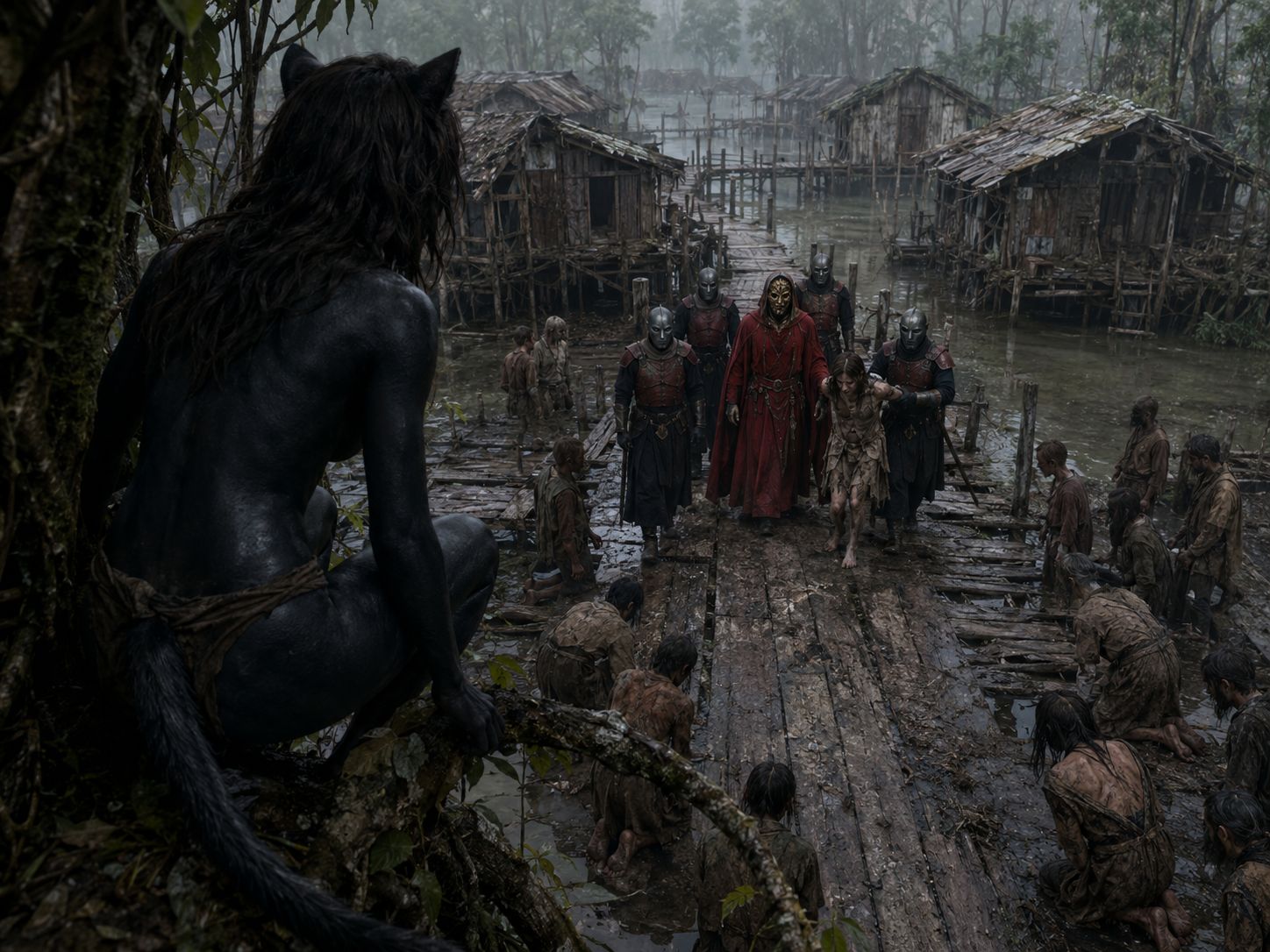
Use this event once the players have begun to suspect that the western channel is the right direction. It should not come out of nowhere, and it should not replace their investigation. It confirms that their reading of Ashmere is correct.
The scene marks the transition from watching the village to following the trail.
Purpose of the Scene
This visit does several things at once.
- It confirms that the western channel matters.
- It shows the crew their first Crimson Synod mage in person.
- It demonstrates how Vigiles and Custodes operate.
- It shows that the Synod takes food, supplies and people as routine tribute.
- It gives the crew an early connection to the three captives they can later find in the tower.
Most importantly, it shows that Ashmere is not merely afraid of punishment. The village has been trained to participate in its own oppression.
The Mage
The mage should feel calm, certain and untouchable. He does not need to threaten anyone, explain himself or raise his voice. His red robe and bronze hydra mask are enough. Everyone in Ashmere already knows what he is and what his presence means.
This is the first time the crew sees one of the Synod directly. Do not overplay him as theatrical. His horror lies in routine authority. He walks through the village as if inspecting tools, livestock or inventory.
The Vigilis and Custodes
The Vigilis leads the procession and acts as the mage’s immediate officer. His individual iron mask marks him as someone with authority and judgment. He watches for disobedience, hesitation and improper emotion.
The Custodes are faceless force. Their blank iron masks, identical bearing and silent obedience make them feel less like soldiers and more like instruments. They take orders without reaction. They shackle the chosen youths without cruelty or anger, which makes them worse. This is not personal to them. It is work.
The Village Reaction
The villagers should react before they are ordered. They kneel because they know the pattern. They lower their heads because they know looking too long is dangerous. Families do not cry out when their children are taken because crying out might make things worse.
This is the grip of fear the scene needs to show. Protest has already been beaten out of Ashmere. Grief still exists, but it has nowhere safe to go.
The Taken Youths
The mage selects three youths, two young women and one young man. Do not make them anonymous background victims. Give each enough detail to be remembered later: a girl who gasps before she can stop herself, a boy whose father shakes the planks beneath him, a girl who stands early because she thinks obedience might make the taking gentler.
These details let the later tower scene land harder. The crew did not simply find prisoners. They saw these people taken.
Supplies as Tribute
The workers loading supplies onto the boat are important. Ashmere is starving, but the Synod takes food anyway. Dried fish, swamp tubers, jars, reed rope and other basic goods are removed without negotiation or thanks.
This shows that the Synod’s cruelty is not limited to rituals. It is administrative. The village is made to keep producing so it can keep being drained.
The Children
Only once the youths are taken should the Game Master draw attention to how many children there are in Ashmere. Before then, it is just part of the village’s misery. After the taking, the detail changes shape. The crew has seen what the Synod does with young bodies, and suddenly the number of children becomes harder to ignore.
Do not explain the implication. Do not have a villager say it aloud. Let the players sit with it.
The Synod needs bodies. Villages like Ashmere are not only settlements, but managed populations, breeding stock. If the players make that connection themselves, it will hit harder than exposition.
Progression
Once the boat leaves through the western channel, the search has changed. The crew now has a visible route, known captives and a concrete enemy movement to follow.
They still do not know where the tower is. They still do not know what waits there. But the investigation has narrowed. The next part of the arc begins when they decide how to follow the trail without alerting the Synod.
Into the Swamp
The journey from Ashmere toward the tower should feel tense, exposed and oppressive, but not yet like the swamp itself is actively trying to kill the crew. That comes on the way out, once the Synod has reason to respond.
For now, the swamp is pressure, not obstacle.
Purpose of the Segment
This segment bridges the open search and the tower. The crew has found the direction, but not yet the destination. The swamp should make that movement feel dangerous without turning the approach into a survival slog or blocking progress with constant hazards.
Use the journey to reinforce three ideas.
- The Synod owns this place.
- The route is watched, used and understood by those who belong to the system.
- The crew are intruders moving through hostile silence.
The Mood
The swamp is wet, dark and close. Mangrove roots twist through black water. Insects gather in clouds. Reeds scrape against the skiff like fingernails. Sound carries strangely, sometimes swallowed by mist, sometimes returning from the wrong direction.
The crew should feel that they are being observed even when nothing is visible. A bird stops calling. Water ripples where nothing surfaced. A broken pole stands in the mud with a strip of cloth tied around it. A half-sunk barrel drifts against the roots and turns slowly in the current.
Do not make every detail a clue. Some details are only pressure.
Travel and Movement
The crew can follow the western channel. It is narrow, winding and difficult, but passable. They can use a skiff, move along occasional patches of firmer ground or scout from the trees where possible. Progress is slow, but not blocked.
Do not make the approach about getting lost unless the players do something reckless. They have enough information to follow the route. The tension comes from knowing they are getting closer, not from wondering whether they are going in circles.
If the crew takes sensible precautions, they can avoid immediate detection.
Signs of Use
The channel should show signs of regular passage.
- Fresh pole marks in the mud.
- Reeds cut back just enough for flat-bottomed boats.
- A mooring post hidden under hanging roots.
- A place where boats wait out of sight of Ashmere.
- Scraps of binding cord.
- Old blood on a plank.
- A broken oar.
- A discarded food jar marked with a tower symbol, mask sign or tally mark.
These details confirm that the route is real and that prisoners, supplies and Custodes pass this way often.
The Swamp as Synod Territory
The Synod does not need walls here. Fear does most of the work. Geography does the rest. The channels are confusing, dry ground is rare and every village has been trained to report anything strange. The swamp isolates victims, hides towers and makes escape difficult.
On the way in, this should feel like entering a system.
On the way out, it will feel like that system waking up.
Restraint Before the Tower
Avoid spending too much danger here. The tower is the next major pressure point, and the escape is where the swamp becomes truly hostile. The approach should not exhaust the crew before they arrive.
Use one or two tense moments, then keep moving. Examples:
- A Custodes boat passes nearby, forcing the crew to hide beneath roots or reed mats.
- Meyrha hears Samden’s breath for a moment, then loses it when the skiff drifts.
- Ivy senses dead spirits watching from the waterline, but they do not approach yet.
- Ileena notices that even animal trails avoid one bend in the channel.
- Pelonias realizes the current is being used like a road, not a natural stream.
No Open Attack Yet
Do not have the swamp attack them on the way in unless the crew makes a loud mistake or chooses direct confrontation. The Drowned Marshes are dangerous, but the active hunt belongs later.
This approach is the held breath before the alarm. Do not spend the chase before it begins.
The Base Attack
The Tower in the Marsh
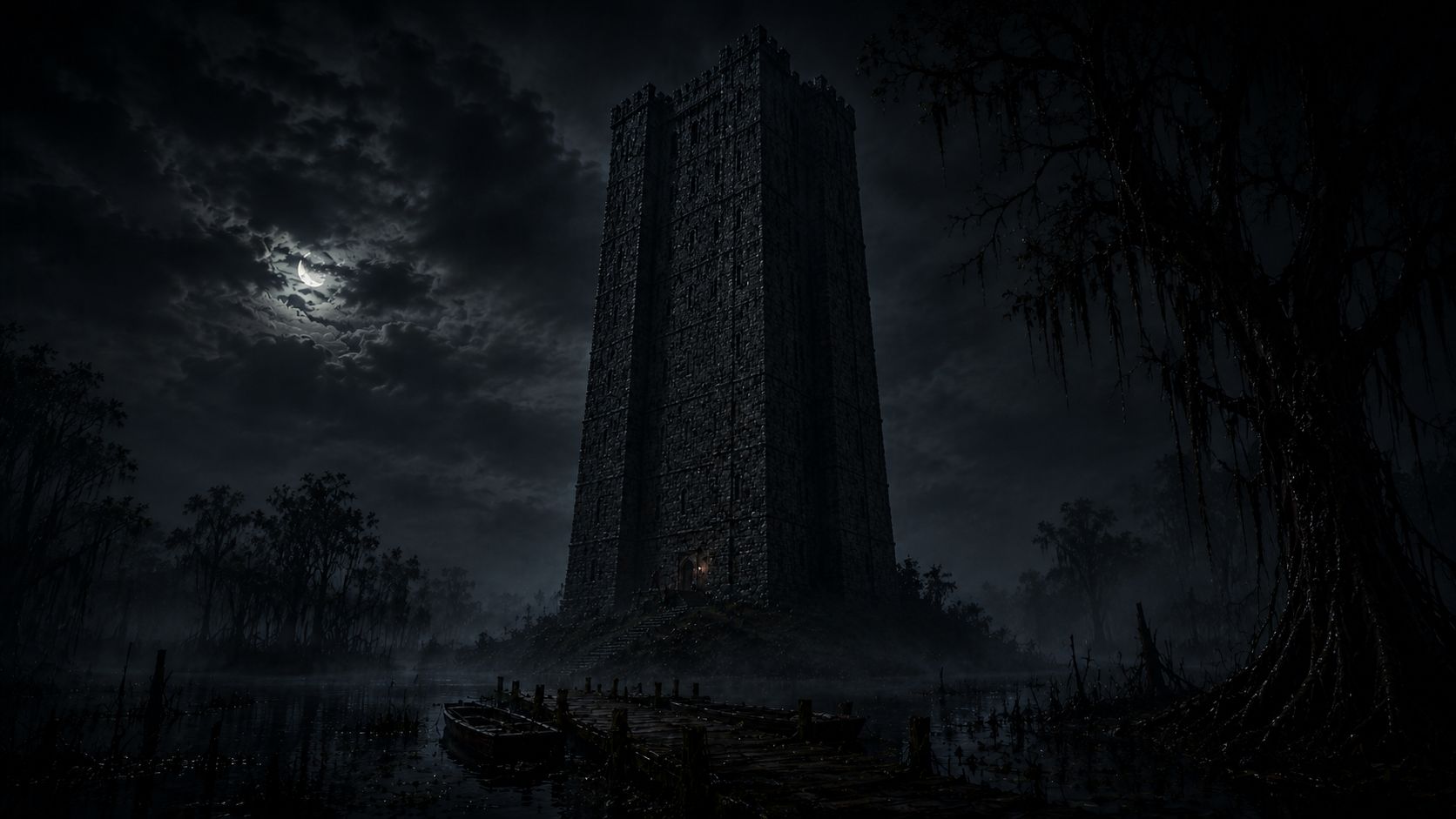
The tower is not a dungeon. It is a prison, laboratory, archive, barracks and private estate stacked vertically above black water. It rises from a patch of firmer ground among mangroves, with docks and work platforms built around its base. There is no basement. In a mangrove swamp, anything below ground is water, rot and collapse.
The building is tall, narrow and severe, made of dark stone hauled or shaped long ago by means the villagers do not understand. Its lower levels are practical and fortified. Its middle levels are cramped, foul and functional. Its upper levels become more private, cleaner and more controlled. The higher one goes, the closer one comes to the mage’s actual work and the farther one moves from anything resembling ordinary life.
The tower belongs to Kaelthar of the Masks, the Synod mage whose bronze mask bears the hydra. His specialty is demon-human breeding, possession, hybridization and the creation of loyal monstrous servitors. Other Synod fields appear here through books, trade ledgers and borrowed techniques, but this tower’s true purpose is the making of usable bodies.
Outer Dock and Approach
The tower is reached by a narrow channel hidden among mangroves. A small dock sits at the base, wide enough for two flat-bottomed swamp boats. One dock arm is used for supplies, the other for prisoners. The separation is practical, not ceremonial. Bodies, food, rope, cages, ash jars and lamp oil are all treated as inventory, but keeping flows separate prevents confusion.
A short raised walkway leads from the dock to a stone stairway, which climbs to the tower door. There is little cover here. Anyone approaching from the water must either come openly or wait among the roots and reeds for a chance to move. A watch platform stands beside the entrance, high enough for a single Custos to see down the channel, but not grand enough to look like a military fortification.
The first impression should be functional horror. No banners. No grand gate. Just a place where things are delivered and processed.
Ground Level: Barracks and Entry Hall
The ground level is the tower’s shell. It contains the main entrance, the Custodes barracks, weapon racks, wet storage and the first checkpoint. This is where force lives.
The layout is simple. The main door opens into a low, square entry hall with a central open space and side rooms around it. One side holds sleeping benches for Custodes. Another holds weapon racks, spare blank iron masks, shackles, polearms and heavy hooks. A rear door leads to a narrow stairwell spiraling upward. A smaller side door opens back toward the dock, used when moving prisoners or supplies without bringing them through the front hall.
The Custodes do not lounge, gamble or complain. They wait. Some stand motionless. Some sit on benches with masks still on. Some tend weapons in silence. Their blank iron faces should make the room feel less like a barracks and more like a tool rack where some of the tools breathe.
This is the most dangerous floor for a direct fight. It contains the largest concentration of armed force.
Second Level: Servants, Stores and Processing
The second level handles the tower’s daily needs. Food, lamp oil, rope, cages, reed mats, spare clothes, water jars, ash, herbs, cleaning tools and prisoner feed are stored here. A few terrified servants live in small rooms beside the stores. Some are villagers taken long ago. Some are failed subjects still useful enough to keep alive. All of them have had their minds broken with magic.
The layout is a ring of storage rooms around a central work area. Crates and jars are stacked in strict order. Hooks hang from ceiling beams. A narrow side room is used to strip, wash and mark new prisoners before they are taken higher. Another contains ledgers for intake, rations and transfers.
This floor shows the Synod’s evil as administration. Prisoners are not dragged screaming straight to ritual circles. They are received, counted, washed, categorized and moved. The servants know the procedures and fear mistakes more than cruelty.
Useful details here include prisoner tags, food tallies, lists of villages, supply marks from Ashmere and evidence that the three youths taken from the village have recently passed through.
Third Level: Apprentices
The apprentices occupy the level above the servants. They are not prisoners, but they are not free in any meaningful sense. They have served Kaelthar for years or decades, hoping one day to be raised into the Synod’s inner circle and given access to the full life-extending rites.
The layout is divided into small cells, a shared study room and a cramped work chamber. The cells are cleaner than servant quarters but still austere. The study room contains copied notes, anatomical sketches, ritual diagrams and correspondence prepared for the mage’s review. The work chamber is where apprentices prepare reagents, copy ledgers, sort specimens and write observations dictated from the laboratory above.
This level should feel ambitious, resentful and disciplined. The apprentices are not innocent victims. They are collaborators waiting for promotion. They fear Kaelthar, but they also admire him and want what he has.
The most useful information here is partial, not complete. Notes may mention scheduled rituals, references to "the three new subjects", requests from other Synod members or the continuing effort to break "the monk vessel."
Fourth and Fifth Levels: Holding Pens
The holding pens occupy two middle floors. These are the worst levels for atmosphere. They contain cages, chained alcoves, hanging restraints and narrow cells with viewing slits. Prisoners are sorted by condition, usefulness and intended purpose.
The layout is deliberately efficient. A central corridor runs around the stairwell, with cages and cells lining the outer walls. Some are iron-barred. Some are wood and rope. Some are stone niches with only a grate for air. A pulley shaft and trap hatch allows cages to be raised or lowered between levels without moving prisoners through public halls. This can be used as an escape route, bypassing levels directly down to first level, but it can only take two persons at the time.
The people here are not all the same. Some are ordinary prisoners awaiting use. Some are failed experiments kept for observation. Some are demon-touched hybrids too unstable to release. Some are abominations judged interesting enough to preserve. The smell is rot, waste, sweat, fear and bitter cleaning herbs.
The three youths from Ashmere can be found here. Their presence ties the village scene to the tower and turns the rescue into something personal. Most other captives are too broken, altered or terrified to flee cleanly, or too dangerous to release.
This level should create the desire to save everyone, while making clear that saving everyone is not simple or perhaps even possible.
Sixth Level: The Laboratory
The laboratory is where Kaelthar’s work becomes explicit. It is cleaner than the holding pens, which makes it worse. Tables are scrubbed. Tools are arranged. Restraints are maintained. Shelves hold jars, preserved organs, bone samples, demon ash, blood vials, teeth, scales, malformed embryos and failed growths in cloudy fluid.
The layout is broad and open compared to the levels below. A central ritual floor is marked by stains and carved channels. Worktables stand along one wall. Shelves and specimen cabinets line another. A smaller screened chamber is used for procedures requiring privacy, while a writing desk sits where the mage or apprentices can observe and record.
This is where the ledgers become important. The records should feel mundane, precise and horrific: names, ages, villages, condition, ritual result, trade value, notes for other mages and promised services. They show that the Synod is not a set of isolated monsters. It is a professional network sharing bodies, methods, failures and favors.
Seventh Level: Ritual Chamber
If the laboratory is the workshop, the ritual chamber is the sacred operating room. This level is used for major bindings, possessions, hybridization rites and procedures too important to perform among ordinary tools.
The layout is simpler and more ceremonial. The center of the floor is open, marked by permanent grooves, old burn scars and drain channels. Iron rings are set into the stone. Tall shelves hold ash jars, blood bowls, carved bone implements and sealed vessels containing unidentified substances. Windows are narrow, high and barred, letting in little light.
This is where victims are used for major rites. Notes, stains and prepared instruments reveal what has already been done here and what Kaelthar intends to continue doing: breeding demon hybrid guards for another Synod member in exchange for service, specimens or forbidden knowledge.
The chamber should make the Synod’s internal cooperation visible. Kaelthar is not acting alone. He is fulfilling obligations, trading results and contributing to a larger structure.
Top Level: Kaelthar’s Private Quarters
The top level belongs to Kaelthar. It is the cleanest and most private space in the tower. It contains his sleeping chamber, personal study, private archive and the cage where Samden is kept. This is not kindness. Samden is kept close because he is the prize.
The layout is divided into three main areas. The private study faces the swamp through narrow windows and contains Kaelthar’s most important notes. The sleeping chamber is sparse, controlled and almost unused. The cage room is separate, reinforced and positioned where the mage can observe Samden without bringing him into the laboratory for every intervention.
Samden’s cage is not large. It is built for restraint, observation and access. Iron bars. Binding chains. Marks from fingers, blood and old impact. Nearby are notes describing the demon possession, the struggle for control and Kaelthar’s method of helping the demon whenever Samden began to resist too successfully.
This floor should feel quieter than the rest. The horror here is intimate. The crew has passed through the system below and now reaches the personal cruelty at its top.
The blood bottles of the Synod are kept here. They sit in a locked cabinet with iron bar doors protecting them, each labeled with a mask sign rather than a name. They bubble when a mage is wounded and turn black when one dies.
Roof or Upper Watch Platform
The tower has a roof platform above the private quarters. It is narrow, wet and exposed, with a view over the mangroves. This is the place where Kaelthar goes to think.
This is not a dramatic battle arena unless the players make it one. Its main use is perspective. From here, the crew can see how deeply the tower is embedded in the marsh: channels winding away, mangroves closing around them and the sense that this place belongs to a wider network they cannot see.
How the Tower Should Play
The tower should feel like an institution, not a monster lair. Every level has a function. Every horror is placed somewhere for a reason. The Custodes protect. The servants process. The apprentices prepare. The holding pens store. The laboratory studies. The ritual chamber transforms. The mage above directs.
The crew can sneak, misdirect, sabotage, kill selectively, free prisoners or gather proof. They do not need to clear every floor. They do not need to fight every guard. The tower works best when the players understand enough of its structure to make choices under pressure.
The higher they go, the clearer the truth becomes. The lower they return, the harder escape becomes.
Kaelthar of the Masks

Kaelthar of the Masks is dangerous because of what he has built, not because he is a battlefield mage. He is not a fighter, duelist or combat sorcerer. His magic is centered on slow rituals, preparation, controlled subjects, bound demons and procedures performed in chambers made for that purpose.
If confronted directly, Kaelthar does not fight with spells. His first response is to call the Custodes and Vigiles. His second response is to retreat toward places where his servants, locks, cages and knowledge of the tower give him control. If he is alone and trapped, he is physically vulnerable.
What He Can Do
Kaelthar can command his tower with absolute authority. Custodes obey without hesitation. Vigiles understand his signals and move quickly to protect him. Apprentices fear him too much to disobey unless they believe he is already doomed.
He can also use what is already prepared: prisoners as leverage, knowledge of the tower layout, ritual implements, demon-bound subjects and the threat of destroying records or samples. His strength is not improvisation. His strength is preparation. He understands exactly which threat will make decent people hesitate.
What He Cannot Do
Kaelthar cannot win a fight against the crew. He cannot match even the weakest of them in a fair fight. If the crew reaches him cleanly, without Custodes between them, the danger is not that he overpowers them. The danger is what killing him causes.
The Blood Bottle Consequence
If Kaelthar is wounded, his blood bottles begin to bubble in the other Synod towers. If he dies, his blood turns black. The rest of the Synod will not know who killed him or exactly where the danger came from, but they will know one of their own has fallen.
That makes attacking him a real choice. Kaelthar can be killed, but his death turns the escape into something much more dangerous.
Under the Mask
If the crew removes Kaelthar’s bronze hydra mask, they do not find a merely old man. His face is ancient. The skin is parchment-thin, folded and sunken against bone. His eyes are wet, pale and furious, set in a face that should have died centuries ago.
The mask is not only authority. It is concealment. It lets the Synod appear timeless and controlled, hiding the shriveled thing that still clings to power beneath it.
Vigiles and Custodes
The Vigiles and Custodes are Kaelthar’s enforcers. They are not ordinary guards. They are demon-human hybrids bred, shaped and conditioned for absolute obedience. They do not negotiate, surrender or act from personal loyalty. They exist to carry out the will of the Synod.
Vigiles
Vigiles are officers. They command patrols, supervise collections, watch for disobedience and speak directly to apprentices or the mage when needed. Each Vigilis wears an individual iron mask, shaped differently enough that Kaelthar can tell them apart at a glance and villagers can learn to fear specific shapes.
They are allowed judgment within narrow limits. A Vigilis decides when a villager’s fear looks like hesitation, when a mistake needs punishment and when Custodes must act.
Custodes
Custodes are the rank and file. They wear blank iron masks and move in disciplined silence. To villagers, they are almost interchangeable: faceless bodies in dark robes, arriving when someone is taken, punished or made an example.
They do not display anger. They do not need to. Their lack of reaction is part of the horror.
Combat Ability
Vigiles and Custodes are strong, but they are not exceptional fighters. The Synod does not think like soldiers, and their breeding work focuses on what can be seen and measured: strength, endurance, obedience and resistance to fear. Training is secondary.
In a fight, a Custos is roughly on par with a decent trained fighter. A Vigilis is somewhat more dangerous because of authority, experience and judgment, not because of refined martial skill.
Their true strength is loyalty. It has been etched into their minds with magic. They do not break, flee, surrender or reconsider orders. A better fighter can beat them, but cannot make them hesitate.
Masks and Faces
Both Vigiles and Custodes wear dark robes under red leather breastplates. They carry spears and short swords, and their iron masks hide what they are. The masks hide what they are. Beneath them, their faces show the Synod’s work: human features warped by demon blood, uneven teeth, wrong eyes, split skin, ridged bone or mouths that do not close correctly.
The masks serve two purposes. They conceal the hybrid nature of the enforcers from villagers and outsiders. They also create fear. A blank mask turns a Custos into a tool of punishment. An individual mask turns a Vigilis into a remembered threat.
The Ledgers
The ledgers are not written like grimoires or confessions. They are working records: intake lists, resource tallies, trade notes, ritual outcomes, debts between towers and observations written in a precise, almost bored hand. Their horror comes from how ordinary they are. The Synod does not record atrocity as sin or triumph, but as administration.
Subject A-17, female, Ashmere stock, sixteen years. Lungs sound. Hips narrow but adequate. Fear response strong. Assigned to binding trial.
Subject A-18, male, Ashmere stock, seventeen years. Good muscle development despite poor nutrition. No visible deformity. Transferred to restraint pens pending transfer to Zhorai for mind breaking.
Subject A-19, female, Ashmere stock, eighteen years. Initial implantation successful. Growth rate exceeds expected schedule. Pain response severe but survivable. Monitor closely.
Ashmere tribute received: dried fish, eleven baskets. Tubers, four sacks. Reed rope, twenty-seven lengths. Lamp oil, two sealed jars. Three breathing subjects. Village compliance acceptable.
Punishment record, Ashmere revolt aftermath. Principal instigators burned or taken. Three public examples retained in village. Results satisfactory.
Request from Rhovan the Binder received. Requires two viable hybrid guards within six months. Payment offered: two servants, body enhanced. Acceptable.
Drevan the Collector requests soul residue from failed possession subjects. Provide residue only from discarded stock. Do not release material from monk vessel.
Monk vessel remains resistant. Demon reports pressure, silence and recurring rejection. Pain inducement restores advantage to demon when applied during resistance phase.
Monk vessel displays abnormal discipline. Subject weakens physically but retains internal structure. Continue hunger, sleep interruption and nerve work. Do not kill.
Custodes ration count adjusted. Blank-mask units require less food than unaltered men, but more salt. Note for future breeding refinements.
Vigilis Septimus reports two villagers near western channel speaking after curfew. One taken for questioning. One returned as warning. No further disturbance.
Ashmere output declining. Recommend no further burnings this season unless revolt signs return. Population must remain productive.
Old Mother Fen markings found near western bank. Three stones removed. One woman questioned. She denied prayer until mind probe forced confession.
Subject B-42 expired during binding. Cause: cardiac rupture. Useful lesson. Increase ash dilution before next rite.
Hybrid whelp killed handler during first feeding. Handler fault: fear display. Whelp retained for observation to determine if it is controllable.
Failed growths transferred to lower pens. Two show awareness. One repeats mother’s name. No practical value yet. Observe before discard decision.
Blood bottle cabinet inspected. All inner circle samples stable. Minor bubbling in Iyssandra vessel noted, likely distant injury or failed working. No blackening.
Apprentice Telvar reprimanded for sentimental language in observation notes. "Suffering" is not a useful category. Replace with pain response, compliance and endurance.
Three subjects from Ashmere processed successfully. Families remained controlled during collection. Village fear level remains usefully high.
Send report to the Synod before moonless convocation: demon stock viable, possession refinement progressing, monk vessel near conclusion.
Note to self: when the monk breaks, preserve the eyes. The demon wants them unchanged.
The Blood Pact
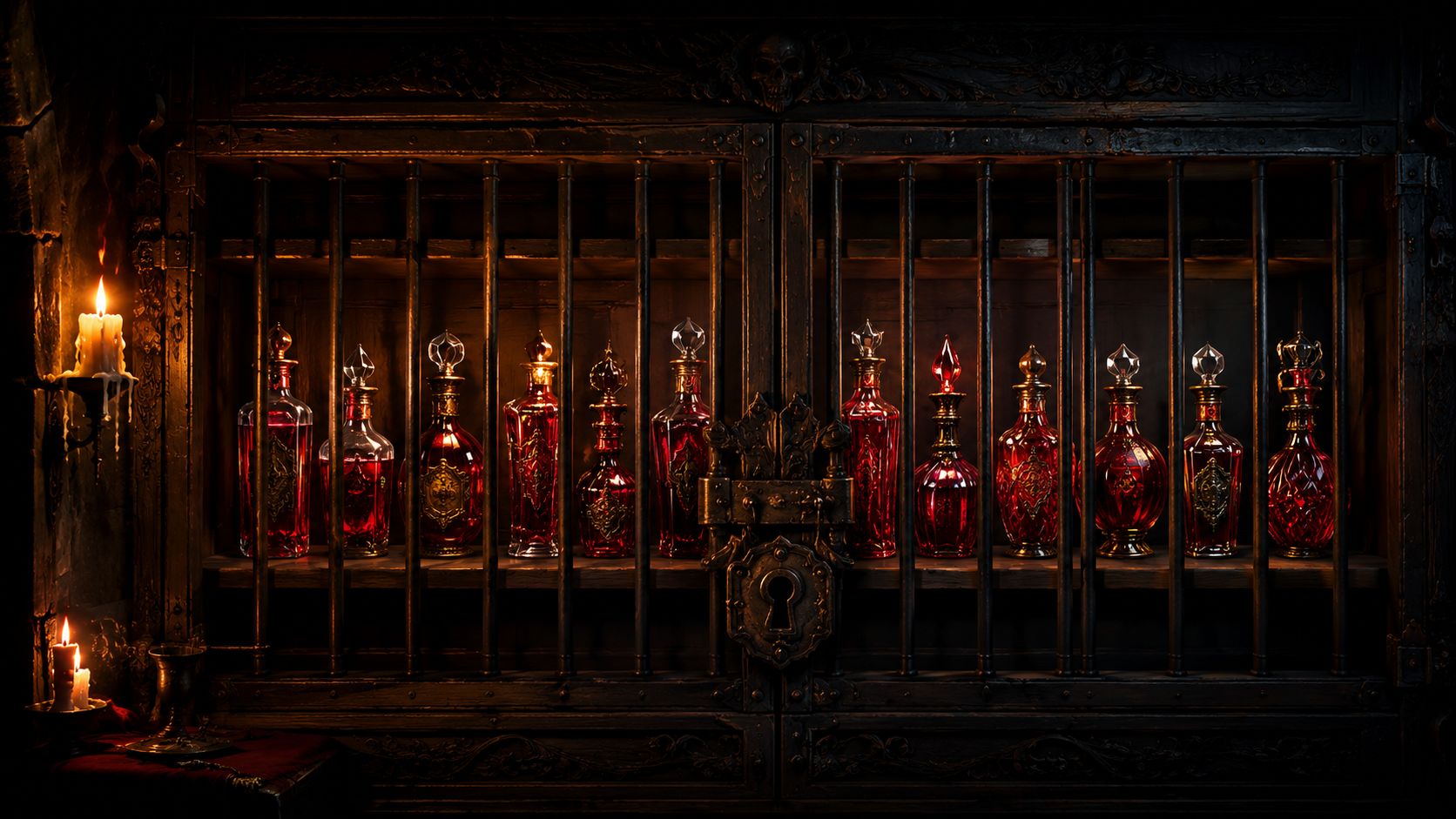
The blood bottles are part of the initiation rite that binds a mage to the inner circle of the Crimson Synod. When an apprentice is raised to full membership, blood is drawn, divided and sealed into small glass bottles prepared with old Synod rites. One bottle remains with the new mage. The others are distributed to the seated members.
This is not a communication tool in the ordinary sense. The bottles do not carry messages, voices or visions. They only show the condition of the mage whose blood they hold.
What the Bottles Show
When a Synod mage is unharmed, their blood remains dark red and still.
When a mage is wounded, the blood begins to bubble. Minor wounds cause small movement. Serious harm makes the blood foam, darken and strain against the glass.
When a mage dies, the blood turns black.
This means that the Synod does not immediately know what happened, where it happened or who was responsible. They only know that one of their own has been hurt or killed. That is enough. Once the blood changes, demon messengers are sent, servants are questioned, boats are readied and the swamp begins to close.
Where Kaelthar Keeps Them
Kaelthar keeps his blood bottles in his private quarters, locked behind iron bar doors in a cabinet near his study. Each bottle is labeled with a mask sign rather than a name.
The cabinet is part record, part shrine and part warning. It reminds Kaelthar that he is not alone. It also reminds him that he is never fully beyond the reach of the others.
Why It Matters in Play
The blood pact makes killing Kaelthar consequential without turning the tower into a magical alarm system. The crew can still strike, but they cannot kill a Synod mage and expect the death to remain secret for long.
If Kaelthar is wounded, the other bottles begin to bubble elsewhere in the marsh.
If Kaelthar dies, his blood turns black in every Synod tower.
From that moment, the Synod knows that one of its own has fallen, or soon will. The bottles are not watched every moment, but they are inspected, tended and feared. They do not reveal the full truth, but they force a response. The escape begins under that shadow.
Samden
Skarnulf opened the door slowly.
No hinge screamed. No latch snapped. The room beyond stayed dark, close and silent, except for one sound.
A low snarl from the cage.
Skarnulf stepped back at once, short sword ready. "Something is in here."
Light slid into the chamber, thin and yellow, catching iron bars, old blood and the curve of a body hunched in the corner. Meyrha made a small sound behind him, not quite a gasp, not quite a sob.
Then she pushed forward.
Skarnulf reached out to stop her, but she was already on her knees.
The figure in the cage raised its head.
It was him. It was not him. His face was gaunt, skin stretched too tight over bone. Beneath it, something moved, pressing outward as if another shape tried to wear him from inside. His lips peeled back from his teeth in a snarl that did not belong to any monk.
Meyrha reached toward the bars.
"Stop," Skarnulf said.
She stopped with her fingers inches from the iron.
Samden’s face twisted harder. His shoulders jerked. For a heartbeat, the thing inside him looked out through his eyes.
Then the face steadied.
Only for a moment.
Pain filled him so completely it seemed to hold his bones together.
"Meyrha," he whispered.
She broke then. One hand went to her mouth. The other closed around the bars.
His eyes found hers.
"Kill me."
Samden dragged breath through clenched teeth. "I cannot hold it back."
His face convulsed. The snarl returned, wider now, wet with triumph.
"No," the thing said with Samden’s mouth. "No, no, no. You came all this way. You found him. You can see him. You can hear him."
It leaned closer to the bars.
"And you cannot cut me out without killing Samden."
Meyrha bowed her head against the iron.
Skarnulf looked at the cage, then at Scarnax.
"What do we do?"
Scarnax looked at Meyrha.
Meyrha did not look back. She was staring at Samden, tears running silently down her face.
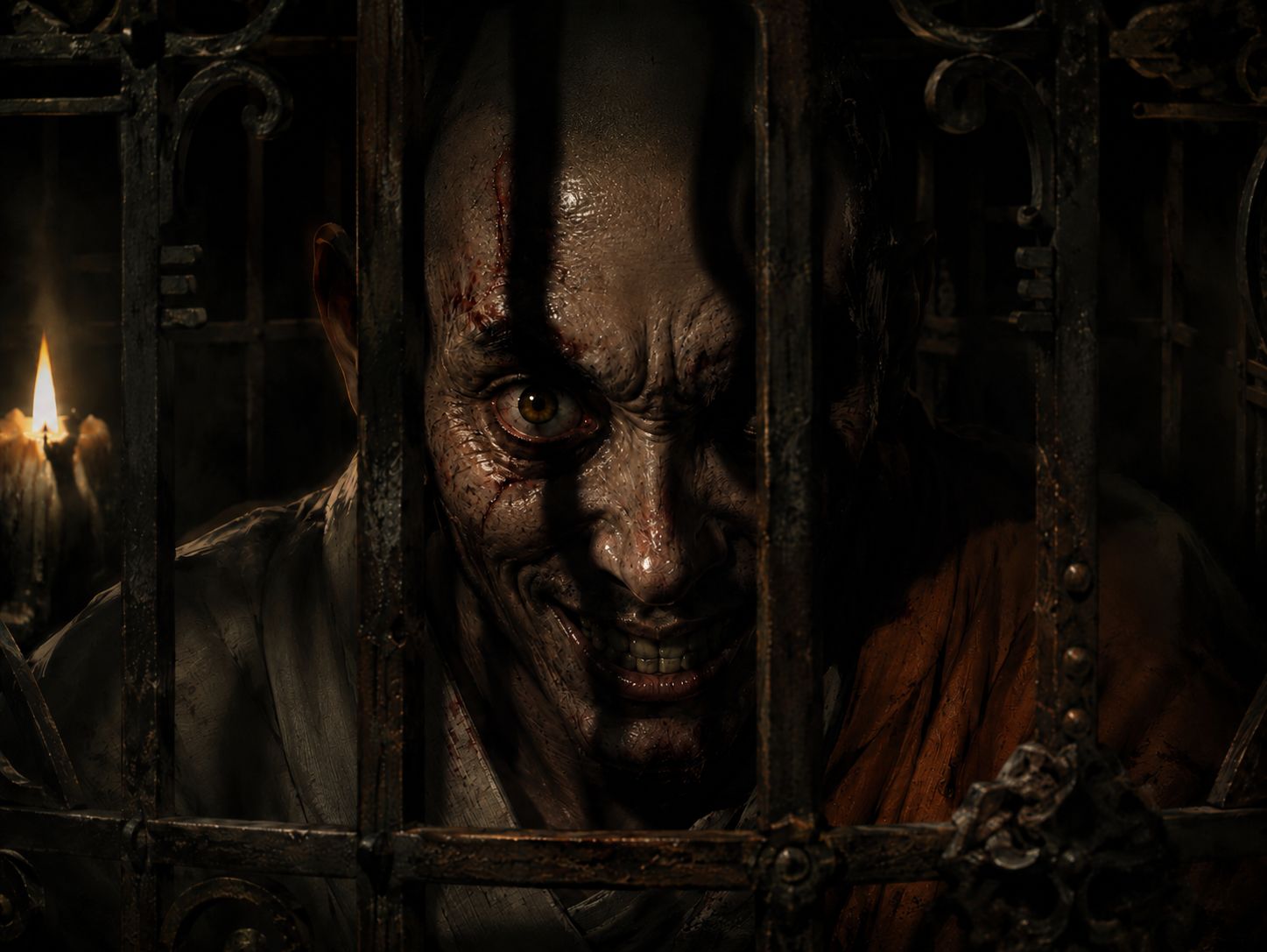
This scene is the emotional center of the tower. The crew has found Samden, but they have not arrived in time to save him. The question is no longer whether he can be rescued. The question is whether they can end his suffering before the demon fully takes him.
Do not turn this into a combat scene. The fight is already happening inside Samden, and Samden is losing.
Samden’s Condition
Samden is possessed, but not gone. He is still present inside his own body, resisting with everything he has left. His discipline, faith and bond with Meyrha have held the demon back far longer than Kaelthar expected, but the struggle has broken him down.
His body is weak. His voice comes in fragments. His face shifts between pain, clarity and the demon’s expression. At moments, Samden speaks. At others, the demon uses his mouth.
There is no safe way to remove the demon. Killing Samden kills the demon. Refusing to kill him allows the demon to take full control.
The Demon
The demon understands the cruelty of the moment and uses it. It does not need to defeat the crew physically. It wants them to hesitate, argue and break.
It taunts them with Samden’s voice. It mocks their rescue. It tells them they came too late. It insists that killing it means murdering the man they came to save. It plays on Meyrha’s guilt, Scarnax’s responsibility and the crew’s instinct to protect their own.
The demon can show its growing control through small violations: forcing Samden’s face to smile, making his hand twitch toward Meyrha, speaking words Samden would never choose or dragging his body against the bars as if testing how close freedom is.
Samden’s Plea
When Samden gains control, he asks them to kill him. He is not confused, manipulated or giving up in weakness. He understands exactly what is happening.
This is his last act of resistance.
He cannot win, and he is asking the crew to deny the demon its victory. He is asking Meyrha to let him die as himself, before his body becomes a weapon used by the Synod.
Keep his words simple. He does not have strength for speeches. A few broken lines are enough.
Meyrha’s Choice
The decision rests with Meyrha.
Others can argue, prepare or ask what must be done, but the emotional authority is hers. She is the one who has felt him fading. She is the one who came because she could not abandon him. She is the one who must accept that saving Samden now means ending him.
Do not rush the moment. Let silence sit. Let the demon speak if hesitation grows too long. Let Samden surface once more if needed.
Eventually, Meyrha tells them to end his suffering.
Running the Scene
This scene should hurt, not surprise. By the time the decision comes, the crew should understand that there is no clean rescue hidden behind a clever trick. The horror is that they found him, he knows they found him and the only mercy left is death.
Keep the focus tight: Samden, Meyrha, the cage and the thing inside him smiling when they hesitate.
Once Meyrha gives the word, move to the death scene. That is where Samden’s final clarity, his last words to Meyrha and the Waverider clue belong.
Meyrha was shaking.
Not loudly. Not wildly. Only enough that the iron bars trembled under her hands.
Behind the bars, the thing inside Samden wore his smile.
Scarnax waited. So did Skarnulf. So did everyone. No one breathed as if breathing too hard might make the choice happen before she was ready.
Meyrha closed her eyes.
When she opened them again, she looked only at Samden.
"Do it," she whispered.
The demon’s smile vanished.
Skarnulf stepped forward at once, short sword low in his hand. "There will be no pain," he said.
Junia moved close to Meyrha. "Do not look."
Meyrha did not answer. She kept her eyes on Samden’s.
For one heartbeat, the snarl fell away. Samden was there. Ruined. Starved. Broken almost past recognition. But there.
His gaze found Meyrha, and the pain in him became something clear.
"Thank you," he whispered.
Meyrha pressed both hands to the bars.
His lips moved again, barely enough for words.
"It is not your fault."
Skarnulf struck.
It was fast. Merciful. The kind of cut only a killer could make when he meant kindness.
Samden collapsed against the bars, then slid down inside the cage. The thing in him tried to snarl, but the sound broke apart in his throat. His body jerked once.
Then his eyes lifted.
Meyrha leaned closer, as if the world had narrowed to the space between them.
Samden drew one last breath.
"I love you."
Meyrha's face broke, the strength leaving her all at once. She gripped the bars as if they were the only thing keeping her in the world.
"I always loved you," she whispered. "Always."
Samden’s eyes softened.
Then he was gone.
For a moment, nothing happened.
Then grey ash spread across his skin, thin as dust from a dead fire. It covered his face, his hands, his robe, then loosened and fell through the cage bars in silent flakes. The demon went with it. No scream. No final curse. Only ash on stone.
Meyrha’s knees gave way.
Junia caught her before she hit the floor and held her tightly, one hand cradling the back of her head. Meyrha clung to her without seeming to know who held her.
No one spoke.
Skarnulf wiped his blade once, slowly, then lowered it as if it had grown too heavy.
At last Meyrha drew a broken breath.
"He sent me something," she said. "One word. After he died."
Meyrha swallowed.
"Zuth’Morra."
The name stayed in the room after she spoke it.
Scarnax bowed his head. Then, quietly, he said, "It is over. We need to leave."
This scene resolves Samden’s possession. When Samden dies, the demon dies with him. It does not escape, transfer or bargain its way free. The ash left on his body is the visible sign that the thing inside him has been destroyed.
Absolution
Samden uses his final clarity to free Meyrha from guilt. He knows she will blame herself for not finding him sooner, for losing contact and for giving the order to kill him. His words should make clear that this was not her failure. She came. She found him. She gave him the only mercy left.
Forbidden Love
Samden’s final confession reveals what both of them had carried in silence. Their bond was not only spiritual, not only friendship, not only shared faith. They loved each other, and because of who they were, that love was forbidden, buried and never allowed to become a life.
This should not become explanation or backstory. A few words are enough. The tragedy is that the truth is spoken only when there is no future left for it.
The Final Gift
Samden’s last act is to send Meyrha the next Waverider destination: Zuth’Morra.
This is not a convenient clue. It is a final effort made after a long struggle, given because Samden understands that the Blue Marlin’s mission matters beyond his own death. He leaves Meyrha with grief, but also with responsibility. The crew came for him. He gives them the path onward.
The moment should feel heavy. Samden is gone, but his last act leaves the Blue Marlin with an obligation as much as a direction.
The Escape
The escape begins the moment the crew takes what the tower was never meant to release: Samden’s final word, proof of the Synod’s work and the three living captives from Ashmere. From here, the arc changes shape. The crew is no longer searching, watching or choosing how deeply to enter. They are carrying wounded people through enemy territory while the tower behind them begins to matter to powers far beyond it. The swamp that was pressure on the way in now becomes danger on the way out, and every delay gives the Synod more time to close its hand.
The Rescue That Cannot Hold
The tower contains many captives, but the escape should not become a mass rescue. The only prisoners the crew can reasonably bring out are the three youths taken from Ashmere. They were taken recently enough that the crew is not only opening cages, but interrupting something still unfolding.
This is not a moral failure. It is the reality of what the Synod has done.
Why Most Cannot Be Rescued
Most prisoners in the tower are beyond practical rescue.
Some are too physically broken to walk, climb or survive the swamp. Some have been altered so severely that moving them would kill them. Some have had their minds broken by magic and cannot understand escape as a possibility. Some are too terrified to leave their cells, because the idea of disobedience has been carved deeper than hope.
Others are dangerous. Demon-touched subjects, unstable hybrids and abominations kept for observation can kill rescuers, prisoners or villagers if released. Some are victims, but still cannot be safely set loose.
Make this clear without dwelling on every cage. The crew should understand the scale of suffering, but the scene should not become a catalogue.
The Three From Ashmere
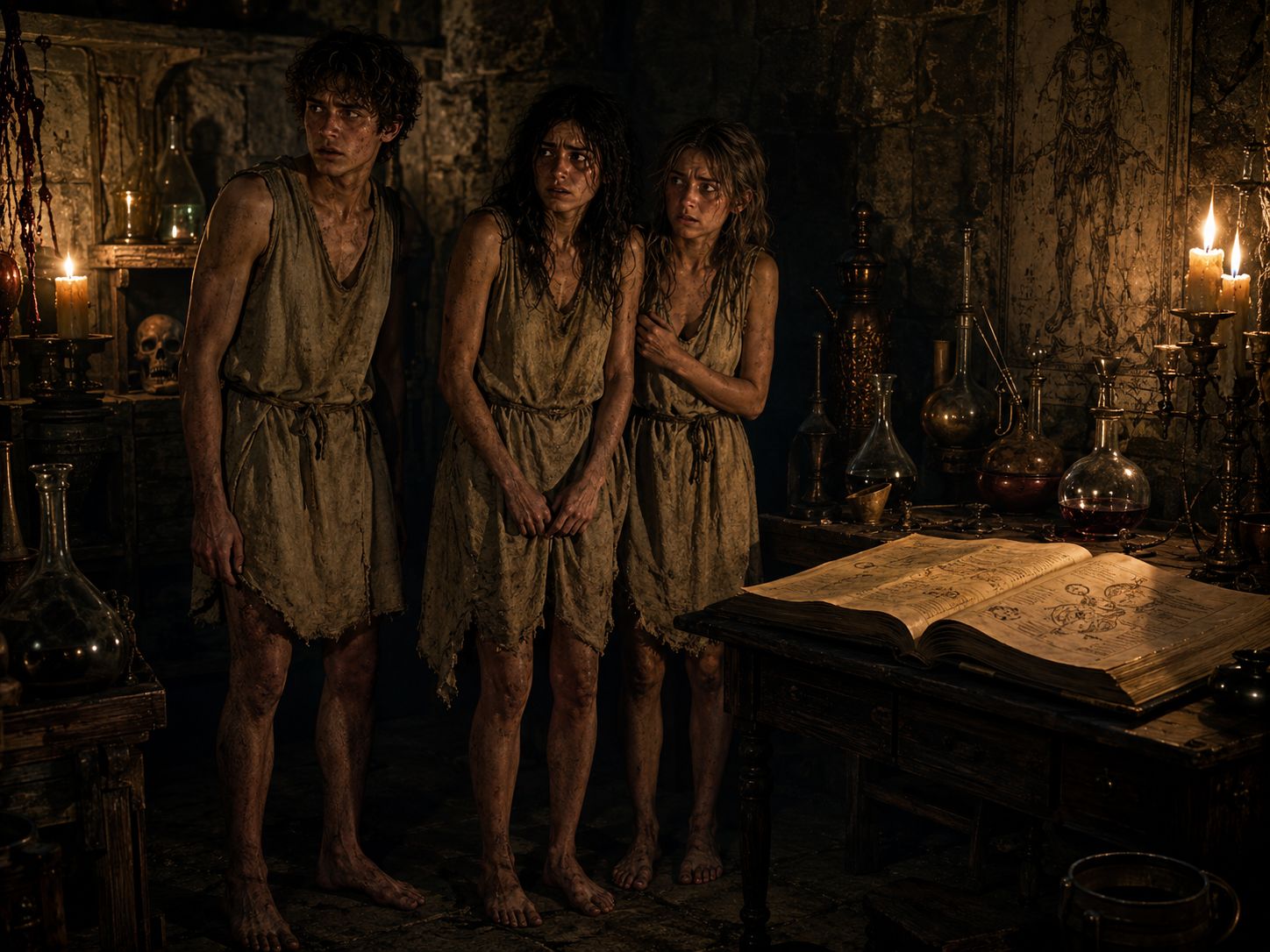
The three captives from Ashmere are different because the crew saw them taken. They are specific faces, not abstract prisoners.
They can still move. They still understand what has happened. They still have enough self left to flee if someone leads them. This makes them the only realistic rescue targets in the tower.
Although the crew does not know it yet, they are also not safe. Vessa has been impregnated with a demon hybrid and is already changing. Salla is terrified enough to betray the crew if she believes it will buy mercy. Marn is physically intact but emotionally shattered. Saving them from the cage does not mean saving them from the Synod’s reach.
The Game Master’s Role
Do not present the other prisoners as a puzzle with a perfect solution. The tower is not designed to be emptied. It is designed to make rescue feel urgent, limited and cruelly insufficient.
Let the players try to help where they can. They can kill suffering abominations, give water, open a few cages, speak comfort, gather names or promise that the Synod will pay. These acts matter emotionally, but they do not turn into a caravan of rescued captives.
The escape must remain small enough to function and painful enough to leave a scar.
The Emotional Point
The crew can do something real.
They cannot do enough.
That is the point. They came for Samden. They found him too late. They can still take three living victims from the tower, but even that mercy is poisoned. The Synod’s work does not end when a cage opens.
The Swamp
The escape should feel like the moment the Drowned Marshes stop watching and begin hunting.
On the way in, the swamp was pressure: wet silence, hidden routes, strange sounds, watchful water and the sense that every path belonged to someone else. On the way out, that pressure becomes open hostility. The crew now carries proof, grief and living captives. Kaelthar is dead or wounded, Samden is gone and the blood pact has begun to stir the Synod into motion.
This is not a battle to win. It is a collapsing window. The crew must get back to the Blue Marlin before the swamp, the Custodes, the Vigiles and the demons close around them completely.
The Changing Swamp
Routes that were passable on the way in become unreliable on the way out. A channel is blocked by a fallen tree that was not there before. A shallow stretch has risen into sucking mud. A familiar bend opens into the wrong pool. Reeds lean across the water as if trying to hide the path.
Do not make this feel like random navigation failure. Make it feel like the swamp belongs to the Synod, and now that ownership has become active. The crew can still escape, but every route costs time, noise, risk or strength.
The key mood is narrowing. They are not lost forever. They are running out of good choices.
The Search Begins
The Synod response first spreads outward from the tower.
Custodes patrol waterways in flat-bottomed boats, silent behind blank iron masks.
Vigiles enter villages, question survivors and watch for panic.
Villagers shut doors, lower their eyes and report anything strange because fear has taught them that silence toward outsiders is safer than mercy.
Demon seekers move through water, mud and spirit-shadow, following traces of blood, fear, ritual ash and the wound left by Samden’s death.
The crew does not need to fight all of this. They need to avoid enough of it to keep moving.
Within two days, forces from other Synod mages will start to show up as well, further increasing the pressure.
Marn Is Taken
Marn is physically intact, but emotionally shattered. During the escape, he becomes the first proof that leaving the tower is not the same as surviving the marsh.
Use this when the crew is crossing water, hiding under roots or poling through a narrow channel. The demon seeker strikes from below. It does not rise like a monster announcing itself. Marn simply stiffens, gasps and is pulled down hard enough to vanish before anyone can fully react.
The water closes over him.
Let the crew try to save him if they react instantly. Make it frantic, muddy and almost impossible. Hands grasp at reeds. Someone plunges an arm into black water. Something moves beneath the skiff. Then Marn is gone.
Later, farther along the route, his body is found floating face-down among the roots. This should not feel like a second shock for spectacle. It confirms that the hunt is real, that the demons are close and that the swamp keeps what it takes.
Salla Betrays Them
Salla is not malicious. She is terrified.
When the crew hides from a passing Custodes boat or a search party on a walkway, Salla breaks. She calls out. Not loudly at first. A cracked whisper, then a desperate cry. She believes that if she reveals the crew, the Synod may spare her. It is not rational hope. It is trained fear reaching for the only authority she understands.
This immediately turns concealment into crisis.
The crew must silence her, flee or fight. The Custodes do not negotiate. If the Vigilis is present, he understands at once what has happened and moves to trap them rather than rush blindly.
If Salla survives the fight or escape, she collapses afterward and begs for mercy. She claims she had no choice, that they would have found them anyway, that she only wanted to live. She asks to be left at the next village.
This is a moral dilemma, not a puzzle. Taking her along risks another betrayal. Leaving her in a village almost certainly returns her to the Synod. Killing her is simple, ugly and final. Leaving her in the swamp is worse than killing her. Let the players decide what kind of mercy still exists here.
Vessa Begins to Change
Ileena stopped first.
Her head turned toward the black wall of mangroves behind them, ears lifting, body going still in a way that made everyone else stop breathing.
"Movement," she whispered.
Scarnax looked over his shoulder. "Close?"
"Not close. Closer than I like."
The skiff had grounded on a mud shallow, its keel dragged half out of the water and half buried in sucking black silt. Everyone had climbed out to lighten it. Mbaru and Skarnulf were already pulling at the bow rope. Shaedra watched the reeds. Meyrha pushed the skiff, one hand pressed to her temple as if holding herself together by force.
Vessa tripped.
She made two steps through the mud, then folded with a small, broken cry. Her knees struck first, then one hand, then her shoulder. Dirty water splashed over her tunic, and when she struggled upright, the cloth clung to her body.
Junia reached her in an instant. "Easy. Let me see."
Then she stopped.
Her eyes fixed on Vessa’s belly.
It was slight, but it was there. A tight, wrong swelling beneath the soaked cloth. Too high. Too sudden. Too alive.
Vessa saw Junia looking.
"No," she whispered.
Junia’s face changed. Not fear. Worse. Understanding.
She turned toward Scarnax. "Captain..."
"Later," Scarnax said, before she could finish.
Vessa wrapped both arms around herself, shaking. Junia helped her stand, but her eyes kept dropping to the place beneath the wet tunic where something moved too soon.
Vessa’s horror unfolds during the final stretch toward the Blue Marlin, ideally in a situation which is too stressful to allow investigation or discussions about the matter.
At first, it is easy to mistake for injury, fever or exhaustion. She doubles over. She sweats through her clothes. Anyone who looks closely can see that her body is changing too quickly. Her belly tightens and swells in a way that cannot be natural. Something inside her moves before anything human could move.
Do not turn this into a fight. It is foreshadowing and dread. The delivery belongs later, on the ship, where the crew has a moment to believe they have escaped before learning that the Synod’s work came with them.
Vessa herself understands enough to be terrified. She knows what was done to her. She knows something is wrong. Let her fear become quieter as the change progresses. Not because she is calm, but because she is too afraid to keep speaking.
Practical Escape Events
- A Custodes boat blocks the main channel, forcing the crew to cut through a shallow side route where the skiff drags through mud.
- A Vigilis questions a village ahead of them, and the villagers point toward the water before the crew even comes into view.
- A demon seeker circles beneath the skiff, visible only as a long dark shape under the surface.
- Meyrha hears Samden’s absence like a wound, then catches a last echo of his warning just before danger appears.
- Ivy sees the spirit world boiling with frightened dead, all of them moving away from something behind the crew.
- A false safe route leads toward a village dock where Custodes are waiting in silence.
- A flock of birds erupts from the mangroves behind them, marking the movement of something large and unseen.
- A villager tries to help with a whispered direction, then immediately begins sobbing because helping has doomed them.
- A cloth marker appears on a branch ahead, the same kind used on Synod routes, meaning the crew has stumbled back onto a watched path.
Running the Escape
Keep the pressure moving. The escape should not become a sequence of fair encounters. Each event should change the situation: a route closes, someone is lost, concealment fails, a captive breaks, Vessa worsens or the Synod draws nearer.
The crew can win moments. They can kill a patrol, mislead a demon seeker, hide from a Vigilis or find a faster channel. They cannot defeat the swamp. If they stop too long, more pressure arrives.
Use short decisions. Which route. Who carries whom. Fight or hide. Silence Salla or risk discovery. Leave the skiff or drag it. Help the villager or keep moving. These choices make the escape feel alive without turning it into a map exercise.
If Pelonias is part of the team, use his navigational skills to confirm that the swamp is changing. It is no longer a suspicion, now they know.
The Shape of the Climax
The escape ends when the Blue Marlin comes back into reach.
This should feel like reaching air after drowning. The ship is safety, but not triumph. Marn is dead. Salla has betrayed them or forced a terrible choice. Vessa is changing. Meyrha is carrying Samden’s death and Zuth’Morra. The Synod has been wounded and alerted.
The crew gets out because they move fast enough, choose hard enough and refuse to stop when the marsh demands that they do.
They escape the Drowned Marshes. They do not defeat them.
Departure
The Narrow Escape
Rotmere appeared through the mist like a rotten tooth.
For one heartbeat, Scarnax thought they might pass unseen.
Then two flat-bottomed boats pushed from the village dock.
Vigiles stood at the prows, iron masks turned toward the skiff. Custodes filled the boats behind them, dark robes under red leather breastplates, spears held low. They did not shout. They did not hurry. They only turned into the channel between the skiff and open water.
"Faster," Scarnax barked.
Mbaru and Skarnulf bent over the oars. Pelonias shoved hard with the pole. The skiff lurched forward through black water and reeds. Vessa lay curled in the bottom, shaking. Meyrha sat pale and silent beside Junia.
"Faster!"
Beyond Rotmere, the Blue Marlin waited in the grey water.
Nasheem saw them from the deck.
For an instant he stood still. Then his voice cut across the ship.
"Bring her closer! Archers to starboard!"
The Blue Marlin began to move.
Shaedra rose in the skiff and drew. Her first arrow struck a Custos beneath the mask. The second killed a poleman. The third punched into a Vigilis, who staggered and kept standing.
From the Blue Marlin, more arrows joined hers, hissing through mist and damp air. Custodes fell. One boat struck a mud bank as its poleman died upright. A spear splashed short of the skiff.
Still they came.
No fear. No retreat. No change in pace.
"They do not stop," Pelonias muttered.
The skiff broke into open water.
Ropes flew from the Blue Marlin. Mbaru caught one and hauled. Hands reached down. Caelin shouted from the rail. Nasheem stood above them, blade drawn, eyes fixed on the dying boats.
The last Custos fell with arrows in his chest, tried once to rise and pitched forward into the water.
Only then did the attack end.
The skiff struck the Blue Marlin’s side.
"Up!" Scarnax ordered.
They climbed fast. Ormun lifted Vessa aboard. Junia helped Meyrha.
Nasheem met Scarnax at the rail, polished calm cracked.
"It is good to have you back, Captain."
Scarnax looked toward Rotmere. More shapes were gathering at the docks.
"Not yet," he said. "Get us out."
Caelin turned.
"Cast off! Full sail!"
The departure is the final sprint of the escape. Do not let the pressure fade as soon as the crew reaches the Blue Marlin. They are not safe when they reach the ship. They are safe only once the ship is beyond the marsh’s reach.
The Last Pursuit
Use the return to Rotmere as the final visible response from the Synod. Vigiles and Custodes move to intercept in flat-bottomed boats. More figures gather on the docks. The village does not resist them, warn the crew or help. It only watches, silent and terrified.
This is not a fight to win. It is a race to board, cast off and get beyond pursuit. Let arrows, oars, shouted orders and last-second movement carry the scene.
The Blue Marlin Responds
The Blue Marlin should feel like life and motion after the suffocating stillness of the swamp. Let the crew react quickly. Lines are thrown. Archers fire. Sails are made ready. The ship closes the distance as much as the water allows.
This is the crew’s home saving them, not just a convenient exit.
The Synod Does Not Break
The Vigiles and Custodes press forward even when the chase is already lost. They do not retreat when arrows fall among them. They keep coming until they are dead, trapped or left behind by distance. This reinforces their true danger: not skill, but absolute obedience.
Leaving the Marsh
Once the Blue Marlin reaches open water, the pressure changes. The Synod has been wounded, but its immediate grip fades with the mangroves behind them. The water opens. The air moves. The spirit world quiets. Meyrha’s visions lessen. Ivy feels the dead recede. The swamp no longer presses against every breath.
Do not make this feel like triumph. Make it feel like surfacing.
The crew has escaped the Drowned Marshes. They have not escaped what the Drowned Marshes did to them.
Delivery
Vessa lay on the narrow cot while Junia’s hand moved carefully over her swollen belly.
The movement beneath her skin was visible now. Slow at first, then sudden, as if something inside her had turned in sleep and struck the world around it. She flinched every time. Her tunic had been replaced because it no longer fit, and Junia had laid a blanket over her, though both of them knew modesty was not what Vessa was trying to protect.
"I do not understand," Vessa whispered.
Her eyes were red from crying. She looked too young for the body she had been given, too small beneath the swelling that had no right to be there.
Junia sat beside the cot, one hand holding Vessa's hand. Her face was calm because she had forced it to be calm.
"Neither do I," Junia said. "I have seen bad healing. Bad magic. Bodies changed in ways they should not be changed. I have never seen this."
Vessa swallowed. "Then I am dying."
"I did not say that."
"But you thought it."
"I never think that," Junia quickly answered.
Something moved beneath the stretched skin. Vessa shut her eyes and began to sob again, silently this time, shoulders trembling while Junia's hand stayed fixed over the thing inside her.
Junia leaned closer. "Tell me what happened in the tower."
Vessa shook her head at once.
"Only what you can," Junia said. "No more."
For a long while, Vessa only breathed.
"They took me upstairs," she said at last. "Not to the cages. Higher. There was stone under me. Cold stone. Lines cut into it. Bowls. Smoke. The air smelled wrong. Bitter. Like burned hair and wet leather."
Junia kept still.
"They took my clothes." Vessa’s voice thinned. "Tied me down. Face to the stone. I could not see them. I heard the bronze one speaking. Others answering. Words I did not know. Then the room changed."
"Changed how?"
"It became dark." Vessa opened her eyes, staring past Junia now. "Not like lamps going out. Like the dark came closer. Like it had weight."
Her fingers dug into the blanket.
"There was a sound. Low. In the dark. A growl, but pleased. Then something was over me. It forced itself..." Her voice broke again.
Junia’s mouth tightened, but she said nothing.
"I saw one hand," Vessa whispered. "Only that. Dark grey. Leathery. Claws on the fingers. It pressed against the stone beside my face."
She began crying harder.
"I could not move. I could not even turn my head. Then it was gone. They washed me. Wrote something down. Took me back to the cell."
The thing inside her shifted again.
Vessa made a broken sound and curled as much as her body allowed. "I do not know what is happening to me."
Junia stood.
Vessa grabbed her wrist. "Do not tell him."
"Vessa."
"Please. Do not tell the captain. Do not let them look at me like that."
Junia looked down at the hand clutching her. Thin fingers. Torn nails. A village girl’s hand, still trying to hold the world in place.
"I have to tell Scarnax," Junia said softly. "Not because you are in trouble. Not because this is your shame. Because I cannot help you alone."
Vessa shook her head. "Can you help me?"
The question landed like a blade.
Junia covered Vessa’s hand with her own.
"I do not know. I wish I could promise you, but honestly, I do not know."
Vessa stared at her.
Junia did not look away. "I will not lie to you. I do not know what this is, or what it will do. But I will do everything I can. So will Scarnax. So will everyone on this ship."
Vessa breathed in, ragged and shallow.
"They will not give me back?"
"Never."
"Even if it wants out?"
Junia’s grip tightened.
"Especially then. Whatever happens, we do this together."
For a moment, Vessa looked like she might break again. Then she gave one small nod.
Vessa’s condition is not a normal pregnancy, not even a difficult one. It is the result of Synod ritual work and demon breeding, progressing at an impossible speed. Junia has never seen anything like it, and that worries her. She can treat pain, fever, bleeding and exhaustion, but she cannot honestly explain what is happening or promise that Vessa will survive.
Vessa
Vessa is terrified. She knows enough about what happened in the tower to understand that something was done to her, but not enough to understand what is growing inside her. She needs reassurance, company and simple human care more than explanations. Food, water, clean clothes, someone sitting beside her and being treated as a person all matter.
Crew Reactions
The crew’s default mood should be fear held together by decency. Everyone knows this is strange and evil. They know Vessa is an innocent victim. No one knows what will happen. Still, the Blue Marlin does not hand frightened victims back to monsters. The feeling should be, "We are in this together. We help Vessa." Player actions can change this, but that is the emotional baseline.
Junia, Ivy and Meyrha
Junia is worried because the body is changing too fast. Vessa’s belly grows over days instead of months, and the movement inside comes far too early. By the time of delivery, her belly is larger than a normal pregnancy and her body is under severe strain.
If Ivy enters the spirit world, she sees Vessa’s spirit as frightened and dimmed by pain, with something like a black hole in her belly. It is not simply a second spirit. It is an absence, a hunger, a pull inward. Spirits avoid it.
Meyrha receives no visions about Vessa’s condition. Samden’s final message is gone, and this horror belongs to the Synod’s work, not to the Waverider trail.
Preparing for the Delivery
The delivery comes about a week after the escape. The crew has time to become worried, argue quietly and prepare, but not enough time to find a safe port or outside help.
If the players do not think of it themselves, have one of the fighters suggest that at least one armed person should be present when the delivery begins. This should not feel like cruelty toward Vessa. It is grim practicality. Everyone wants to help her, but no one knows what she is carrying.
The captain’s cabin had been stripped of everything that could be moved.
Charts were rolled and tied. The table had been cleared and covered in clean cloth. Lamps hung from hooks, swaying gently with the sea. A basin steamed near Junia’s instruments. More cloth lay folded within reach, far more than anyone wanted to think about.
Vessa lay on the table, knees drawn, hands clenched so tightly around the cloth beneath her that her fingers had gone white. Her belly rose above her, too large, too tight, moving in ways no child ever moved.
Junia stood between her legs, sleeves rolled, face pale but steady.
At Vessa’s head, Amaxia held one shoulder and Shaedra the other. Neither spoke much. They only stayed close, strong hands keeping Vessa from slipping when the pain took her. Cassandra hurried in and out of the cabin with water, cloth, pillows and whatever Junia asked for, always returning just before she was needed again.
Vessa gasped, back arching.
Junia looked down, then shook her head. "Not yet. Try to breathe."
"It hurts," Vessa whispered.
Then her whole body spasmed.
Amaxia caught her before she twisted sideways. Shaedra tightened her grip. Cassandra dropped the folded cloth she was carrying and stepped forward, eyes wide.
Junia placed both hands on Vessa’s belly.
For the first time, her calm faltered.
"It is moving too much."
Vessa screamed.
Not from labor. Not from birth. From something inside her turning with purpose.
"Hold her," Junia snapped.
Amaxia and Shaedra pinned Vessa as gently as strength allowed. Cassandra caught her head before it struck the table, both hands cradling her skull.
A wet tearing sound filled the cabin.
Vessa’s scream broke into something smaller, rawer and worse.
The thing came out through her belly.
For one heartbeat, no one moved.
It was pale, slick and wrong, all claws, teeth and blind hunger. Its skin was sickly white, stretched over a soft body that looked less like an infant than a maggot given limbs. Its mouth opened too wide. Its eyes were too large and dark. It dragged itself free with clawed hands and made a thin, eager sound.
Junia’s face went empty with horror.
Then she shouted, "Amaxia!"
Amaxia moved before the thing reached the edge of the table. One hand seized it by the back of the neck. Her knife flashed once, twice.
The sound stopped.
She threw the body aside and turned back, breathing hard.
Junia was already working.
"Cloth. Now."
Cassandra shoved a bundle into her hands.
"More. And the bottle over there."
Shaedra grabbed the next stack.
Junia pressed down, hands slick, jaw clenched. Pain crossed her face as she drew what she could from Vessa, taking it into herself in sharp, visible waves. Her shoulders trembled. Her breath hitched. She kept working.
"Too much blood," she muttered. "Too much."
Vessa coughed. Red touched her lips.
Junia pressed harder. "Stay with me."
Vessa’s eyes moved once, unfocused, searching for someone who was not there. Her fingers loosened from the cloth.
"No," Junia said.
Vessa breathed out. She did not breathe in again.
For several heartbeats, Junia kept trying.
Then she stopped.
The cabin was full of blood, steam and silence.
Junia staggered back, one hand pressed to her own stomach as if the wound had opened in her instead. Her face was grey with borrowed pain.
"She was destroyed inside," she whispered. "Everything was torn apart."
No one answered.
Amaxia sank down against the wall and let the bloody knife fall from her hand. Shaedra sat beside Vessa’s head and stared at nothing. Cassandra covered her mouth with both hands, shaking soundlessly.
Junia lowered herself to the floor. Her legs would no longer hold her. She was shaking in pain.
This scene is not a medical challenge. Vessa cannot be saved. The Synod ritual has made her body into a temporary vessel for the creature, not a mother meant to survive the birth. Once she was impregnated, the damage is already inevitable.
No Safe Intervention
The creature cannot be aborted or removed early without killing Vessa. If Junia or the crew attempts it, the creature fights from inside her, tearing through organs, blood vessels and tissue as it resists. Its survival instincts are already active before birth.
When it finally emerges, it claws its way out through Vessa’s belly, shredding her vital organs from within. Junia can reduce pain, slow bleeding for a few moments and try everything she knows, but there is no intact body left to save.
Mood
This is gory body horror. Keep the focus on shock, helplessness and the brutal physical wrongness of what the Synod created. The horror is not that the creature is powerful. The horror is that Vessa was used so completely that her death was an intended part of the process.
Do not turn the creature into a boss fight. It is dangerous, but it is also newborn, wet, hungry and killable. Any armed crew member can end it quickly. The emotional wound is what remains after it dies.
What This Shows
Vessa was never intended to live. Kaelthar did not fail to protect Vessa. He did not care. Her only purpose in the ritual was to carry the demon hybrid until it could emerge.
This is the point of the scene: the Synod’s evil is not rage or madness. It is ruthlessness made procedural. Vessa was selected, used, recorded and discarded before the crew ever reached her.
Act Summary
What the Crew Found
The Drowned Marshes revealed that the Crimson Synod is not legend, not dead history and not a local rumor exaggerated by fear. The Synod still exists, hidden in the swamp, ruling through terror, human-demon hybrids, ritual science and generations of learned helplessness. Rotmere showed the facade. Ashmere showed the truth. Kaelthar’s tower showed the machinery behind it.
The crew looked directly into a system built to turn people into resources. Prisoners became subjects. Villages became managed populations. Pain became data. Cruelty became procedure.
Samden
The crew did save Samden, but not in the way anyone hoped. They found him before the demon fully took him, but too late to bring him home. Killing him was the only way to stop the demon and let him die as himself.
His final moments gave Meyrha both grief and mercy. He told her it was not her fault, and the love they had both buried was spoken aloud only when no future remained for it. His death leaves a wound that will not close cleanly, but it also gives Meyrha the one thing he still had power to give: absolution.
The Next Lead
Samden’s final act was to send Meyrha one word: "Zuth’Morra."
This is the next Waverider lead, but it should not feel like a convenient clue. Samden spent the last of himself to give it. The Blue Marlin did not simply receive information. They received a responsibility. Following that lead becomes a way to honor him, not merely a continuation of the mission.
The Synod
The crew escaped the Synod and dealt it a real blow. Kaelthar’s work was disrupted, prisoners were taken from his tower and the Synod was forced to notice that someone had reached into its hidden domain and hurt it.
But the Synod was not defeated.
That is the crucial lesson. One mage can be killed. One tower can be damaged. One horror can be interrupted. The system remains. The Synod is old, organized, patient and far too strong for the Blue Marlin to destroy here. The crew leaves alive because they move fast enough, not because they have broken the power behind the marsh.
What Remains
The Drowned Marshes leave the crew with proof of what evil looks like when it is calm, organized and unrestrained. They have seen cruelty without passion, fear made into law and human beings reduced to material.
They also leave with losses. Samden is dead. Vessa is dead. Marn is dead. Salla is gone or worse. Meyrha carries love, guilt and a final message. Junia carries the memory of a body she could not save. The crew carries the knowledge that some places cannot be fixed by one brave act.
They escaped the Drowned Marshes. They did not escape what they saw there.
The coast drifted past in moonlight.
It was only a dark line beyond the rail now, mangroves and low trees sliding away into mist. The Drowned Marshes no longer pressed against the hull, but Meyrha still stood as if she could feel them behind her.
She had always seemed difficult to break. Calm voice. Still hands. Eyes that looked past fear because they had seen stranger things. Now she looked smaller inside her robe, hollowed by something no rest could mend.
Nephyla stood beside her, silent and uncertain. Ivy stood on the other side, her aura hidden from waking eyes, though the moon caught the faint lines of her tattoos and made them seem almost glowing.
After a long while, Meyrha spoke.
"Do you have any comforting words?"
Nephyla looked out over the water.
"I have words," she said. "I was raised with many. Words for death. Words for grief. Words for the path of the soul." She swallowed. "They do not feel true to me anymore. They feel like painted clay."
Meyrha nodded, not disappointed.
"Yes," she said. "It is easy to speak wisely about loss before it belongs to you."
Nephyla lowered her eyes.
Ivy leaned on the rail, watching the moon break on the water.
"When he died," she said softly, "I felt something."
Meyrha turned her head.
"Only a glimpse," Ivy continued. "Bright. Very brief. Like a hand opening. The thing had held him so tightly, but then it was gone, and what was his was free."
Meyrha closed her eyes.
Nephyla looked at Ivy, then at Meyrha.
"Then his spirit was saved," she said. "Even if his body could not be."
Meyrha opened her eyes again.
"Do you believe that?"
Nephyla did not answer quickly. She stood very still, as if listening to the words after they had left her mouth. Testing them. Weighing them. Finding whether they were another painted thing.
At last she nodded.
"Yes," she said, almost surprised. "I do. Those words taste true."
Meyrha’s face trembled.
Then she turned and pulled Nephyla into her arms.
Nephyla stiffened at first, startled by the sudden closeness, then awkwardly raised her hands and held on. Ivy watched them for one breath too long, eyes wet, before Meyrha reached out without looking and dragged her in as well.
The three of them stood together beside the rail while the Blue Marlin carried them away from the marsh.
For a moment, none of them knew whether they were crying or laughing.
Perhaps it was both.