Campaign: Ashkar
Act Synopsis
The crew enters Ashkar pursuing a faint lead that points inland. They quickly discover a society where suffering is treated as duty, comfort is treated as corruption and outsiders are treated as spiritually endangered. The crew, especially Junia, is likely to react strongly and becomes the emotional focal point because their instinct to help is repeatedly reinterpreted as harm. Early interactions establish the core tension: relieving someone’s pain can be seen as stealing their penance and condemning them to worse suffering later, which turns “mercy” into a social provocation.
As the crew follows their trail deeper into the jungle, they realize the most dangerous resistance is not violence but sincere communal pressure. The lead eventually draws them toward an old temple whose imagery suggests Ashkar’s doctrine is not only cultural but tied to something older, deliberate and possibly exploited. When a secret faction arrives, the arc pivots from culture shock to confrontation, with the crew forced to choose between leaving, pushing for the truth or accepting compromises that feel morally tainted.
Core Themes and Tone
This arc is investigation under moral claustrophobia. Ashkar’s way of life is not the whole plot but it changes what every choice means. Helping can backfire. Social tools fail. Outsiders are framed as spiritually doomed rather than merely rude. The tone should be quiet, oppressive and sincere, with hostility expressed through calm certainty and community consensus rather than theatrical cruelty.
Arc Structure
Arrival in Varethul and First Friction
The crew’s earliest scenes establish the inversion of mercy. Attempts at compassion create social backlash, not because locals are mindless but because their moral logic condemns comfort. The crew learns that even small actions can trigger community hostility.
The crew gathers multiple independent leads that all point inland. One comes from an outsider contact, one from a local who wants a witness rather than rescue, and one from official authority that attempts to control the crew’s movement. The arc pushes inward through a mix of investigation, misdirection and tightening social consequences.
Descent Into the Deep Jungle
As the crew commits to the inland trail, the jungle becomes more oppressive and the crew’s options narrow. Resupply and rest become socially constrained, not just logistically difficult. The lead continues to point deeper toward older sites.
Temple Discovery and Revelation
The crew finds the old temple and recognizes a repeated motif of systematic erasure. This reframes Ashkar’s doctrine from pure culture into something tied to older secrets. The crew gains a clearer sense that someone benefits from keeping the erased truth buried.
Thorned God Cult Confrontation
The cult worskipping in the temple arrives and forces the turning point of the arc. The crew must decide whether to withdraw, negotiate or push through conflict. The outcome determines what they learn, what enemies they make and how Ashkar treats them afterward.
After the confrontation, the crew finds a deliberately placed clue to the next Waverider port, staged to ensure they leave Ashkar with the trail intact. This is Samden’s work, but they will not know this.
Arrival in Varethul and First Impressions
Varethul is a river settlement built for rain and rot. Walkways are raised on slick posts, roofs are steep, gutters spill into reed beds and everything smells of wet wood, ash and bitter bark. The soundscape is the first wrongness. There is work noise and low murmured phrases, but no laughter, no singing, no idle chatter. People glance at strangers, look away, then watch again from the corner of the eye as if direct attention would be indulgence.
The tone should land as sincerity, not cruelty. Nobody is putting on a show. Nobody thinks their routines are strange. The settlement is calm, disciplined and quietly confident in its moral frame. Outsiders are treated like children walking toward a cliff, which reads as pity that can easily feel like contempt.
First Visible Rituals
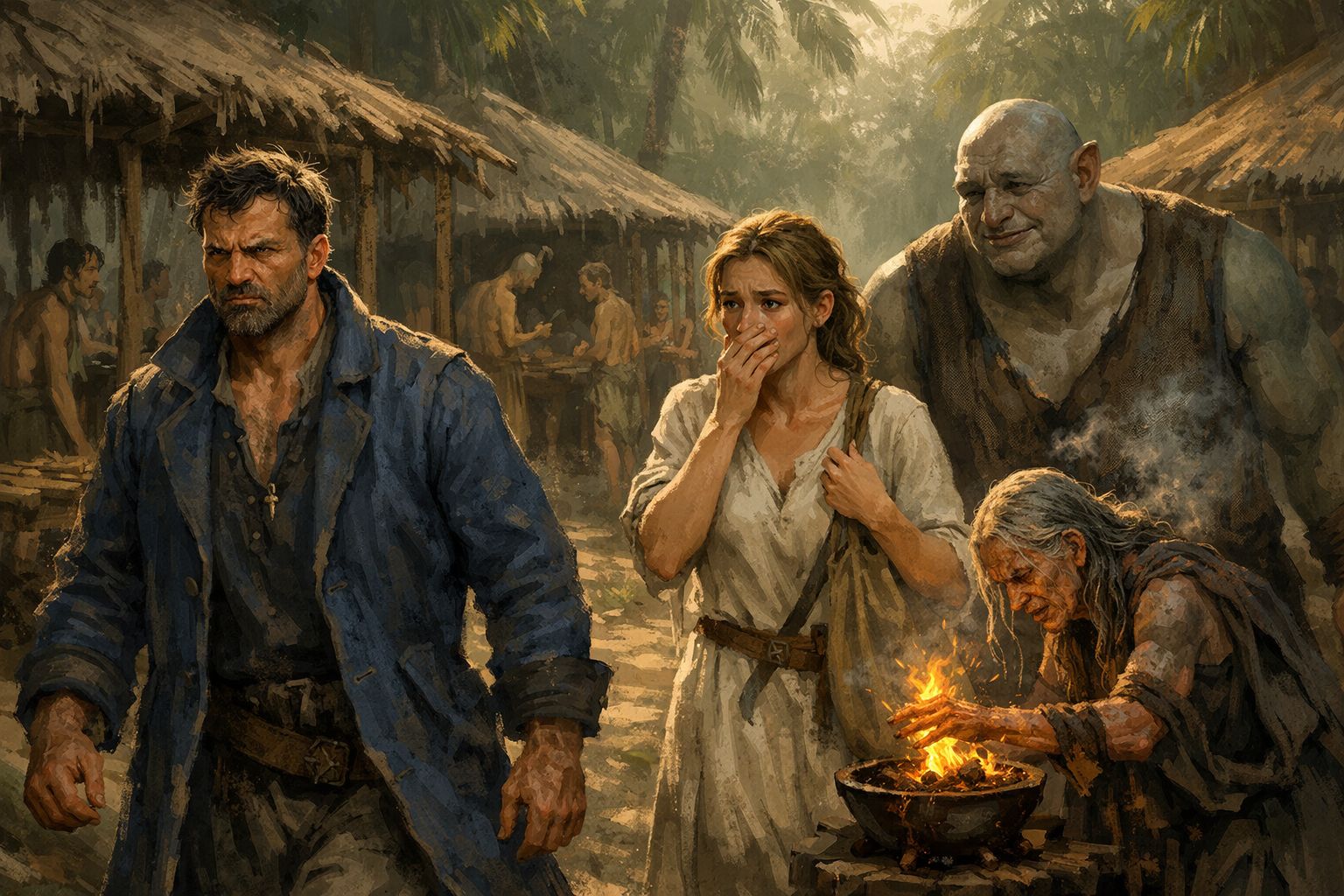
The crew sees pain as routine labor, not as spectacle. A young porter named Veyas drags reeds with a deliberately abrasive cord, leaving neat raw lines on his shoulders. An older woman named Teshri holds her palm over a small brazier for a slow count, then dips it in the river with an expression of relief that reads like completion. Two children practice controlled discomfort under supervision, pressing fingertips into thorns while a parent quietly corrects posture and breathing. The point is not blood. The point is voluntary submission to unpleasantness, shown in public like table manners.
If the crew reacts with visible shock, Varethul does not escalate into hostility immediately. It escalates into concern. Locals exchange glances as if the crew has admitted they are spiritually unprotected, unwilling to repent and thus unclean.
Inverted Hospitality
Varethul offers hospitality that feels like an insult until the crew understands the social logic. A local guide, Raku, leads the crew to a covered lean-to where visitors are expected to rest. Water is offered first, then food, but both are intentionally unpleasant. The drink is bitter bark tea, the food is bland grain mash with sour leaves. A young attendant named Sava brings it with careful respect, then waits to see if the crew accepts without complaint. They are refusing to be the source of your because causing comfort is morally risky.
Payment is inverted. Coins are refused or treated as childish. Instead, locals offer fair exchange as shared inconvenience. Shelter comes without blankets. Fire comes with damp wood that forces patience and gives off thick smoke. Simple questions are answered slowly, as if speed would be indulgence. This is not a trick. It is a test of whether outsiders can meet them on their terms without demanding comfort.
How Locals React to Outsiders
Most locals respond with restrained urgency. They warn outsiders in soft voices that life without penance is a debt that will be collected later. The warnings sound like compassion, which makes them harder to dismiss. A shrine attendant named Lenako speaks with earnest gentleness and explains that refusing pain does not prevent pain, it only postpones it. He asks whether the crew has anyone to guide them in “correct living,” as if asking whether they have a physician.
Outsiders should feel watched, but not hunted. People withdraw when addressed directly, then reappear nearby as silent witnesses. The pressure is communal and unanimous. It does not need threats.
A Safe Early Misstep
Give the crew a small moment where a normal kindness triggers immediate consequences without starting a fight. If someone offers comfort to a child, the child flinches away, then presses their fingers harder into thorns to cleanse the contact. If someone carries a burden for an elder, the elder tries to crawl back to it in shame, then apologizes to the crew for making them witness “weakness.” The point is to show that pity can be interpreted as sabotage here, and that locals will punish themselves to correct the emotional imbalance.
Game Master Notes
Play Varethul as calm, sincere and internally consistent. The discomfort comes from certainty, not from theatrical cruelty. Keep this beat focused on sensory detail, inverted manners and the unsettling kindness of people convinced outsiders are doomed, then move on to clue seeking once the table has absorbed the premise.
The skiff nosed in under Varethul’s raised walkways and the smell hit them first, wet timber, ash, bitter bark and river rot. Above, feet moved in a steady rhythm. No laughter. No market chatter. Only work sounds and low murmurs that never rose into anything like joy.
Scarnax stepped onto the slick boards and paused long enough to take the place in with his eyes. “Keep your hands close. Keep your faces calm,” he said, quiet. “Watch first.”
Junia climbed up behind him, then stopped dead.
On the near walkway a young porter dragged reed bundles with a cord that looked deliberately rough. It had flayed neat lines into his shoulders. He did not hide it. He did not rush to finish. He moved like this was simply how work was done.
“What in the world…” Junia breathed.
Ormun came up last and nearly bumped into her because he had also stopped. His mouth opened, then closed. His eyes stayed on the porter’s shoulders, then flicked to the man’s face, searching for distress and finding none. The lack of distress made it worse. His hands hovered for a moment as if he might reach out, then he pulled them back to his sides like they were guilty.
“You are seeing it,” Ormun said, voice tight. “Tell me I am not seeing it.”
“You are seeing it,” Junia replied. Her tone had shifted, sharper, not anger yet, but the beginning of it. “He needs bandages. He needs someone to stop him.”
Scarnax did not look at them. He kept his gaze on the people watching from doorways and shadowed corners. “No,” he said. “He needs you to not make him a problem.”
Junia turned on him. “Scarnax.”
“Listen,” Scarnax said. He lifted his chin toward an older woman by the river. She held her palm over a small brazier, slow count, then cooled it in the water with a sigh that sounded almost satisfied.
Junia stared. “She is burning herself.”
“She thinks she is cleaning herself,” Scarnax said. “If you step in and stop it, you do not become a hero. You become the person who stole her penance.”
Ormun’s face had gone pale. He swallowed once, hard. “That is not how people work,” he said. “That is not… that is not a thing.”
“It is here,” Scarnax replied.
Ileena hopped down from the skiff with the lightness of someone stepping onto a jungle root. She took in the porter, the brazier, the quiet onlookers and the children nearby pressing fingertips into thorns while a parent corrected their breathing. She snorted.
“They are crazy,” Ileena said, simple, satisfied, as if naming a species. “Fine. Let them be crazy. Jungle makes sense. Stones make sense. Teeth make sense. This does not.”
Junia rounded on her too. “You cannot just dismiss it.”
“I can,” Ileena said, already scanning the greenery beyond the last houses. “Because if I start trying to understand every new madness, I will die of boredom. Their rules are their rules. We have ours. Our rule is: get the lead, get out.”
Ormun made a small sound that was almost a laugh and almost a choke. His eyes had gone wet and he blinked hard, angry at himself for it. “If we walk past,” he said, “we are letting it happen.”
Scarnax finally looked at him. His voice softened a fraction. “We are not letting it happen. It is happening with or without us. If you shove your mercy into their mouths, they will spit it back and call it poison.” He glanced at Junia. “And they will blame the person you tried to help.”
Junia’s hands clenched. She took a step as if to move toward the porter anyway.
A man appeared at the edge of the landing, skin slick with humidity, posture calm, eyes lowered in polite restraint. “Raku,” he introduced himself with a small bow of the head. He did not ask where they were from. He looked at their boots, their dry hands, their unscarred arms.
“You have no guide,” he said. It was not accusation. It was concern. “You look unrepented.”
Junia stared at him. “Unrepented.”
Raku nodded slowly as if confirming a diagnosis. “You will suffer later for what you refuse now. We can help you begin correctly.” He gestured toward a covered lean-to. “Rest. Drink.”
A young attendant brought bark tea that steamed like medicine and a bowl of grain mash with sour leaves. The attendant, Sava, set it down with careful respect and then waited, eyes fixed, measuring their reaction.
Junia looked from the bowl to Scarnax. “They think this is kindness.”
“It is,” Scarnax said. “Just not our kind.”
Ormun’s hand trembled slightly as he lifted the cup. He took a sip and didn’t even seem to taste it. His eyes were on the children at the thorn patch. One of them had been staring at the crew. When Ormun looked back, the child flinched away, then pressed fingers harder into the thorns, face tight with determination, as if the mere sight of outsiders required correction.
Ormun set the cup down too carefully. “That,” he said, voice low and strained, “is not devotion. That is fear.”
Raku heard him anyway. He smiled, gentle and sad. “Fear is honest,” he said. “Comfort is the lie.”
Ileena leaned closer to Scarnax, voice pitched for the crew only. “You see why I want the jungle,” she murmured. “Trees do not pretend pain is food.”
Scarnax kept his eyes on Raku and the watching faces beyond him. “We do not start a war on the dock,” he said, equally low. “We take the tea. We nod. We learn the rules. Then we move.”
Junia’s jaw worked as she swallowed words she wanted to throw. Then she forced herself to pick up the cup, forced herself to drink, forced herself to look calm while everything in her wanted to reach out and stop the world from hurting itself.
Ormun did the same, but his composure sat on him like ill-fitting clothes. His eyes kept drifting back to the brazier, back to the cords, back to the children. He looked like someone standing on a deck in a storm, trying not to show he was about to be sick.
“Later,” Scarnax said, barely moving his lips. “When we know who we are dealing with.”
Junia swallowed again. “And if there is no later.”
Scarnax did not answer.
Searching for Clues in Varethul
The crew can ask openly, but Varethul does not reward directness. Most locals answer in sideways phrases, pause to consider whether a question is indulgence, then offer guidance framed as moral warning rather than information. The crew should feel that every question is being weighed, not for secrecy alone, but for whether it encourages wrong living. Some answers are refused gently, some are redirected toward penance, and some are given only after the crew accepts small discomforts without complaint.
Use three levers to pace the search.
- First, public visibility. The more the crew asks in open spaces, the more the settlement quietly gathers around them.
- Second, perceived softness. If the crew looks eager for comfort or shows too much emotion, locals become pitying, then evasive.
- Third, ritual compliance. If the crew accepts bitter tea, sleeps without extra warmth, or tolerates unpleasant manners without snapping, locals become more willing to speak, believing the crew might be teachable.
Core Clue
Several people in Varethul know the same basic fact: the Waverider crew moved inland along the Thornpath Route. Nobody frames it as “they went that way.” They frame it as “they chose the Thornpath,” implying it was a moral choice rather than a direction.
The crew should be able to reach this core clue through multiple sources so they cannot get stuck.
Reliable Sources of the Thornpath Lead
The general impression of the people they talk to should be that they are soft and friendly, and genuinely want to help the crew find salvation. Play them like doorbell missionaries, except that they try to convert you to pain.
Veyas, Reed Porter
Veyas saw them, because he helped carry goods for them and because outsiders are memorable. He describes them in practical fragments, boat people with salt stiff in their hair, gear wrapped too carefully, eyes that kept searching for water like sailors do even under canopy. He is the first source who will say the name Waverider without making it into a moral lesson. His angle is work. He mentions that the outsiders asked for the Thornpath by name and were told it was “correct” only if they were willing to suffer. They went anyway.
Haran, an older porter, hushes him with a look and a phrase about tempting outsiders into softness.
Lenako, Shrine Attendant
Lenako knows because he was asked for guidance. He did not travel with them, but he gave them the settlement’s framing. He says the outsiders were “unrepented” and frightened, and that at least one of them looked like someone trying to stop shaking. Lenako claims he warned them that the Thornpath is not a road, it is a vow. They took it.
Lenako is useful because he can add a second layer without adding detail. He implies they were not simply passing through. They were looking for something specific inland, something that made them accept hardship voluntarily.
Sava, Visitor Attendant

Sava knows because they were lodged in the same lean-to and watched by the same quiet eyes. Sava will not speak quickly. Sava asks the crew first whether they accept the settlement’s hospitality properly. If the crew is respectful, Sava admits that the Waverider crew left at dawn with a local guide, carrying only what they could manage without beasts, and they choose the Thornpath.
Sava also provides a practical follow-up: who guides people to the Thornpath, and how those guides are found.
Teshri, River Worker
Teshri is not a formal source, but she is a strong human one. She saw them from the riverbank while doing her brazier count, and she remembers the way a female crew member stared at the pain work with horror and fascination mixed together. She says they looked like people carrying a storm inside, and that storms in Ashkar either break or become useful.
Teshri’s information is basic, but she can offer one small anchor: they asked about an old temple without naming it. That is enough to suggest motive without giving map detail.
Raku, Local Guide
Give the crew one concrete name tied to the Thornpath.
Raku can tell that a Thornpath guide named Halvek led them in. Halvek is not in Varethul now. He left with them and did not return. That one fact is a clean reason the crew must go inland, and it gives them a second objective if they want it, find Halvek.
Interesting Interactions with People Who Do Not Know
These scenes add tone and friction, and they can produce secondary clues or complications later.
Mother Sarakai’s Quiet Intervention
Mother Sarakai does not know details, or claims she does not, but she notices the crew’s questions quickly. She sends a message rather than arriving herself. A child or novice delivers a strip of bark with a few words burned into it, requesting the crew present themselves at a certain hour.
When the crew meets her, she frames their questioning as a symptom. She warns them that outsiders who chase mysteries without penance become tools for worse things. She may not confirm the Thornpath directly, but she offers a controlled concession: a safer inland route and a shrine to visit first. She is interesting because she is not lying for greed. She is lying to control moral risk.
The Friendly Carpenter Who Cannot Help
A carpenter named Odran is repairing a walkway post. He chats, but only about craft. If asked about outsiders, he apologizes and says he does not watch such things because watching is indulgence. His interaction is useful because it shows the crew that ignorance here can be a moral choice, not a lack of senses.
Odran can still offer practical help. He can tell the crew where to buy rope, where to mend a boat, or how to avoid a river eddy. He can be kind while refusing to be curious.
The Child Who Copies Outsiders
A child named Ravan follows the crew at a distance, then imitates them. If someone smiles, the child tries the shape and then winces, as if the face itself hurts. If someone offers a coin, the child drops it like it burns. Ravan cannot give information, but the child can create tension by drawing attention, and later you can reuse the child as a face the crew recognizes on the way back.
The Vendor of Bitter Remedies
A vendor named Mera sells bark powders, ash salves, and thorn rings. She has no clue about the Waverider, but she loves to diagnose. She tells the crew exactly what is wrong with them, too soft, too loud, too hungry for ease. She offers “remedies” that are really ritualized discomfort.
Mera is an interaction that lets the crew feel the pressure to conform. If they refuse, she is not offended, only sad, as if watching someone refuse medicine.
How to Deliver the Lead Cleanly
By the end of the Varethul search, the crew should have three things.
- Confirmation that the Waverider crew took the Thornpath Route.
- At least one named person connected to that departure, Halvek the guide, plus the fact he did not return.
- A sense that going inland will escalate social pressure into something stranger, because even the locals who share the clue treat it as a vow, not a direction.
Stop there, then transition into the departure and the first stretch of Thornpath.
Thornpath Route
With or without a guide, the Thornpath Route is simple to follow. It is a well trodden line through dense jungle, kept open by constant barefoot traffic and deliberate maintenance that looks like neglect. The path is not hidden. It is displayed, because walking it is a public statement. The crew should quickly understand that the Thornpath is not treated as a route, but as a ritual that happens to lead somewhere.
Travel Tone
The jungle is wet and loud, but the path itself is disciplined. Where the undergrowth crowds in, it has been pressed down by repetition, not cleared by tools. The air smells of sap, rot, smoke and the sharp green bite of crushed vines. The crew will see simple markers, strips of bark tied to branches, small thorn rings hung like warnings, and occasional ash smears on stones at ankle height.
If the crew has a guide, use the guide to explain the social rules, not the geography. If they do not, the jungle still delivers the same information through what the pilgrims do and how they react.
Pilgrims on the Path
The crew meets pilgrims regularly. They move in small groups, quiet and steady, with limbs wrapped in thorny vines. The wraps are not haphazard. They are neat, purposeful, and adjusted mid walk with practiced fingers. Most pilgrims carry stones in slings or woven packs that force strain. Nobody complains. When they rest, they rest in uncomfortable positions, backs against roots, knees on gravel, hands in stinging leaves.
Pilgrims are not hostile. They are concerned. They offer advice the way a sailor offers advice to someone about to sail into a storm. They suggest ways the crew can begin to “walk correctly,” such as removing boots, carrying a stone, or binding a wrist in a mild thorn wrap. These suggestions should be framed as friendly help, not coercion.
Names to Use on the Road
Soreth and Mali, Married Pilgrims
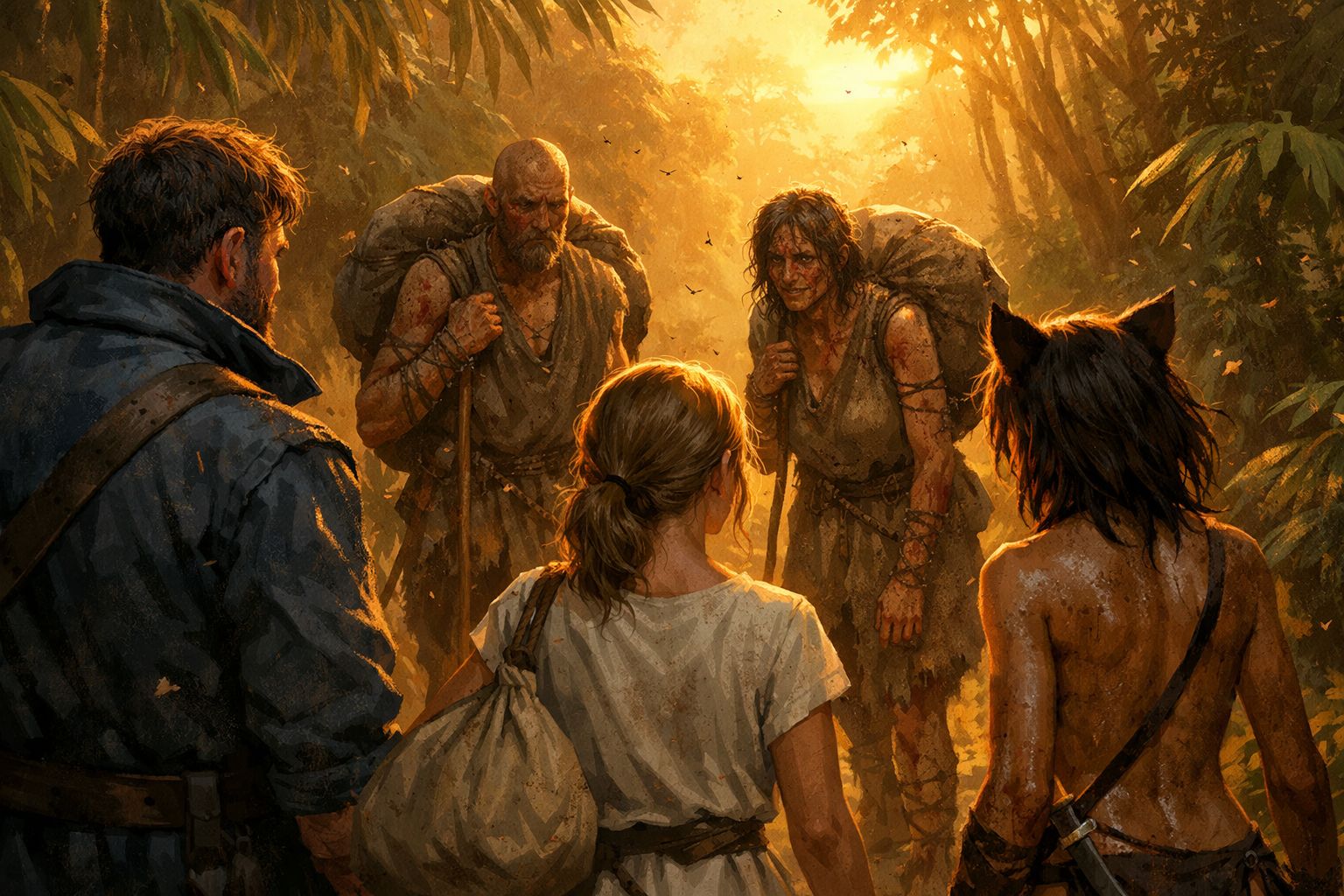
A middle aged pair who greet the crew with soft smiles, then apologize for smiling. They explain that the Thornpath is easier when shared, and offer the crew a small thorn ring as a “starter,” treating it like a gift.
Odan, Young Penitent
A young man walking alone, too intense, too eager. He watches the crew with bright hunger, the kind that can tip into zeal. He suggests stronger penance than is polite, and other pilgrims quietly correct him, showing that even here there are social boundaries.
Day One Destination, The Blood Fountain Shrine
The clearing opened like a held breath. The jungle noise did not stop, it only changed shape, tightening into a steady buzz that crawled under the skin. A stone fountain sat in the middle, water spilling over worn lips into a shallow basin, and the water was pink at first glance, then plainly red when the light caught it right.
Mbaru slowed, shoulders rising toward his ears as insects found him. “This place is alive,” he muttered, swatting at his neck. “It is alive and it hates me personally.”
Scarnax did not answer. He watched the kneeling pilgrims instead. They pressed thorns into skin with practiced calm, letting droplets fall into the basin like offerings. No sobbing. No rage. Only the same expression a sailor wore when tying off a line in bad weather, focused and intent on doing it correctly.
Junia took one step closer, then stopped as if the ground had turned to glass. “They are bleeding into the drinking water,” she said. Her voice was low, careful, like speaking too loud might make it worse. “That is not cleansing. That is infection.”
Gastved shifted his weight and looked around the clearing, not at the blood first, but at the edges. He counted paths the way he would count animal runs, then glanced at the fountain again with a quiet frown. “They are not hiding it,” he said. “They want it seen. That means it is a rule, not a lapse.”
Ileena crouched near a stone where insects clustered thickest, peering at them with interest that was almost cheerful. “If you bleed enough, the bugs are happy,” she concluded. “Everyone wins. Except the part where you bleed.” She straightened and flicked a gnat from her ear. “They are still crazy.”
A man in plain robes approached as if greeting guests to a meal. His hands were clean, his smile gentle, and even that smile looked practiced, like something done carefully. “Welcome,” he said. “I am Father Lenaro. You are walking the Thornpath. That is good.” His eyes moved over their boots, their hands, their unmarked arms, and his pity was as soft as his voice. “You carry debt. You can begin to pay it here.”
Junia’s throat tightened. “We are not here to hurt ourselves,” she said. “We are here to find someone.”
Father Lenaro nodded, accepting the sentence while rejecting its meaning. “Finding is easier when you are clean,” he replied. He gestured toward a bowl of thorn rings and strips of cloth laid out with care, like bandages in a healer’s kit. “A small cut is enough to begin. A few drops, and you will feel lighter.”
Mbaru let out a sound that was half laugh, half groan as a larger insect landed on his cheek. He slapped it and stared at his palm with disgust. “I am already paying,” he said. “My blood is going to the air for free.”
Scarnax raised a hand, palm down, the quiet signal that meant hold. “We appreciate the advice,” he told Father Lenaro. “But we will pass on that medicine.” His tone stayed polite, almost warm, the way you spoke to a port official you did not trust. “We will wash our hands, though. Out of respect.”
Junia’s eyes snapped to him. “Scarnax.”
He did not look at her. “Later,” he said softly, just for the crew. “We do not make ourselves the story in a place like this.”
Gastved’s gaze stayed on the pilgrims. One of them looked up, saw the crew, and smiled with the calm satisfaction of someone seeing a sick neighbor finally arrive at the clinic. Gastved’s mouth twitched once, not amusement, more like recognition of a trap that was not made of rope. “They mean it,” he said. “That is what makes it hard.”
Ileena leaned in toward Junia, voice light. “If you want to help them, you will have to learn their rules,” she whispered. “If you do not, help will be just more noise.” Then she looked back toward the jungle beyond the clearing, where the path narrowed into green shadow. “I still vote we leave the buzzing blood fountain and go where things make sense.”
After roughly a day of travel, the Thornpath opens onto a small shrine clearing. The place is humid, still, and swarming with insects. The air vibrates with buzzing, and the smell is coppery under the green. A stone fountain sits at the center, its basin tinted red. The red is not paint. It is fresh blood diluted into water.
Pilgrims kneel, press thorns into skin, drip blood into the basin, then wash and drink in small sips. They do it calmly, with the focus of people completing a task. The shrine is not guarded. It does not need to be.
What the Shrine Communicates
This is where you reinforce that the Ashkari are not trying to scare outsiders. They believe this is correct living. They treat participation as medicine. Outsiders who refuse are pitied, not punished.
The shrine also acts as a threshold. After the first day, the crew has been observed by enough pilgrims that word of them will have moved ahead. Even if nobody is hostile, the crew should feel that they are being socially carried forward by rumor.
Encouragement to Participate
A shrine keeper named Father Lenaro, not a Sorrowbound, but a local caretaker, greets the crew warmly. He offers them clean cloths, thorn rings, and water from the basin. He says the crew will feel lighter after the first cut. He is not threatening. He is earnest, like a healer offering a bitter cure.
If the crew refuses, he accepts it with sadness and urges them to at least wash their hands in the basin “to begin.” If the crew participates, locals become more open and helpful, convinced the crew can be saved.
Second Day Destination, Pilgrim Village Rest
Another day along the Thornpath brings the crew to a small village that functions as a rest point. It is not a welcoming inn. It is an organized pause. Pilgrims arrive, eat unpleasant food, tend wounds with ash salves, then sleep in sparse shelters without bedding.
The village has a steady rhythm of low voiced correction, people reminding each other not to seek ease, not to complain, not to turn rest into comfort.
Halvek’s Introduction
The pilgrim village was not a place that welcomed. It was a place that allowed stopping.
Shelters stood on short stilts to keep rot from the floors, open on the sides so the jungle air and insects could not be kept out. Smoke crawled low from damp cooking fires and clung to skin. People ate without seasoning, spoke without laughter, tended their cuts with ash salves as if it were ordinary hygiene. Even rest had rules. Bodies lay on woven mats without padding, faces turned away from comfort as if comfort could see them.
Scarnax moved through it with the careful pace of a man who knew how quickly a crowd could become a sea. Gastved stayed half a step behind, eyes always drifting to the edges where the jungle pressed closest, reading the village as terrain. Junia tried not to stare at the bandaged limbs and the thorn wraps, but her gaze caught anyway, snagging on every flinch that was swallowed back into pride.
A man detached himself from a group by a post rack and walked toward them as if he had been waiting for the moment to be permitted. He was lean, sun darkened, with the calm posture of someone who lived on foot. His forearms were marked with old vine scars, but they were faded and tidy, like a record kept without vanity. By Ashkar standards, he looked almost sociable.
“You are not from here,” he said, and it was not accusation. It was simple fact. His voice carried farther than most voices in the village, not loud, just unafraid to be heard. “I am Halvek.”
Scarnax did not offer his own name immediately. He watched Halvek’s eyes, watched how they moved, looking for the tell of a fanatic, a liar, a man paid to set traps. Halvek met the scrutiny without offense.
“You came along the Thornpath,” Halvek continued. “You walked it like people who do not know how to walk it, but you walked it.”
Junia’s patience cracked at the edges. “We are looking for a crew,” she said. “Sailors. Foreigners. They came through here.”
Halvek nodded once, as if that confirmed what he had already decided. “Waverider,” he said. He spoke the name plainly, not like a moral lesson.
Gastved’s head tilted a fraction. “You know them.”
“I guided them,” Halvek replied. “From Varethul to this village. Then farther, not along the proper way.”
Junia stepped closer before she could stop herself. “They left the Thornpath?”
“They did,” Halvek said. “They asked about an old place in the forest. A ruin that should not still be standing. They did not ask it like pilgrims ask. They asked it like sailors ask for shore leave. Hungry and afraid at the same time.”
Scarnax’s eyes narrowed. “Why would a sailor crew chase a ruin in Ashkar?”
Halvek’s mouth twitched, almost a smile, then he thought better of it. “Because they thought it would answer them,” he said. “Because they believed hardship would buy safety, and when hardship did not feel like enough, they wanted something older, something that could not argue back.”
Junia’s voice dropped. “Did they come back?”
Halvek did not answer right away. He glanced toward the shelters, toward the ash salves, toward the sleeping pilgrims. “From the ruin, yes,” he said. “Back here with me. At dawn they left again for Varethul. This time without a guide.”
Gastved let the silence sit. “Show us,” he said.
Halvek spread his hands slightly, palms forward, a gesture of offering rather than persuasion. “I can take you,” he said. “A few hours more on the Thornpath. Then a side trail. It is barely trodden. After that, there are no pilgrims. Just jungle and the sound of your own breath.”
Scarnax weighed him for a heartbeat longer. The offer was too clean, but it was also the only clean thing they had been handed since the river landing. He nodded once.
“You take us,” Scarnax said. “You set the pace. You tell us when to stop talking.”
Halvek’s shoulders eased, as if he had been waiting for permission to do what he was already going to do. “Then leave at first light,” he said. “Do not eat until you have packed. The jungle likes the smell of food on your hands.”
Junia looked at Scarnax, wanting to argue, wanting to demand more, wanting to claw certainty out of Halvek’s calm. Scarnax only gave her the same quiet look he used on deck when storms rose. Not comfort. Not promise. Just decision.
“We leave at first light,” Scarnax said.
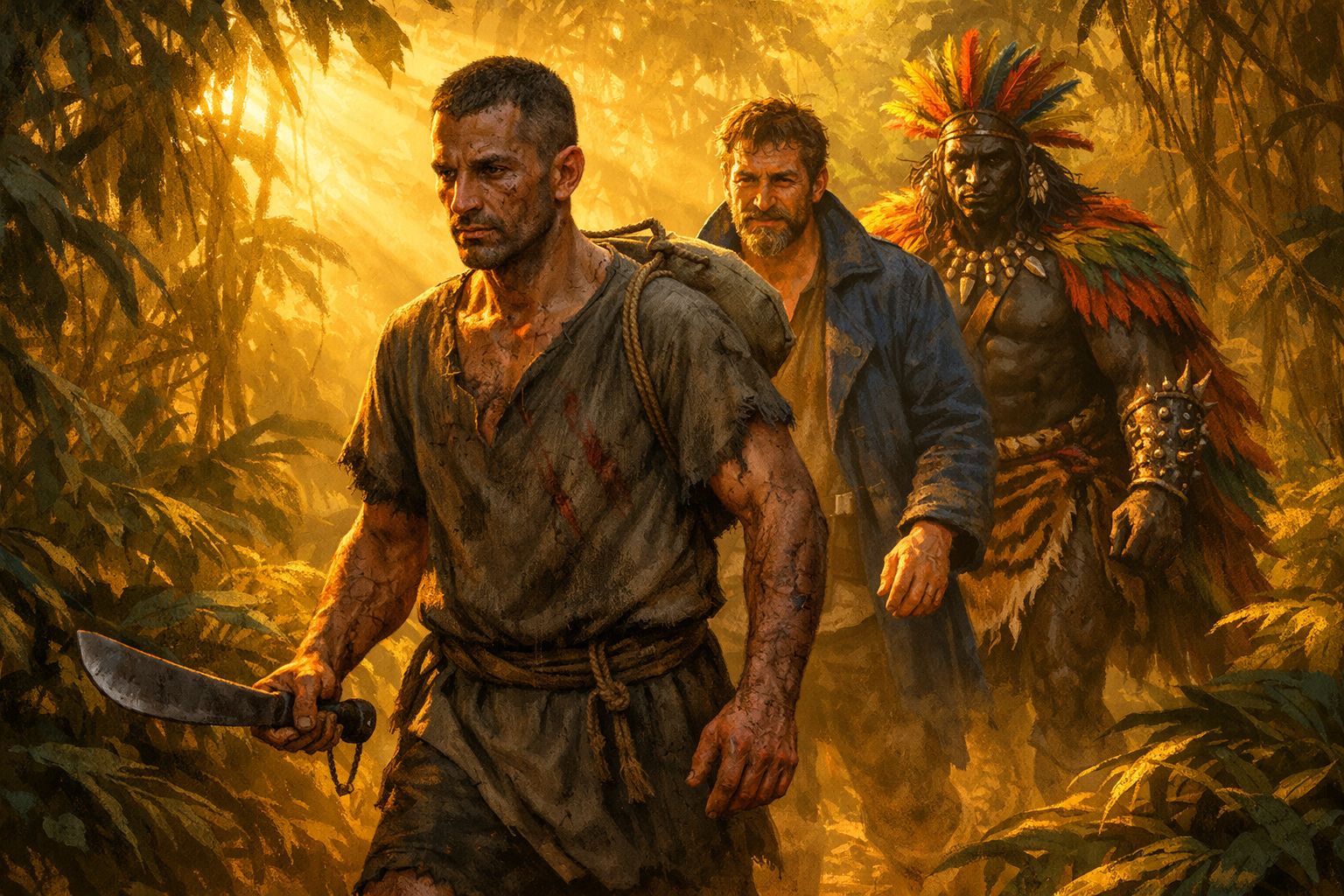
Here the crew meets Halvek, the Thornpath guide. He recognizes them as foreigners and approaches them rather than waiting to be asked. By Ashkar standards he is friendly and talkative. He offers his name without it being dragged out of him, and he asks questions in plain language.
Halvek’s defining trait is practical confidence. He is not trying to convert the crew on every sentence. He assumes the doctrine is true, but he is also a working guide with a job to do.
What Halvek Tells Them
Halvek confirms he guided the Waverider crew. He says they chose the Thornpath because they believed there was knowledge. He says they left the main path for a barely trodden side trail leading to an ancient ruin. He does not describe the ruin in detail here. He only calls it old and wrong.
He can guide the crew there. The route is roughly one day of travel, starting with a few hours along the Thornpath, then the rest along the side path.
Leaving the Thornpath
As soon as the crew leaves the Thornpath, there are no more pilgrims. The jungle closes in. The ground becomes less stable, the undergrowth thicker, and navigation slower. The path becomes a suggestion rather than a road. The change should feel immediate, like stepping off a dock into water.
Halvek’s value becomes obvious, they would not have found this path on their own.
Arrival at the Ruins
The crew arrives at the edge of the ruins roughly an hour before sunset. Use the light change as a pacing tool. The jungle dims faster here under heavy canopy. Shadows lengthen. Insects shift tone. Halvek becomes quieter and stops making casual conversation. Whatever friendliness he had is replaced by a professional caution that signals the next phase of the arc.
Old Jungle Temple
The jungle gave them the ruins the way a mouth gives up a bone. Stone shoulders rose out of vine and leaf, half-swallowed walls furred with moss, roots gripping corners like hands that had forgotten they were hands. Scarnax stopped at the edge of the clearing and let his eyes travel across angles that did not match anything they had seen since leaving the coast, not Ashkari timber, not imperial masonry, not the rough, practical stone of river forts. This place had lines that felt older than function, as if whoever built it cared more about meaning than shelter.
Halvek stood a few steps back, respectful in the Ashkar way, which meant he did not interrupt silence. When Scarnax finally looked over his shoulder, Halvek gave a small shrug. "No one knows who made it. Not in Varethul, not on the Thornpath. As far as I know, only I and the Waverider crew have stood here in living memory."
Junia’s breath came shallow, more from the air than fear. She pushed damp hair back from her face and stared at the stonework like it might explain itself if she looked hard enough. "And you never told the Sorrowbound?" It was not accusation, only disbelief.
Halvek’s expression barely moved. "They do not ask. I do not offer." Then he added, as if it settled the matter, "It is not on the Thornpath."
Ileena circled the entrance without ceremony, feet silent on wet leaf litter, nose lifting, eyes narrowed. Her ears twitched at the shift in sound, the way the jungle buzz seemed to avoid the doorway by a few careful steps. "It smells wrong," she said. Not frightened, just certain. "Not rot. Not beast. Wrong like cold ash." She peered into the dark and glanced back at Scarnax.
They stepped inside, slow, letting their eyes adjust as the green light fell away. The air was cooler and close, heavy with stone damp and old residue. When the darkness resolved into surfaces, Junia halted, her hand rising to her mouth without touching it. The walls were covered in reliefs, row upon row of figures cutting, binding, breaking themselves in orderly devotion, every gesture aimed toward a central presence. And in every carving the central figure had been hacked away, not weathered, not broken by time, but cut out with intent. The voids were rawer than the surrounding stone, as if the absence was newer than the story around it.
At the far end a shallow pool lay under a single hole in the ceiling. Murky water sat still as oil, catching a thin shaft of light that would, at some point in the day, strike the surface clean and bright. It was the only place in the chamber that looked almost planned for beauty, which made it worse. Scarnax stared at the hacked voids, then at Halvek. "What does it mean?"
Halvek lifted his shoulders again, the same small, practical motion as before. "It means our way is older than the prophet Ishmael." He said it the way he might say a river changes course, as fact, not pride. "Old enough that even stone remembers."
Junia shuddered, eyes locked on one of the missing shapes. "Who, or what, did they cut out?" Her voice was tight, not with squeamishness, but with the sense that she was standing near a story that had been strangled.
Halvek looked at the empty space as if it were nothing more than damage. "It does not matter. It is all the same."
For a moment no one spoke. The jungle outside pressed sound against the entrance, insects and distant birds like a held curtain. Scarnax turned away from the pool and glanced back toward the doorway where the light was already thinning. "It is getting dark. We set camp now."
Ileena did not look relieved, but she nodded once, sharp. "Outside," she said. "One way in means no way out."
Scarnax did not argue. He simply agreed, and that agreement carried more weight than comfort, because it was the kind made by someone who could feel the night closing, and did not intend to be trapped inside a stone throat when it did.

The ruin is an old stone temple swallowed by jungle, unknown to Varethul and effectively forgotten by everyone except Halvek and the Waverider crew. Its architecture does not match Ashkar’s timber settlements or any imperial style the crew has seen. It feels older than Ishmael’s doctrine, older than the social rules on the Thornpath, and that age should land as fact rather than melodrama.
The temple’s purpose is not immediately clear. Its function is not hospitality, not burial, not storage. It reads like a place built to witness and to shape behavior, with stone teaching a lesson over and over.
Approach and Exterior
The temple sits in a small clearing where the jungle feels slightly hesitant. Vines and moss cover most surfaces, but the doorway remains visible as if the growth avoids it by a few careful steps. Roots grip corners like hands. The stone is damp and cool even in heat. Insects gather everywhere except directly inside the threshold, where the air feels briefly still.
If Halvek is present, he becomes quieter here. His talkative edge disappears. He does not forbid entry. He simply stops volunteering opinions.
Interior
Light drops quickly inside. Eyes take time to adjust. The air is cooler, close, and smells of wet stone and old residue. The sound changes, too. Jungle noise becomes muffled, as if the temple eats distance.
The interior walls are covered in reliefs. Rows of figures perform acts of self-mutilation in orderly repetition, cutting, binding, breaking themselves with careful posture and ritual calm. Every scene is directed toward a central figure.
In every relief, that central figure has been hacked away.
The removal is not weathering. It is deliberate destruction. The voids are rawer than the surrounding stone, the edges uneven and scarred, as if someone took tools to it long after the rest of the work was finished. The repeated erasure should feel like a decision made again and again, not a single accident.
How to Play the Missing Figure
Do not define what the missing figure was. Let the negative space do the work. If different players imagine different shapes, that is good. The important point is that the same absence exists everywhere, implying systematic censorship or containment.
If a character examines the tool marks, the impression should be that more than one hand did this over time. Different angles. Different force. Different patience. That suggests a long effort to keep the figure unremembered.
The Pool and the Light
At the far end of the main chamber is a shallow pool of murky water. A single hole in the ceiling lets in a shaft of light. At some point during the day, that light likely strikes the pool directly, turning the surface into a bright focal point.
The pool is not obviously magical, but it is staged like a ritual endpoint. The shaft of light reads like intention. If the crew spends time here, emphasize that the water is still, heavy, and slightly opaque, as if it holds sediment that never quite settles.
If the pool is searched, it contains only murky water, algae and drowned insects. The stone lip is worn smooth in one spot, as if countless hands have gripped it while leaning over.
Halvek’s Interpretation
If asked what it means, Halvek offers the simplest Ashkari framing.
"It shows our way is older than Ishmael."
He does not dramatize it. He says it like a practical truth. If pressed about the missing figure, he shrugs and dismisses it.
"It does not matter. It is all the same."
This matters because it shows the Ashkari capacity to flatten difference. In Halvek’s view, names and origins are less important than obedience. That is both a cultural clue and a frustration tool for curious players.
Player Choices and Stakes
Exploration vs Caution
If the crew pushes deeper or tries to force certainty, lean into the temple’s narrowing effect. It does not need traps. It needs pressure. The light fading toward evening is your main escalation tool.
Participation Logic
If any player suggests using pain or blood to “match the local rules,” do not punish it automatically. In Ashkar, that logic often works socially. Here, it might or might not work, and the uncertainty is the point. They can do it, but they will not know if it made any difference, for good or bad. If they do it, describe a subtle sensory response, then do not confirm meaning.
The temple is older than the doctrine, so Ashkar’s rules might be an imitation of something that was never meant for humans.
Thorned God Cult Confrontation
Dawn came in damp layers, not light so much as the slow lifting of shadow. The crew’s camp sat just beyond the temple threshold, where the jungle pressed in and the ruins watched without eyes. Smoke from last night’s fire had sunk into everything, hair, cloth, skin, and the air carried that coppery hint that never quite left once you had seen the reliefs.
Ileena was already awake. She crouched near a root tangle at the edge of the clearing, still as a hunting cat, gaze fixed on a patch of green that looked no different than any other. Her hand rested on her blade without gripping it.
“Someone’s coming,” she said.
Mbaru, half wrapped in his blanket, lifted his head with a grunt. “No one is coming. I can’t hear anything.” He sat up anyway, squinting into the trees. “All I hear is bugs and my own bones complaining.”
Junia was awake too, eyes tired, jaw set. She did not bother to look where Mbaru looked. She looked where Ileena looked. “If Ileena says someone’s coming,” she said, “someone’s coming.”
Scarnax rose without hurry and started waking the rest with small touches and quiet words. Steel came out. Straps tightened. Gastved checked the clearing the way he checked a shoreline, counting angles, measuring distance. Halvek sat up last, blinking like a man pulled from shallow sleep, then went still when he saw the crew arm.
Ten minutes passed. The jungle did not change. No birds burst up. No branches snapped. The buzz stayed steady enough to make Ileena look foolish, and Mbaru took advantage of it.
“I told you,” he said, just loud enough to be smug. “Nothing. This is what happens when you travel with cats. You start believing the forest whispers secrets.”
Ileena did not answer. She only shifted her weight a fraction.
Then the jungle parted.
Gastved’s head turned toward Mbaru, eyebrows lifting, clearly impressed. “From that far out,” he said quietly. “She really heard them.”
Five Ashkari stepped into the clearing, limbs bandaged with thorny vines, faces calm until their eyes landed on the crew. The calm cracked into outrage so sudden it came out as breath.
“Outsiders.”
“Heretics.”
“Defilers.”
Knives flashed. Not swords, not spears, but short blades meant for close work. They spread out at once, drifting left and right to encircle, quick and practiced, moving as if this was a drill they had rehearsed in silence.
“Feed the Thorned God,” one of them said, and the others echoed it, not shouted, but spoken with the steady certainty of prayer.
Junia’s shoulders tightened, and she moved back behind Mbaru, her hand on her small knife. Gastved’s gaze tracked the spacing, calculating how many heartbeats until someone slipped behind them. Mbaru raised his spear.
Scarnax’s eyes flicked to Halvek.
Halvek stared at the newcomers like they were strangers in his own village. Confusion sat plain on his face. He lifted both hands slightly, empty. “I don’t know,” he said, voice low. “This is not… I don’t know.”
They moved in tighter, blades low, feet careful on wet leaf litter.
Ileena’s knife was still down, but her eyes had gone flat, focused, the way they did when the world stopped being complicated and became simple geometry. She licked her lips in anticipation.

The crew camps at the ruin and is approached at dawn by a small cell of Ashkari cultists who have come to the temple for their own rites. They do not expect outsiders and do not attempt a sneak attack. The encounter begins with shock, insult and immediate maneuvering, then it hardens into violence. Any conversation is brief and tactical, not a path to information or peace.
Approach and Timing
How They Arrive
The cultists emerge from the jungle in a loose line, then spread into a shallow arc as soon as they see the crew. They move like people who have rehearsed one scenario, not like experienced skirmishers. Their opening tells are emotional certainty, drilled phrases and immediate knife work, not stealth discipline.
They are loud enough that a careful watcher can notice them before they enter the clearing. They are not trying to be silent because they are not hunting. They believe the temple is theirs and the jungle is theirs.
No Sneak Attack Baseline
Because they do not expect the crew, their first seconds are spent reacting and repositioning. They lose surprise by default. Their advantage is momentum and willingness to close distance, not hidden approach.
Early Warning and Preparation
If Ileena or Shaedra Is Present
Either of them can pick up the approach in time for the crew to stand, arm, and choose formation. Ileena notices because she reads the jungle in terms of movement and intention. Shaedra notices because she reads pattern breaks and unnatural stillness. Either way, the crew gets a short window to prepare without the cultists noticing that they were detected.
If Neither Is Present
The crew still gets some warning from camp sounds, jungle shifts, or Halvek’s reaction, but the window is shorter. They are more likely to be caught mid routine, still pulling on boots, still packing, still organizing gear.
Cultist Group Composition
Group Size
Use a small group that feels plausible as a temple visiting cell. Matching player numbers is a good default, but adjust according to group composition as well.
Typical Loadout
They carry short knives and a few jungle machetes. Their knives are designed as tools, not weapons. They do not bring heavy weapons. Their gear is practical and poor. They have thorn wraps and small fetish items, but nothing that identifies a broader organization.
Leader Figure
The group has a speaker, Yareth, Thorncrowned Speaker. The leader does not need to be more skilled. The leader needs the strongest certainty and the clearest command voice.
Opening Beats
Recognition and Reaction
The cultists enter, spot the crew, then react with immediate religious labeling. They use short terms, then pivot into their chant of "Feed the Thorned God" as they spread out.
They draw knives and attempt to encircle. The maneuvering is not subtle. It is direct and designed to put blades at multiple angles, to surround and outflank.
Halvek’s Position
Halvek is visibly confused and not part of the cult. He does not recognize them as an allied faction. He may blurt that he does not know them, or that they are not like him. Cultists treat him as irrelevant unless he interferes. If attacked, it is because he stands with outsiders, not because of a personal history.
Conversation Window
What Conversation Is For
Conversation exists to create a brief decision point and to let the cultists reposition.
The cultists want to know one thing: How many outsiders know this place exists?
They will press for that in different ways, through accusation, demand, and pseudo mercy. They are not negotiating. They are measuring risk and looking for the best moment to lunge.
What It Should Feel Like
Their tone is calm certainty with sudden spikes of intensity. Their tone is reasonable, but their words are the words of a fanatic.
They are not ranting. They are performing a verdict. They do not argue morality. They declare it. They might offer the crew a “chance” to cleanse, but it is not genuine mercy. It is framing for the kill.
Information Yield
Conversation does not give concrete intelligence. At best it confirms the following.
- They are fanatics
- They have no practical common sense
- They believe outsiders are fuel
- They believe this temple matters, but they will not explain why
If players try to interrogate them, they respond with doctrine slogans, not facts.
Fight Triggers
Violence starts when any of these happen.
- The crew backs toward the temple entrance
- The crew draws weapons openly and takes a fighting stance
- A cultist completes a reposition and sees an opening
- Halvek speaks too much or is treated as a liability
- Or simply when the cult leader decides the questions are answered
Do not drag the conversation. It should feel like a thin veil over a knife.
Combat Behavior
Fanatic Mindset
They do not surrender or run. They will fight until they are down. They may accept injury gladly. They may take reckless actions to close distance. They may aim for whoever looks like an authority figure or whoever looks least willing to kill.
Threat Profile
They are Ashkari. Their health is not exceptional. They are not trained duelists or soldiers. Their danger comes from fearlessness, numbers, and aggression.
They will make mistakes. They will overextend. They will take bad trades. That is on theme. They are not here to win cleanly. They are here to feed something.
Tactics and Environment
They prefer close range. They try to surround. They use the edge of the ruin and the jungle line to limit retreat angles. They do not use sophisticated feints.
If you want a slight escalation, have them try to force the crew toward the temple threshold, treating the entrance like a sacred line that matters. They might not know how it works, but they believe it does.
Aftermath and Clues
Bodies and Marks
After the fight, the clearest discovery is the cult marking. Symbols are carved into skin in places usually hidden under wraps. The icon is a thorned circle, like a crown or sun, repeated with variations. It is clearly intentional and clearly done over time.
No Other Identifiers
They carry no letters, no tokens, no maps, no useful possessions. Do not reward looting with organizational clues. The point is that the cult is real and dangerous, but opaque.
What Halvek Can Tell Them
Halvek has no useful information about the cult. This is only the second time he has been here. The Waverider crew were the ones with the map. He did not know there was another group interested in the ruin. His confusion is genuine and supports the idea that the Thorned God cult is not an open Ashkar institution.
Halvek has one uneasy thought he cannot prove. If these cultists found the ruin without him, there may be another way in, or he may simply be overestimating his own uniqueness as a guide. No search reveals a second path, and the uncertainty is the point.
That fact can hang as an unease thread without being solved.
Scene Outcome and Next Step
Immediate Outcome
The fight ends with dead cultists in the clearing and no meaningful trail to follow. There are no documents, no tokens, no map, no trail marker that points to a larger cell. The only concrete takeaway is that a real violent fringe exists in Ashkar and that it can surface even this far from the Thornpath, but the crew cannot do anything actionable with that knowledge right now.
Halvek remains genuinely uninvolved. He cannot identify them, cannot explain their doctrine beyond “fanatics,” and cannot offer any next step tied to them. If the crew wants answers about the cult, there are none available here.
The One Remaining Temple Discovery
If the crew chooses to return inside, there is a single final reveal the ruin can offer. The hole in the ceiling is not just architecture. At noon, the shaft of light strikes the pool cleanly. If a character looks into the water then, the surface shows an inhuman face, with horns formed from thorns. It is not a clear vision with context or instruction. It is a glimpse. It is an elaborate reflection trick, a face assembled by ceiling shapes and distortion in the murky water.
It suggests that whoever hacked away the relief figures did not fully succeed, that one final image was missed, and that the thing they tried to erase still has a reflection.
Do not turn this into a new quest. Treat it as a hard image the crew can carry forward, a foreshadowing that may or may not matter later depending on how the campaign develops.
Exit State
The crew leaves with suspicion, not answers.
Whether Ashkar is feeding something, or whether this is a fringe cult misusing older imagery, is left unresolved.
The practical situation resolves into closure. The crew has dead cultists, no actionable leads on them, and nothing here that advances the Waverider trail. After the noon pool reveal, there is no reason to linger, and the arc should move on.
Leaving

They left the clearing with the temple at their backs and the jungle closing in again as if it had only stepped aside to watch. The path was slick with rain and leaf rot. Everything smelled of wet stone and bruised green.
A stone sat in the middle of the trail ahead, too neatly placed to be chance. On top of it lay a folded paper, pinned down with another stone. The lower stone lifted the paper off the wet ground like someone had bothered to keep it dry.
Ileena stopped first, head tilted, eyes on the trees. Gastved’s gaze slid over the path edges, then into the undergrowth, reading the places a watcher would choose. Scarnax did not reach for it immediately. He took a slow step, then another, as if expecting the jungle to object.
Nothing moved.
Ileena’s eyes narrowed. “I don’t like this,” she said, not afraid, just annoyed at the idea of an unseen hand.
Scarnax bent, lifted the top stone, then the paper. He unfolded it carefully. The writing was simple. Not a sermon. Not a threat. Just a few words.
He read it aloud.
“The next port you seek is Tseradun in Khazryn.”
For a moment the jungle buzz filled the silence for them.
Scarnax looked up, brow furrowing. “Did either of you see someone leave this?”
Gastved gave a slow shake of his head. “No.” He glanced at Ileena. “Not even you?”
Ileena shrugged, still watching the trees. “If I did, I’d be chasing them.”
Scarnax folded the paper again, slower this time, as if the act might make it less strange. He tucked it away and exhaled through his nose.
“Well,” he said, voice quiet, “it looks like we have a friend. Even here.”

The return is the same route in reverse, but the tone should not be the same. The crew is carrying three weights now: the reality of the Thorned God cult, the possibility of the entire Ashkar religion being a dark plot, and the fact that someone is tracking them closely enough to place a message without being seen. The return is uneventful in terms of obstacles, but it should feel watched and unresolved.
The Note on the Path
What the Crew Finds
As the crew leaves the temple clearing, a stone has been placed on the wet path. A paper lies on top, held down with another stone. The lower stone keeps the paper off the ground and dry. There are no tracks, no snapped twigs, no obvious sign of approach or retreat. The note is simply there, clean and deliberate.
What It Says
“The next port you seek is Tseradun in Khazryn”
The message is plain, practical, and delivered in a way that implies competence.
What the Players Do Not Know
The note is Samden’s work. The crew has no way to prove it here, and there is no breadcrumb trail to follow. Treat this as a campaign utility beat, not a new mystery to investigate. The unease comes from the competence of it, not from clues.
How to Run It
Do not allow a tracking mini-game to grow out of this. If players search for prints or signs, let them find nothing meaningful. If players post a lookout, no one appears. The point is that the message arrives without a visible messenger.
The Thornpath in Reverse
Varethul looked the same from the river. Raised walkways, steep roofs, gutters spilling into reed beds. Wet timber, ash, bitter bark. The same quiet rhythm of feet above them.
It was the sameness that felt wrong.
They stepped onto the slick boards and the settlement noticed them the way a body notices a splinter. Glances flicked over their packs, their hands, their faces, then slid away too quickly. A few people paused mid task, not staring, not gawking, just holding still for half a breath as if listening for something beneath the obvious.
Junia’s voice dropped without her meaning to. "They look at us differently."
Scarnax kept moving, steady pace, eyes forward. "We are still outsiders."
Gastved’s gaze stayed on the edges, doorways, shadowed corners, the places you could watch without being seen. "Or they think we are something else now," he said. "They might suspect we are cultists."
Junia swallowed and glanced at a child tying a thorn ring to a cord. The child’s hands were careful, almost tender, like tying a charm for luck. The thought made her skin crawl. "Or they are cultists," she murmured, "and they are deciding how much we know."
Ahead, Sava stood by the visitor lean-to with the same calm posture as before. The attendant’s face was unreadable, but the eyes lingered a fraction longer than they had on the first arrival. Not hostile. Measuring.
Ileena’s nose wrinkled. She tugged her hood up as if it could keep the place out of her lungs. "It does not matter," she said. "This is not the kind of jungle I like. Too many rules. Too many smiles that mean knives."
Scarnax did not argue. He only angled them toward the river landing where the skiff waited, and beyond it the stretch of water that led back to open air. "Agreed," he said. "We go to the ship. We leave."
They walked on, and Varethul made room for them the way it had the first time. Quietly. Politely. With just enough watching to make every innocent gesture feel like a sign.
Same Places, Different Read
They pass the same beats as on the way in. The Blood Fountain Shrine. The swarming insects. The pilgrims with thorn wraps. The same polite warnings. But the crew will experience each of these through the lens of what they now suspect.
Use the return to subtly shift the meaning of earlier scenes.
- The shrine now feels less like strange medicine and more like a feeder station, whether that is true or not.
- Pilgrims now feel less like harmless devotees and more like a potential cover for extremists, whether that is true or not.
- The cult marks on dead bodies make every hidden scar feel suspicious.
Do not confirm answers. Let paranoia and doubt do the work. The return should encourage questions, not resolve them.
Pilgrim Interactions
The crew will meet pilgrims again. They are still soft-spoken, friendly, and sincere. They still offer advice, not threats. The difference is the crew’s internal response. Where the first trip was disgust and culture shock, the return should be wariness and pattern scanning.
If you want one simple visual to carry the ominous feeling, have the crew notice the same thorned circle motif as a casual decoration in harmless contexts, like carved on a tree or scrawled on a rock. It may mean nothing. It will still land. Remember that it is a mood setter, not an actionable clue.
Halvek’s State
Quiet and Reflective
Halvek is very quiet on the return. He is not sulking. He is thinking. He has now seen a violent fringe at a place he believed was simply old and irrelevant. He is reprocessing what he thought he knew.
This is not an immediate conversion moment. It is a slow crack. The crew’s words and reactions can influence him, but he will not state a conclusion yet.
How the Crew Can Influence Him
If the crew treats ordinary pilgrims as enemies, Halvek leans toward defensiveness, reaffirming that outsiders do not understand.
If the crew distinguishes between mainstream belief and cult violence, Halvek leans toward doubt, because it allows him to admit a problem without abandoning everything.
If the crew shows pity rather than contempt, Halvek leans toward uncertainty, because pity is what Ashkar weaponizes, but it is also what can be honest.
Parting in the Pilgrim Village
They return to the same village rest point where Halvek first approached them. This is where he parts ways.
He will acknowledge the experience in a short, restrained way. He may say he needs to think. He may say the Thornpath is not as clean as he believed. He may also say nothing more than a farewell that sounds normal but carries weight.
He remains undecided, even if leaning.
Return to Varethul
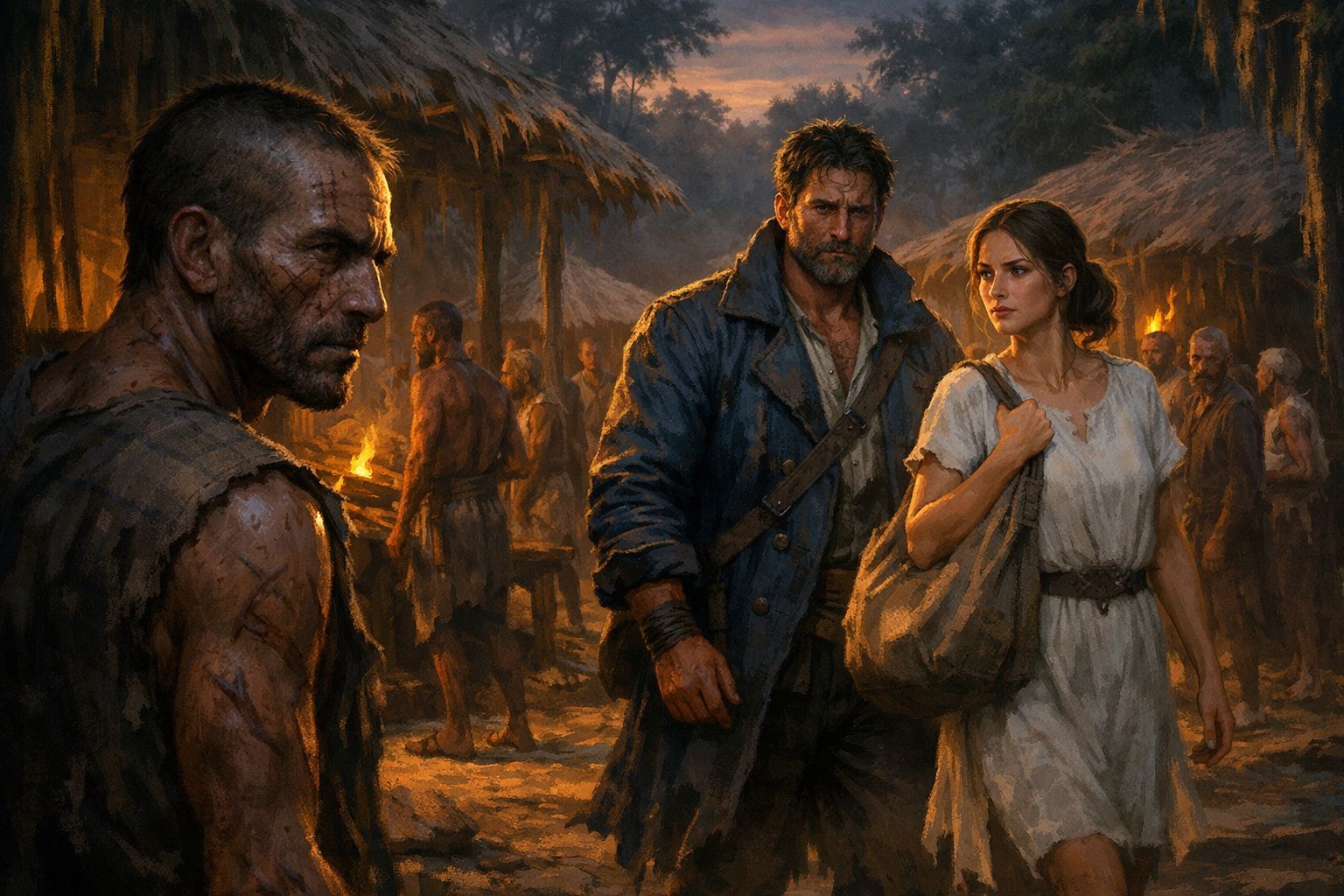
Varethul reads differently on return. The same inverted hospitality now feels like a social mechanism. The same calm faces now feel like faces that could hide more than doctrine.
Do not add new conflict here. Let the crew pass through under quiet observation.
If the crew wants to report the cult, the response is controlled and unsatisfying. Varethul accepts the report without visible reaction, as if it is not new interesting or not considered urgent.
Boarding the Blue Marlin
The crew boards the Blue Marlin and leaves. This is the clean mechanical end of the Ashkar segment.
Keep the departure beat simple. Sails go up. River smell fades. Varethul becomes a smear of green and gray behind them.
Tone of the Departure
Uneventful, Ominous, Unresolved
Nothing attacks them. No one follows in sight. The unease is that they have learned something they cannot categorize. The note proves an unseen hand is operating in parallel to their journey. The temple reflection suggests something older than Ashkar’s doctrine still persists. The cult bodies prove that belief can sharpen into violence with no warning.
End the return with forward motion and lingering questions, then move on to the next port.
Act Summary
The crew enters Ashkar following a faint lead that forces them off familiar social ground and into a culture where suffering is treated as duty and comfort is treated as spiritual danger. In Varethul they learn that ordinary compassion can be received as sabotage, and that the local kindness is sincere but aimed at converting outsiders into “correct living.” The crew’s search confirms that the Waverider crew moved inland along the Thornpath Route, and that they left the main path to reach an unknown jungle ruin.
The crew follows the Thornpath past pilgrims, shrines, and ritualized self-inflicted pain until they reach the ruin and confront evidence that Ashkar’s belief may rest on something older than Ishmael’s doctrine. The hacked away figure motif and the noon pool reflection leave a lingering suspicion that the faith is not merely harsh but possibly instrumental, a system that might be feeding something or hiding something. A violent fringe appears in the form of the Thorned God cult, confirming that belief can sharpen into organized violence even far from the Thornpath.
The arc ends with the crew leaving Ashkar with forward momentum restored. A message appears without a visible messenger, delivering the next Waverider port of call. The crew cannot prove who placed it, but the competence and timing reinforce a growing pattern: someone wants them to succeed and is willing to intervene invisibly to keep the expedition moving.
Key Takeaways
Next Waverider Port of Call Secured
The crew receives a clear, practical lead for the next expedition step.
“The next port you seek is Tseradun in Khazryn”
This transitions the campaign back into the main spine and prevents Ashkar from becoming a dead end.
Ashkar’s Culture Understood as a Social Mechanism
The crew gains working knowledge of Ashkar’s inverted morality and how it shapes interaction.
Suffering is treated as duty, not spectacle.
Comfort is treated as corruption, and offering comfort can be interpreted as spiritual harm.
Hospitality is offered as shared inconvenience rather than relief.
Pressure is communal and calm, expressed through pity, warnings, and quiet consensus rather than overt threats.
This is a practical toolkit for future diplomacy and travel in cultures where the crew’s instincts can backfire.
Suspicion of a Deeper Truth Behind the Religion
The ruin reframes Ashkar. The hacked away central figure motif implies deliberate erasure, and the noon pool reflection suggests something inhuman remains present in some form. The Thorned God cult adds a second signal that the faith may contain hidden layers or distortions, either as a fringe exploitation or as part of a larger mechanism.
The crew does not leave with proof. They leave with an unresolved dread and a new lens for interpreting Ashkar’s rituals.
Further Evidence of an Unseen Ally
The note on the path is a direct intervention. It arrives with no tracks and no visible messenger, and it provides exactly what the crew needs at exactly the right time. This strengthens the ongoing campaign thread that someone, later to be revealed as Samden, is shaping their progress from the shadows.
Key NPC Outcomes
Halvek
Halvek confirms the Waverider crew’s inland route and their diversion to the ruin, then leaves the crew with a quiet, unresolved shift in his certainty. He is not converted, but he is no longer as cleanly convinced as he was.
Mother Sarakai and Varethul Locals
Ashkar’s official face remains calm and controlled. The crew’s passage is observed, evaluated, and absorbed without visible panic. The crew leaves without public closure, reinforcing the sense that Ashkar’s system is designed to contain disturbance rather than resolve it openly.
End State
The crew departs Ashkar with the next port of call in hand, cultural lessons learned, and a sharpened suspicion that Ashkar’s faith may be masking something darker. They also carry a reinforced pattern of invisible help, suggesting the expedition is being guided toward success by someone who refuses to be seen.
The coastline slid away in slow pieces, mangrove shadow, wet stone, then only green haze under a low sky. The Blue Marlin held steady on the river’s breath until the water tasted less like rot and more like open distance. Behind them Varethul was already gone, not because it was far, but because the jungle swallowed its own edges.
Junia stood at the rail with both hands on the wood as if the ship’s steadiness could be borrowed. Her eyes were fixed on the last smear of green, but her thoughts were still in stone darkness and red water.
Scarnax came to stand beside her without announcing it. He did not lean, did not relax. He watched the line where shore became fog and measured it the way he measured weather.
After a while Junia spoke, voice low. "That pool. The face. The horns. What do you think it was?"
Scarnax did not answer immediately. He let the question sit, because any fast answer would have been a comfort. "I think it was something someone tried to forget," he said at last. "And I think forgetting failed."
Junia’s fingers tightened on the rail. "The reliefs were all aimed at it. Every cut, every act of pain, all toward that one thing. Like feeding an altar." She swallowed. "What if the whole country is doing it, and they do not even know they are doing it?"
Scarnax’s mouth tightened. "Or they know, and they call it virtue."
Junia shook her head once, sharp. "Most of them did not feel like monsters. They felt… kind. Like well meaning missionaries. They looked at us the way you look at a child about to touch a stove." Her voice went thin. "If that kindness is built on a lie, then what are they saving, and what are they feeding?"
Scarnax’s gaze stayed on the receding shore. "People can be kind inside a cage and still keep the door closed," he said. "If the cage is called faith, they will defend it harder."
Junia stared at the water sliding past. "Halvek did not know. He had walked that path his whole life. If he can be blind, they all can."
Scarnax gave a slow nod. "Blindness is useful. It makes a machine run without anyone asking what it costs."
For a moment they listened to the ship. Rope creak. Sailcloth shift. The steady push of water along the hull. The familiar sounds felt like proof that not everything was wrong.
Junia’s voice softened, not comforted, just tired. "If they are feeding something, it is feeding on guilt. On fear. On the idea that suffering makes you clean." She looked sideways at Scarnax. "And if that is true, then we did not just pass through a strange country. We passed through a trap that thinks it is mercy."
Scarnax’s eyes flicked toward her, then back to the shore as it vanished. "We got what we needed," he said. "We got out. That is all I can promise."
Junia exhaled, a small sound that could have been a laugh in another place. "That is not a comforting promise."
"It is an honest one," Scarnax replied.