Campaign: Amazireth, Act 2
Act Synopsis
Premise And Tone
Act 3 turns the crew’s outward violence back inward. After Ashimora, Thirvash Hollow, and the burning of Eshkar, the crew returns to Amazireth expecting a routine handoff and a promised reward. Instead, the cost of Amazireth’s ownership culture lands on someone the crew actually loves.
This act should feel like betrayal by normalcy. The city does not treat what happened as a scandal. It treats it as order.
Inciting Event: Silvio Taken
On return to Kethyris, other crew members meet them immediately with urgent news. Silvio was taken that morning in the harbor by his former mistress, an Amazon general who recognized him and dragged him away.
Witnesses are local dock workers and bystanders. Nobody can provide a useful name or address, and most speak as if the event was not even unusual. To them, a slave being reclaimed is not a crime.
Amaxia knows exactly who the mistress is and where she lives. The moment the crew hears it, the scene risks becoming a sprint. Let that urgency exist.
Institutional Wall: “Rightful Owner”
If the crew goes to the Queen, Harbor Watch, or any local authority, they meet the same posture. Silvio is treated as property. The mistress is treated as a rightful owner. The crew is treated as outsiders trying to interfere with Amazireth’s internal order, and it is implied that pushing the issue might cause them to be seen as thieves.
No one is overtly malicious. They are simply certain.
Confrontation At Thessa’s House
The crew reaches the mistress’s home. She is named Thessa Vael of House Arkeion. She is flippant, contemptuous, and unafraid. She calls Amaxia a fake Amazon and a traitor. She refuses negotiation.
Thessa has blood spatter on her clothing and skin. She makes no effort to hide it. The implication is clear: whatever happened inside is not something she considers shameful.
Discovery: Silvio’s Death
Whether the crew enters by force or subterfuge, the outcome is the same. They find Silvio dead.
He is hanging by his hands from a frame. His feet and knees are crushed. His body is bruised and broken. Nearby are three bloody clubs, strongly suggesting Thessa and her twin daughters, both sixteen, were involved.
This is the emotional detonation of the act. The crew’s mission violence in Srel was framed as necessary. This violence is framed as normal.
The Moral Problem: Thessa And Her Daughters
Thessa and the daughters are present in the house. The crew will want revenge. The daughters complicate it. They may be willing participants, indoctrinated, or coerced by an abusive mother. The crew must decide what justice looks like when the perpetrators include children shaped by the system.
Do not force a single outcome. Let the table choose.
The Audience And The Reward
When the crew returns to Queen Selkara to report on the Sreli raid and the burning of Eshkar, Selkara already knows what happened at Thessa’s house.
She does not condemn it. She reads it as strength. She gives the promised Waverider port of call, then commends Amaxia for showing the kind of resolve Amazireth respects.
This closes the loop of the arc’s theme. In Amazireth, demonstrated strength, even if brutal, is not a scandal. It is a credential.
Closure: Departure And Burial
The Blue Marlin leaves port carrying grief. The crew holds an emotional burial at sea.
The arc ends with the quiet weight of loss and the knowledge that the Waverider lead was purchased with something that cannot be recovered.
Return to Kethyris and Bad News
| Story |
|---|
| The skiff scraped against the familiar dock timbers of Kethyris and for a heartbeat it felt like the mission had ended where it was supposed to end. Salt, stone, ordered noise. A place that pretended it was stable. The harbor lights were still up, pale against the morning glare, and the city looked clean from the water in the way it always did, like it could wash anything away if it refused to look. |
| Skarnulf was waiting before they even had both feet on the planks. He did not stroll. He did not lean. He was standing with his hands half raised like he had started running, stopped, then realized he could not afford to waste another breath. Sweat darkened his collar. His chest rose and fell too fast for a man who usually carried himself like weather. |
| “Amaxia,” he said, and the relief in his voice turned into something sharper. “Listen.” |
| Amaxia’s posture changed at once. She had not even unshouldered her gear, but her eyes narrowed, reading him. “What happened.” |
| Skarnulf swallowed. “Silvio. He was taken. This morning.” |
| The words landed wrong, like a sentence spoken in the wrong language. For a moment the harbor noise seemed to tilt. Ileena’s ears pricked and her gaze snapped past Skarnulf, scanning the docks as if the boy might still be visible between crates and ropes. |
| Scarnax spoke carefully, as if careful words could keep the world from tipping further. “Taken by who.” |
| “We did not see it,” Skarnulf said, frustration and guilt twisting together. “We only learned hours later when we started looking for him. A dock worker finally told us. Said his owner spotted him, grabbed him in front of everyone and dragged him away like it was nothing. Like the harbor was hers.” |
| Amaxia’s face went hard, then colder still. “Thessa Vael.” |
| Skarnulf blinked once, then nodded fast. “You know her.” |
| “I know her,” Amaxia said. “Even better, I know where she lives, and where she will die.” |
| She started moving immediately, not walking so much as deciding the world would have to get out of her way. Skarnulf fell in beside her without hesitation, panic turning into purpose the moment he had a direction to run toward. |
| “The crew is spread out,” he said as they moved. “Some are still searching the dock district, some went up toward the lower markets. I told them to keep looking, but I came here in case you returned.” |
| “Good,” Amaxia said. Her voice was tight with something that was not grief yet because she had not allowed herself that. “We go now.” |
| Scarnax reached out and caught her forearm, not stopping her, just anchoring her for a fraction of a second. “We should have a plan first.” |
| Amaxia turned her head just enough for him to see her eyes. They were bright, not wet, like a blade catching light. “Then you better plan fast,” she said. “Then we kill the bitch.” |
| Ileena walked a step behind, quiet, thinking. Her tail gave one slow, deliberate sweep. “This,” she said at last, as if choosing a tool from a rack, “requires the tiger paint.” |
| Amaxia did not slow, but a sharp humor flickered across her mouth like a spark that refused to become warmth. “Fine,” she said. “Battle paint is a plan, then we go get the kid.” |
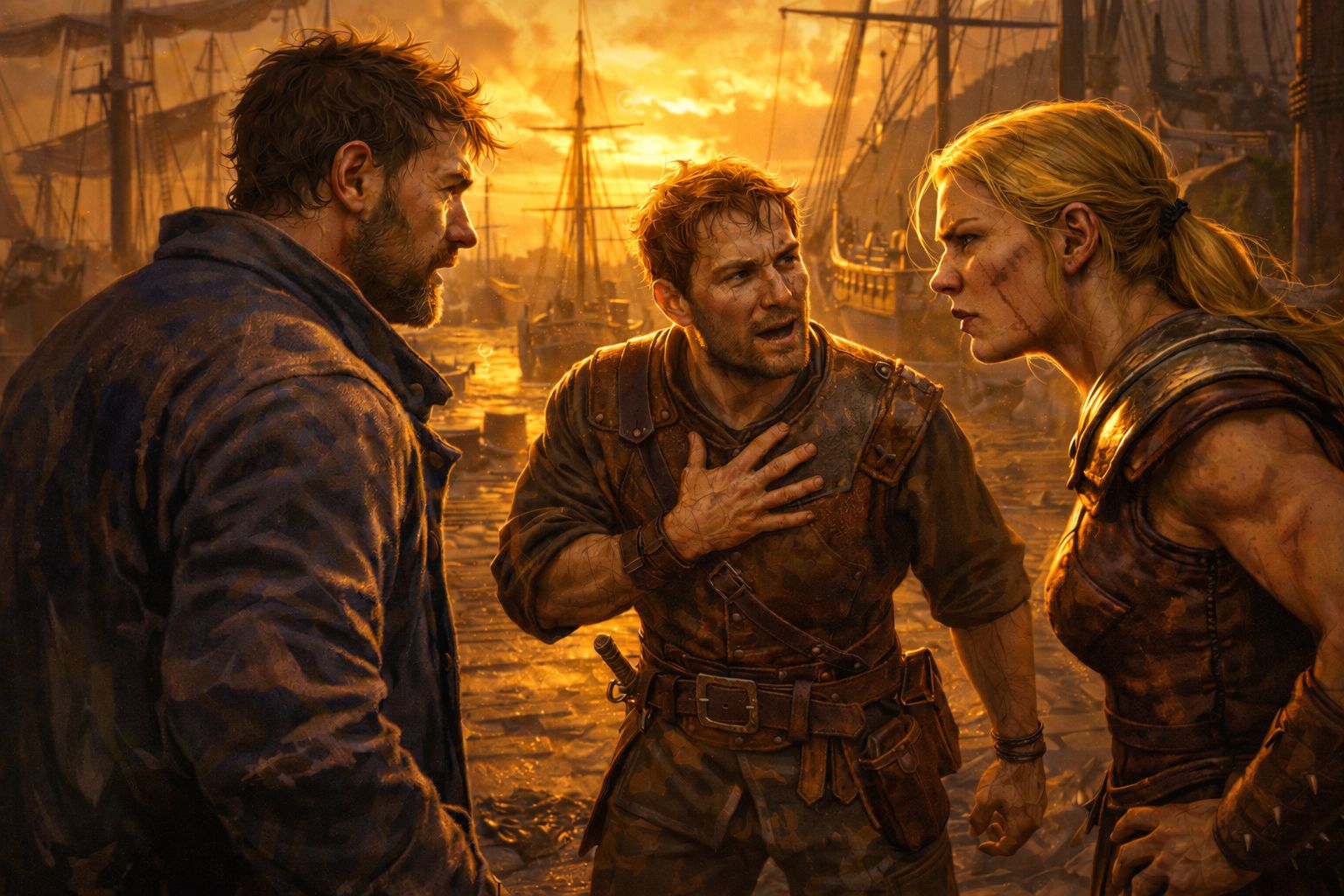
This breaks the false relief after Eshkar and forces an immediate choice. The crew expected a simple report and reward. Instead, the city reminds them what Amazireth considers normal.
The Message
As the crew returns to Kethyris, they are met at the docks by a breathless runner from the Blue Marlin, bringing urgent news.
Silvio was taken earlier that morning in the harbor by his former owner, Thessa Vael of House Arkeion. The witnesses are locals, and the story is delivered with the casual certainty of a society where reclaiming property is not considered a crime.
What Amaxia Knows
Amaxia recognizes the name immediately. She knows exactly who took Silvio and where Thessa lives. This turns a vague search into a direct line, and it also spikes emotion. The scene wants speed, anger, and urgency.
The Crew Is Scattered
The Blue Marlin crew has already reacted, but without coordination.
- Some are searching the dock district, asking dockhands and watching the gates.
- Some have pushed into markets and side streets, trying to follow rumors.
- Some may be running to authorities or contacts, wasting time on dead ends.
Gathering everyone for a full scale operation will take time, and time is the enemy here. The immediate pressure is whether to move fast with whoever is present, or to slow down to assemble strength and a plan.
End Note
Run this section as momentum. The goal is not to solve a puzzle. The goal is to make the table feel that delay costs lives, and that acting now means acting imperfectly.
Institutional Wall
| Story |
|---|
| They found the guard office where the dock district bled into the first clean streets of Kethyris, a white stone arch with a spear crest above it and two sentries standing in shade like statues. |
| Inside, the air smelled of ink, oiled leather, and heat trapped in stone. An Amazon officer sat behind a desk with a slate board and a stack of forms. She looked up as they entered, not alarmed, not hostile, just mildly impatient, like a person interrupted mid task. |
| Her name, on the small bronze plate, read Lykara Dathen. |
| Amaxia stepped forward fast, too fast to be polite. Scarnax stayed half a step behind, watching the sentries, watching the officer’s hands. |
| “Our crewman was taken,” Amaxia said. The words came out tight. “A young man. Silvio. He was dragged from the harbor this morning. We need you to help us get him back.” |
| Lykara blinked once, then tilted her head. Genuine confusion, not pretense. |
| “Taken,” she repeated. “By whom.” |
| “Thessa Vael,” Amaxia said. The name was a knife. “She found him and reclaimed him.” |
| Lykara’s brow furrowed, as if Amaxia had just described something ordinary and then called it strange. “Then I do not understand. If he belongs to Thessa, she reclaimed a runaway. That is her right.” |
| Amaxia’s mouth opened. Something sharp rose behind her eyes, anger and urgency tangled together. |
| “He doesn’t belong to her,” she started. |
| Lykara lifted a hand, palm out, not as a threat but as a procedural stop. “How did he come to be with you, then.” Her voice stayed even, almost curious. “If he is Thessa’s property, by what claim do you say he is yours.” |
| Amaxia stared at her. For a heartbeat it looked like she might lunge across the desk just to make the world change shape. Her hands flexed at her sides. |
| “We freed him,” she said, forcing the words through her teeth. “He is not property.” |
| Lykara’s expression did not harden. It simply failed to connect. “Freed,” she echoed, like a word from a foreign tongue. “There is no freeing someone else’s slave in Kethyris. There is theft, there is purchase, there is transfer. If you took him, you took him.” |
| Amaxia’s breath hitched. She leaned forward, voice rising despite herself. |
| “You don’t understand,” she began. “He is one of us. He is...” |
| Scarnax moved. |
| He put a hand lightly on Amaxia’s arm, the same kind of touch he had used before, a reminder and a restraint. He leaned in, not to the officer, but to Amaxia, and spoke low. |
| “We are not getting help here,” he said. “Come on.” |
| Amaxia’s jaw worked. Her eyes stayed on Lykara for a moment longer, as if trying to force her to become a different person. Lykara just watched back, waiting for the next form, the next normal problem. |
| Then Amaxia snapped her gaze away. She turned, sharp and controlled, and Scarnax guided her out before her fury could turn into something the city would happily punish. |
| Behind them, the officer called after them, still puzzled, still polite. |
| “If you have proof of purchase,” she said, “bring it. Otherwise I cannot intervene.” |
This section exists to keep the table in world while steering them away from a time sink. The crew can ask for help, but the city’s legal framework is built to make that help impossible.
The Core Legal Reality In Amazireth
In Kethyris, slavery is lawful and ordinary. Ownership is treated as a property right backed by custom, courts, and force.
A runaway being reclaimed is not treated as kidnapping. It is treated as recovery of property.
A foreign crew claiming “we freed him” does not map to any recognized legal category. It does not create rights. It creates suspicion.
What Authorities Actually Hear
When the crew asks the Harbor Watch, the City Guard, or any office for help, the request is translated into Amazireth logic.
- A lawful owner reclaimed her slave.
- Foreigners are attempting to interfere.
- If the foreigners insist the slave is “theirs,” the authorities hear theft or illegal possession.
- If the foreigners insist the slave is “free,” the authorities hear nonsense, ideology, or provocation.
This is not malice. It is certainty. The system is not confused. The crew is simply speaking a language the system refuses to recognize.
Why Amaxia Cannot Fix It Through Status
Amaxia’s Amazon status affects how she is spoken to, not what the law becomes. In this case, her authority makes the situation worse in one specific way.
If she argues loudly, she risks being framed as a traitor to Amazireth norms.
If she demands intervention, she forces officials to choose between protecting “order” or indulging a public challenge.
The safe institutional move is always the same. Shut it down, cite ownership, and treat the crew as trouble.
The Paper Wall
If the crew presses for procedure, they will be offered procedural dead ends.
- Bring proof of purchase.
- File a claim.
- Wait for a hearing day.
- Speak to a magistrate who is not currently available.
- Produce witnesses willing to testify against an Amazon owner.
Every step consumes time and produces nothing, because the legal assumption is that Thessa’s claim is valid until proven otherwise, and proving otherwise is designed to be unrealistic for outsiders.
How To Run It At The Table
If the crew tries to go down this path, give them one clear scene with an officer or clerk.
Make the refusal calm, procedural, and repetitive.
Let the crew feel the trap: the more they argue, the more they sound like thieves.
Then offer the obvious exit. The only path that matters is direct action at Thessa’s house, with speed, secrecy, or force, depending on what the players choose.
The point is not to punish the crew for caring. The point is to show that in Amazireth, the law is not a neutral tool. It is the voice of ownership.
At Thessas House
| Story |
|---|
| Thessa Vael’s house sat back from the street behind a low wall of pale stone, with a gate that did not bother to lock properly because it did not believe anyone would test it. The lamps outside were lit more for display than for safety, throwing warm light onto clean masonry and a door carved with a family crest that looked like it had never been touched by desperate hands. |
| Amaxia went straight to that door like it had personally insulted her. Skarnulf hung half a step behind, still breathing too fast, eyes flicking between windows and roofline. Scarnax said nothing. He watched Amaxia’s hands and the set of her jaw, measuring how close she was to doing something irreversible. |
| Amaxia struck the door with the heel of her fist. Once. Twice. Hard enough that the sound carried down the street and made a nearby dog start barking. When no one answered fast enough she hit it again, and the wood shuddered in its frame. |
| The door swung open with a lazy jerk. Thessa filled the doorway like a challenge, hair loose, eyes bright with drink. She wore a loose tunic that was obviously expensive. Now it was stained. Dark spatters across her chest and throat, a smear along one cheek as if she had wiped her mouth with the back of her hand and missed. |
| She looked at Amaxia and smiled as if she had been gifted a joke. |
| “Amaxia,” Thessa said. The name came out slow, savoring the sound of it. “I thought you were still hiding behind men on a foreign deck.” |
| Amaxia did not give her time to build momentum. “Hand him over,” she said. “Silvio. Now.” |
| Thessa blinked once, then laughed. It was not loud. It was casual, like the sound a person makes when they are amused that someone else is confused about something obvious. |
| “That scrap,” she said. “That worthless little thing is not your concern.” |
| Amaxia took one step closer, forcing Thessa to lean back a fraction without meaning to. “He is crew,” Amaxia said. “He is under my protection.” |
| Thessa’s smile widened, and something sharp moved behind it. “Protection,” she repeated, then spat the word out like it tasted bad. “You mean ownership, but you are too soft to say it. That is why you failed. That is why you got taken.” |
| Skarnulf’s hands curled, then unclenched. His face tightened. Scarnax shifted his weight, ready for the moment this turned from speech into motion. |
| Amaxia’s voice dropped. “Open the door wider,” she said, “or I will.” |
| Thessa leaned on the frame as if she had all the time in the world. “Do you hear yourself,” she said, eyes glittering. “You come back wearing foreign dirt and make demands like you are still an Amazon worth listening to. You are a disappointment dressed in borrowed strength.” |
| Amaxia’s breath came out through her nose, controlled, but it was control like a lid pressed down on boiling water. “Last chance,” she said. “Move.” |
| Thessa laughed again, softer this time, and her gaze flicked over Amaxia’s shoulder to the others. “Look at you,” she said, voice turning crueler, deliberately ugly. “A failed Amazon with pets and strays. Go back to your ship. Go back to pretending you have a place.” |
| Ileena’s voice cut through the doorway like a blade drawn cleanly. “Enough talk.” |
| Amaxia did not hesitate. She shoved forward, shoulder into Thessa’s space, not striking her but taking the ground. Thessa stumbled a step backward, more surprised than hurt, her laughter breaking into an angry breath. |
| The threshold was crossed. The choice was made. Skarnulf and Scarnax moved in after Amaxia, and Ileena followed, quiet and certain, as the door swung wider behind them and the house swallowed them into lamplight and blood. |
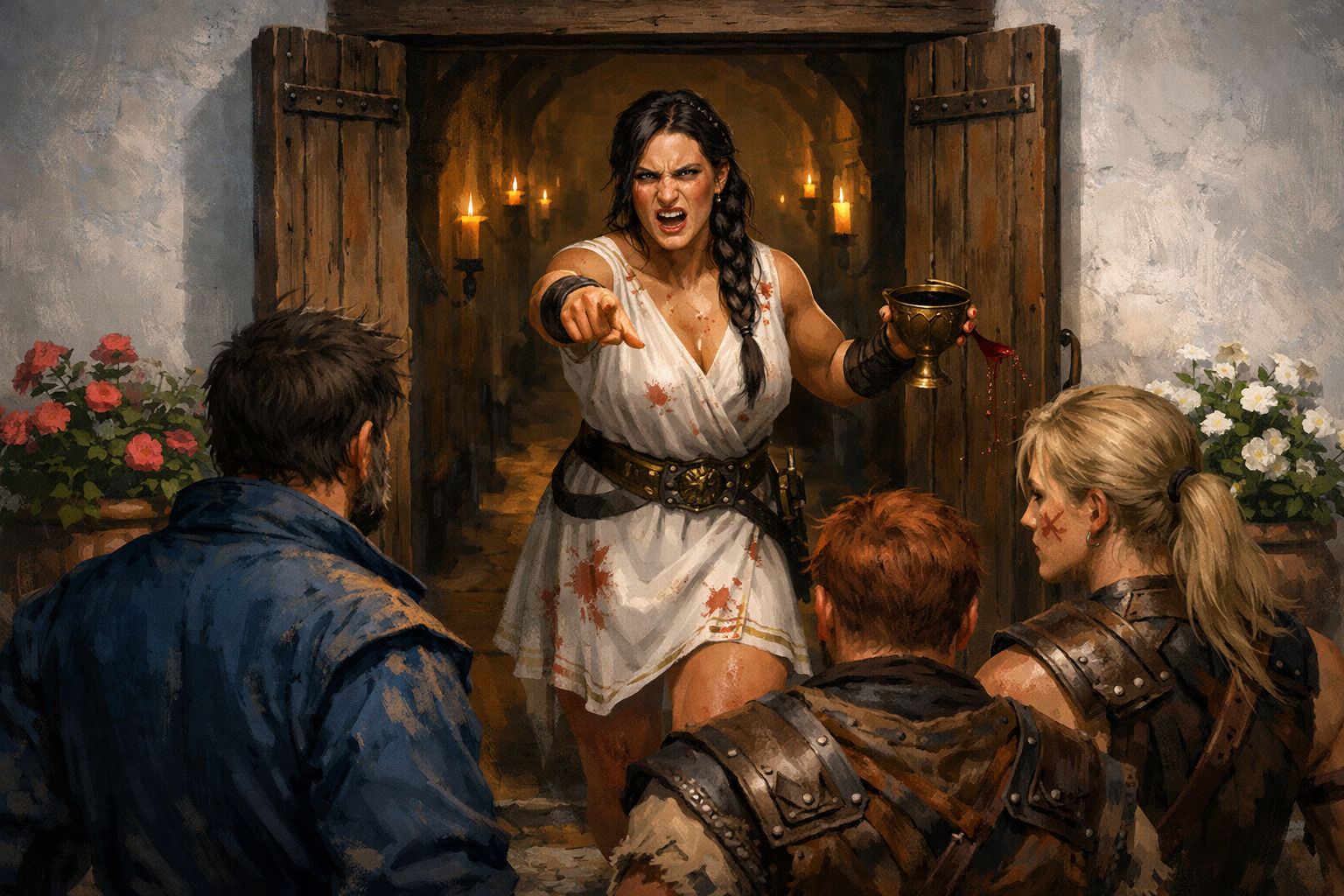
This scene is the emotional detonation of the act. It is not a whodunit and not a fair fight. It is the moment where Amazireth’s ownership culture stops being atmosphere and becomes personal loss.
Arrival At The Door
Thessa Vael answers the door herself.
She is notably drunk, but not falling over. Her speech is sharp, her mood is loose, and her judgment is sloppy. She has blood spatter on her clothes and skin, and she shows no embarrassment about it.
Her posture is arrogant, and she looks down on the crew as outsiders and on Amaxia as a failed Amazon. She is unarmed except for a dagger on her body.
If the crew threatens her, she mocks them.
If the crew pushes past her, she does not physically stop them. She assumes status will protect her more than force.
What She Does While They Enter
Thessa will talk and posture, trying to keep control through contempt. She does not call for guards. She does not flee. She does not understand the danger she is in.
Her daughters are not visible at this stage.
House Layout And Tone
The house is built around a central open atrium, square in shape, with rooms opening off the atrium on all sides.
A short corridor from the front door leads into the atrium.
There are several slaves inside the house. They do not run. They do not cry out. They vanish into corners, closets, and side rooms with a practiced smoothness that implies this is normal. Their silence should feel trained.
The Atrium Reveal
| Story |
|---|
| The corridor was short, the kind of corridor meant to make a house feel larger than it is. Lamplight pooled on pale stone. The air smelled of wine and something else underneath. Amaxia went first, fast, as if speed could keep the world from changing. Skarnulf followed with his hands half raised, ready to grab, ready to steady, ready to do anything that would make this not true. Junia came last, already afraid of what her eyes would have to accept. |
| The atrium opened suddenly, too wide, too bright, and the sight hit them like stepping onto a deck in rough sea. For a moment Junia’s balance went wrong, her stomach dropping as if the floor had tilted. Silvio hung in the center from a wooden frame, arms pulled up, shoulders ruined by the weight, head lolling at an angle that made the body look like a puppet abandoned by its strings. The skin was bruised in blooms and bands, dark and ugly. His feet were wrong, his knees wrong, the whole lower half a broken geometry. It took Junia a heartbeat to understand that the stillness was not shock or fainting, but absence. |
| Skarnulf made a sound that did not become a word. He took one step forward, then stopped as if the air itself was a wall. His face tightened, and it was impossible to tell if it was rage, grief or both. Junia’s hand rose on instinct, healer’s reflex, then froze in midair when her mind caught up. There was nothing to call back. Her eyes flicked to the table, to the neatly placed clubs, to the spilled wine, to the thrown one on the floor. The room was not only a death. It was time, and leisure, and someone in frustration deciding to stop only when there was no life left to beat out of him. |
| Behind them Thessa was still talking, voice lazy with drink, as if she were explaining a minor inconvenience. She called Silvio useless. She said he ran, so he earned pain. She laughed at the idea that anyone would care. She said Amaxia was a weakling and a traitor and always had been. Her words came and went like the buzz of flies, a sound without meaning, because the meaning was hanging in the center of the room and it had stolen the ability to listen. |
| Amaxia did not look back. She stared up at Silvio’s ruined arms and the slack line of his mouth, and the muscles in her jaw jumped once as if a tooth had cracked. When she finally spoke, her voice was low and flat, the way a blade feels cold before it cuts. |
| “No,” she said, and it was not denial. It was a promise that something in this house was about to end. |
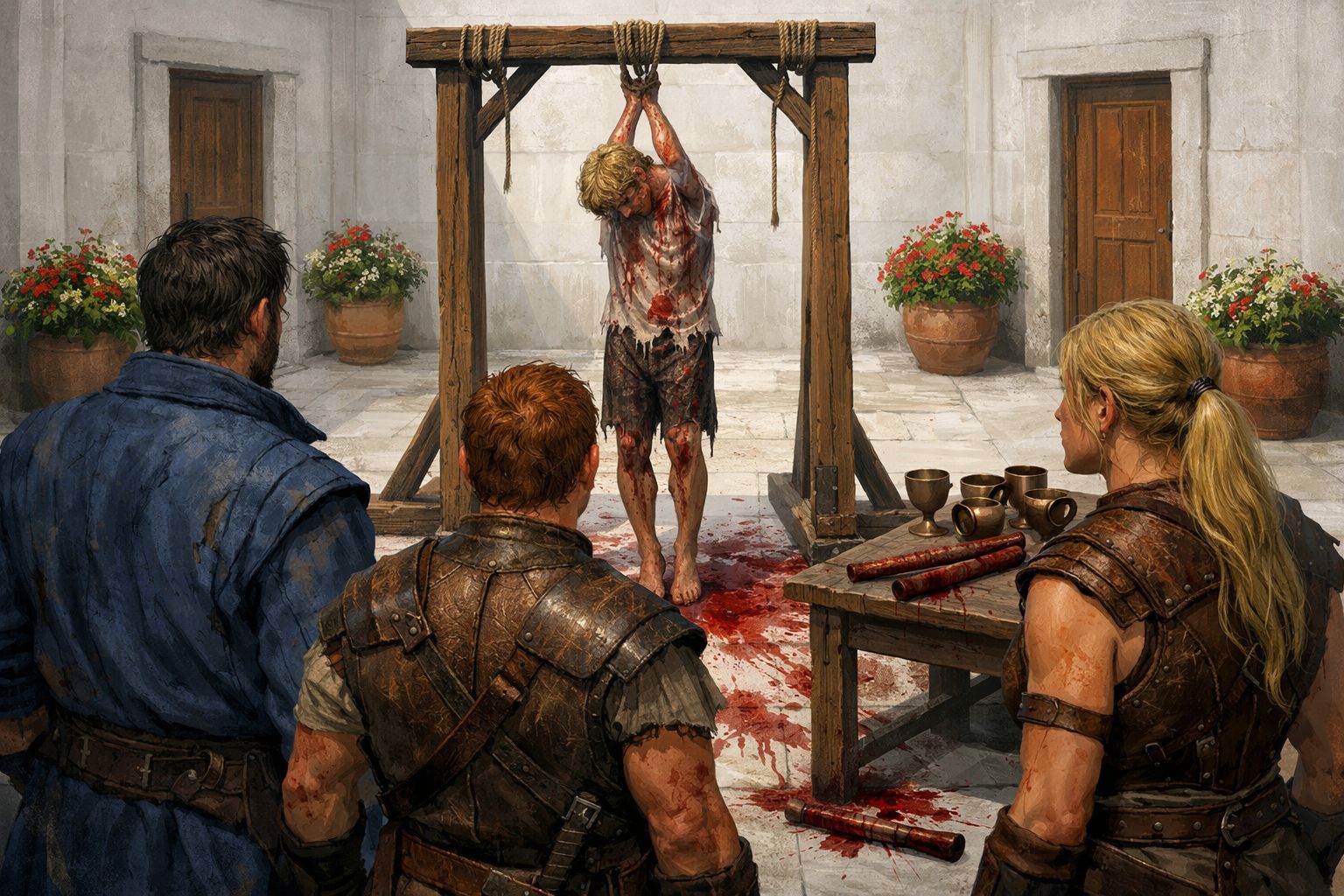
In the atrium, a frame stands in clear view.
Silvio hangs from it by his hands. Lifeless. Not a staged display for outsiders, but a private act left because she lost interest in it.
On the floor is a bloody club thrown aside as if in contempt. On a table are two more bloody clubs laid out neatly.
Also on the table are many empty wine glasses and spilled wine.
The arrangement implies time. It implies the act was prolonged. It implies more than one person participated, and that two participants were less enthusiastic but still involved.
Let the table sit in the silence before anyone speaks.
Silvio’s Condition
Silvio is dead. His body is broken.
Feet and knees are crushed. One elbow is crushed. Bruises cover him, with heavy damage to the groin. His face is badly damaged.
If Junia is present, she can identify more: broken ribs, internal bleeding, and the pattern of repeated trauma.
The most disturbing point is this. There is no distinct killing blow. This was not an execution. It was prolonged venting. It ended when his body simply could not take more.
Thessa’s Attitude
Thessa is flippant.
She frames Silvio as an escaped slave who received what he deserved. She calls him useless. She does not show regret. She does not understand why the crew is angry. She treats their outrage as foreign sentimentality.
She continues to needle Amaxia, and refers to the crew as pets, strays, or stolen property.
If Violence Starts
Violence is likely, and you should be ready to run it cleanly.
Thessa is not a tough enemy.
She was once competent, but she is now a general, softened at the edges by rank and habit. The wine makes her slower and more reckless. She carries only a dagger unless the crew gives her time and space to reach a sword.
Run her as arrogant and reactive. She expects to win by status, and when that fails, she fights dirty.
The Daughters Enter
| Story |
|---|
| Footsteps came from the corridor, light and unhurried, the sound of people who expect to find a normal night. The twins appeared in the atrium doorway with wet hair and clean tunics, smelling of soap and oil that could not quite cover wine and blood. |
| They looked at the strangers first, curious, mildly annoyed at being interrupted. Then their eyes found the frame and the hanging body, and the reaction was wrong. Not horror. Not shame. One blinked, as if surprised it was still there. The other frowned at Junia’s face. |
| “Why are you making that look,” she asked, honestly puzzled. “It was a slave.” |
| Amaxia’s voice came out as a low growl. “You helped.” |
| The girls traded a quick glance, then shrugged the truth like it was ordinary. “He ran,” one said. “He got what he deserved.” |
| “Why the fuss over a slave,” the other added, her tone turning sharp with contempt. |
| Ileena shifted into view beside Junia, quiet, eyes narrowed, watching the twins the way a hunter watches animals that have never been chased. |
| Amaxia took a single step, not even toward them, just forward, and both girls recoiled as if a chain had snapped. They backed up, hands raised defensively, not ready to fight, only ready to resist the one fate they actually feared. |
| “We’ll die before becoming slaves,” one spat, chin high. “We are Amazons.” |
| “We are not owned,” the other echoed, more bravado than courage. |
| The atrium went still. Junia could not speak. Skarnulf’s hands trembled at his sides. Amaxia stared at them like she was trying to decide if they were children or enemies. |
| No one moved, because any movement would become a choice that could not be taken back. |
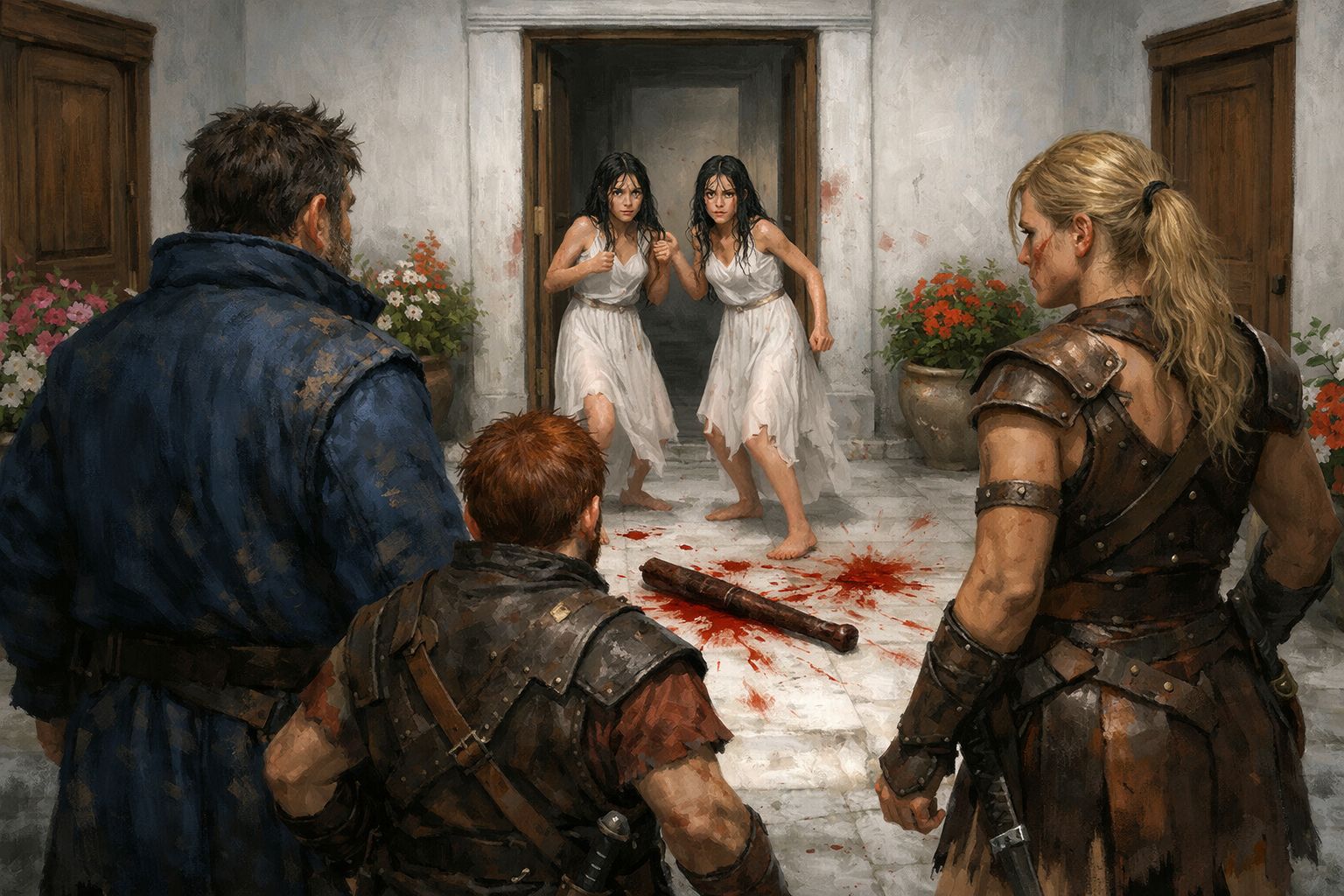
Her daughters do not appear until a fight starts or a loud confrontation erupts inside the house.
They are twins, fifteen, and lightly drunk.
Their hair is wet and their clothes are fresh, suggesting they recently washed and changed after what happened.
They do not rush to fight. They back away, but they carry their mother’s attitude. They speak like young Amazons who have learned bravado before they have learned consequences.
They do not perceive death as the likely outcome. They perceive enslavement as the threat.
Expect lines like:
- “We’ll die before we are owned.”
- “We are Amazons.”
This is not courage. It is indoctrination and panic dressed as pride.
If they try to defend their actions, they'll say that it was their mother's slave, and they actually didn't want to do it, they had other things to do. They don't see it as wrong, they just see it as something they were told to do.
The Moral Dilemma
The daughters are mid teens, and it is plausible they were pressured or forced into participation by their mother. They are also not true combatants, even if their training has begun.
However, they also do not believe they did anything wrong. In their worldview, a male runaway slave has no worth and no rights. They show no remorse. They are not likable.
This places the crew in a decision that will not feel clean.
Mercy risks letting indoctrinated cruelty walk away without consequence.
Killing risks executing children shaped by a system, possibly coerced, who still do not understand the stakes.
Do not dictate the “correct” choice. Make sure both options have weight, and let the table own what they decide.
Trying to sneak away from the decision by letting the authorities handle it will simply mean that the authorities get their side of the story, and will side with them. In the eyes of the law, a slave is property.
The Audience and the Reward
| Story |
|---|
| Selkara’s hall was the same disciplined silence as before, polished stone and controlled firelight, with men moving along the edges like furniture that had learned to breathe. The court watched the returning crew with the calm interest of people waiting to see if a tool still worked. |
| Selkara did not let them set their own frame. |
| “I noticed your visit to General Thessa Vael,” she said, as if commenting on weather. |
| Amaxia’s shoulders tightened. “Your Majesty, we did not come to cause trouble, we came because she took one of ours and she…” |
| Selkara lifted a hand, and the interruption was so effortless it felt like gravity. |
| “No need to explain,” she said. “You solved it like an Amazon. She was weak, and frankly, I found her annoying.” |
| Amaxia’s mouth closed. The words she had prepared had nowhere to land. Scarnax did not move, but his eyes flicked once across the room, taking the temperature of every face that had just heard a murder treated as housekeeping. Ayesha stood silent, balanced, evaluating the unexpected turn. |
| Selkara leaned forward slightly, as if the earlier subject had already bored her. |
| “Now,” she said, “your mission. My scouts saw the ruckus you caused. Good. It will not stop the Sreli fanatics for long, but it will remind them that Amazireth is not free to bleed. There is a price. Even if they think they are chosen by the gods, they bleed.” |
| She named the next port of call for the Waverider without ceremony, like paying a debt that had never been emotional to begin with. |
| Then her eyes drifted, almost lazily, toward Mbaru. The corner of her mouth moved, not quite a smile. |
| “And,” she said, “have you changed your mind?” |
| Amaxia did not even glance at him. Her voice was flat. |
| “No. He is still my private toy.” |
| Selkara laughed, a full sound that carried across the hall and made a few of the armored women laugh as if amused despite themselves. |
| “Either way,” Selkara said, “you have redeemed yourself. You are again considered an Amazon.” |
| Amaxia’s face twisted, not in gratitude but in something sharper. |
| “I do not need anyone’s validation,” she snarled. |
| She turned and walked out without bowing, and the others followed because in that moment there was nothing left to say inside a room that could make cruelty sound like praise. |
| Behind them Selkara’s laughter rose again, larger, delighted, and she spoke to her court like she had just won an argument. |
| “See,” she said. “She is a real Amazon now.” |
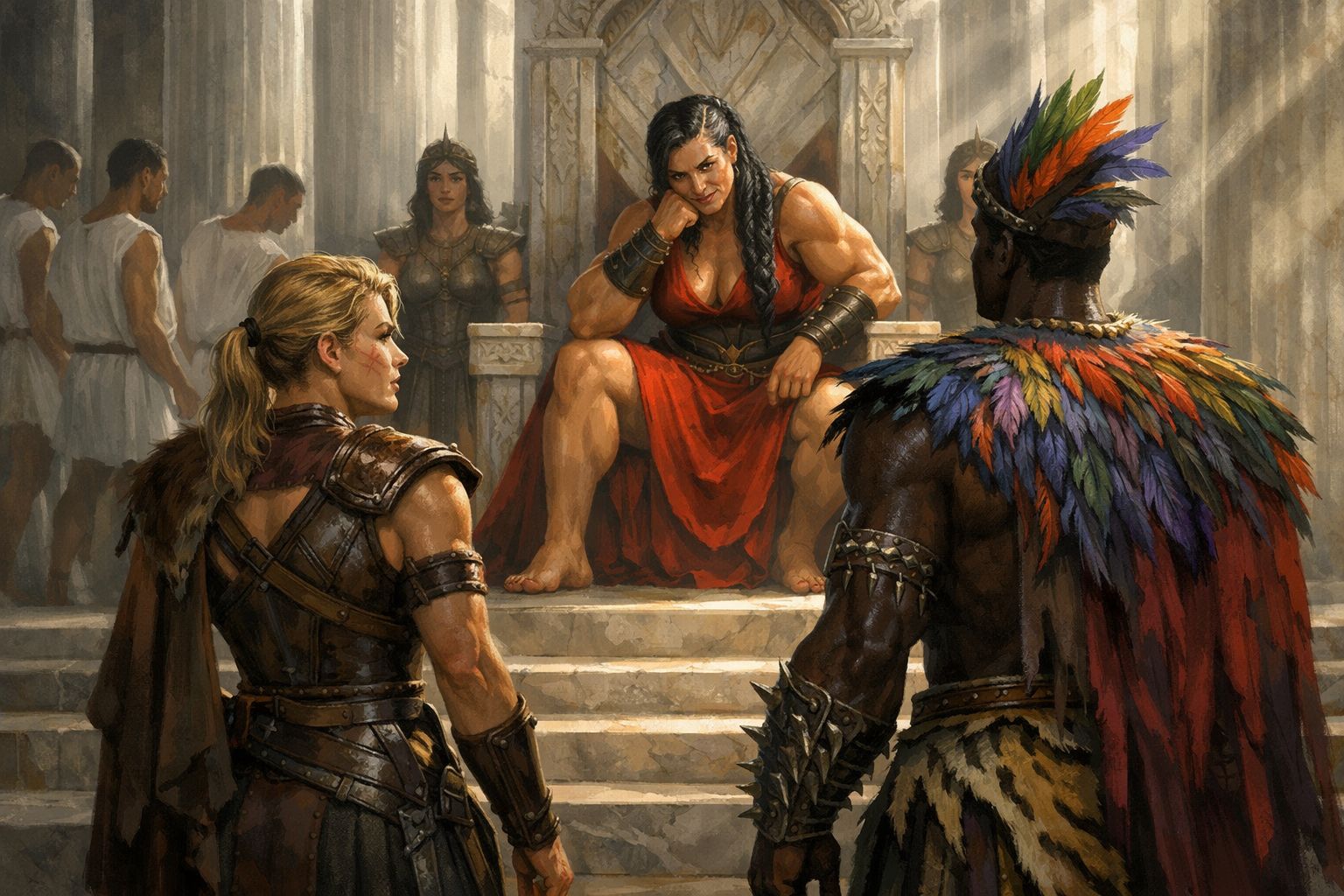
This scene is the payoff beat and the thematic sting. The crew comes in expecting judgment and bargaining. Selkara treats both the Srel mission and the Thessa incident as simple measures of strength.
Selkara And Thessa
Selkara holds no grudge against the crew for what happened at Thessa’s house. If anything, she reads it as a practical resolution.
She frames Thessa as weak, unstable, and politically inconvenient. The point is not that Selkara approves of murder. The point is that she approves of decisive control, and she does not value Thessa enough to pretend outrage.
If the crew tries to explain, Selkara cuts it off. Explanation is weakness in her court language.
Selkara’s Reaction To The Mission
Selkara is pleased with the sabotage in Eshkar. She knows it will not end Srel aggression, but she values the message.
Amazireth was struck. Amazireth struck back. The price is now public.
Play Selkara as satisfied, not triumphant. Her worldview is arithmetic.
Reward: The Port Of Call
Selkara delivers the promised information, the next port of call for the Waverider. She does it without ceremony. This is payment, not generosity.
Make the transfer clear and clean so the table feels the story move forward.
Amaxia’s “Redemption”
Selkara explicitly frames Amaxia as redeemed. She treats the Srel mission and the Thessa resolution as proof that Amaxia is again fit to be considered an Amazon.
This is not emotional forgiveness. It is a public declaration that Amaxia has demonstrated the culture’s required hardness.
If Amaxia rejects the validation, Selkara enjoys it. From Selkara’s perspective, defiance is part of the proof.
The Second “Borrow” Attempt
Selkara makes another attempt to borrow, buy, or trade for the male crew member she earlier asked about, framed as casual interest.
Run it as a probe, not a seduction. She is testing whether Amaxia’s authority is real. She is also testing whether the crew can be pressured through social dominance rather than force. Selkara is also testing whether the crew treats this as insult, comedy, or negotiation.
The exact phrasing can be playful, but the function is political.
Leaving
Selkara does not detain them. The crew is free to leave.
The court lets them walk out with the information because the transaction is complete and because Selkara believes she has already proven her point.
End the scene with motion. The crew has what they came for, they have a new lead to follow, and the emotional aftermath is now theirs to carry.
Departure and Burial
| Story |
|---|
| The sea was calm in the way it sometimes is after a storm, as if it had spent all its anger and now wants to pretend it was never there. The Blue Marlin moved with steady purpose, leaving Kethyris behind as a pale line of stone that refused to shrink fast enough. |
| They laid Silvio on a board near the rail, wrapped in sailcloth that still smelled faintly of tar and sun. Someone had washed the blood away, but not the damage. The cloth did not hide the fact that he was lighter than he should have been, like the world had stolen weight from him along with everything else. |
| Four drummers stood in a line. Three began a slow heart rhythm, steady and human, the sound of life insisting on itself. The fourth held his sticks and did not move. That silence was its own beat, the missing pulse that everyone felt but nobody named. |
| Scarnax stepped forward. He did not perform. He looked down at the wrapped body like he was forcing his eyes to stay open. |
| “Silvio was small,” he said. “Not in worth. In the way he moved. In the way he tried to take up as little space as he could, like the world would hurt him less if it noticed him less.” |
| He swallowed once. |
| “He was brave anyway. Not the brave of shouting and steel. The brave of waking up and doing it again. The brave of trusting us, even when trust was a stupid thing to do.” |
| The three drums kept their patient rhythm. The fourth drummer still did not strike. |
| Skarnulf stood closest, hands tight on the rail, knuckles pale. His face had that empty look people get when grief is too big to fit behind the eyes. When the board shifted, he flinched as if the motion itself hurt, then he leaned forward and pressed his forehead to the wood, breathing through clenched teeth. No words. Only the shape of a man breaking. |
| Junia stood a step back, very still, staring at the sailcloth as if waiting for it to rise and fall with breath. Her mouth was slightly open, but nothing came out. Shock had made her quiet in a way that felt wrong for someone who usually tried to help. Her hands were folded together so tightly her fingers shook. |
| Ileena moved without asking and wrapped her arms around Amaxia from the side, holding on like a tether. It was not gentle. It was solid, the kind of contact that says you need support, someone to hold on to. Amaxia accepted it without looking and laid an arm around Ileena. She stared out over the water with a hard fixed gaze, jaw set, face empty of tears. The anger in her was not loud. It was packed down, dense, like a weight she planned to carry until it could be used. |
| Pelonias did not try to hide it. He cried openly, shoulders shaking, wiping his face with the back of his hand and failing to stop the tears. Each breath sounded like he was trying to pull air through a wound. |
| Ormun sobbed, loud and without shame, sitting as if all strength had dried out of him, his face buried in Cassandra's hair. His tears made it wet, but she didn't even notice, as she held him close, like a child, her face buried in his neck. |
| When they lifted the board, the three drums kept beating. The fourth drummer stayed silent. |
| Scarnax nodded once, a small harsh motion. |
| “Sea,” he said, voice low, “be kinder than people were. You owe him that much.” |
| They tipped the board. The wrapped body slid and then was gone, taken by the dark water with a soft sound that felt obscene in its simplicity. For a moment there was only the rhythm of three hearts and one missing one, and the hiss of the ship cutting forward as if the world had places to be. |
| Nobody spoke. |
| The fourth drummer never struck a single beat. |
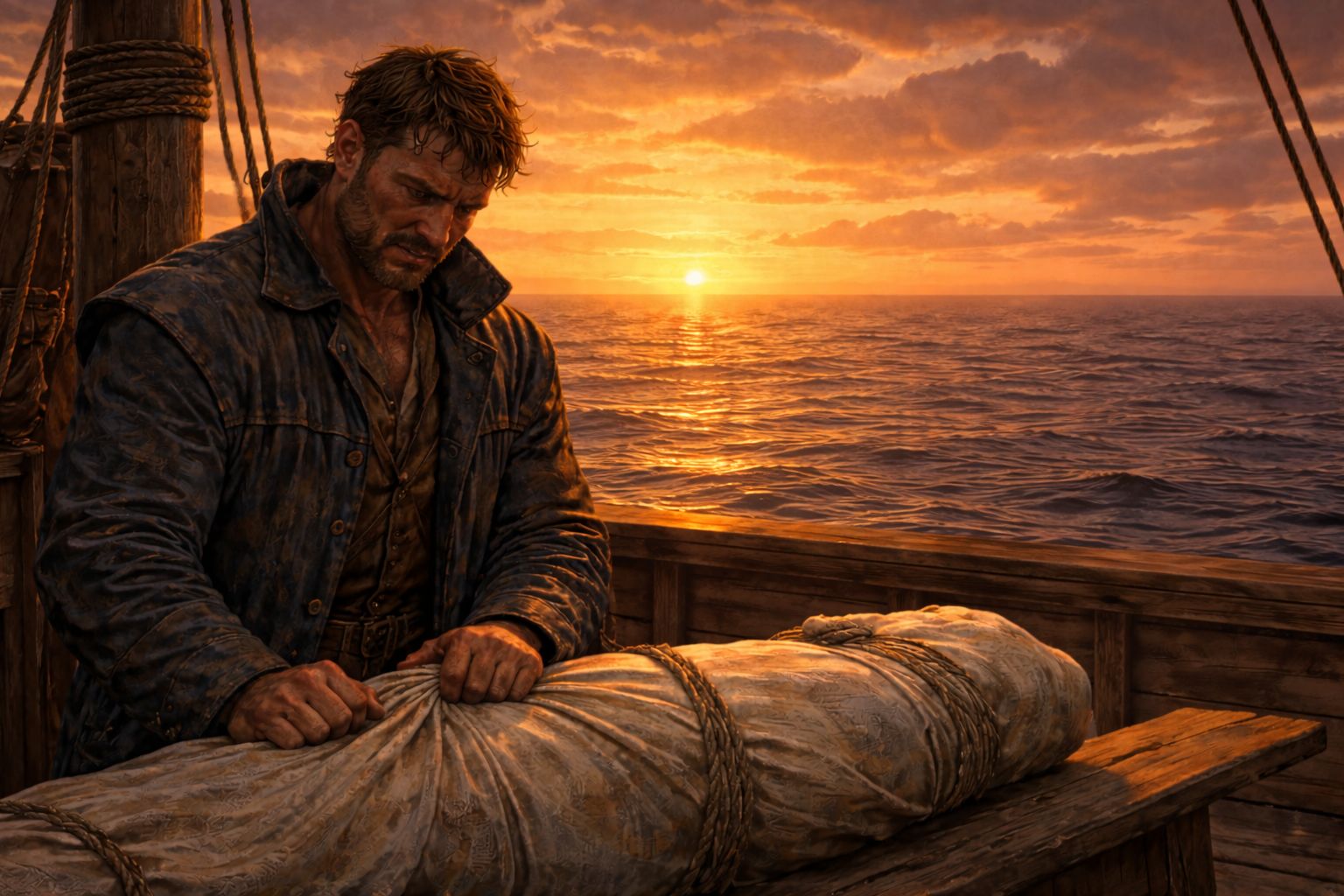
Burial At Sea
This is the release valve after the violence, and it should be allowed to be slow. Do not rush it. Keep the deck quiet, keep the sea calm, and let the crew’s grief be the only thing that feels loud.
Use the four drummers as the spine of the scene. Three play a steady heart rhythm. The fourth remains silent for the entire ceremony. Do not explain it. Let the table feel the missing beat.
Have Scarnax speak a few simple sentences. Avoid speeches. Make it personal, small, and true. The goal is not poetry, it is recognition.
Then lower the body into the sea. Make it one clean motion, no dramatic struggle, no last second interruption. The world does not stop for grief, and that is part of the pain.
Show reactions through behavior rather than dialogue. Skarnulf breaking. Junia in silent shock. Ileena holding Amaxia because she is closest. Amaxia staring hard at the horizon. Pelonias crying openly. Ormun sobbing without shame as Cassandra holds him steady. One or two details for each is enough.
End with silence. Let the three drums fade. Let the fourth drummer never strike.
Leaving Amazireth
The ship leaves without incident. No pursuit. No last confrontation. Kethyris recedes into jungle and distance, and the crew carries the weight with them.
Do not add complications here. The point is that grief does not come with closure, and the sea does not give answers. The only forward motion is the Waverider lead and the fact that the crew is still sailing.
Act Summary
This arc trades certainty for consequence. The crew comes to Amazireth for a lead, and they get it, but the price is written in bodies. The arc ends with forward momentum and a deep internal wound.
Silvio’s Loss
Silvio is gone, taken and killed in a way that is not heroic, not fair, and not meaningful in any noble sense. It is ownership culture made personal, and it leaves the crew with anger that has nowhere clean to go. His death should remain a reference point in later arcs, not as a plot hook, but as a scar.
Amaxia’s Standing
Amaxia is “redeemed” in the eyes of Amazireth. Selkara and the court read both the Srel retaliation and the Thessa outcome as proof of hardness and authority. Whether Amaxia accepts or rejects that validation, the culture has marked her as an Amazon again, and that changes how Amazons will treat her going forward.
The Waverider Lead
The crew leaves Kethyris with the next port of call. This is the clean mechanical gain of the arc, and it should feel almost cold in contrast to everything else. The Waverider chase continues, but the crew is no longer chasing it with the same innocence.
The Weight Of Blood
Ashimora, Thirvash Hollow, Eshkar, and the house in Kethyris stack into a single impression: too much blood, too much cruelty, too many nocents and innocents broken for someone else’s certainty. The arc reinforces that violence in this world does not resolve itself. It echoes.
The Hole In The Crew
Silvio’s absence is not abstract. It changes the ship’s social gravity. It leaves quiet spaces where a voice used to be, and it pulls at the crew in different ways: some get harder, some get quieter, some get reckless. Use the burial as the moment this becomes real, then let it linger as the ship sails on.
| Story |
|---|
| The sun was low and red, flattening the sea into hammered copper. The Blue Marlin cut through it without hurry, sails full, wake whispering. Amaxia stood at the rail with her forearms resting on the wood, gaze locked on the horizon like she could keep the day from ending by sheer will. |
| Mbaru leaned nearby, close enough to be company but not crowding her. His voice was quiet, as if he did not want the ship to overhear. |
| “You know I am not easily scared,” he said. “But that queen. She scares me.” |
| Amaxia did not look at him. Her face stayed perfectly straight. |
| “Luckily,” she said, “you are my personal toy. Right, toy?” |
| Mbaru let out a laugh, half surprise, half relief. He expected her to crack too, to share the joke, but she did not. She kept the same hard stare at the sunset, the same calm mouth, the same Amazon stillness. |
| The laugh died in his throat. He glanced at her, unsure, searching for the wink that did not come. |
| Amaxia turned her head slowly, just enough for him to see her eyes. |
| “Do you think I am joking?” she asked. |
| Before he could answer she stepped closer, gave him a sharp slap, then a firm grab at his backside, like a commander punctuating an order. It was fast, confident, and completely unfair. |
| Mbaru froze. His eyebrows lifted. His mouth opened, then closed again. He looked like a man trying to decide which rulebook applied and finding none of them helpful. |
| Amaxia held the serious face for one more heartbeat, watching him squirm in it. |
| Then she broke. A big laugh burst out of her, sudden and loud, the kind that shakes something loose in the chest. For a moment she looked younger, lighter, like the weight had slipped off her shoulders and hit the deck. |
| Mbaru stared, then started laughing too, relief flooding in behind it. |
| “Now you scare me,” he said, breathless. |
| Amaxia’s laughter faded, and the serious returned, but it was different now. Softer at the edges. |
| “You know what I have been through,” she said. “I would never force myself on anyone. Not even you.” |
| Mbaru’s smile shrank into something thoughtful. He nodded once, slow. |
| He held out his hand. “Well. Thanks for saving me from the scary queen.” |
| Amaxia took it. Her grip was firm, then she pulled him in before he could brace, a quick friendly hug that was more solidarity than affection. When she let go she went back to the rail, looking at the sunset again. |
| Mbaru stayed beside her, still smiling, and for a few breaths the only sound was the sea and the ship and two people trying, in their own clumsy way, to keep each other upright. |