Campaign: Amazireth, Act 1
Act Synopsis
Premise And Tone
The Blue Marlin reaches Kethyris seeking the next port of call for the Waverider. Amazireth is proud, rigid and strength obsessed, with slavery and dominance treated as ordinary order. The crew is not welcomed as equals. The city feels like polished stone over old blood.
Arrival At Kethyris
The Blue Marlin docks under heavy scrutiny. Harbor officials enforce Amazireth hierarchy immediately, speaking past most of the crew and treating male presence as property by default. Amaxia becomes the only acceptable point of contact.
The Audience
The crew secures an audience with Queen Selkara. Selkara makes it clear she knows the Waverider’s next port of call but refuses to share it as a favor. She considers Amaxia a failure for being captured and abused and she treats the Blue Marlin as an extension of that failure. If Amaxia shows anger or hesitation, Selkara questions her loyalty and implies treason.
The Border Raid
A breathless messenger interrupts the court. A Sreli raid has destroyed the border town of Ashimora. Selkara reacts with cold determination, seeing it as an opportunity to force Amaxia into proving herself. Selkara orders the crew to go upriver, confirm what happened and then carry the war into Srel by striking Eshkar. The demand is explicit: brutality, fear and a lesson written in flames.
Silvio Stays With The Ship
Before departure, the Game Master steers the group toward leaving Silvio aboard the Blue Marlin, preferably by making another suggestion through a NPC. The justification is practical rather than protective: this is exposed river travel into a kill zone and later infiltration work will suit him better. Ileena or a hardened fighter is the suggested replacement if the crew wants another body in the skiff.
Journey Upriver
The crew takes a skiff upriver through humid jungle and fortified river bends. The travel is tense but fast, a lead in that gives space for dread and for the crew to commit emotionally to the Queen’s mandate before they see the evidence.
Ashimora
Ashimora is found burned and butchered. There is no profit motive, no restraint and no sparing of the weak. Bodies are left where they fell and the violence reads as frenzy and contempt rather than strategy. The scene is meant to lock in moral momentum: vengeance feels earned, not demanded.
Act 1 Outcome
The crew leaves Ashimora with proof of the atrocity and a unified emotional drive toward retaliation. They have Selkara’s mission hanging over them: go into the jungle to Srel and make Eshkar burn, or return to Kethyris branded weak and unworthy and lose the only lead they have on the Waverider.
Arrival
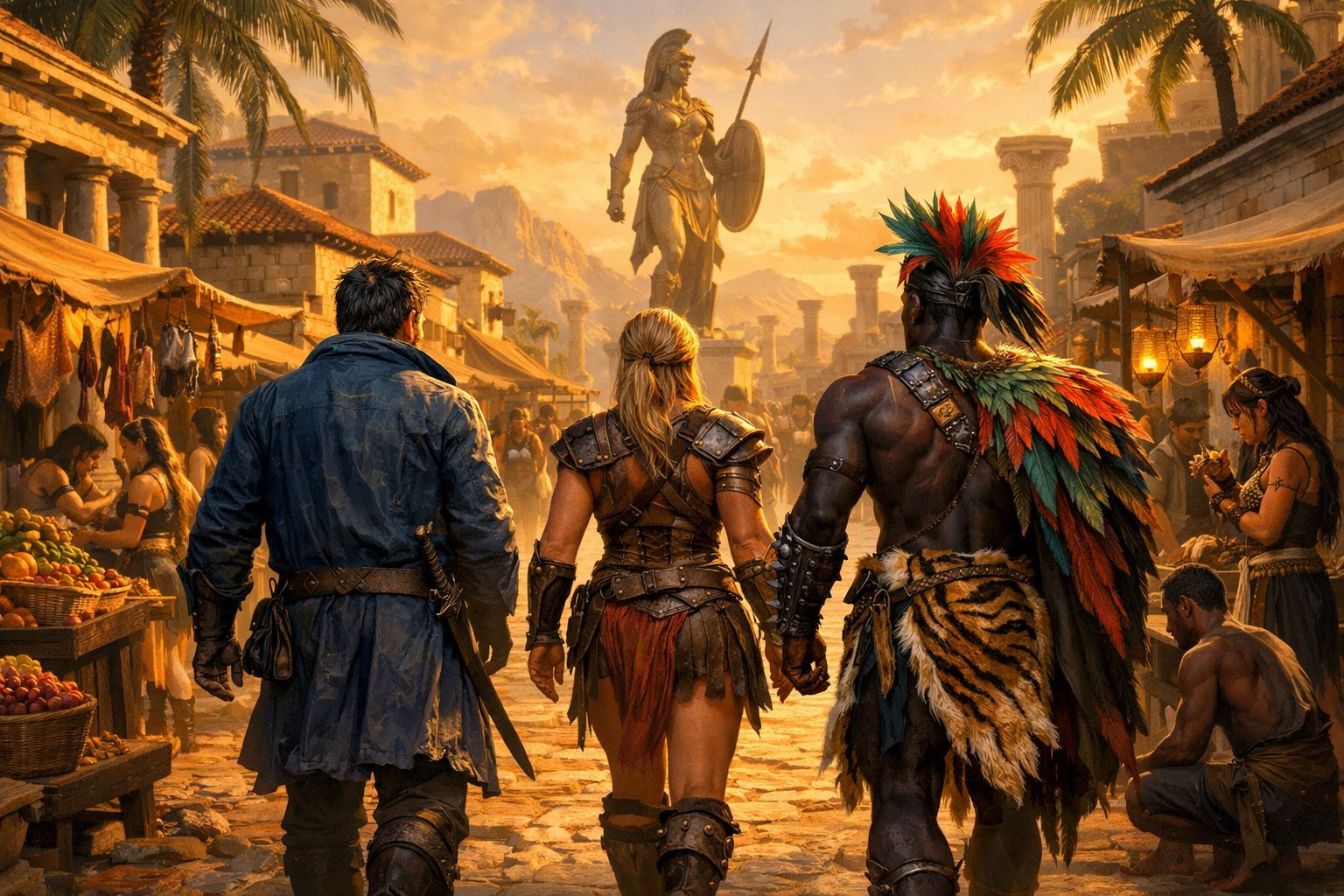
Mood And First Impression
Kethrys is the capital of Amazireth, and straddles a narrow strip of land between the Sorvalen and Ishlurai rivers, with a network of canals between them.
Kethyris greets the Blue Marlin like a courtroom greets a defendant. The harbor is bright white stone and hard angles, built to be seen from a distance and to make every newcomer feel small. The air is hot, the light is harsh and everything looks scrubbed clean, not because it is peaceful but because the city expects blood and refuses to let it stain the image.
The dock crowds are orderly, not curious. There is no sense of welcome, only assessment.
Harbor Authority And The First Words
Captain Thalessa Vorn of the Harbor Watch arrives with a small formation, sun helms and spear tips catching the light. She does not ask permission to come aboard. She takes the gangplank as if it was always hers and her eyes go immediately to the women.
She addresses Amaxia first, even if Amaxia says nothing, because Amazireth assumes command follows Amazon status. If Scarnax speaks, Thalessa’s gaze does not change. She answers him the way one answers a loud tool. Not angry, not offended, simply not acknowledging that his words have weight.
If Nasheem or Pelonias try to negotiate, Thalessa treats them as property that has learned to imitate speech. Her responses go past them and land on Amaxia, Ileena, Shaedra or any other woman who looks capable of violence.
The Unspoken Sorting
Within minutes the harbor staff has quietly divided the crew into categories.
Women who look hard are treated as potential peers. They are not respected yet, but they are spoken to directly.
Women who look soft are treated as embarrassments. Junia and Cassandra draw a particular kind of disdain, not because they are women but because they do not fit the warrior ideal. The looks they receive are not leering, they are contemptuous, as if softness is a stain that should have been cut away.
Men are treated as slaves by default. Dockhands gesture at them the way one gestures at livestock. A clerk asks for roles and owner as if they are listing cargo. If they claim to be unowned, the question is instead put to the women, asking who will vouch for them. If any man meets an Amazon’s eyes too long, a nearby watcher steps closer as a reminder of place.
Small Interactions To Set The Tone
A harbor scribe, Neryssa Kal, records names without looking up. When a man gives his name, she repeats it incorrectly and does not correct herself. When a woman speaks, she writes carefully.
A matronly dock overseer, Vasha of the Chain, tells a male crew member to carry a crate that is not his job, not as a test but as a casual assumption. If he refuses, the mood tightens immediately, not because it is dangerous but because it is improper.
A young Amazon recruit stares openly at Junia’s gentleness, then whispers something to her friend and laughs without humor. The friend’s face is blank, as if the joke is simply that softness exists.
| Story |
|---|
| Heat sat on Kethyris like a hand that would not lift. White stone reflected the sun back into their faces and the streets carried sound cleanly, sandals on tile, spear butts on steps. People looked at them without curiosity. They measured. They judged. When their eyes landed on the men, they slid past as if over furniture. |
| Amaxia walked half a pace ahead without meaning to. The city made that decision for her. Scarnax kept close, not from courage but from habit, a former slave who had learned how quickly a crowd becomes a cage. Mbaru watched corners and rooftops, already counting exits. |
| An Amazon warrior stepped out of a side street, tall, sun bronze, hair bound tight under a helm. She slowed as she saw Amaxia and her mouth twisted, not in surprise but in recognition. |
| "Amaxia," she said, the name spoken like a stain. |
| She spat on the stone between them. |
| Amaxia’s body reacted before her mind did. One step forward, shoulders squaring, jaw setting, a familiar heat rising in her chest, old training and older pride snapping into place. Her hand flexed, ready to make an answer the only language Kethyris respected. |
| Scarnax’s hand closed around her arm. |
| It was not force. It was contact. It was a reminder of where they were and what they needed from this city. Amaxia froze with her weight forward, caught between the urge to strike and the discipline to endure. |
| The warrior’s eyes slid to Scarnax’s hand and her nostrils flared with contempt. |
| "Still owned by men," she snorted, loud enough for passersby to hear. Then she turned away as if the matter was settled and wandered off, disappearing into the glare and the crowds. |
| For a moment Amaxia stared after her, breathing slow, keeping her face still while something inside her kicked against its cage. The street did not pause. The city did not care. A clerk kept talking to an Amazon guard without looking at the men beside her. A pair of young recruits laughed at something that was not funny. |
| Scarnax let go and shifted as if to put himself between Amaxia and any second insult that might come. |
| "I am sorry," he said, low. His voice held the old reflex of apology, the one he hated most. |
| Amaxia exhaled through her nose. She made her shoulders loosen on purpose. She forced her hands to unclench. |
| "You did the right thing," she said. "I was about to do something stupid. I was angry and not thinking." |
| Ayesha did not speak at first. She walked a few steps in silence, then drifted closer to Amaxia’s side, her face forward, her voice barely a thread. |
| "Only angry?" |
| Amaxia’s throat tightened. She kept her eyes on the bright street ahead, on banners and spears and women who would never see her as anything but a failure. Her answer came out as a whisper meant for one person. |
| "No," she said. "I thought I was past it." |
| She swallowed, and the motion looked like pride. |
| "It hurt," she admitted. "More than I thought it would." |
| Ayesha nodded once, not in sympathy, not in pity, but in understanding. Then she let the space return, letting Amaxia keep walking as if the spit on the stone was only spit and not a verdict. |
How To Run It At The Table
Keep the dialogue short and the silences long. Let people speak past the men. Let answers arrive to the women even when the men ask the questions.
Do not make it theatrical cruelty. Make it bureaucracy plus certainty. Nobody thinks they are doing wrong. They think they are maintaining order.
End the arrival with a clear direction. Thalessa Vorn informs Amaxia that the Queen will decide whether the Blue Marlin is permitted an audience. Until then, the crew will remain under watch, their movements limited to the dock district and their property expected to behave.
That last word, spoken without emphasis, should land like a collar clicking shut.
The Audience
| Story |
|---|
| The hall of Selkara was built to make a visitor feel like an accident of geography. White stone rose in clean planes and columns that looked cut from a single thought, not quarried. Bronze braziers burned without smoke, their heat controlled and deliberate, and the banners along the walls carried the Spear Mother in stitched gold that caught every shift of torchlight. The court did not buzz. It watched. Women in polished armor stood like statues. Men moved along the edges with lowered eyes, carrying trays, water, ink, anything that kept them useful and silent. |
| Amaxia was brought forward as if pulled by an invisible rope. Not by guards, not by force, but by the city’s assumption that command belongs to an Amazon and must be addressed as such. Scarnax walked behind her and felt the weight of the room slide over him without sticking, the way a glance slides off a tool. Mbaru’s presence drew a different kind of attention, sharper, appraising, as if the court could not decide whether he was dangerous livestock or something more. Ayesha kept her face calm and her posture balanced, careful not to look like a supplicant and careful not to look like a challenge. |
| Queen Selkara sat above them on a stepped dais, not lounging, not performing ease, simply occupying power as if it was her natural element. She looked at Amaxia with a gaze that did not search for familiarity. It searched for proof. |
| “So,” Selkara said. “You return.” |
| The word return was a hook. It caught on everything Amaxia had been forced to carry and tried to forget. Her spine stayed straight anyway. She did not bow deeply. She did not lower her eyes. She gave Selkara the respect due a ruler and denied her the submission due a judge. |
| “I have come for information,” Amaxia said. “The Waverider’s next port of call.” |
| Selkara’s mouth moved, almost a smile, but there was no warmth in it. “You have come for a gift.” |
| “It is not a gift,” Amaxia said. “It is a price. Name it.” |
| That earned the first flicker of interest. Selkara’s eyes went to Scarnax for a heartbeat, then past him, as if verifying that the world was still ordered properly. When Scarnax spoke, it was only to add a detail, and Selkara did not answer him. She answered Amaxia, as if the sound had come from her mouth. |
| “You were taken,” Selkara said. “Used. You returned breathing and you call that survival. In my palace it would be called evidence.” |
| Amaxia felt the words hit the part of her that still wanted approval, the part she hated most. She kept her voice level. “I am here. I am armed. I am not asking for pity.” |
| Selkara’s gaze sharpened. “Pity is for the weak. Do you want to prove you are not weak, Amaxia, or do you want to prove you are obedient?” |
| The silence that followed was the kind that kills mistakes. Ayesha watched Amaxia’s hands, not her face, as if she could read the truth there. Mbaru’s jaw tightened once, then relaxed, a controlled response to an insult that was not aimed at him but was meant to bind him into it. |
| Selkara leaned forward slightly, as if the hall itself leaned with her. "I know where the Waverider went. I know what you need." |
| A runner was ushered in, panting, dirt on her knees, a smear of dried blood on her forearm. She spoke quickly, eyes fixed on the floor, low enough that only Selkara could hear. Selkara listened without interruption and when the report ended she dismissed the runner with a small motion that felt like a sentence. |
| "The Sreli have burned Ashimora. They have mocked Amazireth. They have announced to every predator in the jungle that my reach ends at the mountains.” |
| Anger did not distort Selkara’s face. It made it cleaner. |
| “You will go,” she said. “You will see what they did. You will find proof enough to justify what must be done next. Then you will go into Srel and make Eshkar remember the cost of crossing my line. A lesson written in flame, so the next raid dies in the throat before it is spoken.” |
| Amaxia held Selkara’s gaze. She could feel the pull inside her, the old training that wanted a mission, a target, a clear enemy. She could also feel the other pull, the one that hated being used. The Queen was not asking for justice. She was asking for deterrence, for reputation, for border math written in bodies. |
| “We will go,” Amaxia said, because the lead mattered and because Ashimora would matter even if Selkara did not. |
| Only then did Selkara allow her eyes to drift, a slow sweep across the group. They paused on Ayesha for a breath, the way one acknowledges a blade. They paused on Scarnax with indifference. They paused on Mbaru and stayed there, measuring. |
| “While you are away,” Selkara said, almost casually, “can I borrow that one?” |
| The hall remained silent but it changed. A few women shifted, eyes flicking to Mbaru, then back to Selkara. |
| Amaxia did not look at Mbaru. She did not need to. She felt the insult for what it was, not just to him, but to her claim of command. She smiled without showing teeth. |
| “No,” she said. “He’s a private toy.” |
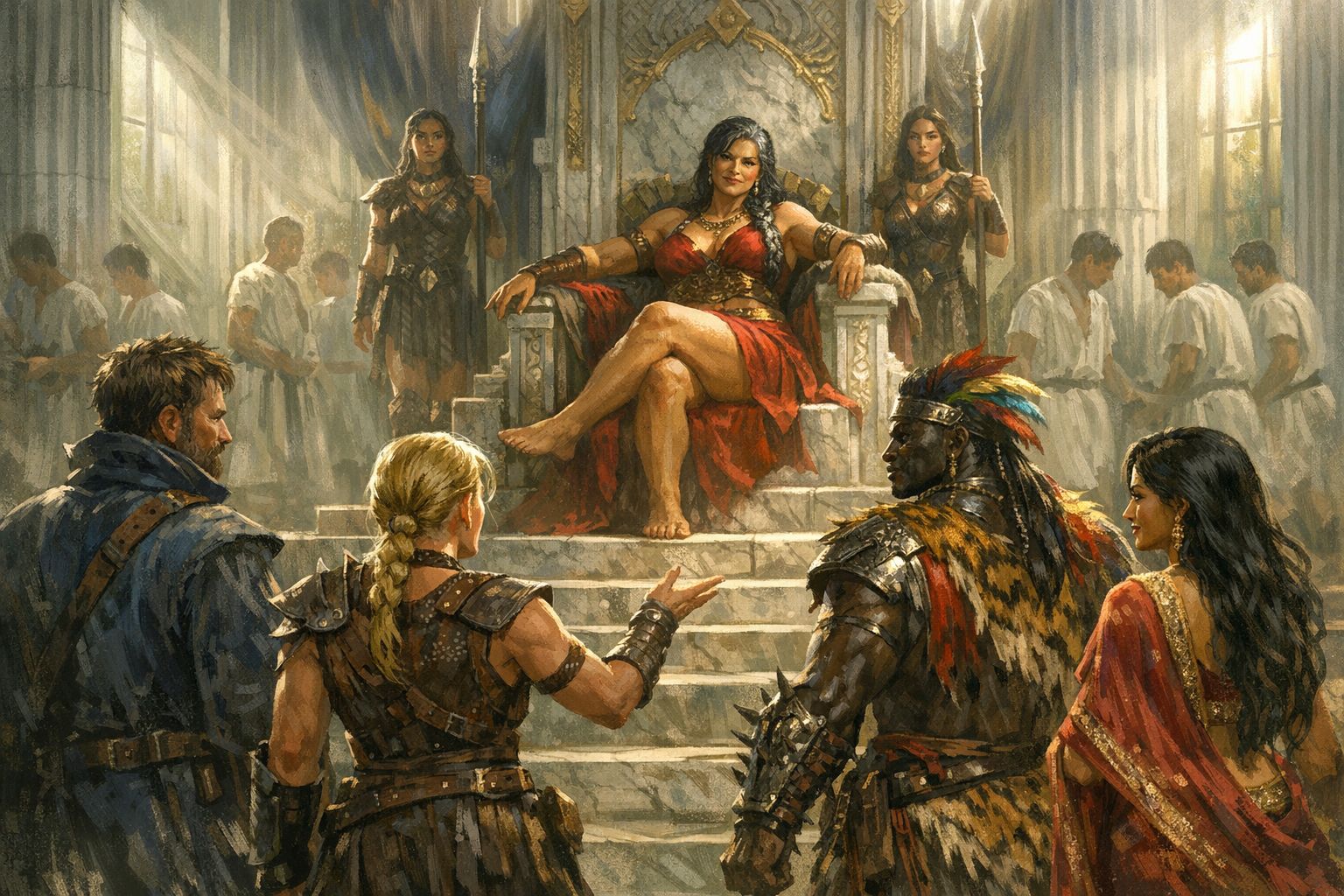
This is a quiet duel hidden inside court etiquette. The Queen is testing who holds authority, who is considered property and whether Amaxia can speak the local language of power without breaking. The pressure is carried as much by what is not said as by what is said.
Set The Room
The hall is disciplined silence. Every step, pause and breath is witnessed. The court expects dominance to be public, clean and unashamed. Men are present as tools. Women are present as weapons, judges and owners.
Amaxia is positioned forward by custom. Any male crew members behind her are treated as belongings by default. Any female crew members are evaluated for hardness, confidence and utility. Nobody needs to announce these assumptions. The room behaves as if they are laws of nature.
The Mission As Leverage
The Queen knows the lead the crew came for. She does not state terms explicitly yet. Instead she waits for the moment she can frame obedience as necessity and refusal as weakness.
When the news arrives that Ashimora has been destroyed, the Queen’s tone shifts to cold purpose. She does not mourn. She identifies what the raid means in practical terms: border deterrence has failed, reputation has been wounded, and the next raid becomes more likely if the response looks soft.
She assigns the crew a task with three layers.
- Go upriver to Ashimora and verify what happened.
- Collect proof strong enough to justify escalation.
- Then cross into Srel and strike Eshkar hard enough that the next raid dies before it is planned.
The order is phrased as strategy, not cruelty. It is still brutal. The brutality is the instrument.
What Is Not Said
The Queen does not say she will reward them with the Waverider information. She lets it hang in the air as an obvious reward for proving worth.
She does not call it revenge. She calls it deterrence.
She does not ask whether they agree. She speaks as if the decision has already been made, forcing Amaxia to either accept the frame or publicly reject it.
Let the silence after the order sit for a beat. The court watches for hesitation.
The Hidden Question The Queen Is Asking
The Queen’s final request is not really about the man she points at. It is a probe aimed at Amaxia’s claim to command.
- If Amaxia hesitates, the court learns she can be made to flinch.
- If Amaxia looks to the man for permission, the court learns her command is uncertain.
- If Amaxia refuses too politely, the court learns she can be pressed through manners.
- If Amaxia refuses by claiming ownership in court language, the court learns she understands the rules here and can use them.
That said, if she does lend the man to the Queen, from the Queen's view, that tells her that she takes orders and gives her some leverage when they are away. It also gives the queen a nice distraction.
How The Queen Delivers It
The Queen asks to "borrow" a specific male crew member as if it is a minor convenience. She does not leer. She does not smile. She makes it sound practical, almost bored. That is what makes it threatening.
Crucially, she does not address the man. She addresses Amaxia. The man is treated as an object and Amaxia is treated as the title holder.
What The Court Does
The room reacts without reacting. A scribe pauses. A spear hand tightens once. A few women shift their stance, eyes flicking to the man and back to Amaxia.
Let the silence stretch. The point is to make the players feel the weight of the moment, that a wrong answer costs face, leverage and safety even if nobody draws steel.
How Others Read It
Male crew members should read the room before they read the insult. The safest reaction is controlled neutrality. Any visible anger invites the court to treat them as leverage.
Female crew members should recognize the move as tactical. This is not about affection. It is about authority, boundaries and refusing a monarch in a way the monarch cannot publicly punish without admitting the insult was the point.
End State
The Queen registers the refusal, not with offense but with recognition. A small approving breath, a faint laugh or a single nod is enough. Then she moves on as if nothing happened.
That indifference is the final cut. In this court, domination is not an event. It is punctuation.
The Journey to Ashimora
Purpose
This journey is a tone bridge. It moves the crew from Kethyris politics into the reality of the border, while keeping forward momentum toward Ashimora. It also sets up Amaxia as the visible face of the expedition so the later horror feels personal, not abstract.
Non Negotiable Constraint
Amaxia’s Role
Amaxia must be on this journey. This is her redemption arc. She is the cultural key that makes Amazireth feel safe and cohesive, and she is the emotional key that turns Ashimora into a wound rather than a rumor.
If Amaxia is a player character, the trip gives her space to carry the weight of being watched by Amazons again.
If Amaxia is an NPC, position her as the expedition’s public face. She speaks to patrols. She chooses where to dock. She decides where they sleep. Even if the crew leads tactically, the country treats her as the authority.
Silvio Does Not Come
Silvio must remain aboard the Blue Marlin. Treat this as a practical decision, not a veto. The river trip is exposed, his skills are not expected to be needed and the mission is expected to turn violent. Silvio is more valuable later when stealth, locks and city work matter.
If the players insist, handle it gently and in character.
Option One, Amaxia Takes The Slot
If Amaxia is an NPC, she explicitly claims the extra seat and frames it as her responsibility. This is her homeland, her reputation and her test. She does not say Silvio is weak, she says the mission is hers.
Option Two, A Crew Member Volunteers Instead
A capable crew member insists on taking the extra seat in the skiff. They make it about competence and duty. They can say the quiet part out loud: Ashimora is a kill zone and the crew needs someone who can fight in the open.
Option Three, A Crew Member Suggests A Better Fit
A crew member recommends a replacement that fits the task. Someone with a bow, shield or battlefield calm. This lets the players feel they made a tactical choice rather than being corrected.
Travel Overview
Timing
It is a two day trip upriver.
- Day One is routine movement through settled territory.
- Night One is spent in an Amazon village.
- Day Two continues upriver toward the river’s end and the shadow of the mountain range.
They reach Ashimora at the end of Day Two, before dusk.
The River And The Shore
This is Amazon country and it is safe. The river is a highway, not a wilderness threat, with small boats ferrying goods along the river. The jungle is present but controlled, cleared along the banks in places, watched by patrols and dotted with small settlements that treat travelers as predictable.
Patrol Encounters
Use patrols to reinforce that this land is governed, watched, and safe.
A patrol appears on the shore, spearpoints visible through leaves. Amaxia raises a hand in a clean Amazon salute. The patrol answers with a wave or a short call.
If approached, the patrol is direct and blunt. They ask where Amaxia is going, why and whether she needs escort. The questions are not rude in their culture, they are normal.
If there are male crew members present, patrol members glance at them as property and speak past them. If there are softer female crew members present, patrol members may show faint disdain, not aggression.
Keep it short. Two lines, a shared understanding, then on they go.
Overnight Stops
There are many villages along the river where the crew can sleep safely. Amaxia chooses a place with a dock, a communal hall and a local matron or captain who can host.
Hospitality exists, but it is not warm in a soft way. It is practical. Food is offered because travelers are part of the river’s rhythm, and because denying aid would look weak.
Expect Amazon attitudes. Women are addressed directly and evaluated. Men are treated as attachments to women, valued for usefulness, ignored if they speak out of turn. Softness is seen as incompetence unless it is clearly paired with some other strength.
If you want a small friction beat, have a host ask Amaxia, calmly, why she keeps a male captain and why she tolerates foreigners. It's not a challenge, merely curiosity. Do not turn it into an argument. Let it sit as pressure.
Pacing Notes
Keep the travel uneventful by design. The point is contrast. The players should feel the safety of Amazireth so that Ashimora feels like a rupture, not just another dangerous location.
Use one repeating image to build anticipation. The river narrows. The current changes. The mountains begin to appear ahead, dressed in thick jungle. Each time they stop, the locals mention Ashimora with a little more tension, as if the border is a place you respect even when it is quiet.
Transition Into The Ashimora Reveal
On the second day, the patrols thin out. The villages become fewer. The river feels more exposed. The mountain pass beyond the river’s end becomes a visible line on the horizon, the route into Srel.
That is the moment to let the table feel that they are leaving the controlled world behind, even before they see what happened.
Arrival at Ashimora
| Story |
|---|
| The river carried them to Ashimora as if it wanted to pretend nothing was wrong. The water was calm. The banks were green. Even the birds sounded ordinary. From a distance the town looked wounded but still standing, a wide sprawl of timber roofs and palisade lines, smoke stains on the sky long faded. Blackened shells of houses broke up the pattern like missing teeth. Thousands had lived here. The place was built to hold that many. Storehouses, wide lanes, a burnt temple roof rising above the rest like an omen. |
| Junia shaded her eyes and swallowed. "It is too quiet." |
| Amaxia did not answer. Her hands were tight on the edge of the skiff. Her gaze stayed locked on the shore as if she could force the town to explain itself before they stepped onto it. |
| Ileena stood at the bow. Her nose twitched. She did not smile. |
| Scarnax guided them in without flourish. "We go in. We see. We leave." |
| Mbaru said nothing. He had his spear in hand already, not raised, just present, like a heavy truth. |
| They grounded the skiff on mud and ash, and the first thing that hit them was the smell. Not smoke. Not char. Rot. Sweet, thick, wrong. It clung to the back of the throat and turned every breath into effort. Flies rose in clouds from the reeds and the broken docks. The buzzing was so dense it sounded like a low wind, even though the air was still. |
| Junia pressed a sleeve to her mouth. Her eyes watered. "Gods," she whispered, and it was not a prayer so much as a reflex. |
| Ileena stopped at the first plank walkway and stared down. Her voice was quieter than usual. "Too many." |
| Amaxia stepped past them and onto the dock as if walking into judgment. The boards were scorched in places. A coil of rope lay half melted, fused to the wood. A child’s sandal sat beside it, untouched by fire, as if someone had set it down neatly before vanishing. |
| They moved inland and the town opened around them. The first street was a corridor of burned frames, roofs collapsed into black triangles. Pots lay shattered. A bucket had been kicked over and dried into a streak of mud. It looked like a place that had been interrupted, not conquered. |
| Then the first bodies. |
| At first it was one, then three, then a cluster that made Junia stop hard enough that Scarnax nearly bumped into her. A man lay on his side with his hands bound behind him. His face was turned into the dirt. Not executed cleanly. He had been kept there a while. Nearby, a woman lay half inside a doorway, her fingers clawing at the threshold as if she had almost made it into shelter and been pulled back out again. |
| Mbaru crouched, looking without flinching. "No looting." |
| Scarnax’s voice went colder. "They came for something else." |
| Amaxia walked forward, eyes scanning, jaw locked. "They came to make a point." |
| The deeper they went, the more the town stopped being a place and became a message. |
| A pile of bodies in a square, thrown together with no care for who lay on top of who, as if the attackers had wanted the heap to be seen from far away. An old man and a girl tangled together, the girl’s hair stuck to her cheek with dried blood. Junia made a small sound and turned her face away, then forced herself to look again, as if refusing to grant the dead even the small disrespect of being ignored. |
| A burned house with black streaks up the walls and the smell of cooked flesh still trapped inside the charred beams. Scarnax stepped in, saw what was left on the floor, and backed out again without a word. His face did not change but his hands tightened until the tendons stood out. |
| A line of stakes near the palisade. Two Amazon women among them, not spared for being warriors, not spared for being the same blood. One had been impaled in a crude mockery of intercourse. The other had been left hanging upside down from a beam, wrists cut, blood pooled beneath her in a dark stain that had drawn insects into a writhing carpet. |
| Amaxia stopped there. For a moment she looked like she might speak, but her throat worked and nothing came out. Her eyes were bright with something that was not tears, not yet. |
| Ileena stared at the hanging body and her voice turned flat. "This is not a hunt. This is play." |
| Junia nodded once, pale. "They enjoyed it." |
| Mbaru rose slowly. His calm was intact, but there was a heavier tension in it now, like a door being shut. "People who do this do not stop because they are asked." |
| They walked on. |
| In the market district the stalls were overturned, not to steal, but to smash. A butcher’s block sat in the open with deep gouges in it, body parts and bodies piled around it. An anvil and a smith's hammer stood nearby, beside it, a crushed child's arm, bones shattered. Amaxia’s gaze lingered on it for too long before she forced herself onward. |
| In a side alley they found a mother with two children. Not an accident. They had been arranged, the children pressed against her like she had tried to hide them under her own body. It had not worked. Junia dropped to her knees without thinking and reached out, then stopped her hand in midair as if she had remembered that healing was a language that no longer applied here. |
| Scarnax looked down at her. His voice was rough, simple. "You cannot fix this." |
| "I know," Junia said, and the words came out sharp with anger she did not often show. "I know." |
| Amaxia walked a few steps ahead, spear in hand, as if the act of carrying it was the only thing keeping her from breaking apart. "I left my home," she said quietly, and it sounded like a confession she hated. "I thought I would return and face contempt. I did not think I would return and find this." |
| Mbaru’s eyes tracked the street, the doorways, the rooftops, as if some part of him still expected an ambush. "They wanted you to see it," he said. "Someone did." |
| Ileena’s tail twitched. "Srel stinks of ash and pride," she muttered. "But this smells like men who laughed while they worked." |
| The town kept offering them proof. Not one survivor. Not one hidden cellar with a trembling family. Not one wounded guard who had crawled away. It was absolute. A large town, emptied with deliberate thoroughness. The kind of violence that did not happen by accident or panic. The kind of violence that required time. |
| When they finally reached the temple square, the flies were so thick the air looked mottled. The temple doors were splintered inward. The goddess relief above them had been hacked at until the face was ruined, not to break stone, but to insult. Amaxia stood in front of it and breathed in through her nose, slow, controlled, like she was practicing restraint. |
| Scarnax waited. He did not rush her. He knew what it meant to be made powerless by someone else’s cruelty, and he knew the cost of holding yourself together in the place that proved you had failed. |
| Junia came to stand beside Amaxia, close enough that their shoulders nearly touched. She did not speak. The nearness was the offer. |
| Amaxia finally turned away from the ruined goddess and looked at the others. Her voice was clipped, but it shook at the edges. "Does anyone object to burning Eshkar." |
| Mbaru’s reply came without heat, which made it worse. "My only objection is that burning is too good for the people who did this." |
| Junia nodded once, face hard. |
| Scarnax stared back toward the river, toward the way out, toward the next step. "Then let's move out of this place and do some damage." |
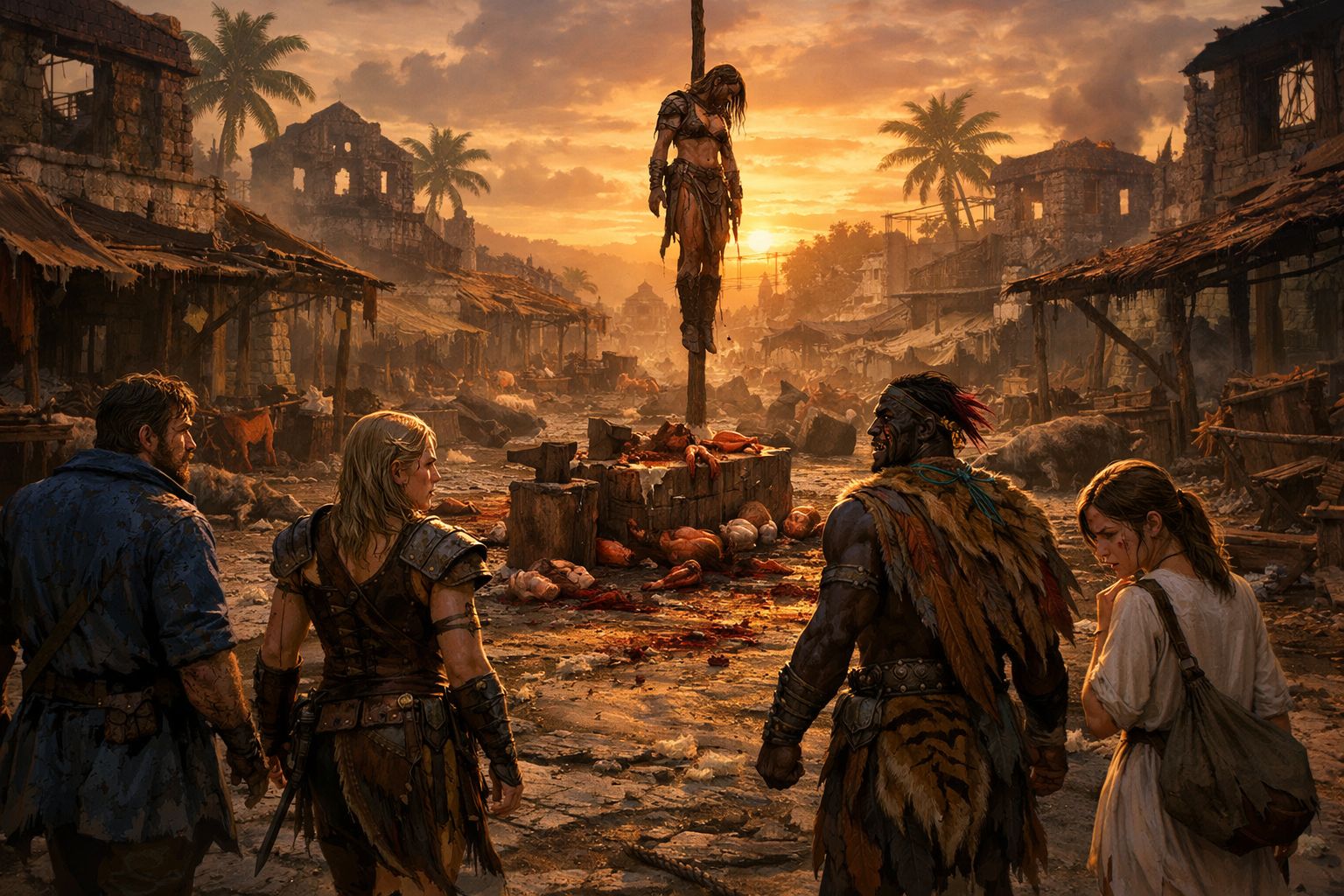
This investigation is not about solving a mystery. It is about making the crew feel, in their bones, that what happened here was chosen. The goal is hatred with clarity. Not “war is hell” fatalism, but the specific certainty that the Sreli did not just kill, they enjoyed breaking people.
Keep the focus on scale, intent and staging. The town is large. The dead are everywhere. The cruelty is varied on purpose. The killers had time, energy and enthusiasm.
Core Principles
Make It Vast Before It Is Specific
Start with distance, silence, smoke stains, burned roofs and no movement. Let the players realize the size of Ashimora before they touch a single body.
Then make it personal in controlled steps. One street. One square. One doorway. The horror grows as they walk, not as you dump details.
Show Intent Through Arrangement
Military killing leaves patterns that are practical. Chokepoints. Barricades. Guard positions. Looting. Ransacked stores. Here, the pattern is theatrical. Bodies are positioned to be found. Cruelty is displayed where it will be seen. The town is turned into a stage.
Let the players notice that, then let them say it out loud.
Give Them Space To React
Do not rush through scenes. After each major discovery, pause. Ask what they do. Ask who takes the lead. Ask who is looking away, who is forcing themselves to look, who is getting angry.
Your job is not to keep them moving. Your job is to make each step feel heavier.
Structure Of The Investigation
Phase One: The Threshold
What They See
Ashimora is burned in patches, not flattened. That matters. This was not an accidental fire during battle. It is selective destruction.
No guards on the walls. No sentries. No smoke. No shouts. No dogs. Not even scavenger birds behaving normally, because there is too much for nature to process.
What They Smell
Rot and old smoke, layered together. It is stale, heavy and everywhere. Flies are the first living thing that feels abundant.
What They Learn
There was no evacuation. No organized retreat. No survivors calling for help. That absence is an answer.
Phase Two: The First Street
Goal
Make the players understand that this was not a raid for profit, territory or prisoners.
Clues To Emphasize
Stores and homes are not stripped in a consistent way. Valuable items remain where they fell. Food is not systematically taken. Tools are not gathered.
People were killed where they stood, where they ran and where they hid. The dead are not only fighters.
Questions To Ask
What was the first thing your character notices that proves this was not a battle.
Who among you has seen war before, and why is this different.
Phase Three: The Message Points
Use three set pieces that escalate. Do not pile on ten. Make each set piece reveal a different kind of cruelty, spectacle, intimacy, desecration, so it feels deliberate rather than repetitive.
Set Piece One: The Public Square
Bodies are gathered in a place everyone would pass. Not because it was efficient, but because it makes a statement. The square feels like it was used for spectacle.
Key line you want the players to reach: Someone wanted this to be seen.
Set Piece Two: The Home Or Alley
A cramped, intimate location. Here the horror is not mass, it is closeness. Signs of hiding, pleading, crawling, being dragged. This is where players usually stop thinking strategically and start feeling it.
Key line you want the players to reach: They followed people into their last places.
Set Piece Three: The Desecration
A temple defaced, a goddess relief destroyed, a symbol of Amazireth ruined, something that says the killers wanted humiliation as much as death.
Key line you want the players to reach: This is contempt, not necessity.
Phase Four: The Pattern Recognition
Now you let them connect it.
Prompts
- Ask them what is missing from a normal military action.
- Ask them what is repeated here. Not just death, but the way death is presented.
- Ask them to describe what they think the killers felt while doing this.
What They Should Conclude
This was reveling. Pain used as entertainment. Degradation used as a tool. The variety of cruelty is the proof. Someone spending effort to invent new ways to break people is not trying to win a battle. They are feeding something in themselves, and they have no holding back.
How To Make The Sreli Hated Without Over Explaining
Use Sreli Signs Sparingly
- One ash marked symbol on a wall.
- One line of doctrine carved into wood.
- One crude token left behind like a signature.
Do not turn it into a puzzle. These are confirmations, not leads.
Contrast Their Ideology With Their Behavior
If the crew has heard Srel claims about cleansing, doctrine or purity, use Ashimora to show what that doctrine looks like in practice. Not discipline, but permission.
If the crew has not heard that yet, let them feel it anyway. Later, when they learn about the Doctrine of Ashen Dawn, they will recognize it.
End Condition
The investigation ends when the crew stops searching for survivors and starts speaking in decisions.
Run it like a verdict being read. Quiet. Final. The town does not get justice. The town gets an answer.
Act Summary
The crew has crossed a line from negotiation into commitment. This is no longer a question of getting the next Waverider lead by talking to the right ruler. The lead now has a price, and the price is action.
What The Crew Learned About Power
Amazireth does not separate politics from violence. Selkara treats violence as a tool of state, as deterrence and security. In this world, being right is not enough. You must also be useful, hard, and willing to look unflinching at what the work requires.
What The Crew Learned About The Enemy
Ashimora proves the Sreli are not simply raiders or soldiers. They are practitioners of horror meant to be found. The point was not victory or profit. The point was humiliation, pain, and the demonstration that they can do this again. Hatred is no longer an emotional reaction, it is a clear reading of intent.
It is also clear that for the Sreli it is more than just purpose, they revel in it, enjoy it.
What The Crew Gained
A reason to strike that does not rely on the Queen’s approval. Even if Selkara vanished tomorrow, Ashimora would still demand an answer. They know they are not just political pawns, they are acting for their own reasons.
Next Step
The path now moves on, through the jungle, into Sreli controlled lands.