Ormun
| Story |
|---|
| They went ashore together at first light, when the harbor was still waking and the stones held the night’s cool. Ormun stood still for a moment after stepping off the gangplank, boots planted wide, as if checking that the ground would not drift away beneath him. Cassandra noticed and said nothing. She did the same, breathing in the smell of tar, fish and dust, letting the weight of the world settle under her feet. |
| They walked slowly through the lower streets, buying bread, dried fruit and lamp oil. Ormun carried everything without comment, careful not to bump anyone. People stared. Some looked away. Some did not. |
| Near a fountain cracked with age, two young men blocked their path. Not guards. Not important. Just bored and loud enough to be cruel. |
| One of them laughed and said something about Ormun being too big to think properly. The other followed, calling him simple minded, drawing the word out as if tasting it. |
| For a fraction of a second, something hard moved behind Ormun’s eyes. His shoulders shifted. His hands curled. |
| That was enough. |
| The laughter stopped. The young men stepped back, suddenly aware of how small they were. They muttered and moved on, finding somewhere else to be brave. |
| Ormun did not look at Cassandra. He simply nodded once and kept walking. |
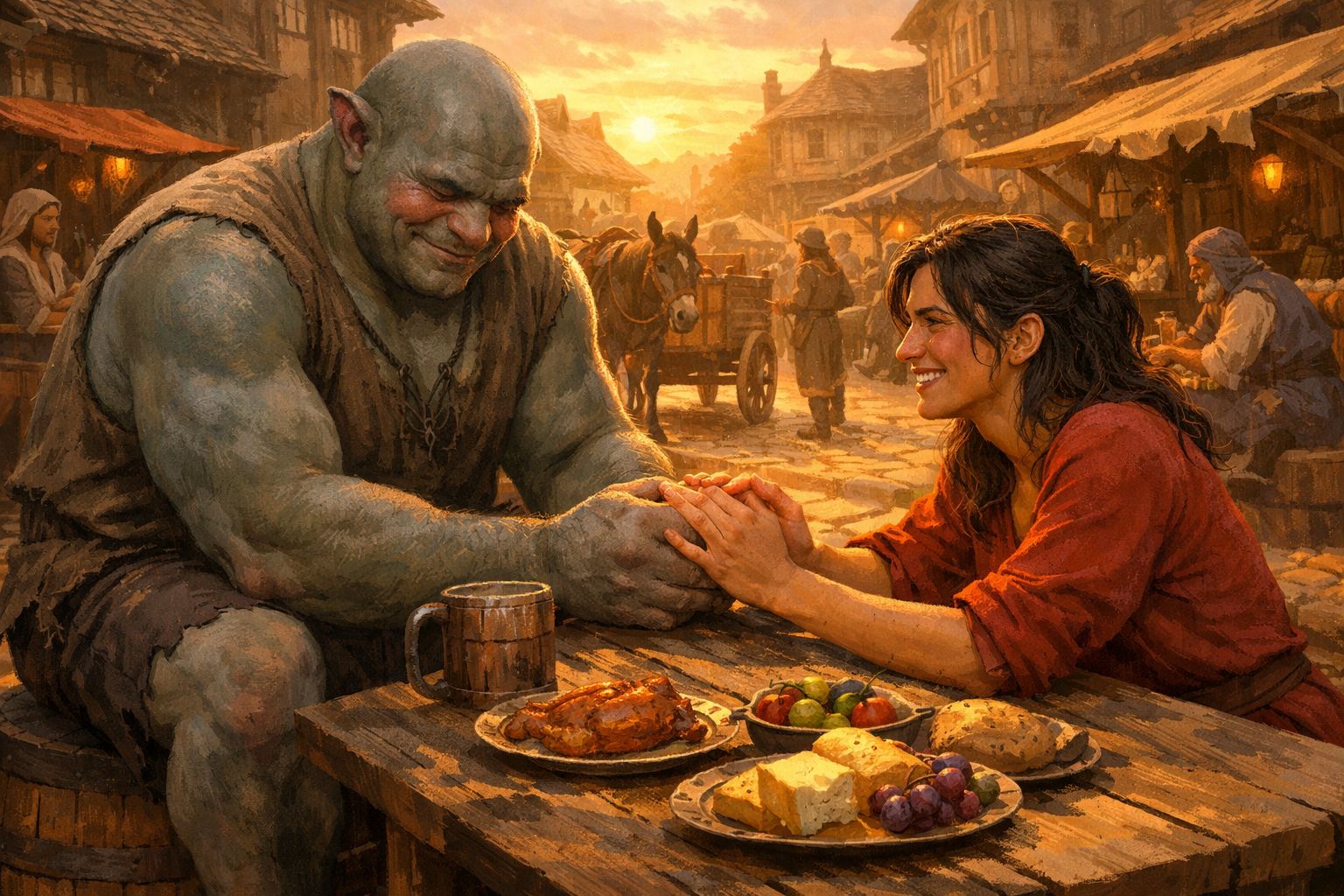
| They ate later outside a tavern with peeling paint and crooked tables. Ormun sat carefully on an empty barrel, hunched slightly to make himself smaller. He barely touched his food. |
| Cassandra watched him for a while before speaking. |
| “That hurt you,” she said gently. |
| He swallowed, then nodded. “I know they meant it as an insult,” he said. “I just thought I was used to it by now.” |
| She turned toward him, folding her hands in her lap. “They think simple means empty,” she said. “But it doesn’t.” |
| He glanced at her, uncertain. |
| “Complex minds,” she continued, “are very good at explaining why terrible things are necessary. Why cruelty has reasons. Why someone deserves what happens to them.” She paused. “A simple mind knows better. Right feels right. Wrong feels wrong. No arguments needed.” |
| Ormun frowned, thinking. |
| “I have never met anyone,” she said, “who knows that difference as clearly as you do.” |
| His ears reddened. Color crept up his cheeks. He looked away, embarrassed, but the tension in his shoulders eased. |
| She reached across the table and took his large hand in both of hers. It was warm, rough and steady. |
| “Your heart,” she said softly, “is worth more than all the clever scholars and learned men in the world.” |
| His blush deepened until it reached his brow. He looked down at their joined hands, suddenly very interested in the grain of the table. |
| But Cassandra saw his smile. |
| It was wide and unguarded, the kind that comes from being seen rather than praised. |
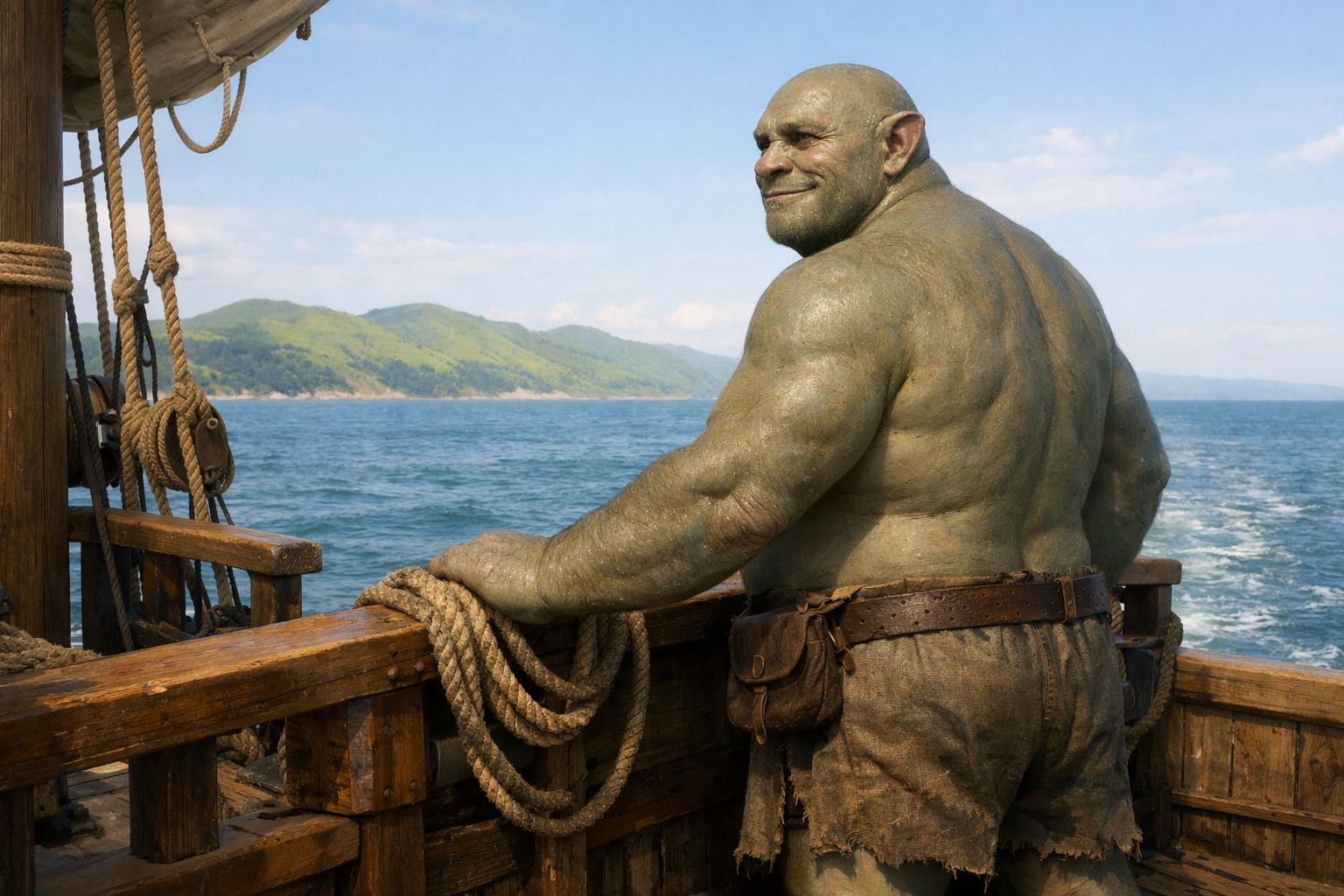
Ormun is an ogre born in the Olydrian Isles, raised in the shadow of a society that never expected him to be anything but muscle and obedience. He learned early that his size defined how others saw him. Strength was assumed. Thoughtfulness was ignored. Kindness was treated as weakness or novelty.
He grew up in the household of the Pelagos family, technically a slave, practically something closer to kin. The distinction mattered to the world even when it mattered less inside the walls.
Childhood Bond with Phaedros
Ormun and Phaedros Pelagos grew up together. They trained, explored and got into trouble side by side. Phaedros was sharp and curious, always pushing outward. Ormun was steady, patient and protective, often the one who made sure trouble did not turn fatal.
To Ormun, Phaedros was not a master but a brother. To Phaedros, Ormun was not property but family. The law did not care about either view.
The arrangement persisted because of fear rather than cruelty. In the Isles, a free ogre without papers or patronage is assumed to be dangerous or criminal. Ownership, distasteful as it was, provided a kind of brutal legitimacy. The family saw it as protection. Ormun accepted it because it kept him close to Phaedros and gave him a place in the world.
Freedom Granted
When the Blue Marlin arrived in the Olydrian Isles searching for Phaedros, Ormun learned of it quickly. He wanted to join at once. But he did not run. He asked.
Phaedros’ brother received him, Scarnax and Ayesha and spoke honestly. He said he had always seen Ormun as family. He admitted that fear and convenience had kept the chains intact longer than they should have. He also admitted something else. If anyone could go to the end of the world to find Phaedros, it was Ormun.
That same day, he freed him and sent him with the crew, not as property or guard but as a brother entrusted to another brother. He left with the blessing of the Pelagos family, and the Blue Marlin was similarly blessed.
For Ormun, freedom arrived without ceremony. No speech. No ritual. Just the absence of a claim. It took time for that to feel real.
Life on the Blue Marlin
On the ship, Ormun quickly proved indispensable. His strength made heavy work trivial. Hauling lines, bracing rigging, lifting cargo and holding structures steady in storms all fell naturally to him. He works without complaint and without show, taking pride in being useful rather than impressive.
What surprised the crew was not his strength but his gentleness. Ormun listens more than he speaks. He remembers small details. He checks on people quietly. He apologizes when he bumps into someone even when they were the ones in the way.
More important than his strength was the way people felt around him. Ormun became the one others drifted toward when words ran out or thoughts tangled themselves into knots. He did not offer clever insights or long speeches. He listened, nodded, and said little. When he did speak, it was usually something plain and unadorned, the sort of answer that felt obvious only after hearing it. People often left those conversations surprised by how much lighter they felt, even if nothing had been solved.
The Blue Marlin became the first place where his presence was valued without suspicion.
Bond with Cassandra
Ormun noticed Cassandra long before he dared speak to her. Not her beauty first, though he saw that, but the way her shoulders tensed before commands and how her eyes tracked rooms the way hunted animals do. He recognized pain shaped by obedience. It was familiar in a different way.
At first he blushed constantly around her, unsure how to exist near someone he found beautiful without frightening her. His size made him cautious. He learned to sit, kneel or lean so he did not loom. He softened his voice without thinking.
Their bond grew through conversation rather than drama. They talked during repairs, watches and quiet evenings. Ormun listens. Cassandra speaks. Over time she listens too.
He sees her as fragile, kind and precious, something to be protected gently rather than guarded fiercely. She sees him as trustworthy, reliable and profoundly safe. With him, she does not feel watched or evaluated. He never asks her to perform anything.
Their closeness is quiet and unspoken but obvious to those who pay attention. There are more feelings growing between them.
| Story |
|---|
| The forest of northern Draknir was quiet in the way only deep winter forests are, sound swallowed by snow and old trees standing close together. Dark needles held white weight. Breath showed. The ground was uneven with roots and stone hidden beneath frost. |
| They were moving carefully. Scarnax led, eyes forward, steps confident but rushed. Nasheem followed with practiced ease, light on his feet. Cassandra and Ormun brought up the rear, slower, watching the ground. |
| It happened fast. |
| Scarnax stepped where stone met stone, a narrow crack hidden beneath snow. His foot slid, twisted, and there was a sharp sound that did not belong in the forest. He went down hard with a shout that cut short into a breathless groan. |
| Nasheem was beside him instantly. |
| Scarnax tried to stand and failed. Pain hit him in waves, sharp and sickening. His leg lay wrong, boot already darkening where blood pressed against cloth. He clenched his jaw and said nothing for a moment, breathing through it. |
| Nasheem knelt, checked quickly, then looked up. |
| “Broken,” he said. “Badly.” |
| Scarnax nodded once. “Then we do this properly.” |
| Nasheem turned to Cassandra and Ormun. “You go back to the ship. Get Junia and either Amaxia or Mbaru. Leave the blankets if you can. I will stay with him.” |
| Cassandra hesitated, looking between them. |
| Nasheem met her eyes. “I have him. He will not be alone.” Scarnax gave a pained, but distinct nod. |
| That settled it. |
| They turned back into the forest, moving as fast as care allowed. |
| --- |
| By the time dusk came, the light had thinned to blue and gray. Snow began to fall again, light at first, then heavier. Wind threaded through the trees, finding every gap in cloak and collar. |
| They pushed on until Cassandra slowed and stopped. |
| “We will not make it before night,” she said quietly. |
| Ormun looked around, then nodded. He pointed to a massive pine, its lower branches thick and heavy, reaching down to the ground. Beneath it the snow was thinner, the earth darker. |
| They crawled under the boughs as the storm worsened and lay down on the ground, huddling under the worst wind. |
| The cold crept in quickly. Cassandra’s hands shook as she pulled her cloak tighter, and moved close to Ormun for warmth. Ormun moved without thinking, angling his body so the worst of it hit him first. After a moment, he shifted again and drew her closer, one broad arm around her shoulders, then another, careful, uncertain, enclosing without pressing. |
| She did not resist. She leaned into him, body heat warming the space between them. |
| They said little as the storm howled above, snow hissing against needles and bark. Ormun held still, a living wall. Cassandra slept in fragments, waking to the sound of wind and the steady rise and fall of his chest. |
| When dawn came, it arrived quietly. The storm had passed, leaving the world pale and clean. Light filtered through branches heavy with snow. |
| Cassandra stirred and laughed softly, a sound of warmth rather than humor. |
| Ormun froze. |
| He pulled back slightly, worry written plain across his face. “I am sorry,” he said quickly. “I did not mean to take liberties. I only thought you were cold.” |
| She turned toward him, eyes bright despite the morning chill. |
| “You were a complete gentleman,” she said. “Completely appropriate under the circumstances.” |
| He relaxed a little, then stiffened again as she continued. |
| “Nothing happened,” she added, smiling. “But if it were not for the cold, I would not have minded if something did.” |
| The words took a moment to land. |
| Ormun’s ears reddened. His face followed. He swallowed. |
| “I would be afraid to hurt you,” he said. “I sometimes forget how strong I am.” |
| She shook her head. “You know what I have been through,” she said. “You know I was forced into things I did not want with rough men. That is exactly why I trust you. If there is one man I would always trust to be gentle with me, it is you.” |
| He looked at her then, really looked, and the happiness that crossed his face was open and unguarded. |
| He leaned forward and hugged her quickly, awkward and brief, arms careful, then pulled back at once, flustered. She hugged him back, staying a little longer. |
| “We should hurry,” he said too quickly. “The captain will need us.” |
| He stood and set off at a faster pace than before. |
| Cassandra followed, smiling. |
| There was a lightness to his steps now. Once, when he thought she was not looking, he took two quick steps and a small, foolish skip, as if his feet could not quite contain him. |
| --- |
| They found Nasheem where they had left him, still steady, still calm. Scarnax lay wrapped in blankets, pale in a cold sweat, but conscious. |
| With them stood Junia, Amaxia, Mbaru, and Shaedra, eager, prepared, and already arguing about the best way to move a wounded captain through snow. |
| Relief washed through Cassandra. |
| Ormun straightened, the soft warmth of the night still with him as he stepped back into the work of the crew. |
Limits of Freedom
Despite his freedom, Ormun is still an ogre in a world that fears ogres. In many ports he cannot walk alone without risking chains, accusations or violence. A lone ogre is assumed to be an escaped slave or a threat. Papers rarely help.
Because of this, he often goes ashore with another crew member. Not as a guard, but as a legal fiction. Someone who can claim responsibility for him, speak on his behalf, and satisfy authorities who need an owner more than they need the truth.
This frustrates him more than he admits. Freedom with conditions still feels like a leash.
Personality and Temperament
Ormun is patient, kind and deeply loyal. He avoids conflict unless someone he cares about is threatened. When violence is necessary, he does not hesitate, but he never enjoys it. His anger is rare and frightening precisely because it is controlled.
He struggles with self worth. Years of being seen as a dumb brute taught him to measure himself by usefulness. Praise makes him uncomfortable. Gratitude confuses him. Trust moves him more than admiration ever could.
He is quietly brave. Not because he thinks himself strong, but because he believes others deserve protection.
Skills and Presence
Ormun is a physical problem solver. He stabilizes collapsing structures, restrains threats without killing when possible and serves as an anchor in chaos. He understands leverage, balance and effort intuitively. Where others see obstacles, he sees weight and angle.
More importantly, he brings emotional stability. His presence calms tense rooms. His reliability lets others rest. He does not command attention, but when he is absent, the ship feels less secure.
Despite his size and strength, Ormun is not a trained fighter. He lacks footwork, timing, and tactical awareness, and a skilled opponent can outmaneuver him with ease. He does not think in terms of strikes or openings. He thinks in terms of holding, stopping, and not letting go. If he manages to get his hands on someone, the fight usually ends quickly, but getting there is never elegant.
Motivations
Ormun wants to find Phaedros. That purpose anchors him.
Beyond that, he wants to learn what freedom actually means for someone like him. Not in theory, but in daily life. He wants to protect those who cannot protect themselves and to be valued without being owned.
The Blue Marlin is the first place where that feels possible.
Roleplaying Notes
Play him like all the best traits people associate with a loyal hound. Protective, reliable, openly affectionate, and honest about his feelings. He does not hide what he feels, and he does not play social games. He is not stupid, but he is not complex. He goes for simple, straightforward solutions. He is loyal, but do not mistake him for a pet, and do not mistake loyalty for obedience.
Play his emotions. When he is happy, he is very happy. When he is angry, he is very angry. When he is sad, he is very sad. He laughs or cries with similar ease.