Dividing the Cake
| Story |
|---|
| The river Willowfen was low that year, its banks thick with silt and the stink of old war. |
| Lira knelt in the mud beside the half-buried post that once marked the border. The sign was gone. Someone had pried it off after the treaty, probably to melt for coin. On the other side, a patrol from the Empire watched her with the bored confidence of new owners. They were merchants in armor, their spears more for show than for fight. |
| She had come for her field, the one her family had planted since before the wars. It lay just beyond the patrol line, a patch of black earth dotted with the green of early grain. Her husband had died there, beneath a banner that meant nothing now. |
| A man in fine robes rode down from the road, his guards stepping aside. He carried a ledger instead of a sword. "These lands," he said, smiling, "now fall under Empire rule. You will pay fair tax for continued use." |
| "Continued use," Lira repeated. |
| "Of course. You may till the soil as before. The difference is ownership. The yield belongs to the Empire. You receive labor credit, not currency. Efficient, no?" |
| She looked past him, to the field that had fed three generations, to the hut by the river that would soon rot empty. The soldiers were still watching, their hands easy on their spears. |
| She nodded once. "Efficient," she said. |
| That night, smoke rose from the fields of Drenn. No one knew who lit the fires, but by morning the grain was gone, and the new border smelled of ash. |
| The next week, the same merchant passed through again and noted in his ledger: Incident of sabotage. Locals ungrateful. Peace holding. |
Description
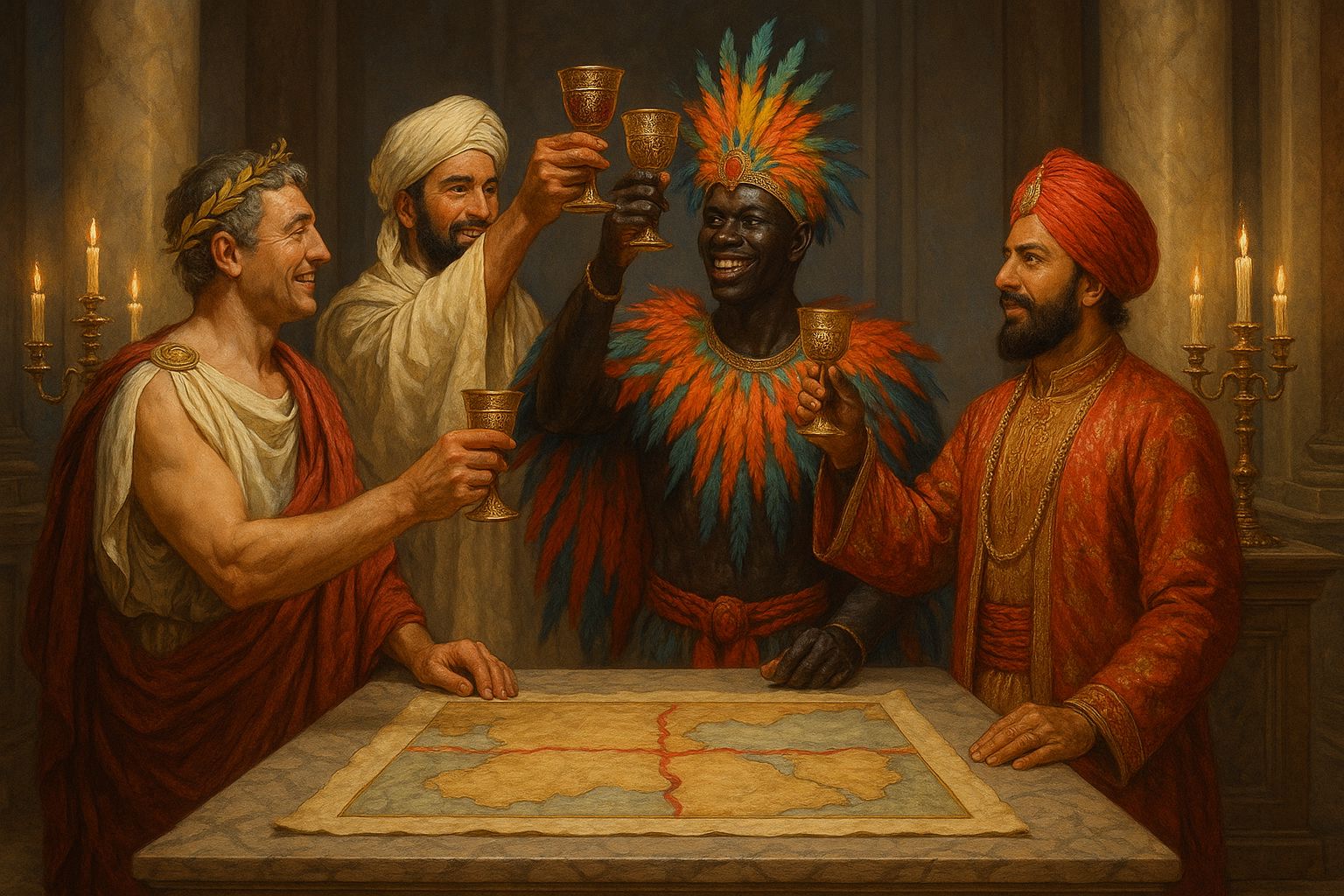
After centuries of war, exhaustion, and famine, the world's great powers finally agreed to peace, but not justice. The Treaty of Astoria, named for the neutral city where it was signed, brought an end to open conflict by carving the world into four vast dominions: The Empire, Zarhalem, Zanakwe, and Mataraaj.
Each claimed a sphere of influence, vast regions of land, trade routes, and vassal states, under the promise of "non-interference." In truth, the treaty was less a pact of peace than an agreement to feed on the world in order, not in chaos.
Astoria stands as the only neutral ground, a glittering city of ambassadors, spies, and merchants where the powers meet behind silken curtains to divide what remains of the world. Its streets run on diplomacy, its palaces on corruption.
The world calls it peace. The wise call it carving the corpse.
The Treaty of Astoria
The Treaty, signed by trembling monarchs and smug diplomats, established the Four Spheres, each with absolute dominion within its borders:
- The Empire claims the entire Yelthara continent, Tir Albireth, Para Omros and Montosho, its legions enforcing "order" over exhausted vassal states.
- Zarhalem takes the The Great Desert, the Olydrian Isles, the Drowned Marshes and Kaelthir, ruling through gold, guilds, and merchant-princes who now have license to bleed the world legally.
- Zanakwe expands its dominion across the Skarthuun steppe, Grashkaar, Elarune, Khazryn and Twin Cities, It's smaller, but the wealth of the Twin Cities makes it equal to the others.
- Mataraaj claims Ashkar, Zverilov, Ozukari and Tikirri, as well as the unknown kingdoms beyond the Sunhome sea, preaching unity under the now undisputed maharaja, but ruled by generals who dream of empire.
Each power recognizes the others' claims, and swears never to cross another's borders.
But the map's lines were drawn by greed, not truth. Dozens of smaller kingdoms, tribes, and free cities found themselves inside one sphere or another, their fates sealed without consent.
The Feeding Frenzy
With the major wars ended, the real war begins, the war against the weak.
The four powers descend upon their assigned territories like wolves on divided carcasses.
The Empire "annexes" protectorates that once traded freely. Zarhalem sends fleets to "secure" ports for safety. Zanakwe's priests lead holy crusades of conversion, dragging villages into the faith one bloody sacrifice at a time. Mataraaj builds "fortified sanctuaries" that look suspiciously like occupied cities.
Astoria watches and records, its diplomats congratulating themselves on having achieved "a lasting peace."
Within a decade, the map of Heroica burns anew, not from global war, but from endless local extinction.
The Silent Wars
The Treaty forbids armies from crossing spheres, but not from fighting inside them.
Proxy wars bloom like weeds. Mercenary companies switch allegiances overnight. Puppet rulers rise and fall on the whispers of foreign agents. Every "neutral" faction is bought by one of the Four.
Assassinations replace invasions. Trade blockades replace sieges. The battlefield shifts from plains to council chambers, from armies to economies.
The great powers no longer fight one another, they compete only to consume faster.
Astoria, the Neutral City
At the center of it all stands Astoria, the jewel of false peace. It is the capital of hypocrisy, and everyone's last sanctuary.
More than ever the beating heart of diplomacy, and corruption. Here, every nation maintains embassies, spy houses, and shadow courts. Armies cannot march here, but gold and rumor flow freely.
The city's neutrality is sacred, enforced by all four powers, who understand that Astoria's survival ensures their control.
Its marketplaces sell more than slaves, spices and silk; they sell treaties, secrets, and names. Behind every tavern is an informer; beneath every temple, a hidden vault of bribes.
And yet, for all its deceit, Astoria thrives. It is the only place where envoys from every sphere can meet, to conspire, to celebrate, or to sharpen the knife for tomorrow's partition.
The End of Nations
As the small powers vanish, the world shrinks.
First the free cities fall. Then the border kingdoms are absorbed. The independent orders, the scholar enclaves, the trade leagues, all disappear, swallowed by one banner or another.
The old diversity of cultures, languages, and faiths erodes, replaced by four monolithic ideologies: Imperial Order, Zarhalem's Profit, Zanakwe's Faith, and Mataraaj's Unity.
The people whisper that one day soon, there will be no borders left to divide - only the moment when the Four realize there is no one left to devour but each other.
And when that day comes, peace will end exactly where it began: in blood and smoke above Astoria's golden towers.
Tone and Themes
Cold, political, and inevitable. The peace of exhaustion, a stillness that masks rot. The tone is cynical but precise, a portrait of ambition disguised as diplomacy.
Themes
- Peace as Division: The world is carved like spoils, not healed.
- Power in Balance: Stability through mutual greed, a harmony of corruption.
- The Death of the Small: Every great peace is paid for by the destruction of the weak.
- Diplomacy as Warfare: Treaties become weapons sharper than swords.
- The Illusion of Order: The world believes itself safe, unaware that it is being consumed from within.
The war is over. The table is set.
The world itself is the feast, and the Four have only begun to eat.