A Fairer World
| Story |
|---|
| The tavern was full of laughter, but none of it warm. |
| A minstrel played near the hearth, his voice soft and pleasant, singing a song about justice that no one believed. The crowd listened all the same, because music costs nothing and silence costs more. |
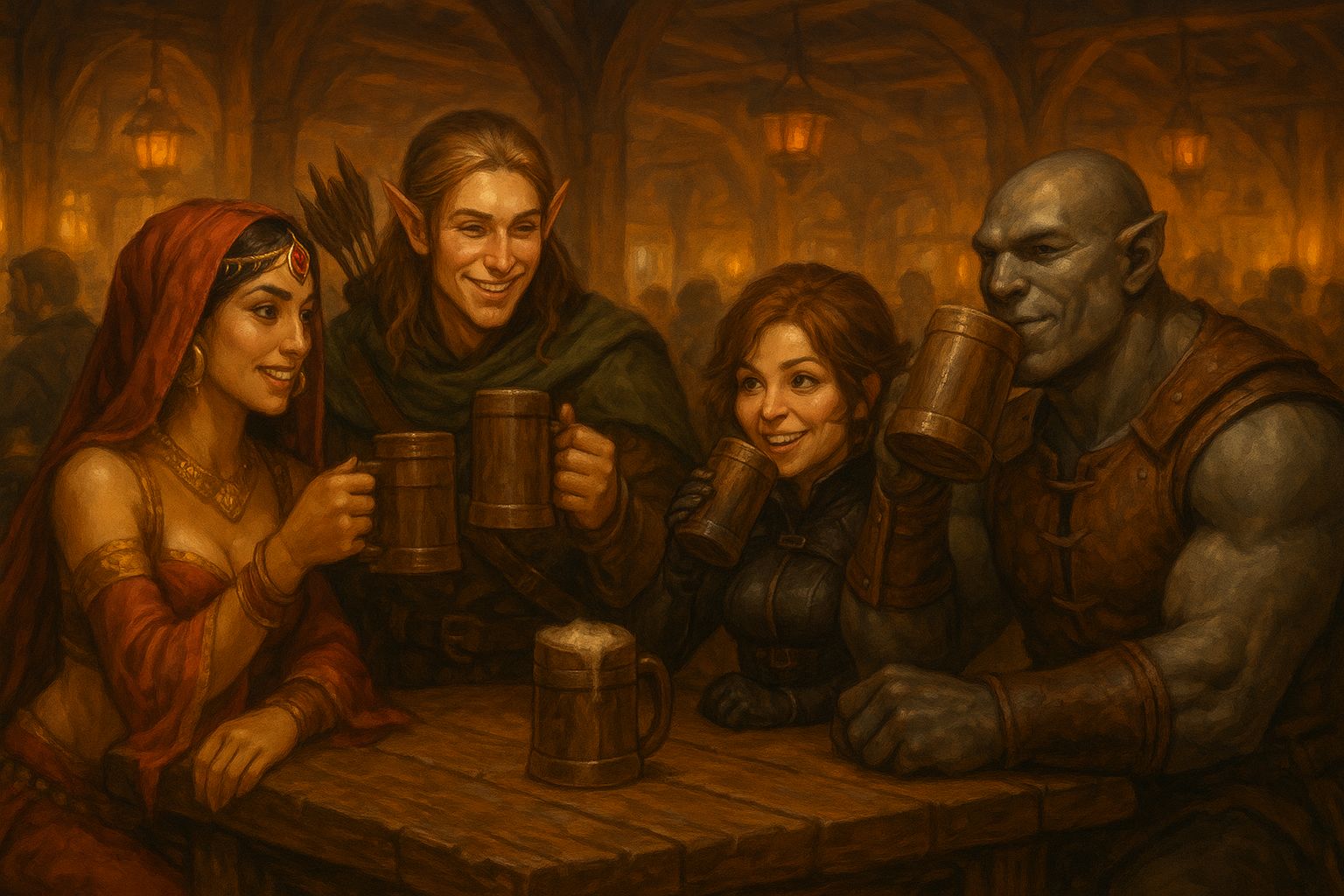
| At a corner table, a merchant, an orc, and a priestess of no clear god shared a bottle. Their clothes were fine, their words sharper. They spoke of trade routes, border tariffs, the value of coin against grain. Not one of them mentioned race, faith, or family. Those were old currencies, long devalued. |
| The girls in veils moved between the tables, serving the customers, were bound by silver now, not by chains, but bound nevertheless. |
| By the window, a freedman counted his debts on a scrap of parchment. Each mark was a day worked toward freedom, each erased one a breath closer to hunger. The woman beside him watched the street outside, her hand resting on the knife at her belt. |
| Near the door, a soldier in worn armor told a story of a campaign in the south, how the legions had broken a rebellion and taken prisoners. "Not slaves," he said, smiling into his cup. "Servants of the state. For their own good." No one challenged him. No one wanted to. |
| Above them all, the tavern’s sign creaked in the night wind. It read The Honest Coin. |
| Outside, the rain came down in clean, equal drops, washing the dirt from no one. |
Description
This version of Heroica is not gentler, only fairer. The old hatreds of race, gender, and creed have softened, but cruelty has not vanished, it has simply changed its shape. People are not judged for what they are, but for what they can do. Power, not birth, remains the measure of worth.
In this world, prejudice takes fewer forms, yet injustice still rules. Slavery, conquest, and the hunger for dominance persist, carried out in the name of order, strength, or divine will. The world is not kind, only less small-minded in its cruelty.
The Balance of Sexes
In most lands, men and women stand as equals. The balance may tilt here or there, but it is not the rigid hierarchy it once was. Queens rule as often as kings, priestesses preach beside priests, and women serve in the legions without question. In the cities, inheritance and craft are no longer bound to gender.
Still, old habits die slowly. Some nations cling to their old ways, Amazireth, for instance, still holds to its belief that women are the chosen vessel of divine wisdom, and men the lesser vessel of flesh. Elsewhere, patriarchy lingers in shadows, enforced by tradition more than law. Even in balance, power breeds tension.
The Peoples of the World
Races coexist more freely than in most versions of Heroica. Trade, migration, and intermarriage have blurred the lines between species. A merchant caravan might host elves, orcs, and humans in equal number, united by profit rather than heritage. In the markets of Zarhalem, human and orcish merchants haggle in the same tongue, their guild banners stitched with sigils of once-hostile gods.
Prejudice remains, but it is pragmatic rather than racial, a disdain for weakness, poverty, or failure rather than skin or blood. Among the cities, wealth is the only race that matters. The poor of every kind live together, as do the rich.
Still, there are corners where the old hatred endures. The Empire continues to see itself as the pinnacle of civilization, treating outsiders as barbarians in need of rule. The Sreli, zealous and fanatic, see themselves as the crown of creation, a race destined to rule or destroy all others.
Faiths and Tolerance
The great faiths of Heroica coexist uneasily but without constant war. In most lands, temples of different gods stand side by side, each claiming its truth while acknowledging the others. Syncretic cults blend beliefs, and prophets preach unity through shared struggle. In the great port cities, travelers pour offerings for every god they pass, not from faith, but fear of offending one they forgot to name.
But there are still those who refuse the idea of peace. Para Omros remains zealously pure, worshiping only Omros and outlawing all other faiths. They send missionaries into tolerant lands and call their neighbors heretics.
Tolerance has made the world quieter, but not calmer. The faithful argue in words now rather than war, yet words can burn slower and longer than fire.
The Chains That Remain
Slavery still exists, though its justification has shifted. It is, in most places, no longer built on race or birth but on crime, conquest, and debt. Criminals, prisoners of war, and the impoverished are the ones chained now. Some nations defend it as a necessary evil, a punishment, a means of labor, or a price for survival.
In others, slavery is rare but not abolished. Laws limit cruelty, but enforcement is thin. A person freed in one city may find themselves enslaved again in the next. The Desert Rim markets still thrive, their cages filled with the defeated rather than the despised.
For all the talk of fairness, the strong still rule, and the weak still serve. Chains are fewer, but they bite just as deep. The world may no longer draw lines between bloods, faiths or sexes, but it has drawn sharper ones between masters and those who serve.
The Shape of Power
With prejudice fading, power has become purer. Nobility, wealth, and ambition are now the only true divisions. The powerful no longer hide behind faith or lineage, they rule by merit, manipulation, and fear.
This has made the world both brighter and darker. Without the excuse of blood or gender, cruelty stands bare. EvEvery tyrant now claims virtue in victory, as if cruelty were proof of merit. Every conqueror justifies domination as proof of strength.
In this world, equality is real, but it brings no peace. Heroica remains a place of struggle, of might against might, and the fairness of the grave.
The Tone of the World
The Fairer World removes some of Heroica’s ugliness but none of its weight. It is still a dark, brutal place, not because of prejudice, but because people remain what they always were: hungry, fearful, and cruel when given cause.
It is a world without excuses. No one can hide their evil behind faith or birthright. Every cruelty is chosen. Every injustice, deliberate. In the end, fairness does not make Heroica kind, only honest.