Waverider Epilogue
The Storm
The storm had lasted six days.
Six days of screaming wind and water that fell sideways, of ropes snapping like bowstrings and men vanishing into blackness before their names could be shouted twice. The Waverider shuddered under every wave, her masts groaning like old trees. When the second one split, it went down with a sound like thunder, taking three men and half the foredeck with it.
On the seventh day, the rain thinned, though the sea still heaved like something alive.
Then came the cry from above.
"Land! Land to starboard!"
Through the fog they saw it - cliffs like broken teeth, rising from the foam. Too close.
"Hard to port!" Solonex shouted, voice raw from salt and sleeplessness. The ship lurched, scraping past jagged stone by what felt like inches. Lightning flashed, showing a narrow gap in the cliffs. They took it.
For hours, the sea gave them nothing, only mist and exhaustion. Then an island broke the horizon. He ordered the sails trimmed, steering by instinct more than sight. The wind carried them closer, too fast, too blind.
For a few heartbeats, they sailed in eerie calm. Then came the crash.
The Waverider struck the reef with a sound like the world splitting
open. The deck pitched, the hull groaned, water poured in. Solonex gave
the order, though it broke his throat to do it.
"Abandon ship."
They made the shore by oar, by plank, by sheer will. When they reached the sand, most could only lie there, breathing like men reborn.
Dawn came soft and gold. The storm was gone. The sea lay smooth again, cruelly calm, as if it had done nothing wrong. The Waverider stood half-buried on the reef, one mast leaning like a broken arm.
Otto the Dwarf stood beside the captain, water dripping from his beard. "Only way to keep her from sinking," he said grimly, "is to keep her standing there. Ain't fixable."
Solonex didn't answer. He only looked at the wreck, the greatest ship ever built, and gave a small nod, like a man closing a door.
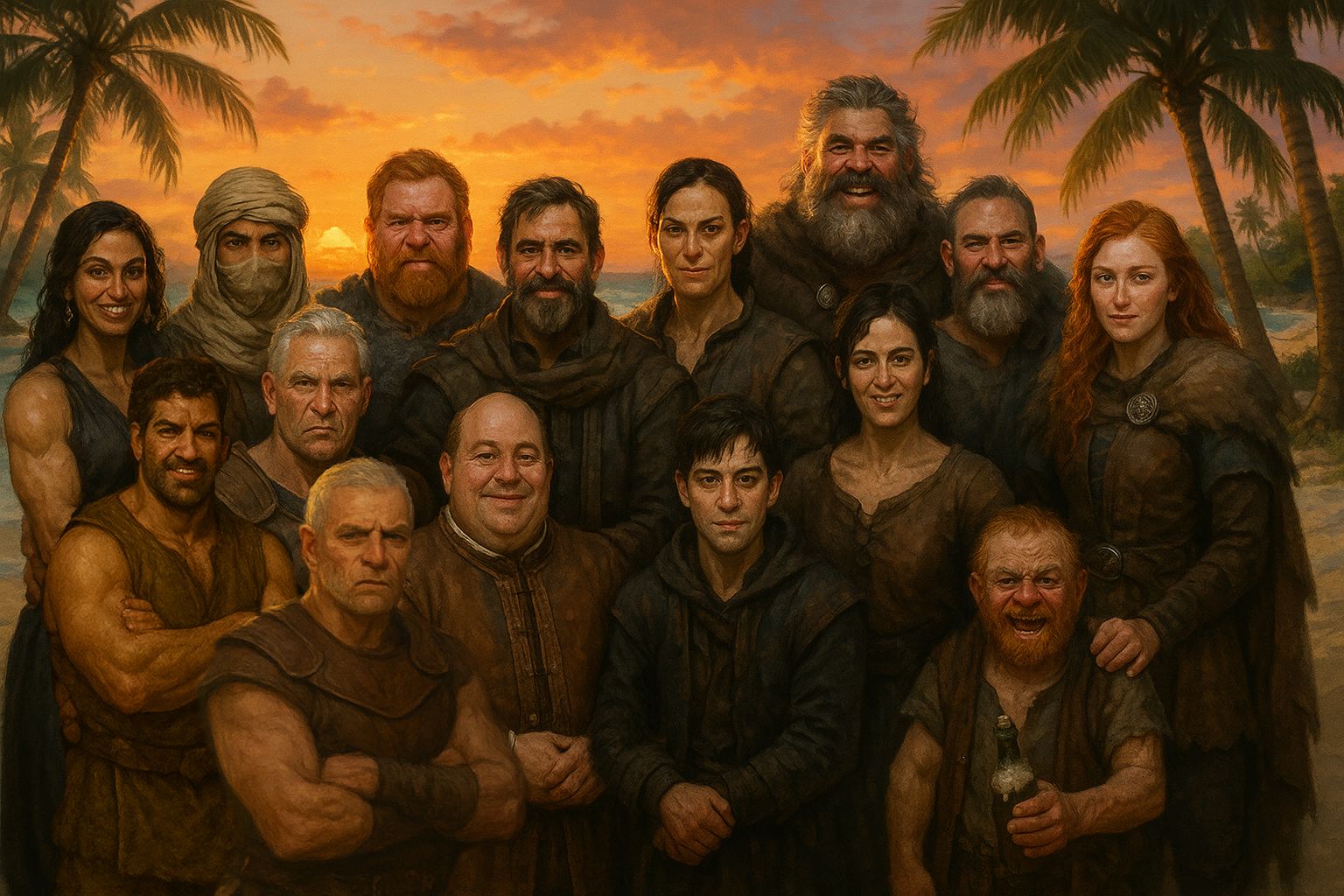
By noon, figures appeared on the far side of the beach. Islanders. Barefoot, brown-skinned, curious but smiling. They brought baskets of fruit and water, and the crew felt instantly welcome.
They helped haul what could be saved from the wreck. Sails for tents, barrels of grain, crates of tools. Selene tended the injured beneath a palm grove, her hands steady even as her eyes betrayed exhaustion. Severin tried to trade, but the islanders insisted that it was all gifts.
When night came, the survivors lit a fire on the sand. No one spoke of leaving. They all knew the truth: the Waverider was finished, and the palm trees of this place would never bear a ship strong enough to face the open sea.
But the air was warm. The waves were gentle. The islanders sang to them under a red sunset, and for the first time in months, no one stood watch.
Decimus and Severin
Evening settled slow over the new camp. The sea burned orange where the sun sank behind the reef, and smoke from cooking fires drifted soft across the beach. The islanders were laughing somewhere inland, drums faint beneath the sound of surf.
Decimus sat apart, sharpening his old sword with a shellstone, though the blade hadn't been drawn since the wreck. Severin approached with two cups of palm wine and handed him one.
"Still keeping that thing ready?" Severin asked.
"Habit," Decimus said. He turned the sword in the fading light. "Steel's no good if it forgets what it's for."
They drank in silence for a time. Gulls wheeled low over the tide.
"Peaceful place," Severin said at last.
"For now."
Severin smiled faintly. "You sound disappointed."
Decimus shook his head. "No. Just thinking ahead. Sooner or later, another ship will find this place. Maybe traders, maybe soldiers. If it's soldiers, we'll need to make sure the first one that comes doesn't send word back."
Severin tilted his head. "A local militia, then?"
"Something like that. Enough bows, enough drills, enough discipline to make outsiders think twice. The people here can fight if they must. They just need someone to show them how."
"And you'll be that someone."
Decimus nodded once. "I've spent my life fighting other men's wars. Might as well make this one my own."
Severin looked out toward the horizon, the line where the sea and sky blurred together. "Practical. Sensible. Predictable." He sipped the wine. "I'm told I'm none of those things."
Decimus grunted. "So what will you do, talk the invaders to death?"
"Perhaps." Severin's eyes glimmered with amusement. "There's already talk of disputes, fishing rights, land, marriage promises. Someone has to listen, to keep the peace. I seem to have been volunteered."
"A judge, then."
"Of a sort. I prefer the word mediator. It sounds less final."
Decimus sheathed his sword, the motion slow, deliberate. "You and I are strange men to build peace."
Severin raised his cup. "Maybe that's why we'll manage it."
They drank together as the last light died. Behind them, the Waverider's broken mast stood black against the red sky, a monument to what they had survived, and what they would build in its place.
Velan and Arven
The sun was sinking low when Velan found his place on the fallen palm. The trunk was smooth from the tide, its curve pointing toward the horizon where the sky burned copper and rose. He sat in silence, elbows on his knees, watching the light fade from the waves.
Arven passed along the beach, bare-chested, carrying a basket of shellfish. When he saw Velan, he slowed, then sat beside him, setting the basket down between them. For a while, neither spoke. The air smelled of salt and roasting fruit from the campfires behind them.
"Strange, isn't it," Arven said finally, "having nowhere to march to."
Velan gave a slow nod. "Strange. But not unwelcome."
Arven chuckled. "So what will you do now? We've got no walls to guard, no captains to shout at us."
Velan watched the sea a long time before answering. "I think I'll teach," he said quietly. "There are children here. They'll need to know more than how to fish and climb trees. Letters. Numbers. Maybe a bit of history, though not too much of mine."
Arven raised an eyebrow. "Teacher, eh? Didn't see that coming."
"Neither did I," Velan said. "But maybe it's time. I've done enough taking in my life. Might be time to give something back. Maybe it'll balance things. Maybe not. But I'll try."
Arven nodded slowly. "Good. We could use men who think like that." He picked up a shell and rolled it between his fingers. "As for me, I'm done wandering. I'll build a house. Maybe two, if the first one falls down. Find someone to share it with, if I'm lucky."
Velan smiled faintly. "And if you're not?"
"Then I'll help Decimus with his guard idea," Arven said. "Not to fight, but to prepare. The Grashkaar orcs used to say that strength isn't in killing - it's in knowing you can, and choosing not to."
Velan turned to him, the last light glinting off his white hair. "That's wisdom. Hard-earned, too."
"Maybe," Arven said. "But I think I'm ready to try it."
They sat together as the sun slipped beneath the horizon, the tide washing over their boots. Behind them, the campfires began to glow brighter, and the sound of laughter rose through the dusk.
Velan looked toward it and said softly, "Maybe we were meant to find this place."
Arven nodded. "Or maybe it found us."
Eira and Ulfar
The tide was low when they walked the beach, waves whispering against the sand. The air smelled of salt and driftwood smoke, and the sunset painted the water in copper and gold.
Ulfar walked with his hands clasped behind his back, unusually quiet. Eira kept pace beside him, her axe slung over one shoulder.
"Feels strange," Ulfar said at last. "Without the ship. Without orders. Without the noise. I'm afraid...", he frowned, searching for words, "I'm afraid I'll be alone now."
Eira glanced at him. "You won't be."
He gave a puzzled grunt. "Who'd stay with an old storm like me?"
Before she could answer, a voice barked from the palms behind them.
"Ulfar! Not even you can be that effin' dense!"
Otto the Dwarf sat leaning against a tree, arms crossed, grinning as he raised his bottle.
Eira smirked. "For once, I agree with him."
Ulfar blinked, turning to her. "Wait..."
He stared at her for a long moment. You could almost see the thoughts working their way through that thick skull... The nights in storm and battle, her laughter beside the fire, the way her eyes always found him in a fight.
Then, slowly, the grin began. It started small, then spread, then burst into a booming laugh that rolled down the beach like thunder. He swept her up in a bear's embrace, lifting her clean off the sand.
Eira laughed too, arms around his neck. "Took you long enough, you oaf."
"Had to be sure," he rumbled, voice thick.
Otto threw up his hands. "Yeah, yeah, I'll leave you two to it," he muttered, and trundled off toward the firelight, shaking his head. "The bottle's dry anyway... and I'm not drunk enough to watch this."
Eira and Ulfar stayed there, wrapped in each other's arms, watching the sun sink into the sea. The waves rolled in, slow and steady, and for once neither of them felt the need to move.
Brannick
Brannick took to the island like a cook to a new spice rack. Within days, he had his sleeves rolled up, nose deep in baskets of strange fruit and fish he couldn't name, arguing cheerfully with anyone who looked like they knew what they were doing.
He found a kindred spirit in a woman named Maika, who ran the village hearth. She cooked barefoot, sang while she worked, and had no patience for anyone who didn't taste before they judged. Between the two of them, the beach became a battleground of recipes - Brannick's thick stews and salted meats against Maika's sweet broths and spiced fruit pastes.
Mostly, it worked. Sometimes, it didn't. One disastrous experiment involving sea snails and coconut milk sent half the helpers running for water. Brannick laughed so hard he nearly dropped the pot.
But by the end of the week, something had changed. The smells that rose from the cooking fires weren't foreign anymore. They were theirs.
So, they decided to mark it.
The villagers and crew built long tables from driftwood and sails, and together prepared a feast that stretched from dusk till the stars came out. Roasted fish stuffed with herbs neither side could name, bread baked from island root flour, Brannick's stew laced with Maika's bright spices.
When it was done, and the first plates were passed around, Brannick stood there, wiping his hands on his apron, pretending he wasn't smiling.
"This," he said, voice rough but warm, "isn't my food or yours. It's ours. Eat up before it gets cold."
They did.
And for that night, the camp smelled of home - whatever that word meant to each of them.
Gato
The evening was calm, the air warm with the smell of salt and cooking fires. Solonex sat on a driftwood log, carving absently at a bit of wood as the waves rolled in and out. Gato approached quietly, as always, then hesitated before sitting down beside him.
For a while, neither spoke. The surf did the talking.
Finally, Gato said, "I don't know what to do now."
Solonex looked up from his carving. "What do you mean?"
"I was a scout," Gato said. "A soldier. I found paths, watched for danger. But here..." He gestured at the calm sea, the glowing village lights. "There's nothing to scout. No roads. No enemies. Everyone just... lives."
Solonex smiled faintly. "That sounds like a problem most people would kill to have."
Gato kicked at the sand. "I just don't fit, Captain. They're kind, but... I still feel like I'm on the outside, looking in."
Solonex studied him for a moment, then said, "You're a smart kid, Gato. Smarter than you give yourself credit for. You can do anything you set your mind to."
Gato shrugged. "Maybe. Still doesn't change what I am."
The captain's smile widened, slow and knowing. "You mean what you were. Tell me, have those sharp scout eyes of yours noticed how the local girls look at you?"
Gato blinked. "What? No, I..."
"Then you haven't been paying attention." Solonex's grin turned mischievous. "You're not invisible here, lad. Not anymore."
Gato tried to hide his smile, but it crept through anyway. "Maybe I should... take another look around, then."
"You do that," Solonex said.
Gato rose, dusted sand from his trousers, and started back toward the village. His step was lighter than before, almost a skip.
Solonex watched him go, the smile still lingering. "You'll find your place, boy," he murmured to the sea. "We all do, in the end."
Kethra and Rahim
Rahim stood at the edge of the palms, staring at a patch of open ground just above the tide line. The sea breeze tugged at his sleeves.
Kethra came up behind him, barefoot in the sand. "You've been staring at that spot for a while," she said. "Planning to fight it, or just admire it?"
He smiled faintly. "Neither. I'm thinking it might be a good place for a house. Close enough to hear the waves, high enough to stay dry."
She looked out over the beach, the water flashing gold under the sun. "You're right. It's perfect."
Rahim nodded, then turned to her. "Then perhaps we should build it together."
Kethra blinked, caught off guard. "Together?"
He met her eyes steadily. "I've seen enough war to know that peace is wasted alone."
For a long moment, she said nothing. The sea murmured at their feet.
"I've been hurt before," she said. Her fingers brushed the scar at her wrist, then fell still. "Too many times. I'm not ready."
"I know," he said simply.
"But when I am..." she hesitated, then smiled faintly, "you're the one I want waiting."
He smiled back. "Then I'll wait." His tone held no urgency, no plea, only respectful patience, like the tide waiting for the moon.
She breathed out, tension leaving her shoulders. "Then we'll build one house, but with a wall between us."
Rahim chuckled. "A wall?"
"So that when the time comes," she said, "we can make a door."
They went to find Otto the Dwarf, who was already sketching something obscene in the sand with a stick.
Kethra crossed her arms. "We need a house. Two halves. One wall. And a door that can be added later."
Otto the Dwarf squinted up at them. "So when you two get horny a week from now, I've got more work to do?"
Rahim sighed. "A locked door, then."
"Fine," Otto the Dwarf grunted. "You each get a key. But don't come crying to me when you lose ‘em."
Kethra smiled. "We'll manage."
As Otto the Dwarf shuffled off to gather tools, Rahim looked at her again, eyes calm as still water. "One wall," he said quietly.
She nodded. "For now."
Selene
The laughter of children drifted through the palms. Selene knelt in the sand, a half circle of little ones around her, showing them how to wrap a bandage around a scraped knee. Her hands moved with the same calm precision they always had, but now there was a softness to her face that few on the Waverider had ever seen.
When she looked up, Solonex was watching from the edge of the grove, a faint smile under his weathered eyes.
"Captain," she said, rising and brushing sand from her hands. "You look out of place without a deck under your boots."
He chuckled. "And you look... happier than I've ever seen you."
Selene smiled, turning to watch the children chase each other down the beach. "For the first time in my life, I'm looking forward to being a healer. Here, I mend fevers and broken bones, not sword cuts and torn flesh. I fix things instead of just patching people up for the next battle."
"You've earned some peace," Solonex said.
She nodded. "There's less to heal here, which means I can finally rest. And the people..." She glanced toward the village, where a woman waved at her in greeting. "They thank me. They bring food, flowers, songs. It helps. More than they know."
Solonex's voice softened. "I always knew it was your calling."
Selene turned back to him, and for a moment, all the years of storms and pain and blood between them seemed far away. She stepped forward and embraced him, not as captain and crew, but as friends.
"I have you to thank for that," she said. "If you hadn't taken me aboard, I'd still be someone's abused slave. Healing until it killed me."
He smiled faintly, resting a hand on her shoulder. "You've saved my life more times than I can count, Selene. And most of theirs too. I still owe you."
She shook her head. "At this point, why keep score? We're friends."
Solonex nodded, eyes warm. "Aye. Friends."
She smiled, then turned back to the children calling her name. "Go on, Captain," she said. "Find someone else to save for a change."
He laughed quietly as he walked away, the sound of her laughter, light and easy, following him down the beach.
Otto the Dwarf
The fire crackled between them, the scent of roasted fruit and smoke hanging in the air. Otto handed Venera a cup of palm wine, his third batch, he claimed, "the first two bein' merely poisonous."
He took a long drink and leaned back on a log. "We had the greatest ship ever built," he said. "Now we've got the greatest wreck ever made. That's somethin', isn't it?"
Venera smirked over her cup. "Don't say that where Solonex can hear you."
"Aye, aye." Otto the Dwarf waved a hand. "Man's still mournin' the timbers like they was his children. Anyway, I've got plans."
"That worries me already," Venera said.
He grinned. "I'm gonna start distillin' this palm wine proper. Make it strong, clean, and worth tradin' for. Give it a name - Otto's Fire, maybe. I'll get popular, powerful even. If these islanders had money, I'd be rich too."
Venera took a slow sip. "Just don't drink it all at once. And don't forget your craft. The island still needs a smith."
He shrugged. "If all else fails, I'll make gods."
She raised an eyebrow. "Come again?"
"The locals carve gods out of wood," he said. "Pray to 'em. If the prayers work, they keep the god. If not, they chuck it on the fire and carve a new one. So I figure - that's steady work. Build 'em saints, sinners, and a few with good arses for luck."
Venera laughed, shaking her head. "Making gods. That's ambitious, even for you."
Otto the Dwarf grinned around his cup. "Aye, well. Someone's got to keep the divine economy runnin'."
Phaedros
The afternoon was bright and still, the sea beyond the reef calm as glass. Phaedros sat at a rough-hewn table beneath a palm awning, quill in hand, a scatter of papers weighted with shells around him.
Solonex stopped beside him. "Working, even here?"
Phaedros didn't look up. "Habit dies slower than sailors, Captain. I'm making copies of our map. Sending them to sea in bottles. One a day, as long as I have bottles."
Solonex smiled faintly. "You shouldn't mark this place."
Phaedros chuckled. "I'd never do that. Even if I knew where here was."
He corked a bottle and set it gently in a basket beside the table. Inside, the parchment gleamed faintly with ink and salt.
Solonex folded his arms. "And when you run out of bottles?"
"Or when Otto drinks them all, you mean?" Phaedros said with a crooked grin. "Then I'll write a book. The story of our voyage. Not the kind with monsters or heroes - just the truth, or what passes for it."
Solonex nodded slowly. "Then I'll fetch you the logbooks. So you get it right."
Phaedros looked up at him, the sun catching the silver in his hair. "Aye, do that. If the world's going to remember the Waverider, we may as well make sure it tells the right lies."
The captain laughed softly. They clasped hands across the table, two sailors who had chased the same horizon for too long.
As Solonex turned to leave, Phaedros uncorked another bottle, rolled a new map, and slipped it inside. When the tide turned, he walked down to the water and set it adrift, watching it float away.
It drifted slowly out to sea, spinning once before the current caught it - a message to the world from the edge of all maps.
Solonex and Venera
The wreck of the Waverider lay half-buried in the sand, her ribs jutting from the shallows like the bones of whale. The tide whispered through them, patient and unhurried. Solonex stood at the water's edge, hands clasped behind his back, watching the waves break and pull away again.
Venera joined him, the salt wind tugging at her hair. Behind them, the village smoked gently from the morning fires. Village elder Serand Brogret leaned on his staff, scratching at his white beard, silent as driftwood.
Venera's voice was soft. "Will it be hard? Letting her go?"
Solonex smiled faintly. "I've let go of worse. The sea doesn't belong to us. We only borrow her for a while." He looked out toward the horizon, where the line of blue blurred into sky. "I think I'll stay here. Fish, mend nets, argue with the gulls. Still the sea. Quieter. Fewer ghosts."
She nodded, but her eyes lingered on the broken hull. "Feels like we left too much undone. So many things we couldn't set right."
"There'll always be things to fix," Solonex said. "The world's made that way. You patch what you can, then you sail on."
Serand Brogret shifted his weight, the staff creaking under his hand. "And there will be others," he said. "Heroes who'll take up what you began. Somewhere out there, another ship sails, another fight waits. The world never runs out of heroes. It just changes who carries the torch."
Venera looked between them, the wreck, and the waves that had carried her farther than she ever dreamed. She drew a slow breath, then smiled through the ache in her throat.
"So," she said quietly, "I'll fix things here. I'll be a hero."
Solonex looked at her, and for a moment, the old captain's eyes held something bright, pride, maybe, or hope. Then he turned back to the sea, and the three of them stood together as the tide rolled in, carrying the last splinters of the Waverider out into the endless blue.
The Message
The bottle drifted for a long time, turning with the tides. Salt glazed its glass, and the ink inside had softened but endured.
One dawn, the current changed. Gulls wheeled above as the bottle crested a wave, and there, on the horizon, land rose green against the sun.
The tide carried it onward until it vanished in the foam.
Inside, the letter waited - a map, a name, a promise - patient as the sea.