Golems
| Story |
|---|
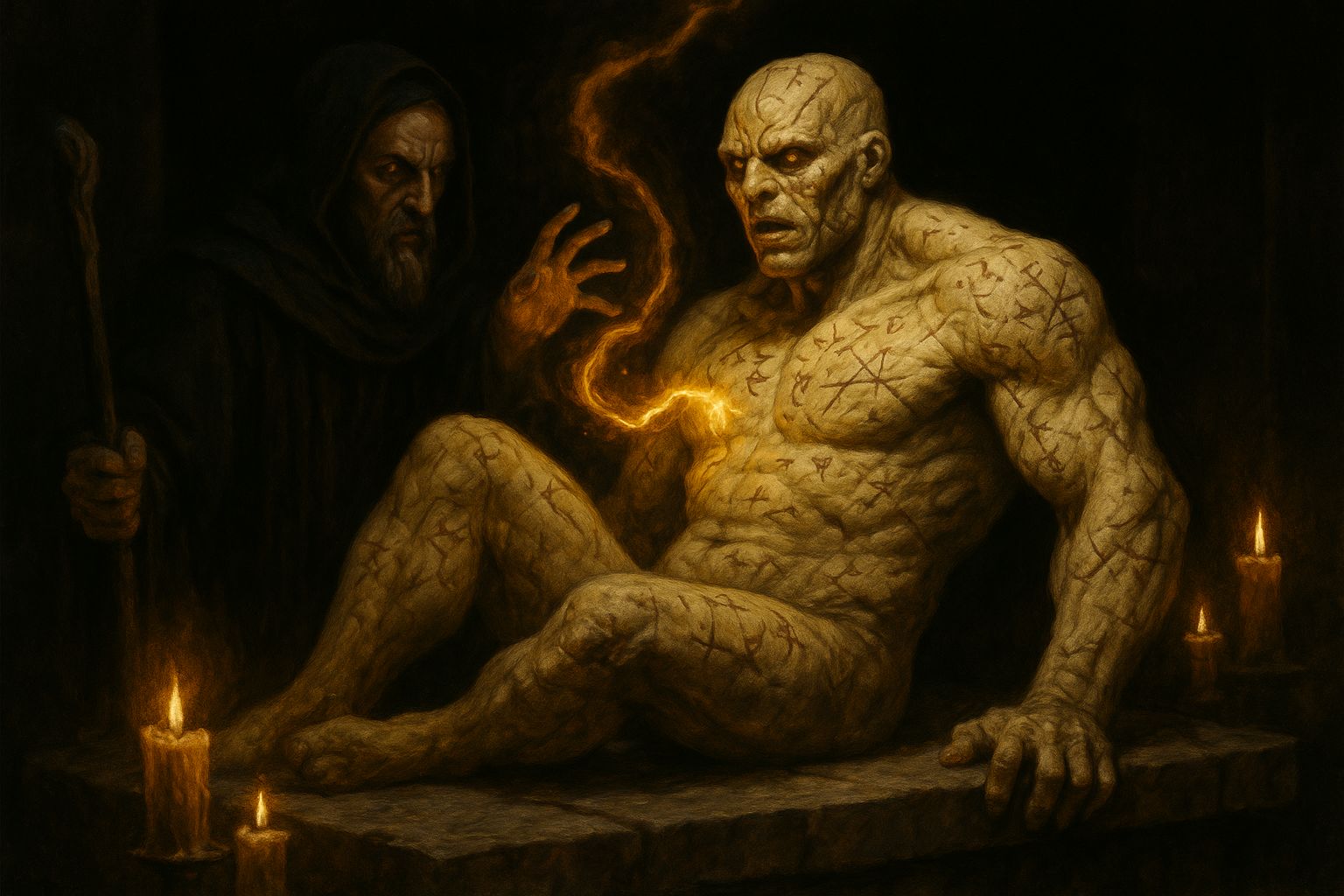
| The chamber was dim, lit by a handful of smoking torches that spat resin into the air. Shadows clung to the walls, long and trembling, as if they feared the thing being born upon the slab. The air was heavy with the stench of blood, fat, and burnt hair. Buckets overflowed with cast-off scraps, bones stacked neatly against the wall like timber awaiting use. |
| On the table lay a form that might have been a man, if one squinted in the dark. Its limbs were uneven, its skin a patchwork quilt of pale and dark, smooth and scarred. The magus stood over it with a knife of black iron, his face a mask of concentration. He had stitched the parts together with careful, ruthless hands, but stitching was not enough. Flesh had to be bound with more than thread. |
| He pressed the blade to the creature's chest and began to carve. The knife parted the sewn skin in long, shallow strokes, tracing patterns older than any kingdom. Spirals, lines, letters no tongue could pronounce. Blood welled along the cuts and ran into the grooves, filling them with red that glistened in the torchlight. The runes spread across the body like a map of veins, curling over shoulders, down arms, into thighs. The sound was soft but unbearable - the slow rasp of steel against skin, the wet whisper of carved flesh opening again. |
| When the final symbol was carved into its brow, the magus leaned close and whispered a single word. The air grew cold. The blood-filled sigils began to glow faintly, as if the body itself were smoldering from within. The stitched limbs jerked once, then again, and the head lifted with a creak like leather pulled too tight. |
| Its eyes opened. They were not alive, not truly. They were flat, empty stones set in a face of stolen skin. The creature drew in a rattling breath it did not need, chest rising and falling in mockery of life. |
| The magus stepped back, his knife dripping, his work complete. The golem sat up slowly, joints stiff, its gaze following him without thought, without question. It did not live. It would never live. But it obeyed. |
| Story |
|---|
| The road into the valley was broken and overgrown, grass sprouting through cracked stones. A traveler came upon the ruin of a mill, its wheel long rotted away, the stream diverted to nothing but a trickle. The village was gone, houses collapsed into piles of moss and timber. Only one figure remained. |
| In the shadow of the ruin, a clay golem stood knee-deep in the weeds. Its arms were thick and smeared with centuries of dirt, its body cracked where the sigils had faded but not yet broken. In its hands it carried a bucket, the bottom eaten through by rust. |
| Step by heavy step, it trudged to the dry streambed, dipped the broken bucket into the dust, and turned back toward the husk of the mill. Ash crumbled inside the pail, but still the golem walked on. It emptied the bucket into the trough, then turned again, lumbering back toward the stream that no longer ran. |
| Over and over, the same path. For how many years, no one could say. Its master's order - "Keep the mill supplied with water" - had outlasted the village, the river, even the memory of those who lived there. |
| The traveler watched in silence as the creature passed, eyes dull, body cracking, carrying a bucket that would never again hold water. |
| The golem did not see him. It only turned and walked the same path again, tireless, thoughtless, eternal. |
Golems are magical constructs, born not of flesh or spirit but of craft and word. They are created from unliving material shaped by hand, infused with written sigils, and animated through rituals of command. Their nature is simple: they obey, they endure, and they persist until their magic unravels.
Types of Golems
Flesh golems - stitched together from corpses. Some cultures whisper that these are blasphemous, for the soul does not rest easy when its vessel is misused.
Clay golems - the most iconic, sculpted from river clay and carved with letters of binding. Many priests have used them to guard temples or haul stone.
Wood golems - often carved from sacred trees or assembled from driftwood, carrying charms and fetishes. These are common among hedge-witches and shamans.
Stone golems - hewn from quarry rock or carved from statues, heavy and durable, though slow.
Metal golems - rarest of all, forged by master smiths and empowered with runes hammered into the iron. They are said to be nearly indestructible, but their creation demands both great wealth and dangerous amounts of magical energy.
The Magic of Words
The magic of a golem lies in its words. The runes and inscriptions carved or painted into its form act as veins for the binding magic. Should those markings be marred, erased, or broken, the golem collapses into inert matter. Many a battle against a golem has ended with a clever strike to its sigils.
Limitations
Golems are not clever. They do not reason or interpret, only follow. If commanded to fetch water, they will do so until ordered otherwise, even if the village drowns. If told to protect a doorway, they will stand against all who approach, never sleeping, never tiring. When their master dies or disappears, they continue with their last command, sometimes leading to bizarre or tragic outcomes: clay arms carrying buckets long after the well has gone dry, or a stone sentinel barring a gate to a ruined city where no one lives.
Though they look fearsome and unyielding, golems were never meant for war. They are workers at heart, not fighters. Their steps are slow, their blows predictable, and no spark of strategy guides their hands. In battle they resemble millstones come to life, crushing if they catch you, but easily avoided by those with swiftness and wit.
Dangers
Despite their simplicity, golems are dangerous in their own way. They do not feel pain or fear. They cannot be bribed or reasoned with. They are as strong as their material, relentless until broken apart. For this reason, their creation is often restricted, feared, or outright outlawed in many lands. Only priests, sanctioned mages, or hidden cults still craft them openly.
Legends and Myths
Legends speak of forgotten places still patrolled by their creator's golems, continuing centuries-old commands. Entire villages have vanished when a golem was given orders too broad or cruel.
Some whisper of a greater danger: that when too much magic is bound into a golem, when the words burn too deep, it awakens something of its own. Not true intelligence, but a hunger, an echo of a will that was never meant to be.
Cultural Views on Golems
- Priests of Vathis consider clay golems sacred guardians, symbols of man shaping order out of chaos. Only the high temples are permitted to fashion them, and they are often stationed at tombs and shrines.
- The people of Sylvaranith see wood golems as dark omens. To carve the spirits of trees into service is thought to anger the forest itself. A Borealian tale speaks of a witch whose wooden sentinel turned on her the moment she gave a careless command.
- The Empire uses stone and metal golems as tools of prestige. Aristocrats commission them as status symbols, to hold their gates or carry their litters. The slaves hate them, calling them cold masters of iron.
- Flesh golems are universally reviled. Only necromancers and secret cabals dare to craft them, and the mere rumor of one is enough to spark mob violence.
- Wandering magicians see a golem as a practical servant. They cannot betray, cannot gossip, and never tire. Yet even these mages are wary of letting their creations grow too complex, lest they take on a life of their own.
Possible Secrets
Divine Origin
Some scholars believe that the first golems were not made by mortals at all, but by gods who wished to shape guardians without souls. Mortal magicians only imitated that divine craft.
Part of Yourself
Hidden grimoires describe a way to bind part of the creator's spirit into the golem, making it faster, stronger, and more cunning. The cost is that the master's own life weakens with every command.
Is There Anybody In There?
A few golems show signs of memory. Though they should be mindless, there are tales of clay and wood constructs repeating gestures or words from long-dead masters.
Golem Without a Cause
Some golems are said to wander without masters, driven by a last command too vague to end. These are called "Lost Ones," and their presence warps the land with lingering magic.
Life Eternal
A heretical cult in the Empire believes that the true path to immortality is not undeath, but becoming a golem. They are rumored to be experimenting with binding living souls into stone and metal shells.
Adventure Hooks
Guard Duty
A village is plagued by an abandoned clay golem that was told to guard a barn. The barn has long since burned, but the golem still attacks anyone who steps onto the scorched field.
Escorting the Golem
A noble family hires adventurers to escort a newly built stone golem through bandit territory. The golem cannot fight unless ordered to, and the noble refuses to risk giving it such commands.
Maintenance or Protection
In the ruins of an ancient city, several wood golems patrol endlessly, clearing pathways, mending walls, and stacking stones. They do not harm intruders, but their strange routines hide something beneath the rubble.
Face of the Family
A desperate farmer seeks someone to destroy his deceased brother's flesh golem, which is still tending the fields. The family cannot bring themselves to face it, as it carries their brother's face.
Cave-in Imminent
In a half-flooded mine, workers refuse to return because the clay golems inside are still digging endlessly, despite the collapse of their master's guild. The tunnels shake with their ceaseless labor.
Child Care Golem
A lonely village priest maintains a small clay golem that has become beloved by the children, who treat it like a gentle guardian. When the priest dies, the golem begins to enforce the last command - "protect them" - in increasingly overzealous ways.