Vestris & Elystra
The Faith of Vestris and Elystra
The religion of Vestris and Elystra is a widespread and deeply rooted faith among the slave populations of many kingdoms, often encouraged and upheld by their masters. At the heart of the religion is the divine pairing of two gods: Vestris, the golden god of dominion, law, and order, and Elystra, the silver goddess of obedience, devotion, and endurance.
The Divine Pair
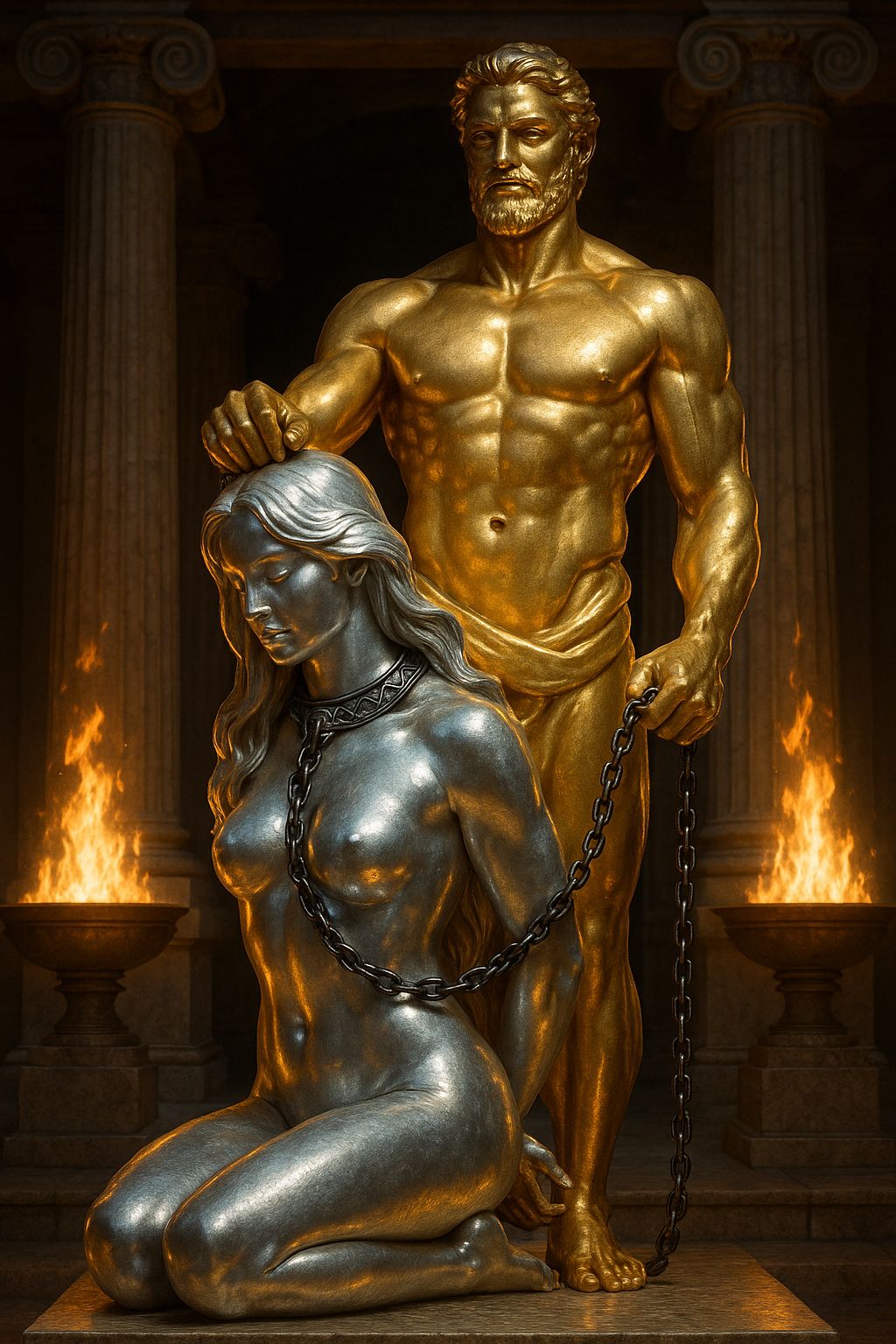
Vestris is depicted as a tall, radiant man cast in gold, robed in flowing garments of light, his eyes ever-watchful. He stands firm, hand raised in authority, the embodiment of strength, judgment, and rightful rule. His gaze is distant, impersonal, yet ever-present.
At his feet kneels Elystra, sculpted in silver, her posture always one of submission. She is beautiful, serene, and sorrowful, with downcast eyes and hands joined in supplication. She represents the ideal of perfect servitude, patient suffering, and divine loyalty. Her chains are not symbols of cruelty but of devotion, willingly borne.
Doctrine and Beliefs
The faith teaches that the world is divinely ordered into hierarchies, with Vestris ruling above and Elystra below. This order reflects the ideal relationship between master and slave. Just as Elystra serves Vestris with grace and love, so too should slaves serve their masters. By enduring hardship without rebellion and fulfilling their roles with humility, slaves may earn the favor of the gods and be rewarded in the next life with a kind master, though they will always remain a slave. Once a slave, always a slave, and they should be content with their place.
Masters, in turn, are taught that their will is the law for the slave. They are expected to care for their slaves as a god cares for his devoted servant, but also to punish disobedience as a divine necessity. The religion offers moral and spiritual justification for slavery, portraying it as not only natural but sacred.
Rituals and Worship
Daily prayers are common among slaves, often whispered at dawn or dusk. These prayers are directed to Elystra, asking for strength to endure suffering, for grace in obedience, and for hope of a better fate in the afterlife. Shrines to Elystra are simple, often found in corners of slave quarters or beside fields, decorated with silver-painted stones, chains, and small offerings such as tears gathered in bowls or drops of blood from self-inflicted penance.
Masters worship Vestris in grander temples, where priests recite the Codex of Authority, a holy text outlining divine law and proper hierarchy. Rituals involve symbolic acts of dominance and submission, often played out in dramatizations of the two gods’ interactions. One sacred rite, the Ascendant Chain, involves a slave kneeling before a golden statue of Vestris while chained to a silver effigy of Elystra, pledging their loyalty and suffering in her name.
The high holy day is the Day of the Binding, which reenacts the moment when Elystra knelt before Vestris and offered herself in eternal service. Slaves are required to wear ceremonial chains and fast in honor of Elystra’s sacrifice, while masters make public oaths to maintain their power.
Criticism and Contradictions
While some outside the religion see it as a tool of oppression, its hold remains strong because of the emotional and spiritual support it offers. To many slaves, Elystra is a source of silent strength. She shares their pain and offers them hope beyond death. To many masters, the religion provides certainty and order, binding society into a structure they see as divinely mandated.