Orcs
| Story |
|---|
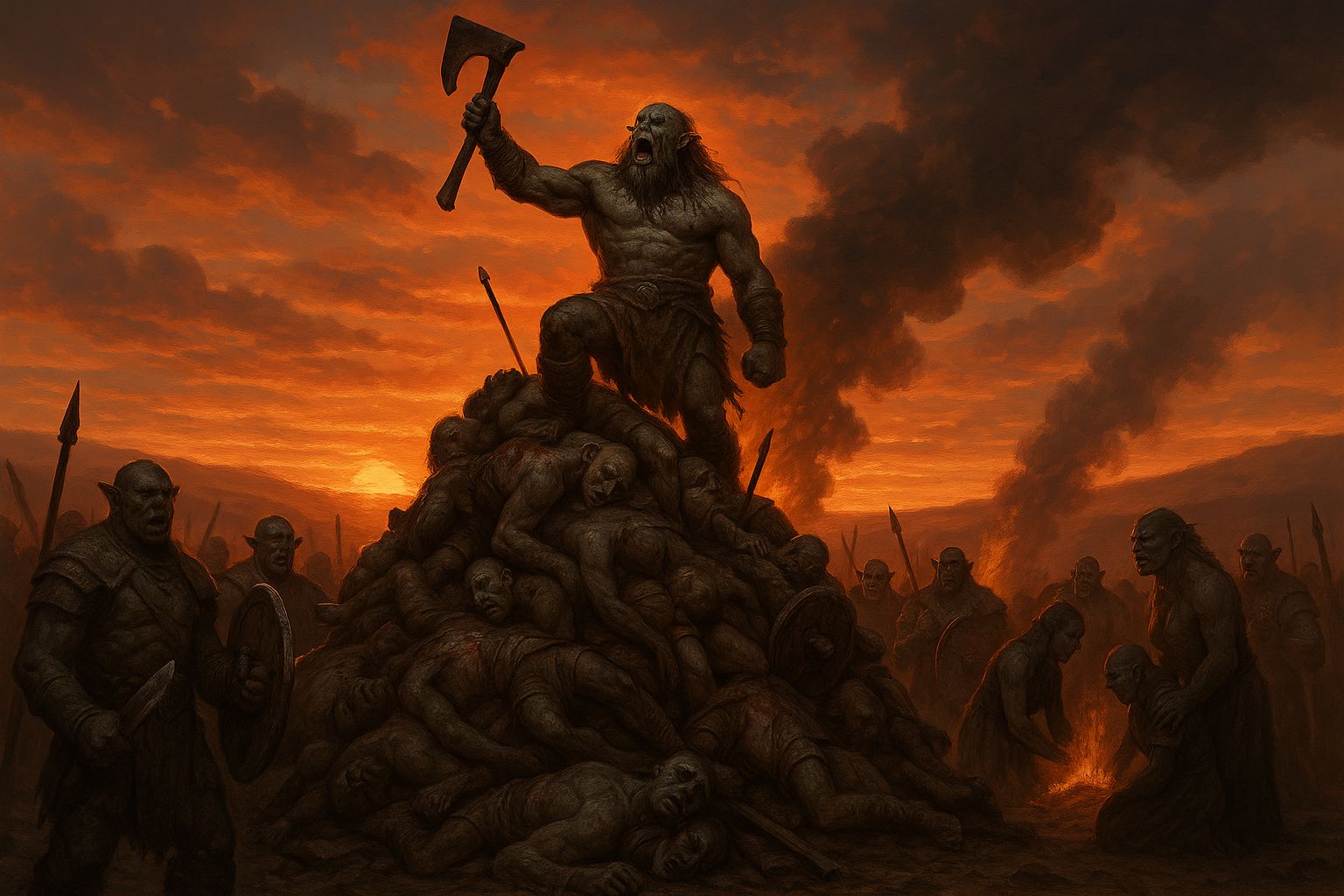
| The raid was over by dusk. Smoke still curled from shattered huts, and the steppe was littered with bodies cooling under the reddening sky. Varkhul Ashfang's warriors stood among the wreckage, their tusks and blades dark with blood, their laughter rolling like thunder. At the center of the camp lay the corpse of Chief Drogmar, his axe snapped in two, his sons strewn around him. |
| When the victors moved to strip the dead, the women of Drogmar's tribe stepped forward. Their faces were streaked with ash, their hair unbound, but their voices did not waver. "Our men are gone," the eldest said, her hand resting on the head of a child. "By the law of the steppe, we are yours now. Take us into your tents, or we will starve, and your honor will be ash as well." |
| The warriors shifted, uneasy. It was no plea - it was a claim. To refuse would dishonor the victory. To accept meant more mouths to feed, more children to raise, but also greater strength for the tribe. |
| Varkhul nodded once, his face unreadable. "You speak true," he said at last. He placed Drogmar's shattered axe upon the corpse-pile rising in the center of the camp, then turned to the women. "From this night, your children eat at our fires. Your sons will grow with ours, and your daughters will bear the blood of Ashfang's line." |
| There was no joy in their eyes, but no fear either. This was the law of the orcs, older than memory. The dead were honored with vengeance, the living bound to the victors. By nightfall, the camp of Drogmar was gone, and Varkhul's tribe had swelled with new wives, new children, new blood. |
The orcs are a people shaped by hunger, fire, and the endless horizon of the steppe. To outsiders, they are often seen as brutal savages, little more than raiders who live to kill. To themselves, they are children of the wind and the blade, a people who measure life not in years or harvests, but in scars, vengeance, and the strength to endure.
Appearance
Orcs are grey-skinned, their hides toughened by wind and weather. Their frames are heavy with muscle, even in youth, and their movements have the raw efficiency of predators. Most orcs are the size of strong men, but among them, leaders grow into giants: two and a half meters tall, broad as oxen, their bodies swelling with authority. Their eyes range from pale yellow to ember-red, often glinting with the fierce vitality of their kind.
Female orcs are smaller than their male kin, standing closer to the height of a human woman and lacking the massive growth that comes with male authority. Their frames are wiry and sturdy rather than hulking, built for endurance and labor. While men carry the weight of combat and leadership, women shape the rhythm of daily life, raising children, tending hearths, and in Grashkaar lands, working the fields. Among the steppe tribes, their smaller size does not spare them from hardship; raids and vengeance often decide their fates, though their voices within the camp can quietly steer the will of warriors.
Life and Society
Orc life begins in hardship. Children are born into sprawling camps of hides and wood, where survival is uncertain and strength is valued above tenderness. From a young age, boys are trained to fight, wrestle, and endure pain. Girls tend the camp, fetch water, prepare hides, and raise the next generation. Their society is patriarchal, with men holding authority and women wielding their influence within hearth and family.
Among the steppe tribes, war is the measure of worth. Men fight duels to settle disputes, raid neighbors to claim cattle and slaves, and rise to leadership by proving themselves unbreakable. A chieftain rules only as long as he cannot be challenged. Tricks and ambushes are admired, for cunning is strength, and strength is survival.
Death defines much of orc culture. When a warrior falls, vengeance is expected, his kin slay as many of his killers as they can and heap the bodies upon his own. In the afterlife, they believe, he will command those heaped upon him in an eternal war. When a woman dies, her body is burned, her smoke rising into the sky so she may dwell forever with her children in the eternal camp.
Religion is fragmented. Each tribe raises crude effigies of gods, fanged beasts, horned figures, or simple idols carved from stone. These are painted with blood after every battle, their power measured by the tribe's victories. Faith is less about devotion than about proof: a god who fails to deliver victory is discarded and replaced.
The Grashkaar Exception
A century ago, the tribe of Warchief Urgan turned away from this life after he was swayed by the monk Celestius. They became the Grashkaar, farmers who replaced the axe with the plow. Unlike their kin, they do not raid and no longer live by vengeance. Their gods are gentler, their effigies daubed with milk and grain instead of blood. Where other orcs shorten their lives with ceaseless battle, the Grashkaar grow old and raise families.
Yet even in peace, their power grows. They reproduce quickly, live longer lives, and labor tirelessly. Their villages swell with grain and children, spreading outward across the steppe like the rising tide. Though they do not seek war, every man among them still carries the size and strength of his heritage, and every visitor feels their restrained aggression: a constant reminder that they could kill, but choose not to.
Strengths and Weaknesses
The orcs are strong beyond any human measure, tireless in labor and fierce in battle. They are resistant to hunger, hardship, and pain, and their bodies respond to leadership by growing stronger still. Their loyalty to kin is absolute, and their traditions of vengeance ensure that no insult is easily forgotten.
Yet they are also fractured. No single belief binds them together. Tribes feud endlessly, and even within camps, authority is fragile. Their short tempers and deep pride make peace difficult, and their disdain for outsiders isolates them from trade or alliance. The Grashkaar, by breaking from this cycle, may yet prove the exception, or prove the greatest threat of all, should they one day decide to wield their numbers in war.
Outsiders' View
To humans of the Empire, orcs are a problem that cannot be solved. The steppe tribes are dismissed as beasts, fit only for killing or the arena. The Grashkaar are seen as useless, producing grain but never selling it, swelling in numbers but never integrating. Yet beneath the contempt lies unease. Every imperial soldier who has looked into an orc's eyes, whether raider or farmer, has felt it: a people built for war, and only their own willpower keep them from it. Outsiders may call them savages, but none mistake what they are.
Possible Secrets
The Growth of Leaders
It is believed that orc leaders grow to monstrous size by sheer force of will and the respect of their kin. In truth, old shamans whisper that it is the blessing, or curse, of ancient war-gods. The more authority an orc holds, the more his body twists into their chosen vessel. If the Grashkaar ever united under a single High Father, he might grow into something godlike.
The Slave Lineages
Some slaves taken long ago were not outsiders but orcs themselves, men of rival tribes captured in battle. Their descendants still live among the camps, smaller and weaker from years of oppression.
The Hidden Matriarchs
While orc society is loudly patriarchal, in many tribes the oldest women of the camp secretly control decisions. They guide the young, whisper counsel to chieftains, and sometimes even decide the outcome of leadership challenges. Among the Grashkaar, this hidden matriarchy grows stronger every generation.
The Forgotten God
Legends tell of an orcish god older than war, older than the steppe itself - a figure of harvest, hearth, and kinship. Some scholars believe the Grashkaar have unknowingly revived fragments of this ancient worship, which is why their effigies resemble the Withheld Blade instead of blood-soaked idols. If this god fully returned, it could change the orcs forever.
The Silent March
At night, travelers whisper of orc warriors walking silently across the steppe, neither Grashkaar nor tribe. Their movements are precise, disciplined, unlike any orc known. Fear spreads that a new people is rising, or that one of the tribes has mastered something unheard of.
Adventure Hooks
The Bride Price
Two steppe tribes are about to clash because a marriage pact was broken. The bride, however, has fled to a Grashkaar village seeking sanctuary. The adventurers are pulled in by both sides, one demanding her return, the other insisting she should stay. Whichever way they choose, the steppe could erupt in war.
The Feast of the Pile
The steppe orcs are preparing for a massive funeral, one meant to honor a fallen warchief by raising the largest corpse-pile in living memory. Neighboring tribes are already sharpening their blades to make offerings. The adventurers may be hired to protect one side, to stop the bloodbath, or to ensure the pile grows to mythic size.
The Runaway Sons
A band of young Grashkaar warriors, restless and frustrated with farming, have fled north to join the steppe raiders. The elders want them returned before their choice sparks a blood-feud. The task is delicate, the youths don't want to come back, and their new steppe allies will kill to keep them.
The Burning of Krothaal
An orc farming village has been burned to the ground, its fields salted and its people scattered. The Grashkaar blame the Empire, the Empire blames the steppe tribes, and the tribes deny everything. The adventurers must track down the real culprits before the fragile peace shatters.
The Broken Idol
A steppe tribe has had their war-god effigy stolen and desecrated. In retaliation, they accuse the Grashkaar of blasphemy and prepare to raid their villages. The truth is murkier: the idol was taken by opportunistic smugglers hoping to sell it in Estoria's market. The adventurers must choose whether to return it, sell it, or let the feud burn.