Goblins
| Story |
|---|
| The bells of the caravan rang before the wagons even reached the village. Children dropped their chores to run to the road, and by the time the first painted wagon rolled into sight, half the village trailed behind it. |
| Bright banners snapped in the wind, colors wild against the grey dust of the road. A goblin in a feathered hat stood on the roof of a wagon, juggling knives that caught the sun. With every toss, he called out jokes, promises, and riddles, until even the stern miller was grinning. |
| By dusk, the square was alive with music and fire. Lanterns of colored glass hung from ropes, masks leered from poles, and the smell of spiced meats drifted thick in the air. A goblin girl told fortunes with cards painted in gold, while her brothers wrestled on the green to the laughter of farmers. |
| When the fire-dancers came, the crowd gasped. Flames spun and leapt, leaving trails of light that seemed to shape beasts in the night air. The goblins laughed along, quick hands passing hats for coin, quicker still when a drunk merchant fumbled his purse. |
| No one spoke of the caravan's outlaw reputation. No one mentioned the stories of tricks and cheats. That night, with the drums beating and the fire high, the village forgot its worries and danced until the stars wheeled overhead. |
| And by dawn, the goblins were gone, leaving behind ash, laughter, and the faint ringing of bells on the empty road. |
| Story |
|---|
| The square is boiling with noise when you arrive. Goblin wagons stand in a painted ring, their banners bright against the dusk, while townsfolk crowd close with torches and pitchforks. |
| Atop one of the wagons, a goblin ringmaster in a feathered coat bows low, smiling wide. "Friends, friends! Do not mistake us for thieves. We brought only song, laughter, and a little luck!" His words ripple through the crowd, but the shouts do not stop. |
| A farmer waves a torn sack of grain. "Luck, is it? My barn was broken into last night, and I found this at the door." He holds up a goblin bead, bright blue in the torchlight. Murmurs spread-some certain proof has been found, others muttering that beads fall from goblins like leaves from a tree. |
| Another villager swears she saw shadows moving near the wagons at midnight. Yet when pressed, she admits it was dark, and she had drunk more than a little ale. The goblins laugh at her tale, tossing knives in the air, but their smiles seem stretched thin. |
| Behind the crowd, a goblin child slips a carved toy into a stranger's hand, whispering, "We didn't do it." But in the corner of your eye you catch another goblin quietly pushing a heavy bundle under a wagon canvas, face carefully turned away. |
| The reeve raises his staff, shouting for silence. "Strangers! You've come at the right moment. Decide for us, are these folk honest wanderers, or tricksters fattening themselves on our loss?" |
| The crowd waits, torches flaring, eyes hard. The goblins bow and grin, but the truth hangs just out of reach, tangled in smoke, laughter, and suspicion. |
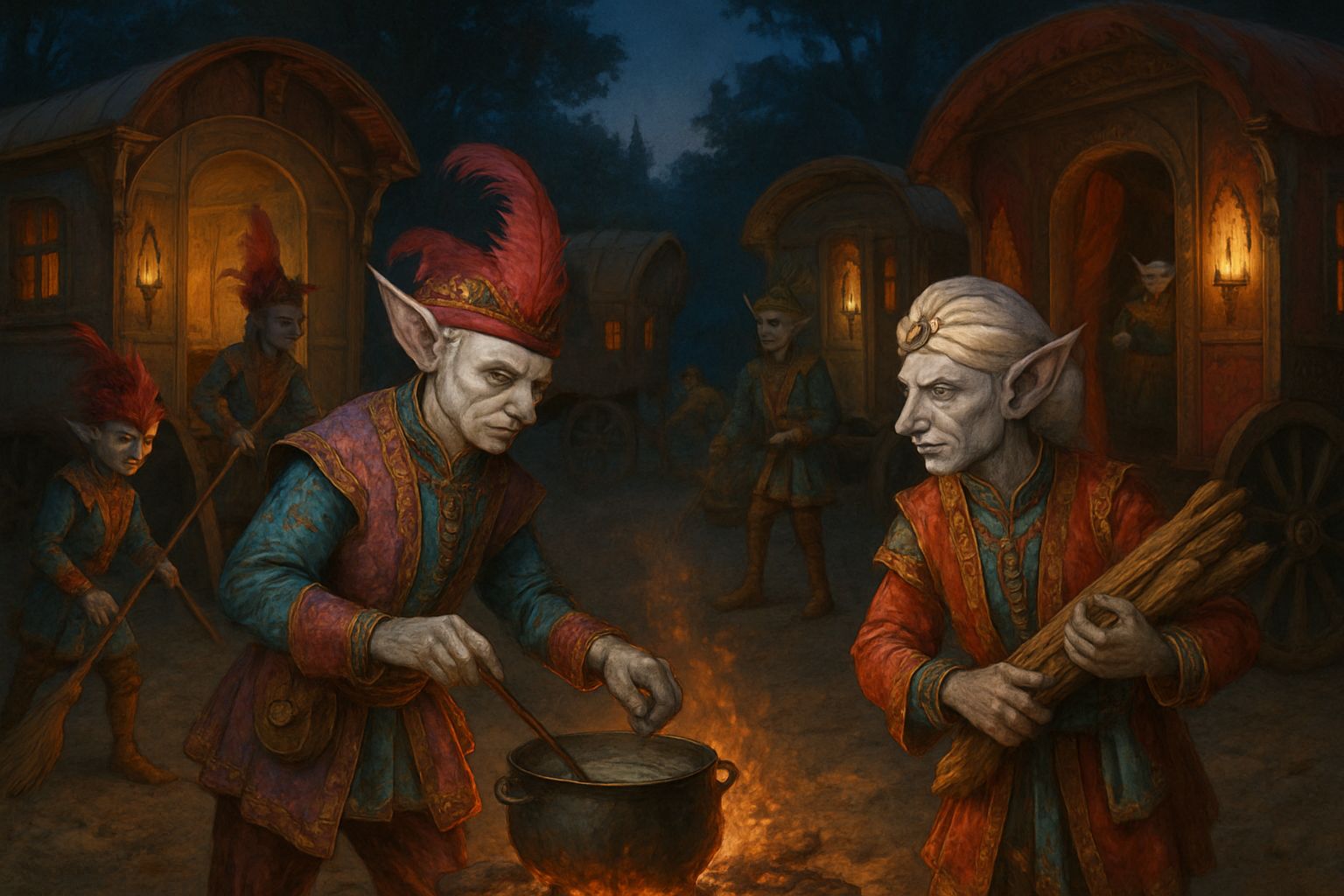
Goblins are a short folk, rarely taller than a meter and a half, with wiry frames, pointed ears, and grey-hued skin that ranges from a light-skinned human to ash pale. Their faces are quick to grin, their eyes bright and darting, and their voices carry a sharp sing-song tone.
Wanderers Without a Land
They have no kingdom of their own, no flag to rally under, but travel as nomads through the lands of others. Their homes are painted wagons, bright with colors and carved symbols, drawn in long caravans that follow trade routes and festivals. In each caravan family ties run deep, with generations living and working together, bound by shared craft and tradition.
Carnival Folk
The arrival of goblins in a town is never a quiet thing. Long before the wagons roll into the square, scouts spread rumors and stir anticipation. By the time the caravan arrives, the air is charged. Horns sound, banners flutter, and painted masks grin from wagon windows. Children chase after jugglers, and townsfolk gather to see what wonders the goblins bring. Their carnivals blend market, theater, and festival in one, fire dancers, puppet shows, fortune tellers, and stalls heavy with wares both clever and strange.
Reputation
To many, goblins are cheats and tricksters, silver-tongued and sharp-eyed. Tales abound of farmers trading good oxen for goblin trinkets, or merchants finding their purses lighter after too much laughter and drink. Yet even the wary admit that goblin goods last, their jewelry shines true, and their wagons carry crafts found nowhere else. It is said, half in jest and half in truth, that "a goblin merchant could sell you a second mother-in-law for a thousand silver, and you'd thank him for the bargain."
Still, their welcome is fleeting. Inns and villages will throw open their gates for the carnival, but once the songs fade and the coin is counted, folk grow uneasy. Goblins seldom overstay, knowing when smiles sour into suspicion.
Social Bonds
They are monogamous, marriages lasting a lifetime, and even if the partner dies, they cannot remarry. The family unit is the heart of goblin life, but in truth the caravan itself is an extended household. Elders tell the old stories, teach craft and lore, and serve as judges in disputes. Children are raised communally, learning performance, trade, and cunning from an early age.
On Slavery and Freedom
Goblins keep no slaves, nor are they often enslaved. Their small frames lack the strength for heavy toil, and their quick wits make them too slippery for chains. A goblin in bondage will scheme, connive, or escape, and most slavers deem them more trouble than they are worth, and enslaving one goblin means making all of them your enemy. Still, their outsider nature gives them a shadowed status. They are welcome almost everywhere, yet they belong nowhere, and to some that makes them lawless by nature.
The Road-Faith
Goblins follow a wandering faith, not tied to temples or fixed shrines but carried in song, story and symbol. They call it the Road-Faith, for to them the path itself is sacred. It is a religion of freedom, where no chain can bind the spirit, and life is seen as a journey of wit, love and play. The gods are not distant rulers but traveling companions, each walking beside the goblins in their wagons and carnivals.
The Pantheon
- Zarith the Unbound: God of freedom. Zarith is the one who broke the first chain and tore down the first wall. He is shown with broken shackles in his hands or wings unfurled, and goblins say that every road is his gift. His blessing is invoked whenever a caravan departs, or when one slips free from danger.
- Lyssara of the Mask: Goddess of performance. Lyssara wears a thousand faces, none her own. She is laughter, dance, and the illusion that hides sorrow beneath a smile. Goblin performers whisper prayers to her before donning costumes, and it is said that a show without her favor will fall flat no matter the skill.
- Korrin the Cunning: God of trickery. Korrin is a sly, sharp-eared figure, forever laughing at those who take themselves too seriously. He delights in bargains won, pranks pulled and traps avoided. Goblins thank him whenever they turn a deal to their advantage, and curse him just as often when they themselves are outfoxed.
- Mira Hearthmother: Goddess of family. Mira is the keeper of the fire, the one who binds caravan to caravan and turns many wagons into one home. She is gentle but firm, and her name is called in marriage rites, at births, and whenever goblins gather around the evening fire. The beads worn in goblin clothes are said to be her blessing, each one a symbol of family ties.
- Talvek the Wanderer: God of travel. Talvek is the eternal pilgrim, walking the roads of the world and never resting in one place. He carries a staff and lantern, and his footprints mark the paths that caravans follow. Goblins offer him coins at crossroads and lay tokens on graves, so that the dead may follow him onward rather than be lost.
- Veyrik Coinspinner: God of gambling and theft. Veyrik is the youngest of the goblin gods, a trickster even among tricksters. He is pictured as a lean figure tossing dice or flipping a coin, his grin wide and dangerous. Some songs show him with nimble fingers plucking purses, others with cards slipping from his sleeve.
Practices
Goblins do not build temples. Their shrines are painted wagons, masks hung in trees, or fires burning at the heart of a festival. Songs, dances, and jokes are acts of worship, just as much as prayers or oaths. Every caravan keeps a "Godchest," a box filled with small offerings, feathers, beads, coins, carved toys, left for the gods to share among themselves.
Religious festivals are indistinguishable from carnivals. Music, food, and spectacle are seen not only as entertainment but as sacred celebration. To refuse joy, the goblins say, is to dishonor the gods.
Possible Secrets
The Broken Chain
Goblins say Zarith the Unbound broke the first chain. Some whisper this is not just myth. Hidden in their lore is the tale of a true artifact-the First Shackle-broken in half and carried in secret by goblin caravans. If the two halves are ever joined, no chain, gate or prison in the world could hold.
Masks of Lyssara
Every goblin carnival has masks, but some claim a handful are older than the caravans themselves. These masks are said to carry Lyssara's true faces. Anyone who wears one risks losing their own identity, becoming a vessel for the goddess-or for something else wearing her guise.
The Cunning Pact
Traders say goblins always get the better end of a deal, but among the goblins themselves there are whispers that Korrin the Cunning taught their ancestors a secret bargain. Supposedly, they may sacrifice something small in a trade to ensure luck always tilts their way. What the god takes in return, however, is not spoken aloud.
The Silent Fire
Mira Hearthmother is always shown as warm and kind, yet an old story says she has a second face: a smoldering wrath against any who betray family. In times of betrayal, the family fire may go cold and refuse to burn. Some elders whisper that such a sign means Mira herself has turned away, and that punishment is near.
The Hidden Country
Though goblins insist they have no homeland, some scholars suspect their endless wandering hides the truth. Fragments of old songs speak of a green valley with painted stones where the gods themselves once walked. If such a place exists, it may be the origin of all caravans, and perhaps the goblins still guard its road in silence.
The Outlaw Blessing
Why are goblins so rarely enslaved? A few claim it is not just reputation but divine law. To bind a goblin in true slavery is to invite Zarith's curse, bringing misfortune until the chains are broken. Most slavers scoff at the tale, but a few ruined masters mutter otherwise.
Adventure Hooks
Carnival in Trouble
A goblin caravan has set up a grand carnival outside a town, but local merchants accuse them of cheating customers and demand they be driven out. The goblins beg the party to prove their innocence before the angry townsfolk turn violent.
The Vanished Wagon
One night, a wagon full of performers disappears from a caravan's camp without a trace. The goblins hire the party to find their missing kin before the show must go on.
Rivals on the Road
Two caravans of goblins arrive in the same town at once, both vying for attention and coin. Their rivalry grows into sabotage, brawls, and schemes that spill over into the streets. The players are caught between them, or perhaps hired to tip the scales.
Unwanted Guests
A goblin carnival sets up camp outside a noble's estate, and soon the noble is furious. He demands the players drive them off. But the goblins insist they were invited, by someone whose name the noble dare not hear spoken.
The Duel of Merchants
A goblin trader and a wealthy town merchant both claim rights to a rare shipment of silks. The goblin challenges the merchant to a contest of skill and wit, but insists on choosing outsiders as their champions.
The Sickly Caravan
A goblin caravan arrives with half its members struck by a strange illness. Locals shun them, fearing plague. The goblins beg the players for help finding a cure or source of the sickness before their kin waste away.
The Caravan Heist
Bandits plan to raid a goblin caravan on the road. The goblins know the ambush is coming and hire the party as guards. But the bandits are clever and have inside help.
The Forbidden Town
A town where goblins were once outlawed now receives a caravan. The goblins claim they were granted permission to return, but angry locals gather with torches. Can the players keep peace, uncover the truth, or choose a side?
Chains to Break
Word spreads through the caravan that one of their kin has been captured and sold to a slaver notorious for cruelty. Most goblins are too clever to be chained, but this one was tricked, and the insult cuts deep. The goblins hire the party, not to buy their kin back, but to strike at the slaver himself. They want the prisoner freed, the chains shattered, and a message sent so clear no one will dare touch goblins again.