Campaign: Necropolis
Act Synopsis
This arc is short and sharp. It shows the cruelty of the Empire, gives the players moral choices, and demonstrates that surrender is a valid path to survival. It also quietly introduces Samden through the arrows in the dust, though the players will not understand the source yet. Tension should come from time pressure and the atmosphere of Necropolis. Very little combat is needed unless the players force it.
The scene is best paired with the Solcanum arc. The crew will need to pass Solcanum to get to Necropolis, so it'll be sandwiched between the beginning and the end of the Solcanum arc.
It leads naturally toward whatever region the GM wants to nudge them toward next, since the rescued children can point the way.
Arrival
The Blue Marlin crew arrives on the road from Solcanum to the sunlit outskirts of Necropolis. Silence hangs over the ruins like a held breath. The crew sees a man, Varro Licentus, standing at the edge of the rubble. He watches the city with nervous impatience.
Short exchange. He speaks only of his runners. He does not name them. He cares only about the loot they should bring back.
Five children and youths burst out of the ruins. They are filthy, starved, terrified. They scream for him to help a girl who has fallen inside and hurt her leg. He waves them off. He only checks the sacks they carry. Their findings disappoint him. He punches one and snarls that slaves who fail are replaceable.
Give the players space to react. If they confront him, he yields at once. Cowardice is his nature. He will not lift a finger to help with any rescue. He sees the girl as already lost, and that a failed runner is a bad runner. He does not understand why anyone would go after a slave with daylight running out.
Into the Ruins
The crew follows small footprints and drag marks through dust. Necropolis feels wrong. The scale is inhuman. Streets turn without logic. Shadows bend. Far off, the sun lowers faster than expected. However, the track is easy to follow.
They find the girl, Nera. Thin. Fifteen. In agony. Her ankle is broken. Junia could mend it, but there is no time for healing here. The crew must carry her. That slows them, and the shifting geometry of the ruins presses the tension.
As they hurry back, they lose their path. Intersections repeat. Streets fold in on themselves. The light shifts in ways that make no sense. The sun is too close to the horizon.
Let dread grow. Players should fear nightfall more than any fight. Use Nera's fear to push the feeling.
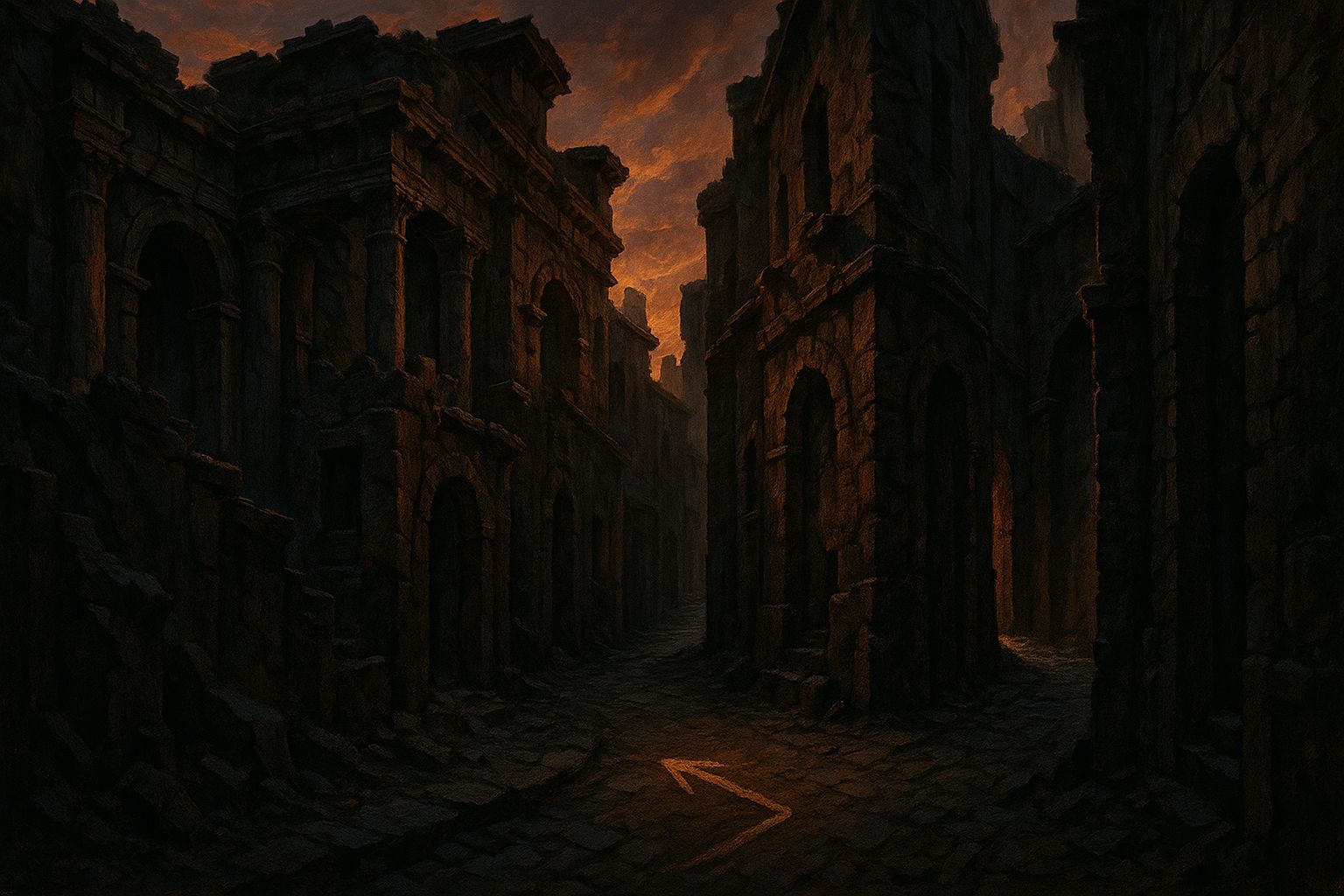
Then they see it. A clean arrow drawn in the dust. Not a natural mark. Not something the runners would leave. Another arrow. Then another. A trail leading them outward.
These marks lead them back to daylight with minutes to spare.
Do not explain who drew them. The crew should leave with the sense that something unseen guided them. This is Samden's quiet hand.
Confrontation
When the slave owner sees the girl, he spits on her with contempt. She is ruined as a runner.
A fight is likely. If the players strike first or even threaten, he puts up a token defense, then folds. He will plead, bargain, promise anything to walk away alive. He offers the girl as payment. If pressed harder, he offers all the slaves, and some mostly worthless trinkets they found.
Make surrender the optimal path. He is a coward, not a warrior. He signals the Empire's real cruelty by showing how cheaply they value the lives under them.
The Dilemma
The players now hold responsibility for six enslaved children. Freeing them in the Empire means they will be enslaved again the moment they reach a road. They need a safe place to go.
Most of the children come from a region the GM wants the campaign to shift toward. Their families will take them back. That creates a natural lead toward the next major location.
The injured girl is the exception. Born a slave. No family. Now a burden in the eyes of every imperial household.
Two main options:
- Hand her to one of the other families. They will accept for silver. The players will sense the ugliness. The girl will be safe for a while, but there is a real chance she could be sold again later. This reinforces the brutal pragmaticism of the world.
- Take her aboard the Blue Marlin. This feels better but adds a complication. She will start as an apprentice under Galenor. She learns fast. Over time she becomes skilled with tools and small, finicky work such as locks, clocks and jewelry. Her background makes her also good at stealth.
Either choice shapes future story threads. If they leave her behind, you can later show the consequences. If they take her aboard, she becomes a recurring character who can shine in infiltration or sabotage scenes.
Purpose of the Arc
- Show the Empire's casual brutality.
- Give players a rescue under real time pressure.
- Demonstrate that surrender works and that not every problem is solved by killing.
- Provide a moral burden the players cannot shrug off.
- Tie the next destination to the rescued children.
- Hint at Samden without revealing him.
Arrival
| Story |
|---|
| The ruins rose ahead like the ribs of some dead titan, black stone jutting from the earth in crooked lines that caught the light like broken glass. Even at noon the city seemed to drink the sun, its alleys choked with shadows that clung as if they had weight. The road from Solcanum wound toward it in a slow descent, and as the Blue Marlin crew followed it they noticed the grass along the last stretch had withered into a pale, brittle line. Beyond it nothing grew at all. The soil turned gray, lifeless, as if the city had exhaled across it. |
| A warm breeze carried dust across their boots. It felt normal, yet the silence tasted wrong, too thick, too expectant. Even the air seemed to pause before crossing that dead threshold. |
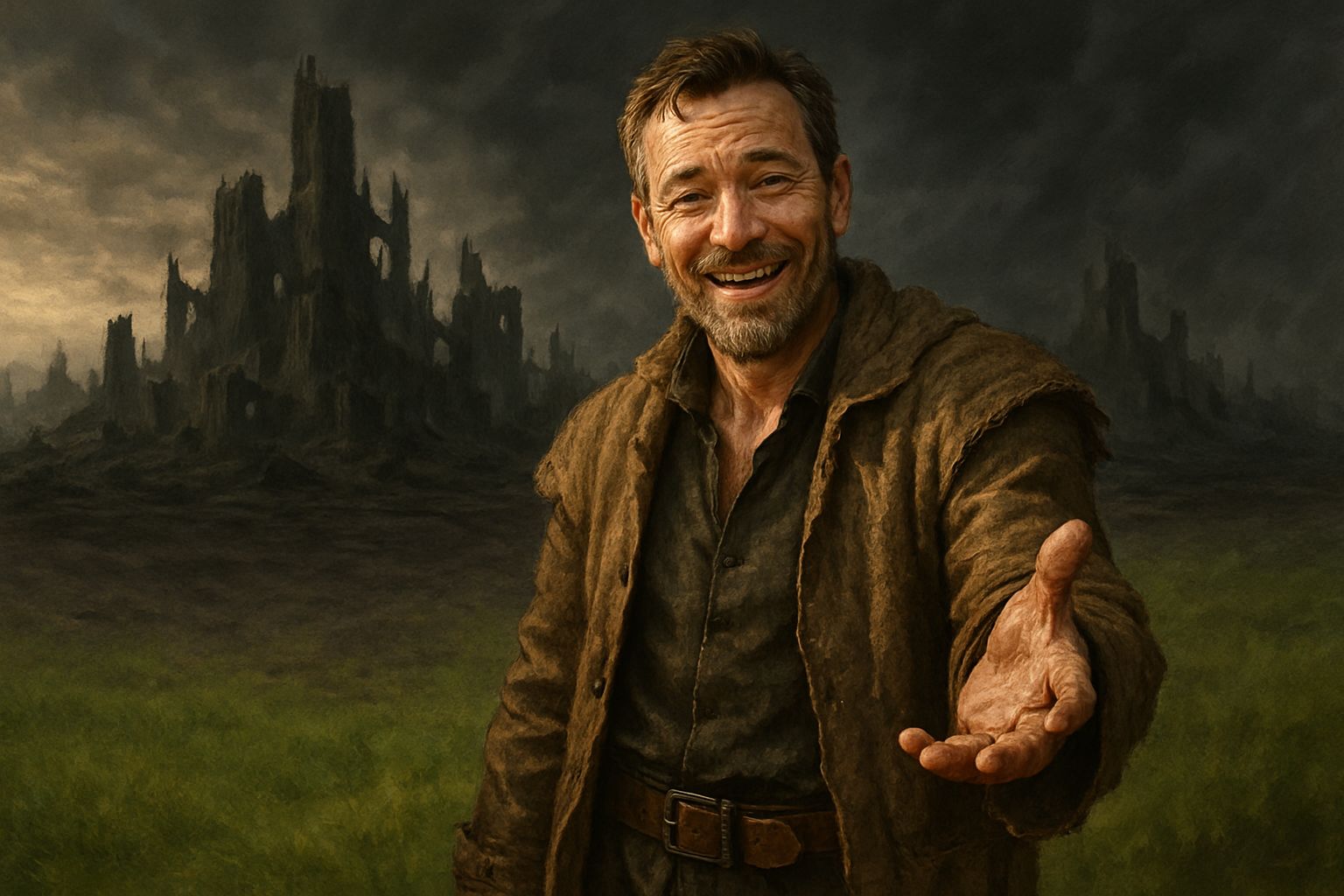
| A man waited there, standing close to the border where yellow grass met lifeless stone. He was broad shouldered, neat, and smiling, with a friendly tone that arrived too quickly. |
| "Travelers from Solcanum? Lucky timing. Wasn't expecting company this far out." He gave a shallow nod. "Varro Licentus. Trader. Treasure broker. I deal in small finds from the ruins. Nothing dangerous. Nothing too deep." He spoke like a man eager for conversation, as if loneliness had worn him smooth. |
| He asked who they were, where they sailed, if they had ever seen a place like this. He laughed easily, gesturing toward the shattered skyline. "Looks grim from the outside, I know, but don't worry. Daylight keeps the curse asleep. Only fools wander after sunset, and I don't own fools." He tapped the empty leather satchel at his side with practiced confidence. "My runners should be back any moment. Good kids, quick on their feet. Hard working." |
| For a moment he seemed almost charming. Almost. |
| Then footsteps burst from the ruins. Five children stumbled into view, panting, filthy, eyes wide with panic. One shouted for him to help, voice cracking. A girl had fallen behind. Hurt leg. Could not walk. |
| Varro's smile thinned. He waved the cries away like flies. "Where is the haul? Show me." He snatched the nearest sack and peered inside, expression souring. |
| "Pathetic," he muttered. |
| Then he punched the boy who handed it to him, sharp and hard, without hesitation. |
Varro shifts the moment the children arrive. The friendly surface cracks and something small and mean slips through. Once he throws the punch, the mask is gone. This is where you let the players respond.
If the players intervene physically or verbally, Varro stops at once. He is not brave. He steps back, raises his hands and forces a thin smile. Have him act irritated rather than afraid. He does not want a fight, but he does not think of himself as a villain either.
If the players demand he help with a rescue, he refuses with baffled annoyance. In his mind the matter is simple. A runner who falls behind is worthless. A lost slave is just part of the work. He cannot understand why anyone would risk going in with dusk approacing for a slave.
Use these lines to guide his tone:
"She is done. You cannot save every broken tool."
"Night will take her. Better to accept it and move on."
"Go in if you want, but do not expect me to risk my neck for a bad runner."
If the players threaten him, he folds immediately. He complains about disrespect, mutters about imperial law and property rights, but he does not escalate. He keeps his hands visible, gives small nods, and tries to look harmless. He never apologizes. That would imply the slaves matter.
If the players demand he stop hitting the children, he stops. If they demand he help, he grumbles and refuses. If they demand he stay out of the way, he agrees.
When you portray him, think of him as having three faces:
- The friendly face when he speaks to someone he considers equal.
- The cruel face when dealing with slaves.
- The coward face when threatened.
You want the players to feel two things about him. One, that he is pathetic rather than intimidating. Two, that the Empire produces men like him by the thousands. Keep his cruelty casual, not dramatic. The sparks of conflict come from the children, the city and the time limit, not from Varro.
Into the Ruins
The moment the players enter Necropolis, shift the tone. Outside, the ruins feel ominous. Inside, they feel wrong. Not hostile yet, only waiting.
The Trap Structure
The rescue is built on contrast. Going in feels simple and almost safe. Coming out tightens slowly into dread. This gives the players confidence at first, then undermines it, which mirrors how the Empire once treated the ruins.
Use three beats.
- One. Ease of entry
- Two. Confusion on the return
- Three. A race against the sun
Entering the Ruins
The track left by the children is unmistakable. Small footprints. Drag marks. A dropped scrap of cloth. Everything about the approach feels straightforward. Nothing distorts. No strange shadows. No tricks. The city allows them in.
Let the players feel the false comfort. This builds the moment when the trap snaps.
Keep the sensory palette muted. Dry dust. Still air. Distant spires they recognice when glimpsed again.
Finding Nera
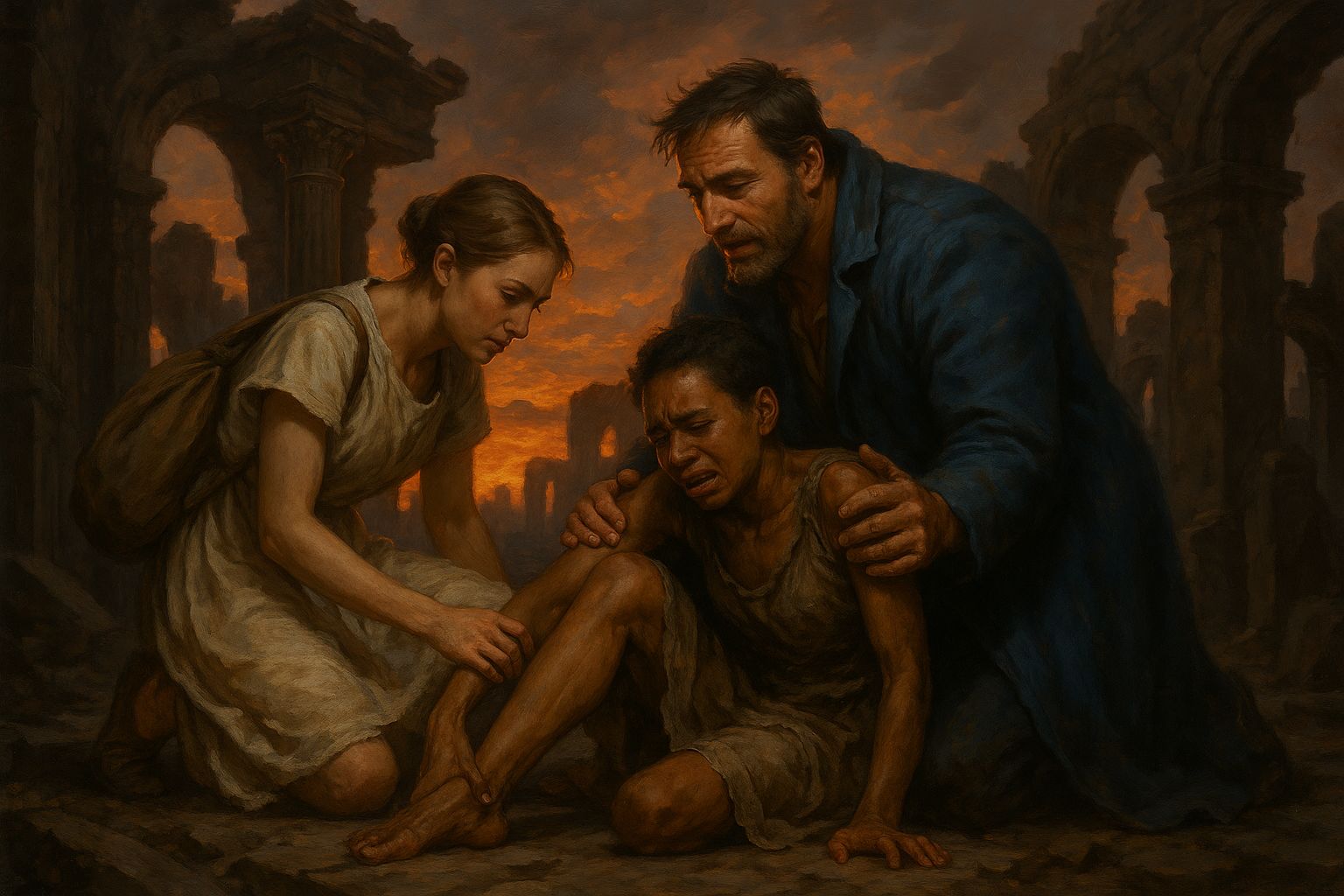
The crew reaches the girl quickly, 10 minutes in, and almost an hour of daylight remaining, at least that's the estimate of the crew. Nera is thin, terrified and shaking. She sits against a block of fallen stone. Her ankle is swollen and twisted at an angle that makes her gasp whenever she tries to move.
She begs them not to leave her. Her voice is hoarse from crying. She grips whoever reaches her first with surprising strength.
Junia could heal her, but there is no time. The sun is still high enough to seem safe, but close enough to matter. They will have to carry her.
Make this moment emotional but not drawn out. The tension comes from what follows, not from the injury itself.
Losing the Way
The crew turns back toward what they believe is the entrance. This is where Necropolis changes.
The tracks they followed are gone. Not brushed away. Gone. As if the dust has reset.
Paths do not match memory. Corners turn the wrong direction. A collapsed arch they passed earlier is now intact. A courtyard they crossed has become a narrow corridor. Even the sunlight seems to strike at impossible angles.
Do not make it a maze with complex mapping. Make it an inconsistent place. Whatever direction they choose, let it almost connect with their intended route, then slip away into unfamiliar shapes.
- Let them try multiple paths.
- Let them retrace steps.
- Let the city fold in small, subtle ways.
- Never repeat the same distortion twice. The city is not mechanical.
As time passes, describe the sun more often. Shadows grow longer, but tilt strangely. Light fades too fast when they glance away. The mood should become claustrophobic, not through enclosed space, but through the sense that distance is collapsing.
Let time pass at whatever pace the mood requires. Never give them an exact time. Act as if you are tracking it precisely, so they feel the pressure without seeing the numbers.
Nera's Fear
Nera knows when the city turns. She keeps glancing at the sky, whispering that the light is wrong. As it dims, she begins to cry again. Not loudly. Not dramatically. Small, sharp sounds of genuine terror.
Use her fear to sharpen the players' own sense of stakes.
Have her repeat one idea.
"We have to go. Before it wakes up. Please, please, we have to go."
She does not explain what she means. She does not need to. The players will fill in the blanks.
The Arrow in the Dust
Just when tension peaks and players feel the first edge of desperation, give them the first arrow. If you want to put Nera more in a favorable position with the crew, have her see the arrow first.
A simple line. Drawn with a fingertip or stick. Not stylized. Not magical. Just an arrow that had not been there a moment ago.
Place it where they almost miss it. This keeps the moment grounded.
After the first arrow, place the next one at the next turning. Then another. Let the trail feel hand placed, not systematic. A human guide, not a mapping system.
This path should feel like an escape rather than a victory.
The last arrow should be placed at a point where the players still cannot see the border. Make them take one more turn or step past the mark before the ruins suddenly fall away and the outside world snaps back into view. This preserves the shock of escape. The air outside feels wrong too, but in a different way. Less heavy. Less watchful.
They cross the threshold with daylight measured in minutes.
Unseen Intervention
The players should not identify the source now. There is no figure on a rooftop. No lingering footprints. No signature.
Leave only the realization that someone or something guided them out.
Much later in the campaign, they learn the truth. Samden moved ahead of them through the city, leaving marks unseen by everything that hunts the night.
For now, it remains a mystery.
Confrontation
| Story |
|---|
| They crossed the dead grass line with the last smear of light flattening across the ruins behind them. The children waiting by the road let out thin, shaky sounds when they saw Nera carried in strong arms. Relief mixed with fear. They did not step forward. They all watched Varro. |
| He approached at once, boots grinding the brittle grass underfoot. His face pinched as if the sight offended him. He grabbed Nera by the chin before anyone could stop him and turned her face side to side like she was a bruised fruit. When she cried out he dropped her head with a flick of disgust. |
| "Thought so," he said. "Worthless. A useless runner. Should have left her where she fell. At least then she would not be my problem." |
| He spat. The spit landed on Nera’s arm. She jerked but could not pull away. |
| Varro clicked his tongue at the crew. "You risked daylight on this. Why. Look at her. She cannot walk. She cannot work. She is nothing." He leaned in close to the girl, voice low and contemptuous. "Maybe I can sell you to a brothel. They do not need standing stock. You might even fetch a coin if they dim the lamps. Probably born in a brothel anyway..." |
| Nera’s breath hitched. She folded in on herself like she expected a blow. |
| The crew spoke up at once. Protests. Questions. Cold anger. Varro straightened and waved them off. |
| "You do not understand how the Empire works. Property is property. A man has the right to discipline what he owns. She failed. They all failed. They brought back almost nothing. I should beat the lot of them." |
| The nearest boy flinched at the word beat. Varro noticed and grinned thinly. |
| That was what pushed Scarnax forward. |
| Varro reacted fast but without courage. He shoved the nearest child aside to make space and put a hand on the knife at his belt. The blade was small and showy. Meant for threats, not fights. |
| "Back off," he snapped. "You do not touch what belongs to me." |
| Skarnulf stepped in. Then Amaxia. The circle tightened. Varro’s bravado thinned. He tried to lift the knife but a strong hand caught his wrist and squeezed until the blade slipped from his fingers and fell into the dirt. |
| Varro gasped and tried to pull free. The hand held firm. |
| "All right," he said quickly. "All right. Take her then. The broken one. She is nothing but trouble." |
| The crew did not move. |
| Varro’s gaze darted from face to face. His back bumped against one of the children he had shoved earlier. He jerked forward again, as if touched by something dirty, unsteady, trapped between the crew and the people he claimed to own. His breathing quickened. Sweat gathered at his temples. |
| "Fine," he said. "Fine. You want more. Take the other runners too. They are yours. Every one of them. I do not care. Just step back." |
| No one moved. He swallowed. His voice cracked as he hurried to sweeten the offer. |
| "And the trinkets. The sacks. Everything they brought out. Gold, silver, or whatever trash they scraped up. It is all yours. Every asset. Just let me walk away." |
| He pushed the children toward the crew with a rough sweep of his arm, careful not to touch any sailor. He kept his eyes low, as if looking at the ground might make the confrontation end sooner. |
| He never looked at the children. Not when he gave them away. Not when they crept behind the crew for safety. Not even when Nera stared at him with wide, wounded eyes. |
| To Varro Licentus they were objects. Tools that had broken. Property transferred to avoid pain. |
| And now that pain was aimed at him, he surrendered everything without a heartbeat of hesitation and ran. |
Running the Confrontation
This scene is about contrast. Varro greeted the crew earlier with warmth and easy charm. Now he reveals what he truly is. The purpose is not to challenge the players with a dangerous foe, but to show the casual cruelty of an imperial slaver and how quickly he collapses when confronted by people who refuse to accept that cruelty.
Keep Varro confident at first. When the crew returns, treat Nera like damaged cargo. He grabs her, inspects her, insults her. He refers to all the children as property, assets, stock. Never let him acknowledge them as human beings. This is where you sell the ugliness of his worldview.
Expect the players to intervene. When they do, have Varro resist only with words at first. He believes he is in the right. He believes the law supports him. He believes the crew is overreacting. Once they step closer, escalate him slightly. Let him posture with his knife, push a child aside, bark threats. This creates the physical tension the scene needs.
The moment they threaten him directly, he folds. The snap should be immediate. His fear is real. He is not trained, he is not brave, and he knows he is outmatched. Let him try to buy them off. First he offers Nera. Then the other children. Then the trinkets. He keeps sweetening the deal because he is desperate to escape intact.
Important. Do not let him become a cartoon villain or a target for cathartic violence. He is not here to be killed. He is here to reveal the Empire at its everyday worst. His cruelty is casual, not dramatic. His surrender is pathetic, not tragic. This contrast reinforces the campaign’s moral tone.
Once the crew forces his capitulation, let him run. Do not drag the scene out. The emotional focus should be on the children and the consequences, not on punishing Varro. The players now have six lives in their hands, and that is the weight that matters.
The Dilemma
The confrontation ends with Varro fleeing and the children clustering around the crew for safety. This should feel like a victory with immediate weight attached. The Empire will not protect these children. Returning them to the road would see them enslaved again within days. The players must decide what to do with them, and there is no perfect answer.
Make the dilemma feel practical, not moralistic. The world is cruel, the Empire is efficient at reclaiming escaped slaves, and the children are frightened but hopeful. The players now carry responsibility they did not ask for.
Most of the children come from a region the Game Master wants to guide the campaign toward. They can name their home, describe the village, the raid, and the direction they were taken. They know where their families are and want to return. This is the cleanest option and creates a natural hook for the next location. Families will take their children back. They may be poor, but they will try. The risk of re-enslavement exists but is low if the place they came from lies outside imperial control or on the Empire’s fringe.
Nera is the exception. Born a slave. No family to return to. No free person is responsible for her. The families of the other children will adopt her if paid, and even then her future would be uncertain. Make sure the players understand that the world does not reward compassion by default. If the players place her with another family for silver, she will be fed and sheltered, but they are not rich, and she is likely to be sold or exploited after the Blue Marlin leaves. Let the players feel the evaluation made by the families, and make the choice feel bitter. Let the crew come across her later in the campaign, hurt and trembling in fear at any sign of anger. This will both give them a second chance to save her, and push the cold harshness of the world.
The other option is to take her aboard the Blue Marlin. This is the hopeful path, but not without cost. Another mouth to feed. Another soul to protect. She will not be a passenger. She will apprentice under Galenor, who values clever hands and curious minds. This gives her a future, and it ties her to the ship in a way the other children will not be.
Nera’s Moment
When the crew inspects the trinkets the runners recovered, describe one item as a small, intricate time piece, its gears half seized with age but clearly of fine make. Nera recognizes it at once. She has seen similar devices in the Necropolis loot before. She shyly offers that she could fix it if they let her try. Galenor should react with real interest. This is her first step toward a role aboard the ship if the players choose that path.
This moment is not meant to tip the scales. It only shows that Nera is more than a burden. She has skills shaped by a life she did not choose, and someone finally notices.
Outcome Notes
If the players return the children to their families, those families will be grateful and may become allies later. The children will be safe for now, though Nera’s future remains uncertain if left with strangers.
If the players take Nera aboard, she becomes a crew member, who, in time, might become a player character. She gains confidence under Galenor, learns tools, locks and delicate mechanisms, and grows into someone useful during infiltration or sabotage scenes. Her presence also makes the Blue Marlin crew feel more like a found family, contrasting the Empire’s treatment of the weak.
Present the dilemma plainly. Let the players feel the weight of responsibility, then let them decide what kind of people they want to be.
Act Summary
The Necropolis arc is a short but heavy intervention into the cruelty of the Empire and the indifference baked into its systems. It begins with a simple rescue and ends with the players holding responsibility for lives the world would rather discard. The ruins themselves underline the themes of decay, neglect, and danger that does not roar but waits.
The players should feel that the world is larger, harsher, and far less forgiving than they expected. Even simple victories carry weight, and even small acts of compassion change futures. Necropolis offers no glory, only consequences.
Themes to Push
Fragile lives in an uncaring world
The children are not symbolic. They are real burdens. Their survival depends entirely on player choice. This is the heart of the arc.
Casual cruelty of the Empire
Varro’s behavior is normal for an imperial slaver. There is no drama in his cruelty. That makes it more disturbing. This arc shows the Empire not as a villainous caricature but as a system where human value is measured in coin and usefulness.
The ruins as a silent threat
Necropolis is not a monster. It is a place where rules break. Easy to enter, hard to leave. It feels like a trap because it is one. Push the dread, not the action. The city is older than anyone understands, and its hostility is quiet, not loud.
Compassion is costly, but it matters
Helping Nera, helping the other children, even confronting Varro, all come at a cost. The arc teaches that compassion will not be rewarded automatically but still shapes the world.
Surrender is a real part of the world
Varro gives up quickly. Others later will too. The players should begin learning that surrender is an expected and valid outcome, not a trick or a trap.
Expected Player Takeaways
Good
- They saved lives that would otherwise be lost.
- They stood against imperial cruelty.
- They uncovered new leads that guide their path forward.
- They may have gained a future crew member in Nera.
- They have gained an inkling that they have an unseen helper.
Bad
- The world is brutal enough that saving someone can feel like a burden.
- They cannot save everyone, and even small victories can turn sour.
- Necropolis is a reminder that not all dangers can be fought.
Most of all, the players should leave with a lingering sense that the world moves its own way and will not shape itself around their comfort. Their choices matter precisely because the world does not bend to protect them.
Closing Note
After resolving the dilemma and deciding the fate of the children, the crew returns to the Blue Marlin, anchored safely in Solcanum. This provides a natural progression to the next arc, and a transition toward the next destination chosen by the children’s origins or the players’ curiosity.