Waverider Story - Campaign - Author's Notes
Yelthari
Voodoo in the jungle.
| Story |
|---|
| I had heard the stories before, whispered in the lake towns, of shadows that breathed poison, of hunters smaller than boys who could strike down grown men with a sigh. I laughed at them, of course. The jungle is always full of stories. But I stopped laughing the first night we camped beneath the canopy. |
| The air was thick as syrup, the insects a constant hum. My men lit a fire to keep the damp from their bones. That was when I noticed the silence beyond the circle of light. No frogs. No night-birds. Only the drip of water, steady as a heartbeat. |
| Then the charms appeared, dangling from the branches, tiny dolls of reed and feather, faces smeared with red clay. They swayed though there was no wind. One of my men spat and cursed, saying it was children's nonsense. Another reached to tear one down. He froze before his hand touched it, his eyes rolling back white. He fell twitching to the ground, and when he rose again, he spoke in a tongue none of us knew. |
| From the shadows came laughter, light and mocking, and I saw them at last: bare feet on the branches above us, eyes painted white, blowpipes in hand. They did not strike, not yet. They wanted us to see. They wanted us to know we were the ones being hunted. |
| I swear the firelight dimmed, as if the night itself was their cloak. And then the voice came, soft as a lover's whisper, from nowhere and everywhere: |
| "Go home." |
| We did not wait for a second warning. |
| Story |
|---|
| The night was thick with drums and smoke. We had buried old Timo under the banyan roots at dusk, but the Bokura said the rite was not finished. So we gathered again, the whole tribe, and lit the fire high. Rum was poured onto the earth, and the drummers beat until my heart stumbled to match their rhythm. |
| I remember the smell first, sharp, sweet, and foul, like rotting fruit and strong drink. Then the laughter came, rough as stones, rolling out of the dark. A tall figure stepped into the firelight, hat tipped low, coat patched with grave-dirt, a cane clicking against the earth. His grin gleamed white as bone. |
| "Barani walks," the Bokura cried, falling to his knees. The rest of us did the same, for none may meet his eyes too long. |
| Barani leaned on his cane, staring at Timo's grave. "So. Another one for me." He bent, scooping a handful of rum-soaked soil, and smeared it across his lips. Then he laughed again, shaking so hard the fire cracked with him. |
| When he was finished, he turned to us. "This one is mine now. He will not rise to trouble you. And in return..." His grin widened. "You will pour me a drink at every feast for a season. A full cup, mind you, or perhaps next time it is one of your children I come for." |
| No one argued. The Bokura brought him a jug, and Barani drank deep, spilling half down his chest. When he was done, he spat into the fire, and the flames leapt blue as the sky. Then, with a bow mocking and grand, he faded back into the shadows, still laughing. |
| No one spoke until the drums ceased. But I swear I saw him again at dawn, sitting cross-legged on Timo's grave, whistling a tune only the dead could know. |
Description
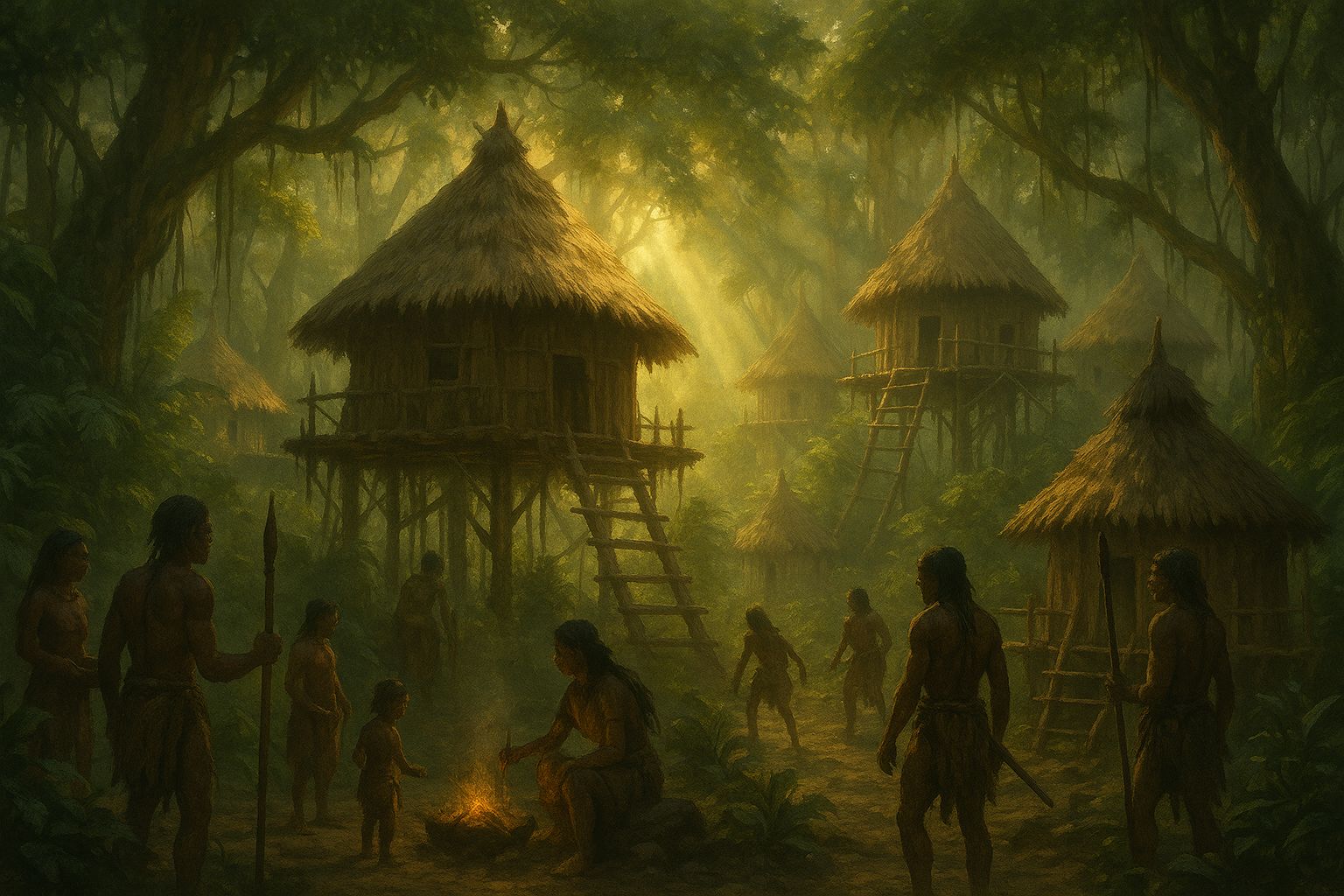
In the north of the Yelthara Jungle dwell many tribes that share one woven culture, calling themselves the Yelthari. Their homes lie beneath the endless green roof of the jungle, where sunlight is broken into shards and the ground steams after every rain.
They live under constant threat. From the south raid the Itzalcoa warbands, who steal captives for their sacrificial altars. From the north come the slavers of the Lake of Life, pale-skinned oarsmen who raid the coastal areas with nets and chains. Because of this, the Yelthari have learned the art of vanishing. Villages are seldom permanent, often abandoned after only a handful of seasons, their huts left to rot beneath the strangling vines. Paths are covered, trails confused, smoke scattered with damp leaves so that even hunters might mistake the way.
Unlike many peoples of the world, the Yelthari do not war with one another. Once, in older days, rival tribes fought bitterly over hunting grounds and river crossings. That changed when the raids grew worse. Old hatreds were set aside. Now it is common for tribes to trade, feast together, or exchange sons and daughters as spouses to strengthen their bonds. If a tribe is broken, its survivors may be taken in by neighbors, as happened when the Andoro joined the Eshari after a season of famine and fire.
Their way of life is intimate and ordered. They are monogamous, and the family is the center of every village. A husband and wife share not only children but duties, for the jungle does not forgive idleness. Men hunt with bows, spears, and arrows dipped in serpent venom, while women tend the fires, gather herbs, and weave the mats and baskets that sustain the community. Yet both fight when pressed, and both may lead.
Weapons and Warfare
The Yelthari are not a people of open battle, for the jungle does not favor armies. Instead, they fight as the canopy itself fights, with silence, patience, and sudden violence.
Hunters use bows strung from palm fiber, their arrows dipped in serpent venom or the sap of deadly plants. Spears of hardened wood are common, but only rarely used in direct combat; more often they serve in ambushes, thrust from the undergrowth or thrown from cover.
Warriors paint their faces white with ash to resemble the spirits, believing this confuses enemies and pleases the Loa. They move barefoot, leaving almost no trace, and their scouts are known to trail invaders for days, picking them off one by one.
When pressed into direct fighting, the Yelthari favor sudden strikes - volleys of arrows from hidden positions, then vanishing into the foliage before a counterattack can be organized. They avoid prolonged battle, for they know raiders will always return in greater number.
More fearsome still are the curses laid by the Bokura and Zina before a raid. Invaders sometimes find their torches sputtering, their water fouled, or their guides struck with sudden sickness. The Yelthari believe it is better to sap an enemy's will than to risk their own blood.
To outsiders, this makes the Yelthari seem like phantoms, never where they are expected, always striking from the shadows, then gone before dawn.
Religion
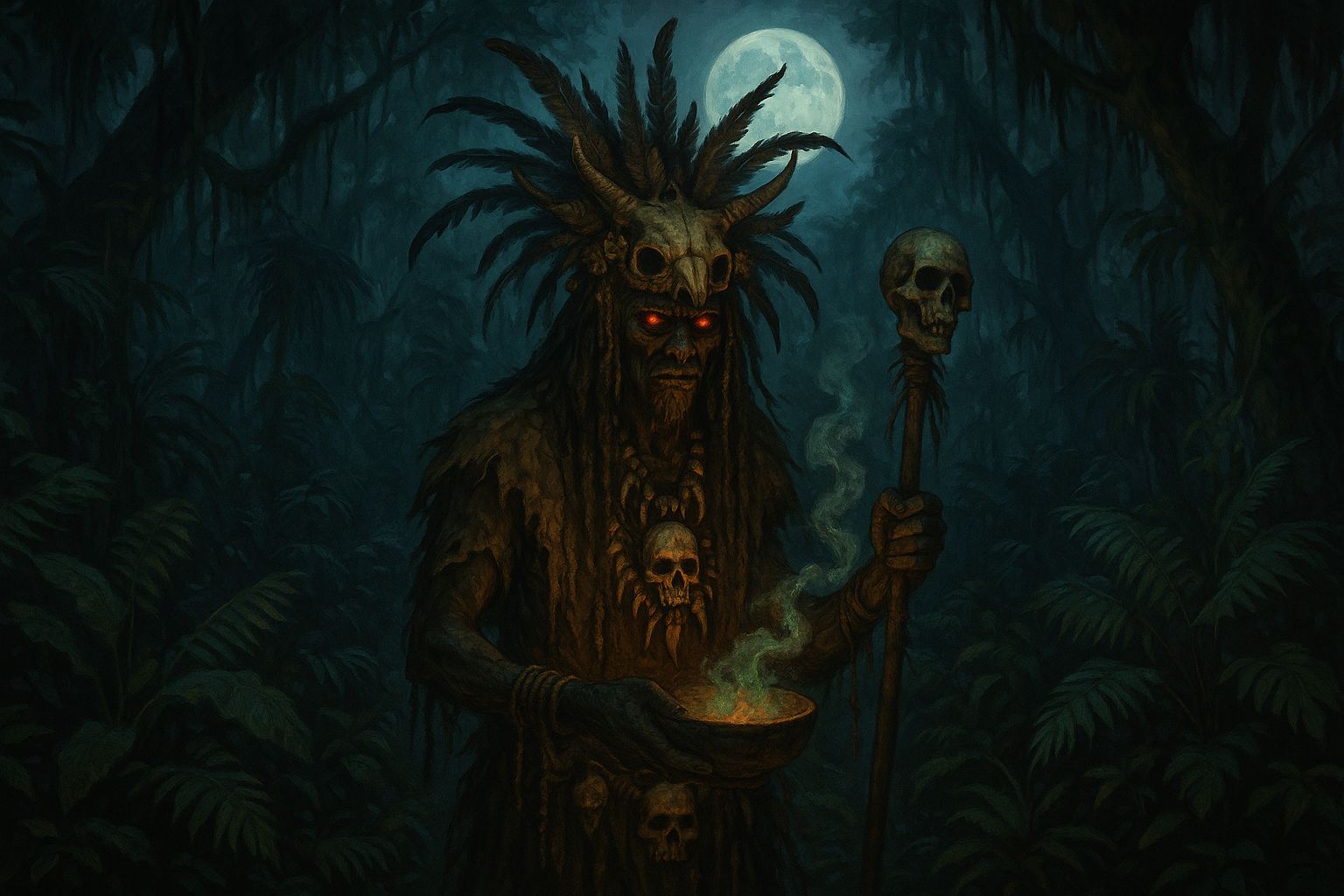
Their priests and priestesses, called the Bokura if male and the Zina if female, are both feared and revered. They serve the great gods, mighty spirits who walk close to the people, as well as the countless Loa who whisper from every shadow. The gods are not remote; they laugh, bargain, and curse like mortals, yet their power is beyond question.
Among the Yelthari, the most honored gods are:
- Kalombé, Keeper of the Gates. He is the opener of paths, the one who decides whether prayers reach the spirits. Old and bent, with a staff of living wood and a voice like wind in the reeds, he must always be honored first. Without Kalombé, no other god or Loa will listen. Offerings of tobacco smoke or carved keys are left at his shrines.
- Barani, Lord of the Grave. He is the black-hatted trickster who laughs in graveyards, master of death and disease, but also the one who protects the Yelthari from restless spirits. Barani loves rum, fire, and crude jokes. It is said he appears at every burial, leaning on his cane, to make sure the dead stay down. When properly honored, he turns away sickness and confounds the hunters of the jungle.
- Nashara, the Veiled Lady. Pale as moonlight, with a smile half-kind and half-cruel, she is the goddess of night, dreams, and secrets. She guides lovers, wanderers, and liars alike, and grants visions to those who dare drink her bitter brew. Offerings of silver-painted shells and whispered prayers in the dark please her.
The gods often walk in disguise, taking the shapes of beggars, children, or strangers to see if the Yelthari will honor them.
The Loa, the lesser spirits, are countless, in every river, tree, beast, and storm. Some are small and fleeting, like the Loa of a single snake, others vast, like the Loa of a whole river. They are not worshiped as gods, but bargained with, coaxed, or threatened. They carry out the will of the great ones, but often pursue their own games.
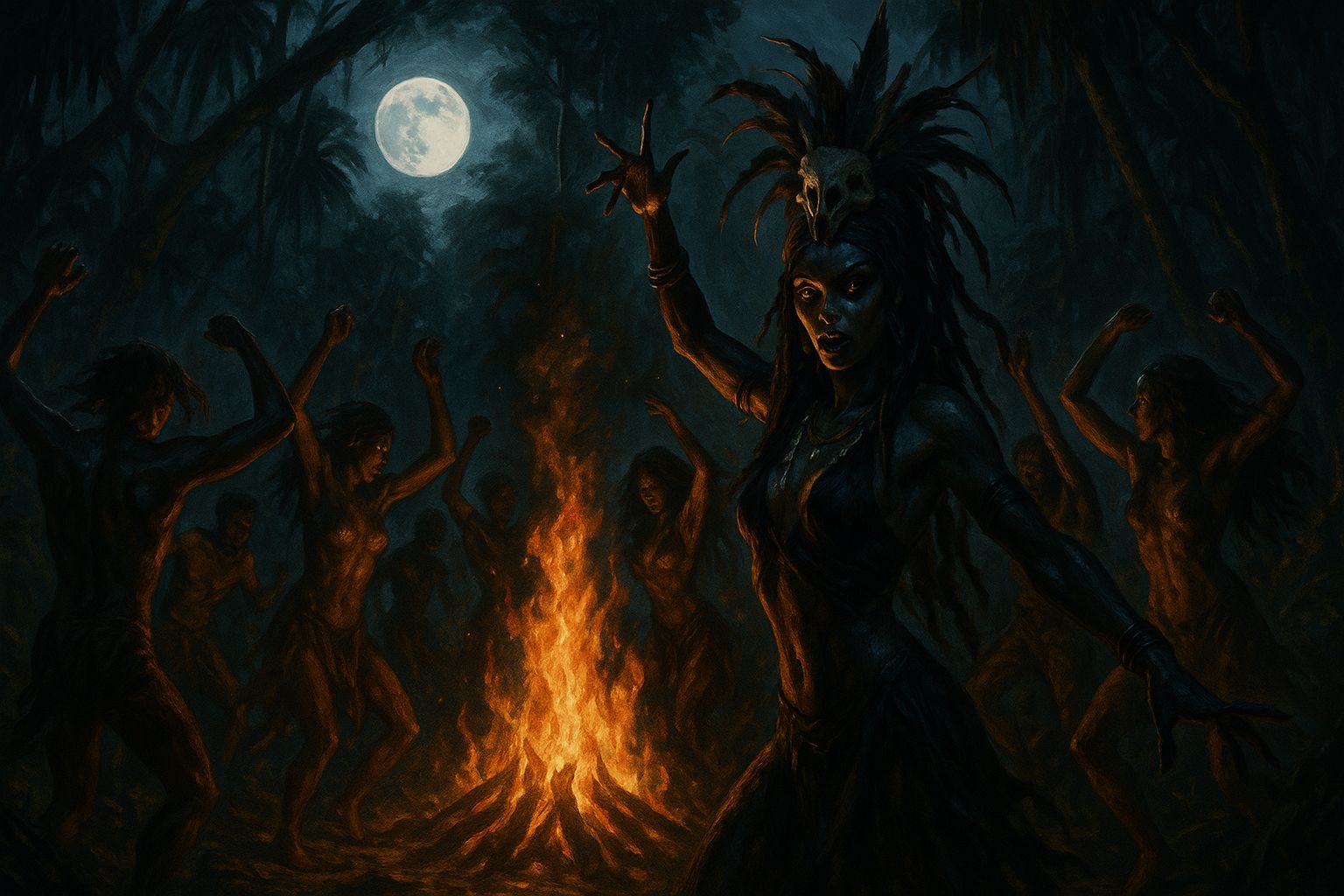
The Bokura and Zina call upon gods and Loa through drumming, dance, and trance, as well as blood sacrifices. The sacrifices are only animals, not people. During ceremonies, spirits sometimes ride the bodies of worshippers, speaking through their mouths and demanding gifts. The Yelthari do not see this as possession but as a sign of honor, to be chosen as a vessel is to be touched by the unseen.
To the Yelthari, the gods are family - dangerous family, full of whims and hungers, but family nonetheless. And like family, they must always be remembered, fed, and respected.
Tribes
The main tribes known in the northern Yelthara are:
- The Eshari, keepers of the Spirit Tree of Kalombe, whose priestess Zina Maroa is famed for cursing an entire Itzalcoa column with blindness.
- The Andoro, once nearly destroyed, now bound to the Eshari by blood and marriage.
- The Vekhara, river-dwellers who string floating charms of bone and feather across waterways to confuse pursuers.
- The Zatiri, wanderers of the deep jungle who claim to hear the Loa's voices in every storm.
- The Tolane, fierce hunters who once feuded with the Eshari, now their closest allies.
There are many other tribes, but these are the most influential.
Together the Yelthari are not a nation, nor a kingdom, but a living net stretched across the jungle, bound by shared danger, by the spirits, and by the will to endure.
In the far east, there are also Yelthari tribes, under the name of Tzolani, fighting a desperate battle for survival against the Sreli, but they are separated from the main body of tribes by geography and enemies.
Possible Secrets
The Hidden Pact
Long ago the Yelthari Bokura made a bargain with Barani, Lord of the Grave. In exchange for his protection against the Itzalcoa, the Yelthari must give him one soul every turning of the moon. The victim's family is told they "wandered into the jungle."
The Gatekeeper's Price
Kalombé the Keeper of the Gates is not only a god but perhaps the remnant of an ancient mortal sorcerer who bound himself to the Loa. Some Bokura whisper that if his staff is ever found and broken, the way to all other spirits will close.
The Blackened Shrines
In abandoned Yelthari villages, explorers sometimes find shrines covered in soot and ash. The tribes claim they burned them to "cast out the Loa," but in truth these shrines are prisons, binding dangerous spirits too wild to roam free. If released, they could devastate the jungle.
The Moon-Mother's Twin
Nashara, the Veiled Lady, may not be a single goddess. Some Bokura teach in secret that she has a hidden twin who appears only under eclipses, a cruel reflection who leads followers into madness. Her name is never spoken aloud.
The Slaver's Curse
The lake people of the north fear the Yelthari's curses for good reason: a forgotten Zina once cursed their ancestors so that every slave they took would, in death, rise to haunt their dreams. This is why the slavers paint their faces with ash and cover their eyes during raids.
The United Tribes
The story of the Andoro joining the Eshari is known, but some claim this was not mere survival. A ritual was performed by both tribes, binding them as one before the Loa. If true, the Andoro and Eshari may literally share a single spirit, which explains their uncanny unity.
The Living Jungle
Some Bokura whisper that the jungle itself is the greatest Loa, older and hungrier than the gods. Every offering of blood, every spirit-ride, and every curse strengthens it. If enough power gathers, the jungle may awaken in full, and the Yelthari would be its voice.
Adventure Hooks
The Vanished Village
A Yelthari settlement near the river is found deserted, the huts intact but abandoned overnight. Tracks vanish into the jungle. Were they taken by raiders, or did something drive them into hiding?
The Bride's Journey
Two tribes have arranged a marriage to strengthen their bond. The bride must be escorted through hostile jungle and across raider-patrolled rivers. Spirits demand offerings along the way, and enemies lie in wait to prevent the union.
The Spirit Hunt
A powerful Loa has grown violent, possessing hunters and turning them against their own kin. The Yelthari beg outsiders to help trap the Loa before it tears the tribe apart.
The Broken Path
A vital trade route through the northern jungle is blocked by strange woven charms and bone totems. Travelers fall sick or vanish when passing. The Yelthari claim a spirit guards the path until proper rites are restored.
The Slaver's Chains
A raiding canoe from the Lake of Life has captured Yelthari children. The tribe offers sacred relics to anyone who dares pursue the slavers upriver and bring the captives home.