Waverider Expedition - The Great Empire
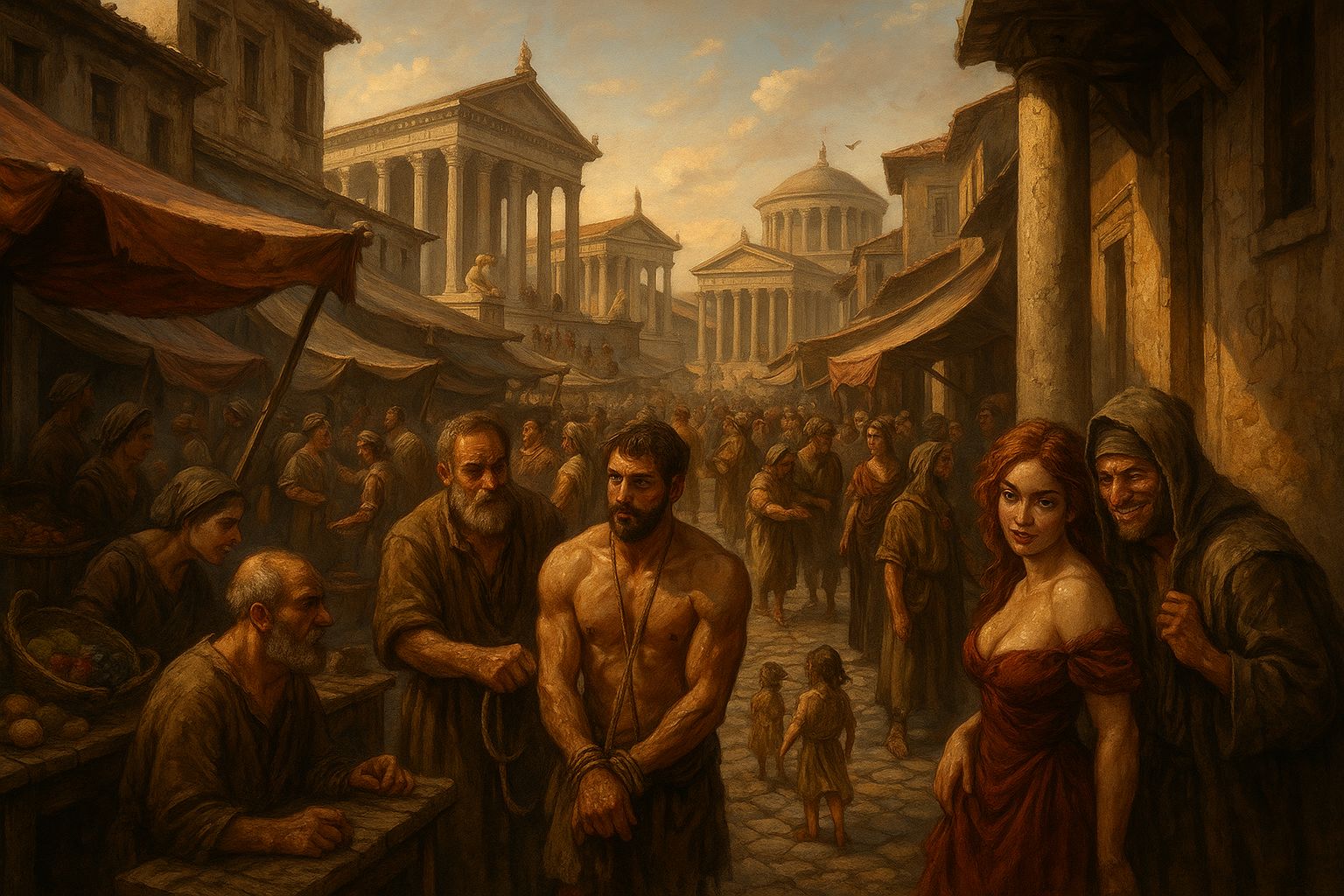
The air of Alborum was thick with spice and rot.
The Waverider’s crew walked single file through the market, the sound of their boots lost beneath the roar of the city. Above them rose the towers of the Great Empire, white marble stained by smoke, banners fluttering like the wings of carrion birds.
The marketplace sprawled in chaos. Stalls overflowed with silks and gems, perfumes and powders, gold worked by hands that would never touch it again. Every color screamed for attention, every voice shouted over the rest. Beneath it all, chains clinked.
A slave auction took place on a raised platform beside a fountain. The auctioneer called prices like a priest leading a chant. The merchandise stood silent: men, women, and children, their backs marked, their eyes fixed on nothing. One of them coughed, and the auctioneer struck him for it. The crowd laughed.
“Keep walking,” Virellus said. His tone carried no anger, only restraint.
Past the auction stood a row of tents draped in red cloth, guarded by fat men with whips. Outside, the faces of the slave women were painted in powders to hide the bruises beneath, offering their bodies for coin, all under the watchful eyes of their owners. A group of young nobles stumbled out laughing, tossing coins at a child to hold their cloaks. The coins fell in the mud. The child knelt and licked one clean before pocketing it.
Ulfar muttered under his breath, “This city stinks of perfume and piss.”
“Worse than that,” Phaedros replied. “It stinks of comfort.”
They turned down a broader street, paved with white stone that gleamed even through the grime. There, under banners of gold and crimson, slaves fanned their masters as they dined at open tables. Wine spilled freely. Musicians played. A man lay on the steps nearby, ribs showing through his skin. No one looked at him.
From somewhere ahead, a cheer rose, sharp, savage. Someone mentioned the spectacle at the arena: an amazon captured from the Amazireth jungles, to be executed for rebellion. The words “public spectacle” and “artful dismemberment” passed between the crowd as if describing a play.
Selene’s face went pale. “They call that entertainment?”
“They call it justice,” Venera said coldly.
They crossed a bridge where slave children scrubbed the stones with rags, watched by guards who lounged in the shade. Below, the river ran brown and slow, carrying the city’s waste out to sea.
At the far end of the market, a noblewoman passed surrounded by soldiers. Her dress shimmered like oil. Behind her trailed six slaves, three carrying her train, two fanning her, one kneeling to polish the dust from her shoes after every few steps. She did not once look at them.
The Waverider’s crew stood aside to let her pass. None of them spoke.
Only when they reached the outer gate did Captain Virellus stop. He looked back toward the heart of the Empire, the shining city of his sponsors, its towers glinting like spears in the sun.
“That,” he said quietly, “is what they call civilization.”
Then he turned away, and they followed, leaving the laughter and the chains behind them.