Waverider Expedition - N'gazama
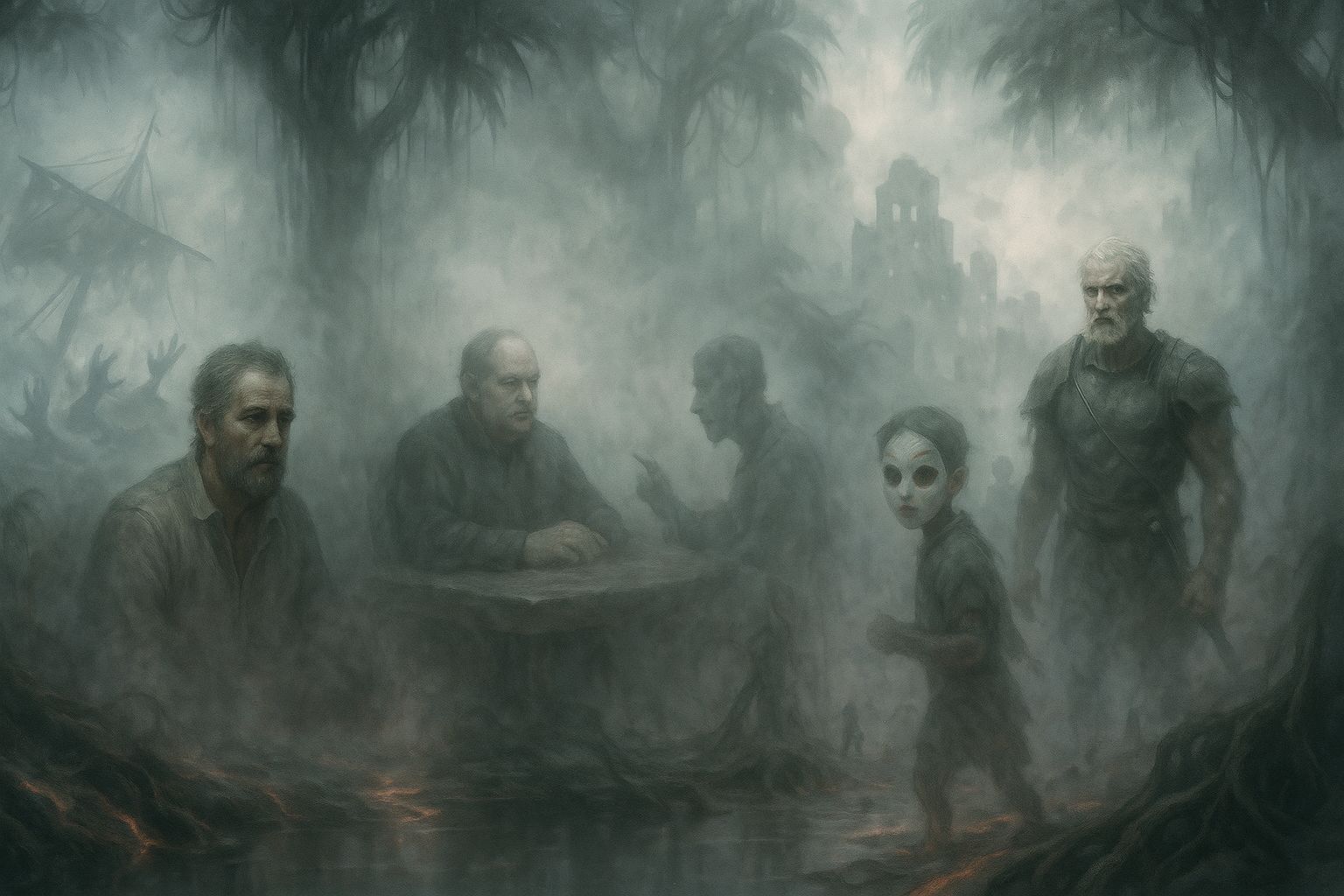
The river narrowed until it was only a vein through white.
Mist hugged the water, soft as wool and just as smothering. The banks were a suggestion, dark ribs of root and stone glimpsed, lost, glimpsed again. The air tasted metallic, warm with the breath of hidden springs.
Solonex held the oar and set a slow, careful rhythm. Severin sat aft with his ledger closed, lips pressed thin for once. Velan watched the banks, one hand white-knuckled on the side, as if the fog might take hold of the boat and pull.
"No charts. No warnings," Severin said at last, voice small in the hush. "Just a river that doesn't want us."
"Rivers don't want," Solonex said. "They go."
This one seemed to listen.
They had come inland to mark a blank space between headwaters. Nothing more heroic than that. The first bend gave them reeds. The second gave them silence shaped like attention. On the third, faces appeared on the shore-masks of bone-wood and ash-lacquer, spiral-painted, tied with fiber cords. No bodies behind them. Just the masks, hung at eye height among the roots, turned toward the water.
"Household shrines?" Severin guessed.
"They're looking at us," Velan murmured.
They passed a cluster of huts on stilts, half seen. Smoke rose through the white in narrow threads. Figures moved, men, women, children, each with a mask carved in slow swirls. No one spoke. A child raised a hand, palm out, fingers apart, a sign neither welcome nor warning, and then the mist folded and the village was gone.
They made camp on a grid of roots that might once have been a fallen giant. Fire took reluctantly, hissing at the damp. Solonex set a watch. Severin brewed something bitter and called it tea. Velan did not sit.
The fog thickened with the dark. It did not lie still; it shifted, curling around ankles, lifting when they moved, sinking when they stopped. The jungle hummed without insects. Far off, something bubbled like a pot.
Solonex dozed and woke to the sound of water that was not the river. A rhythmic slap of waves against wood, a boatswain's whistle, a low call to heave, impossible, all of it, this far inland. He rose and followed the sound down a slant of root to a little hollow where the mist had pooled.
Lanterns swung there, dull as coins. Men clung to wreckage, faces barely above the surface. He knew those faces. He had read their names from logs to widows. "Captain," one croaked, smile gentle as it had been in life. "We tried to come up."
He blinked. There was only the hollow and the fog, beaded like sweat.
Back at the fire, Severin pretended to write. He watched words appear on the blank page as if the quill were moving. A hand slid into view at the edge of his sight, ring he remembered, scar he remembered, and a familiar voice, dry as winter leaves: "We had the deal. All you had to do was agree where it hurt."
"I couldn't give them that," Severin whispered.
"Then you gave them me."
He breathed, counted, looked full-on. No hand. No ledger marks. Only his own reflection in the polished lid of his inkwell, his face stretched long by the curve-like a mask.
Velan did not sleep. He stood on the roots watching the river breathe. The fog thinned once, just once, and he saw a street of toppled statues in a city no jungle should hold, a line of thin children running past him, small feet slapping stone. He knew the line. He had counted those feet, that day. He had told himself he was keeping them safe by staying back.
The smallest of them turned. Her mask was paint over an ordinary child's face, chalk spirals, two eye holes. Underneath, he knew every freckle, though the fog made the freckles swim. "You said to the corner," she said. It sounded like the whisper of a kettle about to boil.
He closed his eyes. "Run."
When he opened them, there was only river.
At dawn their footprints circled their own fire. No one mentioned it. They pushed off. The masks along the bank had multiplied in the night. Some were blackened, cracked as if burned; some were wet and wept onto the roots. Faces of animals among the human: a jaw like a tapir, a coil like a serpent, a dish of bark with holes that felt like eyes. All turned toward the water. All watching.
The current quickened. Steam rose in threads. The bank leaned in so close that the boat brushed bark and came away briefly sticky. Velan wiped resin from his palm and felt his pulse there, faint and wrong, like a heartbeat not his own.
"Left," Solonex said. "Slow."
They rounded into a channel that should have opened but didn't. Mist made a wall. The oar clicked on stone and gave back a hollow echo, as if the river were under a roof.
"Vent," Severin said. "Hot spring. Can't see it."
A shape waited in the white. A person standing shin-deep in the water, still as a mast. Spiral mask. The figure lifted one hand and drew three curves in the air with two fingers: a sign, slow and precise.
"What does that..." Severin began.
Velan's breath left him. The figure was child-sized.
He stepped over the side of the boat before Solonex could grab him. The fog took him to the waist, then the chest. The swirl-face did not move. It was only when he was within arm's reach that he saw the truth: mask tied to a stake, the water bubbling around it, steam slipping through the eye holes as if the wood breathed.
He touched the cheek. It was warm. The spiral paint bled onto his finger, black and gray.
"Velan," Solonex called. "Back in the boat."
A sound rolled under their feet then, small at first, then like the throat-clear of a mountain. The roots trembled. The mist lifted in one place, a column, then sank in another, as if something beneath had turned in sleep.
Severin's voice went quiet. "We should go."
They went. Not quickly; speed made the boat shudder; but steadily, Solonex setting the rhythm, Severin bow low, Velan staring into white with eyes that watered and would not blink.
Voices came out of the fog as they moved. Familiar voices, wrong in the way echo is wrong. "Hold fast," a boatswain. "Don't go," a child. "We had it," a friend. The words arrived a breath after their own fear named them, as if the air were practicing being their mouths.
They passed another mask hung from a root. This one was black, edges curled as if licked by fire, yet when Solonex's knuckles brushed it, it was cold enough to bite.
"Don't look," he said. "Row."
They rowed until the color of the mist changed from pewter to pearl, until the smell of sulfur thinned to moss and leaf. Trees sharpened. The river widened. Sunlight made a pale disk on the water and did not fall apart.
Only when the jungle sounded like itself again, insects, bird, a frog like a plucked string, did Solonex set his oar across his knees.
"Report?" he asked, the habit of command grasping for handholds.
"Bad dream," Severin said. He meant it to be light. His mouth failed him.
Velan stared at his hands. "I told them to the corner," he said. "I told them to the corner."
"No one's asking you to answer it," Solonex said, too sharp.
"Someone is," Severin murmured.
They sat without speaking. The river tugged them toward safer water as if it were relieved.
Severin leaned to the side to cup water and wash his face. In the slow ripple he saw three reflections: captain, diplomat, soldier. Each wore a second face laid faintly over the first-a spiral of gray, a curve at the mouth, an eye not where it should be. The masks were thin as breath and clear as glass, smiling with a patience that did not belong to any of them.
He blinked hard. The masks remained for one heartbeat more, then slid away like oil.
Severin dried his hands on his coat. "We should write nothing," he said.
Phaedros would have argued that a blank on a map is a lie. Severin did not add it. Solonex nodded once, which is how he agreed to things that tasted wrong but needed doing.
They did not look back.
Behind them, the white had already closed, as if the river's mouth had never opened. The masks on the bank watched them go, or did not; it was impossible to be sure, while under the mud and roots something vast rolled over and settled, and the fog above it breathed in, breathed out, remembering each of their names without a sound.