Waverider Expedition - Drowned Marshes
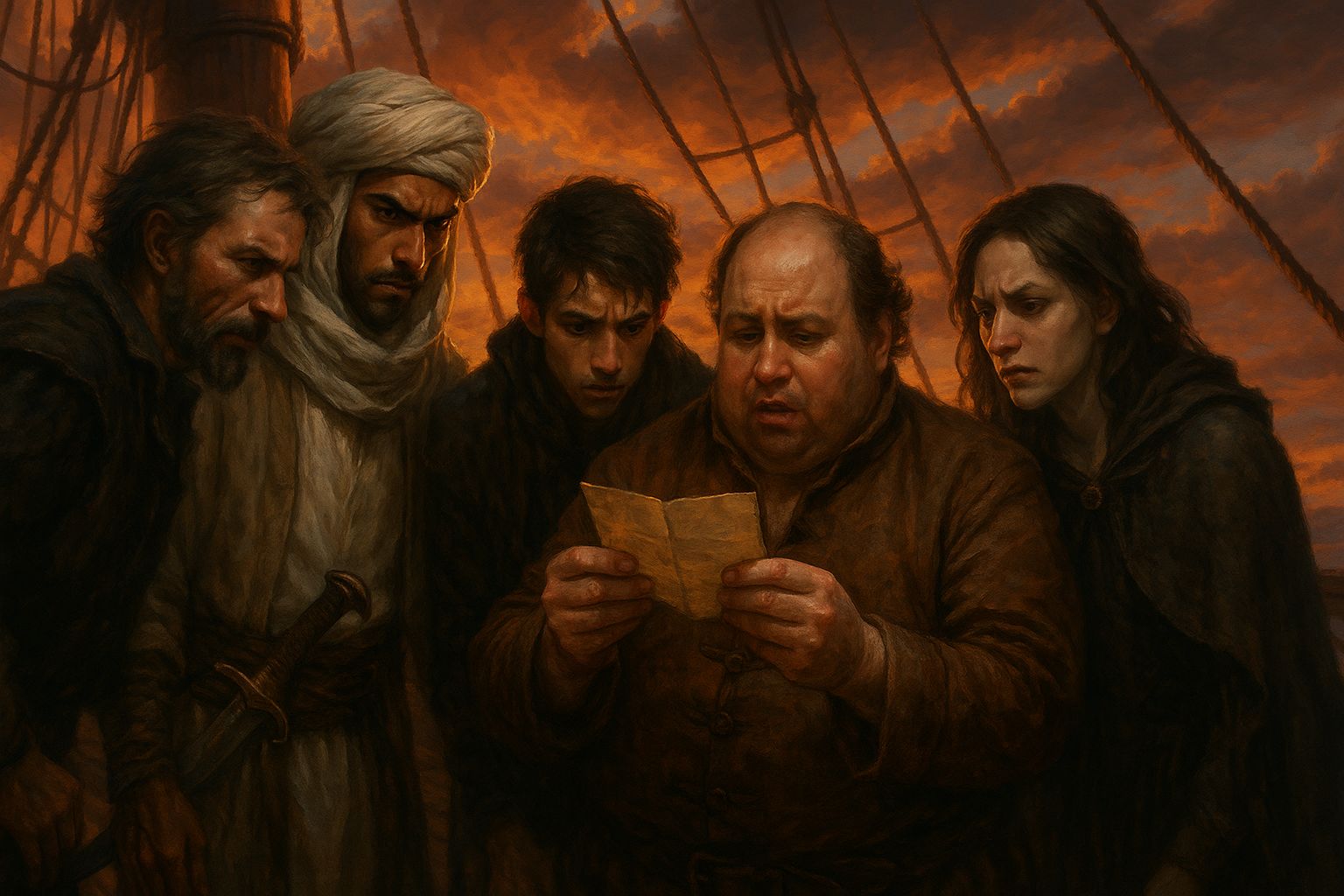
The coast of the Drowned Marshes looked dead even from a mile out.
A gray line of mangroves rose from the sea like rot, their roots black and tangled, the water between them dull as lead. The only sign of habitation was a cluster of huts on stilts, smoke drifting low across the tide. No birds circled. No laughter carried. Even the waves seemed to hush as the Waverider drew near.
They made anchor where the planks looked least ready to collapse.
A few villagers waited there, silent, watching. Their clothes were simple, clean enough, but their eyes flicked constantly toward the inland fog. Always the same glance, as if counting something unseen.
Virellus stepped ashore first, Severin and Rahim behind him, Eira keeping watch near the boat. "Let's make this quick," the Captain murmured. "I don't want the tide going out under us."
Trade began easily enough. Dried fish for salt, mangrove wood for nails, a basket of swamp pearls that glimmered faintly pink in the light. The villagers spoke little, their words soft and rehearsed, like lines recited under threat. The children stood in doorways but never came closer. Even the dogs were silent.
One man, older, narrow-shouldered, did the bargaining. He smiled when Severin approached, but the smile was brittle. His hands shook as he counted out the coin. When he passed the last piece across, his fingers brushed Severin's palm, a fleeting contact, almost accidental.
Something small and folded rested there.
Severin didn't look down. He pocketed it with a single smooth movement, thanked the man, and turned away.
The villager bowed quickly and stepped back, eyes darting toward the mist.
They finished loading the trade goods without incident.
Only when the Waverider was half a league out to sea did Severin unfold the scrap of paper.
The handwriting was uneven, written with something that looked like soot and seawater.
They take our children. They took my wife. My daughters. My son. We are watched always. I am already dead, but the world must know. - T.
The crew gathered around the scrap, the damp wind flattening it against the deck. For a long moment, no one spoke.
Then Virellus said, quietly, "They're doing it again."
Rahim's jaw tightened. "The Synod."
Selene crossed herself in silence.
The Captain's expression hardened. "If they're taking children, they're not just tyrants anymore. They're butchers."
Severin folded the note carefully. "And clever butchers. A letter like this should never have reached us."
"Someone has to see what's true," Virellus said. "If they're hiding something, I want eyes on it."
His gaze shifted to Gato, who was sitting on a coil of rope, sharpening his knife with idle precision. "Gato," the Captain said. "You know swamps."
Gato looked up, grinning faintly. "Better than they know me, Cap'n."
"Good. Go find out what's happening inland. Take the small boat. Two days, no longer."
The grin faded. "Aye."
He stood, tested his blade, and looked toward the green horizon where the mist thickened into the swamp. "Looks quiet," he said.
Severin closed the folded note in his hand. "That's what frightens me."
The Waverider drifted at anchor as Gato climbed into the skiff, the oars dipping soundlessly into the gray water. He rowed toward the mangroves until the mist swallowed him whole.
For a while, they could still hear the slow rhythm of the oars.
Then even that was gone.
The swamp had no horizon.
Just gray sky melting into gray water, broken by reeds and the shapes of trees that might once have been alive. Gato moved through it like a ghost, his skiff gliding between the roots. Even the insects seemed afraid to make noise here.
He followed the sound before he saw it. A slow splash of oars somewhere ahead, the rasp of a voice echoing over still water.
He pulled his skiff against a tangle of mangrove roots and waited.
Through the mist, a procession took shape: a long black boat, rowed by slaves whose eyes were covered with strips of cloth. At its center sat a man in a crimson cloak, bronze mask gleaming dully in the half light. Four guards stood around him, bare-chested, their skin painted in streaks of red. Their weapons dripped water.
They approached a stilt-village half lost in fog.
At once, the villagers appeared, spilling from their huts like frightened birds, bowing low. None dared speak. Some of them bore signs of work, arms too long, mouths sealed with scar tissue, eyes sunken and wet, as though they'd been reshaped to suit some unseen purpose, or as punishment.
The man in crimson stepped onto the pier. He did not walk so much as glide, the hem of his cloak never wetting. He surveyed them in silence, the bronze mask unreadable.
Then he lifted one finger.
Two children were pulled forward, a boy and a girl, no more than fourteen. The boy's jaw trembled; the girl's hands were balled so tightly her knuckles shone white. A woman tried to reach for them, but another villager caught her arm, whispering frantically into her ear.
The guards seized the children and dragged them into the boat.
A few people cried, softly, behind their hands. No one else moved.
The man in crimson turned without a word, sat, and the boat slid back into the mist.
Gato waited until the ripples died, then followed.
Hours passed. The sky never changed, only deepened from gray to black, the air heavy as breath.
When the boat stopped, it was before a black stone tower rising from the water like a finger pointing at nothing. No light showed within. The children were taken through a door at its base.
Gato's pulse hammered, but he waited. When the last torch went out, he rowed closer.
The stone was slick, but the vines made handholds. He climbed in silence until he reached a narrow window cut into the wall. Faint light pulsed from within, red and sickly, like a heartbeat behind cloth.
He looked.
For a long moment, his mind refused to understand what it saw.
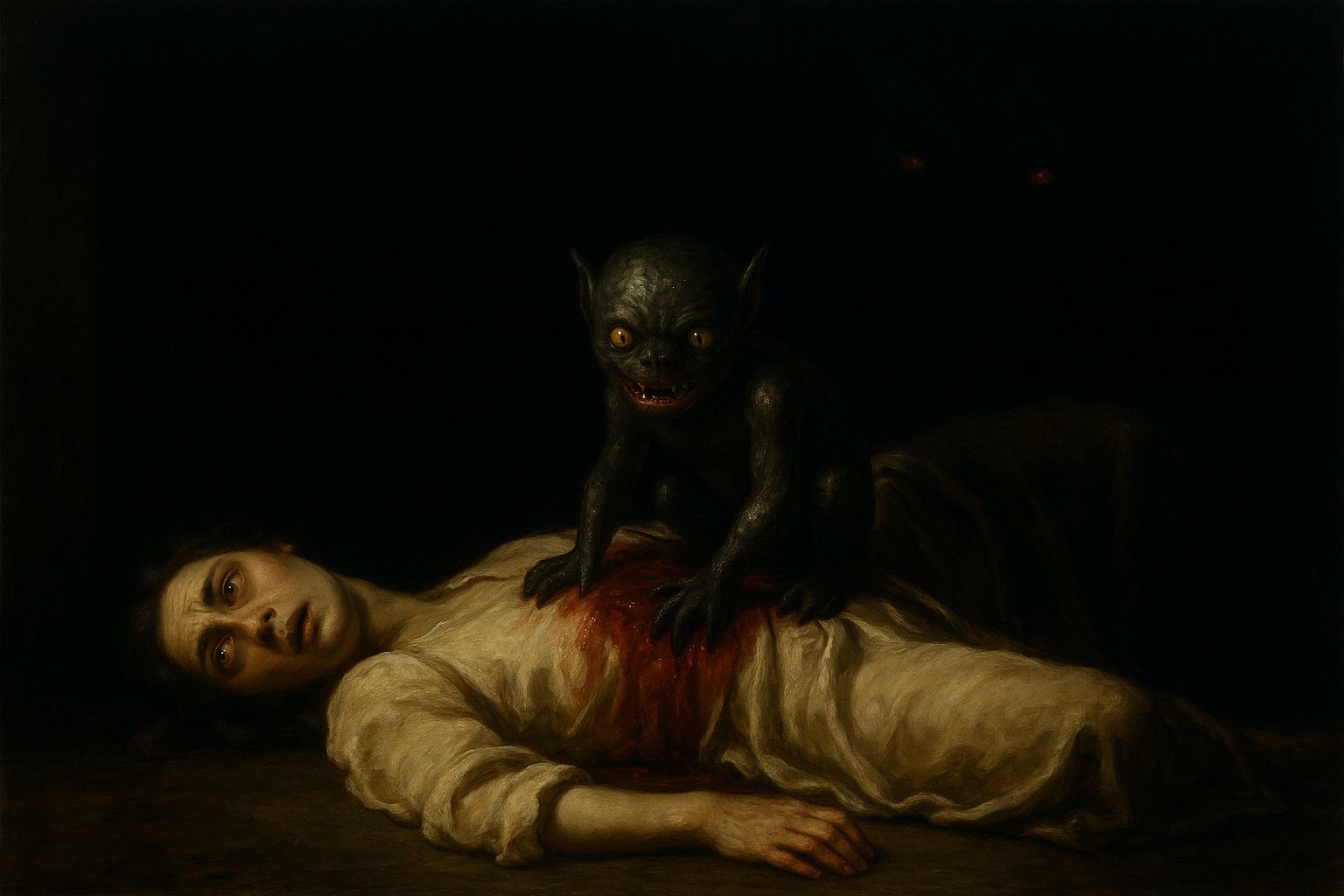
A dead woman lay sprawled on the floor, her belly torn open.
A small creature crouched below her ribs, something shaped like a child but wrong in every proportion, its skin a black sheen of scales, its mouth too wide. It was eating. Delicately. Chewing.
Her face was turned toward him, eyes glassy with pain, breath catching in tiny, broken sobs, and he realized she was alive, and gasped.
The demon thing paused.
Its head turned toward the window. Its eyes, gold and wet, locked on Gato's.
He froze.
The creature smiled. And in that instant, something moved in the darkness behind it, something far larger, hunched and breathing in rhythm with the woman's fading gasps.
A second pair of eyes opened. Red, dull, ancient.
Gato's hand slipped on the stone. The sound was tiny, but enough.
The thing in the shadows stirred, massive and slow, the air around it shifting as if the swamp itself were inhaling.
Gato's heart stuttered. He didn't think; he dropped.
He hit the water hard, the cold shocking him into motion. He swam, splashed, ran when he hit the shallows, dragging himself through reeds and mud until he found his skiff. Behind him, nothing followed, but the swamp seemed to close over the noise, swallowing even his breath.
He rowed without rhythm, without thought, the oars cutting black water that didn't want to be moved.
Only when the Waverider's lights flickered through the fog did he dare look back.
Nothing there. Only mist. Only the endless quiet.
He rowed faster, and the fog swallowed the sound.
The sea mist clung to the Waverider like cobwebs when Gato returned.
They hauled him aboard in silence. His hands were shaking, his face streaked with mud and something darker. He didn't speak at first. He just sat on the deck, breathing in harsh, shallow bursts. When Virellus knelt beside him, he started to talk, disjointed, half-choked words spilling out like seawater from a cracked hull.
He told them what he had seen.
The man in crimson.
The children.
The tower.
Then the woman, the body, the thing that was not a child. The eyes that found him.
By the time he finished, his voice was gone. He sat there, shoulders hunched, trembling, staring at the boards beneath him as if afraid something might look back through the cracks.
"I ran," he said finally. "Gods forgive me, I ran. Those children..."
He broke off, covering his face. "They'll die screaming. And I ran."
Captain Solonex knelt beside him, placing a steady hand on his shoulder. "You did what you had to," he said quietly. "If you'd stayed, you'd be one more body feeding their monsters. Instead, you came back. You brought us truth."
He looked at the others. "A dead hero helps no one. A living scout saves lives."
No one spoke for a while. The sound of the waves filled the silence, slow, heavy, like a heartbeat through the hull.
Then Solonex rose. "So now we know what they are." His voice was iron. "Tell me, Decimus, can we fight them?"
Decimus leaned on the rail, eyes distant. "Not here. Not now. They know their ground. We don't." He shook his head. "We couldn't win."
Venera crossed her arms. "We're explorers, Captain. Our task is to map the world, not to burn it. You can't fight every horror we find."
Solonex turned to her, jaw tight. "So we look away?"
"Sometimes," she said softly, "that's all you can do."
He started to speak again, but Decimus cut in, his tone level, factual. "Even if we struck one of them, one of their towers, the others would know. There are many. Kill one, and the rest come for you. You'd be fighting the swamp itself."
Selene's voice was low. "And the people there aren't soldiers. They've lived in terror for generations. They'd fight for their masters because they're too afraid not to."
Solonex looked from one face to another, anger, sorrow, exhaustion reflected back at him. "So we do nothing?" he demanded.
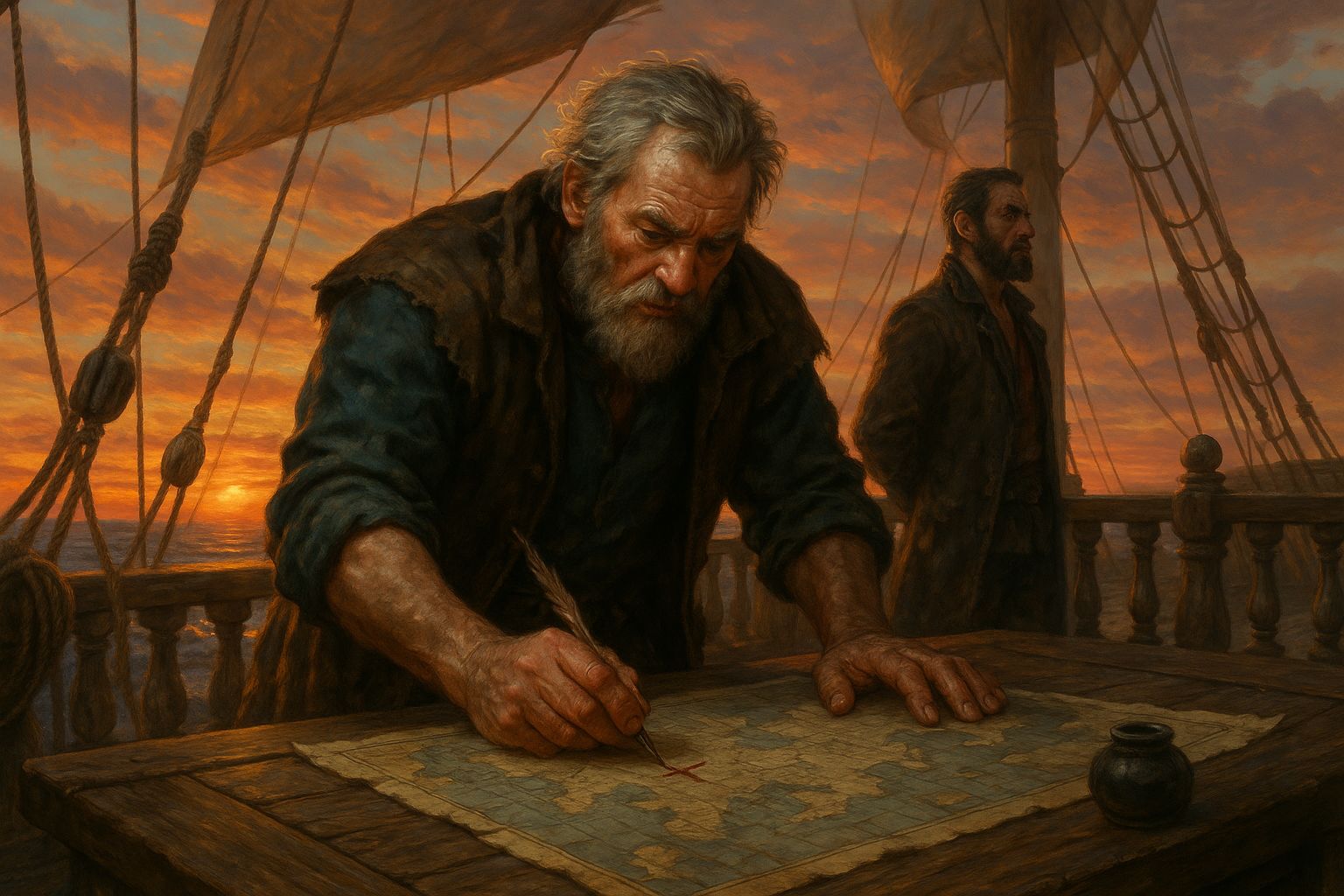
Severin had been silent until then, standing apart near the chart table. His voice was calm, but it carried. "We finish what we came for. We mark what we've found. That's what we do."
Solonex turned sharply. "You think we should just run?"
"No," Severin said. "I think we should remember."
He stepped closer.
"Power draws power, Captain. Sooner or later, someone stronger than us will come looking, an empire, a crusade, a warlord hungry for glory. When they do, they'll need to know where to strike. The best thing we can do is put the Crimson Synod on the map. Make them real. Make them known. An army can give the people the courage to rise up."
He paused, his voice dropping lower.
"If those people are ever freed, it won't be out of mercy. It'll be because someone else wants what the Synod has. And, probably, that someone will be less cruel."
The deck was silent again, the air heavy with salt and smoke and the faint stench of swamp clinging to Gato's clothes.
At last, Solonex exhaled, slow and bitter. "Fine."
He looked to Pheadros at the chart table. "Mark it. Clear and black: The Drowned Marshes. The Crimson Synod."
He turned toward the crew. "Then set the sails. We're done here."
The Waverider's anchors lifted with a groan. The ship turned seaward, cutting through the gray waves as the mist thickened behind them. For a long time, no one spoke.
Gato stood at the stern, staring into the fog where the swamp had vanished. His eyes were hollow, his voice a whisper.
"The children," he said. "they'll still die... giving birth to demons."
Solonex didn't answer. The wind filled the sails. The swamp was gone.
But on the map, for the first time, it had a name.