Waverider Story - Campaign - Author's Notes
The Steppe Orcs
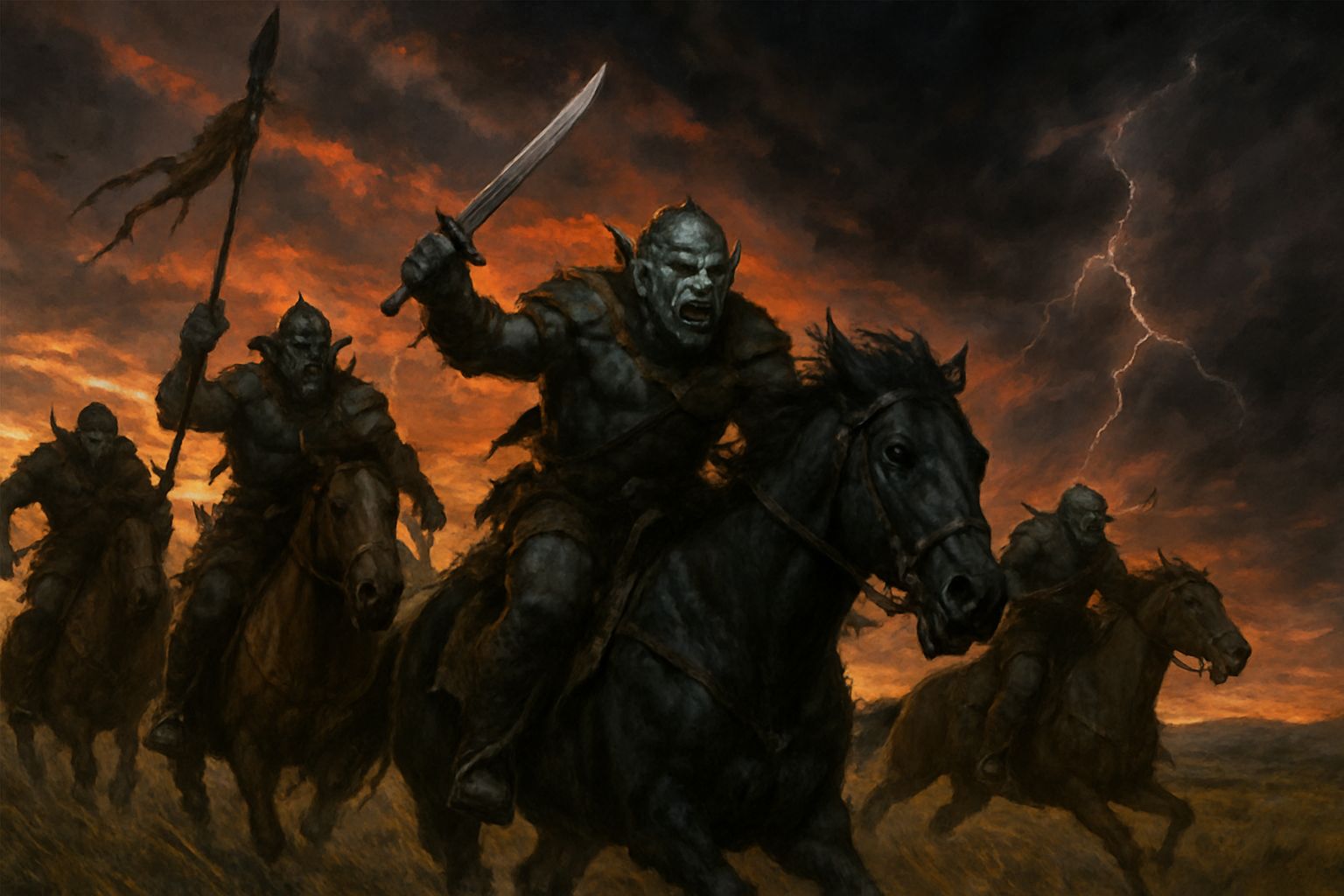
Nomadic tribes of orcs raiding the steppe.
| Story |
|---|
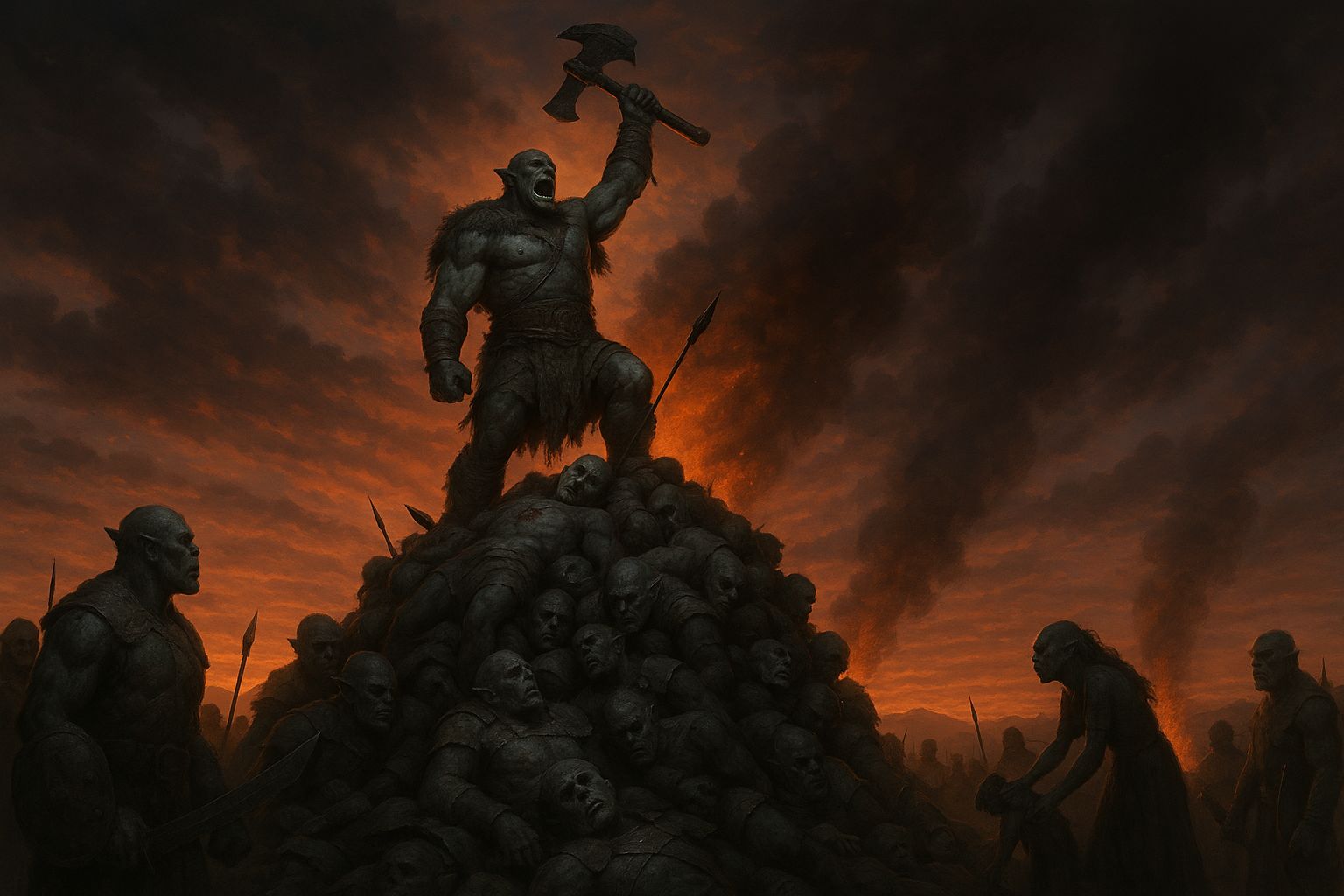
| The wind howled across the Skarthuun Steppe, carrying with it the stench of blood and smoke. In the distance, dark figures moved among the bodies of the slain. Varkhul Ashfang’s warriors were building the pile. |
| They laid their fallen comrade first, a young warrior named Drogmar, his chest pierced through by a spear. Around him, they stacked the corpses of his killers, dragged from the field and thrown like kindling on the heap. Each enemy body was another servant Drogmar would command in the endless battle of the afterlife. By the time they were done, the pile stood taller than a man, a magnificient monument of blood and bone. |
| Varkhul himself climbed atop it, raising his iron axe to the sky. “See how Drogmar walks into the afterlife, not alone, but with a warband at his side!” he roared, voice breaking against the wind. His warriors bellowed in reply, striking their weapons against their shields until the air trembled. |
| Nearby, women tended to their own dead. They carried Drogmar’s mother beyond the camp, where a pyre of dry wood waited. Flames licked at her body as chants rose, her smoke twisting into the sky to find her children in the eternal camp. |
| When all was finished, silence fell. The warriors of Varkhul’s tribe gathered around the corpse-pile, watching the horizon. Already, other tribes would smell the smoke, and soon new battles would come. But none feared it. To live was to fight. To die was to fight forever. |
Description
Beyond the farmlands of the Grashkaar, the steppe still belongs to the old ways. The tribes that never followed Urgan remain locked in the rhythm of war and vengeance. Their camps shift with the seasons, moving herds of shaggy steppe-oxen and hunting wild horses, always ready to strike at a rival clan.
Life in these tribes is measured by blood spilled and scars earned. Every man seeks glory through combat, and every leader holds power only as long as he can defend it with his strength. Duels are common, ambushes more so, and raids against neighbors are expected rather than condemned. Even within a tribe, challenges to authority can erupt at a feast, in the midst of travel, or during the division of spoils.
Their women keep the camps, tan hides, and raise children, but all live under the shadow of sudden loss. A man may fall in a raid today, and tomorrow his family may be marched into the camp of his killer, forced to serve the victor. This cycle is not seen as cruelty but as the proper order of things.
As brutal as their raids are, there are rules:
- If an opponent surrenders, they are spared but enslaved.
- To kill a foe means to absorb his family. His women are yours, his children are your children, and they now belong fully to your tribe.
- All tricks are fair once battle begins.
- The dead must be honored with vengeance and ritual.
As for absorbing families, this is not considered loot, it's considered a moral obligation. One does not leave women and children unprotected on the steppe.
It's worth noting that only slaying an opponent of equal or greater strength and reputation gives honor. There is no disrepute from slaying a weaker opponent, but there is also no gain. Women and children are not seen as warriors, so attacks on them are heavily frowned upon.
Tribes
Each tribe is ruled by a chieftain, and they are typically small, less than two dozen warriors. If a tribe grows larger, internal power struggles usually leads to a split, where some members form a new tribe, eager to prove themsleves.
This means that tribes are often wiped out, and new tribes are created, at a high pace.
Some tribes have endured, though, and has earned great respect. This, of course, also means that there is much more glory in raiding them.
High Chieftain Drogath Skullhand
Current foremost leader, two and a half meters tall, known for crushing a man’s head with one hand.
Chieftain Marnok the Patient
Sly and calculating, ruler of a northern clan pressing into Varkhul territory.
Chieftain Orvash Bloodsong
Leads many raids against larger tribes, sings while fighting, feared for his madness.
Varkhul Ashfang
An enormous warchief who bites his enemies in battle to leave scars that mark his kills. Revered for his ferocity and feared for his short temper.
Gruthar the Black Wolf
Lean, cunning, and cruel. Uses ambushes and traps, admired for trickery rather than brute strength.
Morvak Flame-Eater
Scarred from fire rituals, believed to swallow coals in his youth. He claims his gods speak to him through smoke and flame.
Tharog Bone-Crusher
Breaks enemy bones with his bare hands, a giant even by orc standards. Considered invincible in close combat.
Urzath the Silent
A chieftain who speaks rarely but kills swiftly. Rumors claim he hears the whispers of the dead and lets them guide his raids.
Krovar Blood-Eye
One eye blinded and always bleeding from an old wound. He paints the other eye red before battle and swears it lets him see weakness in enemies.
Vorrak Storm-Caller
Believes himself chosen by the thunder. Known to attack only during storms, which has made him terrifying to foes.
Marnuk the Laughing Butcher
Notorious for laughing throughout battle, unnerving enemies. A cruel and unpredictable leader.
Shargath Skull-Pile
Builds towering mounds of skulls at the borders of his territory. Considered a zealot of the old war-gods.
Religion
Religion among the steppe orcs is a frenzy of blood and fury. Their gods are rough-hewn effigies of fangs, beasts, and weapons, painted red with fresh blood after every battle. Each tribe claims its gods are strongest, and when they clash, the victor insists that his gods have proven truer.
Funeral rites are savage spectacles. The fallen warrior is laid down, and enemies slain in vengeance are piled upon him, so that in the eternal battle beyond death, he will command a host. When women die, their bodies are carried outside the village by women, and are burned upon open pyres, their smoke rising to the endless sky, carrying them to the afterlife camp where they will dwell with their children forever.
To outsiders, the steppe tribes are wild, dangerous, and untamable. But to themselves, they are living as orcs were meant to live: fierce, proud, and unbroken by softness. To them, the Grashkaar are traitors who traded strength for soil, and one day, they vow, the plow-orcs will relearn what it means to be children of the steppe.
Possible Secrets
The Pact of Blood and Wind
Long before the Empire, the steppe orcs are said to have made a pact with the spirits of the wind, that they would never build cities or walls, and in return, no army could ever trap them. Some shamans whisper that if the orcs ever tried to settle permanently, the wind itself would turn against them.
The Night That Never Ended
A few generations ago, a section of the northern steppe was plunged into darkness for three days. Whole tribes vanished, their fires found cold but their tents still standing. Now and then, travelers see torchlights moving through that region at night, though no tribe dares live there. The orcs call it the Dark March.
The Taming of the Gods
The steppe tribes claim their gods demand blood. Yet among the oldest shamans, it is whispered that these gods were once bound, caged by the orcs themselves when they grew too wild. The effigies of tusks and claws are not idols of worship, but locks holding divine predators imprisoned beneath the steppe.
The Spirit Graves
Every tribe has stories of ancient mounds scattered across the plains, said to be the burial places of the first orcs. When the wind blows right, you can hear chanting beneath the earth. Some shamans believe those voices are not of the dead, but of ancestors who never left, and who still hunger for new bodies to inhabit.
The Broken Sky
An old prophecy carved into a sacred stone says that when the sky cracks and the moon bleeds, the steppe tribes will unite again under one banner. Every generation, a few chieftains claim to be the one destined to fulfill it, and every generation ends with their corpse atop a pile.
The Bone Field
Far in the northwest lies a plain where bones jut from the ground like white trees. No tribe hunts there. The bones are too large for orcs, too old for any known war. The shamans say it was once a battlefield between gods, and that the bones are slowly waking.
Adventure Hooks
The God That Demands More
An effigy of a war-god has begun to “drink” blood sacrifices, its carved mouth running wet long after battle. The tribe believes the god hungers for a greater offering: either the capture of a Grashkaar village, or perhaps the sacrifice of an entire tribe. Can the heroes stop the frenzy, or do they risk facing a war-god’s wrath?
The Wandering Warband
A band of young warriors has split from their tribe, roaming the steppe to carve out their own legend. They raid villages, attack caravans, and leave head-piles behind as their calling card. The tribes see them as dangerous but sacred, living proof of orcish ferocity. To outsiders, they are a plague. Who dares put them down?
Storm-Caller’s Challenge
Chieftain Vorrak Storm-Caller swears the thunder-gods speak to him, and he has declared he will unite the tribes under his banner. The heroes may be asked by a rival chieftain to join a raid stop his rise once and for all, or perhaps they find themselves caught in the middle when Vorrak calls a great moot on the open steppe.
The Stolen Women
During a raid, one tribe takes the women and children of another. By custom, they now belong to the victors, but the defeated tribe refuses to accept it. A war is about to break out, and the heroes are asked to mediate. Which side do they favor?
The Empire’s Bait
The Empire offers steel and coin to any tribe willing to raid the Grashkaar settlements, hoping to turn the steppe orcs against their converted kin. Some chieftains take the bait, others see it as dishonor. The heroes might stumble into this web as mercenaries, spies, or unwilling pawns.
The Silent Tribe
One morning, smoke fails to rise from a known steppe camp. When the heroes arrive, they find every warrior, woman, and child dead, their bodies arranged in eerie silence around a massive effigy. No one knows which tribe did it, or if something else stalks the steppe.