Campaign: The Great Empire, Luminara
Act Synopsis
Purpose of the Arc
This arc is designed as a pressure scenario. Multiple critical situations unfold simultaneously in a hostile city, forcing the crew to divide attention, make imperfect choices and accept consequences. There is no clean sequence. Everything overlaps.
The arc is about confrontation with the past, operational overload and the Empire’s casual, systemic cruelty, as well as the Empire rotting from within. It places personal trauma and political instability side by side and lets them collide.
The City Situation
Luminara is unstable.
Inspired by the revolt in Freevalor, influential factions in Luminara openly proclaim that the city should replace the imperial capital. Some call for a new emperor crowned in Luminara itself. Others merely push for autonomy. Rumors spread faster than the legion can suppress them.
The emperor responds through force. The local legion cracks down on agitators. Arrests, disappearances and executions become common. The population is split. Some want revolution. Some fear civil war. Most are simply afraid of being caught on the wrong side.
The city is tense, suspicious and volatile. Movement draws attention. Violence escalates quickly. Law exists, but it serves ownership and authority, not justice.
Plant details about this unrest throughout this arc.
Waverider Clues
The crew will find the city almost mysteriously dried up on clues. Some people remember a huge ship, but it is impossible to find anyone who knows destinations.
Core Structure of the Arc
The arc consists of four major threads that unfold in parallel. None can be ignored without consequences.
Amaxia’s Thread
Amaxia encounters the brothel where she was enslaved and abused. It is still operating openly. One of her former abusers is still a regular client.
She storms the brothel in a rage. Legionnaires are present. She is subdued, knocked unconscious and taken into custody. Because she is still legally owned by the brothel, the system immediately reasserts control. She is chained and returned as property.
This creates an urgent rescue situation. Once freed, Amaxia demands more than escape. She insists that the brothel must be shut down and that the man who abused her must die. This is non negotiable for her and will shape her behavior going forward.
Junia’s Thread
Junia encounters her former mentor while buying herbs.
The mentor calls the guards immediately. Junia is dragged before a magistrate. The ruling is swift and legal. According to her contract she still owes ten years of service, plus another ten for running away.
She is returned to the apprentice house.
The situation is worsened by the mentor’s current reputation. She is now respected for developing new medical treatments. These were achieved through horrific experimentation on slaves.
Junia must be rescued, but the arc is structured so that rescue alone is insufficient. Leaving the mentor in place allows the abuse to continue under legal protection.
Skarnulf’s Thread
Skarnulf sees two slaves displayed in the market, scheduled for sale the next day.
He recognizes them as the daughters of two slaves he was forced to execute in the arena years ago. They were killed after attempting to flee to save their children.
This revelation breaks Skarnulf’s emotional detachment from his past. He intends to save the daughters regardless of cost.
This thread is about guilt, responsibility and refusing to allow survival to become an excuse for inaction.
Sandros and Civil Unrest
Civil unrest escalates in the background throughout the arc.
If the crew is indebted to Sandros, he approaches them directly. He asks them to ship out an escaped agitator.
If they are not indebted, circumstances still push them toward Sandros. He has information, contacts and leverage that may be required to resolve the other threads. He offers help in exchange for help.
In all cases it should become clear that Sandros is actively fanning the flames of rebellion. He is not loyal to any outcome, only to profit and leverage.
This thread ties the personal stories into the wider political situation and reinforces that nothing happens in isolation.
Themes to Reinforce
Slavery as infrastructure, not aberration. The law supports ownership. Slaves are a resource, nothing more. Cruelty is normalized.
Overload and urgency. Solving one problem worsens another. Delay has consequences.
Personal reckoning. Amaxia, Junia and Skarnulf are forced to face unresolved past trauma directly.
Choice under pressure. There are no perfect solutions. The crew must decide what they are willing to risk, sacrifice or leave unfinished.
Expected Outcomes
By the end of the arc, the crew should feel stretched, compromised and changed.
Relationships within the crew deepen under stress.
Their hatred and understanding of the Empire sharpens. It will be clearer that the Empire is falling apart.
Their involvement in imperial politics increases, whether they want it or not.
Luminara should feel less like a stop on a journey and more like a turning point.
This arc is not about victory. It is about survival, defiance and refusing to look away.
Arrival in Luminara
| Story |
|---|
| They came ashore in late morning, when the sun had already warmed the stone and the canals glittered like polished glass. |
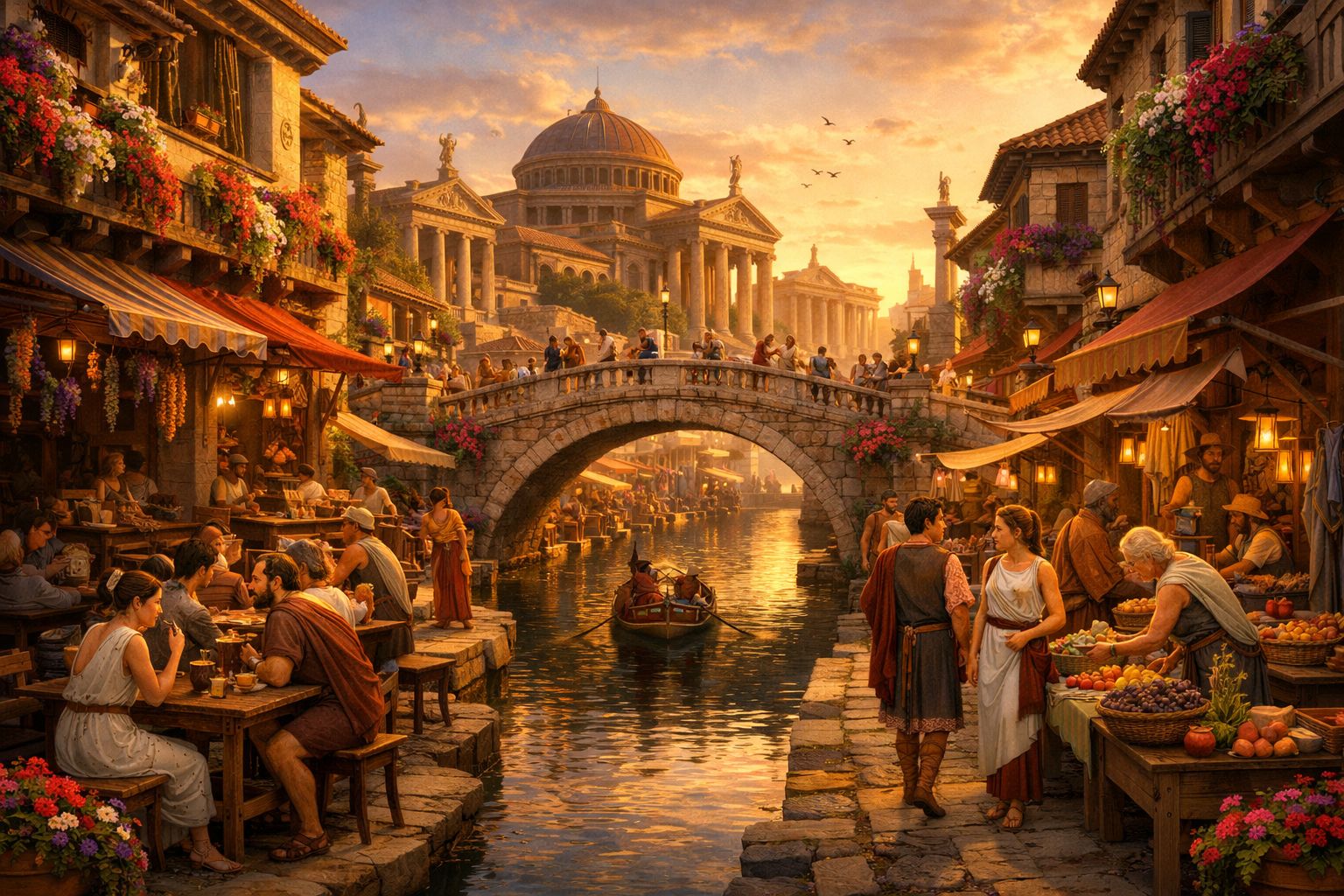
| Luminara rose around them in pale marble and white bridges, a city built to be admired. Flowering vines spilled over balconies. Bells rang softly from distant temples. The air smelled of citrus, salt and fresh bread. Gondola like boats drifted past with lazy grace, their poles dipping soundlessly into green water. |
| Cassandra laughed once, low and surprised. |
| "I did not expect this," she said. |
| Yasmira turned slowly in place, taking in the arc of a bridge, the columns of a temple, the painted shutters opening above them. "It is beautiful," she said. "They knew how to build beauty once." |
| Mbaru said nothing. He watched the crowds instead. Merchants in bright robes. Priests in white and gold. Citizens with plaques and tattoos marking status. He noted how the guards stood at every crossing, how their hands never strayed far from their swords. |
| They walked along the canal toward the market quarter, enjoying the warmth, the colors, the sound of music drifting from open windows. For a while it was easy to forget what kind of city this was. |
| Then the smells changed. |
| They turned a corner and found the slave market without meaning to. |
| On one side of the square cattle stood in wooden pens, lowing softly, tagged and prodded by traders. On the other side stood people. |
| Men and women on low platforms, naked or half clothed, skin oiled to shine. Plaques hung from their necks listing age, origin, skills. A boy no older than twelve stared at the stones with empty eyes while a buyer lifted his chin and looked into his mouth. |
| Yasmira stopped walking. |
| Cassandra’s hands curled into fists. |
| Mbaru took a slow breath through his nose. |
| A trader laughed as a man bargained loudly over a woman with scars on her back. Somewhere nearby a bell rang to announce a new lot. |
| "Let us go," Yasmira said quietly. |
| They moved on, but the street narrowed and worsened. |
| A heavy cart blocked an intersection ahead, piled high with stone. Four slaves strained at the harness, shoulders raw and bleeding. A legionnaire walked beside them, striking with the flat of a staff whenever one faltered. The blows landed without anger, without hurry, as if correcting an animal. |
| Cassandra turned away, jaw tight. |
| Further along a shout rose behind them. A man was dragged from a doorway by two soldiers, hands bound, mouth bloodied. Someone in the crowd threw a peel at the soldiers. Someone else booed. A woman spat and shouted that traitors deserved worse. |
| The man tried to speak. A fist ended the attempt. |
| They did not stop. |
| At the next square music spilled from a tavern, bright and inviting. Painted signs promised wine and dice and warmth. Through an open door they saw serving girls in thin silk, collars at their throats, smiling too carefully. A painted matron leaned close to a merchant and murmured about private rooms and special attention. |
| Cassandra stared at the floor. |
| Yasmira’s voice was very calm. "I think I have seen enough." |
| Mbaru nodded once. "Yes." |
| They turned back toward the harbor without arguing, walking faster now, no longer looking up at bridges or balconies. The bells still rang. The flowers still bloomed. The canals still shone. |
| None of it mattered anymore. |
| When the Blue Marlin came into view Cassandra finally spoke. |
| "Next time," she said quietly, "we stay on the ship." Neither Yasmira nor Mbaru disagreed. |
| They climbed the gangplank and left the jewel of the Empire behind them, glad to return to wood and rope and honest salt air. |
| Along the quay, slaves moved under the weight of cargo, backs bent, feet slipping on wet stone as crates and amphorae passed from hand to hand. |
Purpose of the Arrival Scene
The first arrival in Luminara is about contrast, not exposition. The city should present itself as beautiful, welcoming and civilized before the rot becomes visible. The goal is not to explain the Empire, but to let the players feel the contradiction between surface splendor and underlying cruelty.
Do not rush this. Let sensory detail and small moments do the work. Avoid speeches or explanations. Trust the city to indict itself.
Initial Tone and Description
Introduce Luminara as the Empire’s jewel on the water. Marble bridges, canals, temples, flowers and warm air. Emphasize ease and confidence. This is a city that believes in itself.
Let the crew react naturally. Curiosity, admiration, relief at solid ground. Let them enjoy it briefly.
Then shift gently. Smells change. Crowds behave differently. Authority becomes visible. Slavery appears not as spectacle, but as routine.
Key First Impressions to Seed
Slavery is everywhere and unremarked. Not hidden. Not whispered. It exists alongside trade, beauty and leisure.
Authority is present and tense. Legionnaires are visible, alert and ready to intervene. The city is not relaxed.
The population is divided. Some cheer the legion. Some jeer. Most watch carefully and keep their opinions hidden.
Handling the Crew’s Dispersal
After the initial walk through the city, allow the crew to disperse naturally.
Do not force plot hooks immediately. Let characters pursue errands that make sense to them. Supplies. Contacts. Curiosity. Old habits.
This dispersal is intentional. It allows the arc’s pressure to build organically as individual threads begin to tighten around different characters.
Use the arrival vignette as emotional groundwork. Once the players understand the city’s tone, the later crises will feel inevitable rather than arbitrary.
Parallel Structure and Timing
This arc is not meant to be handled one problem at a time.
The different threads in Luminara are designed to unfold in parallel. Events should continue to move even when the crew is focused elsewhere. Delays matter. Solving one situation may worsen another. Some opportunities will close if ignored.
Do not wait for one thread to fully resolve before advancing the others. Let news travel. Let consequences surface off screen. Let the city keep moving.
The intent is to create pressure through simultaneity. The crew is not failing because they cannot do everything. They are being forced to choose what matters most, knowing something else will be left unattended.
Game Master Notes
Do not over explain the state of the Empire. Let contradictions and cruelty speak for themselves.
Avoid turning the first arrival into a checklist of horrors. One or two clear moments are enough.
If players choose to retreat quickly, that is fine. Luminara is not meant to welcome them yet. The city will demand attention soon enough.
Above all, let the city be confident in its ugliness. Luminara does not hide what it is. It assumes no one with power needs to care.
Amaxia's Arc
| Story |
|---|
| They had not planned to go that way. |
| Amaxia walked with long, deliberate strides, Nera half a step behind, head turning constantly as she tried to take everything in at once. The streets here were narrower, the buildings closer together, balconies almost touching overhead. Silk banners hung from windows. Laughter drifted down, too loud, too practiced. |
| Nera was talking about glasswork she had seen in a shop window, something with moving parts, her hands already sketching shapes in the air. |
| Amaxia stopped. |
| Her body went rigid, as if struck. |
| The building stood across the street, three stories of polished stone and carved shutters. Bright lanterns hung by the door even in daylight. Music pulsed softly from within, slow and inviting. |
| She had only seen it once before, in darkness, running for her life. But recognition slammed into her all the same. The proportions. The doorway. The smell that leaked out when the door opened. The memory of the basement. |
| Nera followed her gaze and frowned. "What is it?" |
| The door opened. |
| A man stepped inside, laughing as he adjusted his cloak. Well fed. Well groomed. Comfortable. |
| Amaxia’s breath caught. |
| The Laugher. |
| That was what she had named him in her head. Not because he was funny, but because he laughed while others screamed. When she screamed. She remembered the sound of it more clearly than his face. Now she had both. |
| Her vision narrowed. |
| She did not answer Nera. She did not warn her. She crossed the street in three strides and shoved the door open hard enough that it banged against the wall. |
| The music faltered. |
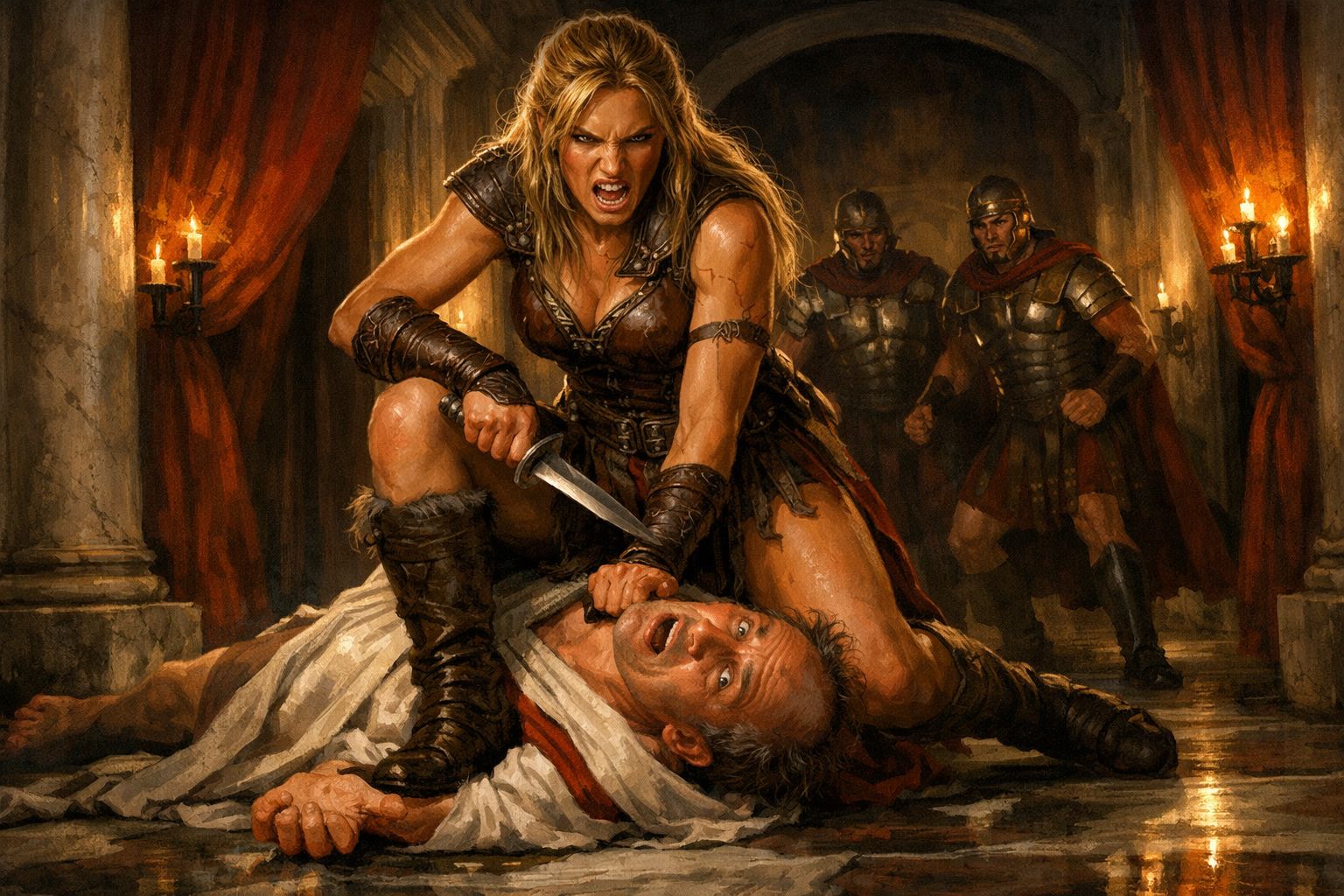
| The man turned, surprise barely registering before Amaxia’s hand closed on his collar. She hauled him back and drove him into the floor with bone jarring force. The air rushed out of him in a wet gasp. |
| She planted her foot hard between his legs and leaned down until he could see her face, her dagger at his throat. |
| His mouth opened. No sound came out. |
| Around them, chairs scraped back. Someone shouted. |
| She barely heard it. |
| Hands grabbed her shoulders. More than one. More than two. Legion armor flashed in her peripheral vision. Someone struck her across the temple. The room spun. She fought anyway, pure reflex, muscle and fury, but there were too many of them and she was alone. |
| The last thing she saw was The Laugher curled on the floor, as iron closed around her wrists. "I'll get you!" he growled, "I'll get you again!" |
| Outside, Nera stood frozen for half a heartbeat. |
| Then she ran. |
| She ran flat out through the streets, skirts hitched up, breath burning in her chest. She shoved past carts and citizens and priests who shouted after her. She did not stop until the harbor opened up before her and the Blue Marlin’s familiar lines cut through the crowd. |
| She did not slow as she hit the gangplank. |
| "Amaxia," she gasped. "They took Amaxia." |
Purpose of this Arc
Amaxia’s arc is about rage colliding with law.
Her capture is not a mistake or bad luck. It is the system working exactly as intended. The story already establishes how and why she is taken. Do not linger on it. The emotional weight should come from what happens next and how little protection the law offers her.
Current Situation
After her attack on The Laugher, Amaxia is restrained by legionnaires and returned to the brothel as legal property.
She is chained in the basement holding area. This is the same place she was kept before.
Unless the crew acts quickly, she will be sold for abuse again. The establishment intends to keep her secured overnight and prepare her customers to use the following day.
Time matters in this thread.
What the Law Says
The brothel is legally protected.
They have ownership papers. They have witnesses. They have legion customers who will confirm events in whatever way is convenient.
Any attempt to involve magistrates, guards or civic authorities will fail. At best it results in delay. At worst it exposes the crew.
The law recognizes Amaxia as property and treats her resistance as a crime.
Rescue Timing and Constraints
A rescue during the day is effectively impossible.
The streets are crowded. The brothel is busy. Guards are alert. Too many eyes.
The establishment operates late into the night. As hours pass, customers become intoxicated and activity slows down.
Late night is the intended window.
Brothel Security Overview
There are always customers present. Assume at least two legionnaires inside at any given time.
If the Game Master wants to reduce difficulty, these legionnaires can be mid session, undressed, distracted or separated from armor and weapons.
The brothel employs two in house guards. They are street thugs, not soldiers. They are unarmed or lightly armed. Their role is intimidation and debt extraction, not real defense.
They will not fight to the death. They will flee if overwhelmed.
Approaches to Rescue
- Subterfuge is possible but difficult.
- The brothel is active and crowded. Sneaking in unnoticed is unlikely.
- Posing as a customer can provide entry but not an exit. Once inside, movement is limited and watched.
- Involving money, bribes or paperwork can buy moments, not freedom.
- A frontal assault is the most reliable option. A fast hit and run late at night can work if the crew commits fully and withdraws quickly.
If the crew comes up with another viable solution, reward it.
The goal is extraction, not punishment. Lingering increases risk of legion response.
Scouting Opportunities
There is a tavern across the street from the brothel.
It functions as a bar and meeting place. From there the crew can observe patterns, customer flow and guard behavior without drawing attention.
This is the best place to plan timing and entry.
Consequences and Stakes
If Amaxia is rescued the first night, nothing irreversible has happened yet beyond restraint and confinement.
If the rescue is delayed, her condition worsens quickly. Physical and psychological harm should escalate in ways that matter.
| Story |
|---|
| The cabin was quiet except for the creak of the hull and the soft slap of water against the Blue Marlin’s side. |
| Amaxia stood near the table, shoulders squared, jaw set. Junia lingered close, one hand resting lightly at Amaxia’s back, as if steadying her. Scarnax faced them, arms crossed, eyes tired in the way they only became after violence had come aboard his ship. |
| “I should not have gone in alone,” Amaxia said. Her voice was flat, controlled. “That was my fault.” |
| Scarnax held her gaze. “You saw something that mattered,” he replied. “You acted. I understand why. Just do not do it again.” |
| She nodded once, accepting that much. Then the control cracked. |
| “It cannot stay standing,” she said. “That place. The brothel. And him. The Laugher. He has to die.” |
| Scarnax exhaled slowly. “I hear you,” he said. “But this city is full of guards and laws that cut the wrong way. We hit them again, we risk the ship, the crew, everything.” |
| Amaxia’s hands trembled. Frustration burned through her restraint. |
| Without warning she reached down and pulled her tunic loose, letting it fall to her waist. Junia inhaled sharply but did not stop her. |
| Amaxia pointed to the scars. Small, ugly marks on either side of each breast, pale and twisted. |
| “He put a metal rod through here,” she said. “Straight through. Used it as a handle while he raped me. He laughed the whole time. That was not the worst thing he did.” |
| The words were blunt. Unadorned. They landed like blows. |
| Scarnax stared. His face drained of color. For a moment he could not speak. |
| Junia stepped forward. Her voice was steady but tight. “I treated her afterward,” she said. “I treated her other times as well. Worse injuries. Things that do not heal cleanly.” |
| Amaxia pulled the tunic back up but did not soften. “There are still women in there,” she said. “Still chained. Still being used. He is still a regular.” |
| Silence stretched between them, heavy and final. |
| Scarnax’s jaw set. He gave a sharp nod. “All right,” he said. “We end it. But not like before. No one runs ahead. No lone wolves. We do this together, as a crew.” |
| Amaxia stepped forward and took his hand in both of hers. Her grip was strong, steady, grateful. |
| “Together,” she said. |
| Scarnax returned the grip, just as firmly. |
Intent and Timing
This phase of Amaxia’s arc is deliberately not urgent. Compared to the immediate danger facing Junia or Skarnulf, this situation can wait days, and in many cases it works better if it does. Let the city cool down. Let patrol patterns relax. Let attention drift to other unrest. This is not a desperate rescue but a deliberate act of judgment and retribution. Encourage planning, scouting and coordination rather than impulse.
Tracking The Laugher
The Laugher is a creature of habit and comfort. He visits the brothel almost every evening around sunset, arriving openly and leaving unhurried. Shadowing him is easy in the crowd as long as the person doing it does not stand out as foreign or threatening. Amaxia is a poor choice for this. Someone more anonymous will have little trouble following him back to his home.
He lives in a better suburb, with clean stone streets and bored guards who assume nothing ever goes wrong here. He works as a scribe in the city administration, a position that gives him confidence rather than real power. At his home lives a young slave girl who keeps the household. She shows signs of abuse and lives in constant fear. She understands the system well enough to know that if her owner dies, suspicion will fall on her first, and survival will depend entirely on who controls the narrative afterward.
Confronting and Killing The Laugher
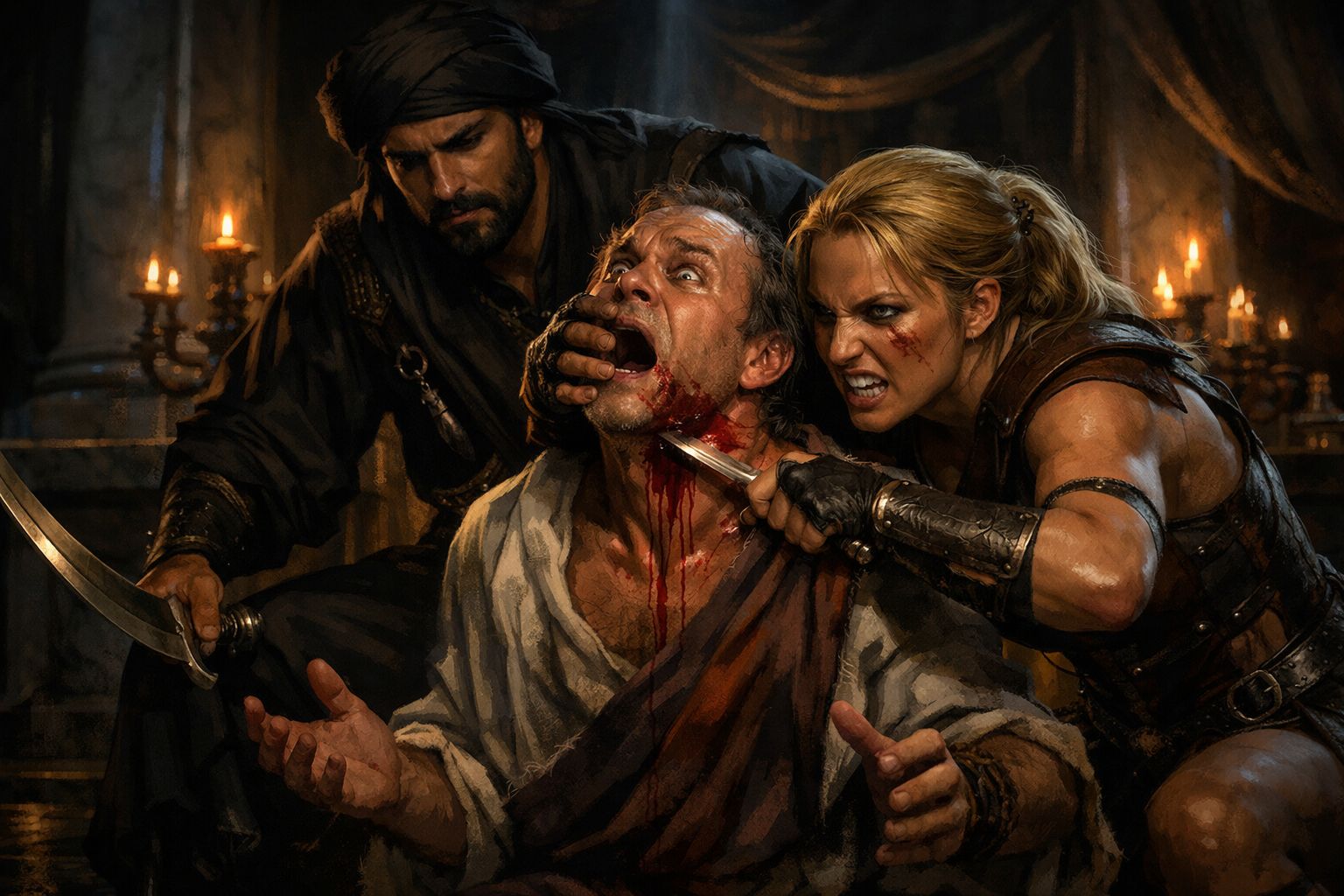
If confronted while outmatched, The Laugher will surrender. He will beg, plead and attempt to bargain with information, money or claims of influence. Amaxia will not accept surrender. This should not be framed as a moral debate or a negotiation scene. The tension here comes from managing the situation around her rather than questioning her resolve.
Having a calmer companion present is strongly advised, not to restrain Amaxia, but to handle practical concerns. Witnesses, noise, timing, escape routes and the slave girl all require attention. The killing itself should be quick and final, not theatrical.
The Slave Girl at the House
The slave girl will be terrified and compliant. She knows that the death of her owner puts her in immediate danger. At best she will be seized and resold. At worst she will be accused of involvement and executed in the arena. Leaving her behind is not a neutral choice. Whatever the crew does next, she becomes part of the problem they now carry with them.
The Brothel Itself
The brothel can be dealt with separately from The Laugher, and often should be. Scouting reveals that once it closes for the night, only a small staff remains. The madam, her husband and one bouncer. They are not fighters. Their power comes from legality, intimidation and the assumption that no one will challenge them. From their viewpoint, they are just a service establishment, not that different from a tavern or a merchant.
Amaxia does not know how the slaves are secured. She was chained in the basement and never saw the others. Junia knows more. The slaves are locked in or chained, sometimes both. Some restraints have keys, others do not. Someone capable of opening locks, by skill or by force, is required. Enough brute force to handle the remaining staff is necessary, but combat should be brief and contained. The real difficulty is not the takedown, but what follows.
Extracting the Slaves
Once the brothel is breached, the situation expands rapidly. A dozen slave girls, a couple of slave boys, and the slave girl from The Laugher’s house all need to be moved. Simply releasing them into the city guarantees recapture and punishment. Their position would be worse than before.
Discreet transport is essential. A covered cart, disguises, false paperwork or a combination of these may work. The Blue Marlin can remove them from Luminara, but that only relocates the problem rather than solving it.
The Unavoidable Problem
Afterward, the crew has people, not answers. They have freed slaves with nowhere safe to go. Returning them to the Empire is not an option. Keeping them aboard indefinitely is unsustainable. Finding a place that will not betray, resell or exploit them is extremely difficult.
This is intentional. Destroying the brothel and killing The Laugher resolves a specific evil. It does not fix the system that created it. The weight of that reality should linger. This part of the arc is not about clean victory. It is about choosing to act anyway, and then living with what that action demands next.
Junia's Arc
| Story |
|---|
| Junia liked the herb quarter. It was one of the few places in the city where the Empire felt almost quiet. |
| Stalls crowded the narrow street, baskets of dried leaves and bundled roots stacked high, the air thick with sharp, clean scents. Junia moved slowly from table to table, asking careful questions, fingers brushing leaves, noting color and smell. Yasmira followed at her side, far less restrained, already deep in conversation with a merchant about spices that would survive a long voyage without losing their bite. |
| They stopped at a shop set back from the street, half herbalist, half apothecary. Shelves lined the walls inside, jars labeled in careful script. Junia stepped closer to inspect a bundle of pale blue flowers. |
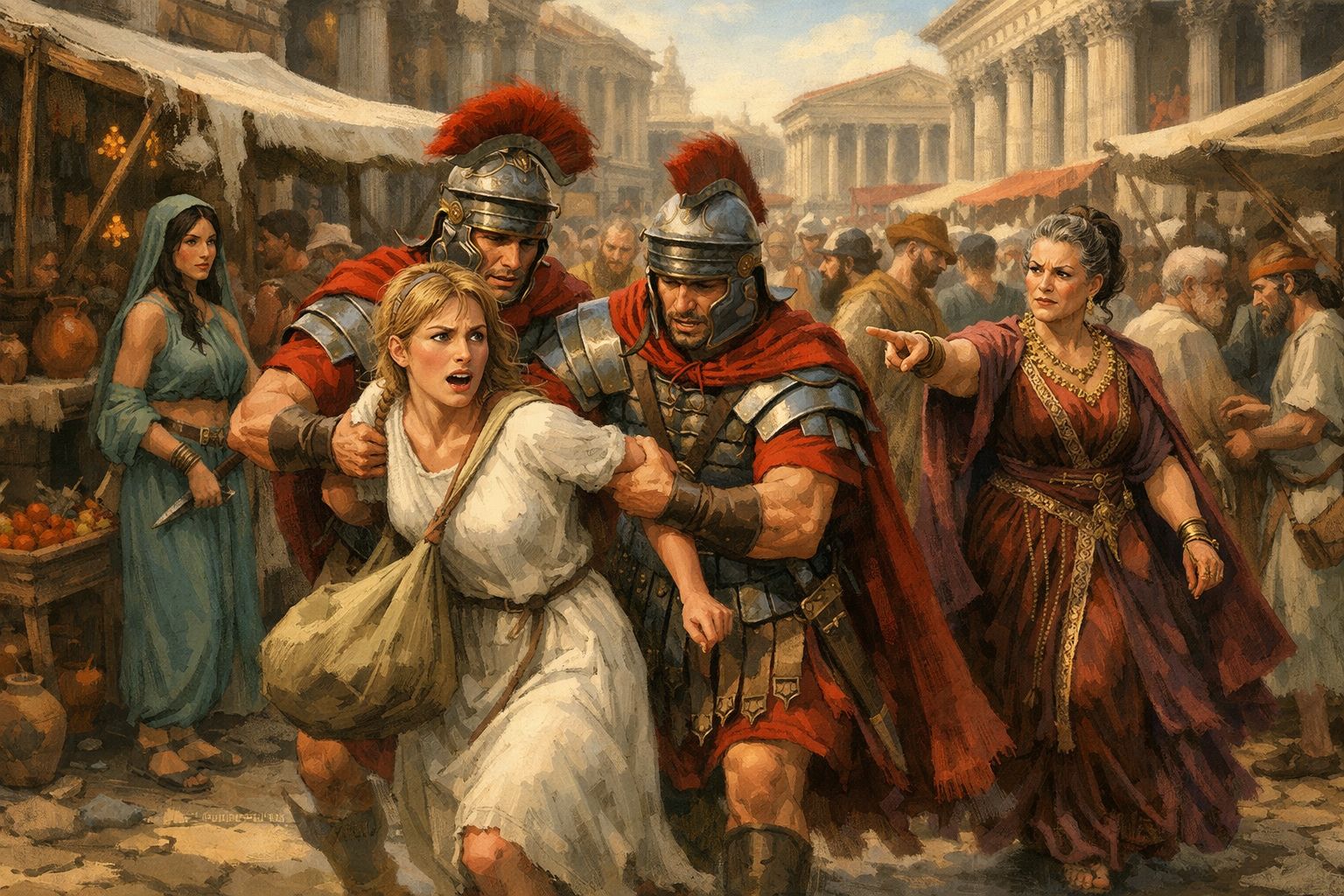
| A hand seized her arm. |
| She was spun around hard enough that the room blurred. |
| The woman gripping her was tall and severe, her hair streaked with gray and bound tight against her scalp. Her robes were clean and expensive, marked with the sigils of a licensed healer. |
| Her eyes widened, then sharpened. |
| “You,” the woman barked. “You owe me a decade. Guards. Guards!” |
| The words were barely out before two legionnaires stepped in from the street, drawn by the shout. One grabbed Junia’s other arm. The second moved behind her, already reaching for restraints. |
| Junia’s mouth opened. No sound came out. |
| Yasmira froze for the briefest instant, then stepped back, slipping into the crowd as if she had never been there at all. |
| The woman did not look at her. All her attention was on Junia. |
| “Thief,” she said loudly. “Runaway.” |
| Junia was dragged into the street, her feet barely touching the ground. |
| Inside the shop, Yasmira waited until the noise faded. Then she turned back to the shopkeeper, her expression calm. |
| “Who was that?” she asked. |
| The shopkeeper hesitated, then leaned closer. “Domina Valeria Morn,” he said. “A respected healer. Lives on the eastern rise. You’ve heard of her work, surely. The new treatments. Groundbreaking work. People come from all over the city.” |
| Yasmira nodded, thanked him, and left. |
| --- |
| Junia was marched through the streets and into a civic hall that smelled of ink and dust. The magistrate barely looked up as Valeria Morn placed a folded contract on his desk. |
| He scanned it, lips moving silently. |
| “This is valid,” he said at last. “You owed ten years of service at the time of flight. For attempting to evade lawful obligation, an additional ten years are added.” |
| Junia found her voice. “I was forced to do harm,” she said. “What she...” |
| Valeria struck her across the face, hard enough to snap her head to the side. |
| “She lies,” Valeria said coolly. “She will be kept in chains from now on. You will not be troubled again.” |
| The magistrate waved a hand, already bored. “See that you are.” |
| Junia was pulled away. |
| --- |
| Yasmira did not stop running until the harbor opened before her and the Blue Marlin came into view. She took the gangplank two steps at a time. |
| Scarnax was on deck. She did not waste words. |
| “They took Junia,” she said. “A healer named Valeria Morn. Contract.” |
| Scarnax’s eyes hardened. “You did right,” he said. “You kept your head.” |
| He turned and raised his voice. “Nasheem. Get everyone.” |
| The crew began to gather. |
| “We’re getting her back.” |
Purpose of this Arc
Junia’s arc is about lawful cruelty rather than overt violence. Unlike Amaxia, she is not treated as property, but the difference is technical, not humane. The system closes around her quietly and correctly, and that is what makes this situation dangerous.
This arc should emphasize how little room the law leaves for mercy once a contract is acknowledged.
Junia’s Legal Status
Junia is not a slave. She is an indentured apprentice under a binding contract held by Domina Valeria Morn.
In practice, the difference is narrow. Junia cannot be sold and cannot be legally killed. The contract is time limited rather than permanent. Aside from that, her lack of freedom is nearly identical. She can be confined, restrained, punished and compelled to work.
The contract is valid. The magistrate has confirmed it. No legal appeal is realistically possible in Luminara. Ayesha will know this.
Valeria Morn
Valeria Morn is a respected imperial healer in her late forties. She is licensed, wealthy and well connected. Her recent success comes from what the public calls groundbreaking work, treatments that have earned her prestige and protection.
Privately, these advances were achieved through experimentation on slaves. This is not illegal. It is merely unspoken.
Valeria is not a fighter. She has no bodyguards. Her protection comes from law, reputation and speed in raising alarms.
Constraints on Solutions
The contract holds. Any solution must work around that fact rather than through it.
Appealing to magistrates, priests or guild authorities will fail. The paperwork is clean. Junia’s attempt to explain herself is legally irrelevant.
Possible Approaches
Buying Out the Contract
Paying Valeria to release Junia is possible.
The price is effectively the value of twenty years of skilled labor. It will already be high. Any attempt to buy out the contract signals urgency and attachment. Valeria will exploit that knowledge and demand far more than the contract’s nominal value. She is a shrewd businesswoman and understands leverage.
This option drains resources and reinforces the system even as it frees Junia.
Violence
Violence is simple, but not uncomplicated.
Valeria has no guards and will not resist physically. If confronted, she will surrender immediately.
If given any opportunity, she will raise the alarm. Guards will respond quickly in her district.
Killing her ends the contract but escalates consequences dramatically. Assaulting her and extracting Junia creates immediate pursuit and longer term attention.
Stealth Extraction
Stealth is viable but temporary.
Valeria is wealthy and lives in a large house. Junia will be restrained but not heavily guarded. A skilled scout can enter, remove Junia from chains and extract her without immediate confrontation.
By morning, Valeria will raise the alarm. Junia will be declared a runaway under contract, and attention will follow.
This option trades speed for time and shifts pressure forward rather than resolving it.
What This Thread Is About
This arc is not about finding the clean solution. There is none.
Every option costs something. Coin, blood, exposure or future danger.
The point is to show that even when someone is not a slave, that they can still be owned completely through law. Junia’s rescue should feel like defiance, not vindication, and whatever choice the crew makes should leave consequences that follow them forward.
| Story |
|---|
| The cabin felt smaller than usual, crowded with bodies and the weight of what had just been done. |
| Junia sat on the edge of a bench, hands folded tightly in her lap. Her face was pale but steady, the way it became when she spoke of things she wished were not true. Around her the crew listened in silence. Even the ship seemed to hold its breath. |
| “She kept records,” Junia said. “Careful ones.” |
| Scarnax leaned against the bulkhead, arms crossed. Amaxia stood nearby, unmoving. Cassandra hovered close to the door, as if already considering escape. |
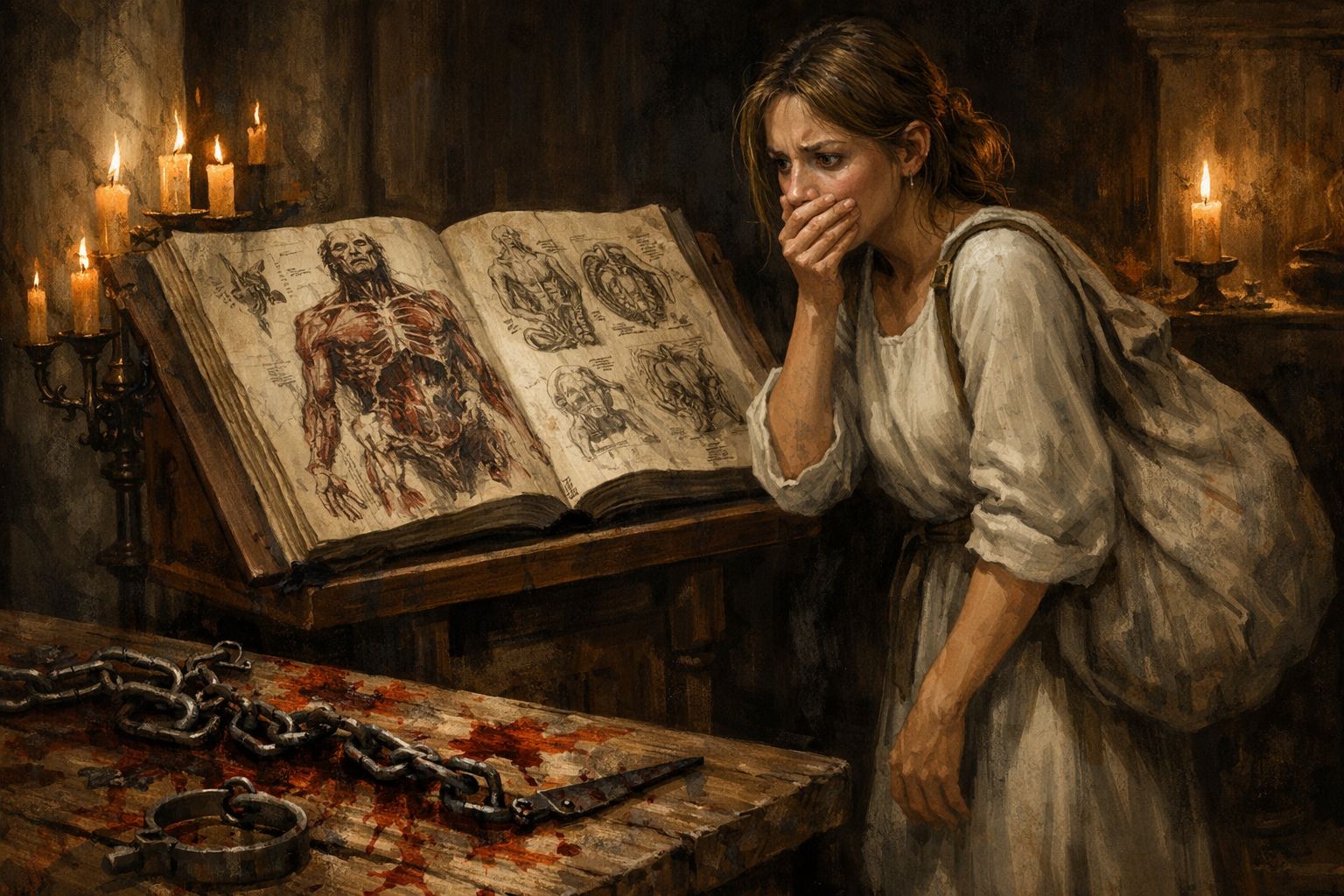
| “Not journals,” Junia continued. “Not reflections. Not doubts. Notebooks. Page after page. Drawings. Measurements. Notes written while the blood was still warm.” |
| Someone swore softly. |
| “She would cut them open while they were alive,” Junia said. “Slaves. She said pain altered the body’s responses, so it had to be real pain. She would expose organs and inject herbal compounds directly into them. Roots. Resins. Distillates. Then she would watch. Write down what failed first. How long it took.” |
| A murmur rippled through the room. Horror, disbelief, rage. |
| “There were many books,” Junia said. “Stacks of them. Years of work.” |
| Cassandra made a small sound that might have been a breath or a sob. She turned and left the cabin without a word. A moment later Ormun followed, ducking through the doorway, his face tight with worry. |
| Junia swallowed. “This is why people praise her. This is how she made her name.” |
| Silence followed. Heavy. Unforgiving. |
| “We cannot allow her to keep doing this,” Junia said. There was no plea in her voice. Just certainty. |
| Scarnax looked around the cabin. He met eyes one by one. What he saw there needed no argument. He gave a short nod. |
| “Agreed,” he said. |
| Ileena tilted her head, ears flicking slightly. “When we are done,” she asked, very casually, “can I have her heart?” |
| Scarnax closed his eyes for a moment. Then he sighed and shrugged. |
| “Fine,” he said. |
Stopping Valeria
This section assumes Junia has already been recovered, but depending on how the rescue unfolded, this may already have been taken care of.
Valeria already know Junia is gone. She will have raised an alarm about an escaped apprentice. She believes the matter finished and has returned to her work. Adjust details accordingly, but the core situation remains the same. Valeria is not expecting retaliation. She believes the system has already corrected itself.
Valeria’s Mindset
In Valeria’s view, Junia’s escape is an inconvenience, not a threat.
She assumes the law will handle the matter eventually. She does not expect violence. She does not expect witnesses to act. She does not expect anyone to come for her.
This overconfidence is her greatest weakness.
Urgency and Pressure
Speed matters.
Legally, Junia is now an escaped apprentice under contract. That status will draw attention. Guards will eventually come to the ship to ask questions. They will be polite at first. Then persistent.
This creates a limited window. The crew can act before scrutiny tightens, or they can wait and accept higher risk.
Confronting Valeria
Stopping Valeria is practically simple.
She is not a fighter. She has no guards. She does not live in a fortified home. Even if she has reported Junia missing, she is not prepared for an attack.
If confronted directly, she will attempt to talk. She will argue legality. She may threaten future consequences. None of this is backed by immediate force.
If given opportunity, she will raise the alarm.
The Notebooks
Junia will insist on retrieving Valeria’s notebooks.
They are extensive. Years of records. Detailed descriptions of live dissections, organ exposure and direct injections of herbal compounds. This knowledge is the source of Valeria’s reputation.
Junia does not want Valeria remembered as a great healer. She wants her forgotten. At the same time, she refuses to let the suffering that created that knowledge be meaningless.
Junia intends to use what she learned to heal rather than harm. This is non negotiable for her.
Aftermath and Delay
If Valeria is killed quietly and her absence is not immediately noticed, several days will pass before concern turns into investigation. She is wealthy and reclusive. Missed appointments are not unusual.
This delay gives the crew space. Time to leave the city. Time to put distance between themselves and the consequences.
What This Section Is About
This is not a boss fight.
It is an execution of a system enabler who believed herself untouchable. The tension comes from timing, discretion and the weight of what is being ended.
Stopping Valeria closes Junia’s immediate wound, but it also deepens the crew’s conflict with the Empire. Once again, they choose action over legality, knowing the law will never be on their side.
Skarnulf's Arc
| Story |
|---|
| The cabin smelled of tarred wood and old salt, familiar and steady. The Blue Marlin creaked softly around them, the sound of a ship at rest but never truly still. |
| Skarnulf stood near the table, hands resting on the edge as if he needed the support. He did not sit. Scarnax watched him quietly from behind the desk, waiting. |
| “This is not an easy story,” Skarnulf said at last. |
| Scarnax did not interrupt. |
| “You know I fought in the arenas,” Skarnulf continued. “As a slave. As Ursulus. You know what that means.” |
| Scarnax nodded once. His face did not change, but his eyes did. He knew. |
| “There was more than fighting,” Skarnulf said. His voice roughened, and for a moment he stared at the wall as if gathering strength. “There were executions,” Skarnulf continued. “Public ones.” He swallowed. “The crowd never wanted it to end.” |
| Scarnax exhaled slowly. “I know.” |
| “I told myself I had no choice,” Skarnulf said. “That it was them or me. I still tell myself that. But it does not stop the nights. I lie awake and think about what I might have done differently. What courage would have cost.” |
| Scarnax leaned back, folding his arms. “I have worn chains,” he said quietly. “I know what the word choice means in that place.” |
| Skarnulf nodded, grateful for that much. |
| “My owner was named Lucius Marcellan,” he went on. “Rich beyond reason. He kept a household full of slaves. Among them was a man and a woman. Good people. They had two daughters. Bright girls. Clever. They were afraid for them.” |
| Skarnulf swallowed. |
| “They tried to run. All four of them. They were caught before they reached the city gates.” |
| He closed his eyes for a heartbeat. |
| “I was ordered to execute the parents in the arena. In front of the crowd. They were my friends. I could not refuse. For as long as they could still speak, they begged me to save their daughters. Not themselves. The girls.” |
| His voice broke then, just slightly. |
| “I did it anyway.” |
| Silence filled the cabin, thick and heavy. |
| “Not long after that,” Skarnulf said, “I was sold to the crime lord. Things moved fast. I survived. I told myself survival was enough.” |
| He looked up at Scarnax then. |
| “Today I passed the slave market.” |
| Scarnax straightened. |
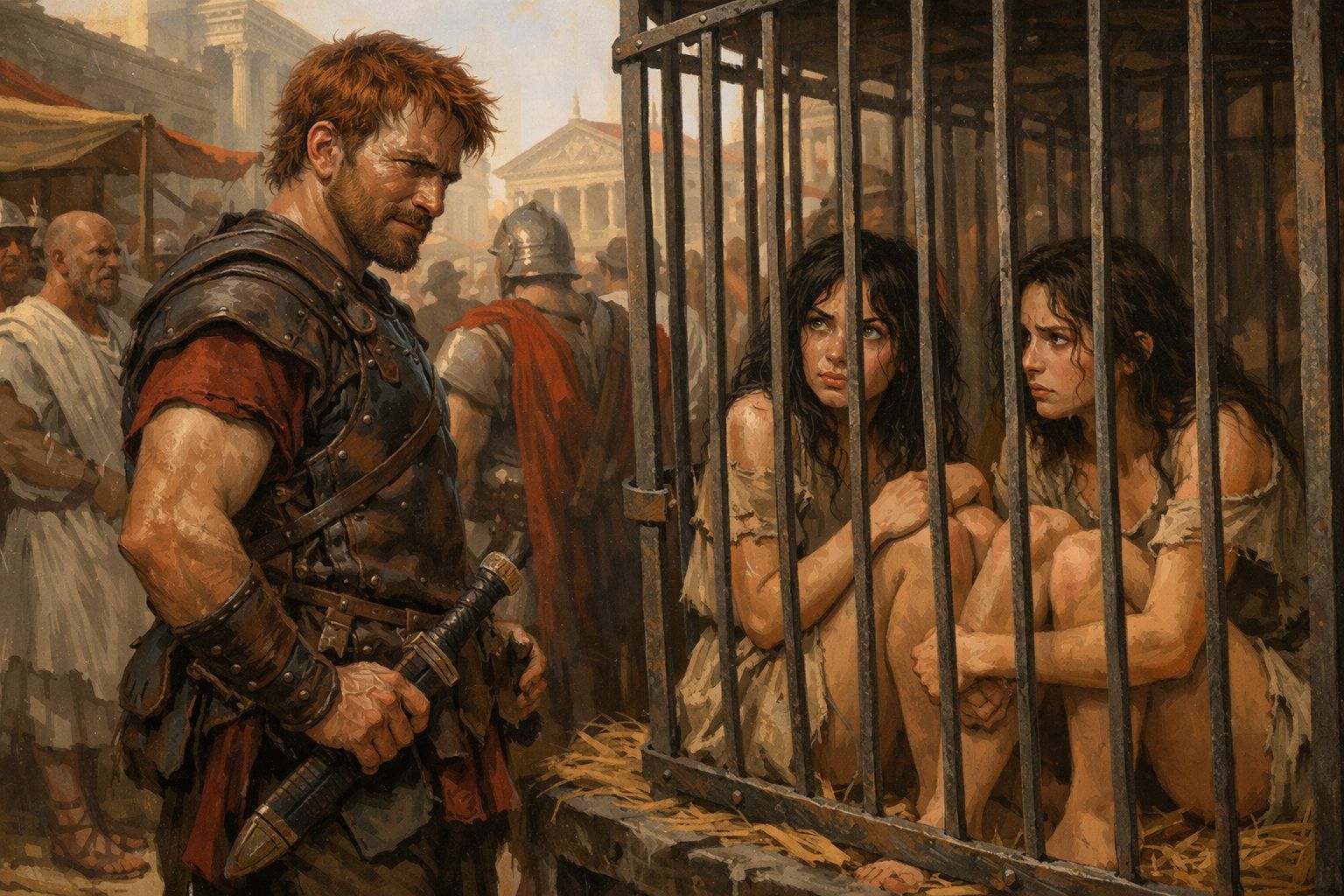
| “In cages,” Skarnulf said. “Displayed like livestock. The daughters. Both of them. The older one is eighteen now. The younger fifteen.” |
| He did not need to explain further. He did not need to describe what waited for them. |
| “I owe them,” Skarnulf said. “I owe their parents. I owe myself. I cannot let them remain slaves.” |
| Scarnax studied him for a long moment. Then he nodded. |
| “We will find a way,” he said. |
Purpose of this Arc
This arc is structured differently from the others. Unlike Amaxia’s and Junia’s situations, this problem appears to have a clean, lawful solution at first glance. That apparent simplicity is intentional. It creates a contrast that allows the crew to feel the weight of choice rather than the pressure of inevitability.
The two slave girls Skarnulf has recognized are named Livina and Cassia. Livina is eighteen, sharp eyed and guarded, already old enough to understand exactly what the market will do to her. Cassia is fifteen, quieter, clinging to her sister whenever handlers allow it. Both are healthy, unmarked and visibly frightened, which makes them valuable.
They are being held overnight in cages in a warehouse near the slave market and will be auctioned the following day.
The Obvious Solution
The most straightforward option is to attend the auction and outbid the competition.
This will work. The Empire recognizes coin more readily than justice, and a properly executed purchase would draw no immediate suspicion. Ownership would transfer cleanly, and the girls could be removed without resistance.
The cost, however, will be high. Two attractive, healthy young girls will draw interest from brothels, private collectors and wealthy nobles looking for prestige playthings. The Blue Marlin can afford it, but not comfortably. It will be a noticeable drain on resources, and more importantly, the money will ultimately flow back to Lucius Marcellan, Skarnulf’s former owner. That knowledge matters to Skarnulf, and likely to others aboard. This option solves the problem cleanly, but at a moral and emotional cost that should not be minimized.
The Rescue Option
The alternative is a direct rescue before the auction.
The warehouse is functional rather than fortified. Two guards are stationed just inside the entrance, there to discourage trouble rather than repel a serious attack. A small, decisive strike can overwhelm them quickly. Mechanically, the raid is well within the crew’s capabilities.
The complication is scale and noise. Livina and Cassia are not alone. Dozens of slaves are held in the same space, and when violence breaks out, they will understand what is happening. They will beg for rescue. Some will shout. Panic will spread. What begins as a focused extraction can rapidly turn into a loud, chaotic event. The crew is likely planning for a quiet, focused rescue. The presence and reaction of the other slaves undermines that assumption almost immediately.
This matters because the city is already on edge. Civil unrest has increased patrols and shortened response times. A disturbance near the slave market is likely to draw guards quickly. In addition, the crew is already stretched thin. Other operations are planned or underway the same night, and there is limited manpower to spare.
This is not a question of whether the raid can succeed, but whether it can remain contained long enough to avoid escalation.
Extraction and Discretion
Regardless of how the girls are freed, getting them back to the ship without drawing attention is essential.
Livina and Cassia cannot simply be marched through the streets. Disguises, cloaks, false identities or hidden transport will be required. Timing matters. Routes matter. Who accompanies them matters. This is especially true if the rescue option is chosen, as alert levels may rise rapidly.
Handled well, the girls can be aboard the Blue Marlin before the city fully understands what has happened.
What This Thread Is About
On the surface, this is the simplest of the three arcs. Underneath, it is about choice rather than necessity.
Skarnulf is not being forced by circumstance alone. He is choosing how to pay a debt, and what kind of cost he is willing to accept. Coin, blood, risk or compromise. Each solution says something different about who he is now, and about what the crew is becoming together.
Unlike the other arcs, this one offers the illusion of a clean victory. Whether that illusion holds depends entirely on how the players decide to act.
| Story |
|---|
| The cabin was small but clean, lit by a single lantern swaying gently with the motion of the ship. Fresh clothes lay folded on a bench. The smell of herbs lingered in the air, sharp and comforting. Junia had finished her examination and left quietly, giving them privacy without comment. |
| Livina and Cassia sat side by side on the bunk. The borrowed clothes hung a little loose on them, but they were warm, fed and no longer caged. That alone felt unreal. |
| Skarnulf stood just inside the doorway. |
| He did not move further in. His hands hung at his sides, fingers flexing as if he were bracing for a blow that had not yet come. |
| “I… I do not...,” he began. |
| Nothing followed. |
| He drew a breath and tried again. “I know you must hate me.” |
| Livina looked at him for a long moment. Then she shook her head slowly. |
| “We did,” she said. “At first.” |
| Cassia’s hands tightened in her lap. |
| “We were children,” Livina continued. “We saw you kill our parents. That was all we knew. We did not understand what it meant to be a slave. We did not understand choice.” |
| She lifted her chin slightly. “Later, we did. We talked to others in the house. We heard things. We learned that if you had refused, someone else would have done it. And they would have killed you along with them.” |
| Cassia nodded. “People talked about you,” she said quietly. “About how it hurt you. About how you drank after. About how you stopped speaking for a long time.” |
| Skarnulf’s throat worked, but no sound came out. |
| “We do not hate you now,” Cassia said. |
| He tried to speak again. His mouth opened. Nothing came. His shoulders sagged, as if something inside him had finally given way. |
| Livina rose from the bunk and stepped closer. She was still smaller than him, still thin, but there was steadiness in the way she stood. |
| “We are all victims,” she said. “But you got out. And you came back for us.” |
| She met his eyes. “Then you did what you had to. Now you did what you could.” |
| She opened her arms, uncertain but hopeful. “Friends?” |
| Skarnulf’s legs folded beneath him. |
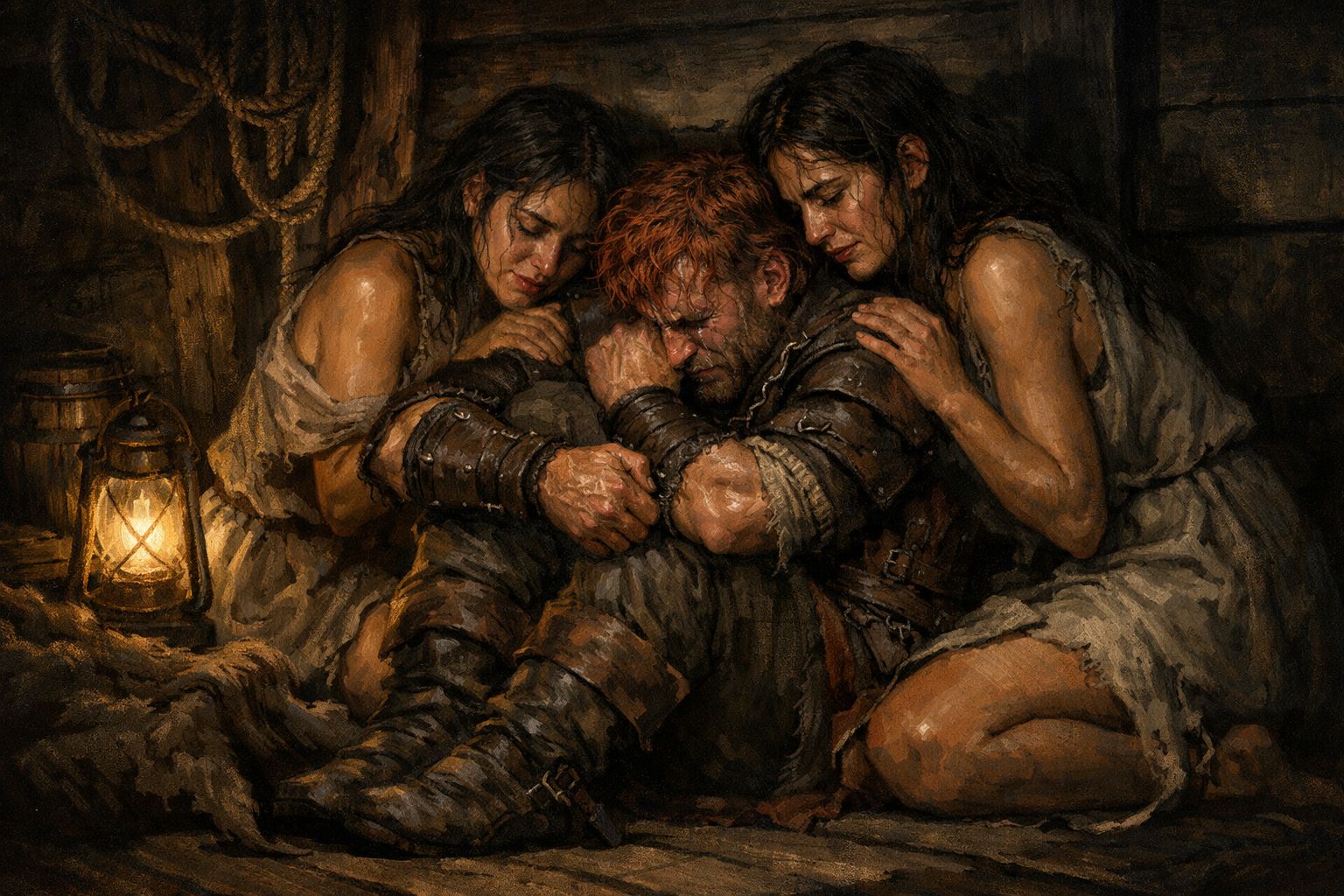
| He sank to the floor like a man struck from behind, hands coming up to cover his face as the sound broke out of him, rough and unguarded. Livina knelt and wrapped her arms around him without hesitation. Cassia followed, pressing in close, her forehead against his shoulder. |
| They cried together, the kind of crying that came from holding something too long and finally letting it fall. |
| After a long while, through tears and broken breath, Skarnulf managed a single word. |
| “Friends.” |
Practical Closure, Not Vengeance
Skarnulf’s arc does not end with revenge.
Although he hates Lucius Marcellan for what he represents and for what he was forced to do under his ownership, Skarnulf is not interested in pursuing him further. As far as Skarnulf is concerned, the debt that mattered has been paid. Livina and Cassia are free. The past has been faced directly rather than avoided. That is enough.
Lucius is not uniquely monstrous within the Empire. He is one of many men who profit from the same system. Killing him would not undo the past and would not meaningfully change the future. Someone else would take his place and the machine would continue. Skarnulf understands this clearly and does not want to drag the crew into an act that would be emotionally hollow and strategically pointless.
This distinction is important. Unlike the figures in Amaxia’s and Junia’s arcs, Lucius is not an active, ongoing threat that must be removed to stop further harm. His crimes are systemic rather than personal at this point. Skarnulf choosing not to pursue him is not mercy, and it is not weakness. It is judgment.
Emotional Breakthrough
What matters here is not what Skarnulf does next, but what he allows himself to feel.
This moment marks the first time since his enslavement that Skarnulf permits himself to be openly vulnerable. He does not bury the past. He does not justify it. He lets it surface, be witnessed, and be answered by those who were most harmed by it.
That matters profoundly for his character. The hardness that kept him alive does not vanish, but it cracks. From this point forward, Skarnulf is more emotionally present. He is still quiet. Still controlled. Still dangerous when needed. But he is no longer sealed off from his own feelings.
For the character, this is a pivot. Skarnulf can now react with empathy rather than distance. He may speak a little more. He may show protectiveness in ways that are gentler rather than purely tactical. He is not transformed into someone else, but he becomes more complete.
Using This Going Forward
Do not turn this into a continuing plot hook unless the players push it there themselves.
This arc is meant to close cleanly. It resolves guilt rather than generating new enemies. If Lucius appears again later, it should be incidental rather than inevitable.
What should carry forward is the change in Skarnulf, not unfinished business. His story here is about release, not escalation.
Sandros Pellaios' Arc
| Story |
|---|
| Sandros Pellaios arrived without ceremony. |
| The Blue Marlin lay quiet at her berth, lines creaking softly as the tide shifted. The deck smelled of salt and tar and recent work. Scarnax was supervising a repair when the familiar, unhurried voice drifted up from the gangplank. |
| “Busy days,” Sandros said pleasantly. |
| Scarnax turned. Sandros stood there as if he belonged, hands folded behind his back, coat immaculate despite the dust and chaos of the harbor. Ayesha had already stepped into place beside the captain, posture relaxed but eyes sharp. |
| “We tend to keep moving,” Scarnax replied. |
| Sandros smiled. “You certainly have. Rescues. Disappearances. A few unfortunate people no longer answering their doors. Luminara is restless, but even for this city, you have made an impression.” |
| Ayesha crossed her arms. “If you are here to threaten us, do it plainly.” |
| Sandros shook his head. “No threat. Just observation.” His gaze flicked briefly toward the hold, where new footsteps and unfamiliar voices could be heard below deck. “You also seem to have acquired a ship full of people who cannot remain here and cannot safely go anywhere obvious.” |
| Scarnax said nothing. He did not need to. |
| “I can solve that problem,” Sandros continued, tone conversational. “Or rather, I can make it solvable.” |
| Ayesha’s eyes narrowed slightly. “For a price.” |
| “For a favor,” Sandros corrected. “A small one.” |
| He stepped closer, lowering his voice more out of habit than necessity. “A separatist agitator was recently captured. Passionate fellow. Wrong place, wrong night. With a little help, he has since escaped, but Luminara is not a city one escapes for long. He needs to leave quietly.” |
| Scarnax studied him. “You want us to take him.” |
| “Yes. Nothing dramatic.” Sandros smiled again. “Put him ashore in Velkhara. Let him vanish into someone else’s problem.” |
| Ayesha tilted her head. “And in return?” |
| “In return,” Sandros said, “I ensure that the events of the past days are folded neatly into the general disorder. Riots. Crackdowns. Rumors. No one connects them to your ship. No one asks inconvenient questions about missing healers, burned brothels or liberated property.” |
| He paused, then added lightly, “It also happens to serve my own interests.” |
| Scarnax snorted softly. “At least you are honest about that.” |
| “I pride myself on efficiency,” Sandros said. |
| He reached into his coat and withdrew a folded packet. “Additionally, I have information. About the Waverider. Where she went next. You may consider this a gift. For now.” |
| Ayesha did not reach for the packet. “And later?” |
| Sandros shrugged. “Later, I may ask for a favor. Or I may not. That depends on how the world turns.” |
| He placed the packet on a nearby crate and stepped back, already preparing to leave. “Think about it. You are already smuggling people who cannot be seen. One more passenger changes very little.” |
| Sandros sighed. "Negotiating with you always feels like wrestling a venomous eel without knowing which end is which." |
| Sandros allowed himself a rare, genuine smile. “Thank you, I do try.” |
| He inclined his head politely. “As always, a pleasure.” |
| Sandros Pellaios descended the gangplank and disappeared into the crowd, leaving the harbor unchanged and the deck suddenly very quiet. |
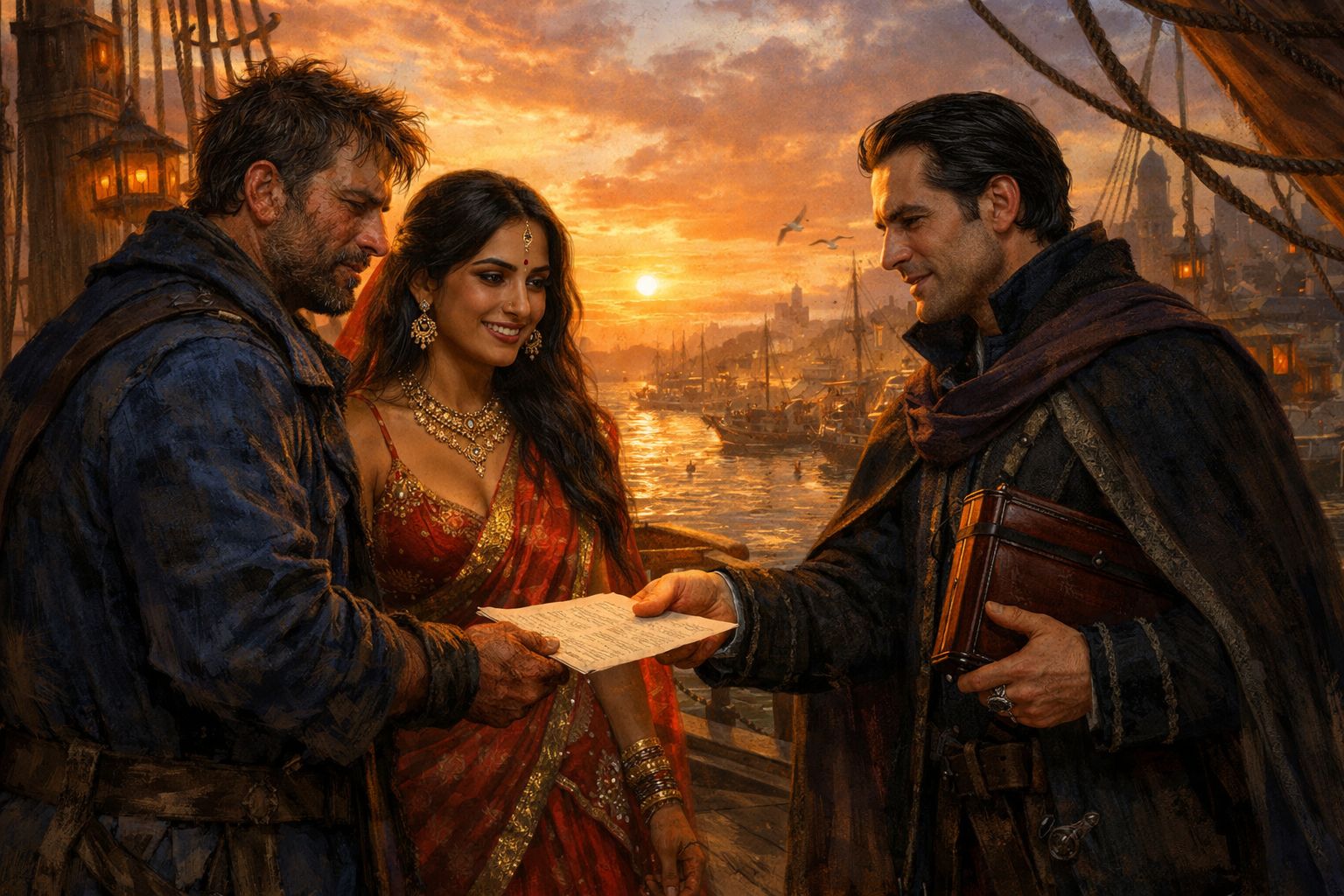
Sandros’ Offer and Role in This Arc
Sandros Pellaios remains what he has always been. He controls information, and by information, events. What he says is accurate. What he promises, he delivers. What he omits is where the danger lies.
Nothing he offers here is a lie. It is simply arranged to benefit him first.
The crew should be able to sense that they are being guided rather than coerced. Sandros does not threaten, rush or pressure. He presents solutions that are convenient, efficient and morally uncomfortable in quiet ways.
The Agitator
The separatist agitator is named Damarion Vex. He is exhausted, injured and very aware that his survival depends on discretion. He does not want speeches or heroics. He wants out.
Taking him aboard presents no immediate difficulty. Harbor guards are conspicuously absent when he arrives, a detail that should feel intentional rather than lucky. This is Sandros smoothing the path.
Damarion will keep his head down during the voyage and will not cause trouble. Dropping him in Velkhara completes the favor cleanly. Sandros will consider the matter settled and will not press further on this point, for now.
The Solution for the Freed Slaves
Sandros’ solution for the freed slaves leads to Lysara in Olydria.
There, the crew can seek out a diplomat named Theokles Argyron. He owns a large agricultural estate and maintains a carefully cultivated image as a benevolent patron. He owes Sandros a favor. Mentioning Sandros’ name is enough to secure work and shelter.
On Theokles’ land, the freed slaves will be employees, not property. They will be paid, housed and protected. This is a genuine improvement to their lives. It is also not charity. It is a favor called in and one that quietly binds the crew into Sandros’ web of obligations.
This is intentional. Sandros does not frame it as a debt, but the implication is there. Solutions provided by him always come with a shadow.
If the Crew Refuses the Deal
If the crew refuses to take the agitator, Sandros does not retaliate. He simply steps aside.
The slaves still need a solution. Without Sandros’ intervention, the crew must find somewhere to leave them where they can survive. That is possible, but difficult. Starting new lives without skills, capital or protection is harsh.
If the crew later returns to such a place, they will find the freed slaves running a brothel. Not because they are enslaved again, but because it is the work they know. They are free, but still exploited, now by circumstance rather than law. They keep the coin. They set the terms. The cost is different, not gone.
This outcome is not meant as punishment. It is a reminder that freedom without support is fragile.
The Waverider Information
Sandros’ information about the Waverider is accurate.
He is offering it as a gift, but gifts from Sandros are never without context. This should be treated as the opening of a future ledger rather than a closed account.
Reading Sandros Correctly
By this point, the players should begin to understand Sandros’ role in Luminara.
He is actively fanning unrest. He benefits from instability. Every riot, crackdown and disappearance increases the value of his services. He is not loyal to rebellion or empire. He is loyal to leverage.
He is not the architect of collapse. He is the man who profits from cracks as they widen.
This arc is not about opposing Sandros directly. It is about realizing that working with him always means becoming part of a larger, quieter conflict that does not end when the ship leaves port.
Leaving Luminara
Departing Luminara is unexpectedly easy.
There are no inspections. No delays. No sudden interest from harbor officials. The usual questions are asked by junior clerks who barely look up from their tablets. Guards are present, but distracted, watching the city rather than the water. The Blue Marlin is allowed to cast off without comment.
This should feel wrong.
After everything that has happened, after rescues, disappearances and quiet violence, the lack of resistance is conspicuous. The city does not tighten its grip. It loosens it.
Suspicious Absence of Authority
The absence of scrutiny is not an oversight. It is deliberate.
Whether through Sandros’ influence, the sheer volume of unrest, or both, attention has shifted inward. Luminara is preoccupied with itself. The Empire is busy suppressing voices, not tracking ships that leave quietly.
If the crew looks for signs of pursuit, they find none. If they expect last minute complications, they do not come. The harbor feels watched, but not by anyone who intends to act.
Deliveries and Separation
Dropping off passengers proceeds cleanly.
The agitator is delivered without incident. He leaves quickly, without speeches, only handshakes of gratitude, vanishing into the anonymity of someone else’s struggle.
The freed slaves are received as promised. Names are exchanged. Doors open. No one asks too many questions. The relief is real, but understated. Lives are redirected rather than celebrated.
The information about the Waverider proves accurate. Routes align. Timelines match. Sandros’ word holds.
The Aftertaste
The ease of departure should linger as a discomfort rather than a relief.
Nothing went wrong because nothing needed to. Luminara does not chase every injustice. It absorbs them. The city remains behind, still beautiful, still brutal, still unstable.
The crew leaves with fewer immediate threats, but more understanding. They were not expelled. They were allowed to go.
Act Summary
This arc is about pressure, simultaneity and revelation rather than progression or victory, forcing the crew to act under constraint on several tasks while showing them what the Empire looks like when examined up close. Luminara is not a battlefield. It is a system under strain, still beautiful, still functional, and quietly monstrous.
The most important structural takeaway is that nothing here happens in isolation. Personal crises, political unrest and institutional cruelty all overlap. The crew is never allowed to fully focus on one problem without another advancing in parallel. That sense of being stretched thin is intentional and should linger in memory.
Emotional Core of the Arc
At its heart, this arc is about confronting the past and discovering that survival has a cost.
Amaxia’s story is raw and uncompromising. Her capture and rescue reinforce that the Empire does not forget ownership and does not forgive defiance. The destruction of the brothel and the killing of The Laugher are not acts of heroism but acts of refusal. They do not dismantle the system. They simply deny it one piece. The emotional impact here is rage validated, not resolved. Amaxia does not heal. She asserts that what happened to her mattered and that it will not be quietly absorbed.
Junia’s arc is colder and more suffocating. The law is clean. The paperwork is correct. The cruelty is procedural. Her rescue and the later stopping of Valeria demonstrate that legality and morality are not aligned in the Empire. Junia’s insistence on preserving the notebooks reframes the arc. It is not about erasing harm, but about refusing to let suffering exist only to elevate its perpetrator. Emotionally, this arc replaces naivete with resolve. Junia does not become harder, but she becomes clearer.
Skarnulf’s arc provides contrast. It offers what the others do not. Closure. His confrontation with the daughters and their forgiveness allows him to finally release guilt that has shaped his entire adult life. His refusal to pursue Lucius is not mercy, but discernment. This is the arc where survival turns into something more than endurance. The emotional impact is softness earned, not weakness revealed.
The Role of Sandros and the Wider World
Sandros’ presence reframes everything.
He does not cause the chaos in Luminara, but he benefits from it and quietly amplifies it. His solutions are real. His promises hold. His influence is subtle and deeply unsettling. By the end of the arc, the crew should understand that instability is not accidental and that people like Sandros thrive as the Empire frays.
The ease with which the crew leaves Luminara reinforces this. They are not hunted. They are not punished. They are ignored. The Empire is too busy suppressing itself to care about a ship leaving quietly. And someone has made sure it stays that way. That realization should feel worse than pursuit.
Thematic Takeaways
- Slavery is infrastructure, not aberration. It is legal, normalized and embedded in every layer of the city.
- The law is not broken. It is functioning as designed.
- Personal action matters, but it does not fix systems. It only creates ripples.
- Choice under pressure defines character more than success does.
- The Empire is not collapsing yet. It is rotting. Quietly. Unevenly. From the inside.
What the Crew Leaves With
The crew leaves Luminara changed.
They have saved lives, but not innocently.
They have acted decisively, but not cleanly.
They understand the Empire better now, and that understanding is heavier than ignorance.
Luminara should feel like a turning point, not because something exploded, but because something became impossible to unsee.
| Story |
|---|
| The sea was dark and open, a broad sheet of moving ink beneath the stars. |
| The Blue Marlin cut through it with quiet confidence, her sails full, her deck steady. Far astern, Luminara was already gone. No glow on the horizon. No reflected marble light. Just water and night and distance. |
| Junia paused outside Amaxia’s cabin, listening for a moment before knocking softly. |
| “Come in,” Amaxia said. |
| She was standing by the small stern window, hands resting on the frame, eyes fixed on the place where the city had been. Or where it should have been. The lantern light caught the edge of her shoulders but left her face half in shadow. |
| Junia closed the door gently behind her. |
| “How are you feeling?” she asked. |
| Amaxia did not answer at first. She searched for the words, frowned when they did not come easily. |
| “Empty,” she said at last. “Not tired. Not angry. Just… empty.” |
| Junia nodded, as if that made perfect sense. She moved closer and leaned back against the table. |
| “A lot of scores were settled,” she said quietly. “A lot of weight went overboard.” |
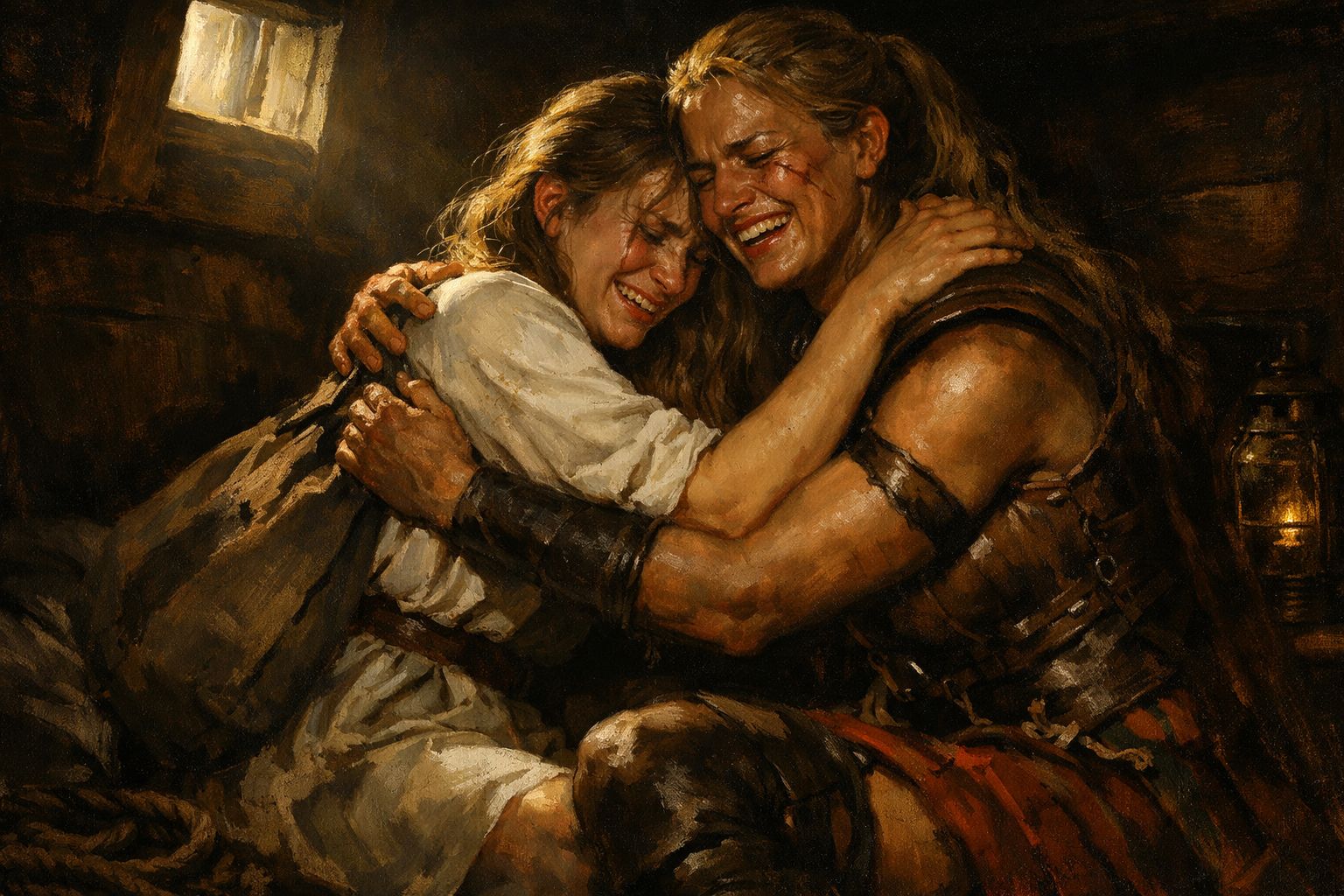
| Amaxia let out a short, surprised laugh. |
| “Scores,” she repeated, and then the sound broke apart. |
| She laughed again, harder this time, and then suddenly her breath hitched. The laughter folded in on itself and turned into something raw and shaking. Tears spilled down her cheeks without warning, without permission. |
| "I wanted to make him suffer as much as did to me. I've dreamt of it. But I just couldn't..." Amaxia sobbed. |
| “You are not like him,” Junia said softly. |
| She crossed the space between them and wrapped her arms around Amaxia before she could think better of it. Amaxia stiffened for a heartbeat, then sagged into the embrace, forehead pressing into Junia’s shoulder as the sobs finally came free. The kind that left her gasping, not from pain, but from release. |
| Junia held on, her own eyes burning now. |
| “It’s all right,” she murmured. “It’s all right. You don’t have to carry it anymore. You can let it go.” |
| Amaxia sniffed, wiped at her face with the heel of her hand, and gave a wet, crooked smile against Junia’s collarbone. |
| “Just don’t tell the crew,” she said hoarsely. “They’ll never let me hear the end of it.” |
| Junia huffed a laugh, tears slipping down her own cheeks. “Your fearsome reputation would never recover.” |
| They both laughed then, quietly, helplessly, tears still running, the sound easing the last tight knots in Amaxia’s chest. |
| After a while, the laughter faded. They stayed where they were, arms still around each other, breathing evening out. The ship creaked. Water whispered past the hull. Somewhere above them, someone laughed on deck, unaware and alive. |
| Amaxia finally pulled back and looked at Junia properly. |
| “For the first time since I was taken,” she said, voice low and steady now, “I feel clean.” |
| Junia swallowed and nodded. “I know what you mean.” |
| Amaxia glanced once more toward the dark window, then squared her shoulders. |
| “That city can keep its ghosts,” she said. “I’m done carrying them.” |
| She turned back to Junia, a spark of her old fire returning. “Come on. It’s time to leave the past where it belongs. Let’s drink too much wine.” |
| Junia smiled, wide and genuine. “Absolutely.” |
| They hugged again, warmer this time, longer, and when they stepped out into the corridor together, the weight they left behind did not follow. |