Campaign: Olydrian Isles - Zarynthos
Act Synopsis
Purpose
This act is a decompression and bonding stop after harsher arcs. It gives the crew warmth, music, food and social ease while planting two shadows. First, the Olydrian Isles are not innocent. Second, the Great Empire is preparing something large and practical.
It also introduces Ormun as a valuable new crew member.
They also get confirmed destinations of Waverider.
Part One: Zarynthos
Arrival During the Vine Festival
The Blue Marlin reaches Zarynthos at the height of Enyra's vine festival. The harbor is crowded with foreign sails, traveling performers, athletes and traders. Rules loosen without collapsing. The mood is welcoming, generous and loud. Strangers are offered wine before questions.
This is a good place to include some recurring NPCs, especially Amir, The Painted Road, Samir and the Licentius couple. Don't linger too much on them, just show them as a familiar face, or as the introduction of a face that will become familiar.
The Blue Marlin draws attention for two reasons. It is fast and unusual, and it is clearly a ship with purpose. Sailors gossip. Poets exaggerate. Dockhands invent stories. Many remember the Waverider as well, because a ship that large becomes a legend the moment it anchors.
Asking About the Waverider
As the crew asks around, they get fragments. Most people only remember spectacle. A massive blue sailed ship. A stern captain. A gray streaked navigator with a sharp tongue. A diplomat who could charm a tax collector into smiling. Details are vague but consistent enough to prove the Waverider was here.
While asking after Phaedros Pelagos, the crew is confronted by Ormun, an ogre with gray olive skin and the wary posture of a guard dog. He is suspicious and slightly hostile at first. Phaedros is his friend. Outsiders asking questions feel like trouble.
Once the crew explains their mission and shares food and wine, Ormun shifts quickly into warmth. He believes them. He wants to know what happened. He invites them to the Pelagos vineyard, where the family will know more and where hospitality is taken seriously.
The Pelagos Vineyard
The vineyard is wealthy, sprawling and busy. Servants and slave workers move constantly through terraces and storehouses. The slaves here are real slaves, well fed and well kept but still owned. Ormun stands apart from them. He is a slave on paper only, kept that way as a legal shield, and treated as family.
Alepos Pelagos, Phaedros’ brother, receives the crew with festival generosity. The Blue Marlin are treated like guests of the house once their mission is understood. The tone is warm, communal, and almost too easy.
Key information delivered here:
- Confirmation that the Waverider anchored at Zarynthos
- Stories and character color about Phaedros, framed as the Island Wolf who never truly stopped chasing horizons
- Stories about the rest of the Waverider crew
- Clear confirmation of some earlier destinations the players already suspect or visited
- The next destinations on the Waverider trail, given as concrete leads rather than rumor
This scene should feel like a feast that also happens to be a briefing.
Ormun’s Freedom and Joining the Crew
Ormun asks to join the Blue Marlin to help find Phaedros. Because he is legally bound, he must ask Alepos.
Scarnax goes with Ormun to negotiate. Ayesha Marindar is a likely choice to accompany him, both as diplomat and as someone who can read the room.
Alepos agrees quickly but not sentimentally. He does not view Ormun as cattle. He views him as family and as a protector of the estate. He also wants his brother found, and he knows Ormun would go to the edge of the world for Phaedros.
Alepos sets Ormun free.
The Favor
Alepos also asks a favor. This is never asked as a debt, just a favor of common interest.
There are rumors that the Great Empire is preparing something at Portus Gravellum. Zarynthos does not know what. Alepos wants confirmation, not war.
The Blue Marlin is fast and not Olydrian. It can enter as a normal ship, observe, and return with information.
The crew are not obliged. The favor is social pressure, not a contract. However, the feast, the help, the information, and Ormun’s freedom make refusal feel costly.
Foreshadowing During the Festival
While the festival continues, drop one or two quiet signs that something is being measured.
On a beach outside the main revel routes, the crew finds long, deliberate tracks in the wet sand. The stride is too regular to be a stroll. The path pauses as if someone stood and watched the shoreline. Nearby, a pair of ordinary looking traders walk along the surf with a steady pace and do not look at the sea like locals do.
No confrontation. No certainty. Just the feeling that someone is taking distances.
Also include a festival ceremony that celebrates Olydrian unity and past victories at sea. It should be joyful and grand, but with the undertone of reassurance, as if the city is reminding itself of something it is not fully sure it can repeat.
Part Two: Portus Gravellum (optional)
If the players take the favor, the Blue Marlin sails to Portus Gravellum.
Portus Gravellum is both trade harbor and naval port, so entry is easy. The trade side functions normally. The naval side is locked down hard.
A section of the harbor is sealed off by legion guards. Alleys and wharves are blocked. Civilians cannot enter. The guards refuse questions. Pushing for answers invites counter-questions, and further pushing escalates quickly.
Local civilians know only surface facts. Many timber shipments. Large numbers of craftsmen. The craftsmen are housed inside the restricted zone.
The crew eventually encounters Urru, a dwarf carpenter from inside the project area. He is in the discreet bragging mood. Pay for his drinks and he offers secrets like they are party tricks.
Urru reveals the project. The Empire is building a new ship type. Huge, armored, built to carry troops and smash into coastal defenses. Little sail, poor maneuverability, designed to close distance under escort, board, destroy, or land large forces fast.
Galenor, hearing the description, dismisses it as a beast that any true ship can out sail, then corrects himself. With escorts it becomes a threat. It can unload troops and then function as a coastal fortress.
Galenor names it a combat barge.
At this point the crew has what Alepos asked for. They can leave.
If they attempt to sneak in or sabotage, treat it as a high risk improvisation. The Empire will not be careless here.
Return and Payoff
When the Blue Marlin returns with the information, Alepos takes it seriously. If the players have not already said it aloud, Alepos does.
The Great Empire is preparing an invasion attempt or a major coastal strike. Olydria must prepare agile fleets, fire catapults and rapid response forces to meet a landing before it becomes a foothold.
Alepos thanks the crew and treats their help as a real service to the Isles.
Rewards should match the act’s tone. Barrels of the vineyard’s best wine, delicacies, rare ingredients, and provisions that make Yasmira happy. The gift is generous and culturally meaningful, not a sack of coin.
Ormun departs with the crew as a free man and a new member of the Blue Marlin.
Act Outcomes
- Ormun joins the crew.
- The Waverider trail is advanced with confirmed next destinations and reinforced past ones.
- The players receive a clear picture of an imperial naval innovation and what it implies.
- The Isles gain warning that war is moving from rumor to logistics.
- The act ends with warmth on the surface, but the sense that the horizon is being measured.
Part One: Zarynthos
Arrival During the Vine Festival
| Story |
|---|
| The first thing that hits them is sound. |
| Not music, not exactly. Sound layered on sound. Singing over drums. Laughter cutting through chanting. Feet striking stone in uneven rhythm. Voices raised not to be heard, but because everyone else is loud too. |
| Zarynthos spills down toward the harbor in white stone terraces, every stair and courtyard crowded with bodies. Garlands hang from balconies and pillars. Vines heavy with grapes are draped over doorways like blessings pulled down within reach. The air smells of salt, crushed fruit, roasted meat, sweat, incense, and something sweet and sharp that stings the nose. |
| People press close without apology. A man with wine stained teeth grabs Nasheem by the shoulders and laughs in his face before pressing a cup into his hand. A woman dances past Ayesha with her fingers tangled in another woman’s hair, both of them half dressed and unconcerned with who sees. Pelonias nearly collides with a pair of singers who spin aside at the last moment, never missing a note, one of them winking at him as if this were all planned. |
| Yasmira stops walking and just laughs. |
| “This is good,” she says, already scanning stalls and tables like a hunter spotting prey. “This is very good.” |
| They move with the flow, not against it. The Blue Marlin crew is absorbed into the festival almost immediately. Hands clap them on the back. Someone shouts a toast at them for no clear reason. A man with a painted face bows deeply to Pelonias and declares him blessed by the sea, then wanders off before Pelonias can respond. |
| A woman wearing a haphazardly arranged toga grabs Nasheem, gives him a deep kiss, then moves on. "I could taste how much bad wine she has drunk," he laughs. |
| Ayesha takes it all in with a small, satisfied smile. She is close enough to be brushed constantly, hips, shoulders, fingers, but she moves easily with it, returning touches casually, laughing when someone presses a kiss to her cheek without asking. There is no sense of threat here. The closeness feels celebratory, not possessive. |
| Nasheem lifts his cup, sniffs it, shrugs, and drinks. Whatever it is, it burns and tastes like fruit left in the sun too long. He coughs, then laughs, and immediately someone refills it. |
| They end up at a long, low table beneath an olive tree whose branches are hung with lanterns. Yasmira claims space with authority, shooing aside half empty plates and rearranging dishes until there is room for them to sit. |
| “Eat,” she says. “Do not ask what it is yet. Eat first.” |
| There are small fried fish dusted with herbs and salt. Flatbread still warm, torn by hand and dipped into oil thick with spices. Bowls of stewed grapes and meat that melt together into something rich and strange. Cheese sharp enough to bite back. Minced meat wrapped in grape leaves. Wine poured freely, red and cloudy, leaving stains on fingers and lips. |
| Occasionally, Yasmira smacked her lips appreciatively, mumbling that she must ask for the recipe. |
| As they eat, the festival continues around them. Dancers whirl past, skirts flaring. A trio of acrobats tumble through an open space, drawing cheers. Someone nearby begins a song, and a dozen voices join in without hesitation, harmonies forming and collapsing and reforming again. |
| Ayesha watches it all with an expression halfway between fascination and disbelief. |
| “They do this often?” she asks. |
| Pelonias laughs softly. “Often enough to practice.” |
| Nasheem leans back, letting the noise wash over him. “There is a confidence here,” he says. “As if the world can be kept at bay by refusing to acknowledge it.” |
| Ayesha tastes something, closes her eyes, and makes a pleased sound. “No,” she says. “This is not refusal. This is knowing exactly what you have and enjoying it while it is still yours.” |
| A drunken man staggers past and raises his cup toward them. “To strangers,” he declares, sloshing wine onto the stones. “May you leave with fuller bellies.” |
| They drink, because that seems to be the correct response. |
| From where they sit, the sea is just visible between bodies and lantern light. Dark, calm, reflecting distant firelight. The festival roars on, pressing close, warm and alive, and for the moment, the world feels loud enough to drown out everything else. |
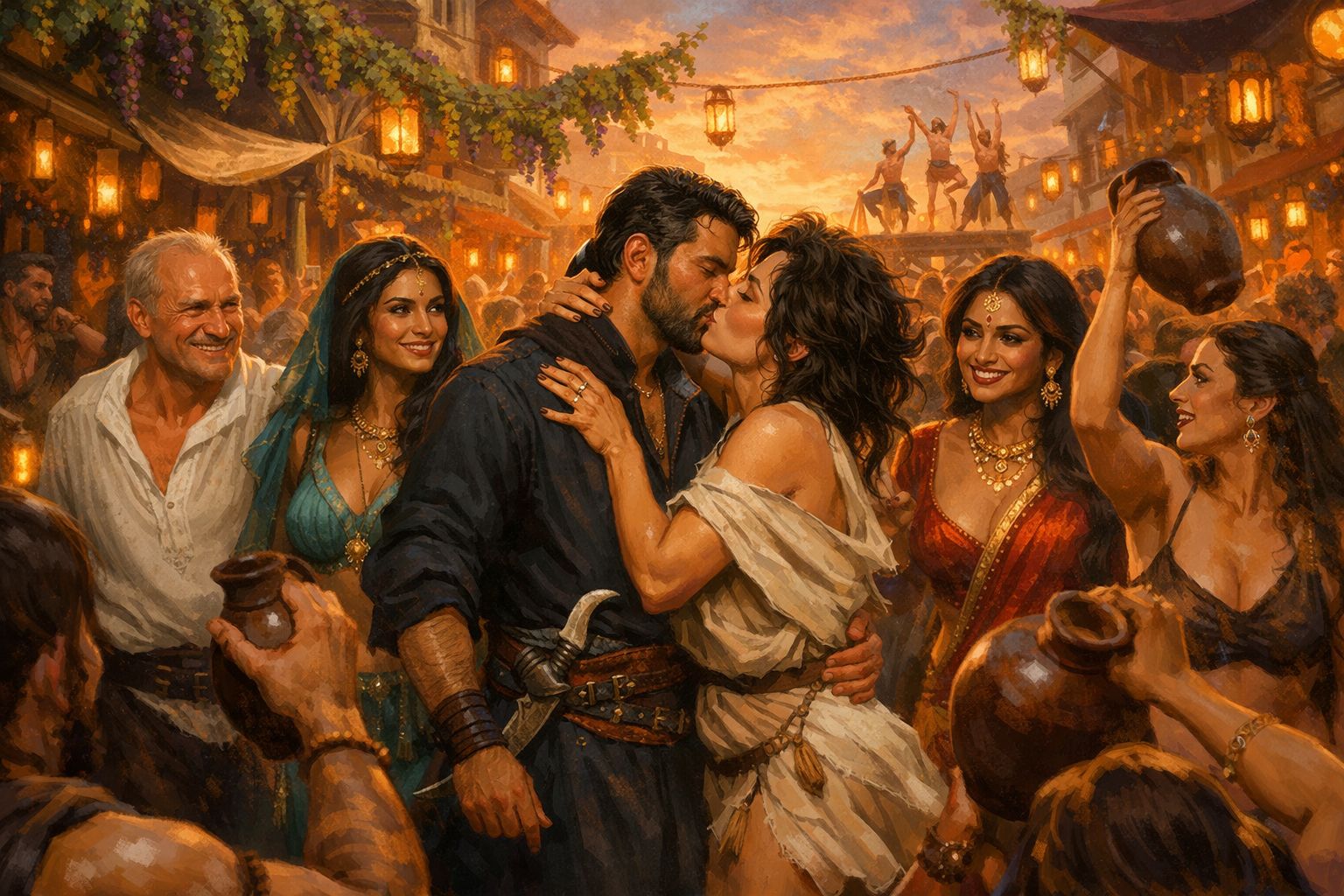
Mood and Purpose
This arrival scene is about sensory overload that feels safe. The crowd is loud, intimate, and welcoming. People assume goodwill, touch freely, laugh easily, and make space without asking permission. There is no suspicion directed at the crew and no pressure to explain themselves.
The purpose is decompression. This is a deliberate pause after harsher material. Let the players eat, drink, laugh, and feel briefly unguarded. Do not rush the scene, but do not let it sprawl into aimlessness. The goal is comfort and belonging, not investigation.
No big plot advancements here, but do add small bits of stories of what has happened to places they visited before since they left, as a way to show what consequences their actions in earlier events had.
This warmth is also a contrast setup. Later signs of measurement, secrecy, and imperial intent will matter more because the players remember how open and joyful this place felt at first.
Using Recurring NPCs in the Festival
This scene is ideal for light reappearances. Familiar faces should drift through, greet the crew, and vanish again. They reinforce continuity and the feeling of a shared world. Don't use all of them, pick one or two.
Amir al Javeen fits as a burst of motion and noise. He might be performing, tumbling through the crowd, or shouting greetings while balancing on something he should not be standing on. Keep him joyful and disruptive. He should add energy, not demand attention. If he causes trouble, it should be minor and social, never dangerous.
Prophet Samir the Radiant works best at the edge of the crowd. He may be mid miracle, arguing with a priest, or running from someone who wants their coin back. His presence should add chaos and humor. He can drop a rumor or half truth casually, as a pretended prophecy, but mostly, he is comic relief.
The Painted Road Caravan should appear as atmosphere rather than focus. Musicians, dancers, or brightly dressed goblins performing near the waterfront or moving through the streets. Use one clear visual or sound cue and move on. They should feel like part of the festival itself, not guests.
Varro and Livia Licentius should be present but restrained. They are up to their usual petty crimes. Varro re-marking wine barrels to imply higher quality, while also watering the wine down. Livia may be speaking sweetly with someone already marked as a future opportunity. If they are threatened, they run.
All recurring NPCs should appear briefly, feel recognizable, and then dissolve back into the celebration. None of them should linger long enough to pull focus from the crew’s first impression of Zarynthos. The exception is if they are introduced for the first time, in which case, they deserve a bit more attention. Do not make a first introduction of the Licentius couple here, that will ruin the Necropolis arc.
That said, if the players choose to interact with them, let them. If it drags on for too long, just let the flow of the festival sweep them away.
Asking About the Waverider
This phase is about noise, not answers.
Zarynthos remembers the Waverider vividly, but inaccurately. The greatest ship in the world leaves impressions, not records. People are eager to talk. Sailors, dockhands, merchants, performers, and priests all have something to say, and none of them need convincing. Information flows freely, generously, and without suspicion.
What they offer are fragments. Exaggerations. Personal angles. Someone swears the ship blocked the sun. Another insists it carried a shrine on its deck. A third claims the captain was a giant. Names are remembered inconsistently. Details blur. Timelines contradict each other. What remains constant is scale, presence, and myth, and occasional facts.
Use this to establish tone rather than facts. The players should come away with a strong feeling for how the Waverider was perceived, not a clear itinerary. Emphasize how quickly stories drift from observation into legend. Correct answers should be rare and partial.
At the same time, this is a sea nation. Many people are just as interested in the Blue Marlin. Comparisons are inevitable. Questions are asked freely. Compliments are offered. Advice is given whether requested or not. The crew should feel seen and evaluated as sailors, not interrogated as strangers.
If the players push for precision, let it slip through their fingers. A dockhand knows the ship left east but cannot agree on when. A merchant recalls the navigator clearly but confuses his name. A priest remembers a blessing given but not why. Truth is present, but scattered.
As the crew asks questions, someone is listening.
Ormun appears.
| Story |
|---|
| They are halfway through a conversation that has already forked into three different versions when the space around them tightens. |
| A shadow pushes through bodies that had been laughing a moment before. Someone is shoved aside. A cup spills and shatters. The music stutters, then resumes louder, as if to cover the interruption. |
| A massive figure steps into their circle, gray olive skin catching lantern light, shoulders broad enough that the crowd parts without argument. His eyes are fixed on Pelonias. |
| “You,” he says, voice low and sharp. “Why are you asking about the Waverider.” |
| The suddenness of it knocks the words out of them. |
| Scarnax straightens instinctively, hand half rising before he checks himself. Pelonias opens his mouth, closes it again, then tries to speak over the noise. Cassandra shrinks back a step, startled, her breath catching as the ogre’s gaze flicks across her. |
| Ayesha starts to answer, but the ogre leans forward, teeth showing. |
| “My friend is on the Waverider,” he hisses. |
| Cassandra flinches hard at that, shoulders drawing in, and the ogre notices immediately. His eyes narrow, not with anger now, but with something sharper. Protective. Focused. |
| Ayesha steps forward smoothly, palms open. |
| “Then we are on the same side,” she says. “The Waverider has been lost. We are searching for her. To find what happened. To bring help. To bring her people home.” |
| The words land. |
| For a heartbeat the ogre simply stares at her, as if weighing whether to believe such a thing could be spoken aloud so easily. Then the tension drains out of him all at once. His shoulders drop. His face splits into a broad, sudden grin that looks almost absurd on someone his size. |
| “Lost,” he says softly. Then louder, brighter. “Lost means not gone.” |
| He laughs, a booming sound like stones rolling down a hillside. Nearby festival goers glance over, decide nothing is wrong, and turn back to their drinks. |
| “I am Ormun,” he says, thumping a fist against his chest. “And I am very glad you are here.” |
| He looks down at Cassandra and crouches a little, bringing himself closer to her height. His voice lowers. |
| “I am sorry,” he says, genuinely. “I did not mean to scare you.” |
| Cassandra nods, still wide eyed, but the fear is already fading. |
| Ormun straightens and waves them toward a nearby table already crowded with half empty plates. |
| “Come,” he says. “We talk better with food.” |
| They sit. Wine appears. Bread is torn. Ormun eats like someone who enjoys every bite and expects everyone else to do the same. |
| “Phaedros,” he says, grinning at Pelonias. “Sharp tongue even as a boy. We stole grapes together. I was supposed to be the lookout. He ate more than I did. I took the blame.” |
| He laughs again. “Worth it.” |
| His cheer never quite hides the urgency underneath it. Every joke circles back to the same truth. His friend is out there. |
| “You should come to the Pelagos vineyard,” he says finally. “Phaedros’ family. They will know more than dock gossip. They always do.” |
| Ayesha exchanges a glance with Scarnax. Pelonias nods. |
| “Lead the way,” Scarnax says. |
| Ormun rises, already pushing back into the crowd, and this time the festival opens for him gladly. |
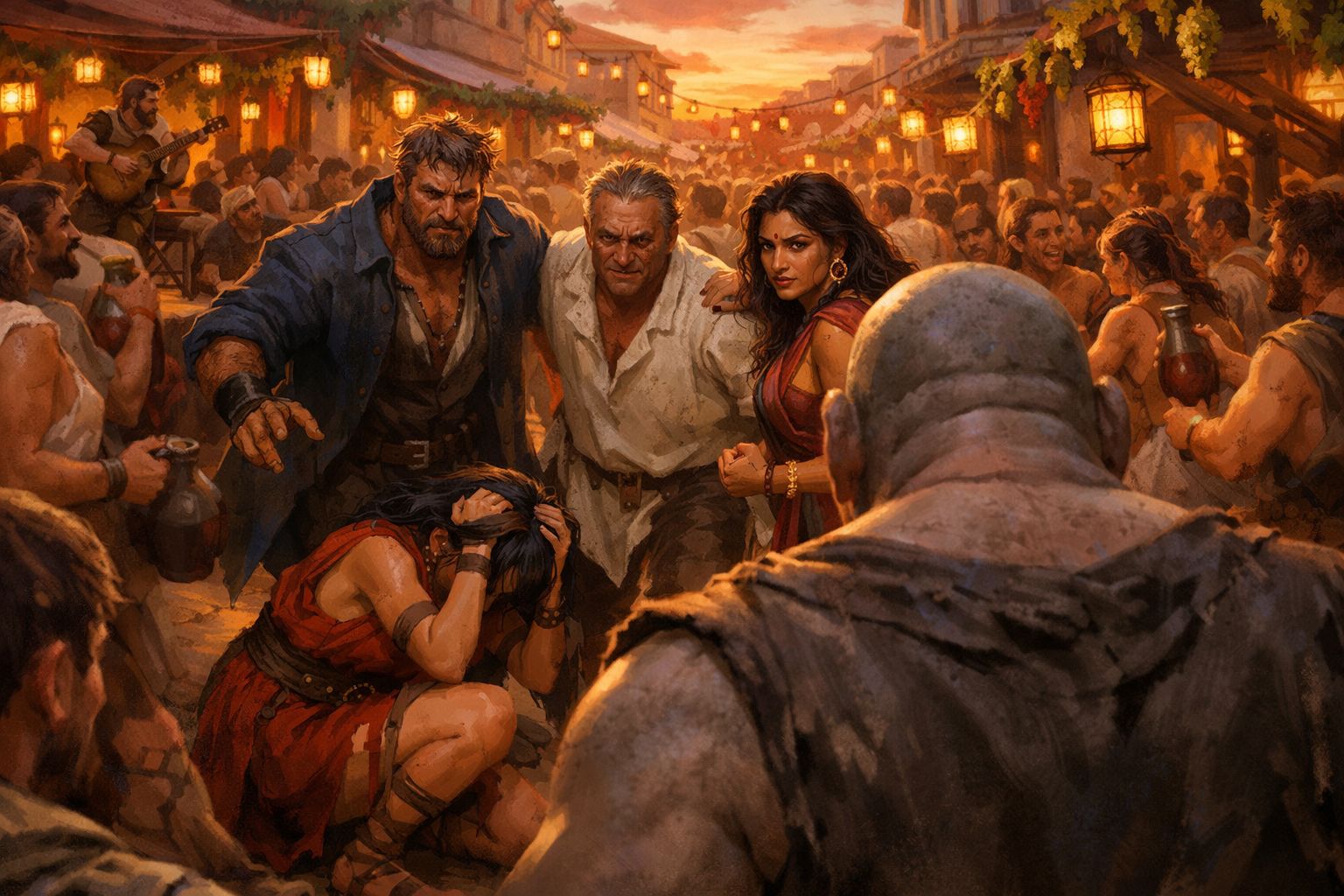
Ormun’s Interruption and First Contact
This interaction should feel sudden and intrusive, but not malicious.
Ormun overhears the crew asking about the Waverider before he is seen. He pushes through the crowd and confronts them directly, voice sharp and posture imposing. This is not a calculated interrogation. It is a protective reaction from someone who believes strangers are circling the fate of someone he loves.
His suspicion should be narrow and focused. He is not angry at outsiders in general. He is angry that outsiders are asking about that ship. Keep his questions blunt and accusatory. "Why are you asking? What do you want with the Waverider?"
Let the crew stumble in their response. Confusion, overlapping explanations, or hesitation are all appropriate. This sells the shock of the moment and reinforces that Ormun’s presence disrupts the easy festival flow.
If one of the crew reacts with fear or withdraws, make sure Ormun notices. When he snaps that his friend is on the Waverider, it should come out sharp and emotional. The moment he realizes he has frightened someone, his posture shifts. Not defensive, not apologetic yet, but alert. This is the hinge of the scene.
The turning point comes when the crew makes their purpose clear. The Waverider is lost. They are searching for it. Their intent is rescue and understanding, not pursuit or profit.
Once this is said, Ormun’s demeanor changes immediately. Do not slow this down. His trust is decisive, not cautious. Relief should be visible in his body. Shoulders lower. Voice warms. A smile breaks through. What they say aligns with his fear, and that is enough.
He apologizes directly to the person he scared. Keep it simple and sincere. This establishes that his protectiveness extends beyond his friend and is instinctive rather than selective.
Building Trust Through Familiarity
Once seated with food and wine, Ormun becomes openly friendly. This is genuine. He is relieved to have found allies and is eager to help.
Use stories to cement trust. His anecdote about stealing grapes with Phaedros as children should be warm and slightly self mocking. It is not meant to convey useful information. It is meant to prove intimacy. Phaedros is not an abstract name to him. He is a brother in all but blood.
Let the conversation breathe. Ormun should ask about the crew, their ship, and their travels. He's especially interested in what they have found out so far about the Waverider, what his friend has been up to. He is curious now, not suspicious.
Underneath the laughter, keep the urgency present. His friend being lost never leaves his mind. This quiet pressure motivates what comes next without needing to be stated outright.
The Invitation
Ormun invites the crew to the Pelagos vineyard because it is the obvious next step to him. He trusts the family to know more than dockside rumor and believes hospitality will open doors that gossip cannot.
The invitation should feel generous and confident, not transactional. He is not bargaining. He is welcoming them into a circle of trust.
If the crew agrees, Ormun leads immediately. The crowd parts for him easily, reinforcing that he belongs here and is respected. Some people greet him as a friend as they pass.
End the scene with motion. A confrontation has become companionship, and he is already starting to feel one of the team.
The Pelagos Vineyard
Approach to the Pelagos Vineyard
The walk to the Pelagos vineyard should feel peaceful, prosperous, and faintly wrong.
The festival noise fades as the path climbs into terraced hills. Stone walls cradle heavy vines. Olive trees throw slow moving shade. Cicadas hum. The air smells of sun warmed leaves, turned earth, and sweet rot from fallen grapes. Everything here suggests patience, care, and long cultivated wealth.
Slaves work the land in quiet, practiced rhythms.
They are healthy. Clean. Well fed. Their tools are well made and maintained. Water is carried regularly. Overseers speak calmly and without raised voices. When someone stumbles, another steps in without fuss. When a basket breaks, it is replaced. There is no visible cruelty.
And there is no question of ownership.
The slaves step aside automatically when free folk pass. Eyes lower by habit, not command. Conversations stop and resume without comment. When addressed, answers are brief, polite, and precise. Gratitude and obedience are woven together so tightly they are hard to separate.
This should not be played as abuse. It should be played as normal.
That is what makes it unsettling.
Ormun walks among them at ease. He greets several by name. They greet him back openly, even warmly. He gives no orders and receives none. His presence highlights the structure without challenging it. Ormun is the exception. The vineyard is the rule.
Do not linger. Do not explain. Let the players notice and sit with it.
Arrival at the Vineyard House
The Pelagos house crowns the terraces, pale stone and open arches overlooking the sea. It is beautiful without being defensive. No walls meant to stop an army. No guards on display. Wealth here assumes safety.
Servants receive Ormun warmly and accept the crew without question. Water is offered before names are asked. Wine follows quickly. Shade is provided. Comfort is assumed, not negotiated.
The transition should be subtle but clear. The crew has moved from public celebration into private order. From shared joy into controlled abundance.
Everything is generous. Everything is calm.
And everything here works exactly as intended.
| Story |
|---|
| The house opens onto a wide shaded courtyard where pale stone columns frame the view of the terraces below. Beyond the vines, the sea glints in steady afternoon light. Household slaves move quietly across the flagstones, already shifting benches and clearing space as Ormun approaches. |
| A man steps forward to meet them, dark haired, broad shouldered, dressed in simple linen edged with blue. His eyes move quickly, taking in faces, posture, the way they stand. |
| “Ormun,” he says with a smile. “You look loud today.” |
| Ormun grins. “I found something worth being loud about.” |
| The man’s gaze turns to the others. |
| “I am Alepos Pelagos,” he says, inclining his head. “You are welcome in my house.” |
| Ormun does not linger on ceremony. He gestures toward the group. |
| “They search for the Waverider,” he says. “For Phaedros. They mean to find her, and to bring help.” |
| Alepos’ expression softens, not with surprise, but with recognition. |
| “Then you should sit,” he says. “We speak better with food.” |
| Servants move at once. Cushions are laid out beneath the colonnade. A long low table is set with practiced ease. Water comes first, cool and clear, then wine, dark and fragrant. Bread still warm is broken and passed. Platters of grilled fish and lamb follow, bowls of olives gleaming with oil, figs split open, cheese sharp and fresh. |
| Alepos seats himself at the head. Two women join him, sisters by face and bearing. The elder, Thaleia Pelagos, laughs as she sits, already pouring wine with a generous hand. The younger, Ione Pelagos, studies the guests openly, curiosity bright in her eyes. Their spouses arrive soon after, Nikandros and Leandros, greeting Ormun like kin and the others like honored guests. |
| Conversation begins easily. |
| Stories of travel first. Of ports that smelled worse than they looked. Of storms that came without warning. Alepos listens more than he speaks, nodding, asking questions that draw out detail without pressing. |
| When the Waverider is mentioned, no one pretends surprise. |
| “You could not miss her,” Thaleia says, smiling into her cup. “She made the harbor feel small.” |
| “The dockhands claimed she drank half the sea,” Nikandros adds. “They always exaggerate.” |
| “They do,” Alepos says mildly. “But not about scale.” |
| He looks toward Pelonias. “My brother was restless when he left,” he says. “In good spirits. Sharp tongued as ever. He never learned how to stay.” |
| Ormun snorts. “He stole grapes from these terraces when we were children.” |
| "Didn't we all?" Alepos replied. |
| “And blamed you,” Ione says, laughing. |
| “As was tradition,” Ormun replies solemnly. |
| They speak of the crew. Of a captain who watched the horizon as if daring it to move. Of a diplomat who could turn an argument into a feast. Of a ship that felt less like wood and sail and more like will made visible. |
| Alepos confirms what matters. The Waverider anchored here. She took on supplies. She stayed only briefly. She left with purpose. |
| Destinations were spoken softly and quickly, marked with nods and brief silences. Routes traced with fingers across the table, then brushed away with careless palms. Nothing is written. Nothing is fixed. |
| Wine flows. Plates are refilled without comment. Laughter comes easily and without strain. |
| For a time, it feels like a family meal into which strangers have been gently folded. |
| As the light shifts and the sea beyond the vines turns gold, Alepos raises his cup. |
| “To finding those who sail too far,” he says. |
| They drink. |
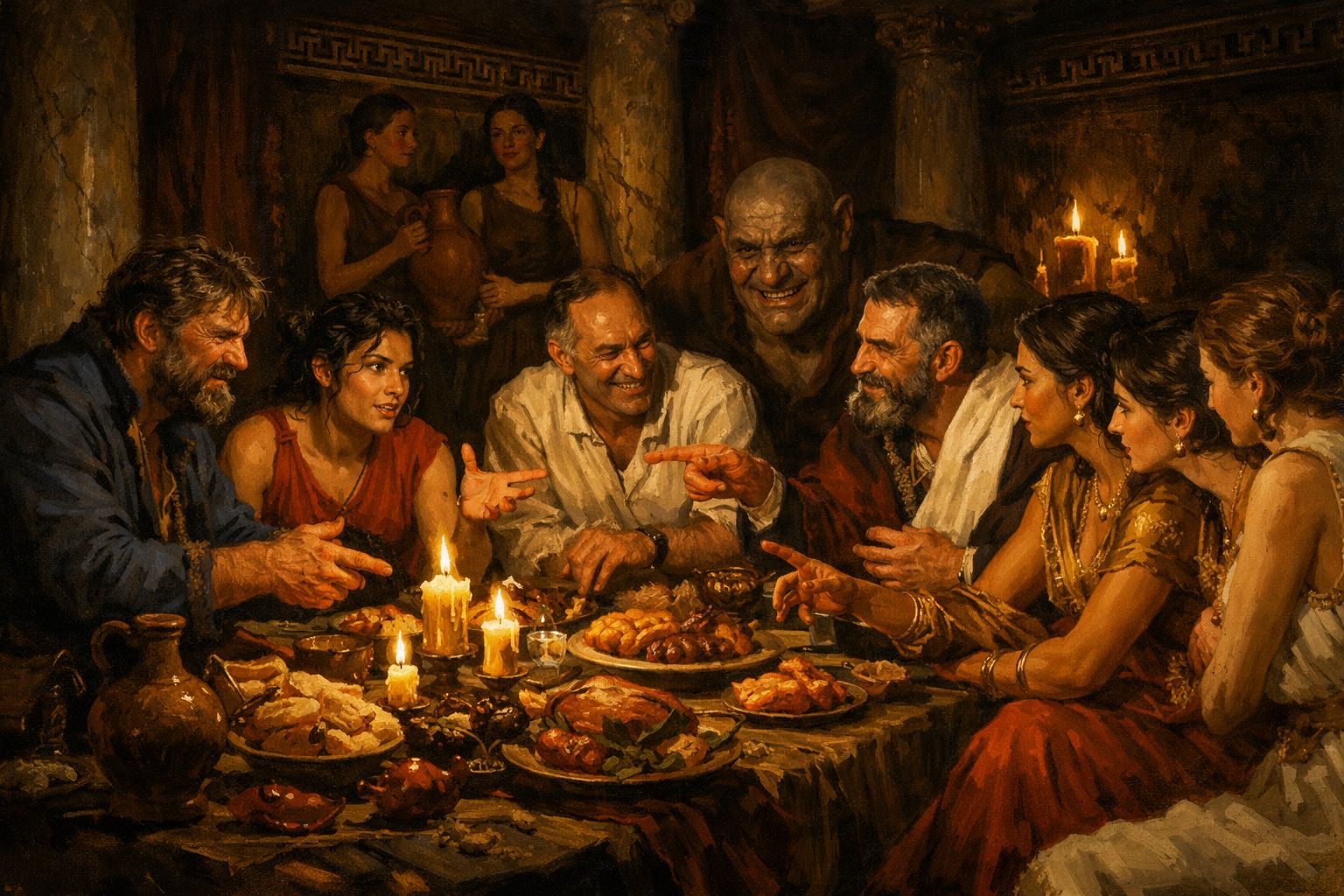
The Pelagos Vineyard Meeting
This scene is meant to feel welcoming, generous, and quietly important.
The Pelagos household receives the crew as guests, not petitioners. Hospitality comes first and questions come later, if at all. Food and wine should arrive before explanations. Conversation begins with shared stories rather than purpose. This reinforces the Olydrian belief that trust is built socially, not transactionally.
The mood should be warm and familial. Laughter is easy. Interruptions overlap. People speak over one another without offense. The crew should feel folded into a family table rather than seated across from an authority.
Information Gained
The Waverider is confirmed to have visited Zarynthos. This is no longer rumor. Supplies were taken on. The stay was brief. The departure was deliberate.
Stories about the Waverider crew are shared freely, especially about Phaedros Pelagos. These stories are personal rather than strategic. They establish who he is, how he was regarded, and why Ormun cares so deeply. Use them to humanize the missing crew rather than to advance plot. Select a few colorful or revealing anecdotes from the Waverider stories and share them.
Specific destinations are discussed by name. Do not list them in narration. Let names be spoken, corrected, and erased in the flow of conversation. The important takeaway is that the players receive concrete leads chosen by the Game Master, not that the table records them in detail.
Give the crew one destination forwards, and several they already know and possibly have visited.
Earlier suspected destinations can be confirmed or quietly corrected here, depending on the campaign’s needs.
Purpose of the Scene
This scene advances the Waverider trail while reinforcing trust. The players should leave with clearer direction and stronger emotional investment, not a sense of having negotiated for information.
It also establishes the Pelagos family as allies and Ormun’s later choice to help as grounded and supported rather than impulsive.
End the scene when it feels complete, not when information runs out. When plates are empty and the wine has flowed, move the story forward.
Ormun’s Freedom and Joining the Crew
| Story |
|---|
| The meal slows as the light thins and the shadows lengthen across the courtyard. Plates sit half empty. Wine cups are refilled less often. Conversation drifts, looping back on familiar stories and shared laughter. |
| Ormun shifts on his bench, fingers worrying the edge of the table. Finally he rises and nods toward Scarnax. |
| “Walk with me,” he says quietly. |
| They move a short distance away, close enough that voices from the table blur into background warmth. Ormun looks out over the terraces for a long moment, jaw tight. |
| “I want to go with you,” he says at last. “Wherever you sail. Phaedros is my brother. I will not sit here while the sea has him.” |
| Scarnax answers without hesitation. “Then you come.” |
| Ormun exhales, a sound halfway between relief and dread. |
| “I cannot,” he says. “Not without Alepos. I am a slave. We must speak to him.” |
| Scarnax studies him for a heartbeat. Sensing a negotiation, he turns back toward the table. He gestures once, and Ayesha rises smoothly, already reading the shape of what is coming. |
| They find Alepos near the fire pit, where embers glow low and steady. He listens without interruption as Ormun speaks, words tumbling out now, loyalty and fear tangled together. When Ormun falls silent, Alepos does not answer immediately. |
| Instead, he steps closer and places a hand on Ormun’s arm. |
| “You will not be sold,” Alepos says calmly. “Not like cattle. Never.” |
| Ormun swallows hard. |
| “You have been family since before you could lift a basket,” Alepos continues. “You know this.” |
| He glances toward Scarnax and Ayesha. |
| “The law says he is owned,” Alepos says. “The truth is simpler. A free ogre is hunted. A bound ogre is ignored. The papers were a shield. Nothing more.” |
| He turns back to Ormun, voice softening. |
| “But Phaedros is gone. And I know this much. If anyone would walk to the edge of the world and beyond for him, it is you.” |
| Alepos reaches into a chest beside the wall and withdraws a small bundle of folded parchment. He leafs through them, mumbling names, picks one, holds it for a moment, then tosses it into the fire. |
| The paper curls. Blackens. Vanishes. |
| Ormun stares, breath caught in his chest. Then the sound breaks out of him, a rough, helpless laugh that turns into a sob before he can stop it. |
| “Alepos,” he says, and then there are no more words. |
| He wraps Alepos in a crushing embrace, lifting him clean off the ground. He is laughing and crying at the same time, tears streaking freely down his face. |
| “You idiot,” Alepos says, voice thick, gripping him back. “Put me down before you break my spine.” |
| Ormun does not listen. He sets Alepos down only to turn and pull the others into his arms one by one. Scarnax first, ribs creaking. Then Ayesha, laughing despite herself as she is swept up. Anyone close enough is caught and held, whether they expect it or not. |
| When the moment finally settles, Ormun wipes his face with the back of his hand, unashamed. |
| Alepos steps forward again, placing a hand on Scarnax’s forearm, then on Ayesha’s. |
| “Take care of him,” he says. “He has a heart too big for his body, loyalty without measure, and wisdom that goes straight to the point and nowhere else. He will give you everything he has.” |
| Scarnax meets his gaze. “He will be family.” |
| Ayesha nods. “On my word.” |
| Alepos inclines his head once, satisfied. |
| Ormun stands between them, breathing hard, eyes bright, smiling like the world has cracked open and let him through. |
| “For Phaedros,” he says simply. |
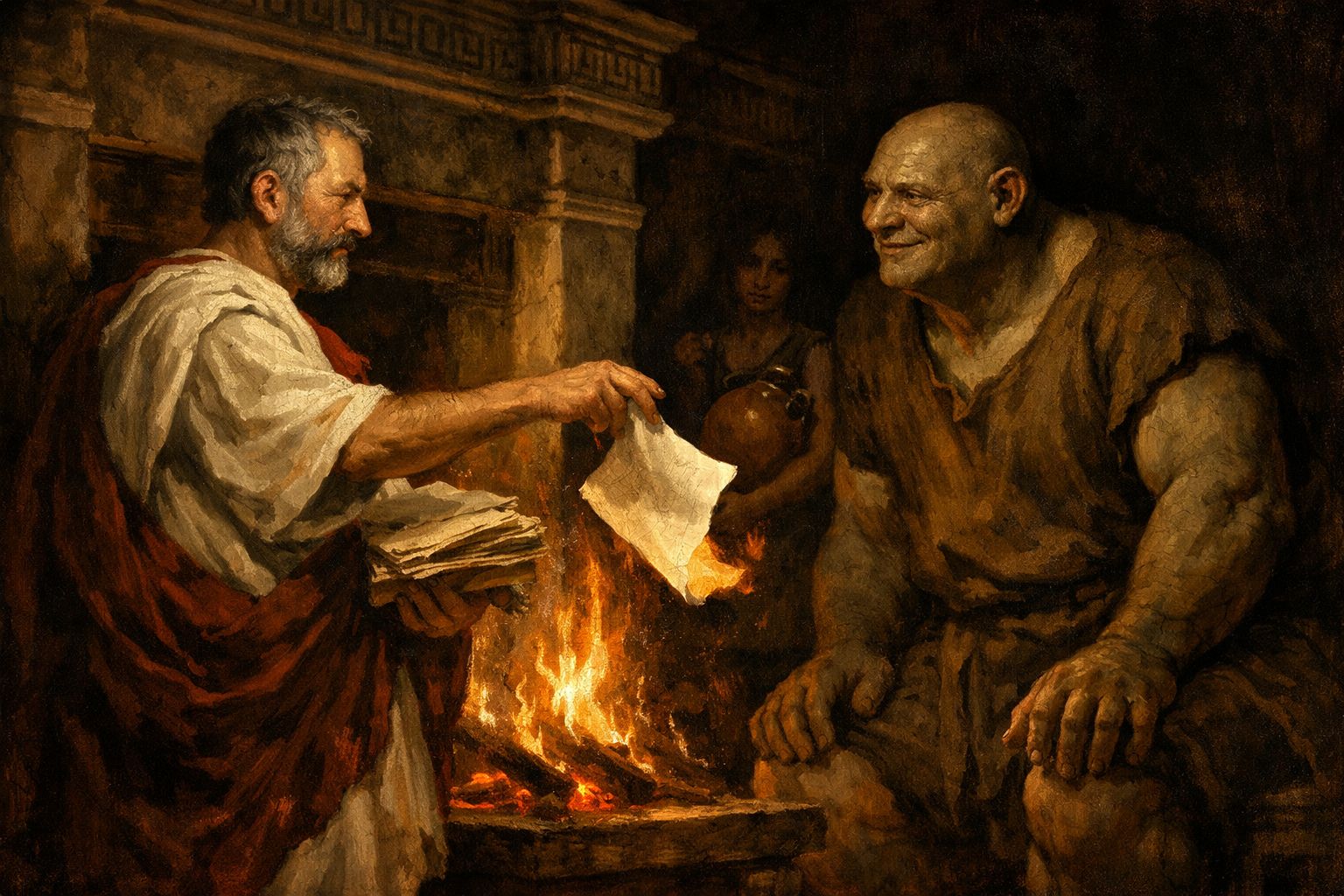
Ormun’s Freedom
This scene is about emotional weight, not bargaining.
It should begin with a sense of expectation. Ormun’s request to join should feel deeply personal and difficult for him to voice. Make it clear that this is not wanderlust. This is loyalty. He is asking because Phaedros is lost, and because staying behind feels like betrayal.
The crew should reasonably expect resistance. This feels like it should be a negotiation. Ownership papers. Conditions. Haggling. Money changing hands. Prepare the table for tension.
Then do not deliver it.
Alepos’ response should bypass negotiation entirely. He does not haggle. He does not weigh options. He does not ask for compensation. His decision is rooted in long standing loyalty to both Ormun and Phaedros, in friendship. That sudden absence of bargaining is the release valve for the scene.
Emotional Core
Ormun’s reaction is the heart of the moment. Let it be messy and unfiltered. He does not process this quietly. He laughs. He cries. He hugs too hard. He forgets decorum. He is overwhelmed because this is not just freedom. It is permission to act on love and loyalty without restraint.
Alepos should be steady and contained by contrast. His care is practical, grounded, and expressed through action rather than sentiment. Burning a single paper matters more than any speech.
The promises exchanged with the crew should be simple and sincere. This is not a contract. It is adoption. It is handing over the care of a loved one.
The Uncomfortable Truth
Do not let the scene become morally clean.
Other slave papers remain. Other slaves remain. Some of them are present in the room, serving food and wine, witnessing the moment without comment. They are healthy. Calm. Professional. Still owned.
This contrast is important. Ormun’s freedom is real and earned, but it is an exception, not a transformation of the system. Let that sit quietly in the background. Do not underline it. Do not resolve it. Mention them occasionally as someone who pours wine, removes empty plates, or among the people Ormun hugs.
This moment should leave the table with a familiar truth intact. You can free a slave, but you can’t end slavery.
Ending the Scene
End on Ormun’s joy and resolve, not on reflection.
This is his moment. Let it land fully before moving on.
The Favor
The Favor
This scene should feel calm, reasonable, and quietly weighty.
As the crew prepares to depart, Alepos raises the matter without ceremony. This is not framed as repayment or obligation. He does not invoke hospitality already given, nor does he speak of debt. He presents it as a shared concern between people who care about the same sea.
There are rumors that the Great Empire is preparing something at Portus Gravellum. Restricted harbors, secrecy. Nothing solid. Zarynthos does not know what is being built or for what purpose. Alepos wants confirmation, not escalation. Knowledge, not response.
Make his intent clear. This is reconnaissance, not provocation. He is not asking the crew to interfere, sabotage, or take sides. He wants to know what is coming, if anything.
Why the Crew
The Blue Marlin is fast, discreet, and unaffiliated. It can enter Portus Gravellum as a normal vessel, observe without drawing attention, and leave before questions are asked. An Olydrian ship would be noticed. The Blue Marlin will not.
This is framed as suitability, not expectation. Alepos explains why they are the right choice, not why they owe him.
Obligation Without Contract
The crew is not obliged to accept.
Make that explicit.
At the same time, the social pressure should be felt. The warmth of the feast. The openness of the Pelagos household. The clarity of the information given. Ormun’s freedom. All of it weighs quietly in the background. On top of that, they have, by now, ample reason to dislike the Empire.
Neutrality is not available. Choosing not to act is still a choice, and it will be read as such.
Foreshadowing During the Festival
This section should be subtle, optional, and easy to miss.
Do not interrupt the festival. Let it continue loudly and joyfully. These signs are not warnings. They are background friction, noticed only if the crew wanders, lingers, or looks sideways instead of forward.
The goal is not certainty. The goal is unease.
Measuring the Shore
Away from the densest crowds, the shoreline grows quieter. Lanterns thin out. Music fades into distance.
Here, the sand tells a different story.
The crew may notice long, deliberate tracks pressed into wet sand near the surf. The stride is too even, too regular to belong to someone strolling. The prints run parallel to the water, pause, then resume. At one point, they stop entirely, as if someone stood still and watched the shoreline for a long time.
There is no proof. The tide has already begun to soften the edges.
Nearby, two ordinary looking traders walk along the beach. Their clothes are unremarkable. Their conversation is low. They keep a steady pace and glance inland more than they look at the sea. Locals watch the waves. These do not.
Do not escalate this.
If approached, the traders are polite, boring, and unmemorable. If followed, they drift back toward the crowds or separate naturally. If ignored, they leave nothing behind.
What matters is the feeling. Someone is counting distances. Someone is imagining ships where there are now only waves.
The Ceremony of the Sea
At some point during the festival, the city gathers for a formal ceremony honoring Olydrian unity and past victories at sea.
It is grand and sincere. Banners are raised. Names of old battles and admirals are spoken aloud. Children are lifted onto shoulders. Veterans are applauded. Ships in the harbor sound horns in unison.
The tone is celebratory, but there is an undercurrent of reassurance.
Speakers emphasize togetherness. Preparedness. The strength of the Isles when united. The words are confident, but they linger a moment too long on certain points, as if spoken to steady nerves rather than stir pride.
This is not propaganda. It is memory being reinforced.
Let the players feel the contrast. Joy layered over vigilance. Celebration brushing against fear that is not yet named.
Guidance
The mentioned elements are only examples. Use only one or two of these elements, not all of them.
If the players miss them, nothing breaks. If they notice them, do not explain.
Foreshadowing works best when it feels like the world noticing something before the players do.
Part Two: Portus Gravellum (optional)
This section only comes into play if the crew accepts Alepos’ favor. Treat it as a contained reconnaissance stop, not a full arc.
Arrival at Portus Gravellum
Portus Gravellum is a dual harbor, half trade port and half naval installation.
Entry is easy. The trade harbor functions normally. Merchant ships arrive and depart. Dockworkers shout. Cargo moves. Taverns are open. Paperwork is routine.
The naval side is another matter.
A large section of the harbor is sealed off entirely. Wharves are chained. Alleys are blocked with temporary barriers. Legion guards stand at every access point. This is not a hidden operation. It is openly closed and unapologetic.
The Lockdown
Guards do not answer questions.
They are not rude, but they are firm. Any inquiry is met with a flat refusal or a redirection that goes nowhere. Pushing for details invites counter questions. Names. Papers. Reasons for asking.
Further pressure escalates quickly. More guards arrive. Voices harden. The sense is clear. This area is not meant to be curious about outsiders.
Make it obvious that trying to force entry socially or physically is possible but risky and very visible.
What Civilians Know
Outside the restricted zone, information is shallow and repetitive.
Civilians speak of increased timber shipments. Large quantities, steady arrivals. Many slaves. They mention an unusual number of craftsmen in the city. Carpenters, smiths, and riggers.
The craftsmen are housed inside the locked down area. They do not drink in public. They do not frequent taverns. They are not available for casual conversation.
No one knows what is being built. No one claims to have seen it. Everyone agrees it is something large.
The common refrain should be simple. Something is happening. It is naval. It is important. And it is not meant to be discussed.
At this point, the crew should clearly understand that Portus Gravellum is preparing for something, even if they do not yet know what.
| Story |
|---|
| The tavern squats against the docks like a bad habit that never quite gets kicked. Smoke clings to the ceiling. The floor sticks underfoot. Someone is shouting about dice. Someone else is laughing far too hard at nothing. |
| Urru is impossible to miss. |
| He is slumped sideways on a bench that was not built for him, belly pressing against the table, boots hooked around a rung to keep from sliding off. His arms are thin and sinewy, his hands raw and blackened with pitch. His beard is half braided, half undone, damp with spilled beer. His face is flushed deep red, eyes bright and unfocused. |
| He is talking. Loudly. To no one in particular. |
| “And I tell you,” he says, slapping the table hard enough to slosh drink everywhere, “no one else could’ve done it. No one. Too big. Too thick. Too much iron. Ha.” |
| Scarnax watches him for a moment. Galenor grimaces. Nasheem sighs and sets three cups on the table anyway. |
| Urru squints at them, then grins, showing stained teeth. |
| “Ah. Friends,” he says, already reaching. “Good friends. Buying drinks like that.” |
| He downs one cup in a single swallow, wipes his mouth with his sleeve, and leans in far too close. |
| “You didn’t hear this from me,” he says, voice dropping to a conspiratorial rasp that still carries halfway across the room. “But I’m important. Very important. Inside work. Special work.” |
| Another drink appears. Urru laughs, a rough nasal bark, and drinks again. |
| “It’s big,” he says. “Big big. Hull like a wall. Plates on plates. You hit a thing with it and the thing sinks.” |
| He pauses, frowns, then waves the thought away. |
| “Doesn’t move right, though. Sails like a drunk pig. Slow. Stupid. Ha. Who cares.” |
| Galenor snorts. “Then it’s useless.” |
| Urru jabs a finger at him, missing by a handspan. |
| “No. No no. You bring fast ships. Little ones. They keep the gnats off. This one just goes straight. Close. Bang.” |
| He makes a vague crashing gesture, knocking over his cup. |
| “You smash. You climb. Or you beach it and the soldiers just keep coming. Out they pour. Boots everywhere. Then it just sits there. Thick. Angry. Bows up. Walls.” |
| He laughs again, pleased with himself. |
| Galenor’s expression shifts. The mockery drains away. |
| “With escort,” he says slowly, more to himself than to Urru. “It doesn’t need to maneuver. It only needs to arrive.” |
| Urru nods enthusiastically, though it is not clear he followed. |
| “Aye! Arrive. That’s the word. Arrive and stay.” |
| Galenor exhales. “A combat barge,” he says. “Only the Empire would solve the sea by turning it into ground.” |
| Urru beams as if complimented. He raises his cup. |
| “To ground,” he declares. |
| The tavern door slams open. |
| A large, burly man fills the doorway, face dark with fury, belt heavy with tools. His eyes lock onto Urru instantly. |
| “You,” the foreman roars. “You useless sack.” |
| Urru freezes. His grin collapses into a wince. |
| “I was just having one,” he whines as the foreman storms over and grabs him by the collar. “Just one. I needed it. Head hurts.” |
| “You talk too much,” the foreman snarls, hauling him upright. “And you drink like you want us both buried in the harbor.” |
| He drags Urru toward the door. Urru’s boots scrape uselessly. |
| “I’m important,” Urru protests weakly. “They need me.” |
| “No one needs you drunk,” the foreman snaps. |
| As he is pulled out into the street, Urru twists just enough to look back, eyes bright and foolish. |
| “Next time,” he calls, voice cracking into a laugh, “you buy first.” |
| The door slams shut. |
| The noise of the tavern swells back in, just as loud, just as empty. |
| But the shape of what the Empire is building now sits heavy on the table, impossible to spill away. |
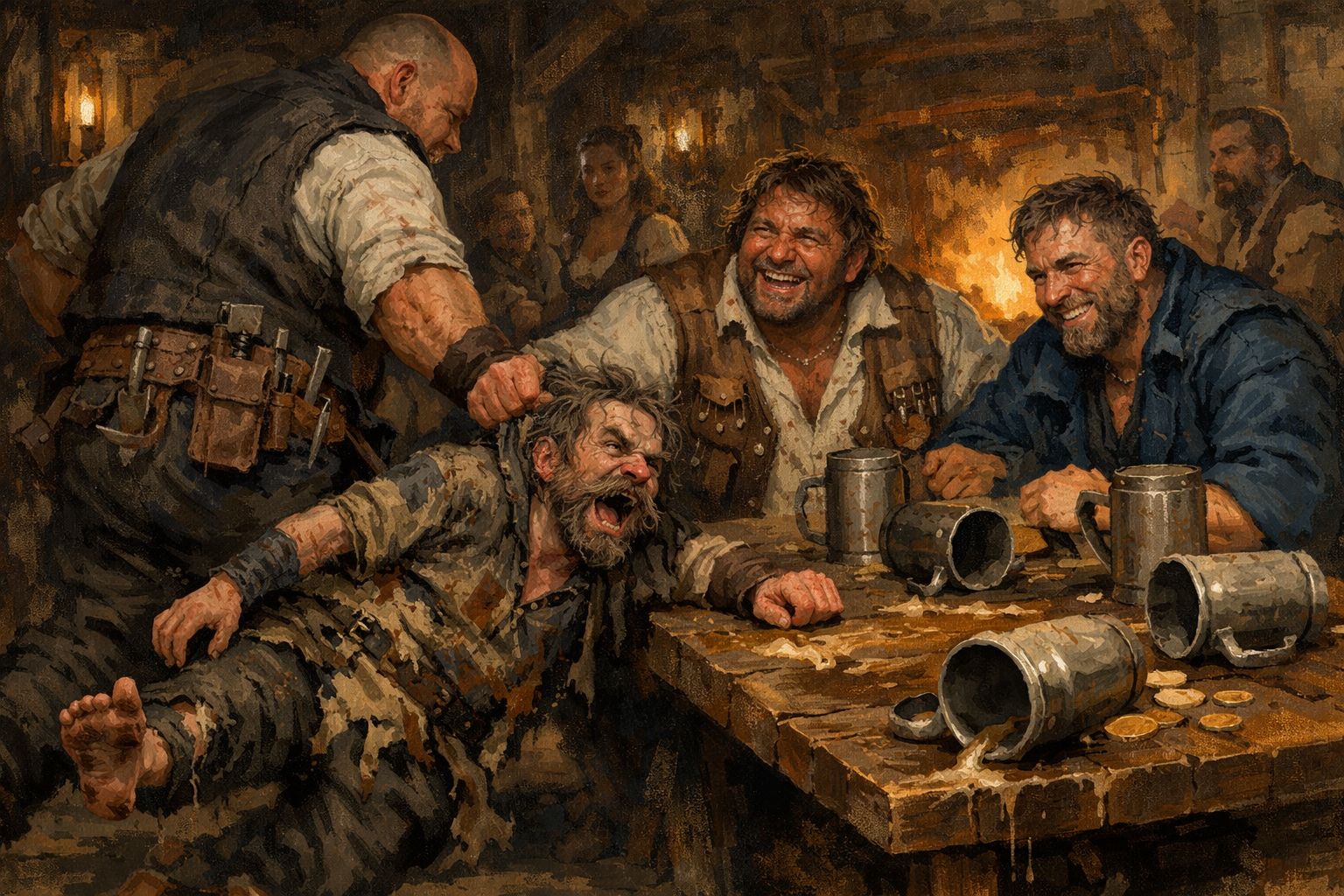
Urru the Carpenter
This encounter exists to deliver information, not to open a new front.
Urru is a dwarf carpenter working inside the restricted naval zone. He is drunk, loud, indiscreet, and proud of his proximity to something important he barely understands. He is not an informant in the professional sense. He is showing off.
Play him as sloppy and unreliable in tone, but accurate in substance. He brags, repeats himself, contradicts minor details, and stumbles into the truth rather than presenting it cleanly.
Paying for his drinks is enough. He treats secrets like party tricks. There is no leverage beyond alcohol and attention.
The Information
Urru reveals the existence of a new Imperial ship type.
It is massive, heavily built, armored, and designed to carry large numbers of troops. It has limited sail and poor maneuverability. It is not meant to pursue. It is meant to close distance under escort, board or smash defenders, or land forces rapidly on a hostile shore. Once forces are landed, it is meant to be beached, serving as a temporary fortress until a strong beachhead is established.
This is an Empire solution. Inelegant. Overbuilt. Brutal.
Let Galenor name it. “Combat barge” is appropriate and should feel dismissive at first, then unsettling.
The important takeaway is not technical detail. It is intent. The Empire is preparing for coastal assault, not naval dominance.
End of the Lead
When Urru is dragged away by his foreman, the encounter is over.
This is deliberate. The crew has what they came for. Further interaction with Urru would not yield more information.
Scope and Risk
Make it clear that sabotage is not the mission.
Interfering with the project is possible but extremely risky and highly visible. The area is locked down for a reason. Any attempt to disrupt construction risks immediate escalation and long term consequences.
More importantly, sabotage would not be interpreted as an isolated act. It would be read as Olydrian interference, regardless of who actually acted. Retaliation would not fall on the Blue Marlin alone. It would fall on the Isles.
If the players push toward sabotage, let them understand the cost before they choose. This act is about observation, not intervention.
Once the information is secured, the intended move is to leave.
Return and Payoff
Return to Zarynthos
When the Blue Marlin returns, the mood should shift immediately from celebration to attention.
Alepos receives the crew without ceremony, but not casually. He listens carefully. He asks clarifying questions. He weighs what they say against what Zarynthos already suspects. This is not panic. It is recognition.
If the players have not already stated it plainly, Alepos does.
The Great Empire is preparing either an invasion attempt or a major coastal strike. The design described leaves no other reasonable interpretation.
He speaks of preparation, not fear. Olydria must ready agile fleets. Fire catapults, the Isles’ primary naval answer to ships that cannot be rammed or boarded. Rapid response forces able to meet a landing before it becomes a foothold. Speed matters more than numbers. Reaction matters more than walls. The city states of Olydria must set aside their differences.
Do not play this as a council scene or a debate. Alepos does not need convincing. The information confirms what the Isles must now accept.
Consequences and Thanks
Alepos treats the crew’s actions as a real service to Zarynthos.
There is no theatrical gratitude. No speeches. No medals. He thanks them plainly and sincerely, and that carries more weight than ceremony. The information they brought has value beyond gold, and he makes that clear.
Their help will be remembered.
Make it clear that this is not the end of the matter. Preparations will continue offscreen. Rumors will spread. Decisions will be made. The world has shifted slightly because the crew chose to look instead of look away.
Rewards
Rewards should match the tone of the act.
Alepos does not offer coin. Instead, he gives what Zarynthos values. Barrels of the vineyard’s best wine. Carefully packed delicacies. Rare ingredients and preserved goods. Provisions chosen with care.
Make Yasmira visibly pleased.
This is a gift of culture and trust, not payment. Accepting it is an acknowledgment. From this point on, they are seen as one of Olydria’s own.
Ormun’s Departure
Ormun leaves with the crew openly and without hesitation.
He is free. That matters, and it should be felt. He does not sneak away. He does not look back in doubt. He says his farewells loudly and with feeling.
He boards the Blue Marlin as a member of the crew, not a passenger.
From this point on, Ormun is part of the ship’s life, its risks, and its loyalties. His choice is complete, and it closes this act on a note of earned connection rather than victory.
| Story |
|---|
| The coast pulls away slowly, white stone and green terraces shrinking into something softer, familiar shapes dissolving into distance. Ormun stands at the rail, hands resting on the wood, shoulders squared and unmoving. His face holds a strange balance, a wide smile that does not quite reach his eyes, eyes bright with something heavier than joy. |
| Cassandra hesitates, then steps up beside him. |
| “How do you feel?” she asks quietly. |
| Ormun lets out a long breath, part sigh, part laugh. |
| “I do not know,” he says. “It is big. I am free. There is a whole world out there for me now.” He watches the shoreline fade. “But I am also leaving home. Leaving friends. Leaving everything I know.” |
| Cassandra nods. “I understand. Freedom can be scary. I am still learning how to live with it.” She glances back toward the ship, the crew moving about their work. “Having friends helps. They help you learn how to be free.” |
| She looks up at him. “I can be your friend. If you want. I can help.” |
| For a heartbeat, Ormun just stares at her. Then his face splits open into a grin so wide it seems to chase every shadow away. A deep, booming laugh bursts out of him, rolling across the deck. |
| “Friends it is!” he says, gripping her hand carefully, as if afraid of breaking the moment. |
| Cassandra smiles. “Then we will discover the world and freedom together! And you can always talk to me.” |
| Ormun squeezes her hand once, gently. |
| “And you can talk to me,” he says. “Any time you feel sad.” |
| The coastline is almost gone now, but the ship moves forward, steady and sure, carrying something new with it. |
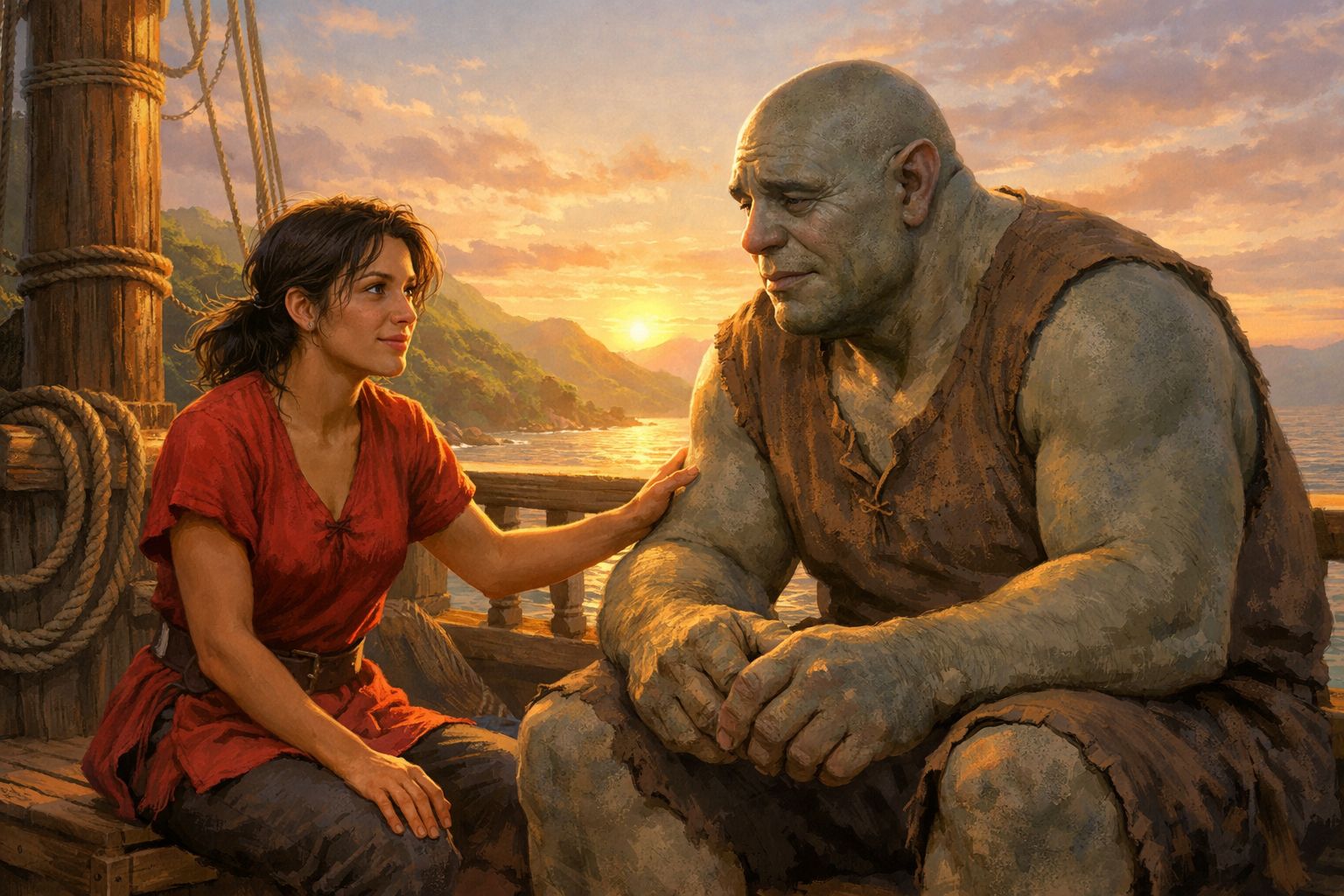
Act Summary
This act is about contrast, choice, and consequence.
It begins with openness, hospitality, and human connection, and ends with the quiet realization that the wider world is already moving toward war. Nothing explodes on screen. No banners are raised. But lines are drawn.
Core Takeaways
By the end of this act, the crew should carry several lasting changes with them.
Ormun joins the Blue Marlin as a free man and a full member of the crew. His loyalty is personal, absolute, and emotionally open. He is not an asset. He is family.
The crew gains personal, human understanding of the Waverider crew, especially Phaedros. These are not legends or names on a map anymore. They are people with habits, flaws, and relationships. This deepens the emotional stakes of the search.
The Waverider’s trail advances meaningfully. One new forward destination is confirmed, chosen by the Game Master, along with several earlier destinations being verified, corrected, or reframed. The pursuit now feels grounded rather than speculative.
The crew establishes genuine allies in Zarynthos. The Pelagos family, and by extension parts of Olydria, now see the crew as friends rather than passing outsiders. This is social capital, not protection.
Most importantly, the crew gains clarity. The Great Empire is not posturing. It is preparing. The world is already at war, even if many places have not yet admitted it.
The Empire’s Preparation
Through observation rather than intervention, the crew learns that the Empire is constructing a new class of naval vessel.
The Malion class vessel, or, as it is called by the Blue Marlin crew, combat barge, is designed for coastal assault rather than naval engagement. It is slow, armored, heavily built, and intended to land troops directly onto hostile shores under escort. Once beached, it becomes a temporary fortress until a foothold is secured.
This design reveals Imperial intent. The Empire is preparing to project force ashore, not merely contest the sea.
What the crew chose to do with this knowledge shapes what the world becomes next.
Long Term Consequences
Which outcome manifests depends on the crew’s choices, timing, and what information they carried forward.
If the warning reaches Olydria in time and preparation follows, news will later spread of an Imperial assault being met at sea. An agile Olydrian fleet harasses the escorts, sets the combat barge ablaze, and sinks several supporting vessels. The barge, named Malion Rex by the Empire, is destroyed at great cost to the Empire. Olydria suffers some losses, but the Isles hold. Their city states set aside rivalries, at least for a time, and the Empire does not attempt a similar strike again for many years.
If the warning does not translate into effective preparation, or is delayed, news will arrive of the Empire striking Phorakos instead. The assault succeeds. Imperial forces occupy the island in an attempt to break Olydrian sea power. Before the fall, many vital charts and maps are burned to prevent their capture. A few maps are smuggled out and saved. Phorakos remains occupied, separated from the rest of Olydria, and rumors of a counterattack circulate, so far without substance.
In this outcome, it becomes clear that Zarynthos was not the only shoreline measured. The Empire scouted many coasts, choosing its target with care.
What This Act Was About
This act was not about stopping a war.
It was about seeing it early.
The crew could not prevent the Empire from acting, but they could influence where, when, and at what cost. They learned that information matters, that hospitality can carry obligation, and that choosing to look away is itself a decision.
This act once again demonstrates a familiar truth. A slave can be freed, but slavery remains.
They also learned that success is rarely complete. It buys time, not safety.
A friend was freed.
A warning was given.
A war still came.
The world moves forward, altered slightly by their presence, and the sea remains wide and unforgiving.