Campaign: Elarune
Act Synopsis
This arc places the Blue Marlin crew in the forest homeland of Shaedra and uses Elarune to establish loss, moral pressure and the long reach of the slaver networks tied to the Twin Cities. It is designed to play quickly and linearly, serving as an emotional and narrative bridge rather than a self contained mystery.
Arrival and the Slave Raid
Shortly after making landfall along the forested coast, the crew witnesses a slaver operation in progress. Captives are being dragged from the tree line toward a waiting ship. Shaedra immediately recognizes the signs and insists on intervention. Whether the players act decisively or hesitate, the outcome is imperfect. Some captives are saved, others are lost. The point is not victory but urgency.
Among the survivors is a forest dweller, Fogstep, who carries news of the Waverider. He speaks of the Waverider crew's presence deeper inland and recognize Shaedra by lineage, grounding the information in shared history rather than coincidence. He offers to guide them there.
The Trail Through the Forest
Guided inland, the crew follows signs of repeated slaver incursions. They encounter an abandoned slaver camp and later the remains of a plundered village. The damage is as much spiritual as physical. Broken ritual masks, wounded tree twins and desecrated glades show what is being lost. This segment establishes Elarune’s culture through absence and harm rather than exposition. Use the reactions of Fogstep to drive home the importance of these desecrations.
The trail becomes a race. Another slaver force is moving toward the village, and there is no time for stealth or detours.
The Desperate Defense
The crew reaches the village with little warning. The defenders are druids and shamans, not soldiers, and their preparations are clumsy and hurried. The ambush that follows is chaotic and costly. The slavers are driven off, but lives are lost and rituals are broken in the process.
During the aftermath, the crew witnesses Elarune rites firsthand. Healing through plant magic, spirit trances guided by sacred spores and burial beneath living roots. Selene’s earlier presence here is spoken of with gratitude, creating a quiet parallel to Junia’s own path as a healer.
Tales of the Waverider
The villagers share what they know of the Waverider. Her crew are remembered as allies who warned them of slavers, freed captives and treated the wounded without demanding reward. Gato and Kethra are spoken of as quiet and lethal. Selene as tireless and gentle. These are not heroic legends but precise memories, meant to make the Waverider crew feel real and human.
The key witness who knew where the Waverider went next, Morthen Briarbound, a village elder, is gone. Captured by slavers three months earlier. Slavers captured in the battle know that he was shipped to the Twin Cities.
The Coded Trust
Before the crew departs for the Blue Marlin, the shamans give the crew a simple coded phrase. It means nothing on its own, but if spoken to Morthen, it will tell him where the village has relocated. This is not information but trust. A risk placed deliberately in the crew’s hands.
The villagers make it clear they will abandon this location permanently. The forest will close behind them, and the crew is warned not to return.
Departure Toward the Twin Cities
The arc ends with the crew returning to the Blue Marlin and setting sail for the Twin Cities. Shaedra leaves knowing she helped save lives, but not enough. Junia leaves with a living example of what her future might become. The crew gets familiar with the Waverider crew, a step on the path of seeing them as friends they haven't met yet. The players leave with a moral responsibility that will resurface later, when they learn the witness broke under torture and unwittingly caused the raid they just stopped.
Elarune fades behind them, not as a resolved chapter, but as a wound that will never fully close.
Arrival
| Story |
|---|
| The Blue Marlin anchored in a quiet stretch of coast where the forest pressed close to the water. Another ship already rode at anchor nearby, its hull dark with pitch, sails furled, crew moving about at an unhurried pace. It was a good spot. Sheltered, deep enough for larger vessels, easy access to shore. No one seemed surprised to see another ship there. |
| The crews met on the beach. Sailors talked like sailors always had. About weather, repairs, the quality of rum in the last port. The other ship’s men were easygoing, sun browned and relaxed, glad for company that was not trees and insects. They spoke of their work inland in vague terms. Cargo, hard to move through the forest. Dangerous work, but profitable. They laughed about leeches and mud, about how the forest seemed to watch you when you turned your back. |
| Nothing about them felt sharp. No drawn steel. No threats. Just men doing a job, waiting for it to be finished so they could leave. |
| Then the forest parted. |
| At first it was only movement between the trunks. Shapes in the mist. Then the sound reached the beach. Boots on roots. Shouted orders. A cry cut short. |
| A line of people was dragged out of the trees. Men and women, some barely standing, some half carried because their legs no longer worked. Wrists bound with rope, necks bruised raw. Blood streaked skin where branches and blows had done their work. One woman stumbled and was hauled upright by the hair. Another was struck for moving too slowly. No one resisted. Whatever fight they had left was gone. |
| Armed raiders flanked them, hard eyed and unhurried, their work already done. They moved with the ease of men who had done this before. |
| On the beach, the sailors barely reacted. One of them sighed and shook his head, more annoyed than troubled. “Took them long enough,” he said, then raised his voice toward the raiders. “Careful with that one, she’s worth more alive.” Another laughed and clapped a companion on the shoulder, already talking about how soon they could cast off once the cargo was aboard. |
| Their tone did not change. There was no malice in it. No cruelty. This was simply how things were done. |
| Shaedra went still. Her hand tightened on her bow, knuckles white, breath shallow and sharp. When she spoke it was low, burning, every word forced through clenched teeth. She did not look at the captives. She looked at Captain Scarnax. |
| “We stop this,” she said. Not a plea. A demand. “Now.” |
| Scarnax did not answer immediately. His eyes moved instead. He counted the raiders. Measured the distance to the other ship. Noted the weapons, the posture, the way the sailors continued their easy talk even as blood dripped onto the sand. He looked at his people. At the forest. At the water. |
| The moment stretched, tight as a drawn line. |
| Whatever he decided, it had to be decided now. |
Situation at the Shore
Two groups are present. The slaver ship Tidebound Mercy anchored offshore with a relaxed deck crew of twelve sailors led by First Mate Harlon Reeve. On land are eight forest raiders under the command of Vask the Hook, veterans used to quick extraction rather than prolonged fights. The captives number between ten and fifteen, many injured and exhausted.
The Tidebound Mercy crew sees nothing unusual in the situation. They are merchants, not fighters, and expect the raiders to deliver cargo and be paid. They do not want a fight, but they will not abandon profit lightly. The raiders are alert but not defensive. Their job is almost done.
Captain Scarnax must decide quickly. Delay favors the slavers.
If the Crew Chooses to Fight
This becomes a fast, brutal skirmish rather than a set piece battle. The goal is disruption, not annihilation.
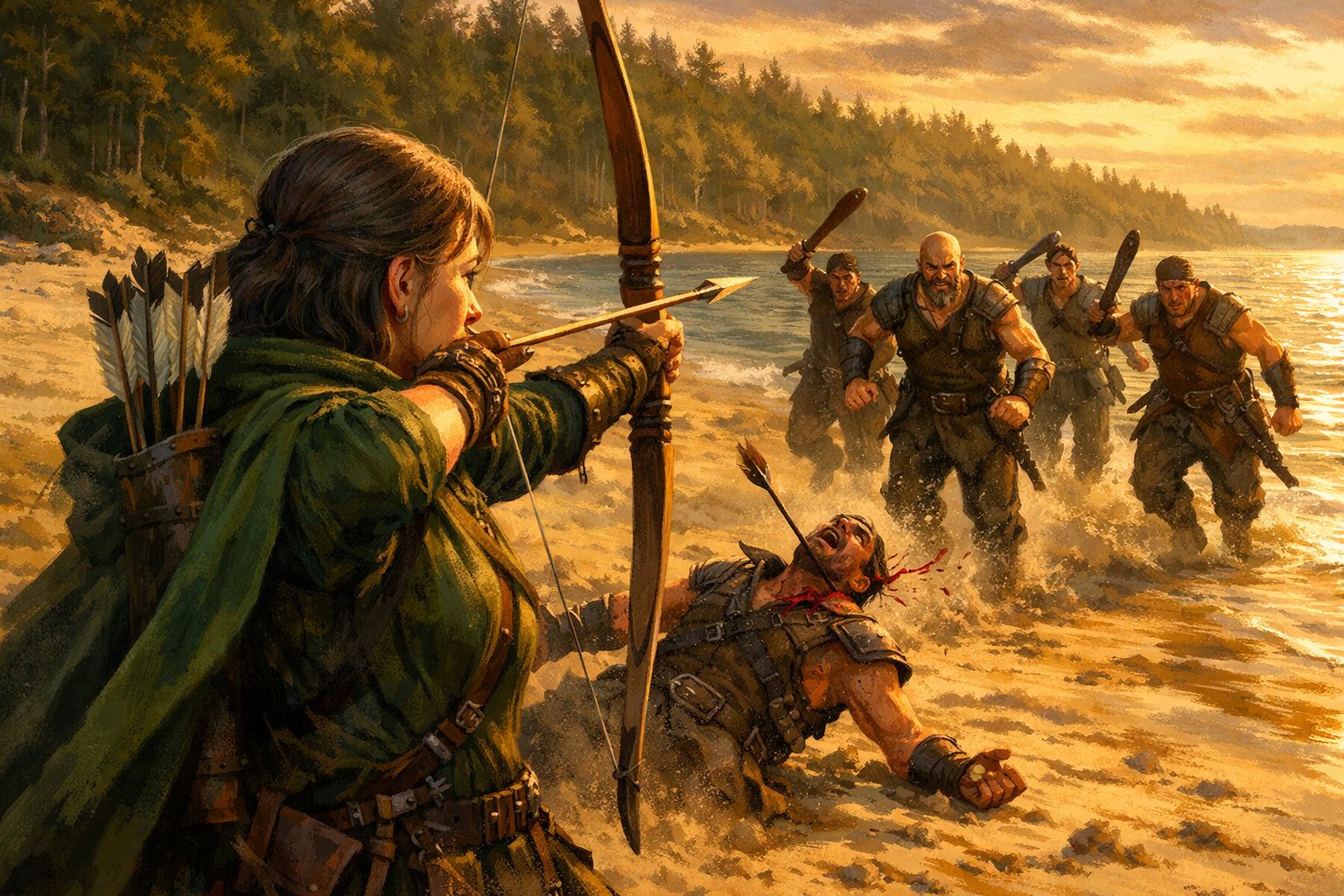
Shaedra has clear sight lines and the beach offers no cover. She can realistically drop several raiders before they close distance, and she will point this out if the players hesitate. This should be framed as tactical reality, not rules advice.
The Blue Marlin sailors can keep the slaver sailors occupied. They are not eager to fight and will not press aggressively. If the raiders start to lose ground or suffer heavy losses, First Mate Reeve will order the Tidebound Mercy to cut loose and flee, even if it means abandoning the raiders on shore. He values ship and crew over hired muscle.
The fight should feel dangerous but controlled. Raiders fight hard, but are equipped with only clubs and knives, and will break and run or surrender rather than fighting to the end. To them, it's still business, not conviction. Sailors defend themselves but do not pursue. Characters should be bloodied and pressured, not killed. This is an early arc and the intent is urgency, not punishment.
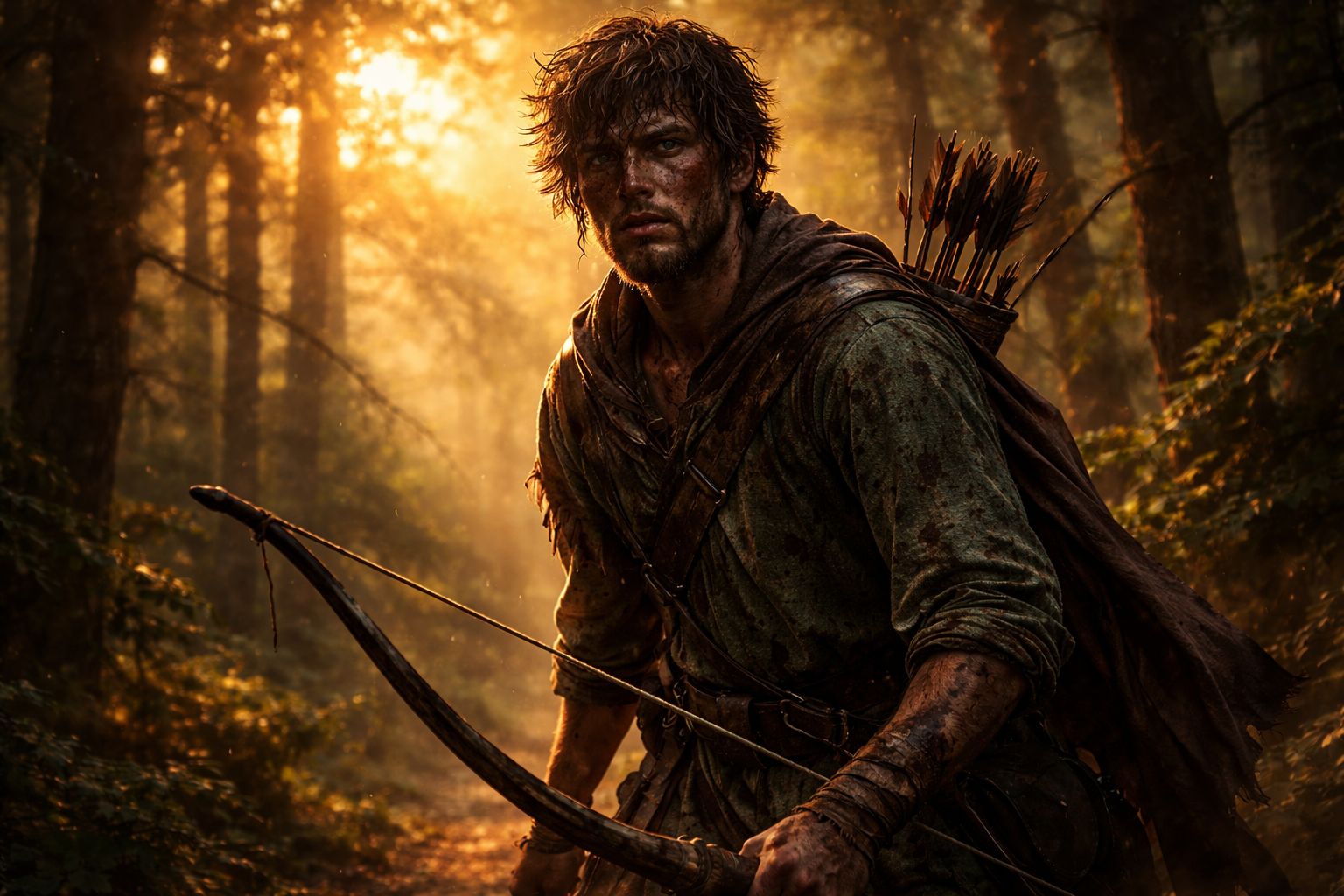
Fogstep may already be among the captives or may emerge from the forest mid fight. If used actively, he supports with a bow from concealment, targeting raiders. His intervention should feel competent but limited. The game master can make this decision on the fly, using him to balance the fight as needed.
If the captives are freed, they will follow the group part of the way inland to their own village, Mistroot. They are frightened, grateful and in no condition to fight further.
If the Crew Chooses Not to Fight
Shaedra will be furious. She will argue forcefully with Captain Scarnax, framing the choice as abandonment rather than caution. This tension should be allowed to sit. Do not resolve it immediately.
Negotiation does not succeed. First Mate Reeve is polite, calm and immovable. The Tidebound Mercy is under contract to deliver slaves to the Twin Cities mines. Returning empty handed would damage future deals far more than losing a single opportunity for profit. Even excessive payment will not sway him.
Once it becomes clear that the Blue Marlin will contest the slaves, the slavers become alert. Raiders tighten formation. Sailors fetch weapons. Any attempt to start a fight now would be extremely costly and likely result in civilian deaths among the captives.
The ship departs with its cargo.
Fogstep appears after the slavers leave. He has been shadowing the raiders, waiting for an opening that never came. He recognizes that the crew argued and considered action and does not treat them as enemies. He is guarded but respectful, especially toward Shaedra.
Common Outcome and Continuation
In both paths, Fogstep knows of a village, Elderglen, further inland that was aided by the Waverider crew. He recognizes Shaedra by lineage and treats her presence as significant. He offers to guide the Blue Marlin crew there.
If captives were freed, they accompany the group for the first stretch of the journey to their own village, Mistroot.
If captives were taken, the journey begins under heavier emotional weight. Shaedra’s anger carries forward, and Fogstep’s quiet resolve reinforces that the forest has not given up, even when outsiders have walked away.
This decision sets the emotional tone for the Elarune arc and colors Shaedra’s relationship with Captain Scarnax going forward. Eventually, she will see the sense in his decision, and even if she doesn't agree, can accept it. She has had to make hard decisions, and she can plainly see how hard the decision was for him.
| Story |
|---|
| The deck was quiet, the kind of quiet that only came once the ship was well underway and the work of the day was done. The forest was long behind them. Ahead was only dark water and a line of stars trembling on the waves. |
| Shaedra found Scarnax near the rail. He was alone, hands resting on the wood, staring out at the ocean as if it might answer him if he looked long enough. |
| “You made the wrong call,” she said. There was no greeting, no softening of the words. The anger in her voice was sharp and raw, scraped clean by hours of restraint. “You left them. You saw what was happening and you let it happen.” |
| He did not turn at first. When he did, his face looked older than it had before. Tired in a way sleep would not fix. |
| “I don’t know,” he said quietly. His voice caught, just slightly. “I don’t know if it was the right call.” He swallowed and looked back out at the water. “I made it because my first responsibility is this crew. A fight there would have cost lives. Maybe yours. Maybe mine. Maybe people who trusted me to get them home.” |
| His shoulders sagged, the weight finally finding somewhere to rest. |
| “Don’t you think I wanted to save them,” he said, the words breaking, almost a whimper. “Don’t you think I will carry that with me.” |
| Shaedra’s anger did not vanish, but it shifted. She stood beside him now, close enough that he could feel her there. |
| “Some decisions are hard,” she said. “Some only become harder when you look back at them.” She breathed out slowly. “I have made choices that cost lives too. I live with them. I always will.” |
| She reached out and pulled him into an embrace. For a moment he stood stiff, then his arms came up around her, gripping as if she might disappear if he let go. They both cried then, quietly, without shame. |
| When they finally pulled apart, neither spoke. They sat side by side on a coil of rope, facing the endless black water, watching the ocean roll on as it always did, indifferent and immense. |
| For a long time, there were no more words. |
The Trail
The Camp Site
Not far from the shore, the trail leads to a rough camp carved into the undergrowth. It is unmistakably slaver made. Trees hacked back rather than shaped. Roots chopped through instead of stepped around. A fire pit dug straight into living earth, ash scattered where it killed moss and ground growth alike.
There is blood. Not enough for slaughter, but enough to show violence. Dark smears on bark where someone was struck and dragged. Drops pressed into leaves where a wound was reopened and ignored. This was not a place of rest. It was a holding point.
Details to Show Indifference
Broken rope lies half buried in mud. A snapped branch where someone was tied. Empty skins and scraps of food tossed aside without care. Someone used a living sapling as a post, bark stripped where bindings rubbed it raw.
If the captives were rescued, one of them recognizes a small cloth rabbit thrown into the bushes, soaked and trampled. A child freezes when she sees it, then runs to reclaim it with shaking hands.
If no captives were rescued, the rabbit is found abandoned, crushed into the mud near the edge of the camp. No one here cared enough to notice it was dropped.
Tone to reinforce
This camp should feel temporary and careless. The slavers did not fear the forest and did not respect it. They passed through it like a wound closing behind them, leaving only damage and silence.
Do not linger here. This is foreshadowing, not a scene to solve. It exists to set expectation. What comes next will be worse.
Mistroot Village
| Story |
|---|
| Mistroot should have been loud. |
| It should have greeted them with the sound of wind moving through high branches, with voices calling down from living platforms, with the soft creak of rope bridges swaying between trees. Instead there was only silence, thick and wrong, pressing in from all sides. |
| The first of the freed captives broke into a run before anyone could stop her. A small girl, barefoot, clutching a mud stained rabbit to her chest. She called a name as she ran, high and thin, the sound tearing through the stillness. No one answered. |
| The village was ruined. |
| Living homes grown from bark and bough had been hacked apart, not dismantled, but butchered. Platforms lay splintered on the forest floor. Rope bridges hung slack or snapped entirely, their ends frayed like torn flesh. The great central tree of Mistroot stood scarred, deep gouges cut into its trunk where axes had bitten without care. Blood had soaked into the moss at its roots, dark and dried. |
| Tree twins lay wounded everywhere. Young saplings snapped and left to rot. Older trees burned at the base, smoke scars climbing their bark. For the people of Elarune, this was not destruction of property. It was murder stretched across generations. |
| They found bodies. |
| A druid lay slumped against a fallen platform, his wooden mask cracked in two, face frozen in a grimace of effort. His hands were still pressed to the soil, fingers broken, as if he had tried to force life back into the earth even as it failed him. |
| The shaman was found near the spirit glade. Her ritual mask lay beside her, carved antlers split down the center. Tattoos along her arms had been cut through with shallow, mocking slashes. Around her, the ground was scorched black where sacred fungi had been burned, the spirit paths severed in an act of deliberate desecration. She had died with her eyes open, staring into a world that had abandoned all meaning. |
| The freed villagers fell to their knees one by one. Some screamed. Some made no sound at all. One man rocked back and forth, whispering the names of his tree twin, his parents, his children, as if reciting them might keep them from slipping away forever. |
| Shaedra stood among them, unmoving. This was not her village, but it might as well have been. She recognized the rituals. The way the platforms had been grown. The marks left behind where spirits once lingered. Her jaw clenched until it hurt. |
| Fogstep knelt beside the shaman’s body and bowed his head. He pressed his forehead to the earth and stayed there, breathing slowly, as if afraid that standing would break something that could never be fixed. |
| When night came, there were no songs for the dead. Only quiet hands lighting small fires, careful not to wound what little life remained. The forest watched, wounded and silent, as its children grieved beneath broken branches. |
Purpose of the Scene
This scene exists to show the cost of the slaver raids in concrete terms and to reinforce what is truly being destroyed in Elarune. Do not turn this into an investigation or a combat follow up. The story has already delivered the emotional weight. This segment is about aftermath and direction.
What the Crew Finds
Mistroot is beyond saving. The living structures are cut apart rather than damaged. Tree twins are wounded or dead. Sacred glades are burned. The druid Eiran Leafscar and the shaman Ylsa Rootseer are both dead, killed where they tried to protect the village and its spirit paths.
Survivors confirm that the raid was recent and deliberate. The slavers did not just take people. They destroyed rituals, killed spiritual leaders and ensured the village could not recover.
More raiders were involved than the group seen on the coast. That force split after the attack. One portion returned toward the shore with captives. Another pressed deeper inland, continuing the raid pattern.
Role of the Villagers
The freed villagers grieve briefly, then speak with quiet certainty. Without a druid to tend growth and without a shaman to guide rites, Mistroot cannot remain. The spirits here are wounded and the place is known to outsiders.
They decide to leave.
They explain that they will travel inland to Shadebrook, a village that still stands and will take them in. It is a long journey, but it is the only one that preserves their place in the forest and in the spirit world.
They will part ways with the crew, and Fogstep will continue to guide the crew to their goal, Elderglen.
How to Move On
Make it clear that time matters. The raiders who continued inland are still out there, and another village is at risk.
Allow short farewells and practical preparations. Then push the crew forward. The trail to Elderglen is clear, but it is not safe.
Mistroot is finished. The race has begun.
The Desperate Defense
| Story |
|---|
| They came out of the forest at a run. |
| Breath burned in their chests, sweat streaked skin and gear, words tumbling over each other as they crossed into the living platforms of Elderglen. Shaedra did not slow. Fogstep did not hesitate. They shouted the warning into the trees themselves, voices raw and urgent, naming slavers, naming direction, naming time. |
| The village reacted at once. |
| There were no questions, no challenges. Elderglen recognized its own. Shaedra’s bearing, Fogstep’s markings, the way they moved through branches without looking down. Trust settled fast and hard. Ropes were cut. Platforms cleared. Children were pulled inward and upward. Druids shrouded defenders in underbrush. Shamans marked foreheads with ash and sap, murmuring to spirits that had already begun to stir. |
| It was not elegant. It was not planned. It was all there was time to muster. |
| Weapons were pressed into hands that rarely held them. Hunters took to the higher branches. Others hid where they could, clutching charms and each other. Someone rang a hollowed trunk, the sound rolling through the canopy like a heartbeat. |
| Then the forest answered. |
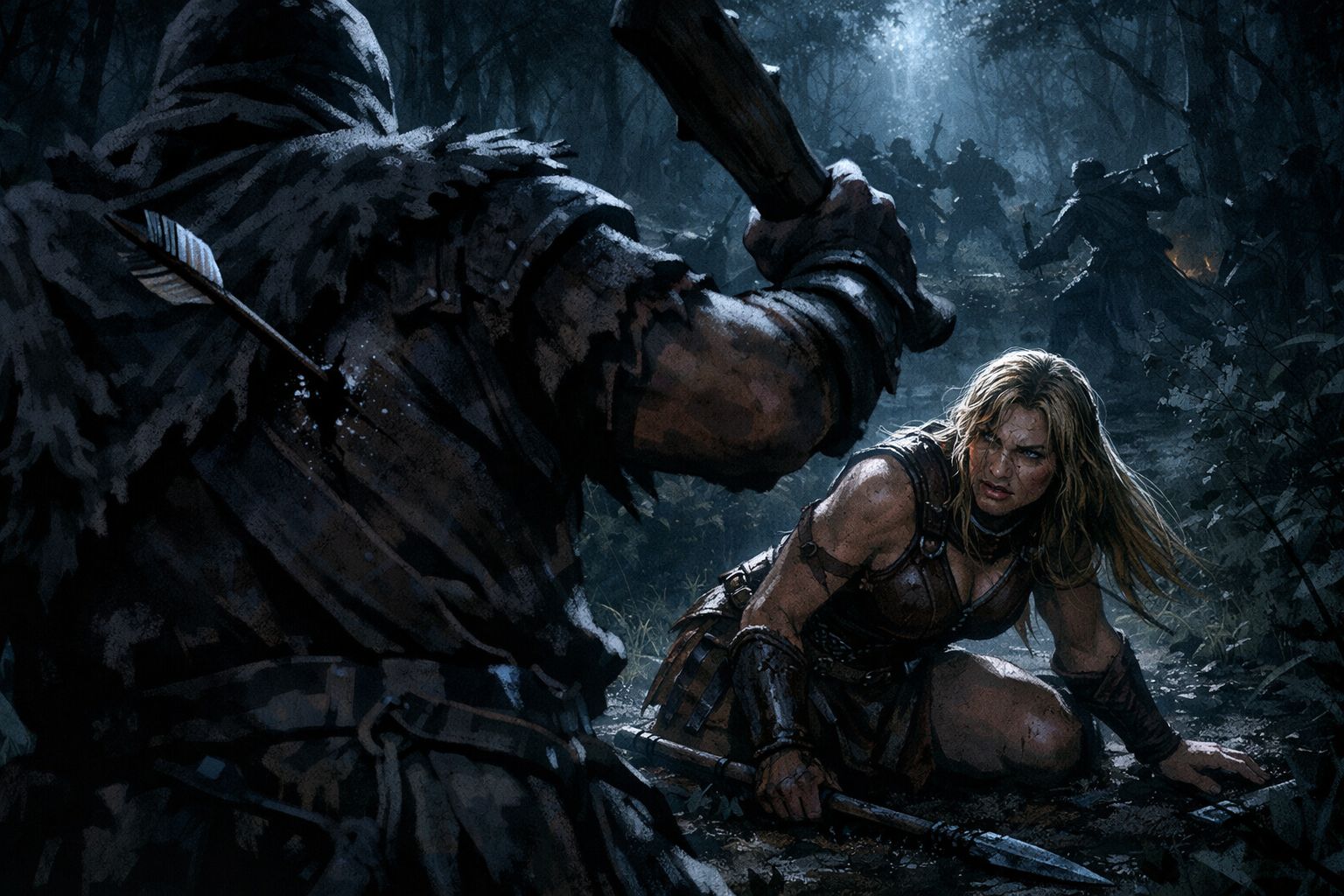
| Shouts rose from below. Boots struck roots. Shapes moved fast between the trees, no longer cautious, no longer patient. Raiders burst into view, clubs raised, knives flashing, momentum carrying them forward before the village’s defenses were fully set. |
| There was no more time. |
| The first raider broke from the undergrowth, and Elderglen met them head on. |
Intent and tone
This fight should feel chaotic and ugly. It is not a clean ambush and not a heroic stand. It is a desperate collision in dense terrain where visibility is poor and coordination breaks down quickly. The goal is confusion, fear and cost. Victory comes through attrition and resolve, not tactics.
The opening clash
The raiders enter fast and aggressive, expecting panic and flight. Instead they hit resistance that is half formed and uneven. Some defenses work. Others fail immediately.
The forest limits sight lines. Fighters lose track of allies. Orders are shouted and misunderstood. Someone stumbles from a platform. Someone else is struck down before realizing where the blow came from.
Villagers die in this first exchange. Not many, but enough to make the cost undeniable. Choose losses that matter. A young hunter. A druid apprentice. Someone the players spoke to moments earlier.
Escalation
Once the raiders realize they were expected, they adapt. Clubs are discarded. Daggers come out.
From this point on the fight becomes much more dangerous. The raiders aim to disable quickly and escape, cutting tendons, slashing throats when pressed, striking from close range. They are no longer trying to preserve cargo. They are trying to survive.
This is where the Blue Marlin crew matters most. They hold lines that villagers cannot. They plug gaps. They pull wounded back. Shaedra is lethal here, but even she cannot see everything.
Breaking point
As losses mount, the raiders’ confidence cracks. They are not fanatics. This was supposed to be easy.
When it becomes clear they are being beaten, they break. Some flee back into the forest. Others throw down weapons and surrender if given the chance. Do not force a last stand.
Let the fight end messily. With wounded crying out. With blood in the leaves. With no sense of triumph.
| Story |
|---|
| The fighting ended the way it began. Abruptly, without ceremony. |
| When the last shouts faded into the forest, Elderglen did not celebrate. There were no raised voices, no cheers. The village breathed in, slow and shaking, and then moved. |
| Healers were already at work. They knelt where people had fallen, hands stained with blood and sap, voices low and steady. Poultices of crushed leaf and resin were pressed into wounds. Bones were set with practiced force. Pain was not denied, but it was not indulged either. Junia was folded into the work without question, guided by quiet instruction and knowing glances. Someone murmured that Selene of the Waverider had taught them this binding, this stitch, this way of easing fever without dulling the spirit. Selene’s name was spoken with respect, not reverence, the way one spoke of a skill that had proven itself. |
| Shamans gathered at the edge of the village. Ash and fungus dust marked their skin as they slipped into shallow trances, breath slowing, eyes unfocusing. They spoke softly to the unseen, tracing the paths the raiders had torn through the forest. Directions were given. Signs read. A few hunters listened, nodded once, and vanished into the trees without another word. There would be no pursuit in force. Only quiet endings, handled far from the village. |
| Elsewhere, druids worked among the dead. |
| They washed bodies with water drawn from living roots. Broken masks were mended where they could be. Each fallen villager was carried to the tree that had been planted for them in childhood. Words were spoken, not loudly, not for comfort, but to mark the bond being fulfilled. Soil was parted. Bodies were laid beneath roots that already reached for them. Growth would follow. Life would not end here, only change. |
| Fogstep moved among all of it, silent, carrying what needed carrying, steadying hands that trembled too much. Shaedra helped where she could, though her jaw stayed tight, her eyes sharp, always counting what could not be undone. |
| As night settled over Elderglen, small fires were lit, careful ones, fed only with fallen wood. The forest leaned close again. Wounded, but still listening. |
Tales of the Waverider
| Story |
|---|
| They spoke of the Waverider when the worst of the blood had been washed away and the night had settled enough to allow quiet voices. |
| It was not a story told all at once. It came in pieces, offered by different mouths, as if no one person felt entitled to carry it alone. |
| An old hunter remembered the warning first. How the ship’s people had come without demands or ceremony, how they spoke plainly of slavers moving inland and left before thanks could be properly given. A woman with a bandaged arm spoke of captives cut free in the dark, of ropes falling away without a word spoken. Another recalled a man who moved through the trees like he belonged there, eyes always searching, already gone by the time anyone thought to speak to him. That one was Gato, they said. Quiet. Watching. Dangerous, and awkward in stillness, as if he did not know what to do when no one needed him. |
| Kethra’s name came with fewer words. A shaman described her as a shadow that left bodies behind. Not cruel. Not loud. Simply final. |
| When Selene was mentioned, the tone changed. Voices softened. She had stayed, they said. Long after the fighting was done. She had worked until her hands shook, until others had to take tools from her fingers. She had not asked who deserved help and who did not. She had simply healed, and some said the pain followed her, taken into herself so others did not have to bear it. |
| One of them spoke of the captain as well. Not loudly, and not with awe, but with certainty. Solonex Virellus had stood apart from the fighting, they said, watching everything, missing nothing. When he gave orders, they were followed, not because he shouted them, but because they made sense. He listened when spoken to, even by those with no rank, and when he decided, he did so cleanly. Afterward, he moved among the wounded without hurry, offering water, steady words and quiet thanks. Strong, they said, but not hard. Fair, and still kind, which in their eyes was the rarer thing. |
| There was no boasting in any of it. No shaping of legend. Just moments remembered because they mattered. |
| When they finished, no one spoke for a while. The fire cracked softly. Somewhere in the branches, something stirred. |
| The Waverider felt closer then. Not as a ship to be found, but as people already known. |
Purpose of this scene
This section exists to humanize the Waverider crew and bind them emotionally to the players before they are ever met. These are not legends or heroic summaries. They are remembered actions, told plainly by people who benefited from them. The goal is familiarity and trust, not admiration.
Use this moment to let the players feel that they are not chasing a ship, but people they already know something about.
What the villagers know
The villagers confirm that the Waverider was here months ago. Her crew warned Elderglen of slaver activity, freed captives and treated the wounded without demanding payment or allegiance. They left quickly and did not linger.
One person knew where the Waverider went next.
That person was Morthen Briarbound, a village elder. Not a druid, not a shaman, but a keeper of paths, stories and agreements between villages. He was captured by raiders approximately three months ago during a later incursion.
The villagers do not know where he was taken. They believe he was kept alive for questioning, but nothing more.
Information from captured raiders
Captured raiders do know where Morthen was sent. He was sold onward to the Twin Cities.
They will not volunteer this information. To them, Morthen was cargo, no different from any other captive.
This information can be extracted in several ways. Promising release works, but releasing them means releasing information about the location. Threats work. Shaedra is more than willing to supply and carry out those threats if needed. The tone should make it clear that this is not a clean or comfortable exchange.
Once revealed, the information should feel costly. The truth comes from pressure, not cooperation.
How to move forward
Once the destination is known, the path of the campaign is clear. The trail leads out of the forest and toward the Twin Cities.
Do not linger here. The purpose of this scene is connection and direction. The weight of what comes next belongs to the journey ahead.
The Coded Trust
| Story |
|---|
| They did not speak of it until the preparations were nearly done. |
| The wounded were stable. The dead were buried. What could be repaired had been bound and grown enough to hold. Only then did the shamans approach, faces marked with ash and pale sap, masks hanging at their sides rather than worn. This was not ceremony. This was something else. |
| Ylsa’s successor, a woman named Thren of the Deep Bark, spoke for them. Her voice was calm and deliberate, each word placed with care. |
| “We will not remain here,” she said. “The roots are cut. The paths are known. Elderglen will empty before the next moon.” |
| She looked at the crew, then at Shaedra, then at Fogstep, as if weighing all of them together. |
| “There is a phrase,” Thren continued. “A simple one. It means nothing to those who hear it, and everything to the one it is meant for.” |
| She spoke the words once, quietly. They sounded ordinary. Cool winds, blue sky. Something that could be said in a market, or a cell, or a moment of frustration without drawing a glance. |
| “If Morthen hears this from you,” she said, “he will know where we have gone. He will know that we still live.” |
| There was no demand attached to it. No instruction beyond that. Just expectation, heavy and unspoken. |
| “We are placing this in your hands,” Thren said. “Not as information. As trust.” |
| The shamans stepped back then. The villagers did not argue or ask questions. They were already dismantling what little could be taken, cutting ropes, loosening bridges, preparing to fade deeper into the forest. If the crew would return, there would be nothing here to return to. |
| As they parted, Fogstep lingered for a moment, eyes on the trees. |
| “Do not come back,” he said quietly. “The forest will close. If you follow after, you will find only spirits, and they will not know you.” |
Departure Toward the Twin Cities
The return to the coast takes several days. The forest offers no further resistance and no further threats. This stretch should be played quietly, allowing the weight of what has happened to settle rather than introducing new tension.
As the crew passes the remains of Mistroot, it is already empty. Platforms hang unused. Ropes sway without hands to guide them. The place feels abandoned rather than destroyed, as if the forest has begun to reclaim it with deliberate speed. Do not linger here. The absence speaks for itself.
The remainder of the journey is uneventful. No pursuit. No further raids. The trail fades as the land opens toward the shore.
The Blue Marlin still waits where it was left. The beach is undisturbed. The sea is calm.
Let the crew board without incident. This is a transition, not a test. The next chapter begins at Twin Cities.
Act Summary
Tone and mood
Elarune establishes loss without resolution. This is not a land that can be saved through victory, only endured through retreat. The mood should linger as quiet grief, moral pressure and the sense that even the right choices leave scars.
Understanding Elarune
The players learn Elarune through what has been damaged or destroyed. Slaver camps, ruined villages and wounded tree twins show that raids do not just take people but unravel an entire way of life. Druids, shamans and communal ritual are not flavor, but infrastructure. When they are killed, a village cannot remain.
Elarune survives through withdrawal, secrecy and trust rather than force.
The Waverider as people
The Waverider crew are framed as real, human figures rather than distant legends. Their actions are remembered precisely. Warnings given, captives freed, wounds treated without reward. Gato’s quiet competence, Kethra’s finality, Selene’s self sacrificing healing and Solonex’s fair leadership are established through lived memory.
By the end of the act, the players should feel they already know these people and want to find them.
Clues and direction
The only person who knew where the Waverider went next was Morthen Briarbound, a village elder captured by slavers three months ago.
Captured raiders confirm that Morthen was taken to the Twin Cities. This is the clear narrative lead out of the forest and into the next arc.
The lingering dilemma
The shamans entrust the crew with a coded phrase that will reveal Elderglen’s new location to Morthen. This is not a quest item, but a moral burden.
Whether and when to use that phrase will matter later.
The act ends with the Blue Marlin leaving Elarune behind, carrying grief, trust and a clear course toward the Twin Cities.