Campaign: Albirica Colony
Act Synopsis
Arrival in a Fractured Colony
The Blue Marlin arrives in the capital of Albirica, Corvessia, at a moment of visible shock. News spreads quickly that Fort Glimmerpass has burned, struck from behind by a Caerduin raid that slipped through imperial lines. Tracks and reports suggest inside knowledge, and the legion responds by rushing troops to seal the gap. This stabilizes the frontier, but at a cost. Garrisons elsewhere are thinned, patrols stretched, and fear fills the vacuum.
Albirica does not react with calm discipline. It reacts with suspicion.
Foreigners are watched. Questions linger too long. People imagine spies in every shadow. Granary guards double. Harbor inspections tighten. The colony is still functioning, but trust is eroding fast.
Searching for Eamon mac Braigh
Asking after Eamon mac Braigh, known in Albirica under the alias Ivar Strongbow, has immediate consequences. The crew learns he has been captured, identified as a Caerduin saboteur, and is currently under interrogation. His execution is scheduled for the arena in one week, framed as a public warning meant to restore confidence.
Their inquiries also ripple outward. Someone notices the pattern of their questions.
Sandros Pellaios becomes aware of them.
Rising Fires and Rising Fear
In the days that follow, unexplained fires break out. A granary burns. A warehouse smolders. A dockside storehouse goes up in the night. None of the damage is catastrophic, but each incident feeds the same conclusion.
Albirica is under attack from within.
The legion tightens its grip. Curfews are announced. Patrols become aggressive. Civilian vigilante groups form, stopping and questioning anyone unfamiliar. Beatings occur, justified as caution. The city begins to eat itself in fear.
The Blue Marlin crew feels the pressure directly. They are outsiders, visible, spoken about. Movement becomes difficult. Time begins to matter.
Sandros Pellaios Makes an Offer
Sandros Pellaios approaches the crew openly, calmly, as if this were inevitable. He does not name his employers, and the crew will not find out that he is acting on behalf of Zarhalem. He explains that his interests and theirs currently align.
He offers leverage. Information that will allow Eamon to be extracted quietly. He also offers two confirmed ports of call tied to the Waverider’s trail.
The price is destabilization.
Sandros asks for two actions. One is simple. A fire set in a remote warehouse to draw attention and stretch imperial response even thinner.
The second is final. The assassination of Governor Lucius Aurelian Marcellus, architect of Caerduin’s famine and the keystone holding Albirica together.
Sandros does not moralize. He presents it as arithmetic.
The Empire weakens. Caerduin breathes. His client gains leverage.
He leaves the choice to them, knowing they have little real choice.
The Fire and the Palace
The warehouse fire is easy. Light guards. Predictable routines. The blaze draws troops and rumor exactly as Sandros predicted.
The palace infiltration is not easy.
Reaching the governor requires careful movement through heightened security and a city already on edge. When the crew finally reaches him, the choice is taken from their hands.
Marcellus is already dead.
The White Lily is there, dressed in black, placing a single white lily on his body with ritual precision. She offers no explanation, only courtesy. Their objectives overlapped. Her contract is complete.
She vanishes, leaving behind certainty and dread.
Someone else is playing this game.
Aftermath: A City in Panic
The assassination shatters Albirica’s fragile confidence.
Administrative paralysis follows almost immediately, as orders conflict, offices lock themselves down, and no one is certain which signature still carries authority.
Patrols flood the streets. Searches become arbitrary. Foreigners are detained. Vigilantes grow bolder. Rumors spiral. The Empire’s authority no longer feels inevitable, only violent.
Sandros honors the agreement because results were achieved, but he frames the debt not as payment for failure, but as compensation for opportunity. He did not get what he paid for, but the world still moved in his favor. That distinction matters.
He is curious about the White Lily. He knows about her, has worked with her previously, but he does not know who she serves. That unsettles him. Clearly, another major power is involved.
Extracting Eamon mac Braigh
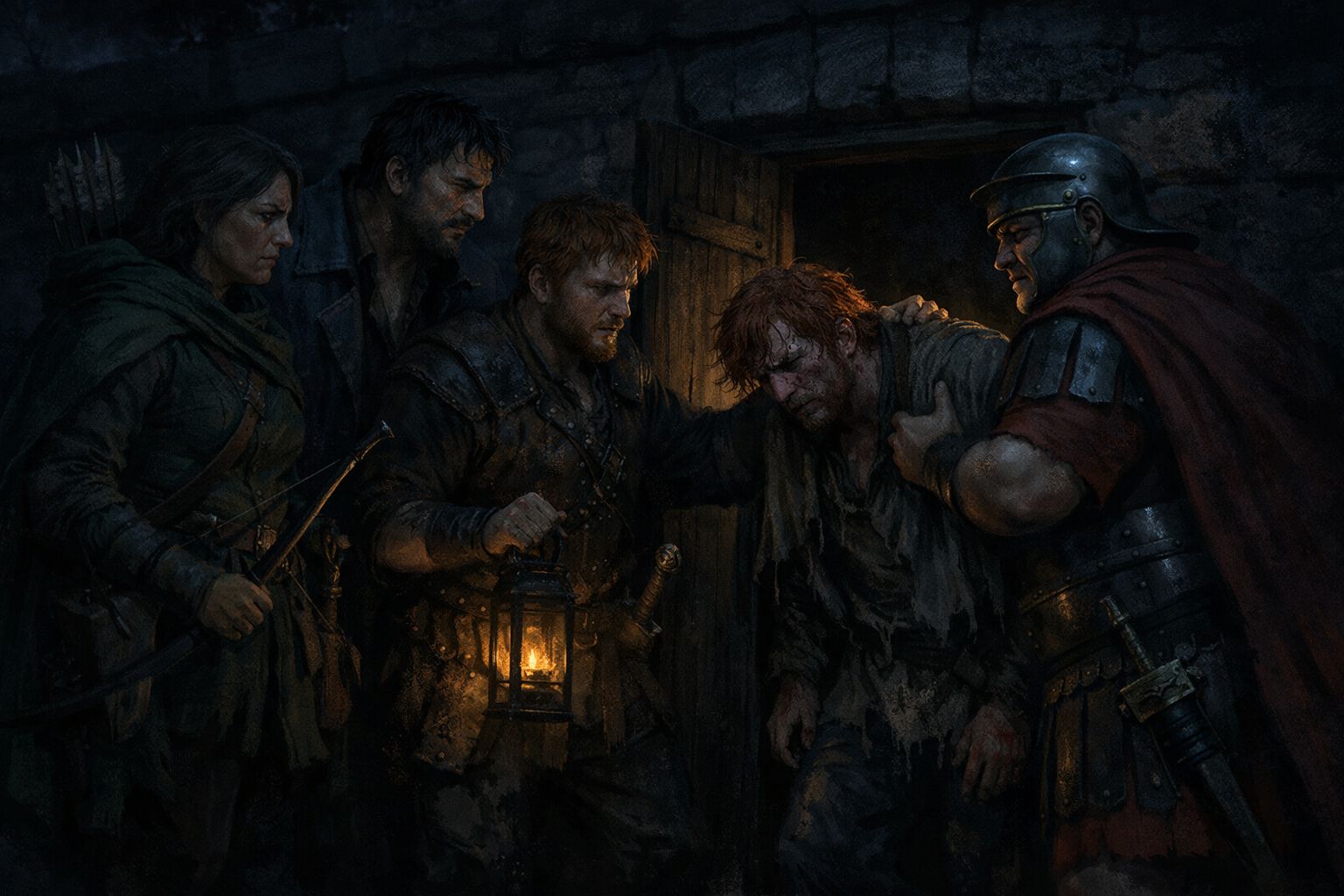
Using Sandros’s intelligence, the crew identifies a compromised guard. Blackmail is enough. Wine laced with sleeping draughts does the rest. The breakout is staged cleanly. Alarms are never raised.
Eamon is delivered to them broken, bruised, barely conscious.
Saving him is not difficult.
Getting him out is.
Escape Through a Hostile City
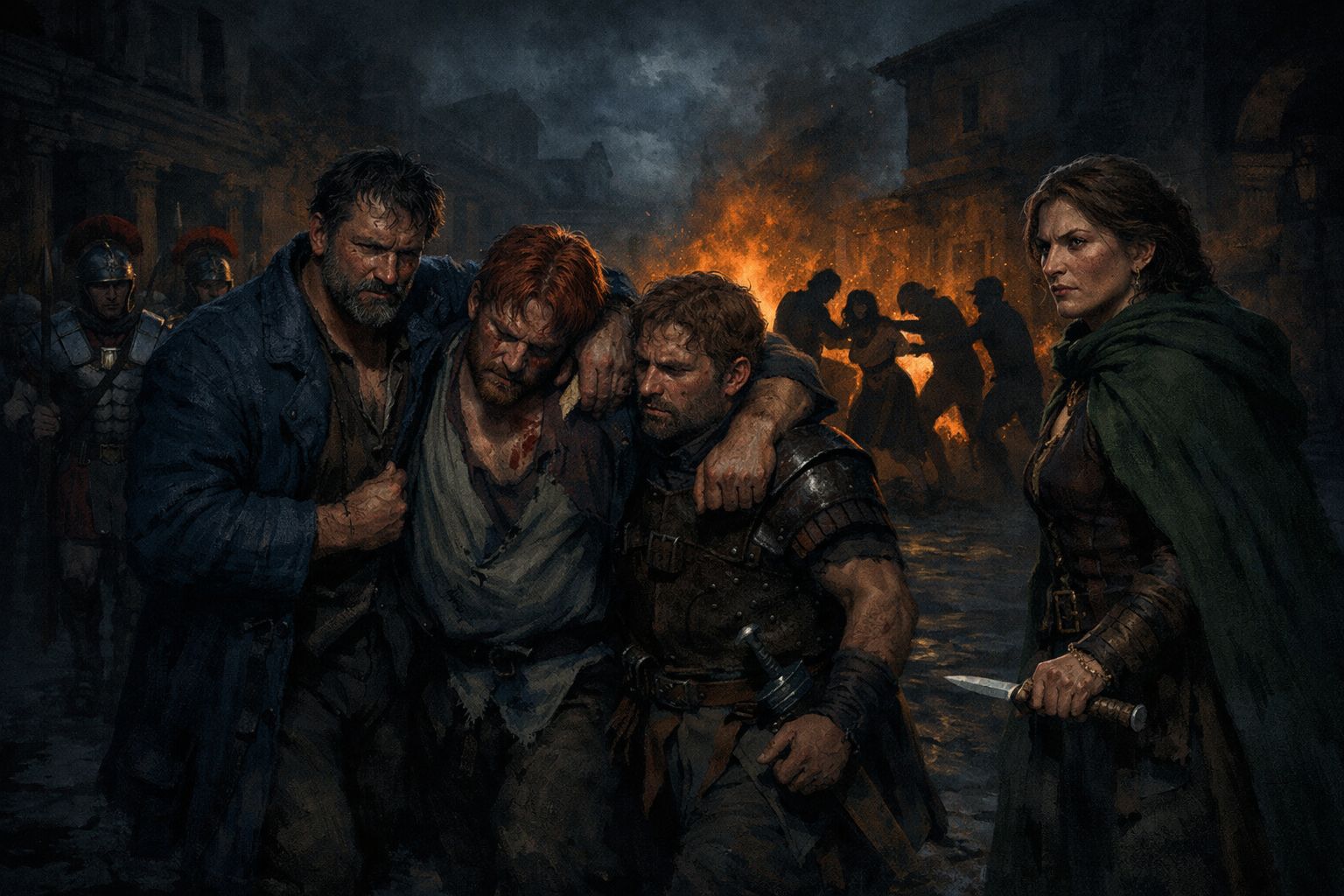
Moving Eamon through Albirica becomes the true test. His condition draws attention. Patrols stop them. Curfews close streets. Vigilantes roam unchecked. Every delay increases the risk of recognition.
The city is no longer just watching. It is hunting reassurance.
Reaching the harbor requires patience, misdirection, and restraint. Violence risks escalation. Speed invites notice.
When they finally reach the Blue Marlin, there is no celebration. Only relief and exhaustion.
Departure and Consequences
The Blue Marlin slips away under cover of chaos.
Sandros’s information points them toward the next Waverider destination. The trail continues.
Eamon survives. He can be returned to Caerduin or left within Albirica to continue the quiet war from inside imperial territory. He can also provide a Waverider port of call.
Behind them, Albirica convulses. A new governor will come. New legions will arrive. The Empire will retaliate, but not immediately.
For now, pressure eases. Caerduin gains time. Ardenvale is spared scrutiny.
The larger truth is revealed.
This war is not contained. Other powers are intervening. The Empire is being tested not by open rebellion, but by knives in the dark, whispers in corridors, and fear turned inward.
The Blue Marlin sails on, knowing now that the world is at war in more ways than open warfare, on a large scale.
Arrival in a Fractured Colony
| Story |
|---|
| The Blue Marlin reached Corvessia at dawn, sails slack as if the wind itself hesitated to carry them closer. |
| Smoke lay on the northern horizon, a long dark bruise against the pale sky. It was too wide to be a farm fire and too steady to be an accident. Even from the river it was visible, rising in a low smear beyond the hills, marking where Fort Glimmerpass had stood. No one on deck needed to ask what it meant. The Empire did not burn quietly. |
| Scarnax stood at the bow, hands resting on the rail, eyes fixed on the smoke. He had seen burning coasts and razed towns before, but this was different. This was an imperial wound, fresh and public. He felt the ship slow beneath his feet as Pelonias adjusted course, giving the harbor traffic space. |
| Pelonias frowned as he worked the helm, his usual calm narrowed into something sharp and attentive. Ships were leaving the harbor in a steady stream, packed low with supplies and men. Others arrived light and fast, messengers rather than traders. Nothing moved lazily. Even the water seemed tense. |
| On the quay, voices rose before the gangplank was lowered. |
| “They came from behind,” a dockworker was saying to anyone who would listen, his hands shaking as he pointed north. “From the hills. Gods know how they slipped through.” |
| Another spat into the water. “Traitors. Has to be. Someone opened the way for them.” |
| A woman clutching a bundle of cloth cut in, her voice tight. “They say the fort burned through the night. That the watchtowers fell before the horns could sound.” |
| Junia listened from the rail, eyes scanning faces rather than smoke. Fear showed differently on each person. Tight jaws. Rapid speech. People touching charms without realizing it. She saw the first signs of it already, the way suspicion settled into the body like a fever. This was how cities sickened. |
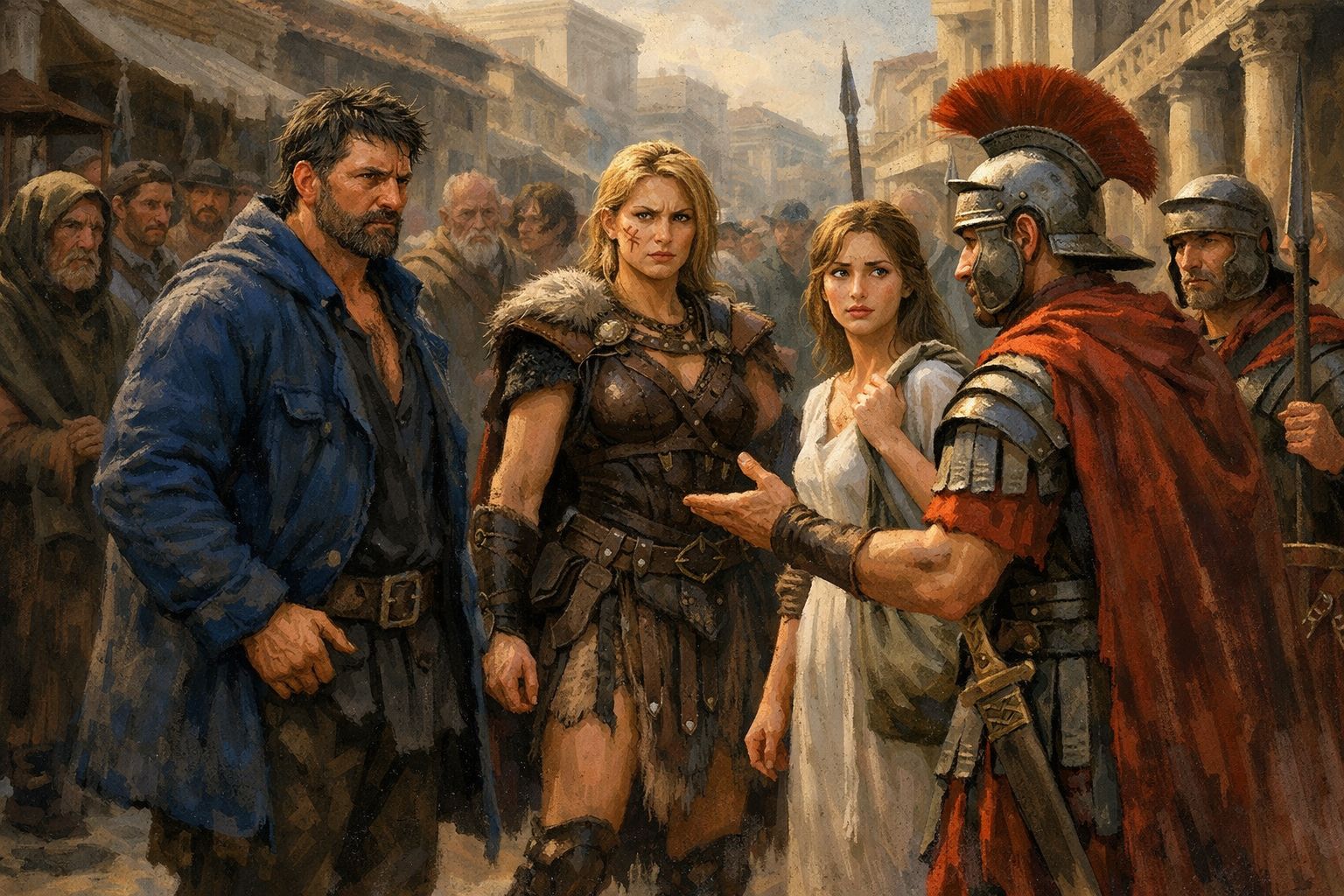
| A group of legionaries marched past the docks, armor dull with travel dust, shields stacked and strapped for speed rather than display. An officer barked orders without stopping, voice hoarse from shouting them too often already. More followed, then more, boots striking stone in a relentless rhythm as they moved north toward the smoke. |
| Amaxia watched them go, arms crossed, jaw set. “They are scared,” she said quietly, not mocking, not surprised. “That makes them dangerous.” |
| A merchant nearby overheard and rounded on her, eyes wild. “Scared?” he snapped. “We should be. If Caerduin can burn a fort, they can be anywhere.” |
| His gaze lingered on Amaxia a second too long before sliding away, as if something about her did not fit. He pulled his cloak tighter and moved off, muttering to himself. |
| The harbor master approached with forced briskness, flanked by two soldiers who tried and failed to look casual. He gave Scarnax a tight smile and asked for papers that had never been required before. Pelonias handed them over without comment, already cataloging the change. |
| Behind them, the city shifted uneasily. Shop shutters half closed despite the early hour. Doors barred from the inside. People whispered in doorways and fell silent when soldiers passed. Over everything hung the smell of smoke, faint but unmistakable, carried on the wind from the north. |
| Junia met Scarnax’s eyes briefly and nodded once. He understood. This place was already looking for someone to blame. |
| As the Blue Marlin was secured at the quay, another column of troops marched past, banners furled, faces grim. One young soldier glanced toward the ship, then quickly away, as if eye contact itself were a risk. |
| Pelonias followed his gaze back to the smoke on the horizon. “Forts do not burn by accident,” he said softly. |
| Scarnax did not answer. He kept his eyes north, on the dark line where imperial certainty had been cut open, and felt the city of Corvessia watching them even as they arrived. |
| Fear had already found its footing here. |
| And it was spreading fast. |
Purpose of the Arrival
This arrival is not about plot delivery. It is about emotional calibration.
The goal is to make the players feel that they have entered a place that is already reacting to something terrible, and that their presence coincides with fear rather than causes it. Corvessia should feel wounded, not yet broken, and already looking for enemies.
Nothing the crew does here fixes the situation. They are stepping into motion, not starting it.
What Has Happened Before the Crew Arrives
Fort Glimmerpass has burned during the night.
The attack came from an unexpected direction, likely using inside knowledge or exploited patrol gaps. This is not common knowledge yet, but it is the loudest rumor. The legion has confirmed the loss and responded immediately by pulling troops from across Albirica to seal the breach.
This has stabilized the frontier but destabilized everything else.
Garrisons are under strength. Patrol schedules are erratic. Officers are issuing overlapping orders. No one feels fully in control, and everyone knows it.
The smoke is still visible on the horizon. That matters. Keep it present, make it feel close.
Mood to Establish
Corvessia should feel tight.
People are moving quickly. Conversations are hushed or frantic. Doors are half shut. Shutters are not fully open. Guards are everywhere, but they are not calm. They are watching hands and faces rather than streets.
Fear is not yet screaming. It is whispering.
The city is still functioning. Markets are open. Ships are loading and unloading. But everything feels provisional, as if people expect it to stop at any moment.
How Information Is Delivered
Do not give a single clean explanation of what happened.
Let information come from panicked dockworkers, muttering merchants, exhausted soldiers, and frightened civilians. Every version should be slightly different.
Some insist the Caerduin clans had help. Others say traitors inside the colony opened the way. A few whisper that imperial officers sold information. No one agrees, but everyone is certain someone betrayed them.
The truth does not matter yet. Fear does.
Using NPC Reactions
Name people. Give them small details. A harbor clerk named Marcus who keeps dropping his tally stick. A baker named Tressa who has boarded her back door but keeps serving customers. A young legionary named Cassius who keeps glancing north instead of watching the crowd.
These people should not deliver exposition. They should bleed anxiety into the scene.
Have NPCs watch the crew too long. Have conversations trail off when soldiers pass. Have people lower their voices around foreigners without fully realizing they are doing it.
The Role of the Legion
The legion should be visible everywhere, but stretched.
Columns of soldiers march north through the city without ceremony. Officers shout orders that are obeyed but not questioned. Some units look well equipped. Others look rushed, missing pieces of kit.
This communicates two things. The Empire responds fast. The Empire is not as secure as it wants to appear.
Do not make the legion immediately hostile to the crew. Make them procedural, suspicious, and tired. Hostility comes later.
How the Crew Should Feel
By the end of the arrival, the players should feel watched.
Not targeted yet. Not threatened directly. But noticed.
They should understand that asking questions will ripple outward. That movement will be remembered. That mistakes will be noticed.
This is the foundation for everything that follows. The paranoia needs to feel earned, not imposed.
What Not to Do
- Do not introduce Sandros yet. Let the city breathe first.
- Do not resolve anything. This is not a briefing or a mission hook scene.
- Do not soften the fear with humor. Even casual jokes should fall flat in this moment.
- Let the players feel the weight of being present when confidence breaks.
Closing the Arrival
End the arrival once the crew understands three things.
- Something serious has gone wrong.
- The city is reacting badly.
- They are already part of the picture, whether they want to be or not.
From here, every question they ask and every name they mention matters.
Searching for Eamon mac Braigh
This section establishes two things at once.
First, that Eamon mac Braigh is already claimed by the system. The Empire has him, knows what he is, and intends to make an example of him.
Second, that information in Corvessia is available, but never free. Every question leaves a mark. Every name spoken has weight.
This phase should feel easy in terms of access to facts and dangerous in terms of exposure. What information they give is more important than what information they get.
What Has Already Happened
Eamon mac Braigh entered Albirica months ago under the alias Ivar Strongbow, posing as a Draknir trader moving goods along the Loarnach routes. His cover held until recently.
In the aftermath of the Fort Glimmerpass disaster, imperial counterintelligence began sweeping for internal threats. Old suspicions were reopened. Shipping records were reexamined. Names that did not quite fit were pulled aside.
Eamon was arrested this morning.
He was taken quietly, without a public charge, and moved to a holding facility beneath the eastern barracks of Corvessia. He is being interrogated as a saboteur and foreign agent. The legion believes he has connections to the recent raid, whether or not that is true.
An execution has already been scheduled.
In one week, Ivar Strongbow will be put to a spectacular death in the arena, framed as proof that the Empire is regaining control.
How the Information Surfaces
The players do not need clever plans to learn this. It is not a secret, in fact, it is used as a propaganda victory to show that they still are in control, that the culprit will pay.
But that's the big picture. Getting details about where he is held requires some discreet asking around.
If they ask the right people, they will get answers.
Dock clerks, junior officials, guards drinking off duty, and minor bureaucrats all know fragments of the story. Some speak out of fear. Some out of relief that someone else is asking. Some because they enjoy being close to something important.
Names you can use include Gellius Varro, a junior records clerk who drinks too much and talks too freely, and Hesta Lorn, a harbor scribe who prides herself on knowing who disappears and why.
Information comes quickly. That is intentional.
What should not come quickly is safety.
The Danger of Asking Questions
Every inquiry increases visibility.
Corvessia is already watching outsiders. Foreign accents, unfamiliar faces, and unusual movements stand out. When the crew asks about a detained trader or a scheduled execution, people notice patterns.
Officials may not intervene yet, but names are remembered. Descriptions are shared. Guards are told to keep an eye on certain individuals.
The players should feel that the city is quietly taking notes on them.
The Name That Must Not Be Spoken
This is critical.
Eamon mac Braigh must not be named openly.
If the crew uses his real name in public, even once, the tone of the act should change immediately.
The Braigh name is known. It is tied to rebellion, raids, and ongoing resistance. Speaking it in connection with a prisoner reframes him from useful example to high value political captive.
If the real name is used, assume the following happens quickly.
- The interrogation intensifies.
- Security around the prisoner increases.
- Paperwork increase and changes.
- Any chance of quiet extraction narrows sharply.
Do not punish the players arbitrarily, but do let the world react hard and fast. This is not a mistake that goes unnoticed.
Alias and Language to Reinforce
Encourage NPCs to correct the crew gently at first.
“No one by that name here. You mean Ivar Strongbow.”
Have guards and clerks flinch subtly if Braigh is mentioned, even in passing. Let someone nearby go quiet. Let a conversation end early.
This trains the table without lecturing them.
How the Game Master Should Play This
Be cooperative, not obstructive.
Answer questions. Provide details. Let the players feel that information flows.
At the same time, track how often they ask, where they ask, and who hears them. You do not need to announce consequences yet. Just let the pressure build.
This phase is about teaching the players that Corvessia is not a puzzle to solve, but a system that reacts.
What This Phase Should Accomplish
By the end of this segment, the players should know four things.
- Ivar Strongbow is in imperial custody.
- He will be executed publicly in one week.
- The Empire believes he matters, or at least want it to seem that way.
- Asking about him is already making the city look back at them.
Once those points are clear, move forward.
The trap is already closing.
Rising Fires and Rising Fear
| Story |
|---|
| The street had not changed, but the way people moved through it had. |
| Scarnax walked with his hands loose at his sides, the way he always did when he wanted to look unremarkable. Ayesha matched his pace half a step behind, her hood drawn just enough to soften her features without hiding them. They did not speak at first. Corvessia had developed ears. |
| A shopkeeper named Dorius was hammering a board over his side door with quick uneven strikes. He glanced up once, eyes sharp, then went back to his work without a word. Across the street, a woman argued with a pair of soldiers about a travel permit she did not have yesterday and needed today. The soldiers listened, stone faced, then waved her away without explanation. She stood there a moment longer, fists clenched, before turning and vanishing into an alley. |
| “They did not announce that one,” Ayesha murmured, her lips barely moving. “Permits.” |
| Scarnax nodded once. “They never do. Makes it feel temporary.” |
| They passed a tavern where the shutters were half closed despite the hour. Inside, voices rose and fell in sharp bursts. A name was spoken too loudly, then swallowed by a sudden silence. Someone laughed, brittle and forced. When the door opened, a man staggered out and nearly collided with Scarnax. He recoiled instantly, eyes wide, then muttered an apology and fled down the street without looking back. |
| Smoke drifted overhead, not from the horizon this time, but closer. A warehouse near the river had burned in the night. Not badly enough to cripple trade, just enough to leave a blackened shell and a story that grew with every retelling. |
| “I heard it was Caerduin,” whispered a fruit seller to a customer, leaning close. “A signal fire.” |
| “No,” the customer replied just as quietly. “Smugglers. They were hiding weapons.” |
| A third voice cut in, urgent. “Imperial drill gone wrong. They burned the wrong place and blamed someone else.” |
| None of them noticed Scarnax listening. Or perhaps they did, and pretended not to. |
| A patrol marched past, four legionaries and a junior officer named Cassius whose helmet sat a little too tight on his brow. He stopped one man, then another, asking questions that had no right answers. When he reached Scarnax, his gaze lingered for a fraction of a second longer than necessary. Scarnax met it calmly. Cassius hesitated, then waved them on. |
| Ayesha did not breathe again until they had passed the next corner. |
| “It is accelerating,” she whispered. “They are not calming people. They are teaching them to look.” |
| Scarnax glanced up at a public notice board where new parchment had been nailed over old. Curfew hours. Restricted districts. Penalties written in careful official script. Someone had already scratched a symbol into the wood beneath it, half a curse, half a prayer. |
| “They are scared,” Scarnax said. “And scared people want certainty.” |
| Ayesha’s smile was thin. “And certainty wants a target.” |
| They turned onto a narrower street where lamps were already being lit though the sun had not yet dipped. A pair of men stood at the corner with clubs in their hands, not soldiers, not guards. One nodded stiffly as they passed, eyes flicking to Ayesha’s hands, then to Scarnax’s boots. |
| “Vigilantes,” Ayesha breathed. “Already.” |
| Scarnax did not look back. “It will get worse.” |
| “Yes,” she said. “That is why we need to move before it feels normal.” |
| They continued on, blending into the flow of a city tightening around itself, while above them the smoke thinned and the fear beneath it thickened, settling into Corvessia like a second skin. |
Purpose of This Escalation
This phase exists to turn background tension into active pressure.
The city should move from anxious to reactive. Fear stops being something people talk about and becomes something they act on. The goal is not chaos, but misdirected certainty.
By the end of this phase, Corvessia should feel hostile without yet being openly violent.
How Fear Escalates in Practice
Fear does not rise evenly. It spikes.
Use small, visible changes rather than dramatic events.
A new curfew posted without announcement.
A warehouse fire that damages nothing important but draws attention.
A merchant named Dorius closing his shop at midday for the first time in years.
A guard named Crixus stopping the same person twice in one afternoon, asking the same questions.
None of these are decisive. Together, they are suffocating.
Who Acts on Fear
The legion reacts first with procedure.
They tighten patrols, add paperwork, and demand explanations for movements that were previously ignored. They are not cruel yet, but they are inflexible.
Civilians react next with imitation.
Vigilante groups form, claiming to protect neighborhoods. Most are well meaning. Some are not. Names to use include Talen Rook, a dockworker turned street watch, and Marra Vens, a tavern keeper who begins keeping a list of unfamiliar faces.
These groups do not need orders. They need permission, and fear gives it to them.
How to Apply Pressure to the Crew
Do not block the crew.
Slow them.
Have conversations interrupted. Routes closed. Familiar faces suddenly unavailable. Require explanations where none were required before.
Let the crew feel that every action costs time and attention. The point here is friction, not failure.
This reinforces that the city is no longer neutral ground.
What Not to Do Yet
- Do not turn fear into open riot.
- Do not make the legion openly sadistic.
- Do not single the crew out explicitly.
Those come later, if needed.
Right now, fear should feel ambient, unavoidable, and increasingly normalized.
Closing This Phase
End this escalation once the players stop asking whether things are getting worse and start assuming they will.
That is the moment Corvessia becomes a threat, not a setting.
Sandros Pellaios Makes an Offer
| Story |
|---|
| Sandros Pellaios found them before they found him. |
| Scarnax and Ayesha were halfway down a narrow street near the eastern baths, where steam curled lazily into air that felt too tight to breathe. A pair of legionaries stood at the far end, pretending to argue about paperwork while watching everyone who passed. A fruit seller had packed up early. Someone had chalked a warning sigil on a door and half erased it again. |
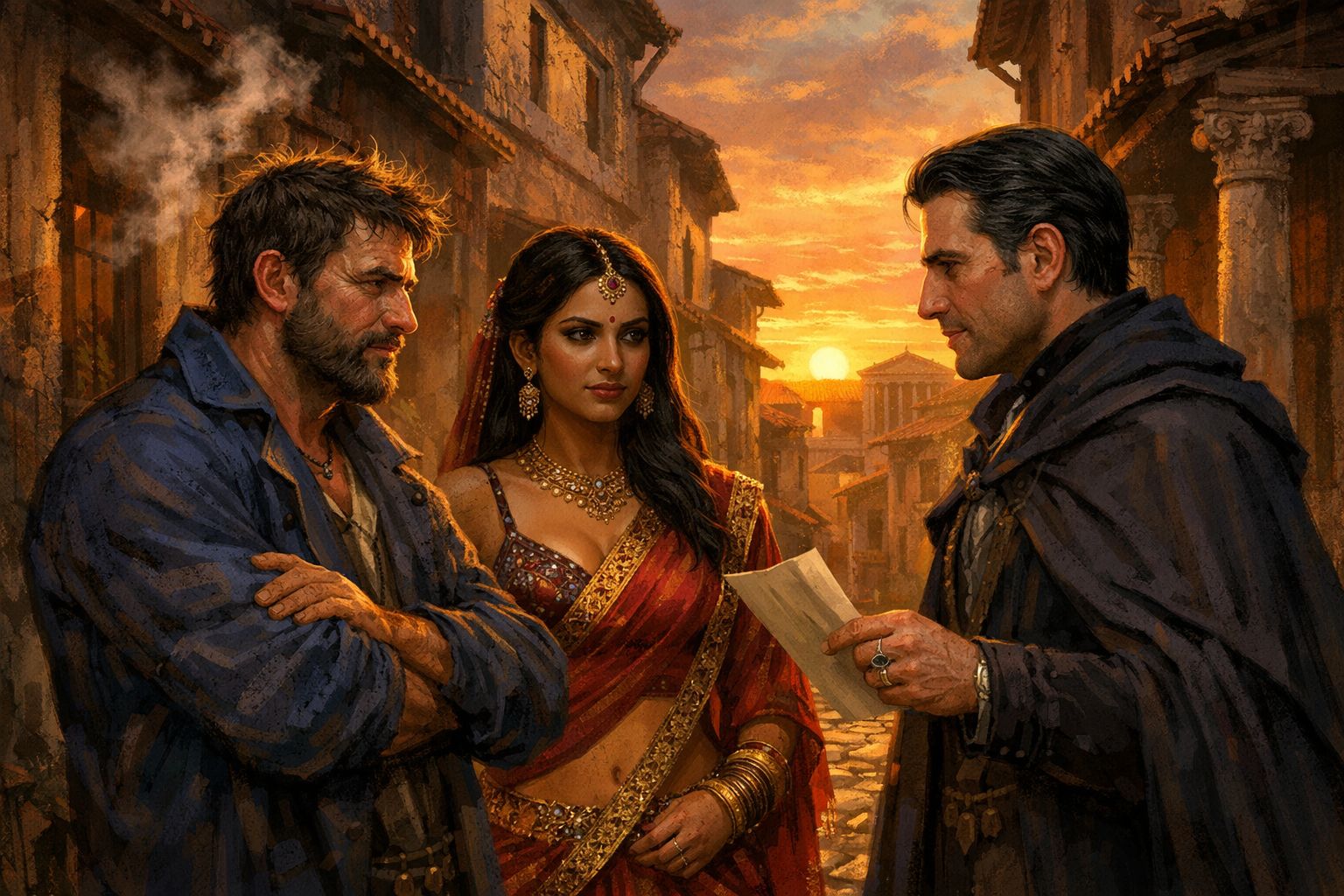
| “Captain Scarnax,” a voice said mildly, close enough to be unsettling. “Lady Marindar.” |
| Sandros stood beside a fountain that had not run in years, hands folded loosely behind his back as if he had been waiting for an appointment. He wore a plain traveling coat, clean but unremarkable, and held a folded paper he did not look at. His expression was relaxed, almost pleased. |
| Ayesha did not turn immediately. “You have us at a disadvantage,” she said softly. |
| Sandros inclined his head. “I try to avoid equal footing. It leads to misunderstandings.” |
| Scarnax studied him in silence. Sandros met his gaze without flinching, eyes sharp and curious, already measuring reactions. |
| “You arrived at dawn,” Sandros continued, as if reading from memory. “You spoke to a harbor clerk named Hesta Lorn and a records man named Gellius Varro. You avoided the arena district. Sensible. You asked careful questions and avoided one particular name. Also sensible. You are looking for Ivar Strongbow.” |
| Ayesha’s fingers tightened slightly in her sleeves. |
| Sandros smiled. “Do not worry. I admire restraint.” |
| “What do you want,” Scarnax said. |
| “To help,” Sandros replied at once. “Which happens, conveniently, to help my employer as well.” |
| “And who is that,” Ayesha asked. |
| Sandros laughed quietly. “No one you can write to. No one who would appreciate being named. Let us say a party with an interest in seeing imperial pressure reduced along certain borders.” |
| He stepped closer, lowering his voice though no one else was near. “I know where Ivar Strongbow is being held. I know which guard drinks alone after second bell. I know which signatures still matter on the transfer orders and which do not. I can give you a peaceful extraction. Quiet. No alarms. No blood.” |
| "I also know two ports of call for Waverider, which I think you will find valuable." |
| Ayesha glanced at Scarnax, then back to Sandros. “And the price.” |
| Sandros unfolded the paper at last. It was blank. |
| “Two small tasks,” he said. “One trivial. One significant.” |
| He gestured vaguely east. “There is a warehouse on the edge of the city. Old grain storage. Light guards. It burns easily. I would like it to burn at the right moment.” |
| Scarnax did not react. |
| “And the second,” Ayesha said. |
| Sandros’s tone did not change. “Governor Lucius Aurelian Marcellus.” |
| The name settled heavily between them. |
| “The architect of the Caerduin famine,” Sandros went on, almost conversational. “A careful man. A patient one. Also the lynchpin holding this place together. His death will accelerate everything already happening.” |
| Ayesha’s voice was very quiet. “You are asking us to kill a governor.” |
| “I am telling you that someone will,” Sandros replied. “I am offering you the advantage of timing.” |
| He folded the paper again. “You need my information. You despise the Empire. You want Strongbow alive. I am not presenting a moral dilemma. I am presenting arithmetic.” |
| Scarnax exhaled slowly through his nose. “You do not leave much room.” |
| Sandros smiled, unoffended. “Room is a luxury of safety.” |
| A long moment passed. A patrol turned the corner and moved on. Somewhere, glass shattered and someone shouted. |
| Ayesha nodded once. “We will consider it.” |
| Sandros’s smile widened just enough to be confident. “Of course you will.” |
| He stepped back, already disengaging. “I will be nearby. You will know where to find me. And Captain,” he added, meeting Scarnax’s eyes again, “do not worry. Keeping my word is good for business.” |
| Then he was gone, leaving behind only the faint sense that the city had shifted slightly around them, and that a path had narrowed to exactly the width Sandros Pellaios required. |
Purpose of This Scene
This scene introduces Sandros as a force, not a quest giver.
He is here to demonstrate that other powers are already acting inside Albirica, that the crew is late to the board, and that leverage matters more than intent. This is not a negotiation. It is a scheduling conversation.
How to Play Sandros Pellaios
Sandros should always appear calm, informed, and unhurried.
He never asks questions to learn. He asks them to confirm. When he states facts, he does so casually, as if they were already old news. He should never explain how he knows something. Knowledge is presented as a given, not a feat.
He does not threaten. He does not raise his voice. He does not argue morality. If challenged, he reframes. If resisted, he waits. Confidence is his primary weapon.
Sandros should feel one step ahead at all times. Even if the crew pushes back, it should feel like he anticipated that reaction and allowed for it.
What Sandros Wants
Sandros represents an unnamed employer with an interest in weakening imperial pressure along the Caerduin and Ardenvale fronts. He does not speak ideology. He speaks outcomes.
He wants instability, distraction, and acceleration.
The warehouse fire is meant to pull attention outward and thin response capacity.
The governor’s death is meant to break confidence, disrupt command, and force the Empire to react rather than plan.
Sandros does not care who performs these actions, only that they happen at the right time.
Sandros does not care about Caerduin or Ardenvale, and he does not pretend to. Their suffering, survival, or victory are incidental variables, not goals. What matters to him and to the people who employ him is pressure applied to the Empire at the right points. If Caerduin breathes easier for a season, that is useful. If Ardenvale avoids scrutiny, that is convenient. If either were crushed tomorrow but the Empire emerged weaker, divided, or distracted, Sandros would adjust without regret. He is not an ally of the oppressed and not an enemy of tyranny. He is a broker of imbalance. Caerduin and Ardenvale are tools, leverage points on a larger board, and Sandros feels no obligation to mourn them once they stop being useful.
What Sandros Offers
Sandros holds leverage the crew cannot easily replace.
He has precise information that allows a quiet extraction of Ivar Strongbow.
He has verified ports of call connected to the Waverider’s trail.
He can time events so that consequences fall elsewhere.
Make it clear through tone and certainty that he is not bluffing. His value lies in accuracy, not volume.
Presenting the Lack of Choice
Sandros should never say the crew has no choice.
He should behave as if the choice has already been made.
When the crew hesitates, he waits. When they object, he reframes. When they attempt to moralize, he reduces the problem to timing and math.
Agreement should feel reluctant, not forced. The crew consents because the alternative is worse, not because Sandros pressures them.
What This Scene Changes
After this meeting, the tone of the arc shifts.
The crew is no longer reacting blindly. They are now entangled in someone else’s design.
From this point forward, Sandros should feel present even when absent. His information will prove accurate. His predictions will land. His debt will linger.
This scene establishes that the war around Albirica is not just fought by legions and rebels, but by people who never wear armor and never admit allegiance.
Play Sandros as one of those people.
The Fire and the Palace
The Fire
This scene exists to lower the threshold.
It is not meant to be difficult, dangerous, or clever. It is meant to feel easy and uncomfortable. The act of burning food in a time of famine should sit poorly, even if the target is imperial stock.
This is the first step across the line. Once it is done, turning back becomes harder.
The Target
The warehouse sits on the eastern edge of Corvessia, near the old river storage yards. It holds grain and dried goods awaiting redistribution to outlying garrisons.
It is not well guarded.
Two legionaries, both tired and bored, stand watch. Their names are Gaius Fen and Lucro Pell, neither of them exemplary soldiers. They were assigned here because more reliable troops are needed elsewhere.
They are alert enough to notice intruders, but not motivated enough to expect trouble.
How the Fire Plays Out
This should be straightforward.
The guards can be avoided, distracted, or neutralized without a fight. If confronted, they are more likely to retreat and raise an alarm than to stand their ground.
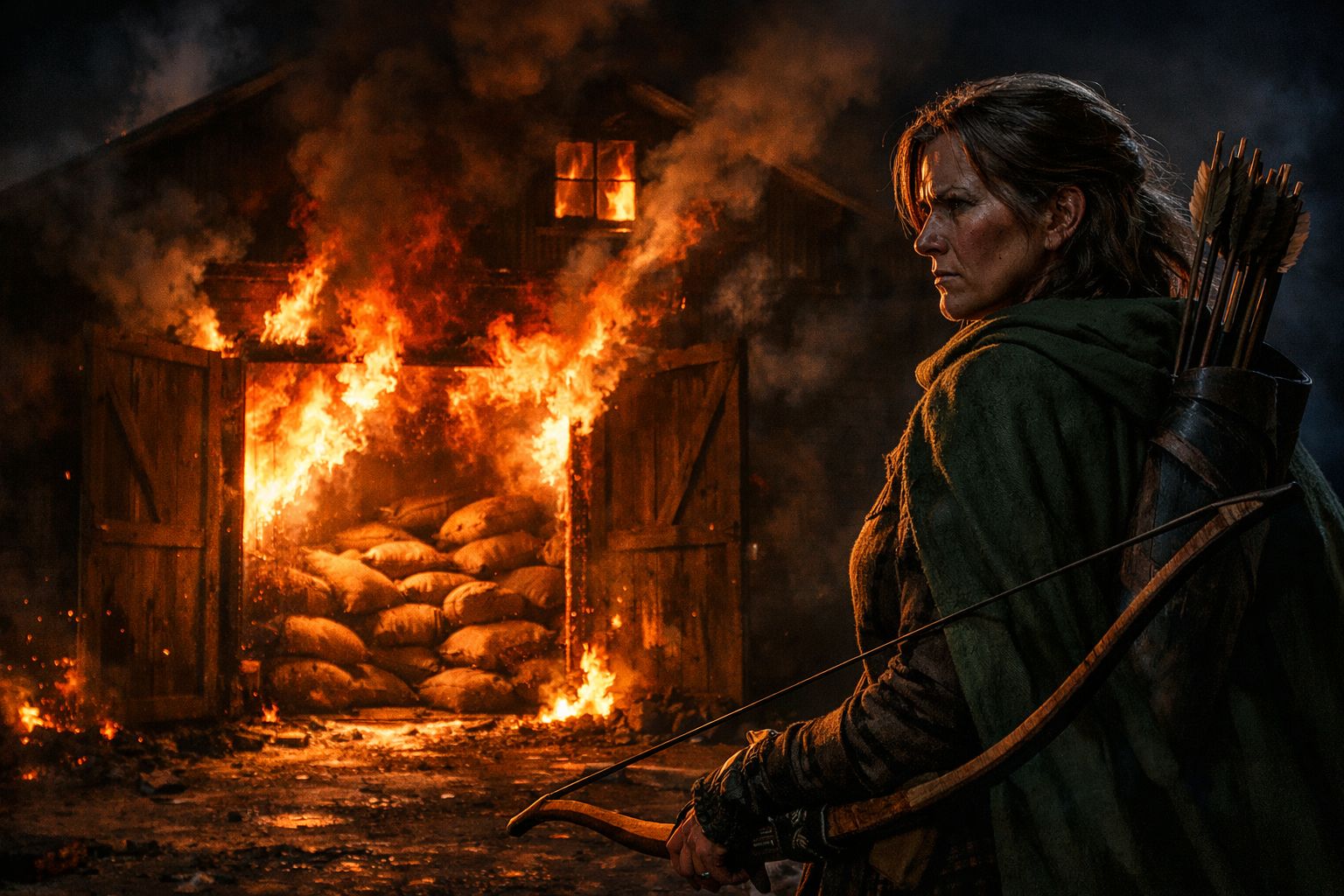
Starting the fire is easy. The structure is old. The goods are dry. A single spark in the right place is enough.
Do not complicate this scene unnecessarily. The point is not challenge. It is commitment.
Moral Texture
Emphasize what is burning.
Sacks marked for redistribution. Grain meant for soldiers, or possibly civilians later. Food that will never be eaten now. No one starves immediately because of this fire, but everyone feels the loss.
Let the players feel that they are not striking a symbol. They are destroying something real.
Immediate Consequences
The fire draws attention exactly as intended.
Troops are pulled from patrols and reassigned to containment and investigation. Officers redirect resources. Orders are shouted and countermanded.
Most importantly, pressure eases elsewhere.
Security around secondary sites thins, including the approaches to the governor’s palace.
The crew should not see this directly. Let them feel it later through absence.
How This Scene Should End
Once the fire is set and the crew withdraws, do not linger.
There is no reward, no confrontation, no dramatic aftermath.
Just smoke rising into a city already choking on fear.
A side has been chosen. From this point on, the crew is committed.
The Palace
This section is about contrast.
The palace should feel hard to enter and easy to move through. The difficulty is all at the edges. Once the crew is inside, the space should feel hollow, underused, and already abandoned by confidence.
This reinforces that imperial power here is brittle and overextended, relying on perimeter control rather than depth.
What the Palace Is and Is Not
The governor’s palace is not grand.
It was built early in Albirica’s history, when the colony was young and uncertain. It is closer to a walled mansion than a true palace, and the wall is more for privacy than defense. Thick walls, narrow courtyards, modest towers, practical stonework and a small garden. It was designed for administration and residence, not spectacle.
There are no sprawling gardens, no ceremonial avenues, no endless halls. Everything is compact and purposeful.
That modesty should make what happened here feel more intimate later.
Current Security Posture
The legion is spread thin and knows it.
As a result, security is concentrated at the perimeter. The walls, gates, and visible approaches are heavily watched. Guards here are alert, under orders, and unwilling to bend.
No amount of charm or quick talking will work at the gates. Orders are clear. No one enters unless personally known to the guard on duty. Papers do not matter. Rank does not matter unless it is familiar.
The wall does not exist to stop intruders, but to make sure that anyone who approaches the palace cannot do so without being seen. Inside the walls, however, security collapses quickly.
Most servants have been ordered to remain in their quarters. Administrative staff have been dismissed for the night. Patrols inside the palace are minimal to nonexistent. The assumption is that the perimeter will hold.
This assumption is wrong.
Ways In
A frontal approach should be clearly impossible. Too many reinforcements nearby, which will arrive quickly when the alarm is raised.
Bribery does not work. The guards here are not corrupt. They are afraid, and fear is more reliable than gold.
Distractions may draw attention away from one section of the perimeter, but they buy minutes at most. Once a disturbance is noticed, the alarm will spread quickly.
Waiting for night changes the equation. The walls can be climbed with care. Sight lines worsen. Patrol timing becomes predictable. This is risky but viable.
Rooftop entry is possible. The palace is built tightly against surrounding houses and temples. From the right adjacent structure, it is possible to cross over without ever touching the street.
There is also an aqueduct running past the palace. A narrow side channel leads directly inside. This is how the White Lily entered. Near the channel entrance, two guards lie unconscious, taken down quietly with drugged blowgun darts. This should be a clear sign that someone else has already passed through. If the players notice, they'll probably think it is Sandros' work. If so, let them.
The sewers technically connect to the palace, but they are filthy, cramped, and slow. They would allow entry, but escaping after that would be difficult and conspicuous. Use them only if the players insist.
Ileena can infiltrate the palace with little trouble. Her challenge is not the interior, but reaching the palace unseen through the increasingly hostile streets, and escaping in the even more hostile aftermath. Make that risk clear if she is sent alone.
Inside the Palace
Once inside, movement should feel almost unsettlingly easy.
Hallways are empty. Lamps burn low. Doors stand unlocked. The palace feels paused rather than guarded.
Include one minor moment of tension. A house slave moving quietly between rooms. A sudden voice around a corner. A place where the crew must hide and listen to footsteps pass.
Nothing more than that.
This is not a dungeon. It is a space already abandoned by authority.
Let the ease of entry and the emptiness of the palace linger. It should feel wrong, like arriving late to a place where something important has already happened.
The White Lily
| Story |
|---|
| The governor’s chamber smelled faintly of oil and cold stone. |
| Skarnulf stepped in first, hand half raised, already expecting resistance. There was none. The room was orderly, almost serene. A lamp burned low near the desk. Papers lay neatly stacked. No sign of struggle. No raised voices. No guards. |
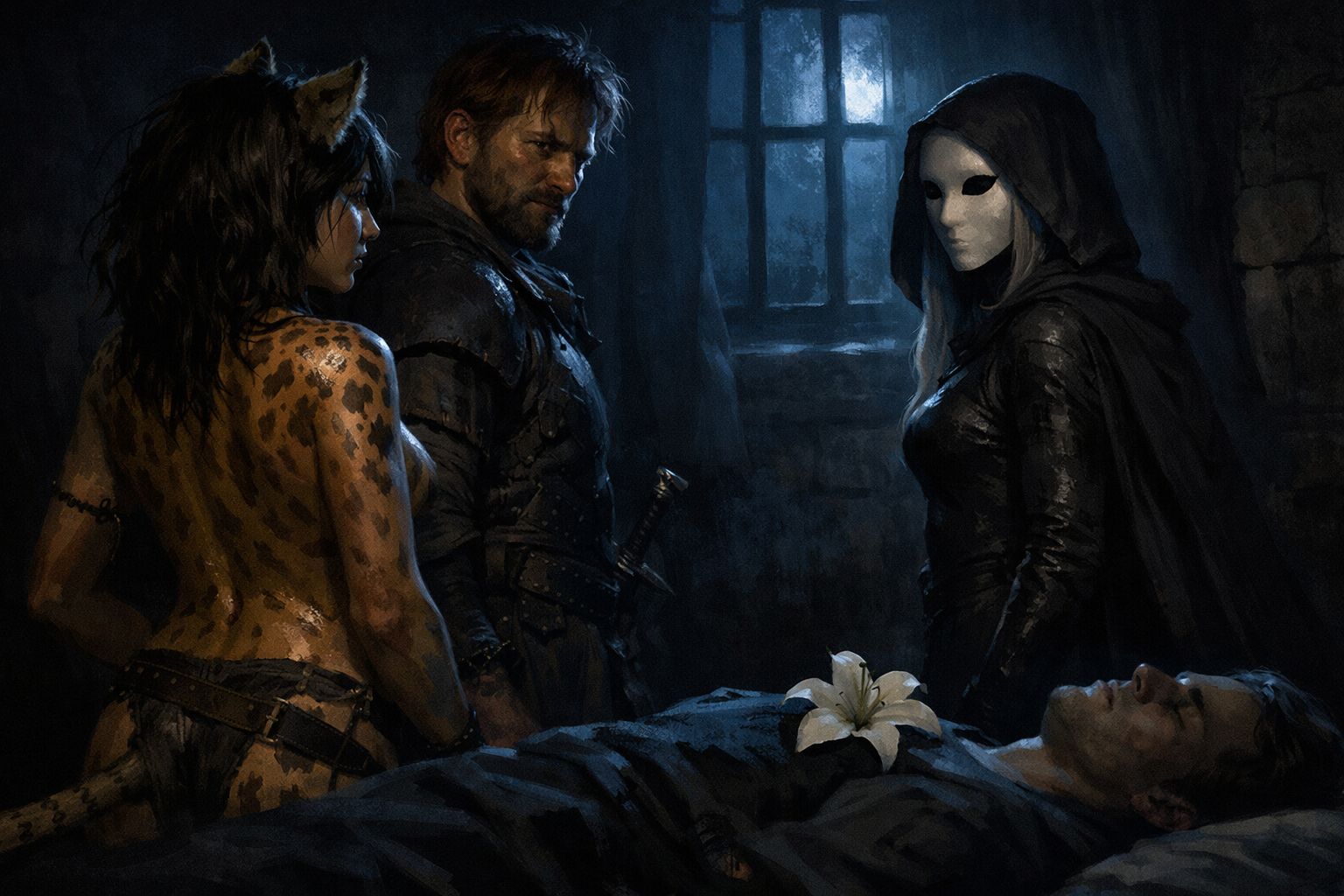
| A woman stood beside the governor’s body, adjusting something white on his chest with precise care. |
| She straightened as they entered, unhurried, and turned to face them. |
| Her clothing was dark, cut simply, and her movements were measured to the point of grace. Her face was covered by a smooth white mask, calm, featureless in a way that made it unreadable. The white lily rested perfectly where she had placed it. |
| “Good evening,” she said politely. |
| Skarnulf did not move. Ileena’s eyes flicked to the windows, the doors, the corners of the room, already mapping exits. |
| “I believe we share an interest,” the woman continued, her tone professional rather than curious. “Though our contracts differ.” |
| She glanced at the body, then back at them. “Mine is complete.” |
| There was no threat in her voice. No challenge. Just a statement of fact. |
| “You may wish to leave now,” she said. “The palace will not remain empty for long. The aqueduct is still clear. It's the best way out.” |
| Ileena’s jaw tightened. “Who are you.” |
| The woman smiled faintly, as if at a private thought, and with a smooth gesture pointed to the white lily on the body. |
| She stepped back toward the shadow near the window, paused, and inclined her head to Skarnulf with the courtesy one might offer a fellow professional. |
| “I am glad we did not interfere with one another,” she said. “It would have been inconvenient.” |
| Then she was gone. |
| Not vanished. Not dramatic. Simply absent, as if she had never been there at all. |
| For a long moment, Skarnulf and Ileena stood in silence, staring at the empty space where she had been. |
| Finally, Skarnulf exhaled. “What just happened here.” |
| Ileena did not answer. She was still looking at the lily. |
What Has Already Happened
The governor is dead.
Lucius Aurelian Marcellus was assassinated cleanly and professionally before the crew arrived. There was no struggle, no alarm, and no witnesses left behind. The death was fast and precise.
The White Lily entered the palace through the aqueduct. Two guards were incapacitated with drugged blowgun darts and left unconscious. She reached the governor’s chambers without interference, completed her contract, and prepared to leave before anyone realized something was wrong.
The crew did not interrupt her work. They arrived in its wake.
How to Play the White Lily
The White Lily is not hostile.
She is also not helpful in the usual sense.
Play her as calm, courteous, and absolutely professional. She does not threaten. She does not posture. She does not explain herself. She treats the crew as fellow professionals who happened to arrive late.
She respects competence. She dislikes mess, noise, and amateur interference.
She should never rush. Even when leaving, she moves with deliberate ease, as if nothing in this space could truly endanger her.
Do not give her a name. Do not give her a client. Do not let her answer direct questions. Let silence and gesture do the work instead.
What She Wants in This Scene
Nothing.
Her contract is complete. She has no interest in fighting, bargaining, or lingering. The crew is not her concern unless they become an obstacle.
Her recommendation to leave via the aqueduct is professional courtesy, not alliance.
What the Scene Should Feel Like
This encounter should be unsettling, not explosive.
The crew should feel outpaced rather than defeated. They did not fail. They were simply not first.
Aim for confusion, unease, and the sense that they have brushed against something far larger than themselves.
There should be no satisfaction here, only the realization that someone else is shaping events with a level of precision they do not control.
This is not an investigation. She left exactly one trace, her white lily, nothing more, nothing less.
What Not to Do
- Do not turn this into a fight.
- Do not explain her motivations.
- Do not reveal her employer.
- Do not let the crew feel clever for surviving the encounter. Survival here is incidental.
Where This Leaves the Story
This scene confirms that the assassination Sandros requested has already been carried out by another hand.
It reinforces the theme that multiple powers are actively undermining the Empire.
It should leave the crew asking the right question, not “Who is she,” but “Who else is playing this game.”
Once she is gone, move quickly. The palace will not remain empty for long.
Aftermath: A City in Panic
Purpose of This Phase
This phase turns fear into behavior.
The assassination does not cause riots or open rebellion. Instead, it breaks certainty. Corvessia becomes a city that cannot decide whether to freeze or thrash, and so does both at once. Movement slows. Decisions multiply. Authority speaks louder and understands less.
The goal is to make the city feel dangerous without becoming chaotic, and hostile without becoming openly violent yet.
What Has Just Happened
Governor Lucius Aurelian Marcellus is dead.
The news does not spread cleanly. It leaks. Whispers move faster than orders. Different versions circulate at the same time. Some say the governor was murdered in his chambers. Others insist he collapsed. Some claim suicide. A few claim he was betrayed by his own staff. No one agrees on details, only on one fact.
Something has gone terribly wrong.
The legion responds immediately, but without coordination. Orders conflict. Commanders wait for confirmation that never arrives. Responsibility shifts upward and sideways at the same time.
The Shape of Panic
Corvessia does not explode. It constricts.
Markets remain open, but trade slows to a crawl. Merchants refuse unfamiliar coin. Dockworkers argue over paperwork that was waved through yesterday. Entire streets empty without explanation, while others choke with people trying to leave all at once.
Some citizens barricade themselves indoors. Others roam the streets looking for certainty in numbers. Taverns fill early and empty abruptly when rumors change. Bells ring for reasons no one understands.
Panic paralyzes decision making while accelerating reaction. People act quickly and think slowly.
The Legion Under Pressure
The legion tightens its grip, but the grip is clumsy.
Patrols double, then triple, then overlap. Checkpoints appear and vanish within hours. Guards demand answers they cannot evaluate. Officers issue orders that contradict one another, each certain they are acting on the most recent directive.
Foreigners are stopped constantly. Papers are examined too closely, then dismissed without comment. Detentions increase, not because of guilt, but because releasing someone feels riskier than holding them.
Violence is still restrained, but the threshold is dropping fast.
Civilian Reaction
Fear spreads faster than orders.
Self appointed street watches appear overnight. Some are earnest, others opportunistic. Names circulate. Lists are made. A tavern keeper begins refusing service to anyone she does not recognize. A dockworker called Talen Rook organizes night patrols with clubs and lanterns.
Most of these people believe they are protecting their city.
Some simply enjoy having permission.
How to Apply Pressure to the Crew
Do not trap the crew. Surround them.
Movement takes longer. Conversations end early. Familiar faces are suddenly unavailable. Streets that were open hours ago are closed without warning.
Every delay feels intentional, even when it is not. Every glance feels like evaluation. Every choice feels observed.
Let the players feel that the city is reacting to everything, even when it does not understand what it is reacting to.
What Not to Do Yet
- Do not collapse Corvessia into riot.
- Do not turn guards into caricatures.
- Do not give the panic a single voice or leader.
This is confusion, not rebellion. Fear has not found direction yet.
| Story |
|---|
| Sandros Pellaios chose a place where panic could not quite reach. |
| Scarnax and Ayesha found him standing beneath the covered colonnade of a shuttered archive, rain beginning to patter softly against stone. The street beyond was loud with confusion. Shouting orders. Running feet. Bells ringing without rhythm. Here, the noise dulled into something distant and almost irrelevant. |
| Sandros watched the street with mild interest, hands folded behind his back. |
| “You were efficient,” he said without turning. “The warehouse burned exactly when it needed to. The city is unraveling according to plan.” |
| Scarnax did not return the compliment. “The governor was already dead.” |
| Sandros turned then. For the first time since they had met him, his expression did not settle immediately. His eyes narrowed just a fraction. |
| “Already,” he repeated. |
| Ayesha spoke calmly. “A woman in black. White mask. Left a lily. She recommended the aqueduct.” |
| Sandros was silent for a breath too long. |
| “That,” he said carefully, “is unexpected.” |
| The word hung between them, heavy because it was rare. |
| He looked away, gaze distant now, calculating rather than observing. “Then there is another actor. An actor with resources.” A pause. “Interesting.” |
| Whatever thought followed never reached his face. The calm returned, perfectly arranged. |
| “Regardless,” Sandros continued, “the outcome stands.” |
| Scarnax frowned. “We did not do it.” |
| Sandros allowed himself a thin smile. “No. But it was done.” |
| He stepped closer, voice lowering. “Let's proceed.” |
| From within his coat he produced a small packet of folded notes and placed them in Scarnax’s hand. “Names. Timings. Habits. Enough to take your man without noise.” His eyes shifted briefly to Ayesha. “And two ports of call tied to the Waverider. Confirmed.” |
| Ayesha did not reach for the papers. “And the cost.” |
| Sandros’s smile widened slightly. “Deferred.” |
| “We did not fulfill our side of the agreement,” Scarnax said. |
| Sandros inclined his head. “Which means you now owe me for information I did not have to give you.” |
| He stepped back, already disengaging. “I find debts more flexible than payment.” |
| As he turned to leave, something subtle shifted. Figures who had leaned too long against walls and lingered near doorways moved as well, drifting away in practiced silence. Only now did they realize how closely Sandros had been protected, and by whom. |
| He disappeared into the city’s noise without urgency. |
| Scarnax watched him go. “Did we just sign a blank contract with a demon?” |
| Ayesha shrugged lightly. “Worse.” |
| She folded her hands, eyes following the chaos beyond the colonnade. “It is politics.” |
| Her voice was steady, but her expression was not. |
Purpose of This Meeting
This meeting confirms consequences.
It establishes that Sandros remains in control even when surprised, that the crew is now indebted, and that the city’s panic is being actively exploited by multiple forces beyond imperial authority.
The scene should feel calm, transactional, and quietly ominous.
How to Play Sandros Here
Sandros is composed, efficient, and already moving on.
He does not dwell on what went wrong. He adapts. His brief surprise at the White Lily should be the only visible crack, and it should close quickly. Play it like a brief flicker of curiosity, a quick mental reassessment of the playfield.
He speaks in outcomes, not explanations. He never justifies his decisions. He treats the meeting as a step already accounted for.
The Information Exchange
Sandros honors the arrangement.
He provides everything needed for a quiet extraction of Ivar Strongbow, as well as two confirmed ports of call tied to the Waverider.
He does not frame this as generosity. It is a transaction deferred, not forgiven.
Make it clear through tone that the debt now outweighs the original agreement.
If Questioned About the White Lily
Sandros knows the name “White Lily.”
He does not know who she is beyond her alias, who employs her, or where she comes from. He does know her in a professional role, and has used her services on occasion, but he will not talk about that.
Make it clear from his reactions that her presence means that another big player has entered the game.
If pressed, he offers only one answer.
“Information is a valuable commodity.”
This reinforces that even Sandros has blind spots, but that he is quick to adapt when he notices them.
What This Scene Should Leave Behind
The crew should leave with tools, options, and a growing sense of obligation.
They gained leverage at the cost of freedom.
They should understand that Sandros is not an ally, not an enemy, but a force that will remember this moment and collect later.
Keep it brief. Let the weight linger.
Closing This Phase
End this section once the players realize that waiting is no longer safe.
Corvessia is not calming down. It is teaching itself new habits, and those habits are hostile.
From here on, every hour matters, and every mistake compounds.
Extracting Eamon mac Braigh
Purpose of This Scene
This scene exists to demonstrate Sandros’s competence and to shift momentum.
After tension, infiltration, and moral weight, this moment should feel almost disturbingly simple. The difficulty is not mechanical. It is ethical and thematic. Power here comes from knowledge, not daring.
The ease of the extraction should underline that the crew is now operating inside someone else’s design.
What Sandros Provided
Sandros’s information is precise and correct.
The key is a single guard assigned to the eastern barracks holding cells. His name is Aelius Corvin. He is not loyal, brave, or ideological. He is terrified.
Years ago, Corvin murdered his father and older brother. He staged the killings, as well as the killings of several farm slaves, to resemble a Caerduin ambush at their farm, then claimed the inheritance. He spent it quickly on wine, women, and gambling on arena fights, and has lived in fear of exposure ever since.
Patricide and fratricide are among the most unforgivable crimes in the Empire. Discovery would mean a punishment so severe that Corvin cannot even speak of it aloud. The killings of the slaves, however, would be seen as a minor crime, a destruction of property.
Sandros knows. That is enough.
How the Guard Breaks
Confronting Corvin with this information should end resistance immediately.
He does not bluster. He does not threaten. He does not bargain. He understands the leverage instantly and agrees to cooperate before demands are even stated.
Play him as shaking, eager, and desperate to please. He is not trying to betray the Empire. He is trying to survive it, and he is a coward at his core.
How the Extraction Works
Corvin agrees to the following without negotiation.
He will get wine provided by the crew, laced with a sleeping draught. Yasmira or Junia can easily prepare this. He will then distribute the wine to his fellow guards during the late watch.
Once the guards are unconscious, he will stage a false breakout. Locks opened. Chains removed. A story prepared.
He instructs the crew to wait at a service entrance on the eastern side of the barracks compound, one used for waste removal and supply deliveries. He will deliver Ivar Strongbow directly to them. He will then go back and drink the wine himself, to cover his tracks.
He guarantees that no alarm will be raised until dawn. Not out of loyalty, but out of terror. If the escape is noticed too soon, Corvin dies screaming.
Eamon’s Condition
Eamon is alive.
He is bruised, starved, and exhausted. He has been questioned hard, but not yet broken. He can walk with assistance. He can speak, but only in fragments.
His condition should be immediately visible. Attention and recognition is the real risk.
How This Scene Should Feel
This should not feel like a victory.
It should feel unsettling.
The extraction works because the Empire’s laws are cruel, because fear is effective, and because someone worse than the crew knew exactly where to press.
Let it be quiet. Efficient. Almost anticlimactic.
That is the point.
Where This Leads
Once Eamon is in their custody, the real danger begins.
Getting him out of Corvessia will be far harder than taking him from a cell.
End the scene as the crew realizes just how easily the system bent, and how much that says about the world they are in.
Escape Through a Hostile City
| Story |
|---|
| Night settled over Corvessia without ceremony, not as darkness but as loss of structure. |
| Scarnax guided Eamon forward through streets that still existed on maps but no longer functioned as streets. Lamps burned in clusters where officials had ordered them lit, while entire blocks lay dark because no one had been assigned responsibility. Smoke drifted low and steady, not from one fire but from many small ones, each too minor to merit attention on its own. Together, they choked the air. |
| Skarnulf walked ahead, not forcing passage, simply occupying space with confidence. That still worked, for now. Junia stayed close to Eamon, adjusting his cloak whenever his injuries drew the wrong kind of glance. Shaedra watched the city itself, eyes tracking patterns rather than people. |
| A legion patrol passed them, very drunk, out of step, moving forwards, but not toward anything that made sense. Some of them carried shields, some had none. Officers barked orders that contradicted the ones shouted moments earlier by someone else. A patrol halted in the middle of an intersection, argued briefly, then split apart and marched off in three directions. |
| The city was still obeying commands. It just no longer knew which ones mattered. |
| A group of vigilantes were beating a slave, calling him a foreign spy. He was probably already dead. |
| At a checkpoint, civilians queued in neat lines, clutching papers that no longer corresponded to anything. Guards waved some through without looking, detained others at random, released them again moments later when a different officer arrived with new instructions. No one protested. People were too busy trying to comply. |
| “This is worse,” Junia murmured. “They still believe it can be fixed.” |
| Shaedra nodded. “So they keep following it.” |
| They passed a barricade built according to regulation, carts aligned, ropes tied, a watch rota chalked on a board. No one stood guard. The men assigned had been pulled elsewhere. The barricade remained because no one had been ordered to remove it. |
| A granary burned under legion supervision. Soldiers kept people back, not to save the building but to maintain order while it burned. Somewhere nearby, another warehouse smoldered unattended because it was not on the list. |
| In the distance, a woman screamed, and no one cared. After a while, the screaming stopped. |
| Eamon faltered, and for a moment the system noticed. A guard looked at them, opened his mouth to speak, then closed it as an officer shouted his name from across the street. The moment passed, not because they were unnoticed, but because the system had higher priorities it could not define. |
| A loud noise, and a gang of drunk men and women rolling barrels of wine out of a tavern. A bloody body lay just inside the broken door. |
| A stream of people fleeing the town, while legion soldiers tried to stop them at the bridge. |
| Four men tearing at the clothes of a woman, while a patrol rushes by. Neither even slows down. |
| By the time they slipped toward the docks, Corvessia was not screaming. |
| It was grinding. |
| The machine was still running. It had simply lost its alignment, and every part was chewing against the next. |
| Scarnax did not look back. |
| The city was not watching them. |
| It was trying, desperately, to continue functioning while falling apart. |
Purpose of This Scene
This escape is not a chase.
It exists to demonstrate scale. The city is failing faster than any group can meaningfully intervene. The crew is moving through a system that is still operating, still issuing orders, still enforcing rules, but no longer producing coherent outcomes.
The goal is not tension through pursuit, but tension through overload. They run not from people, they run from madness.
How Civilization Cracks Here
Corvessia is not collapsing because people are panicking.
It is collapsing because procedures no longer align.
Orders contradict. Authority overlaps. Responsibility dissolves. The machinery of control continues to function, but its parts no longer mesh. This creates spaces where cruelty, opportunism, and indifference flourish without direction.
Violence happens not because it is ordered, but because nothing stops it.
Looting happens not because of ideology, but because restraint feels pointless.
Most people are not choosing evil. They are choosing expedience.
How to Run the Scene
Do not present problems to solve.
Present systems misfiring.
Show checkpoints enforcing meaningless rules. Barricades guarding nothing. Fires supervised instead of extinguished. Patrols moving without purpose.
Let individual atrocities pass without spotlight or resolution. The point is not what happens in each moment, but that it happens everywhere.
Routes are cut off by gangs, patrols, fire or violence, and alternate routes must be found. Use this to add confusion, to engulf the crew in the madness. This is not a navigation puzzle, it's a way to further keep them off balance.
The disorder and violence are not encounters. They are environmental. They establish the scale, tone and chaos. Make the crew feel like they are a tossed life boat on a raging sea of madness.
The Crew’s Role
The crew should move through this without stopping.
Do not invite intervention. If players ask whether they can help, the answer should not be refusal, but irrelevance. Their actions simply do not scale.
This reinforces that they are not abandoning people. They are recognizing the size of the failure.
What This Scene Should Leave Behind
The players should understand that Corvessia is no longer a place that can be fixed by courage or competence.
It is a system eating itself.
Once they reach the docks, do not give relief. Give distance. They can still hear screams, still see fire, still smell the smoke.
They escaped the city, not the consequences of what it has become.
Departure and Consequences
The Departure
The Blue Marlin leaves Corvessia without pursuit.
Chaos provides cover better than darkness ever could. Patrols are redeployed inland. Harbor authorities argue over sealed orders that no longer match the situation. Ships are delayed, redirected, or waved through simply to reduce the number of decisions that must be made.
The Blue Marlin slips away as one more unresolved problem among many.
What the Crew Gains
Sandros’s information proves accurate.
The trail of the Waverider continues, with a clear next destination and context for why it matters. This is not a lucky lead. It is part of a larger pattern now visible to the crew.
Eamon mac Braigh survives.
He is alive, scarred, and useful. He can be returned to Caerduin to strengthen resistance and morale. He can remain within Albirica to continue the quiet war from inside imperial territory. He can also provide a Waverider port of call, which may be the same as one of the ones named by Sandros, if you want to reduce the number of open leads.
Whatever choice is made, Eamon is no longer just a rescued man. He is a symbol for Caerduin.
What the World Absorbs
Behind them, Albirica convulses but does not fall.
A new governor will be appointed. New legions will arrive. Committees will assign blame upward and outward. Order will be restored, eventually, and the Empire will retaliate in its own time.
This was not a decisive blow.
It was a disruption.
Immediate Effects
For now, pressure eases.
Caerduin gains time. Supply lines breathe. Hunger is delayed rather than solved. Ardenvale slips from immediate scrutiny as imperial attention turns inward to stabilize Albirica.
This respite is temporary, but it is real, and time matters.
The Larger Truth
This arc should leave one understanding clear.
The war is not contained.
The Empire is not only facing open rebellion. It is being tested by unseen hands. Knives that never draw banners. Whispers that rot confidence. Fear turned inward until systems fracture under their own weight.
Other powers are not watching. They are intervening. They are ready to pounce when power is within reach.
What the Crew Should Carry Forward
The Blue Marlin sails on with more knowledge than certainty.
They have seen that wars are fought long before armies meet, and long after they disperse. They have learned that influence travels faster than ships, and that information can break things brute force cannot.
They are no longer operating on the edges of a conflict.
They are inside it.
| Story |
|---|
| Smoke still marked the horizon, a dark smear where Corvessia refused to let go. |
| Scarnax stood at the rail, hands resting on weathered wood, eyes fixed on the fading line. The city already felt unreal, like something seen through heat haze, but the smell still clung to the wind. Burnt grain. Pitch. Something older and worse. |
| Junia broke the silence first. “It felt like walking through a machine that forgot what it was built to do.” |
| Ayesha nodded slightly. “It did not forget,” she said. “It kept working. That was the problem.” |
| Mbaru snorted softly. “Back home, when things break, they break loud. This one kept pretending.” |
| Galenor leaned against the mast, arms folded, gaze narrowed. “I have seen madness before,” he said. “This was different. No one was mad. Everyone was following something.” |
| “Paper,” Junia said. “Orders. Habits.” |
| “Fear,” Scarnax added. |
| They stood in silence again as the smoke thinned with distance. The Blue Marlin cut clean water now, leaving the city behind like a wound cauterized too late. |
| Ayesha finally spoke. “We went into it. Whatever that was. And we came back out.” |
| Junia glanced down at her hands as if expecting soot. “Do you think it stays on you.” |
| Mbaru looked at the horizon, then away. “If it does,” he said, “we will find out when we stop moving.” |
| Scarnax did not answer. He stayed where he was, watching the smoke fade into nothing, wondering whether it was truly gone, or just waiting for the right distance to follow. |
Act Summary
What This Act Was About
This act was not about victory.
It was about exposure.
The crew entered Albirica during a moment of fracture and learned how imperial power behaves when stretched thin. They did not defeat the Empire. They did not save a city. They moved through a system that was already failing and learned how easily it could be bent by those who understand it.
What the Crew Learned About the World
They learned that imperial control is procedural rather than moral.
Albirica did not descend into chaos because people panicked. It fractured because rules stopped aligning. Orders contradicted each other. Authority overlapped. Responsibility dissolved. When structure failed, cruelty and opportunism filled the gaps.
They saw that civilization can keep functioning long after it stops making sense.
They also learned scale. Individual courage does not propagate upward. You can save a person. You cannot fix a system in freefall.
Contact With Sandros Pellaios
Sandros was not an ally. He was not an antagonist.
He was proof that the conflict is already crowded.
Through Sandros, the crew learned that information is power, timing is leverage, and morality is irrelevant to those who trade in outcomes. He demonstrated competence without theatrics and control without force.
Most importantly, he left them indebted.
The debt is not symbolic. It is open ended. It is remembered. It will be collected when it is most inconvenient.
The crew now understands that accepting help from someone like Sandros never ends with balance. It ends with obligation. For him, everything which has value has a price.
Encounter With the White Lily
The White Lily was not an obstacle. She was a revelation.
Her presence confirmed that Sandros is not unique. Other actors operate at this level. Some deal in information. Some deal in finality. None of them answer to banners.
The crew did not fail by arriving late. They learned that they are not the first, fastest, or most decisive players on the board.
This encounter should leave a lingering unease. There are forces at work that do not need them, do not explain themselves, and do not care if they are understood.
The Cost of Success
Eamon mac Braigh survived.
He matters. As a leader, a symbol, and a lever. But saving him required participation in destabilization. The crew burned food during a famine. They exploited imperial cruelty. They benefited from fear.
The extraction was easy because the world is ugly in predictable ways.
That should leave guilt, not triumph.
They did what they needed to do. They also made things worse for people they will never meet.
The Mood This Arc Should Leave Behind
This act should leave the players uneasy rather than satisfied. As cruel as the Empire may be, did the people of Corvessia really deserve this?
They were effective. They were compromised. They were outpaced.
They moved through madness and came out the other side, but not untouched. The question is not whether they succeeded.
The question is what they are becoming accustomed to.
The Bigger Picture
The central truth revealed here is simple.
This war is not contained.
The Empire is not only threatened by rebels and clans. It is being tested by unseen hands. By brokers and assassins, employed by foreign powers willing to weaken it without ever declaring war.
Albirica was not an exception. It was a demonstration.
The Blue Marlin sails on now with more knowledge and less innocence. They are no longer operating at the edges of history.
They are inside it, and it does not care who they are.